
Autoimmune Inner Ear Diseases Prof. Ehab Taha
MS
Published · 16 slides · 0 views
1 / 1


Description
Autoimmune Inner Ear Diseases Prof. Ehab Taha Yaseen FICMS, FRCS Head of Al-Yarmouk Center for Postgraduate Study Consultant Otolaryngologist Introduction Rare entity characterized by bilateral sensorineural hearing loss that progresses
Related Topics
Share
Embed code
Download this presentation From Below
"Autoimmune Inner Ear Diseases Prof. Ehab Taha" is the property of its rightful owner. Permission is granted to download and print the materials on this website for personal, non-commercial use only, and to display it on your personal computer provided you do not modify the materials and that you retain all copyright notices contained in the materials. By downloading content from our website, you accept the terms of this agreement.
Presentation Transcript
01
Autoimmune Inner
Ear
Diseases Prof. Ehab Taha Yaseen
FICMS, FRCS
Head of Al-Yarmouk Center for Postgraduate Study
Consultant Otolaryngologist<br>
FICMS, FRCS
Head of Al-Yarmouk Center for Postgraduate Study
Consultant Otolaryngologist<br>
02
Introduction Rare entity characterized by bilateral sensorineural hearing loss that progresses over weeks to months and is responsive to steroids.
Approximately 50% of patients with AIED have vestibulopathy.
Studies suggest that there is likely B-cell and T-cell involvement in AIED, but the pathogenesis has not been elucidated.
Treatment of AIED is not urgent because there is a 6- to 12-month period in which a significant recovery of hearing is possible with administration of high-dose corticosteroids.
Initial therapy for AIED is 60 mg of prednisone per day for 4 weeks.
Response to steroids varies, and treatment is tailored to the initial response.<br>
Approximately 50% of patients with AIED have vestibulopathy.
Studies suggest that there is likely B-cell and T-cell involvement in AIED, but the pathogenesis has not been elucidated.
Treatment of AIED is not urgent because there is a 6- to 12-month period in which a significant recovery of hearing is possible with administration of high-dose corticosteroids.
Initial therapy for AIED is 60 mg of prednisone per day for 4 weeks.
Response to steroids varies, and treatment is tailored to the initial response.<br>
03
The classic definition of AIED: is that of rapidly progressive (over weeks to months) bilateral SNHL that responds to the administration of immunosuppressive agents.
Types:
Primary pathology restricted to the ear (primary AIED).
Secondary as in multisystemic, organ-nonspecific autoimmune diseases may involve the inner ear e.g. Cogan's syndrome, Wegener's granulomatosis, SLE, RA, scleroderma, Sjýgren's syndrome, and celiac disease.<br>
Types:
Primary pathology restricted to the ear (primary AIED).
Secondary as in multisystemic, organ-nonspecific autoimmune diseases may involve the inner ear e.g. Cogan's syndrome, Wegener's granulomatosis, SLE, RA, scleroderma, Sjýgren's syndrome, and celiac disease.<br>
04
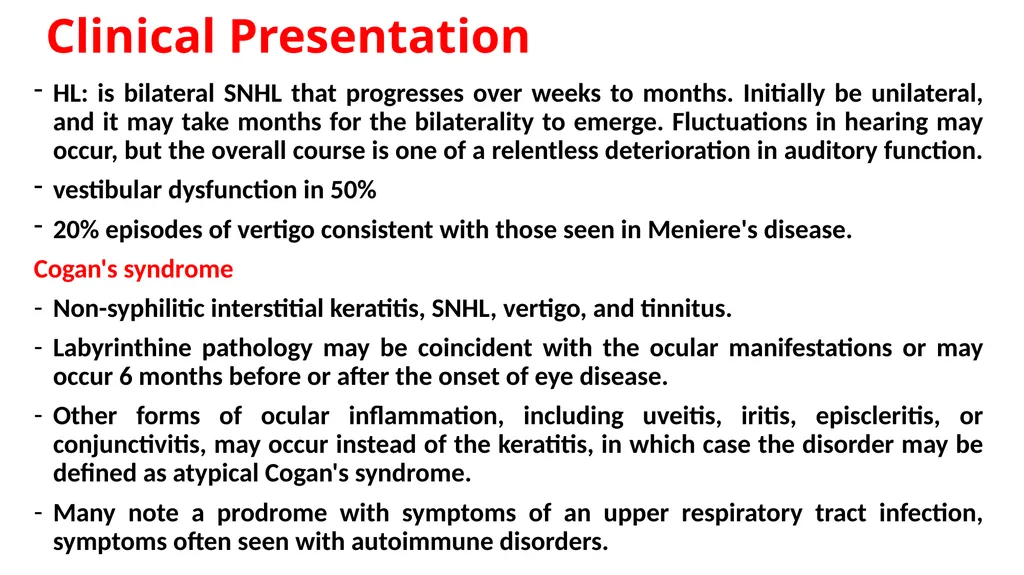
Clinical Presentation HL: is bilateral SNHL that progresses over weeks to months. Initially be unilateral, and it may take months for the bilaterality to emerge. Fluctuations in hearing may occur, but the overall course is one of a relentless deterioration in auditory function.
vestibular dysfunction in 50%
20% episodes of vertigo consistent with those seen in Meniere's disease.
Cogan's syndrome
Non-syphilitic interstitial keratitis, SNHL, vertigo, and tinnitus.
Labyrinthine pathology may be coincident with the ocular manifestations or may occur 6 months before or after the onset of eye disease.
Other forms of ocular inflammation, including uveitis, iritis, episcleritis, or conjunctivitis, may occur instead of the keratitis, in which case the disorder may be defined as atypical Cogan's syndrome.
Many note a prodrome with symptoms of an upper respiratory tract infection, symptoms often seen with autoimmune disorders.<br>
vestibular dysfunction in 50%
20% episodes of vertigo consistent with those seen in Meniere's disease.
Cogan's syndrome
Non-syphilitic interstitial keratitis, SNHL, vertigo, and tinnitus.
Labyrinthine pathology may be coincident with the ocular manifestations or may occur 6 months before or after the onset of eye disease.
Other forms of ocular inflammation, including uveitis, iritis, episcleritis, or conjunctivitis, may occur instead of the keratitis, in which case the disorder may be defined as atypical Cogan's syndrome.
Many note a prodrome with symptoms of an upper respiratory tract infection, symptoms often seen with autoimmune disorders.<br>
05
Vogt-Koyanagi-Harada syndrome:
Symptoms similar to those seen in Cogan’s syndrome.
Depigmentation of the hair and skin around the eyelashes, loss of eyelashes, and onset of aseptic meningitis. This syndrome may represent an autoimmune reaction to melanin-containing cells.
Wegener's granulomatosis
Granuloma formation and vasculitis typically initially affecting the upper and lower respiratory tracts.
It may progress to a more diffuse granulomatous vasculitis with renal involvement.
As noted earlier, the disorder is more commonly associated with middle ear disease resulting in a conductive hearing loss.
Approximately 10% of patients may manifest an SNHL<br>
Symptoms similar to those seen in Cogan’s syndrome.
Depigmentation of the hair and skin around the eyelashes, loss of eyelashes, and onset of aseptic meningitis. This syndrome may represent an autoimmune reaction to melanin-containing cells.
Wegener's granulomatosis
Granuloma formation and vasculitis typically initially affecting the upper and lower respiratory tracts.
It may progress to a more diffuse granulomatous vasculitis with renal involvement.
As noted earlier, the disorder is more commonly associated with middle ear disease resulting in a conductive hearing loss.
Approximately 10% of patients may manifest an SNHL<br>
06
Antiphospholipid antibody syndrome
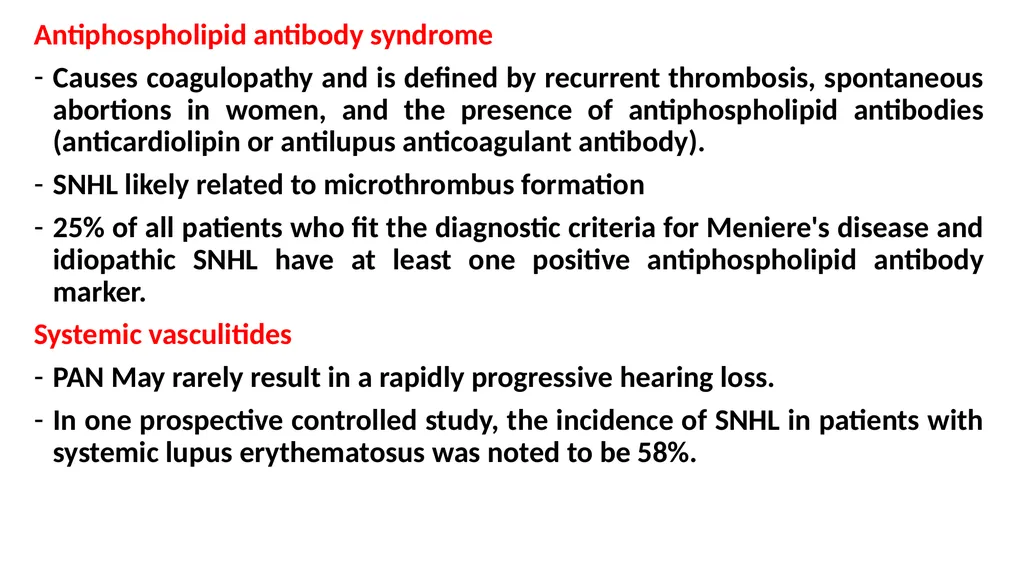
Causes coagulopathy and is defined by recurrent thrombosis, spontaneous abortions in women, and the presence of antiphospholipid antibodies (anticardiolipin or antilupus anticoagulant antibody).
SNHL likely related to microthrombus formation
25% of all patients who fit the diagnostic criteria for Meniere's disease and idiopathic SNHL have at least one positive antiphospholipid antibody marker.
Systemic vasculitides
PAN May rarely result in a rapidly progressive hearing loss.
In one prospective controlled study, the incidence of SNHL in patients with systemic lupus erythematosus was noted to be 58%.<br>
Causes coagulopathy and is defined by recurrent thrombosis, spontaneous abortions in women, and the presence of antiphospholipid antibodies (anticardiolipin or antilupus anticoagulant antibody).
SNHL likely related to microthrombus formation
25% of all patients who fit the diagnostic criteria for Meniere's disease and idiopathic SNHL have at least one positive antiphospholipid antibody marker.
Systemic vasculitides
PAN May rarely result in a rapidly progressive hearing loss.
In one prospective controlled study, the incidence of SNHL in patients with systemic lupus erythematosus was noted to be 58%.<br>
07
Differential Diagnosis Idiopathic SSNHL
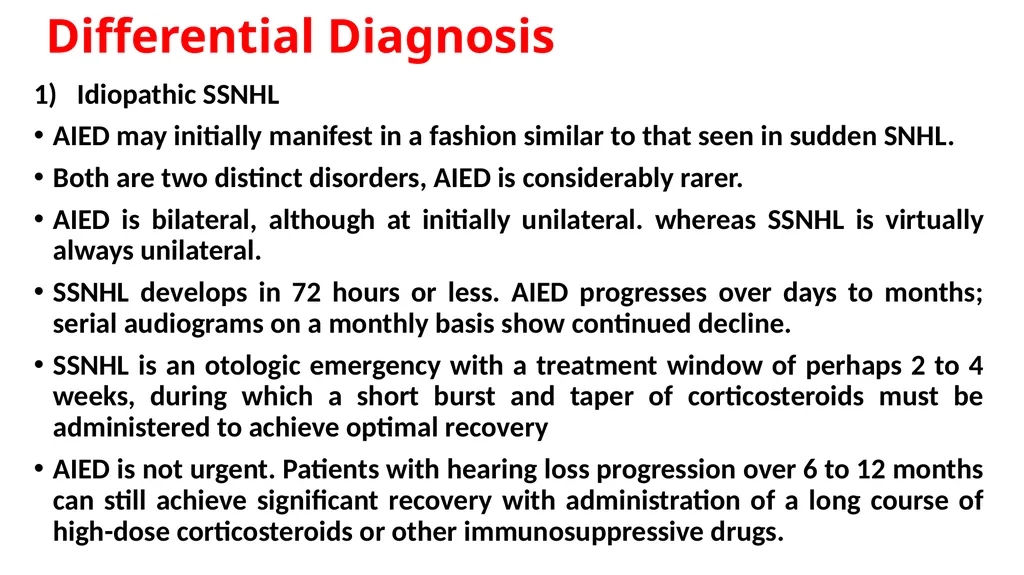
AIED may initially manifest in a fashion similar to that seen in sudden SNHL.
Both are two distinct disorders, AIED is considerably rarer.
AIED is bilateral, although at initially unilateral. whereas SSNHL is virtually always unilateral.
SSNHL develops in 72 hours or less. AIED progresses over days to months; serial audiograms on a monthly basis show continued decline.
SSNHL is an otologic emergency with a treatment window of perhaps 2 to 4 weeks, during which a short burst and taper of corticosteroids must be administered to achieve optimal recovery
AIED is not urgent. Patients with hearing loss progression over 6 to 12 months can still achieve significant recovery with administration of a long course of high-dose corticosteroids or other immunosuppressive drugs.<br>
AIED may initially manifest in a fashion similar to that seen in sudden SNHL.
Both are two distinct disorders, AIED is considerably rarer.
AIED is bilateral, although at initially unilateral. whereas SSNHL is virtually always unilateral.
SSNHL develops in 72 hours or less. AIED progresses over days to months; serial audiograms on a monthly basis show continued decline.
SSNHL is an otologic emergency with a treatment window of perhaps 2 to 4 weeks, during which a short burst and taper of corticosteroids must be administered to achieve optimal recovery
AIED is not urgent. Patients with hearing loss progression over 6 to 12 months can still achieve significant recovery with administration of a long course of high-dose corticosteroids or other immunosuppressive drugs.<br>
08
(2) Meniere's disease.
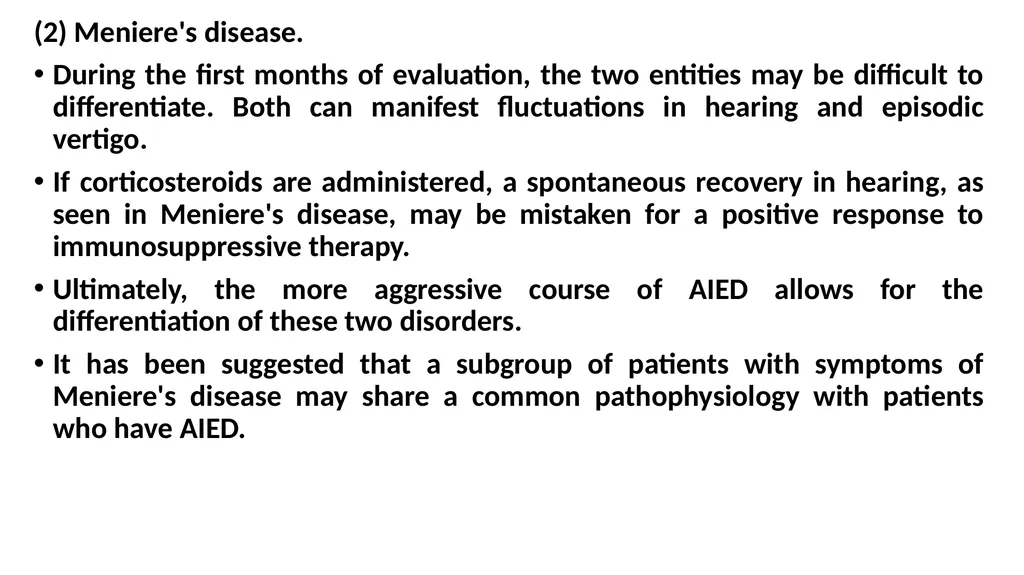
During the first months of evaluation, the two entities may be difficult to differentiate. Both can manifest fluctuations in hearing and episodic vertigo.
If corticosteroids are administered, a spontaneous recovery in hearing, as seen in Meniere's disease, may be mistaken for a positive response to immunosuppressive therapy.
Ultimately, the more aggressive course of AIED allows for the differentiation of these two disorders.
It has been suggested that a subgroup of patients with symptoms of Meniere's disease may share a common pathophysiology with patients who have AIED.<br>
During the first months of evaluation, the two entities may be difficult to differentiate. Both can manifest fluctuations in hearing and episodic vertigo.
If corticosteroids are administered, a spontaneous recovery in hearing, as seen in Meniere's disease, may be mistaken for a positive response to immunosuppressive therapy.
Ultimately, the more aggressive course of AIED allows for the differentiation of these two disorders.
It has been suggested that a subgroup of patients with symptoms of Meniere's disease may share a common pathophysiology with patients who have AIED.<br>
09
(3) Otosyphilis Closely mimic AIED,
(4) Acoustic neuroma may manifest with sudden or progressive unilateral SNHL.
(5) Rarely, meningitis,
(6) MS
(7) Malignancy (e.g., metastatic disease, lymphoma) involving the dura may manifest as rapidly progressive bilateral hearing loss.<br>
(4) Acoustic neuroma may manifest with sudden or progressive unilateral SNHL.
(5) Rarely, meningitis,
(6) MS
(7) Malignancy (e.g., metastatic disease, lymphoma) involving the dura may manifest as rapidly progressive bilateral hearing loss.<br>
10
Diagnosis Appropriate review of systems would include questions pertaining to recurrent or chronic ocular disease, nephritis, arthritis, pneumonitis, sinusitis, and inflammatory bowel disease.
Serologic tests: CBP, differential WBC, ESR, RA, ANA, anti–double-stranded DNA antibodies, anti-SSA/B antibodies, antiphospholipid antibodies, C3 and C4 complement levels, antigliadin antibodies, and Raji cell assay for circulating immune complexes. A fluorescent treponemal antibody absorption test (or a Treponema pallidum hemagglutination test) must be obtained to rule out otosyphilis.
AIDS test may be considered to rule out hearing loss associated with acquired immunodeficiency syndrome.
MRI with contrast must be obtained to rule out the retrocochlear lesions discussed earlier in this chapter.<br>
Serologic tests: CBP, differential WBC, ESR, RA, ANA, anti–double-stranded DNA antibodies, anti-SSA/B antibodies, antiphospholipid antibodies, C3 and C4 complement levels, antigliadin antibodies, and Raji cell assay for circulating immune complexes. A fluorescent treponemal antibody absorption test (or a Treponema pallidum hemagglutination test) must be obtained to rule out otosyphilis.
AIDS test may be considered to rule out hearing loss associated with acquired immunodeficiency syndrome.
MRI with contrast must be obtained to rule out the retrocochlear lesions discussed earlier in this chapter.<br>
11
The diagnosis of primary AIED is more difficult than the secondary type. Because?
Is based on: (Which is more important)
Clinical evaluation, the demonstration of progressive SNHL on audiometric assessment done at monthly intervals
Positive response to the administration of corticosteroids.
The presence of a positive Western blot may support the diagnosis of AIED but can neither confirm nor rule out the diagnosis.
PET no role.<br>
Is based on: (Which is more important)
Clinical evaluation, the demonstration of progressive SNHL on audiometric assessment done at monthly intervals
Positive response to the administration of corticosteroids.
The presence of a positive Western blot may support the diagnosis of AIED but can neither confirm nor rule out the diagnosis.
PET no role.<br>
12
Treatment 1) Corticosteroid therapy
The response is variable.
Adults: prednisone (60 mg daily for 4 weeks).
Pediatric patients receive 1 mg/kg/day of prednisone for 4 weeks.
Follow up:
PTA at the start then at 4 weeks.
If the threshold has improved by 15 dB or more at one frequency or 10 dB at two or more consecutive frequencies, or if the discrimination is significantly improved, patients are considered steroid responders. Non responders are tapered off their medication in 12 days.
Responders continue full-dose therapy until monthly audiograms confirm that they have reached a plateau of recovery. Their medication is slowly tapered over 8 weeks to a maintenance dose of 10 to 20 mg every other day. This maintenance dose is continued for a variable time.
Treatment duration of less than 6 months are at increased risk of relapse compared with patients treated for 6 months or longer.<br>
The response is variable.
Adults: prednisone (60 mg daily for 4 weeks).
Pediatric patients receive 1 mg/kg/day of prednisone for 4 weeks.
Follow up:
PTA at the start then at 4 weeks.
If the threshold has improved by 15 dB or more at one frequency or 10 dB at two or more consecutive frequencies, or if the discrimination is significantly improved, patients are considered steroid responders. Non responders are tapered off their medication in 12 days.
Responders continue full-dose therapy until monthly audiograms confirm that they have reached a plateau of recovery. Their medication is slowly tapered over 8 weeks to a maintenance dose of 10 to 20 mg every other day. This maintenance dose is continued for a variable time.
Treatment duration of less than 6 months are at increased risk of relapse compared with patients treated for 6 months or longer.<br>
13
Treatment 2) Treatment of relapses
In some instances, additional corticosteroid therapy is effective.
Occasionally, HL becomes refractory to corticosteroids.
Some patients, especially children, may occasionally show steroid-dependent hearing loss. In other words, they cannot be weaned below a certain level of steroid dosage without decline in hearing. Such patients often develop unacceptable side effects of long-term steroid administration.
Methotrexate has been used as part of a prednisone-sparing regimen; however, a more recent trial has shown methotrexate to be no better than placebo at maintaining a remission in these patients.<br>
In some instances, additional corticosteroid therapy is effective.
Occasionally, HL becomes refractory to corticosteroids.
Some patients, especially children, may occasionally show steroid-dependent hearing loss. In other words, they cannot be weaned below a certain level of steroid dosage without decline in hearing. Such patients often develop unacceptable side effects of long-term steroid administration.
Methotrexate has been used as part of a prednisone-sparing regimen; however, a more recent trial has shown methotrexate to be no better than placebo at maintaining a remission in these patients.<br>
14
Treatment 2) Other treatment
Etanercept, an inhibitor of tumor necrosis factor-α, has been used to treat AIED., it seems to work well in combination with methotrexate because of its steroid-sparing effect. A more recent study of nine patients showed, however, that the administration of transtympanic tumor necrosis factor-α inhibitor may aid in the tapering of high-dose steroids in AIED.
Cyclophosphamide the high risk of toxicity makes it a better choice as a salvage drug or treatment of last resort. An initial dose of 1 mg/kg/day orally for 4 to 6 weeks may be instituted. When no response is apparent, the dose is doubled to 2 mg/kg/day. Responders are treated for 6 to 12 months. Toxicity includes severe myelosuppression, opportunistic infection, hair loss, cystitis, infertility, and increased risk of malignancies. Weekly monitoring of hematologic status is mandatory.<br>
Etanercept, an inhibitor of tumor necrosis factor-α, has been used to treat AIED., it seems to work well in combination with methotrexate because of its steroid-sparing effect. A more recent study of nine patients showed, however, that the administration of transtympanic tumor necrosis factor-α inhibitor may aid in the tapering of high-dose steroids in AIED.
Cyclophosphamide the high risk of toxicity makes it a better choice as a salvage drug or treatment of last resort. An initial dose of 1 mg/kg/day orally for 4 to 6 weeks may be instituted. When no response is apparent, the dose is doubled to 2 mg/kg/day. Responders are treated for 6 to 12 months. Toxicity includes severe myelosuppression, opportunistic infection, hair loss, cystitis, infertility, and increased risk of malignancies. Weekly monitoring of hematologic status is mandatory.<br>
15
Treatment 2) Other treatment
Intratympanic steroid therapy, intratympanic tumor necrosis factor-α inhibitor, systemic IgG injections, and plasmapheresis are possible treatments with sound theoretic justification. Intratympanic steroid therapy is particularly appealing because it is minimally invasive and enables direct application of the drug to the affected site with low risk of systemic effects. There are, however, no published series in which these treatments have been systematically applied.
In a patient who cannot be maintained on corticosteroids because of complications, the possibility of withdrawing treatment, with the intention of inserting a cochlear implant when hearing becomes significantly impaired, must be considered.<br>
Intratympanic steroid therapy, intratympanic tumor necrosis factor-α inhibitor, systemic IgG injections, and plasmapheresis are possible treatments with sound theoretic justification. Intratympanic steroid therapy is particularly appealing because it is minimally invasive and enables direct application of the drug to the affected site with low risk of systemic effects. There are, however, no published series in which these treatments have been systematically applied.
In a patient who cannot be maintained on corticosteroids because of complications, the possibility of withdrawing treatment, with the intention of inserting a cochlear implant when hearing becomes significantly impaired, must be considered.<br>