Automated Intelligent Healing in Cloud-Scale Data Centers Rui Li1, Zhinan Cheng2, Patrick P. C. Lee2 ,Pinghui Wang3, Yi Qiang1, Lin Lan3, Cheng He1, Jinlong Lu1, Mian Wang1, and Xinquan Ding1 1Alibaba Group 2The Chinese University of Hong
"Automated Intelligent Healing in Cloud-Scale Data" is the property of its rightful owner. Permission is granted to
download and print the materials on this website for personal, non-commercial use only, and to display it
on your personal computer provided you do not modify the materials and that you retain all copyright
notices contained in the materials. By downloading content from our website, you accept the terms of this
agreement.
Presentation Transcript
01
Automated Intelligent Healing in Cloud-Scale Data Centers Rui Li1, Zhinan Cheng2, Patrick P. C. Lee2 ,Pinghui Wang3, Yi Qiang1,
Lin Lan3, Cheng He1, Jinlong Lu1, Mian Wang1, and Xinquan Ding1
1Alibaba Group 2The Chinese University of Hong Kong
3Xi’an Jiaotong University 1<br>
02
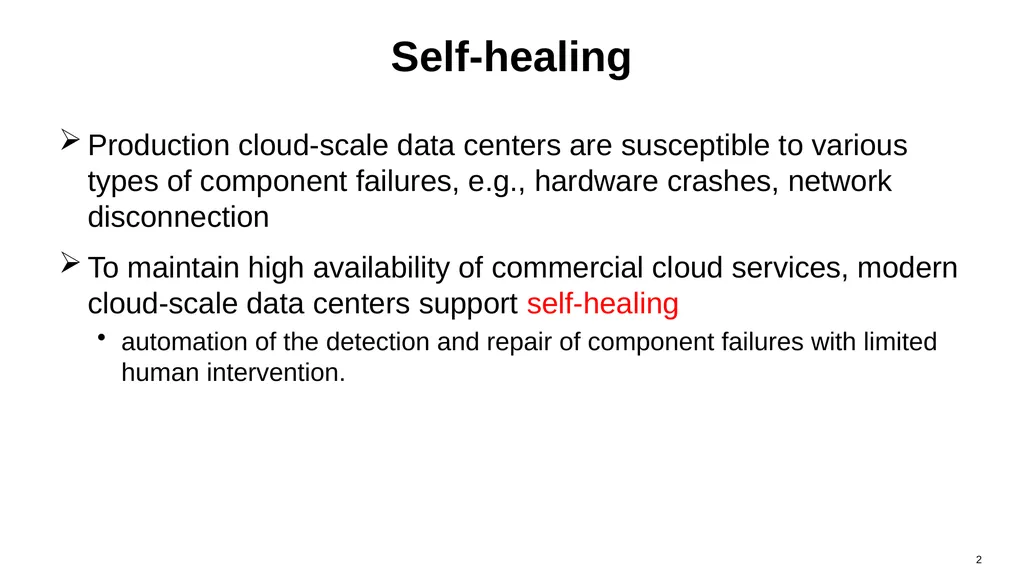
Self-healing Production cloud-scale data centers are susceptible to various types of component failures, e.g., hardware crashes, network disconnection
To maintain high availability of commercial cloud services, modern cloud-scale data centers support self-healing
automation of the detection and repair of component failures with limited human intervention. 2<br>
03
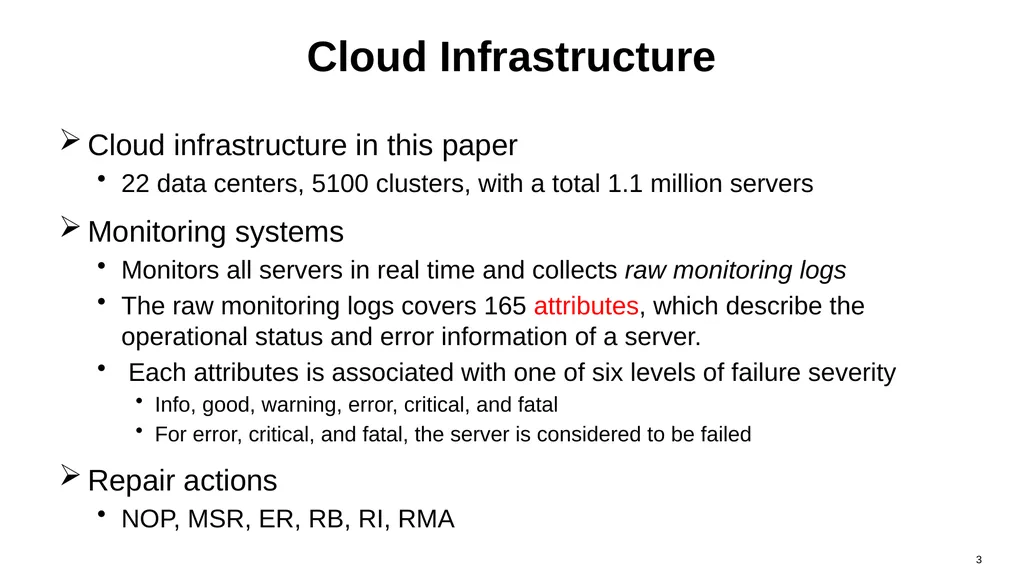
Cloud Infrastructure Cloud infrastructure in this paper
22 data centers, 5100 clusters, with a total 1.1 million servers
Monitoring systems
Monitors all servers in real time and collects raw monitoring logs
The raw monitoring logs covers 165 attributes, which describe the operational status and error information of a server.
Each attributes is associated with one of six levels of failure severity
Info, good, warning, error, critical, and fatal
For error, critical, and fatal, the server is considered to be failed
Repair actions
NOP, MSR, ER, RB, RI, RMA 3<br>
04
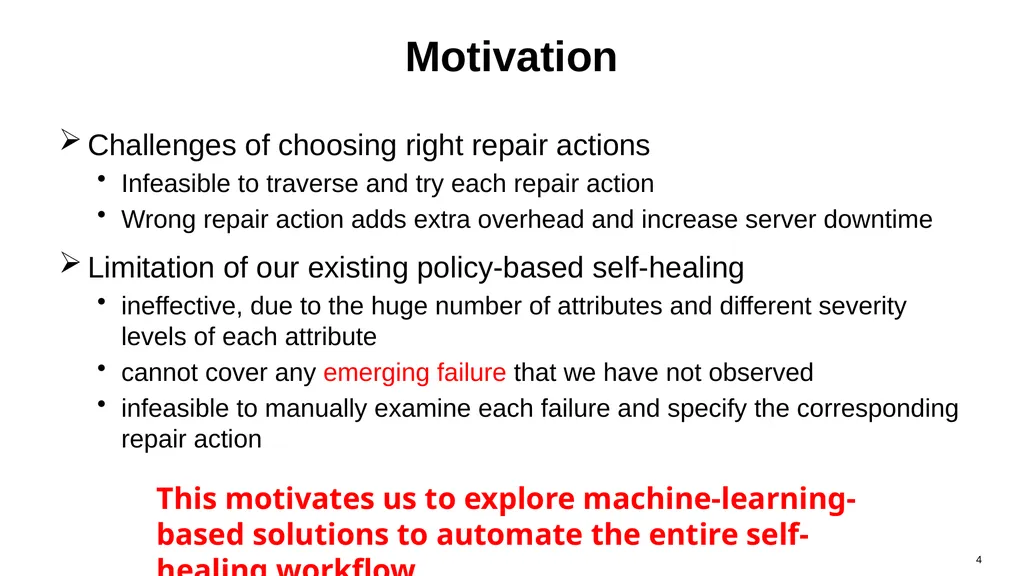
Motivation Challenges of choosing right repair actions
Infeasible to traverse and try each repair action
Wrong repair action adds extra overhead and increase server downtime
Limitation of our existing policy-based self-healing
ineffective, due to the huge number of attributes and different severity levels of each attribute
cannot cover any emerging failure that we have not observed
infeasible to manually examine each failure and specify the corresponding repair action 4 This motivates us to explore machine-learning-based solutions to automate the entire self-healing workflow.<br>
05
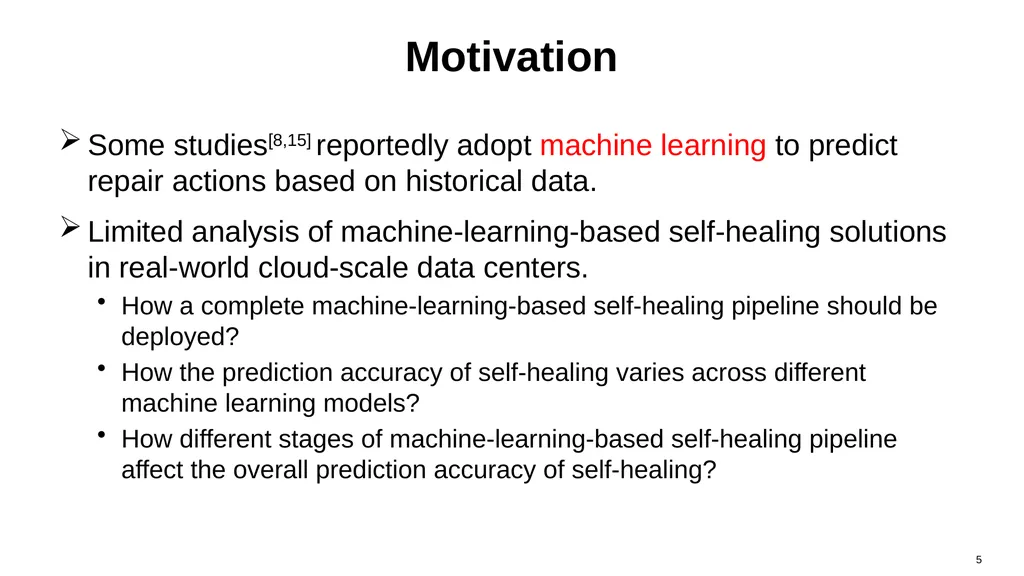
Motivation Some studies[8,15] reportedly adopt machine learning to predict repair actions based on historical data.
Limited analysis of machine-learning-based self-healing solutions in real-world cloud-scale data centers.
How a complete machine-learning-based self-healing pipeline should be deployed?
How the prediction accuracy of self-healing varies across different machine learning models?
How different stages of machine-learning-based self-healing pipeline affect the overall prediction accuracy of self-healing? 5<br>
06
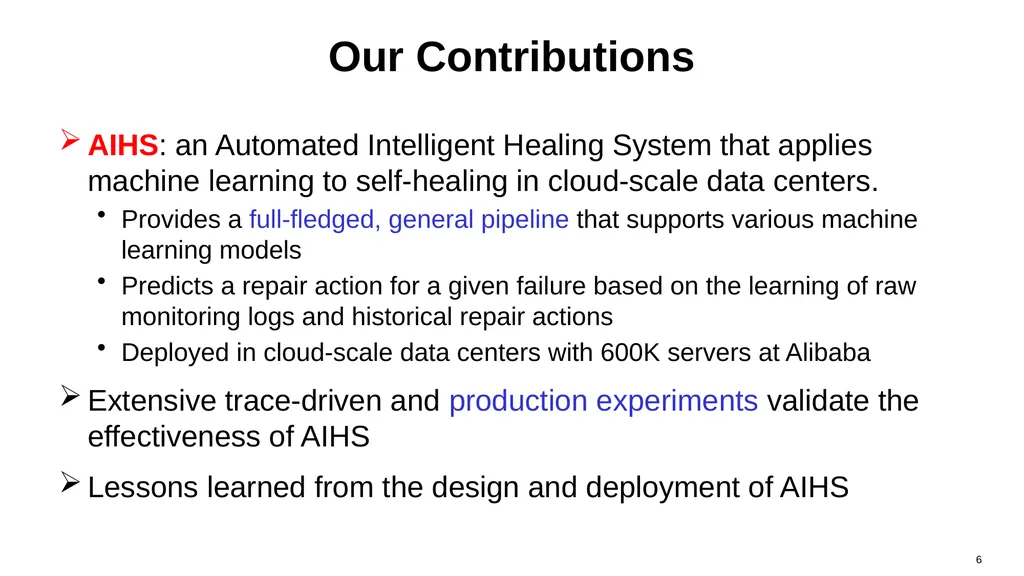
Our Contributions AIHS: an Automated Intelligent Healing System that applies machine learning to self-healing in cloud-scale data centers.
Provides a full-fledged, general pipeline that supports various machine learning models
Predicts a repair action for a given failure based on the learning of raw monitoring logs and historical repair actions
Deployed in cloud-scale data centers with 600K servers at Alibaba
Extensive trace-driven and production experiments validate the effectiveness of AIHS
Lessons learned from the design and deployment of AIHS 6<br>
07
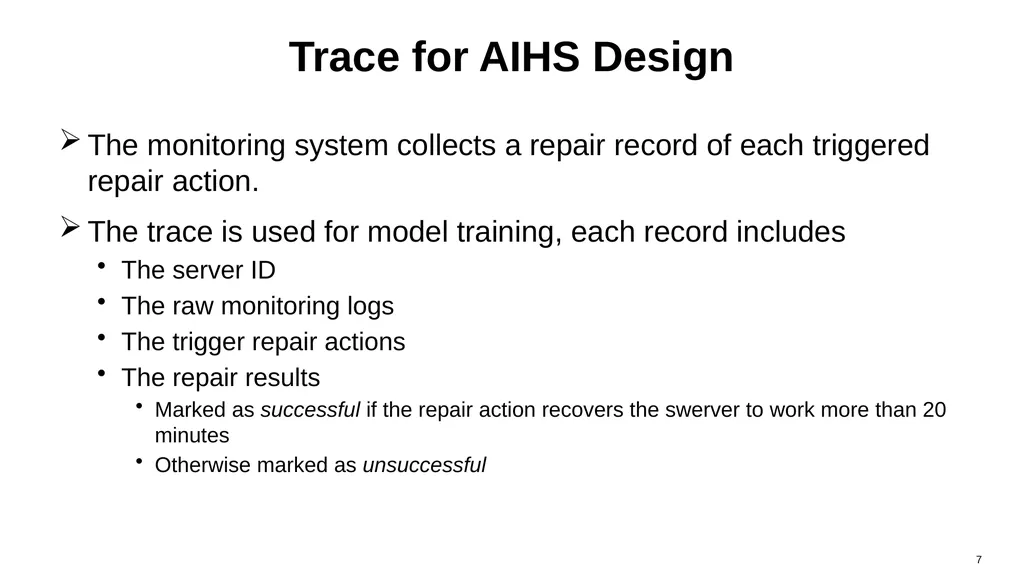
Trace for AIHS Design The monitoring system collects a repair record of each triggered repair action.
The trace is used for model training, each record includes
The server ID
The raw monitoring logs
The trigger repair actions
The repair results
Marked as successful if the repair action recovers the swerver to work more than 20 minutes
Otherwise marked as unsuccessful 7<br>
08
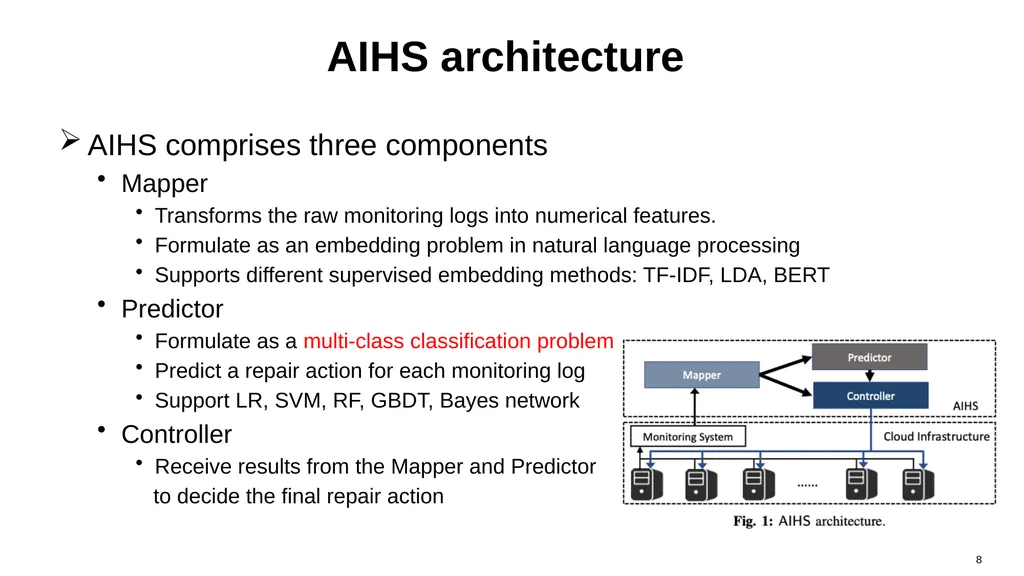
AIHS architecture AIHS comprises three components
Mapper
Transforms the raw monitoring logs into numerical features.
Formulate as an embedding problem in natural language processing
Supports different supervised embedding methods: TF-IDF, LDA, BERT
Predictor
Formulate as a multi-class classification problem
Predict a repair action for each monitoring log
Support LR, SVM, RF, GBDT, Bayes network
Controller
Receive results from the Mapper and Predictor
to decide the final repair action 8<br>
09
Design of Controller Main ideas of Controller
Assess if a repair action is likely to fix the failure
Employs six trained binary classifiers, one for each repair action, that learned the relation between monitoring logs and repair results
Workflows
If the repair action from the Predictor is assessed to be successful, trigger the repair action.
Otherwise, assess the repair action that has the lowest repair cost, if the result is to be successful, tigger repair, otherwise, repeats assessment on other action with higher costs.
Calls the administrator to manually diagnose the failure if no repair action is assessed to be successful 9<br>
10
Production Deployment Model training and update
Offline training
Train the multiclass classifier of the Predictor using successful repair records
Train each binary classifier in Controller using both successful and unsuccessful repair records
Model update
Update the model if the newly collected traces can improve the accuracy
In a monthly basis
Deployment
Deployed AIHS on 2200 clusters.
Divide the clusters into five groups based on business, run one AIHS instance for each group independently 10<br>
11
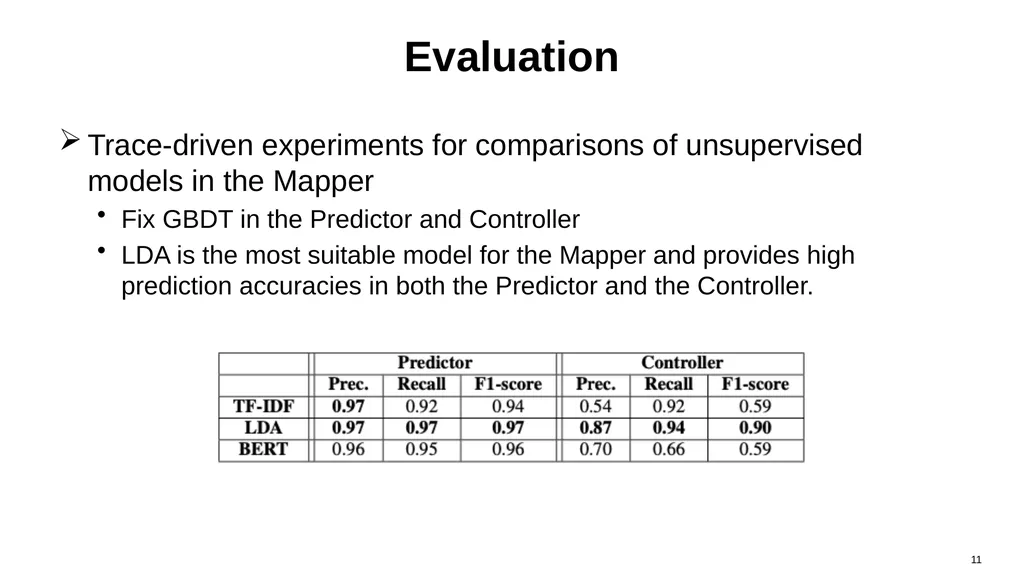
Evaluation Trace-driven experiments for comparisons of unsupervised models in the Mapper
Fix GBDT in the Predictor and Controller
LDA is the most suitable model for the Mapper and provides high prediction accuracies in both the Predictor and the Controller. 11<br>
12
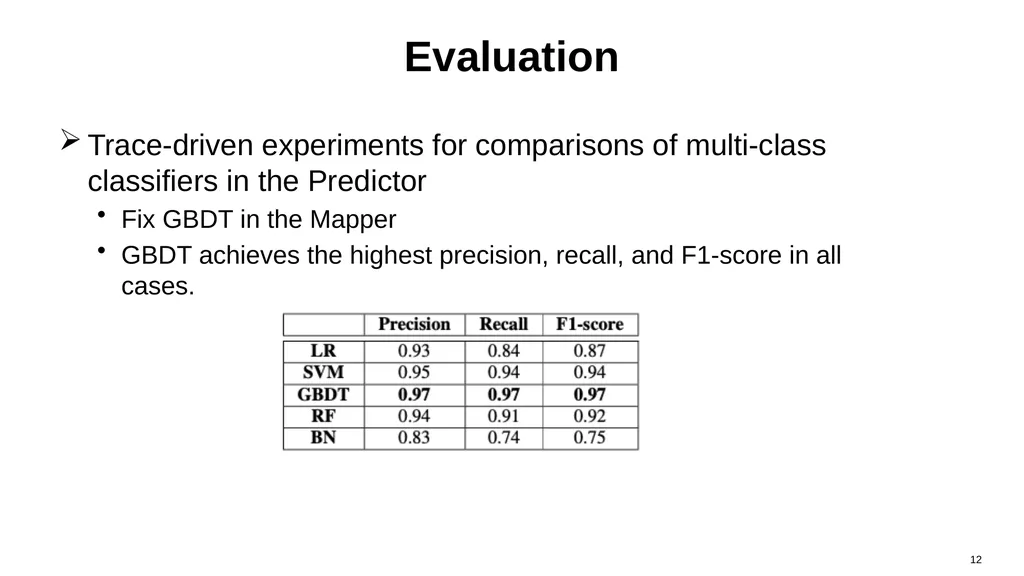
Evaluation Trace-driven experiments for comparisons of multi-class classifiers in the Predictor
Fix GBDT in the Mapper
GBDT achieves the highest precision, recall, and F1-score in all cases. 12<br>
13
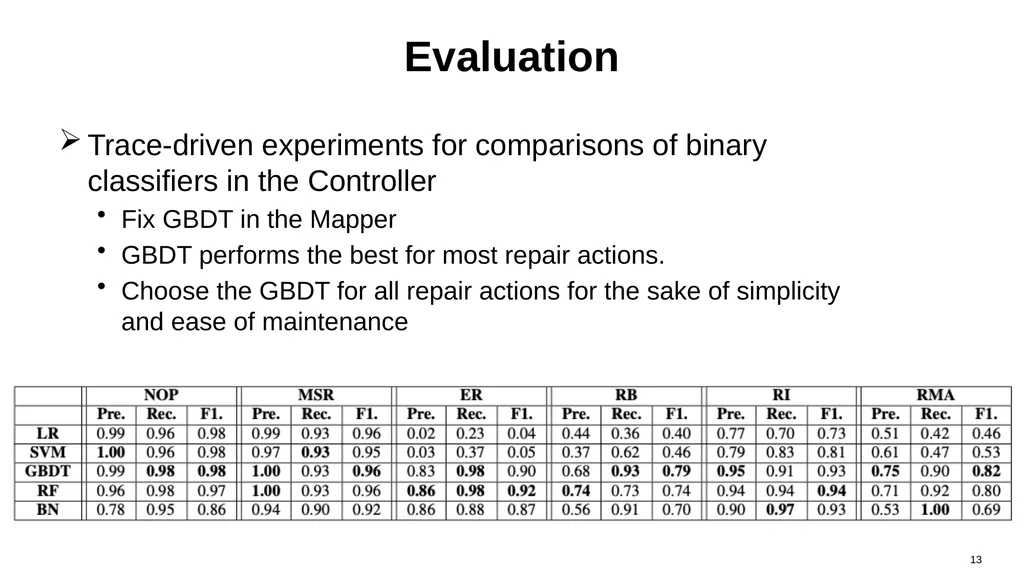
Evaluation Trace-driven experiments for comparisons of binary classifiers in the Controller
Fix GBDT in the Mapper
GBDT performs the best for most repair actions.
Choose the GBDT for all repair actions for the sake of simplicity and ease of maintenance 13<br>
14
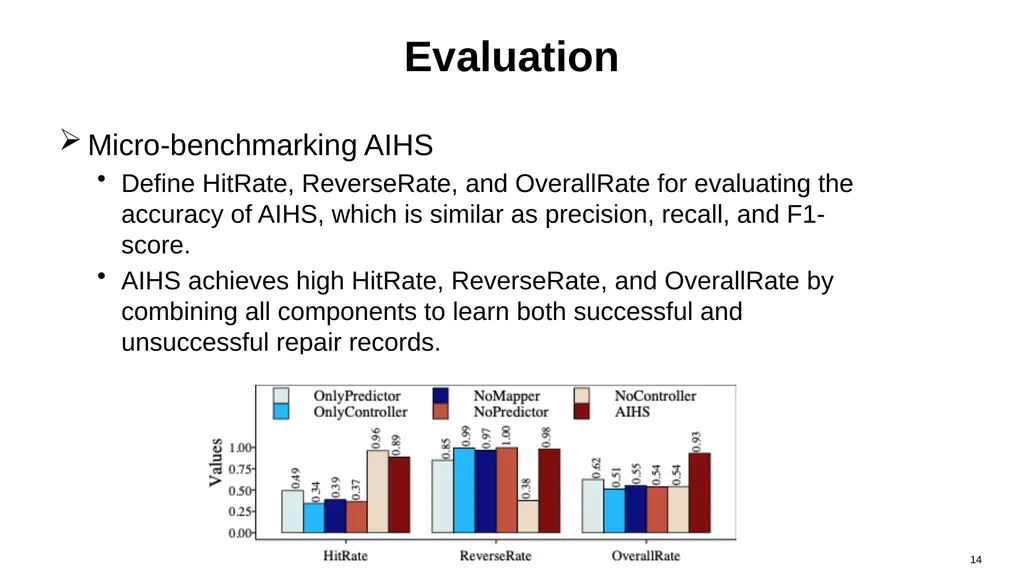
Evaluation Micro-benchmarking AIHS
Define HitRate, ReverseRate, and OverallRate for evaluating the accuracy of AIHS, which is similar as precision, recall, and F1-score.
AIHS achieves high HitRate, ReverseRate, and OverallRate by combining all components to learn both successful and unsuccessful repair records. 14<br>
15
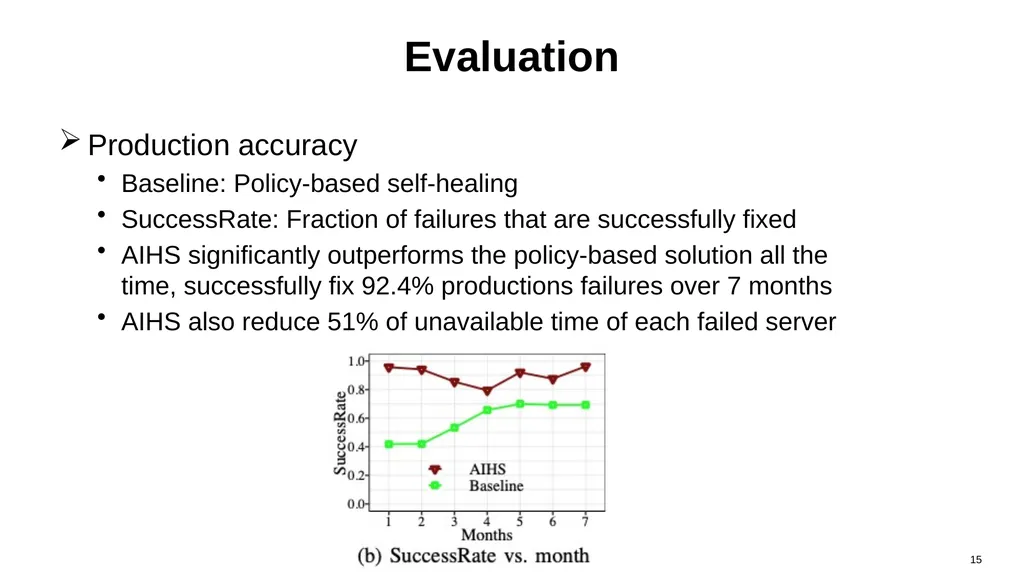
Evaluation Production accuracy
Baseline: Policy-based self-healing
SuccessRate: Fraction of failures that are successfully fixed
AIHS significantly outperforms the policy-based solution all the time, successfully fix 92.4% productions failures over 7 months
AIHS also reduce 51% of unavailable time of each failed server 15<br>
16
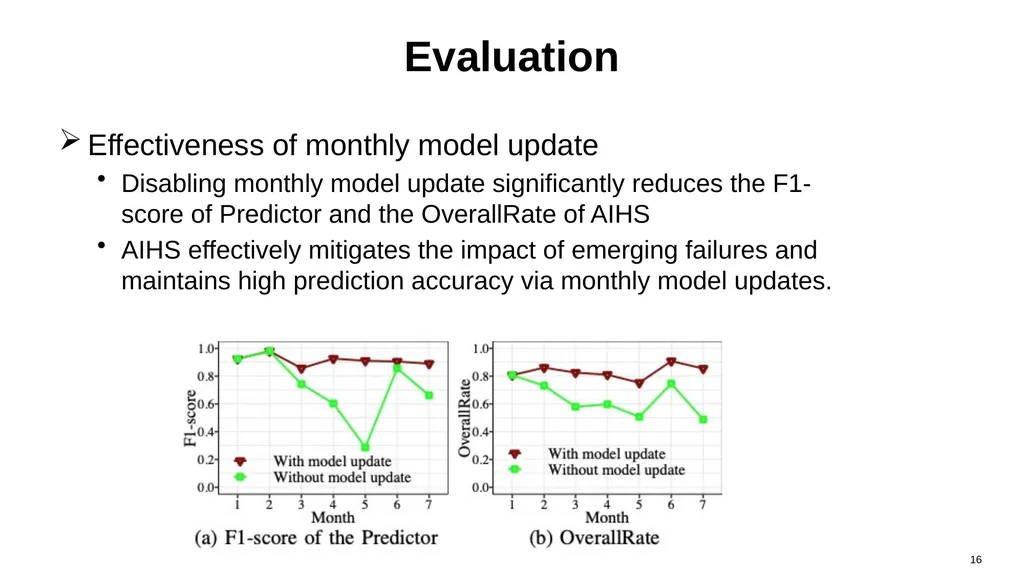
Evaluation Effectiveness of monthly model update
Disabling monthly model update significantly reduces the F1-score of Predictor and the OverallRate of AIHS
AIHS effectively mitigates the impact of emerging failures and maintains high prediction accuracy via monthly model updates. 16<br>
17
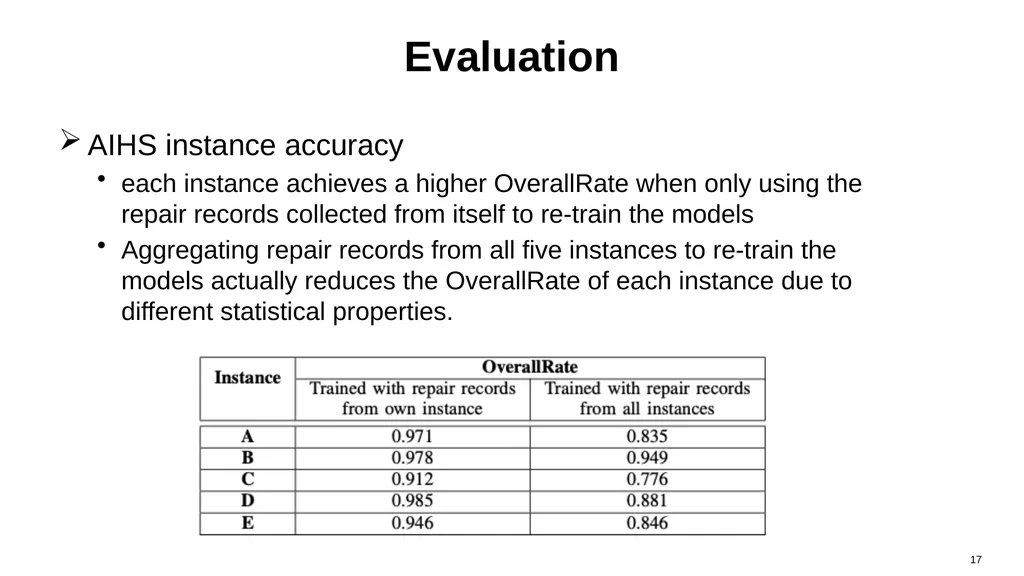
Evaluation AIHS instance accuracy
each instance achieves a higher OverallRate when only using the repair records collected from itself to re-train the models
Aggregating repair records from all five instances to re-train the models actually reduces the OverallRate of each instance due to different statistical properties. 17<br>
18
Lessons Learned Lessons learned from design and deployment of AIHS
Designing AIHS as a general framework allows us to find the appropriate machine learning models for self-healing for different deployment environments in our business.
LDA can better interpret the correlation among different attributes and thus achieve best accuracy in Mapper while GBDT achieves high accuracy in Predictor and Controller as it can solve sample imbalance.
Performing incremental deployment of AIHS on our business and monthly model update for AIHS allows us to observe if AIHS works as expected and make correct decision on AIHS deployment. 18<br>
19
Conclusion AIHS:
A machine-learning-based automated intelligent healing system for cloud-scale data centers.
Support various machine learning for self-healing
Extensive trace-driven experiments and production experiments validate the effectiveness of AIHS.