
AVATAR project Advanced Aerodynamic Tools for
Description: AVATAR project Advanced Aerodynamic Tools for lArge Rotors Gerard Schepers WindEurope Event Amsterdam, the Netherlands November 30h, 2017 2 EU FP7 Project initiated by EERA Energy Research Centre of the Netherlands, ECN (Coordinator) Delft
Related Topics
Download Presentation
"AVATAR project Advanced Aerodynamic Tools for" is the property of its rightful owner. Permission is granted to download and print the materials on this website for personal, non-commercial use only, and to display it on your personal computer provided you do not modify the materials and that you retain all copyright notices contained in the materials. By downloading content from our website, you accept the terms of this agreement.
Presentation Transcript
slide1. AVATAR project
Advanced Aerodynamic Tools for lArge Rotors Gerard Schepers WindEurope Event
Amsterdam, the Netherlands November 30h, 2017<br>
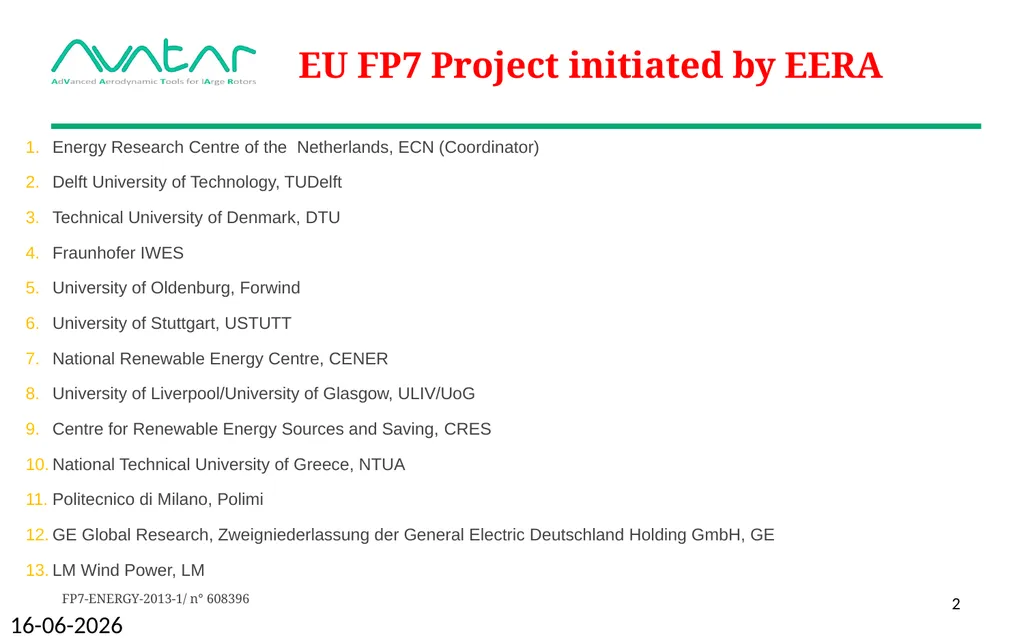
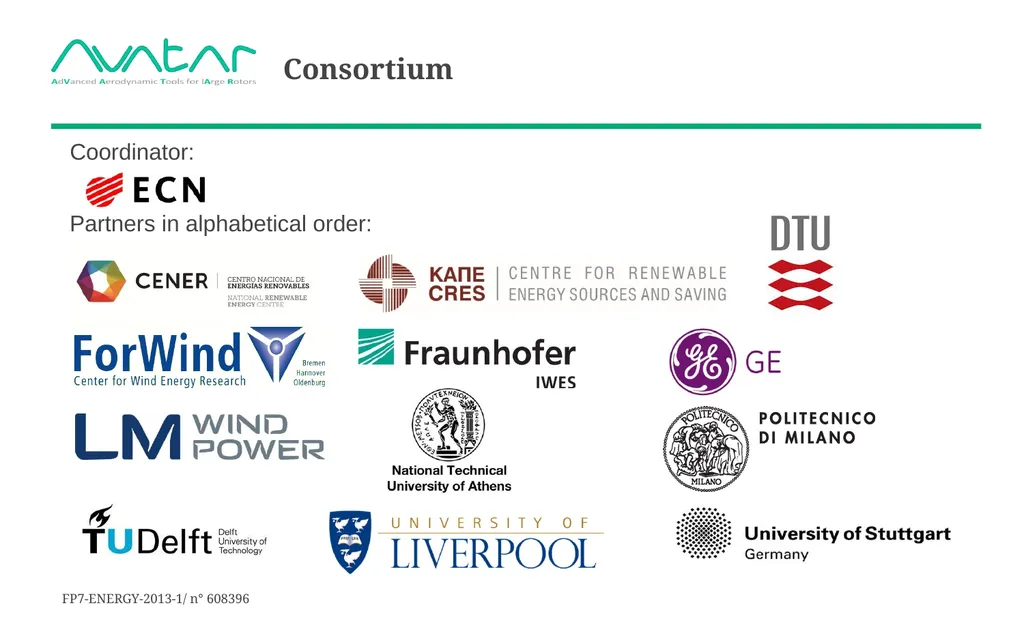
slide2. 2 EU FP7 Project initiated by EERA Energy Research Centre of the Netherlands, ECN (Coordinator)
Delft University of Technology, TUDelft
Technical University of Denmark, DTU
Fraunhofer IWES
University of Oldenburg, Forwind
University of Stuttgart, USTUTT
National Renewable Energy Centre, CENER
University of Liverpool/University of Glasgow, ULIV/UoG
Centre for Renewable Energy Sources and Saving, CRES
National Technical University of Greece, NTUA
Politecnico di Milano, Polimi
GE Global Research, Zweigniederlassung der General Electric Deutschland Holding GmbH, GE
LM Wind Power, LM 27-11-2017<br>
slide3. AVATAR presentations 09.30-09.30 Introduction and main achievements, Gerard Schepers (ECN)
09.30-09.45 Aerodynamic response modelling of complex and turbulent inflow, Niels Sorensen(DTU)<br>
slide4. 4 Period Project period: November 1st 2013- December 31st 2017<br>
slide5. 5 Main motivation for AVATAR: Aerodynamics of large wind turbines (10-20MW) Upscaling turbine size for off-shore applications:
Higher capacity factors and more hours at full (constant) load
The LCOE is relatively insensitive to the size of a turbine
So Upscaling to 10MW+ is an option to reduce the LCOE
However….. 27-11-2017<br>
slide6. 6 Main motivation for AVATAR: Aerodynamics of large wind turbines (10-20MW) We simply didn’t know if aerodynamic models were good enough to design 10MW+ turbines
10MW+ rotors violate assumptions in aerodynamic tools, e.g.:
Reynolds number effects,
Compressibility effects
Thick(er) airfoils
Flow transition and separation,
(More) flexible blades
Flow devices 27-11-2017<br>
slide7. 7 Avatar: Main objective 10MW+ designs fell outside the validated range of state of the art tools.
Objective of AVATAR:
To bring the aerodynamic and fluid-structure models to a next level and calibrate them for all relevant aspects of large (10MW+) wind turbines 27-11-2017<br>
slide8. 8 Avatar: Work procedure Problem: No 10 MW turbines are on the market yet for validation.
Validate submodels against (mainly wind tunnel) experiments
Cross-comparison of model results
In the project we have many models which range from computational efficient ‘engineering’ tools to high fidelity but computationally expensive tools
Engineering tools are needed in industrial design codes 1) and 2)
High fidelity models (and intermediate models) feed information towards engineering models
J.G. Schepers ‘Engineering models in wind energy aerodynamics,’ (2012).
M. Kloosterman, DNV-GL, AVATAR Advisory Board 27-11-2017<br>
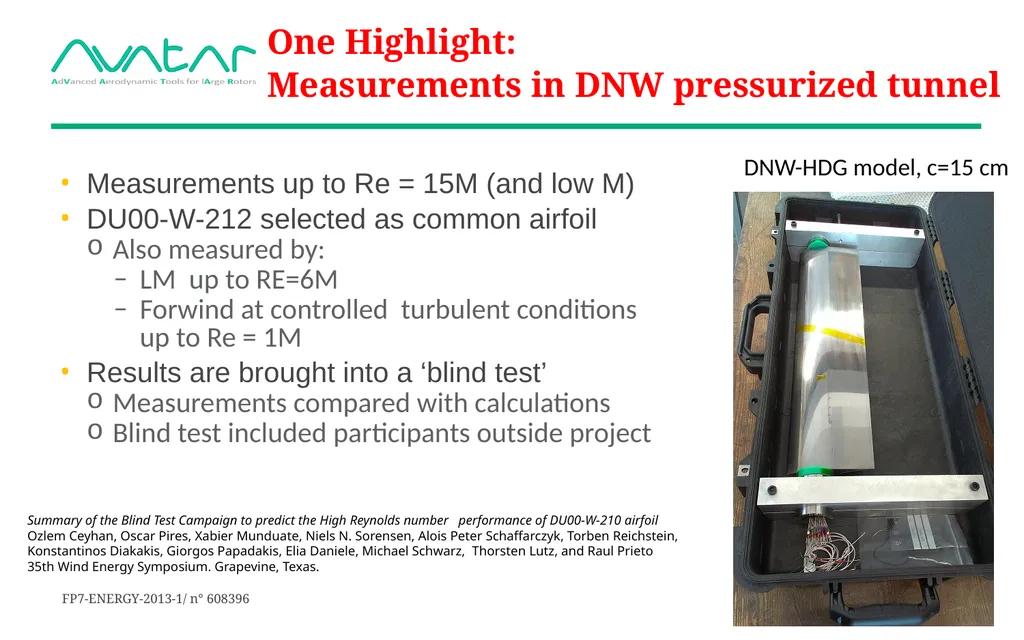
slide9. One Highlight: Measurements in DNW pressurized tunnel Measurements up to Re = 15M (and low M)
DU00-W-212 selected as common airfoil
Also measured by:
LM up to RE=6M
Forwind at controlled turbulent conditions up to Re = 1M
Results are brought into a ‘blind test’
Measurements compared with calculations
Blind test included participants outside project DNW-HDG model, c=15 cm Summary of the Blind Test Campaign to predict the High Reynolds number performance of DU00-W-210 airfoil
Ozlem Ceyhan, Oscar Pires, Xabier Munduate, Niels N. Sorensen, Alois Peter Schaffarczyk, Torben Reichstein, Konstantinos Diakakis, Giorgos Papadakis, Elia Daniele, Michael Schwarz, Thorsten Lutz, and Raul Prieto
35th Wind Energy Symposium. Grapevine, Texas.<br>
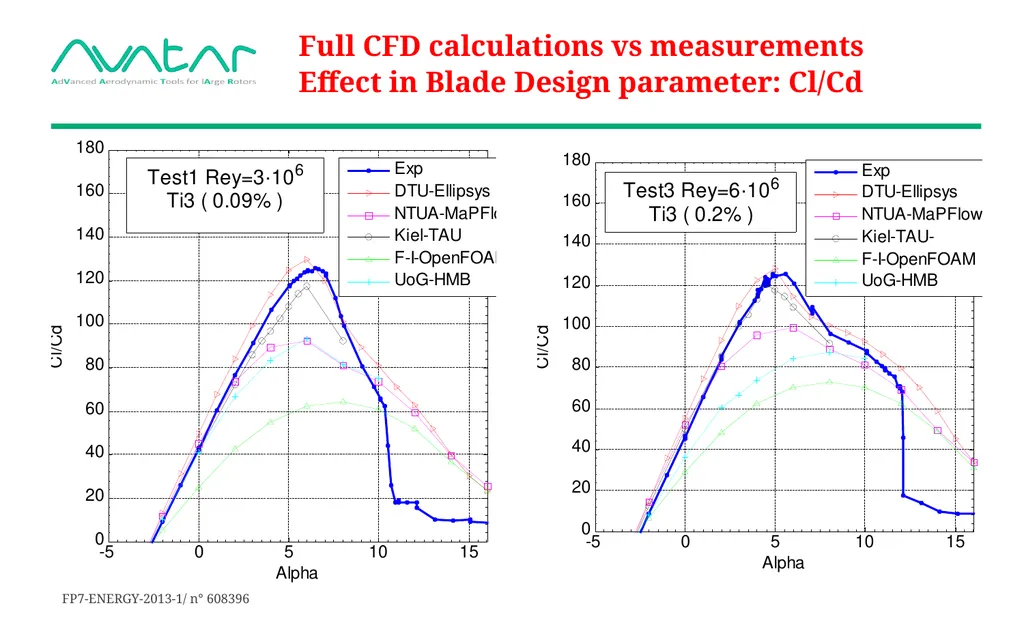
slide10. Full CFD calculations vs measurements Effect in Blade Design parameter: Cl/Cd<br>
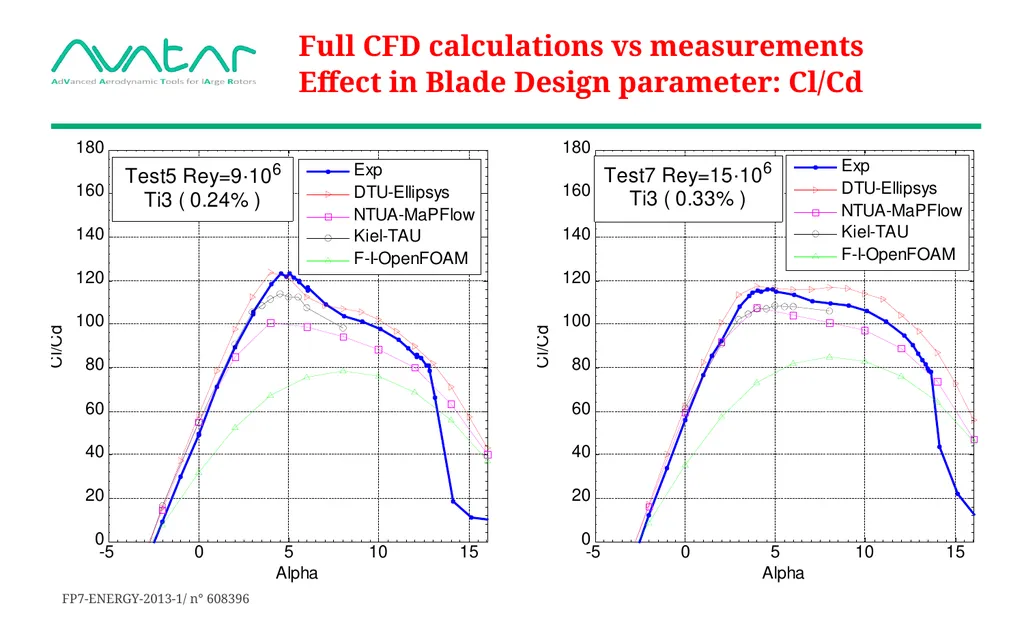
slide11. Full CFD calculations vs measurements Effect in Blade Design parameter: Cl/Cd<br>
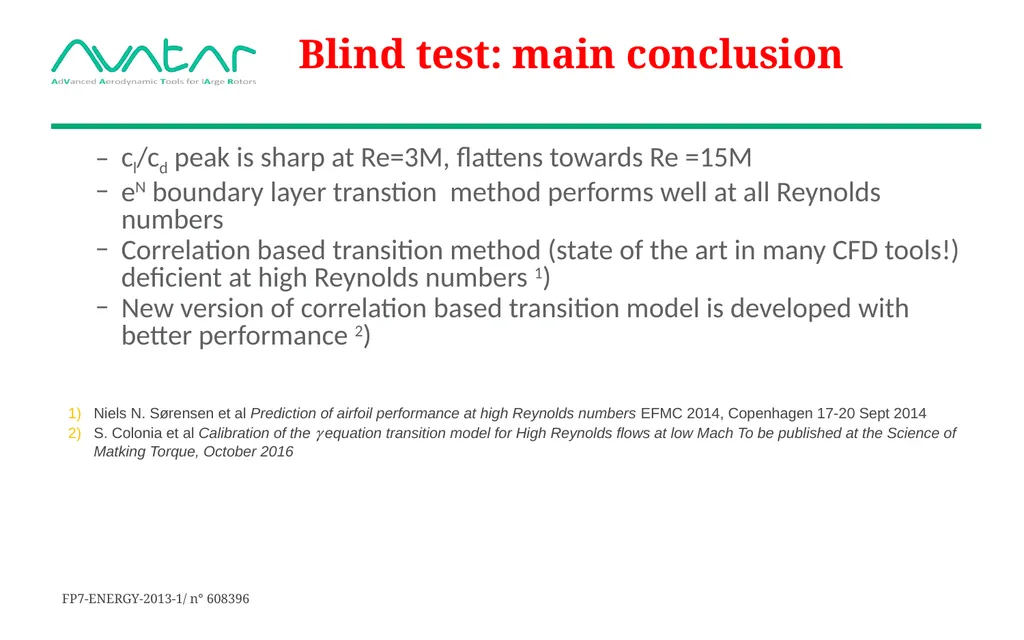
slide12. Blind test: main conclusion cl/cd peak is sharp at Re=3M, flattens towards Re =15M
eN boundary layer transtion method performs well at all Reynolds numbers
Correlation based transition method (state of the art in many CFD tools!) deficient at high Reynolds numbers 1)
New version of correlation based transition model is developed with better performance 2)
Niels N. Sørensen et al Prediction of airfoil performance at high Reynolds numbers EFMC 2014, Copenhagen 17-20 Sept 2014
S. Colonia et al Calibration of the g equation transition model for High Reynolds flows at low Mach To be published at the Science of Matking Torque, October 2016<br>
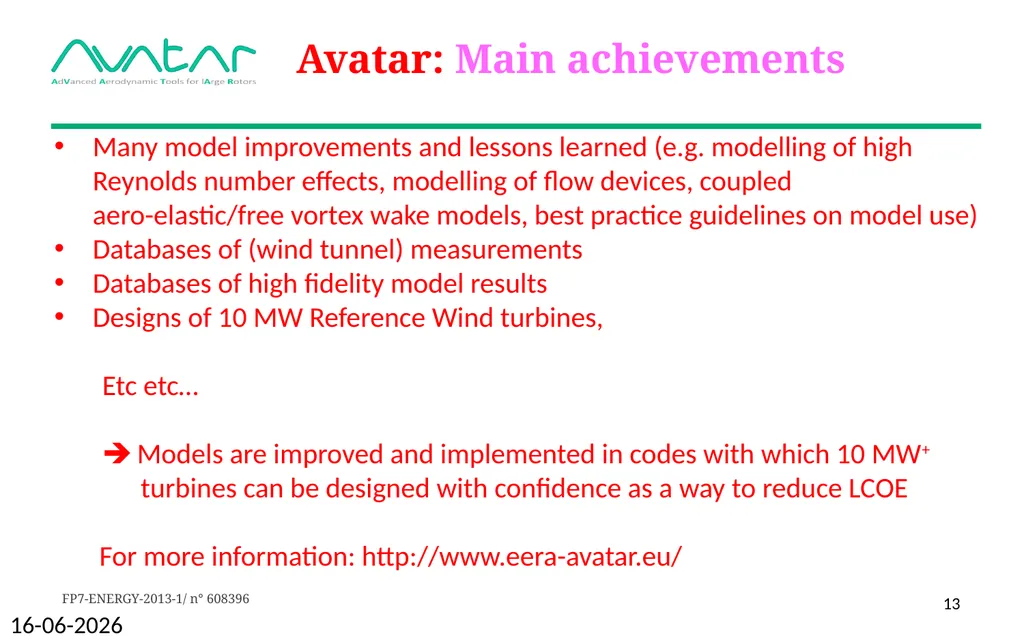
slide13. 13 Avatar: Main achievements 27-11-2017 Many model improvements and lessons learned (e.g. modelling of high Reynolds number effects, modelling of flow devices, coupled aero-elastic/free vortex wake models, best practice guidelines on model use)
Databases of (wind tunnel) measurements
Databases of high fidelity model results
Designs of 10 MW Reference Wind turbines,
Etc etc…
Models are improved and implemented in codes with which 10 MW+ turbines can be designed with confidence as a way to reduce LCOE
For more information: http://www.eera-avatar.eu/<br>
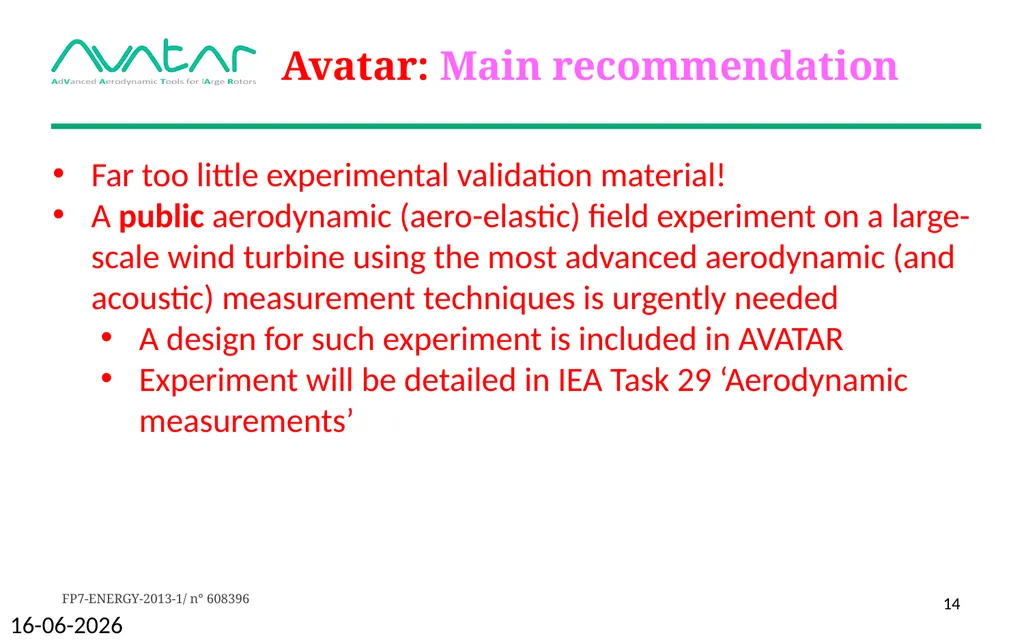
slide14. 14 Avatar: Main recommendation 27-11-2017 Far too little experimental validation material!
A public aerodynamic (aero-elastic) field experiment on a large-scale wind turbine using the most advanced aerodynamic (and acoustic) measurement techniques is urgently needed
A design for such experiment is included in AVATAR
Experiment will be detailed in IEA Task 29 ‘Aerodynamic measurements’<br>
slide16. Thank you for your attention<br>
Amsterdam, the Netherlands November 30h, 2017<br>
slide2. 2 EU FP7 Project initiated by EERA Energy Research Centre of the Netherlands, ECN (Coordinator)
Delft University of Technology, TUDelft
Technical University of Denmark, DTU
Fraunhofer IWES
University of Oldenburg, Forwind
University of Stuttgart, USTUTT
National Renewable Energy Centre, CENER
University of Liverpool/University of Glasgow, ULIV/UoG
Centre for Renewable Energy Sources and Saving, CRES
National Technical University of Greece, NTUA
Politecnico di Milano, Polimi
GE Global Research, Zweigniederlassung der General Electric Deutschland Holding GmbH, GE
LM Wind Power, LM 27-11-2017<br>
slide3. AVATAR presentations 09.30-09.30 Introduction and main achievements, Gerard Schepers (ECN)
09.30-09.45 Aerodynamic response modelling of complex and turbulent inflow, Niels Sorensen(DTU)<br>
slide4. 4 Period Project period: November 1st 2013- December 31st 2017<br>
slide5. 5 Main motivation for AVATAR: Aerodynamics of large wind turbines (10-20MW) Upscaling turbine size for off-shore applications:
Higher capacity factors and more hours at full (constant) load
The LCOE is relatively insensitive to the size of a turbine
So Upscaling to 10MW+ is an option to reduce the LCOE
However….. 27-11-2017<br>
slide6. 6 Main motivation for AVATAR: Aerodynamics of large wind turbines (10-20MW) We simply didn’t know if aerodynamic models were good enough to design 10MW+ turbines
10MW+ rotors violate assumptions in aerodynamic tools, e.g.:
Reynolds number effects,
Compressibility effects
Thick(er) airfoils
Flow transition and separation,
(More) flexible blades
Flow devices 27-11-2017<br>
slide7. 7 Avatar: Main objective 10MW+ designs fell outside the validated range of state of the art tools.
Objective of AVATAR:
To bring the aerodynamic and fluid-structure models to a next level and calibrate them for all relevant aspects of large (10MW+) wind turbines 27-11-2017<br>
slide8. 8 Avatar: Work procedure Problem: No 10 MW turbines are on the market yet for validation.
Validate submodels against (mainly wind tunnel) experiments
Cross-comparison of model results
In the project we have many models which range from computational efficient ‘engineering’ tools to high fidelity but computationally expensive tools
Engineering tools are needed in industrial design codes 1) and 2)
High fidelity models (and intermediate models) feed information towards engineering models
J.G. Schepers ‘Engineering models in wind energy aerodynamics,’ (2012).
M. Kloosterman, DNV-GL, AVATAR Advisory Board 27-11-2017<br>
slide9. One Highlight: Measurements in DNW pressurized tunnel Measurements up to Re = 15M (and low M)
DU00-W-212 selected as common airfoil
Also measured by:
LM up to RE=6M
Forwind at controlled turbulent conditions up to Re = 1M
Results are brought into a ‘blind test’
Measurements compared with calculations
Blind test included participants outside project DNW-HDG model, c=15 cm Summary of the Blind Test Campaign to predict the High Reynolds number performance of DU00-W-210 airfoil
Ozlem Ceyhan, Oscar Pires, Xabier Munduate, Niels N. Sorensen, Alois Peter Schaffarczyk, Torben Reichstein, Konstantinos Diakakis, Giorgos Papadakis, Elia Daniele, Michael Schwarz, Thorsten Lutz, and Raul Prieto
35th Wind Energy Symposium. Grapevine, Texas.<br>
slide10. Full CFD calculations vs measurements Effect in Blade Design parameter: Cl/Cd<br>
slide11. Full CFD calculations vs measurements Effect in Blade Design parameter: Cl/Cd<br>
slide12. Blind test: main conclusion cl/cd peak is sharp at Re=3M, flattens towards Re =15M
eN boundary layer transtion method performs well at all Reynolds numbers
Correlation based transition method (state of the art in many CFD tools!) deficient at high Reynolds numbers 1)
New version of correlation based transition model is developed with better performance 2)
Niels N. Sørensen et al Prediction of airfoil performance at high Reynolds numbers EFMC 2014, Copenhagen 17-20 Sept 2014
S. Colonia et al Calibration of the g equation transition model for High Reynolds flows at low Mach To be published at the Science of Matking Torque, October 2016<br>
slide13. 13 Avatar: Main achievements 27-11-2017 Many model improvements and lessons learned (e.g. modelling of high Reynolds number effects, modelling of flow devices, coupled aero-elastic/free vortex wake models, best practice guidelines on model use)
Databases of (wind tunnel) measurements
Databases of high fidelity model results
Designs of 10 MW Reference Wind turbines,
Etc etc…
Models are improved and implemented in codes with which 10 MW+ turbines can be designed with confidence as a way to reduce LCOE
For more information: http://www.eera-avatar.eu/<br>
slide14. 14 Avatar: Main recommendation 27-11-2017 Far too little experimental validation material!
A public aerodynamic (aero-elastic) field experiment on a large-scale wind turbine using the most advanced aerodynamic (and acoustic) measurement techniques is urgently needed
A design for such experiment is included in AVATAR
Experiment will be detailed in IEA Task 29 ‘Aerodynamic measurements’<br>
slide16. Thank you for your attention<br>