Aviation Meteorology Third Stage The seventh lecture DR.IQBAL KHALAF khames Visibility Visibility is the meteorological component which impacts flight operations the most. Topographic features all tend to look the same at low levels making
"Aviation Meteorology Third Stage The seventh" is the property of its rightful owner. Permission is granted to
download and print the materials on this website for personal, non-commercial use only, and to display it
on your personal computer provided you do not modify the materials and that you retain all copyright
notices contained in the materials. By downloading content from our website, you accept the terms of this
agreement.
Presentation Transcript
01
Aviation Meteorology Third Stage
The seventh lecture
DR.IQBAL KHALAF khames<br>
02
Visibility Visibility is the meteorological component which impacts flight operations the most. Topographic features all tend to look the same at low levels making good route by aircraft.
Types of Visibility
There are several terms used to describe the different types of visibility used by the aviation.
(a) Horizontal visibility - the furthest visibility obtained horizontally in a specific
direction by referencing lights at known distances.
(b) Prevailing visibility - the ground level visibility which is common to one-half
or more of the horizon circle.
(c) Vertical visibility - the maximum visibility obtained by looking vertically
upwards into a surface-based obstruction such as fog or snow.<br>
03
(d) Slant visibility - visibility observed by looking forward and downwards from the cockpit of the aircraft.
(e) Flight visibility - the average range of visibility at any given time forward from the cockpit of an aircraft in flight.
Causes of Reduced Visibility
Lithometers
Lithometers are dry particles suspended in the atmosphere and include haze,
smoke, sand and dust. Of these, smoke and haze cause the most problems. The most common sources of smoke are forest fires. smoke can reduce the visibility significantly .<br>
04
Precipitation
Rain can reduce visibility, the restriction is seldom less than one mile other than in the heaviest showers beneath cumulonimbus clouds.
Drizzle because of the greater number of drops in each volume of air, is usually more effective than rain at reducing the visibility, especially when accompanied by fog.
Snow affects visibility more than rain and drizzle , can easily reduce it to less
than one mile.
Blowing snow is a product of strong winds picking up the snow particles and lifting them into the air.<br>
05
Fog
Fog is the most common and persistent visibility obstruction encountered by the aviation.
Fog, can consist of :-
water droplets, super cooled water droplets, ice crystals or a mix of super cooled droplets and ice crystals.
Snow Squalls and Streamers
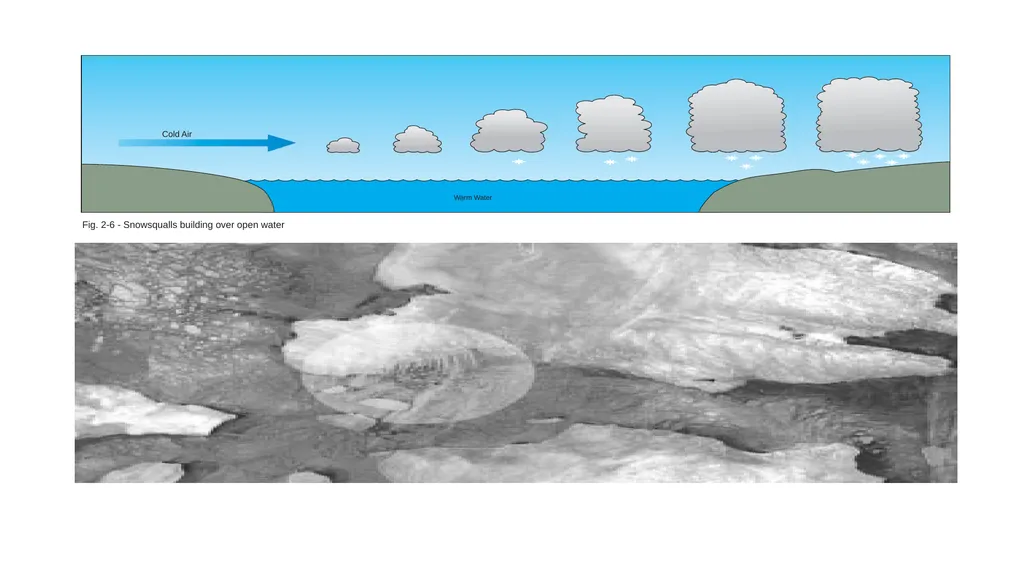
Snow squalls are relatively small areas of heavy snowfall. They develop when cold arctic air passes over a relatively warm water surface, such as Hudson Bay,
before freeze-up.
An injection of heat and moisture from the lake into the low levels of the atmosphere destabilizes the air mass.<br>
06
If sufficient destabilization occurs, convective clouds begin to develop with snow beginning shortly thereafter .
Snowsqualls usually develop in bands of cloud, or streamers, that form parallel to the direction of flow.
Movement of these snow squalls can generally be tied to the mean winds between 3,000 and 5,000 feet.
Not only can snowsqualls reduce visibility to near zero but, due to their convective nature, significant icing and turbulence are often encountered within the clouds.<br>
07
Stability and the Diurnal Variation in Wind In a stable weather pattern, daytime winds are generally stronger and gustier than nighttime winds.
During the day, the heating from the sun sets up convective mixing which carries the stronger winds aloft down to the surface and mixes them with the slower surface winds. This causes the surface wind to increase in speed and become gusty, while at the same time reducing the wind speeds aloft in the mixed layer.
After sunset, the surface of the earth cools which, in turn, cools the air near the surface resulting in the development of a temperature inversion. This inversion deepens as cooling continues, ending the convective mixing and causing the surface winds to slacken<br>
08
Wind Shear Wind shear :-is a change in wind direction and wind speed over the distance between two points. If the points are in a vertical direction then it is called vertical shear, if they are in a horizontal direction than it is called horizontal shear.
In the aviation world
the major concern is how abruptly the change occurs.
If the change is gradual, a change in direction or speed will result in nothing more than a minor change in the air speed.
If the change is abrupt, there will be a rapid change of air speed<br>
09
Significant shearing can occur when the surface wind blowing along a valley varies significantly from the free flowing wind above the valley.
In mountainous terrain changes are reasonably common in direction of 90°and speed changes of 25 knots.
Updrafts and downdrafts also induce shears. An abrupt downdraft will cause a brief decrease in the wing’s attack angle resulting in a loss of lift.
An updraft will increase the wing’s attack angle and consequently increase the lift, however, there is a risk that it could be increased beyond the stall speed.
The AOA :-is defined as the acute angle between the chord line of the plane wing and the direction of the relative wind.
The stall speed:-is defined as the minimum steady flight speed at which the aircraft is controllable<br>
10
Mechanical turbulence :-is a form of shear induced when a rough surface disrupts the smooth wind flow.
The amount of shearing and the depth of the shearing layer depends on:-
The wind speed
The roughness of the surface
The stability of the air.<br>
11
The Relationship Between Wind Shear and Turbulence Turbulence is the direct result of wind shear. The stronger the shear the greater the tendency for the laminar flow of the air to break down into eddies resulting in turbulence, not all shear zones are turbulent, so the absence of turbulence does not infer that there is no shear
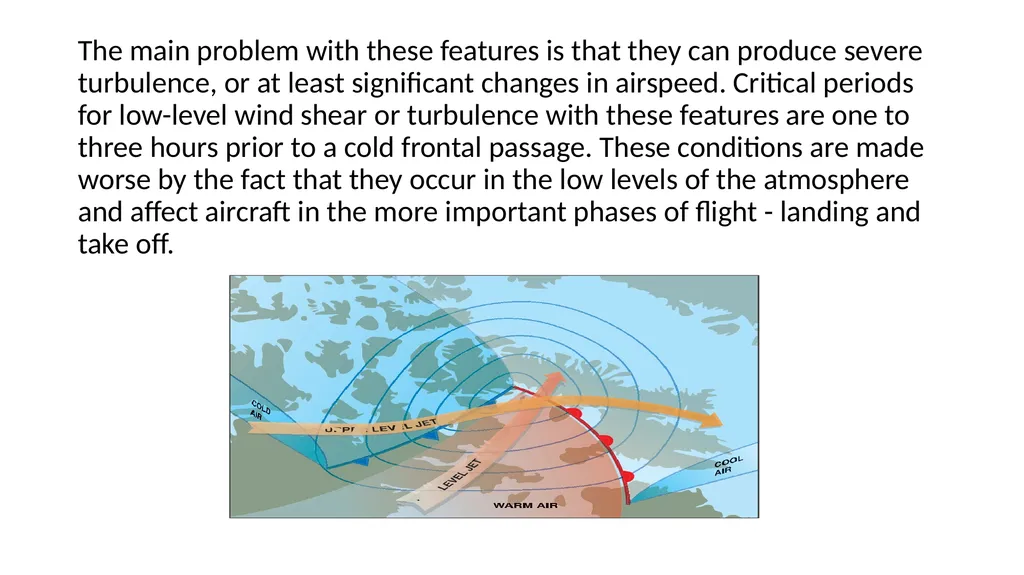
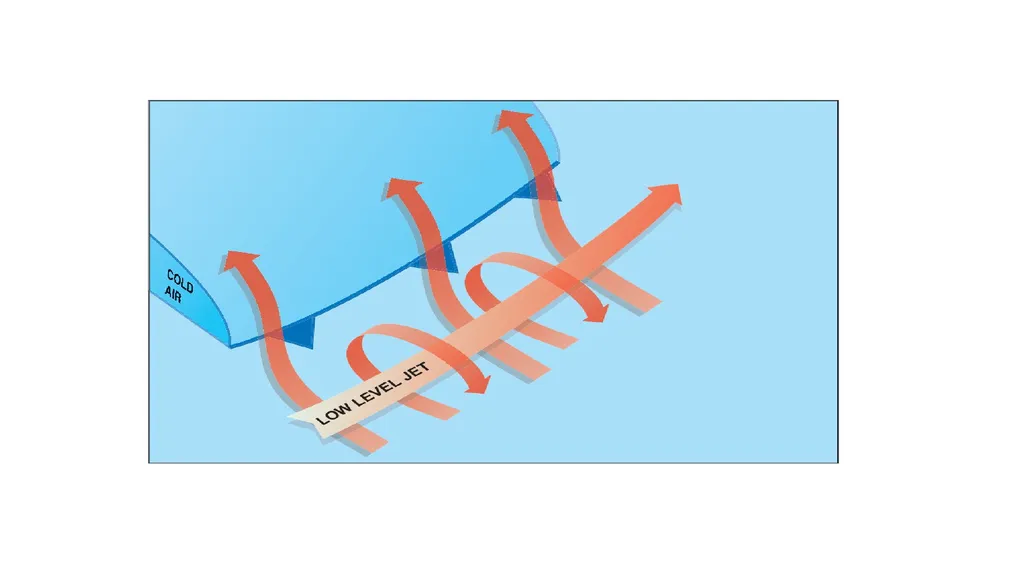
Low-Level Jets – Frontal
They are typically located between 500 and 5,000 feet and can be several hundred feet wide. Wind speeds associated with low-level jets can reach as high as 100 knots in more intense storms.<br>
12
The main problem with these features is that they can produce severe turbulence, or at least significant changes in airspeed. Critical periods for low-level wind shear or turbulence with these features are one to three hours prior to a cold frontal passage. These conditions are made worse by the fact that they occur in the low levels of the atmosphere and affect aircraft in the more important phases of flight - landing and take off.<br>