
Aviation Weather Training Adverse Winds Jim Vasilj
MY
Published · 60 slides · 0 views

1 / 1
Description
Aviation Weather Training Adverse Winds Jim Vasilj Seattle Center Weather Service Unit Motivation Adverse Winds Motivation Adverse Winds Adverse Wind Responsible for most weather-related accidents Often trigger air traffic management
Related Topics
Share
Embed code
Download this presentation From Below
"Aviation Weather Training Adverse Winds Jim Vasilj" is the property of its rightful owner. Permission is granted to download and print the materials on this website for personal, non-commercial use only, and to display it on your personal computer provided you do not modify the materials and that you retain all copyright notices contained in the materials. By downloading content from our website, you accept the terms of this agreement.
Presentation Transcript
01
Aviation Weather Training Adverse Winds Jim Vasilj
Seattle Center Weather Service Unit<br>
Seattle Center Weather Service Unit<br>
02
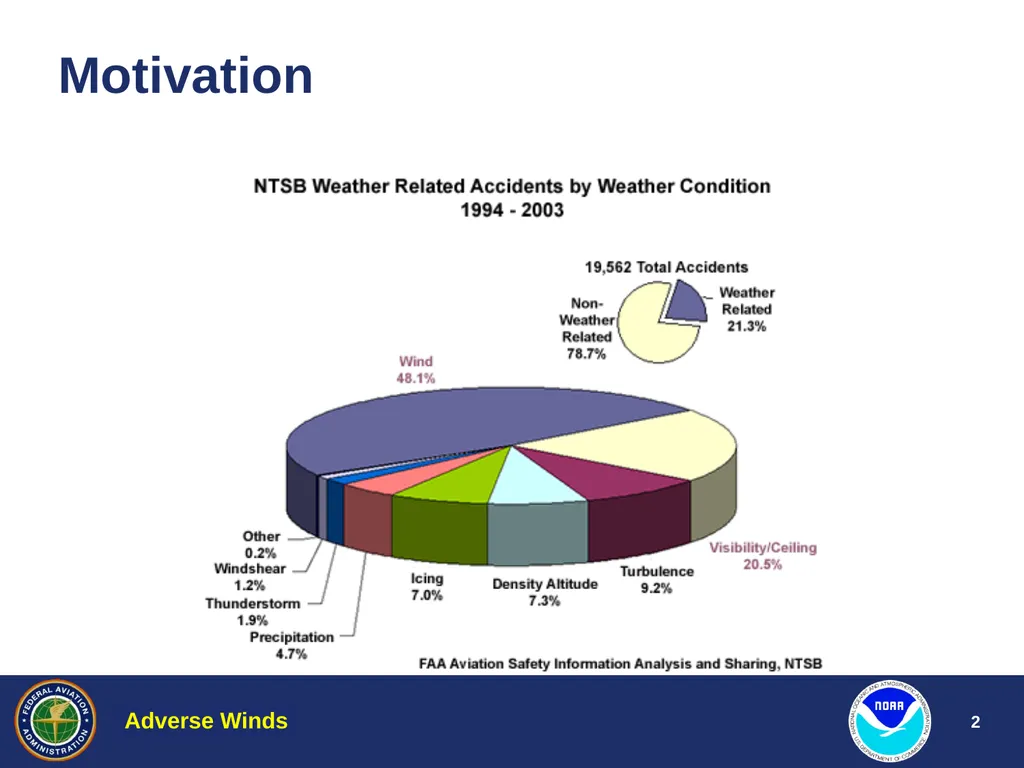
Motivation Adverse Winds<br>
03
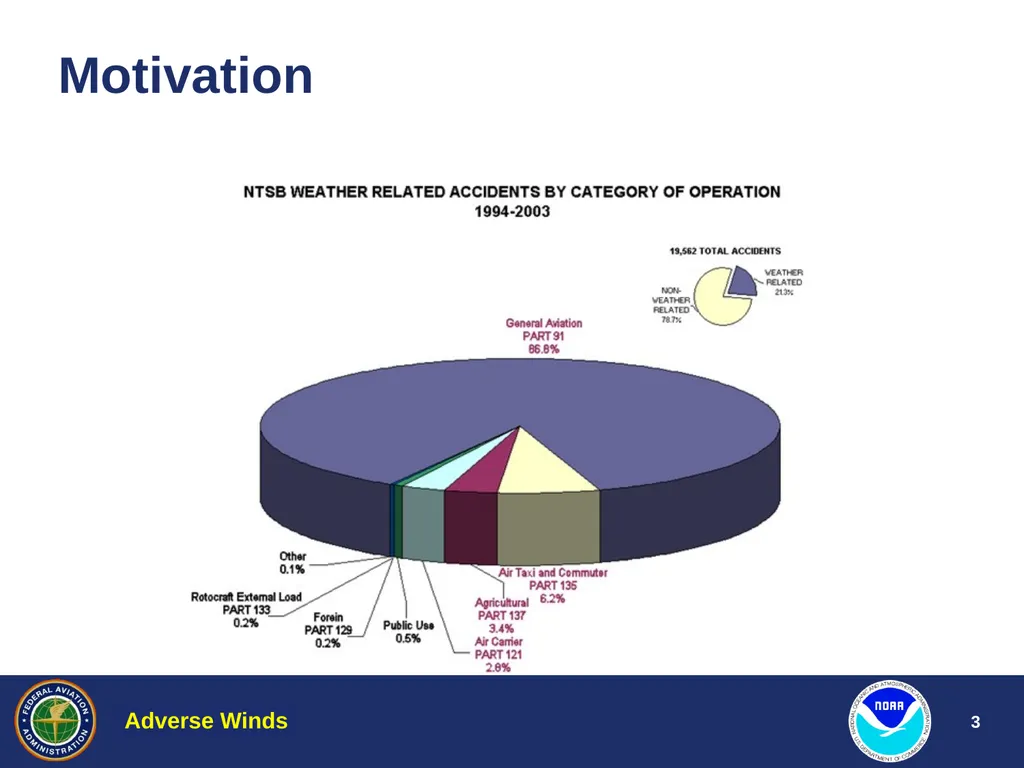
Motivation Adverse Winds<br>
04
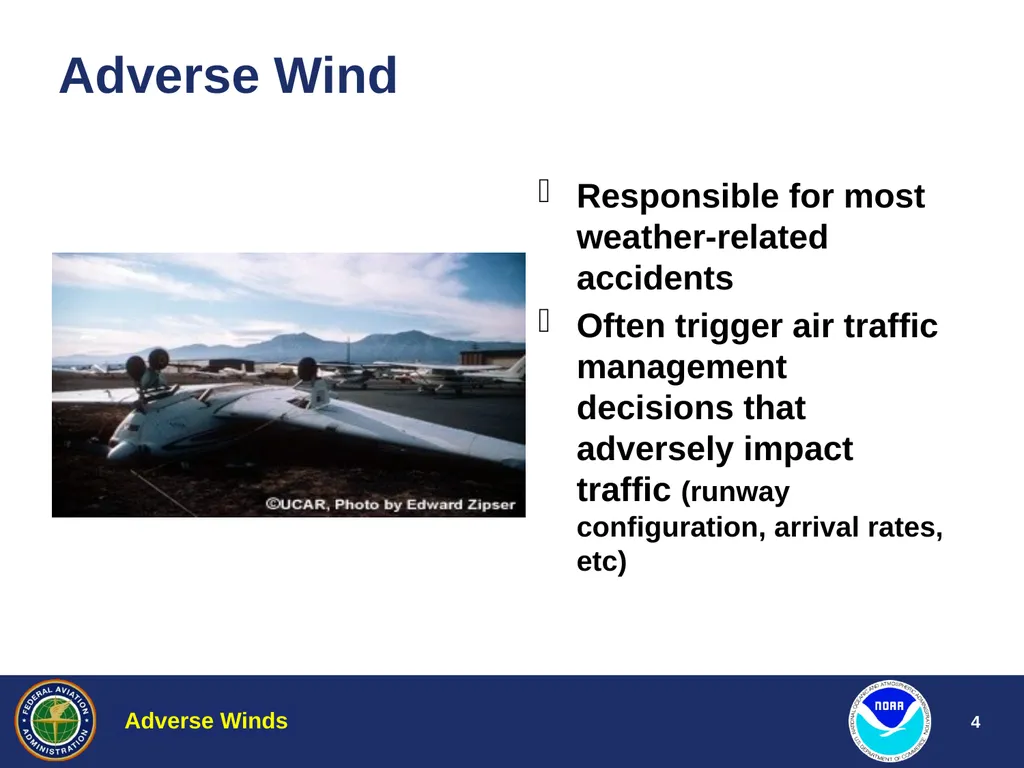
Adverse Wind Responsible for most weather-related accidents
Often trigger air traffic management decisions that adversely impact traffic (runway configuration, arrival rates, etc) Adverse Winds<br>
Often trigger air traffic management decisions that adversely impact traffic (runway configuration, arrival rates, etc) Adverse Winds<br>
05
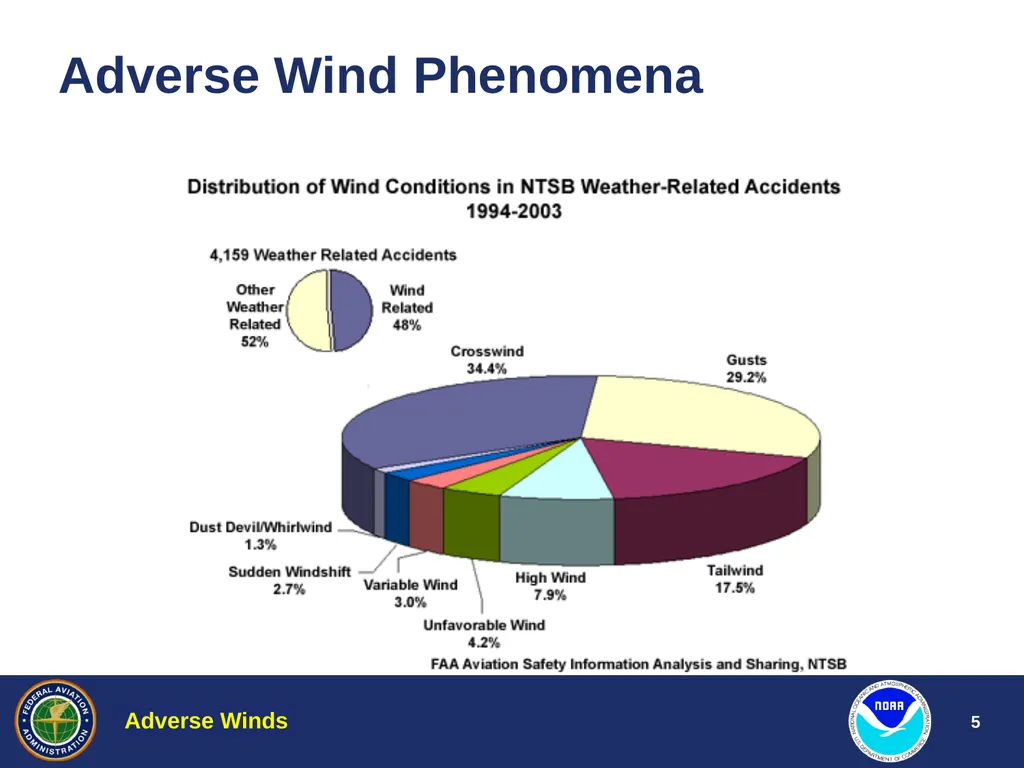
Adverse Wind Phenomena Adverse Winds<br>
06
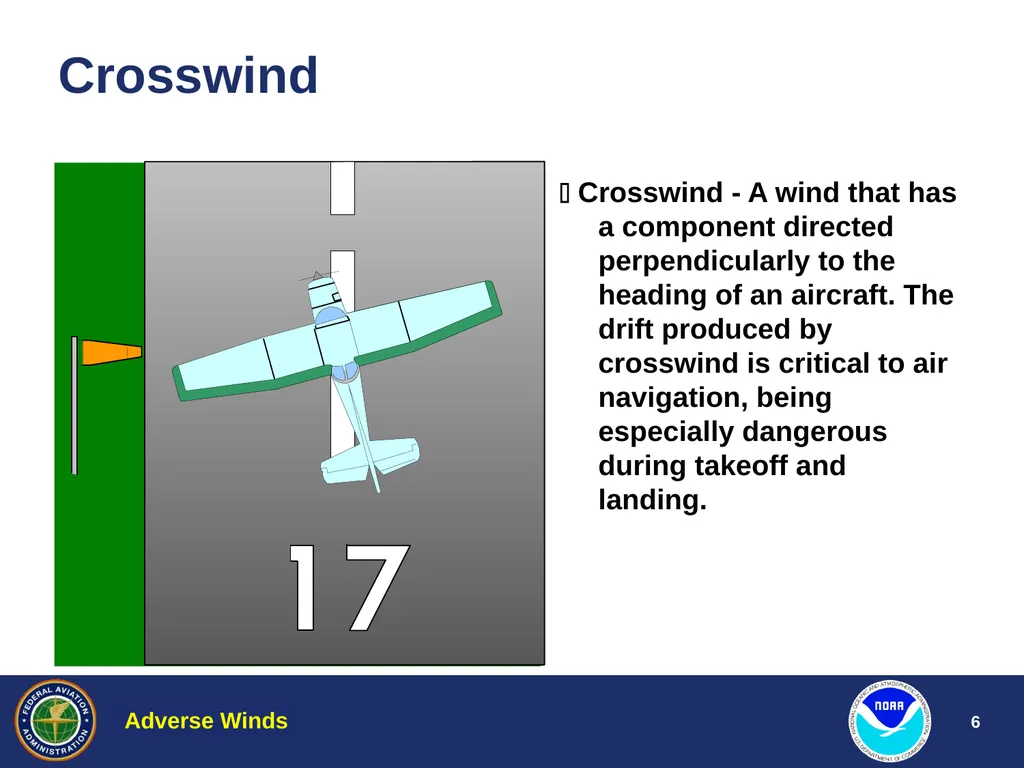
Crosswind Crosswind - A wind that has a component directed perpendicularly to the heading of an aircraft. The drift produced by crosswind is critical to air navigation, being especially dangerous during takeoff and landing. Adverse Winds<br>
07
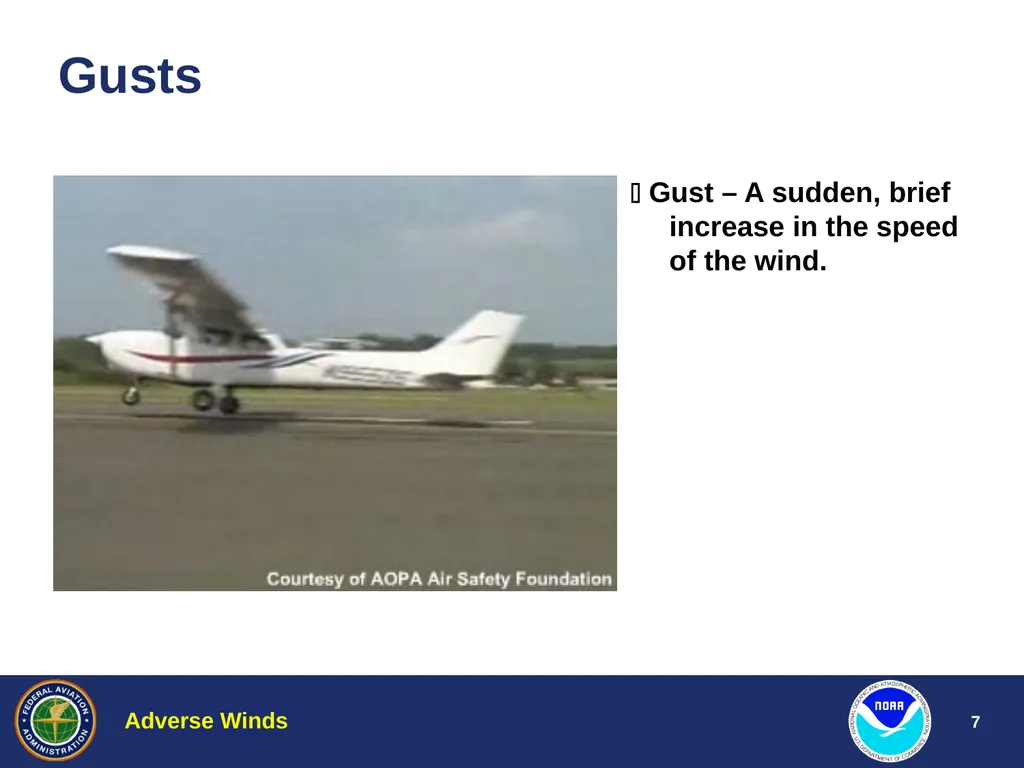
Gusts Gust – A sudden, brief increase in the speed of the wind. Adverse Winds<br>
08
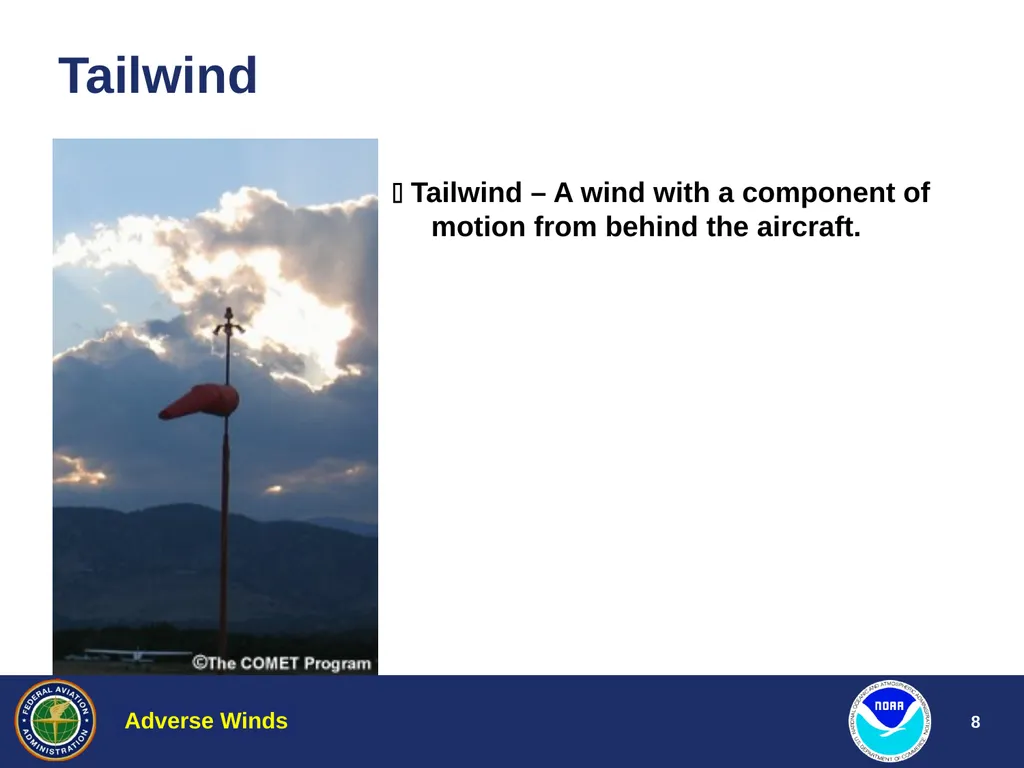
Tailwind Tailwind – A wind with a component of motion from behind the aircraft. Adverse Winds<br>
09
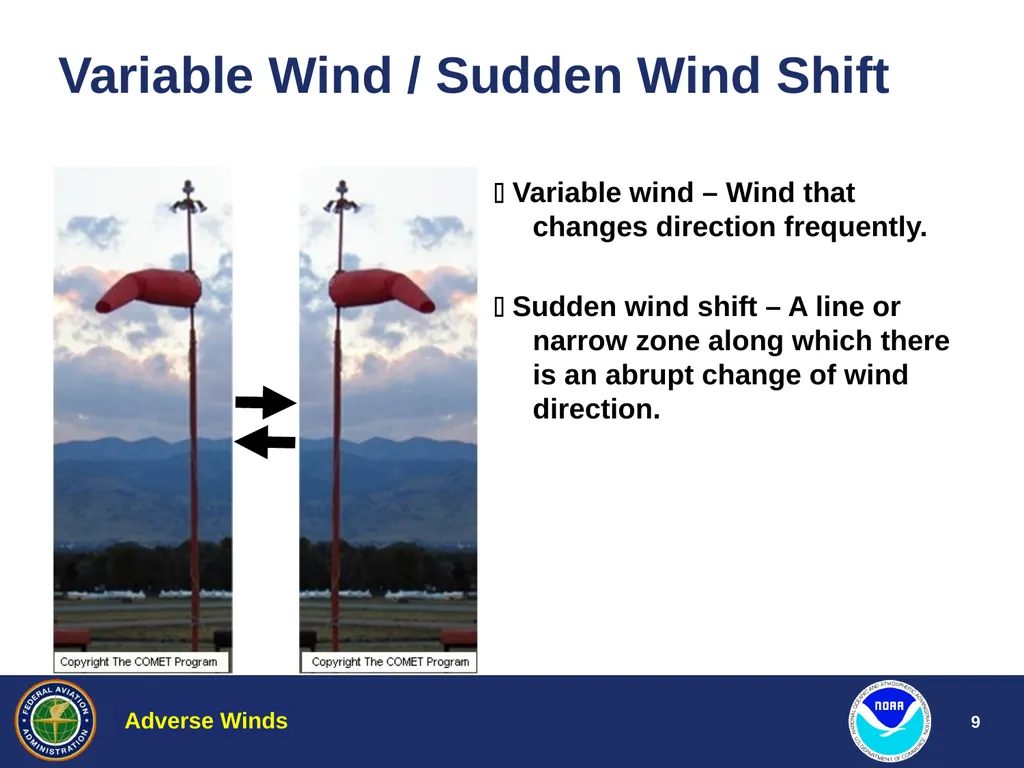
Variable Wind / Sudden Wind Shift Variable wind – Wind that changes direction frequently.
Sudden wind shift – A line or narrow zone along which there is an abrupt change of wind direction. Adverse Winds<br>
Sudden wind shift – A line or narrow zone along which there is an abrupt change of wind direction. Adverse Winds<br>
10
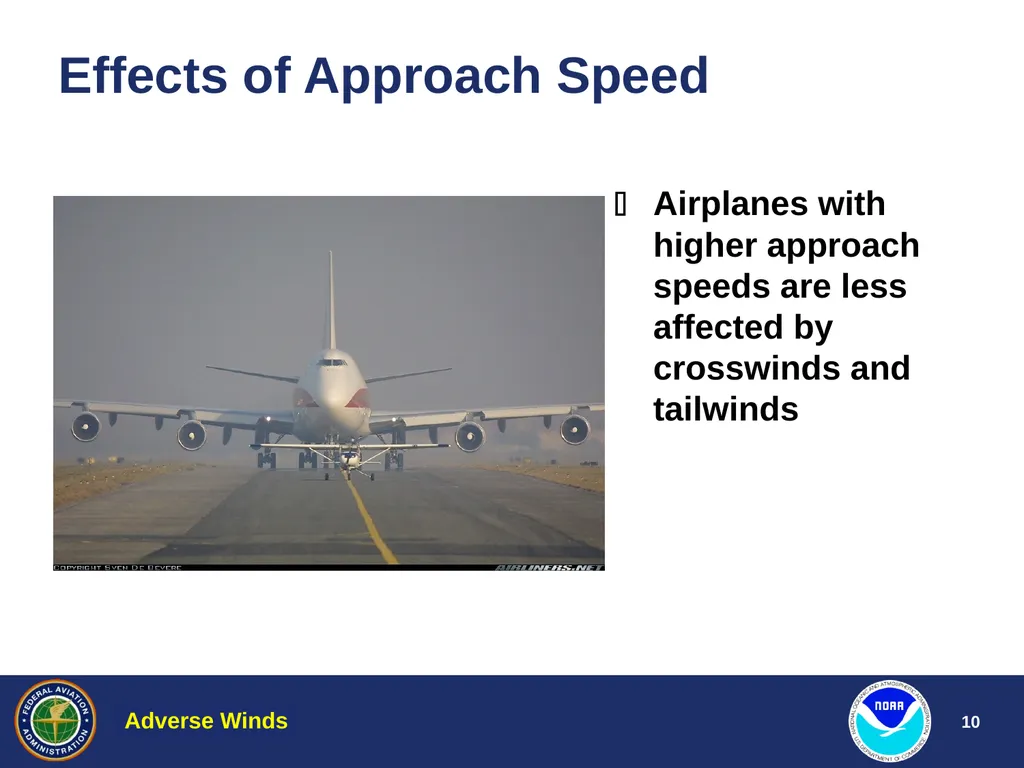
Effects of Approach Speed Airplanes with higher approach speeds are less affected by crosswinds and tailwinds Adverse Winds<br>
11
Response Item Even if an airplane is oriented into the wind, gusts during takeoff and landing may cause the aircraft to _______.
A. drift off the side of the runway
B. bounce on the runway
C. roll off the end of the runway Adverse Winds<br>
A. drift off the side of the runway
B. bounce on the runway
C. roll off the end of the runway Adverse Winds<br>
12
Response Item A variable wind, even at low speeds, can be hazardous on takeoff and landing because it could _______.
A. cause engine failure
B. cause the plane to bounce on the runway
C. quickly become a crosswind or tailwind Adverse Winds<br>
A. cause engine failure
B. cause the plane to bounce on the runway
C. quickly become a crosswind or tailwind Adverse Winds<br>
13
Response Item _______ perform better in adverse winds because most have demonstrated tailwind and crosswind thresholds that exceed FAA runway thresholds.
A. Larger airplanes
B. Smaller airplanes
C. Helicopters Adverse Winds<br>
A. Larger airplanes
B. Smaller airplanes
C. Helicopters Adverse Winds<br>
14
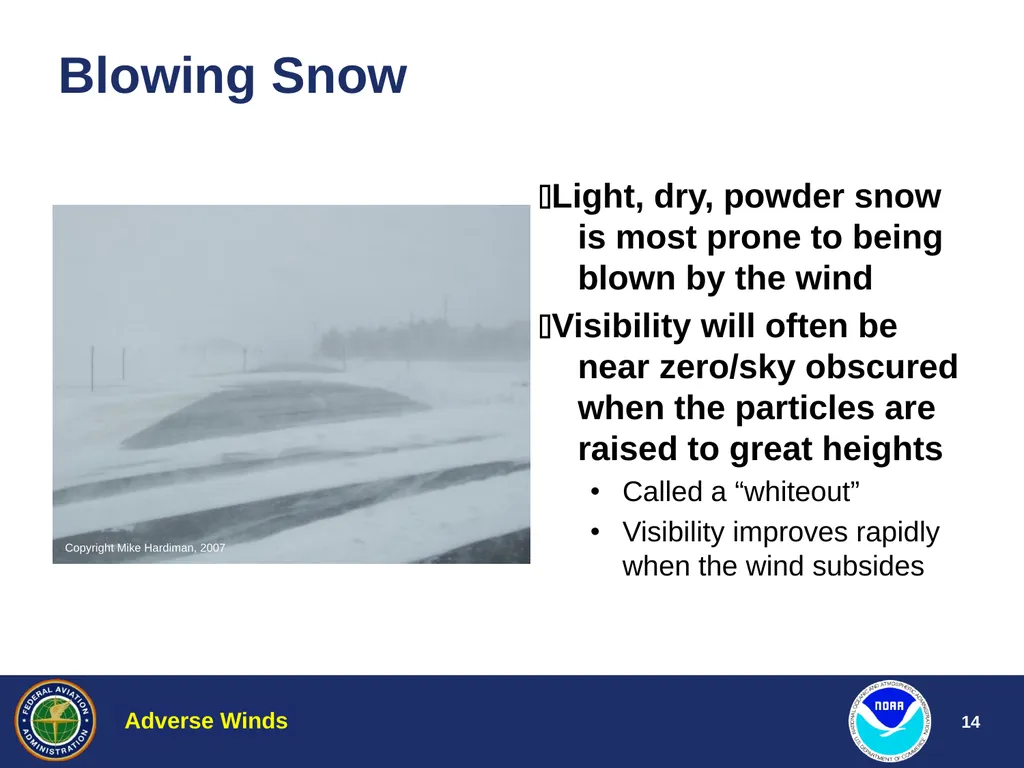
Blowing Snow Light, dry, powder snow is most prone to being blown by the wind
Visibility will often be near zero/sky obscured when the particles are raised to great heights
Called a “whiteout”
Visibility improves rapidly when the wind subsides Copyright Mike Hardiman, 2007 Adverse Winds<br>
Visibility will often be near zero/sky obscured when the particles are raised to great heights
Called a “whiteout”
Visibility improves rapidly when the wind subsides Copyright Mike Hardiman, 2007 Adverse Winds<br>
15
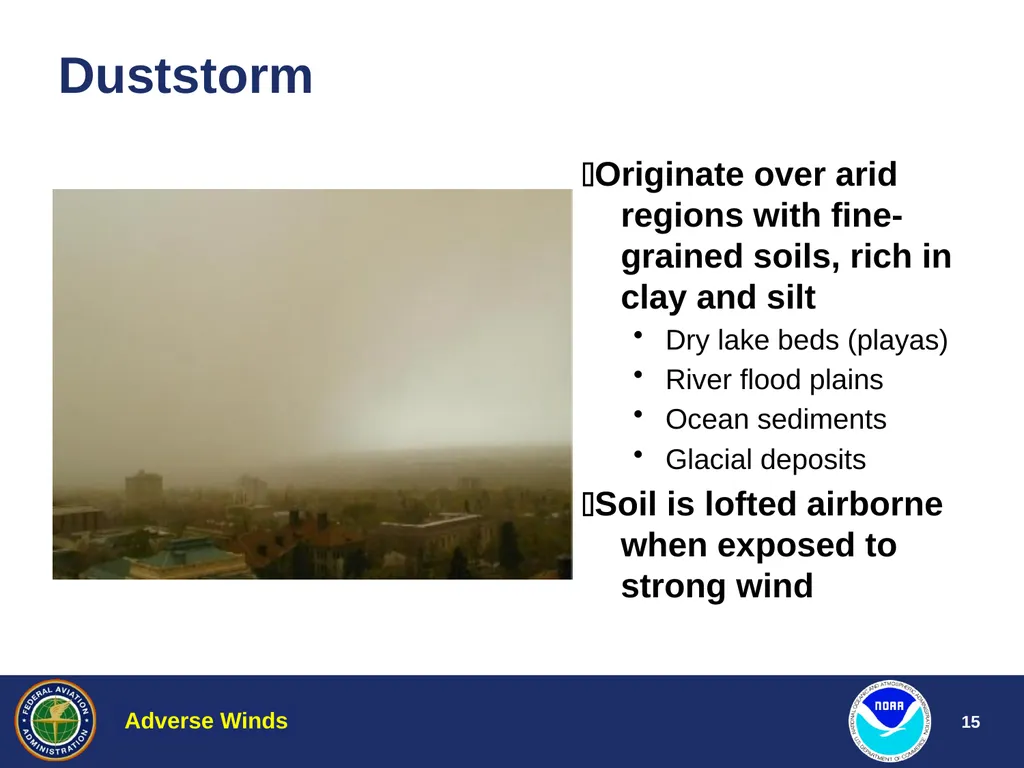
Duststorm Originate over arid regions with fine-grained soils, rich in clay and silt
Dry lake beds (playas)
River flood plains
Ocean sediments
Glacial deposits
Soil is lofted airborne when exposed to strong wind Adverse Winds<br>
Dry lake beds (playas)
River flood plains
Ocean sediments
Glacial deposits
Soil is lofted airborne when exposed to strong wind Adverse Winds<br>
16
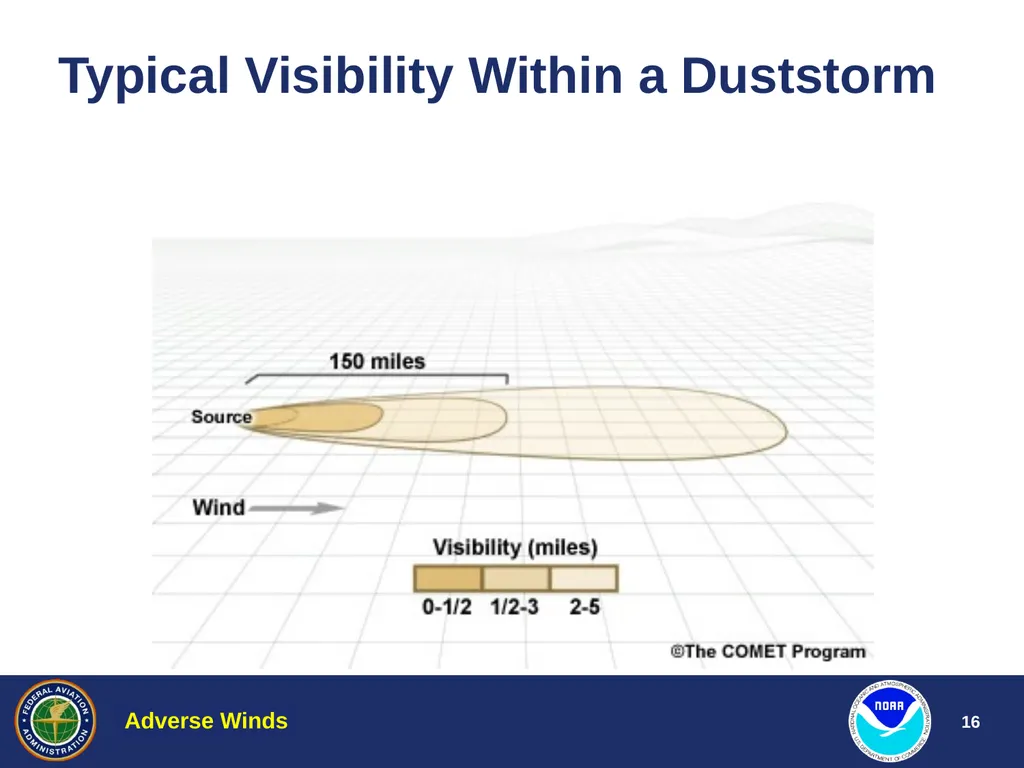
Typical Visibility Within a Duststorm Adverse Winds<br>
17
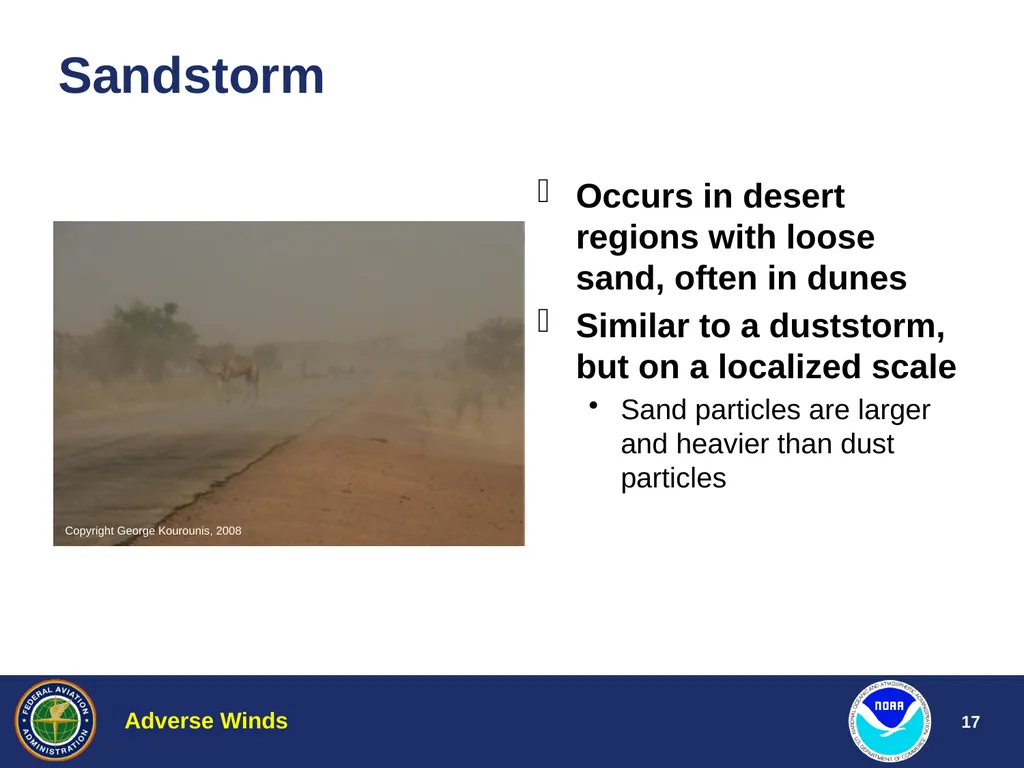
Sandstorm Occurs in desert regions with loose sand, often in dunes
Similar to a duststorm, but on a localized scale
Sand particles are larger and heavier than dust particles Copyright George Kourounis, 2008 Adverse Winds<br>
Similar to a duststorm, but on a localized scale
Sand particles are larger and heavier than dust particles Copyright George Kourounis, 2008 Adverse Winds<br>
18
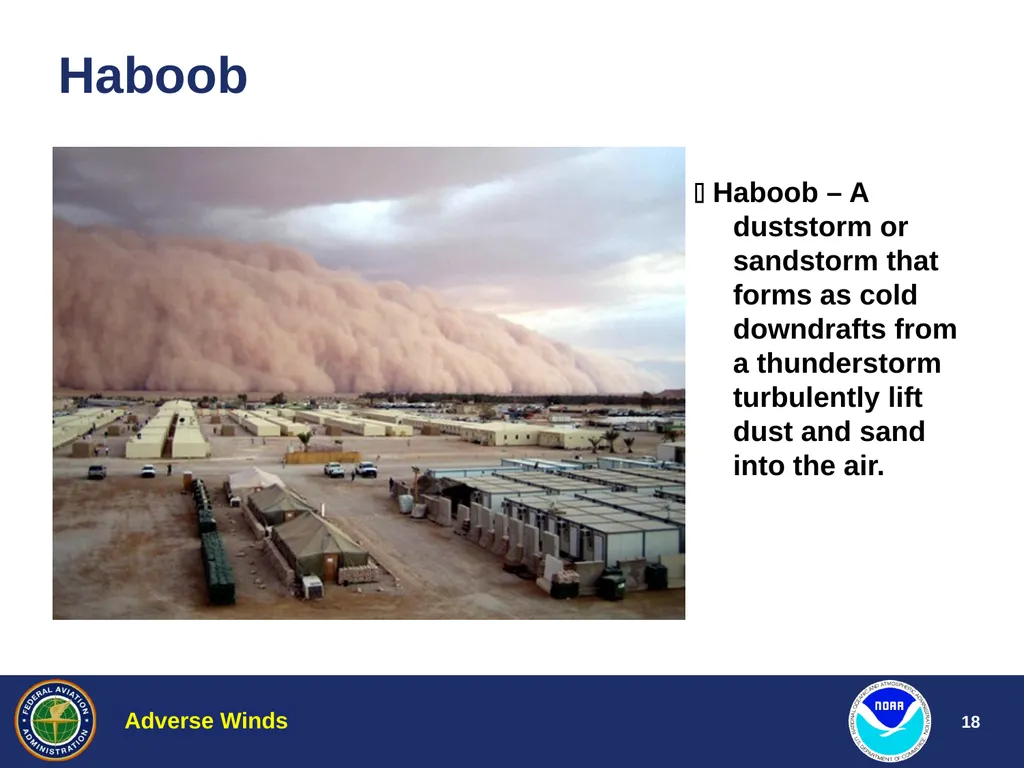
Haboob Haboob – A duststorm or sandstorm that forms as cold downdrafts from a thunderstorm turbulently lift dust and sand into the air. Adverse Winds<br>
19
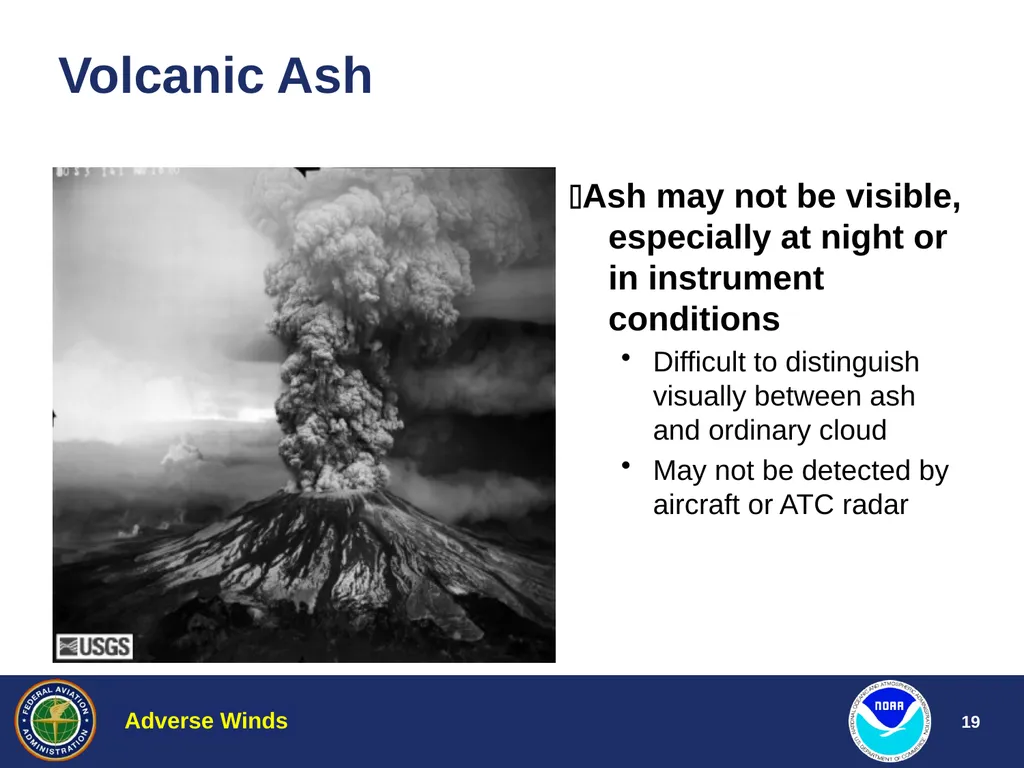
Volcanic Ash Ash may not be visible, especially at night or in instrument conditions
Difficult to distinguish visually between ash and ordinary cloud
May not be detected by aircraft or ATC radar Adverse Winds<br>
Difficult to distinguish visually between ash and ordinary cloud
May not be detected by aircraft or ATC radar Adverse Winds<br>
20
Response Item During a duststorm, most of the dust originates from _______.
A. one point source
B. a number of discrete point sources
C. a large source region Adverse Winds<br>
A. one point source
B. a number of discrete point sources
C. a large source region Adverse Winds<br>
21
Response Item Which phenomenon can continue to restrict visibility, even after the wind subsides?
A. Blowing dust
B. Blowing sand
C. Blowing snow Adverse Winds<br>
A. Blowing dust
B. Blowing sand
C. Blowing snow Adverse Winds<br>
22
Response Item During a sandstorm, sand particles are mostly confined to the lowest ______ feet and rarely rise more than _______ feet above the ground.
A. 10; 50
B. 1,000; 3,000
C. 3,000; 6,000 Adverse Winds<br>
A. 10; 50
B. 1,000; 3,000
C. 3,000; 6,000 Adverse Winds<br>
23
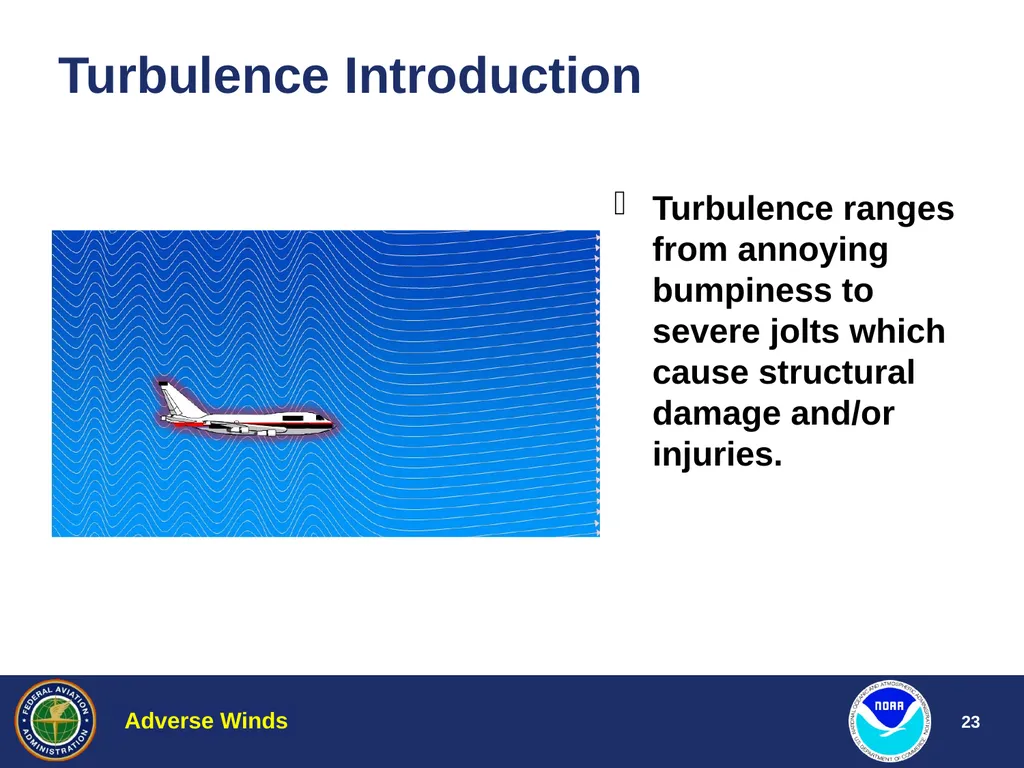
Turbulence Introduction Turbulence ranges from annoying bumpiness to severe jolts which cause structural damage and/or injuries. Adverse Winds<br>
24
Turbulence Definitions a state of fluid flow in which the instantaneous velocities exhibit irregular and random fluctuations
bumpiness in flight
violent movements in the atmosphere caused in many different ways
sudden changes in air movement causing aircraft to pitch, yaw and roll Adverse Winds<br>
bumpiness in flight
violent movements in the atmosphere caused in many different ways
sudden changes in air movement causing aircraft to pitch, yaw and roll Adverse Winds<br>
25
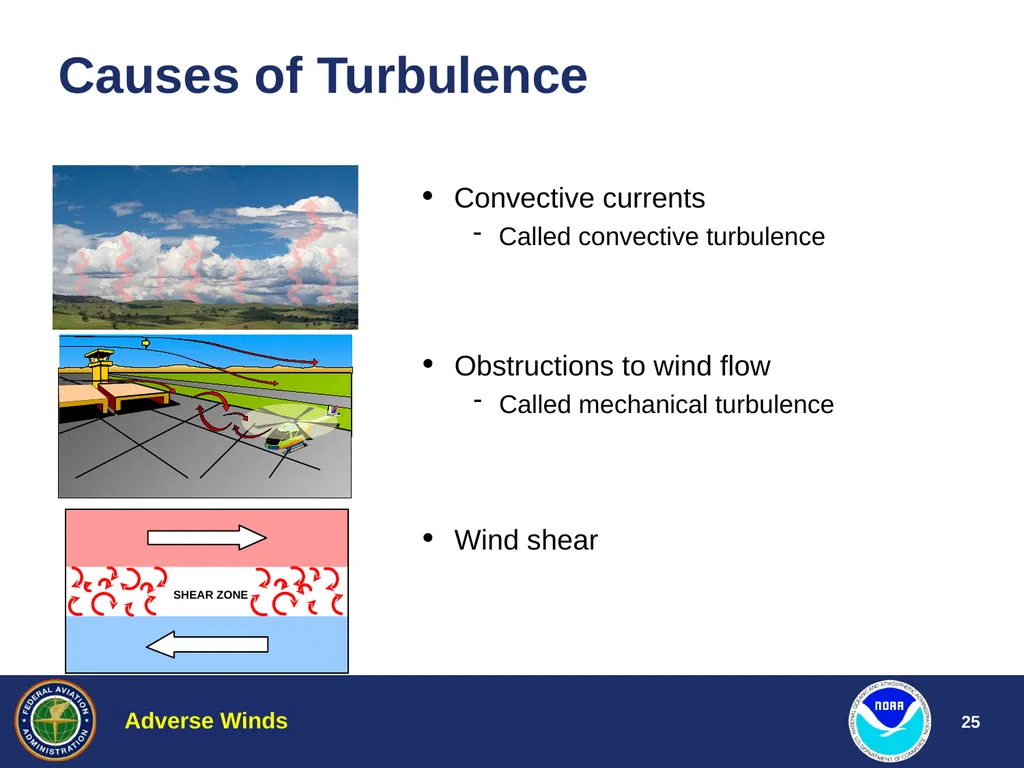
Causes of Turbulence Convective currents
Called convective turbulence Obstructions to wind flow
Called mechanical turbulence Wind shear Adverse Winds<br>
Called convective turbulence Obstructions to wind flow
Called mechanical turbulence Wind shear Adverse Winds<br>
26
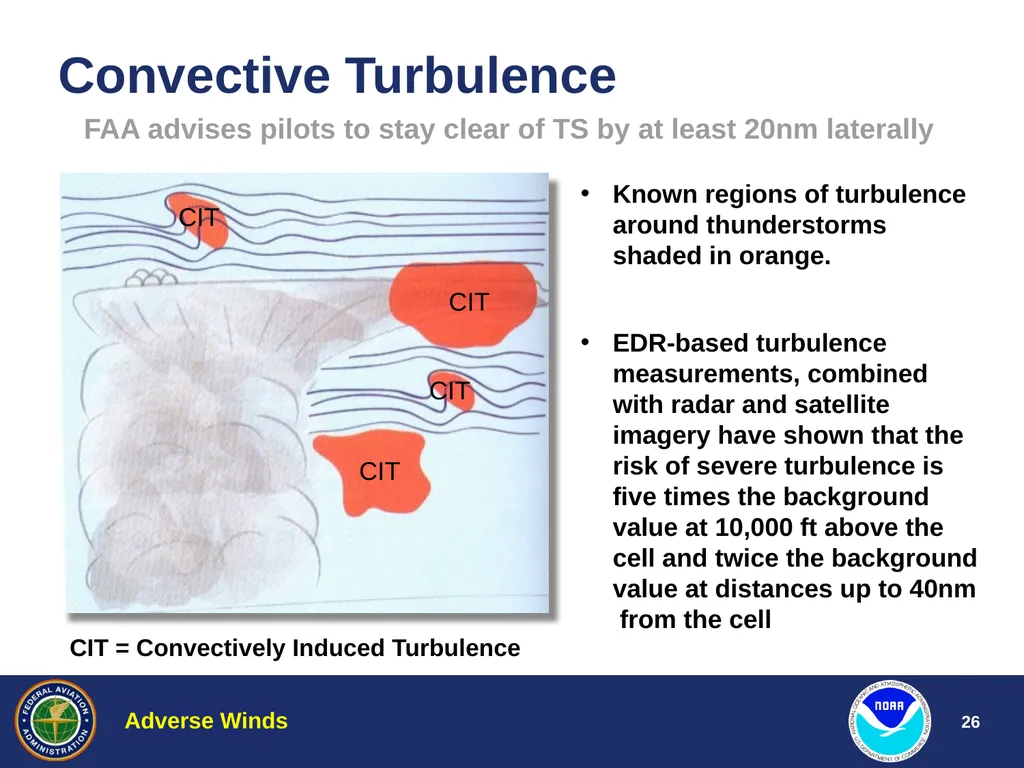
Convective Turbulence Courtesy Wikipedia: WikiProject Aviation Adverse Winds Known regions of turbulence around thunderstorms shaded in orange.
EDR-based turbulence measurements, combined with radar and satellite imagery have shown that the risk of severe turbulence is five times the background value at 10,000 ft above the cell and twice the background value at distances up to 40nm from the cell CIT = Convectively Induced Turbulence FAA advises pilots to stay clear of TS by at least 20nm laterally CIT CIT CIT CIT<br>
EDR-based turbulence measurements, combined with radar and satellite imagery have shown that the risk of severe turbulence is five times the background value at 10,000 ft above the cell and twice the background value at distances up to 40nm from the cell CIT = Convectively Induced Turbulence FAA advises pilots to stay clear of TS by at least 20nm laterally CIT CIT CIT CIT<br>
27
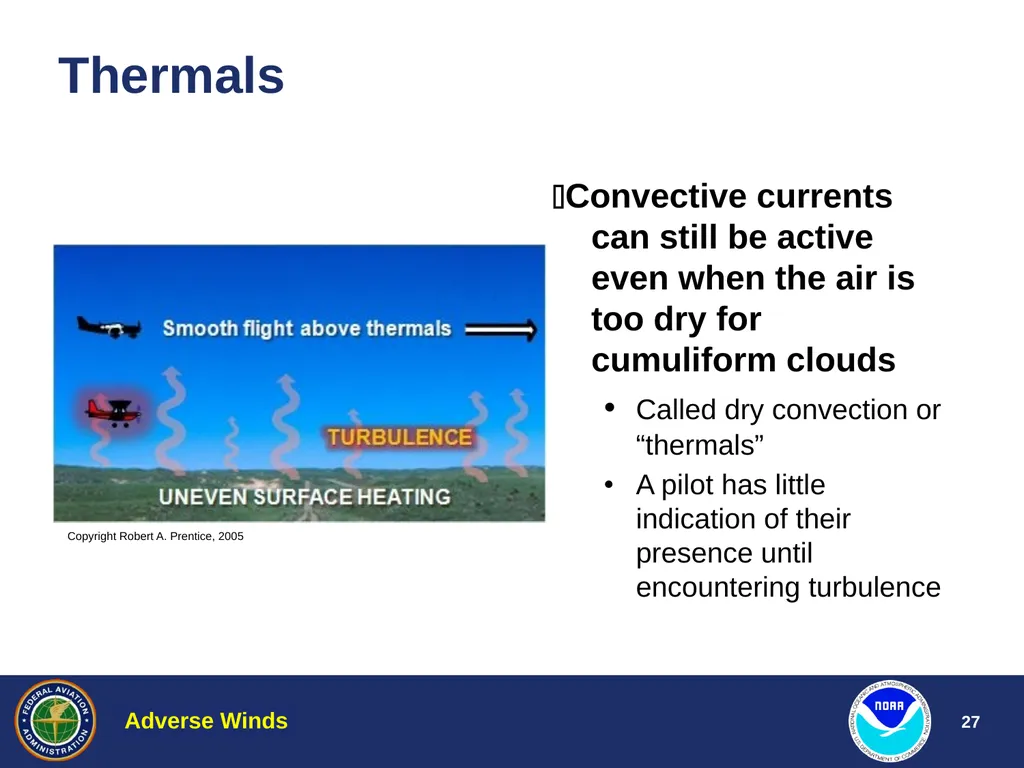
Thermals Convective currents can still be active even when the air is too dry for cumuliform clouds
Called dry convection or “thermals”
A pilot has little indication of their presence until encountering turbulence Copyright Robert A. Prentice, 2005 Adverse Winds<br>
Called dry convection or “thermals”
A pilot has little indication of their presence until encountering turbulence Copyright Robert A. Prentice, 2005 Adverse Winds<br>
28
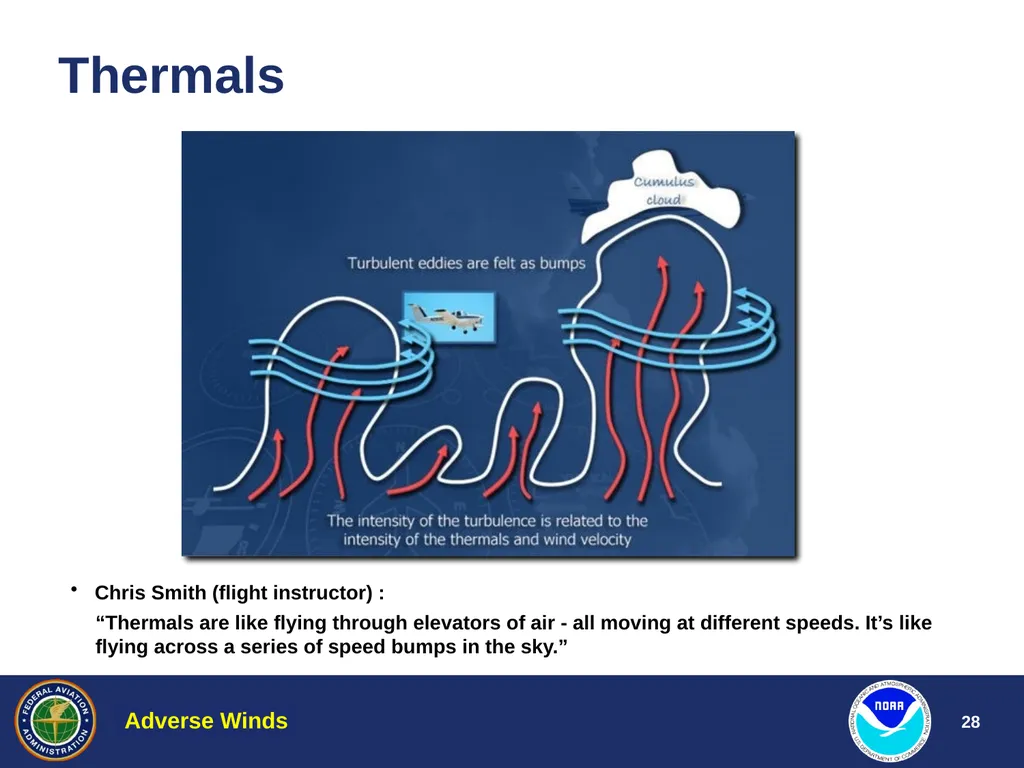
Thermals Adverse Winds Chris Smith (flight instructor) : “Thermals are like flying through elevators of air - all moving at different speeds. It’s like flying across a series of speed bumps in the sky.”<br>
29
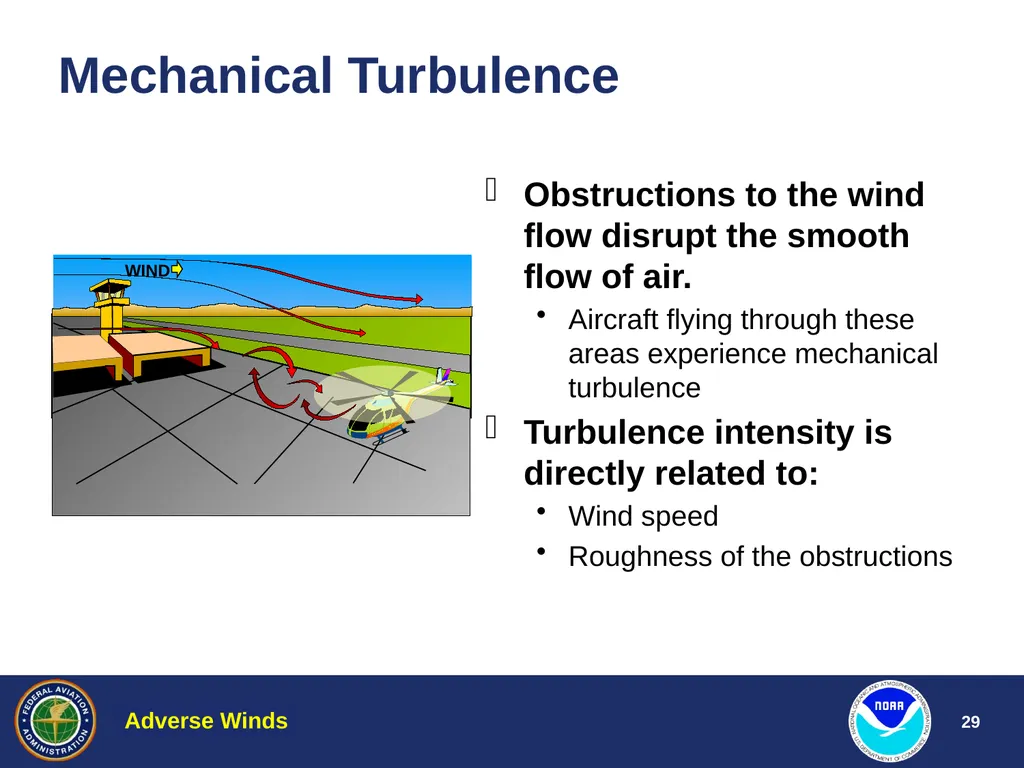
Mechanical Turbulence Obstructions to the wind flow disrupt the smooth flow of air.
Aircraft flying through these areas experience mechanical turbulence
Turbulence intensity is directly related to:
Wind speed
Roughness of the obstructions WIND Adverse Winds<br>
Aircraft flying through these areas experience mechanical turbulence
Turbulence intensity is directly related to:
Wind speed
Roughness of the obstructions WIND Adverse Winds<br>
30
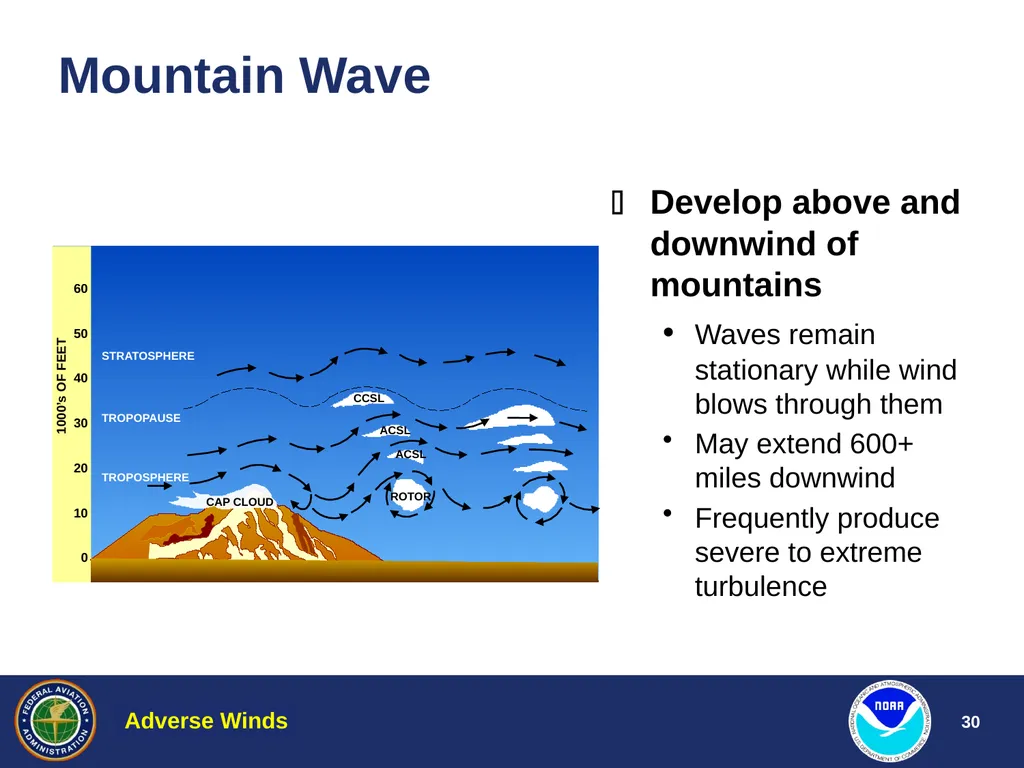
Mountain Wave Develop above and downwind of mountains
Waves remain stationary while wind blows through them
May extend 600+ miles downwind
Frequently produce severe to extreme turbulence Adverse Winds<br>
Waves remain stationary while wind blows through them
May extend 600+ miles downwind
Frequently produce severe to extreme turbulence Adverse Winds<br>
31
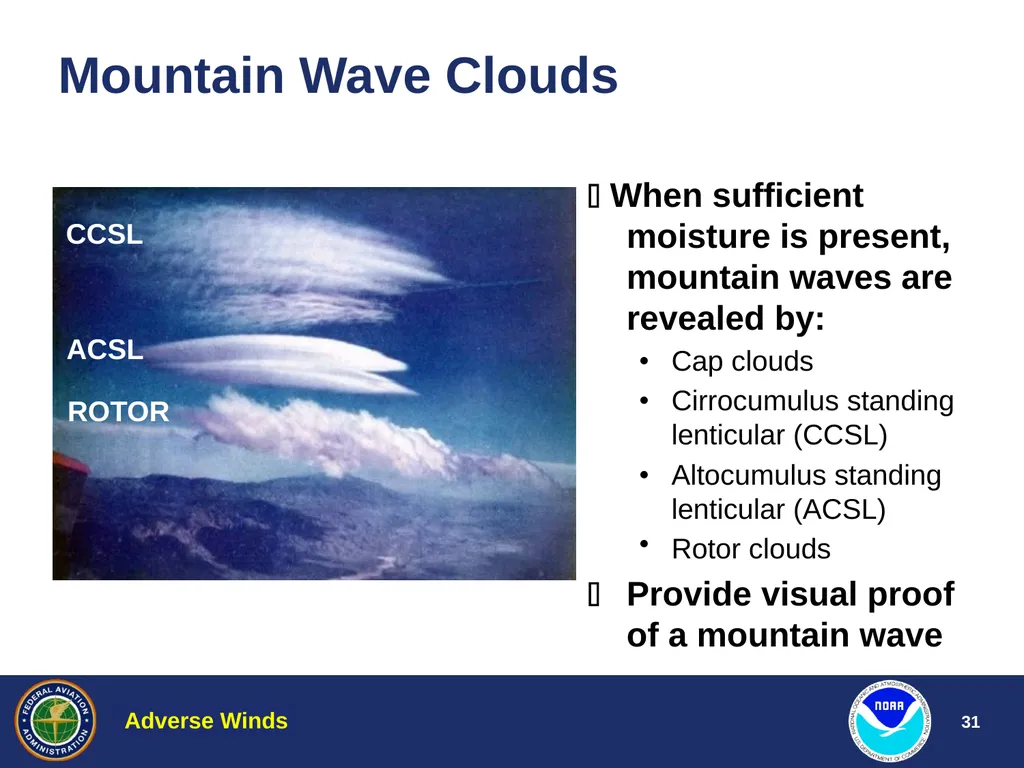
Mountain Wave Clouds When sufficient moisture is present, mountain waves are revealed by:
Cap clouds
Cirrocumulus standing lenticular (CCSL)
Altocumulus standing lenticular (ACSL)
Rotor clouds
Provide visual proof of a mountain wave CCSL ACSL ROTOR Adverse Winds<br>
Cap clouds
Cirrocumulus standing lenticular (CCSL)
Altocumulus standing lenticular (ACSL)
Rotor clouds
Provide visual proof of a mountain wave CCSL ACSL ROTOR Adverse Winds<br>
32
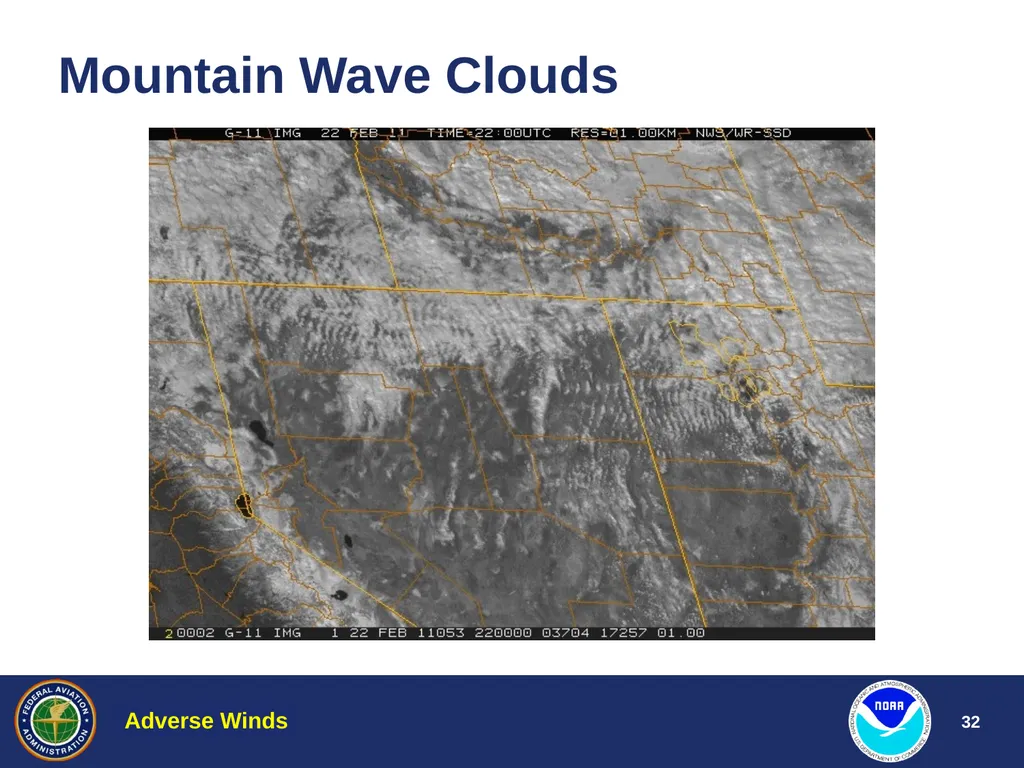
Mountain Wave Clouds Adverse Winds<br>
33
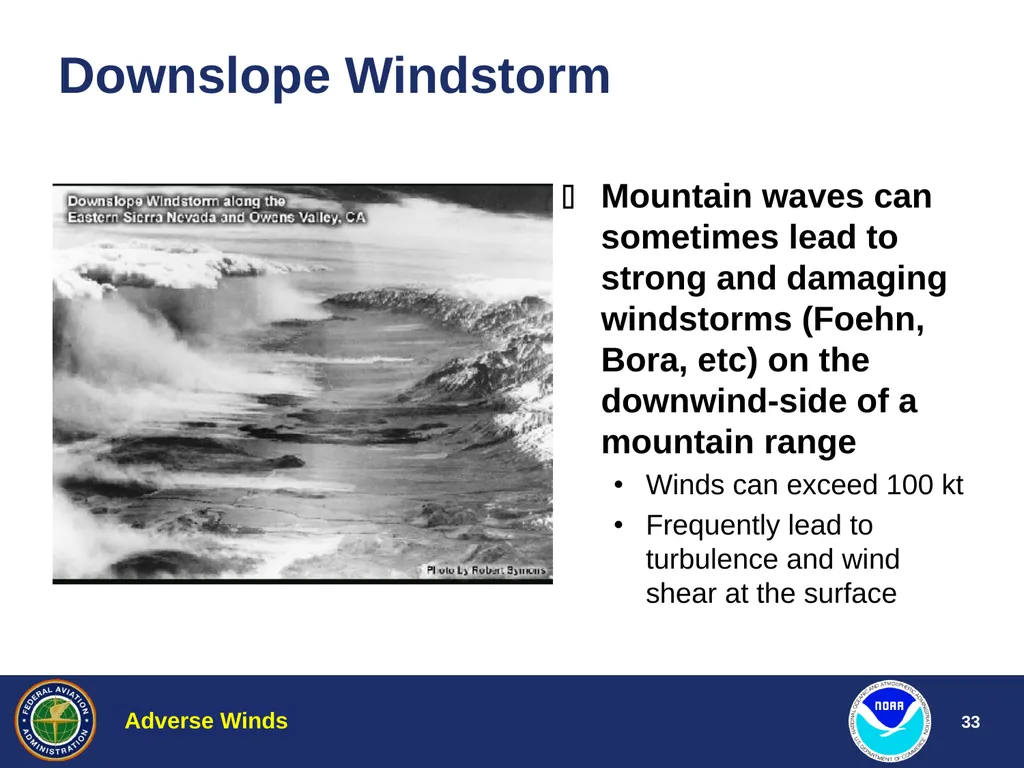
Downslope Windstorm Mountain waves can sometimes lead to strong and damaging windstorms (Foehn, Bora, etc) on the downwind-side of a mountain range
Winds can exceed 100 kt
Frequently lead to turbulence and wind shear at the surface Adverse Winds<br>
Winds can exceed 100 kt
Frequently lead to turbulence and wind shear at the surface Adverse Winds<br>
34
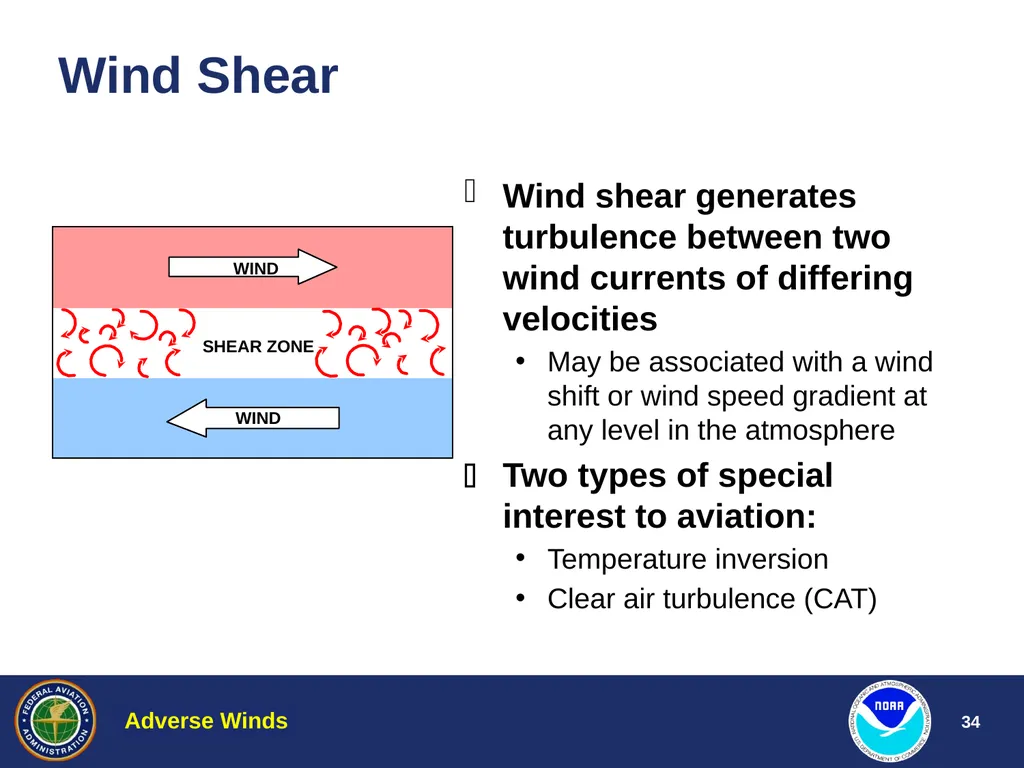
Wind Shear Wind shear generates turbulence between two wind currents of differing velocities
May be associated with a wind shift or wind speed gradient at any level in the atmosphere
Two types of special interest to aviation:
Temperature inversion
Clear air turbulence (CAT) WIND WIND SHEAR ZONE Adverse Winds<br>
May be associated with a wind shift or wind speed gradient at any level in the atmosphere
Two types of special interest to aviation:
Temperature inversion
Clear air turbulence (CAT) WIND WIND SHEAR ZONE Adverse Winds<br>
35
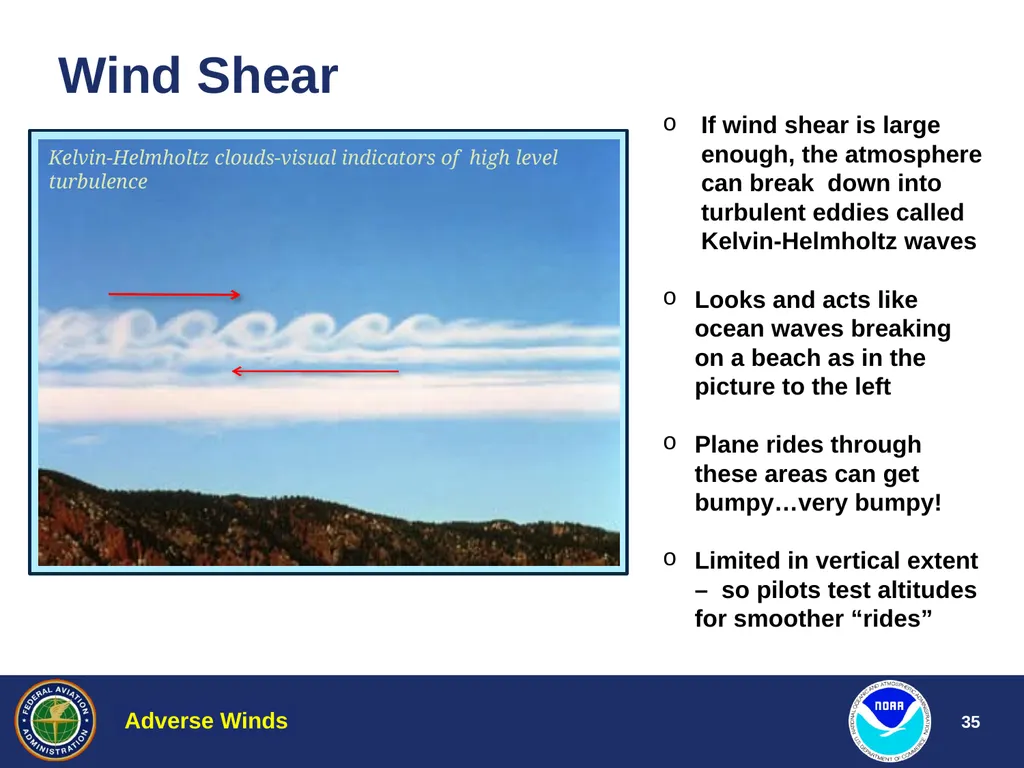
Wind Shear Adverse Winds If wind shear is large enough, the atmosphere can break down into turbulent eddies called Kelvin-Helmholtz waves
Looks and acts like ocean waves breaking on a beach as in the picture to the left
Plane rides through these areas can get bumpy…very bumpy!
Limited in vertical extent – so pilots test altitudes for smoother “rides”<br>
Looks and acts like ocean waves breaking on a beach as in the picture to the left
Plane rides through these areas can get bumpy…very bumpy!
Limited in vertical extent – so pilots test altitudes for smoother “rides”<br>
36
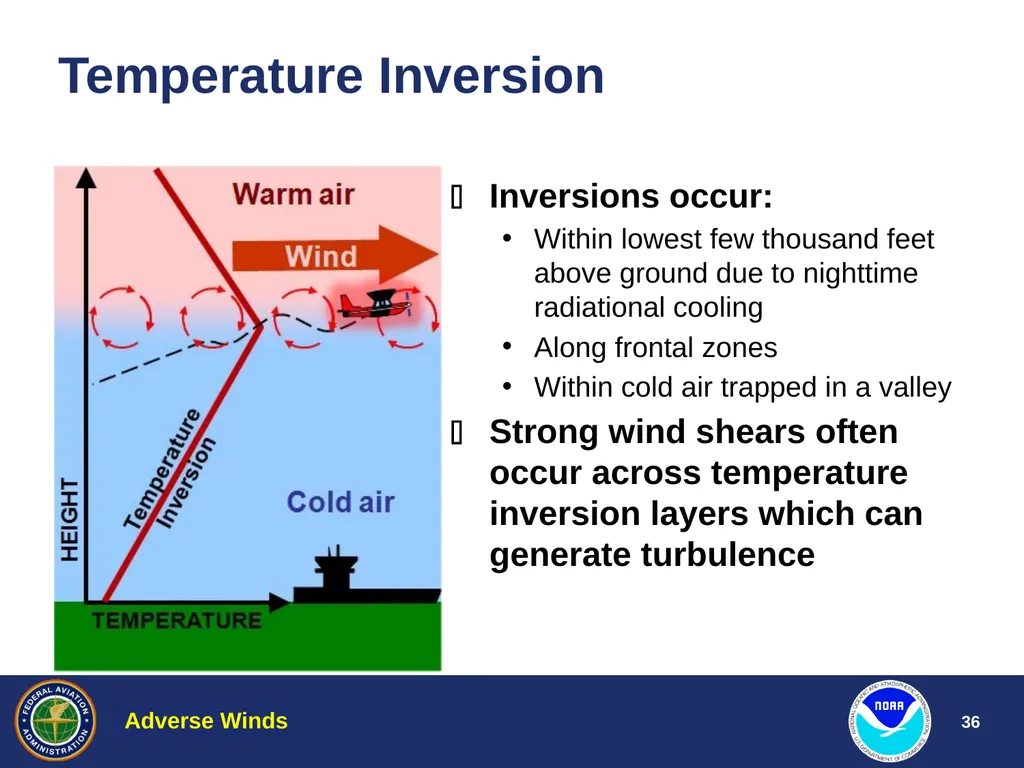
Temperature Inversion Inversions occur:
Within lowest few thousand feet above ground due to nighttime radiational cooling
Along frontal zones
Within cold air trapped in a valley
Strong wind shears often occur across temperature inversion layers which can generate turbulence Adverse Winds<br>
Within lowest few thousand feet above ground due to nighttime radiational cooling
Along frontal zones
Within cold air trapped in a valley
Strong wind shears often occur across temperature inversion layers which can generate turbulence Adverse Winds<br>
37
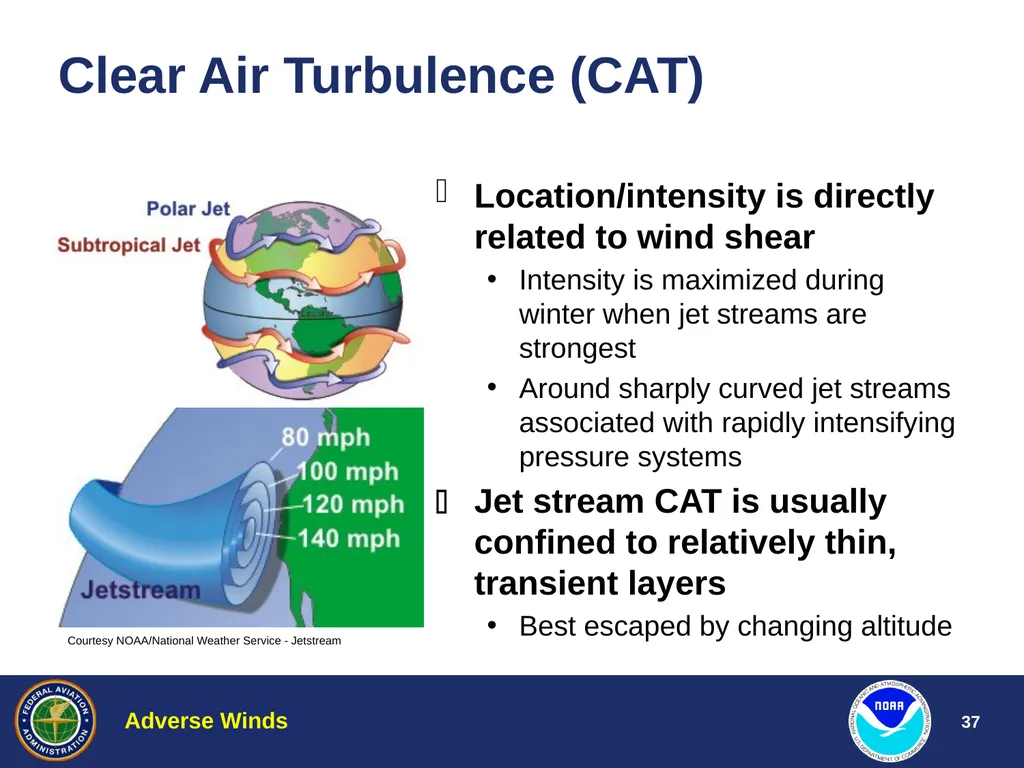
Clear Air Turbulence (CAT) Location/intensity is directly related to wind shear
Intensity is maximized during winter when jet streams are strongest
Around sharply curved jet streams associated with rapidly intensifying pressure systems
Jet stream CAT is usually confined to relatively thin, transient layers
Best escaped by changing altitude Courtesy NOAA/National Weather Service - Jetstream Adverse Winds<br>
38
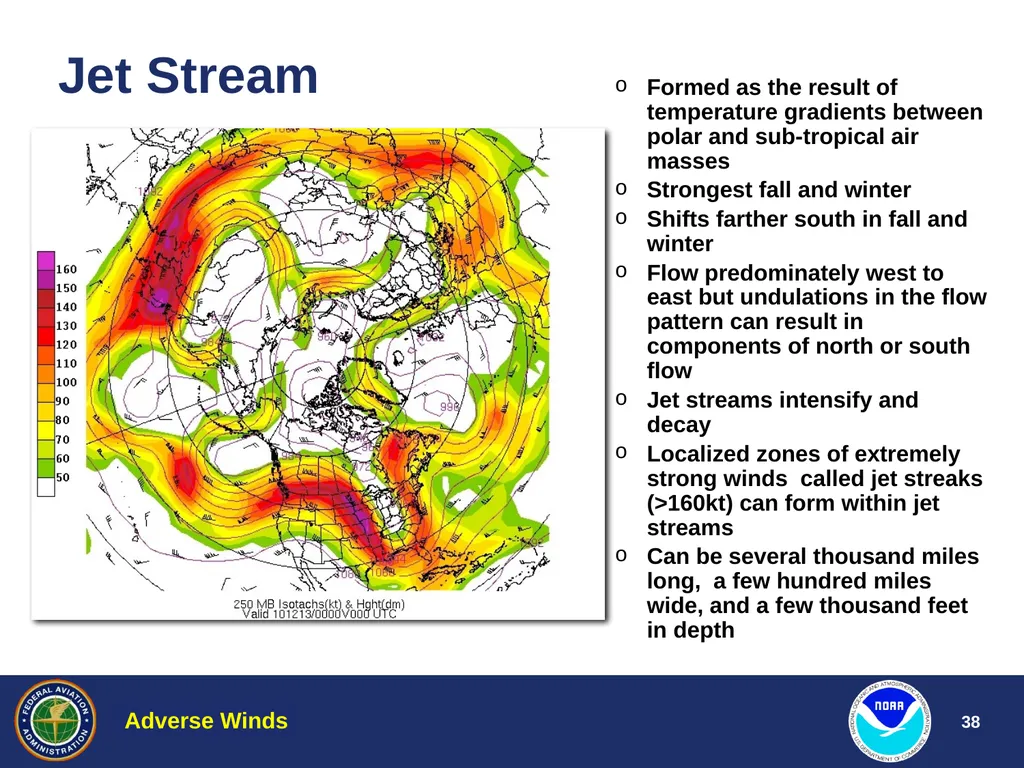
Jet Stream Adverse Winds Formed as the result of temperature gradients between polar and sub-tropical air masses
Strongest fall and winter
Shifts farther south in fall and winter
Flow predominately west to east but undulations in the flow pattern can result in components of north or south flow
Jet streams intensify and decay
Localized zones of extremely strong winds called jet streaks (>160kt) can form within jet streams
Can be several thousand miles long, a few hundred miles wide, and a few thousand feet in depth<br>
39
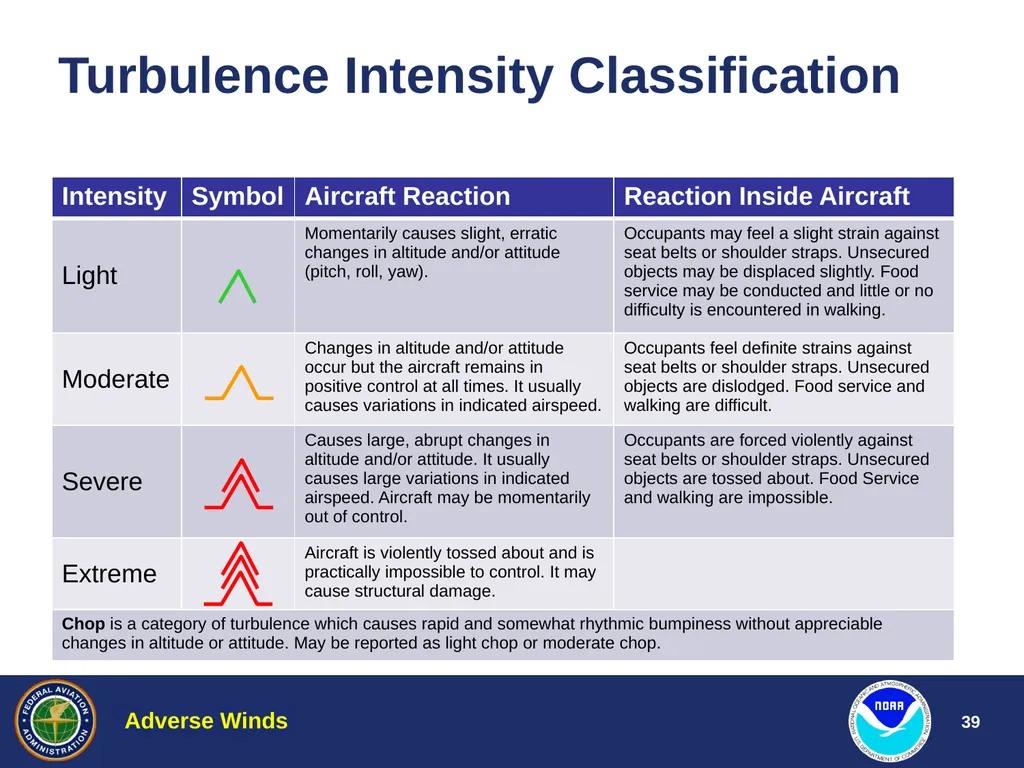
Turbulence Intensity Classification Adverse Winds<br>
40
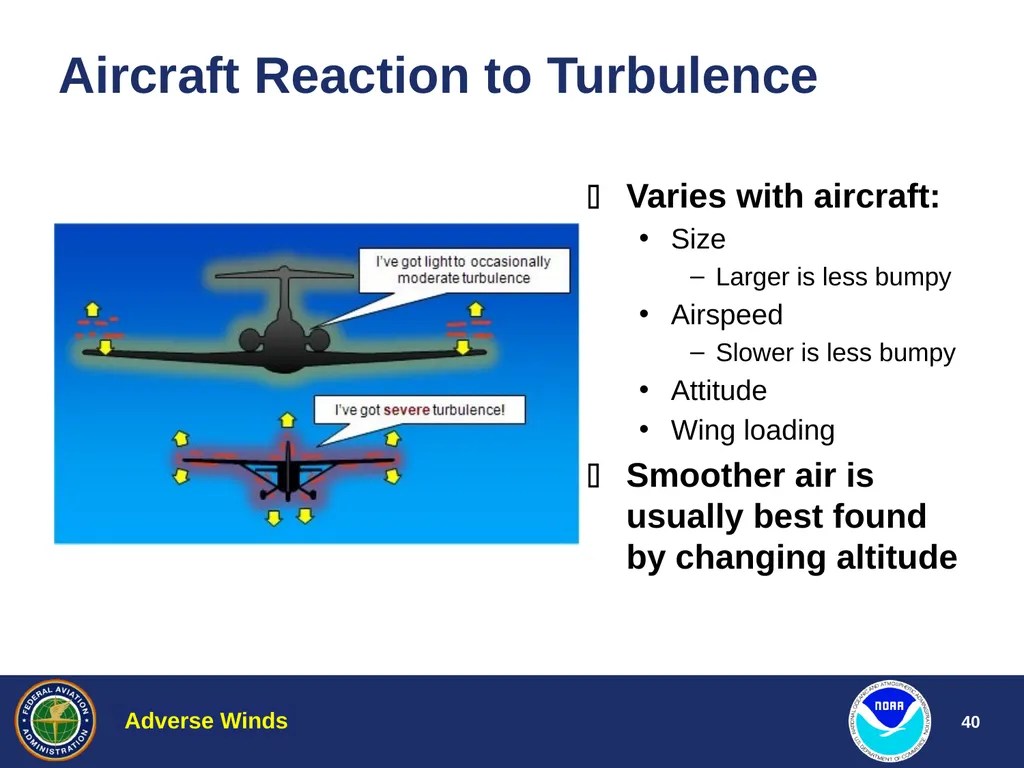
Aircraft Reaction to Turbulence Varies with aircraft:
Size
Larger is less bumpy
Airspeed
Slower is less bumpy
Attitude
Wing loading
Smoother air is usually best found by changing altitude Adverse Winds<br>
Size
Larger is less bumpy
Airspeed
Slower is less bumpy
Attitude
Wing loading
Smoother air is usually best found by changing altitude Adverse Winds<br>
41
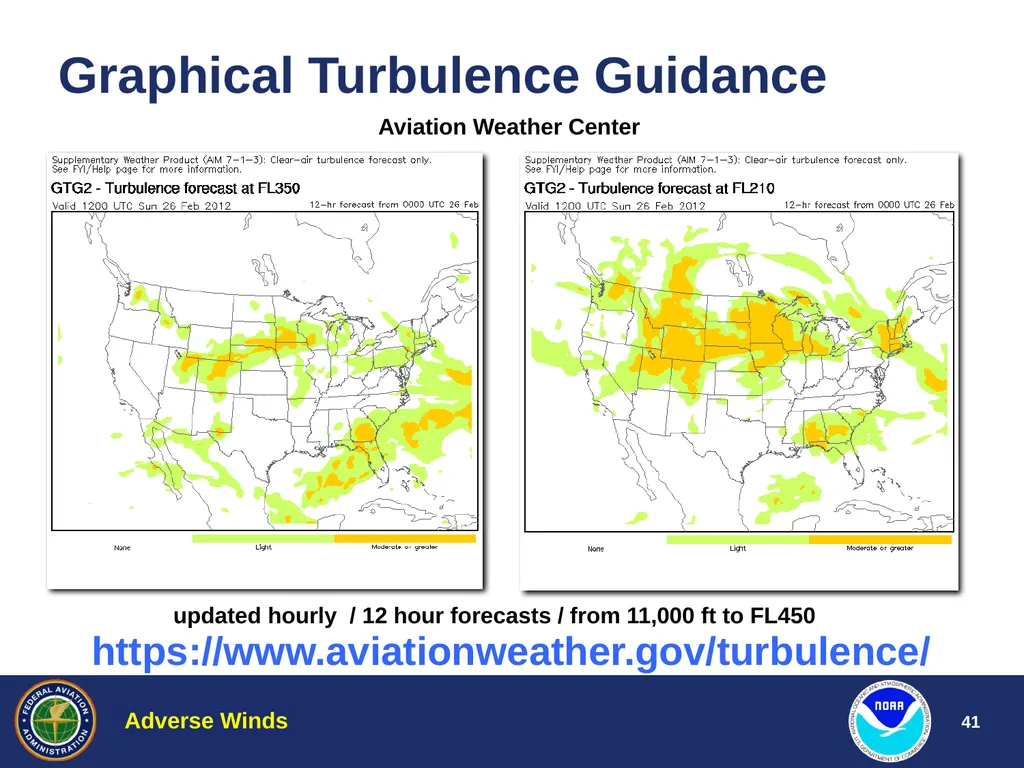
Graphical Turbulence Guidance Adverse Winds updated hourly / 12 hour forecasts / from 11,000 ft to FL450 Aviation Weather Center https://www.aviationweather.gov/turbulence/<br>
42
Response Item When the air is too dry for cumuliform clouds to form, _______ currents called thermals can still be active and cause turbulence.
A. wind shear
B. mechanical
C. convective Adverse Winds<br>
A. wind shear
B. mechanical
C. convective Adverse Winds<br>
43
Response Item Which of the following clouds would provide visual proof that a mountain wave exists?
A. Rotor cloud
B. Towering Cumulus (TCU)
C. Cumulonimbus (CB) Adverse Winds<br>
A. Rotor cloud
B. Towering Cumulus (TCU)
C. Cumulonimbus (CB) Adverse Winds<br>
44
Response Item _______ generates turbulent eddies between two wind currents of differing velocities.
A. Wind shear
B. Obstructions to the wind flow
C. Convective currents Adverse Winds<br>
A. Wind shear
B. Obstructions to the wind flow
C. Convective currents Adverse Winds<br>
45
Response Item _______ turbulence momentarily causes slight erratic changes in altitude and/or attitude (pitch, roll, yaw).
A. Light
B. Moderate
C. Severe Adverse Winds<br>
A. Light
B. Moderate
C. Severe Adverse Winds<br>
46
Response Item With _______ turbulence, the aircraft is violently tossed about and is practically impossible to control. It may cause structural damage.
A. moderate
B. severe
C. extreme Adverse Winds<br>
A. moderate
B. severe
C. extreme Adverse Winds<br>
47
Response Item Aircraft reaction to turbulence varies with aircraft _______.
A. altitude
B. size
C. navigational equipment Adverse Winds<br>
A. altitude
B. size
C. navigational equipment Adverse Winds<br>
48
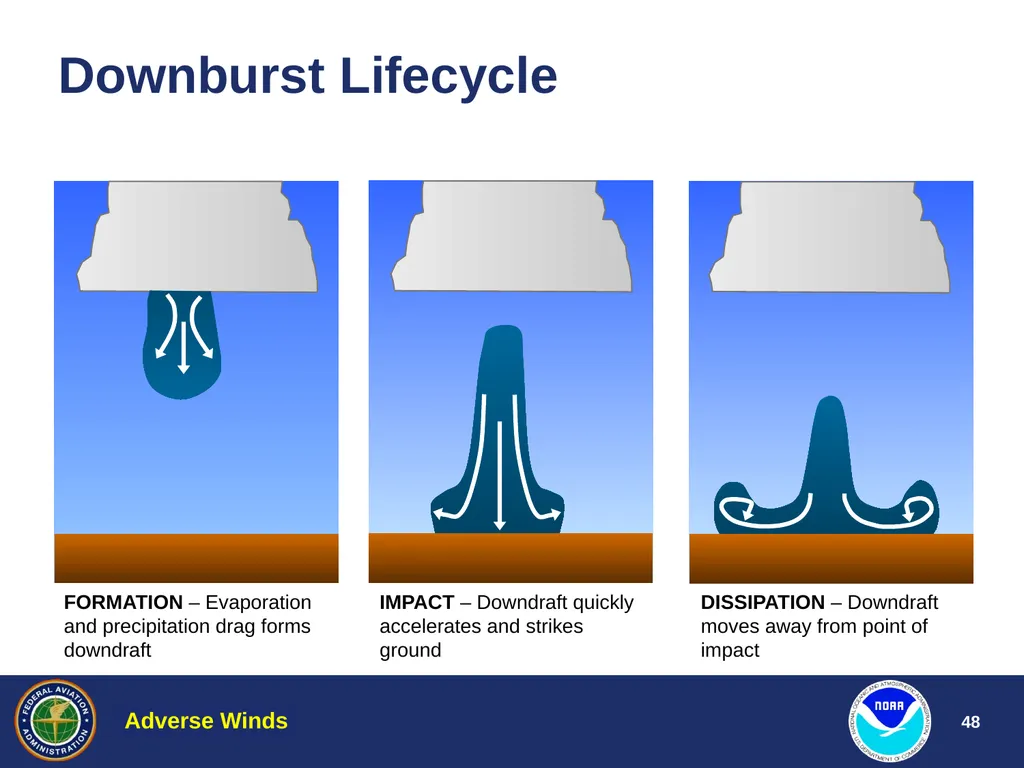
Downburst Lifecycle FORMATION – Evaporation and precipitation drag forms downdraft IMPACT – Downdraft quickly accelerates and strikes ground DISSIPATION – Downdraft moves away from point of impact Adverse Winds<br>
49
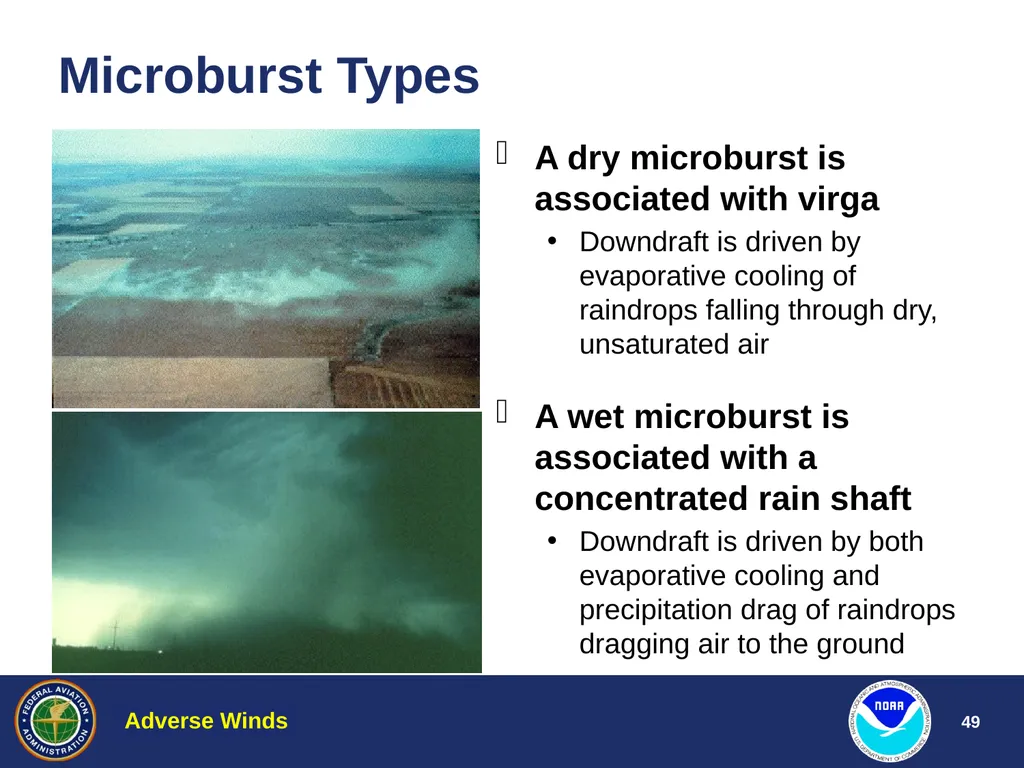
Microburst Types A dry microburst is associated with virga
Downdraft is driven by evaporative cooling of raindrops falling through dry, unsaturated air
A wet microburst is associated with a concentrated rain shaft
Downdraft is driven by both evaporative cooling and precipitation drag of raindrops dragging air to the ground Adverse Winds<br>
Downdraft is driven by evaporative cooling of raindrops falling through dry, unsaturated air
A wet microburst is associated with a concentrated rain shaft
Downdraft is driven by both evaporative cooling and precipitation drag of raindrops dragging air to the ground Adverse Winds<br>
50
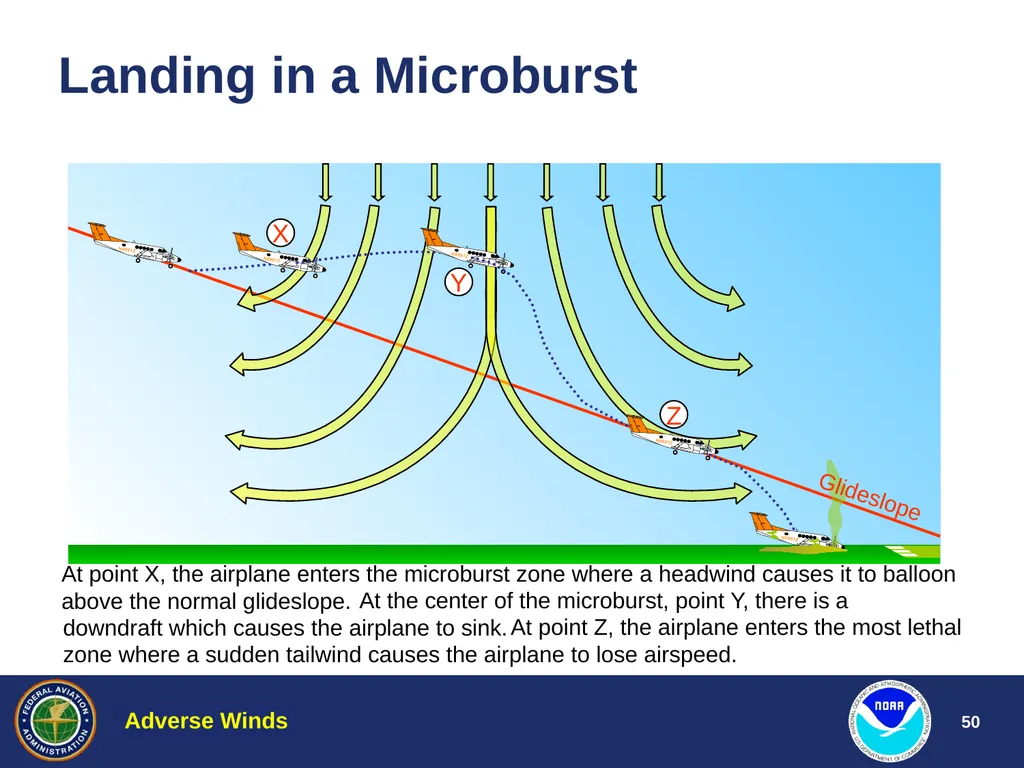
Landing in a Microburst At the center of the microburst, point Y, there is a downdraft which causes the airplane to sink. At point Z, the airplane enters the most lethal zone where a sudden tailwind causes the airplane to lose airspeed. At point X, the airplane enters the microburst zone where a headwind causes it to balloon above the normal glideslope. Adverse Winds<br>
51
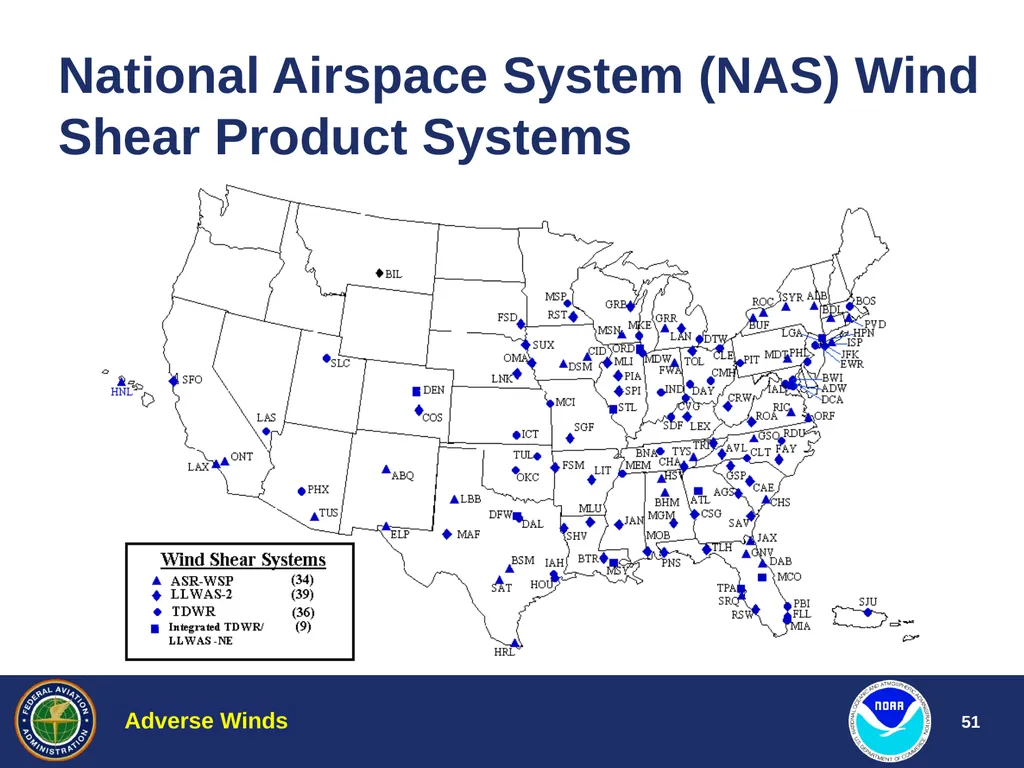
National Airspace System (NAS) Wind Shear Product Systems Adverse Winds<br>
52
Response Item It may be impossible to recover from _______ encountered at low altitude.
A. a headwind
B. a microburst
C. an outburst Adverse Winds<br>
A. a headwind
B. a microburst
C. an outburst Adverse Winds<br>
53
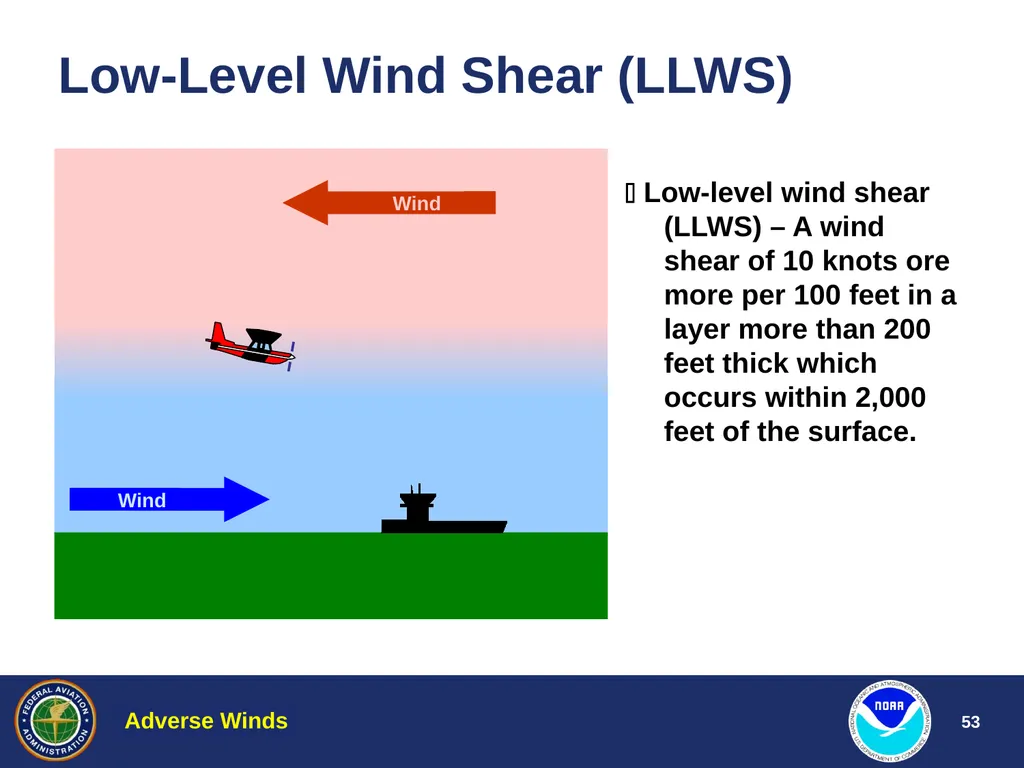
Low-Level Wind Shear (LLWS) Low-level wind shear (LLWS) – A wind shear of 10 knots ore more per 100 feet in a layer more than 200 feet thick which occurs within 2,000 feet of the surface. Adverse Winds<br>
54
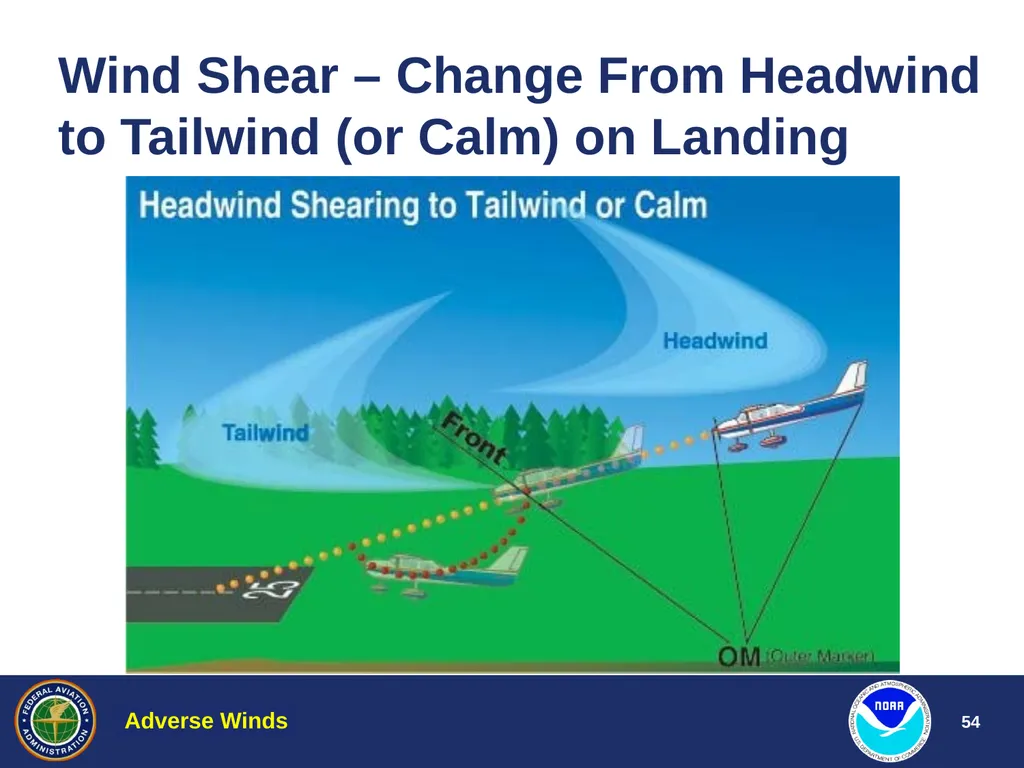
Wind Shear – Change From Headwind to Tailwind (or Calm) on Landing Adverse Winds<br>
55
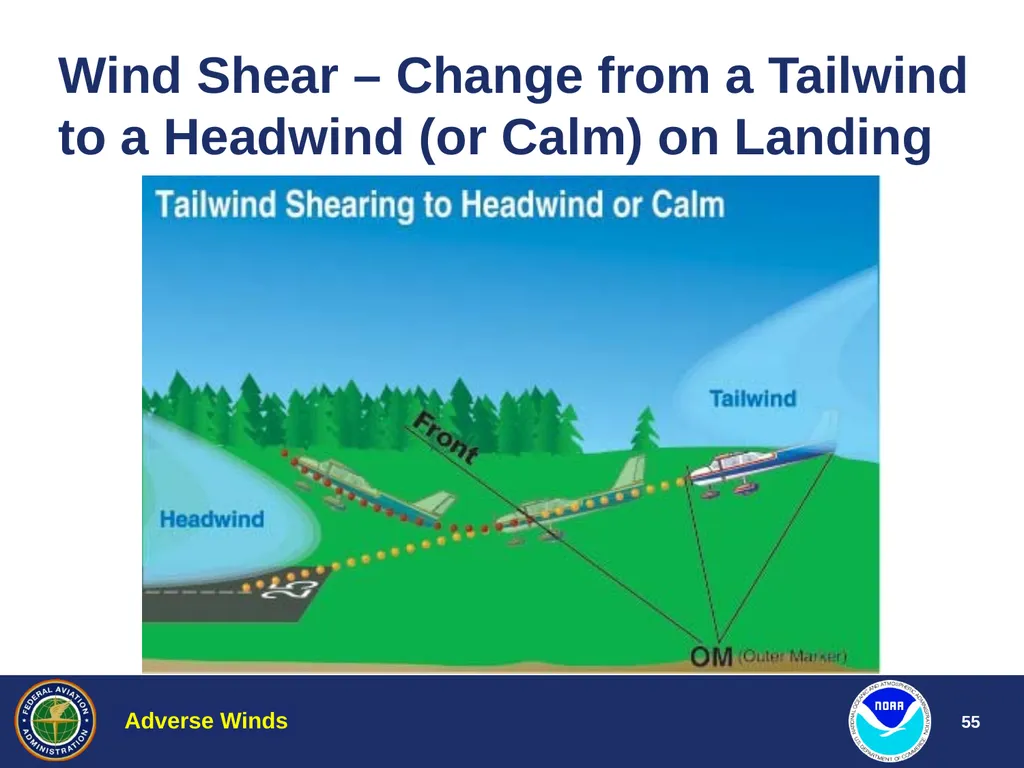
Wind Shear – Change from a Tailwind to a Headwind (or Calm) on Landing Adverse Winds<br>
56
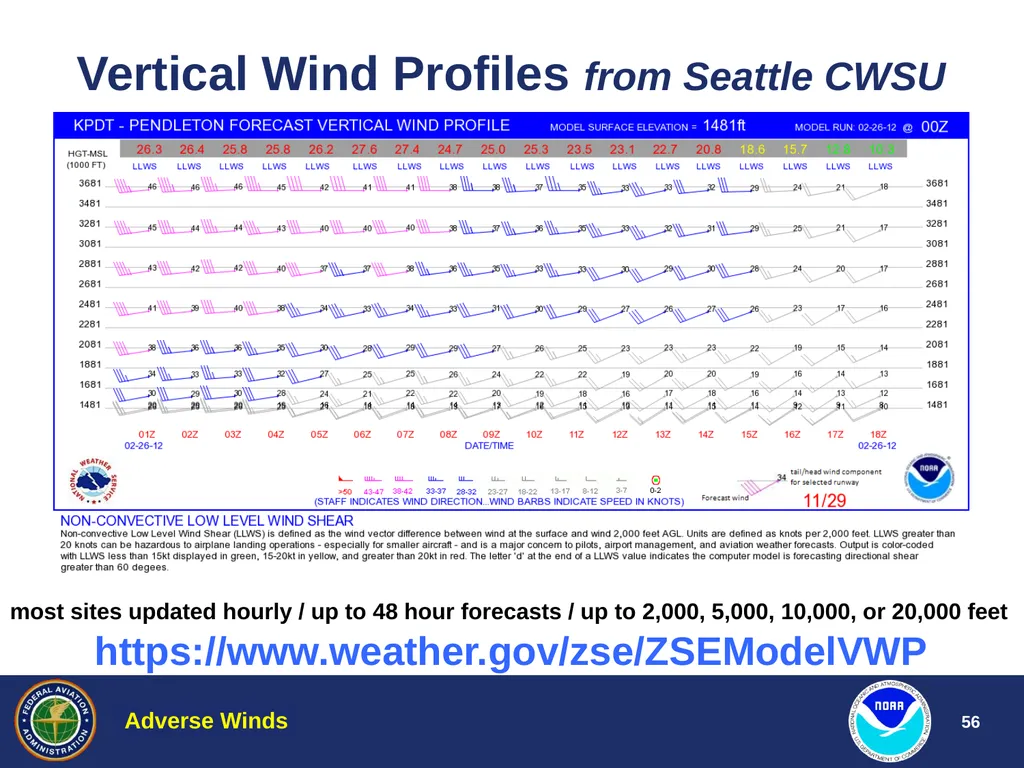
Vertical Wind Profiles from Seattle CWSU Adverse Winds most sites updated hourly / up to 48 hour forecasts / up to 2,000, 5,000, 10,000, or 20,000 feet https://www.weather.gov/zse/ZSEModelVWP<br>
57
Response Item Wind shear is especially dangerous when it is encountered _______.
A. during takeoff and landing
B. enroute
C. while in a holding pattern Adverse Winds<br>
A. during takeoff and landing
B. enroute
C. while in a holding pattern Adverse Winds<br>
58
Response Item While an aircraft is on approach, a shear from a tailwind to a headwind causes airspeed to _______, the nose to pitch _______, and the aircraft to _______ the glide slope.
A. increase, up, balloon upward above
B. increase, up, drop below
C. decrease, down, drop below Adverse Winds<br>
A. increase, up, balloon upward above
B. increase, up, drop below
C. decrease, down, drop below Adverse Winds<br>
59
What You Can Do Adverse Winds Continue to report turbulence…even reports of no turbulence when it’s forecast. These will help other pilots, dispatchers, aviation forecasters, and ARTCC controllers do a better job in making sure you have a safe and comfortable ride! Report encounters with turbulence<br>
60
The End Adverse Winds<br>