Avoiding Bias in Video Interview Training Every candidate deserves an equal opportunity to demonstrate their potential fit for your school or system. To meet this goal and hire strong, diverse candidates, you must become aware of and avoid
"Avoiding Bias in Video Interview Training Every" is the property of its rightful owner. Permission is granted to
download and print the materials on this website for personal, non-commercial use only, and to display it
on your personal computer provided you do not modify the materials and that you retain all copyright
notices contained in the materials. By downloading content from our website, you accept the terms of this
agreement.
Presentation Transcript
01
Avoiding Bias in Video Interview Training<br>
02
Every candidate deserves an equal opportunity to demonstrate their potential fit for your school or system. To meet this goal and hire strong, diverse candidates, you must become aware of and avoid implicit bias when interviewing. The next slides will help you identify, understand, and learn to counter the biases that may affect your work.
This is only a starting point: We encourage you to reflect regularly, both individually and as a hiring team.<br>
03
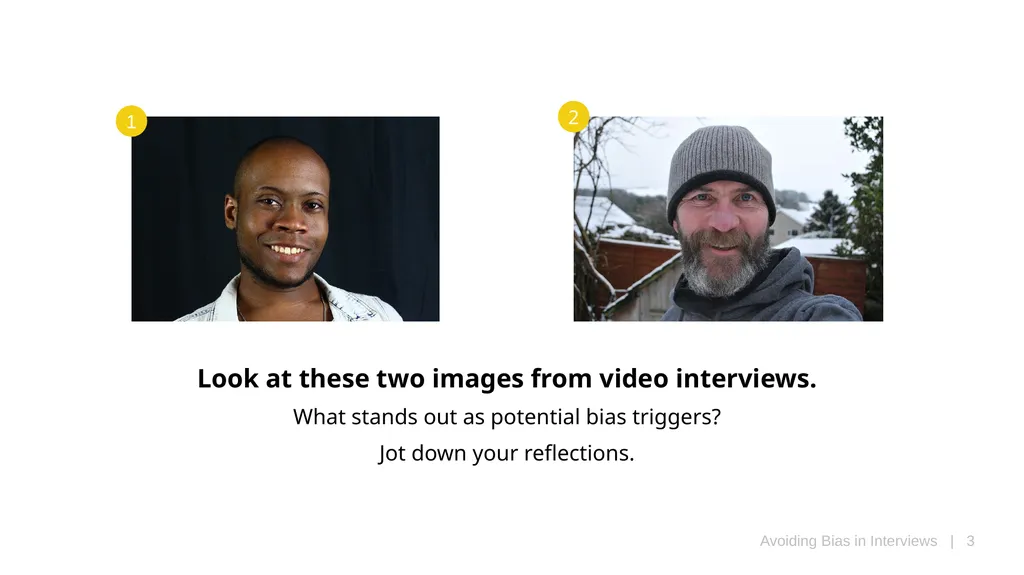
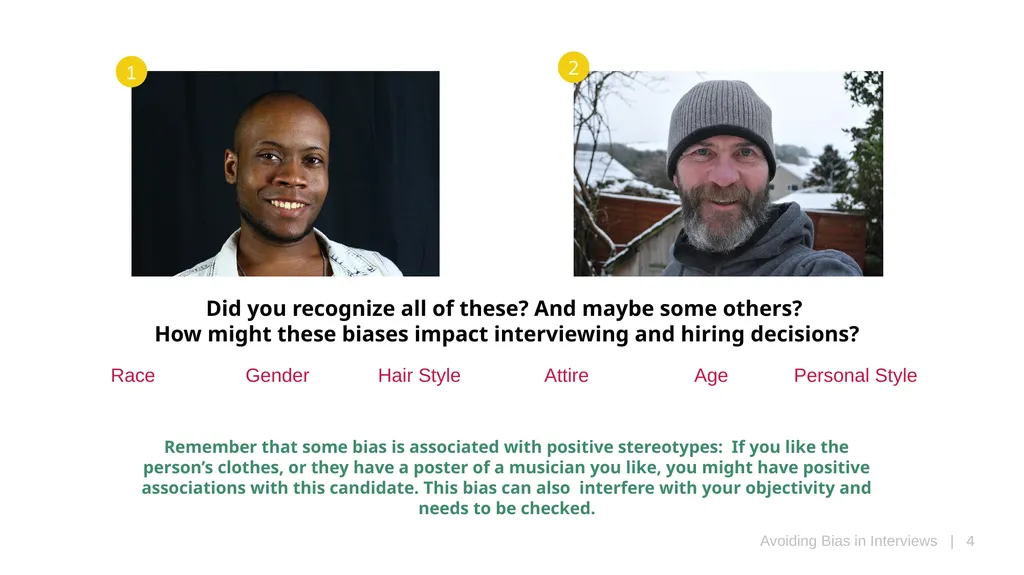
Look at these two images from video interviews.
What stands out as potential bias triggers?
Jot down your reflections. Avoiding Bias in Interviews | 3 1 2<br>
04
| 4 Did you recognize all of these? And maybe some others? How might these biases impact interviewing and hiring decisions? Remember that some bias is associated with positive stereotypes: If you like the person’s clothes, or they have a poster of a musician you like, you might have positive associations with this candidate. This bias can also interfere with your objectivity and needs to be checked. Avoiding Bias in Interviews 1 2<br>
05
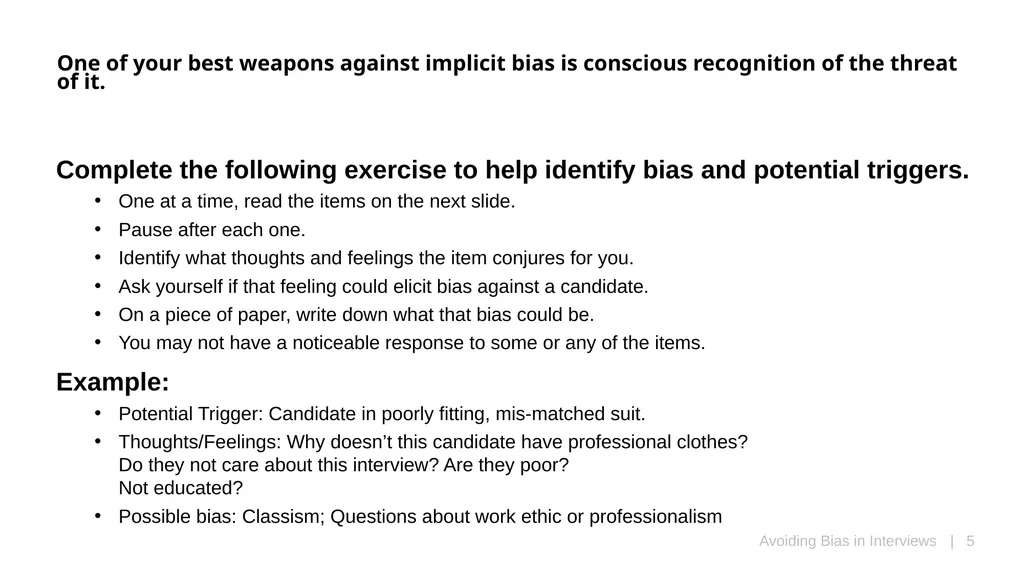
Complete the following exercise to help identify bias and potential triggers.
One at a time, read the items on the next slide.
Pause after each one.
Identify what thoughts and feelings the item conjures for you.
Ask yourself if that feeling could elicit bias against a candidate.
On a piece of paper, write down what that bias could be.
You may not have a noticeable response to some or any of the items.
Example:
Potential Trigger: Candidate in poorly fitting, mis-matched suit.
Thoughts/Feelings: Why doesn’t this candidate have professional clothes? Do they not care about this interview? Are they poor? Not educated?
Possible bias: Classism; Questions about work ethic or professionalism One of your best weapons against implicit bias is conscious recognition of the threat of it. | 5 Avoiding Bias in Interviews<br>
06
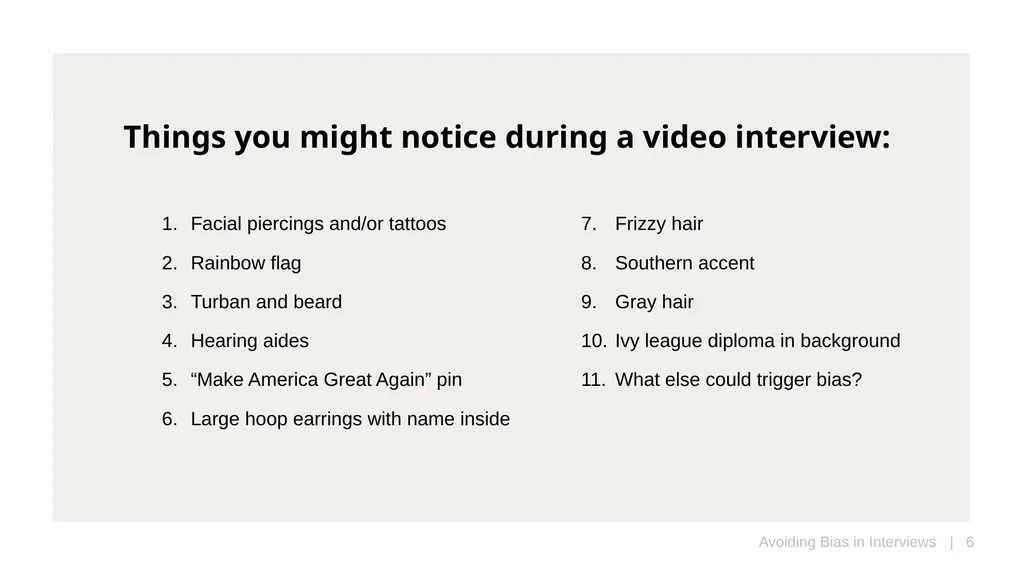
Things you might notice during a video interview: Facial piercings and/or tattoos
Rainbow flag
Turban and beard
Hearing aides
“Make America Great Again” pin
Large hoop earrings with name inside
Frizzy hair
Southern accent
Gray hair
Ivy league diploma in background
What else could trigger bias? | 6 Avoiding Bias in Interviews<br>
07
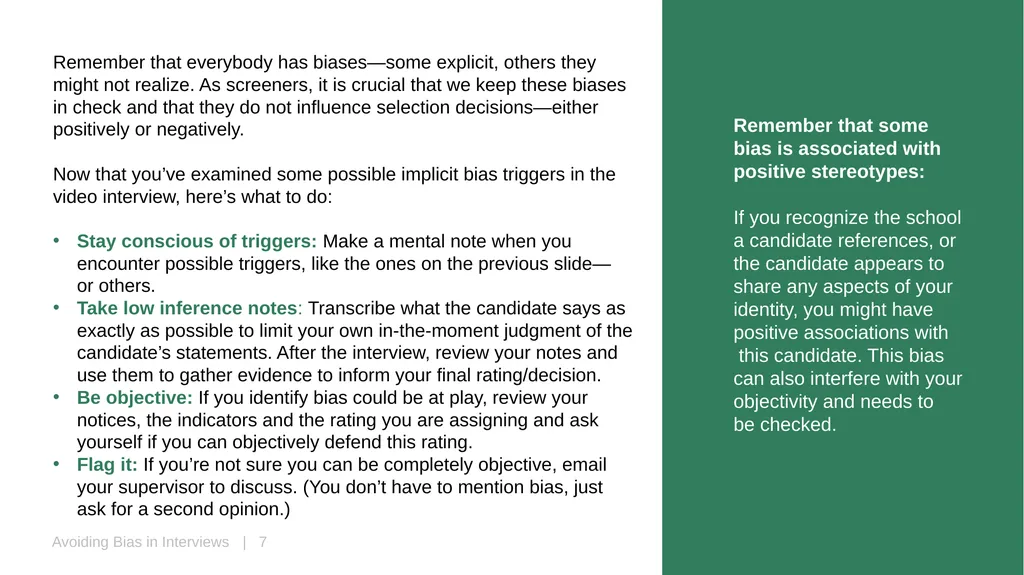
Remember that everybody has biases—some explicit, others they might not realize. As screeners, it is crucial that we keep these biases in check and that they do not influence selection decisions—either positively or negatively.
Now that you’ve examined some possible implicit bias triggers in the video interview, here’s what to do:
Stay conscious of triggers: Make a mental note when you encounter possible triggers, like the ones on the previous slide—or others.
Take low inference notes: Transcribe what the candidate says as exactly as possible to limit your own in-the-moment judgment of the candidate’s statements. After the interview, review your notes and use them to gather evidence to inform your final rating/decision.
Be objective: If you identify bias could be at play, review your notices, the indicators and the rating you are assigning and ask yourself if you can objectively defend this rating.
Flag it: If you’re not sure you can be completely objective, email your supervisor to discuss. (You don’t have to mention bias, just ask for a second opinion.) Remember that some bias is associated with positive stereotypes:
If you recognize the school a candidate references, or the candidate appears to share any aspects of your identity, you might have positive associations with this candidate. This bias can also interfere with your objectivity and needs to be checked. | 7 Avoiding Bias in Interviews<br>
08
| 8 Reflection:
What is one next step you’ll take to reduce implicit bias in your selection and hiring processes? Share with your team. Avoiding Bias in Interviews<br>
09
| 9 Terms of Use
These tools and resources are provided for informational or educational use only and are not intended as a service. Unless otherwise indicated, the resources provided on the Teacher Talent Toolbox are licensed under the Creative Commons Attribution Non-Commercial Share-Alike license and are subject to the copyright rules under that license.
Commercial use of the materials is not allowed without explicit written permission from TNTP, Inc. Unless otherwise noted, any distribution of materials posted on this website must credit TNTP, Inc. as follows:
From Teacher Talent Toolbox (2020) by TNTP, Inc., available at https://tntp.org /toolkit/teacher-talent-toolbox/
Permission to copy, use and distribute materials as described above shall not extend to information housed on the Teacher Talent Toolbox and credited to other sources, or information on websites to which this site links. Avoiding Bias in Interviews<br>