
Avoiding Kidney Injury: Cardiac Surgery Objectives
AS
Published · 32 slides · 0 views
1 / 1

Description
Avoiding Kidney Injury: Cardiac Surgery Objectives Additional Resources For a more in-depth overview of kidney disease, including staging definitions, please reference: MPOG Avoiding Kidney Injury - Overview, Pathophysiology, Definitions
Related Topics
Share
Embed code
Download this presentation From Below
"Avoiding Kidney Injury: Cardiac Surgery Objectives" is the property of its rightful owner. Permission is granted to download and print the materials on this website for personal, non-commercial use only, and to display it on your personal computer provided you do not modify the materials and that you retain all copyright notices contained in the materials. By downloading content from our website, you accept the terms of this agreement.
Presentation Transcript
01
Avoiding Kidney Injury: Cardiac Surgery<br>
02
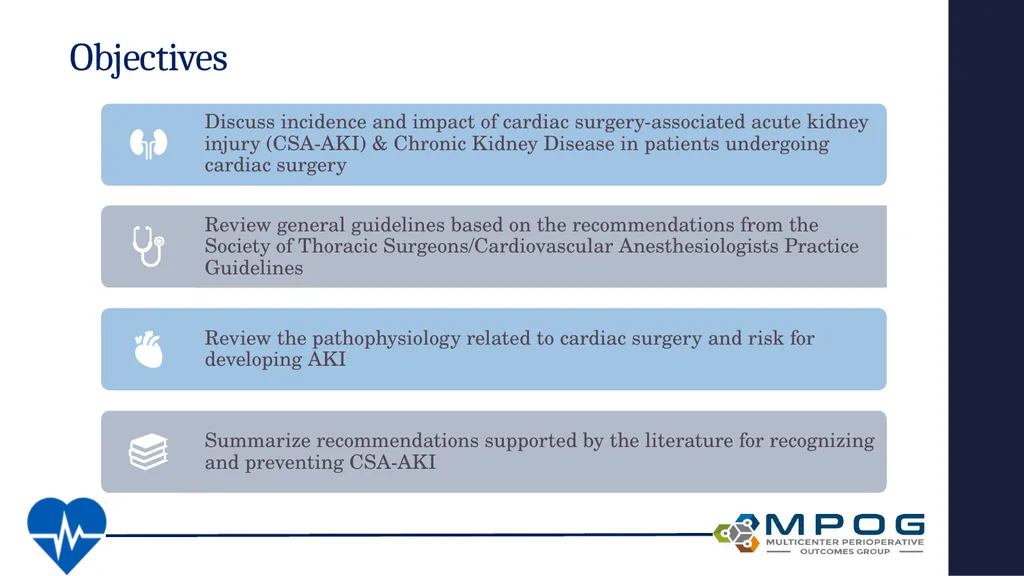
Objectives<br>
03
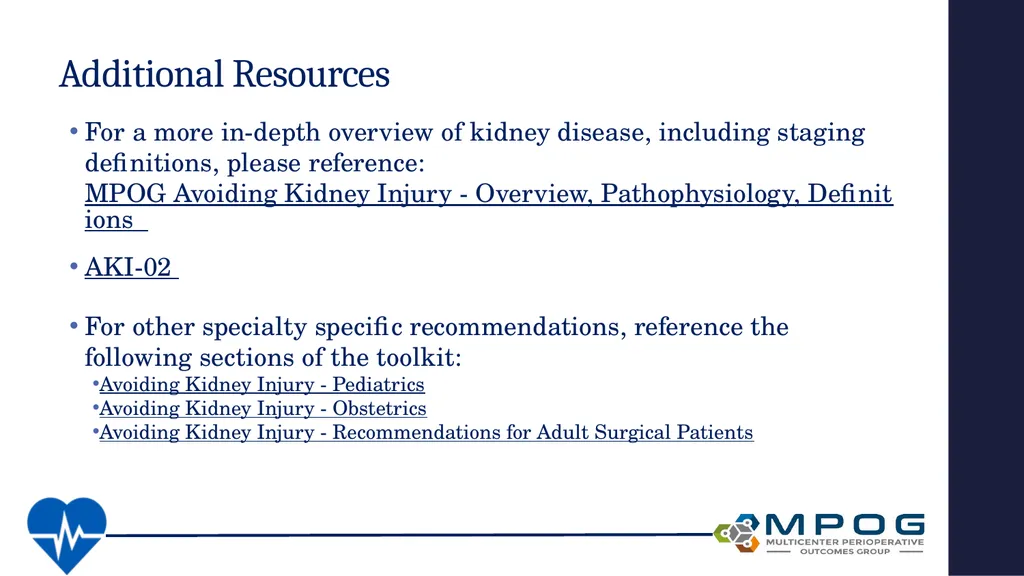
Additional Resources For a more in-depth overview of kidney disease, including staging definitions, please reference: MPOG Avoiding Kidney Injury - Overview, Pathophysiology, Definitions
AKI-02
For other specialty specific recommendations, reference the following sections of the toolkit:
Avoiding Kidney Injury - Pediatrics
Avoiding Kidney Injury - Obstetrics
Avoiding Kidney Injury - Recommendations for Adult Surgical Patients<br>
AKI-02
For other specialty specific recommendations, reference the following sections of the toolkit:
Avoiding Kidney Injury - Pediatrics
Avoiding Kidney Injury - Obstetrics
Avoiding Kidney Injury - Recommendations for Adult Surgical Patients<br>
04
Incidence of Cardiac Surgery - Acute Kidney Injury Acute kidney injury (AKI) is a common complication after cardiac surgery and occurs in 20-30% of pateints 1
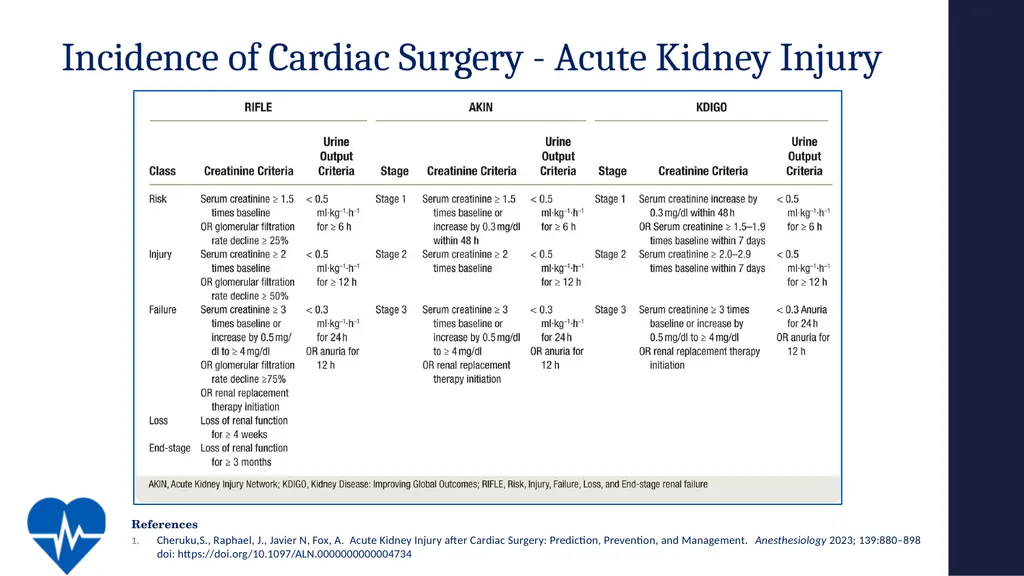
The Society of Thoracic Surgeons defines AKI as a 3-fold increase in serum creatinine, creatinine more than 4 mg/dL, or initiation of dialysis after cardiac surgery. 1
28% (287/1030) patients: 2013 single-center registry, AKIN criteria 2
36% (819/2,284) patients: 2018 single-center prospective cohort study, KDIGO criteria 3
36% (931/2,575) patients: 2017 single-center retrospective analysis, KDIGO criteria 4
50% (221/443) patients: 2015 single-center retrospective study, RIFLE definition 5 References:
Cheruku,S., Raphael, J., Javier N, Fox, A. Acute Kidney Injury after Cardiac Surgery: Prediction, Prevention, and Management. Anesthesiology 2023; 139:880–898 doi: https://doi.org/10.1097/ALN.0000000000004734
Hansen MK, Gammelager H, Mikkelsen MM, Christiansen, CF. Et al.: Post-operative acute kidney injury and five-year risk of death, myocardial infarction, and stroke among elective cardiac surgical patients: a cohort study. Crit Care 2013; 17:R292
Howitt SH, Grant SW, McCollum, C. Et al.: The KDIGO acute kidney injury guidelines for cardiac surgery patients in critical care: a validation study. BMC Nephrol 2018; 19:149
Xie X, Wan X, Cao, C. Et al.: Reassessment of Acute Kidney Injury after Cardiac Surgery: A Retrospective Study. Intern Med 2017; 56:275–82
Lagny M-G, Jouret F, Koch J-N, Blaffart F, Donneau A-F, Albert A, Roediger L, Krzesinski J-M, Defraigne J-O: Incidence and outcomes of acute kidney injury after cardiac surgery using either criteria of the RIFLE classification. BMC Nephrol 2015; 16:76<br>
The Society of Thoracic Surgeons defines AKI as a 3-fold increase in serum creatinine, creatinine more than 4 mg/dL, or initiation of dialysis after cardiac surgery. 1
28% (287/1030) patients: 2013 single-center registry, AKIN criteria 2
36% (819/2,284) patients: 2018 single-center prospective cohort study, KDIGO criteria 3
36% (931/2,575) patients: 2017 single-center retrospective analysis, KDIGO criteria 4
50% (221/443) patients: 2015 single-center retrospective study, RIFLE definition 5 References:
Cheruku,S., Raphael, J., Javier N, Fox, A. Acute Kidney Injury after Cardiac Surgery: Prediction, Prevention, and Management. Anesthesiology 2023; 139:880–898 doi: https://doi.org/10.1097/ALN.0000000000004734
Hansen MK, Gammelager H, Mikkelsen MM, Christiansen, CF. Et al.: Post-operative acute kidney injury and five-year risk of death, myocardial infarction, and stroke among elective cardiac surgical patients: a cohort study. Crit Care 2013; 17:R292
Howitt SH, Grant SW, McCollum, C. Et al.: The KDIGO acute kidney injury guidelines for cardiac surgery patients in critical care: a validation study. BMC Nephrol 2018; 19:149
Xie X, Wan X, Cao, C. Et al.: Reassessment of Acute Kidney Injury after Cardiac Surgery: A Retrospective Study. Intern Med 2017; 56:275–82
Lagny M-G, Jouret F, Koch J-N, Blaffart F, Donneau A-F, Albert A, Roediger L, Krzesinski J-M, Defraigne J-O: Incidence and outcomes of acute kidney injury after cardiac surgery using either criteria of the RIFLE classification. BMC Nephrol 2015; 16:76<br>
05
Incidence of Cardiac Surgery - Acute Kidney Injury References
Cheruku,S., Raphael, J., Javier N, Fox, A. Acute Kidney Injury after Cardiac Surgery: Prediction, Prevention, and Management. Anesthesiology 2023; 139:880–898 doi: https://doi.org/10.1097/ALN.0000000000004734<br>
Cheruku,S., Raphael, J., Javier N, Fox, A. Acute Kidney Injury after Cardiac Surgery: Prediction, Prevention, and Management. Anesthesiology 2023; 139:880–898 doi: https://doi.org/10.1097/ALN.0000000000004734<br>
06
Impact of CSA-AKI 2-5% of cardiac surgery patients require renal replacement therapy postoperatively.1
Five-year risk of death was 27% among cardiac surgery patients with AKI compared to 12.1% in patients without AKI.2
In a study of valve and valve+CABG operations, postoperative renal injury of AKI stage 1 or higher found to be associated with an increase in long-term mortality (HR: 2.27 for valve; HR: 1.65 for valve+CABG; HR: 1.56 for CABG).3
Further, an increase in creatinine by only 10% during the first week after valve operation is associated with an increased risk for long-term mortality3 References:
Howitt SH, Grant SW, Caiado C, Carlson E, Kwon D, Dimarakis I, Malagon I, McCollum C: The KDIGO acute kidney injury guidelines for cardiac surgery patients in critical care: a validation study. BMC Nephrol 2018; 19:149
Hansen MK, Gammelager H, Mikkelsen MM, Hjortdal VE, Layton JB, Johnsen SP, Christiansen CF: Post-operative acute kidney injury and five-year risk of death, myocardial infarction, and stroke among elective cardiac surgical patients: a cohort study. Crit Care 2013; 17:R292
Bouma HR, Mungroop HE, Geus AF de, Huisman DD, Nijsten MWN, Mariani MA, Scheeren TWL, Burgerhof JGM, Henning RH, Epema AH: Acute Kidney Injury Classification Underestimates Long-Term Mortality After Cardiac Valve Operations. Ann Thorac Surg 2018; 106:92–8<br>
Five-year risk of death was 27% among cardiac surgery patients with AKI compared to 12.1% in patients without AKI.2
In a study of valve and valve+CABG operations, postoperative renal injury of AKI stage 1 or higher found to be associated with an increase in long-term mortality (HR: 2.27 for valve; HR: 1.65 for valve+CABG; HR: 1.56 for CABG).3
Further, an increase in creatinine by only 10% during the first week after valve operation is associated with an increased risk for long-term mortality3 References:
Howitt SH, Grant SW, Caiado C, Carlson E, Kwon D, Dimarakis I, Malagon I, McCollum C: The KDIGO acute kidney injury guidelines for cardiac surgery patients in critical care: a validation study. BMC Nephrol 2018; 19:149
Hansen MK, Gammelager H, Mikkelsen MM, Hjortdal VE, Layton JB, Johnsen SP, Christiansen CF: Post-operative acute kidney injury and five-year risk of death, myocardial infarction, and stroke among elective cardiac surgical patients: a cohort study. Crit Care 2013; 17:R292
Bouma HR, Mungroop HE, Geus AF de, Huisman DD, Nijsten MWN, Mariani MA, Scheeren TWL, Burgerhof JGM, Henning RH, Epema AH: Acute Kidney Injury Classification Underestimates Long-Term Mortality After Cardiac Valve Operations. Ann Thorac Surg 2018; 106:92–8<br>
07
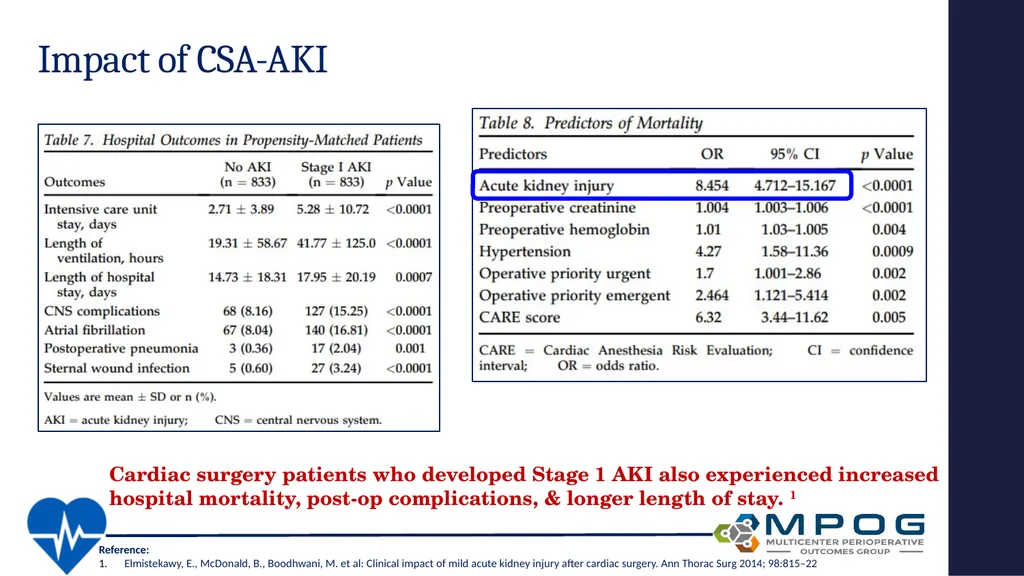
Impact of CSA-AKI Cardiac surgery patients who developed Stage 1 AKI also experienced increased hospital mortality, post-op complications, & longer length of stay. 1 Reference:
Elmistekawy, E., McDonald, B., Boodhwani, M. et al: Clinical impact of mild acute kidney injury after cardiac surgery. Ann Thorac Surg 2014; 98:815–22<br>
Elmistekawy, E., McDonald, B., Boodhwani, M. et al: Clinical impact of mild acute kidney injury after cardiac surgery. Ann Thorac Surg 2014; 98:815–22<br>
08
Impact of CSA-AKI Mortality rates among cardiovascular patients requiring postoperative renal replacement therapy are between 40-70% 1
In a review of cases for 1,078,036 patients undergoing CABG, valve-replacement surgery or both from the Nationwide Inpatient Sample from 2008-2011 (United States only) 2
1 in every 10 patients developed AKI after cardiac operation
10-fold greater in-hospital mortality
Twofold greater length of stay
On average, $36,453 greater index hospitalization costs References:
Ishani A, Nelson D, Clothier B, Schult T, Nugent S, Greer N, Slinin Y, Ensrud KE: The magnitude of acute serum creatinine increase after cardiac surgery and the risk of chronic kidney disease, progression of kidney disease, and death. Arch Intern Med 2011; 171:226–33
Alshaikh HN, Katz NM, Gani F, Nagarajan N, Canner JK, Kacker S, Najjar PA, Higgins RS, Schneider EB: Financial Impact of Acute Kidney Injury After Cardiac Operations in the United States. Ann Thorac Surg 2018; 105:469–75<br>
In a review of cases for 1,078,036 patients undergoing CABG, valve-replacement surgery or both from the Nationwide Inpatient Sample from 2008-2011 (United States only) 2
1 in every 10 patients developed AKI after cardiac operation
10-fold greater in-hospital mortality
Twofold greater length of stay
On average, $36,453 greater index hospitalization costs References:
Ishani A, Nelson D, Clothier B, Schult T, Nugent S, Greer N, Slinin Y, Ensrud KE: The magnitude of acute serum creatinine increase after cardiac surgery and the risk of chronic kidney disease, progression of kidney disease, and death. Arch Intern Med 2011; 171:226–33
Alshaikh HN, Katz NM, Gani F, Nagarajan N, Canner JK, Kacker S, Najjar PA, Higgins RS, Schneider EB: Financial Impact of Acute Kidney Injury After Cardiac Operations in the United States. Ann Thorac Surg 2018; 105:469–75<br>
09
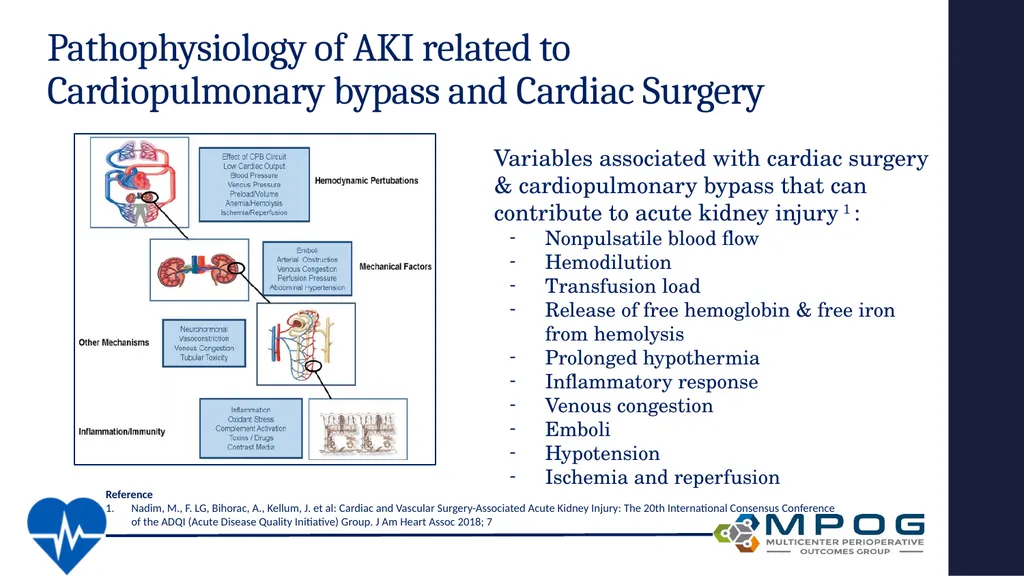
Pathophysiology of AKI related to Cardiopulmonary bypass and Cardiac Surgery Variables associated with cardiac surgery & cardiopulmonary bypass that can contribute to acute kidney injury 1 :
Nonpulsatile blood flow
Hemodilution
Transfusion load
Release of free hemoglobin & free iron from hemolysis
Prolonged hypothermia
Inflammatory response
Venous congestion
Emboli
Hypotension
Ischemia and reperfusion Reference
Nadim, M., F. LG, Bihorac, A., Kellum, J. et al: Cardiac and Vascular Surgery-Associated Acute Kidney Injury: The 20th International Consensus Conference of the ADQI (Acute Disease Quality Initiative) Group. J Am Heart Assoc 2018; 7<br>
Nonpulsatile blood flow
Hemodilution
Transfusion load
Release of free hemoglobin & free iron from hemolysis
Prolonged hypothermia
Inflammatory response
Venous congestion
Emboli
Hypotension
Ischemia and reperfusion Reference
Nadim, M., F. LG, Bihorac, A., Kellum, J. et al: Cardiac and Vascular Surgery-Associated Acute Kidney Injury: The 20th International Consensus Conference of the ADQI (Acute Disease Quality Initiative) Group. J Am Heart Assoc 2018; 7<br>
10
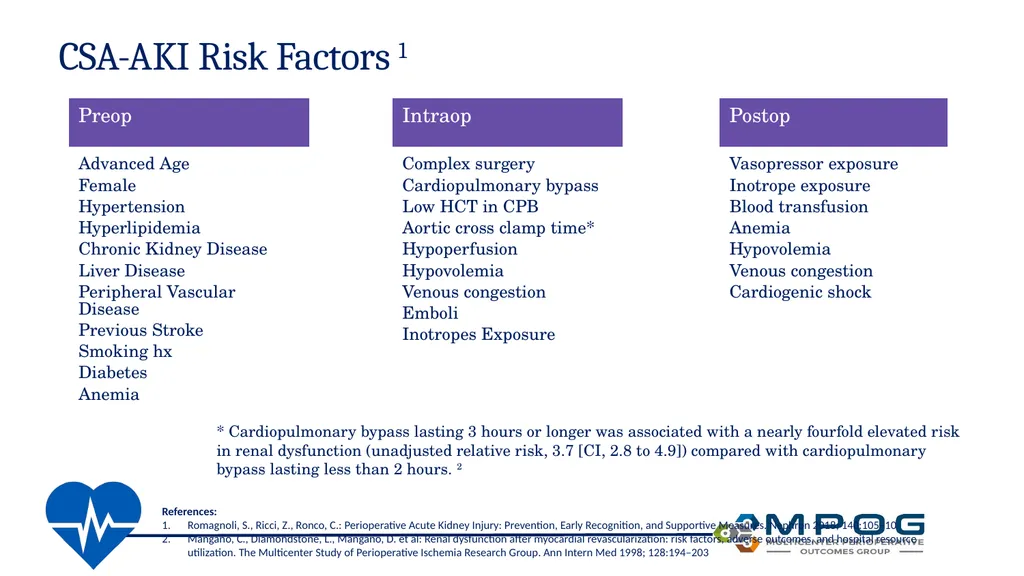
CSA-AKI Risk Factors 1 * Cardiopulmonary bypass lasting 3 hours or longer was associated with a nearly fourfold elevated risk in renal dysfunction (unadjusted relative risk, 3.7 [CI, 2.8 to 4.9]) compared with cardiopulmonary bypass lasting less than 2 hours. 2 References:
Romagnoli, S., Ricci, Z., Ronco, C.: Perioperative Acute Kidney Injury: Prevention, Early Recognition, and Supportive Measures. Nephron 2018; 140:105–10
Mangano, C., Diamondstone, L., Mangano, D. et al: Renal dysfunction after myocardial revascularization: risk factors, adverse outcomes, and hospital resource utilization. The Multicenter Study of Perioperative Ischemia Research Group. Ann Intern Med 1998; 128:194–203<br>
Romagnoli, S., Ricci, Z., Ronco, C.: Perioperative Acute Kidney Injury: Prevention, Early Recognition, and Supportive Measures. Nephron 2018; 140:105–10
Mangano, C., Diamondstone, L., Mangano, D. et al: Renal dysfunction after myocardial revascularization: risk factors, adverse outcomes, and hospital resource utilization. The Multicenter Study of Perioperative Ischemia Research Group. Ann Intern Med 1998; 128:194–203<br>
11
Incidence of CKD after Cardiac Surgery In a review of 29,388 cardiac surgery patients using the VASQIP registry: 1
31% (9125) patients had CKD at time of surgery
CKD defined as average eGFR <60mL/min/1.73m2 for at least 3 months
In remaining 20,263 patients without CKD at baseline:
25% of patients with NO increase in postop creatinine developed CKD
33% of patients with an increase of 1-24% in postop creatinine developed CKD
44% of patients with an increase of 25-49% in postop creatinine developed CKD
51% of patients with an increase of 50-99% in postop creatinine developed CKD
53% of patients with an increase of ≥100% in postop creatinine developed CKD Reference:
Ishani A, Nelson D, Clothier B, Schult T, Nugent S, Greer N, Slinin Y, Ensrud KE: The magnitude of acute serum creatinine increase after cardiac surgery and the risk of chronic kidney disease, progression of kidney disease, and death. Arch Intern Med 2011; 171:226–33<br>
31% (9125) patients had CKD at time of surgery
CKD defined as average eGFR <60mL/min/1.73m2 for at least 3 months
In remaining 20,263 patients without CKD at baseline:
25% of patients with NO increase in postop creatinine developed CKD
33% of patients with an increase of 1-24% in postop creatinine developed CKD
44% of patients with an increase of 25-49% in postop creatinine developed CKD
51% of patients with an increase of 50-99% in postop creatinine developed CKD
53% of patients with an increase of ≥100% in postop creatinine developed CKD Reference:
Ishani A, Nelson D, Clothier B, Schult T, Nugent S, Greer N, Slinin Y, Ensrud KE: The magnitude of acute serum creatinine increase after cardiac surgery and the risk of chronic kidney disease, progression of kidney disease, and death. Arch Intern Med 2011; 171:226–33<br>
12
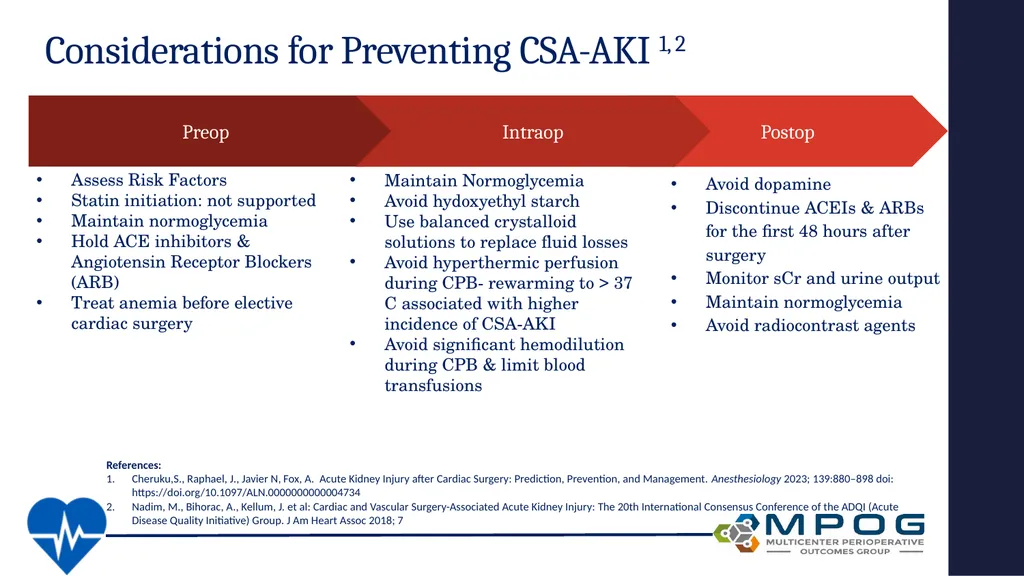
Considerations for Preventing CSA-AKI 1, 2 References:
Cheruku,S., Raphael, J., Javier N, Fox, A. Acute Kidney Injury after Cardiac Surgery: Prediction, Prevention, and Management. Anesthesiology 2023; 139:880–898 doi: https://doi.org/10.1097/ALN.0000000000004734
Nadim, M., Bihorac, A., Kellum, J. et al: Cardiac and Vascular Surgery-Associated Acute Kidney Injury: The 20th International Consensus Conference of the ADQI (Acute Disease Quality Initiative) Group. J Am Heart Assoc 2018; 7<br>
Cheruku,S., Raphael, J., Javier N, Fox, A. Acute Kidney Injury after Cardiac Surgery: Prediction, Prevention, and Management. Anesthesiology 2023; 139:880–898 doi: https://doi.org/10.1097/ALN.0000000000004734
Nadim, M., Bihorac, A., Kellum, J. et al: Cardiac and Vascular Surgery-Associated Acute Kidney Injury: The 20th International Consensus Conference of the ADQI (Acute Disease Quality Initiative) Group. J Am Heart Assoc 2018; 7<br>
13
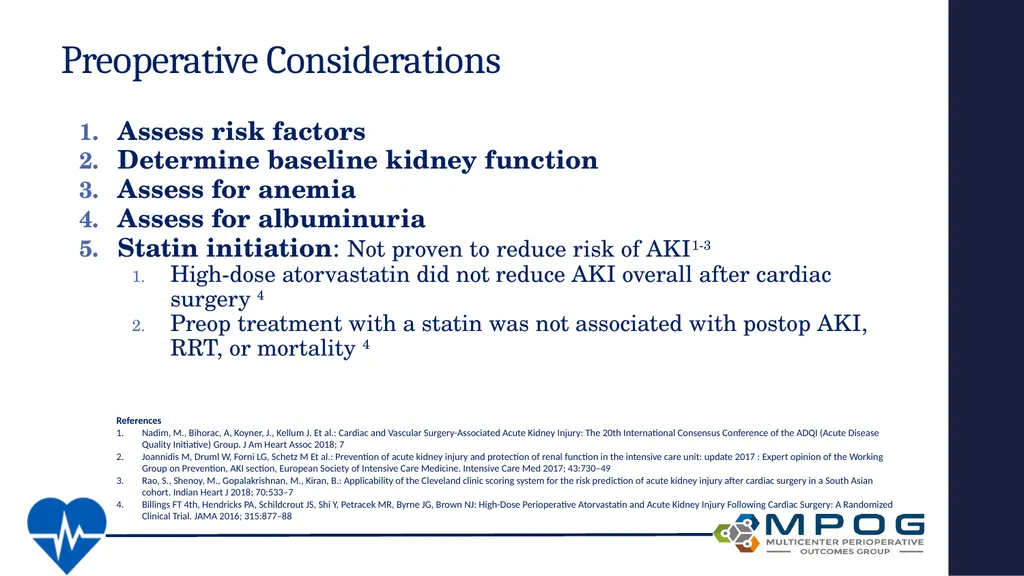
Preoperative Considerations Assess risk factors
Determine baseline kidney function
Assess for anemia
Assess for albuminuria
Statin initiation: Not proven to reduce risk of AKI1-3
High-dose atorvastatin did not reduce AKI overall after cardiac surgery 4
Preop treatment with a statin was not associated with postop AKI, RRT, or mortality 4 References
Nadim, M., Bihorac, A, Koyner, J., Kellum J. Et al.: Cardiac and Vascular Surgery-Associated Acute Kidney Injury: The 20th International Consensus Conference of the ADQI (Acute Disease Quality Initiative) Group. J Am Heart Assoc 2018; 7
Joannidis M, Druml W, Forni LG, Schetz M Et al.: Prevention of acute kidney injury and protection of renal function in the intensive care unit: update 2017 : Expert opinion of the Working Group on Prevention, AKI section, European Society of Intensive Care Medicine. Intensive Care Med 2017; 43:730–49
Rao, S., Shenoy, M., Gopalakrishnan, M., Kiran, B.: Applicability of the Cleveland clinic scoring system for the risk prediction of acute kidney injury after cardiac surgery in a South Asian cohort. Indian Heart J 2018; 70:533–7
Billings FT 4th, Hendricks PA, Schildcrout JS, Shi Y, Petracek MR, Byrne JG, Brown NJ: High-Dose Perioperative Atorvastatin and Acute Kidney Injury Following Cardiac Surgery: A Randomized Clinical Trial. JAMA 2016; 315:877–88<br>
Determine baseline kidney function
Assess for anemia
Assess for albuminuria
Statin initiation: Not proven to reduce risk of AKI1-3
High-dose atorvastatin did not reduce AKI overall after cardiac surgery 4
Preop treatment with a statin was not associated with postop AKI, RRT, or mortality 4 References
Nadim, M., Bihorac, A, Koyner, J., Kellum J. Et al.: Cardiac and Vascular Surgery-Associated Acute Kidney Injury: The 20th International Consensus Conference of the ADQI (Acute Disease Quality Initiative) Group. J Am Heart Assoc 2018; 7
Joannidis M, Druml W, Forni LG, Schetz M Et al.: Prevention of acute kidney injury and protection of renal function in the intensive care unit: update 2017 : Expert opinion of the Working Group on Prevention, AKI section, European Society of Intensive Care Medicine. Intensive Care Med 2017; 43:730–49
Rao, S., Shenoy, M., Gopalakrishnan, M., Kiran, B.: Applicability of the Cleveland clinic scoring system for the risk prediction of acute kidney injury after cardiac surgery in a South Asian cohort. Indian Heart J 2018; 70:533–7
Billings FT 4th, Hendricks PA, Schildcrout JS, Shi Y, Petracek MR, Byrne JG, Brown NJ: High-Dose Perioperative Atorvastatin and Acute Kidney Injury Following Cardiac Surgery: A Randomized Clinical Trial. JAMA 2016; 315:877–88<br>
14
Preoperative Considerations continued References:
Nadim, M., Forni, L., Kellum, J.. Et al: Cardiac and Vascular Surgery-Associated Acute Kidney Injury: The 20th International Consensus Conference of the ADQI (Acute Disease Quality Initiative) Group. J Am Heart Assoc 2018;
Joannidis, M., Druml, W., Schetz, M. Et al: Prevention of acute kidney injury and protection of renal function in the intensive care unit: update 2017 : Expert opinion of the Working Group on Prevention, AKI section, European Society of Intensive Care Medicine. Intensive Care Med 2017; 43:730–49
Rao, S., Shenoy, P,. Kiran, A. Et al: Applicability of the Cleveland clinic scoring system for the risk prediction of acute kidney injury after cardiac surgery in a South Asian cohort. Indian Heart J 2018; 70:533–7
Coca, S., Garg, A., Parikh, C.. Et al. TRIBE-AKI Consortium: Preoperative angiotensin-converting enzyme inhibitors and angiotensin receptor blocker use and acute kidney injury in patients undergoing cardiac surgery. Nephrol Dial Transplant 2013; 28:2787–99
Yacoub R, Patel N, Arora, P. Et al.: Acute kidney injury and death associated with renin angiotensin system blockade in cardiothoracic surgery: a meta-analysis of observational studies. Am J Kidney Dis 2013; 62:1077–86 Maintain Normoglycemia
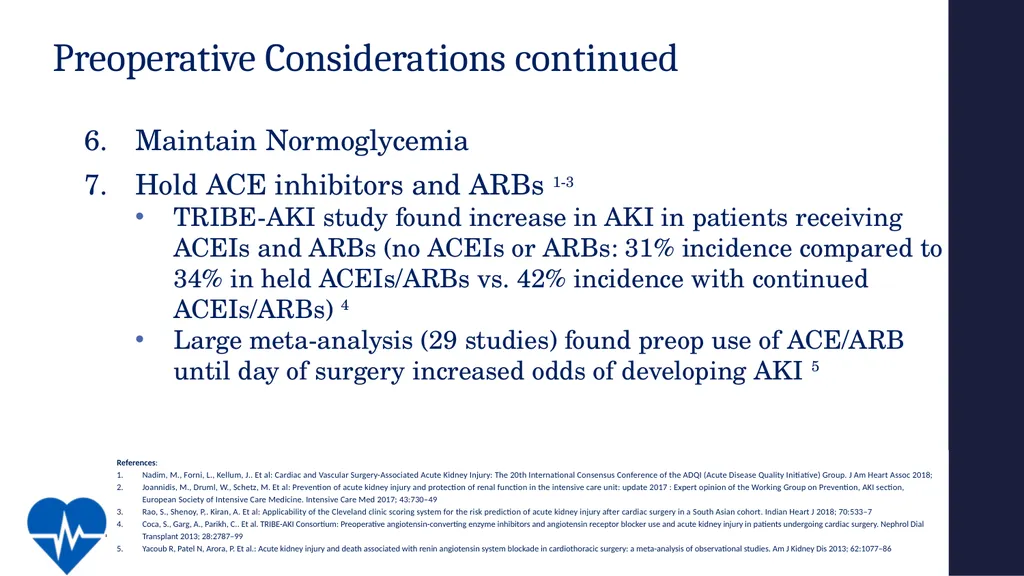
Hold ACE inhibitors and ARBs 1-3
TRIBE-AKI study found increase in AKI in patients receiving ACEIs and ARBs (no ACEIs or ARBs: 31% incidence compared to 34% in held ACEIs/ARBs vs. 42% incidence with continued ACEIs/ARBs) 4
Large meta-analysis (29 studies) found preop use of ACE/ARB until day of surgery increased odds of developing AKI 5<br>
Nadim, M., Forni, L., Kellum, J.. Et al: Cardiac and Vascular Surgery-Associated Acute Kidney Injury: The 20th International Consensus Conference of the ADQI (Acute Disease Quality Initiative) Group. J Am Heart Assoc 2018;
Joannidis, M., Druml, W., Schetz, M. Et al: Prevention of acute kidney injury and protection of renal function in the intensive care unit: update 2017 : Expert opinion of the Working Group on Prevention, AKI section, European Society of Intensive Care Medicine. Intensive Care Med 2017; 43:730–49
Rao, S., Shenoy, P,. Kiran, A. Et al: Applicability of the Cleveland clinic scoring system for the risk prediction of acute kidney injury after cardiac surgery in a South Asian cohort. Indian Heart J 2018; 70:533–7
Coca, S., Garg, A., Parikh, C.. Et al. TRIBE-AKI Consortium: Preoperative angiotensin-converting enzyme inhibitors and angiotensin receptor blocker use and acute kidney injury in patients undergoing cardiac surgery. Nephrol Dial Transplant 2013; 28:2787–99
Yacoub R, Patel N, Arora, P. Et al.: Acute kidney injury and death associated with renin angiotensin system blockade in cardiothoracic surgery: a meta-analysis of observational studies. Am J Kidney Dis 2013; 62:1077–86 Maintain Normoglycemia
Hold ACE inhibitors and ARBs 1-3
TRIBE-AKI study found increase in AKI in patients receiving ACEIs and ARBs (no ACEIs or ARBs: 31% incidence compared to 34% in held ACEIs/ARBs vs. 42% incidence with continued ACEIs/ARBs) 4
Large meta-analysis (29 studies) found preop use of ACE/ARB until day of surgery increased odds of developing AKI 5<br>
15
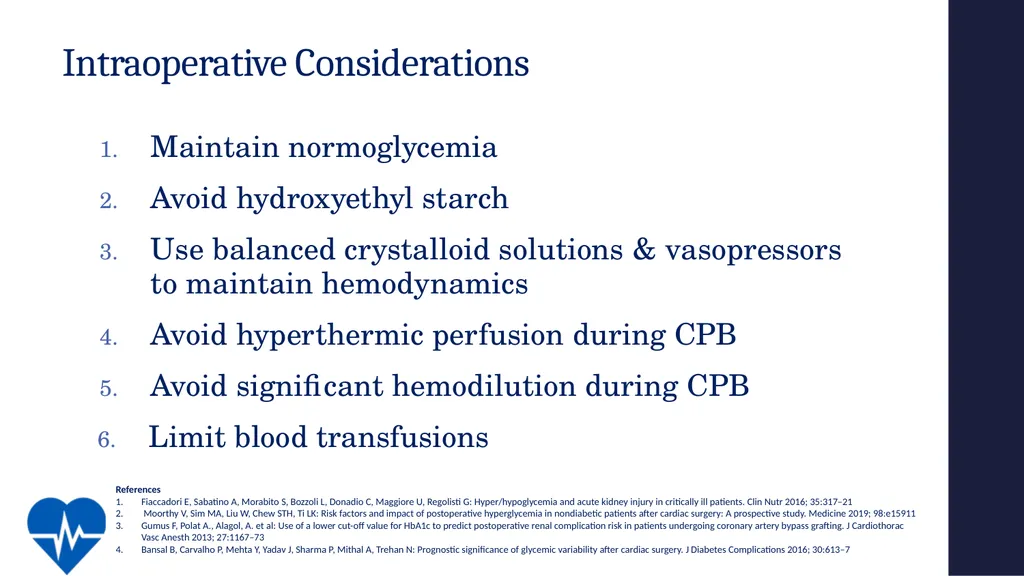
Intraoperative Considerations Maintain normoglycemia
Avoid hydroxyethyl starch
Use balanced crystalloid solutions & vasopressors to maintain hemodynamics
Avoid hyperthermic perfusion during CPB
Avoid significant hemodilution during CPB
Limit blood transfusions References
Fiaccadori E, Sabatino A, Morabito S, Bozzoli L, Donadio C, Maggiore U, Regolisti G: Hyper/hypoglycemia and acute kidney injury in critically ill patients. Clin Nutr 2016; 35:317–21
Moorthy V, Sim MA, Liu W, Chew STH, Ti LK: Risk factors and impact of postoperative hyperglycemia in nondiabetic patients after cardiac surgery: A prospective study. Medicine 2019; 98:e15911
Gumus F, Polat A., Alagol, A. et al: Use of a lower cut-off value for HbA1c to predict postoperative renal complication risk in patients undergoing coronary artery bypass grafting. J Cardiothorac Vasc Anesth 2013; 27:1167–73
Bansal B, Carvalho P, Mehta Y, Yadav J, Sharma P, Mithal A, Trehan N: Prognostic significance of glycemic variability after cardiac surgery. J Diabetes Complications 2016; 30:613–7<br>
Avoid hydroxyethyl starch
Use balanced crystalloid solutions & vasopressors to maintain hemodynamics
Avoid hyperthermic perfusion during CPB
Avoid significant hemodilution during CPB
Limit blood transfusions References
Fiaccadori E, Sabatino A, Morabito S, Bozzoli L, Donadio C, Maggiore U, Regolisti G: Hyper/hypoglycemia and acute kidney injury in critically ill patients. Clin Nutr 2016; 35:317–21
Moorthy V, Sim MA, Liu W, Chew STH, Ti LK: Risk factors and impact of postoperative hyperglycemia in nondiabetic patients after cardiac surgery: A prospective study. Medicine 2019; 98:e15911
Gumus F, Polat A., Alagol, A. et al: Use of a lower cut-off value for HbA1c to predict postoperative renal complication risk in patients undergoing coronary artery bypass grafting. J Cardiothorac Vasc Anesth 2013; 27:1167–73
Bansal B, Carvalho P, Mehta Y, Yadav J, Sharma P, Mithal A, Trehan N: Prognostic significance of glycemic variability after cardiac surgery. J Diabetes Complications 2016; 30:613–7<br>
16
Intraoperative Considerations: Maintain normoglycemia
AKI may further complicate glycemic control as it is associated with insulin resistance and reduced renal clearance of insulin 1
Aortic cross-clamp time and blood transfusion as independent risk factors of postoperative hyperglycemia after cardiac surgery in non-diabetics 2
In a study of 510 patients undergoing cardiovascular surgery and found the incidence of AKI to be higher in patients with high HbA1c levels preoperatively; Every 1% increase over 6% in HgA1c levels increased the risk of renal complications by 24% 3
Glycemic variability, a standard deviation of all POC-BG readings, is associated with increased postoperative LOS-ICU, rise in creatinine, and AKI 4 References
Fiaccadori E, Sabatino A, Morabito S, Bozzoli L, Donadio C, Maggiore U, Regolisti G: Hyper/hypoglycemia and acute kidney injury in critically ill patients. Clin Nutr 2016; 35:317–21
Moorthy V, Sim MA, Liu W, Chew STH, Ti LK: Risk factors and impact of postoperative hyperglycemia in nondiabetic patients after cardiac surgery: A prospective study. Medicine 2019; 98:e15911
Gumus F, Polat A., Alagol, A. et al: Use of a lower cut-off value for HbA1c to predict postoperative renal complication risk in patients undergoing coronary artery bypass grafting. J Cardiothorac Vasc Anesth 2013; 27:1167–73
Bansal B, Carvalho P, Mehta Y, Yadav J, Sharma P, Mithal A, Trehan N: Prognostic significance of glycemic variability after cardiac surgery. J Diabetes Complications 2016; 30:613–7<br>
AKI may further complicate glycemic control as it is associated with insulin resistance and reduced renal clearance of insulin 1
Aortic cross-clamp time and blood transfusion as independent risk factors of postoperative hyperglycemia after cardiac surgery in non-diabetics 2
In a study of 510 patients undergoing cardiovascular surgery and found the incidence of AKI to be higher in patients with high HbA1c levels preoperatively; Every 1% increase over 6% in HgA1c levels increased the risk of renal complications by 24% 3
Glycemic variability, a standard deviation of all POC-BG readings, is associated with increased postoperative LOS-ICU, rise in creatinine, and AKI 4 References
Fiaccadori E, Sabatino A, Morabito S, Bozzoli L, Donadio C, Maggiore U, Regolisti G: Hyper/hypoglycemia and acute kidney injury in critically ill patients. Clin Nutr 2016; 35:317–21
Moorthy V, Sim MA, Liu W, Chew STH, Ti LK: Risk factors and impact of postoperative hyperglycemia in nondiabetic patients after cardiac surgery: A prospective study. Medicine 2019; 98:e15911
Gumus F, Polat A., Alagol, A. et al: Use of a lower cut-off value for HbA1c to predict postoperative renal complication risk in patients undergoing coronary artery bypass grafting. J Cardiothorac Vasc Anesth 2013; 27:1167–73
Bansal B, Carvalho P, Mehta Y, Yadav J, Sharma P, Mithal A, Trehan N: Prognostic significance of glycemic variability after cardiac surgery. J Diabetes Complications 2016; 30:613–7<br>
17
Intraoperative Considerations: Maintain normoglycemia (continued)
In a randomized controlled trial, moderate glucose control defined as 127-179 mg/dl was found to be preferable to tight control ≤ 126 in patients undergoing CABG 1
Incidence of AKI was higher in patients with time-weighted average intraop glucose of >150mg/dl (8%) as compared to patients with blood glucose 110-150 mg/dl (3%) 2
KDIGO - recommends maintaining blood glucose between 110 - 149 mg/dL in critically ill patients 3,4
Tight glucose control (<150mg/dl) is seen as controversial as risks of hypoglycemia are significant: NICE-SUGAR meta-analysis 4
Society of Thoracic Surgeons (STS) Practice Guidelines recommend maintaining serum glucose levels ≤ 180 mg/dL for at least 24 hours after cardiac surgery 5 References:
Bhamidipati, C., LaPar, D., Ailawadi, G. et al.: Superiority of moderate control of hyperglycemia to tight control in patients undergoing coronary artery bypass grafting. J Thorac Cardiovasc Surg 2011; 141:543–51
Song, J., Shim, J., Yoo, K., Kwak, Y. et al.: Impact of intraoperative hyperglycaemia on renal dysfunction after off-pump coronary artery bypass. Interact Cardiovasc Thorac Surg 2013; 17:473–8
KDIGO. “KDIGO 2012 Clinical Practice Guideline for the Evaluation and Management of Chronic Kidney Disease.” https://kdigo.org/wp-content/uploads/2017/02/KDIGO_2012_CKD_GL.pdf.
Brown, J; Baker, R.; Hammon, J. et al. The Society of Thoracic Surgeons/Society of Cardiovascular Anesthesiologists/American Society for Extracorporeal Technology Clinical Practice Guidelines for the Prevention of Adult Cardiac Surgery–Associated Acute Kidney Injury. Anesthesia & Analgesia 136(1):p 176-184, January 2023. | DOI: 10.1213/ANE.0000000000006286
NICE-SUGAR Study Investigators, Finfer S, Chittock DR, Ronco, J. et al.: Intensive versus conventional glucose control in critically ill patients. N Engl J Med 2009; 360:1283–97
Lazar, H., McDonnell, M., Shemin, R. et al., Society of Thoracic Surgeons Blood Glucose Guideline Task Force: The Society of Thoracic Surgeons practice guideline series: Blood glucose management during adult cardiac surgery. Ann Thorac Surg 2009; 87:663–9<br>
In a randomized controlled trial, moderate glucose control defined as 127-179 mg/dl was found to be preferable to tight control ≤ 126 in patients undergoing CABG 1
Incidence of AKI was higher in patients with time-weighted average intraop glucose of >150mg/dl (8%) as compared to patients with blood glucose 110-150 mg/dl (3%) 2
KDIGO - recommends maintaining blood glucose between 110 - 149 mg/dL in critically ill patients 3,4
Tight glucose control (<150mg/dl) is seen as controversial as risks of hypoglycemia are significant: NICE-SUGAR meta-analysis 4
Society of Thoracic Surgeons (STS) Practice Guidelines recommend maintaining serum glucose levels ≤ 180 mg/dL for at least 24 hours after cardiac surgery 5 References:
Bhamidipati, C., LaPar, D., Ailawadi, G. et al.: Superiority of moderate control of hyperglycemia to tight control in patients undergoing coronary artery bypass grafting. J Thorac Cardiovasc Surg 2011; 141:543–51
Song, J., Shim, J., Yoo, K., Kwak, Y. et al.: Impact of intraoperative hyperglycaemia on renal dysfunction after off-pump coronary artery bypass. Interact Cardiovasc Thorac Surg 2013; 17:473–8
KDIGO. “KDIGO 2012 Clinical Practice Guideline for the Evaluation and Management of Chronic Kidney Disease.” https://kdigo.org/wp-content/uploads/2017/02/KDIGO_2012_CKD_GL.pdf.
Brown, J; Baker, R.; Hammon, J. et al. The Society of Thoracic Surgeons/Society of Cardiovascular Anesthesiologists/American Society for Extracorporeal Technology Clinical Practice Guidelines for the Prevention of Adult Cardiac Surgery–Associated Acute Kidney Injury. Anesthesia & Analgesia 136(1):p 176-184, January 2023. | DOI: 10.1213/ANE.0000000000006286
NICE-SUGAR Study Investigators, Finfer S, Chittock DR, Ronco, J. et al.: Intensive versus conventional glucose control in critically ill patients. N Engl J Med 2009; 360:1283–97
Lazar, H., McDonnell, M., Shemin, R. et al., Society of Thoracic Surgeons Blood Glucose Guideline Task Force: The Society of Thoracic Surgeons practice guideline series: Blood glucose management during adult cardiac surgery. Ann Thorac Surg 2009; 87:663–9<br>
18
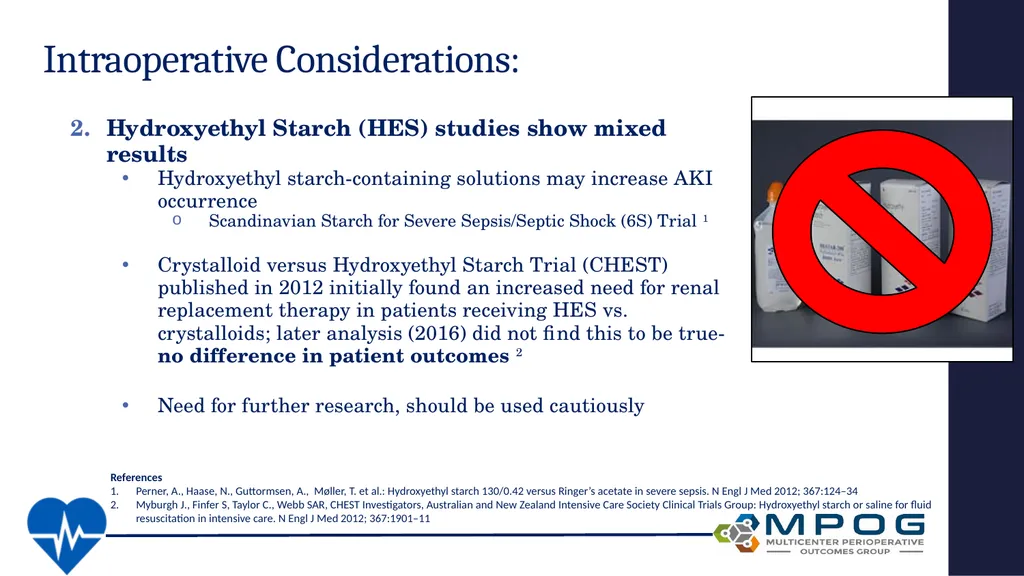
Intraoperative Considerations: Hydroxyethyl Starch (HES) studies show mixed results
Hydroxyethyl starch-containing solutions may increase AKI occurrence
Scandinavian Starch for Severe Sepsis/Septic Shock (6S) Trial 1
Crystalloid versus Hydroxyethyl Starch Trial (CHEST) published in 2012 initially found an increased need for renal replacement therapy in patients receiving HES vs. crystalloids; later analysis (2016) did not find this to be true- no difference in patient outcomes 2
Need for further research, should be used cautiously References
Perner, A., Haase, N., Guttormsen, A., Møller, T. et al.: Hydroxyethyl starch 130/0.42 versus Ringer’s acetate in severe sepsis. N Engl J Med 2012; 367:124–34
Myburgh J., Finfer S, Taylor C., Webb SAR, CHEST Investigators, Australian and New Zealand Intensive Care Society Clinical Trials Group: Hydroxyethyl starch or saline for fluid resuscitation in intensive care. N Engl J Med 2012; 367:1901–11<br>
Hydroxyethyl starch-containing solutions may increase AKI occurrence
Scandinavian Starch for Severe Sepsis/Septic Shock (6S) Trial 1
Crystalloid versus Hydroxyethyl Starch Trial (CHEST) published in 2012 initially found an increased need for renal replacement therapy in patients receiving HES vs. crystalloids; later analysis (2016) did not find this to be true- no difference in patient outcomes 2
Need for further research, should be used cautiously References
Perner, A., Haase, N., Guttormsen, A., Møller, T. et al.: Hydroxyethyl starch 130/0.42 versus Ringer’s acetate in severe sepsis. N Engl J Med 2012; 367:124–34
Myburgh J., Finfer S, Taylor C., Webb SAR, CHEST Investigators, Australian and New Zealand Intensive Care Society Clinical Trials Group: Hydroxyethyl starch or saline for fluid resuscitation in intensive care. N Engl J Med 2012; 367:1901–11<br>
19
Intraoperative Considerations: Use Vasopressors & crystalloids to maintain hemodynamic stability:
Either norepinephrine or vasopressin can be used for hemodynamic support in the patient post-cardiac surgery 1
European Society of Intensive Care Medicine recommendations: 11
Norepinephrine recommended as first-choice vasopressor to protect kidney function (Grade 1B evidence)
Suggest vasopressin in patients with vasoplegic shock after cardiac surgery (Grade 2C evidence)
Controlled fluid resuscitation in volume depletion, while avoiding volume overload using balanced crystalloids (Grade 1C/2C)
American Heart Association - Cardiac and Vascular Surgery- Associated Acute Kidney Injury Consensus Guidelines recommend:10
Use of balanced crystalloid solutions guided by measures of fluid responsiveness (Grade 1B)
In adult cardiac surgery with CPB, fenoldopam may be reasonable to reduce the risk of CSA-AKI, as long as hypotension is avoided4 References:
Thiele, R., Isbell, J., Rosner, M. et al.: AKI associated with cardiac surgery. Clin J Am Soc Nephrol 2015; 10:500–14
Nadim, M., Forni, L., Kellum JA et al.: Cardiac and Vascular Surgery-Associated Acute Kidney Injury: The 20th International Consensus Conference of the ADQI (Acute Disease Quality Initiative) Group. J Am Heart Assoc 2018; 7
Joannidis, M., Druml, W., Schetz, M. et al.: Prevention of acute kidney injury and protection of renal function in the intensive care unit: update 2017 : Expert opinion of the Working Group on Prevention, AKI section, European Society of Intensive Care Medicine. Intensive Care Med 2017; 43:730–49
Brown, J; Baker, R.; Hammon, J. et al. The Society of Thoracic Surgeons/Society of Cardiovascular Anesthesiologists/American Society for Extracorporeal Technology Clinical Practice Guidelines for the Prevention of Adult Cardiac Surgery–Associated Acute Kidney Injury. Anesthesia & Analgesia 136(1):p 176-184, January 2023. | DOI: 10.1213/ANE.0000000000006286<br>
Either norepinephrine or vasopressin can be used for hemodynamic support in the patient post-cardiac surgery 1
European Society of Intensive Care Medicine recommendations: 11
Norepinephrine recommended as first-choice vasopressor to protect kidney function (Grade 1B evidence)
Suggest vasopressin in patients with vasoplegic shock after cardiac surgery (Grade 2C evidence)
Controlled fluid resuscitation in volume depletion, while avoiding volume overload using balanced crystalloids (Grade 1C/2C)
American Heart Association - Cardiac and Vascular Surgery- Associated Acute Kidney Injury Consensus Guidelines recommend:10
Use of balanced crystalloid solutions guided by measures of fluid responsiveness (Grade 1B)
In adult cardiac surgery with CPB, fenoldopam may be reasonable to reduce the risk of CSA-AKI, as long as hypotension is avoided4 References:
Thiele, R., Isbell, J., Rosner, M. et al.: AKI associated with cardiac surgery. Clin J Am Soc Nephrol 2015; 10:500–14
Nadim, M., Forni, L., Kellum JA et al.: Cardiac and Vascular Surgery-Associated Acute Kidney Injury: The 20th International Consensus Conference of the ADQI (Acute Disease Quality Initiative) Group. J Am Heart Assoc 2018; 7
Joannidis, M., Druml, W., Schetz, M. et al.: Prevention of acute kidney injury and protection of renal function in the intensive care unit: update 2017 : Expert opinion of the Working Group on Prevention, AKI section, European Society of Intensive Care Medicine. Intensive Care Med 2017; 43:730–49
Brown, J; Baker, R.; Hammon, J. et al. The Society of Thoracic Surgeons/Society of Cardiovascular Anesthesiologists/American Society for Extracorporeal Technology Clinical Practice Guidelines for the Prevention of Adult Cardiac Surgery–Associated Acute Kidney Injury. Anesthesia & Analgesia 136(1):p 176-184, January 2023. | DOI: 10.1213/ANE.0000000000006286<br>
20
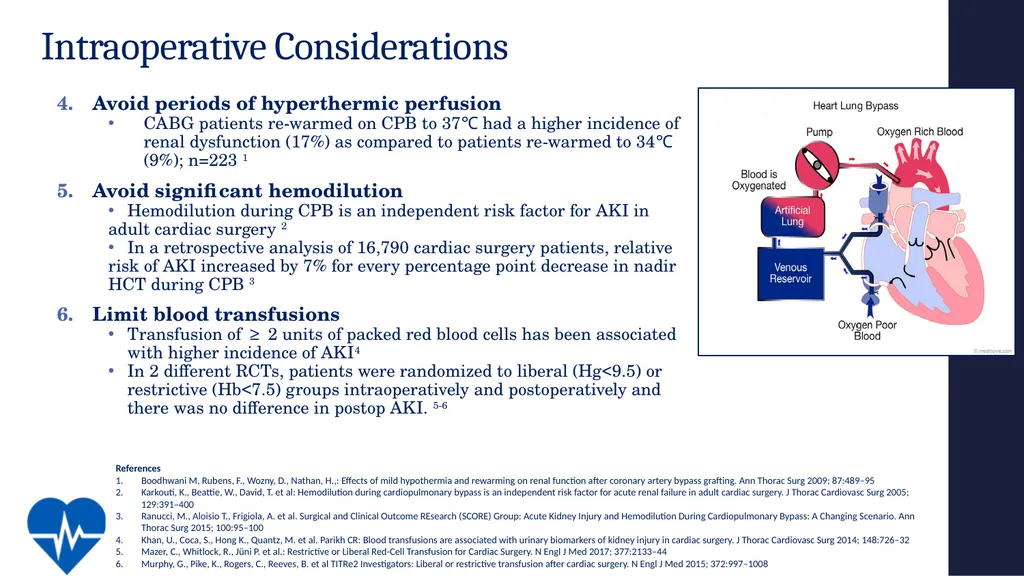
Intraoperative Considerations Avoid periods of hyperthermic perfusion
CABG patients re-warmed on CPB to 37℃ had a higher incidence of renal dysfunction (17%) as compared to patients re-warmed to 34℃ (9%); n=223 1
Avoid significant hemodilution
Hemodilution during CPB is an independent risk factor for AKI in
adult cardiac surgery 2
In a retrospective analysis of 16,790 cardiac surgery patients, relative
risk of AKI increased by 7% for every percentage point decrease in nadir HCT during CPB 3
Limit blood transfusions
Transfusion of ≥ 2 units of packed red blood cells has been associated with higher incidence of AKI4
In 2 different RCTs, patients were randomized to liberal (Hg<9.5) or restrictive (Hb<7.5) groups intraoperatively and postoperatively and there was no difference in postop AKI. 5-6 References
Boodhwani M, Rubens, F., Wozny, D., Nathan, H.,: Effects of mild hypothermia and rewarming on renal function after coronary artery bypass grafting. Ann Thorac Surg 2009; 87:489–95
Karkouti, K., Beattie, W., David, T. et al: Hemodilution during cardiopulmonary bypass is an independent risk factor for acute renal failure in adult cardiac surgery. J Thorac Cardiovasc Surg 2005; 129:391–400
Ranucci, M., Aloisio T., Frigiola, A. et al. Surgical and Clinical Outcome REsearch (SCORE) Group: Acute Kidney Injury and Hemodilution During Cardiopulmonary Bypass: A Changing Scenario. Ann Thorac Surg 2015; 100:95–100
Khan, U., Coca, S., Hong K., Quantz, M. et al. Parikh CR: Blood transfusions are associated with urinary biomarkers of kidney injury in cardiac surgery. J Thorac Cardiovasc Surg 2014; 148:726–32
Mazer, C., Whitlock, R., Jüni P. et al.: Restrictive or Liberal Red-Cell Transfusion for Cardiac Surgery. N Engl J Med 2017; 377:2133–44
Murphy, G., Pike, K., Rogers, C., Reeves, B. et al TITRe2 Investigators: Liberal or restrictive transfusion after cardiac surgery. N Engl J Med 2015; 372:997–1008<br>
CABG patients re-warmed on CPB to 37℃ had a higher incidence of renal dysfunction (17%) as compared to patients re-warmed to 34℃ (9%); n=223 1
Avoid significant hemodilution
Hemodilution during CPB is an independent risk factor for AKI in
adult cardiac surgery 2
In a retrospective analysis of 16,790 cardiac surgery patients, relative
risk of AKI increased by 7% for every percentage point decrease in nadir HCT during CPB 3
Limit blood transfusions
Transfusion of ≥ 2 units of packed red blood cells has been associated with higher incidence of AKI4
In 2 different RCTs, patients were randomized to liberal (Hg<9.5) or restrictive (Hb<7.5) groups intraoperatively and postoperatively and there was no difference in postop AKI. 5-6 References
Boodhwani M, Rubens, F., Wozny, D., Nathan, H.,: Effects of mild hypothermia and rewarming on renal function after coronary artery bypass grafting. Ann Thorac Surg 2009; 87:489–95
Karkouti, K., Beattie, W., David, T. et al: Hemodilution during cardiopulmonary bypass is an independent risk factor for acute renal failure in adult cardiac surgery. J Thorac Cardiovasc Surg 2005; 129:391–400
Ranucci, M., Aloisio T., Frigiola, A. et al. Surgical and Clinical Outcome REsearch (SCORE) Group: Acute Kidney Injury and Hemodilution During Cardiopulmonary Bypass: A Changing Scenario. Ann Thorac Surg 2015; 100:95–100
Khan, U., Coca, S., Hong K., Quantz, M. et al. Parikh CR: Blood transfusions are associated with urinary biomarkers of kidney injury in cardiac surgery. J Thorac Cardiovasc Surg 2014; 148:726–32
Mazer, C., Whitlock, R., Jüni P. et al.: Restrictive or Liberal Red-Cell Transfusion for Cardiac Surgery. N Engl J Med 2017; 377:2133–44
Murphy, G., Pike, K., Rogers, C., Reeves, B. et al TITRe2 Investigators: Liberal or restrictive transfusion after cardiac surgery. N Engl J Med 2015; 372:997–1008<br>
21
Goal-Directed Perfusion Trial (GIFT)1 Multicenter RCT conducted at nine institutions in Europe, Australia, New Zealand, and the United States
350 cardiac surgery patients with cardiopulmonary bypass ≥ 90 minutes
Intervention group: Maintain DO2 value ≥ 280mL・min-1・m-2 during CPB; Adjust arterial pump flow based on Hct value to maintain DO2; Transfuse 1U PRBC if SvO2 <68% and/or the oxygen extraction rate was >40%
Control group: Arterial pump flow based on body surface area and temp, target value of 2.4L・min-1・m-2 at normothermia. Transfusion trigger based on Hct value alone.
Lower incidence of AKIN Stage 1 AKI in GDP group; same incidence for stage 2 & 3 References
Ranucci, M, Johnson I, Pistuddi, V. et al.: Goal-directed perfusion to reduce acute kidney injury: A randomized trial. J Thorac Cardiovasc Surg 2018; 156:1918–27.e2<br>
350 cardiac surgery patients with cardiopulmonary bypass ≥ 90 minutes
Intervention group: Maintain DO2 value ≥ 280mL・min-1・m-2 during CPB; Adjust arterial pump flow based on Hct value to maintain DO2; Transfuse 1U PRBC if SvO2 <68% and/or the oxygen extraction rate was >40%
Control group: Arterial pump flow based on body surface area and temp, target value of 2.4L・min-1・m-2 at normothermia. Transfusion trigger based on Hct value alone.
Lower incidence of AKIN Stage 1 AKI in GDP group; same incidence for stage 2 & 3 References
Ranucci, M, Johnson I, Pistuddi, V. et al.: Goal-directed perfusion to reduce acute kidney injury: A randomized trial. J Thorac Cardiovasc Surg 2018; 156:1918–27.e2<br>
22
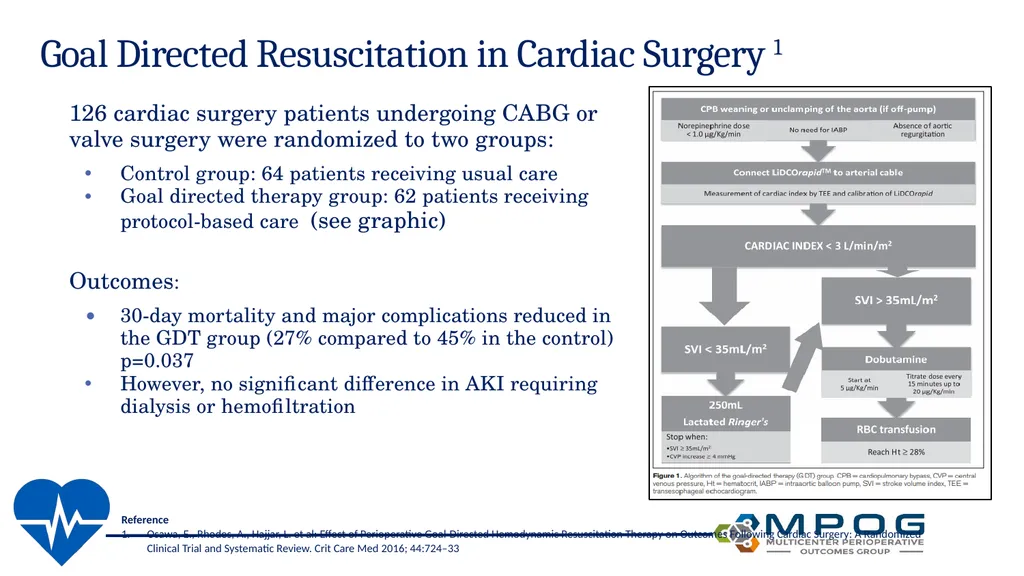
Goal Directed Resuscitation in Cardiac Surgery 1 126 cardiac surgery patients undergoing CABG or valve surgery were randomized to two groups:
Control group: 64 patients receiving usual care
Goal directed therapy group: 62 patients receiving protocol-based care (see graphic)
Outcomes:
30-day mortality and major complications reduced in the GDT group (27% compared to 45% in the control) p=0.037
However, no significant difference in AKI requiring dialysis or hemofiltration Reference
Osawa, E., Rhodes, A., Hajjar, L. et al: Effect of Perioperative Goal-Directed Hemodynamic Resuscitation Therapy on Outcomes Following Cardiac Surgery: A Randomized Clinical Trial and Systematic Review. Crit Care Med 2016; 44:724–33<br>
Control group: 64 patients receiving usual care
Goal directed therapy group: 62 patients receiving protocol-based care (see graphic)
Outcomes:
30-day mortality and major complications reduced in the GDT group (27% compared to 45% in the control) p=0.037
However, no significant difference in AKI requiring dialysis or hemofiltration Reference
Osawa, E., Rhodes, A., Hajjar, L. et al: Effect of Perioperative Goal-Directed Hemodynamic Resuscitation Therapy on Outcomes Following Cardiac Surgery: A Randomized Clinical Trial and Systematic Review. Crit Care Med 2016; 44:724–33<br>
23
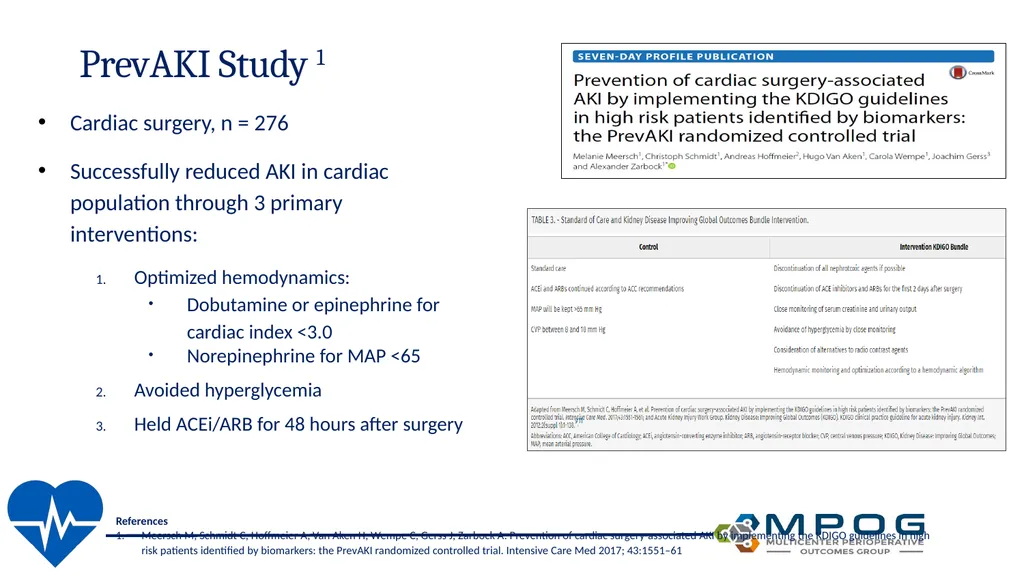
PrevAKI Study 1 Cardiac surgery, n = 276
Successfully reduced AKI in cardiac population through 3 primary interventions: References
Meersch M, Schmidt C, Hoffmeier A, Van Aken H, Wempe C, Gerss J, Zarbock A: Prevention of cardiac surgery-associated AKI by implementing the KDIGO guidelines in high risk patients identified by biomarkers: the PrevAKI randomized controlled trial. Intensive Care Med 2017; 43:1551–61 Optimized hemodynamics:
Dobutamine or epinephrine for cardiac index <3.0
Norepinephrine for MAP <65
Avoided hyperglycemia
Held ACEi/ARB for 48 hours after surgery<br>
Successfully reduced AKI in cardiac population through 3 primary interventions: References
Meersch M, Schmidt C, Hoffmeier A, Van Aken H, Wempe C, Gerss J, Zarbock A: Prevention of cardiac surgery-associated AKI by implementing the KDIGO guidelines in high risk patients identified by biomarkers: the PrevAKI randomized controlled trial. Intensive Care Med 2017; 43:1551–61 Optimized hemodynamics:
Dobutamine or epinephrine for cardiac index <3.0
Norepinephrine for MAP <65
Avoided hyperglycemia
Held ACEi/ARB for 48 hours after surgery<br>
24
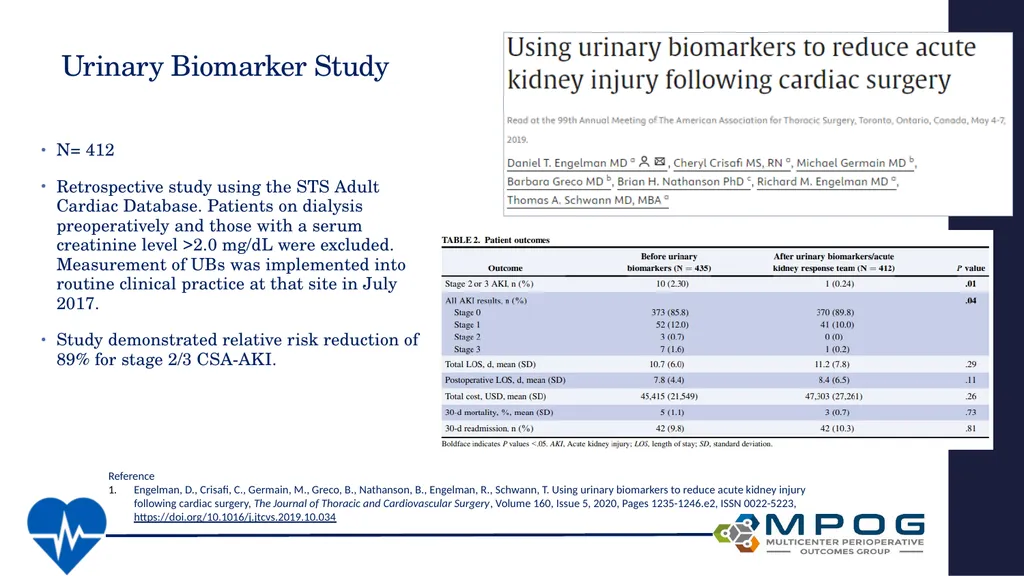
Urinary Biomarker Study N= 412
Retrospective study using the STS Adult Cardiac Database. Patients on dialysis preoperatively and those with a serum creatinine level >2.0 mg/dL were excluded. Measurement of UBs was implemented into routine clinical practice at that site in July 2017.
Study demonstrated relative risk reduction of 89% for stage 2/3 CSA-AKI. Reference
Engelman, D., Crisafi, C., Germain, M., Greco, B., Nathanson, B., Engelman, R., Schwann, T. Using urinary biomarkers to reduce acute kidney injury following cardiac surgery, The Journal of Thoracic and Cardiovascular Surgery, Volume 160, Issue 5, 2020, Pages 1235-1246.e2, ISSN 0022-5223, https://doi.org/10.1016/j.jtcvs.2019.10.034<br>
Retrospective study using the STS Adult Cardiac Database. Patients on dialysis preoperatively and those with a serum creatinine level >2.0 mg/dL were excluded. Measurement of UBs was implemented into routine clinical practice at that site in July 2017.
Study demonstrated relative risk reduction of 89% for stage 2/3 CSA-AKI. Reference
Engelman, D., Crisafi, C., Germain, M., Greco, B., Nathanson, B., Engelman, R., Schwann, T. Using urinary biomarkers to reduce acute kidney injury following cardiac surgery, The Journal of Thoracic and Cardiovascular Surgery, Volume 160, Issue 5, 2020, Pages 1235-1246.e2, ISSN 0022-5223, https://doi.org/10.1016/j.jtcvs.2019.10.034<br>
25
Minimally Invasive Extracorporeal Circulation (MiECC) MiECC has been proposed as an alternative approach to performing cardiac surgery using standard cardiopulmonary bypass. 1
A recent meta-analysis reported MiECC reduced the odds of CSA-AKI by >50% comparted with conventional CPB. 1
Recommendation from the STS and the SCA/ American Society for Extracorporeal Technology Clinical Practice Guidelines for the Prevention of Adult Cardiac Surgery-Associated Acute Kidney Injury:
In adult cardiac surgery with CPB, it might be reasonable to use minimally invasive extracorporeal circulation (MiECC) techniques to reduce the risk of CSA-AKI. (Class of Recommendation: IIB, Level of Evidence: B-R) Reference
Brown, J; Baker, R.; Hammon, J. et al. The Society of Thoracic Surgeons/Society of Cardiovascular Anesthesiologists/American Society for Extracorporeal Technology Clinical Practice Guidelines for the Prevention of Adult Cardiac Surgery–Associated Acute Kidney Injury. Anesthesia & Analgesia 136(1):p 176-184, January 2023. | DOI: 10.1213/ANE.0000000000006286<br>
A recent meta-analysis reported MiECC reduced the odds of CSA-AKI by >50% comparted with conventional CPB. 1
Recommendation from the STS and the SCA/ American Society for Extracorporeal Technology Clinical Practice Guidelines for the Prevention of Adult Cardiac Surgery-Associated Acute Kidney Injury:
In adult cardiac surgery with CPB, it might be reasonable to use minimally invasive extracorporeal circulation (MiECC) techniques to reduce the risk of CSA-AKI. (Class of Recommendation: IIB, Level of Evidence: B-R) Reference
Brown, J; Baker, R.; Hammon, J. et al. The Society of Thoracic Surgeons/Society of Cardiovascular Anesthesiologists/American Society for Extracorporeal Technology Clinical Practice Guidelines for the Prevention of Adult Cardiac Surgery–Associated Acute Kidney Injury. Anesthesia & Analgesia 136(1):p 176-184, January 2023. | DOI: 10.1213/ANE.0000000000006286<br>
26
Postoperative Considerations Avoid low-dose dopamine to treat/prevent AKI
In a meta-analysis of 58 studies examining dopamine use, 24 studies included outcomes: low-dose dopamine was not associated with the prevention of acute renal failure 1
A second meta-analysis of 61 studies established similar findings: low-dose dopamine increased urine output but did not prevent renal dysfunction 2
Monitor sCr and urine output for early detection of AKI3
Maintain blood glucose
Society of Thoracic Surgeons (STS) Practice Guidelines recommend maintaining serum glucose levels ≤ 180 mg/dL for at least 24 hours after cardiac surgery 4
Avoid radiocontrast agents
Contrast dose > 240 mg/kg resulted in greater incidence of CSA-AKI for patients who underwent cardiac catheterization ≤7 days before cardiac surgery than those > 7 days before cardiac surgery (39% vs. 29%, p = 0.025) 5 Reference
Kellum, J., Decker, J. et al: Use of dopamine in acute renal failure: a meta-analysis. Crit Care Med 2001; 29:1526–31
Friedrich, J, Adhikari, N., Herridge, M., Beyene, J.: Meta-analysis: low-dose dopamine increases urine output but does not prevent renal dysfunction or death. Ann Intern Med 2005; 142:510–24
Nadim, M., Forni, L., Kellum, J. et al: Cardiac and Vascular Surgery-Associated Acute Kidney Injury: The 20th International Consensus Conference of the ADQI (Acute Disease Quality Initiative) Group. J Am Heart Assoc 2018; 7
Lazar, H., McDonnell, M., Shemin R. et al. Society of Thoracic Surgeons Blood Glucose Guideline Task Force: The Society of Thoracic Surgeons practice guideline series: Blood glucose management during adult cardiac surgery. Ann Thorac Surg 2009; 87:663–9
Jiang W, Yu J, Teng, J. et al. : Impact of cardiac catheterization timing and contrast media dose on acute kidney injury after cardiac surgery. BMC Cardiovasc Disord 2018; 18:191<br>
In a meta-analysis of 58 studies examining dopamine use, 24 studies included outcomes: low-dose dopamine was not associated with the prevention of acute renal failure 1
A second meta-analysis of 61 studies established similar findings: low-dose dopamine increased urine output but did not prevent renal dysfunction 2
Monitor sCr and urine output for early detection of AKI3
Maintain blood glucose
Society of Thoracic Surgeons (STS) Practice Guidelines recommend maintaining serum glucose levels ≤ 180 mg/dL for at least 24 hours after cardiac surgery 4
Avoid radiocontrast agents
Contrast dose > 240 mg/kg resulted in greater incidence of CSA-AKI for patients who underwent cardiac catheterization ≤7 days before cardiac surgery than those > 7 days before cardiac surgery (39% vs. 29%, p = 0.025) 5 Reference
Kellum, J., Decker, J. et al: Use of dopamine in acute renal failure: a meta-analysis. Crit Care Med 2001; 29:1526–31
Friedrich, J, Adhikari, N., Herridge, M., Beyene, J.: Meta-analysis: low-dose dopamine increases urine output but does not prevent renal dysfunction or death. Ann Intern Med 2005; 142:510–24
Nadim, M., Forni, L., Kellum, J. et al: Cardiac and Vascular Surgery-Associated Acute Kidney Injury: The 20th International Consensus Conference of the ADQI (Acute Disease Quality Initiative) Group. J Am Heart Assoc 2018; 7
Lazar, H., McDonnell, M., Shemin R. et al. Society of Thoracic Surgeons Blood Glucose Guideline Task Force: The Society of Thoracic Surgeons practice guideline series: Blood glucose management during adult cardiac surgery. Ann Thorac Surg 2009; 87:663–9
Jiang W, Yu J, Teng, J. et al. : Impact of cardiac catheterization timing and contrast media dose on acute kidney injury after cardiac surgery. BMC Cardiovasc Disord 2018; 18:191<br>
27
Dopamine infusion nor mannitol are recommended to prevent AKI in Cardiac Surgery Per STS/Cardiovascular Anesthesiologist Practice Guidelines:
In adult cardiac surgery patients with CBP, dopamine infusion during bypass and in the postoperative period is not recommended to reduce the risk of CSA-AKI. (Class of recommendation III: No benefit, Level of Evidence: A). 1
In adult cardiac surgery patients with CBP, mannitol is not recommended to reduce the risk of CSA-AKI. (Class of recommendation III: No Benefit, Level of Evidence, B-R). 1 Reference
Brown, J; Baker, R.; Hammon, J. et al. The Society of Thoracic Surgeons/Society of Cardiovascular Anesthesiologists/American Society for Extracorporeal Technology Clinical Practice Guidelines for the Prevention of Adult Cardiac Surgery–Associated Acute Kidney Injury. Anesthesia & Analgesia 136(1):p 176-184, January 2023. | DOI: 10.1213/ANE.0000000000006286<br>
In adult cardiac surgery patients with CBP, dopamine infusion during bypass and in the postoperative period is not recommended to reduce the risk of CSA-AKI. (Class of recommendation III: No benefit, Level of Evidence: A). 1
In adult cardiac surgery patients with CBP, mannitol is not recommended to reduce the risk of CSA-AKI. (Class of recommendation III: No Benefit, Level of Evidence, B-R). 1 Reference
Brown, J; Baker, R.; Hammon, J. et al. The Society of Thoracic Surgeons/Society of Cardiovascular Anesthesiologists/American Society for Extracorporeal Technology Clinical Practice Guidelines for the Prevention of Adult Cardiac Surgery–Associated Acute Kidney Injury. Anesthesia & Analgesia 136(1):p 176-184, January 2023. | DOI: 10.1213/ANE.0000000000006286<br>
28
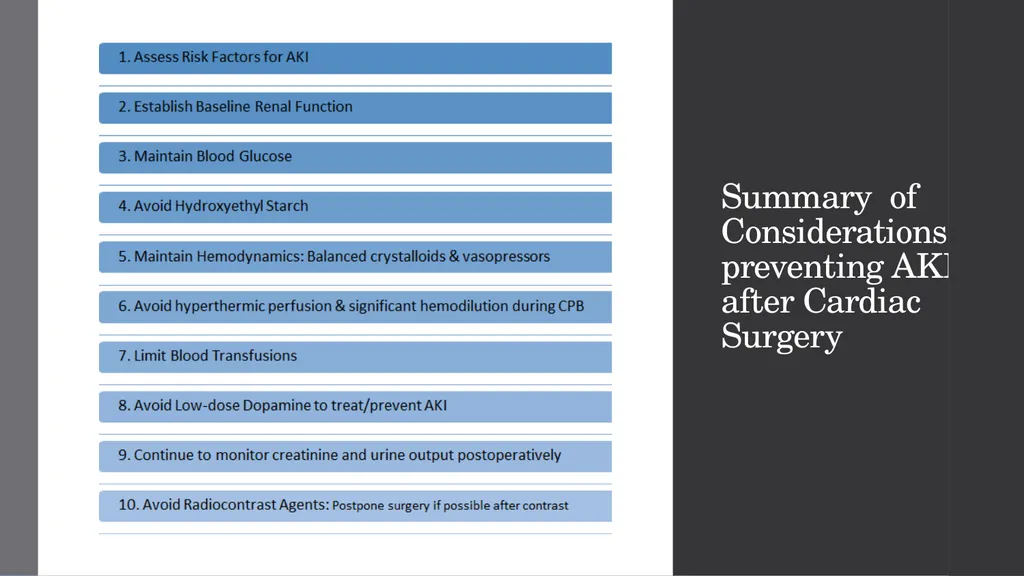
Summary of Considerations for preventing AKI after Cardiac Surgery<br>
29
More research needed<br>
30
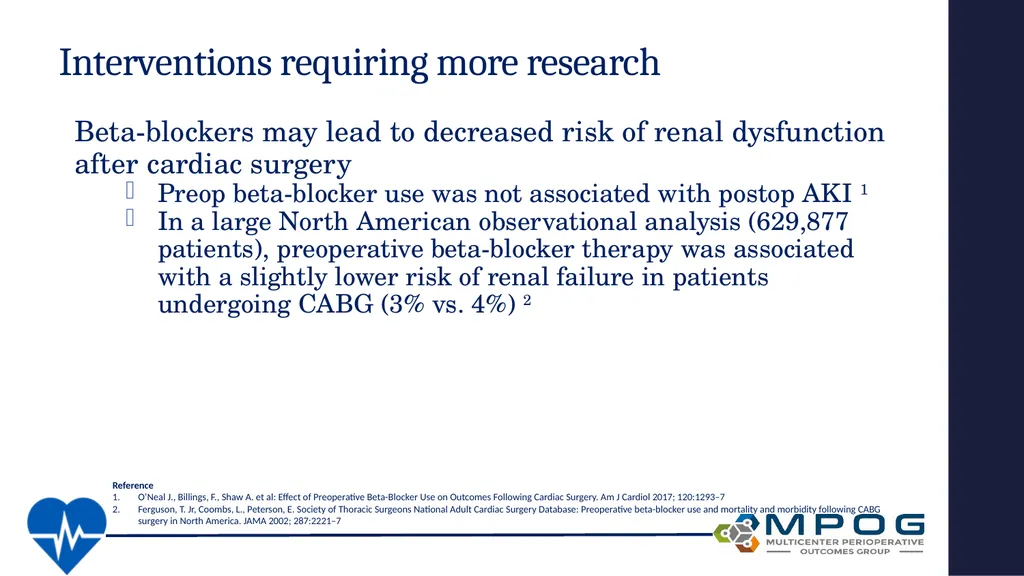
Interventions requiring more research Beta-blockers may lead to decreased risk of renal dysfunction after cardiac surgery
Preop beta-blocker use was not associated with postop AKI 1
In a large North American observational analysis (629,877 patients), preoperative beta-blocker therapy was associated with a slightly lower risk of renal failure in patients undergoing CABG (3% vs. 4%) 2 Reference
O’Neal J., Billings, F., Shaw A. et al: Effect of Preoperative Beta-Blocker Use on Outcomes Following Cardiac Surgery. Am J Cardiol 2017; 120:1293–7
Ferguson, T. Jr, Coombs, L., Peterson, E. Society of Thoracic Surgeons National Adult Cardiac Surgery Database: Preoperative beta-blocker use and mortality and morbidity following CABG surgery in North America. JAMA 2002; 287:2221–7<br>
Preop beta-blocker use was not associated with postop AKI 1
In a large North American observational analysis (629,877 patients), preoperative beta-blocker therapy was associated with a slightly lower risk of renal failure in patients undergoing CABG (3% vs. 4%) 2 Reference
O’Neal J., Billings, F., Shaw A. et al: Effect of Preoperative Beta-Blocker Use on Outcomes Following Cardiac Surgery. Am J Cardiol 2017; 120:1293–7
Ferguson, T. Jr, Coombs, L., Peterson, E. Society of Thoracic Surgeons National Adult Cardiac Surgery Database: Preoperative beta-blocker use and mortality and morbidity following CABG surgery in North America. JAMA 2002; 287:2221–7<br>
31
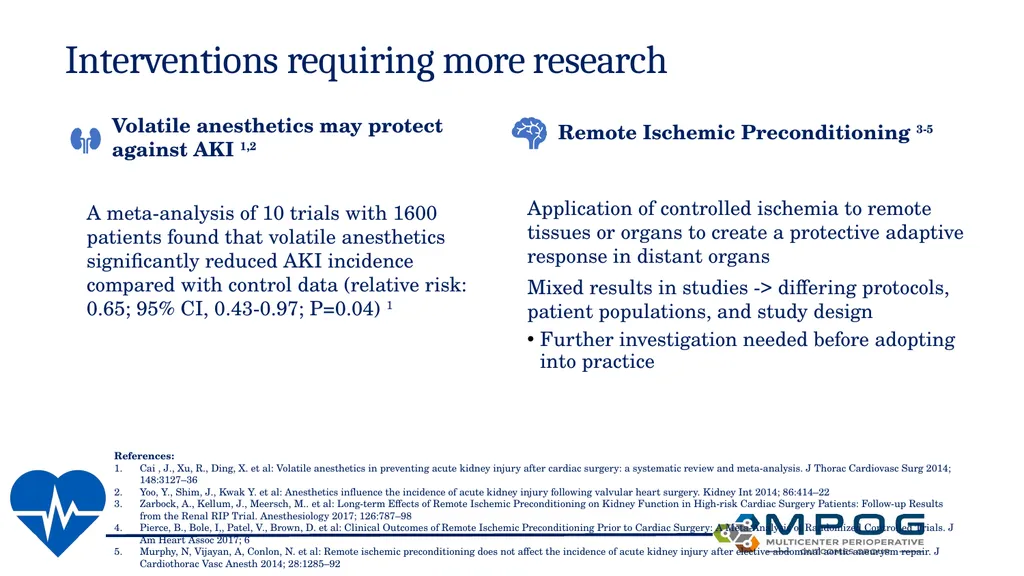
Interventions requiring more research References:
Cai , J., Xu, R., Ding, X. et al: Volatile anesthetics in preventing acute kidney injury after cardiac surgery: a systematic review and meta-analysis. J Thorac Cardiovasc Surg 2014; 148:3127–36
Yoo, Y., Shim, J., Kwak Y. et al: Anesthetics influence the incidence of acute kidney injury following valvular heart surgery. Kidney Int 2014; 86:414–22
Zarbock, A., Kellum, J., Meersch, M.. et al: Long-term Effects of Remote Ischemic Preconditioning on Kidney Function in High-risk Cardiac Surgery Patients: Follow-up Results from the Renal RIP Trial. Anesthesiology 2017; 126:787–98
Pierce, B., Bole, I,, Patel, V., Brown, D. et al: Clinical Outcomes of Remote Ischemic Preconditioning Prior to Cardiac Surgery: A Meta-Analysis of Randomized Controlled Trials. J Am Heart Assoc 2017; 6
Murphy, N, Vijayan, A, Conlon, N. et al: Remote ischemic preconditioning does not affect the incidence of acute kidney injury after elective abdominal aortic aneurysm repair. J Cardiothorac Vasc Anesth 2014; 28:1285–92<br>
Cai , J., Xu, R., Ding, X. et al: Volatile anesthetics in preventing acute kidney injury after cardiac surgery: a systematic review and meta-analysis. J Thorac Cardiovasc Surg 2014; 148:3127–36
Yoo, Y., Shim, J., Kwak Y. et al: Anesthetics influence the incidence of acute kidney injury following valvular heart surgery. Kidney Int 2014; 86:414–22
Zarbock, A., Kellum, J., Meersch, M.. et al: Long-term Effects of Remote Ischemic Preconditioning on Kidney Function in High-risk Cardiac Surgery Patients: Follow-up Results from the Renal RIP Trial. Anesthesiology 2017; 126:787–98
Pierce, B., Bole, I,, Patel, V., Brown, D. et al: Clinical Outcomes of Remote Ischemic Preconditioning Prior to Cardiac Surgery: A Meta-Analysis of Randomized Controlled Trials. J Am Heart Assoc 2017; 6
Murphy, N, Vijayan, A, Conlon, N. et al: Remote ischemic preconditioning does not affect the incidence of acute kidney injury after elective abdominal aortic aneurysm repair. J Cardiothorac Vasc Anesth 2014; 28:1285–92<br>
32
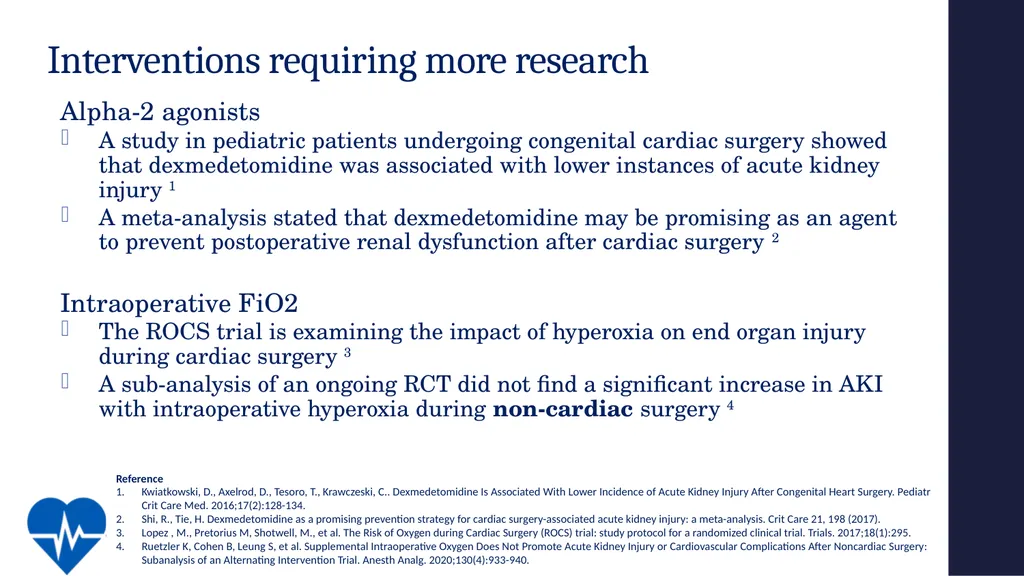
Interventions requiring more research Alpha-2 agonists
A study in pediatric patients undergoing congenital cardiac surgery showed that dexmedetomidine was associated with lower instances of acute kidney injury 1
A meta-analysis stated that dexmedetomidine may be promising as an agent to prevent postoperative renal dysfunction after cardiac surgery 2
Intraoperative FiO2
The ROCS trial is examining the impact of hyperoxia on end organ injury during cardiac surgery 3
A sub-analysis of an ongoing RCT did not find a significant increase in AKI with intraoperative hyperoxia during non-cardiac surgery 4 Reference
Kwiatkowski, D., Axelrod, D., Tesoro, T., Krawczeski, C.. Dexmedetomidine Is Associated With Lower Incidence of Acute Kidney Injury After Congenital Heart Surgery. Pediatr Crit Care Med. 2016;17(2):128-134.
Shi, R., Tie, H. Dexmedetomidine as a promising prevention strategy for cardiac surgery-associated acute kidney injury: a meta-analysis. Crit Care 21, 198 (2017).
Lopez , M., Pretorius M, Shotwell, M., et al. The Risk of Oxygen during Cardiac Surgery (ROCS) trial: study protocol for a randomized clinical trial. Trials. 2017;18(1):295.
Ruetzler K, Cohen B, Leung S, et al. Supplemental Intraoperative Oxygen Does Not Promote Acute Kidney Injury or Cardiovascular Complications After Noncardiac Surgery: Subanalysis of an Alternating Intervention Trial. Anesth Analg. 2020;130(4):933-940.<br>
A study in pediatric patients undergoing congenital cardiac surgery showed that dexmedetomidine was associated with lower instances of acute kidney injury 1
A meta-analysis stated that dexmedetomidine may be promising as an agent to prevent postoperative renal dysfunction after cardiac surgery 2
Intraoperative FiO2
The ROCS trial is examining the impact of hyperoxia on end organ injury during cardiac surgery 3
A sub-analysis of an ongoing RCT did not find a significant increase in AKI with intraoperative hyperoxia during non-cardiac surgery 4 Reference
Kwiatkowski, D., Axelrod, D., Tesoro, T., Krawczeski, C.. Dexmedetomidine Is Associated With Lower Incidence of Acute Kidney Injury After Congenital Heart Surgery. Pediatr Crit Care Med. 2016;17(2):128-134.
Shi, R., Tie, H. Dexmedetomidine as a promising prevention strategy for cardiac surgery-associated acute kidney injury: a meta-analysis. Crit Care 21, 198 (2017).
Lopez , M., Pretorius M, Shotwell, M., et al. The Risk of Oxygen during Cardiac Surgery (ROCS) trial: study protocol for a randomized clinical trial. Trials. 2017;18(1):295.
Ruetzler K, Cohen B, Leung S, et al. Supplemental Intraoperative Oxygen Does Not Promote Acute Kidney Injury or Cardiovascular Complications After Noncardiac Surgery: Subanalysis of an Alternating Intervention Trial. Anesth Analg. 2020;130(4):933-940.<br>