
Axions and Cosmology Roberto Peccei UCLA KAERU
JO
Published · 35 slides · 0 views

1 / 1

Description
Axions and Cosmology Roberto Peccei UCLA KAERU Conference in Honor of K. Hagiwara Kavli IPMU, Tokyo, Japan March 25-26, 2015 Axions and Cosmology The Strong CP Problem and its Resolution Axions Invisible Axions and Cosmological Constraints
Related Topics
Share
Embed code
Download this presentation From Below
"Axions and Cosmology Roberto Peccei UCLA KAERU" is the property of its rightful owner. Permission is granted to download and print the materials on this website for personal, non-commercial use only, and to display it on your personal computer provided you do not modify the materials and that you retain all copyright notices contained in the materials. By downloading content from our website, you accept the terms of this agreement.
Presentation Transcript
01
Axions and Cosmology Roberto Peccei
UCLA
KAERU Conference in Honor of K. Hagiwara
Kavli IPMU, Tokyo, Japan
March 25-26, 2015<br>
UCLA
KAERU Conference in Honor of K. Hagiwara
Kavli IPMU, Tokyo, Japan
March 25-26, 2015<br>
02
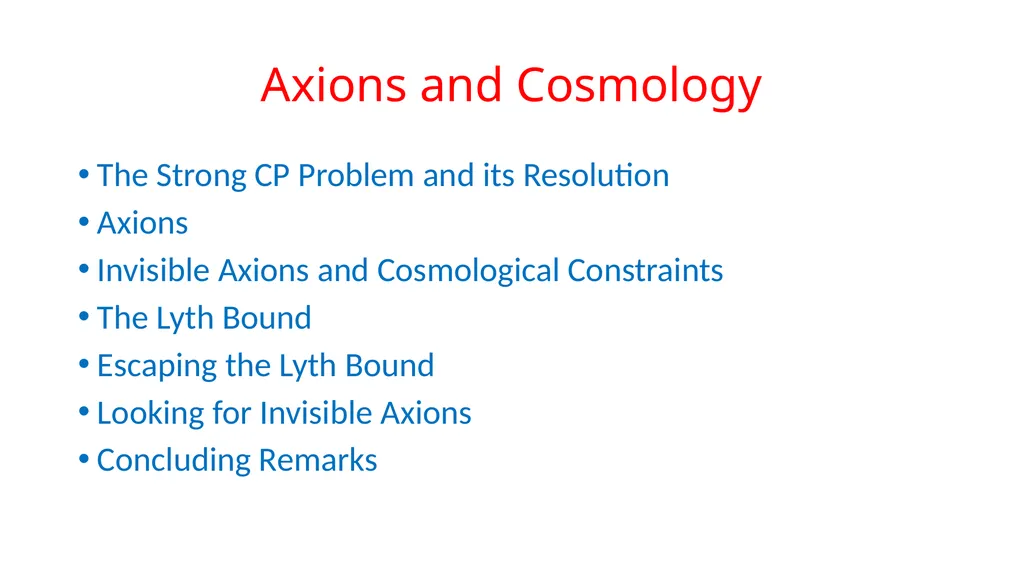
Axions and Cosmology The Strong CP Problem and its Resolution
Axions
Invisible Axions and Cosmological Constraints
The Lyth Bound
Escaping the Lyth Bound
Looking for Invisible Axions
Concluding Remarks<br>
Axions
Invisible Axions and Cosmological Constraints
The Lyth Bound
Escaping the Lyth Bound
Looking for Invisible Axions
Concluding Remarks<br>
03
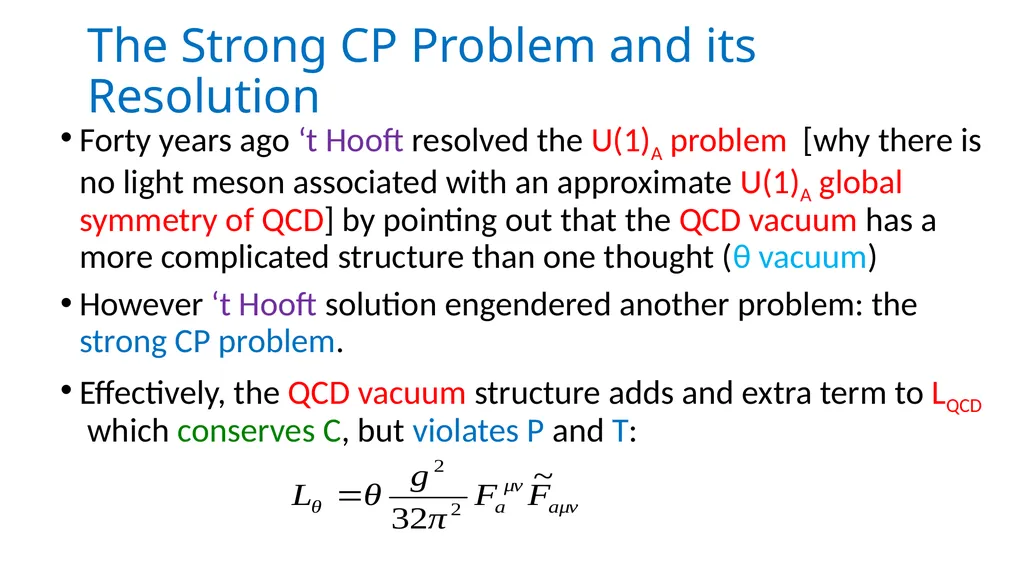
The Strong CP Problem and its Resolution Forty years ago ‘t Hooft resolved the U(1)A problem [why there is no light meson associated with an approximate U(1)A global symmetry of QCD] by pointing out that the QCD vacuum has a more complicated structure than one thought (θ vacuum)
However ‘t Hooft solution engendered another problem: the strong CP problem.
Effectively, the QCD vacuum structure adds and extra term to LQCD which conserves C, but violates P and T:<br>
However ‘t Hooft solution engendered another problem: the strong CP problem.
Effectively, the QCD vacuum structure adds and extra term to LQCD which conserves C, but violates P and T:<br>
04
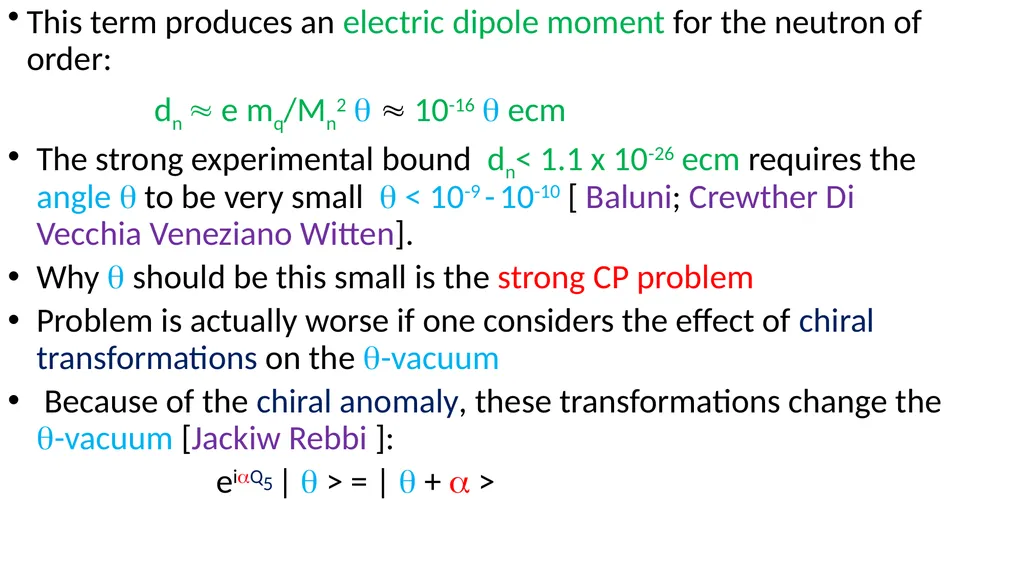
This term produces an electric dipole moment for the neutron of order:
dn e mq/Mn2 10-16 ecm
The strong experimental bound dn< 1.1 x 10⁻²⁶ ecm requires the angle to be very small < 10-9 - 10-10 [ Baluni; Crewther Di Vecchia Veneziano Witten].
Why should be this small is the strong CP problem
Problem is actually worse if one considers the effect of chiral transformations on the -vacuum
Because of the chiral anomaly, these transformations change the -vacuum [Jackiw Rebbi ]:
eiQ5 | > = | + ><br>
05
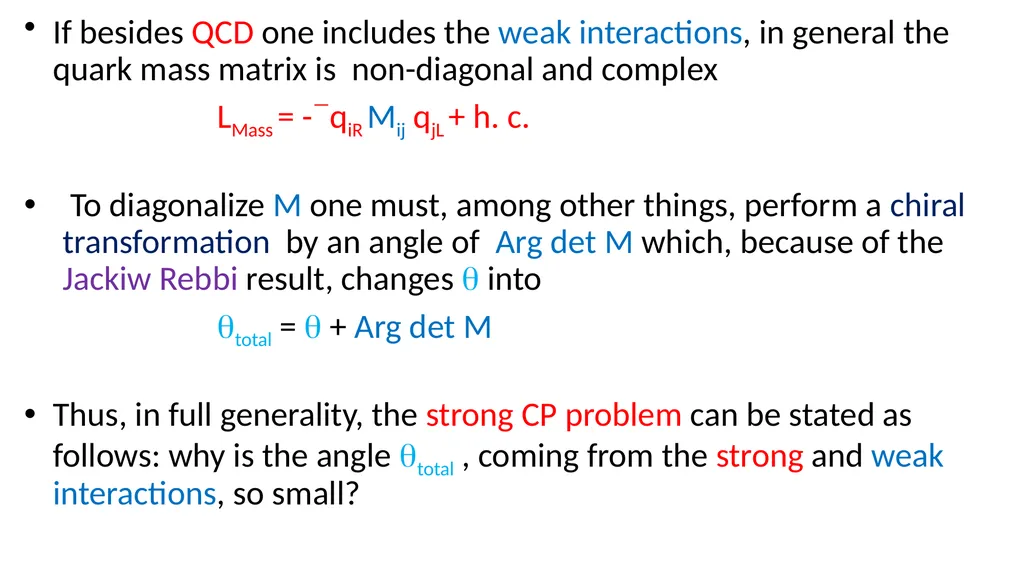
If besides QCD one includes the weak interactions, in general the quark mass matrix is non-diagonal and complex
LMass = -qiR Mij qjL + h. c.
To diagonalize M one must, among other things, perform a chiral transformation by an angle of Arg det M which, because of the Jackiw Rebbi result, changes into
total = + Arg det M
Thus, in full generality, the strong CP problem can be stated as follows: why is the angle total , coming from the strong and weak interactions, so small?<br>
06
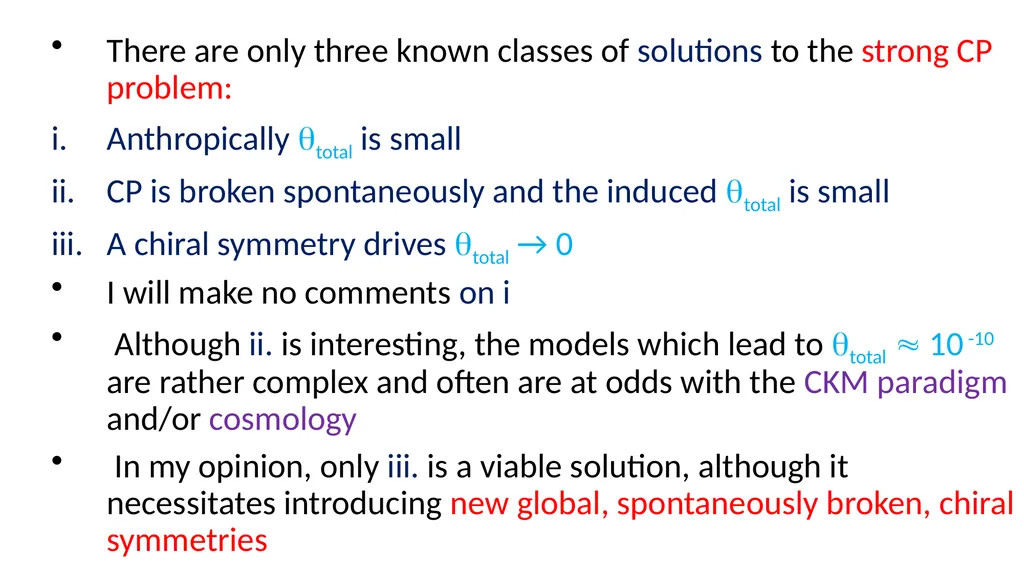
There are only three known classes of solutions to the strong CP problem:
Anthropically total is small
CP is broken spontaneously and the induced total is small
A chiral symmetry drives total → 0
I will make no comments on i
Although ii. is interesting, the models which lead to total 10 -10 are rather complex and often are at odds with the CKM paradigm and/or cosmology
In my opinion, only iii. is a viable solution, although it necessitates introducing new global, spontaneously broken, chiral symmetries<br>
07
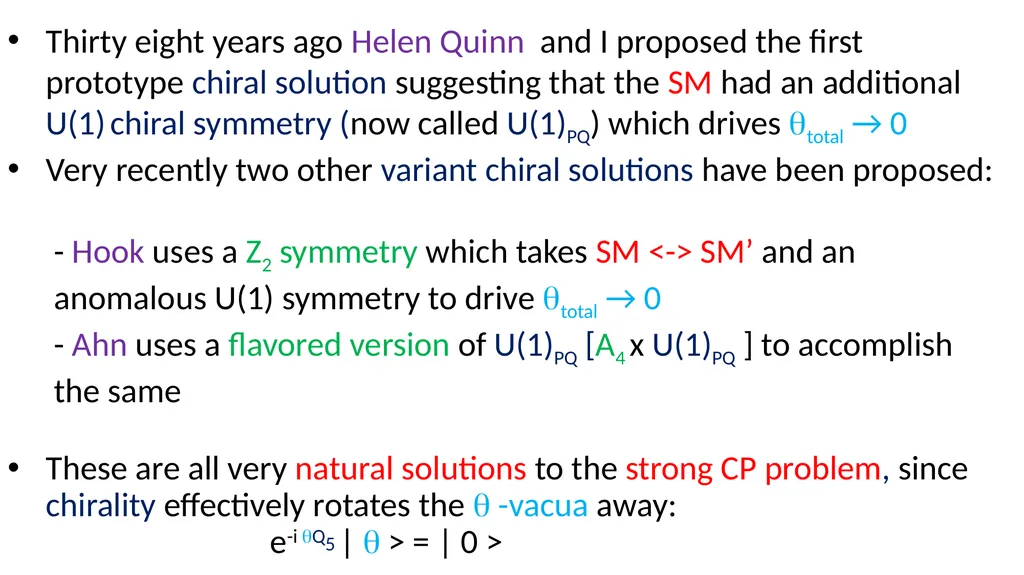
Thirty eight years ago Helen Quinn and I proposed the first prototype chiral solution suggesting that the SM had an additional U(1) chiral symmetry (now called U(1)PQ) which drives total → 0
Very recently two other variant chiral solutions have been proposed:
- Hook uses a Z2 symmetry which takes SM <-> SM’ and an
anomalous U(1) symmetry to drive total → 0
- Ahn uses a flavored version of U(1)PQ [A4 x U(1)PQ ] to accomplish
the same
These are all very natural solutions to the strong CP problem, since chirality effectively rotates the -vacua away:
e-i Q5 | > = | 0 ><br>
08
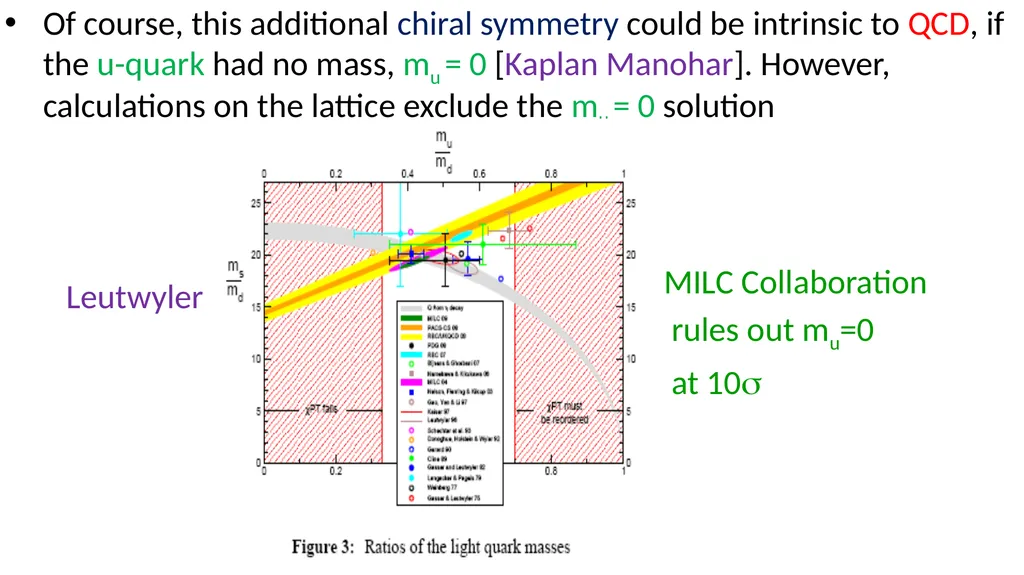
Of course, this additional chiral symmetry could be intrinsic to QCD, if the u-quark had no mass, mu = 0 [Kaplan Manohar]. However, calculations on the lattice exclude the mu = 0 solution
Leutwyler MILC Collaboration
rules out mu=0
at 10<br>
Leutwyler MILC Collaboration
rules out mu=0
at 10<br>
09
Axions
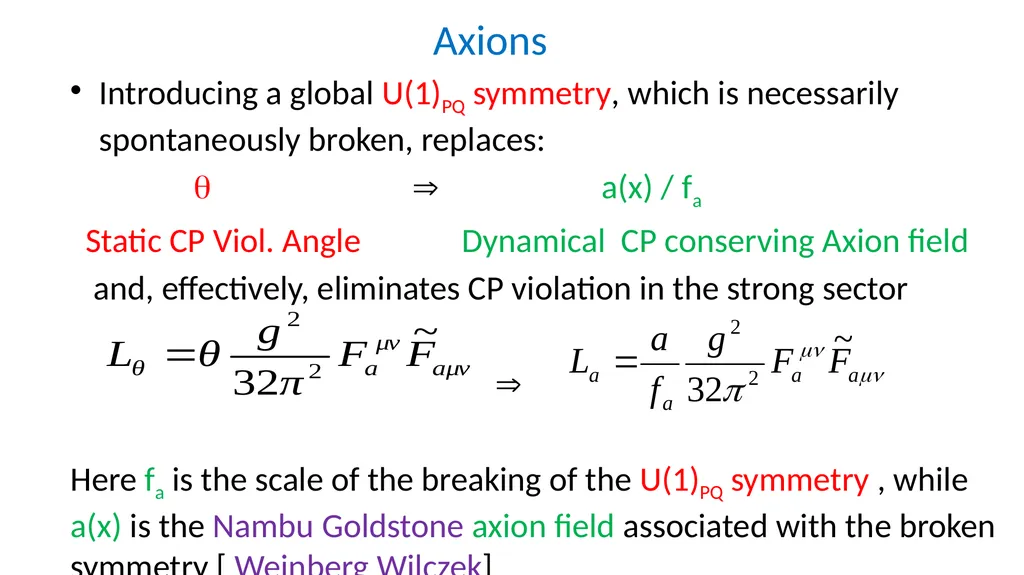
Introducing a global U(1)PQ symmetry, which is necessarily spontaneously broken, replaces:
a(x) / fa
Static CP Viol. Angle Dynamical CP conserving Axion field
and, effectively, eliminates CP violation in the strong sector
Here fa is the scale of the breaking of the U(1)PQ symmetry , while a(x) is the Nambu Goldstone axion field associated with the broken symmetry [ Weinberg Wilczek]<br>
10
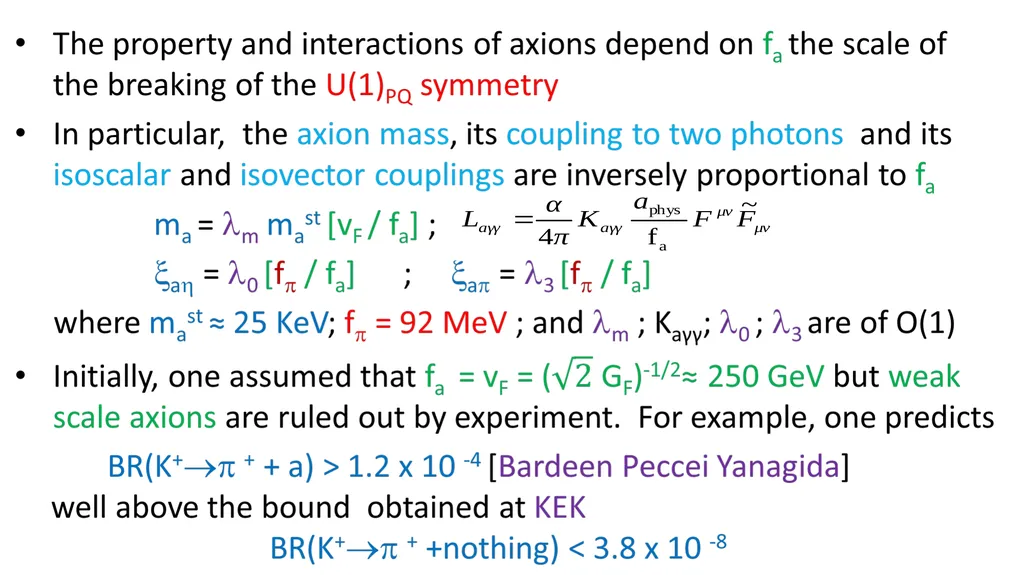
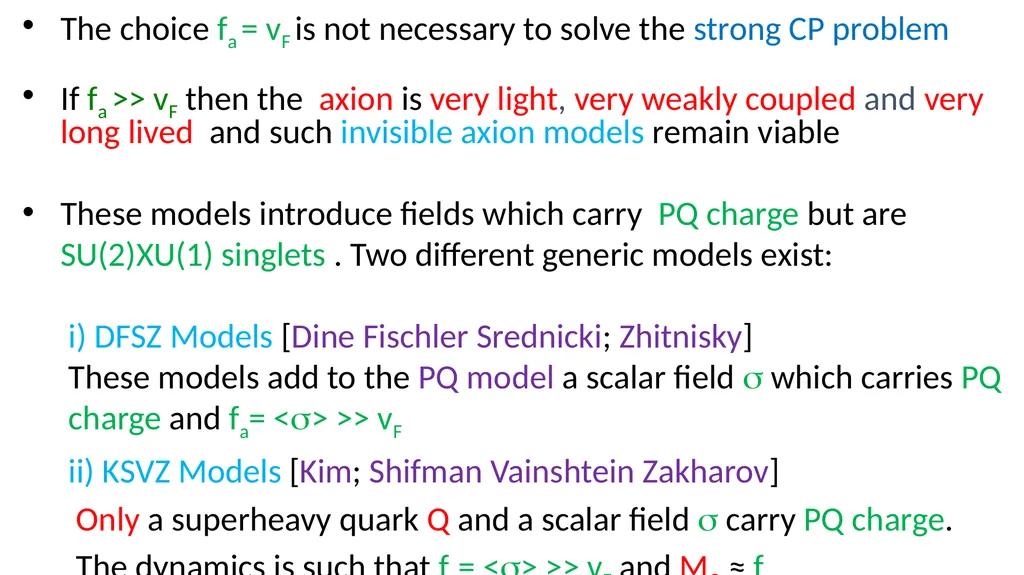
The choice fa = vF is not necessary to solve the strong CP problem
If fa >> vF then the axion is very light, very weakly coupled and very long lived and such invisible axion models remain viable
These models introduce fields which carry PQ charge but are SU(2)XU(1) singlets . Two different generic models exist:
i) DFSZ Models [Dine Fischler Srednicki; Zhitnisky]
These models add to the PQ model a scalar field which carries PQ
charge and fa= <> >> vF
ii) KSVZ Models [Kim; Shifman Vainshtein Zakharov]
Only a superheavy quark Q and a scalar field carry PQ charge.
The dynamics is such that fa= <> >> vF and MQ ≈ fa<br>
11
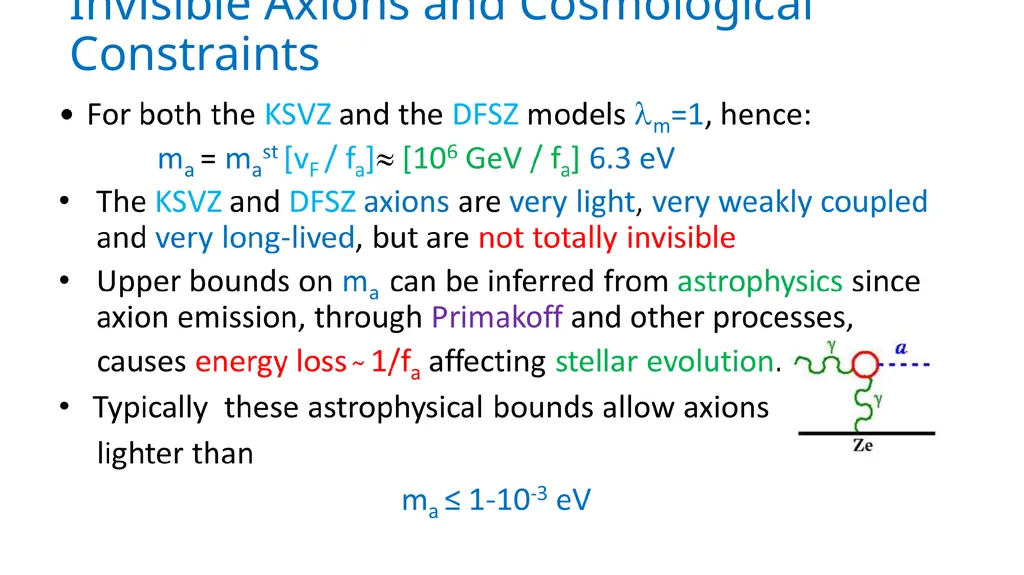
Invisible Axions and Cosmological Constraints<br>
12
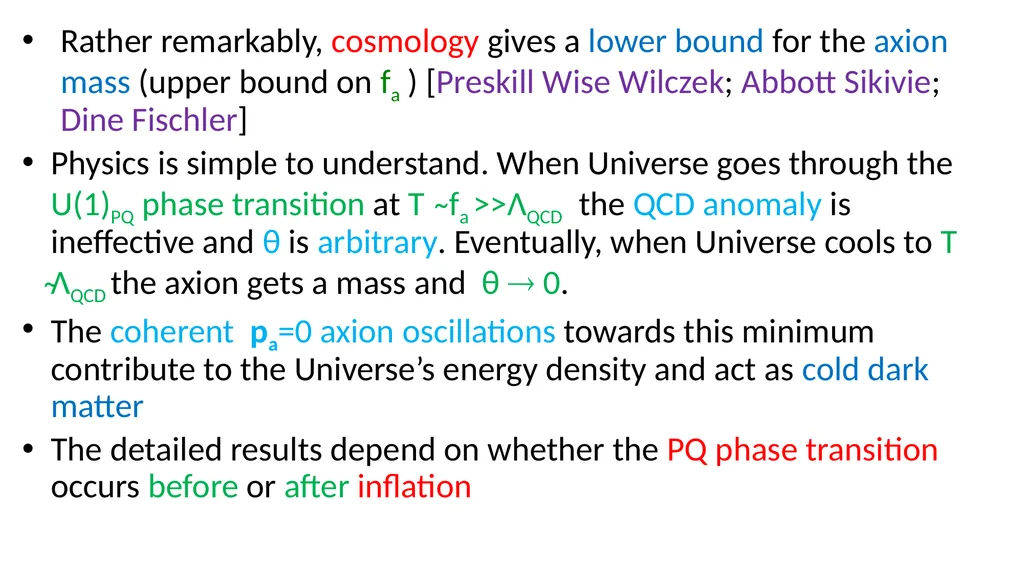
Rather remarkably, cosmology gives a lower bound for the axion mass (upper bound on fa ) [Preskill Wise Wilczek; Abbott Sikivie; Dine Fischler]
Physics is simple to understand. When Universe goes through the U(1)PQ phase transition at T ̴ fa >>ΛQCD the QCD anomaly is ineffective and θ is arbitrary. Eventually, when Universe cools to T ̴ΛQCD the axion gets a mass and θ 0.
The coherent pa=0 axion oscillations towards this minimum contribute to the Universe’s energy density and act as cold dark matter
The detailed results depend on whether the PQ phase transition occurs before or after inflation<br>
13
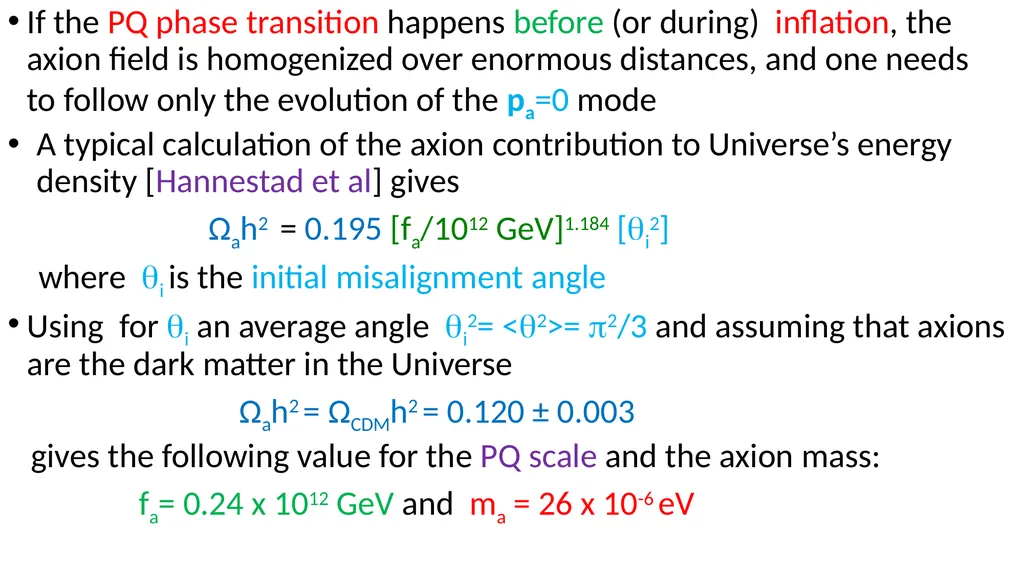
If the PQ phase transition happens before (or during) inflation, the axion field is homogenized over enormous distances, and one needs to follow only the evolution of the pa=0 mode
A typical calculation of the axion contribution to Universe’s energy density [Hannestad et al] gives
Ωah2 = 0.195 [fa/1012 GeV]1.184 [i2]
where i is the initial misalignment angle
Using for i an average angle i2= <2>= 2/3 and assuming that axions are the dark matter in the Universe
Ωah2 = ΩCDMh2 = 0.120 ± 0.003
gives the following value for the PQ scale and the axion mass:
fa= 0.24 x 10¹² GeV and ma = 26 x 10-6 eV<br>
14
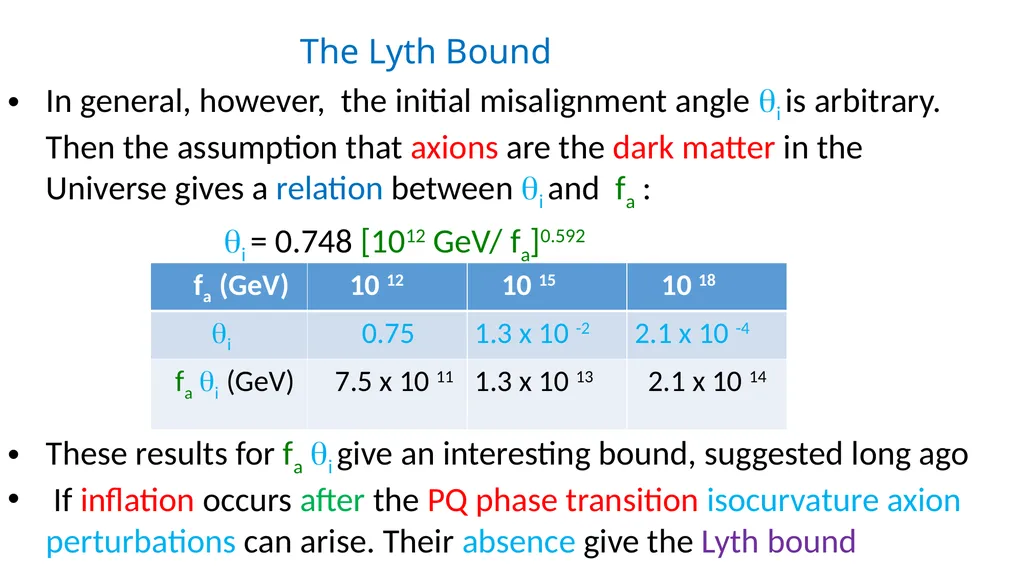
The Lyth Bound In general, however, the initial misalignment angle i is arbitrary. Then the assumption that axions are the dark matter in the Universe gives a relation between i and fa :
i = 0.748 [1012 GeV/ fa]0.592 These results for fa i give an interesting bound, suggested long ago
If inflation occurs after the PQ phase transition isocurvature axion perturbations can arise. Their absence give the Lyth bound<br>
i = 0.748 [1012 GeV/ fa]0.592 These results for fa i give an interesting bound, suggested long ago
If inflation occurs after the PQ phase transition isocurvature axion perturbations can arise. Their absence give the Lyth bound<br>
15
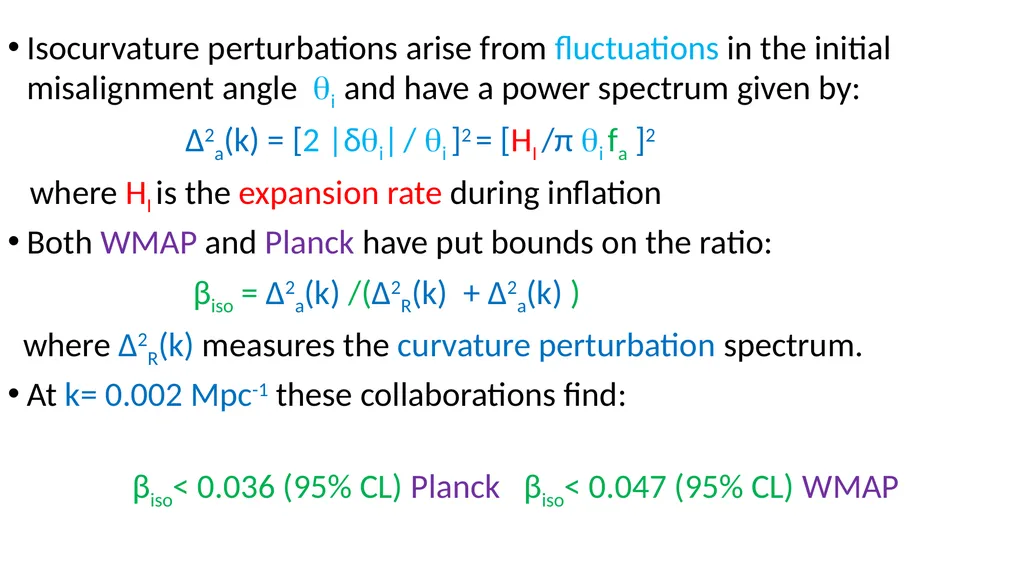
Isocurvature perturbations arise from fluctuations in the initial misalignment angle i and have a power spectrum given by:
Δ2a(k) = [2 |δi| / i ]2 = [HI /π i fa ]2
where HI is the expansion rate during inflation
Both WMAP and Planck have put bounds on the ratio:
βiso = Δ2a(k) /(Δ2R(k) + Δ2a(k) )
where Δ2R(k) measures the curvature perturbation spectrum.
At k= 0.002 Mpc-1 these collaborations find:
βiso< 0.036 (95% CL) Planck βiso< 0.047 (95% CL) WMAP<br>
16
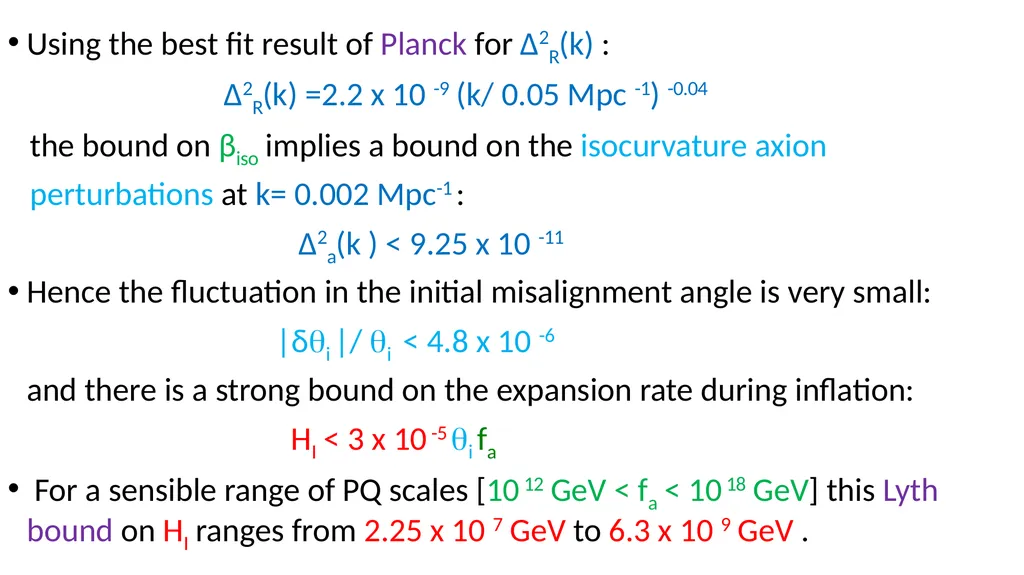
Using the best fit result of Planck for Δ2R(k) :
Δ2R(k) =2.2 x 10 -9 (k/ 0.05 Mpc -1) -0.04
the bound on βiso implies a bound on the isocurvature axion
perturbations at k= 0.002 Mpc-1 :
Δ2a(k ) < 9.25 x 10 -11
Hence the fluctuation in the initial misalignment angle is very small:
|δi |/ i < 4.8 x 10 -6
and there is a strong bound on the expansion rate during inflation:
HI < 3 x 10 -5 i fa
For a sensible range of PQ scales [10 12 GeV < fa < 10 18 GeV] this Lyth bound on HI ranges from 2.25 x 10 7 GeV to 6.3 x 10 9 GeV .<br>
17
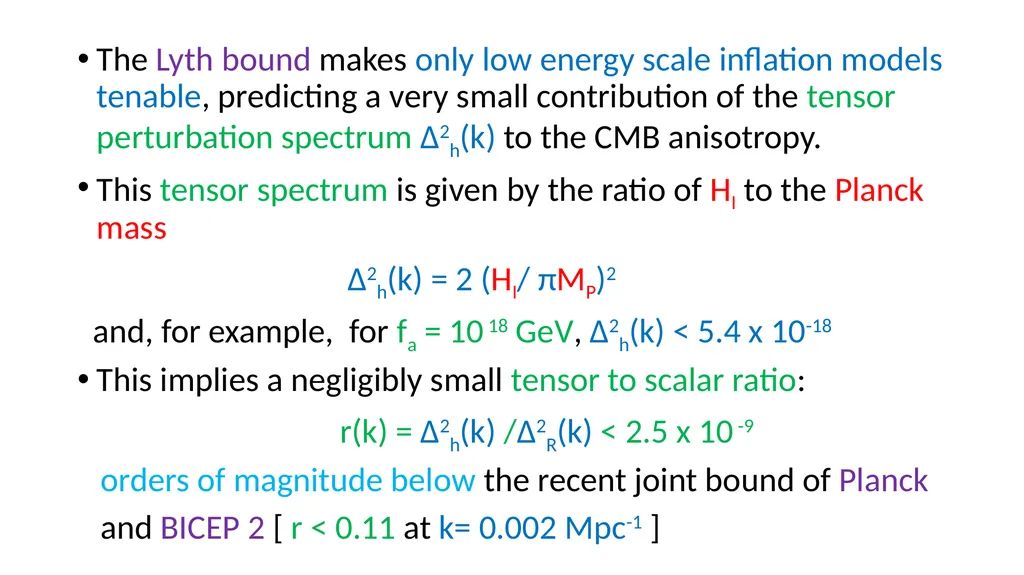
The Lyth bound makes only low energy scale inflation models tenable, predicting a very small contribution of the tensor perturbation spectrum Δ2h(k) to the CMB anisotropy.
This tensor spectrum is given by the ratio of HI to the Planck mass
Δ2h(k) = 2 (HI/ πMP)2
and, for example, for fa = 10 18 GeV, Δ2h(k) < 5.4 x 10⁻¹⁸
This implies a negligibly small tensor to scalar ratio:
r(k) = Δ2h(k) /Δ2R(k) < 2.5 x 10 -9
orders of magnitude below the recent joint bound of Planck
and BICEP 2 [ r < 0.11 at k= 0.002 Mpc-1 ]<br>
18
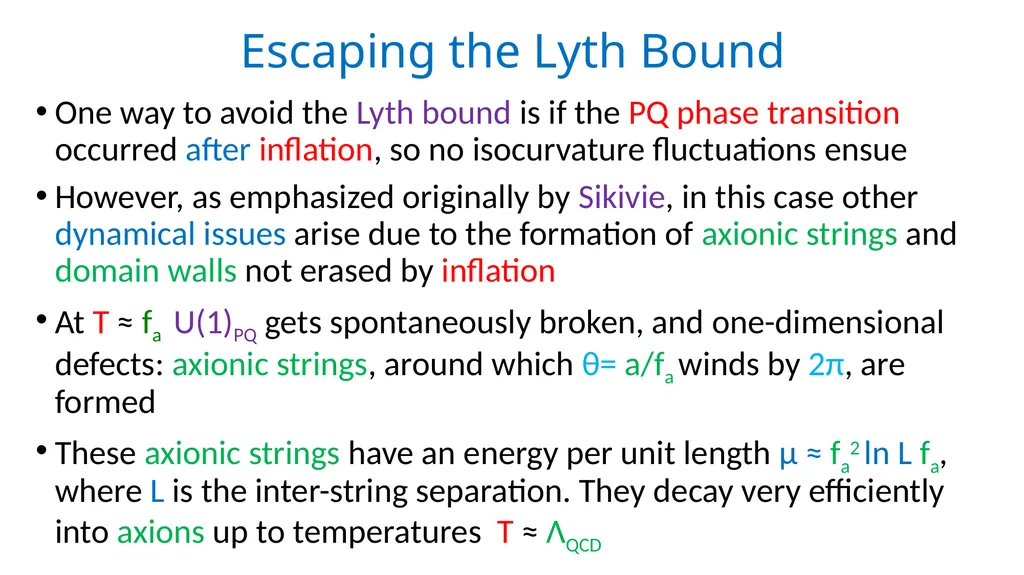
Escaping the Lyth Bound One way to avoid the Lyth bound is if the PQ phase transition occurred after inflation, so no isocurvature fluctuations ensue
However, as emphasized originally by Sikivie, in this case other dynamical issues arise due to the formation of axionic strings and domain walls not erased by inflation
At T ≈ fa U(1)PQ gets spontaneously broken, and one-dimensional defects: axionic strings, around which θ= a/fa winds by 2π, are formed
These axionic strings have an energy per unit length μ ≈ fa2 ln L fa, where L is the inter-string separation. They decay very efficiently into axions up to temperatures T ≈ ΛQCD<br>
19
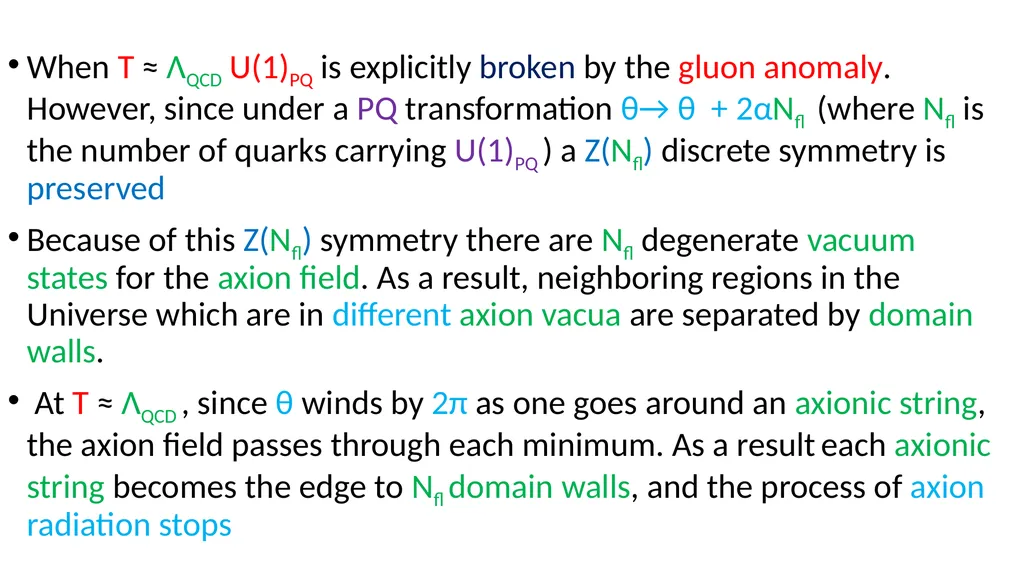
When T ≈ ΛQCD U(1)PQ is explicitly broken by the gluon anomaly. However, since under a PQ transformation θ→ θ + 2αNfl (where Nfl is the number of quarks carrying U(1)PQ ) a Z(Nfl) discrete symmetry is preserved
Because of this Z(Nfl) symmetry there are Nfl degenerate vacuum states for the axion field. As a result, neighboring regions in the Universe which are in different axion vacua are separated by domain walls.
At T ≈ ΛQCD , since θ winds by 2π as one goes around an axionic string, the axion field passes through each minimum. As a result each axionic string becomes the edge to Nfl domain walls, and the process of axion radiation stops<br>
20
If Nfl. > 1 (like in the DFSZ model) this string-wall network is stable and has a sizable surface energy density
σ ≈ ma fa 2 ≈ 6.3 x 10⁹ GeV3 [fa /1012 GeV]
This is a real problem, since the energy density in these walls dissipates slowly as the Universe expands [Zeldovich Kobzarev Okun]
ρwall = σ T
and ρwall now would vastly exceed the closure density of the Universe
This disaster is avoided if Nfl =1. Even though there is a unique vacuum, domain walls still form and attach to an axionic string –one wall per string.
However, as Everett and Vilenkin showed, these walls very rapidly get chopped up into pieces, each enclosed by strings. These structures are unstable and disappear by radiating axions<br>
21
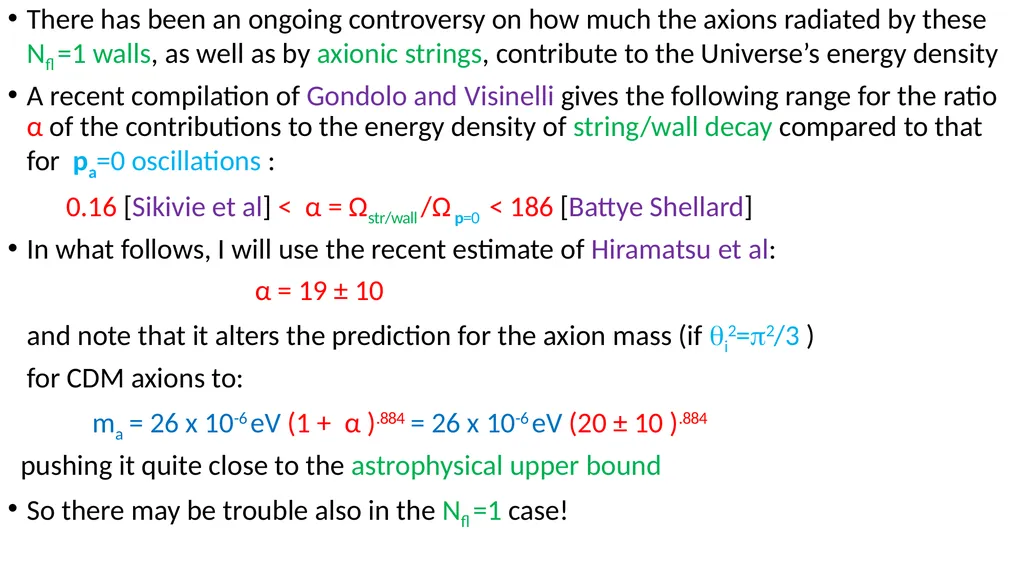
There has been an ongoing controversy on how much the axions radiated by these Nfl =1 walls, as well as by axionic strings, contribute to the Universe’s energy density
A recent compilation of Gondolo and Visinelli gives the following range for the ratio α of the contributions to the energy density of string/wall decay compared to that for pa=0 oscillations :
0.16 [Sikivie et al] < α = Ωstr/wall /Ω p=0 < 186 [Battye Shellard]
In what follows, I will use the recent estimate of Hiramatsu et al:
α = 19 ± 10
and note that it alters the prediction for the axion mass (if i2=2/3 )
for CDM axions to:
ma = 26 x 10-6 eV (1 + α ).884 = 26 x 10-6 eV (20 ± 10 ).884
pushing it quite close to the astrophysical upper bound
So there may be trouble also in the Nfl =1 case!<br>
22
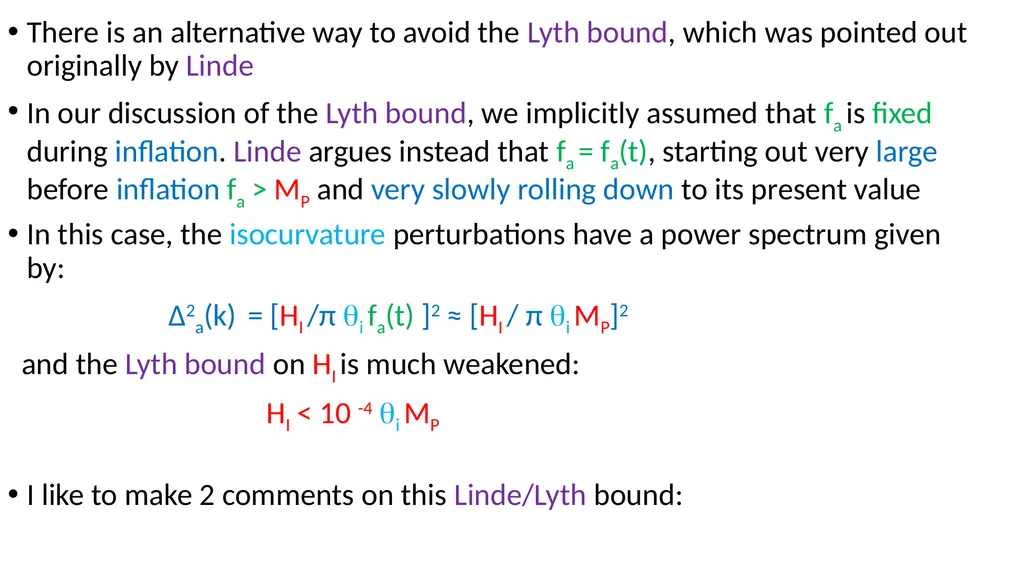
There is an alternative way to avoid the Lyth bound, which was pointed out originally by Linde
In our discussion of the Lyth bound, we implicitly assumed that fa is fixed during inflation. Linde argues instead that fa = fa(t), starting out very large before inflation fa > MP and very slowly rolling down to its present value
In this case, the isocurvature perturbations have a power spectrum given by:
Δ2a(k) = [HI /π i fa(t) ]2 ≈ [HI / π i MP]2
and the Lyth bound on HI is much weakened:
HI < 10 -4 i MP
I like to make 2 comments on this Linde/Lyth bound:<br>
23
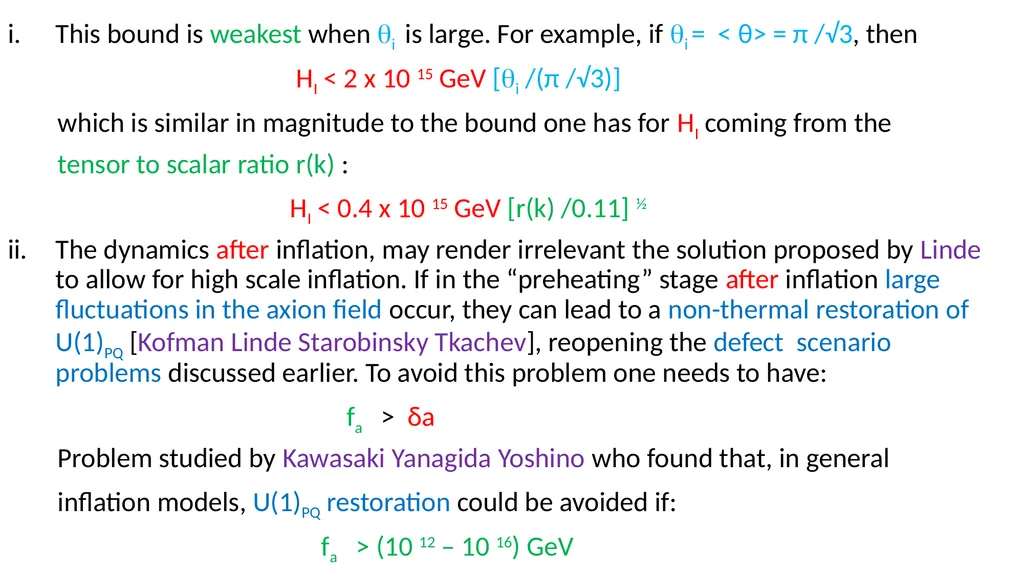
This bound is weakest when i is large. For example, if i = < θ> = π /√3, then
HI < 2 x 10 15 GeV [i /(π /√3)]
which is similar in magnitude to the bound one has for HI coming from the
tensor to scalar ratio r(k) :
HI < 0.4 x 10 15 GeV [r(k) /0.11] ½
The dynamics after inflation, may render irrelevant the solution proposed by Linde to allow for high scale inflation. If in the “preheating” stage after inflation large fluctuations in the axion field occur, they can lead to a non-thermal restoration of U(1)PQ [Kofman Linde Starobinsky Tkachev], reopening the defect scenario problems discussed earlier. To avoid this problem one needs to have:
fa > δa
Problem studied by Kawasaki Yanagida Yoshino who found that, in general
inflation models, U(1)PQ restoration could be avoided if:
fa > (10 12 – 10 16) GeV<br>
24
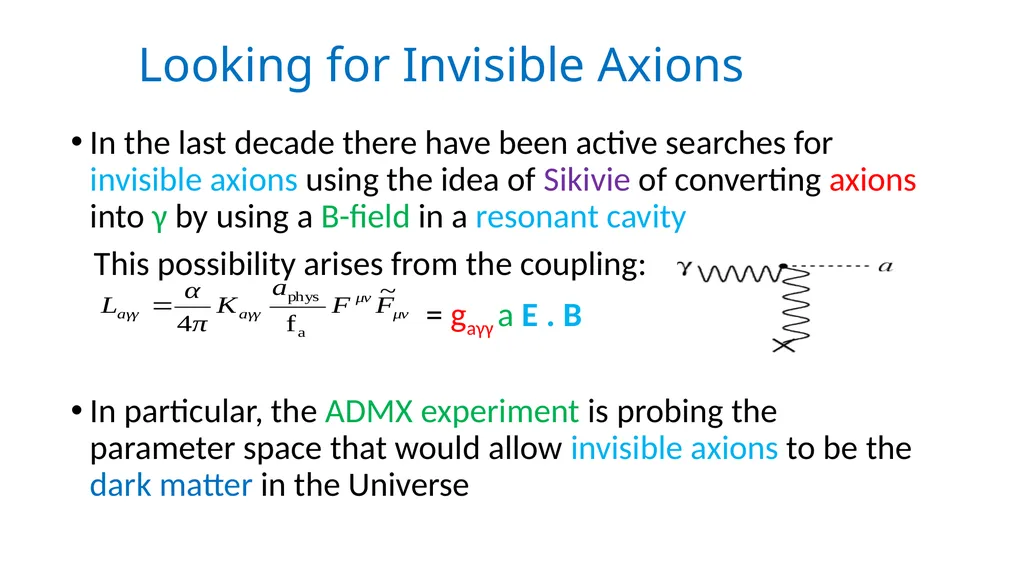
Looking for Invisible Axions In the last decade there have been active searches for invisible axions using the idea of Sikivie of converting axions into γ by using a B-field in a resonant cavity
This possibility arises from the coupling:
= gaγγ a E . B
In particular, the ADMX experiment is probing the parameter space that would allow invisible axions to be the dark matter in the Universe<br>
This possibility arises from the coupling:
= gaγγ a E . B
In particular, the ADMX experiment is probing the parameter space that would allow invisible axions to be the dark matter in the Universe<br>
25
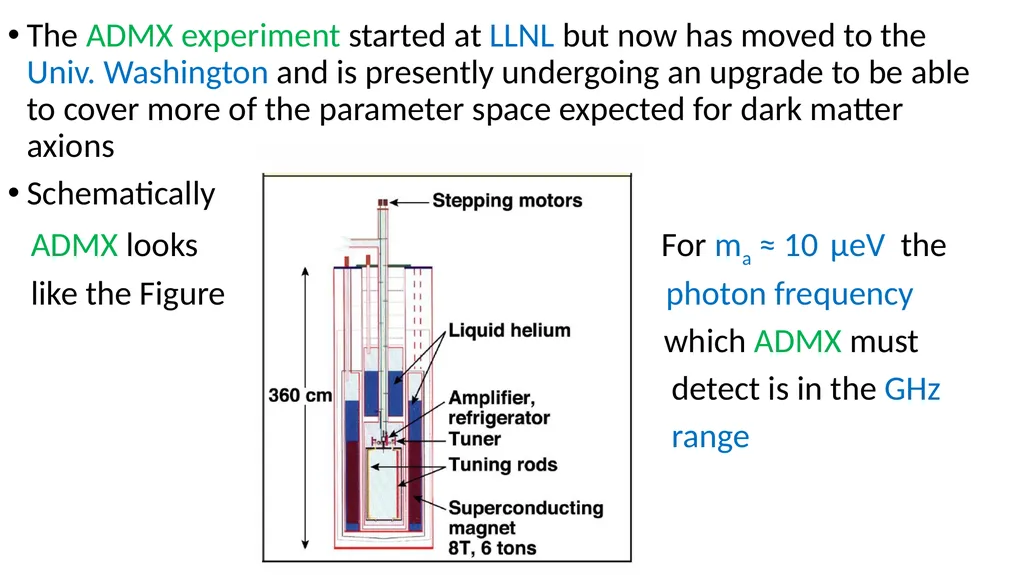
The ADMX experiment started at LLNL but now has moved to the Univ. Washington and is presently undergoing an upgrade to be able to cover more of the parameter space expected for dark matter axions
Schematically
ADMX looks For ma ≈ 10 μeV the
like the Figure photon frequency
which ADMX must
detect is in the GHz
range<br>
Schematically
ADMX looks For ma ≈ 10 μeV the
like the Figure photon frequency
which ADMX must
detect is in the GHz
range<br>
26
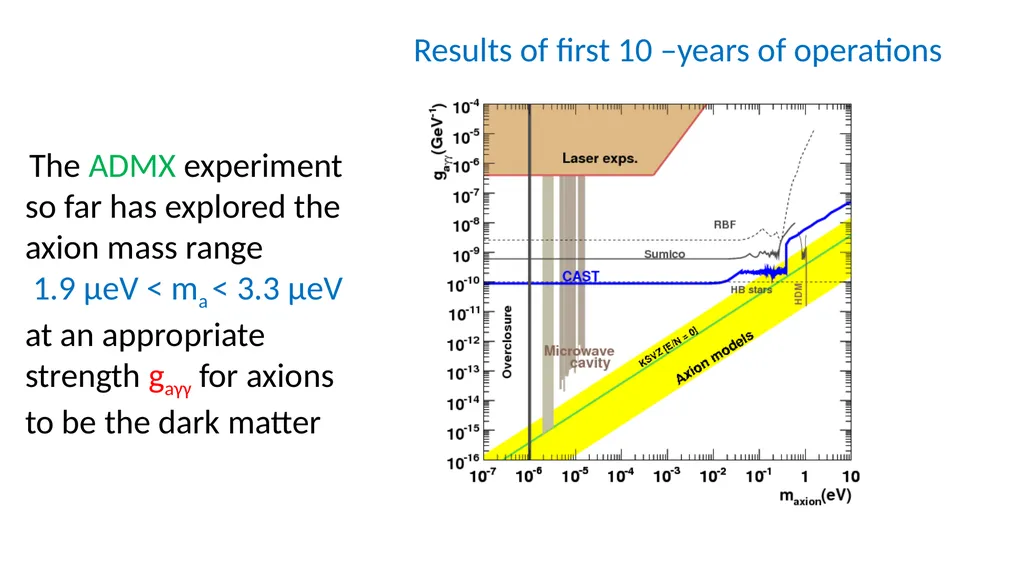
The ADMX experiment so far has explored the axion mass range
1.9 μeV < ma < 3.3 μeV
at an appropriate strength gaγγ for axions to be the dark matter Results of first 10 –years of operations<br>
1.9 μeV < ma < 3.3 μeV
at an appropriate strength gaγγ for axions to be the dark matter Results of first 10 –years of operations<br>
27
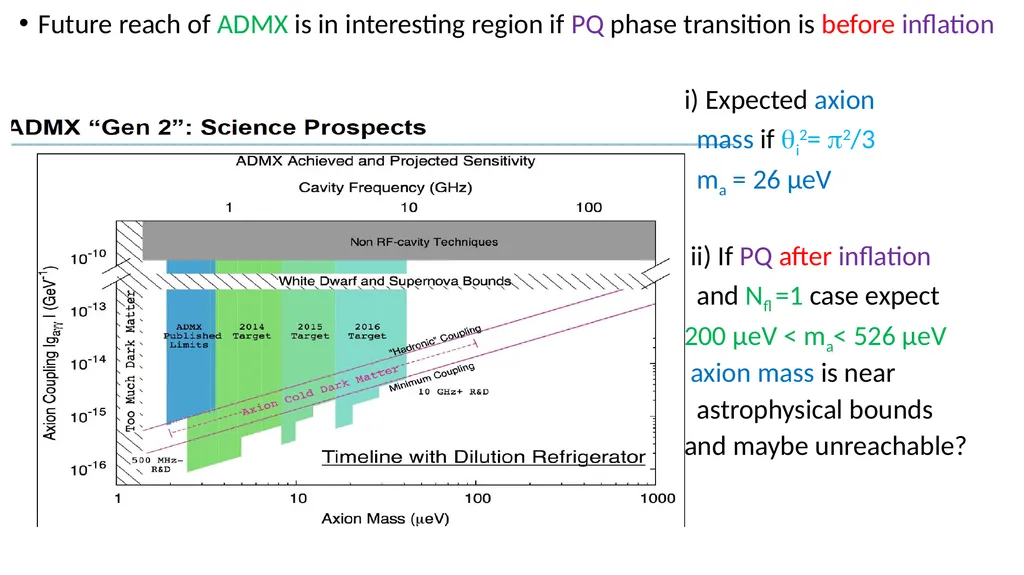
Future reach of ADMX is in interesting region if PQ phase transition is before inflation
i) Expected axion
mass if i2= 2/3
ma = 26 μeV
ii) If PQ after inflation
and Nfl =1 case expect
200 μeV < ma< 526 μeV
axion mass is near
astrophysical bounds
and maybe unreachable?<br>
i) Expected axion
mass if i2= 2/3
ma = 26 μeV
ii) If PQ after inflation
and Nfl =1 case expect
200 μeV < ma< 526 μeV
axion mass is near
astrophysical bounds
and maybe unreachable?<br>
28
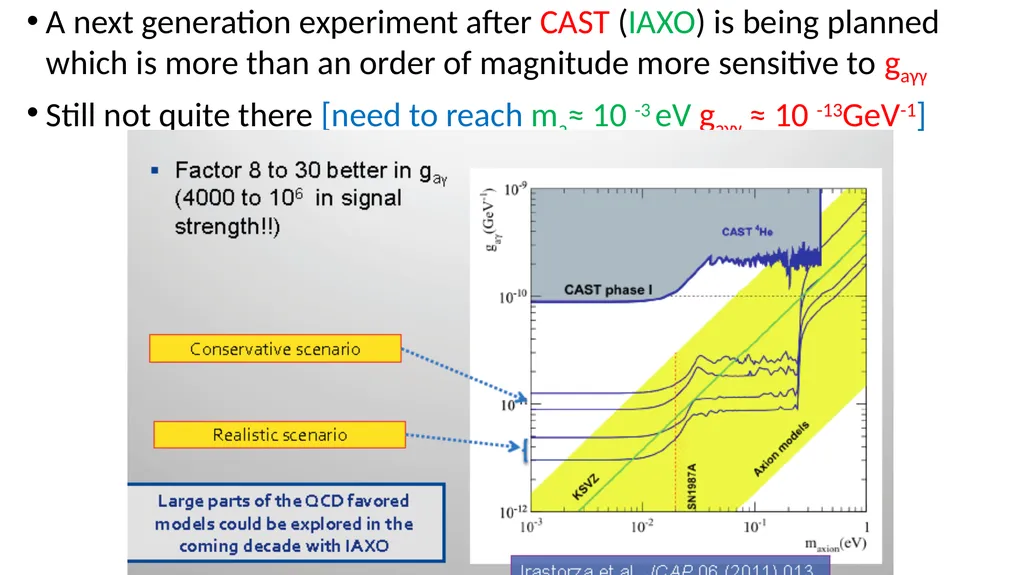
A next generation experiment after CAST (IAXO) is being planned which is more than an order of magnitude more sensitive to gaγγ
Still not quite there [need to reach ma≈ 10 -3 eV gaγγ ≈ 10 -13GeV-1]<br>
Still not quite there [need to reach ma≈ 10 -3 eV gaγγ ≈ 10 -13GeV-1]<br>
29
It is possible that the misalignment angle I is not of 0(1) but much smaller i<< 1. In this case, dark matter axions are associated with larger scales of U(1)PQ breaking [e.g. if i = 1.3 x 10 -2 then fa = 1015 GeV] and the axions are superlight [ma = 6.3 x 10 -9 eV for this example]
In many ways PQ breaking scales fa ≈ (1015- 1018) GeV are very natural, since axions are ubiquitous in string theories [Svrcek Witten]
Remarkably, one might be able to detect such high PQ breaking scales and superlight dark matter axions [Graham and Rajendran ]<br>
In many ways PQ breaking scales fa ≈ (1015- 1018) GeV are very natural, since axions are ubiquitous in string theories [Svrcek Witten]
Remarkably, one might be able to detect such high PQ breaking scales and superlight dark matter axions [Graham and Rajendran ]<br>
30
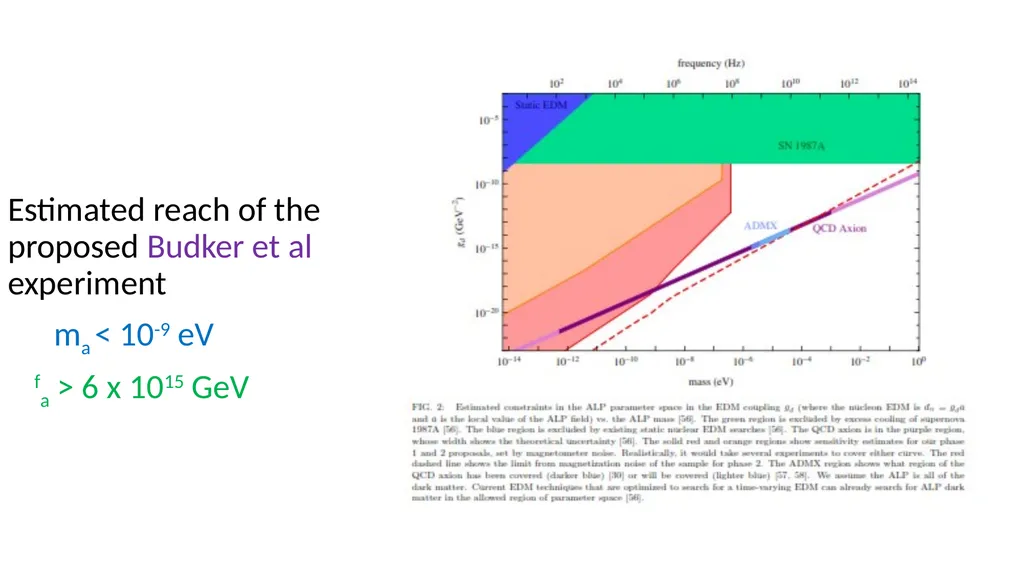
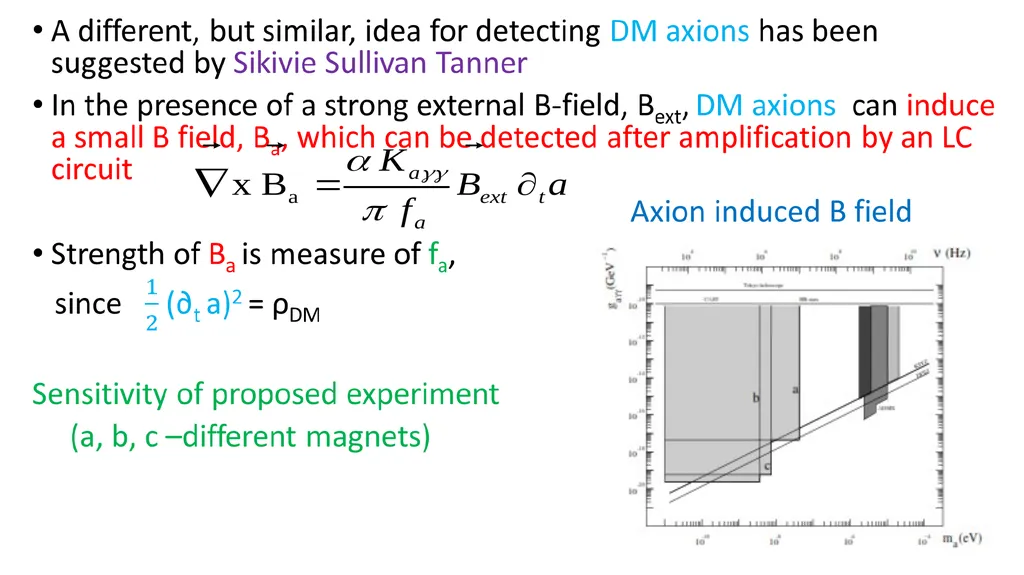
Estimated reach of the proposed Budker et al experiment
ma < 10-9 eV
fa > 6 x 10¹⁵ GeV<br>
ma < 10-9 eV
fa > 6 x 10¹⁵ GeV<br>
31
Concluding Remarks The existence of an additional chiral symmetry- like U(1) PQ -remains the most compelling solution to the strong CP problem
The concomitant axions play an interesting cosmological role and arise naturally in theories beyond the Standard Model
There are both ongoing and proposed experiments which in the next decade or so should tell us if axions exist<br>
The concomitant axions play an interesting cosmological role and arise naturally in theories beyond the Standard Model
There are both ongoing and proposed experiments which in the next decade or so should tell us if axions exist<br>