
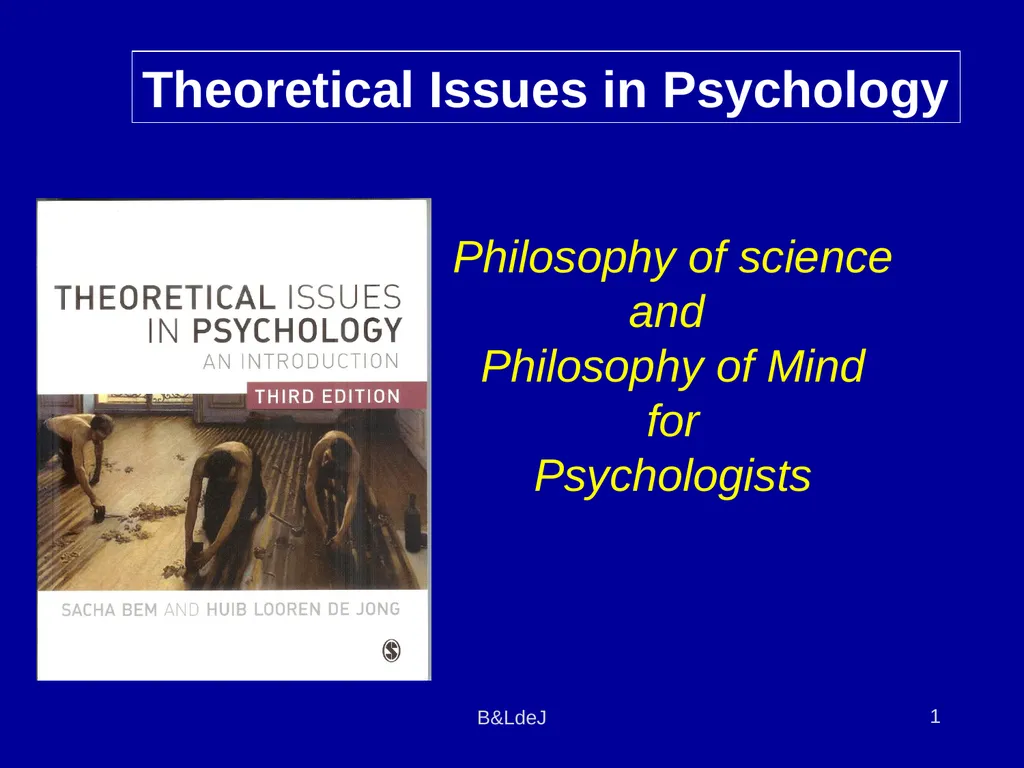
B&LdeJ 1 Theoretical Issues in Psychology
CB
Published · 21 slides · 0 views

1 / 1
Description
BLdeJ 1 Theoretical Issues in Psychology Philosophy of science and Philosophy of Mind for Psychologists BLdeJ 2 Chapter 6 Philosophy of mind, brain and cognition What is mind? Traditional views on the nature of mind: dualism, materialism,
Related Topics
Share
Embed code
Download this presentation From Below
"B&LdeJ 1 Theoretical Issues in Psychology" is the property of its rightful owner. Permission is granted to download and print the materials on this website for personal, non-commercial use only, and to display it on your personal computer provided you do not modify the materials and that you retain all copyright notices contained in the materials. By downloading content from our website, you accept the terms of this agreement.
Presentation Transcript
01
B&LdeJ 1 Theoretical Issues in Psychology Philosophy of science
and
Philosophy of Mind
for
Psychologists<br>
and
Philosophy of Mind
for
Psychologists<br>
02
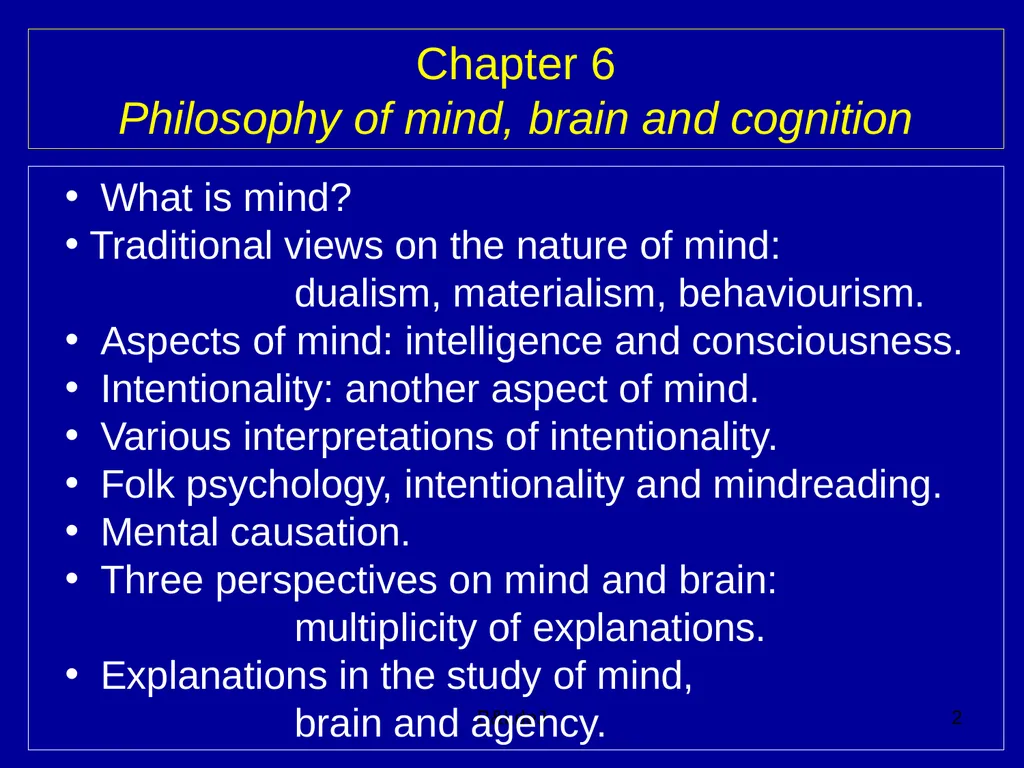
B&LdeJ 2 Chapter 6
Philosophy of mind, brain and cognition What is mind?
Traditional views on the nature of mind:
dualism, materialism, behaviourism.
Aspects of mind: intelligence and consciousness.
Intentionality: another aspect of mind.
Various interpretations of intentionality.
Folk psychology, intentionality and mindreading.
Mental causation.
Three perspectives on mind and brain:
multiplicity of explanations.
Explanations in the study of mind,
brain and agency.<br>
Philosophy of mind, brain and cognition What is mind?
Traditional views on the nature of mind:
dualism, materialism, behaviourism.
Aspects of mind: intelligence and consciousness.
Intentionality: another aspect of mind.
Various interpretations of intentionality.
Folk psychology, intentionality and mindreading.
Mental causation.
Three perspectives on mind and brain:
multiplicity of explanations.
Explanations in the study of mind,
brain and agency.<br>
03
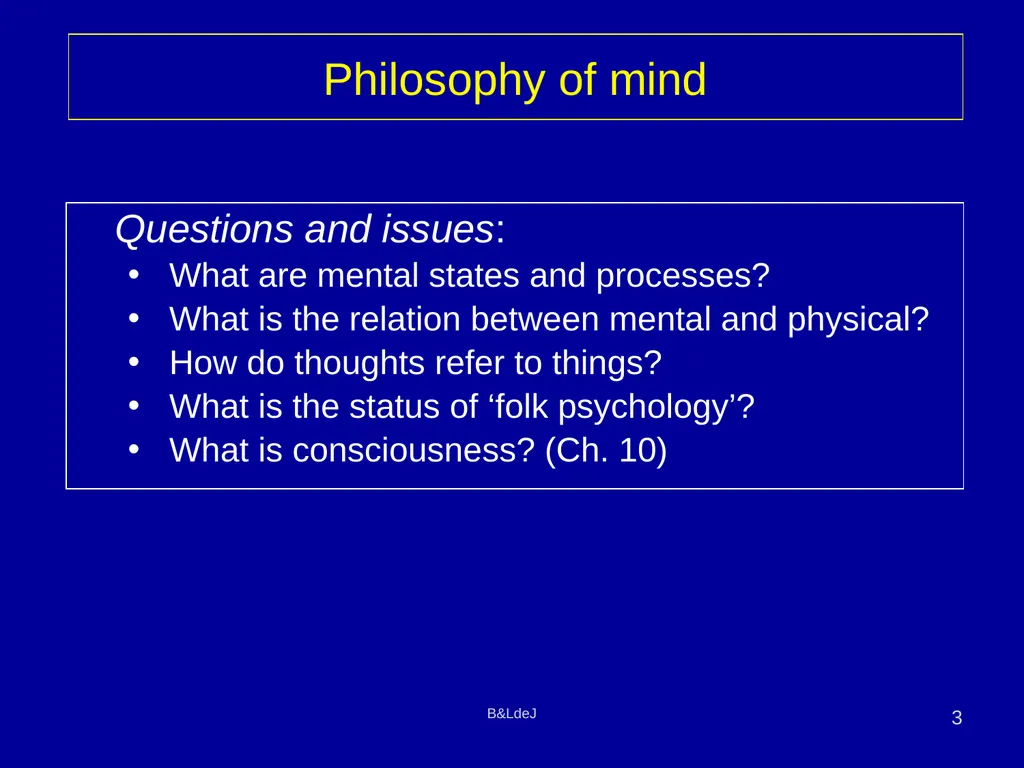
B&LdeJ 3 Philosophy of mind Questions and issues:
What are mental states and processes?
What is the relation between mental and physical?
How do thoughts refer to things?
What is the status of ‘folk psychology’?
What is consciousness? (Ch. 10)<br>
What are mental states and processes?
What is the relation between mental and physical?
How do thoughts refer to things?
What is the status of ‘folk psychology’?
What is consciousness? (Ch. 10)<br>
04
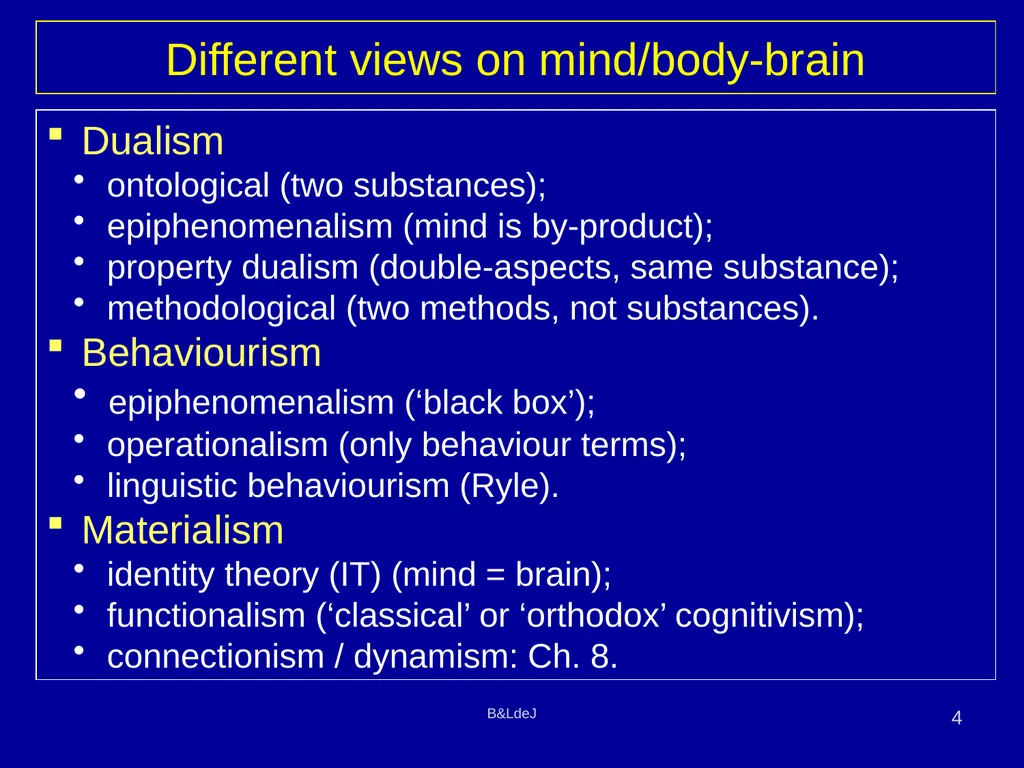
B&LdeJ 4 Different views on mind/body-brain Dualism
ontological (two substances);
epiphenomenalism (mind is by-product);
property dualism (double-aspects, same substance);
methodological (two methods, not substances).
Behaviourism
epiphenomenalism (‘black box’);
operationalism (only behaviour terms);
linguistic behaviourism (Ryle).
Materialism
identity theory (IT) (mind = brain);
functionalism (‘classical’ or ‘orthodox’ cognitivism);
connectionism / dynamism: Ch. 8.<br>
ontological (two substances);
epiphenomenalism (mind is by-product);
property dualism (double-aspects, same substance);
methodological (two methods, not substances).
Behaviourism
epiphenomenalism (‘black box’);
operationalism (only behaviour terms);
linguistic behaviourism (Ryle).
Materialism
identity theory (IT) (mind = brain);
functionalism (‘classical’ or ‘orthodox’ cognitivism);
connectionism / dynamism: Ch. 8.<br>
05
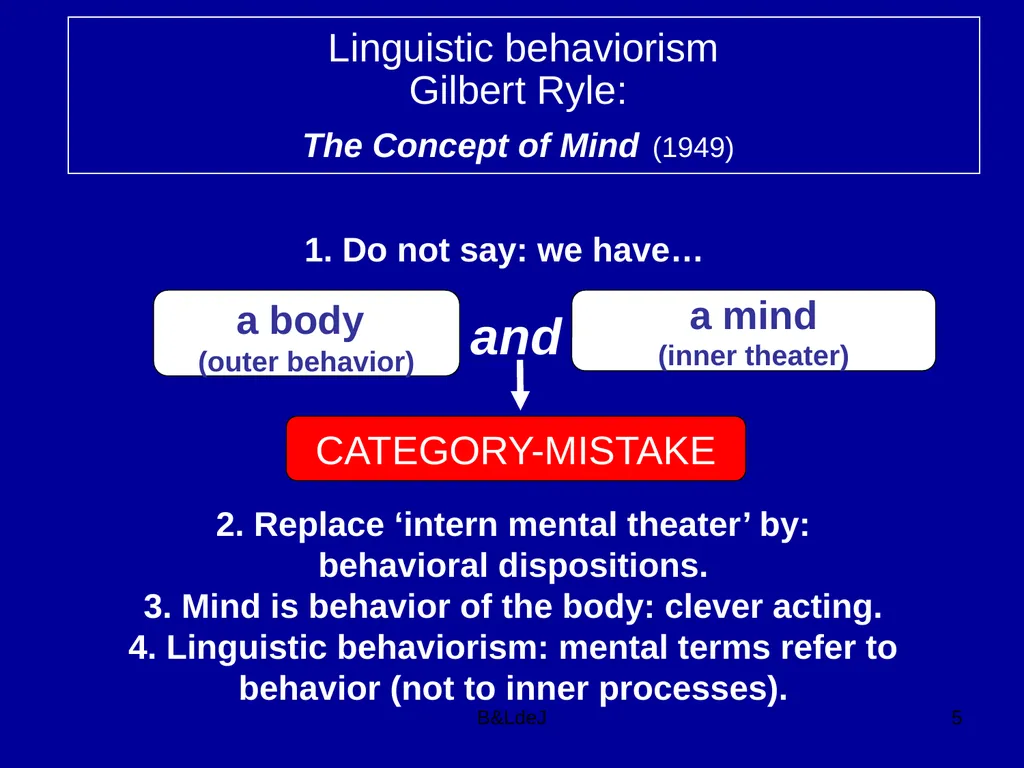
B&LdeJ 5 Linguistic behaviorism
Gilbert Ryle:
The Concept of Mind (1949) 1. Do not say: we have… a body
(outer behavior) and a mind
(inner theater) CATEGORY-MISTAKE 2. Replace ‘intern mental theater’ by:
behavioral dispositions.
3. Mind is behavior of the body: clever acting.
4. Linguistic behaviorism: mental terms refer to behavior (not to inner processes).<br>
Gilbert Ryle:
The Concept of Mind (1949) 1. Do not say: we have… a body
(outer behavior) and a mind
(inner theater) CATEGORY-MISTAKE 2. Replace ‘intern mental theater’ by:
behavioral dispositions.
3. Mind is behavior of the body: clever acting.
4. Linguistic behaviorism: mental terms refer to behavior (not to inner processes).<br>
06
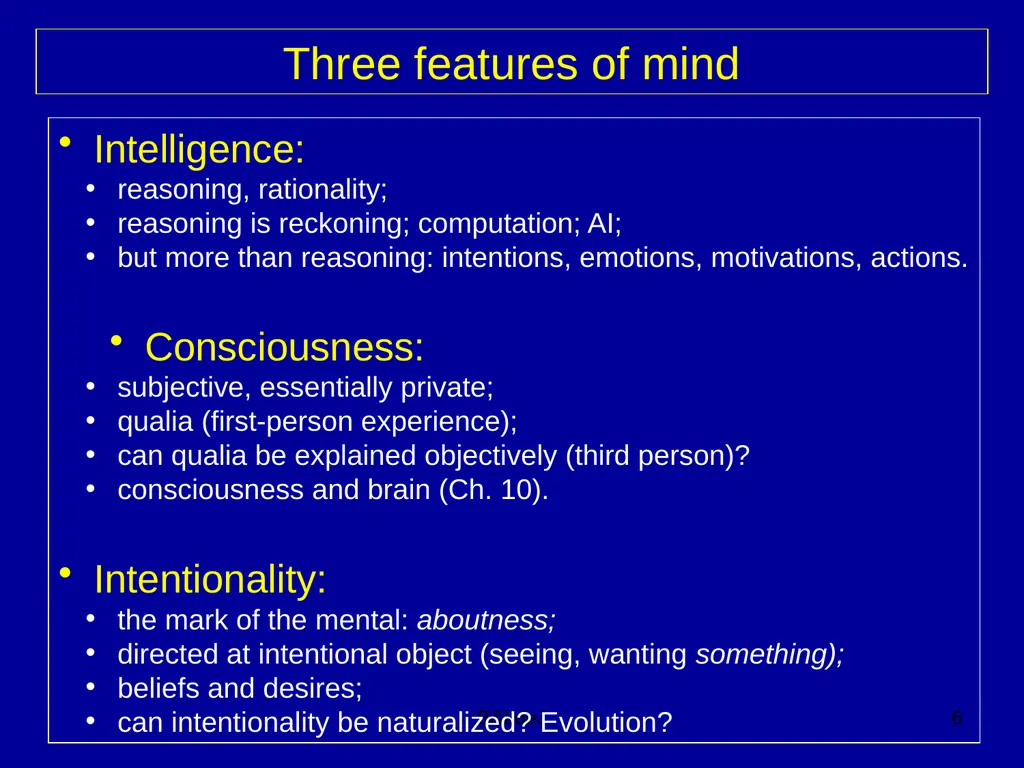
B&LdeJ 6 Three features of mind Intelligence:
reasoning, rationality;
reasoning is reckoning; computation; AI;
but more than reasoning: intentions, emotions, motivations, actions.
Consciousness:
subjective, essentially private;
qualia (first-person experience);
can qualia be explained objectively (third person)?
consciousness and brain (Ch. 10).
Intentionality:
the mark of the mental: aboutness;
directed at intentional object (seeing, wanting something);
beliefs and desires;
can intentionality be naturalized? Evolution?<br>
reasoning, rationality;
reasoning is reckoning; computation; AI;
but more than reasoning: intentions, emotions, motivations, actions.
Consciousness:
subjective, essentially private;
qualia (first-person experience);
can qualia be explained objectively (third person)?
consciousness and brain (Ch. 10).
Intentionality:
the mark of the mental: aboutness;
directed at intentional object (seeing, wanting something);
beliefs and desires;
can intentionality be naturalized? Evolution?<br>
07
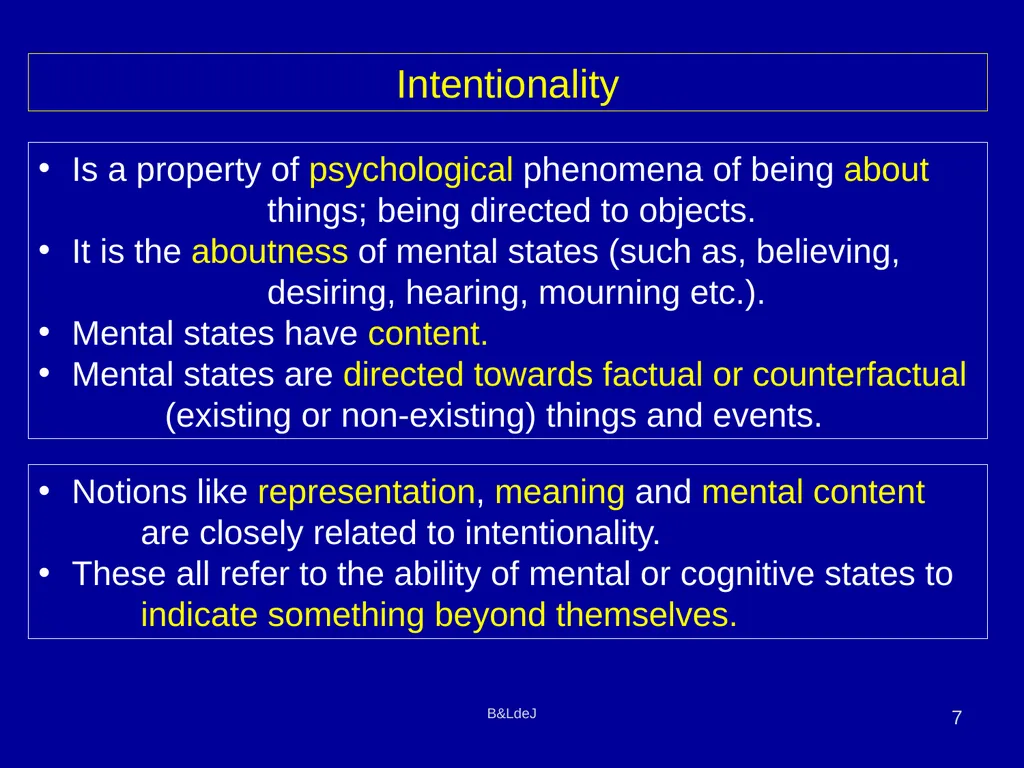
B&LdeJ 7 Intentionality Is a property of psychological phenomena of being about things; being directed to objects.
It is the aboutness of mental states (such as, believing, desiring, hearing, mourning etc.).
Mental states have content.
Mental states are directed towards factual or counterfactual (existing or non-existing) things and events. Notions like representation, meaning and mental content
are closely related to intentionality.
These all refer to the ability of mental or cognitive states to
indicate something beyond themselves.<br>
It is the aboutness of mental states (such as, believing, desiring, hearing, mourning etc.).
Mental states have content.
Mental states are directed towards factual or counterfactual (existing or non-existing) things and events. Notions like representation, meaning and mental content
are closely related to intentionality.
These all refer to the ability of mental or cognitive states to
indicate something beyond themselves.<br>
08
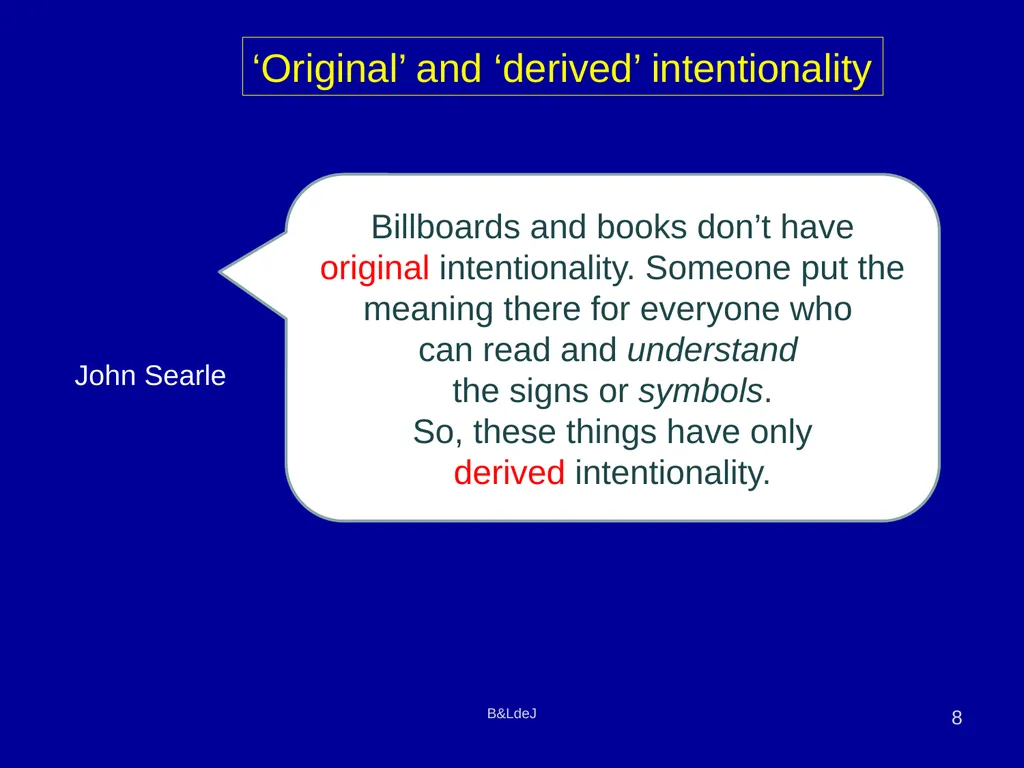
B&LdeJ 8 John Searle Billboards and books don’t have
original intentionality. Someone put the meaning there for everyone who
can read and understand
the signs or symbols.
So, these things have only
derived intentionality. ‘Original’ and ‘derived’ intentionality<br>
original intentionality. Someone put the meaning there for everyone who
can read and understand
the signs or symbols.
So, these things have only
derived intentionality. ‘Original’ and ‘derived’ intentionality<br>
09
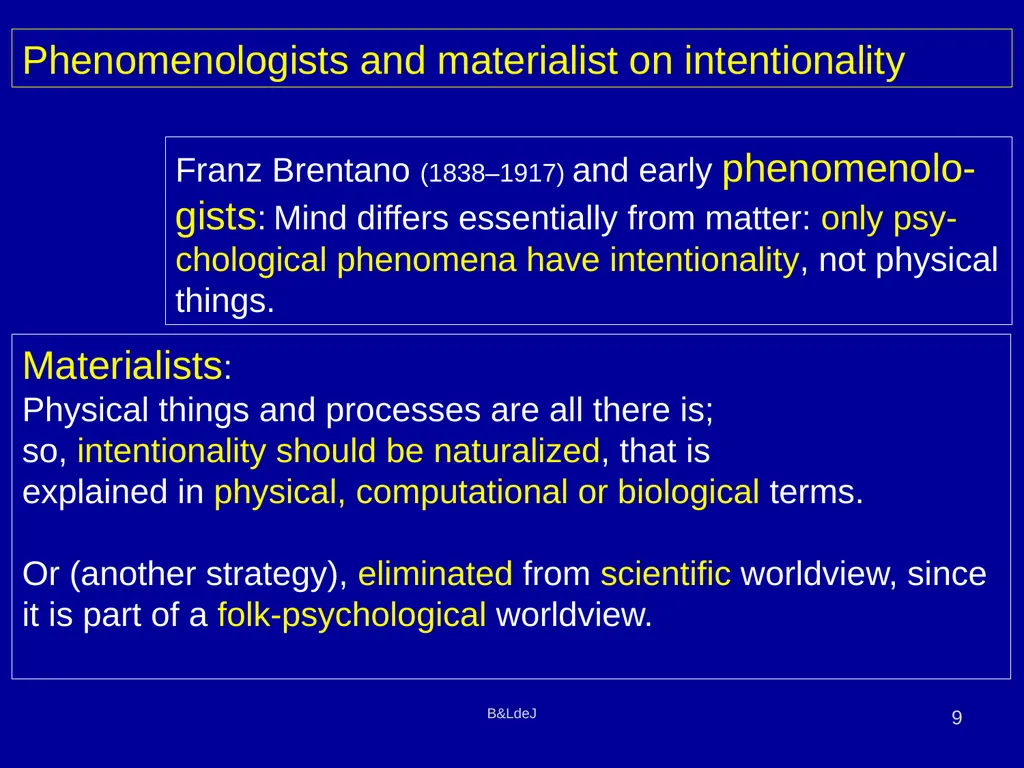
B&LdeJ 9 Franz Brentano (1838–1917) and early phenomenolo-
gists: Mind differs essentially from matter: only psy-
chological phenomena have intentionality, not physical
things. Materialists:
Physical things and processes are all there is;
so, intentionality should be naturalized, that is
explained in physical, computational or biological terms.
Or (another strategy), eliminated from scientific worldview, since it is part of a folk-psychological worldview. Phenomenologists and materialist on intentionality<br>
gists: Mind differs essentially from matter: only psy-
chological phenomena have intentionality, not physical
things. Materialists:
Physical things and processes are all there is;
so, intentionality should be naturalized, that is
explained in physical, computational or biological terms.
Or (another strategy), eliminated from scientific worldview, since it is part of a folk-psychological worldview. Phenomenologists and materialist on intentionality<br>
10
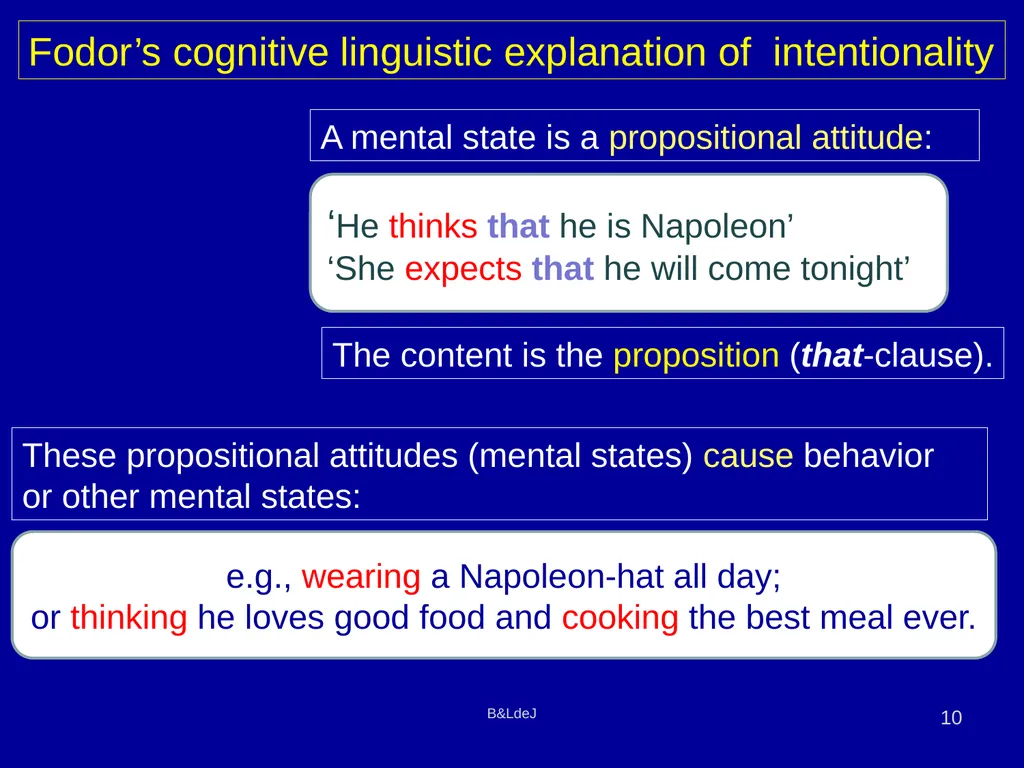
B&LdeJ 10 Fodor’s cognitive linguistic explanation of intentionality A mental state is a propositional attitude: ‘He thinks that he is Napoleon’
‘She expects that he will come tonight’ These propositional attitudes (mental states) cause behavior
or other mental states: e.g., wearing a Napoleon-hat all day;
or thinking he loves good food and cooking the best meal ever. The content is the proposition (that-clause).<br>
‘She expects that he will come tonight’ These propositional attitudes (mental states) cause behavior
or other mental states: e.g., wearing a Napoleon-hat all day;
or thinking he loves good food and cooking the best meal ever. The content is the proposition (that-clause).<br>
11
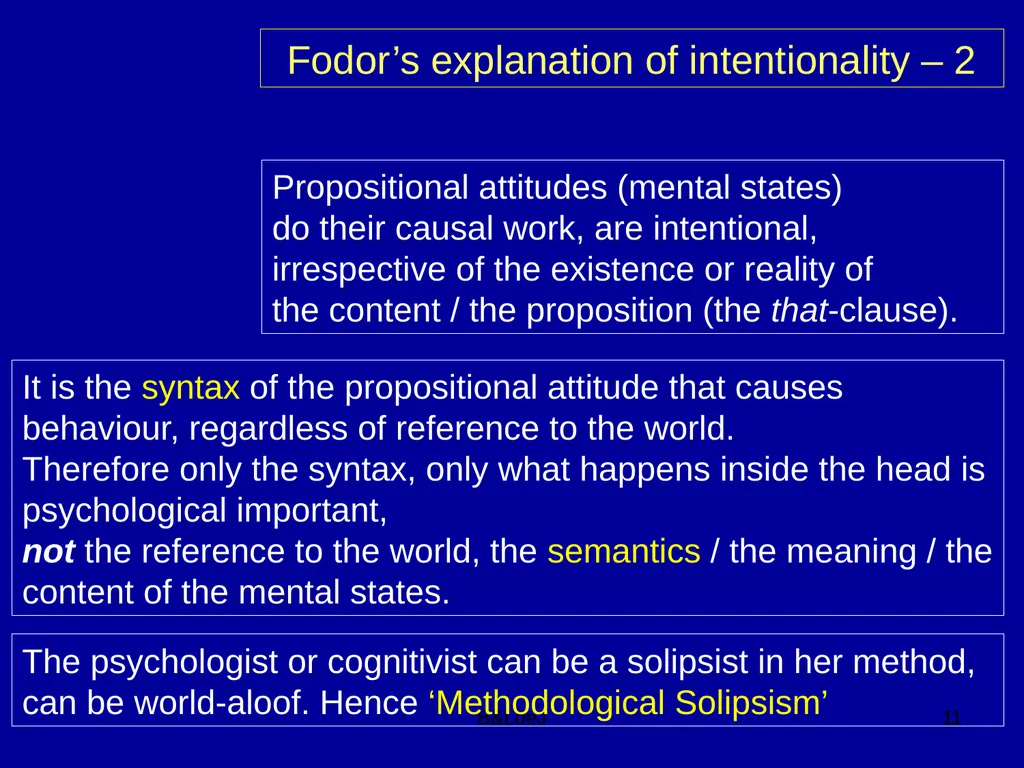
B&LdeJ 11 Fodor’s explanation of intentionality – 2 Propositional attitudes (mental states)
do their causal work, are intentional, irrespective of the existence or reality of
the content / the proposition (the that-clause). It is the syntax of the propositional attitude that causes behaviour, regardless of reference to the world.
Therefore only the syntax, only what happens inside the head is psychological important,
not the reference to the world, the semantics / the meaning / the content of the mental states. The psychologist or cognitivist can be a solipsist in her method, can be world-aloof. Hence ‘Methodological Solipsism’<br>
do their causal work, are intentional, irrespective of the existence or reality of
the content / the proposition (the that-clause). It is the syntax of the propositional attitude that causes behaviour, regardless of reference to the world.
Therefore only the syntax, only what happens inside the head is psychological important,
not the reference to the world, the semantics / the meaning / the content of the mental states. The psychologist or cognitivist can be a solipsist in her method, can be world-aloof. Hence ‘Methodological Solipsism’<br>
12
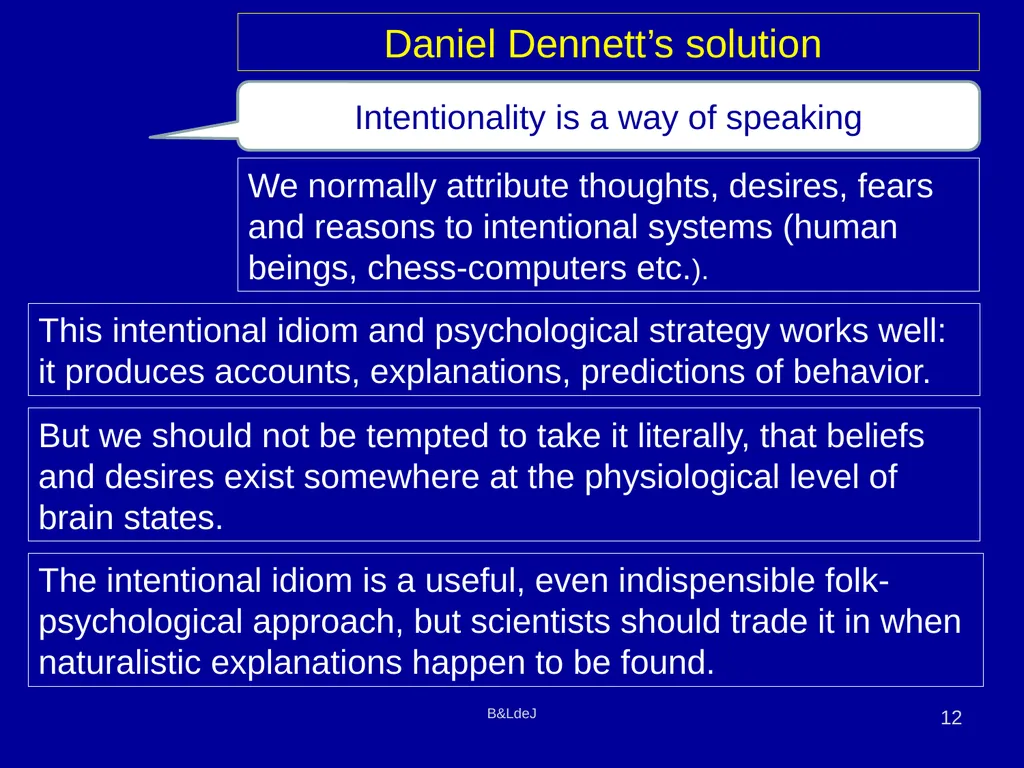
B&LdeJ 12 Intentionality is a way of speaking We normally attribute thoughts, desires, fears
and reasons to intentional systems (human beings, chess-computers etc.). This intentional idiom and psychological strategy works well:
it produces accounts, explanations, predictions of behavior. But we should not be tempted to take it literally, that beliefs and desires exist somewhere at the physiological level of brain states. Daniel Dennett’s solution The intentional idiom is a useful, even indispensible folk-
psychological approach, but scientists should trade it in when
naturalistic explanations happen to be found.<br>
and reasons to intentional systems (human beings, chess-computers etc.). This intentional idiom and psychological strategy works well:
it produces accounts, explanations, predictions of behavior. But we should not be tempted to take it literally, that beliefs and desires exist somewhere at the physiological level of brain states. Daniel Dennett’s solution The intentional idiom is a useful, even indispensible folk-
psychological approach, but scientists should trade it in when
naturalistic explanations happen to be found.<br>
13
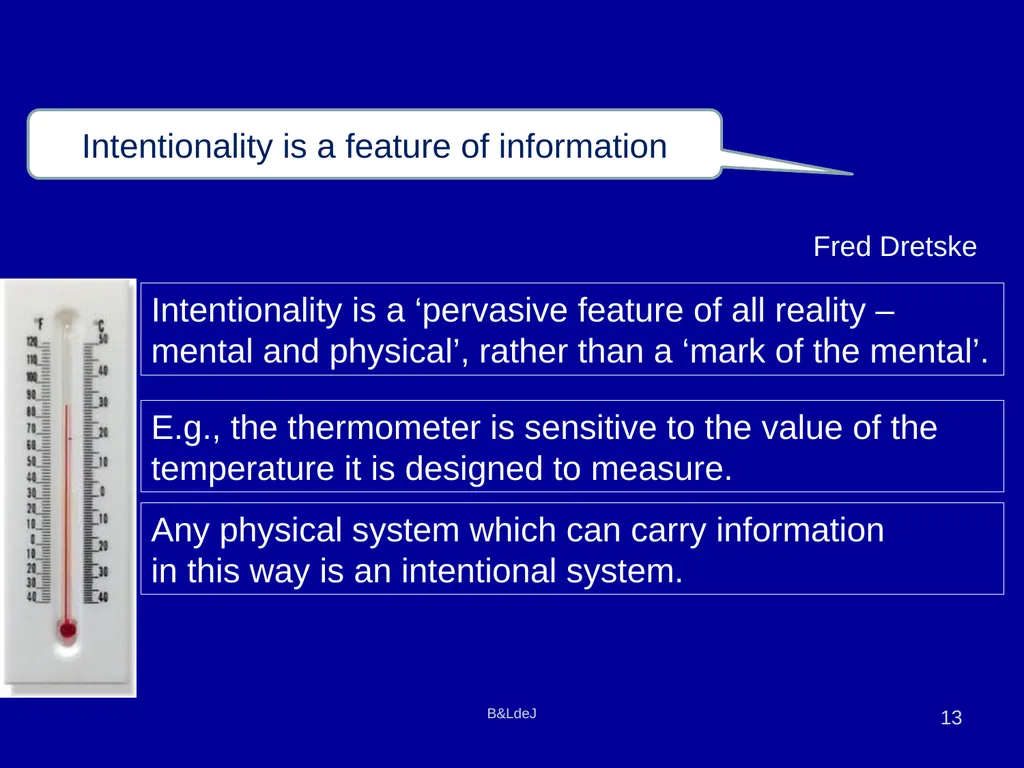
B&LdeJ 13 Intentionality is a feature of information Intentionality is a ‘pervasive feature of all reality –
mental and physical’, rather than a ‘mark of the mental’. Fred Dretske E.g., the thermometer is sensitive to the value of the
temperature it is designed to measure. Any physical system which can carry information
in this way is an intentional system.<br>
mental and physical’, rather than a ‘mark of the mental’. Fred Dretske E.g., the thermometer is sensitive to the value of the
temperature it is designed to measure. Any physical system which can carry information
in this way is an intentional system.<br>
14
B&LdeJ 14 Ecological conception of intentionality Intentionality is the property of a complete being who is cognitive and active in the world. Cognitive activities work in the interaction between organism and environment. Intentionality gets a kind of ecological interpretation, an organism’s situatedness in the world.<br>
15
B&LdeJ 15 Martin Heidegger Maurice Merleau Ponty Second generation of (existential) phenomeno-
logists, like Martin Heidegger and Maurice
Merleau-Ponty had also a broad conception
of intentionality in mind.
Intentionality expresses the property of our
human engagement with the world.
It characterizes human existence, human
living and acting in the world.
They called this ‘being-in-the-world’:
‘Dasein’, ‘être au monde’. Intentionality as being in the world<br>
logists, like Martin Heidegger and Maurice
Merleau-Ponty had also a broad conception
of intentionality in mind.
Intentionality expresses the property of our
human engagement with the world.
It characterizes human existence, human
living and acting in the world.
They called this ‘being-in-the-world’:
‘Dasein’, ‘être au monde’. Intentionality as being in the world<br>
16
B&LdeJ 16 Folk psychology Common-sense psychology we use in everyday life (in clinical and social psychology, and in economics), understanding, explaining, predicting behavior, as guided by goals, thoughts, and reasons:
‘He must be crazy, for dumping her’;
‘Mary had not the slightest desire to go on holiday’.
2. A philosophical reconstruction: the application of common
sense notions to mental states as representing, having
content and aboutness, the ‘belief-desire’ model of mental states, the LOT-model.<br>
‘He must be crazy, for dumping her’;
‘Mary had not the slightest desire to go on holiday’.
2. A philosophical reconstruction: the application of common
sense notions to mental states as representing, having
content and aboutness, the ‘belief-desire’ model of mental states, the LOT-model.<br>
17
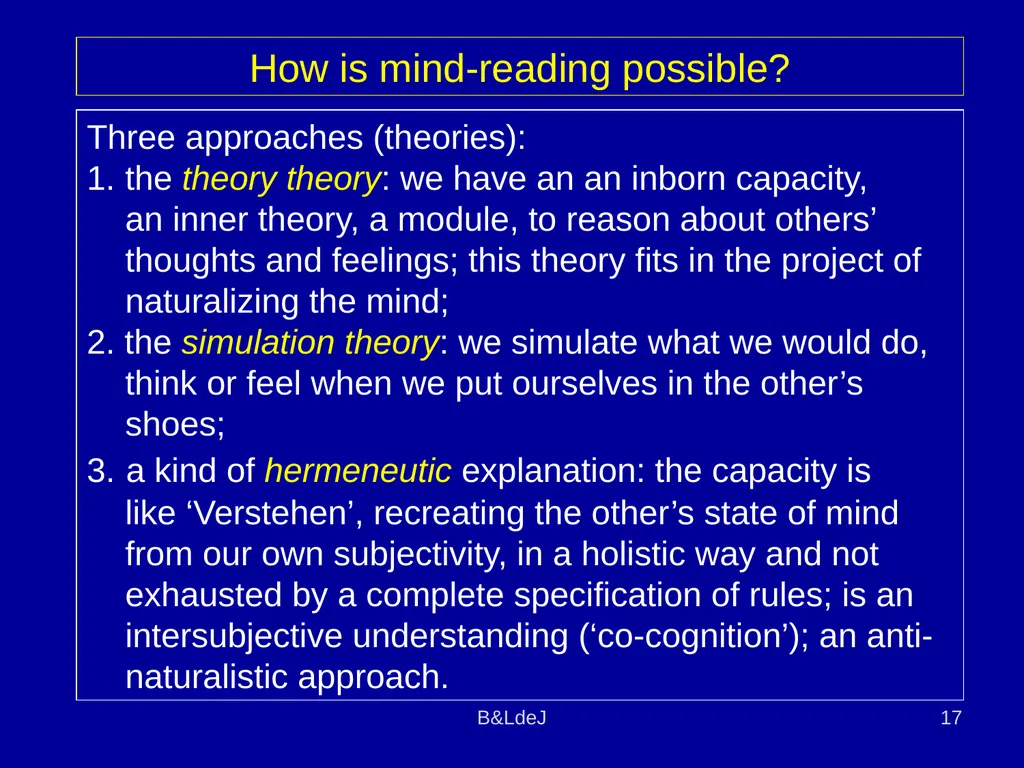
B&LdeJ 17 How is mind-reading possible? Three approaches (theories):
the theory theory: we have an an inborn capacity,
an inner theory, a module, to reason about others’
thoughts and feelings; this theory fits in the project of naturalizing the mind;
2. the simulation theory: we simulate what we would do, think or feel when we put ourselves in the other’s shoes;
3. a kind of hermeneutic explanation: the capacity is
like ‘Verstehen’, recreating the other’s state of mind from our own subjectivity, in a holistic way and not exhausted by a complete specification of rules; is an intersubjective understanding (‘co-cognition’); an anti-
naturalistic approach.<br>
the theory theory: we have an an inborn capacity,
an inner theory, a module, to reason about others’
thoughts and feelings; this theory fits in the project of naturalizing the mind;
2. the simulation theory: we simulate what we would do, think or feel when we put ourselves in the other’s shoes;
3. a kind of hermeneutic explanation: the capacity is
like ‘Verstehen’, recreating the other’s state of mind from our own subjectivity, in a holistic way and not exhausted by a complete specification of rules; is an intersubjective understanding (‘co-cognition’); an anti-
naturalistic approach.<br>
18
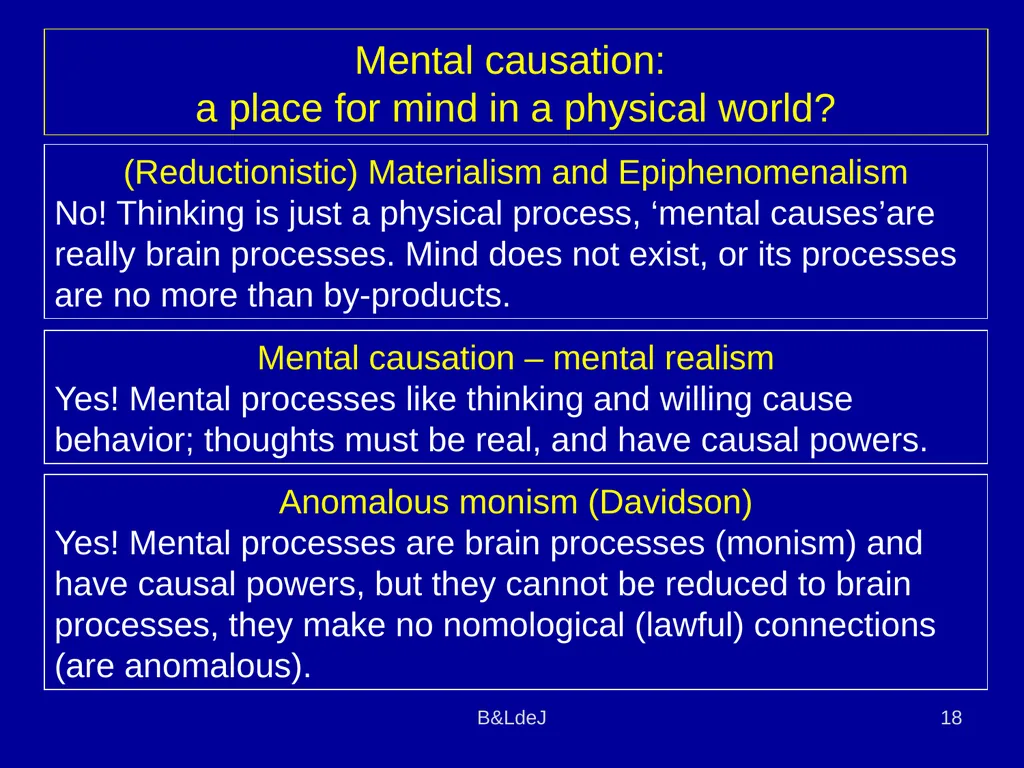
B&LdeJ 18 Mental causation – mental realism
Yes! Mental processes like thinking and willing cause behavior; thoughts must be real, and have causal powers. (Reductionistic) Materialism and Epiphenomenalism
No! Thinking is just a physical process, ‘mental causes’are really brain processes. Mind does not exist, or its processes are no more than by-products. Mental causation:
a place for mind in a physical world? Anomalous monism (Davidson)
Yes! Mental processes are brain processes (monism) and have causal powers, but they cannot be reduced to brain processes, they make no nomological (lawful) connections (are anomalous).<br>
Yes! Mental processes like thinking and willing cause behavior; thoughts must be real, and have causal powers. (Reductionistic) Materialism and Epiphenomenalism
No! Thinking is just a physical process, ‘mental causes’are really brain processes. Mind does not exist, or its processes are no more than by-products. Mental causation:
a place for mind in a physical world? Anomalous monism (Davidson)
Yes! Mental processes are brain processes (monism) and have causal powers, but they cannot be reduced to brain processes, they make no nomological (lawful) connections (are anomalous).<br>
19
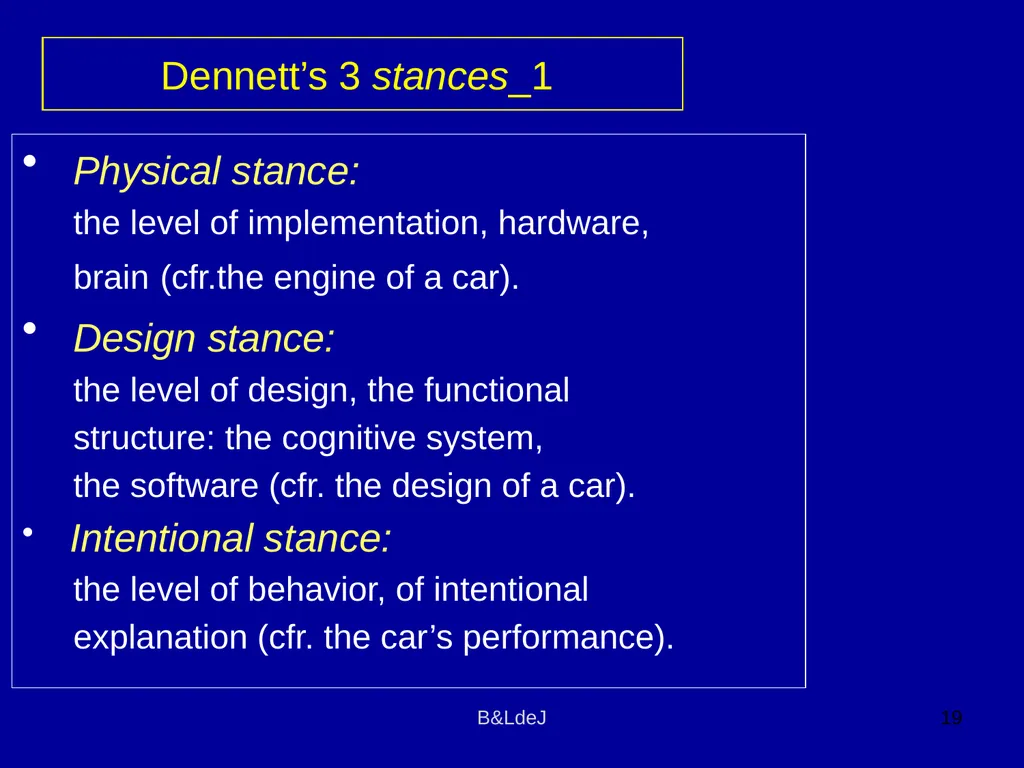
B&LdeJ 19 Dennett’s 3 stances_1 Physical stance:
the level of implementation, hardware,
brain (cfr.the engine of a car).
Design stance:
the level of design, the functional
structure: the cognitive system,
the software (cfr. the design of a car).
Intentional stance:
the level of behavior, of intentional
explanation (cfr. the car’s performance).<br>
the level of implementation, hardware,
brain (cfr.the engine of a car).
Design stance:
the level of design, the functional
structure: the cognitive system,
the software (cfr. the design of a car).
Intentional stance:
the level of behavior, of intentional
explanation (cfr. the car’s performance).<br>
20
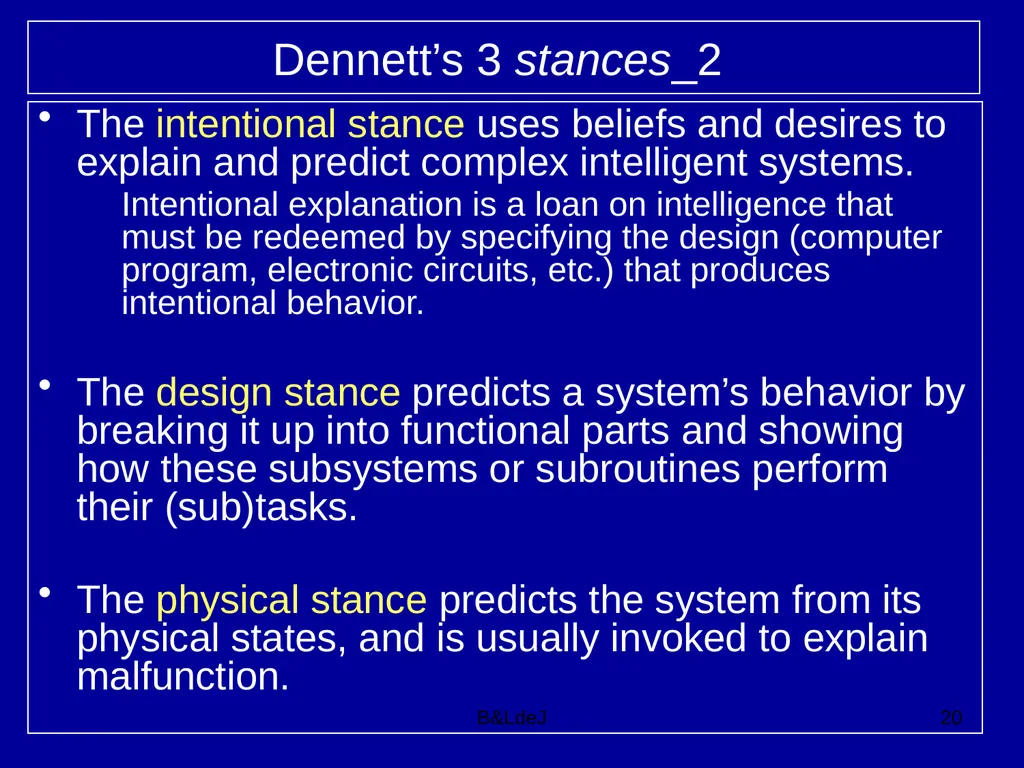
B&LdeJ 20 Dennett’s 3 stances_2 The intentional stance uses beliefs and desires to explain and predict complex intelligent systems.
Intentional explanation is a loan on intelligence that must be redeemed by specifying the design (computer program, electronic circuits, etc.) that produces intentional behavior.
The design stance predicts a system’s behavior by breaking it up into functional parts and showing how these subsystems or subroutines perform their (sub)tasks.
The physical stance predicts the system from its physical states, and is usually invoked to explain malfunction.<br>
Intentional explanation is a loan on intelligence that must be redeemed by specifying the design (computer program, electronic circuits, etc.) that produces intentional behavior.
The design stance predicts a system’s behavior by breaking it up into functional parts and showing how these subsystems or subroutines perform their (sub)tasks.
The physical stance predicts the system from its physical states, and is usually invoked to explain malfunction.<br>
21
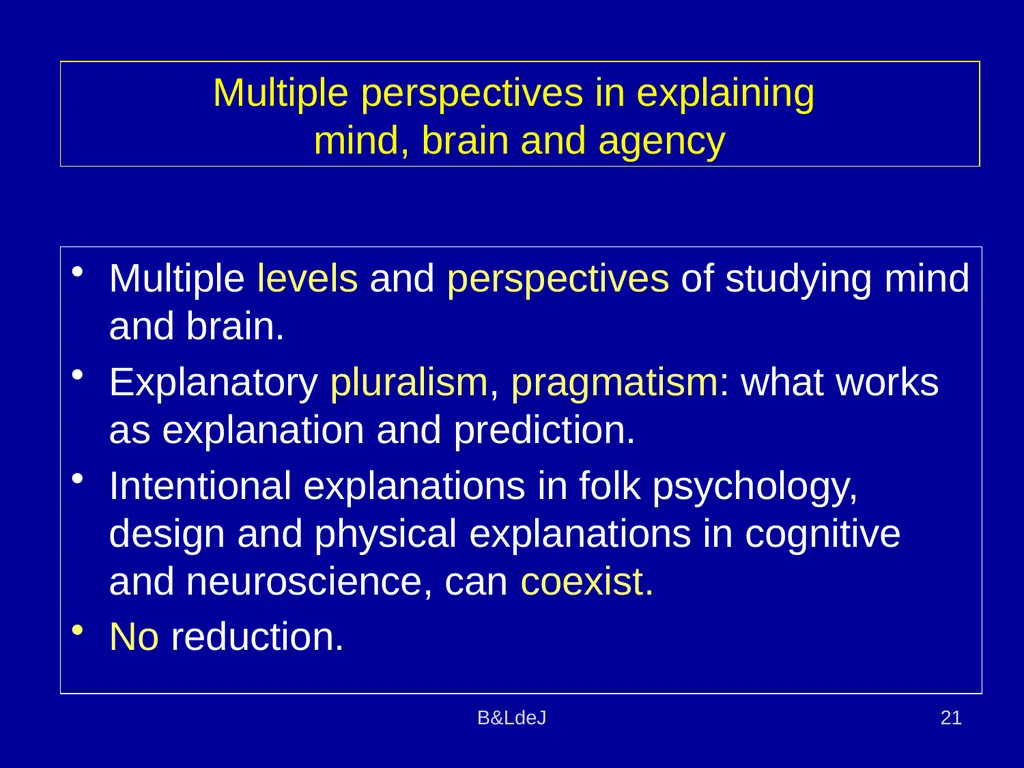
B&LdeJ 21 Multiple perspectives in explaining
mind, brain and agency Multiple levels and perspectives of studying mind and brain.
Explanatory pluralism, pragmatism: what works as explanation and prediction.
Intentional explanations in folk psychology, design and physical explanations in cognitive and neuroscience, can coexist.
No reduction.<br>
Explanatory pluralism, pragmatism: what works as explanation and prediction.
Intentional explanations in folk psychology, design and physical explanations in cognitive and neuroscience, can coexist.
No reduction.<br>