Bachelors Degrees in Physics: What you didnt know 1 Job Stability Satisfaction Based on national surveys of students with bachelors degrees in physics High employment rates (95) High job satisfaction in terms of Feelings of job
"Bachelors Degrees in Physics: What you didn’t know" is the property of its rightful owner. Permission is granted to
download and print the materials on this website for personal, non-commercial use only, and to display it
on your personal computer provided you do not modify the materials and that you retain all copyright
notices contained in the materials. By downloading content from our website, you accept the terms of this
agreement.
Presentation Transcript
01
Bachelors Degrees in Physics: What you didn’t know 1<br>
02
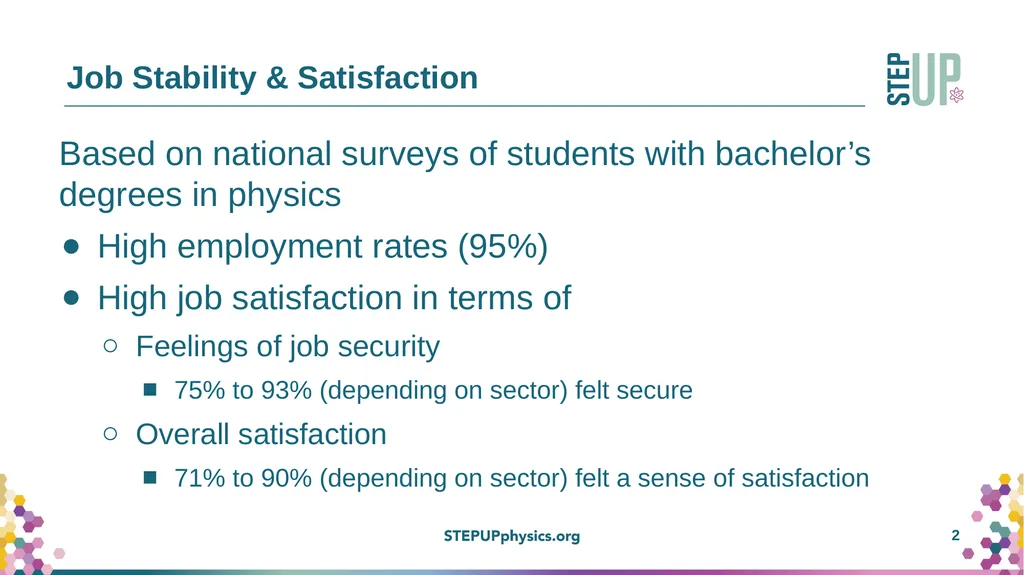
Job Stability & Satisfaction Based on national surveys of students with bachelor’s degrees in physics
High employment rates (95%)
High job satisfaction in terms of
Feelings of job security
75% to 93% (depending on sector) felt secure
Overall satisfaction
71% to 90% (depending on sector) felt a sense of satisfaction 2<br>
03
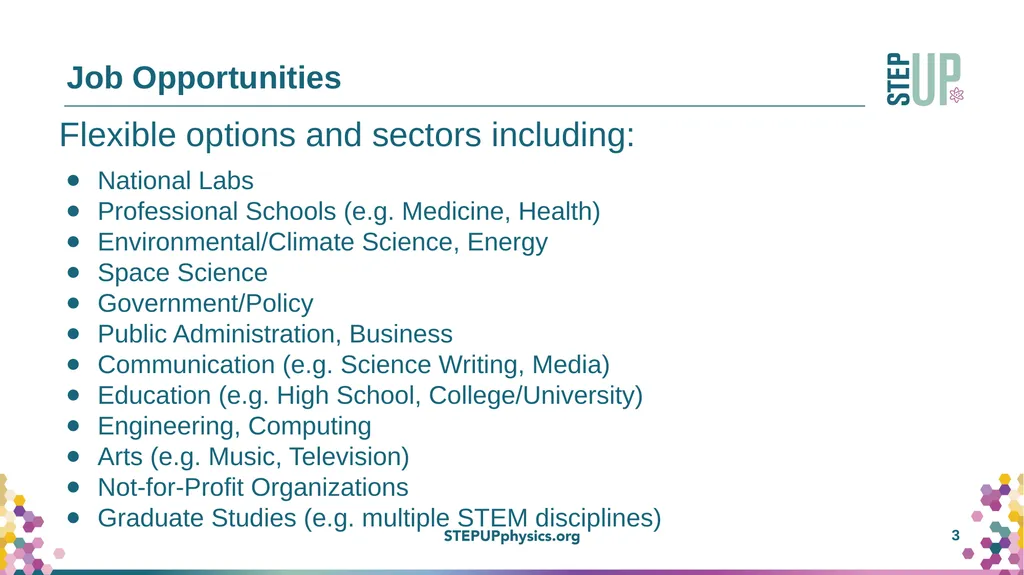
Job Opportunities Flexible options and sectors including:
National Labs
Professional Schools (e.g. Medicine, Health)
Environmental/Climate Science, Energy
Space Science
Government/Policy
Public Administration, Business
Communication (e.g. Science Writing, Media)
Education (e.g. High School, College/University)
Engineering, Computing
Arts (e.g. Music, Television)
Not-for-Profit Organizations
Graduate Studies (e.g. multiple STEM disciplines) 3<br>
04
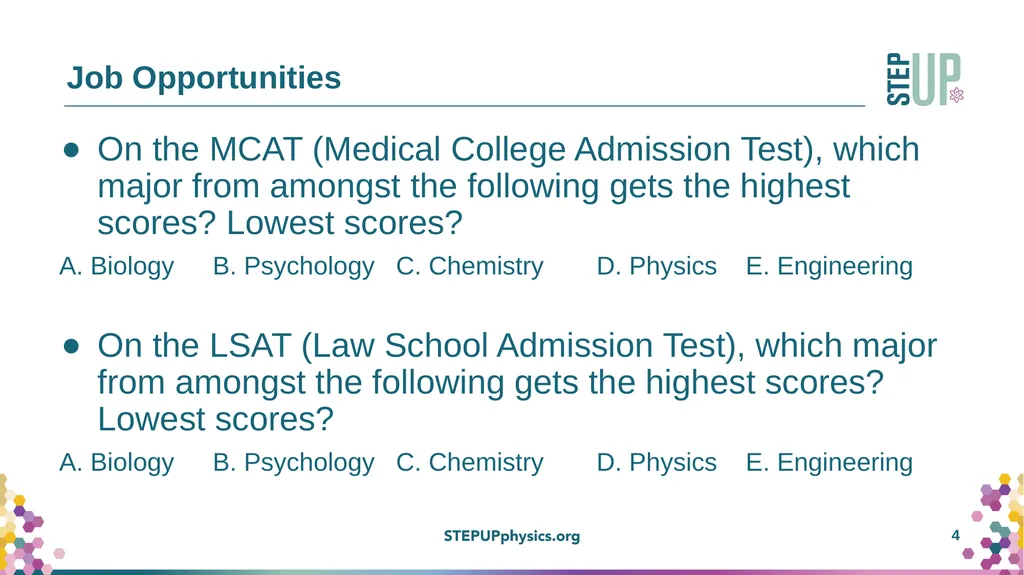
Job Opportunities On the MCAT (Medical College Admission Test), which major from amongst the following gets the highest scores? Lowest scores?
A. Biology B. Psychology C. Chemistry D. Physics E. Engineering
On the LSAT (Law School Admission Test), which major from amongst the following gets the highest scores? Lowest scores?
A. Biology B. Psychology C. Chemistry D. Physics E. Engineering 4<br>
05
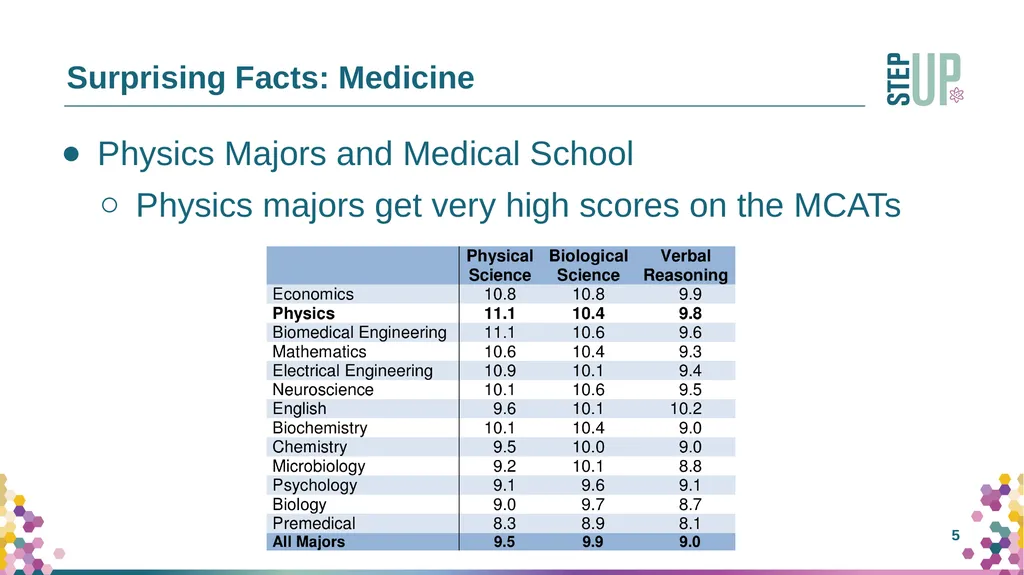
Surprising Facts: Medicine Physics Majors and Medical School
Physics majors get very high scores on the MCATs 5<br>
06
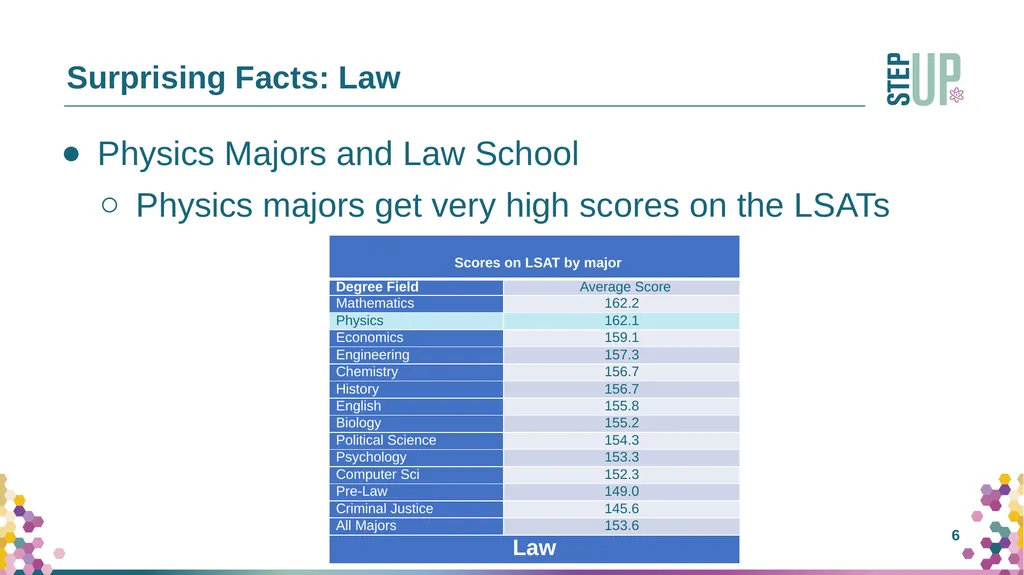
Surprising Facts: Law Physics Majors and Law School
Physics majors get very high scores on the LSATs 6<br>
07
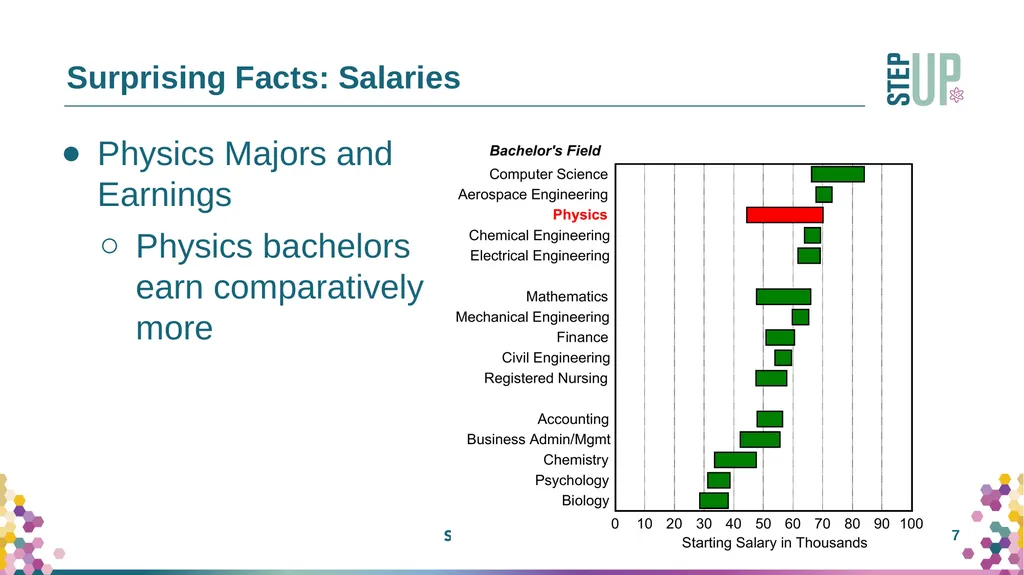
Surprising Facts: Salaries Physics Majors and Earnings
Physics bachelors earn comparatively more 7<br>
08
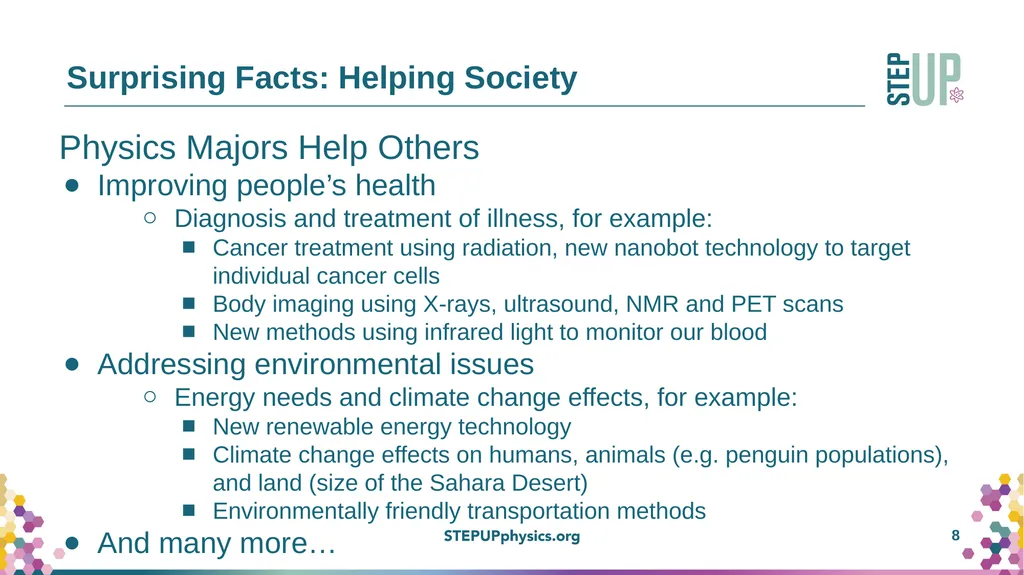
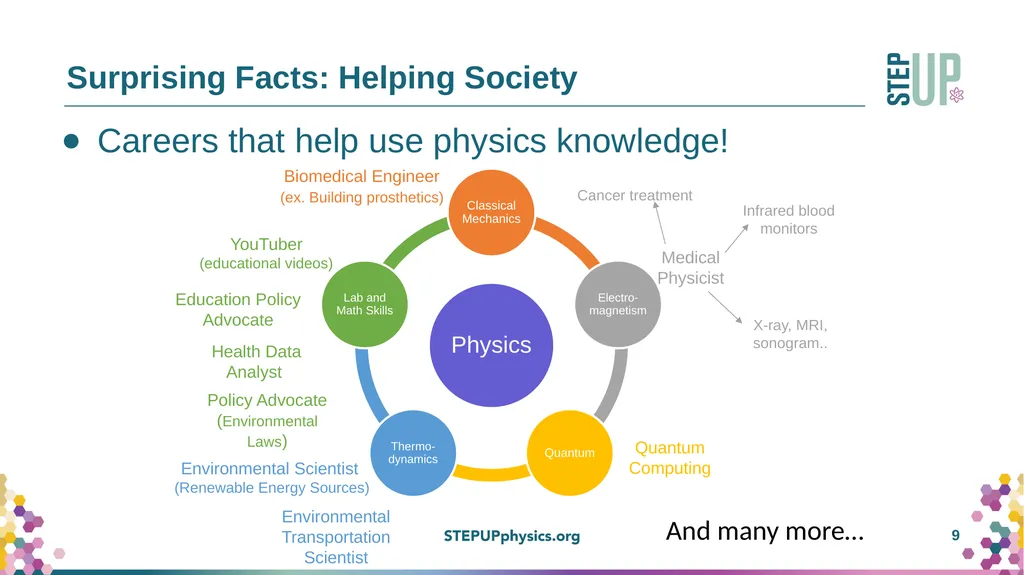
Physics Majors Help Others
Improving people’s health
Diagnosis and treatment of illness, for example:
Cancer treatment using radiation, new nanobot technology to target individual cancer cells
Body imaging using X-rays, ultrasound, NMR and PET scans
New methods using infrared light to monitor our blood
Addressing environmental issues
Energy needs and climate change effects, for example:
New renewable energy technology
Climate change effects on humans, animals (e.g. penguin populations), and land (size of the Sahara Desert)
Environmentally friendly transportation methods
And many more… Surprising Facts: Helping Society 8<br>
09
Surprising Facts: Helping Society Careers that help use physics knowledge! 9 And many more… Cancer treatment<br>
10
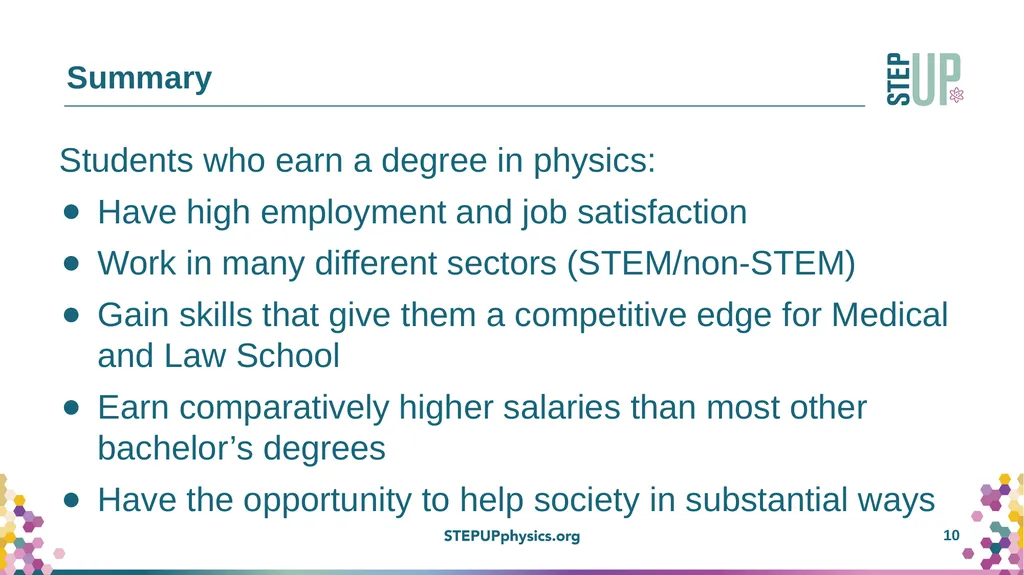
Summary Students who earn a degree in physics:
Have high employment and job satisfaction
Work in many different sectors (STEM/non-STEM)
Gain skills that give them a competitive edge for Medical and Law School
Earn comparatively higher salaries than most other bachelor’s degrees
Have the opportunity to help society in substantial ways 10<br>
11
Exit Slip What surprised you about the:
Areas in which physicists work?
Skills physicists apply working in such diverse areas?
Benefit physicists can have on the lives of others? 11<br>
12
References AIP Statistics (2016). What’s a Bachelor’s Degree Worth? American Institute of Physics (AIP). Retrieved from: https://www.aip.org/sites/default/files/statistics/physics-trends/fall16-bs-deg-worth.pdf
IOP (2017). Institute of Physics (IOP) Careers from physics. Retrieved from: http://www.physics.org/careers.asp?contentid=381
Mulvey, P., & Pold, J. (2017). Physics Bachelor: Initial Employment. American Institute of Physics (AIP) Report. Retrieved from: https://www.aip.org/sites/default/files/statistics/employment/bachinitemp-p-14.1.pdf
Pold, J., & Mulvey, P. (2016). Physics Bachelors: One Year after Degree. American Institute of Physics (AIP) Report. Retrieved from: https://www.aip.org/sites/default/files/statistics/employment/bach1yrafterdeg-p-14.1.pdf
Tesfaye, C.L., & Mulvey, P. (2012). Physics Bachelor’s Initial Employment. American Institute of Physics (AIP) Report. Retrieved from: https://www.aip.org/sites/default/files/statistics/employment/bachinitemp-p-10.pdf
Tesfaye, C.L., & Mulvey, P. (2013). MCAT, LSAT and Physics Bachelor's. American Institute of Physics (AIP) Report. Retrieved from: https://www.aip.org/sites/default/files/statistics/undergrad/mcat-lsat1.pdf 12<br>