Background and Problem: This Silver QI project was
Description: Background and Problem: This Silver QI project was undertaken in the Respiratory and lung function department. The team involved doctors, secretaries, physiologists and obstructive sleep apnoea hypopnoea syndrome (OSAHS) patients. The main
Related Topics
Download Presentation
"Background and Problem: This Silver QI project was" is the property of its rightful owner. Permission is granted to download and print the materials on this website for personal, non-commercial use only, and to display it on your personal computer provided you do not modify the materials and that you retain all copyright notices contained in the materials. By downloading content from our website, you accept the terms of this agreement.
Presentation Transcript
slide1. Background and Problem:
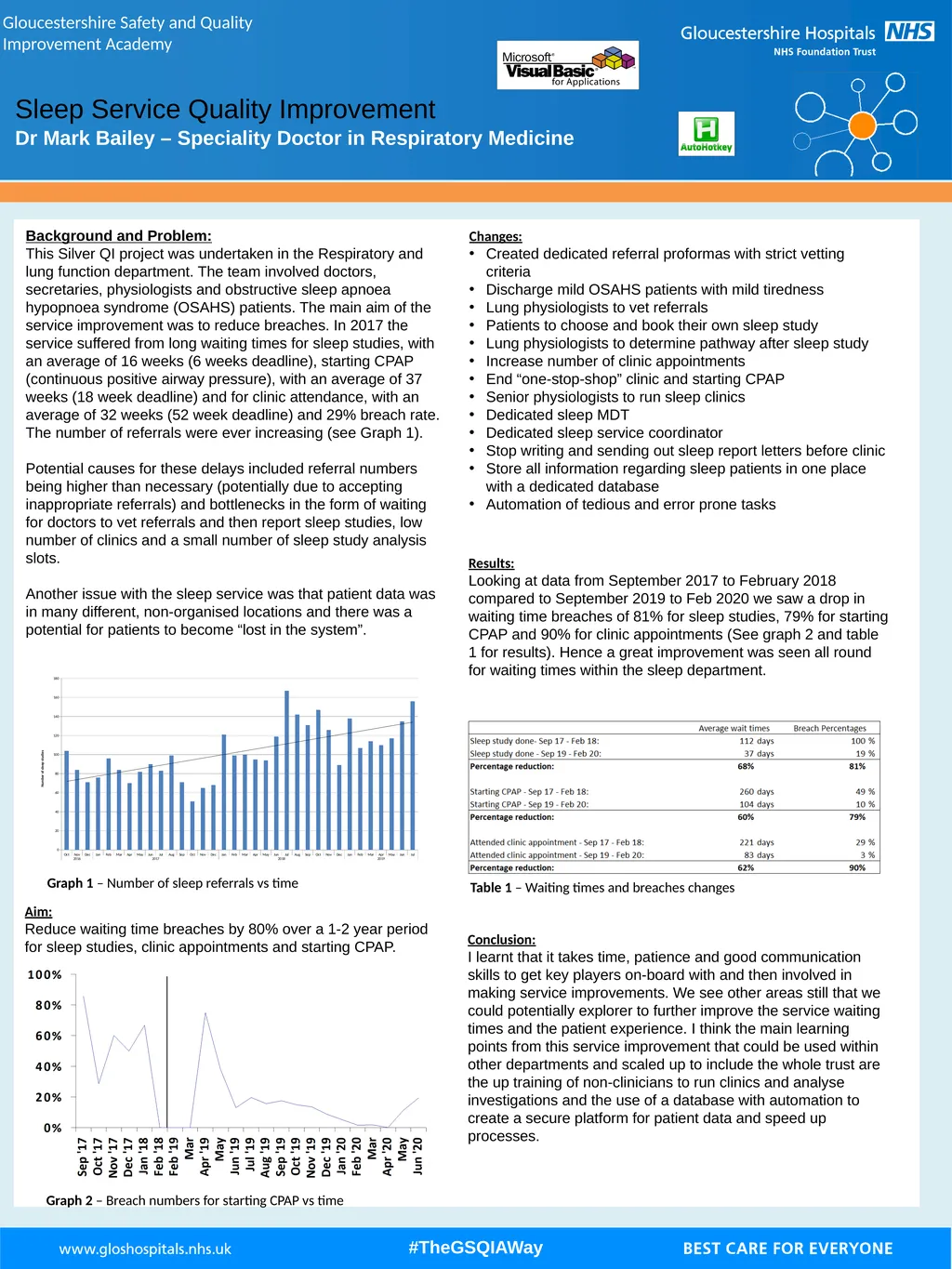
This Silver QI project was undertaken in the Respiratory and lung function department. The team involved doctors, secretaries, physiologists and obstructive sleep apnoea hypopnoea syndrome (OSAHS) patients. The main aim of the service improvement was to reduce breaches. In 2017 the service suffered from long waiting times for sleep studies, with an average of 16 weeks (6 weeks deadline), starting CPAP (continuous positive airway pressure), with an average of 37 weeks (18 week deadline) and for clinic attendance, with an average of 32 weeks (52 week deadline) and 29% breach rate. The number of referrals were ever increasing (see Graph 1).
Potential causes for these delays included referral numbers being higher than necessary (potentially due to accepting inappropriate referrals) and bottlenecks in the form of waiting for doctors to vet referrals and then report sleep studies, low number of clinics and a small number of sleep study analysis slots.
Another issue with the sleep service was that patient data was in many different, non-organised locations and there was a potential for patients to become “lost in the system”. Gloucestershire Safety and Quality Improvement Academy Sleep Service Quality Improvement
Dr Mark Bailey – Speciality Doctor in Respiratory Medicine #TheGSQIAWay Aim:
Reduce waiting time breaches by 80% over a 1-2 year period for sleep studies, clinic appointments and starting CPAP. Changes:
Created dedicated referral proformas with strict vetting criteria
Discharge mild OSAHS patients with mild tiredness
Lung physiologists to vet referrals
Patients to choose and book their own sleep study
Lung physiologists to determine pathway after sleep study
Increase number of clinic appointments
End “one-stop-shop” clinic and starting CPAP
Senior physiologists to run sleep clinics
Dedicated sleep MDT
Dedicated sleep service coordinator
Stop writing and sending out sleep report letters before clinic
Store all information regarding sleep patients in one place with a dedicated database
Automation of tedious and error prone tasks Results:
Looking at data from September 2017 to February 2018 compared to September 2019 to Feb 2020 we saw a drop in waiting time breaches of 81% for sleep studies, 79% for starting CPAP and 90% for clinic appointments (See graph 2 and table 1 for results). Hence a great improvement was seen all round for waiting times within the sleep department. Conclusion:
I learnt that it takes time, patience and good communication skills to get key players on-board with and then involved in making service improvements. We see other areas still that we could potentially explorer to further improve the service waiting times and the patient experience. I think the main learning points from this service improvement that could be used within other departments and scaled up to include the whole trust are the up training of non-clinicians to run clinics and analyse investigations and the use of a database with automation to create a secure platform for patient data and speed up processes. Graph 1 – Number of sleep referrals vs time Graph 2 – Breach numbers for starting CPAP vs time Table 1 – Waiting times and breaches changes<br>

This Silver QI project was undertaken in the Respiratory and lung function department. The team involved doctors, secretaries, physiologists and obstructive sleep apnoea hypopnoea syndrome (OSAHS) patients. The main aim of the service improvement was to reduce breaches. In 2017 the service suffered from long waiting times for sleep studies, with an average of 16 weeks (6 weeks deadline), starting CPAP (continuous positive airway pressure), with an average of 37 weeks (18 week deadline) and for clinic attendance, with an average of 32 weeks (52 week deadline) and 29% breach rate. The number of referrals were ever increasing (see Graph 1).
Potential causes for these delays included referral numbers being higher than necessary (potentially due to accepting inappropriate referrals) and bottlenecks in the form of waiting for doctors to vet referrals and then report sleep studies, low number of clinics and a small number of sleep study analysis slots.
Another issue with the sleep service was that patient data was in many different, non-organised locations and there was a potential for patients to become “lost in the system”. Gloucestershire Safety and Quality Improvement Academy Sleep Service Quality Improvement
Dr Mark Bailey – Speciality Doctor in Respiratory Medicine #TheGSQIAWay Aim:
Reduce waiting time breaches by 80% over a 1-2 year period for sleep studies, clinic appointments and starting CPAP. Changes:
Created dedicated referral proformas with strict vetting criteria
Discharge mild OSAHS patients with mild tiredness
Lung physiologists to vet referrals
Patients to choose and book their own sleep study
Lung physiologists to determine pathway after sleep study
Increase number of clinic appointments
End “one-stop-shop” clinic and starting CPAP
Senior physiologists to run sleep clinics
Dedicated sleep MDT
Dedicated sleep service coordinator
Stop writing and sending out sleep report letters before clinic
Store all information regarding sleep patients in one place with a dedicated database
Automation of tedious and error prone tasks Results:
Looking at data from September 2017 to February 2018 compared to September 2019 to Feb 2020 we saw a drop in waiting time breaches of 81% for sleep studies, 79% for starting CPAP and 90% for clinic appointments (See graph 2 and table 1 for results). Hence a great improvement was seen all round for waiting times within the sleep department. Conclusion:
I learnt that it takes time, patience and good communication skills to get key players on-board with and then involved in making service improvements. We see other areas still that we could potentially explorer to further improve the service waiting times and the patient experience. I think the main learning points from this service improvement that could be used within other departments and scaled up to include the whole trust are the up training of non-clinicians to run clinics and analyse investigations and the use of a database with automation to create a secure platform for patient data and speed up processes. Graph 1 – Number of sleep referrals vs time Graph 2 – Breach numbers for starting CPAP vs time Table 1 – Waiting times and breaches changes<br>