Ballot Measure Fundraising— Basics, Budgeting, &
Description: Ballot Measure Fundraising Basics, Budgeting, Call Time Annie Eagan Consulting The BASICS Fundraising is a reflection of your campaign Coalition Diverse group of community supportersdonors Message Practice campaign talking points as
Related Topics
Download Presentation
"Ballot Measure Fundraising— Basics, Budgeting, &" is the property of its rightful owner. Permission is granted to download and print the materials on this website for personal, non-commercial use only, and to display it on your personal computer provided you do not modify the materials and that you retain all copyright notices contained in the materials. By downloading content from our website, you accept the terms of this agreement.
Presentation Transcript
slide1. Ballot Measure Fundraising— Basics, Budgeting, & Call Time Annie Eagan Consulting<br>
slide2. The BASICS<br>
slide3. Fundraising is a reflection of your campaign
Coalition — Diverse group of community supporters/donors
Message — Practice campaign talking points as you ask for money
Goals — Meets campaign budget<br>
slide4. Fundraising starts first…
so where do you begin?
List building — Build a database of your network and organizational networks that are leading the campaign.
Endorsements — Recruit early support from elected officials, Labor, Business leaders, and organizations focused on early education.
Fundraising deadlines — Learn the fundraising deadlines leading up to Election Day
Finance Plan and Finance Committee — map your fundraising to help you reach goal, and recruit proven fundraisers to help you meet budget.<br>
slide5. Message — Know your “Why?” Leadership — What are the top three reasons why you are a leader with this community organization?
Fundraising — What are the top three reasons why you are raising?
Audience — What are the common values you share with your donor/target supporter?<br>
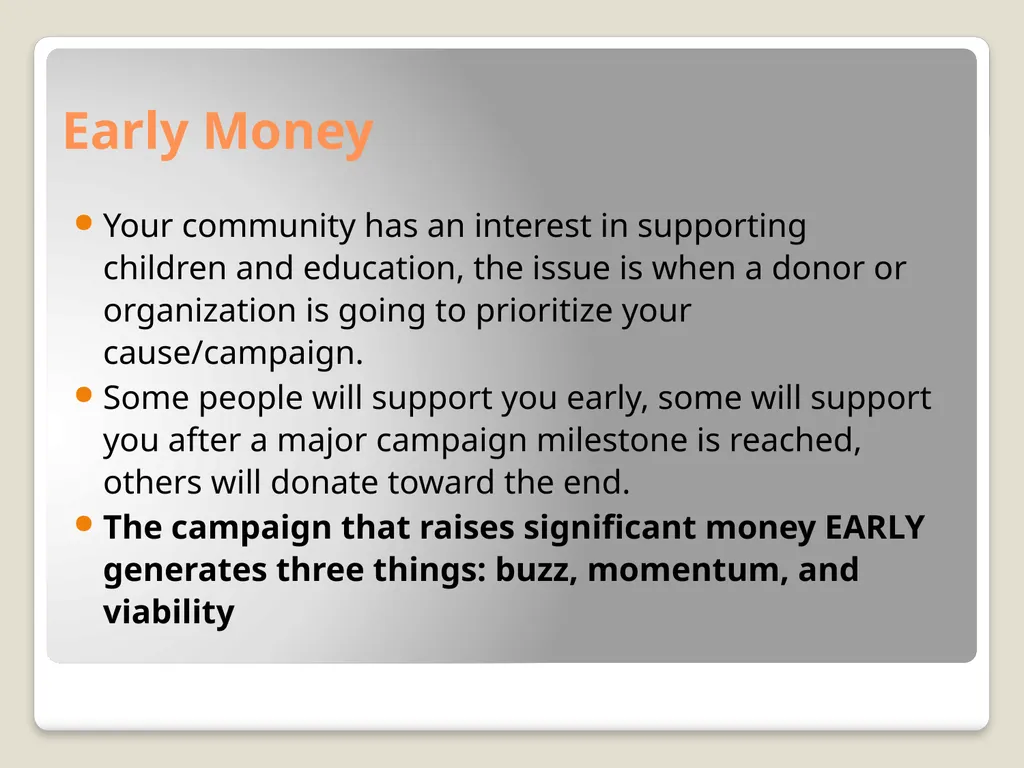
slide6. Early Money Your community has an interest in supporting children and education, the issue is when a donor or organization is going to prioritize your cause/campaign.
Some people will support you early, some will support you after a major campaign milestone is reached, others will donate toward the end.
The campaign that raises significant money EARLY generates three things: buzz, momentum, and viability<br>
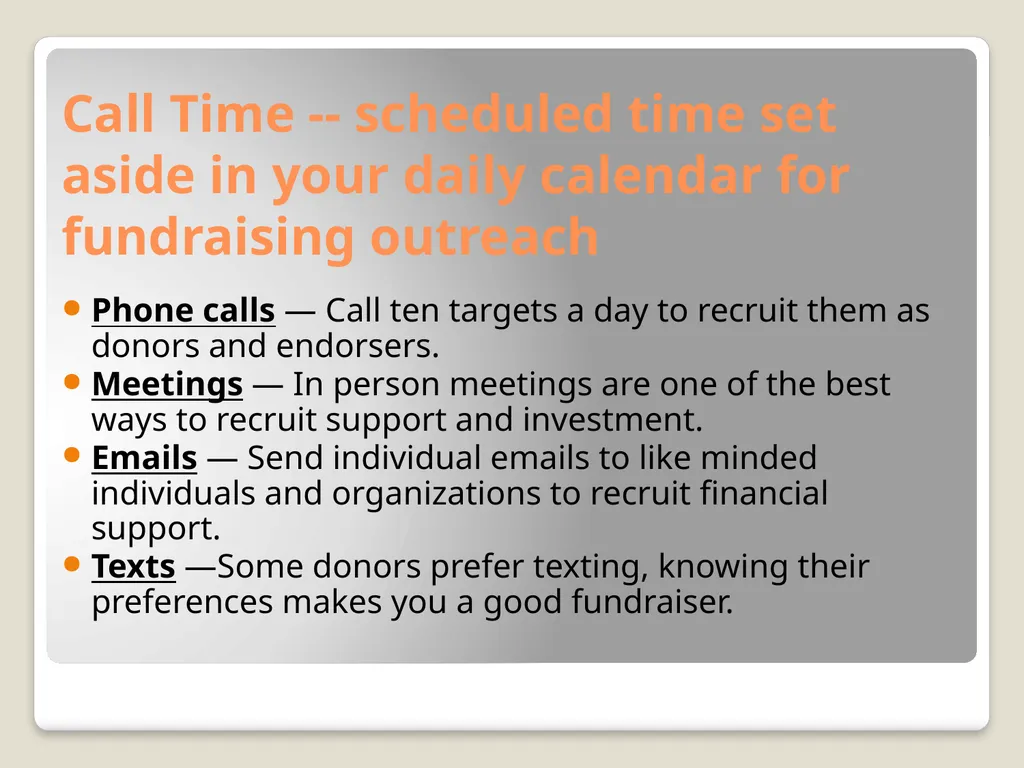
slide7. Call Time -- scheduled time set aside in your daily calendar for fundraising outreach Phone calls — Call ten targets a day to recruit them as donors and endorsers.
Meetings — In person meetings are one of the best ways to recruit support and investment.
Emails — Send individual emails to like minded individuals and organizations to recruit financial support.
Texts —Some donors prefer texting, knowing their preferences makes you a good fundraiser.<br>
slide8. BUDGET<br>
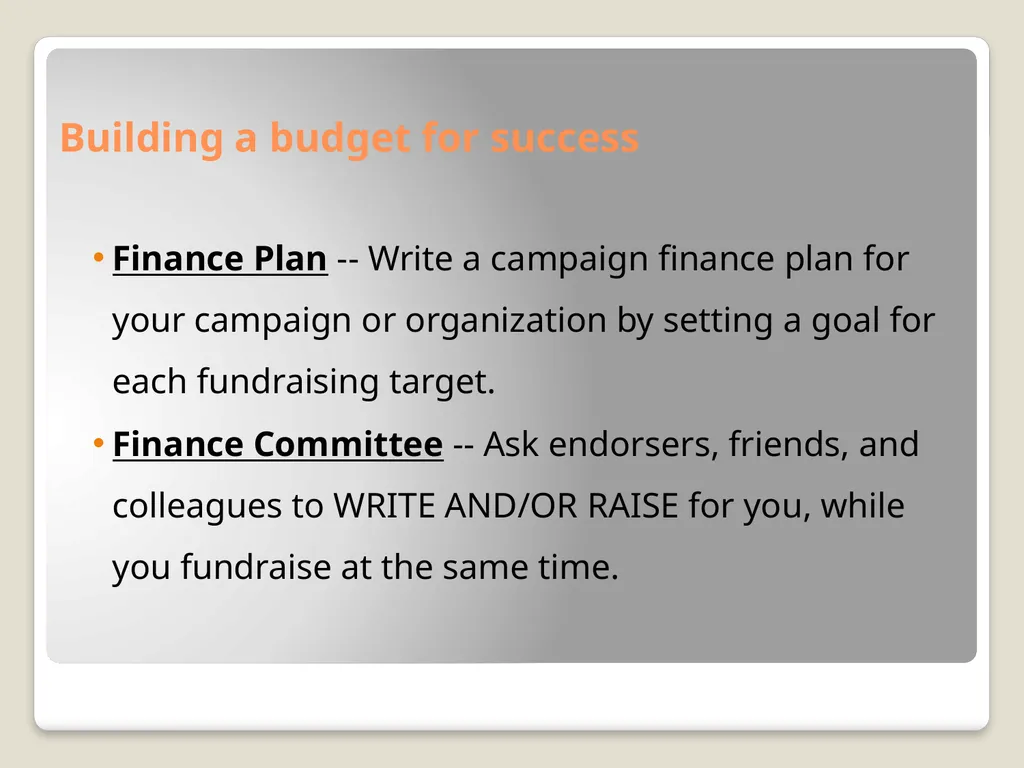
slide9. Building a budget for success
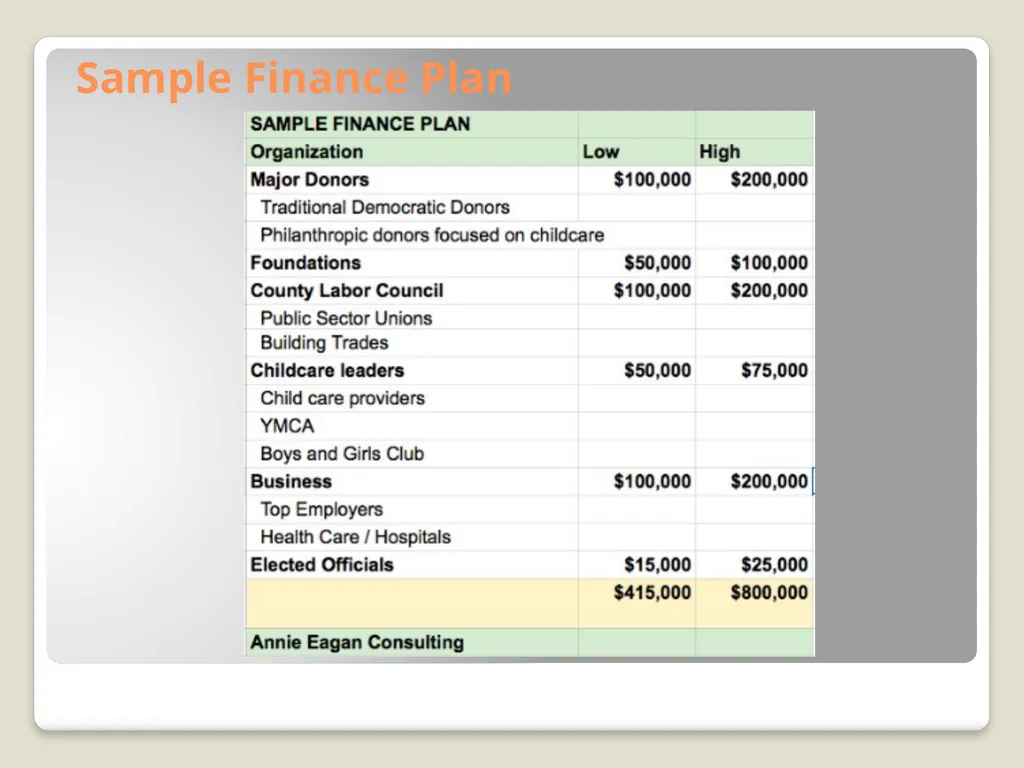
Finance Plan -- Write a campaign finance plan for your campaign or organization by setting a goal for each fundraising target.
Finance Committee -- Ask endorsers, friends, and colleagues to WRITE AND/OR RAISE for you, while you fundraise at the same time.<br>
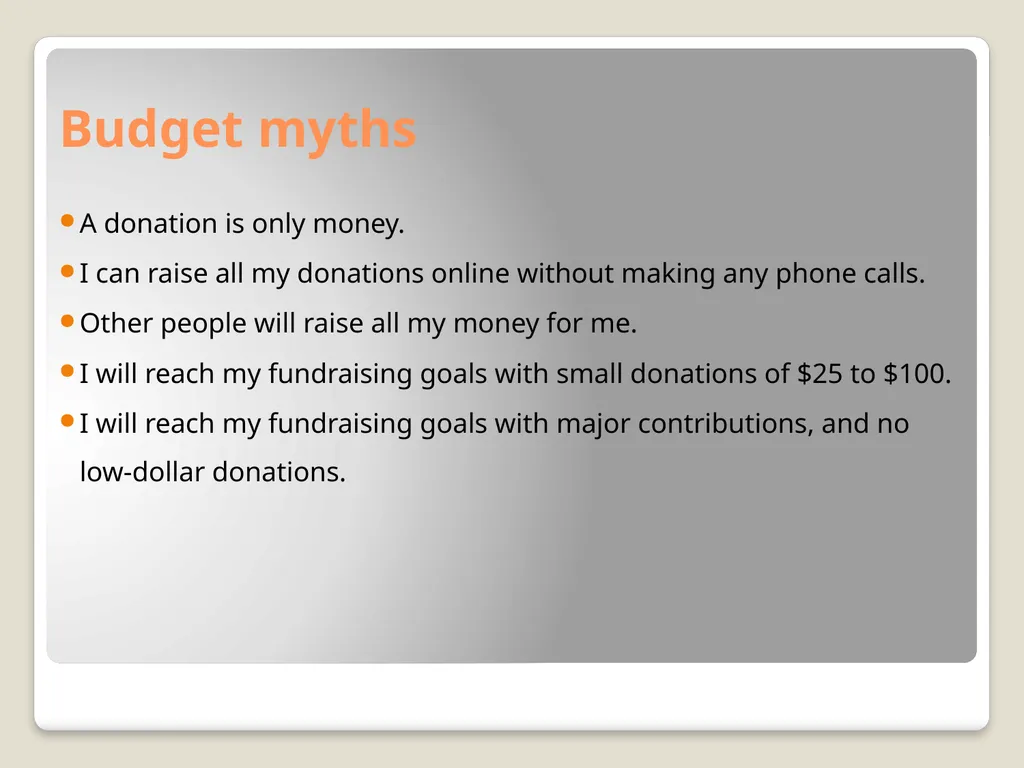
slide10. Budget myths A donation is only money.
I can raise all my donations online without making any phone calls.
Other people will raise all my money for me.
I will reach my fundraising goals with small donations of $25 to $100.
I will reach my fundraising goals with major contributions, and no low-dollar donations.<br>
slide11. Sample Finance Plan<br>
slide12. CALL TIME<br>
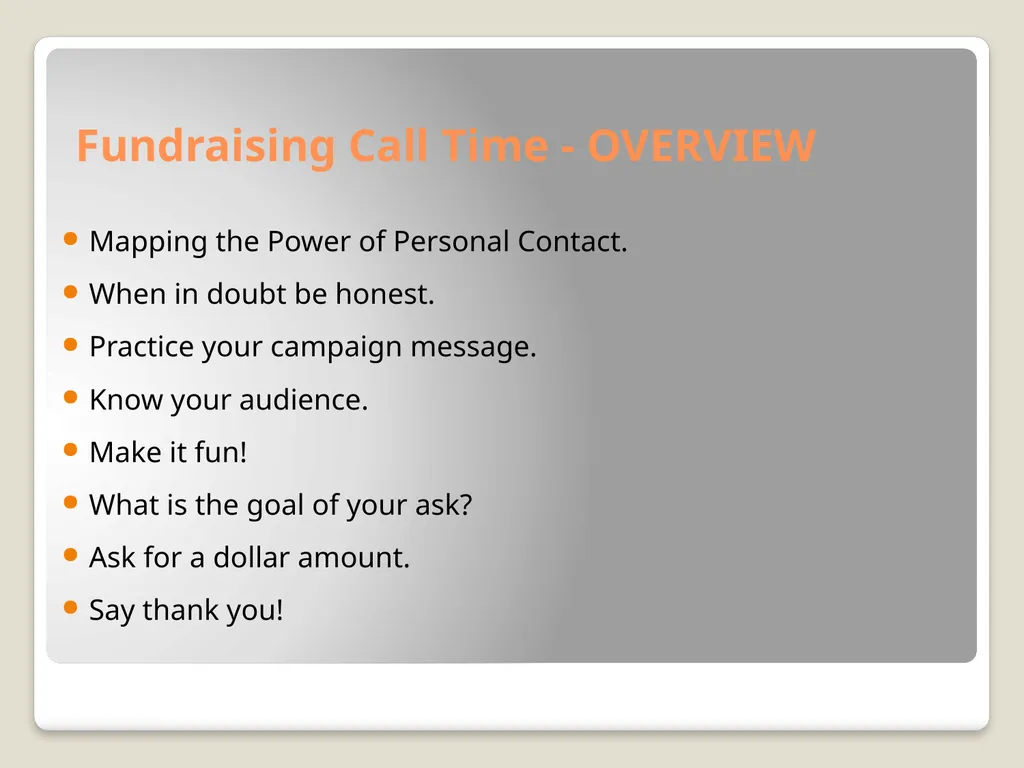
slide13. Fundraising Call Time - OVERVIEW Mapping the Power of Personal Contact.
When in doubt be honest.
Practice your campaign message.
Know your audience.
Make it fun!
What is the goal of your ask?
Ask for a dollar amount.
Say thank you!<br>
slide14. Mapping
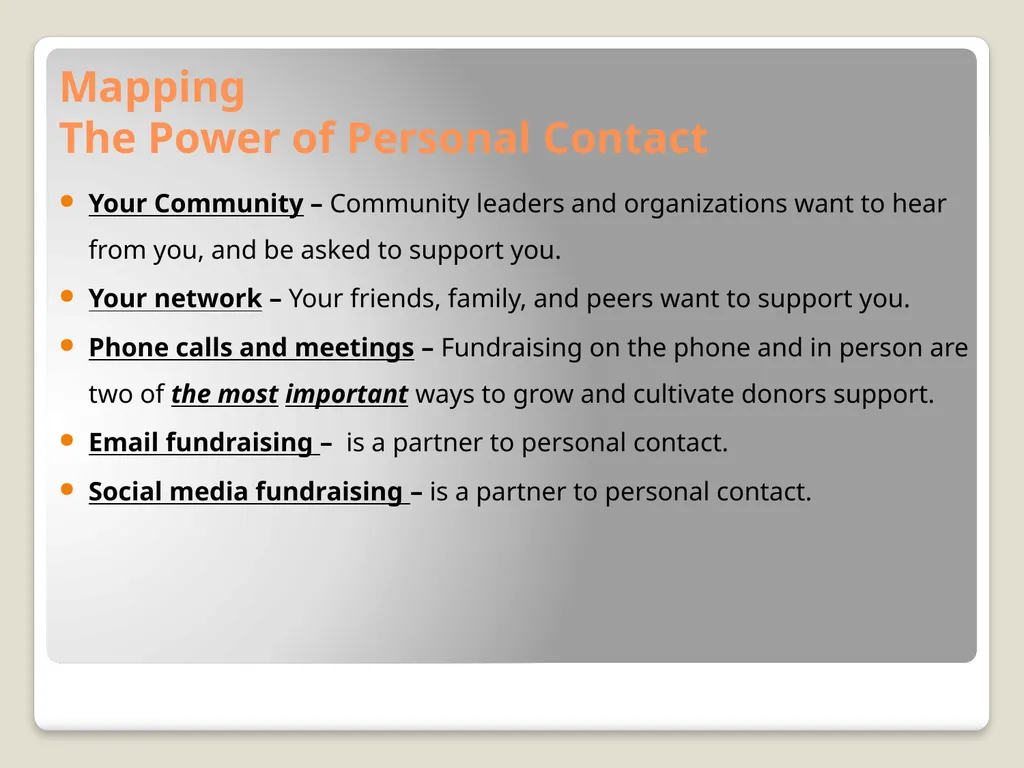
The Power of Personal Contact Your Community – Community leaders and organizations want to hear from you, and be asked to support you.
Your network – Your friends, family, and peers want to support you.
Phone calls and meetings – Fundraising on the phone and in person are two of the most important ways to grow and cultivate donors support.
Email fundraising – is a partner to personal contact.
Social media fundraising – is a partner to personal contact.<br>
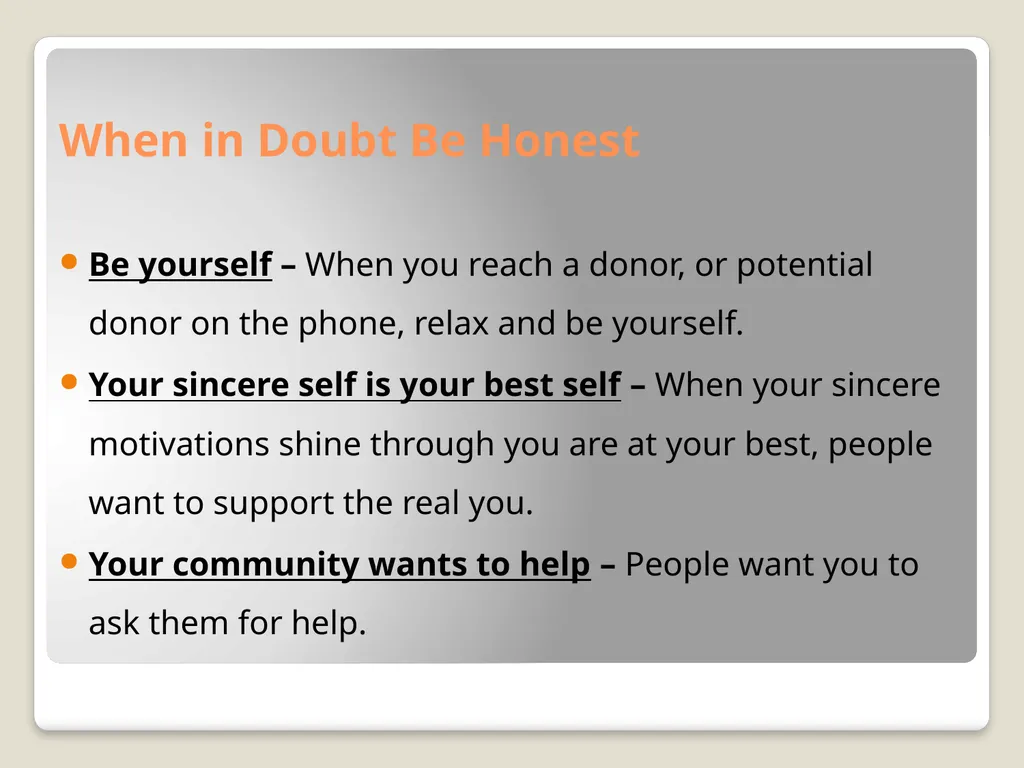
slide15. When in Doubt Be Honest Be yourself – When you reach a donor, or potential donor on the phone, relax and be yourself.
Your sincere self is your best self – When your sincere motivations shine through you are at your best, people want to support the real you.
Your community wants to help – People want you to ask them for help.<br>
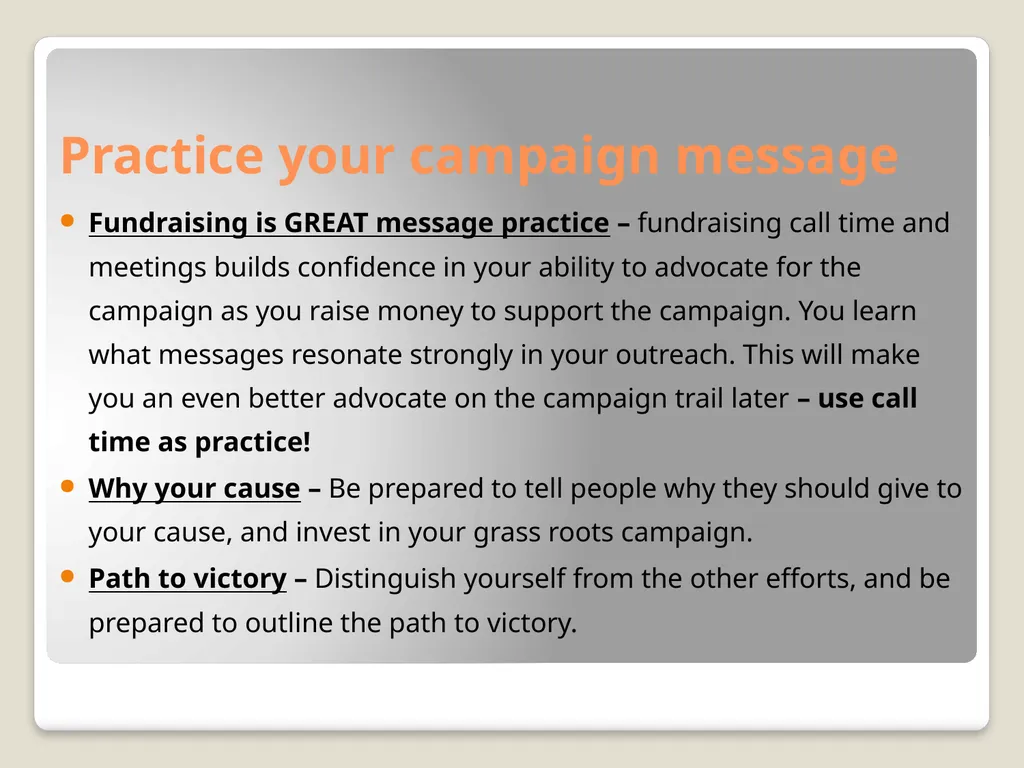
slide16. Practice your campaign message Fundraising is GREAT message practice – fundraising call time and meetings builds confidence in your ability to advocate for the campaign as you raise money to support the campaign. You learn what messages resonate strongly in your outreach. This will make you an even better advocate on the campaign trail later – use call time as practice!
Why your cause – Be prepared to tell people why they should give to your cause, and invest in your grass roots campaign.
Path to victory – Distinguish yourself from the other efforts, and be prepared to outline the path to victory.<br>
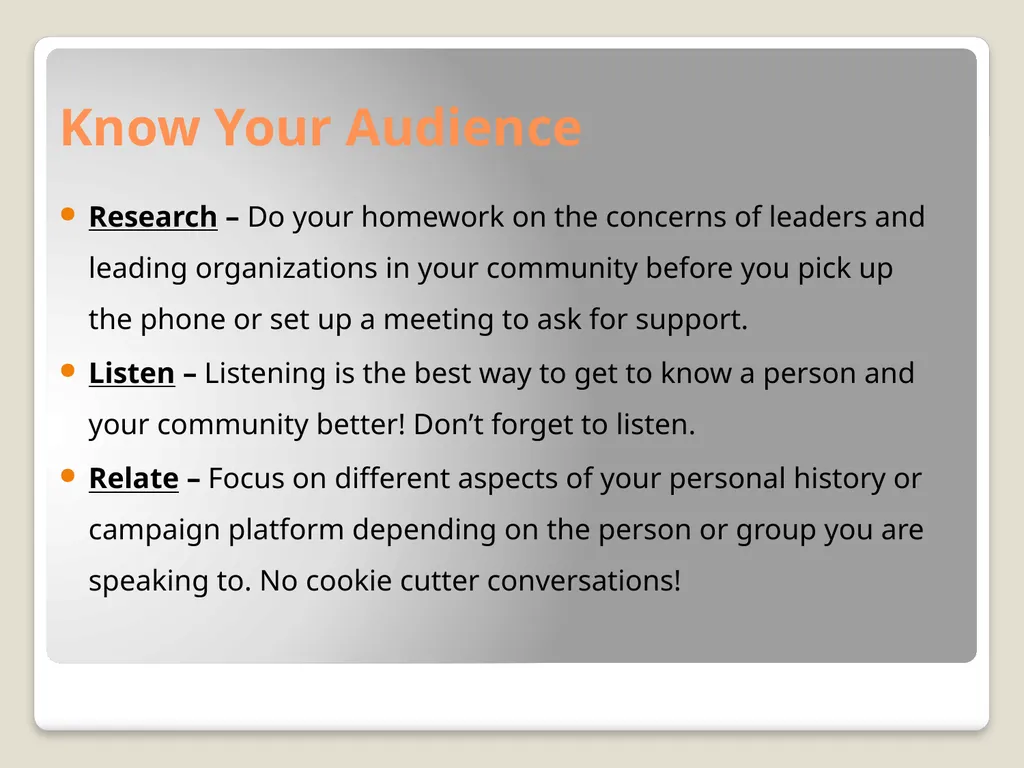
slide17. Know Your Audience Research – Do your homework on the concerns of leaders and leading organizations in your community before you pick up the phone or set up a meeting to ask for support.
Listen – Listening is the best way to get to know a person and your community better! Don’t forget to listen.
Relate – Focus on different aspects of your personal history or campaign platform depending on the person or group you are speaking to. No cookie cutter conversations!<br>
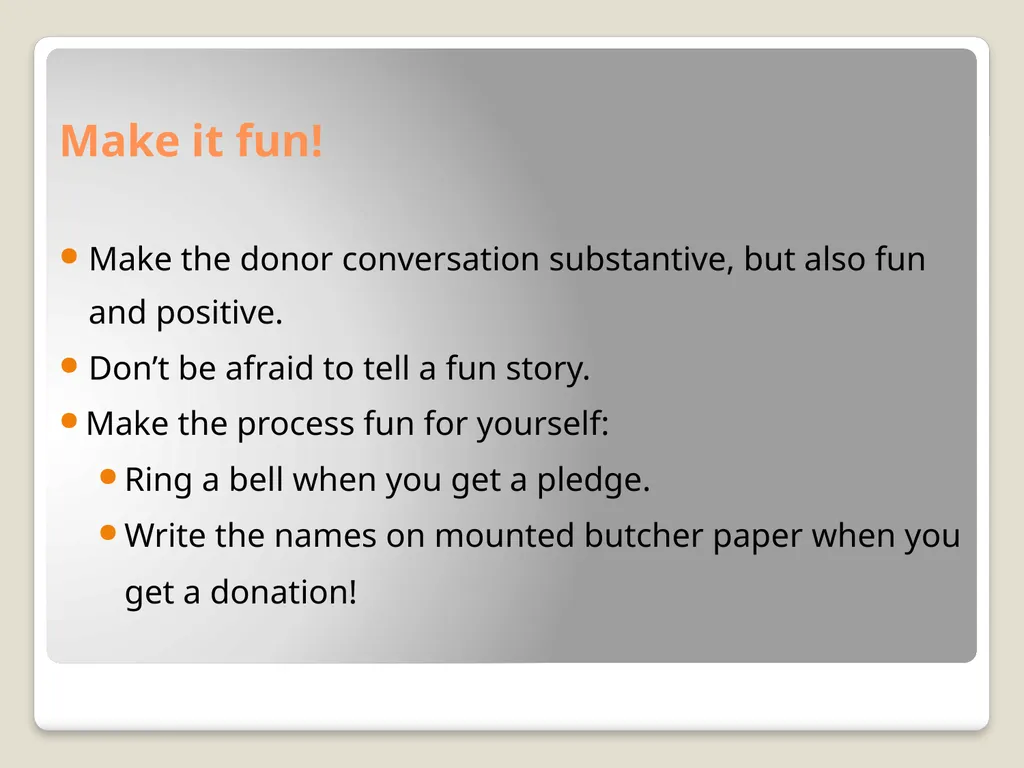
slide18. Make it fun! Make the donor conversation substantive, but also fun and positive.
Don’t be afraid to tell a fun story.
Make the process fun for yourself:
Ring a bell when you get a pledge.
Write the names on mounted butcher paper when you get a donation!<br>
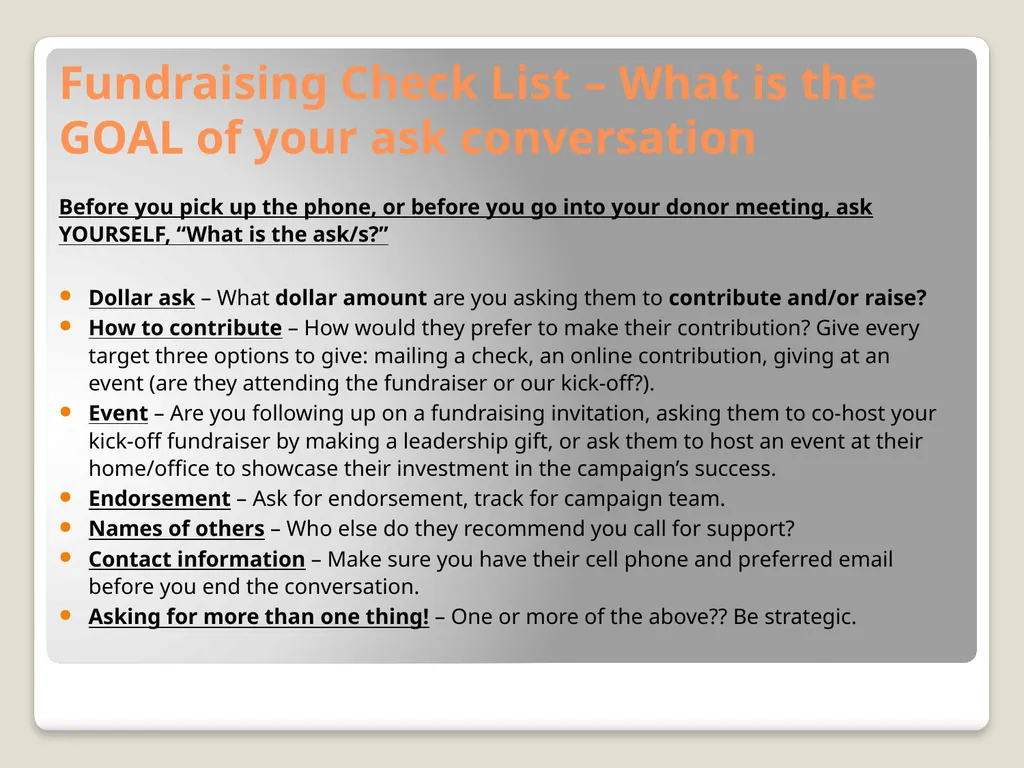
slide19. Fundraising Check List – What is the GOAL of your ask conversation Before you pick up the phone, or before you go into your donor meeting, ask YOURSELF, “What is the ask/s?”
Dollar ask – What dollar amount are you asking them to contribute and/or raise?
How to contribute – How would they prefer to make their contribution? Give every target three options to give: mailing a check, an online contribution, giving at an event (are they attending the fundraiser or our kick-off?).
Event – Are you following up on a fundraising invitation, asking them to co-host your kick-off fundraiser by making a leadership gift, or ask them to host an event at their home/office to showcase their investment in the campaign’s success.
Endorsement – Ask for endorsement, track for campaign team.
Names of others – Who else do they recommend you call for support?
Contact information – Make sure you have their cell phone and preferred email before you end the conversation.
Asking for more than one thing! – One or more of the above?? Be strategic.<br>
slide20. …And one more time: ASK for money! “I am asking friends and community leaders if they can make a donation to support our campaign. Can you donate $$$ today?”<br>
slide21. IF YES… Contact information -- Get the email and cell phone of donor (if you don’t have it already).
Send a thank you email -- confirm the pledge, giving campaign mailing address, online contribution link, and website address for more information.<br>
slide22. IF NO… May we stay in touch? -- Ask if you may stay in touch via email, include their email on the campaign mailing list.
Thank you -- If appropriate, send a thank you email thanking for their input, and say you look for to staying in touch.
If at first you don’t succeed, try, try again!<br>
slide23. Fundraising Call Time Role Play!<br>
slide24. THANK YOU! Always say thank you, no matter the result!!<br>

slide2. The BASICS<br>
slide3. Fundraising is a reflection of your campaign
Coalition — Diverse group of community supporters/donors
Message — Practice campaign talking points as you ask for money
Goals — Meets campaign budget<br>
slide4. Fundraising starts first…
so where do you begin?
List building — Build a database of your network and organizational networks that are leading the campaign.
Endorsements — Recruit early support from elected officials, Labor, Business leaders, and organizations focused on early education.
Fundraising deadlines — Learn the fundraising deadlines leading up to Election Day
Finance Plan and Finance Committee — map your fundraising to help you reach goal, and recruit proven fundraisers to help you meet budget.<br>
slide5. Message — Know your “Why?” Leadership — What are the top three reasons why you are a leader with this community organization?
Fundraising — What are the top three reasons why you are raising?
Audience — What are the common values you share with your donor/target supporter?<br>
slide6. Early Money Your community has an interest in supporting children and education, the issue is when a donor or organization is going to prioritize your cause/campaign.
Some people will support you early, some will support you after a major campaign milestone is reached, others will donate toward the end.
The campaign that raises significant money EARLY generates three things: buzz, momentum, and viability<br>
slide7. Call Time -- scheduled time set aside in your daily calendar for fundraising outreach Phone calls — Call ten targets a day to recruit them as donors and endorsers.
Meetings — In person meetings are one of the best ways to recruit support and investment.
Emails — Send individual emails to like minded individuals and organizations to recruit financial support.
Texts —Some donors prefer texting, knowing their preferences makes you a good fundraiser.<br>
slide8. BUDGET<br>
slide9. Building a budget for success
Finance Plan -- Write a campaign finance plan for your campaign or organization by setting a goal for each fundraising target.
Finance Committee -- Ask endorsers, friends, and colleagues to WRITE AND/OR RAISE for you, while you fundraise at the same time.<br>
slide10. Budget myths A donation is only money.
I can raise all my donations online without making any phone calls.
Other people will raise all my money for me.
I will reach my fundraising goals with small donations of $25 to $100.
I will reach my fundraising goals with major contributions, and no low-dollar donations.<br>
slide11. Sample Finance Plan<br>
slide12. CALL TIME<br>
slide13. Fundraising Call Time - OVERVIEW Mapping the Power of Personal Contact.
When in doubt be honest.
Practice your campaign message.
Know your audience.
Make it fun!
What is the goal of your ask?
Ask for a dollar amount.
Say thank you!<br>
slide14. Mapping
The Power of Personal Contact Your Community – Community leaders and organizations want to hear from you, and be asked to support you.
Your network – Your friends, family, and peers want to support you.
Phone calls and meetings – Fundraising on the phone and in person are two of the most important ways to grow and cultivate donors support.
Email fundraising – is a partner to personal contact.
Social media fundraising – is a partner to personal contact.<br>
slide15. When in Doubt Be Honest Be yourself – When you reach a donor, or potential donor on the phone, relax and be yourself.
Your sincere self is your best self – When your sincere motivations shine through you are at your best, people want to support the real you.
Your community wants to help – People want you to ask them for help.<br>
slide16. Practice your campaign message Fundraising is GREAT message practice – fundraising call time and meetings builds confidence in your ability to advocate for the campaign as you raise money to support the campaign. You learn what messages resonate strongly in your outreach. This will make you an even better advocate on the campaign trail later – use call time as practice!
Why your cause – Be prepared to tell people why they should give to your cause, and invest in your grass roots campaign.
Path to victory – Distinguish yourself from the other efforts, and be prepared to outline the path to victory.<br>
slide17. Know Your Audience Research – Do your homework on the concerns of leaders and leading organizations in your community before you pick up the phone or set up a meeting to ask for support.
Listen – Listening is the best way to get to know a person and your community better! Don’t forget to listen.
Relate – Focus on different aspects of your personal history or campaign platform depending on the person or group you are speaking to. No cookie cutter conversations!<br>
slide18. Make it fun! Make the donor conversation substantive, but also fun and positive.
Don’t be afraid to tell a fun story.
Make the process fun for yourself:
Ring a bell when you get a pledge.
Write the names on mounted butcher paper when you get a donation!<br>
slide19. Fundraising Check List – What is the GOAL of your ask conversation Before you pick up the phone, or before you go into your donor meeting, ask YOURSELF, “What is the ask/s?”
Dollar ask – What dollar amount are you asking them to contribute and/or raise?
How to contribute – How would they prefer to make their contribution? Give every target three options to give: mailing a check, an online contribution, giving at an event (are they attending the fundraiser or our kick-off?).
Event – Are you following up on a fundraising invitation, asking them to co-host your kick-off fundraiser by making a leadership gift, or ask them to host an event at their home/office to showcase their investment in the campaign’s success.
Endorsement – Ask for endorsement, track for campaign team.
Names of others – Who else do they recommend you call for support?
Contact information – Make sure you have their cell phone and preferred email before you end the conversation.
Asking for more than one thing! – One or more of the above?? Be strategic.<br>
slide20. …And one more time: ASK for money! “I am asking friends and community leaders if they can make a donation to support our campaign. Can you donate $$$ today?”<br>
slide21. IF YES… Contact information -- Get the email and cell phone of donor (if you don’t have it already).
Send a thank you email -- confirm the pledge, giving campaign mailing address, online contribution link, and website address for more information.<br>
slide22. IF NO… May we stay in touch? -- Ask if you may stay in touch via email, include their email on the campaign mailing list.
Thank you -- If appropriate, send a thank you email thanking for their input, and say you look for to staying in touch.
If at first you don’t succeed, try, try again!<br>
slide23. Fundraising Call Time Role Play!<br>
slide24. THANK YOU! Always say thank you, no matter the result!!<br>