
Banner Fixed Assets Policies and Procedures How
OM
Published · 26 slides · 0 views

1 / 1



Description
Banner Fixed Assets Policies and Procedures How they affect you. Fixed Assets Coordinator Fixed Assets Training Welcome to the University of North Carolina at Pembroke, Fixed Assets Training. As the Fixed Assets Coordinator for UNCP, I can
Related Topics
Share
Embed code
Download this presentation From Below
"Banner Fixed Assets Policies and Procedures How" is the property of its rightful owner. Permission is granted to download and print the materials on this website for personal, non-commercial use only, and to display it on your personal computer provided you do not modify the materials and that you retain all copyright notices contained in the materials. By downloading content from our website, you accept the terms of this agreement.
Presentation Transcript
01
Banner Fixed Assets Policies and Procedures How they affect you. Fixed Assets Coordinator<br>
02
Fixed Assets Training Welcome to the University of North Carolina at Pembroke, Fixed Assets Training. As the Fixed Assets Coordinator for UNCP, I can be reached via email or phone at 910-521-6234.
We are striving to educate our campus on the proper policies and procedures governing Fixed Assets. Please review the presentation and once you have completed the presentation, clink on the link on the last slide to access a brief quiz. You must score 70 or better to complete this training. If you have any questions or concerns during or after viewing the presentation and taking the assessment, please contact me. Thank you for your participation.<br>
We are striving to educate our campus on the proper policies and procedures governing Fixed Assets. Please review the presentation and once you have completed the presentation, clink on the link on the last slide to access a brief quiz. You must score 70 or better to complete this training. If you have any questions or concerns during or after viewing the presentation and taking the assessment, please contact me. Thank you for your participation.<br>
03
What are we talking about? Fixed Assets policies and procedures that directly affect
your work,
your budget,
and your responsibility for protection of UNCP assets as custodian department.
Our goal is to educate you on the processes, procedures, and everyday activities of Fixed Assets.<br>
your work,
your budget,
and your responsibility for protection of UNCP assets as custodian department.
Our goal is to educate you on the processes, procedures, and everyday activities of Fixed Assets.<br>
04
What does the Fixed Assets Section of Business Services do? We are responsible for:
Determining new assets and tagging for identification
Performing annual inventory audits
Determining correct cost of assets recorded
Maintaining the University Fixed Assets accounting records that document equipment and property acquisitions and which are part of the annual University Financial Statements.
Implement and follow policies set by the GASB, Office of the State Controller, and the State Auditor
Follow Business Process Standards issued by UNC System
Ensures fixed assets are:
properly acquired
accounted for
maintained
disposed of<br>
Determining new assets and tagging for identification
Performing annual inventory audits
Determining correct cost of assets recorded
Maintaining the University Fixed Assets accounting records that document equipment and property acquisitions and which are part of the annual University Financial Statements.
Implement and follow policies set by the GASB, Office of the State Controller, and the State Auditor
Follow Business Process Standards issued by UNC System
Ensures fixed assets are:
properly acquired
accounted for
maintained
disposed of<br>
05
Governing Policies GASB(Governmental Accounting Standards Board): http://gasb.org/
NC Office of the State Controller: https://www.osc.nc.gov/
NC State Auditor: http://www.ncauditor.net/
Finance and Administration: mailto:businessaffairs@uncp.edu<br>
NC Office of the State Controller: https://www.osc.nc.gov/
NC State Auditor: http://www.ncauditor.net/
Finance and Administration: mailto:businessaffairs@uncp.edu<br>
06
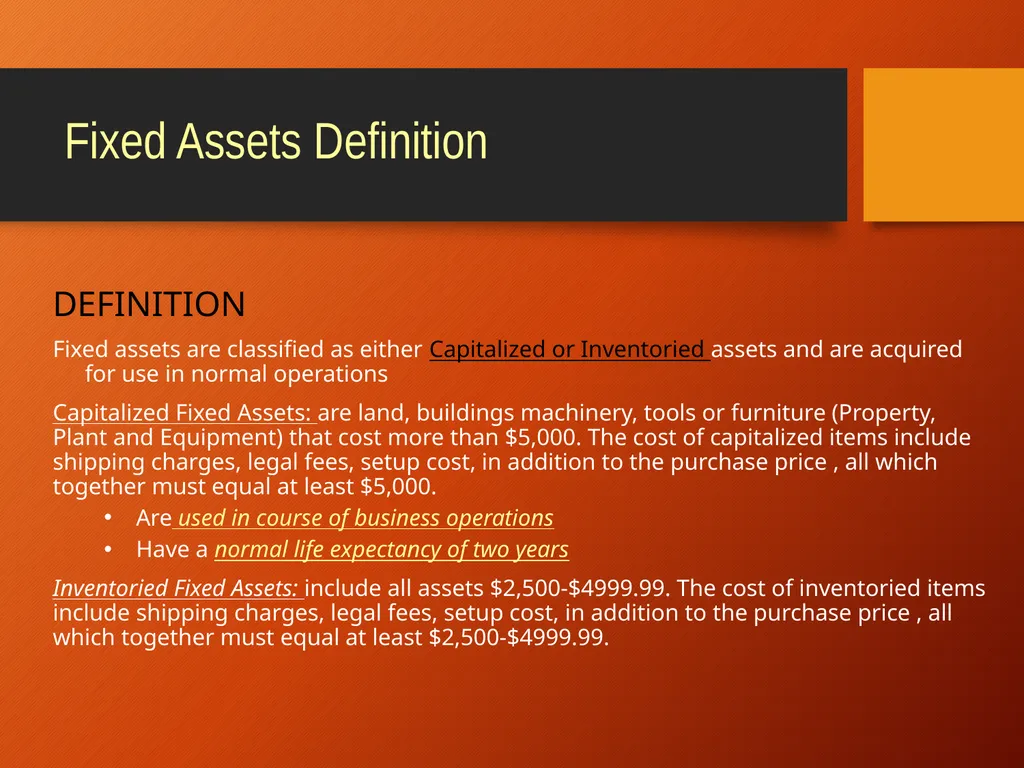
Fixed Assets Definition DEFINITION
Fixed assets are classified as either Capitalized or Inventoried assets and are acquired for use in normal operations
Capitalized Fixed Assets: are land, buildings machinery, tools or furniture (Property, Plant and Equipment) that cost more than $5,000. The cost of capitalized items include shipping charges, legal fees, setup cost, in addition to the purchase price , all which together must equal at least $5,000.
Are used in course of business operations
Have a normal life expectancy of two years
Inventoried Fixed Assets: include all assets $2,500-$4999.99. The cost of inventoried items include shipping charges, legal fees, setup cost, in addition to the purchase price , all which together must equal at least $2,500-$4999.99.<br>
Fixed assets are classified as either Capitalized or Inventoried assets and are acquired for use in normal operations
Capitalized Fixed Assets: are land, buildings machinery, tools or furniture (Property, Plant and Equipment) that cost more than $5,000. The cost of capitalized items include shipping charges, legal fees, setup cost, in addition to the purchase price , all which together must equal at least $5,000.
Are used in course of business operations
Have a normal life expectancy of two years
Inventoried Fixed Assets: include all assets $2,500-$4999.99. The cost of inventoried items include shipping charges, legal fees, setup cost, in addition to the purchase price , all which together must equal at least $2,500-$4999.99.<br>
07
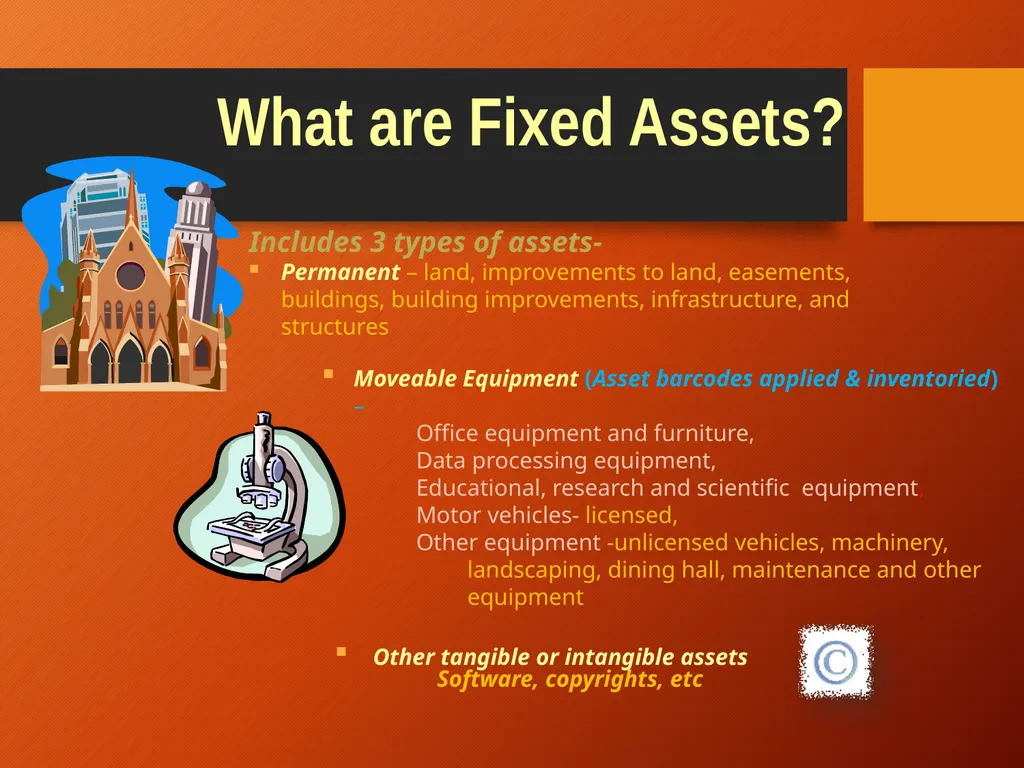
What are Fixed Assets? Other tangible or intangible assets
Software, copyrights, etc Includes 3 types of assets-
Permanent – land, improvements to land, easements, buildings, building improvements, infrastructure, and structures Moveable Equipment (Asset barcodes applied & inventoried) –
Office equipment and furniture,
Data processing equipment,
Educational, research and scientific equipment,
Motor vehicles- licensed,
Other equipment -unlicensed vehicles, machinery,
landscaping, dining hall, maintenance and other
equipment<br>
Software, copyrights, etc Includes 3 types of assets-
Permanent – land, improvements to land, easements, buildings, building improvements, infrastructure, and structures Moveable Equipment (Asset barcodes applied & inventoried) –
Office equipment and furniture,
Data processing equipment,
Educational, research and scientific equipment,
Motor vehicles- licensed,
Other equipment -unlicensed vehicles, machinery,
landscaping, dining hall, maintenance and other
equipment<br>
08
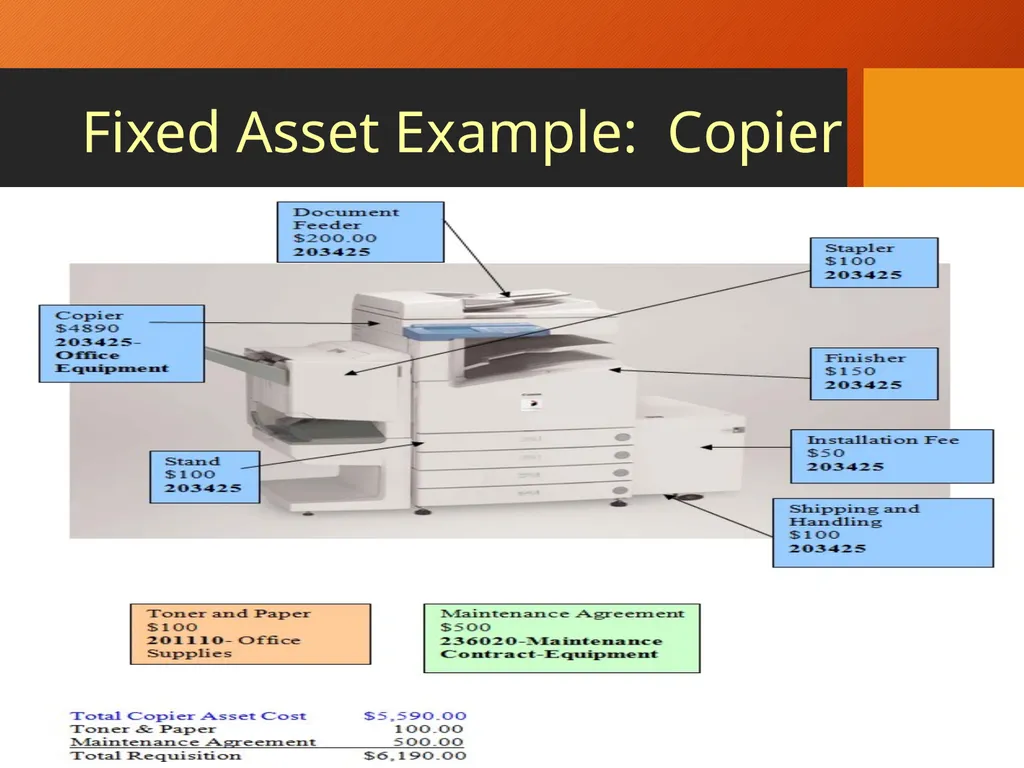
Things to remember when purchasing Fixed Assets : Any item purchased to be permanently added to, attached to, or installed into a previously purchased capital asset must be purchased using the same capital expenditure code used for that asset. This includes equipment items such as a Handicap Lift for a Bus, Digital camera for a Microscope, but does NOT include expendable supplies such as copier toner or intangible assets such as software. (Contact Fixed Assets Department, if unsure.)<br>
09
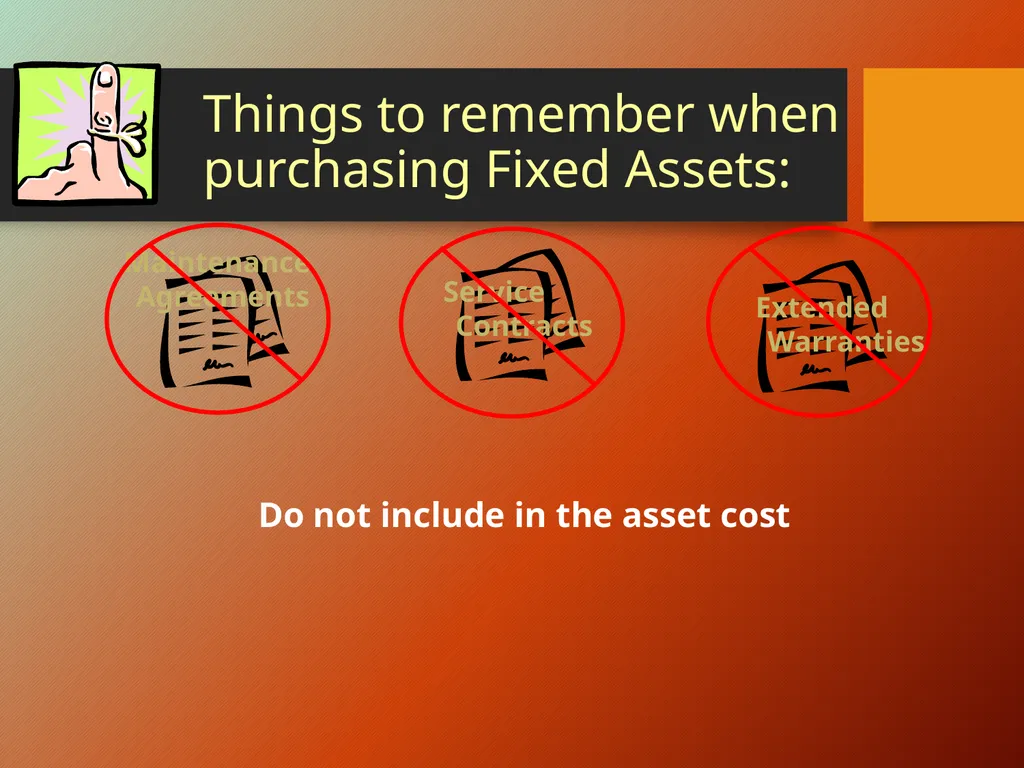
Things to remember when purchasing Fixed Assets: Do not include in the asset cost Maintenance
Agreements Service
Contracts Extended Warranties<br>
10
Fixed Asset Example: Copier<br>
11
Policy for New Assets Based on the University's inventory and capitalization policies, the Receiving Department staff determines which items will be assigned a tag number and added to the Banner Fixed Assets System. Items $5,000 or greater will be added to the Banner Fixed Asset System and to the Bassets Fixed Assets System. The Receiving Department staff is responsible for physically placing the tag number on the front or other easily accessible area of the asset. Under no circumstances should anyone take an item off campus before the Receiving Department staff has properly tagged it.
If assets are shipped directly to a department or contractors are installing assets that meet the monetary threshold the department has 24 hours after installation to contact the Fixed Assets and Central Receiving department so that arrangements can be made to tag the asset. If you are upgrading assets, the old assets need to be sent to surplus for proper disposal unless the department received proper authorization from Purchasing to trade the old equipment in for a discount. NO NEW ASSET SHALL BE REMOVED FROM CENTRAL RECEIVING BEFORE BEING TAGGED!<br>
If assets are shipped directly to a department or contractors are installing assets that meet the monetary threshold the department has 24 hours after installation to contact the Fixed Assets and Central Receiving department so that arrangements can be made to tag the asset. If you are upgrading assets, the old assets need to be sent to surplus for proper disposal unless the department received proper authorization from Purchasing to trade the old equipment in for a discount. NO NEW ASSET SHALL BE REMOVED FROM CENTRAL RECEIVING BEFORE BEING TAGGED!<br>
12
Policy for New Assets Barcode tags are required for these new assets with a total cost of $5,000 or more:
Office Furniture & Equipment
Electronic Data Processing Equipment
Educational, Scientific and Research Equipment
Motor Vehicles (Licensed)
Other Equipment (Non-licensed vehicles, grounds & landscaping, etc.)<br>
Office Furniture & Equipment
Electronic Data Processing Equipment
Educational, Scientific and Research Equipment
Motor Vehicles (Licensed)
Other Equipment (Non-licensed vehicles, grounds & landscaping, etc.)<br>
13
Annual Inventory Procedures<br>
14
Department Head Duties RESPONSIBILITIES
“Each department head is responsible for safeguarding all assets purchased for his or her department and assisting with the physical inventory process (see Annual Inventories)..”
“… designate an individual in a permanent position on your staff (a student is not an acceptable designee) to physically locate each fixed asset on the attached printouts, which were prepared by our Fixed Assets Coordinator. ”
Any missing/surplused items must be accompanied by a police report and a transfer movable/surplus form. (NO EXCEPTIONS)
All Fixed Assets Forms must be signed by the department head and returned to the Fixed Assets Coordinator.<br>
“Each department head is responsible for safeguarding all assets purchased for his or her department and assisting with the physical inventory process (see Annual Inventories)..”
“… designate an individual in a permanent position on your staff (a student is not an acceptable designee) to physically locate each fixed asset on the attached printouts, which were prepared by our Fixed Assets Coordinator. ”
Any missing/surplused items must be accompanied by a police report and a transfer movable/surplus form. (NO EXCEPTIONS)
All Fixed Assets Forms must be signed by the department head and returned to the Fixed Assets Coordinator.<br>
15
Annual Inventory:
Designee Duties Immediately:
Call to confirm receipt of inventory email packet.
During Next Two Weeks:
Physically locate each asset and update list, including additions, documentation for assets not located, and new locations of assets.
Send updates and all forms to Fixed Assets Coordinator.<br>
Call to confirm receipt of inventory email packet.
During Next Two Weeks:
Physically locate each asset and update list, including additions, documentation for assets not located, and new locations of assets.
Send updates and all forms to Fixed Assets Coordinator.<br>
16
Annual Inventory:
Designee Duties Before inventory appointment:
Request by urgent email that all department employees with Off-Campus laptops, portable equipment and instruments bring them in on the day of the appointment for visual inspection.
Arrange for access to all assets listed on inventory: get keys to labs, set up appointments, get combinations to lockers, have students return items, etc.<br>
Request by urgent email that all department employees with Off-Campus laptops, portable equipment and instruments bring them in on the day of the appointment for visual inspection.
Arrange for access to all assets listed on inventory: get keys to labs, set up appointments, get combinations to lockers, have students return items, etc.<br>
17
Annual Inventory:
Designee Duties On the day of scheduled inventory appointment:
Escort your Fixed Assets Coordinator to each asset.
If assets are missing, during next 10 days:
Locate each item or document the status upon receipt of the Missing Assets Report.
Call your Fixed Assets Coordinator for an appointment to verify any located missing items at the close of the inventory in 10 days or after.
Missing Verification Appointment:
Escort the Fixed Assets Coordinator to each located missing asset.<br>
Escort your Fixed Assets Coordinator to each asset.
If assets are missing, during next 10 days:
Locate each item or document the status upon receipt of the Missing Assets Report.
Call your Fixed Assets Coordinator for an appointment to verify any located missing items at the close of the inventory in 10 days or after.
Missing Verification Appointment:
Escort the Fixed Assets Coordinator to each located missing asset.<br>
18
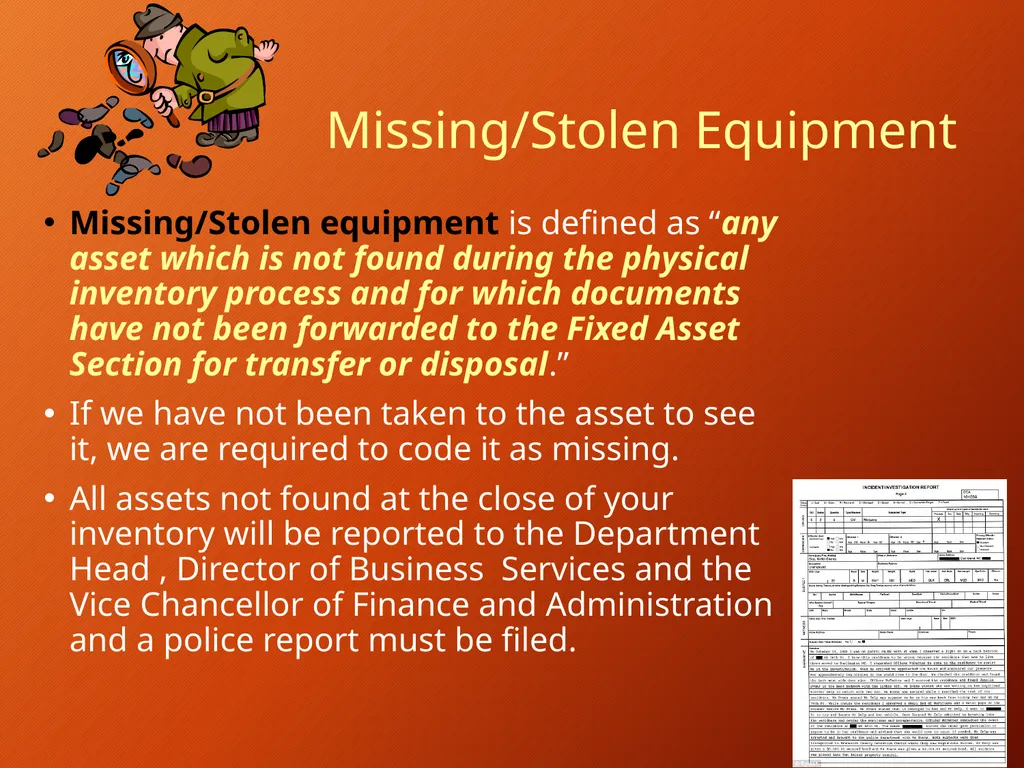
Missing/Stolen Equipment Missing/Stolen equipment is defined as “any asset which is not found during the physical inventory process and for which documents have not been forwarded to the Fixed Asset Section for transfer or disposal.”
If we have not been taken to the asset to see it, we are required to code it as missing.
All assets not found at the close of your inventory will be reported to the Department Head , Director of Business Services and the Vice Chancellor of Finance and Administration and a police report must be filed.<br>
If we have not been taken to the asset to see it, we are required to code it as missing.
All assets not found at the close of your inventory will be reported to the Department Head , Director of Business Services and the Vice Chancellor of Finance and Administration and a police report must be filed.<br>
19
Completing Annual Inventory All Fixed Asset Inventory forms must be signed by the dean or highest ranking department head of the custodian department.
Copies of all FA forms should be kept by the custodian department.
Forms should always be submitted to the Fixed Assets Coordinator as soon as changes in the asset’s inventory status occur!<br>
Copies of all FA forms should be kept by the custodian department.
Forms should always be submitted to the Fixed Assets Coordinator as soon as changes in the asset’s inventory status occur!<br>
20
Things to Know UNDER NO CIRCUMSTANCES CAN STATE-OWNED EQUIPMENT BE DONATED, TRADED-IN, OR GIVEN TO ANOTHER ENTITY WITHOUT APPROVAL OF THE STATE SURPLUS PROPERTY OFFICE.
Change in Location Within Agency :
Prior to changing the assigned location of equipment within an agency, Part A of Form FAS-1(or equivalent agency form) must be completed. The fixed asset number, description, current building and room number, and the reassigned building and room number must be included on this form. The form must be signed by the Division/Section Manager and transmitted to the Fixed Asset Officer.<br>
Change in Location Within Agency :
Prior to changing the assigned location of equipment within an agency, Part A of Form FAS-1(or equivalent agency form) must be completed. The fixed asset number, description, current building and room number, and the reassigned building and room number must be included on this form. The form must be signed by the Division/Section Manager and transmitted to the Fixed Asset Officer.<br>
21
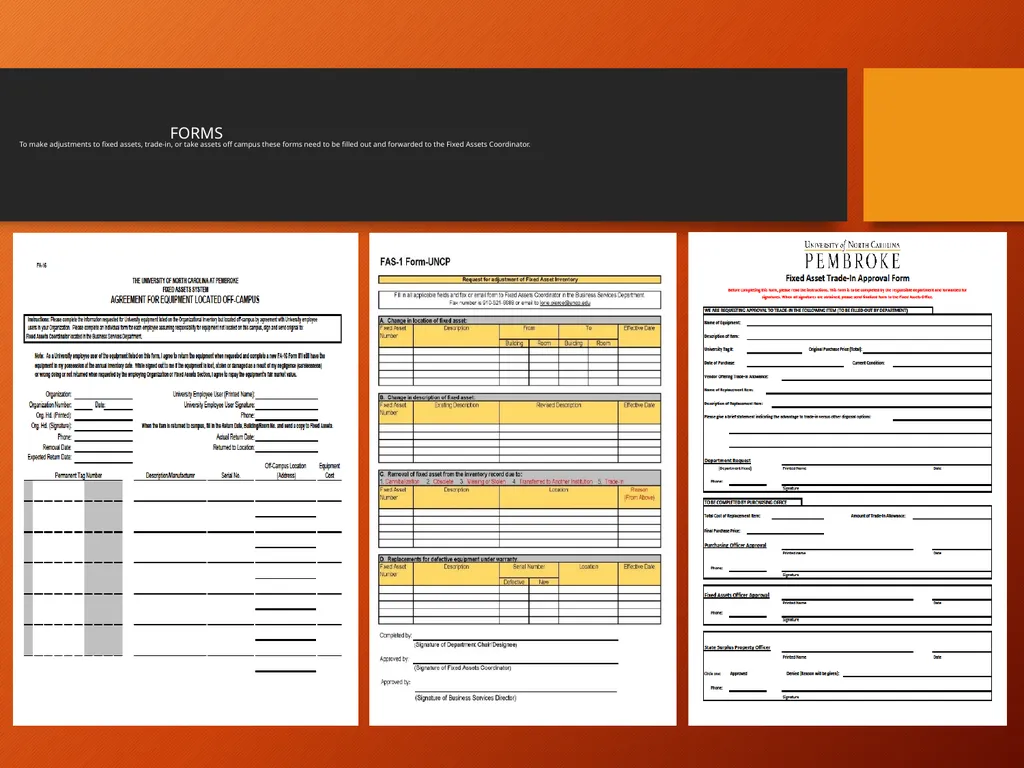
FORMS
To make adjustments to fixed assets, trade-in, or take assets off campus these forms need to be filled out and forwarded to the Fixed Assets Coordinator.<br>
22
Completing Proper Forms FAS-1 Form:
To change the location, description, remove or replace a Fixed Asset. Please complete FAS-1 Form under the Fixed Assets section and return to the Fixed Assets Coordinator.
Trade-in Form:
There are times when it is advantageous to trade-in old equipment for new equipment; however, it is imperative that the University follow the proper procedures and guidelines.
1. Once a department realizes they will benefit from a trade-in, they should complete a Fixed Assets Trade-In Approval Form and send it to the Purchasing Office.
2. Once the Purchasing Office approves the trade-in, they will then forward the Fixed Asset Trade-In Approval Form to the Fixed Assets Office for approval. Once The Fixed Assets Office approves the trade-in, they will then return the University Trade-In Approval Form to the Purchasing Office who will fax the form to the State Surplus Property Agency (SSPA) for approval.
3. Once permission is granted from State Surplus Property, the Purchasing Office will then notify the department that it is okay to submit the requisition and follow through with the trade-in. Once the equipment is traded-in and the new equipment is received, the Purchasing Office must forward the completed Fixed Asset Trade-In Approval Form and the related PO # to the Fixed Assets Office. The Fixed Assets Office will then properly account for the trade-in.
Off-Campus Form: When faculty, student or staff members need to take University owned property/assets off campus. Should be maintained at departmental level while emailing a copy to the Fixed Assets Coordinator.<br>
To change the location, description, remove or replace a Fixed Asset. Please complete FAS-1 Form under the Fixed Assets section and return to the Fixed Assets Coordinator.
Trade-in Form:
There are times when it is advantageous to trade-in old equipment for new equipment; however, it is imperative that the University follow the proper procedures and guidelines.
1. Once a department realizes they will benefit from a trade-in, they should complete a Fixed Assets Trade-In Approval Form and send it to the Purchasing Office.
2. Once the Purchasing Office approves the trade-in, they will then forward the Fixed Asset Trade-In Approval Form to the Fixed Assets Office for approval. Once The Fixed Assets Office approves the trade-in, they will then return the University Trade-In Approval Form to the Purchasing Office who will fax the form to the State Surplus Property Agency (SSPA) for approval.
3. Once permission is granted from State Surplus Property, the Purchasing Office will then notify the department that it is okay to submit the requisition and follow through with the trade-in. Once the equipment is traded-in and the new equipment is received, the Purchasing Office must forward the completed Fixed Asset Trade-In Approval Form and the related PO # to the Fixed Assets Office. The Fixed Assets Office will then properly account for the trade-in.
Off-Campus Form: When faculty, student or staff members need to take University owned property/assets off campus. Should be maintained at departmental level while emailing a copy to the Fixed Assets Coordinator.<br>
23
FAS-1 Form If you are reporting any of these changes you must complete the appropriate forms:
Traded-In with prior authorization from Purchasing and State Surplus Property Manager
Change in location
Stolen/missing with a copy of the police report
Exchanged for different assets or Returned to the vendor after tagging
Junked ( i.e. Used for parts)
Destroyed by fire, water damage or accident.<br>
Traded-In with prior authorization from Purchasing and State Surplus Property Manager
Change in location
Stolen/missing with a copy of the police report
Exchanged for different assets or Returned to the vendor after tagging
Junked ( i.e. Used for parts)
Destroyed by fire, water damage or accident.<br>
24
What All This Means Custodian departments are responsible for their UNCP assets including:
purchase,
protection,
location,
and proper disposal.
Following University policy and procedures during the year will save the department a tremendous amount of searching for missing assets and help maintain inventory accuracy.<br>
purchase,
protection,
location,
and proper disposal.
Following University policy and procedures during the year will save the department a tremendous amount of searching for missing assets and help maintain inventory accuracy.<br>
25
Link to Quiz https://uncp.co1.qualtrics.com/jfe/form/SV_1Sx3aP0umBWTISp<br>