
Basic Business Calculations for BUS 170







Description: Basic Business Calculations for BUS 170 Fundamentals of Finance Basic Bus Calcs 1: Percent Change updated 7232020 About Basic Bus Calcs Basic Business Calculations are calculations every business person should know how to do. Its
Related Topics
Download Presentation
"Basic Business Calculations for BUS 170" is the property of its rightful owner. Permission is granted to download and print the materials on this website for personal, non-commercial use only, and to display it on your personal computer provided you do not modify the materials and that you retain all copyright notices contained in the materials. By downloading content from our website, you accept the terms of this agreement.
Presentation Transcript
slide1. Basic Business Calculations for BUS 170 Fundamentals of Finance Basic Bus Calcs #1: Percent Change updated 7/23/2020<br>
slide2. About “Basic Bus Calcs” “Basic Business Calculations” are calculations every business person should know how to do. It’s best if you can memorize them, because in business you’ll need to use them all the time; like knowing how to tell time from a clock, or knowing how to make change from a dollar bill, it’s possible to look up instructions each time, but it would be awkward and perceived as unprofessional.
Excel (or a Financial calculator) is required to solve these problems. A basic knowledge of Excel is a requirement for most business professionals, so take advantage of this course as an opportunity to practice your Excel skills.* Excel access will be available within the Lockdown Browser while you are taking quizzes and exams for this course. The professor for the COB’s Excel prerequisite courses has made his materials available to all students at these links:
Basic Excel Course (BUS 91L) http://bus91l.altervista.org/Index2.htm
Advanced Excel Course (BUS 91A) http://bus91l.altervista.org/Index3.htm
The website http://www.tvmcalcs.com/ is very helpful for Basic Business Calcs #3 and 5. Other recommended resources are Khan Academy’s Percent Change, Exponents and Time Value of Money tutorials and Exceljet.net’s Excel Training Videos.
* If you choose to use a calculator instead of Excel, you’ll need a Financial Calculator or a programmable calculator equipped with TVM programs; a Scientific or Statistical calculator won’t work. I recommend one of these two calculators: HP10bii (easiest to learn to use) HP 12c (recommended for students who intend to pursue a career in finance). Instruction will not be given in calculator use, you’re on your own if you choose not to use Excel. Networked (phone or other) calculators are not permitted during exams. updated 7/23/2020<br>
slide3. Basic Bus Calcs #1: Percent Change Concept: by what percentage did a number grow, or shrink?
Examples of ways to use…
By what percent did your height change between ages 6 and 16?
By what percent did a company’s 2020 sales decline from 2019?
Think of some of your own “percent change” questions. Write down at least three questions that you’d like to know the answer to. Take your time. This will help make the exercise real to you… updated 7/23/2020<br>
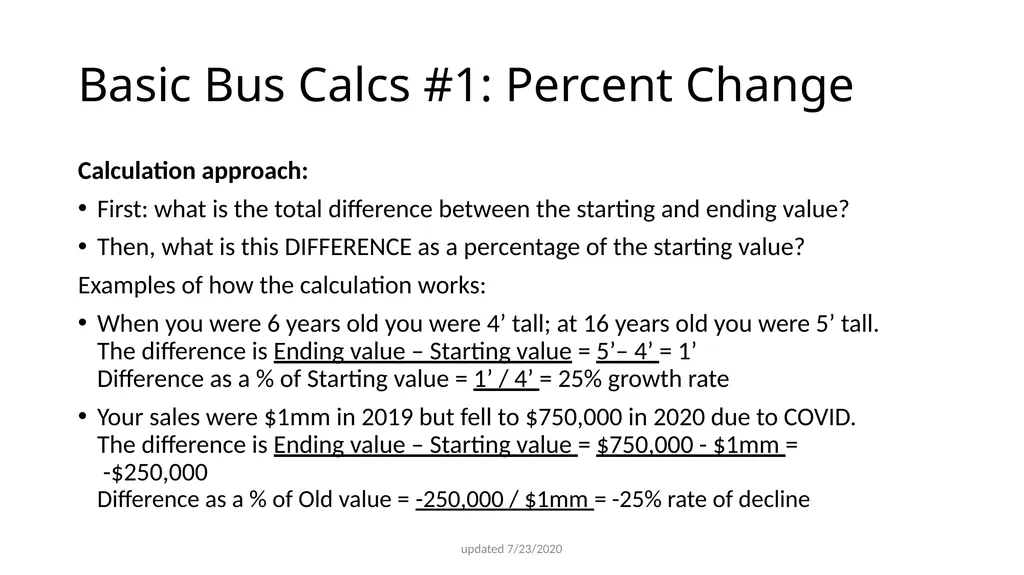
slide4. Basic Bus Calcs #1: Percent Change Calculation approach:
First: what is the total difference between the starting and ending value?
Then, what is this DIFFERENCE as a percentage of the starting value?
Examples of how the calculation works:
When you were 6 years old you were 4’ tall; at 16 years old you were 5’ tall. The difference is Ending value – Starting value = 5’– 4’ = 1’ Difference as a % of Starting value = 1’ / 4’ = 25% growth rate
Your sales were $1mm in 2019 but fell to $750,000 in 2020 due to COVID. The difference is Ending value – Starting value = $750,000 - $1mm = -$250,000 Difference as a % of Old value = -250,000 / $1mm = -25% rate of decline updated 7/23/2020<br>
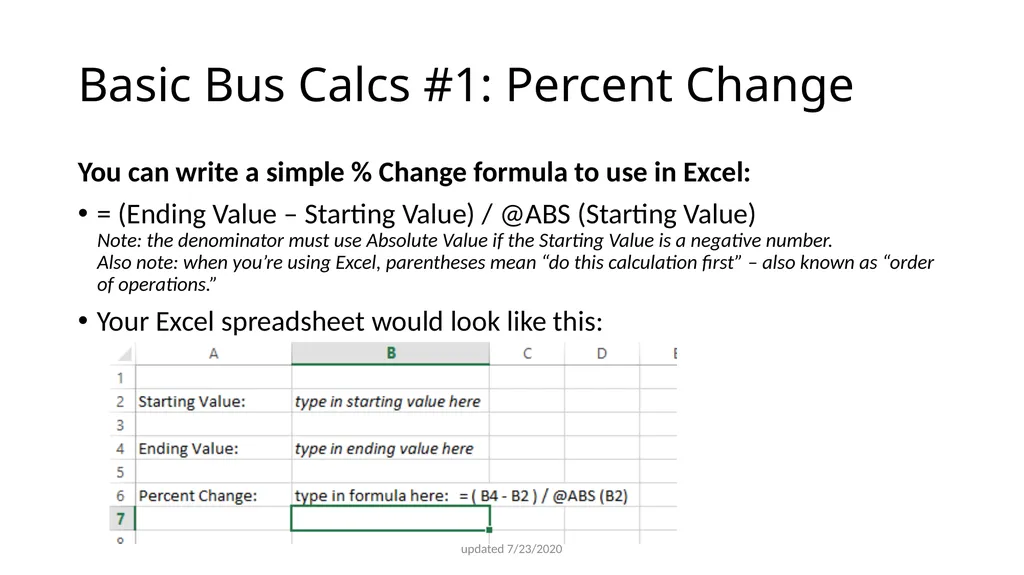
slide5. Basic Bus Calcs #1: Percent Change You can write a simple % Change formula to use in Excel:
= (Ending Value – Starting Value) / @ABS (Starting Value) Note: the denominator must use Absolute Value if the Starting Value is a negative number. Also note: when you’re using Excel, parentheses mean “do this calculation first” – also known as “order of operations.”
Your Excel spreadsheet would look like this: updated 7/23/2020<br>
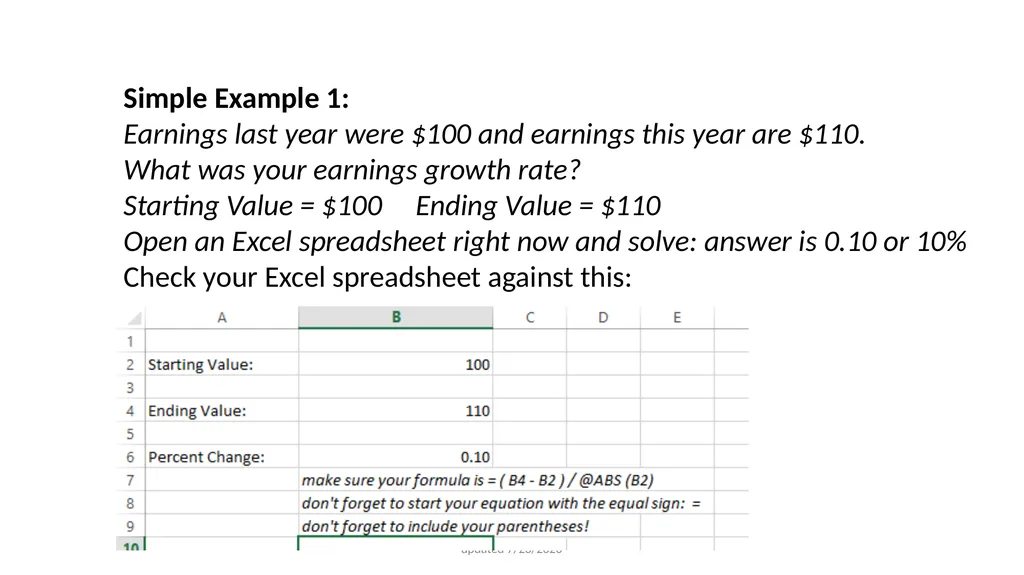
slide6. Simple Example 1:
Earnings last year were $100 and earnings this year are $110. What was your earnings growth rate?
Starting Value = $100 Ending Value = $110
Open an Excel spreadsheet right now and solve: answer is 0.10 or 10% Check your Excel spreadsheet against this: updated 7/23/2020<br>
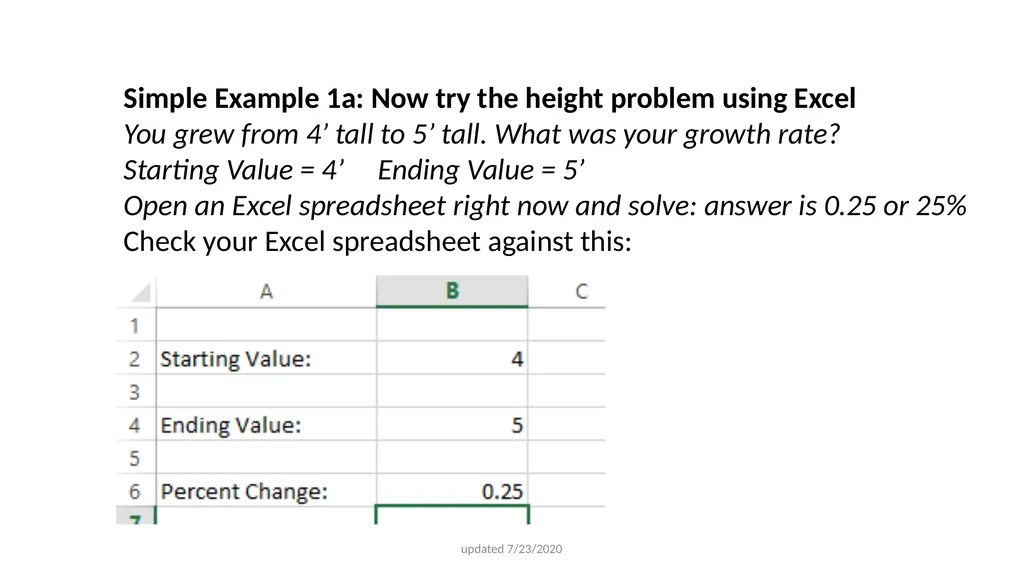
slide7. Simple Example 1a: Now try the height problem using Excel
You grew from 4’ tall to 5’ tall. What was your growth rate?
Starting Value = 4’ Ending Value = 5’
Open an Excel spreadsheet right now and solve: answer is 0.25 or 25% Check your Excel spreadsheet against this: updated 7/23/2020<br>
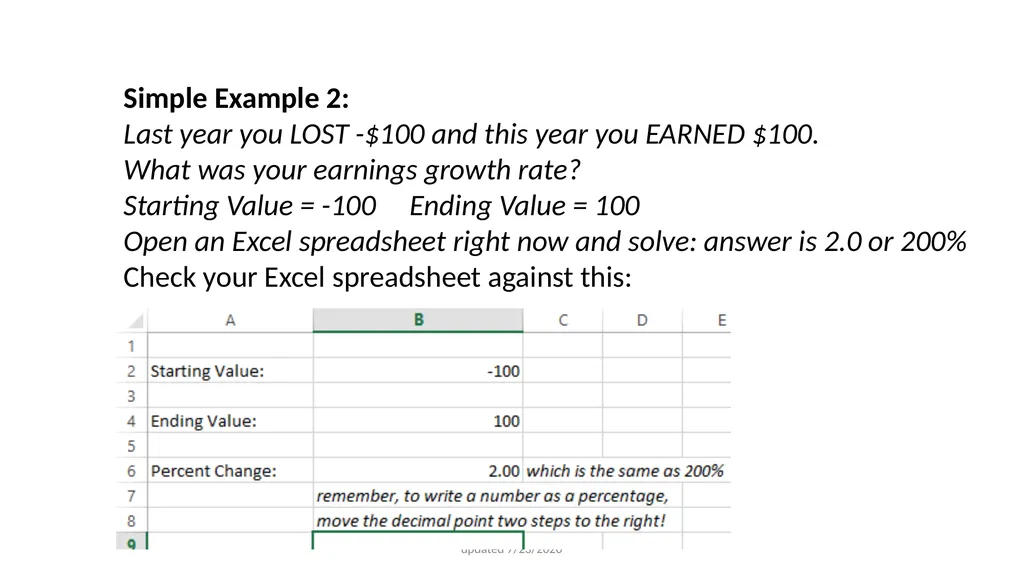
slide8. Simple Example 2:
Last year you LOST -$100 and this year you EARNED $100. What was your earnings growth rate?
Starting Value = -100 Ending Value = 100
Open an Excel spreadsheet right now and solve: answer is 2.0 or 200% Check your Excel spreadsheet against this: updated 7/23/2020<br>
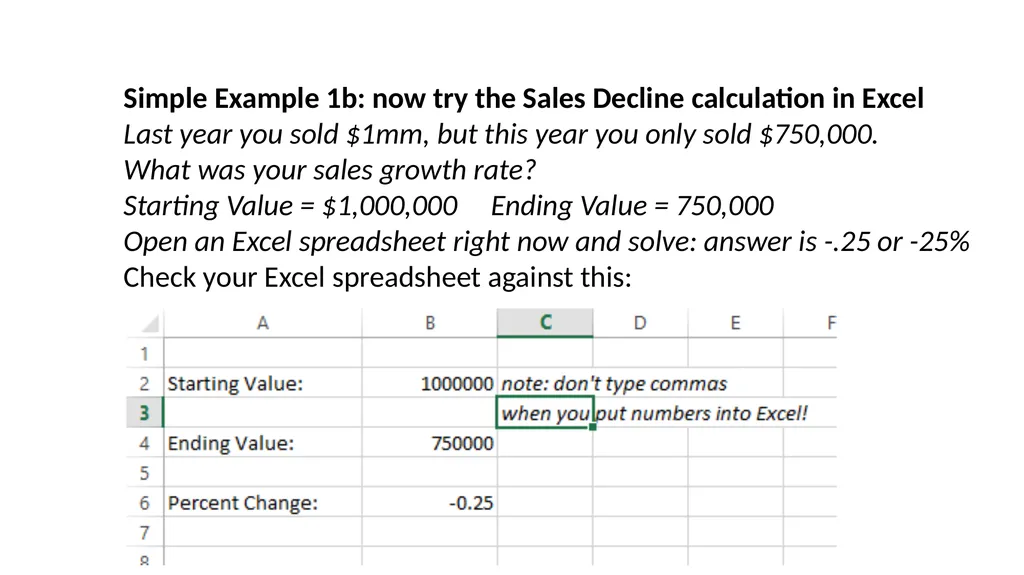
slide9. Simple Example 1b: now try the Sales Decline calculation in Excel
Last year you sold $1mm, but this year you only sold $750,000. What was your sales growth rate? Starting Value = $1,000,000 Ending Value = 750,000
Open an Excel spreadsheet right now and solve: answer is -.25 or -25% Check your Excel spreadsheet against this: updated 7/23/2020<br>
slide10. Basic Bus Calcs #1: applied Percent Change Concept: sometimes you know the growth rate, and want to find out how much your number will change if it grows or shrinks that fast.
Examples of ways to use…
If the price of a Big Mac increases 20%, what will the new price be?
If you have a 30% off coupon, how much will your new shoes cost?
Think of some of your own “applied percent change” questions. Write down at least three questions. updated 7/23/2020<br>
slide11. Basic Bus Calcs #1: applied Percent Change Calculation approach:
First: what’s the amount you’re adding or taking away from the Starting value?
Then, add this amount to the Starting value and see what you End up with .
Examples of how the calculation works:
A Big Mac costs $5, but the price is increasing 20%. What will its new price be? You’re adding 20%, so $5 x .2 = $1 is being added to the price $5 + $1 = $6 will be the new price
You want shoes priced at $60 and have a 30% off coupon. What do you pay? You’re saving 30%, so $60 x 0.3 = $18 savings $60 - $18 = $42 price you pay updated 7/23/2020<br>
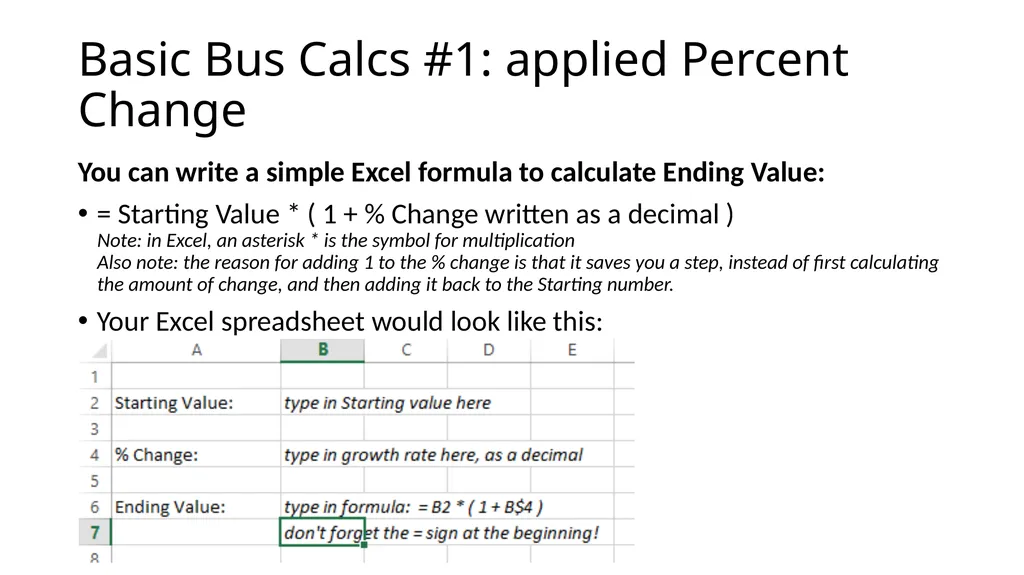
slide12. Basic Bus Calcs #1: applied Percent Change You can write a simple Excel formula to calculate Ending Value:
= Starting Value * ( 1 + % Change written as a decimal ) Note: in Excel, an asterisk * is the symbol for multiplication Also note: the reason for adding 1 to the % change is that it saves you a step, instead of first calculating the amount of change, and then adding it back to the Starting number.
Your Excel spreadsheet would look like this: updated 7/23/2020<br>
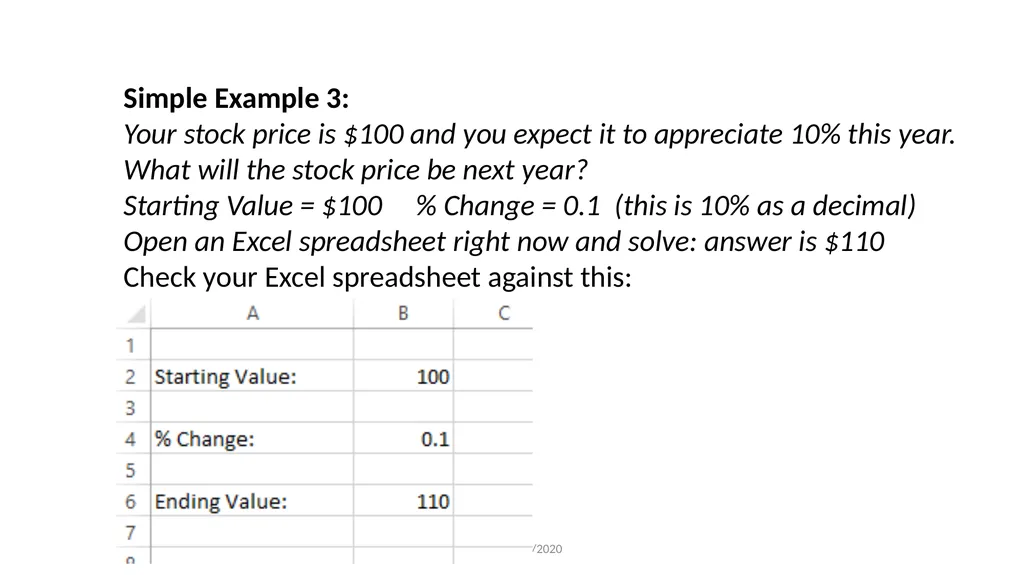
slide13. Simple Example 3:
Your stock price is $100 and you expect it to appreciate 10% this year. What will the stock price be next year?
Starting Value = $100 % Change = 0.1 (this is 10% as a decimal)
Open an Excel spreadsheet right now and solve: answer is $110 Check your Excel spreadsheet against this: updated 7/23/2020<br>
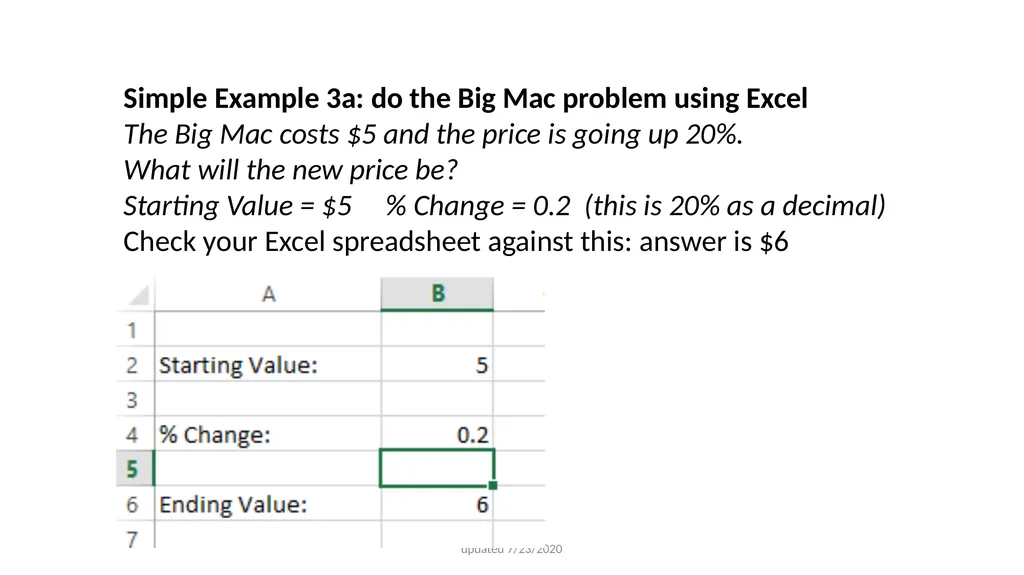
slide14. Simple Example 3a: do the Big Mac problem using Excel
The Big Mac costs $5 and the price is going up 20%. What will the new price be?
Starting Value = $5 % Change = 0.2 (this is 20% as a decimal) Check your Excel spreadsheet against this: answer is $6 updated 7/23/2020<br>
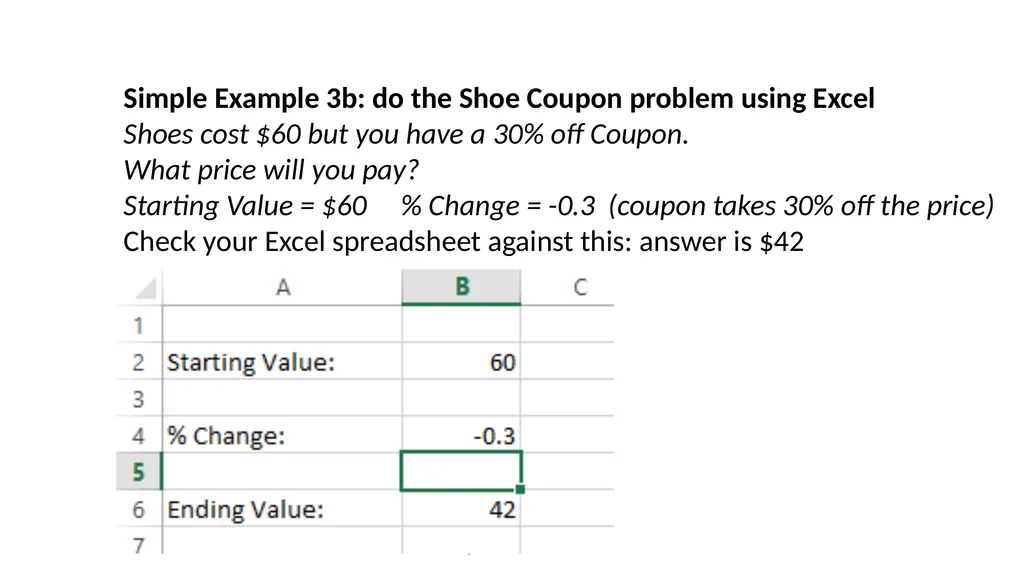
slide15. Simple Example 3b: do the Shoe Coupon problem using Excel
Shoes cost $60 but you have a 30% off Coupon. What price will you pay?
Starting Value = $60 % Change = -0.3 (coupon takes 30% off the price) Check your Excel spreadsheet against this: answer is $42 updated 7/23/2020<br>
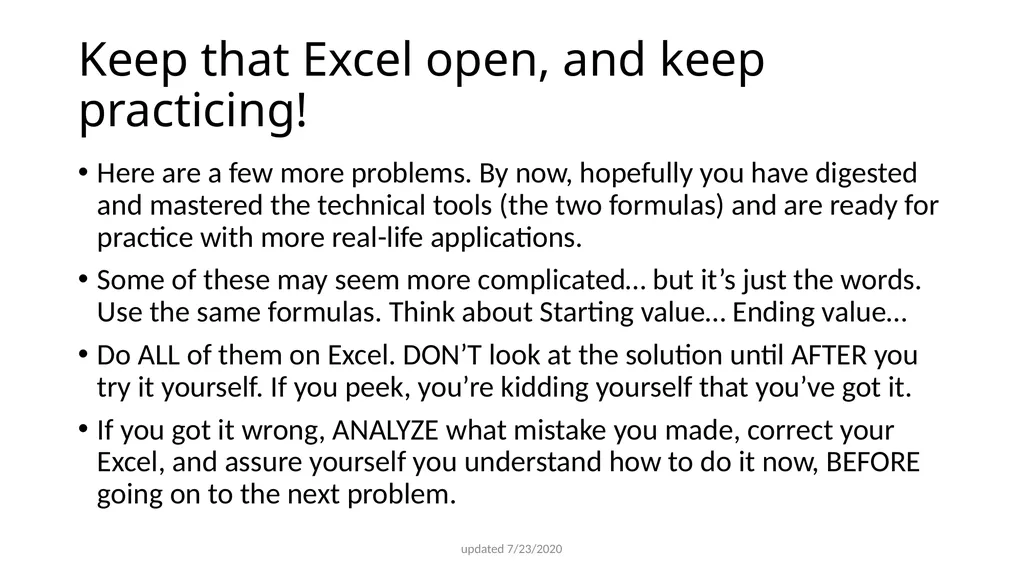
slide16. Keep that Excel open, and keep practicing! Here are a few more problems. By now, hopefully you have digested and mastered the technical tools (the two formulas) and are ready for practice with more real-life applications.
Some of these may seem more complicated… but it’s just the words. Use the same formulas. Think about Starting value… Ending value…
Do ALL of them on Excel. DON’T look at the solution until AFTER you try it yourself. If you peek, you’re kidding yourself that you’ve got it.
If you got it wrong, ANALYZE what mistake you made, correct your Excel, and assure yourself you understand how to do it now, BEFORE going on to the next problem. updated 7/23/2020<br>
slide17. By what % would SJSU need to increase enrollment to break even?
Assume: SJSU has 30,000 students who each pay $15,000/year.
SJSU needs $600mm in student fees to break even. First calculate: Starting total fees = ? Ending total fees = ? Then use your % change formula in Excel to calculate answer.
After you finish your work, check it on the next page. updated 7/23/2020<br>
slide18. By what % would SJSU need to increase enrollment to break even?
Assume: SJSU has 30,000 students who each pay $15,000/year.
SJSU needs $600mm in student fees to break even. Starting total fees = $450mm Ending total fees = $600mm Answer = 33% updated 7/23/2020<br>
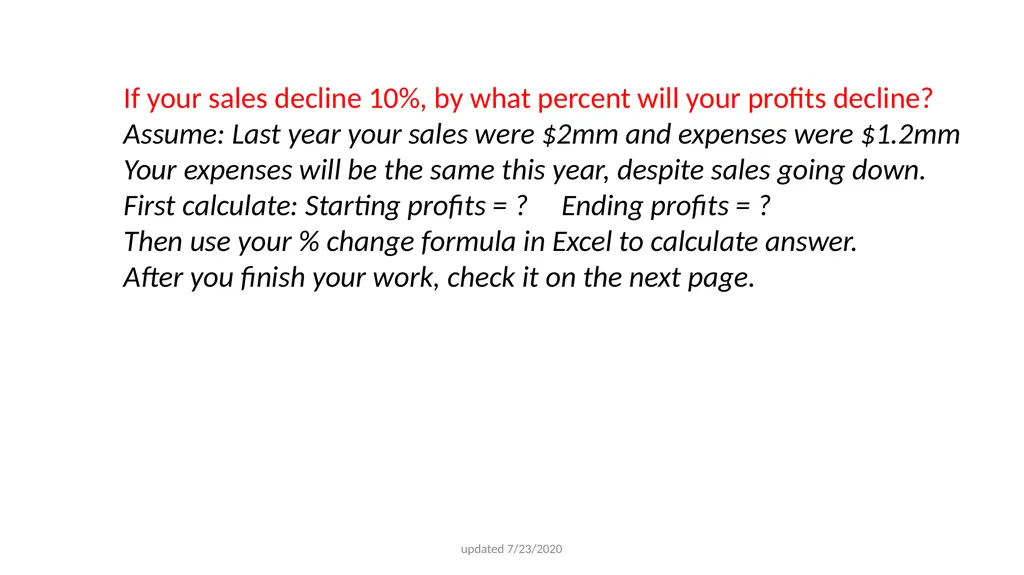
slide19. If your sales decline 10%, by what percent will your profits decline?
Assume: Last year your sales were $2mm and expenses were $1.2mm
Your expenses will be the same this year, despite sales going down. First calculate: Starting profits = ? Ending profits = ? Then use your % change formula in Excel to calculate answer.
After you finish your work, check it on the next page. updated 7/23/2020<br>
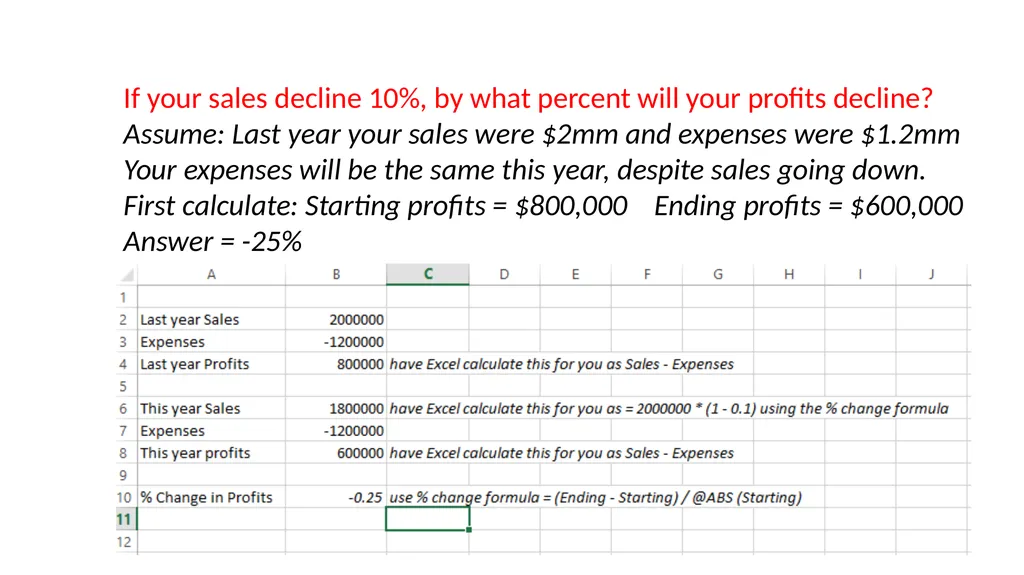
slide20. If your sales decline 10%, by what percent will your profits decline?
Assume: Last year your sales were $2mm and expenses were $1.2mm
Your expenses will be the same this year, despite sales going down. First calculate: Starting profits = $800,000 Ending profits = $600,000 Answer = -25% updated 7/23/2020<br>
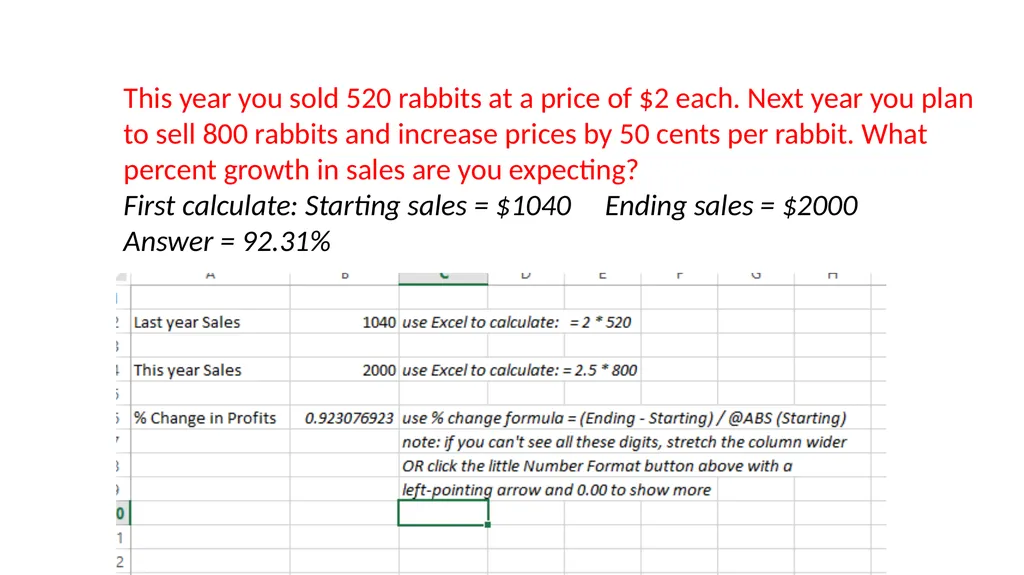
slide21. This year you sold 520 rabbits at a price of $2 each. Next year you plan to sell 800 rabbits and increase your price by 50 cents per rabbit. What percent growth in sales are you expecting? First calculate: Starting sales = ? Ending sales = ? Then use your % change formula in Excel to calculate answer.
After you finish your work, check it on the next page. updated 7/23/2020<br>
slide22. This year you sold 520 rabbits at a price of $2 each. Next year you plan to sell 800 rabbits and increase prices by 50 cents per rabbit. What percent growth in sales are you expecting? First calculate: Starting sales = $1040 Ending sales = $2000 Answer = 92.31% updated 7/23/2020<br>
slide23. Your company had 1,400 employees last year but this year has laid off 300. What percent were laid off? First calculate: Starting headcount = ? Ending headcount = ? Then use your % change formula in Excel to calculate answer.
After you finish your work, check it on the next page. updated 7/23/2020<br>
slide24. Your company had 1,400 employees last year but this year has laid off 300. What percent were laid off? First calculate: Starting headcount = 1400 Ending headcount = 1100 Answer = -21.43% updated 7/23/2020<br>
slide25. Last year your company had a net loss of -$400,000. This year you had a net profit of $600,000. By what percent did profits improve? First identify: Starting profit = ? Ending profit = ? Then use your % change formula in Excel to calculate answer.
After you finish your work, check it on the next page. updated 7/23/2020<br>
slide26. Last year your company had a net loss of -$400,000. This year you had a net profit of $600,000. By what percent did profits improve? First identify: Starting profit = -400,000 Ending profit = 600,000 Answer = 250% (make sure you used @ABS in denominator!) updated 7/23/2020<br>
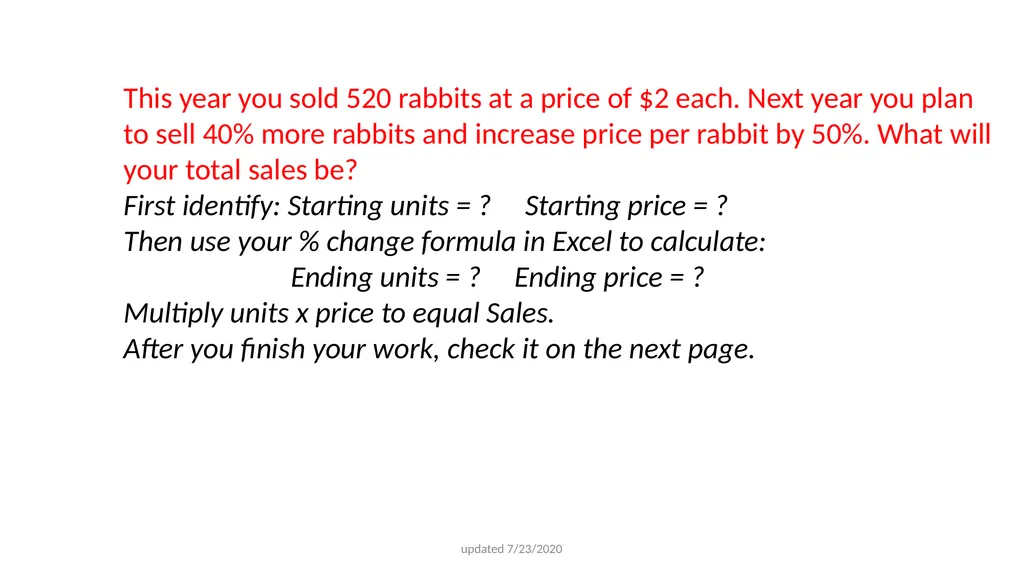
slide27. This year you sold 520 rabbits at a price of $2 each. Next year you plan to sell 40% more rabbits and increase price per rabbit by 50%. What will your total sales be? First identify: Starting units = ? Starting price = ?
Then use your % change formula in Excel to calculate:
Ending units = ? Ending price = ? Multiply units x price to equal Sales.
After you finish your work, check it on the next page. updated 7/23/2020<br>
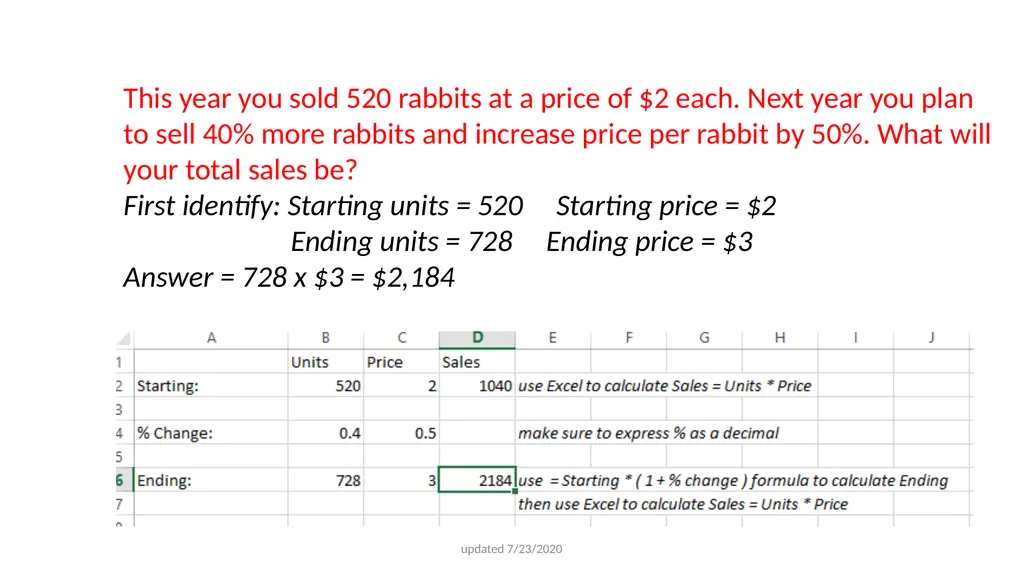
slide28. This year you sold 520 rabbits at a price of $2 each. Next year you plan to sell 40% more rabbits and increase price per rabbit by 50%. What will your total sales be? First identify: Starting units = 520 Starting price = $2
Ending units = 728 Ending price = $3 Answer = 728 x $3 = $2,184 updated 7/23/2020<br>
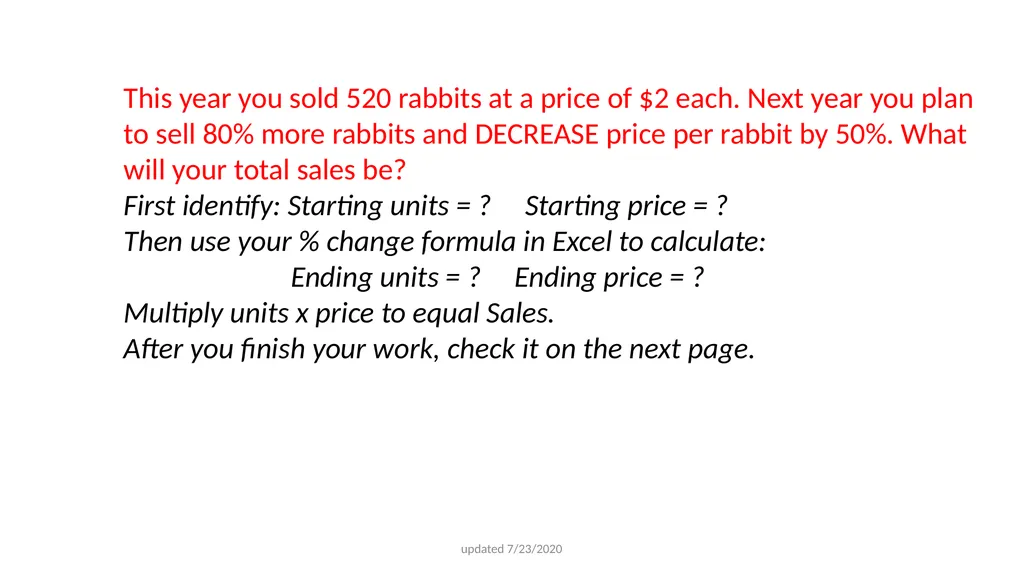
slide29. This year you sold 520 rabbits at a price of $2 each. Next year you plan to sell 80% more rabbits and DECREASE price per rabbit by 50%. What will your total sales be? First identify: Starting units = ? Starting price = ?
Then use your % change formula in Excel to calculate:
Ending units = ? Ending price = ? Multiply units x price to equal Sales.
After you finish your work, check it on the next page. updated 7/23/2020<br>
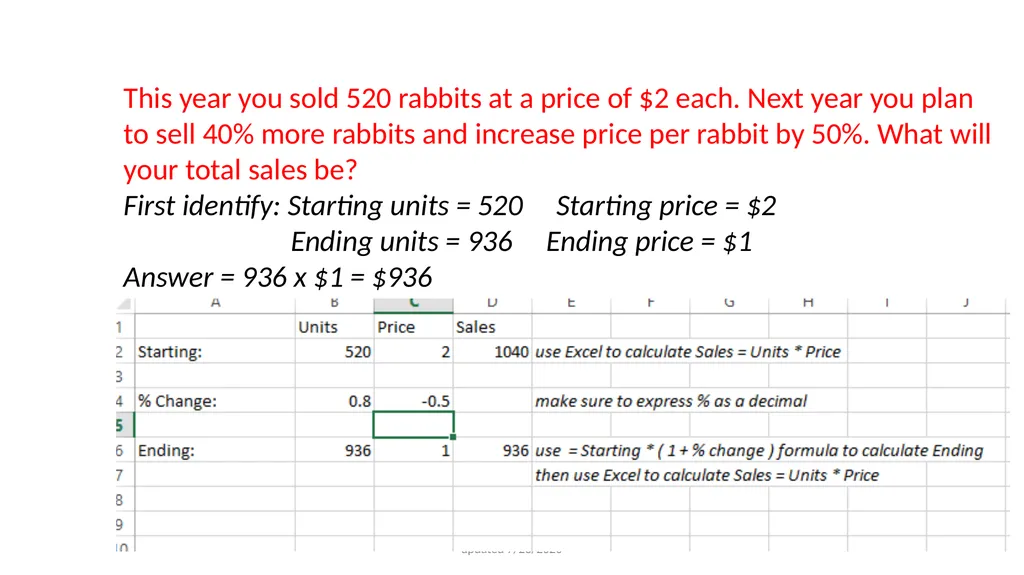
slide30. This year you sold 520 rabbits at a price of $2 each. Next year you plan to sell 40% more rabbits and increase price per rabbit by 50%. What will your total sales be? First identify: Starting units = 520 Starting price = $2
Ending units = 936 Ending price = $1 Answer = 936 x $1 = $936 updated 7/23/2020<br>
slide31. You own real estate worth $2mm and expect it to grow in value 20% per year for the next 2 years. What will it be worth in 2 years? First identify: Starting value = ? Growth rate = ?
Then use your % change formula in Excel to calculate Ending value? After you finish your work, check it on the next page. updated 7/23/2020<br>
slide32. You own real estate worth $2mm and expect it to grow in value 20% per year for the next 2 years. What will it be worth in 2 years? First identify: Starting value = $2mm Growth rate = 20%
2nd year Starting value = $2.4mm Growth rate = 20% Answer = $2.88mm updated 7/23/2020<br>
slide33. Your team has a goal to increase sales 35%. Currently you sell 10 cellphones per week at $80/phone. How many phones do you need to sell per week to meet your goal? First identify: Starting sales = ? Growth rate = ? Target sales = ?
Then divide Target Sales by price per phone to get # Units. After you finish your work, check it on the next page. updated 7/23/2020<br>
slide34. Your team has a goal to increase sales 35%. Currently you sell 10 cellphones per week at $80/phone. How many phones do you need to sell per week to meet your goal? Starting sales = $800 Growth rate = 35% Target sales = $1,080
Answer = $1,080 / $80 per phone = 13.5 phones updated 7/23/2020<br>
slide35. Your team has a goal to increase sales 35%. Currently you sell 10 cellphones per week at $80/phone. If you raise price by 25% per phone, how many phones do you need to sell per week to meet your goal? First identify: Starting sales = ? Growth rate = ? Target sales = ?
Then divide Target Sales by NEW price per phone to get # Units. After you finish your work, check it on the next page. updated 7/23/2020<br>
slide36. Your team has a goal to increase sales 35%. Currently you sell 10 cellphones per week at $80/phone. If you raise price by 25% per phone, how many phones do you need to sell per week to meet your goal? Starting sales = $800 Growth rate = 35% Target sales = $1,080
Answer = $1,080 / $100 per phone = 10.8 phones updated 7/23/2020<br>
slide37. Basic Bus Calcs #1: Percent Change Conclusion: go back to those questions you wrote down earlier…
How do you feel about knowing how to solve them now?
Give it a try.
When you’re feeling ready, take the Homework Check Quiz.
This is a timed quiz to see if you have absorbed the skills learned here, to the degree that would be necessary in a typical business situation.
You can take the quiz a second time if you’re not happy with your score, but make sure to analyze your errors before your 2nd try. updated 7/23/2020<br>
slide2. About “Basic Bus Calcs” “Basic Business Calculations” are calculations every business person should know how to do. It’s best if you can memorize them, because in business you’ll need to use them all the time; like knowing how to tell time from a clock, or knowing how to make change from a dollar bill, it’s possible to look up instructions each time, but it would be awkward and perceived as unprofessional.
Excel (or a Financial calculator) is required to solve these problems. A basic knowledge of Excel is a requirement for most business professionals, so take advantage of this course as an opportunity to practice your Excel skills.* Excel access will be available within the Lockdown Browser while you are taking quizzes and exams for this course. The professor for the COB’s Excel prerequisite courses has made his materials available to all students at these links:
Basic Excel Course (BUS 91L) http://bus91l.altervista.org/Index2.htm
Advanced Excel Course (BUS 91A) http://bus91l.altervista.org/Index3.htm
The website http://www.tvmcalcs.com/ is very helpful for Basic Business Calcs #3 and 5. Other recommended resources are Khan Academy’s Percent Change, Exponents and Time Value of Money tutorials and Exceljet.net’s Excel Training Videos.
* If you choose to use a calculator instead of Excel, you’ll need a Financial Calculator or a programmable calculator equipped with TVM programs; a Scientific or Statistical calculator won’t work. I recommend one of these two calculators: HP10bii (easiest to learn to use) HP 12c (recommended for students who intend to pursue a career in finance). Instruction will not be given in calculator use, you’re on your own if you choose not to use Excel. Networked (phone or other) calculators are not permitted during exams. updated 7/23/2020<br>
slide3. Basic Bus Calcs #1: Percent Change Concept: by what percentage did a number grow, or shrink?
Examples of ways to use…
By what percent did your height change between ages 6 and 16?
By what percent did a company’s 2020 sales decline from 2019?
Think of some of your own “percent change” questions. Write down at least three questions that you’d like to know the answer to. Take your time. This will help make the exercise real to you… updated 7/23/2020<br>
slide4. Basic Bus Calcs #1: Percent Change Calculation approach:
First: what is the total difference between the starting and ending value?
Then, what is this DIFFERENCE as a percentage of the starting value?
Examples of how the calculation works:
When you were 6 years old you were 4’ tall; at 16 years old you were 5’ tall. The difference is Ending value – Starting value = 5’– 4’ = 1’ Difference as a % of Starting value = 1’ / 4’ = 25% growth rate
Your sales were $1mm in 2019 but fell to $750,000 in 2020 due to COVID. The difference is Ending value – Starting value = $750,000 - $1mm = -$250,000 Difference as a % of Old value = -250,000 / $1mm = -25% rate of decline updated 7/23/2020<br>
slide5. Basic Bus Calcs #1: Percent Change You can write a simple % Change formula to use in Excel:
= (Ending Value – Starting Value) / @ABS (Starting Value) Note: the denominator must use Absolute Value if the Starting Value is a negative number. Also note: when you’re using Excel, parentheses mean “do this calculation first” – also known as “order of operations.”
Your Excel spreadsheet would look like this: updated 7/23/2020<br>
slide6. Simple Example 1:
Earnings last year were $100 and earnings this year are $110. What was your earnings growth rate?
Starting Value = $100 Ending Value = $110
Open an Excel spreadsheet right now and solve: answer is 0.10 or 10% Check your Excel spreadsheet against this: updated 7/23/2020<br>
slide7. Simple Example 1a: Now try the height problem using Excel
You grew from 4’ tall to 5’ tall. What was your growth rate?
Starting Value = 4’ Ending Value = 5’
Open an Excel spreadsheet right now and solve: answer is 0.25 or 25% Check your Excel spreadsheet against this: updated 7/23/2020<br>
slide8. Simple Example 2:
Last year you LOST -$100 and this year you EARNED $100. What was your earnings growth rate?
Starting Value = -100 Ending Value = 100
Open an Excel spreadsheet right now and solve: answer is 2.0 or 200% Check your Excel spreadsheet against this: updated 7/23/2020<br>
slide9. Simple Example 1b: now try the Sales Decline calculation in Excel
Last year you sold $1mm, but this year you only sold $750,000. What was your sales growth rate? Starting Value = $1,000,000 Ending Value = 750,000
Open an Excel spreadsheet right now and solve: answer is -.25 or -25% Check your Excel spreadsheet against this: updated 7/23/2020<br>
slide10. Basic Bus Calcs #1: applied Percent Change Concept: sometimes you know the growth rate, and want to find out how much your number will change if it grows or shrinks that fast.
Examples of ways to use…
If the price of a Big Mac increases 20%, what will the new price be?
If you have a 30% off coupon, how much will your new shoes cost?
Think of some of your own “applied percent change” questions. Write down at least three questions. updated 7/23/2020<br>
slide11. Basic Bus Calcs #1: applied Percent Change Calculation approach:
First: what’s the amount you’re adding or taking away from the Starting value?
Then, add this amount to the Starting value and see what you End up with .
Examples of how the calculation works:
A Big Mac costs $5, but the price is increasing 20%. What will its new price be? You’re adding 20%, so $5 x .2 = $1 is being added to the price $5 + $1 = $6 will be the new price
You want shoes priced at $60 and have a 30% off coupon. What do you pay? You’re saving 30%, so $60 x 0.3 = $18 savings $60 - $18 = $42 price you pay updated 7/23/2020<br>
slide12. Basic Bus Calcs #1: applied Percent Change You can write a simple Excel formula to calculate Ending Value:
= Starting Value * ( 1 + % Change written as a decimal ) Note: in Excel, an asterisk * is the symbol for multiplication Also note: the reason for adding 1 to the % change is that it saves you a step, instead of first calculating the amount of change, and then adding it back to the Starting number.
Your Excel spreadsheet would look like this: updated 7/23/2020<br>
slide13. Simple Example 3:
Your stock price is $100 and you expect it to appreciate 10% this year. What will the stock price be next year?
Starting Value = $100 % Change = 0.1 (this is 10% as a decimal)
Open an Excel spreadsheet right now and solve: answer is $110 Check your Excel spreadsheet against this: updated 7/23/2020<br>
slide14. Simple Example 3a: do the Big Mac problem using Excel
The Big Mac costs $5 and the price is going up 20%. What will the new price be?
Starting Value = $5 % Change = 0.2 (this is 20% as a decimal) Check your Excel spreadsheet against this: answer is $6 updated 7/23/2020<br>
slide15. Simple Example 3b: do the Shoe Coupon problem using Excel
Shoes cost $60 but you have a 30% off Coupon. What price will you pay?
Starting Value = $60 % Change = -0.3 (coupon takes 30% off the price) Check your Excel spreadsheet against this: answer is $42 updated 7/23/2020<br>
slide16. Keep that Excel open, and keep practicing! Here are a few more problems. By now, hopefully you have digested and mastered the technical tools (the two formulas) and are ready for practice with more real-life applications.
Some of these may seem more complicated… but it’s just the words. Use the same formulas. Think about Starting value… Ending value…
Do ALL of them on Excel. DON’T look at the solution until AFTER you try it yourself. If you peek, you’re kidding yourself that you’ve got it.
If you got it wrong, ANALYZE what mistake you made, correct your Excel, and assure yourself you understand how to do it now, BEFORE going on to the next problem. updated 7/23/2020<br>
slide17. By what % would SJSU need to increase enrollment to break even?
Assume: SJSU has 30,000 students who each pay $15,000/year.
SJSU needs $600mm in student fees to break even. First calculate: Starting total fees = ? Ending total fees = ? Then use your % change formula in Excel to calculate answer.
After you finish your work, check it on the next page. updated 7/23/2020<br>
slide18. By what % would SJSU need to increase enrollment to break even?
Assume: SJSU has 30,000 students who each pay $15,000/year.
SJSU needs $600mm in student fees to break even. Starting total fees = $450mm Ending total fees = $600mm Answer = 33% updated 7/23/2020<br>
slide19. If your sales decline 10%, by what percent will your profits decline?
Assume: Last year your sales were $2mm and expenses were $1.2mm
Your expenses will be the same this year, despite sales going down. First calculate: Starting profits = ? Ending profits = ? Then use your % change formula in Excel to calculate answer.
After you finish your work, check it on the next page. updated 7/23/2020<br>
slide20. If your sales decline 10%, by what percent will your profits decline?
Assume: Last year your sales were $2mm and expenses were $1.2mm
Your expenses will be the same this year, despite sales going down. First calculate: Starting profits = $800,000 Ending profits = $600,000 Answer = -25% updated 7/23/2020<br>
slide21. This year you sold 520 rabbits at a price of $2 each. Next year you plan to sell 800 rabbits and increase your price by 50 cents per rabbit. What percent growth in sales are you expecting? First calculate: Starting sales = ? Ending sales = ? Then use your % change formula in Excel to calculate answer.
After you finish your work, check it on the next page. updated 7/23/2020<br>
slide22. This year you sold 520 rabbits at a price of $2 each. Next year you plan to sell 800 rabbits and increase prices by 50 cents per rabbit. What percent growth in sales are you expecting? First calculate: Starting sales = $1040 Ending sales = $2000 Answer = 92.31% updated 7/23/2020<br>
slide23. Your company had 1,400 employees last year but this year has laid off 300. What percent were laid off? First calculate: Starting headcount = ? Ending headcount = ? Then use your % change formula in Excel to calculate answer.
After you finish your work, check it on the next page. updated 7/23/2020<br>
slide24. Your company had 1,400 employees last year but this year has laid off 300. What percent were laid off? First calculate: Starting headcount = 1400 Ending headcount = 1100 Answer = -21.43% updated 7/23/2020<br>
slide25. Last year your company had a net loss of -$400,000. This year you had a net profit of $600,000. By what percent did profits improve? First identify: Starting profit = ? Ending profit = ? Then use your % change formula in Excel to calculate answer.
After you finish your work, check it on the next page. updated 7/23/2020<br>
slide26. Last year your company had a net loss of -$400,000. This year you had a net profit of $600,000. By what percent did profits improve? First identify: Starting profit = -400,000 Ending profit = 600,000 Answer = 250% (make sure you used @ABS in denominator!) updated 7/23/2020<br>
slide27. This year you sold 520 rabbits at a price of $2 each. Next year you plan to sell 40% more rabbits and increase price per rabbit by 50%. What will your total sales be? First identify: Starting units = ? Starting price = ?
Then use your % change formula in Excel to calculate:
Ending units = ? Ending price = ? Multiply units x price to equal Sales.
After you finish your work, check it on the next page. updated 7/23/2020<br>
slide28. This year you sold 520 rabbits at a price of $2 each. Next year you plan to sell 40% more rabbits and increase price per rabbit by 50%. What will your total sales be? First identify: Starting units = 520 Starting price = $2
Ending units = 728 Ending price = $3 Answer = 728 x $3 = $2,184 updated 7/23/2020<br>
slide29. This year you sold 520 rabbits at a price of $2 each. Next year you plan to sell 80% more rabbits and DECREASE price per rabbit by 50%. What will your total sales be? First identify: Starting units = ? Starting price = ?
Then use your % change formula in Excel to calculate:
Ending units = ? Ending price = ? Multiply units x price to equal Sales.
After you finish your work, check it on the next page. updated 7/23/2020<br>
slide30. This year you sold 520 rabbits at a price of $2 each. Next year you plan to sell 40% more rabbits and increase price per rabbit by 50%. What will your total sales be? First identify: Starting units = 520 Starting price = $2
Ending units = 936 Ending price = $1 Answer = 936 x $1 = $936 updated 7/23/2020<br>
slide31. You own real estate worth $2mm and expect it to grow in value 20% per year for the next 2 years. What will it be worth in 2 years? First identify: Starting value = ? Growth rate = ?
Then use your % change formula in Excel to calculate Ending value? After you finish your work, check it on the next page. updated 7/23/2020<br>
slide32. You own real estate worth $2mm and expect it to grow in value 20% per year for the next 2 years. What will it be worth in 2 years? First identify: Starting value = $2mm Growth rate = 20%
2nd year Starting value = $2.4mm Growth rate = 20% Answer = $2.88mm updated 7/23/2020<br>
slide33. Your team has a goal to increase sales 35%. Currently you sell 10 cellphones per week at $80/phone. How many phones do you need to sell per week to meet your goal? First identify: Starting sales = ? Growth rate = ? Target sales = ?
Then divide Target Sales by price per phone to get # Units. After you finish your work, check it on the next page. updated 7/23/2020<br>
slide34. Your team has a goal to increase sales 35%. Currently you sell 10 cellphones per week at $80/phone. How many phones do you need to sell per week to meet your goal? Starting sales = $800 Growth rate = 35% Target sales = $1,080
Answer = $1,080 / $80 per phone = 13.5 phones updated 7/23/2020<br>
slide35. Your team has a goal to increase sales 35%. Currently you sell 10 cellphones per week at $80/phone. If you raise price by 25% per phone, how many phones do you need to sell per week to meet your goal? First identify: Starting sales = ? Growth rate = ? Target sales = ?
Then divide Target Sales by NEW price per phone to get # Units. After you finish your work, check it on the next page. updated 7/23/2020<br>
slide36. Your team has a goal to increase sales 35%. Currently you sell 10 cellphones per week at $80/phone. If you raise price by 25% per phone, how many phones do you need to sell per week to meet your goal? Starting sales = $800 Growth rate = 35% Target sales = $1,080
Answer = $1,080 / $100 per phone = 10.8 phones updated 7/23/2020<br>
slide37. Basic Bus Calcs #1: Percent Change Conclusion: go back to those questions you wrote down earlier…
How do you feel about knowing how to solve them now?
Give it a try.
When you’re feeling ready, take the Homework Check Quiz.
This is a timed quiz to see if you have absorbed the skills learned here, to the degree that would be necessary in a typical business situation.
You can take the quiz a second time if you’re not happy with your score, but make sure to analyze your errors before your 2nd try. updated 7/23/2020<br>