Basic Cribbing Objectives Definition of terms used during cribbing Knowledge of how to properly build a box crib Cribbing used by MFFD Types of box cribs Weight rating of cribbing Equipment used with cribbing Additional resources
"Basic Cribbing Objectives Definition of terms used" is the property of its rightful owner. Permission is granted to
download and print the materials on this website for personal, non-commercial use only, and to display it
on your personal computer provided you do not modify the materials and that you retain all copyright
notices contained in the materials. By downloading content from our website, you accept the terms of this
agreement.
Presentation Transcript
01
Basic Cribbing<br>
02
Objectives Definition of terms used during cribbing
Knowledge of how to properly build a box crib
Cribbing used by MFFD
Types of box cribs
Weight rating of cribbing
Equipment used with cribbing
Additional resources<br>
03
Definitions Cribbing –
Specially cut and/or pre cut pieces of wood/polyethylene used to support raised objects, or bases to place tools that are working, and as blocks which chains and cables pass over while moving.
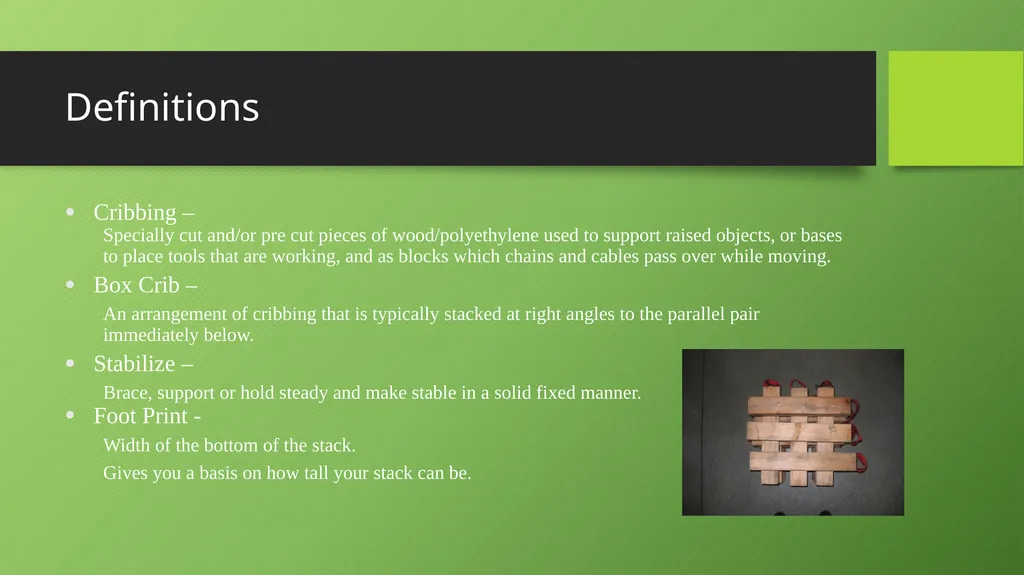
Box Crib –
An arrangement of cribbing that is typically stacked at right angles to the parallel pair immediately below.
Stabilize –
Brace, support or hold steady and make stable in a solid fixed manner.
Foot Print -
Width of the bottom of the stack.
Gives you a basis on how tall your stack can be.<br>
04
Definitions (cont.) Contact Point
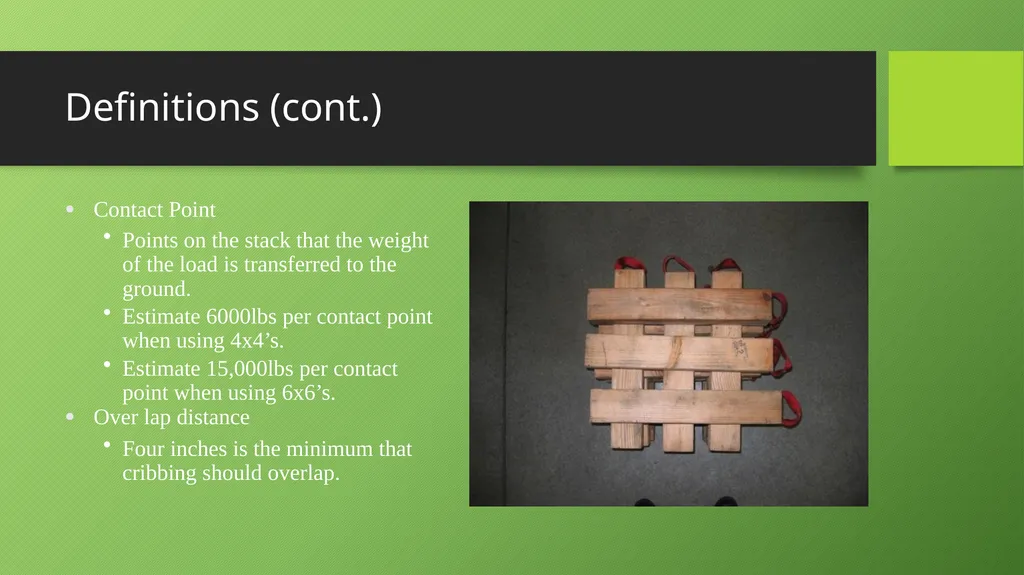
Points on the stack that the weight of the load is transferred to the ground.
Estimate 6000lbs per contact point when using 4x4’s.
Estimate 15,000lbs per contact point when using 6x6’s.
Over lap distance
Four inches is the minimum that cribbing should overlap.<br>
05
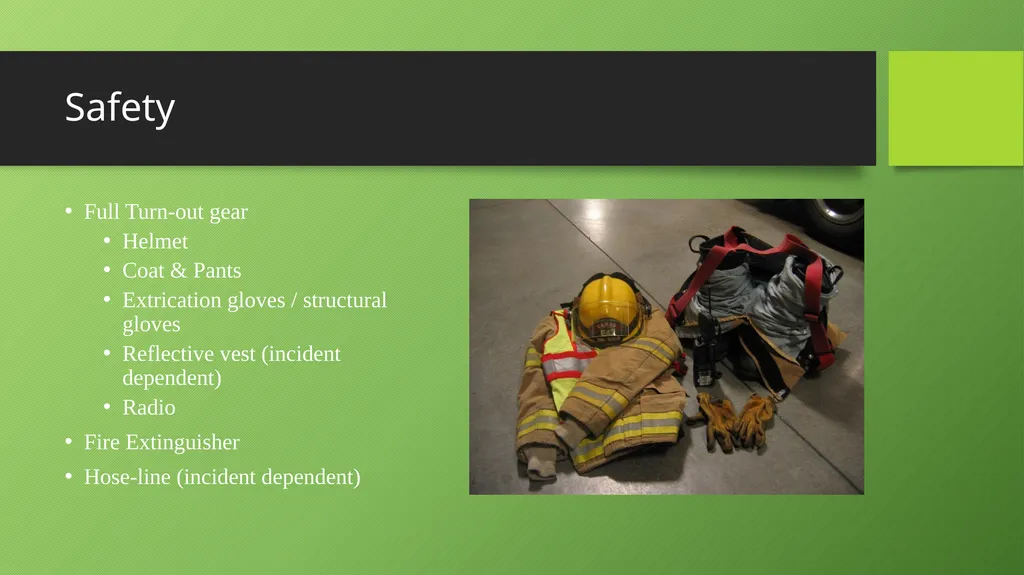
Safety Full Turn-out gear
Helmet
Coat & Pants
Extrication gloves / structural gloves
Reflective vest (incident dependent)
Radio
Fire Extinguisher
Hose-line (incident dependent)<br>
06
Things to think about Do I have enough cribbing or the right materials to get the job done safely and efficiently?
On larger more complex stabilization incidents consider assigning a safety officer to that specific operation.
Have a stabilization plan and make sure everyone is on the same page, Think “cause and effect”
When stabilization is complete do a walk around and make sure all your points where cribbing stacks are located are touching/supporting object being stabilized.<br>
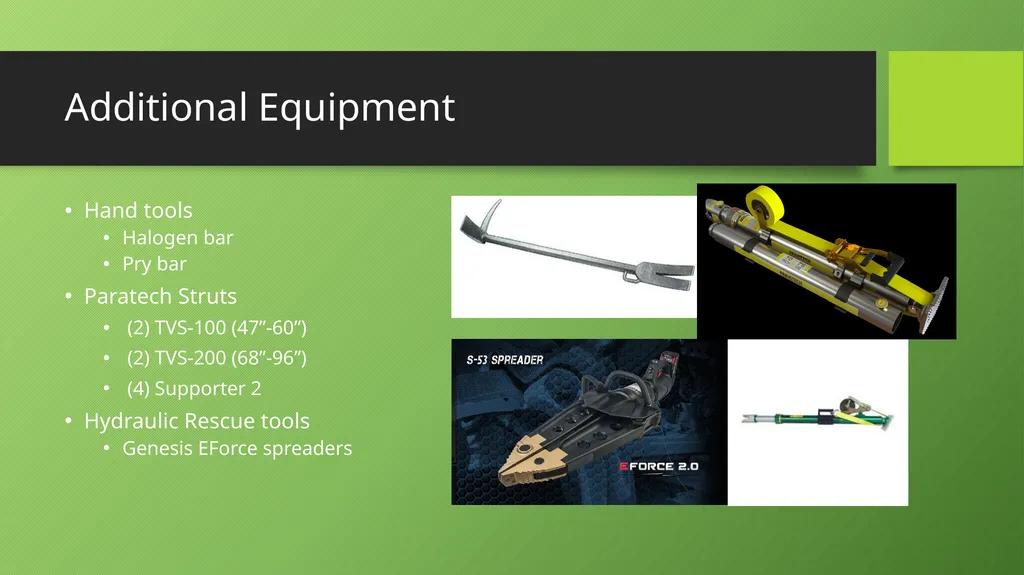
Additional Equipment Hand tools
Halogen bar
Pry bar
Paratech Struts
(2) TVS-100 (47”-60”)
(2) TVS-200 (68”-96”)
(4) Supporter 2
Hydraulic Rescue tools
Genesis EForce spreaders<br>
10
Box Crib Basics Do you know what kind of surface your working on? Concrete or paved roadway, swamp lands, grass, snow or ice covered, steep or shallow angle.
Have a solid foot print.
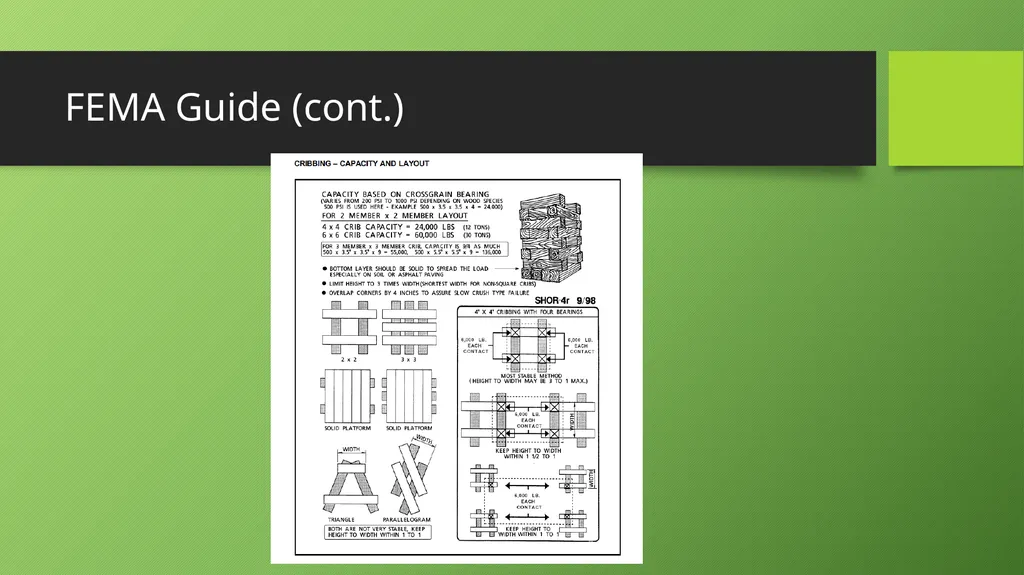
Ends of cribbing should over lap each other by 4” (minimum).
The higher number of contact points between two courses will increase the stacks strength.
Rule of thumb: Box crib stack should not exceed three times the foot print height. (example with a 12” foot print your stack should not exceed 36” high)
Stack is most efficient when weight is directed straight down the stack at all contact points.<br>
11
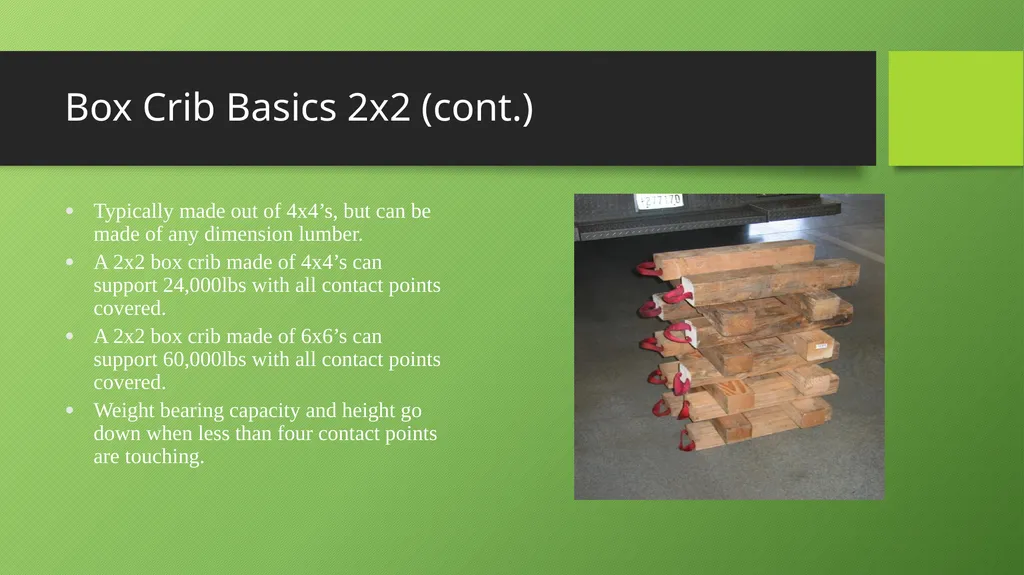
Box Crib Basics 2x2 (cont.) Typically made out of 4x4’s, but can be made of any dimension lumber.
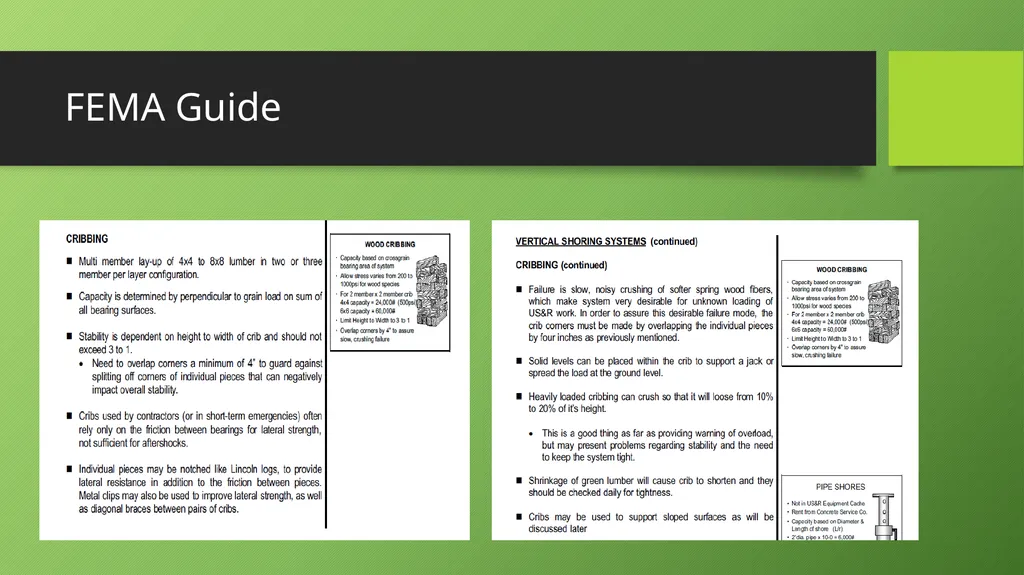
A 2x2 box crib made of 4x4’s can support 24,000lbs with all contact points covered.
A 2x2 box crib made of 6x6’s can support 60,000lbs with all contact points covered.
Weight bearing capacity and height go down when less than four contact points are touching.<br>
12
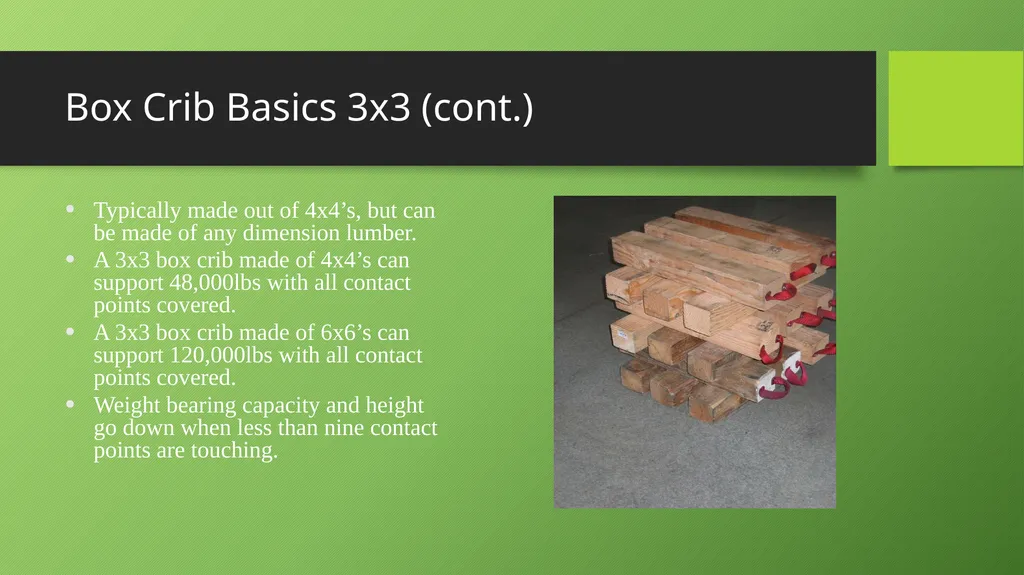
Box Crib Basics 3x3 (cont.) Typically made out of 4x4’s, but can be made of any dimension lumber.
A 3x3 box crib made of 4x4’s can support 48,000lbs with all contact points covered.
A 3x3 box crib made of 6x6’s can support 120,000lbs with all contact points covered.
Weight bearing capacity and height go down when less than nine contact points are touching.<br>
13
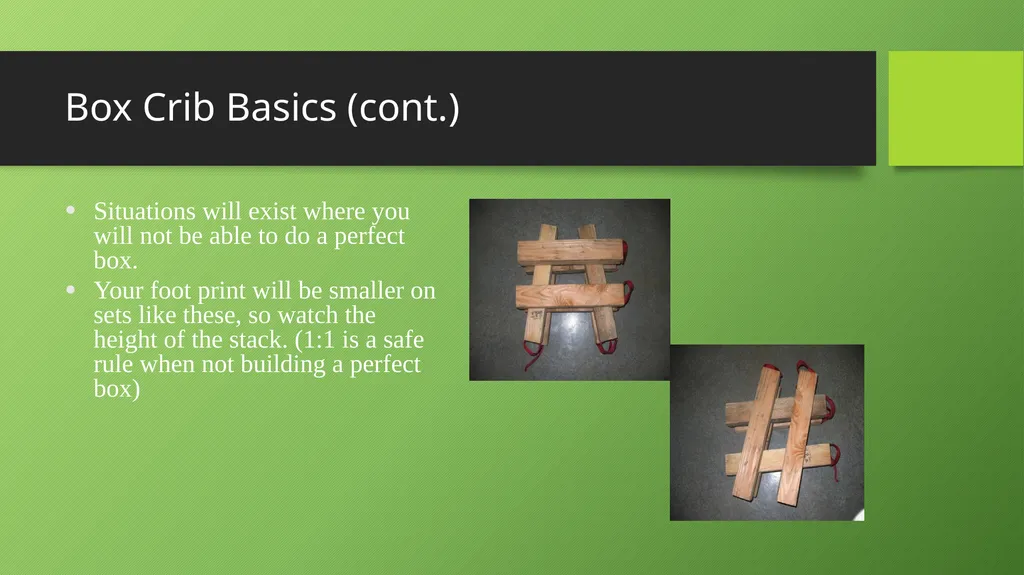
Box Crib Basics (cont.) Situations will exist where you will not be able to do a perfect box.
Your foot print will be smaller on sets like these, so watch the height of the stack. (1:1 is a safe rule when not building a perfect box)<br>
14
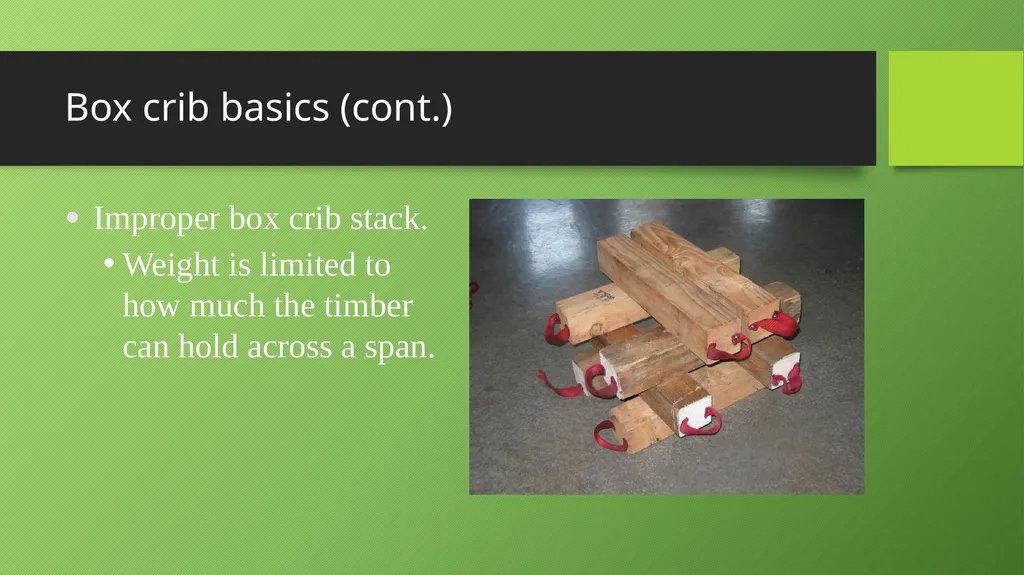
Box crib basics (cont.) Improper box crib stack.
Weight is limited to how much the timber can hold across a span.<br>
15
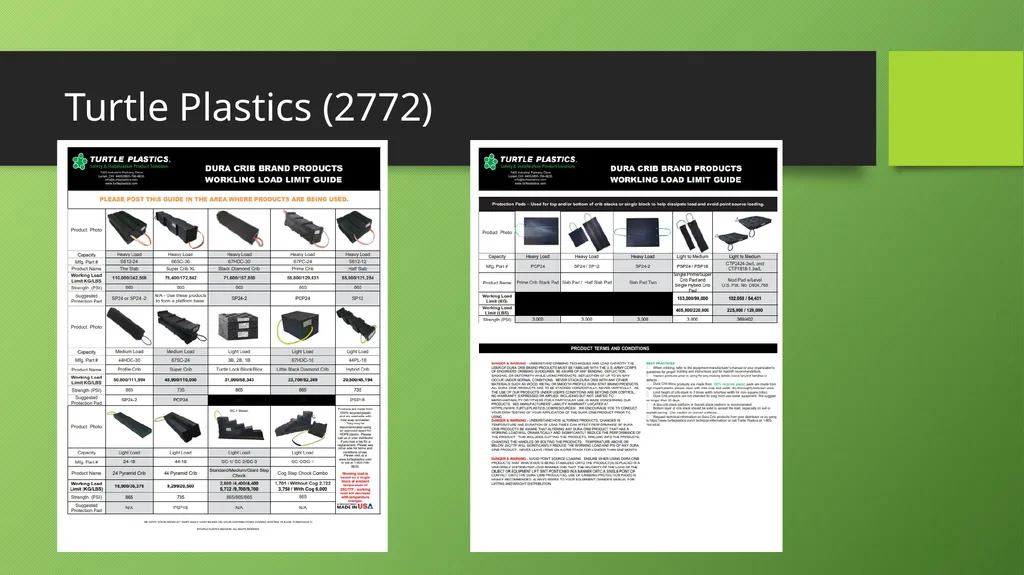
Turtle Plastics (2772)<br>
16
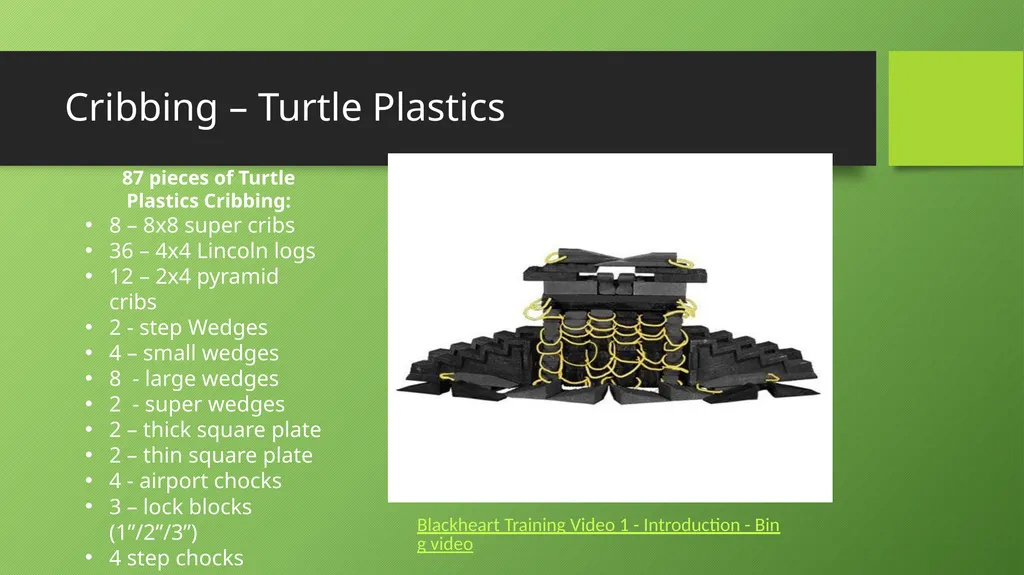
Cribbing – Turtle Plastics Blackheart Training Video 1 - Introduction - Bing video 87 pieces of Turtle Plastics Cribbing:
8 – 8x8 super cribs
36 – 4x4 Lincoln logs
12 – 2x4 pyramid cribs
2 - step Wedges
4 – small wedges
8 - large wedges
2 - super wedges
2 – thick square plate
2 – thin square plate
4 - airport chocks
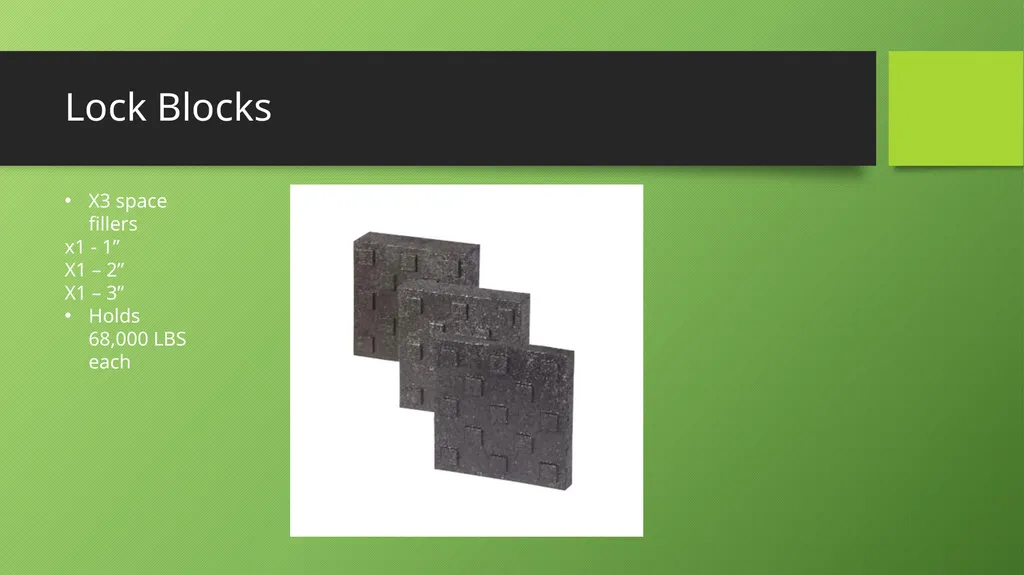
3 – lock blocks (1”/2”/3”)
4 step chocks<br>
17
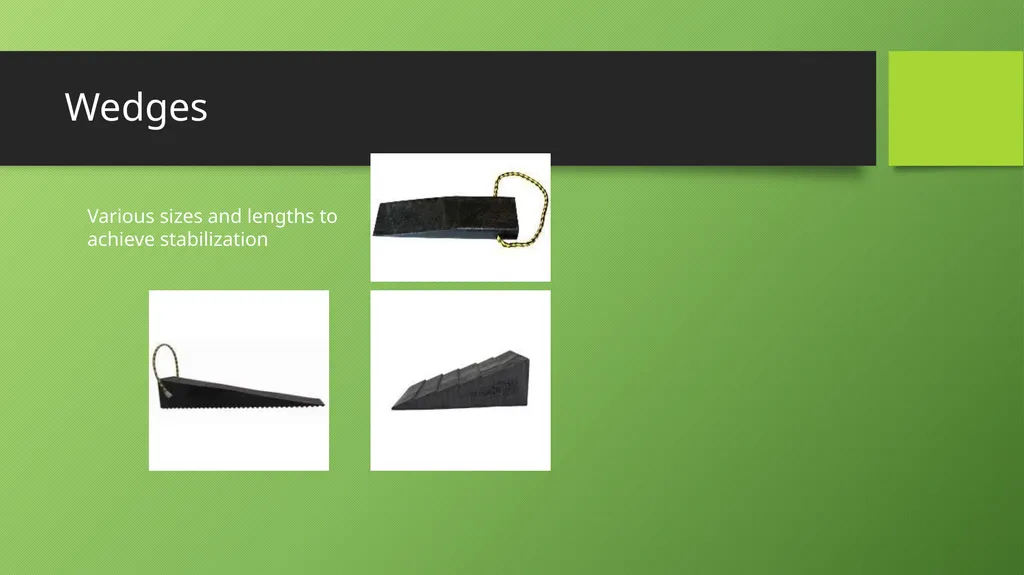
Wedges Various sizes and lengths to achieve stabilization<br>
18
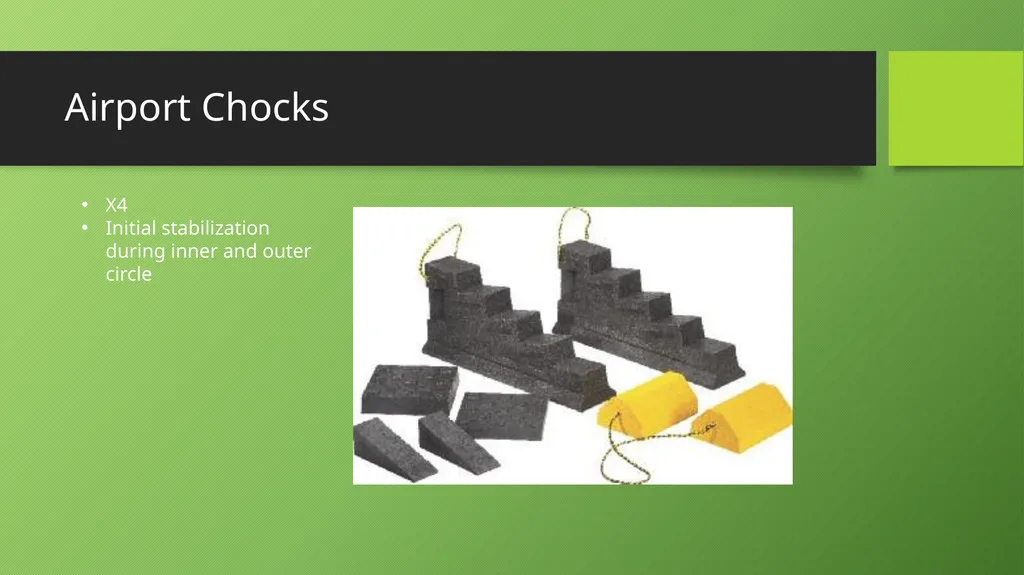
Airport Chocks X4
Initial stabilization during inner and outer circle<br>
19
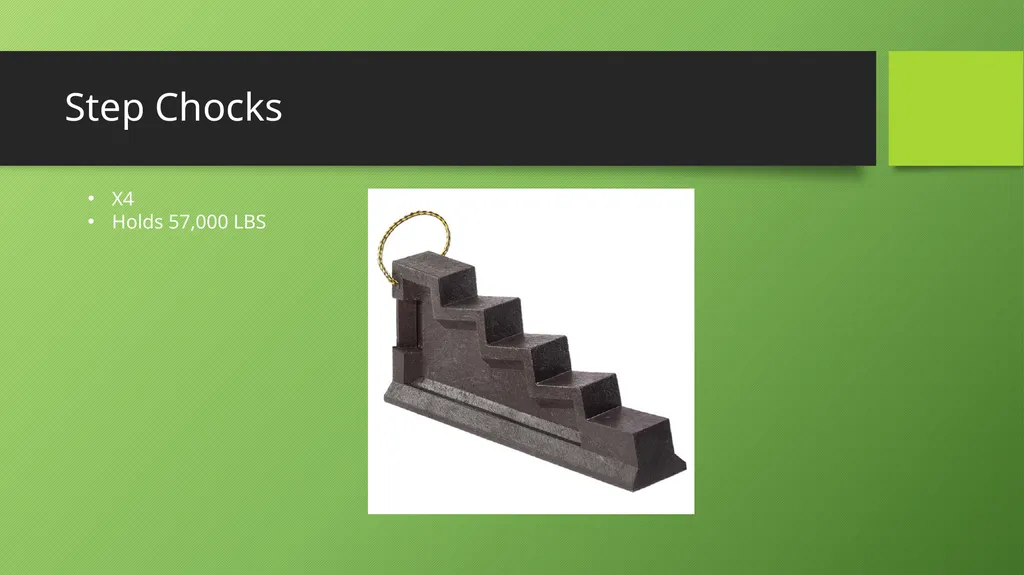
Step Chocks X4
Holds 57,000 LBS<br>
20
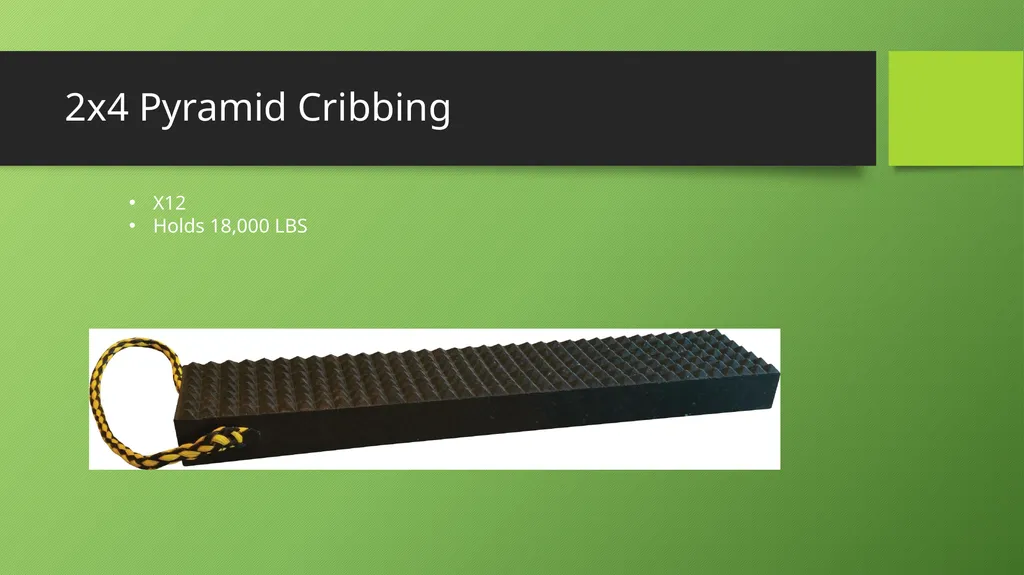
2x4 Pyramid Cribbing X12
Holds 18,000 LBS<br>
21
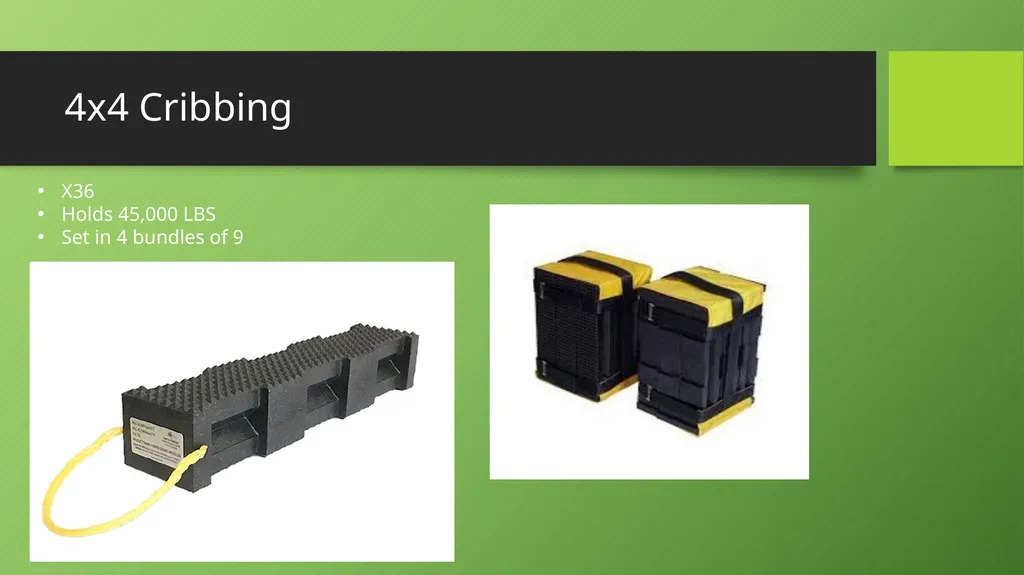
4x4 Cribbing X36
Holds 45,000 LBS
Set in 4 bundles of 9<br>
22
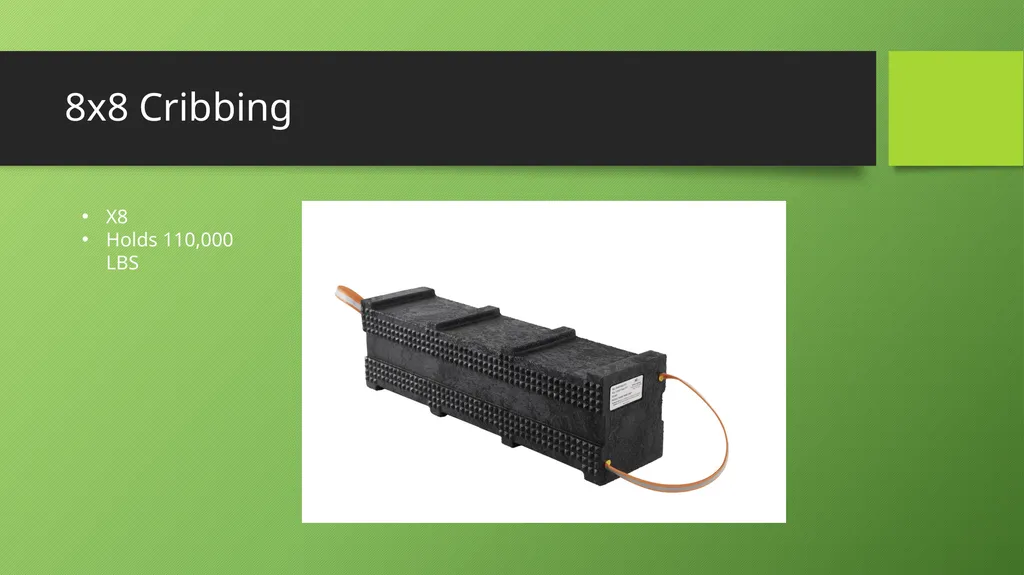
8x8 Cribbing X8
Holds 110,000 LBS<br>
23
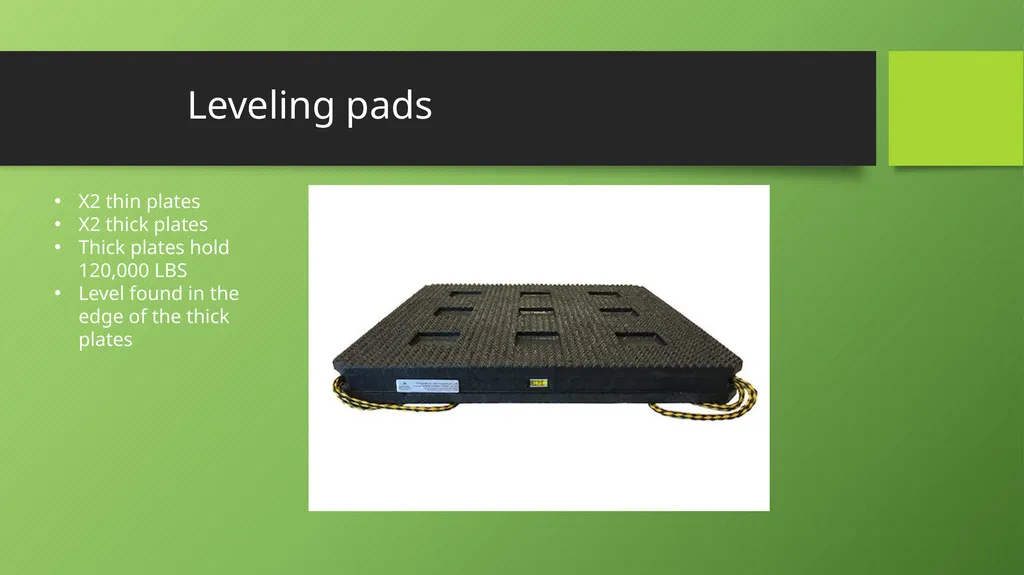
Leveling pads X2 thin plates
X2 thick plates
Thick plates hold 120,000 LBS
Level found in the edge of the thick plates<br>
Mutual aid Resources Milwaukee Fire Department
HURT Team
Heavy Urban Rescue team
One of the 2 Rescue Companies
Home Depot (Thunder Ridge Drive)<br>
26
Inspection & cleaning Check for cracks that may be forming.
Make sure webbing handles are intact.
Sweep or rinse clean.
May use a mild soap solution if needed.
Let dry before placing in cabinet.<br>
27
FEMA Guide<br>
28
FEMA Guide (cont.)<br>
29
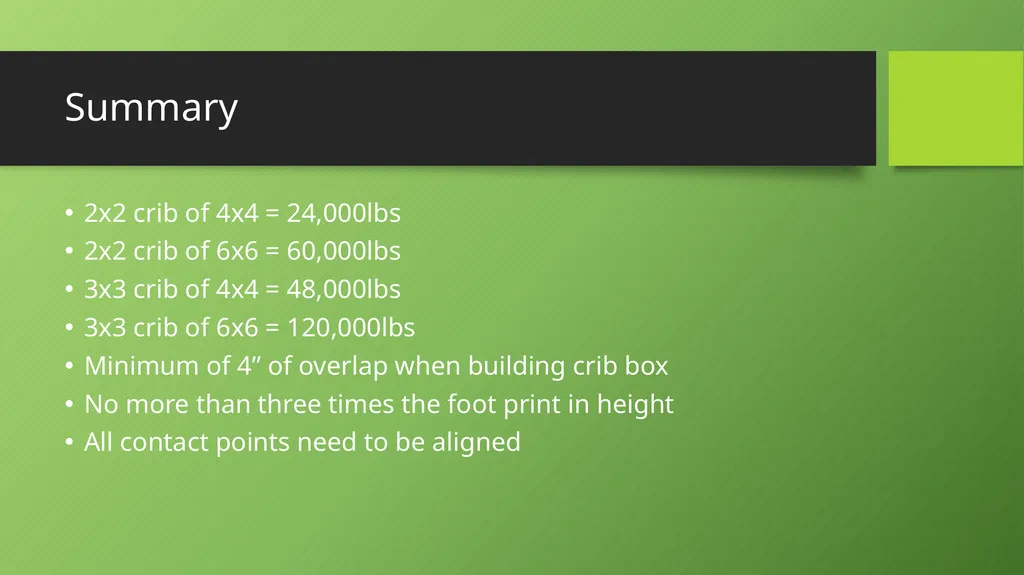
Summary 2x2 crib of 4x4 = 24,000lbs
2x2 crib of 6x6 = 60,000lbs
3x3 crib of 4x4 = 48,000lbs
3x3 crib of 6x6 = 120,000lbs
Minimum of 4” of overlap when building crib box
No more than three times the foot print in height
All contact points need to be aligned<br>