
Basic FBA to BSP Using Functional Behavioral
LO
Published · 72 slides · 0 views
1 / 1




Description
Basic FBA to BSP Using Functional Behavioral Assessment (FBA) to Develop Function-Based Behavior Support Plans (BSP) Adapted from Sheldon Loman and others Day One 1 Learning Objectives Day One: Understand the concepts of function and
Related Topics
Share
Embed code
Download this presentation From Below
"Basic FBA to BSP Using Functional Behavioral" is the property of its rightful owner. Permission is granted to download and print the materials on this website for personal, non-commercial use only, and to display it on your personal computer provided you do not modify the materials and that you retain all copyright notices contained in the materials. By downloading content from our website, you accept the terms of this agreement.
Presentation Transcript
01
Basic FBA to BSP Using Functional Behavioral Assessment (FBA) to Develop Function-Based Behavior Support Plans (BSP)
Adapted from Sheldon Loman and others
Day One 1<br>
Adapted from Sheldon Loman and others
Day One 1<br>
02
Learning Objectives Day One:
Understand the concepts of “function” and “functional behavioral assessment”
Consider how FBA/BSP fits within a multi-tiered system of supports
Learn the FBA process and practice with selected student
Day Two:
Develop a BSP for selected student
Plan for implementing FBA/BSP within your multi-tiered system 2<br>
Understand the concepts of “function” and “functional behavioral assessment”
Consider how FBA/BSP fits within a multi-tiered system of supports
Learn the FBA process and practice with selected student
Day Two:
Develop a BSP for selected student
Plan for implementing FBA/BSP within your multi-tiered system 2<br>
03
Materials
www.pbisvermont.org Introduction and Practice in Functional Behavior Assessment and Behavior Support Planning (FBA/BSP)
From FBA to BSP
Planning Workbook 3<br>
From FBA to BSP
Planning Workbook 3<br>
04
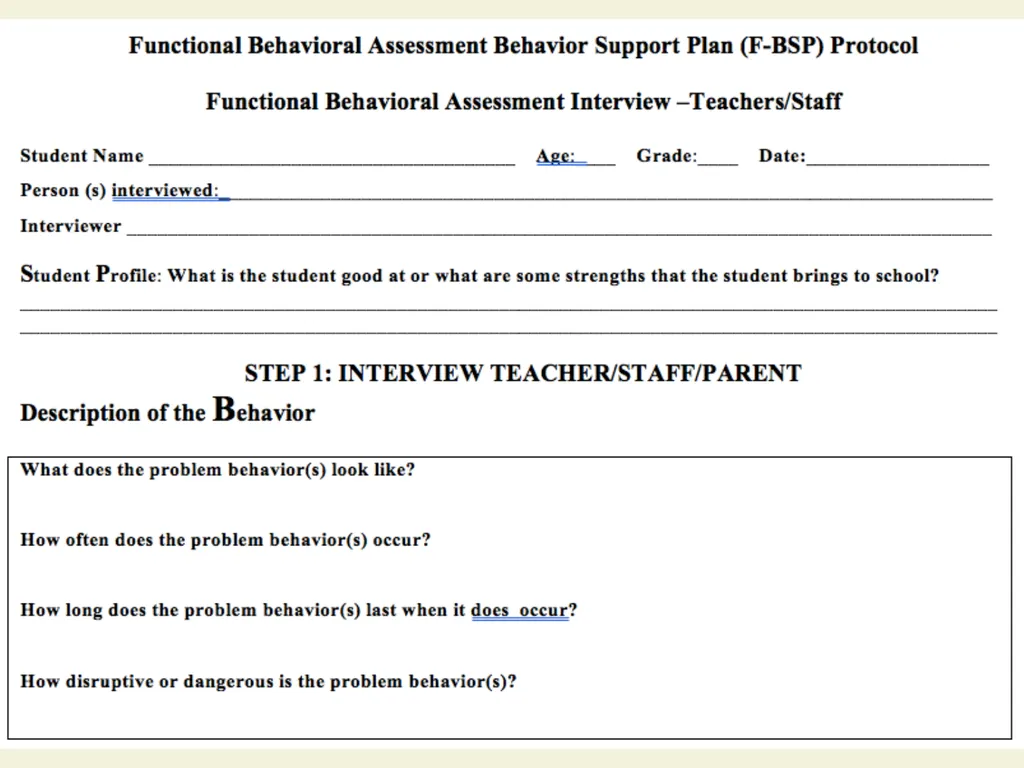
Materials Functional (Behavioral Assessment) Behavior Support Plan (F-BSP) Protocol
Interview tool for collecting information about problem behaviors
For staff, parents, and students
The F-BSP then leads the team to create a competing behavior pathway and behavior support plan 4<br>
Interview tool for collecting information about problem behaviors
For staff, parents, and students
The F-BSP then leads the team to create a competing behavior pathway and behavior support plan 4<br>
05
5<br>
06
http://www.youtube.com/watch?v=hkKOqij_Tdw What’s the function of this behavior? 6<br>
07
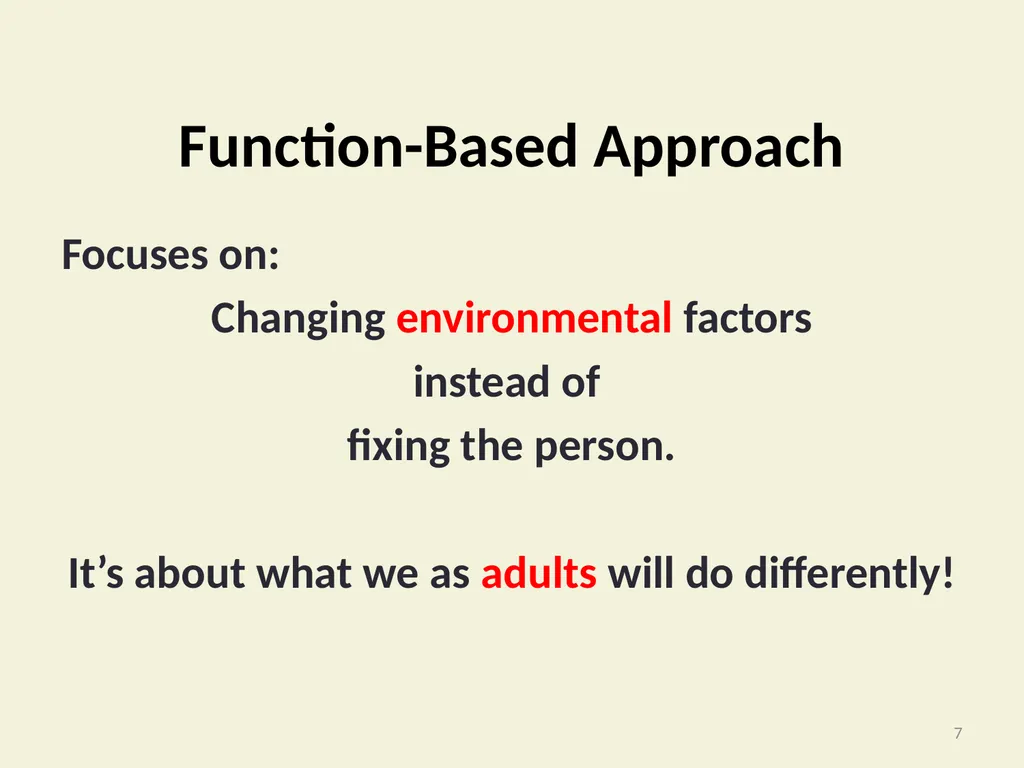
Function-Based Approach Focuses on:
Changing environmental factors
instead of
fixing the person.
It’s about what we as adults will do differently! 7<br>
Changing environmental factors
instead of
fixing the person.
It’s about what we as adults will do differently! 7<br>
08
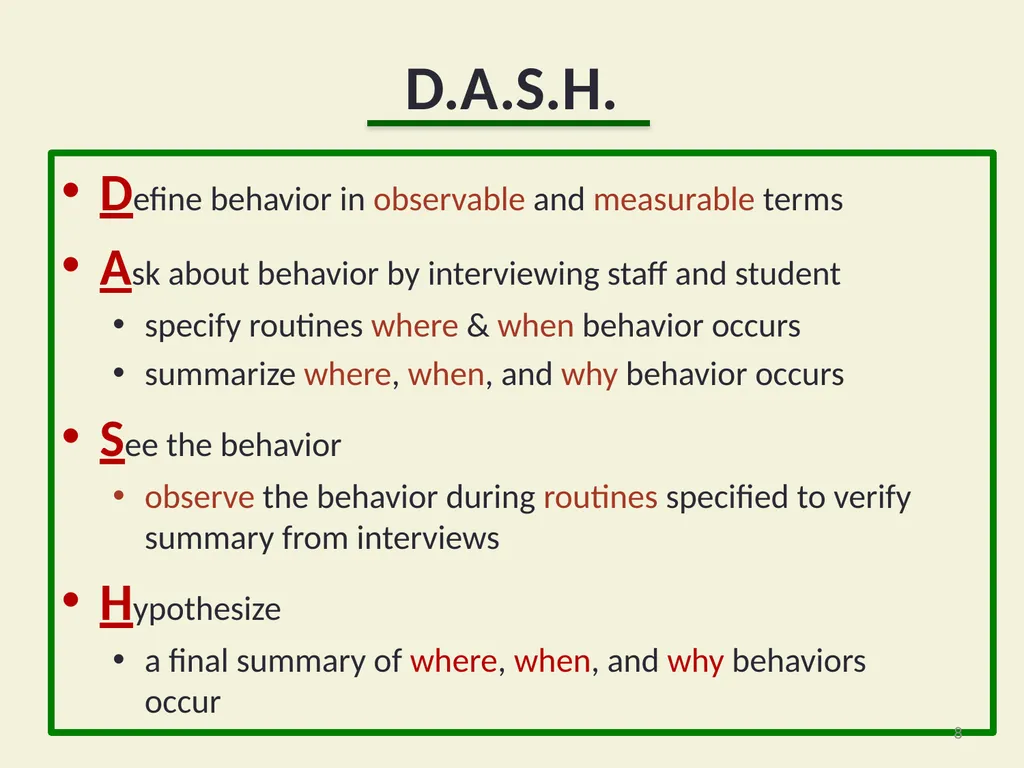
D.A.S.H. Define behavior in observable and measurable terms
Ask about behavior by interviewing staff and student
specify routines where & when behavior occurs
summarize where, when, and why behavior occurs
See the behavior
observe the behavior during routines specified to verify summary from interviews
Hypothesize
a final summary of where, when, and why behaviors occur 8<br>
Ask about behavior by interviewing staff and student
specify routines where & when behavior occurs
summarize where, when, and why behavior occurs
See the behavior
observe the behavior during routines specified to verify summary from interviews
Hypothesize
a final summary of where, when, and why behaviors occur 8<br>
09
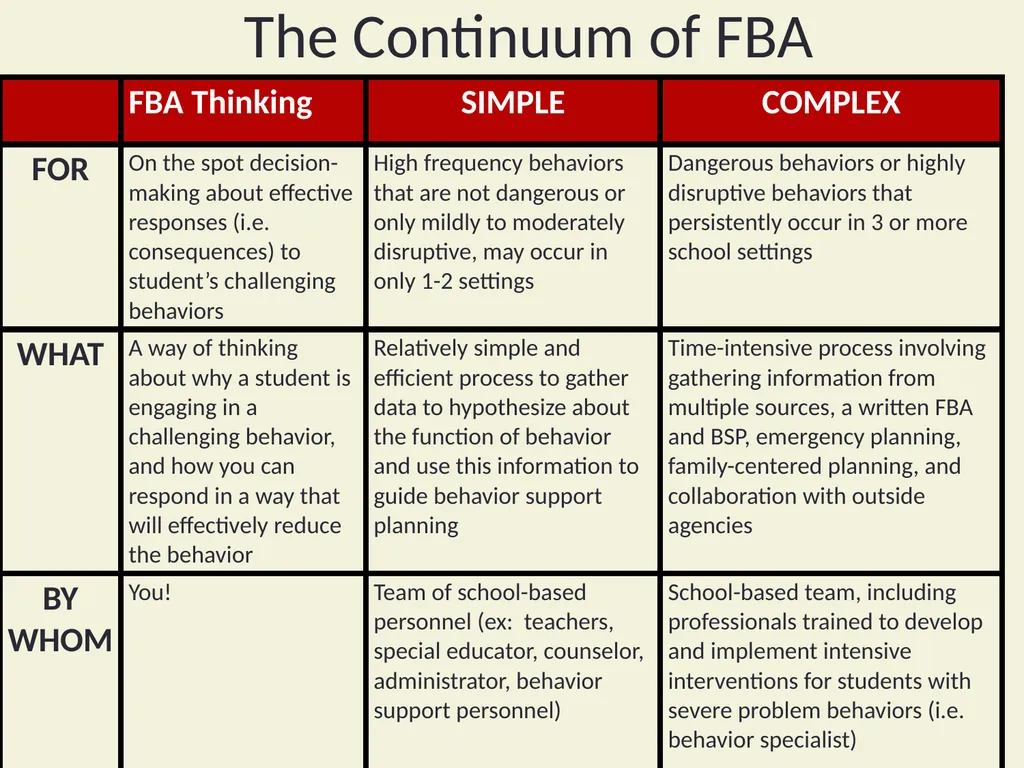
The Continuum of FBA<br>
10
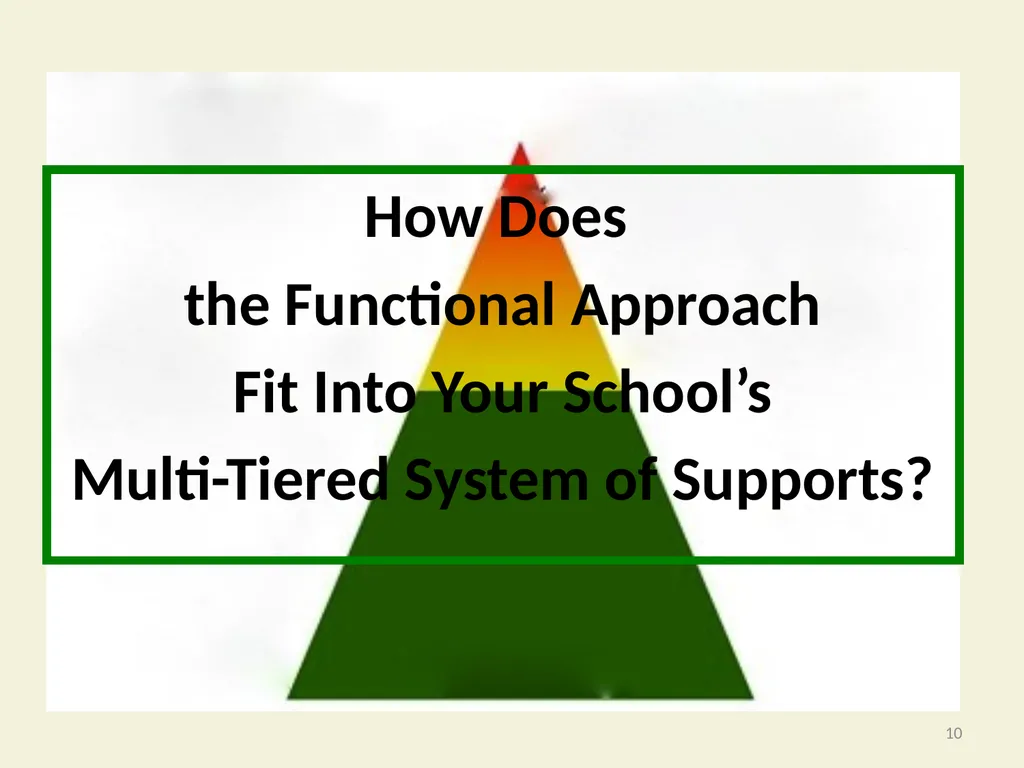
How Does
the Functional Approach
Fit Into Your School’s
Multi-Tiered System of Supports? 10<br>
the Functional Approach
Fit Into Your School’s
Multi-Tiered System of Supports? 10<br>
11
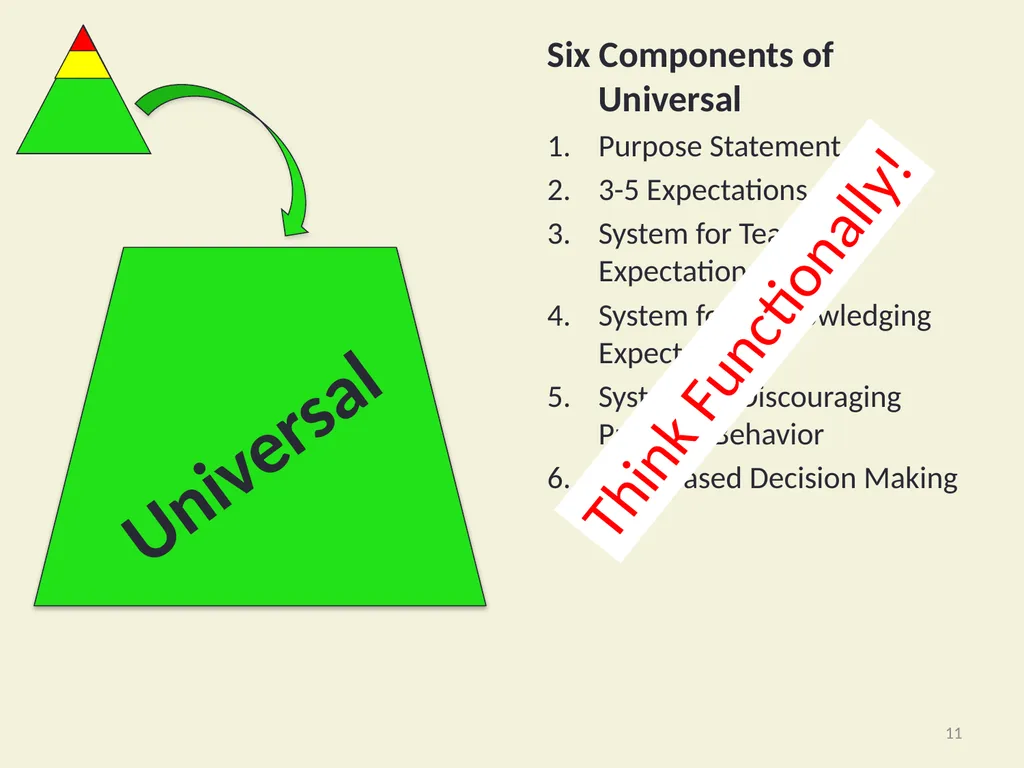
Universal Six Components of Universal
Purpose Statement
3-5 Expectations
System for Teaching Expectations
System for Acknowledging Expectations
System for Discouraging Problem Behavior
Data-based Decision Making Think Functionally! 11<br>
Purpose Statement
3-5 Expectations
System for Teaching Expectations
System for Acknowledging Expectations
System for Discouraging Problem Behavior
Data-based Decision Making Think Functionally! 11<br>
12
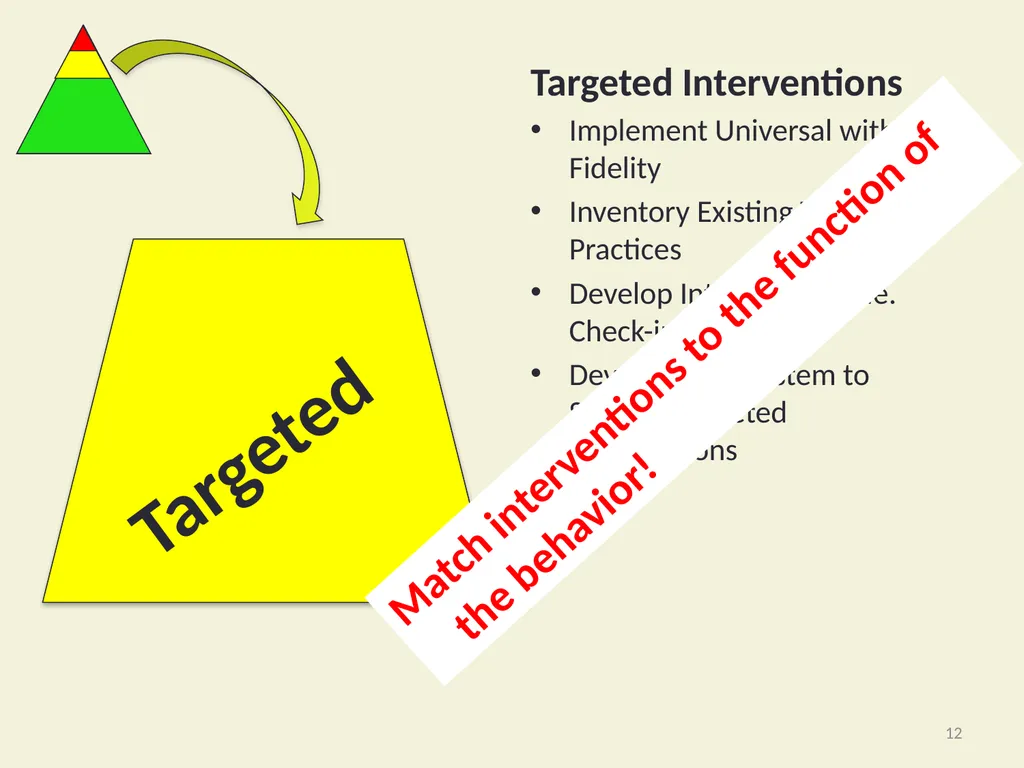
Targeted Interventions
Implement Universal with Fidelity
Inventory Existing Targeted Practices
Develop Intervention – ie. Check-in/Check-out
Develop Data System to Support Targeted Interventions Targeted Match interventions to the function of the behavior! 12<br>
Implement Universal with Fidelity
Inventory Existing Targeted Practices
Develop Intervention – ie. Check-in/Check-out
Develop Data System to Support Targeted Interventions Targeted Match interventions to the function of the behavior! 12<br>
13
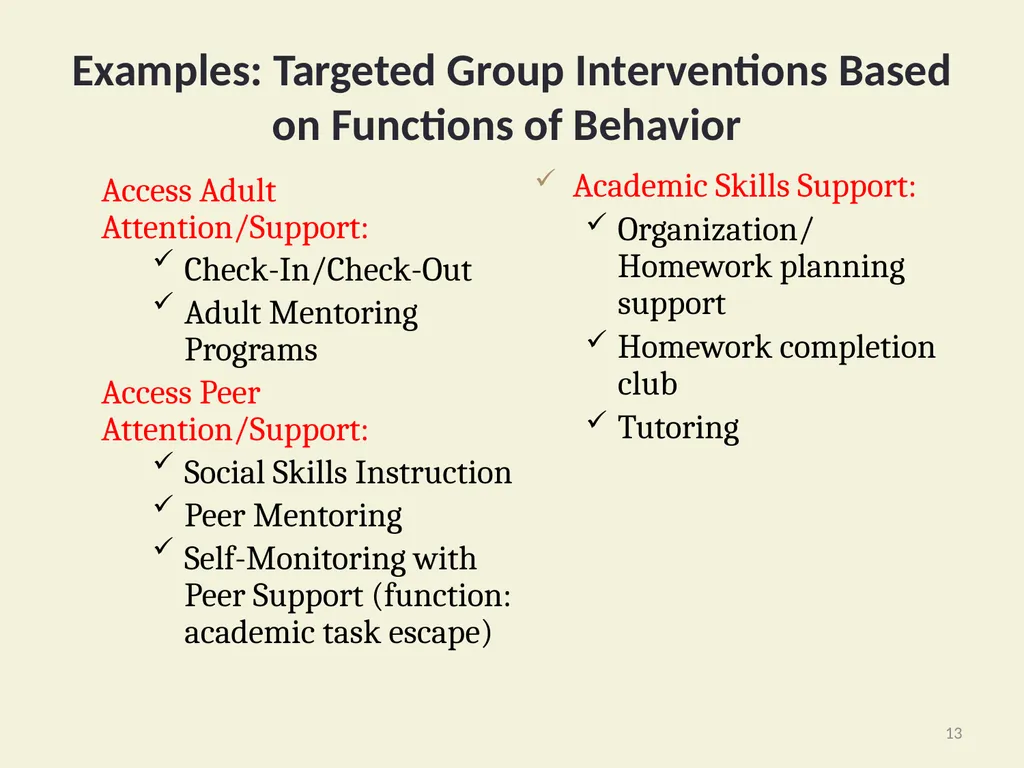
Examples: Targeted Group Interventions Based on Functions of Behavior Access Adult Attention/Support:
Check-In/Check-Out
Adult Mentoring Programs
Access Peer Attention/Support:
Social Skills Instruction
Peer Mentoring
Self-Monitoring with Peer Support (function: academic task escape) Academic Skills Support:
Organization/ Homework planning support
Homework completion club
Tutoring 13<br>
Check-In/Check-Out
Adult Mentoring Programs
Access Peer Attention/Support:
Social Skills Instruction
Peer Mentoring
Self-Monitoring with Peer Support (function: academic task escape) Academic Skills Support:
Organization/ Homework planning support
Homework completion club
Tutoring 13<br>
14
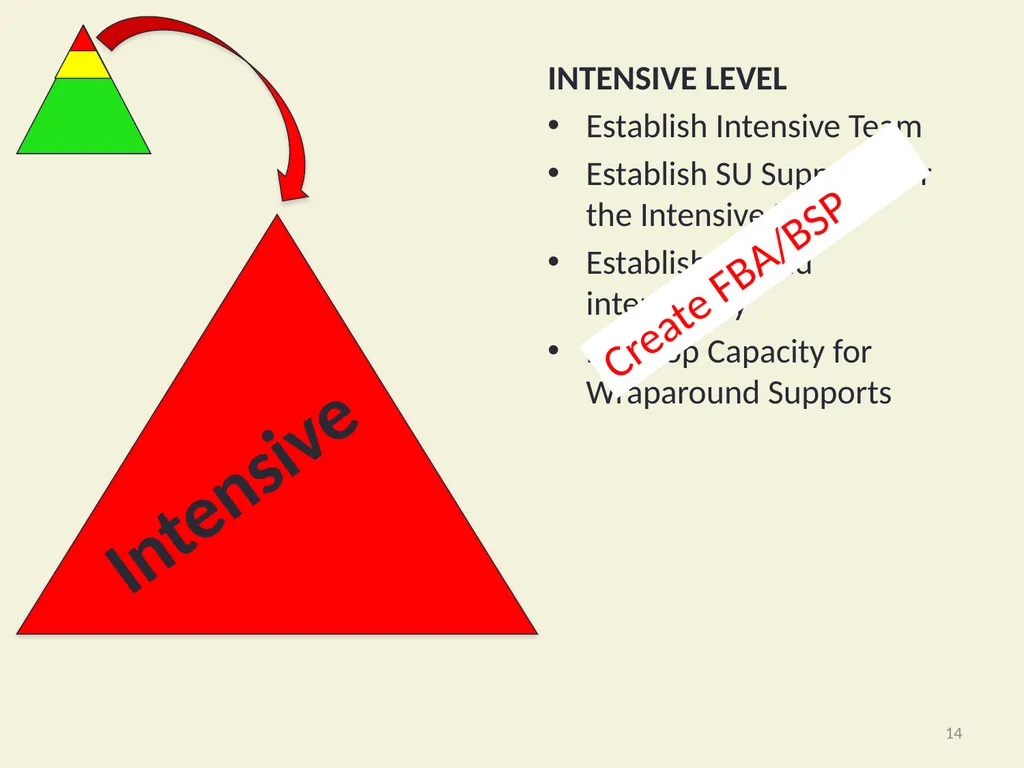
Intensive INTENSIVE LEVEL
Establish Intensive Team
Establish SU Supports for the Intensive Level
Establish SU and interagency
Develop Capacity for Wraparound Supports Create FBA/BSP 14<br>
Establish Intensive Team
Establish SU Supports for the Intensive Level
Establish SU and interagency
Develop Capacity for Wraparound Supports Create FBA/BSP 14<br>
15
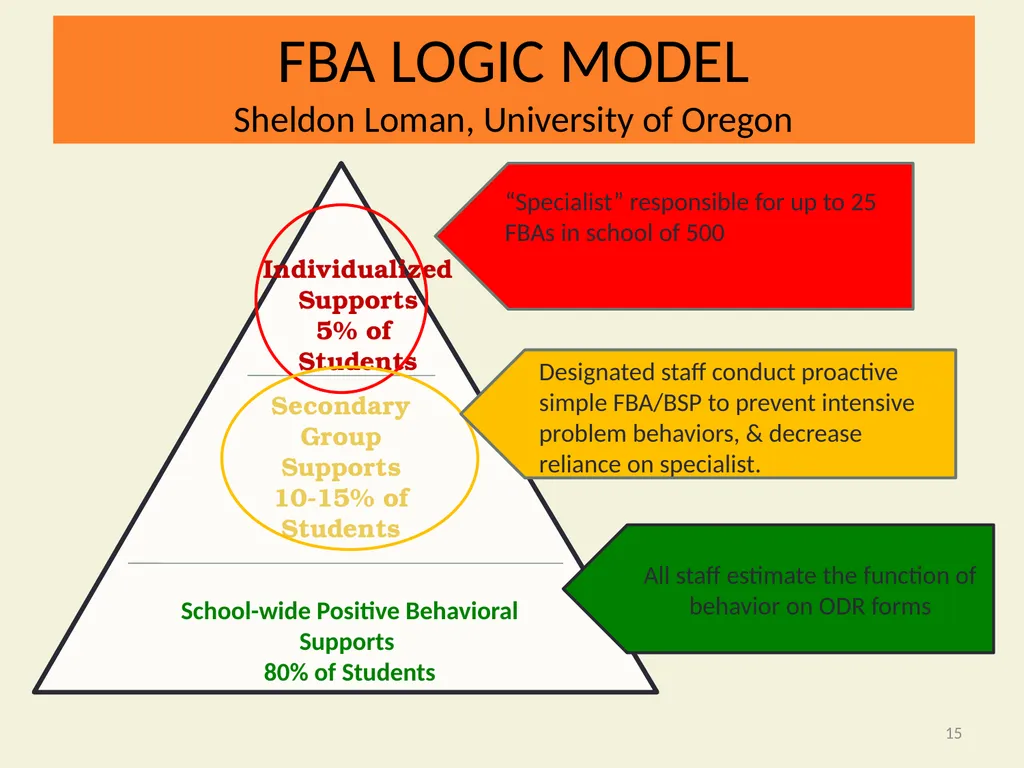
School-wide Positive Behavioral Supports
80% of Students Secondary Group Supports
10-15% of Students Individualized Supports
5% of
Students “Specialist” responsible for up to 25 FBAs in school of 500 Designated staff conduct proactive simple FBA/BSP to prevent intensive problem behaviors, & decrease reliance on specialist. FBA LOGIC MODEL
Sheldon Loman, University of Oregon 15 All staff estimate the function of behavior on ODR forms<br>
80% of Students Secondary Group Supports
10-15% of Students Individualized Supports
5% of
Students “Specialist” responsible for up to 25 FBAs in school of 500 Designated staff conduct proactive simple FBA/BSP to prevent intensive problem behaviors, & decrease reliance on specialist. FBA LOGIC MODEL
Sheldon Loman, University of Oregon 15 All staff estimate the function of behavior on ODR forms<br>
16
Who is responsible for conducting FBA/BSPs in your school? How does someone access this FBA/BSP? 16<br>
17
Requesting an FBA Teachers & school teams should be able to identify the system for requesting assistance
Teachers should be able to identify who to access assistance from
The targeted team/EST will determine when an FBA/BSP referral is necessary, based on data 17<br>
Teachers should be able to identify who to access assistance from
The targeted team/EST will determine when an FBA/BSP referral is necessary, based on data 17<br>
18
ACTIVITY 1: Using the questions in the workbook, review/develop your school’s process for accessing an FBA/BSP 18<br>
19
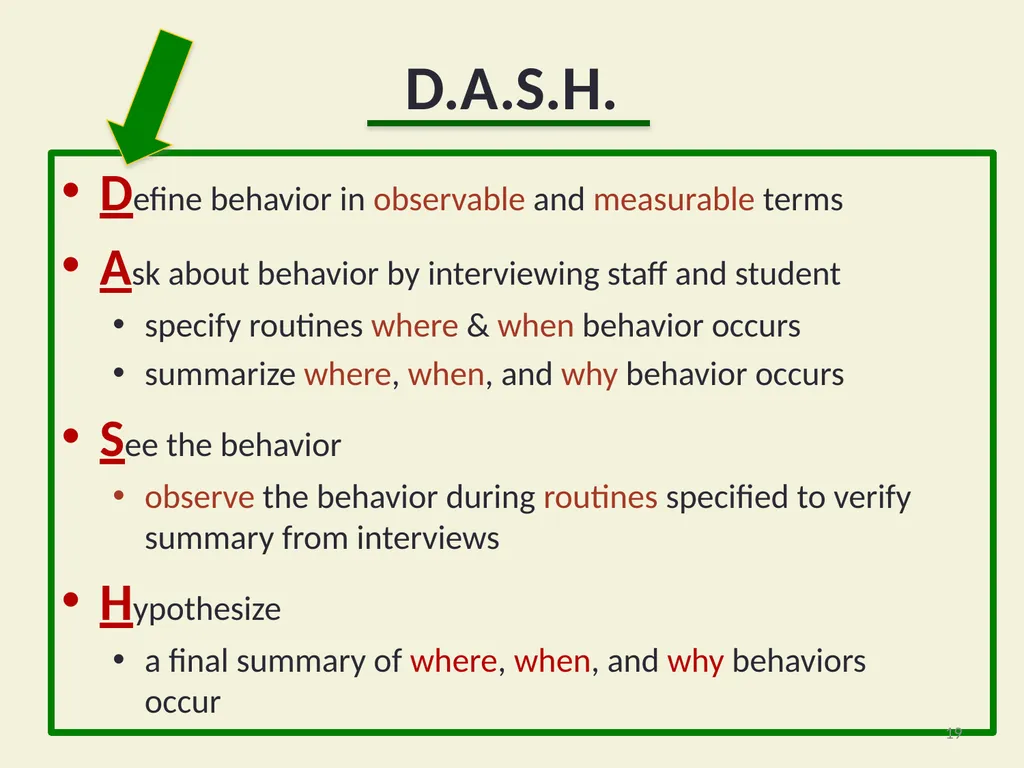
D.A.S.H. Define behavior in observable and measurable terms
Ask about behavior by interviewing staff and student
specify routines where & when behavior occurs
summarize where, when, and why behavior occurs
See the behavior
observe the behavior during routines specified to verify summary from interviews
Hypothesize
a final summary of where, when, and why behaviors occur 19<br>
Ask about behavior by interviewing staff and student
specify routines where & when behavior occurs
summarize where, when, and why behavior occurs
See the behavior
observe the behavior during routines specified to verify summary from interviews
Hypothesize
a final summary of where, when, and why behaviors occur 19<br>
20
Defining
and
Understanding Behavior 20<br>
21
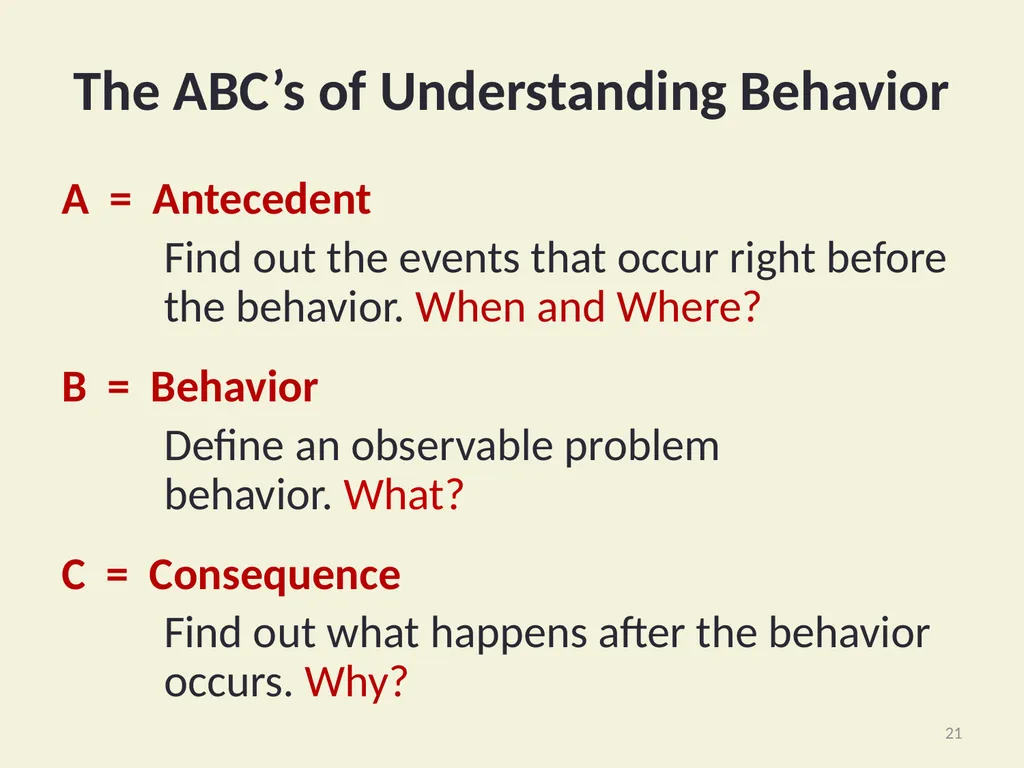
The ABC’s of Understanding Behavior A = Antecedent
Find out the events that occur right before the behavior. When and Where?
B = Behavior
Define an observable problem behavior. What?
C = Consequence
Find out what happens after the behavior occurs. Why? 21<br>
Find out the events that occur right before the behavior. When and Where?
B = Behavior
Define an observable problem behavior. What?
C = Consequence
Find out what happens after the behavior occurs. Why? 21<br>
22
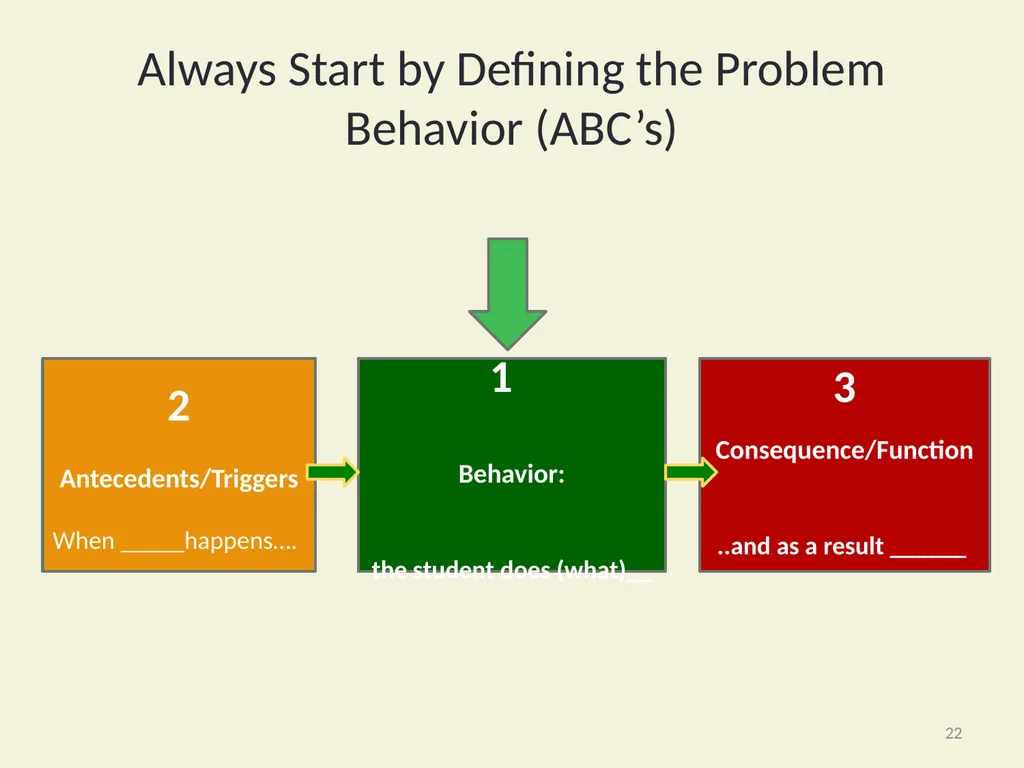
Always Start by Defining the Problem Behavior (ABC’s) 2
Antecedents/Triggers
When _____happens…. 1
Behavior:
the student does (what)__ 3
Consequence/Function
..and as a result ______ 22<br>
Antecedents/Triggers
When _____happens…. 1
Behavior:
the student does (what)__ 3
Consequence/Function
..and as a result ______ 22<br>
23
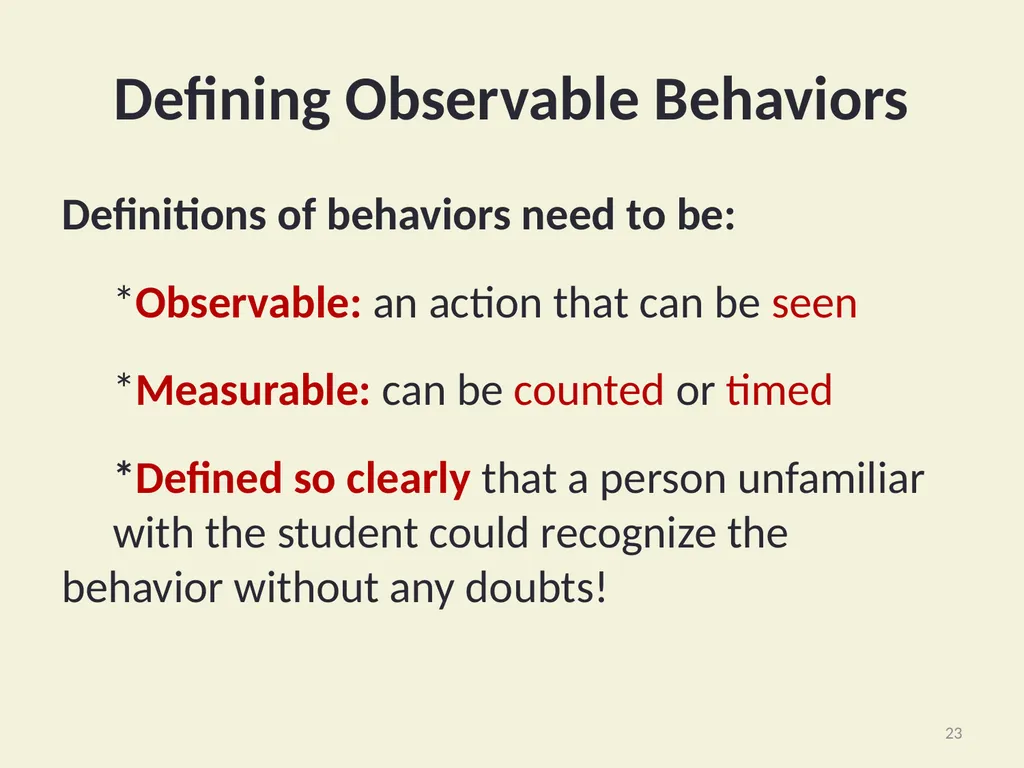
Defining Observable Behaviors Definitions of behaviors need to be:
*Observable: an action that can be seen
*Measurable: can be counted or timed
*Defined so clearly that a person unfamiliar with the student could recognize the behavior without any doubts! 23<br>
*Observable: an action that can be seen
*Measurable: can be counted or timed
*Defined so clearly that a person unfamiliar with the student could recognize the behavior without any doubts! 23<br>
24
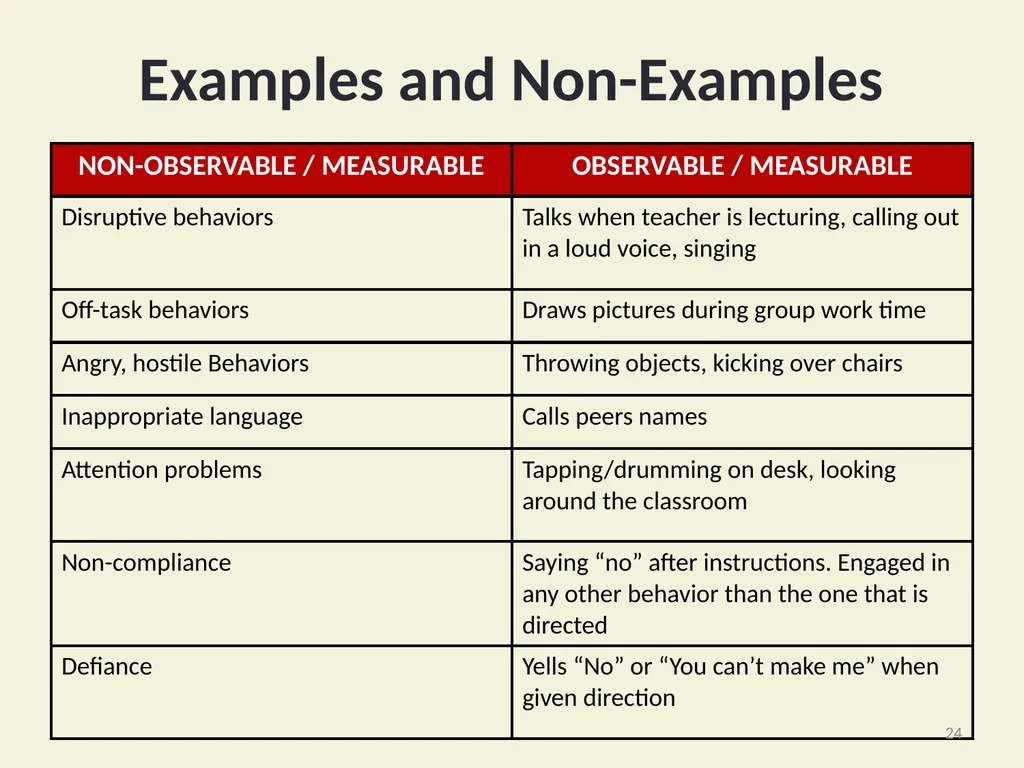
Examples and Non-Examples 24<br>
25
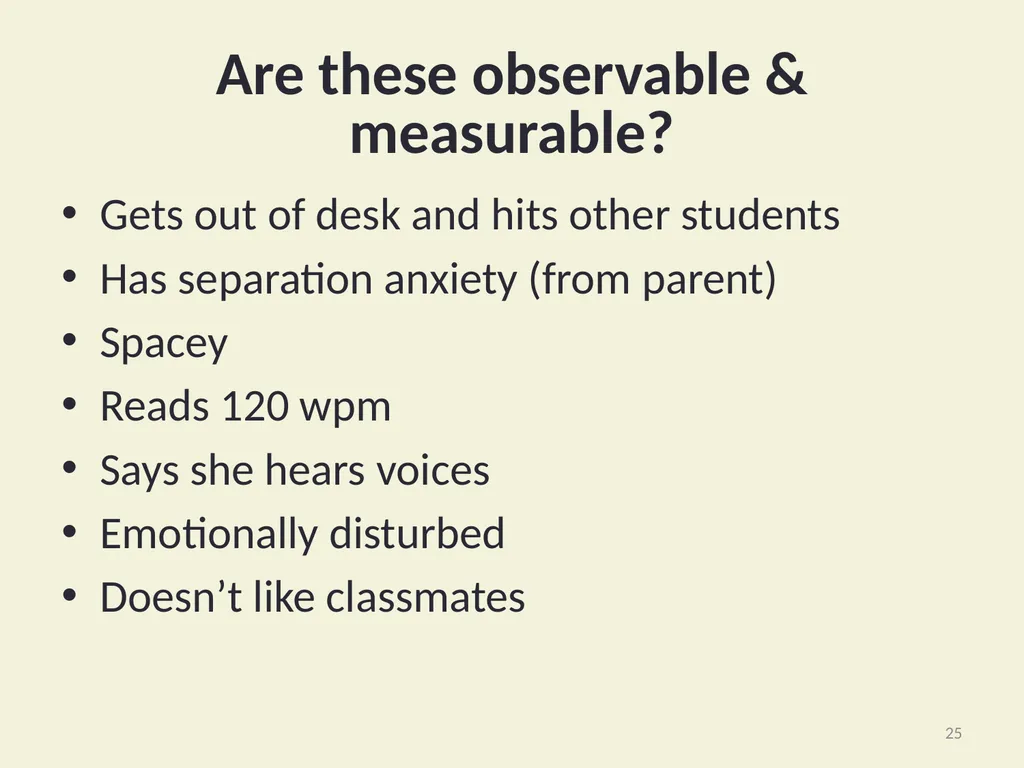
Are these observable & measurable? Gets out of desk and hits other students
Has separation anxiety (from parent)
Spacey
Reads 120 wpm
Says she hears voices
Emotionally disturbed
Doesn’t like classmates 25<br>
Has separation anxiety (from parent)
Spacey
Reads 120 wpm
Says she hears voices
Emotionally disturbed
Doesn’t like classmates 25<br>
26
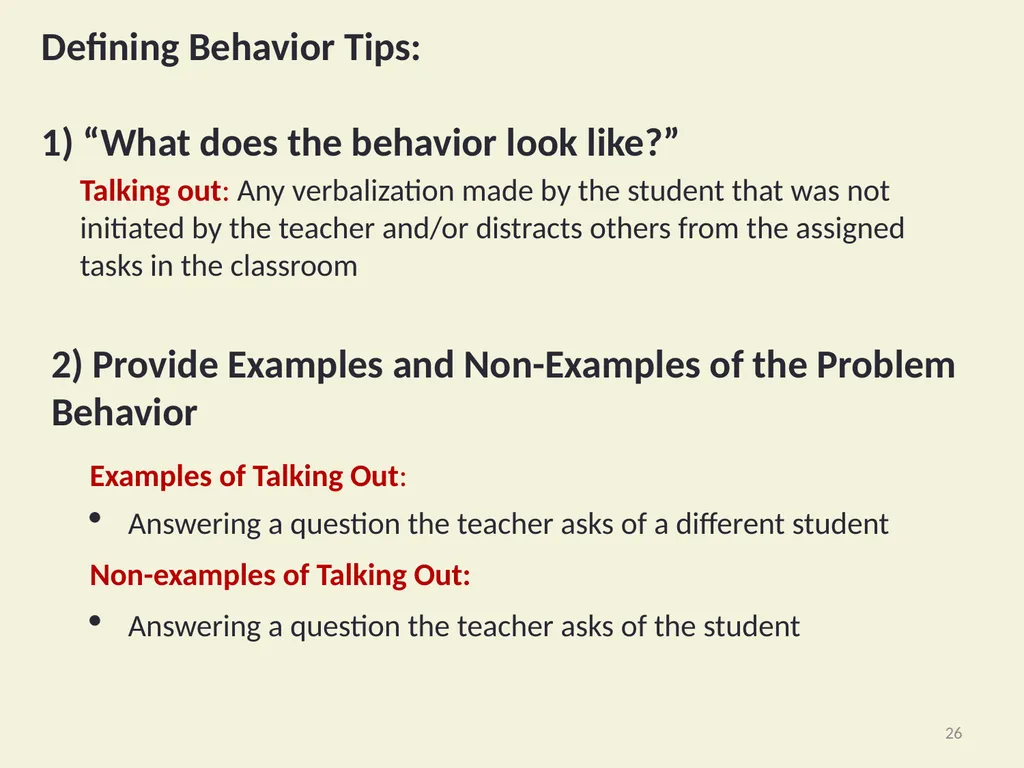
Defining Behavior Tips:
1) “What does the behavior look like?” Talking out: Any verbalization made by the student that was not initiated by the teacher and/or distracts others from the assigned tasks in the classroom 2) Provide Examples and Non-Examples of the Problem Behavior Examples of Talking Out:
Answering a question the teacher asks of a different student
Non-examples of Talking Out:
Answering a question the teacher asks of the student 26<br>
Answering a question the teacher asks of a different student
Non-examples of Talking Out:
Answering a question the teacher asks of the student 26<br>
27
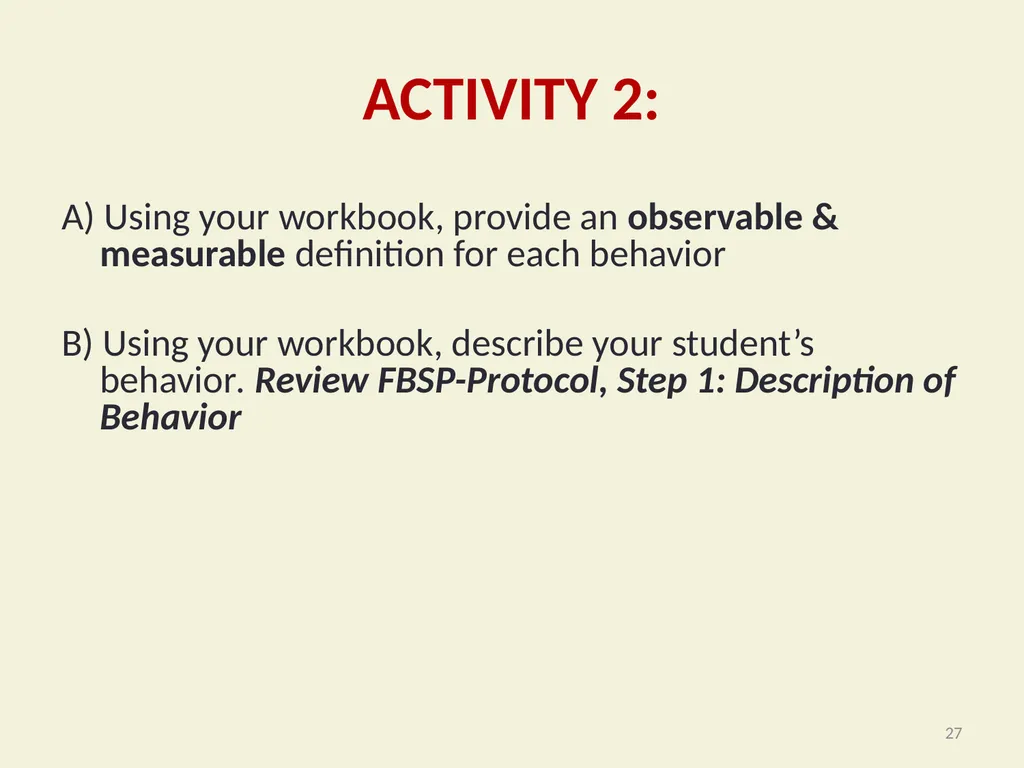
ACTIVITY 2: A) Using your workbook, provide an observable & measurable definition for each behavior
B) Using your workbook, describe your student’s behavior. Review FBSP-Protocol, Step 1: Description of Behavior 27<br>
B) Using your workbook, describe your student’s behavior. Review FBSP-Protocol, Step 1: Description of Behavior 27<br>
28
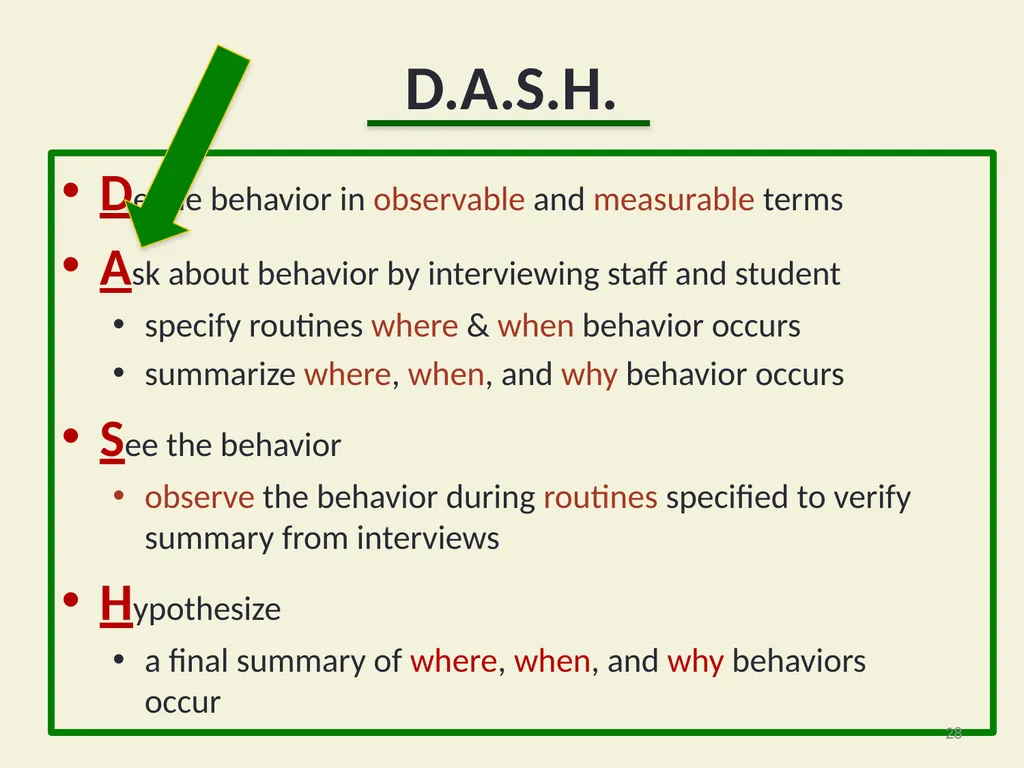
D.A.S.H. Define behavior in observable and measurable terms
Ask about behavior by interviewing staff and student
specify routines where & when behavior occurs
summarize where, when, and why behavior occurs
See the behavior
observe the behavior during routines specified to verify summary from interviews
Hypothesize
a final summary of where, when, and why behaviors occur 28<br>
Ask about behavior by interviewing staff and student
specify routines where & when behavior occurs
summarize where, when, and why behavior occurs
See the behavior
observe the behavior during routines specified to verify summary from interviews
Hypothesize
a final summary of where, when, and why behaviors occur 28<br>
29
Asking
About When, Where, and Why
the Behavior Occurs 29<br>
30
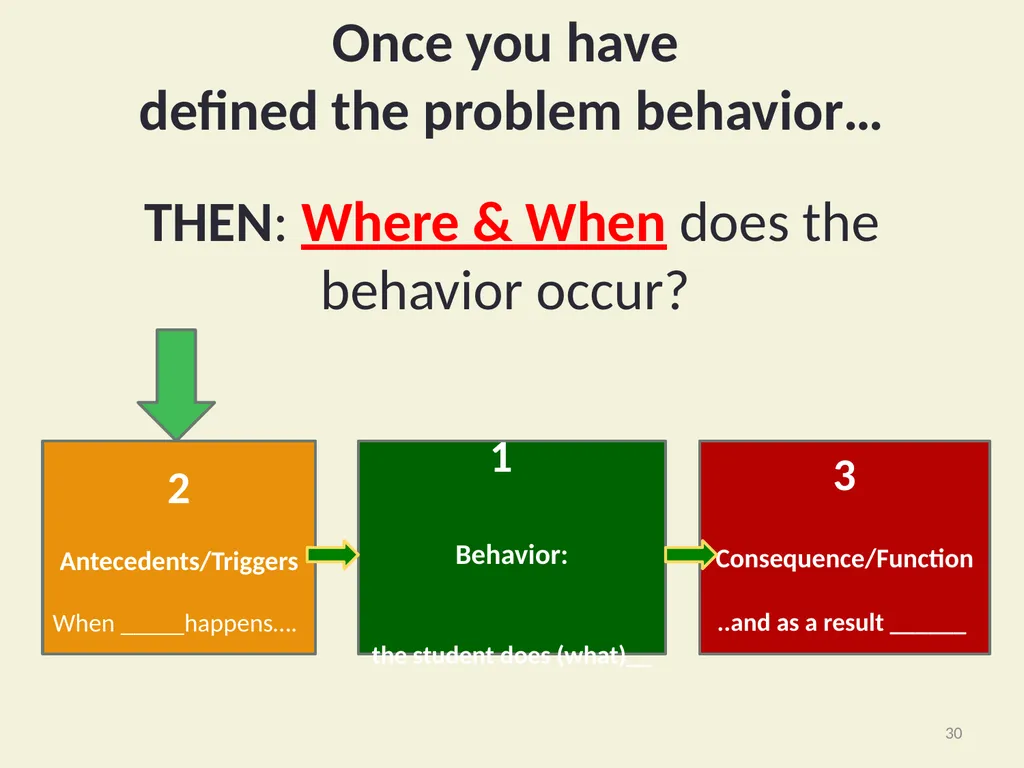
Once you have
defined the problem behavior…
THEN: Where & When does the behavior occur? 2
Antecedents/Triggers
When _____happens…. 1
Behavior:
the student does (what)__ 3
Consequence/Function
..and as a result ______ 30<br>
Antecedents/Triggers
When _____happens…. 1
Behavior:
the student does (what)__ 3
Consequence/Function
..and as a result ______ 30<br>
31
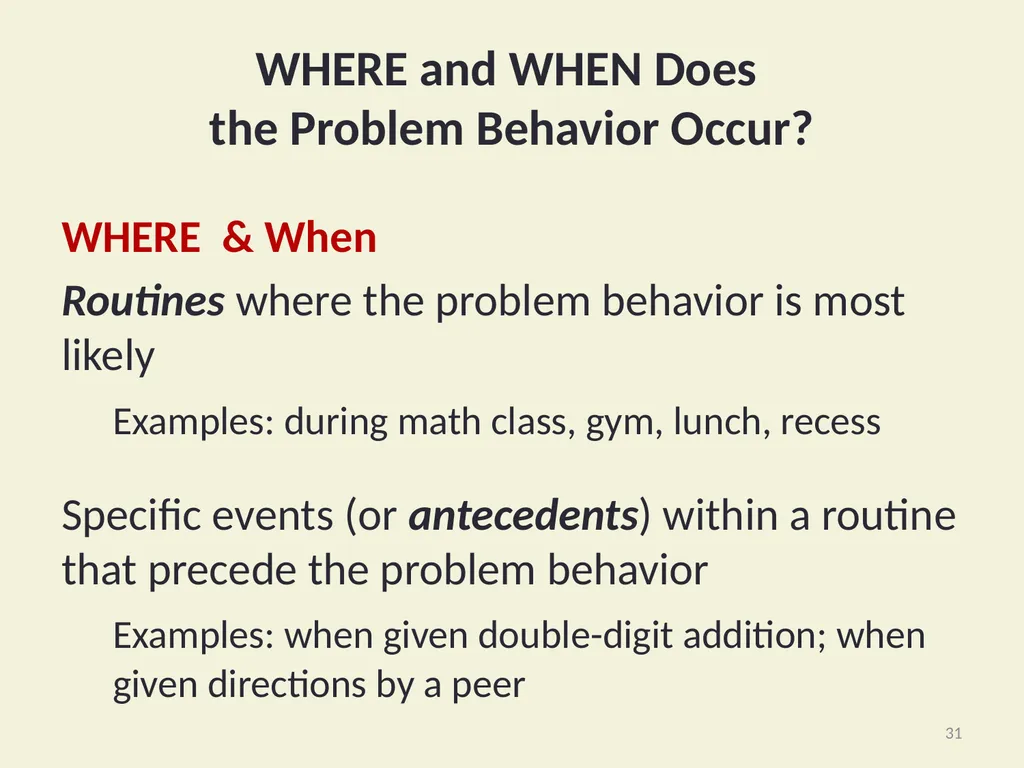
WHERE and WHEN Does
the Problem Behavior Occur? WHERE & When
Routines where the problem behavior is most likely
Examples: during math class, gym, lunch, recess
Specific events (or antecedents) within a routine that precede the problem behavior
Examples: when given double-digit addition; when given directions by a peer 31<br>
Routines where the problem behavior is most likely
Examples: during math class, gym, lunch, recess
Specific events (or antecedents) within a routine that precede the problem behavior
Examples: when given double-digit addition; when given directions by a peer 31<br>
32
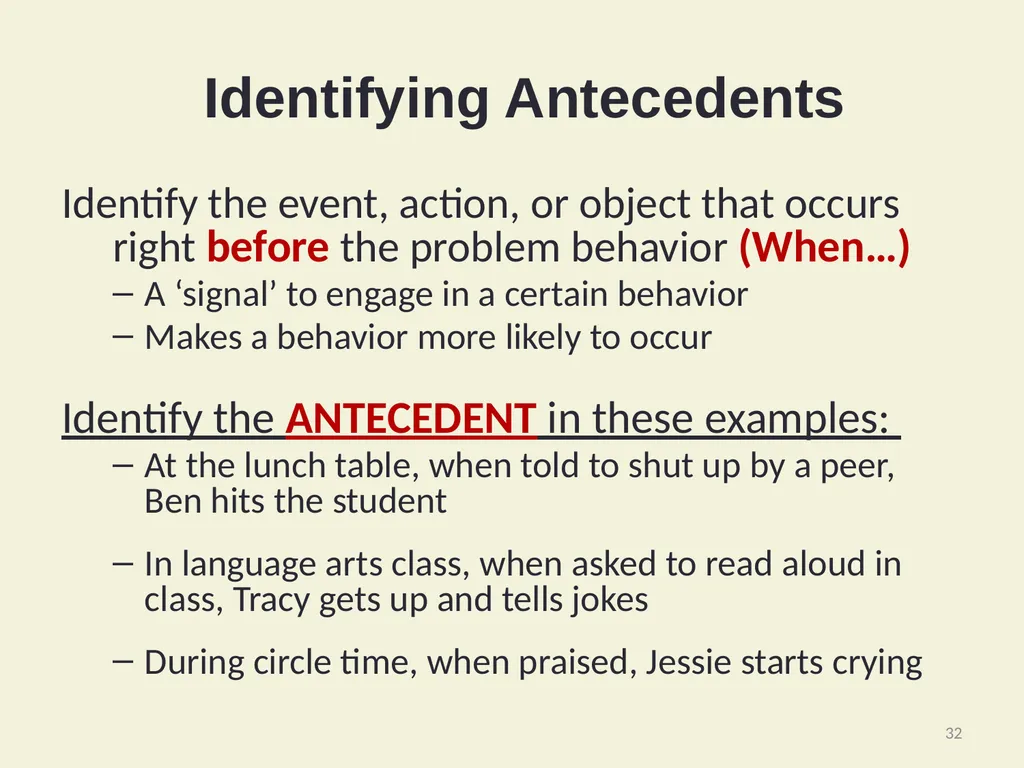
Identifying Antecedents Identify the event, action, or object that occurs right before the problem behavior (When…)
A ‘signal’ to engage in a certain behavior
Makes a behavior more likely to occur
Identify the ANTECEDENT in these examples:
At the lunch table, when told to shut up by a peer, Ben hits the student
In language arts class, when asked to read aloud in class, Tracy gets up and tells jokes
During circle time, when praised, Jessie starts crying 32<br>
A ‘signal’ to engage in a certain behavior
Makes a behavior more likely to occur
Identify the ANTECEDENT in these examples:
At the lunch table, when told to shut up by a peer, Ben hits the student
In language arts class, when asked to read aloud in class, Tracy gets up and tells jokes
During circle time, when praised, Jessie starts crying 32<br>
33
ACTIVITY 3: Using your workbook, identify the behavior and antecedent in the scenarios. 33<br>
34
During passing period in the hallway before recess, when peers tease him about his walk, A.J. calls them names and hits them. Routine: “During __________________________” Scenario #1 PEERS TEASE ABOUT HIS WALK CALLS NAMES & HITS Passing Period before Recess When… When… Antecedent When… The student... The student... Behavior 34<br>
35
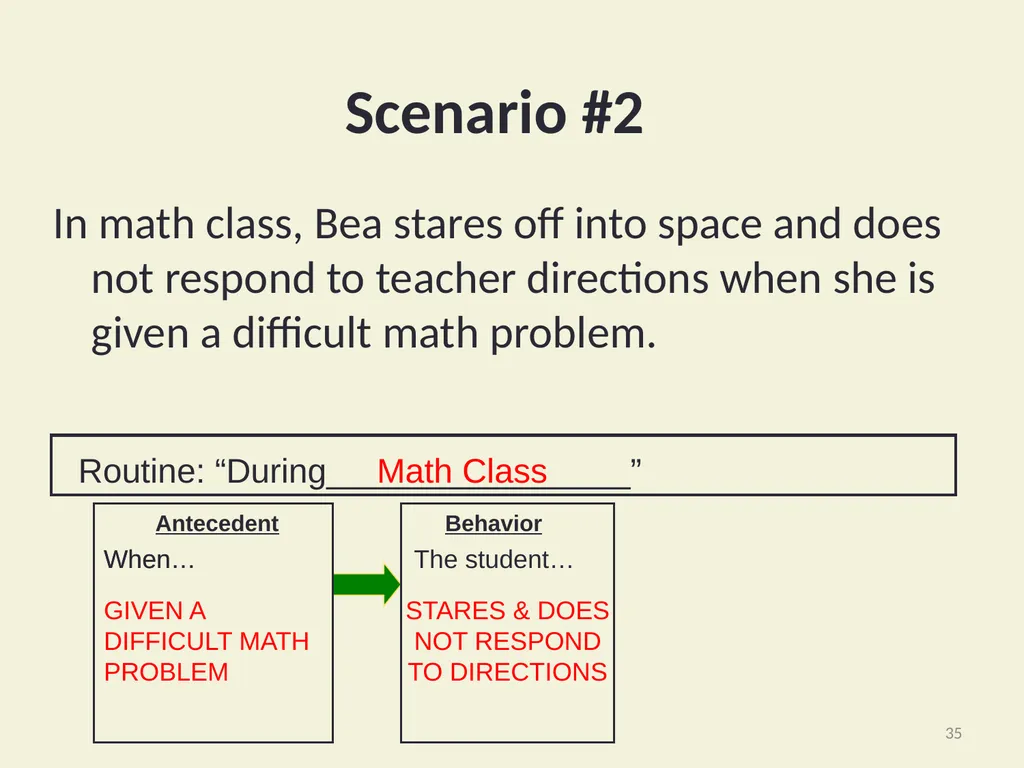
In math class, Bea stares off into space and does not respond to teacher directions when she is given a difficult math problem. Routine: “During________________” Scenario #2 GIVEN A DIFFICULT MATH PROBLEM STARES & DOES NOT RESPOND TO DIRECTIONS Math Class When… Antecedent When… Behavior The student… 35<br>
36
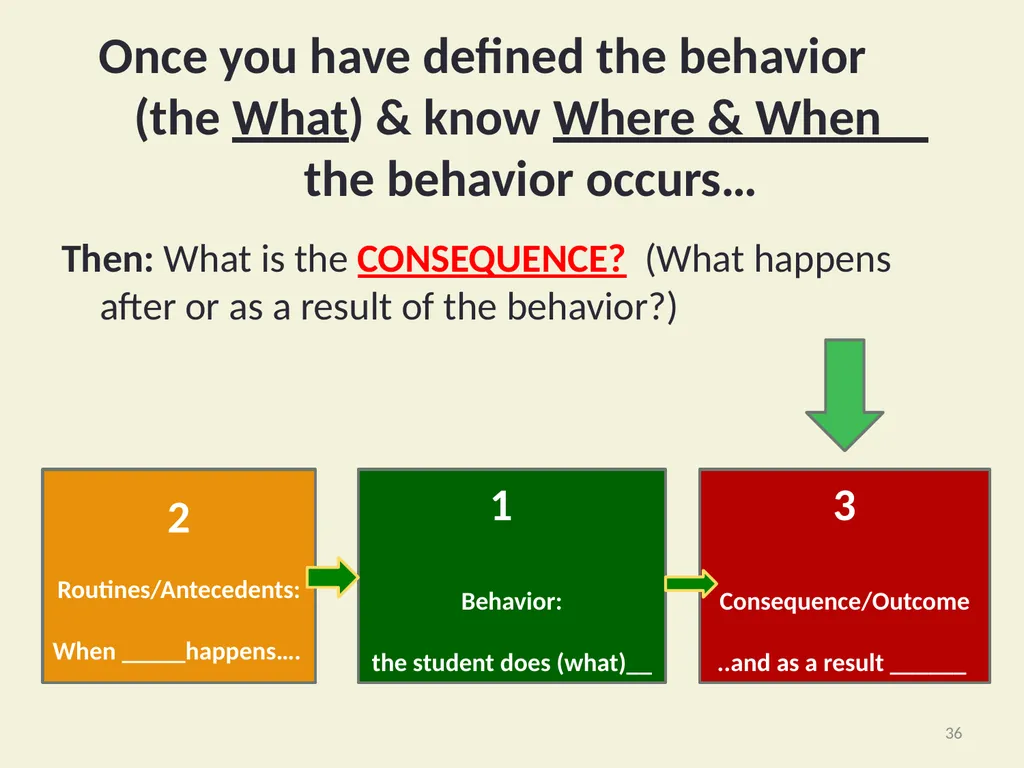
Once you have defined the behavior (the What) & know Where & When the behavior occurs…
Then: What is the CONSEQUENCE? (What happens after or as a result of the behavior?) 2
Routines/Antecedents:
When _____happens…. 1
Behavior:
the student does (what)__ 3
Consequence/Outcome
..and as a result ______ 36<br>
Then: What is the CONSEQUENCE? (What happens after or as a result of the behavior?) 2
Routines/Antecedents:
When _____happens…. 1
Behavior:
the student does (what)__ 3
Consequence/Outcome
..and as a result ______ 36<br>
37
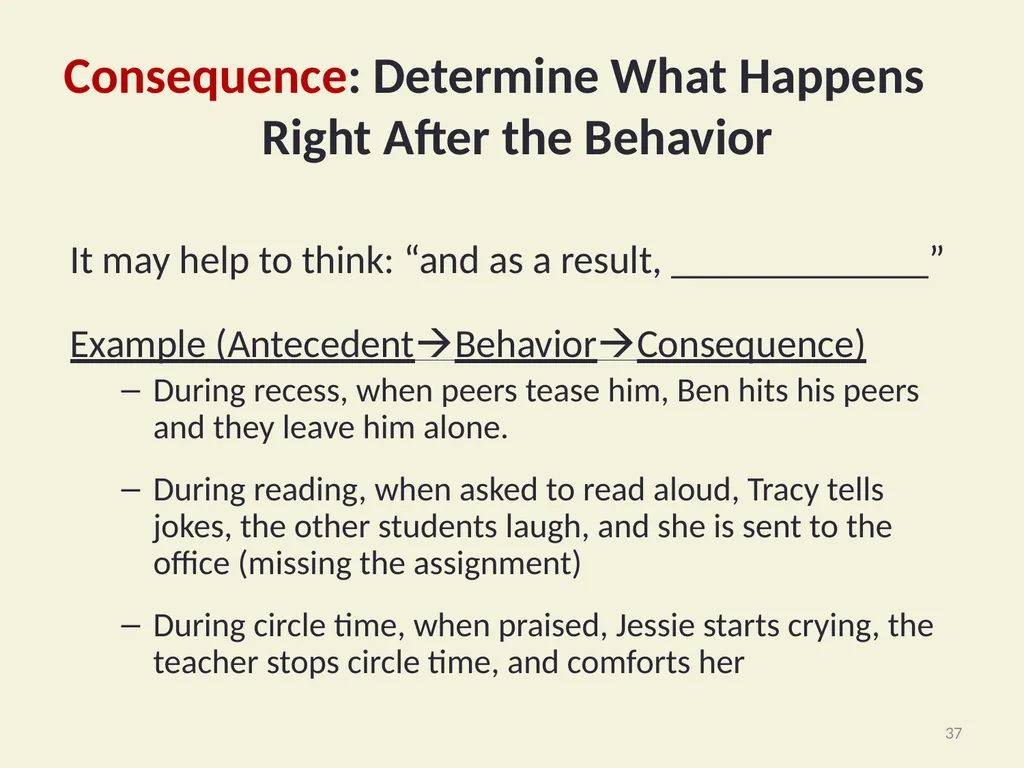
Consequence: Determine What Happens Right After the Behavior It may help to think: “and as a result, _____________”
Example (AntecedentBehaviorConsequence)
During recess, when peers tease him, Ben hits his peers and they leave him alone.
During reading, when asked to read aloud, Tracy tells jokes, the other students laugh, and she is sent to the office (missing the assignment)
During circle time, when praised, Jessie starts crying, the teacher stops circle time, and comforts her 37<br>
Example (AntecedentBehaviorConsequence)
During recess, when peers tease him, Ben hits his peers and they leave him alone.
During reading, when asked to read aloud, Tracy tells jokes, the other students laugh, and she is sent to the office (missing the assignment)
During circle time, when praised, Jessie starts crying, the teacher stops circle time, and comforts her 37<br>
38
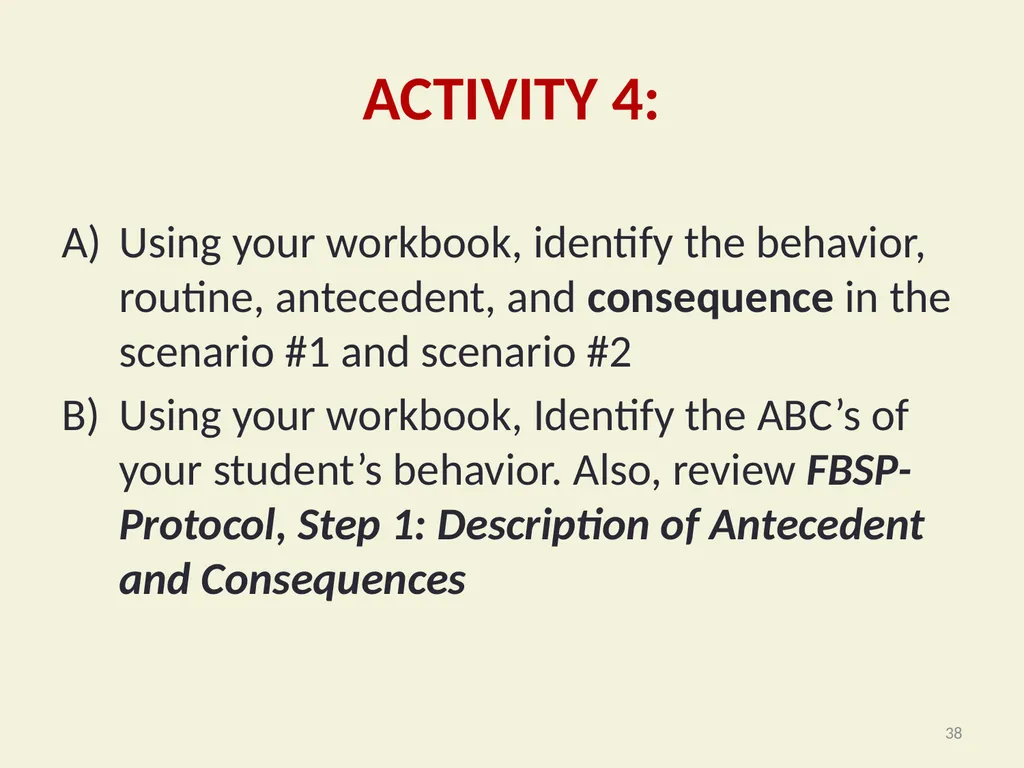
ACTIVITY 4: Using your workbook, identify the behavior, routine, antecedent, and consequence in the scenario #1 and scenario #2
Using your workbook, Identify the ABC’s of your student’s behavior. Also, review FBSP-Protocol, Step 1: Description of Antecedent and Consequences 38<br>
Using your workbook, Identify the ABC’s of your student’s behavior. Also, review FBSP-Protocol, Step 1: Description of Antecedent and Consequences 38<br>
39
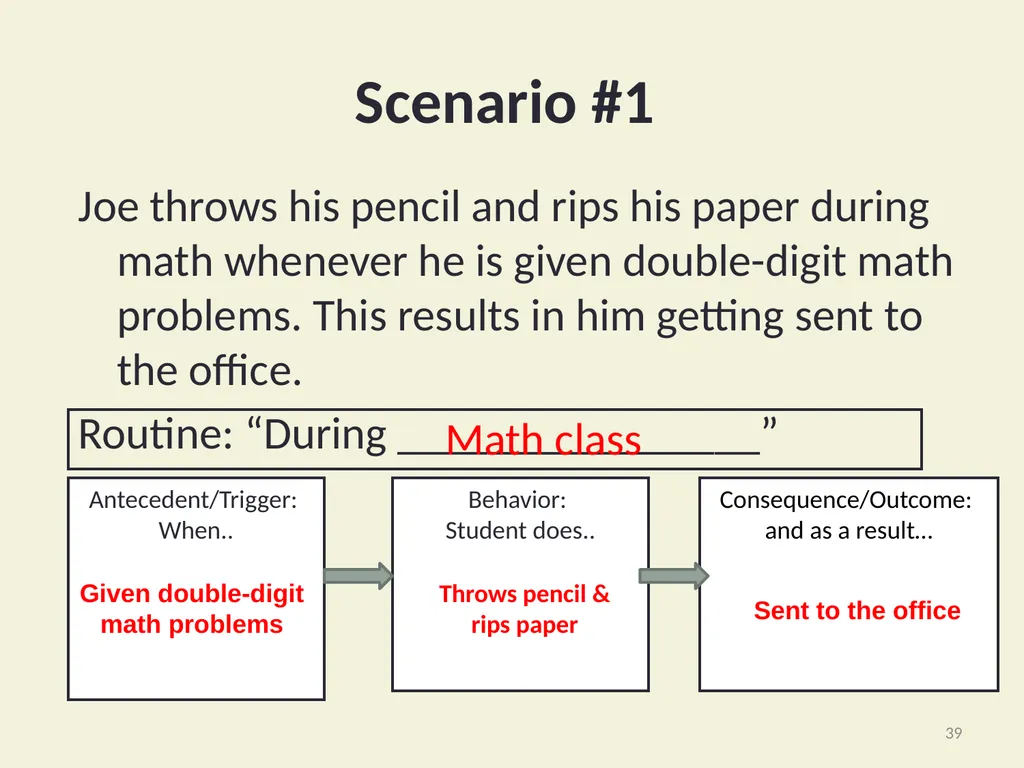
Scenario #1 Joe throws his pencil and rips his paper during math whenever he is given double-digit math problems. This results in him getting sent to the office.
Routine: “During ________________” Antecedent/Trigger:
When.. Behavior:
Student does.. Consequence/Outcome:
and as a result… Math class Throws pencil & rips paper Sent to the office Given double-digit math problems 39<br>
Routine: “During ________________” Antecedent/Trigger:
When.. Behavior:
Student does.. Consequence/Outcome:
and as a result… Math class Throws pencil & rips paper Sent to the office Given double-digit math problems 39<br>
40
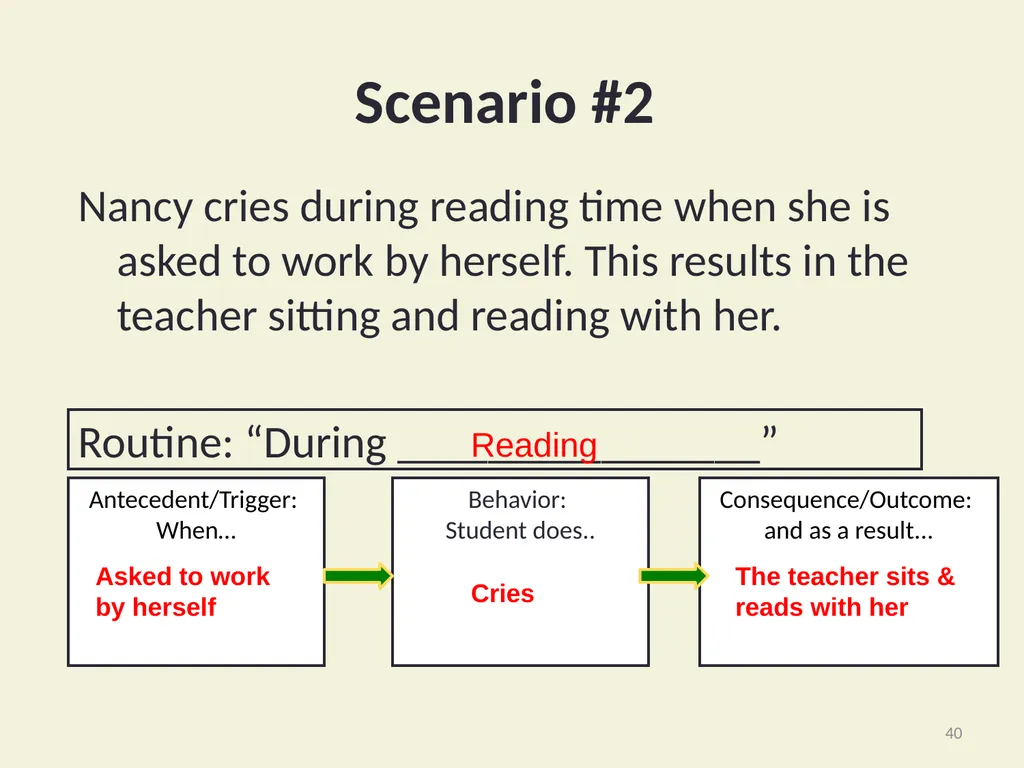
Scenario #2 Nancy cries during reading time when she is asked to work by herself. This results in the teacher sitting and reading with her.
Routine: “During ________________” Antecedent/Trigger:
When… Behavior:
Student does.. Consequence/Outcome:
and as a result... Reading Cries Asked to work by herself The teacher sits & reads with her 40<br>
Routine: “During ________________” Antecedent/Trigger:
When… Behavior:
Student does.. Consequence/Outcome:
and as a result... Reading Cries Asked to work by herself The teacher sits & reads with her 40<br>
41
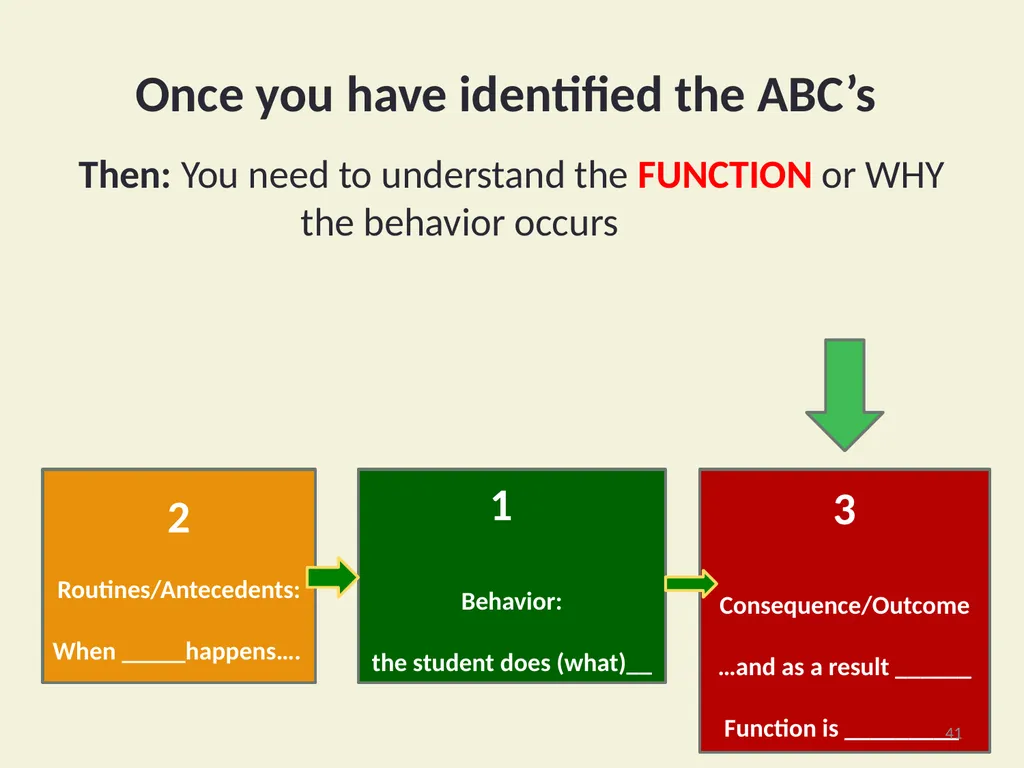
Once you have identified the ABC’s
Then: You need to understand the FUNCTION or WHY the behavior occurs 2
Routines/Antecedents:
When _____happens…. 1
Behavior:
the student does (what)__ 3
Consequence/Outcome
…and as a result ______
Function is _________ 41<br>
Then: You need to understand the FUNCTION or WHY the behavior occurs 2
Routines/Antecedents:
When _____happens…. 1
Behavior:
the student does (what)__ 3
Consequence/Outcome
…and as a result ______
Function is _________ 41<br>
42
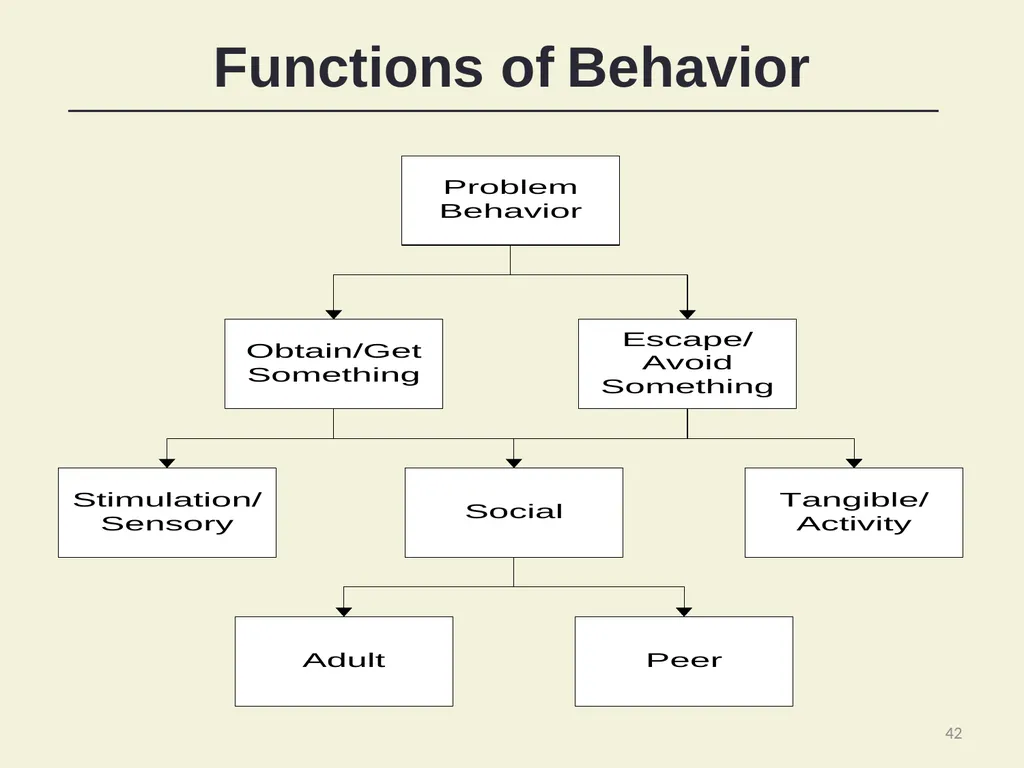
Functions of Behavior 42<br>
43
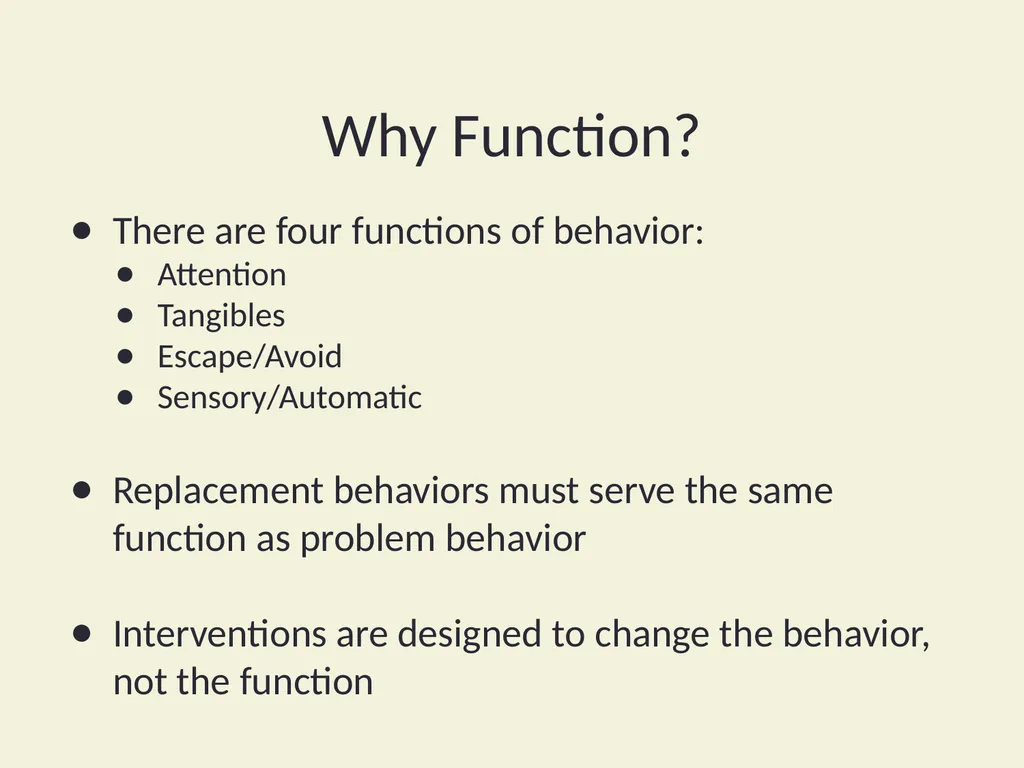
Why Function? There are four functions of behavior:
Attention
Tangibles
Escape/Avoid
Sensory/Automatic
Replacement behaviors must serve the same function as problem behavior
Interventions are designed to change the behavior, not the function<br>
Attention
Tangibles
Escape/Avoid
Sensory/Automatic
Replacement behaviors must serve the same function as problem behavior
Interventions are designed to change the behavior, not the function<br>
44
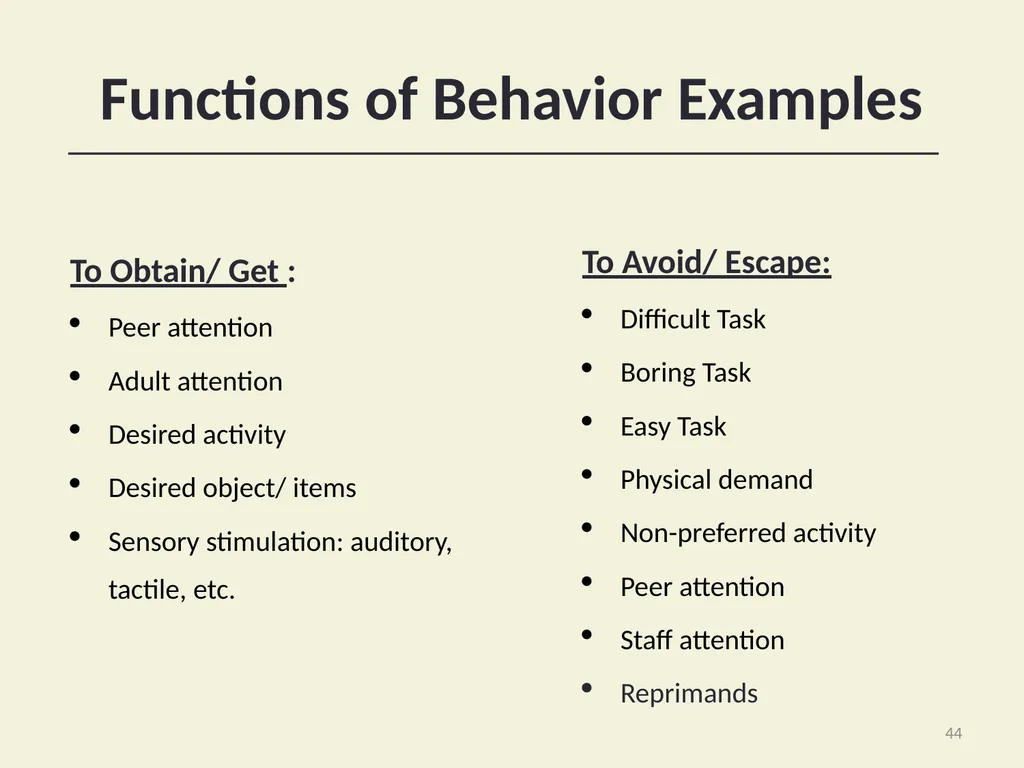
Functions of Behavior Examples To Obtain/ Get :
Peer attention
Adult attention
Desired activity
Desired object/ items
Sensory stimulation: auditory, tactile, etc. To Avoid/ Escape:
Difficult Task
Boring Task
Easy Task
Physical demand
Non-preferred activity
Peer attention
Staff attention
Reprimands 44<br>
Peer attention
Adult attention
Desired activity
Desired object/ items
Sensory stimulation: auditory, tactile, etc. To Avoid/ Escape:
Difficult Task
Boring Task
Easy Task
Physical demand
Non-preferred activity
Peer attention
Staff attention
Reprimands 44<br>
45
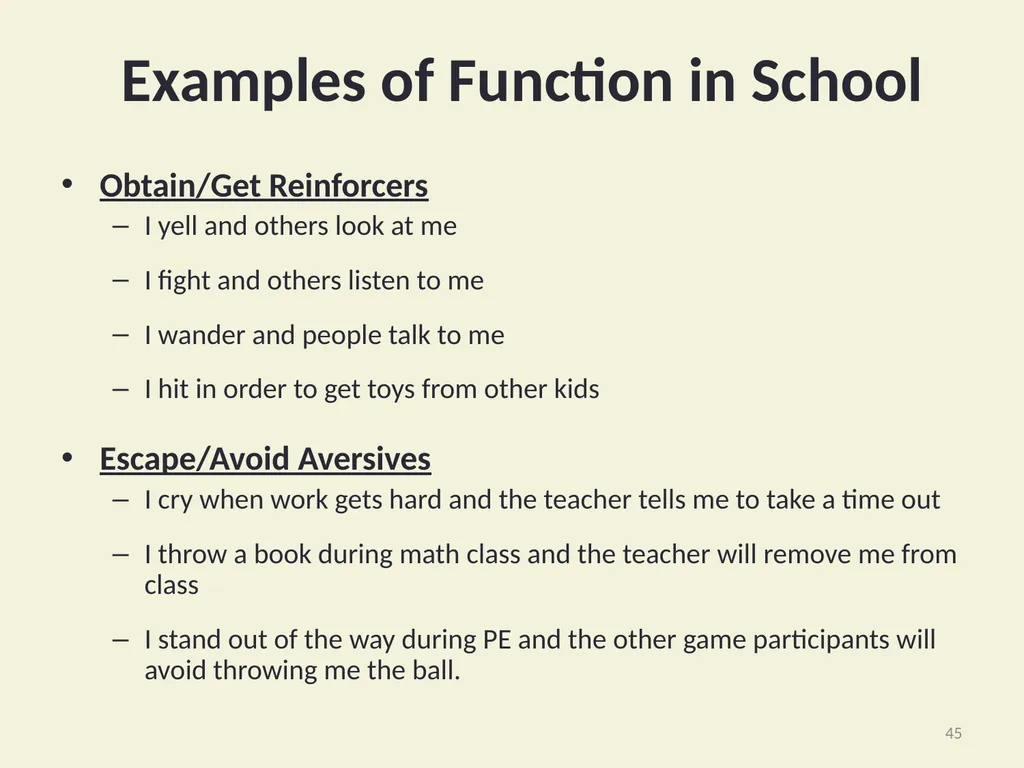
Obtain/Get Reinforcers
I yell and others look at me
I fight and others listen to me
I wander and people talk to me
I hit in order to get toys from other kids
Escape/Avoid Aversives
I cry when work gets hard and the teacher tells me to take a time out
I throw a book during math class and the teacher will remove me from class
I stand out of the way during PE and the other game participants will avoid throwing me the ball. Examples of Function in School 45<br>
I yell and others look at me
I fight and others listen to me
I wander and people talk to me
I hit in order to get toys from other kids
Escape/Avoid Aversives
I cry when work gets hard and the teacher tells me to take a time out
I throw a book during math class and the teacher will remove me from class
I stand out of the way during PE and the other game participants will avoid throwing me the ball. Examples of Function in School 45<br>
46
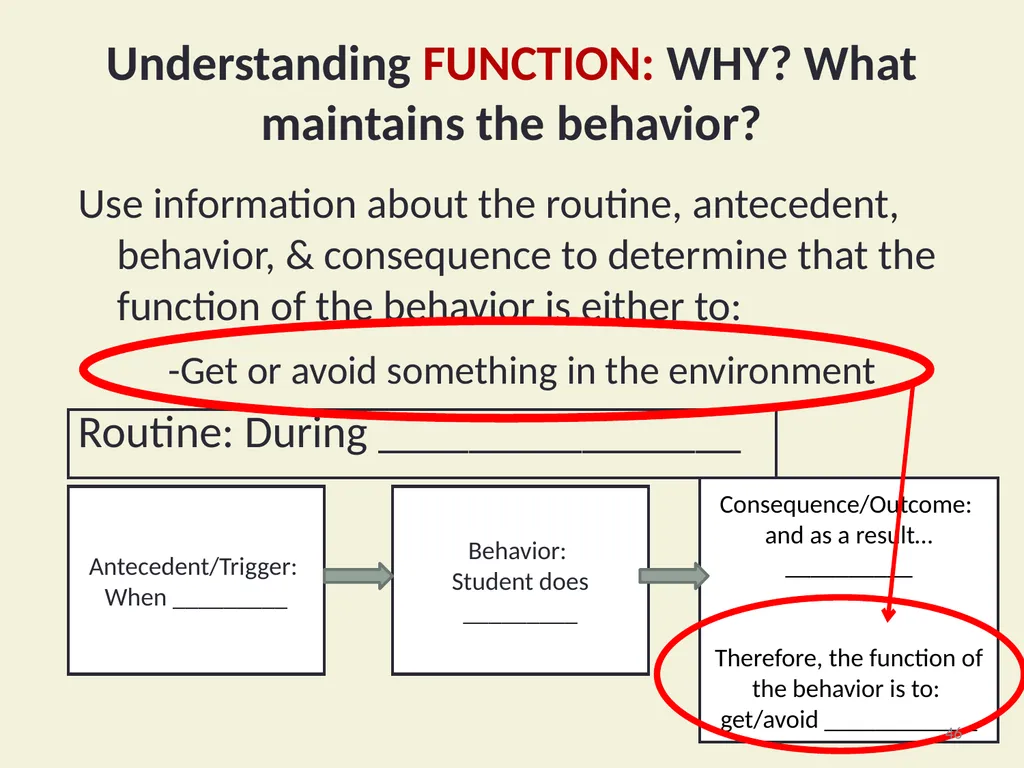
Understanding FUNCTION: WHY? What maintains the behavior? Use information about the routine, antecedent, behavior, & consequence to determine that the function of the behavior is either to:
-Get or avoid something in the environment
Routine: During ________________ Antecedent/Trigger:
When _________ Behavior:
Student does _________ Consequence/Outcome:
and as a result… __________
Therefore, the function of the behavior is to: get/avoid ____________ 46<br>
-Get or avoid something in the environment
Routine: During ________________ Antecedent/Trigger:
When _________ Behavior:
Student does _________ Consequence/Outcome:
and as a result… __________
Therefore, the function of the behavior is to: get/avoid ____________ 46<br>
47
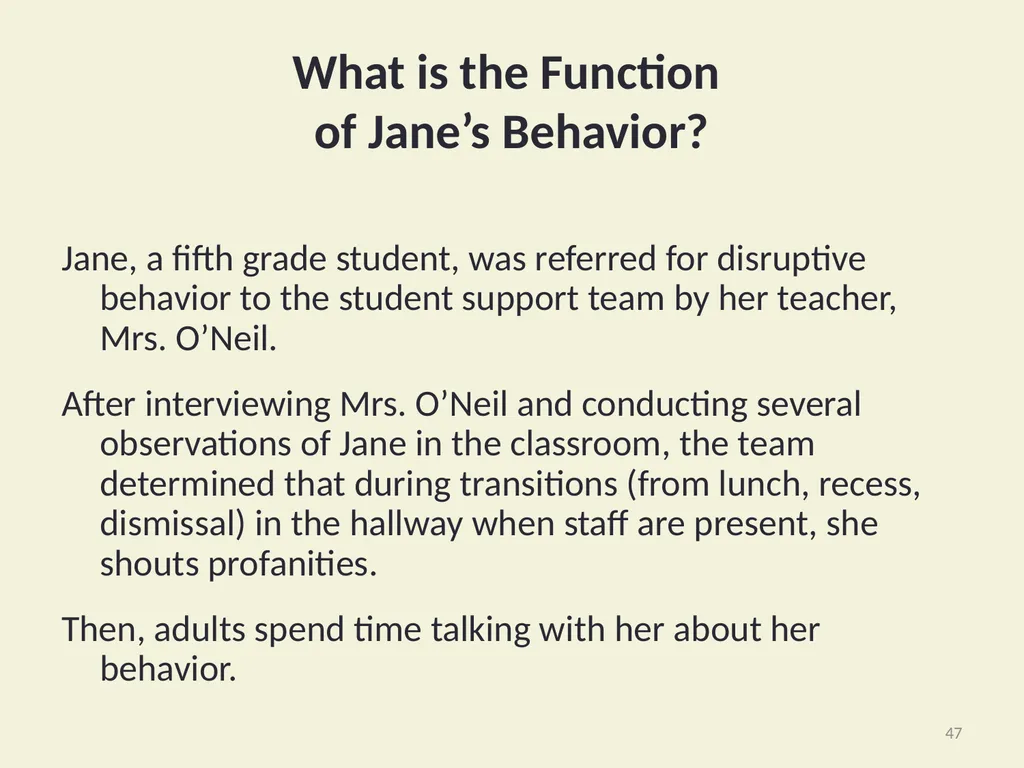
What is the Function
of Jane’s Behavior? Jane, a fifth grade student, was referred for disruptive behavior to the student support team by her teacher, Mrs. O’Neil.
After interviewing Mrs. O’Neil and conducting several observations of Jane in the classroom, the team determined that during transitions (from lunch, recess, dismissal) in the hallway when staff are present, she shouts profanities.
Then, adults spend time talking with her about her behavior. 47<br>
After interviewing Mrs. O’Neil and conducting several observations of Jane in the classroom, the team determined that during transitions (from lunch, recess, dismissal) in the hallway when staff are present, she shouts profanities.
Then, adults spend time talking with her about her behavior. 47<br>
48
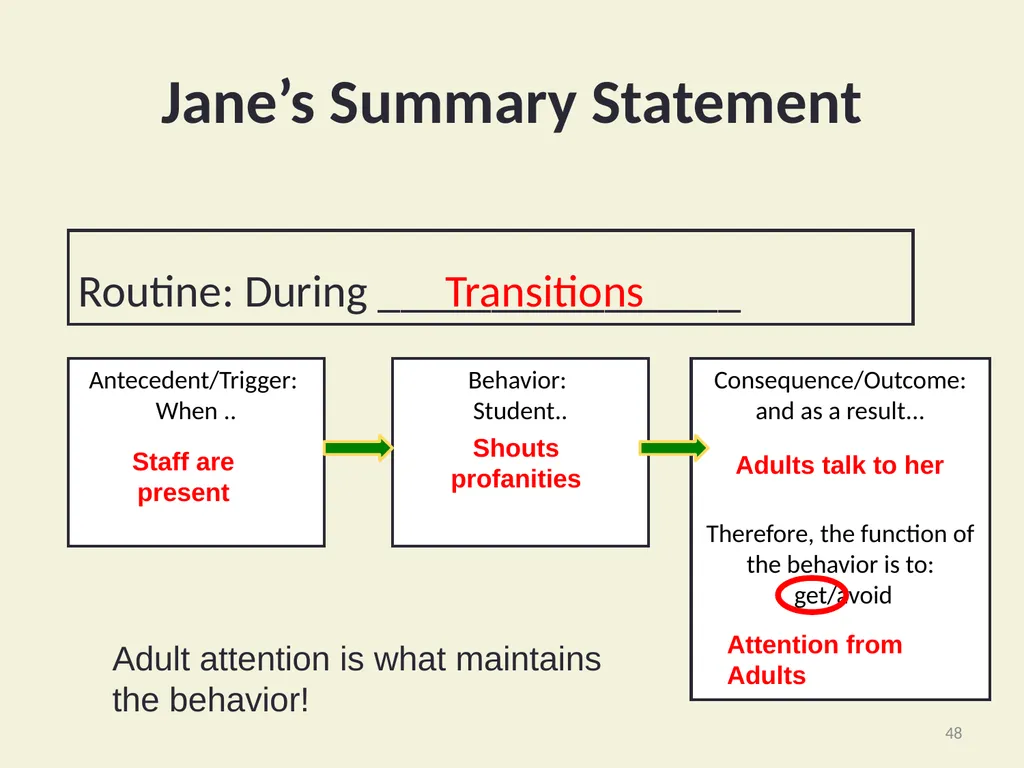
Jane’s Summary Statement Antecedent/Trigger:
When .. Behavior:
Student.. Consequence/Outcome: and as a result...
Therefore, the function of the behavior is to:
get/avoid Adult attention is what maintains the behavior! Routine: During ________________ Transitions Staff are present Shouts profanities Adults talk to her Attention from Adults 48<br>
When .. Behavior:
Student.. Consequence/Outcome: and as a result...
Therefore, the function of the behavior is to:
get/avoid Adult attention is what maintains the behavior! Routine: During ________________ Transitions Staff are present Shouts profanities Adults talk to her Attention from Adults 48<br>
49
ACTIVITY 5: Using your workbook, identify the behavior, routine, antecedent, and consequence in scenario #1; and for your student – Scenario #2.
Use this information to determine the most likely FUNCTION of the problem behavior 49<br>
Use this information to determine the most likely FUNCTION of the problem behavior 49<br>
50
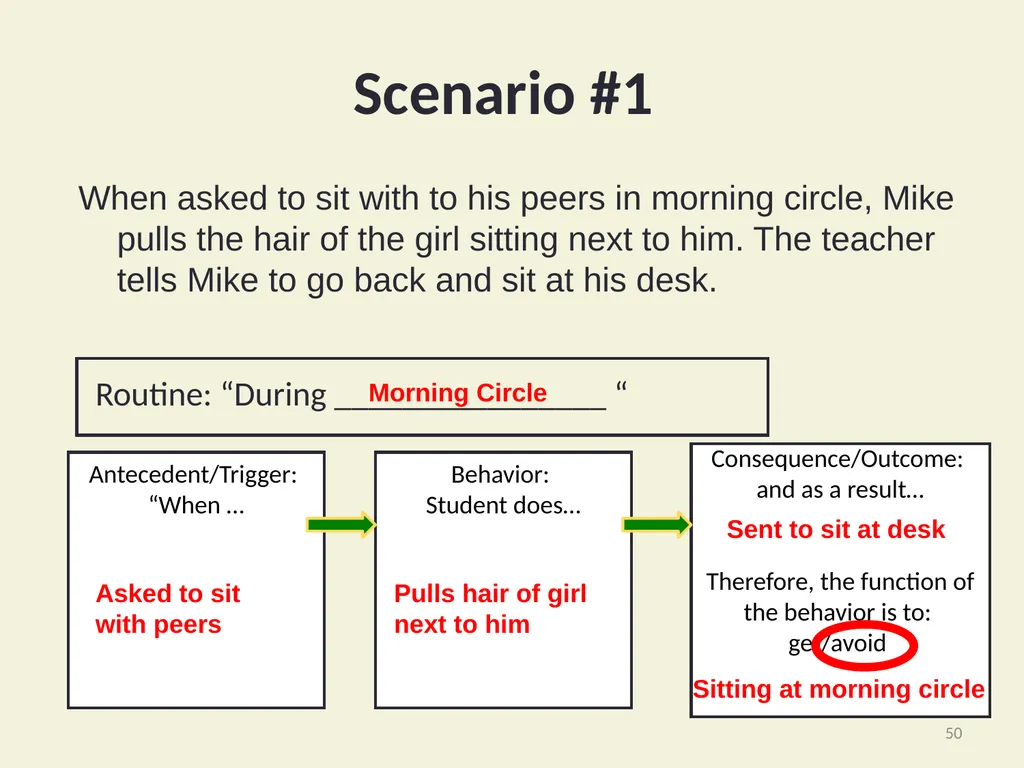
When asked to sit with to his peers in morning circle, Mike pulls the hair of the girl sitting next to him. The teacher tells Mike to go back and sit at his desk. Routine: “During ________________ “ Scenario #1 Antecedent/Trigger:
“When … Behavior:
Student does… Consequence/Outcome:
and as a result…
Therefore, the function of the behavior is to: get/avoid Asked to sit with peers Morning Circle Pulls hair of girl next to him Sent to sit at desk Sitting at morning circle 50<br>
“When … Behavior:
Student does… Consequence/Outcome:
and as a result…
Therefore, the function of the behavior is to: get/avoid Asked to sit with peers Morning Circle Pulls hair of girl next to him Sent to sit at desk Sitting at morning circle 50<br>
51
51<br>
52
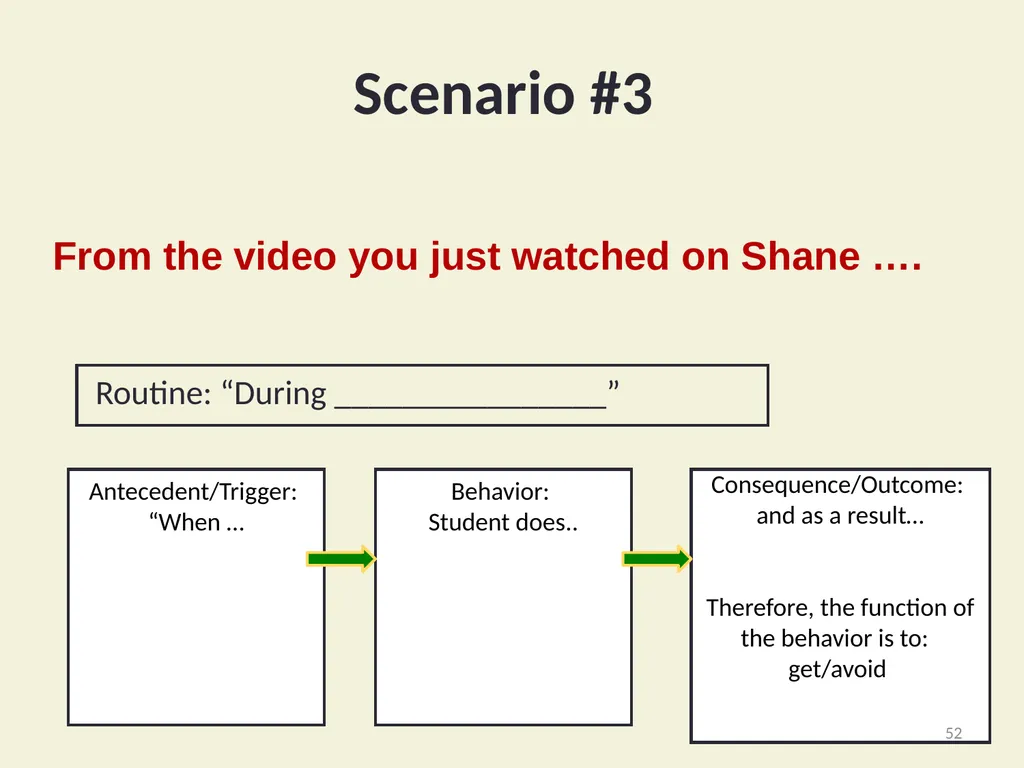
From the video you just watched on Shane …. Routine: “During ________________” Scenario #3 52 Antecedent/Trigger:
“When … Behavior:
Student does.. Consequence/Outcome:
and as a result…
Therefore, the function of the behavior is to:
get/avoid 52<br>
“When … Behavior:
Student does.. Consequence/Outcome:
and as a result…
Therefore, the function of the behavior is to:
get/avoid 52<br>
53
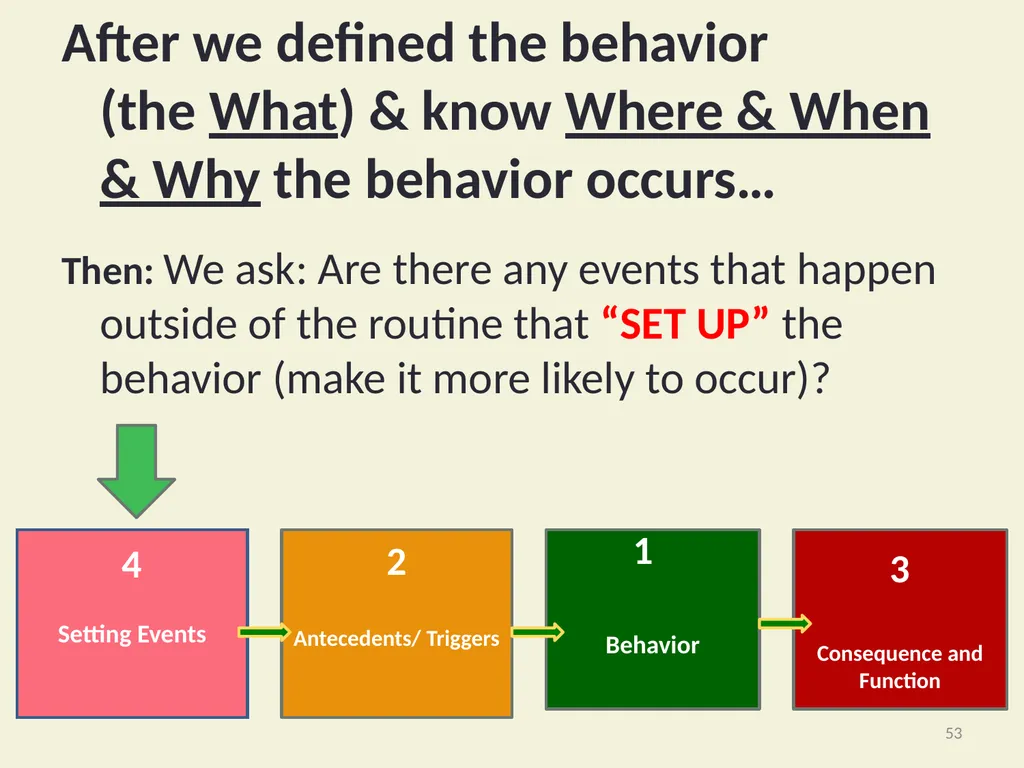
After we defined the behavior (the What) & know Where & When & Why the behavior occurs…
Then: We ask: Are there any events that happen outside of the routine that “SET UP” the behavior (make it more likely to occur)? 2
Antecedents/ Triggers 1
Behavior 3
Consequence and Function 4
Setting Events 53<br>
Then: We ask: Are there any events that happen outside of the routine that “SET UP” the behavior (make it more likely to occur)? 2
Antecedents/ Triggers 1
Behavior 3
Consequence and Function 4
Setting Events 53<br>
54
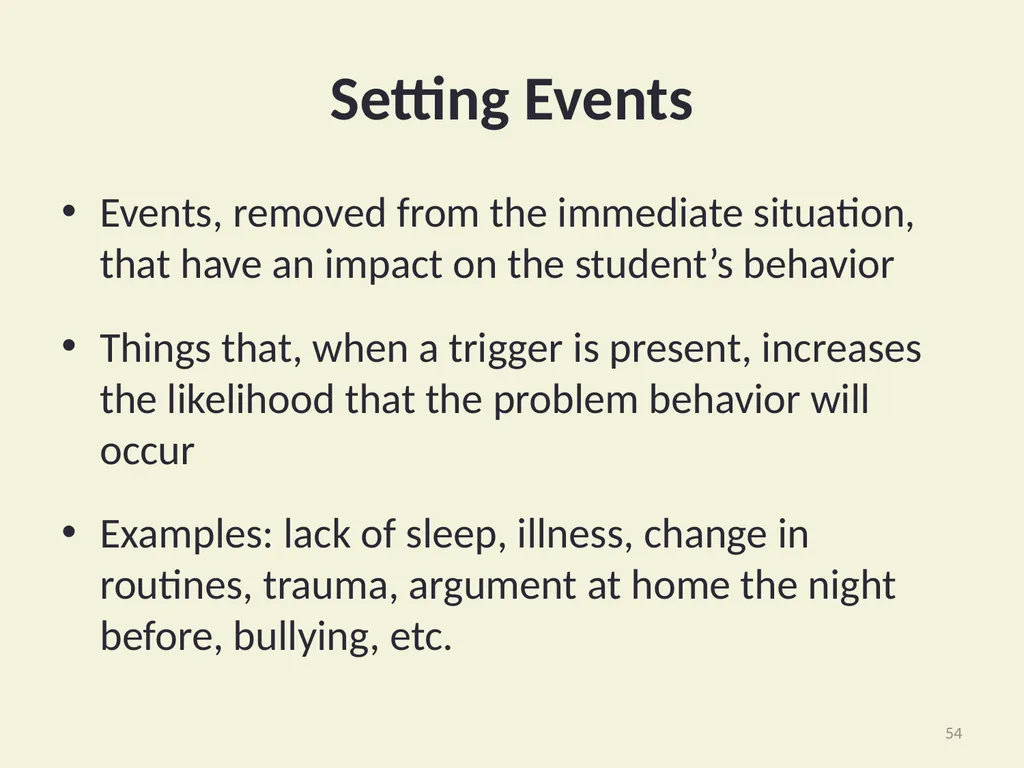
Setting Events Events, removed from the immediate situation, that have an impact on the student’s behavior
Things that, when a trigger is present, increases the likelihood that the problem behavior will occur
Examples: lack of sleep, illness, change in routines, trauma, argument at home the night before, bullying, etc. 54<br>
Things that, when a trigger is present, increases the likelihood that the problem behavior will occur
Examples: lack of sleep, illness, change in routines, trauma, argument at home the night before, bullying, etc. 54<br>
55
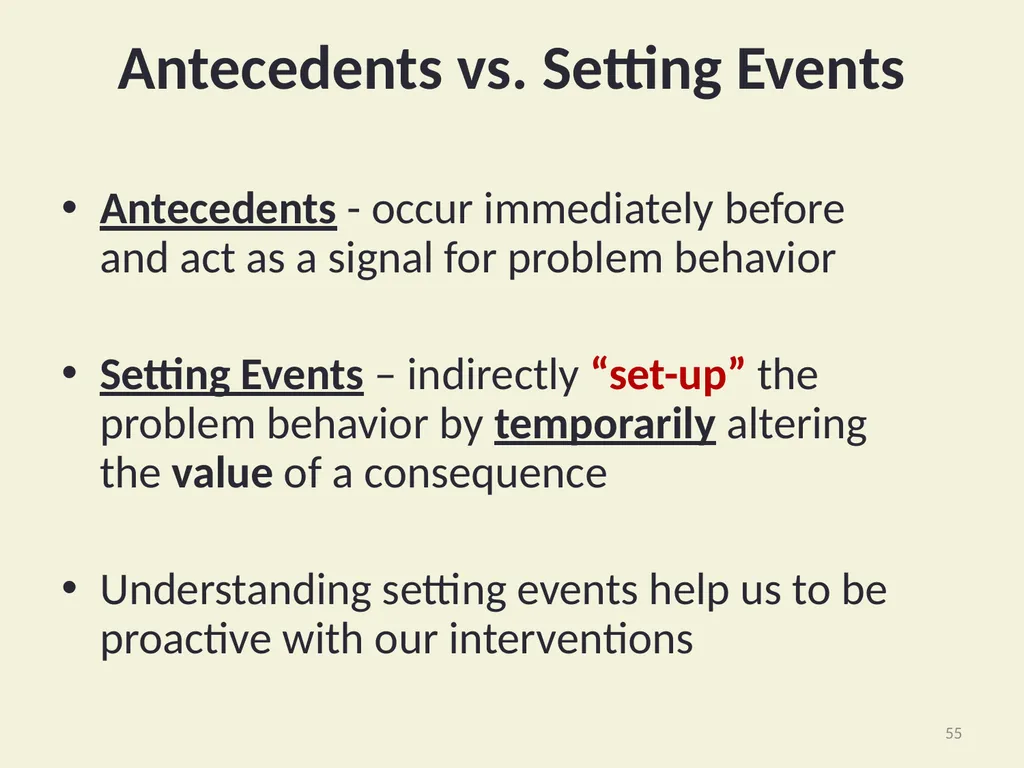
Antecedents vs. Setting Events Antecedents - occur immediately before and act as a signal for problem behavior
Setting Events – indirectly “set-up” the problem behavior by temporarily altering the value of a consequence
Understanding setting events help us to be proactive with our interventions 55<br>
Setting Events – indirectly “set-up” the problem behavior by temporarily altering the value of a consequence
Understanding setting events help us to be proactive with our interventions 55<br>
56
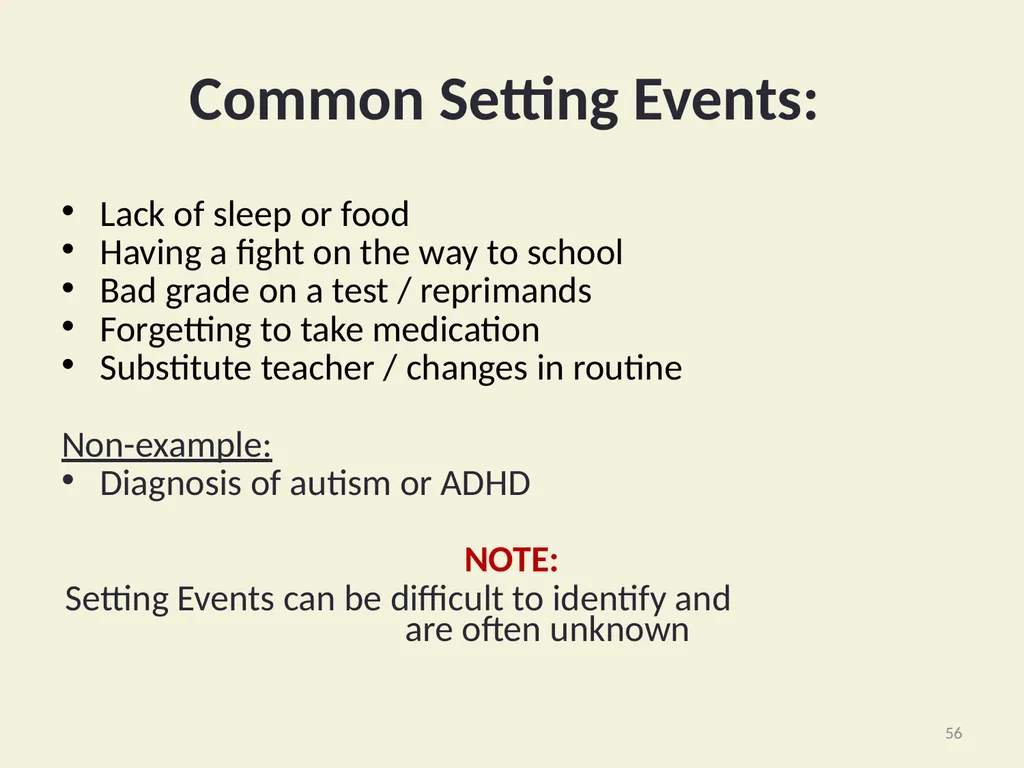
Common Setting Events: Lack of sleep or food
Having a fight on the way to school
Bad grade on a test / reprimands
Forgetting to take medication
Substitute teacher / changes in routine
Non-example:
Diagnosis of autism or ADHD
NOTE:
Setting Events can be difficult to identify and are often unknown 56<br>
Having a fight on the way to school
Bad grade on a test / reprimands
Forgetting to take medication
Substitute teacher / changes in routine
Non-example:
Diagnosis of autism or ADHD
NOTE:
Setting Events can be difficult to identify and are often unknown 56<br>
57
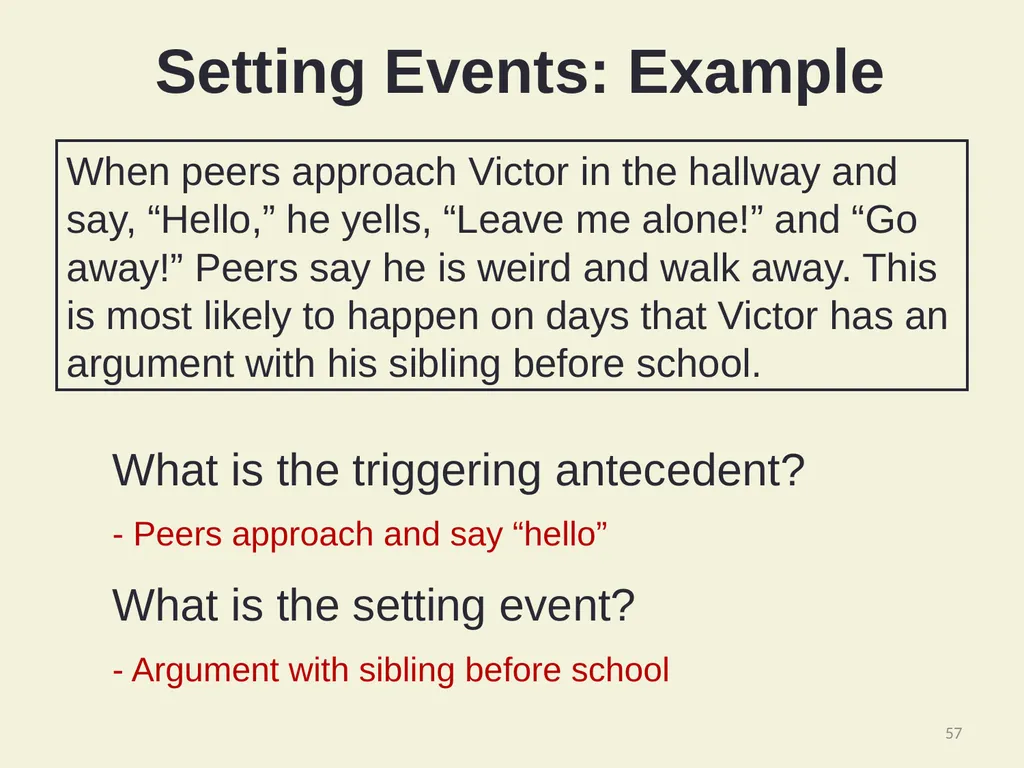
When peers approach Victor in the hallway and say, “Hello,” he yells, “Leave me alone!” and “Go away!” Peers say he is weird and walk away. This is most likely to happen on days that Victor has an argument with his sibling before school. What is the triggering antecedent?
- Peers approach and say “hello”
What is the setting event?
- Argument with sibling before school Setting Events: Example 57<br>
- Peers approach and say “hello”
What is the setting event?
- Argument with sibling before school Setting Events: Example 57<br>
58
ACTIVITY 6: Using your workbook, identify the following in the scenarios:
* The triggering antecedent
* The most likely FUNCTION of the problem
behavior
* The setting event 58<br>
* The triggering antecedent
* The most likely FUNCTION of the problem
behavior
* The setting event 58<br>
59
Teacher sends him
to the office
Function: Scenario #1
When Jason is asked to outline a book chapter in Language Arts, he often argues, refuses to work and uses profanity which results in being sent to the office for ‘disrespect’. This behavior is more likely if Jason has an altercation with a peer on the bus on the way to school. Setting event Antecedent Behavior Consequence Peer altercation on bus on the way to school Asked to outline chapter Arguing with teacher, refusing to work, profanity Routine: Language Arts Escape Task 59<br>
to the office
Function: Scenario #1
When Jason is asked to outline a book chapter in Language Arts, he often argues, refuses to work and uses profanity which results in being sent to the office for ‘disrespect’. This behavior is more likely if Jason has an altercation with a peer on the bus on the way to school. Setting event Antecedent Behavior Consequence Peer altercation on bus on the way to school Asked to outline chapter Arguing with teacher, refusing to work, profanity Routine: Language Arts Escape Task 59<br>
60
EA talks privately with the student
Function: Scenario #2
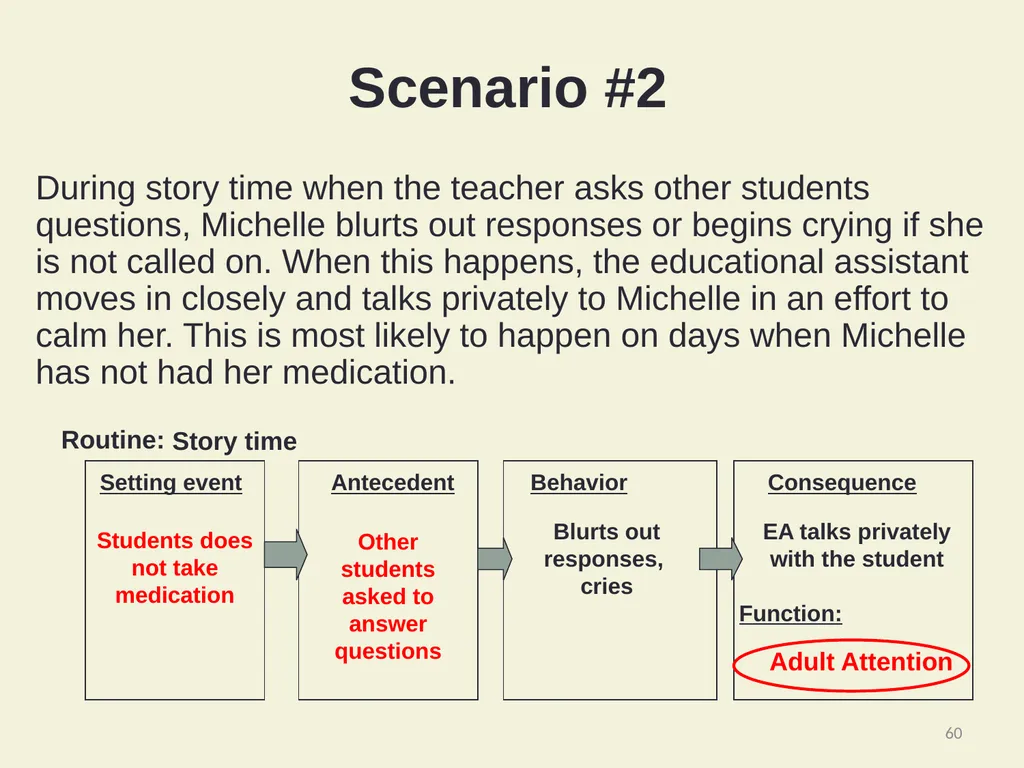
During story time when the teacher asks other students questions, Michelle blurts out responses or begins crying if she is not called on. When this happens, the educational assistant moves in closely and talks privately to Michelle in an effort to calm her. This is most likely to happen on days when Michelle has not had her medication. Setting event Antecedent Behavior Consequence Students does not take medication Other students asked to answer questions Blurts out responses, cries Routine: Story time Adult Attention 60<br>
Function: Scenario #2
During story time when the teacher asks other students questions, Michelle blurts out responses or begins crying if she is not called on. When this happens, the educational assistant moves in closely and talks privately to Michelle in an effort to calm her. This is most likely to happen on days when Michelle has not had her medication. Setting event Antecedent Behavior Consequence Students does not take medication Other students asked to answer questions Blurts out responses, cries Routine: Story time Adult Attention 60<br>
61
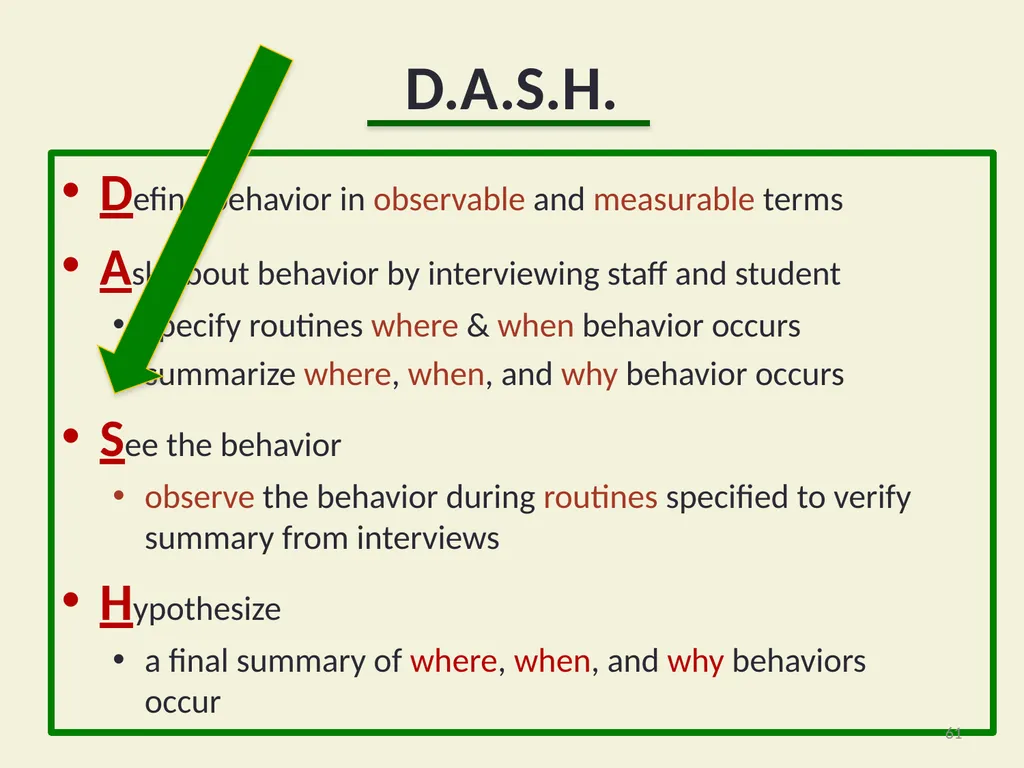
D.A.S.H. Define behavior in observable and measurable terms
Ask about behavior by interviewing staff and student
specify routines where & when behavior occurs
summarize where, when, and why behavior occurs
See the behavior
observe the behavior during routines specified to verify summary from interviews
Hypothesize
a final summary of where, when, and why behaviors occur 61<br>
Ask about behavior by interviewing staff and student
specify routines where & when behavior occurs
summarize where, when, and why behavior occurs
See the behavior
observe the behavior during routines specified to verify summary from interviews
Hypothesize
a final summary of where, when, and why behaviors occur 61<br>
62
Seeing
or observing the behavior
to verify summary from interviews 62<br>
63
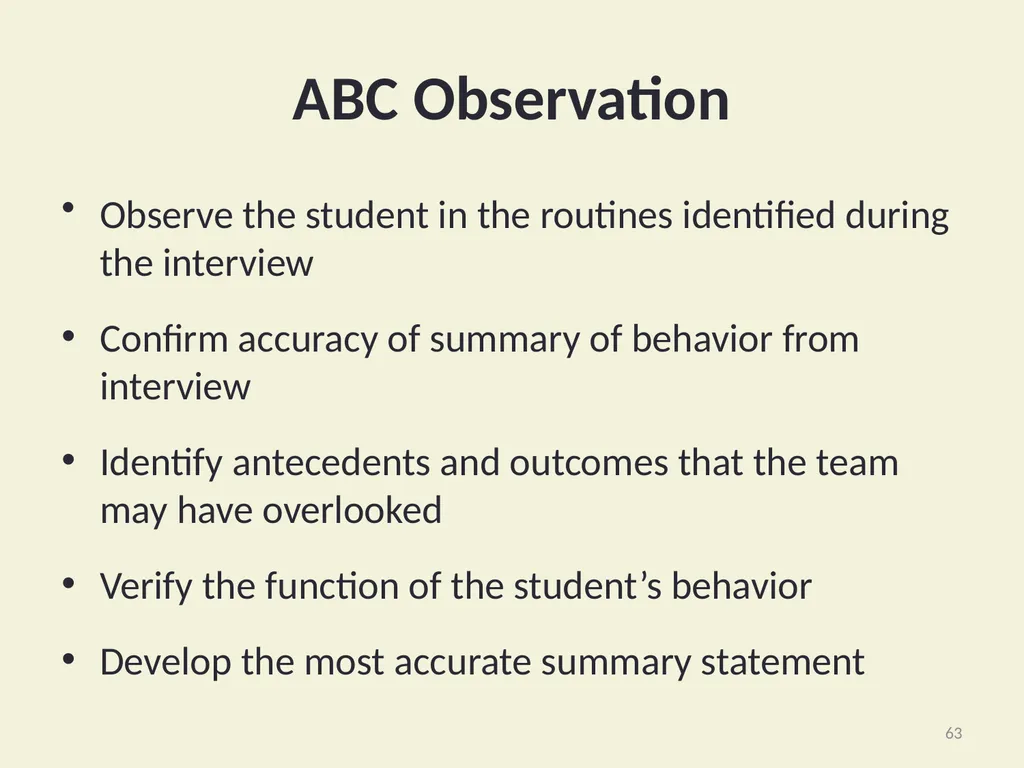
ABC Observation Observe the student in the routines identified during the interview
Confirm accuracy of summary of behavior from interview
Identify antecedents and outcomes that the team may have overlooked
Verify the function of the student’s behavior
Develop the most accurate summary statement 63<br>
Confirm accuracy of summary of behavior from interview
Identify antecedents and outcomes that the team may have overlooked
Verify the function of the student’s behavior
Develop the most accurate summary statement 63<br>
64
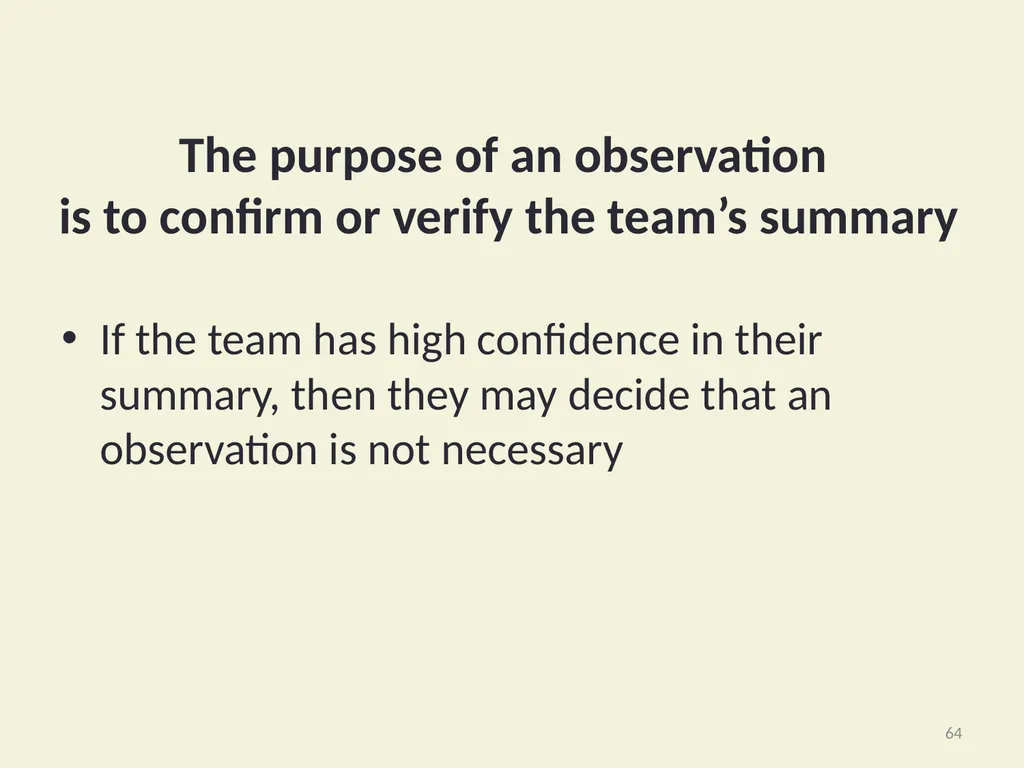
The purpose of an observation
is to confirm or verify the team’s summary If the team has high confidence in their summary, then they may decide that an observation is not necessary 64<br>
65
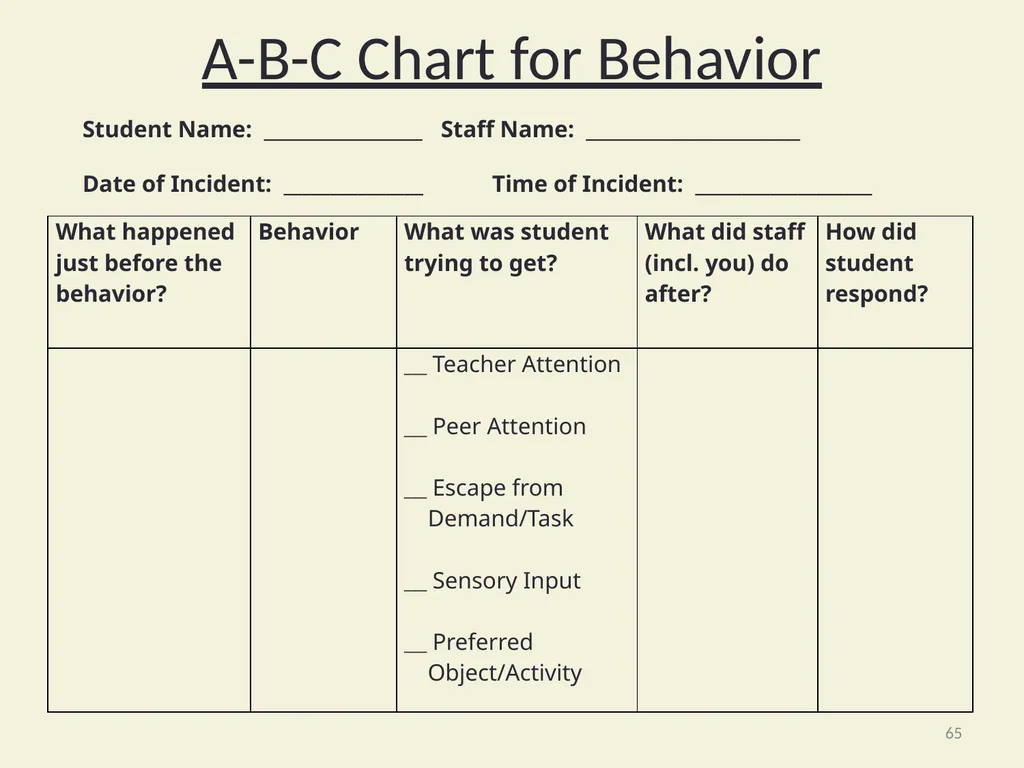
A-B-C Chart for Behavior 65 Student Name: _________________ Staff Name: _______________________
Date of Incident: _______________ Time of Incident: ___________________<br>
Date of Incident: _______________ Time of Incident: ___________________<br>
66
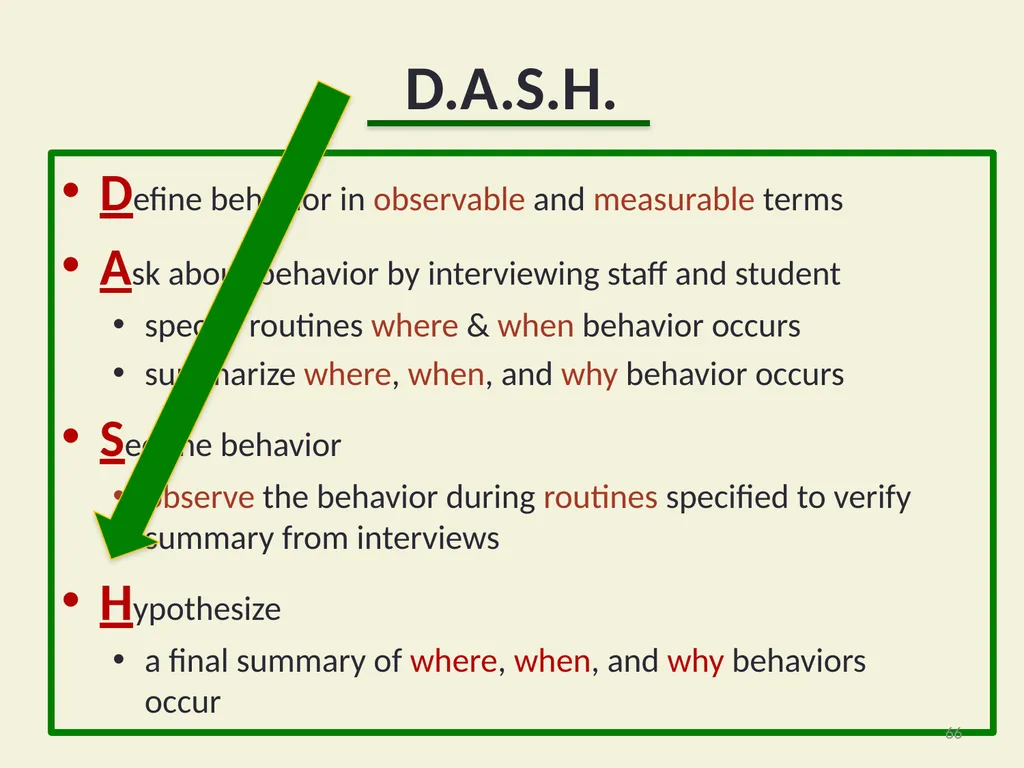
D.A.S.H. Define behavior in observable and measurable terms
Ask about behavior by interviewing staff and student
specify routines where & when behavior occurs
summarize where, when, and why behavior occurs
See the behavior
observe the behavior during routines specified to verify summary from interviews
Hypothesize
a final summary of where, when, and why behaviors occur 66<br>
Ask about behavior by interviewing staff and student
specify routines where & when behavior occurs
summarize where, when, and why behavior occurs
See the behavior
observe the behavior during routines specified to verify summary from interviews
Hypothesize
a final summary of where, when, and why behaviors occur 66<br>
67
Hypothesizing
a final summary
of where, when, and why
behaviors occur 67<br>
68
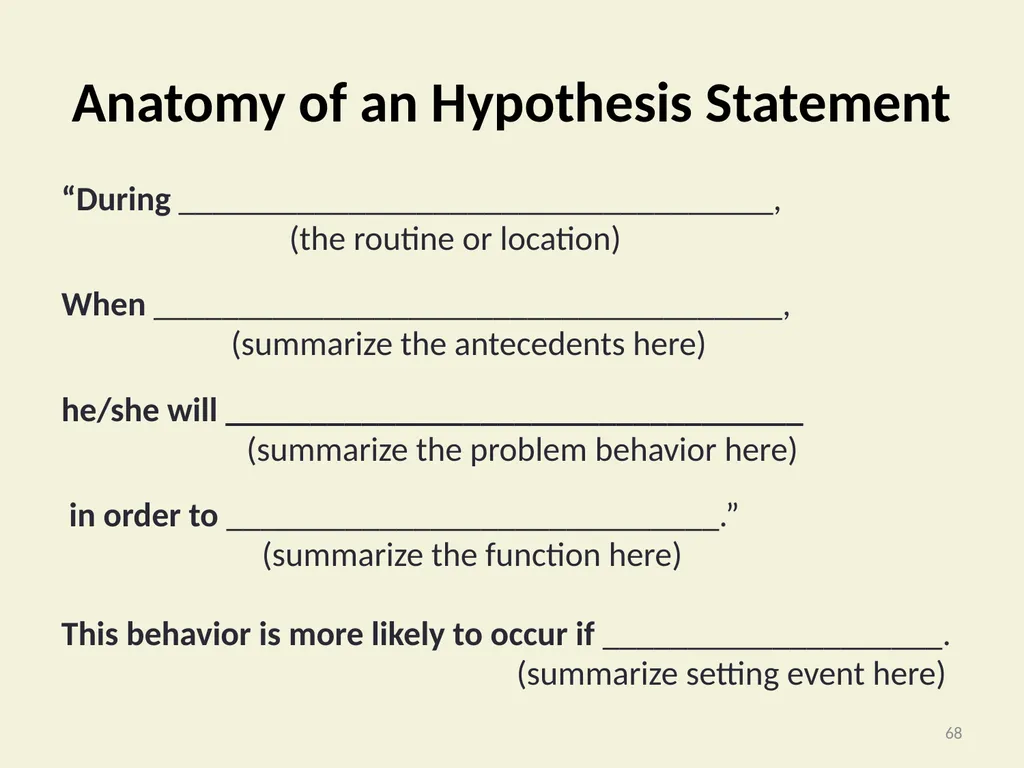
Anatomy of an Hypothesis Statement “During ___________________________________,
(the routine or location)
When _____________________________________,
(summarize the antecedents here)
he/she will __________________________________
(summarize the problem behavior here)
in order to _____________________________.”
(summarize the function here)
This behavior is more likely to occur if ____________________.
(summarize setting event here) 68<br>
(the routine or location)
When _____________________________________,
(summarize the antecedents here)
he/she will __________________________________
(summarize the problem behavior here)
in order to _____________________________.”
(summarize the function here)
This behavior is more likely to occur if ____________________.
(summarize setting event here) 68<br>
69
ACTIVITY 7: Using your workbook,
Complete the behavior pathway for your student
Create your hypothesis statement 69<br>
Complete the behavior pathway for your student
Create your hypothesis statement 69<br>
70
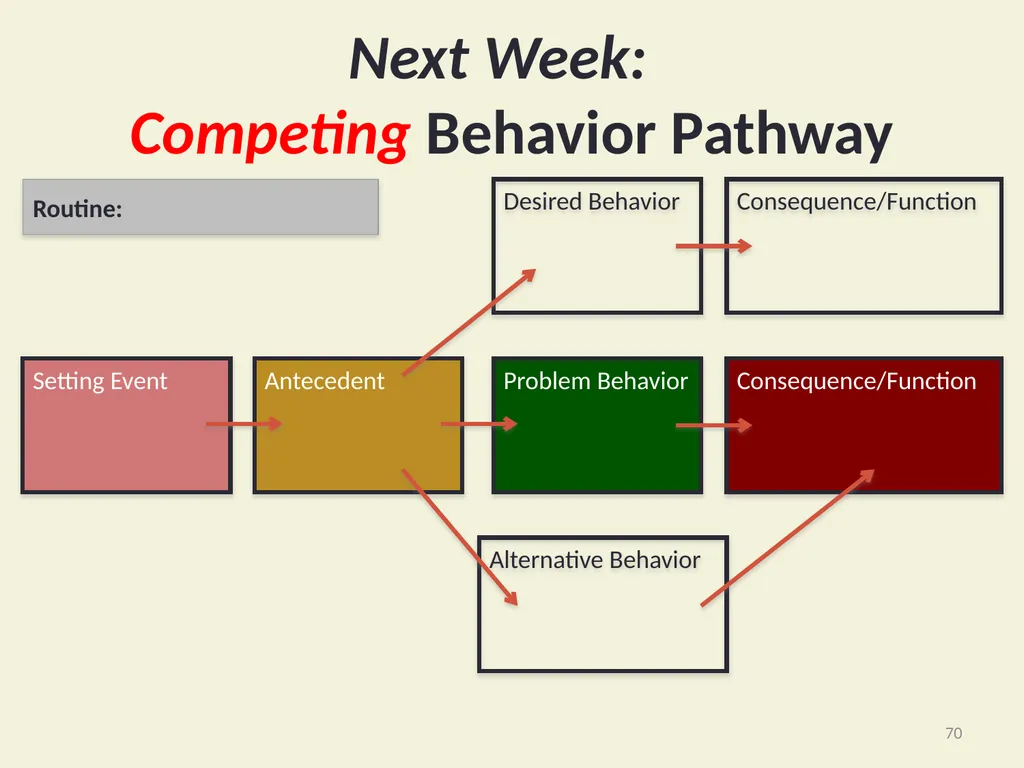
Next Week:
Competing Behavior Pathway Desi Routine: Desired Behavior Consequence/Function Setting Event Antecedent Problem Behavior Consequence/Function Alternative Behavior 70<br>
71
Homework Gather more information on the student you’ve identified using the interview section of the F-BSP Protocol (ideally in a team meeting)
Conduct observations to verify the information gathered thus far
Working with others, confirm/finalize a hypothesis statement for your student 71<br>
Conduct observations to verify the information gathered thus far
Working with others, confirm/finalize a hypothesis statement for your student 71<br>
72
Questions?
THANK YOU! www.pbisvermont.org 72<br>