
Basic ICD 10-CM/PCS and ICD-9-CM Coding, 2015
DJ
Published · 54 slides · 0 views
1 / 1
Description
Basic ICD 10-CMPCS and ICD-9-CM Coding, 2015 Edition Chapter 3: Introduction to the Uniform Hospital Discharge Data Set and Official Coding Guidelines 2 Learning Objectives Review the chapters learning objectives Concepts in this chapter
Related Topics
Download this presentation From Below
"Basic ICD 10-CM/PCS and ICD-9-CM Coding, 2015" is the property of its rightful owner. Permission is granted to download and print the materials on this website for personal, non-commercial use only, and to display it on your personal computer provided you do not modify the materials and that you retain all copyright notices contained in the materials. By downloading content from our website, you accept the terms of this agreement.
Share
Embed code
Presentation Transcript
01
Basic ICD 10-CM/PCS and ICD-9-CM Coding, 2015 Edition Chapter 3: Introduction to the Uniform Hospital Discharge Data Set and Official Coding Guidelines<br>
02
2 Learning Objectives Review the chapter’s learning objectives
Concepts in this chapter may require extra time to study
Recognize the importance of learning about:
UHDDS elements including principal diagnosis, other diagnoses, complication, comorbidity, significant procedure, and principal procedure definitions
Uniform Bill 04
Official coding guidelines<br>
Concepts in this chapter may require extra time to study
Recognize the importance of learning about:
UHDDS elements including principal diagnosis, other diagnoses, complication, comorbidity, significant procedure, and principal procedure definitions
Uniform Bill 04
Official coding guidelines<br>
03
3 UHDDS Uniform Hospital Discharge Data Set
Minimum, common core set of data
Originally intended for acute care, short-term hospitals
Application of UHDDS definitions has been expanded to include all non-outpatient settings, including acute care, short term, long-term care, and psychiatric hospitals; home health agencies, rehab facilities, nursing homes, and such<br>
Minimum, common core set of data
Originally intended for acute care, short-term hospitals
Application of UHDDS definitions has been expanded to include all non-outpatient settings, including acute care, short term, long-term care, and psychiatric hospitals; home health agencies, rehab facilities, nursing homes, and such<br>
04
4 UHDDS Data Elements Specific items regarding patients and their care:
Personal identification number: health record number
Date of birth
Sex
Race
Ethnicity (Hispanic/Non Hispanic)
Residence: zip code or code for foreign residence<br>
Personal identification number: health record number
Date of birth
Sex
Race
Ethnicity (Hispanic/Non Hispanic)
Residence: zip code or code for foreign residence<br>
05
5 UHDDS Data Elements (continued) Specific items (continued)
Hospital identification: provider number
Admission and discharge dates
Physician identification: physician number
Disposition of patient
Expected payer for most of the bill<br>
Hospital identification: provider number
Admission and discharge dates
Physician identification: physician number
Disposition of patient
Expected payer for most of the bill<br>
06
6 UHDDS Data Elements (continued) Clinical information is part of UHDDS
All diagnoses affecting the current hospital stay must be reported
All significant procedures, dates, and person performing the procedure must be reported
Definition of principal and secondary diagnosis and procedure included in UHDDS<br>
All diagnoses affecting the current hospital stay must be reported
All significant procedures, dates, and person performing the procedure must be reported
Definition of principal and secondary diagnosis and procedure included in UHDDS<br>
07
7 Principal and Other Diagnoses Principal diagnosis
The condition established after study to be chiefly responsible for occasioning the admission of the patient to the hospital for care
Other diagnoses
All conditions that coexist at the time of admission, that develop subsequently, or that affect treatment received and/or length of stay<br>
The condition established after study to be chiefly responsible for occasioning the admission of the patient to the hospital for care
Other diagnoses
All conditions that coexist at the time of admission, that develop subsequently, or that affect treatment received and/or length of stay<br>
08
8 Complications and Comorbidities A complication or comorbidity is defined as additional diagnosis that may have an impact on the payment received through the Medicare-severity diagnosis-related group (MS-DRG) inpatient acute care prospective payment system from Medicare<br>
09
9 Significant Procedure Significant procedure
All significant procedures are to be reported
A procedure is identified as significant when it:
Is surgical in nature
Carries a procedural risk
Carries an anesthetic risk
Requires specialized training<br>
All significant procedures are to be reported
A procedure is identified as significant when it:
Is surgical in nature
Carries a procedural risk
Carries an anesthetic risk
Requires specialized training<br>
10
10 Principal Procedure Principal procedure
Procedure is performed for definitive treatment rather than for diagnostic or exploratory purposes or is necessary to take care of a complication
If two procedures appear to be principal, the one most related to the principal diagnosis should be selected<br>
Procedure is performed for definitive treatment rather than for diagnostic or exploratory purposes or is necessary to take care of a complication
If two procedures appear to be principal, the one most related to the principal diagnosis should be selected<br>
11
11 UHDDS Data Elements Complication
An additional diagnosis that describes a condition arising after the beginning of the hospital observation and treatment and then modifying the course of the patient’s illness or the medical care required
Comorbidity
A pre-existing condition that, because of its presence with a specific principal diagnosis, will cause an increase in the patient’s length of stay<br>
An additional diagnosis that describes a condition arising after the beginning of the hospital observation and treatment and then modifying the course of the patient’s illness or the medical care required
Comorbidity
A pre-existing condition that, because of its presence with a specific principal diagnosis, will cause an increase in the patient’s length of stay<br>
12
12 Uniform Bill-04 See Appendix F for sample UB-04 institutional paper claim form, with an electronic claims version 4010
Used for Medicare Part A and other payer claims from hospitals and other healthcare institutions (home care, skilled nursing facility care)
Eighteen diagnosis codes
In addition, there are spaces for:
One admitting diagnosis,
Three reason for visit diagnoses,
Three E-codes
Six procedure codes and dates<br>
Used for Medicare Part A and other payer claims from hospitals and other healthcare institutions (home care, skilled nursing facility care)
Eighteen diagnosis codes
In addition, there are spaces for:
One admitting diagnosis,
Three reason for visit diagnoses,
Three E-codes
Six procedure codes and dates<br>
13
Expanded Number of Codes Effective 1/1/2011, CMS expanded the number of ICD-9-CM diagnosis and procedure codes allowed to be processed on institutional claims through the implementation of version 5010/837I of the electronic claims transaction standards.
Commonly referred to as the 837I, most likely used for claim submissions by institutions 13<br>
Commonly referred to as the 837I, most likely used for claim submissions by institutions 13<br>
14
Expanded Number of Codes 25 diagnosis codes with associated present on admission indicator
1 Principal diagnosis
24 Additional diagnosis
25 procedure codes 14<br>
1 Principal diagnosis
24 Additional diagnosis
25 procedure codes 14<br>
15
15 Present on Admission (POA) Diagnosis “indicator” to be reported with each diagnosis code—was condition present on admission?
Four choices: Yes, No, Documentation insufficient, or Clinically undetermined
Reported for discharges from acute care hospitals or other facilities as required<br>
Four choices: Yes, No, Documentation insufficient, or Clinically undetermined
Reported for discharges from acute care hospitals or other facilities as required<br>
16
16 Present on Admission (POA) Comprehensive POA guidelines are included in the ICD-9-CM Official Guidelines for Coding and Reporting
Guidelines were created by The Cooperating Parties for ICD-9-CM that include a representative from
AHIMA, AHA, CMS, and National Center for Health Statistics (NCHS)<br>
Guidelines were created by The Cooperating Parties for ICD-9-CM that include a representative from
AHIMA, AHA, CMS, and National Center for Health Statistics (NCHS)<br>
17
17 Principal Diagnosis Definition Principal diagnosis is “the condition established after study to be chiefly responsible for occasioning the admission of the patient to the hospital for care”
Principal diagnosis relates only to inpatient care
Specific guidelines must be followed<br>
Principal diagnosis relates only to inpatient care
Specific guidelines must be followed<br>
18
18 Selection of Principal Diagnosis Relates only to all inpatient settings to report patient data
Not applied to coding of outpatient visits
Depends on circumstances of admission
Related to but not the same as admitting diagnosis
Key words “after study” are integral part of the principal diagnosis definition<br>
Not applied to coding of outpatient visits
Depends on circumstances of admission
Related to but not the same as admitting diagnosis
Key words “after study” are integral part of the principal diagnosis definition<br>
19
19 Official ICD-9-CM Guidelines Official ICD-9-CM guidelines for coding and reporting are used to select principal and other diagnoses
Guidelines printed in most publishers’ versions of ICD-9-CM code books<br>
Guidelines printed in most publishers’ versions of ICD-9-CM code books<br>
20
20 Official ICD-9-CM Guidelines—Principal Diagnosis Review principal diagnosis guidelines for:
Codes for symptoms, signs, and ill-defined conditions
Two or more interrelated conditions
Two or more diagnoses that equally meet the definition for principal diagnosis<br>
Codes for symptoms, signs, and ill-defined conditions
Two or more interrelated conditions
Two or more diagnoses that equally meet the definition for principal diagnosis<br>
21
21 Official ICD-9-CM Guidelines—Principal Diagnosis (continued) Review principal diagnosis guidelines for:
Two or more comparative or contrasting conditions
A symptom(s) followed by contrasting/comparative diagnoses
Original treatment plan not carried out<br>
Two or more comparative or contrasting conditions
A symptom(s) followed by contrasting/comparative diagnoses
Original treatment plan not carried out<br>
22
22 Official ICD-9-CM Guidelines—Principal Diagnosis (continued) Review principal diagnosis guidelines for:
Complications of surgery or other medical care
Uncertain diagnosis
Admission from observation unit
Admission from outpatient surgery<br>
Complications of surgery or other medical care
Uncertain diagnosis
Admission from observation unit
Admission from outpatient surgery<br>
23
23 Official ICD-9-CM Guidelines—Additional Diagnosis Reporting of additional diagnoses
All conditions that coexist at the time of the admission, that develop subsequently, or that affect the treatment received and/or the length of stay
Review additional diagnosis guidelines for:
Previous conditions
Abnormal findings
Uncertain diagnosis<br>
All conditions that coexist at the time of the admission, that develop subsequently, or that affect the treatment received and/or the length of stay
Review additional diagnosis guidelines for:
Previous conditions
Abnormal findings
Uncertain diagnosis<br>
24
ICD-10-CM Official Guidelines for Coding and Reporting Developed by the Cooperating Parties (AHA, AHIMA, CMS, NCHS)
Section I
Structure and conventions of ICD-10-CM and the general guidelines that apply to the entire classification system
These are the fundamental coding rules for assigning ICD-9-CM codes 24<br>
Section I
Structure and conventions of ICD-10-CM and the general guidelines that apply to the entire classification system
These are the fundamental coding rules for assigning ICD-9-CM codes 24<br>
25
ICD-10-CM Official Guidelines for Coding and Reporting Section II
Principal diagnosis selection
In determining the principal diagnosis, the coding conventions in ICD-10-CM, the Tabular List and the Alphabetic Index take precedence over all other guidelines
The importance of consistent, complete documentation in the medical record cannot be overemphasized 25<br>
Principal diagnosis selection
In determining the principal diagnosis, the coding conventions in ICD-10-CM, the Tabular List and the Alphabetic Index take precedence over all other guidelines
The importance of consistent, complete documentation in the medical record cannot be overemphasized 25<br>
26
ICD-10-CM Official Guidelines for Coding and Reporting Section II, Principal diagnosis selection
Review the ICD-10-CM guidelines
Guideline II.A
Codes for symptoms, signs and ill-defined conditions
Guideline II.A
Two or more interrelated conditions, each potentially meeting the definition for principal diagnosis 26<br>
Review the ICD-10-CM guidelines
Guideline II.A
Codes for symptoms, signs and ill-defined conditions
Guideline II.A
Two or more interrelated conditions, each potentially meeting the definition for principal diagnosis 26<br>
27
ICD-10-CM Official Guidelines for Coding and Reporting Section II, Principal diagnosis selection
Review the ICD-10-CM guidelines
Guideline II.C
Two or more diagnosis that equally meet the definition for principal diagnosis
Guideline II.D
Two or more comparative or contrasting conditions 27<br>
Review the ICD-10-CM guidelines
Guideline II.C
Two or more diagnosis that equally meet the definition for principal diagnosis
Guideline II.D
Two or more comparative or contrasting conditions 27<br>
28
ICD-10-CM Official Guidelines for Coding and Reporting Section II, Principal diagnosis selection
Review the ICD-10-CM guidelines
Guideline II.E
A symptom(s) followed by contrasting or comparative diagnoses
NOTE: Guideline II.E has been deleted effective October 1, 2014
This change does not apply to ICD-9-CM guidelines 28<br>
Review the ICD-10-CM guidelines
Guideline II.E
A symptom(s) followed by contrasting or comparative diagnoses
NOTE: Guideline II.E has been deleted effective October 1, 2014
This change does not apply to ICD-9-CM guidelines 28<br>
29
ICD-10-CM Official Guidelines for Coding and Reporting Section II, Principal diagnosis selection
Review the ICD-10-CM guidelines
Guideline II.F
Original treatment plan not carried out
Guideline II.G.
Complications of surgery and other medical care 29<br>
Review the ICD-10-CM guidelines
Guideline II.F
Original treatment plan not carried out
Guideline II.G.
Complications of surgery and other medical care 29<br>
30
ICD-10-CM Official Guidelines for Coding and Reporting Section II, Principal diagnosis selection
Review the ICD-10-CM guidelines
Guideline II.H
Uncertain diagnosis
Guideline II.I
Admission from observation unit
Admission following medical observation
Admission following postoperative observation 30<br>
Review the ICD-10-CM guidelines
Guideline II.H
Uncertain diagnosis
Guideline II.I
Admission from observation unit
Admission following medical observation
Admission following postoperative observation 30<br>
31
ICD-10-CM Official Guidelines for Coding and Reporting Section II, Review the ICD-10-CM guidelines
Principal diagnosis selection
Guideline II.J
Admission from outpatient surgery
When the reason for the inpatient admission is a complication, assign the complication as the principal diagnosis
When no complication, or other condition, is documented as the reason for admission, assign the reason for the outpatient surgery as the principal diagnosis
When the reason for the inpatient admission is another condition unrelated to the surgery, assign the unrelated condition as the principal diagnosis 31<br>
Principal diagnosis selection
Guideline II.J
Admission from outpatient surgery
When the reason for the inpatient admission is a complication, assign the complication as the principal diagnosis
When no complication, or other condition, is documented as the reason for admission, assign the reason for the outpatient surgery as the principal diagnosis
When the reason for the inpatient admission is another condition unrelated to the surgery, assign the unrelated condition as the principal diagnosis 31<br>
32
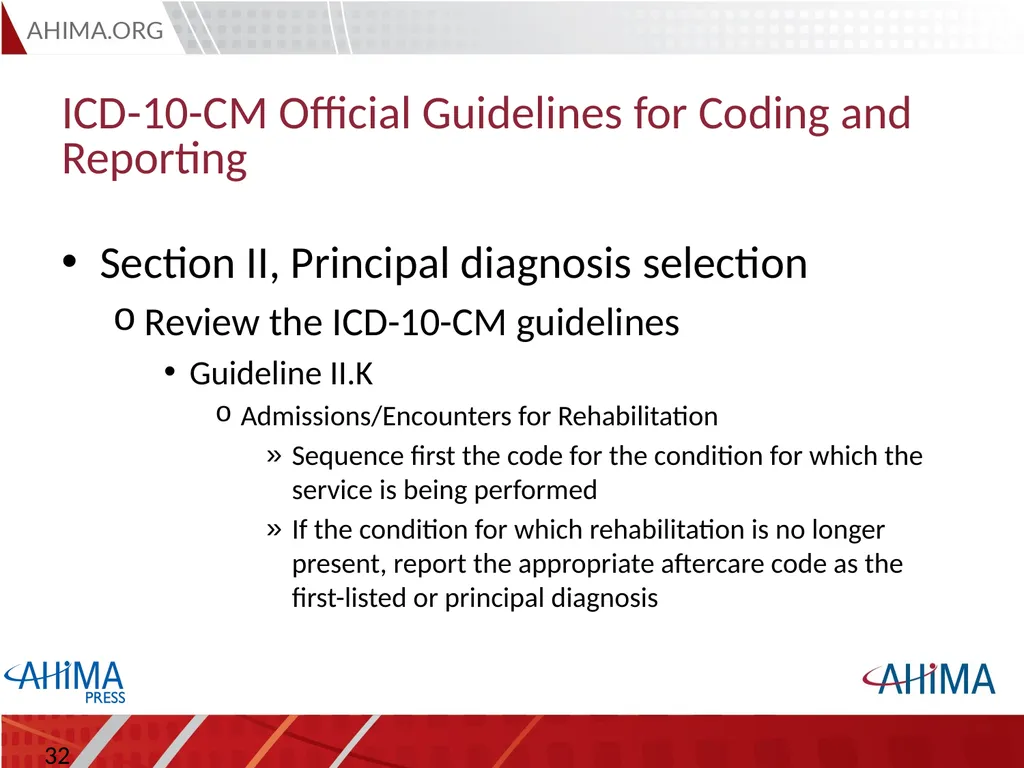
ICD-10-CM Official Guidelines for Coding and Reporting Section II, Principal diagnosis selection
Review the ICD-10-CM guidelines
Guideline II.K
Admissions/Encounters for Rehabilitation
Sequence first the code for the condition for which the service is being performed
If the condition for which rehabilitation is no longer present, report the appropriate aftercare code as the first-listed or principal diagnosis 32<br>
Review the ICD-10-CM guidelines
Guideline II.K
Admissions/Encounters for Rehabilitation
Sequence first the code for the condition for which the service is being performed
If the condition for which rehabilitation is no longer present, report the appropriate aftercare code as the first-listed or principal diagnosis 32<br>
33
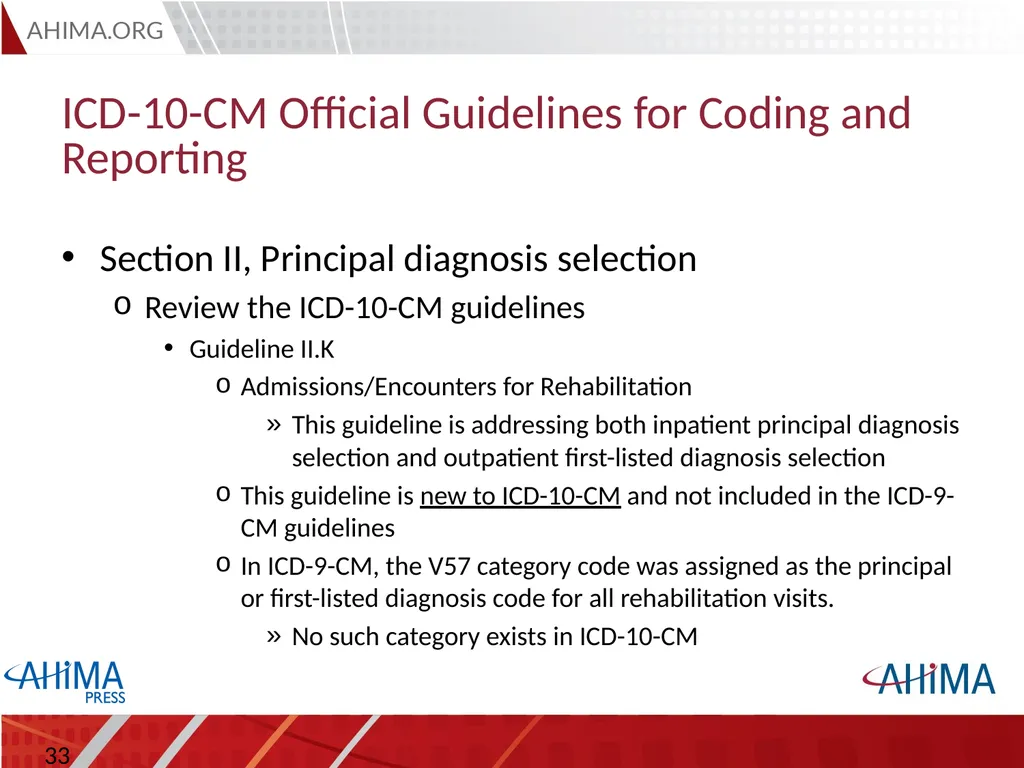
ICD-10-CM Official Guidelines for Coding and Reporting Section II, Principal diagnosis selection
Review the ICD-10-CM guidelines
Guideline II.K
Admissions/Encounters for Rehabilitation
This guideline is addressing both inpatient principal diagnosis selection and outpatient first-listed diagnosis selection
This guideline is new to ICD-10-CM and not included in the ICD-9-CM guidelines
In ICD-9-CM, the V57 category code was assigned as the principal or first-listed diagnosis code for all rehabilitation visits.
No such category exists in ICD-10-CM 33<br>
Review the ICD-10-CM guidelines
Guideline II.K
Admissions/Encounters for Rehabilitation
This guideline is addressing both inpatient principal diagnosis selection and outpatient first-listed diagnosis selection
This guideline is new to ICD-10-CM and not included in the ICD-9-CM guidelines
In ICD-9-CM, the V57 category code was assigned as the principal or first-listed diagnosis code for all rehabilitation visits.
No such category exists in ICD-10-CM 33<br>
34
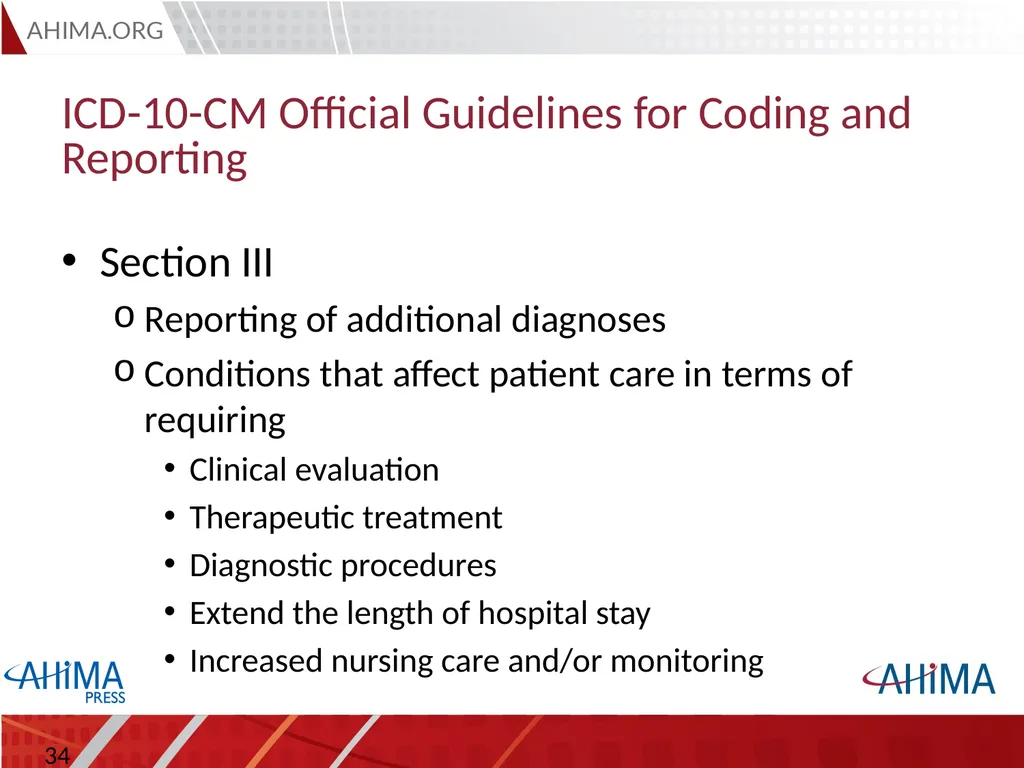
ICD-10-CM Official Guidelines for Coding and Reporting Section III
Reporting of additional diagnoses
Conditions that affect patient care in terms of requiring
Clinical evaluation
Therapeutic treatment
Diagnostic procedures
Extend the length of hospital stay
Increased nursing care and/or monitoring 34<br>
Reporting of additional diagnoses
Conditions that affect patient care in terms of requiring
Clinical evaluation
Therapeutic treatment
Diagnostic procedures
Extend the length of hospital stay
Increased nursing care and/or monitoring 34<br>
35
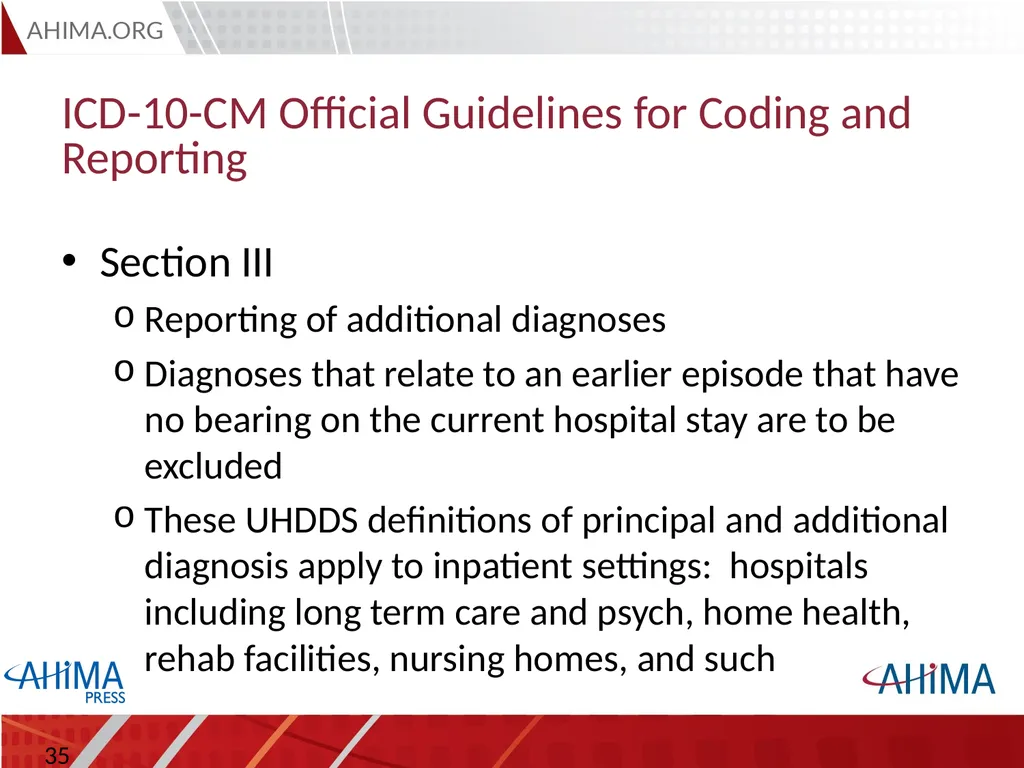
ICD-10-CM Official Guidelines for Coding and Reporting Section III
Reporting of additional diagnoses
Diagnoses that relate to an earlier episode that have no bearing on the current hospital stay are to be excluded
These UHDDS definitions of principal and additional diagnosis apply to inpatient settings: hospitals including long term care and psych, home health, rehab facilities, nursing homes, and such 35<br>
Reporting of additional diagnoses
Diagnoses that relate to an earlier episode that have no bearing on the current hospital stay are to be excluded
These UHDDS definitions of principal and additional diagnosis apply to inpatient settings: hospitals including long term care and psych, home health, rehab facilities, nursing homes, and such 35<br>
36
ICD-10-CM Official Guidelines for Coding and Reporting Section III
Reporting of additional diagnoses
Guideline III.A Previous conditions
Guideline III.B Abnormal findings
Guideline III.C Uncertain diagnosis
If the diagnosis documented at the time of discharge is qualified as probable, suspected, likely, questionable, possible or still to be ruled out or other similar terms indicating uncertainty, code the condition as if it existed or was established
This guideline is applicable only to inpatient admissions 36<br>
Reporting of additional diagnoses
Guideline III.A Previous conditions
Guideline III.B Abnormal findings
Guideline III.C Uncertain diagnosis
If the diagnosis documented at the time of discharge is qualified as probable, suspected, likely, questionable, possible or still to be ruled out or other similar terms indicating uncertainty, code the condition as if it existed or was established
This guideline is applicable only to inpatient admissions 36<br>
37
ICD-10-CM Official Guidelines for Coding and Reporting Section IV
Guidelines for outpatient coding and reporting
Coding for patient visits in hospital outpatient, physician office or other ambulatory care center
Also clarified by Coding Clinic for ICD-10-CM these guidelines apply to the coding of physician services for professional fee billing regardless of the setting where the physician provided the service 37<br>
Guidelines for outpatient coding and reporting
Coding for patient visits in hospital outpatient, physician office or other ambulatory care center
Also clarified by Coding Clinic for ICD-10-CM these guidelines apply to the coding of physician services for professional fee billing regardless of the setting where the physician provided the service 37<br>
38
ICD-10-CM Official Guidelines for Coding and Reporting Section IV
Guideline IV.A
The term “first-listed” diagnosis is used instead of principal diagnosis in the outpatient settings
Selection of first-listed diagnosis
Outpatient surgery
Code the reason for surgery
Observation stay
For medical observation, code the medical condition 38<br>
Guideline IV.A
The term “first-listed” diagnosis is used instead of principal diagnosis in the outpatient settings
Selection of first-listed diagnosis
Outpatient surgery
Code the reason for surgery
Observation stay
For medical observation, code the medical condition 38<br>
39
ICD-10-CM Official Guidelines for Coding and Reporting Section IV
Guideline IV.B
Codes from A00.0–T88.9, Z00–Z99
Any of these codes can be used
Guideline IV.C
Accurate reporting of ICD-10-CM diagnosis codes
Documentation should describe the patient’s condition 39<br>
Guideline IV.B
Codes from A00.0–T88.9, Z00–Z99
Any of these codes can be used
Guideline IV.C
Accurate reporting of ICD-10-CM diagnosis codes
Documentation should describe the patient’s condition 39<br>
40
ICD-10-CM Official Guidelines for Coding and Reporting Section IV
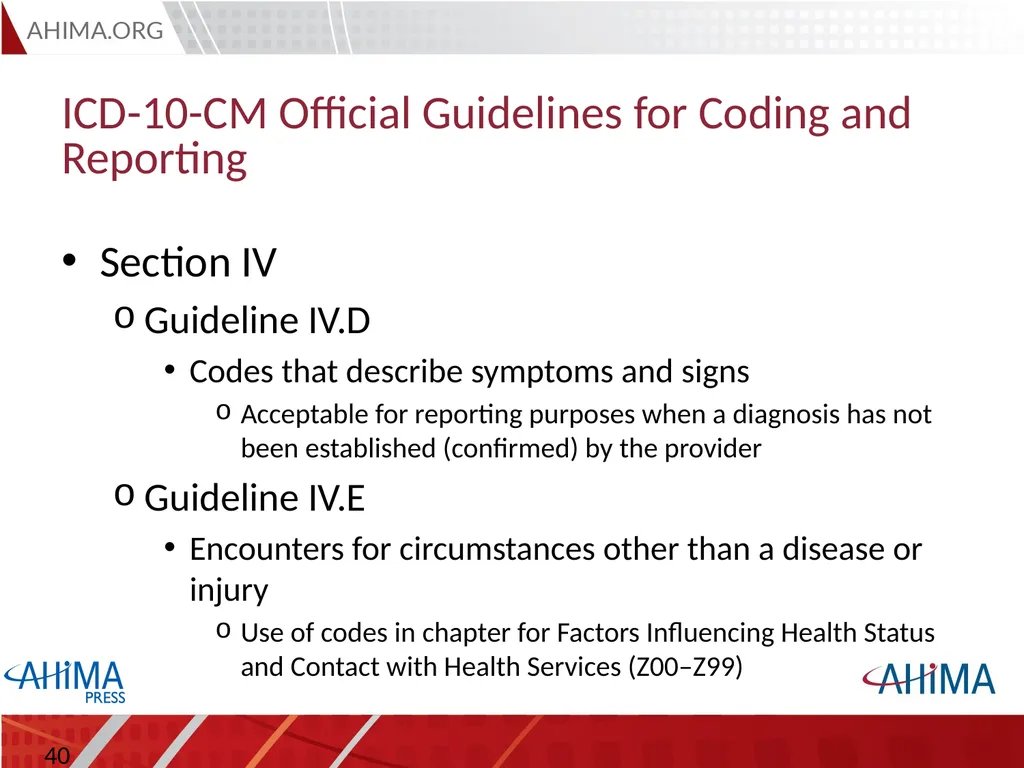
Guideline IV.D
Codes that describe symptoms and signs
Acceptable for reporting purposes when a diagnosis has not been established (confirmed) by the provider
Guideline IV.E
Encounters for circumstances other than a disease or injury
Use of codes in chapter for Factors Influencing Health Status and Contact with Health Services (Z00–Z99) 40<br>
Guideline IV.D
Codes that describe symptoms and signs
Acceptable for reporting purposes when a diagnosis has not been established (confirmed) by the provider
Guideline IV.E
Encounters for circumstances other than a disease or injury
Use of codes in chapter for Factors Influencing Health Status and Contact with Health Services (Z00–Z99) 40<br>
41
ICD-10-CM Official Guidelines for Coding and Reporting Section IV
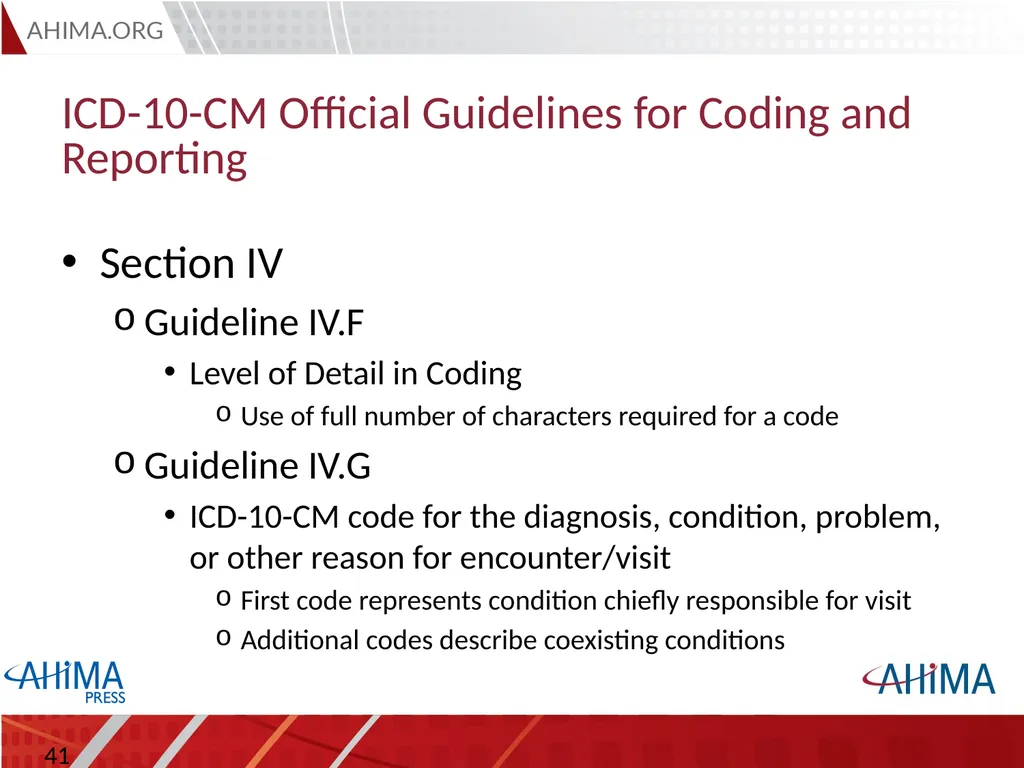
Guideline IV.F
Level of Detail in Coding
Use of full number of characters required for a code
Guideline IV.G
ICD-10-CM code for the diagnosis, condition, problem, or other reason for encounter/visit
First code represents condition chiefly responsible for visit
Additional codes describe coexisting conditions 41<br>
Guideline IV.F
Level of Detail in Coding
Use of full number of characters required for a code
Guideline IV.G
ICD-10-CM code for the diagnosis, condition, problem, or other reason for encounter/visit
First code represents condition chiefly responsible for visit
Additional codes describe coexisting conditions 41<br>
42
ICD-10-CM Official Guidelines for Coding and Reporting Section IV
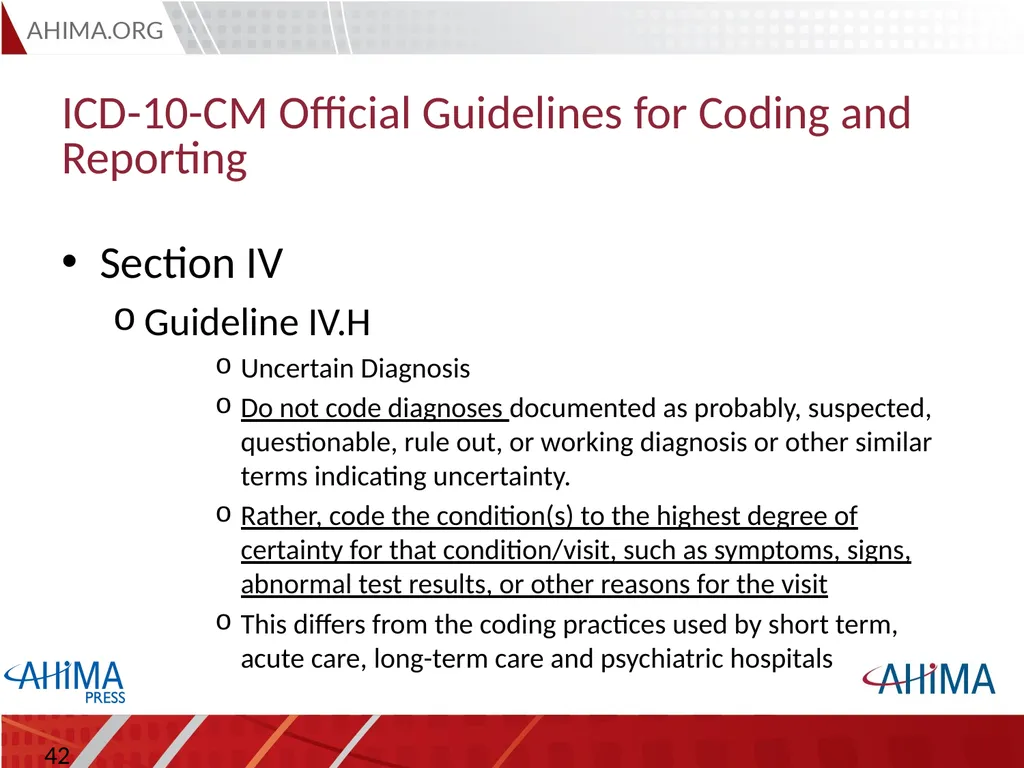
Guideline IV.H
Uncertain Diagnosis
Do not code diagnoses documented as probably, suspected, questionable, rule out, or working diagnosis or other similar terms indicating uncertainty.
Rather, code the condition(s) to the highest degree of certainty for that condition/visit, such as symptoms, signs, abnormal test results, or other reasons for the visit
This differs from the coding practices used by short term, acute care, long-term care and psychiatric hospitals 42<br>
Guideline IV.H
Uncertain Diagnosis
Do not code diagnoses documented as probably, suspected, questionable, rule out, or working diagnosis or other similar terms indicating uncertainty.
Rather, code the condition(s) to the highest degree of certainty for that condition/visit, such as symptoms, signs, abnormal test results, or other reasons for the visit
This differs from the coding practices used by short term, acute care, long-term care and psychiatric hospitals 42<br>
43
ICD-10-CM Official Guidelines for Coding and Reporting Section IV
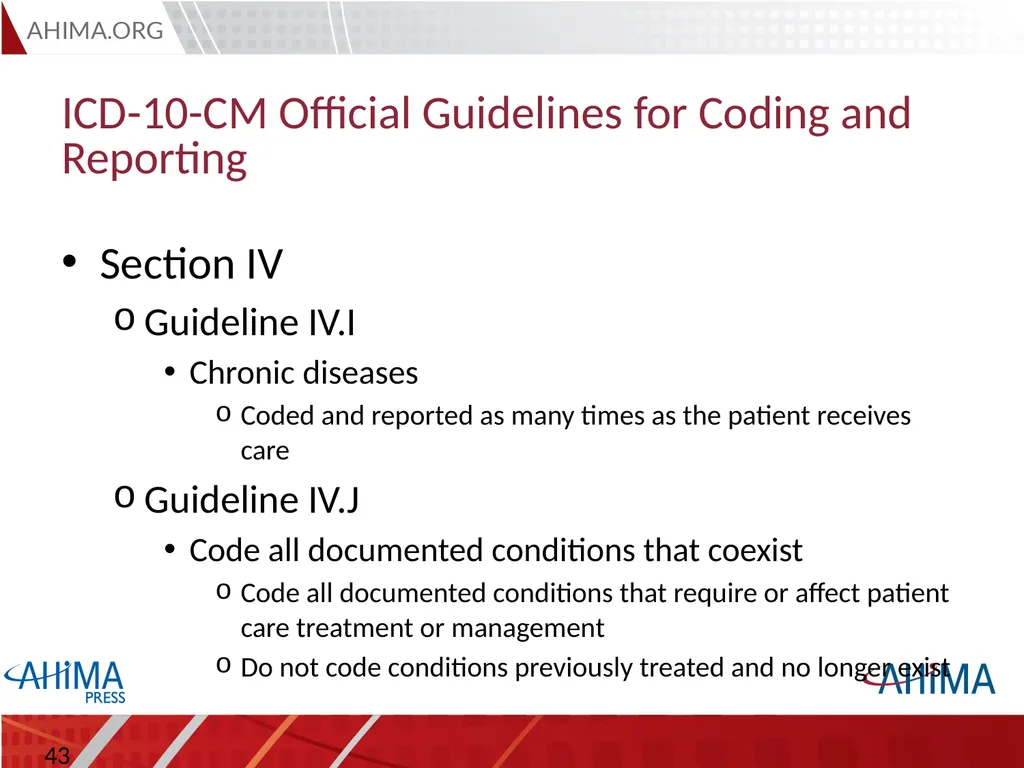
Guideline IV.I
Chronic diseases
Coded and reported as many times as the patient receives care
Guideline IV.J
Code all documented conditions that coexist
Code all documented conditions that require or affect patient care treatment or management
Do not code conditions previously treated and no longer exist 43<br>
Guideline IV.I
Chronic diseases
Coded and reported as many times as the patient receives care
Guideline IV.J
Code all documented conditions that coexist
Code all documented conditions that require or affect patient care treatment or management
Do not code conditions previously treated and no longer exist 43<br>
44
ICD-10-CM Official Guidelines for Coding and Reporting Section IV
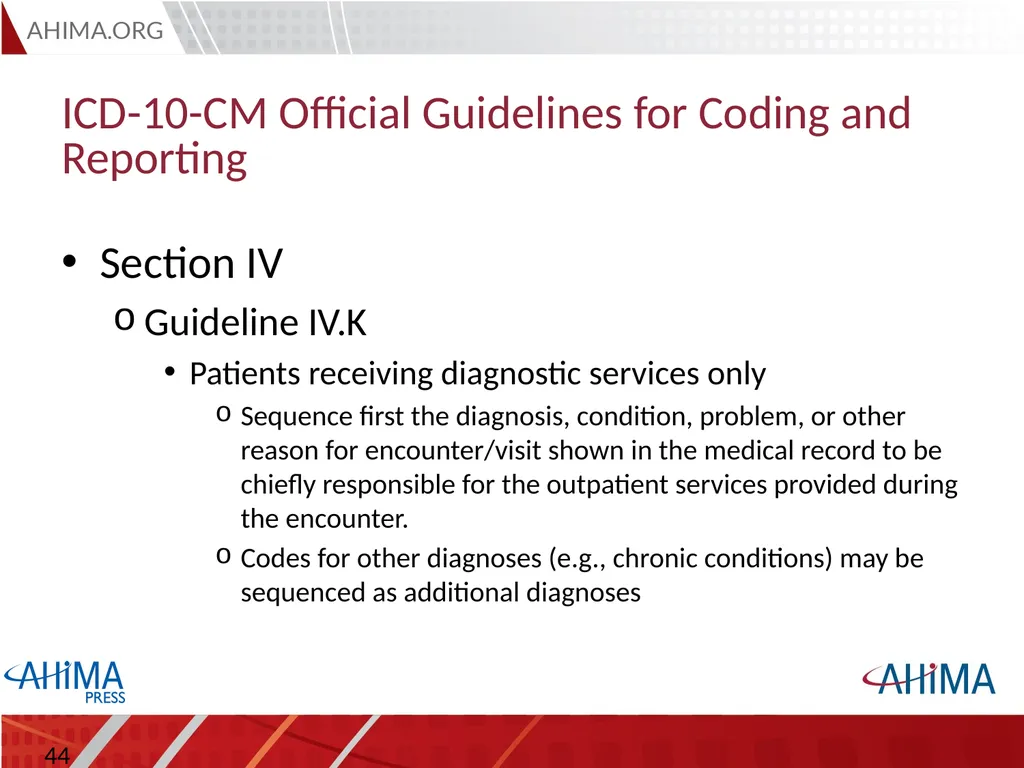
Guideline IV.K
Patients receiving diagnostic services only
Sequence first the diagnosis, condition, problem, or other reason for encounter/visit shown in the medical record to be chiefly responsible for the outpatient services provided during the encounter.
Codes for other diagnoses (e.g., chronic conditions) may be sequenced as additional diagnoses 44<br>
Guideline IV.K
Patients receiving diagnostic services only
Sequence first the diagnosis, condition, problem, or other reason for encounter/visit shown in the medical record to be chiefly responsible for the outpatient services provided during the encounter.
Codes for other diagnoses (e.g., chronic conditions) may be sequenced as additional diagnoses 44<br>
45
ICD-10-CM Official Guidelines for Coding and Reporting Section IV
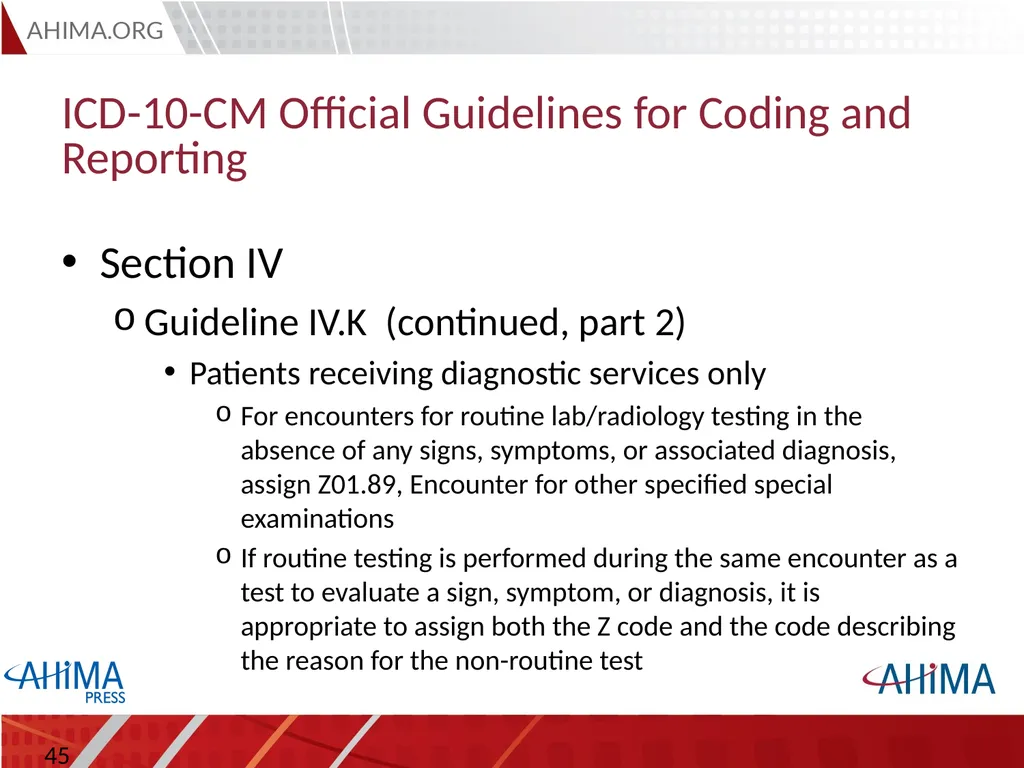
Guideline IV.K (continued, part 2)
Patients receiving diagnostic services only
For encounters for routine lab/radiology testing in the absence of any signs, symptoms, or associated diagnosis, assign Z01.89, Encounter for other specified special examinations
If routine testing is performed during the same encounter as a test to evaluate a sign, symptom, or diagnosis, it is appropriate to assign both the Z code and the code describing the reason for the non-routine test 45<br>
Guideline IV.K (continued, part 2)
Patients receiving diagnostic services only
For encounters for routine lab/radiology testing in the absence of any signs, symptoms, or associated diagnosis, assign Z01.89, Encounter for other specified special examinations
If routine testing is performed during the same encounter as a test to evaluate a sign, symptom, or diagnosis, it is appropriate to assign both the Z code and the code describing the reason for the non-routine test 45<br>
46
ICD-10-CM Official Guidelines for Coding and Reporting Section IV
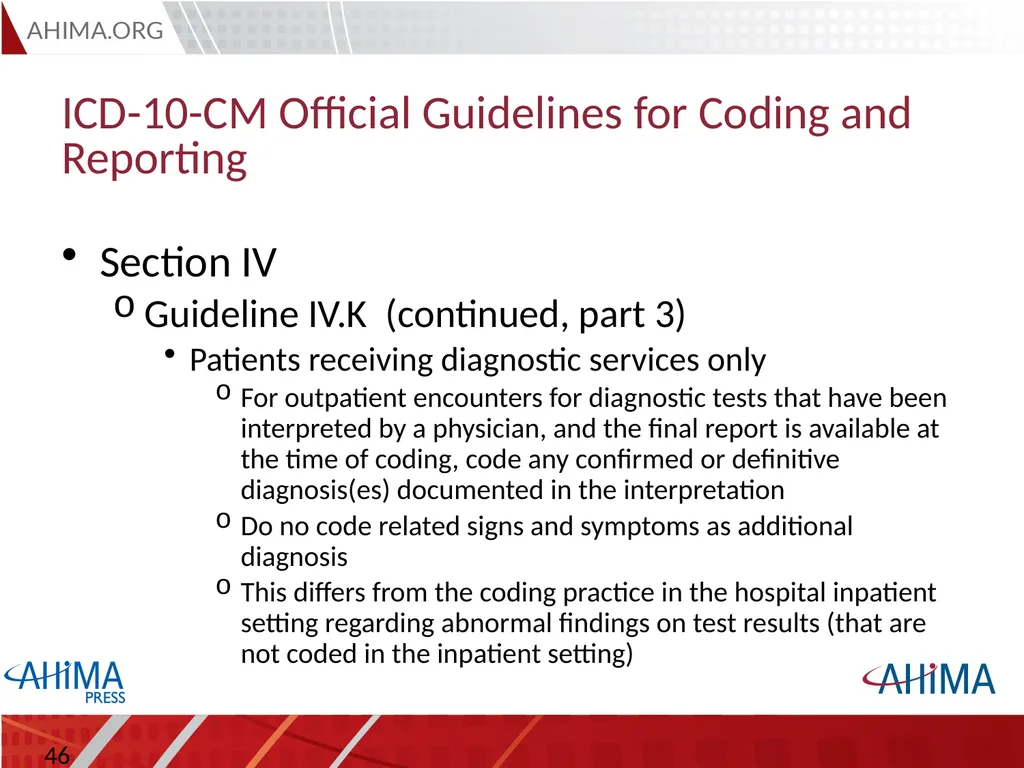
Guideline IV.K (continued, part 3)
Patients receiving diagnostic services only
For outpatient encounters for diagnostic tests that have been interpreted by a physician, and the final report is available at the time of coding, code any confirmed or definitive diagnosis(es) documented in the interpretation
Do no code related signs and symptoms as additional diagnosis
This differs from the coding practice in the hospital inpatient setting regarding abnormal findings on test results (that are not coded in the inpatient setting) 46<br>
Guideline IV.K (continued, part 3)
Patients receiving diagnostic services only
For outpatient encounters for diagnostic tests that have been interpreted by a physician, and the final report is available at the time of coding, code any confirmed or definitive diagnosis(es) documented in the interpretation
Do no code related signs and symptoms as additional diagnosis
This differs from the coding practice in the hospital inpatient setting regarding abnormal findings on test results (that are not coded in the inpatient setting) 46<br>
47
ICD-10-CM Official Guidelines for Coding and Reporting Section IV
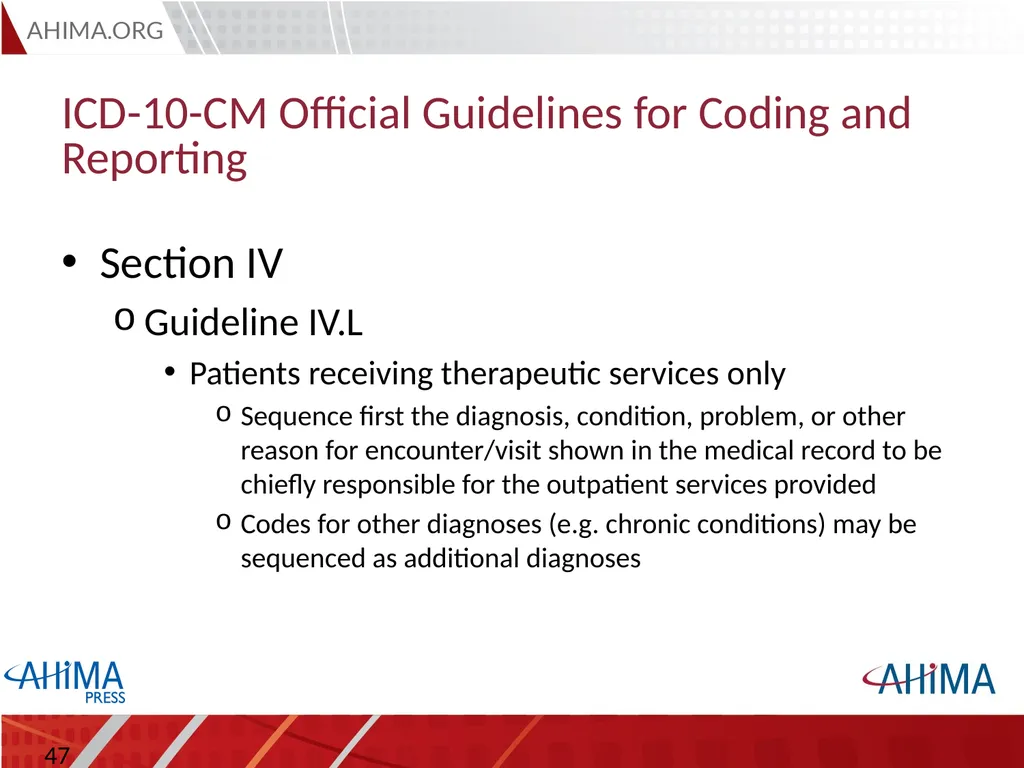
Guideline IV.L
Patients receiving therapeutic services only
Sequence first the diagnosis, condition, problem, or other reason for encounter/visit shown in the medical record to be chiefly responsible for the outpatient services provided
Codes for other diagnoses (e.g. chronic conditions) may be sequenced as additional diagnoses 47<br>
Guideline IV.L
Patients receiving therapeutic services only
Sequence first the diagnosis, condition, problem, or other reason for encounter/visit shown in the medical record to be chiefly responsible for the outpatient services provided
Codes for other diagnoses (e.g. chronic conditions) may be sequenced as additional diagnoses 47<br>
48
ICD-10-CM Official Guidelines for Coding and Reporting Section IV
Guideline IV.L (continued, part 2)
Patients receiving therapeutic services only
The only exception to this rule is when the primary reason for the admission/encounter is chemotherapy or radiation therapy
For these, the appropriate Z code for the service is listed first, and the diagnosis or problem for which the service is being performed is listed second 48<br>
Guideline IV.L (continued, part 2)
Patients receiving therapeutic services only
The only exception to this rule is when the primary reason for the admission/encounter is chemotherapy or radiation therapy
For these, the appropriate Z code for the service is listed first, and the diagnosis or problem for which the service is being performed is listed second 48<br>
49
ICD-10-CM Official Guidelines for Coding and Reporting Section IV
Guideline IV.M
Patients receiving preoperative evaluations only
Sequence first a code from subcategory Z01.81, Encounter for pre-procedural examinations, to describe the pre-op consultations.
Assign a code for the condition to describe the reason for the surgery as an additional diagnosis
Code also any findings related to the pre-op evaluation 49<br>
Guideline IV.M
Patients receiving preoperative evaluations only
Sequence first a code from subcategory Z01.81, Encounter for pre-procedural examinations, to describe the pre-op consultations.
Assign a code for the condition to describe the reason for the surgery as an additional diagnosis
Code also any findings related to the pre-op evaluation 49<br>
50
ICD-10-CM Official Guidelines for Coding and Reporting Section IV
Guideline IV.N
Ambulatory Surgery
Code the diagnosis for which the surgery was performed
If the postoperative diagnosis is known to be different from the preoperative diagnosis at the time the diagnosis is confirmed, select the postoperative diagnosis for coding, since it is the most definitive 50<br>
Guideline IV.N
Ambulatory Surgery
Code the diagnosis for which the surgery was performed
If the postoperative diagnosis is known to be different from the preoperative diagnosis at the time the diagnosis is confirmed, select the postoperative diagnosis for coding, since it is the most definitive 50<br>
51
ICD-10-CM Official Guidelines for Coding and Reporting Section IV
Guideline IV.O
Routine outpatient prenatal visits: See Guidelines for Coding and Reporting Section I.C.15, Routine outpatient prenatal visits 51<br>
Guideline IV.O
Routine outpatient prenatal visits: See Guidelines for Coding and Reporting Section I.C.15, Routine outpatient prenatal visits 51<br>
52
ICD-10-CM Official Guidelines for Coding and Reporting Section IV
Guideline IV.P
Encounters for general medical examinations with abnormal findings
The subcategories, Z00.0-, provide codes for “with” and “without” abnormal findings.
Should the examination result in an abnormal finding, the code for the condition medical examination with abnormal finding is assigned as the first-listed diagnosis
A secondary code for the abnormal finding should also be coded 52<br>
Guideline IV.P
Encounters for general medical examinations with abnormal findings
The subcategories, Z00.0-, provide codes for “with” and “without” abnormal findings.
Should the examination result in an abnormal finding, the code for the condition medical examination with abnormal finding is assigned as the first-listed diagnosis
A secondary code for the abnormal finding should also be coded 52<br>
53
ICD-10-CM Official Guidelines for Coding and Reporting Section IV
Guideline IV.Q
Encounters for routine health screenings
See guidelines for Coding and Reporting Section I.C.21, Factors influencing health status and contact with health services, screening 53<br>
Guideline IV.Q
Encounters for routine health screenings
See guidelines for Coding and Reporting Section I.C.21, Factors influencing health status and contact with health services, screening 53<br>
54
ICD-10-CM Official Guidelines for Coding and Reporting The importance of knowing ICD-10-CM guidelines cannot be overemphasized
Check website for most current version
www.cdc.gov/nchs/icd/icd10cm.htm
Guidelines are included in Appendix J of the website related to this text 54<br>
Check website for most current version
www.cdc.gov/nchs/icd/icd10cm.htm
Guidelines are included in Appendix J of the website related to this text 54<br>