
BCH 201 – GENERAL BIOCHEMISTRY 1 – (3 UNITS) DR
LV
Published · 4 slides · 0 views

1 / 1
Description
BCH 201 GENERAL BIOCHEMISTRY 1 (3 UNITS) DR AKINLOYES ASPECT ENZYMES AND COENZYMES. Introduction The use of enzymes in the diagnosis of disease is one of the important benefits derived from the intensive research in biochemistry since
Related Topics
Share
Embed code
Download this presentation From Below
"BCH 201 – GENERAL BIOCHEMISTRY 1 – (3 UNITS) DR" is the property of its rightful owner. Permission is granted to download and print the materials on this website for personal, non-commercial use only, and to display it on your personal computer provided you do not modify the materials and that you retain all copyright notices contained in the materials. By downloading content from our website, you accept the terms of this agreement.
Presentation Transcript
01
BCH 201 – GENERAL BIOCHEMISTRY 1 – (3 UNITS)
DR AKINLOYE’S ASPECT
ENZYMES AND COENZYMES.
Introduction
The use of enzymes in the diagnosis of disease is one of the important benefits derived from the intensive research in biochemistry since the 1940's. Enzymes have provided the basis for the field of clinical chemistry.
It is, however, only within the recent past few decades that interest in diagnostic enzymology has multiplied. Many methods currently on record in the literature are not in wide use, and there are still large areas of medical research in which the diagnostic potential of enzyme reactions has not been explored at all.
Early Enzyme Discoveries
The existence of enzymes has been known for well over a century. Some of the earliest studies were performed in 1835 by the Swedish chemist Jon Jakob Berzelius who termed their chemical action catalytic. It was not until 1926, however, that the first enzyme was obtained in pure form, a feat accomplished by James B. Sumner of Cornell University. Sumner was able to isolate and crystallize the enzyme urease from the jack bean. His work was to earn him the 1947 Nobel Prize.
John H. Northrop and Wendell M. Stanley of the Rockefeller Institute for Medical Research shared the 1947 Nobel Prize with Sumner. They discovered a complex procedure for isolating pepsin. This precipitation technique devised by Northrop and Stanley has been used to crystallize several enzymes.
Definition.
Enzymes are often referred to as biological catalyst that speeds up the rate of chemical reactions by converting substrate(s) to product(s).
N.B Not all enzymes are protein because we have ribozyme that is nucleic acid in nature.
Almost all processes in biological cells needs enzyme action(s) in order to occur at significant of appreciable rate.
Naming and Classification
Except for some of the originally studied enzymes such as pepsin, rennin, and trypsin, most enzyme names end in "ase". The International Union of Biochemistry (I.U.B.) initiated standards of enzyme nomenclature which recommend that enzyme names indicate both the substrate acted upon and the type of reaction catalyzed. Under this system, the enzyme uricase is called urate: O2 oxidoreductase, while the enzyme glutamic oxaloacetic transaminase (GOT) is called L-aspartate: 2-oxoglutarate aminotransferase.
Enzymes can be classified by the kind of chemical reaction catalyzed.
Addition or removal of water
Hydrolases - these include esterases, carbohydrases, nucleases, deaminases, amidases, and proteases
Hydrases such as fumarase, enolase, aconitase and carbonic anhydrase
Transfer of electrons
Oxidases
Dehydrogenases
Transfer of a radical
Transglycosidases - of monosaccharides
Transphosphorylases and phosphomutases - of a phosphate group
Transaminases - of amino group
Transmethylases - of a methyl group
Transacetylases - of an acetyl group
Splitting or forming a C-C bond
Desmolases
Changing geometry or structure of a molecule
Isomerases
Joining two molecules through hydrolysis of pyrophosphate bond in ATP or other tri-phosphate
Ligases
Many enzymes are named by adding the suffix ‘-ase’ to the name of their substrate e.g urease catalysis the hydrolysis of urea. However, this is not always true for all enzymes e.g pepsin, trypsin acts on protein. The classification based on the International Union of Biochemistry is broadly into six (6) classes thus:<br>
DR AKINLOYE’S ASPECT
ENZYMES AND COENZYMES.
Introduction
The use of enzymes in the diagnosis of disease is one of the important benefits derived from the intensive research in biochemistry since the 1940's. Enzymes have provided the basis for the field of clinical chemistry.
It is, however, only within the recent past few decades that interest in diagnostic enzymology has multiplied. Many methods currently on record in the literature are not in wide use, and there are still large areas of medical research in which the diagnostic potential of enzyme reactions has not been explored at all.
Early Enzyme Discoveries
The existence of enzymes has been known for well over a century. Some of the earliest studies were performed in 1835 by the Swedish chemist Jon Jakob Berzelius who termed their chemical action catalytic. It was not until 1926, however, that the first enzyme was obtained in pure form, a feat accomplished by James B. Sumner of Cornell University. Sumner was able to isolate and crystallize the enzyme urease from the jack bean. His work was to earn him the 1947 Nobel Prize.
John H. Northrop and Wendell M. Stanley of the Rockefeller Institute for Medical Research shared the 1947 Nobel Prize with Sumner. They discovered a complex procedure for isolating pepsin. This precipitation technique devised by Northrop and Stanley has been used to crystallize several enzymes.
Definition.
Enzymes are often referred to as biological catalyst that speeds up the rate of chemical reactions by converting substrate(s) to product(s).
N.B Not all enzymes are protein because we have ribozyme that is nucleic acid in nature.
Almost all processes in biological cells needs enzyme action(s) in order to occur at significant of appreciable rate.
Naming and Classification
Except for some of the originally studied enzymes such as pepsin, rennin, and trypsin, most enzyme names end in "ase". The International Union of Biochemistry (I.U.B.) initiated standards of enzyme nomenclature which recommend that enzyme names indicate both the substrate acted upon and the type of reaction catalyzed. Under this system, the enzyme uricase is called urate: O2 oxidoreductase, while the enzyme glutamic oxaloacetic transaminase (GOT) is called L-aspartate: 2-oxoglutarate aminotransferase.
Enzymes can be classified by the kind of chemical reaction catalyzed.
Addition or removal of water
Hydrolases - these include esterases, carbohydrases, nucleases, deaminases, amidases, and proteases
Hydrases such as fumarase, enolase, aconitase and carbonic anhydrase
Transfer of electrons
Oxidases
Dehydrogenases
Transfer of a radical
Transglycosidases - of monosaccharides
Transphosphorylases and phosphomutases - of a phosphate group
Transaminases - of amino group
Transmethylases - of a methyl group
Transacetylases - of an acetyl group
Splitting or forming a C-C bond
Desmolases
Changing geometry or structure of a molecule
Isomerases
Joining two molecules through hydrolysis of pyrophosphate bond in ATP or other tri-phosphate
Ligases
Many enzymes are named by adding the suffix ‘-ase’ to the name of their substrate e.g urease catalysis the hydrolysis of urea. However, this is not always true for all enzymes e.g pepsin, trypsin acts on protein. The classification based on the International Union of Biochemistry is broadly into six (6) classes thus:<br>
02
CLASS1- OXIDOREDUCTASE- This group of enzyme catalyze the oxidation of one substrate with simultaneous reduction of another substrate .e.g alcohol dehydrogenase
CLASS 2- TRANSFERASE- They catalyze the transfer of functional group(s) other than hydrogen from one substrate to another; e.g hexose-6-phosphate transferase
CLASS 3- HYDROLASE- This class of enzyme hydrolyse ester, ether, peptide or glycosidic bonds by adding water and the breaks the bond, e.g acetylcholine hydrolase
CLASS 4- LYASE: This group of enzyme removes group from a particular substrate or breaks bonds by mechanism other than hydrolysis, e.g aldolase
CLASS 5- ISOMERASE-They catalyse the conversion of one isomer to the other. They produce optical geometric or positional isomer of substrate, e.g triose phosphate isomerase.
CLASS 6- LIGASE- This group catalyses the linkage of two substrates together, usually with the simultaneous hydrolysis of ATP, e.g acetyl CoA carboxylase.
GENERAL PROPERTIES OF ENZYME.
Enzymes have enormous catalytic power i.e they can accelerate reaction rate by at least a million
Enzymes are highly specific i.e highly specific both in the choice o
f substrate and in reaction catalysed
Activities of some enzymes are regulated i.e different kind of regulatory mechanisms affect enzyme catalysed reaction.
Enzymes do not alter the reaction equilibria i.e enzymes do not alter the equilibrium position, meaning that they accelerates the forward and back ward reactions by precisely the same factor.
Enzymes decrease the activation energy e.g the lowers the activation energy by reducing the transition state / activation complex
Enzymes transform different kinds of energy i.e energy of reactant could be converted into different form with high efficiency.
Chemical Nature of Enzymes
All known enzymes are proteins. They are high molecular weight compounds made up principally of chains of amino acids linked together by peptide bonds. See Figure 1.
Enzymes can be denatured and precipitated with salts, solvents and other reagents. They have molecular weights ranging from 10,000 to 2,000,000.
Many enzymes require the presence of other compounds - cofactors - before their catalytic activity can be exerted. This entire active complex is referred to as the holoenzyme; i.e., apoenzyme (protein portion) plus the cofactor (coenzyme, prosthetic group or metal-ion-activator) is called the holoenzyme.
Apoenzyme + Cofactor = Holoenzyme
According to Holum, the cofactor may be:
1. A coenzyme - a non-protein organic substance which is dialyzable, thermostable and loosely attached to the protein part.
2. A prosthetic group - an organic substance which is dialyzable and thermostable which is firmly attached to the protein or apoenzyme portion.
3. A metal-ion-activator - these include K+, Fe++, Fe+++, Cu++, Co++, Zn++, Mn++, Mg++, Ca++, and Mo+++.
FACTORS AFFECTING THE RATE OF ENZYME CATALYSIS
Factors affecting the rate of enzyme catalyzed reactions include among others:
temperature
pH
Substrate concentration
Presence or absence of activator(s) and/or inhibitor(s)
Temperature: The rate of an enzyme reaction varies with temperature according to the Arrhenius equation i.e rate=Ae (-E/RT). The equation explains the sensitivity of enzyme to temperature because of the relationship between the rate and temperature is exponential. Each enzyme has optimum temperature after which is starts to denature
pH: The state of ionization of amino residues in the active site of an enzyme is pH dependent. A typical enzyme has an optimum pH of activity.
Effect of substrate concentration: At constant enzyme concentration, when the sudstrate concentration is low, the rate of reaction is very low. However, this increases with an increase in substrate concentration. Later, a point will be reached beyond which further increase in substrate concentration will not produce significant increase in reaction velocity.<br>
CLASS 2- TRANSFERASE- They catalyze the transfer of functional group(s) other than hydrogen from one substrate to another; e.g hexose-6-phosphate transferase
CLASS 3- HYDROLASE- This class of enzyme hydrolyse ester, ether, peptide or glycosidic bonds by adding water and the breaks the bond, e.g acetylcholine hydrolase
CLASS 4- LYASE: This group of enzyme removes group from a particular substrate or breaks bonds by mechanism other than hydrolysis, e.g aldolase
CLASS 5- ISOMERASE-They catalyse the conversion of one isomer to the other. They produce optical geometric or positional isomer of substrate, e.g triose phosphate isomerase.
CLASS 6- LIGASE- This group catalyses the linkage of two substrates together, usually with the simultaneous hydrolysis of ATP, e.g acetyl CoA carboxylase.
GENERAL PROPERTIES OF ENZYME.
Enzymes have enormous catalytic power i.e they can accelerate reaction rate by at least a million
Enzymes are highly specific i.e highly specific both in the choice o
f substrate and in reaction catalysed
Activities of some enzymes are regulated i.e different kind of regulatory mechanisms affect enzyme catalysed reaction.
Enzymes do not alter the reaction equilibria i.e enzymes do not alter the equilibrium position, meaning that they accelerates the forward and back ward reactions by precisely the same factor.
Enzymes decrease the activation energy e.g the lowers the activation energy by reducing the transition state / activation complex
Enzymes transform different kinds of energy i.e energy of reactant could be converted into different form with high efficiency.
Chemical Nature of Enzymes
All known enzymes are proteins. They are high molecular weight compounds made up principally of chains of amino acids linked together by peptide bonds. See Figure 1.
Enzymes can be denatured and precipitated with salts, solvents and other reagents. They have molecular weights ranging from 10,000 to 2,000,000.
Many enzymes require the presence of other compounds - cofactors - before their catalytic activity can be exerted. This entire active complex is referred to as the holoenzyme; i.e., apoenzyme (protein portion) plus the cofactor (coenzyme, prosthetic group or metal-ion-activator) is called the holoenzyme.
Apoenzyme + Cofactor = Holoenzyme
According to Holum, the cofactor may be:
1. A coenzyme - a non-protein organic substance which is dialyzable, thermostable and loosely attached to the protein part.
2. A prosthetic group - an organic substance which is dialyzable and thermostable which is firmly attached to the protein or apoenzyme portion.
3. A metal-ion-activator - these include K+, Fe++, Fe+++, Cu++, Co++, Zn++, Mn++, Mg++, Ca++, and Mo+++.
FACTORS AFFECTING THE RATE OF ENZYME CATALYSIS
Factors affecting the rate of enzyme catalyzed reactions include among others:
temperature
pH
Substrate concentration
Presence or absence of activator(s) and/or inhibitor(s)
Temperature: The rate of an enzyme reaction varies with temperature according to the Arrhenius equation i.e rate=Ae (-E/RT). The equation explains the sensitivity of enzyme to temperature because of the relationship between the rate and temperature is exponential. Each enzyme has optimum temperature after which is starts to denature
pH: The state of ionization of amino residues in the active site of an enzyme is pH dependent. A typical enzyme has an optimum pH of activity.
Effect of substrate concentration: At constant enzyme concentration, when the sudstrate concentration is low, the rate of reaction is very low. However, this increases with an increase in substrate concentration. Later, a point will be reached beyond which further increase in substrate concentration will not produce significant increase in reaction velocity.<br>
03
CLASS1- OXIDOREDUCTASE- This group of enzyme catalyze the oxidation of one substrate with simultaneous reduction of another substrate .e.g alcohol dehydrogenase
CLASS 2- TRANSFERASE- They catalyze the transfer of functional group(s) other than hydrogen from one substrate to another; e.g hexose-6-phosphate transferase
CLASS 3- HYDROLASE- This class of enzyme hydrolyse ester, ether, peptide or glycosidic bonds by adding water and the breaks the bond, e.g acetylcholine hydrolase
CLASS 4- LYASE: This group of enzyme removes group from a particular substrate or breaks bonds by mechanism other than hydrolysis, e.g aldolase
CLASS 5- ISOMERASE-They catalyse the conversion of one isomer to the other. They produce optical geometric or positional isomer of substrate, e.g triose phosphate isomerase.
CLASS 6- LIGASE- This group catalyses the linkage of two substrates together, usually with the simultaneous hydrolysis of ATP, e.g acetyl CoA carboxylase.
GENERAL PROPERTIES OF ENZYME.
Enzymes have enormous catalytic power i.e they can accelerate reaction rate by at least a million
Enzymes are highly specific i.e highly specific both in the choice of substrate and in reaction catalysed
Activities of some enzymes are regulated i.e different kind of regulatory mechanisms affect enzyme catalysed reaction.
Enzymes do not alter the reaction equilibria i.e enzymes do not alter the equilibrium position, meaning that they accelerates the forward and back ward reactions by precisely the same factor.
Enzymes decrease the activation energy e.g the lowers the activation energy by reducing the transition state / activation complex
Enzymes transform different kinds of energy i.e energy of reactant could be converted into different form with high efficiency.
Chemical Nature of Enzymes
All known enzymes are proteins. They are high molecular weight compounds made up principally of chains of amino acids linked together by peptide bonds. See Figure 1.
Enzymes can be denatured and precipitated with salts, solvents and other reagents. They have molecular weights ranging from 10,000 to 2,000,000.
Many enzymes require the presence of other compounds - cofactors - before their catalytic activity can be exerted. This entire active complex is referred to as the holoenzyme; i.e., apoenzyme (protein portion) plus the cofactor (coenzyme, prosthetic group or metal-ion-activator) is called the holoenzyme.
Apoenzyme + Cofactor = Holoenzyme
According to Holum, the cofactor may be:
1. A coenzyme - a non-protein organic substance which is dialyzable, thermostable and loosely attached to the protein part.
2. A prosthetic group - an organic substance which is dialyzable and thermostable which is firmly attached to the protein or apoenzyme portion.
3. A metal-ion-activator - these include K+, Fe++, Fe+++, Cu++, Co++, Zn++, Mn++, Mg++, Ca++, and Mo+++.
FACTORS AFFECTING THE RATE OF ENZYME CATALYSIS
Factors affecting the rate of enzyme catalyzed reactions include among others:
temperature
pH
Substrate concentration
Presence or absence of activator(s) and/or inhibitor(s)
Temperature: The rate of an enzyme reaction varies with temperature according to the Arrhenius equation i.e rate=Ae (-E/RT). The equation explains the sensitivity of enzyme to temperature because of the relationship between the rate and temperature is exponential. Each enzyme has optimum temperature after which is starts to denature
pH: The state of ionization of amino residues in the active site of an enzyme is pH dependent. A typical enzyme has an optimum pH of activity.
Effect of substrate concentration: At constant enzyme concentration, when the sudstrate concentration is low, the rate of reaction is very low. However, this increases with an increase in substrate concentration. Later, a point will be reached beyond which further increase in substrate concentration will not produce significant increase in reaction velocity.<br>
CLASS 2- TRANSFERASE- They catalyze the transfer of functional group(s) other than hydrogen from one substrate to another; e.g hexose-6-phosphate transferase
CLASS 3- HYDROLASE- This class of enzyme hydrolyse ester, ether, peptide or glycosidic bonds by adding water and the breaks the bond, e.g acetylcholine hydrolase
CLASS 4- LYASE: This group of enzyme removes group from a particular substrate or breaks bonds by mechanism other than hydrolysis, e.g aldolase
CLASS 5- ISOMERASE-They catalyse the conversion of one isomer to the other. They produce optical geometric or positional isomer of substrate, e.g triose phosphate isomerase.
CLASS 6- LIGASE- This group catalyses the linkage of two substrates together, usually with the simultaneous hydrolysis of ATP, e.g acetyl CoA carboxylase.
GENERAL PROPERTIES OF ENZYME.
Enzymes have enormous catalytic power i.e they can accelerate reaction rate by at least a million
Enzymes are highly specific i.e highly specific both in the choice of substrate and in reaction catalysed
Activities of some enzymes are regulated i.e different kind of regulatory mechanisms affect enzyme catalysed reaction.
Enzymes do not alter the reaction equilibria i.e enzymes do not alter the equilibrium position, meaning that they accelerates the forward and back ward reactions by precisely the same factor.
Enzymes decrease the activation energy e.g the lowers the activation energy by reducing the transition state / activation complex
Enzymes transform different kinds of energy i.e energy of reactant could be converted into different form with high efficiency.
Chemical Nature of Enzymes
All known enzymes are proteins. They are high molecular weight compounds made up principally of chains of amino acids linked together by peptide bonds. See Figure 1.
Enzymes can be denatured and precipitated with salts, solvents and other reagents. They have molecular weights ranging from 10,000 to 2,000,000.
Many enzymes require the presence of other compounds - cofactors - before their catalytic activity can be exerted. This entire active complex is referred to as the holoenzyme; i.e., apoenzyme (protein portion) plus the cofactor (coenzyme, prosthetic group or metal-ion-activator) is called the holoenzyme.
Apoenzyme + Cofactor = Holoenzyme
According to Holum, the cofactor may be:
1. A coenzyme - a non-protein organic substance which is dialyzable, thermostable and loosely attached to the protein part.
2. A prosthetic group - an organic substance which is dialyzable and thermostable which is firmly attached to the protein or apoenzyme portion.
3. A metal-ion-activator - these include K+, Fe++, Fe+++, Cu++, Co++, Zn++, Mn++, Mg++, Ca++, and Mo+++.
FACTORS AFFECTING THE RATE OF ENZYME CATALYSIS
Factors affecting the rate of enzyme catalyzed reactions include among others:
temperature
pH
Substrate concentration
Presence or absence of activator(s) and/or inhibitor(s)
Temperature: The rate of an enzyme reaction varies with temperature according to the Arrhenius equation i.e rate=Ae (-E/RT). The equation explains the sensitivity of enzyme to temperature because of the relationship between the rate and temperature is exponential. Each enzyme has optimum temperature after which is starts to denature
pH: The state of ionization of amino residues in the active site of an enzyme is pH dependent. A typical enzyme has an optimum pH of activity.
Effect of substrate concentration: At constant enzyme concentration, when the sudstrate concentration is low, the rate of reaction is very low. However, this increases with an increase in substrate concentration. Later, a point will be reached beyond which further increase in substrate concentration will not produce significant increase in reaction velocity.<br>
04
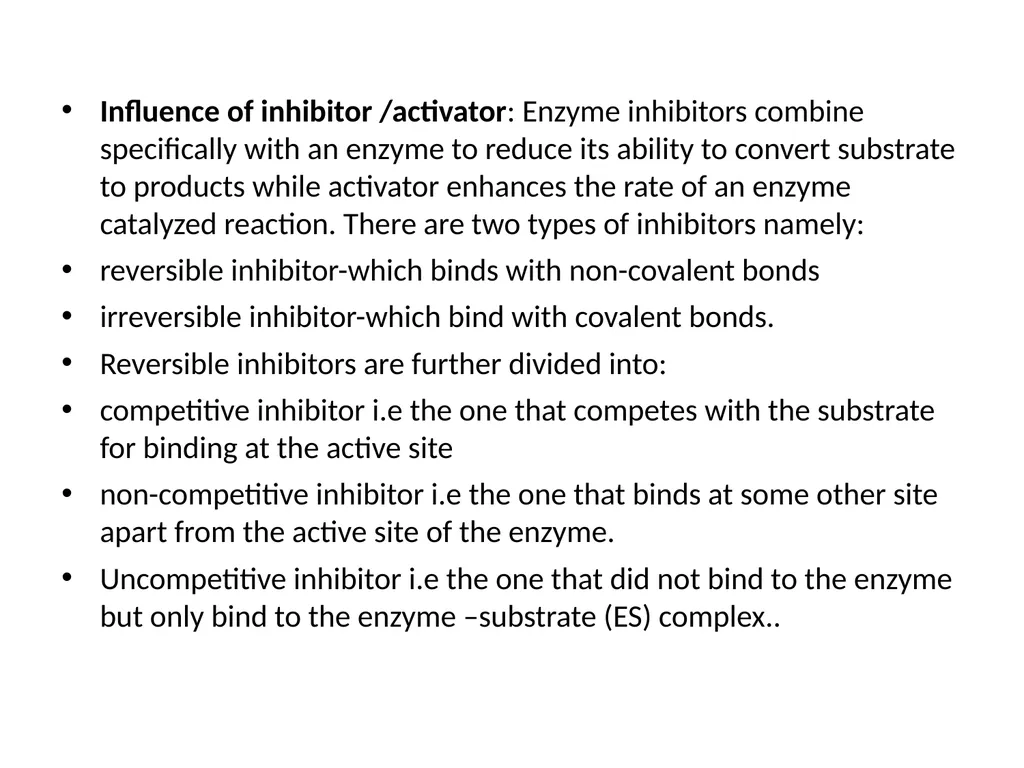
Influence of inhibitor /activator: Enzyme inhibitors combine specifically with an enzyme to reduce its ability to convert substrate to products while activator enhances the rate of an enzyme catalyzed reaction. There are two types of inhibitors namely:
reversible inhibitor-which binds with non-covalent bonds
irreversible inhibitor-which bind with covalent bonds.
Reversible inhibitors are further divided into:
competitive inhibitor i.e the one that competes with the substrate for binding at the active site
non-competitive inhibitor i.e the one that binds at some other site apart from the active site of the enzyme.
Uncompetitive inhibitor i.e the one that did not bind to the enzyme but only bind to the enzyme –substrate (ES) complex..<br>
reversible inhibitor-which binds with non-covalent bonds
irreversible inhibitor-which bind with covalent bonds.
Reversible inhibitors are further divided into:
competitive inhibitor i.e the one that competes with the substrate for binding at the active site
non-competitive inhibitor i.e the one that binds at some other site apart from the active site of the enzyme.
Uncompetitive inhibitor i.e the one that did not bind to the enzyme but only bind to the enzyme –substrate (ES) complex..<br>