
Bear Spray Training For Defense Against Dangerous
LV
Published · 55 slides · 0 views

1 / 1


Description
Bear Spray Training For Defense Against Dangerous Animals U.S. Department of the Interior U.S. Geological Survey Accessibility FOIA Privacy Policies and Notices October 2009 The use of trade, product, industry, or firm names is for
Related Topics
Share
Embed code
Download this presentation From Below
"Bear Spray Training For Defense Against Dangerous" is the property of its rightful owner. Permission is granted to download and print the materials on this website for personal, non-commercial use only, and to display it on your personal computer provided you do not modify the materials and that you retain all copyright notices contained in the materials. By downloading content from our website, you accept the terms of this agreement.
Presentation Transcript
01
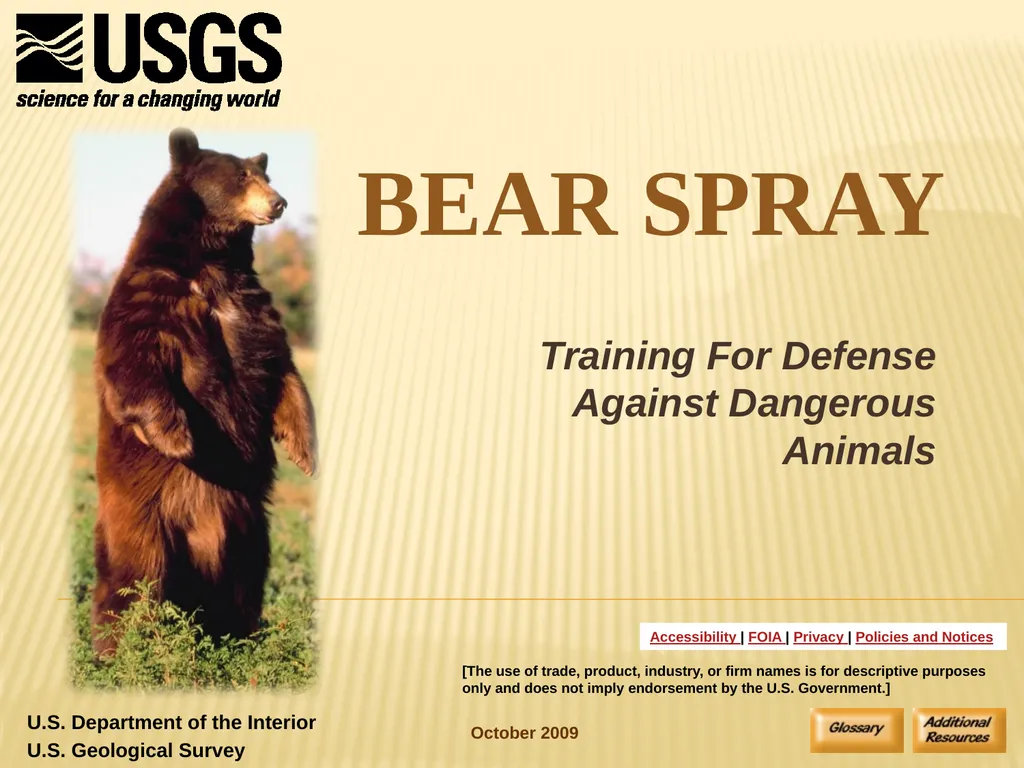
Bear Spray Training For Defense Against Dangerous Animals U.S. Department of the Interior
U.S. Geological Survey Accessibility | FOIA | Privacy | Policies and Notices October 2009 [The use of trade, product, industry, or firm names is for descriptive purposes only and does not imply endorsement by the U.S. Government.]<br>
U.S. Geological Survey Accessibility | FOIA | Privacy | Policies and Notices October 2009 [The use of trade, product, industry, or firm names is for descriptive purposes only and does not imply endorsement by the U.S. Government.]<br>
02
Course Goals The goals of this course are focused on:
Describing the differences between bear spray and personal defense pepper spray.
Demonstrating the correct use of bear spray.
Explaining the correct method of disposal, transportation, and handling of bear spray.
Defining bear spray policies and guidelines.<br>
Describing the differences between bear spray and personal defense pepper spray.
Demonstrating the correct use of bear spray.
Explaining the correct method of disposal, transportation, and handling of bear spray.
Defining bear spray policies and guidelines.<br>
03
Learning Objectives By the end of this course, you will be able to:
Describe how bear spray was developed, tested and it’s composition.
Identify what the active ingredients are, their source and concentration.
Define how bear spray is different from tear gas.
Predict how bear spray effects animals.
Identify bear spray’s pesticide classification.
Apply concepts learned to operate the spray mechanism on a can of bear spray.
Interpret differences between bear spray and personal defense pepper spray.
Describe how canister size, spray pattern, and formulation will effect performance.<br>
Describe how bear spray was developed, tested and it’s composition.
Identify what the active ingredients are, their source and concentration.
Define how bear spray is different from tear gas.
Predict how bear spray effects animals.
Identify bear spray’s pesticide classification.
Apply concepts learned to operate the spray mechanism on a can of bear spray.
Interpret differences between bear spray and personal defense pepper spray.
Describe how canister size, spray pattern, and formulation will effect performance.<br>
04
Learning Objectives (Con’t) By the end of this course, you will be able to (Con't):
Employ storage recommendations.
Operate bear spray canisters.
Evaluate when to use bear spray.
Evaluate the animals reaction after use.
Identify and apply first aid procedures that are needed for exposure to bear spray.
Define the necessary steps for bear spray cleanup.<br>
Employ storage recommendations.
Operate bear spray canisters.
Evaluate when to use bear spray.
Evaluate the animals reaction after use.
Identify and apply first aid procedures that are needed for exposure to bear spray.
Define the necessary steps for bear spray cleanup.<br>
05
Bear Spray—What is it? Less than lethal, unique chemical formula designed specifically to deter aggressive or attacking bears.
Must be registered with the Environmental Protection Agency and the individual State in which it is sold.
The active ingredients are from red pepper extract.
Formulated extract uses a dispersal system that creates an atomized cloud which effects the upper respiratory system and causes involuntary eye closure.
Personal protection from dangerous animals.
Alternative to firearms.
Part of a system of personal protection.<br>
Must be registered with the Environmental Protection Agency and the individual State in which it is sold.
The active ingredients are from red pepper extract.
Formulated extract uses a dispersal system that creates an atomized cloud which effects the upper respiratory system and causes involuntary eye closure.
Personal protection from dangerous animals.
Alternative to firearms.
Part of a system of personal protection.<br>
06
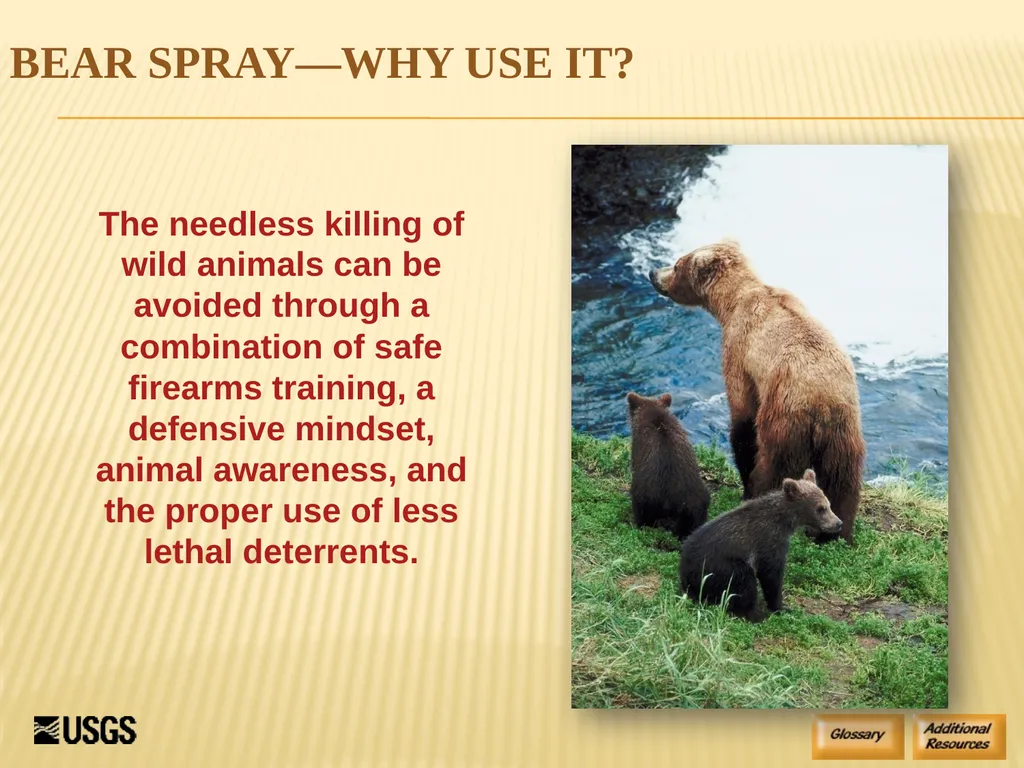
Bear Spray—Why Use It? The needless killing of wild animals can be avoided through a combination of safe firearms training, a defensive mindset, animal awareness, and the proper use of less lethal deterrents.<br>
07
Development and Testing Bear Spray is “OC” (Oleoresin Capsicum).
Wilber Scoville Develops the “Scoville Heat Unit (SHU)” in 1902.
Bell Pepper = 0 SHU
Habaneros = 300,000 SHU
Bhut Jolokia = 1,000,000 SHU
Pure Capsaicin = 15,000,000 SHU<br>
Wilber Scoville Develops the “Scoville Heat Unit (SHU)” in 1902.
Bell Pepper = 0 SHU
Habaneros = 300,000 SHU
Bhut Jolokia = 1,000,000 SHU
Pure Capsaicin = 15,000,000 SHU<br>
08
What is the Source of “HOTNESS” in Bear Spray? The “hotness” in bear spray comes from Oleoresin of Capsicum (OC), a naturally occurring oil-resin mixture that is extracted from peppers (Capsicum Plant) by means of a solvent. Some peppers are “hotter” then others. Therefore, the resulting OC will vary in potency just as do the source peppers and must be analyzed to determine the “hot chemicals” within the OC. These “hot chemicals” Capsaicin and Related Capsaicinoids (CRC) are the active ingredients in OC and bear spray.<br>
09
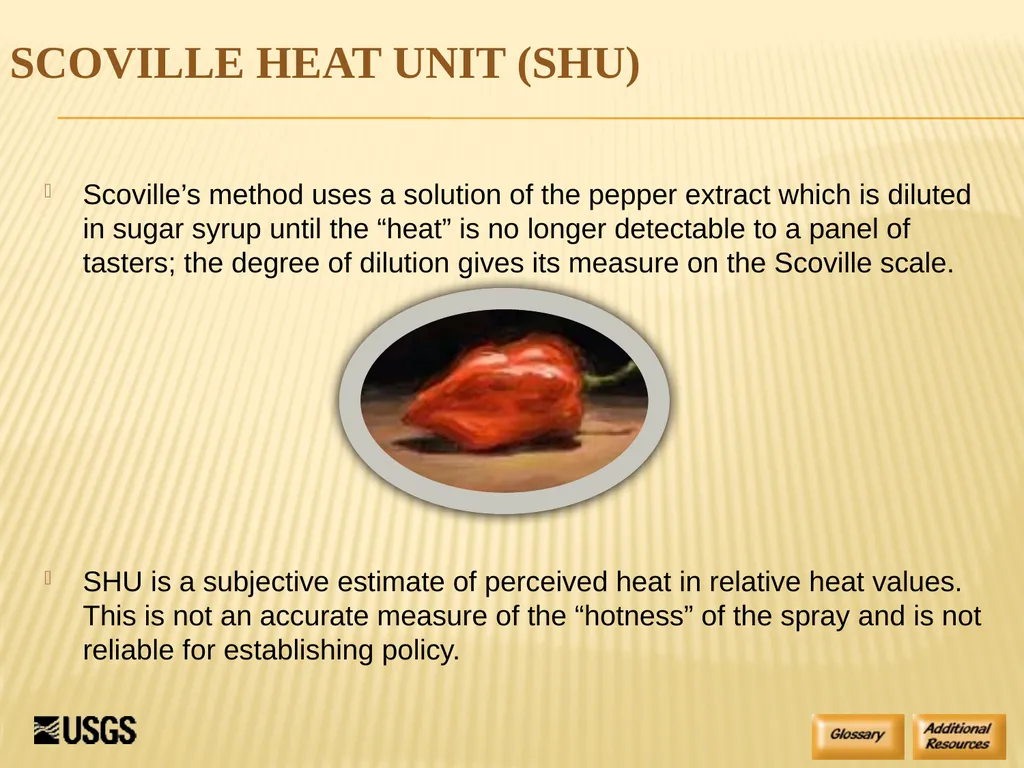
Scoville Heat Unit (SHU) Scoville’s method uses a solution of the pepper extract which is diluted in sugar syrup until the “heat” is no longer detectable to a panel of tasters; the degree of dilution gives its measure on the Scoville scale.
SHU is a subjective estimate of perceived heat in relative heat values. This is not an accurate measure of the “hotness” of the spray and is not reliable for establishing policy.<br>
SHU is a subjective estimate of perceived heat in relative heat values. This is not an accurate measure of the “hotness” of the spray and is not reliable for establishing policy.<br>
10
Reasons for Bear Spray’s Effectiveness Inflammatory agents are more effective for the following reasons:
Causes inflammation of the mucous membranes.
Causes involuntary eye closure (Blepharospasm).
May cause coughing and/or gagging.
Causes a burning sensation to exposed skin.
If inhaled, the effect on animals is immediate.
Effects on animals may subside in 10 to 30 minutes.
Effects on humans may subside in 30 to 45 minutes or longer.<br>
Causes inflammation of the mucous membranes.
Causes involuntary eye closure (Blepharospasm).
May cause coughing and/or gagging.
Causes a burning sensation to exposed skin.
If inhaled, the effect on animals is immediate.
Effects on animals may subside in 10 to 30 minutes.
Effects on humans may subside in 30 to 45 minutes or longer.<br>
11
Bear Spray History U.S. Military develops OC in 1930’s
Bill Pounds tests OC as a “Bear Deterrent” in late 1970’s.
Field studies begin in 1985 by Dr. Charles Jonkel (University of Montana).
1995 Study of OC spray on bears done by Dr. Stephen Herrero (University of Calgary).
1998 EPA issues the first registration to a “Bear Deterrent” as a PESTICIDE.
1998 Dr. Tom Smith’s (USGS) studies indicate bear spray to be a “potential attractant.”<br>
Bill Pounds tests OC as a “Bear Deterrent” in late 1970’s.
Field studies begin in 1985 by Dr. Charles Jonkel (University of Montana).
1995 Study of OC spray on bears done by Dr. Stephen Herrero (University of Calgary).
1998 EPA issues the first registration to a “Bear Deterrent” as a PESTICIDE.
1998 Dr. Tom Smith’s (USGS) studies indicate bear spray to be a “potential attractant.”<br>
12
Development and Testing ENVIRONMENTAL PROTECTION AGENCY The EPA established the Federal Insecticide Fungicide Rodenticide Act (FIFRA). The Act was passed by Congress as the primary statute for pesticide control and regulation and has been amended and updated many times. The Act, referred to as "FIFRA" is codified in Title 7 of the United States Code. Regulations promulgated pursuant to the Act are found at 40CFR (Code of Federal Regulations). The purpose and scope of FIFRA and its amendments are designed to provide for pre-market clearance of pesticides and pesticidal devices to ensure prevention of unreasonable adverse effects upon human health or the environment.<br>
13
Development and Testing (Con’t) The Registrant (owner) of the Pesticide Registration Label is responsible for evaluating and providing scientific data to the EPA so the EPA can establish reasonable risk to the consumer and the environment.
Some required testing includes:
Chemical testing for epidemiology
Full chemistry profile (toxins)
Full disclosure of inert ingredients and concentration, etc.
Environmental Toxicology
Scientific Testing<br>
Some required testing includes:
Chemical testing for epidemiology
Full chemistry profile (toxins)
Full disclosure of inert ingredients and concentration, etc.
Environmental Toxicology
Scientific Testing<br>
14
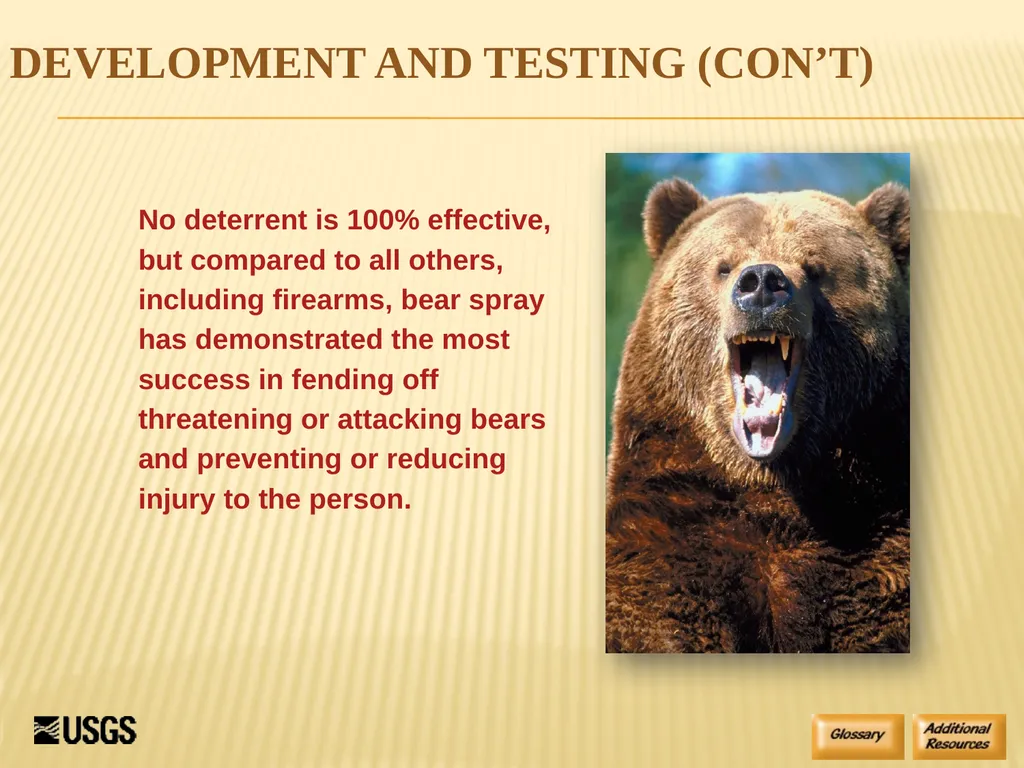
Development and Testing (Con’t) No deterrent is 100% effective,
but compared to all others,
including firearms, bear spray
has demonstrated the most
success in fending off
threatening or attacking bears
and preventing or reducing
injury to the person.<br>
but compared to all others,
including firearms, bear spray
has demonstrated the most
success in fending off
threatening or attacking bears
and preventing or reducing
injury to the person.<br>
15
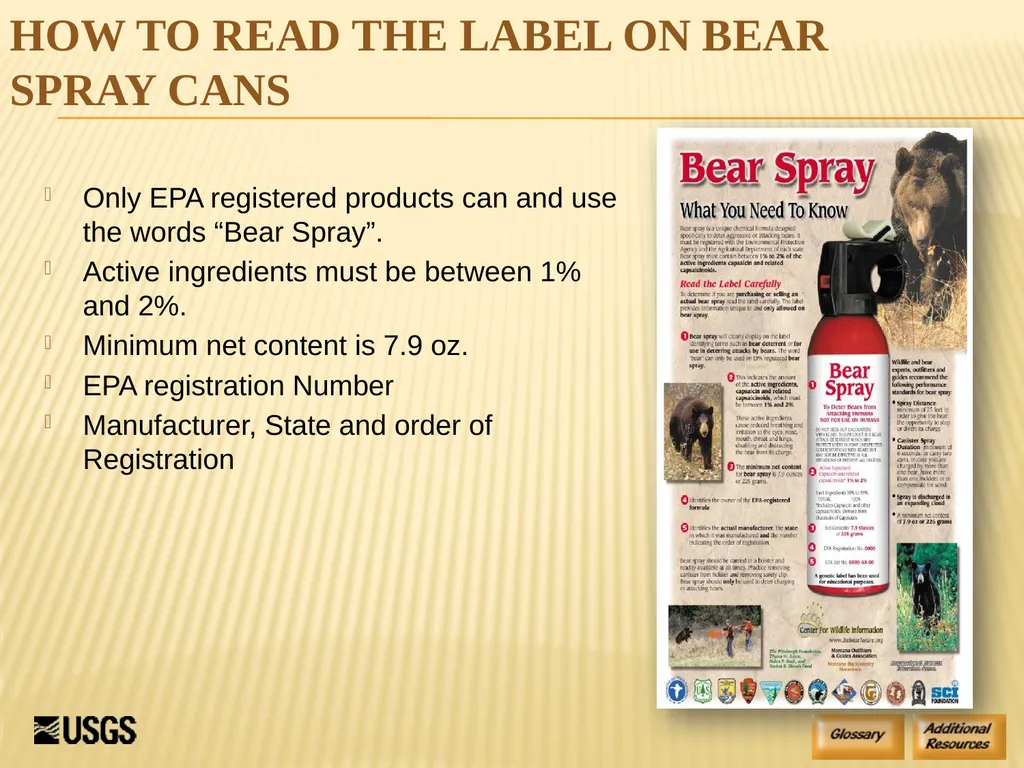
How to Read the Label on Bear Spray Cans Only EPA registered products can and use the words “Bear Spray”.
Active ingredients must be between 1% and 2%.
Minimum net content is 7.9 oz.
EPA registration Number
Manufacturer, State and order of Registration<br>
Active ingredients must be between 1% and 2%.
Minimum net content is 7.9 oz.
EPA registration Number
Manufacturer, State and order of Registration<br>
16
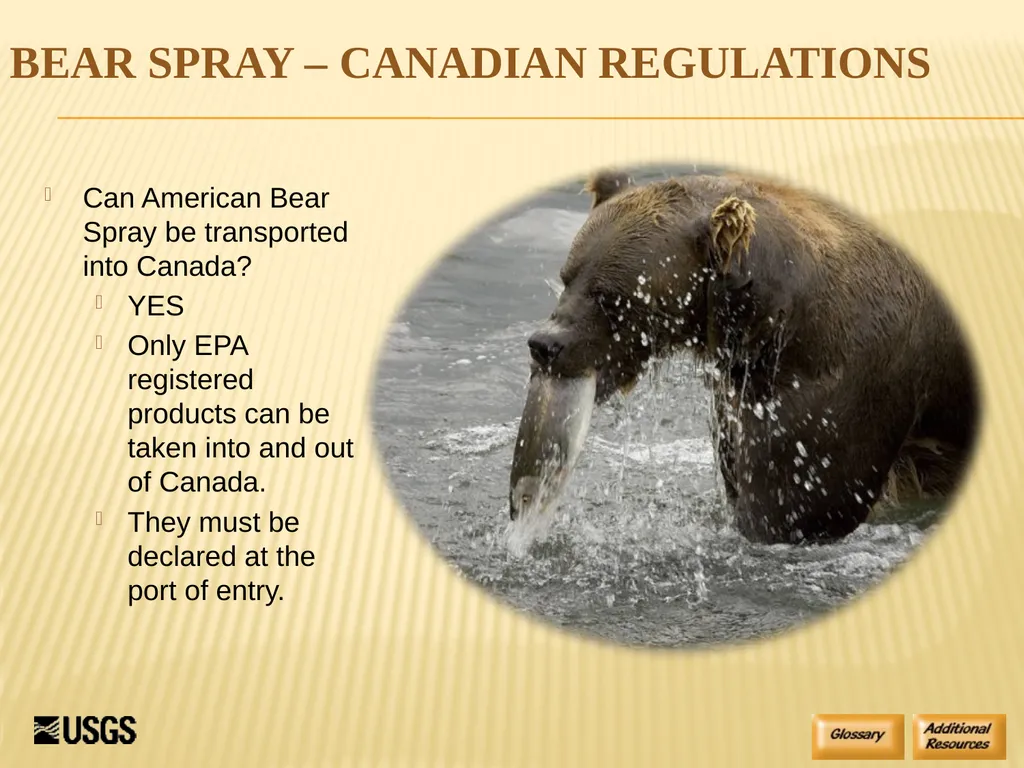
Bear Spray – Canadian Regulations Can American Bear Spray be transported into Canada?
YES
Only EPA registered products can be taken into and out of Canada.
They must be declared at the port of entry.<br>
YES
Only EPA registered products can be taken into and out of Canada.
They must be declared at the port of entry.<br>
17
Formulation of Bear Spray Oleoresin of Capsicum:
Active Ingredients, as defined by EPA, are the “active chemicals” in a pesticide.
Solvent(s), are usually a liquid substance capable of dissolving (to pass into a solution) or dispersing one or more other substances.
Propellant(s), are gaseous chemicals in a pressure bottle for expelling the contents when the pressure is released.<br>
Active Ingredients, as defined by EPA, are the “active chemicals” in a pesticide.
Solvent(s), are usually a liquid substance capable of dissolving (to pass into a solution) or dispersing one or more other substances.
Propellant(s), are gaseous chemicals in a pressure bottle for expelling the contents when the pressure is released.<br>
18
Why EPA Uses Percent Active Ingredient Why does the EPA use Percent Active Ingredient (Capsaicin and Related Capsaicinoids) and not Percent Oleoresin of Capsicum (OC) or Scoville Heat Units (SHU)?
Percent Capsaicin and related Capsaicinoids can be scientifically and accurately measured by HPLC.
Percent OC is the amount of OC contained in a specific product.
SHU is a subjective estimate of perceived heat in relative heat values. 10% OC from which pail? Pail of OC with 3.2 million SHU Pail of OC with 1.5 million SHU Proper scientific analysis must be completed on each pail or “lot” of OC to determine the percent active ingredient.<br>
Percent Capsaicin and related Capsaicinoids can be scientifically and accurately measured by HPLC.
Percent OC is the amount of OC contained in a specific product.
SHU is a subjective estimate of perceived heat in relative heat values. 10% OC from which pail? Pail of OC with 3.2 million SHU Pail of OC with 1.5 million SHU Proper scientific analysis must be completed on each pail or “lot” of OC to determine the percent active ingredient.<br>
19
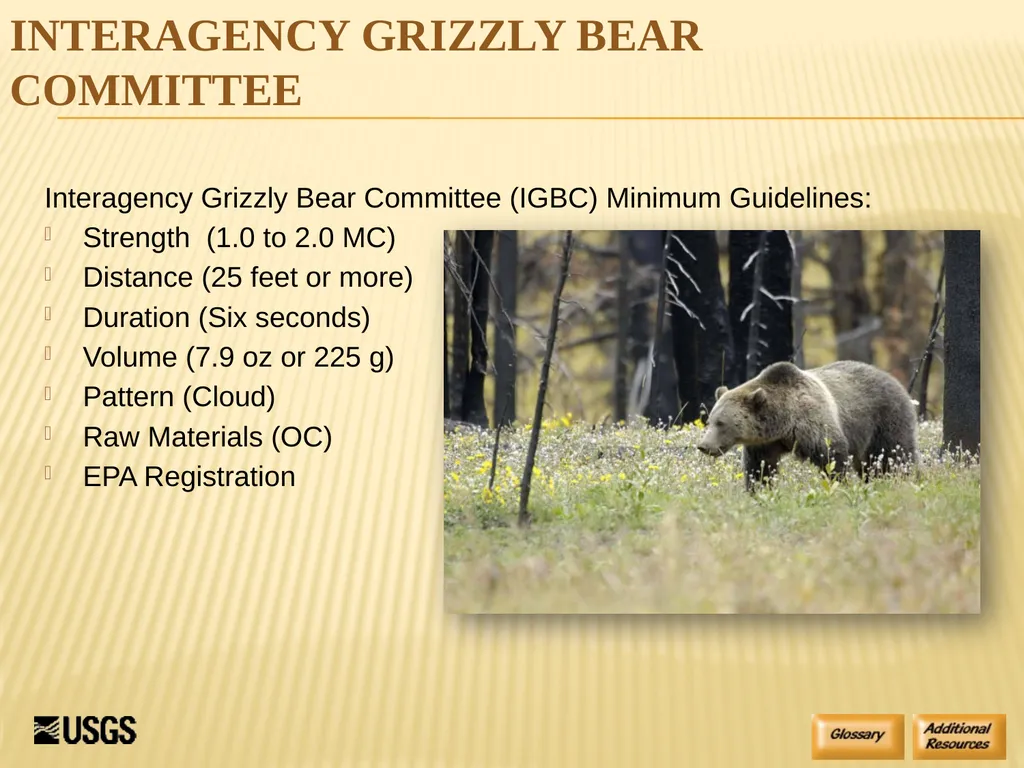
Interagency Grizzly Bear Committee Interagency Grizzly Bear Committee (IGBC) Minimum Guidelines:
Strength (1.0 to 2.0 MC)
Distance (25 feet or more)
Duration (Six seconds)
Volume (7.9 oz or 225 g)
Pattern (Cloud)
Raw Materials (OC)
EPA Registration<br>
Strength (1.0 to 2.0 MC)
Distance (25 feet or more)
Duration (Six seconds)
Volume (7.9 oz or 225 g)
Pattern (Cloud)
Raw Materials (OC)
EPA Registration<br>
20
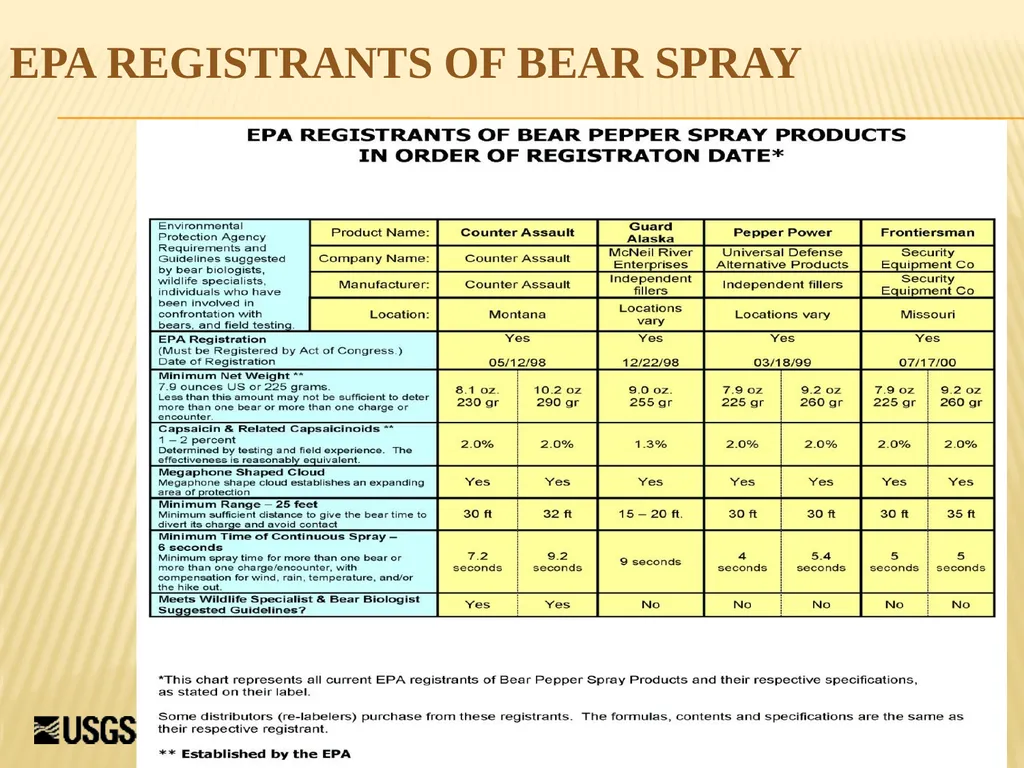
EPA Registrants of Bear Spray<br>
21
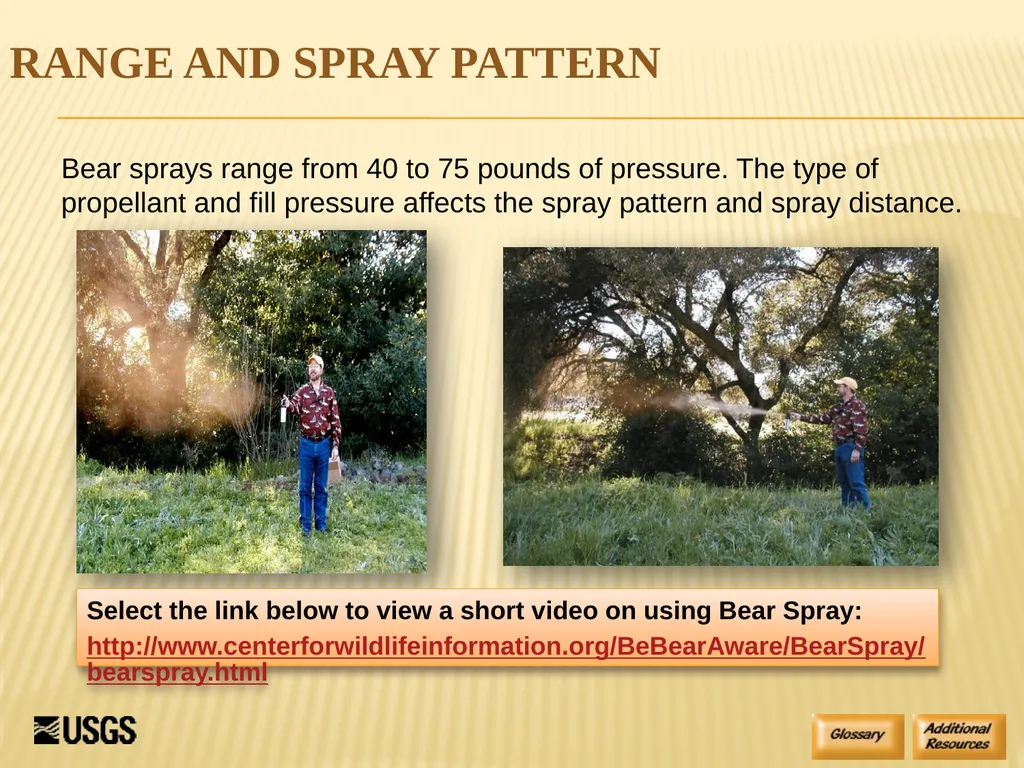
Range and Spray Pattern Bear sprays range from 40 to 75 pounds of pressure. The type of propellant and fill pressure affects the spray pattern and spray distance. Select the link below to view a short video on using Bear Spray:
http://www.centerforwildlifeinformation.org/BeBearAware/BearSpray/bearspray.html<br>
http://www.centerforwildlifeinformation.org/BeBearAware/BearSpray/bearspray.html<br>
22
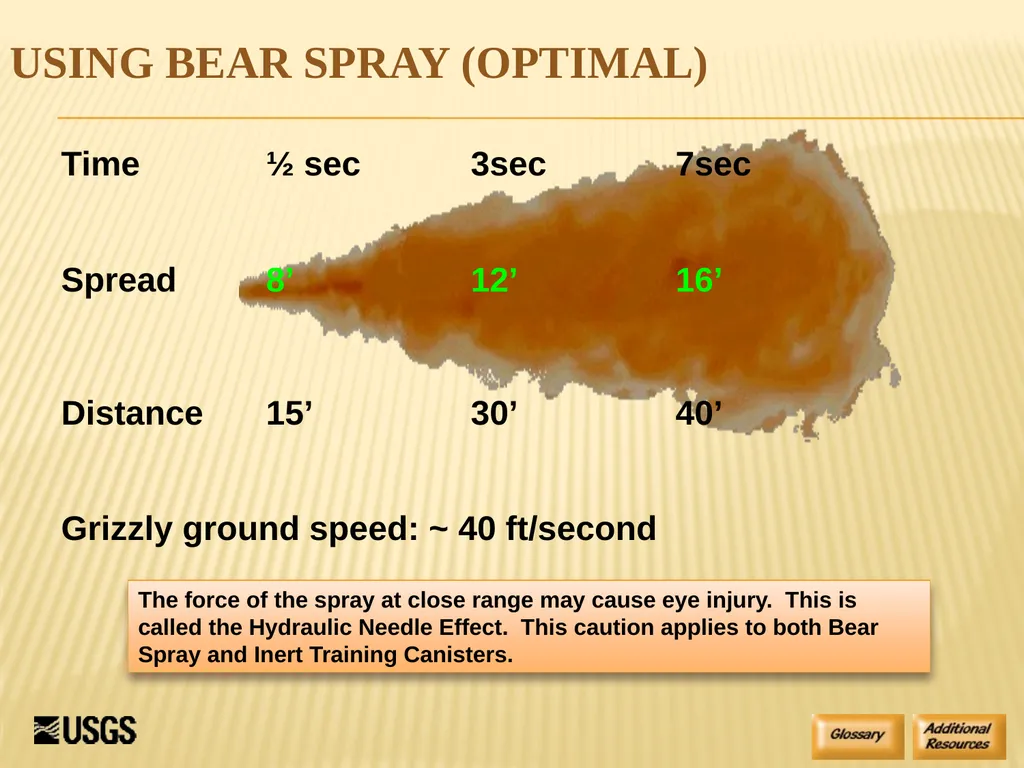
Using Bear Spray (optimal) Time ½ sec 3sec 7sec
Spread 8’ 12’ 16’
Distance 15’ 30’ 40’
Grizzly ground speed: ~ 40 ft/second The force of the spray at close range may cause eye injury. This is called the Hydraulic Needle Effect. This caution applies to both Bear Spray and Inert Training Canisters.<br>
Spread 8’ 12’ 16’
Distance 15’ 30’ 40’
Grizzly ground speed: ~ 40 ft/second The force of the spray at close range may cause eye injury. This is called the Hydraulic Needle Effect. This caution applies to both Bear Spray and Inert Training Canisters.<br>
23
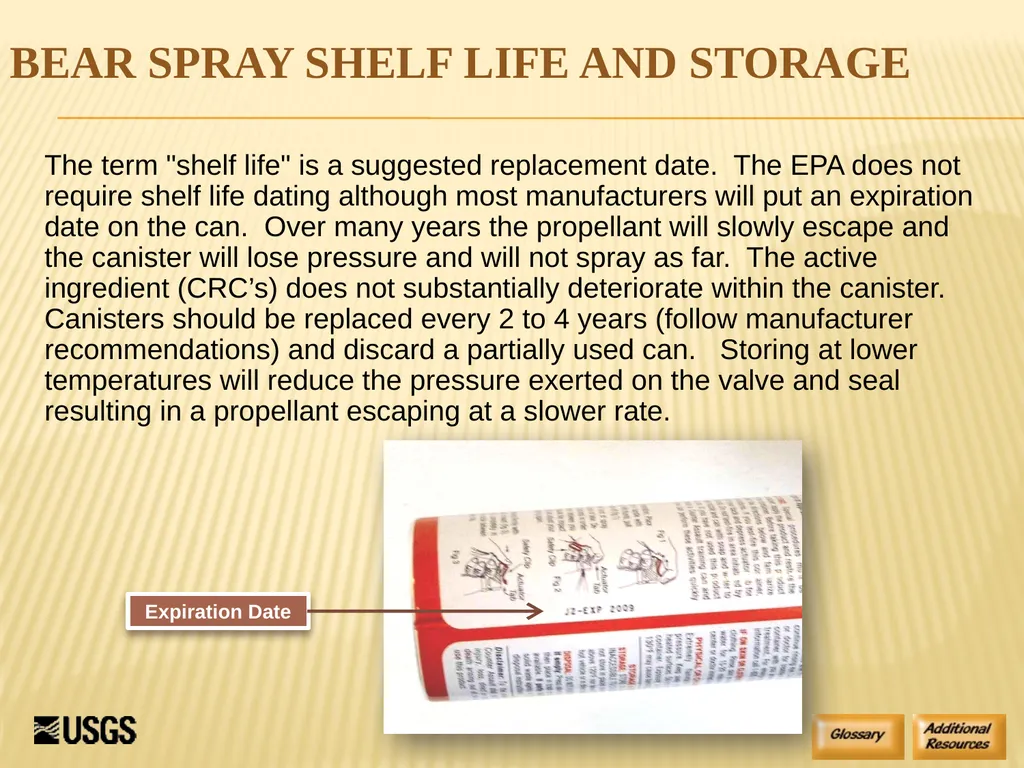
Bear Spray Shelf Life and Storage The term "shelf life" is a suggested replacement date. The EPA does not require shelf life dating although most manufacturers will put an expiration date on the can. Over many years the propellant will slowly escape and the canister will lose pressure and will not spray as far. The active ingredient (CRC’s) does not substantially deteriorate within the canister. Canisters should be replaced every 2 to 4 years (follow manufacturer recommendations) and discard a partially used can. Storing at lower temperatures will reduce the pressure exerted on the valve and seal resulting in a propellant escaping at a slower rate. Expiration Date<br>
24
What Bear Spray Is Not What bear spray is not:
A repellant
For use on skin, clothes, tents
For use on humans
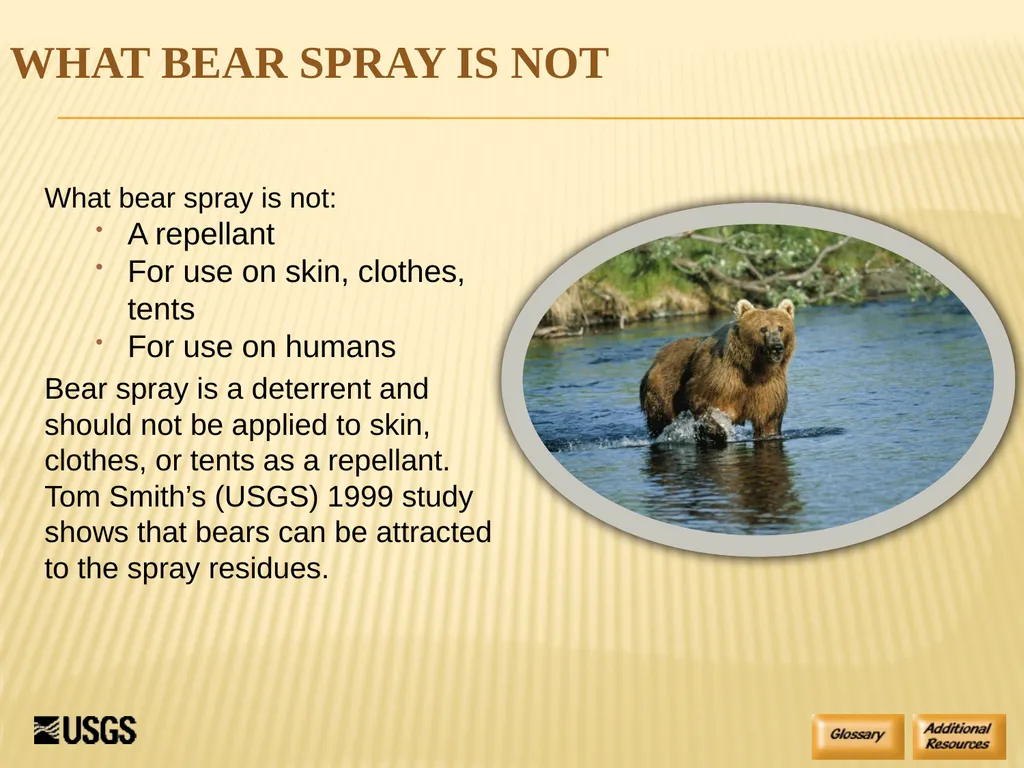
Bear spray is a deterrent and should not be applied to skin, clothes, or tents as a repellant. Tom Smith’s (USGS) 1999 study shows that bears can be attracted to the spray residues.<br>
A repellant
For use on skin, clothes, tents
For use on humans
Bear spray is a deterrent and should not be applied to skin, clothes, or tents as a repellant. Tom Smith’s (USGS) 1999 study shows that bears can be attracted to the spray residues.<br>
25
Bear Spray vs Personal Use Pepper Spray PERSONAL PROTECTION or DEFENSE PEPPER SPRAY IS NOT THE SAME AS BEAR SPRAY.
Personal defense sprays are absolutely not recommended to deter a charging or aggressive bear. There are no federal or state regulatory agencies presently taking an active role in governing these products and they are non-regulated.
Personal Use Pepper Spray has no:
Labeling requirements
Distinction between % Active Ingredient, % OC, or % Concentration
References to spray pattern, distance, or duration
Minimum canister size<br>
Personal defense sprays are absolutely not recommended to deter a charging or aggressive bear. There are no federal or state regulatory agencies presently taking an active role in governing these products and they are non-regulated.
Personal Use Pepper Spray has no:
Labeling requirements
Distinction between % Active Ingredient, % OC, or % Concentration
References to spray pattern, distance, or duration
Minimum canister size<br>
26
Direction and Method of Use When to use:
Use when animal is + 30 feet, give it a warning blast.
Continue to use if animal approaches or charges, use 1 to 2 second blasts. Aim slightly downward in front of the animals head. (Be aware of the wind.)
Spray and React—when the bear is diverted, this is your chance to back away slowly. DO NOT RUN!
“Spank the Bear” curious and food habituated bears.
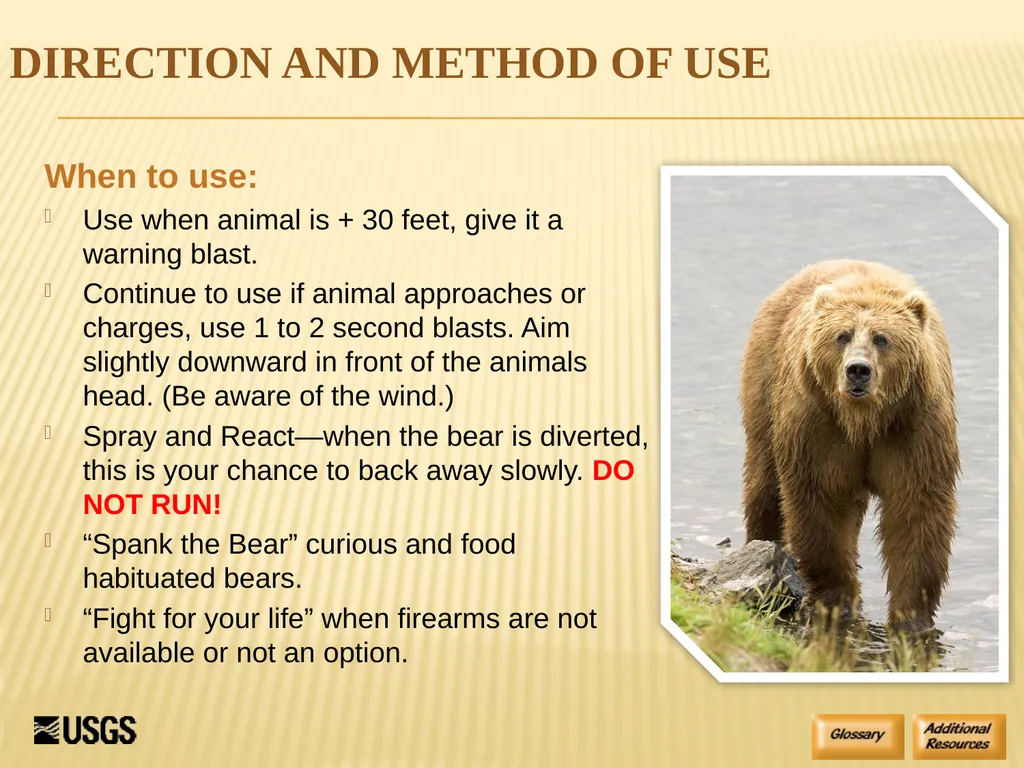
“Fight for your life” when firearms are not available or not an option.<br>
Use when animal is + 30 feet, give it a warning blast.
Continue to use if animal approaches or charges, use 1 to 2 second blasts. Aim slightly downward in front of the animals head. (Be aware of the wind.)
Spray and React—when the bear is diverted, this is your chance to back away slowly. DO NOT RUN!
“Spank the Bear” curious and food habituated bears.
“Fight for your life” when firearms are not available or not an option.<br>
27
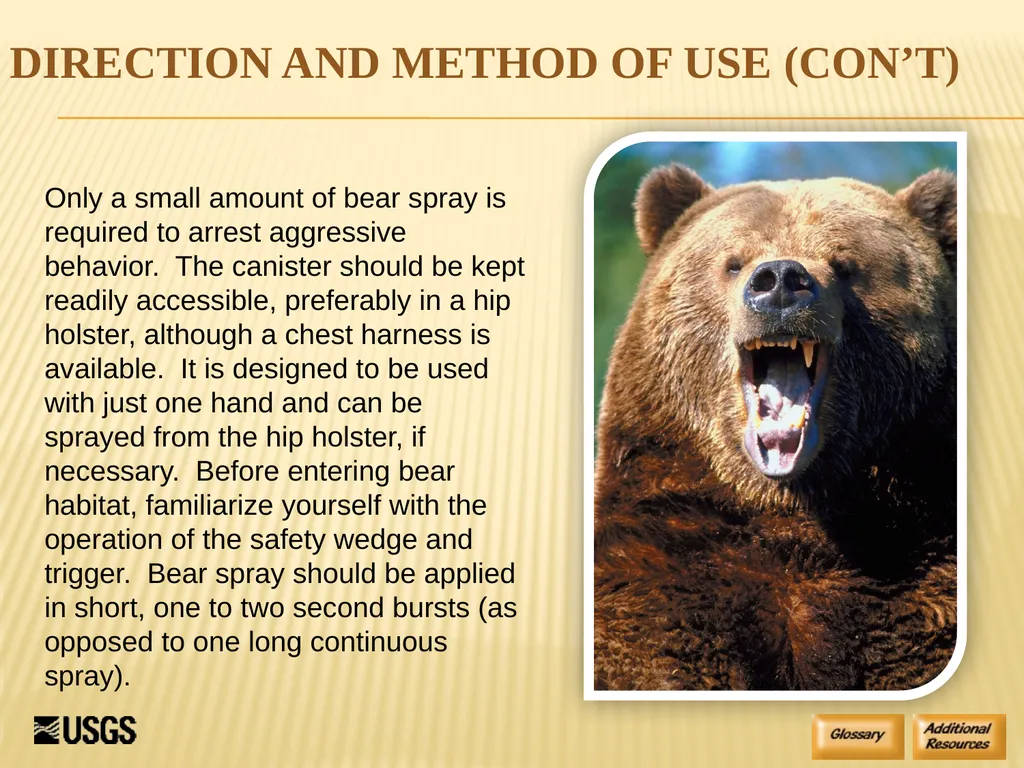
Direction and Method of Use (Con’t) Only a small amount of bear spray is required to arrest aggressive behavior. The canister should be kept readily accessible, preferably in a hip holster, although a chest harness is available. It is designed to be used with just one hand and can be sprayed from the hip holster, if necessary. Before entering bear habitat, familiarize yourself with the operation of the safety wedge and trigger. Bear spray should be applied in short, one to two second bursts (as opposed to one long continuous spray).<br>
28
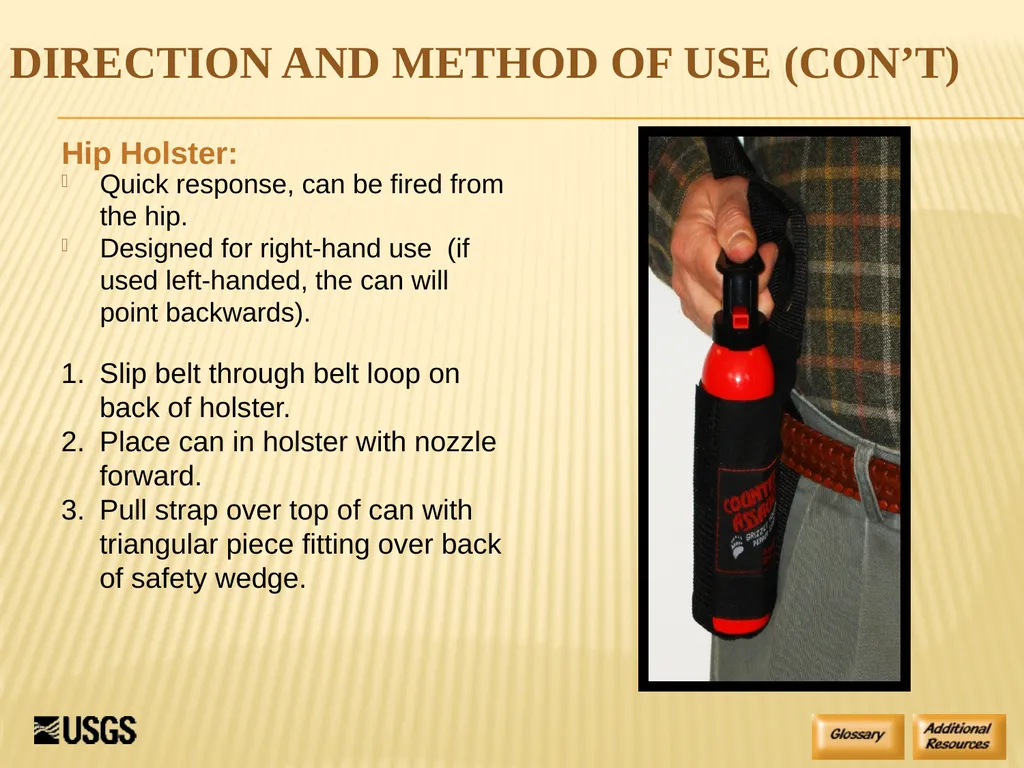
Direction and Method of Use (Con’t) Hip Holster:
Quick response, can be fired from the hip.
Designed for right-hand use (if used left-handed, the can will point backwards). Slip belt through belt loop on back of holster.
Place can in holster with nozzle forward.
Pull strap over top of can with triangular piece fitting over back of safety wedge.<br>
Quick response, can be fired from the hip.
Designed for right-hand use (if used left-handed, the can will point backwards). Slip belt through belt loop on back of holster.
Place can in holster with nozzle forward.
Pull strap over top of can with triangular piece fitting over back of safety wedge.<br>
29
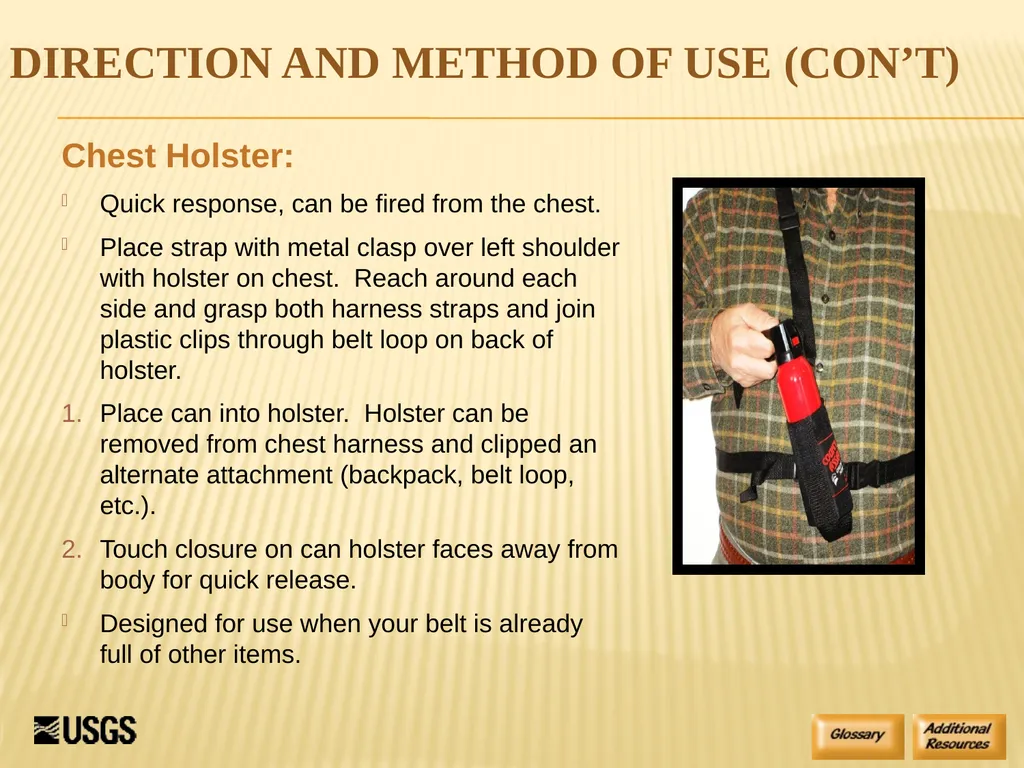
Direction and Method of Use (Con’t) Chest Holster:
Quick response, can be fired from the chest.
Place strap with metal clasp over left shoulder with holster on chest. Reach around each side and grasp both harness straps and join plastic clips through belt loop on back of holster.
Place can into holster. Holster can be removed from chest harness and clipped an alternate attachment (backpack, belt loop, etc.).
Touch closure on can holster faces away from body for quick release.
Designed for use when your belt is already full of other items.<br>
Quick response, can be fired from the chest.
Place strap with metal clasp over left shoulder with holster on chest. Reach around each side and grasp both harness straps and join plastic clips through belt loop on back of holster.
Place can into holster. Holster can be removed from chest harness and clipped an alternate attachment (backpack, belt loop, etc.).
Touch closure on can holster faces away from body for quick release.
Designed for use when your belt is already full of other items.<br>
30
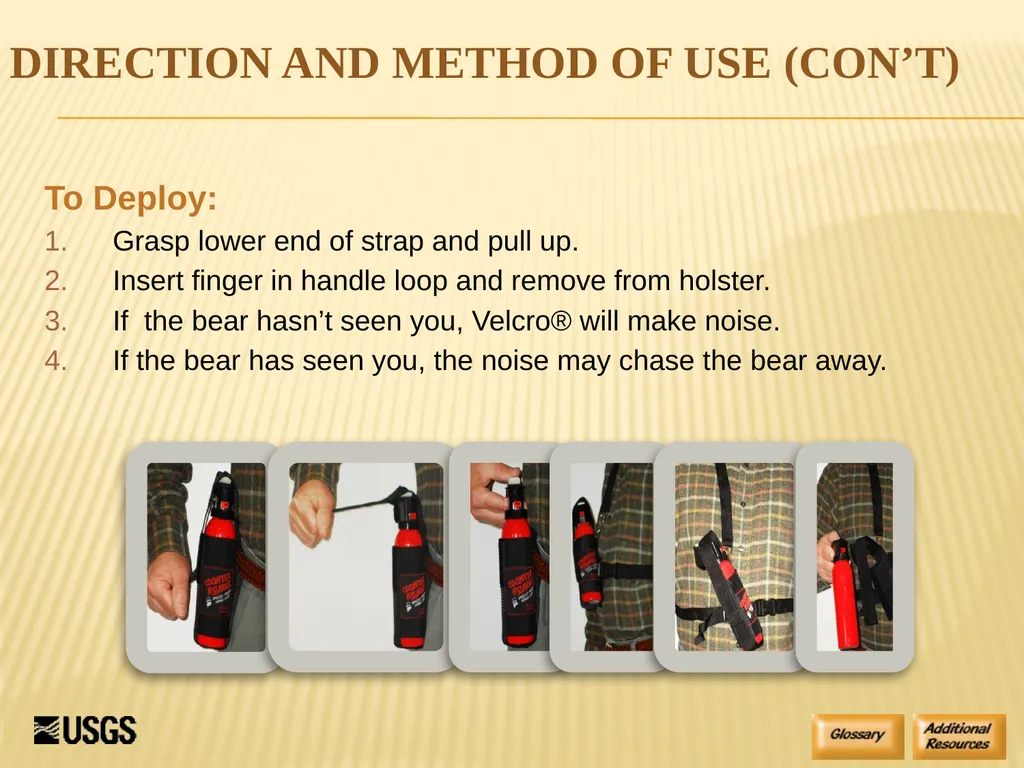
Direction and Method of Use (Con’t) To Deploy:
Grasp lower end of strap and pull up.
Insert finger in handle loop and remove from holster.
If the bear hasn’t seen you, Velcro® will make noise.
If the bear has seen you, the noise may chase the bear away.<br>
Grasp lower end of strap and pull up.
Insert finger in handle loop and remove from holster.
If the bear hasn’t seen you, Velcro® will make noise.
If the bear has seen you, the noise may chase the bear away.<br>
31
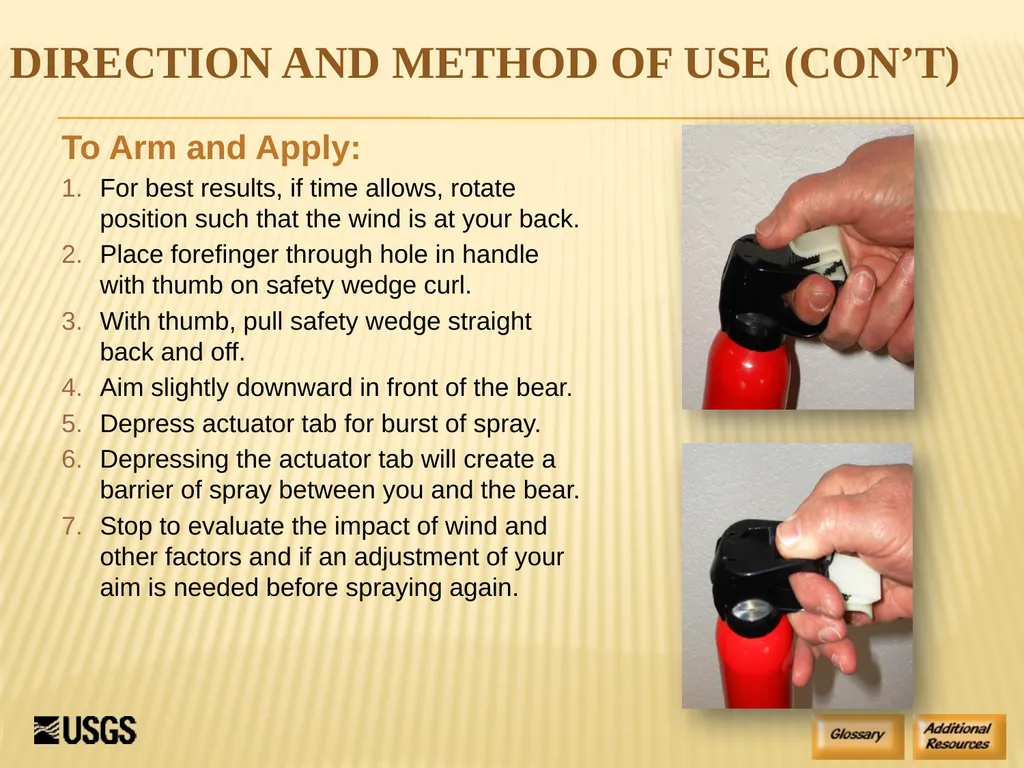
Direction and Method of Use (Con’t) To Arm and Apply:
For best results, if time allows, rotate position such that the wind is at your back.
Place forefinger through hole in handle with thumb on safety wedge curl.
With thumb, pull safety wedge straight back and off.
Aim slightly downward in front of the bear.
Depress actuator tab for burst of spray.
Depressing the actuator tab will create a barrier of spray between you and the bear.
Stop to evaluate the impact of wind and other factors and if an adjustment of your aim is needed before spraying again.<br>
For best results, if time allows, rotate position such that the wind is at your back.
Place forefinger through hole in handle with thumb on safety wedge curl.
With thumb, pull safety wedge straight back and off.
Aim slightly downward in front of the bear.
Depress actuator tab for burst of spray.
Depressing the actuator tab will create a barrier of spray between you and the bear.
Stop to evaluate the impact of wind and other factors and if an adjustment of your aim is needed before spraying again.<br>
32
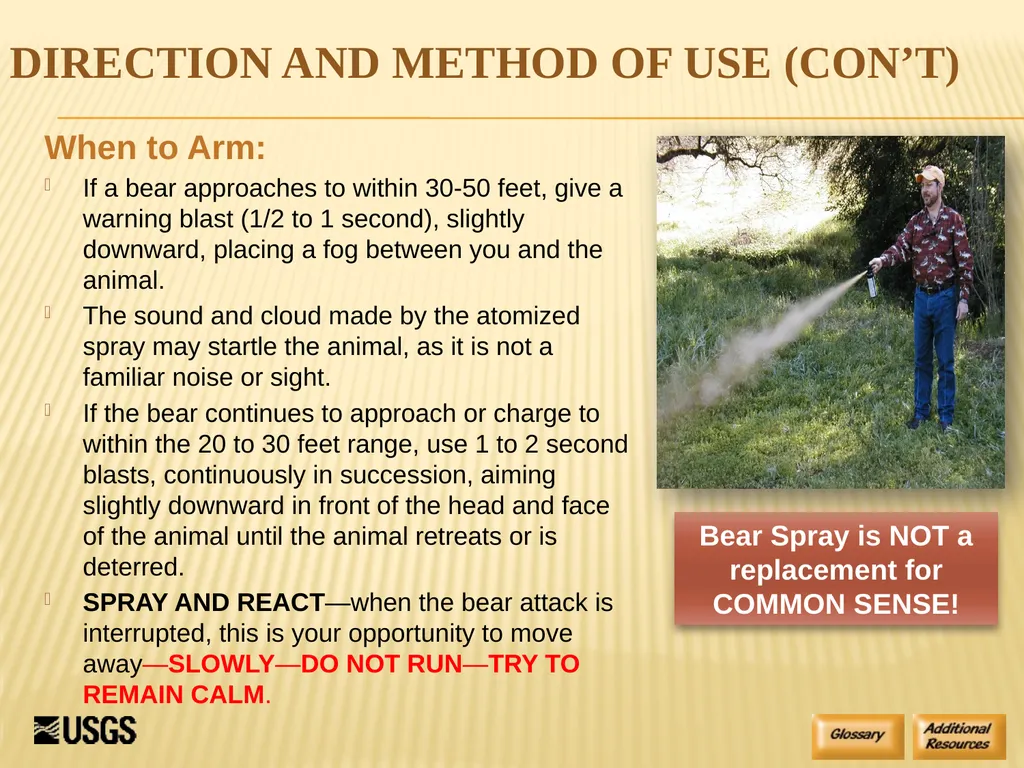
Direction and Method of Use (Con’t) When to Arm:
If a bear approaches to within 30-50 feet, give a warning blast (1/2 to 1 second), slightly downward, placing a fog between you and the animal.
The sound and cloud made by the atomized spray may startle the animal, as it is not a familiar noise or sight.
If the bear continues to approach or charge to within the 20 to 30 feet range, use 1 to 2 second blasts, continuously in succession, aiming slightly downward in front of the head and face of the animal until the animal retreats or is deterred.
SPRAY AND REACT—when the bear attack is interrupted, this is your opportunity to move away—SLOWLY—DO NOT RUN—TRY TO REMAIN CALM. Bear Spray is NOT a replacement for COMMON SENSE!<br>
If a bear approaches to within 30-50 feet, give a warning blast (1/2 to 1 second), slightly downward, placing a fog between you and the animal.
The sound and cloud made by the atomized spray may startle the animal, as it is not a familiar noise or sight.
If the bear continues to approach or charge to within the 20 to 30 feet range, use 1 to 2 second blasts, continuously in succession, aiming slightly downward in front of the head and face of the animal until the animal retreats or is deterred.
SPRAY AND REACT—when the bear attack is interrupted, this is your opportunity to move away—SLOWLY—DO NOT RUN—TRY TO REMAIN CALM. Bear Spray is NOT a replacement for COMMON SENSE!<br>
33
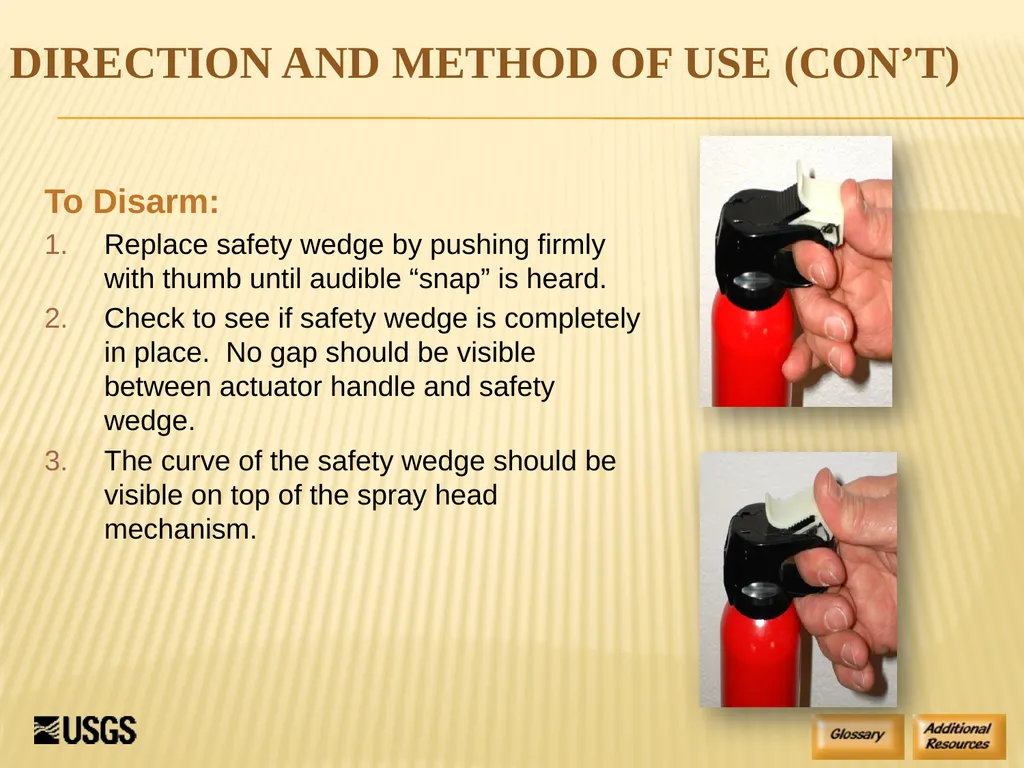
Direction and Method of Use (Con’t) To Disarm:
Replace safety wedge by pushing firmly with thumb until audible “snap” is heard.
Check to see if safety wedge is completely in place. No gap should be visible between actuator handle and safety wedge.
The curve of the safety wedge should be visible on top of the spray head mechanism.<br>
Replace safety wedge by pushing firmly with thumb until audible “snap” is heard.
Check to see if safety wedge is completely in place. No gap should be visible between actuator handle and safety wedge.
The curve of the safety wedge should be visible on top of the spray head mechanism.<br>
34
Direction and Method of Use (Con’t)<br>
35
Post-Exposure Treatment If you are exposed, the effects of bear spray are temporary. With no treatment at all, the major effects will dissipate within approximately 30 to 45 minutes; however, some attempt should be made to relieve the discomfort. If you are with someone who has been exposed, talk to them about the effects to help them understand and stay calm.<br>
36
Post-Exposure Treatment (Con’t) Move to an uncontaminated area as soon as possible and face into the wind if possible. Stay still, breath normally, and relax as much as possible. The effects are only temporary.
Flush the face and eyes with cool water. Remove contact lenses before flushing the eyes with water, and then thoroughly clean and soak the lenses with appropriate cleaning solutions. Disposable contacts may have to be replaced. Do not rub the eyes. You may have to manually force eyes open to flush with water.
DO NOT use lotion, salves or creams on affected areas, as they trap the pepper oil against the skin.<br>
Flush the face and eyes with cool water. Remove contact lenses before flushing the eyes with water, and then thoroughly clean and soak the lenses with appropriate cleaning solutions. Disposable contacts may have to be replaced. Do not rub the eyes. You may have to manually force eyes open to flush with water.
DO NOT use lotion, salves or creams on affected areas, as they trap the pepper oil against the skin.<br>
37
Post Exposure Treatment Con’t. A non-oil based soap (Johnson’s® Baby Wash or No More Tears® Shampoo) can be used and will help remove the pepper oil from the Skin. Once completed, pat dry with a cloth towel. DO NOT RUB.
A wet towel or ice packs may be used on affected areas to reduce inflammation.
Watch for any symptoms of physical distress, e.g., chest pain, cold sweat, or extremely shallow breathing; asthma sufferers may experience acute stress. If anything other than a normal reaction occurs, or symptoms persist beyond 45 minutes, medical attention should be given or summoned immediately.<br>
A wet towel or ice packs may be used on affected areas to reduce inflammation.
Watch for any symptoms of physical distress, e.g., chest pain, cold sweat, or extremely shallow breathing; asthma sufferers may experience acute stress. If anything other than a normal reaction occurs, or symptoms persist beyond 45 minutes, medical attention should be given or summoned immediately.<br>
38
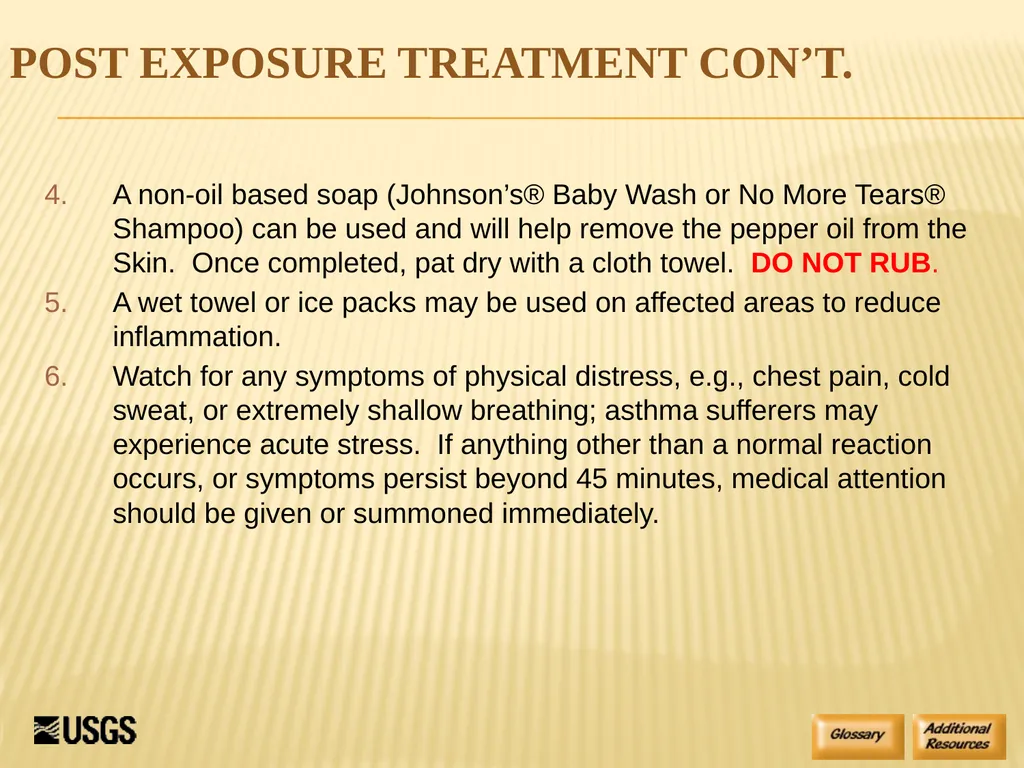
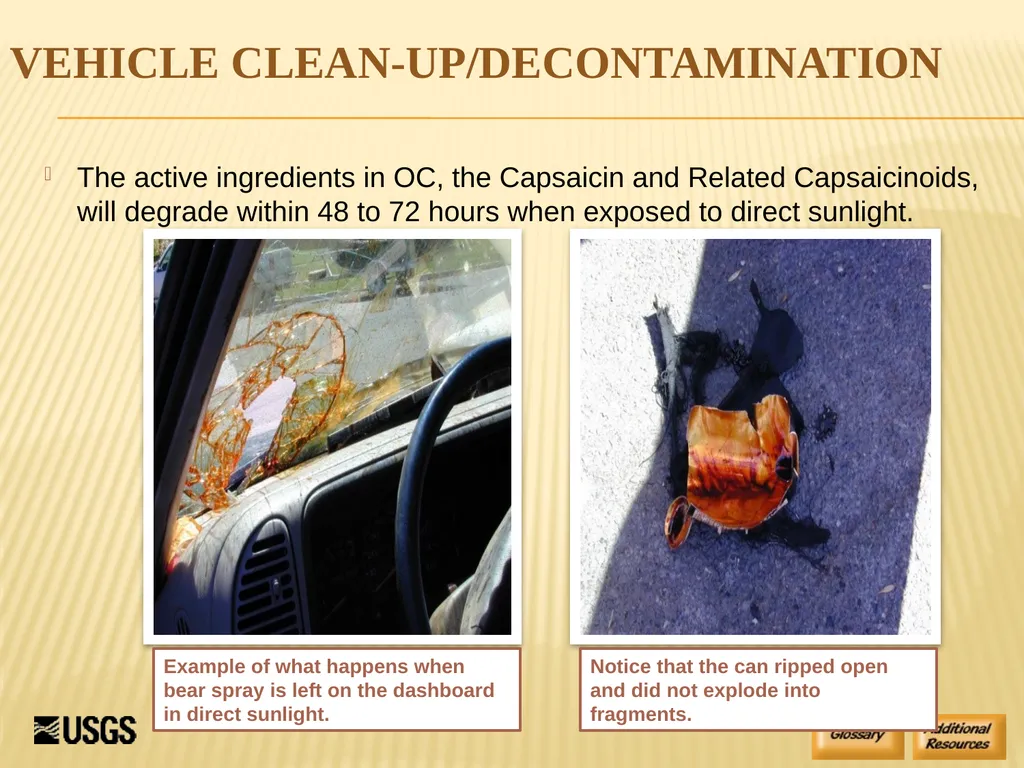
Vehicle Clean-Up/Decontamination The active ingredients in OC, the Capsaicin and Related Capsaicinoids, will degrade within 48 to 72 hours when exposed to direct sunlight. Example of what happens when bear spray is left on the dashboard in direct sunlight. Notice that the can ripped open and did not explode into fragments.<br>
39
Vehicle Clean-up/Decontamination (Con’t) Open doors or windows to allow for maximum ventilation and available sunlight.
At a minimum, the vehicle will require wiping the area with soap (Simple Green® or Dawn®) and water.
The orange/red oil residue in the OC may stain cloth fabric and require professional cleaning.
DO NOT STORE WHERE TEMPERATURES ARE ABOVE 120º F; AN INCREASE IN TEMPEATURE CREATES AN INCREASE IN PRESSURE DO NOT STORE IN DIRECT SUNLIGHT!<br>
At a minimum, the vehicle will require wiping the area with soap (Simple Green® or Dawn®) and water.
The orange/red oil residue in the OC may stain cloth fabric and require professional cleaning.
DO NOT STORE WHERE TEMPERATURES ARE ABOVE 120º F; AN INCREASE IN TEMPEATURE CREATES AN INCREASE IN PRESSURE DO NOT STORE IN DIRECT SUNLIGHT!<br>
40
Disposal Take container outside on a calm day, with the wind at your back, aim spray toward the ground, remove safety wedge, and press actuator to release all pressure. Securely wrap container in several layers of newspaper and discard in trash.
An outdated or unused can may be used for training. Also, it can be carried as a backup if the new replacement can is used.
Remember: if you are in the backcountry and use your spray, an older backup can is better than not having anything.
Replace dented or damaged cans and do not use for training or as a backup.<br>
An outdated or unused can may be used for training. Also, it can be carried as a backup if the new replacement can is used.
Remember: if you are in the backcountry and use your spray, an older backup can is better than not having anything.
Replace dented or damaged cans and do not use for training or as a backup.<br>
41
Transportation and Shipping Cannot be delivered as regular mail. Ship as ORM-D with UPS or Federal Express.
ORM-D (other regulated materials - domestic)
Pressurized
Possibly flammable
Classified as hazardous goods
Must have proper shipping decals and paperwork
Certified carrier, can transport hazardous goods by ground or air
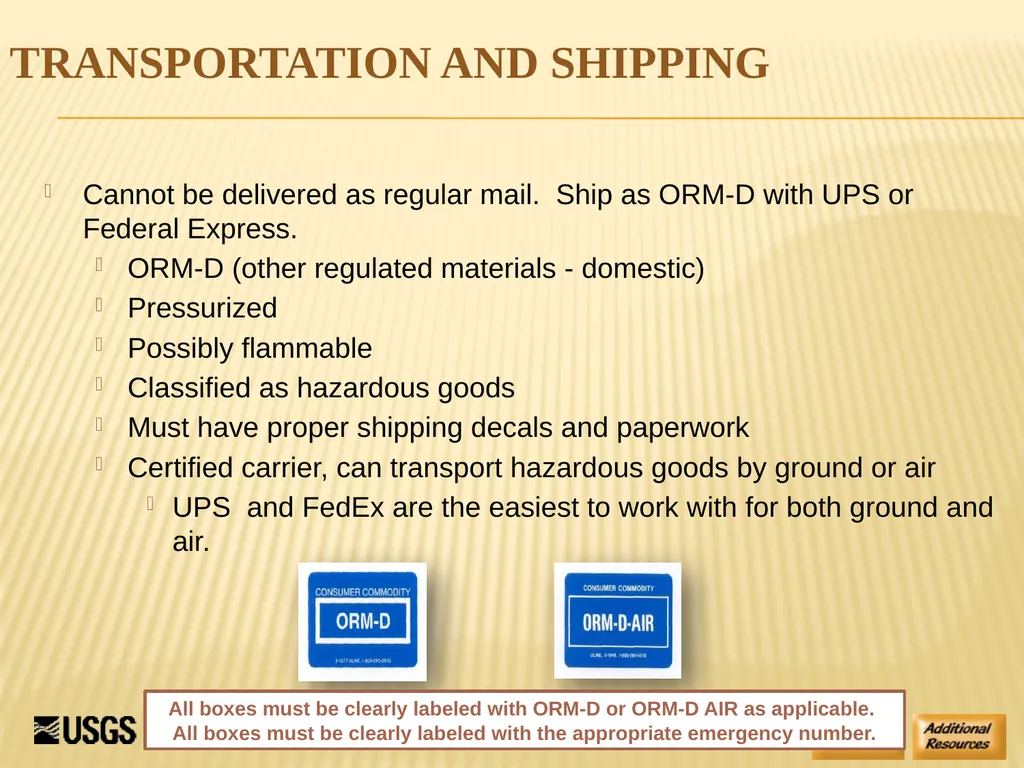
UPS and FedEx are the easiest to work with for both ground and air. All boxes must be clearly labeled with ORM-D or ORM-D AIR as applicable. All boxes must be clearly labeled with the appropriate emergency number.<br>
ORM-D (other regulated materials - domestic)
Pressurized
Possibly flammable
Classified as hazardous goods
Must have proper shipping decals and paperwork
Certified carrier, can transport hazardous goods by ground or air
UPS and FedEx are the easiest to work with for both ground and air. All boxes must be clearly labeled with ORM-D or ORM-D AIR as applicable. All boxes must be clearly labeled with the appropriate emergency number.<br>
42
Transportation and Shipping (Con’t) Vehicles:
Individuals should follow departmental policy.
Many law enforcement officers carry and transport pepper spray inside a vehicle while it is moving, but this is an integral part of the law enforcement job, training, and responsibility.
If it is not pertinent to an individual’s safety, bear spray should be transported in the trunk of a car or in the back of a pickup or sport utility vehicle (SUV).
The canister should be secured.
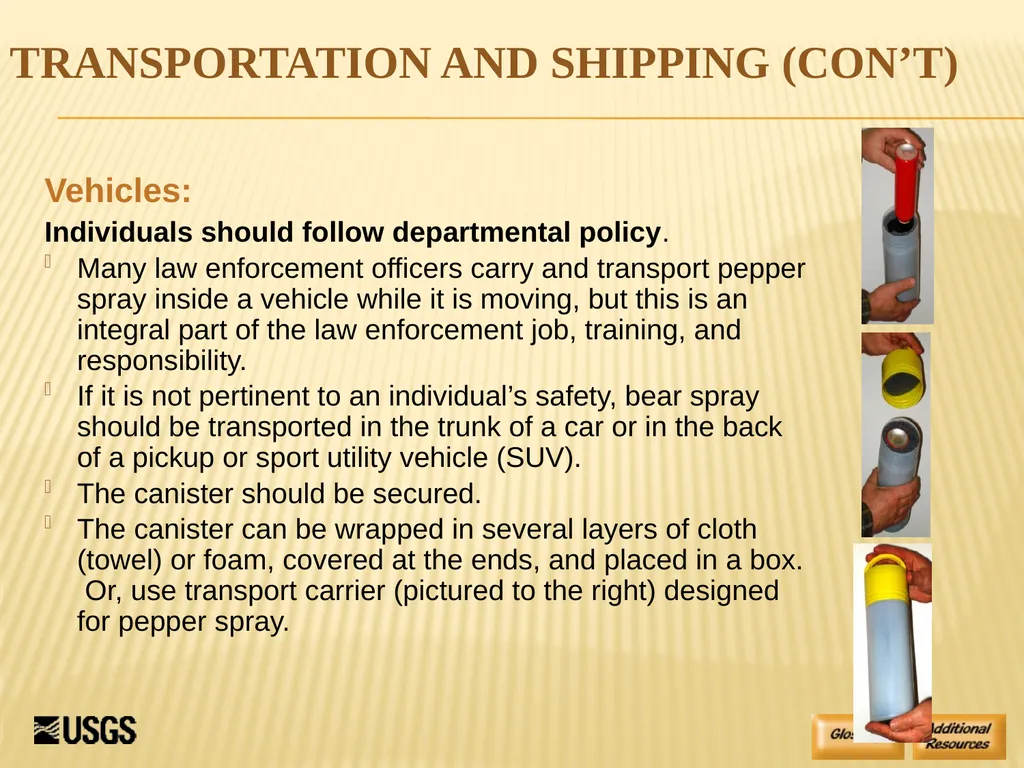
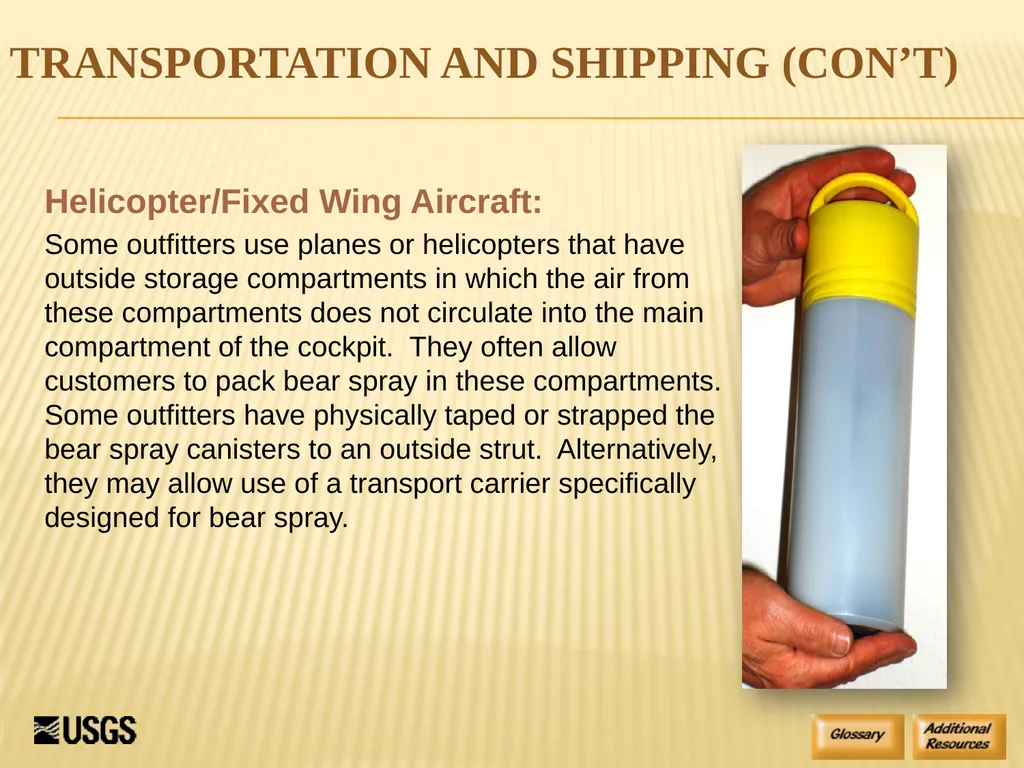
The canister can be wrapped in several layers of cloth (towel) or foam, covered at the ends, and placed in a box. Or, use transport carrier (pictured to the right) designed for pepper spray.<br>
Individuals should follow departmental policy.
Many law enforcement officers carry and transport pepper spray inside a vehicle while it is moving, but this is an integral part of the law enforcement job, training, and responsibility.
If it is not pertinent to an individual’s safety, bear spray should be transported in the trunk of a car or in the back of a pickup or sport utility vehicle (SUV).
The canister should be secured.
The canister can be wrapped in several layers of cloth (towel) or foam, covered at the ends, and placed in a box. Or, use transport carrier (pictured to the right) designed for pepper spray.<br>
43
Transportation and Shipping (Con’t) Vehicles: (Con’t)
The canister should be secured. The canister can be wrapped in several layers of cloth (towel) or foam, covered at the ends, and placed in a box. Or, use a transport carrier designed for pepper spray. Should a mishap occur and the canister is accidentally discharged or leaks, the cloth or foam will filter the oil from the aerosol but will let pressure escape. Transport as far away from the driver as possible.<br>
The canister should be secured. The canister can be wrapped in several layers of cloth (towel) or foam, covered at the ends, and placed in a box. Or, use a transport carrier designed for pepper spray. Should a mishap occur and the canister is accidentally discharged or leaks, the cloth or foam will filter the oil from the aerosol but will let pressure escape. Transport as far away from the driver as possible.<br>
44
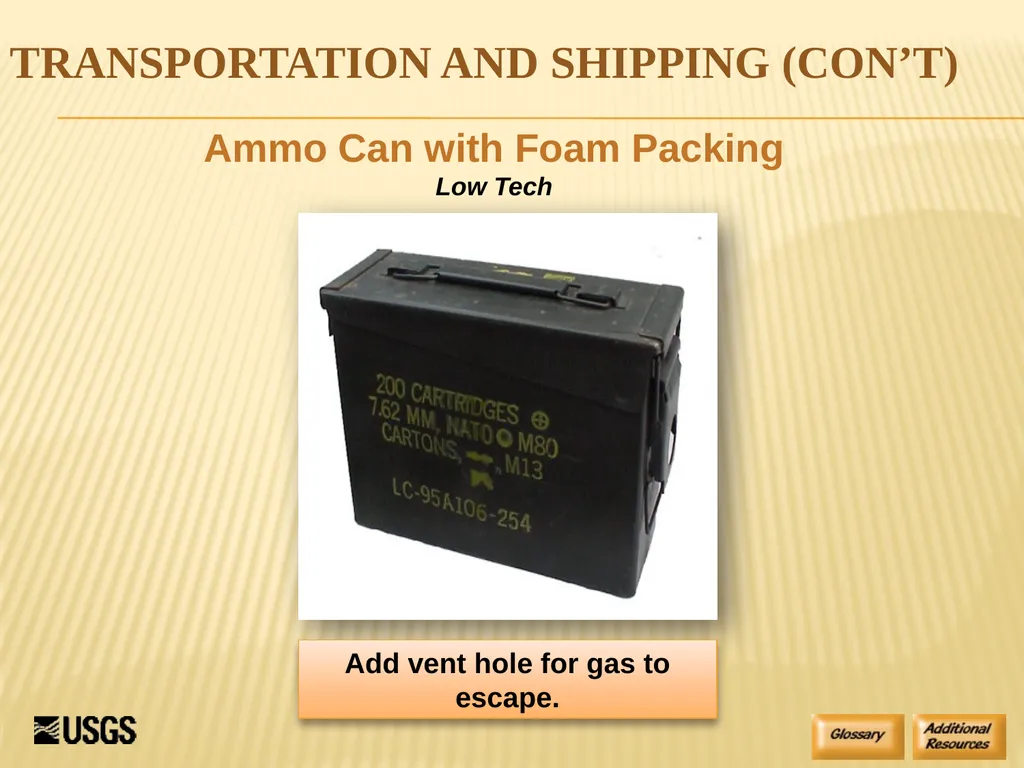
Transportation and Shipping (Con’t) Ammo Can with Foam Packing
Low Tech Add vent hole for gas to escape.<br>
45
Transportation and Shipping (Con’t) Commercial Aircraft:
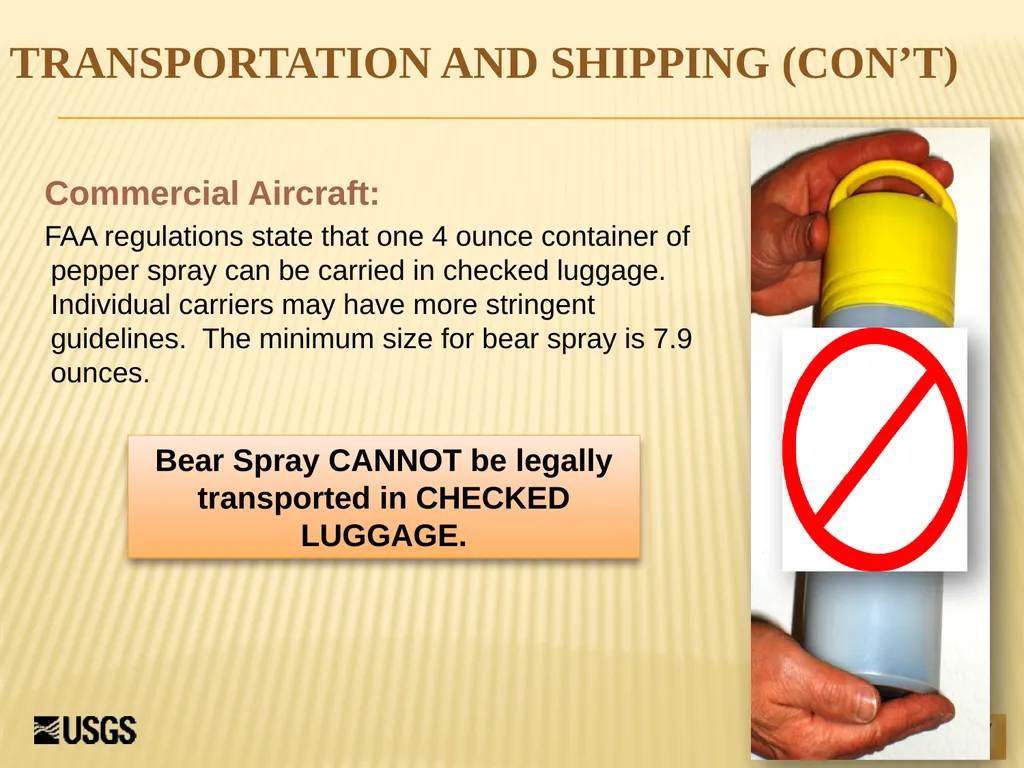
FAA regulations state that one 4 ounce container of pepper spray can be carried in checked luggage. Individual carriers may have more stringent guidelines. The minimum size for bear spray is 7.9 ounces. Bear Spray CANNOT be legally transported in CHECKED LUGGAGE.<br>
FAA regulations state that one 4 ounce container of pepper spray can be carried in checked luggage. Individual carriers may have more stringent guidelines. The minimum size for bear spray is 7.9 ounces. Bear Spray CANNOT be legally transported in CHECKED LUGGAGE.<br>
46
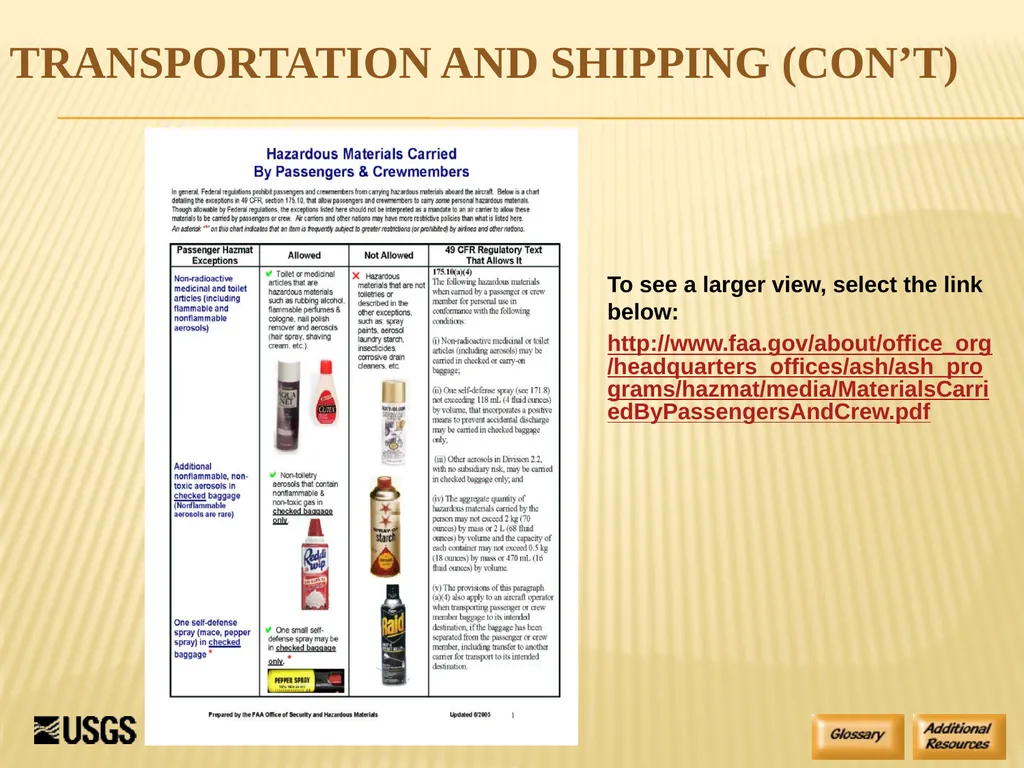
Transportation and Shipping (Con’t) To see a larger view, select the link below:
http://www.faa.gov/about/office_org/headquarters_offices/ash/ash_programs/hazmat/media/MaterialsCarriedByPassengersAndCrew.pdf<br>
http://www.faa.gov/about/office_org/headquarters_offices/ash/ash_programs/hazmat/media/MaterialsCarriedByPassengersAndCrew.pdf<br>
47
Transportation and Shipping (Con’t) Helicopter/Fixed Wing Aircraft:
Some outfitters use planes or helicopters that have outside storage compartments in which the air from these compartments does not circulate into the main compartment of the cockpit. They often allow customers to pack bear spray in these compartments. Some outfitters have physically taped or strapped the bear spray canisters to an outside strut. Alternatively, they may allow use of a transport carrier specifically designed for bear spray.<br>
Some outfitters use planes or helicopters that have outside storage compartments in which the air from these compartments does not circulate into the main compartment of the cockpit. They often allow customers to pack bear spray in these compartments. Some outfitters have physically taped or strapped the bear spray canisters to an outside strut. Alternatively, they may allow use of a transport carrier specifically designed for bear spray.<br>
48
Bear Spray Storage Office:
Use care when transporting from car or truck, remove and store in flammables-type cabinet.
Field Use:
Store in a cool dry place, out of the reach of children.
Vehicle:
Do not store in places where temperature is above 120°F.<br>
Use care when transporting from car or truck, remove and store in flammables-type cabinet.
Field Use:
Store in a cool dry place, out of the reach of children.
Vehicle:
Do not store in places where temperature is above 120°F.<br>
49
General Rules of the Trail
YOUR TOP PRIORITY IS PREVENTING ENCOUNTERS. Know your bears and bear behavior and arm yourself with wisdom and tools before you go hiking in bear country.
Be prepared by bringing bear spray with you and watch for bear signs.
Hike as a group.
Never surprise a bear. Talk loudly as you travel with each other on the trail, clap hands or sing a song to let the bear know you are there.
Always watch for bear signs as you hike or rest.
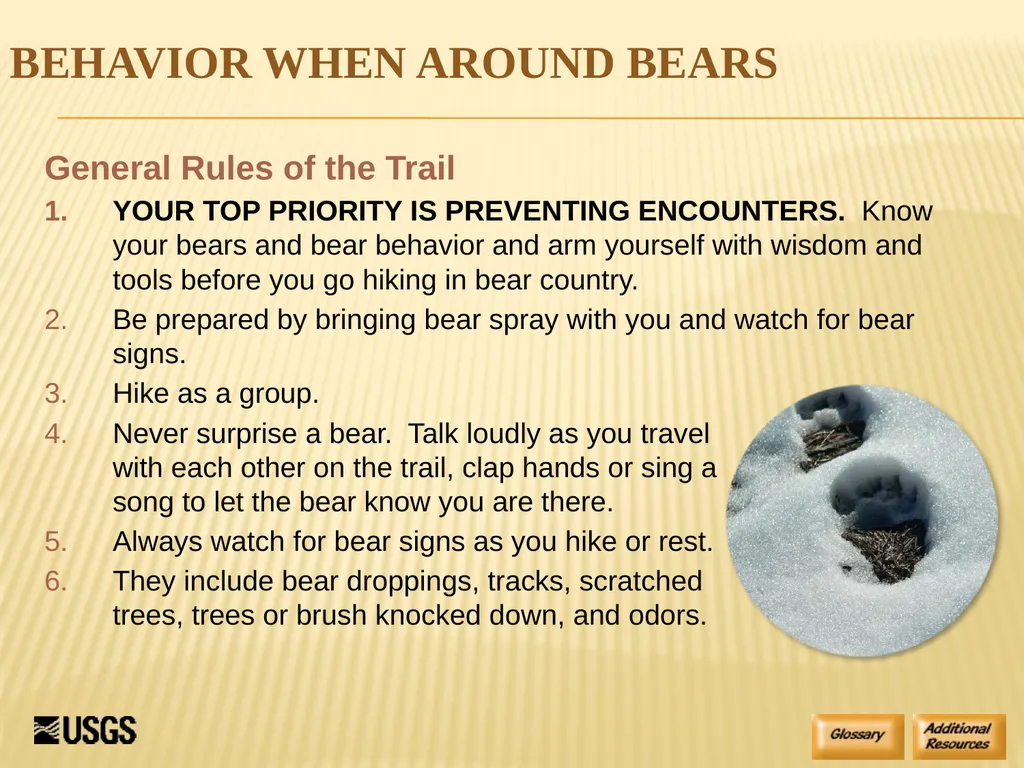
They include bear droppings, tracks, scratched trees, trees or brush knocked down, and odors. Behavior When Around Bears<br>
YOUR TOP PRIORITY IS PREVENTING ENCOUNTERS. Know your bears and bear behavior and arm yourself with wisdom and tools before you go hiking in bear country.
Be prepared by bringing bear spray with you and watch for bear signs.
Hike as a group.
Never surprise a bear. Talk loudly as you travel with each other on the trail, clap hands or sing a song to let the bear know you are there.
Always watch for bear signs as you hike or rest.
They include bear droppings, tracks, scratched trees, trees or brush knocked down, and odors. Behavior When Around Bears<br>
50
Behavior When Around Bears (Con’t) General Rules of the Trail (Con’t)
Be extra careful as you approach berry patches.
Avoid any killed animal; it could belong to the bear and hungry bears are very territorial.
If you do see a bear, DON’T PANIC. Avoid direct eye contact.
Talk softly as you review your options which include:
Always move slowly (DO NOT RUN).
Never turn your back on the bear.
Avoid direct eye contact (especially with grizzlies) because the bear sees this as aggression.
At every stage, assess what the bear is doing or reacting to.
Choose your escape route carefully–never get between a mother bear and her cubs.<br>
Be extra careful as you approach berry patches.
Avoid any killed animal; it could belong to the bear and hungry bears are very territorial.
If you do see a bear, DON’T PANIC. Avoid direct eye contact.
Talk softly as you review your options which include:
Always move slowly (DO NOT RUN).
Never turn your back on the bear.
Avoid direct eye contact (especially with grizzlies) because the bear sees this as aggression.
At every stage, assess what the bear is doing or reacting to.
Choose your escape route carefully–never get between a mother bear and her cubs.<br>
51
Behavior When Around Bears (Con’t) General Rules of the Trail (Con’t)
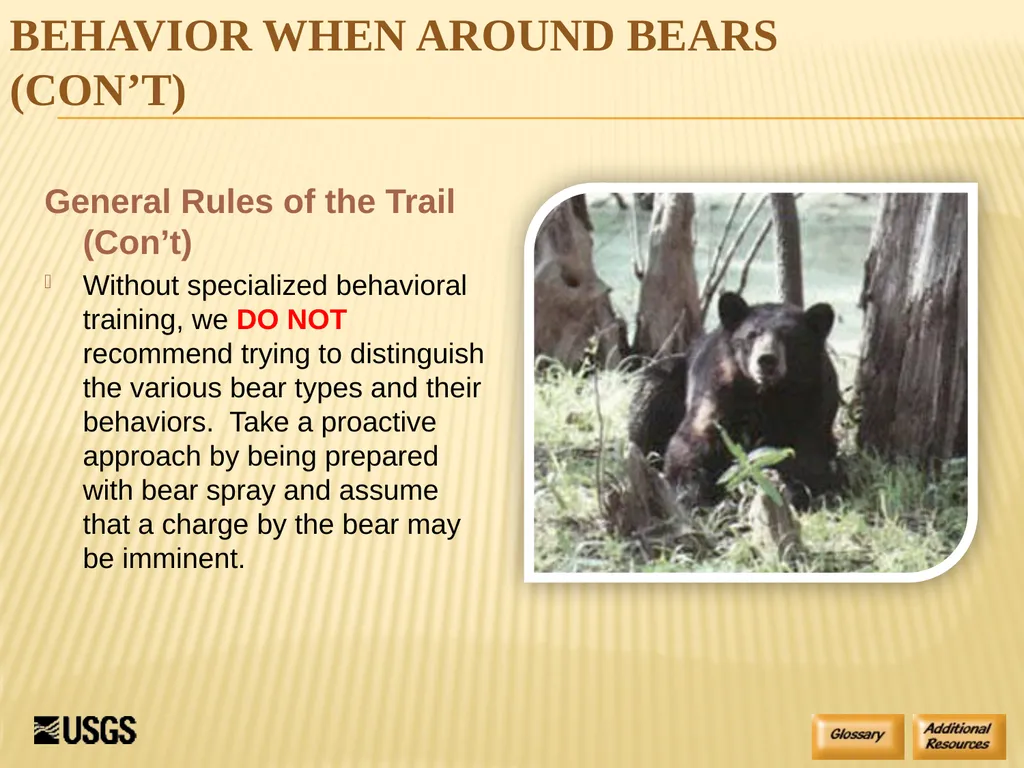
Without specialized behavioral training, we DO NOT recommend trying to distinguish the various bear types and their behaviors. Take a proactive approach by being prepared with bear spray and assume that a charge by the bear may be imminent.<br>
Without specialized behavioral training, we DO NOT recommend trying to distinguish the various bear types and their behaviors. Take a proactive approach by being prepared with bear spray and assume that a charge by the bear may be imminent.<br>
52
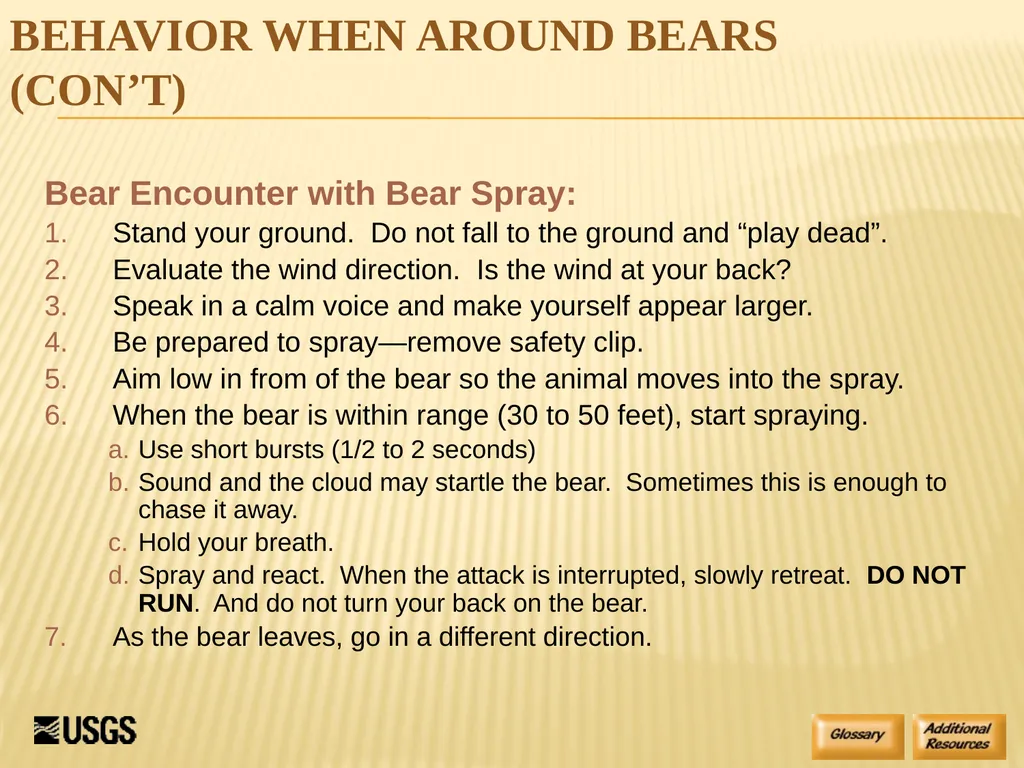
Behavior When Around Bears (Con’T) Bear Encounter with Bear Spray:
Stand your ground. Do not fall to the ground and “play dead”.
Evaluate the wind direction. Is the wind at your back?
Speak in a calm voice and make yourself appear larger.
Be prepared to spray—remove safety clip.
Aim low in from of the bear so the animal moves into the spray.
When the bear is within range (30 to 50 feet), start spraying.
Use short bursts (1/2 to 2 seconds)
Sound and the cloud may startle the bear. Sometimes this is enough to chase it away.
Hold your breath.
Spray and react. When the attack is interrupted, slowly retreat. DO NOT RUN. And do not turn your back on the bear.
As the bear leaves, go in a different direction.<br>
Stand your ground. Do not fall to the ground and “play dead”.
Evaluate the wind direction. Is the wind at your back?
Speak in a calm voice and make yourself appear larger.
Be prepared to spray—remove safety clip.
Aim low in from of the bear so the animal moves into the spray.
When the bear is within range (30 to 50 feet), start spraying.
Use short bursts (1/2 to 2 seconds)
Sound and the cloud may startle the bear. Sometimes this is enough to chase it away.
Hold your breath.
Spray and react. When the attack is interrupted, slowly retreat. DO NOT RUN. And do not turn your back on the bear.
As the bear leaves, go in a different direction.<br>
53
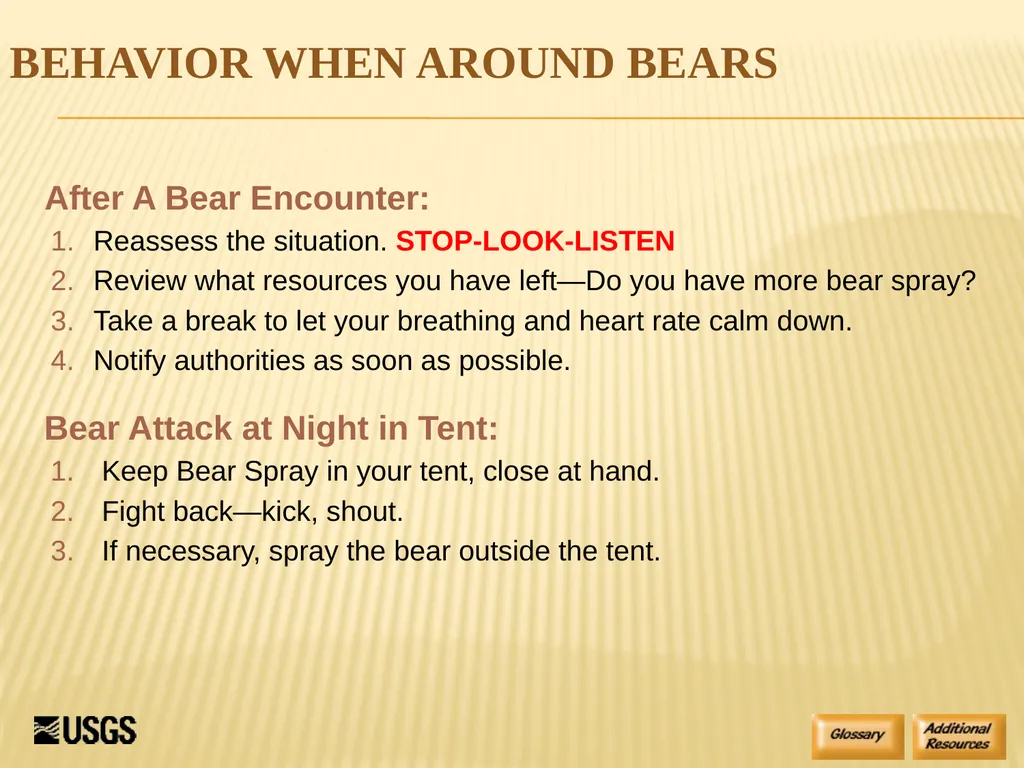
Behavior When Around Bears After A Bear Encounter:
Reassess the situation. STOP-LOOK-LISTEN
Review what resources you have left—Do you have more bear spray?
Take a break to let your breathing and heart rate calm down.
Notify authorities as soon as possible. Bear Attack at Night in Tent:
Keep Bear Spray in your tent, close at hand.
Fight back—kick, shout.
If necessary, spray the bear outside the tent.<br>
Reassess the situation. STOP-LOOK-LISTEN
Review what resources you have left—Do you have more bear spray?
Take a break to let your breathing and heart rate calm down.
Notify authorities as soon as possible. Bear Attack at Night in Tent:
Keep Bear Spray in your tent, close at hand.
Fight back—kick, shout.
If necessary, spray the bear outside the tent.<br>
54
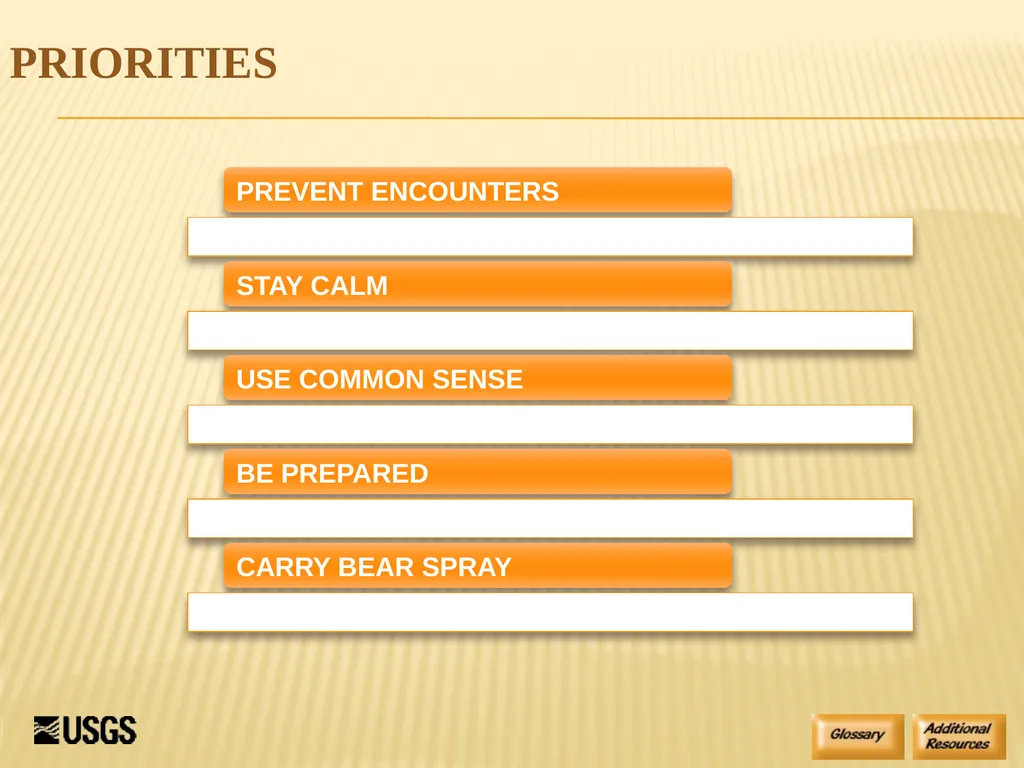
Priorities<br>
55
CONGRATULATIONS!! You have successfully completed the USGS Bear Spray Course.<br>