BEAT THE HEAT: KEY STEPS FOR CHOOSING THE RIGHT HARD HAT IN SUMMER e-Guide presented by Total Safety presents Excessive heat is a threat to the safety of workers especially those working outside in construction, oil and gas, agriculture
"BEAT THE HEAT: KEY STEPS FOR CHOOSING THE RIGHT" is the property of its rightful owner. Permission is granted to
download and print the materials on this website for personal, non-commercial use only, and to display it
on your personal computer provided you do not modify the materials and that you retain all copyright
notices contained in the materials. By downloading content from our website, you accept the terms of this
agreement.
Presentation Transcript
01
BEAT THE HEAT:
KEY STEPS FOR CHOOSING THE RIGHT HARD HAT IN SUMMER
e-Guide presented by Total Safety presents<br>
02
Excessive heat is a threat to the safety of workers — especially those working outside in construction, oil and gas, agriculture and similar industries. If their bodies cannot release heat as quickly as it accumulates, workers can face numerous health risks, such as fatigue, fainting, cardiovascular issues, impaired judgment and other symptoms of heat- related illness.
One critical consideration for outdoor workers in the summer is head protection. In fact, according to recent Honeywell studies, the color of a plastic hard hat is directly related to the heat affecting the body.
This guide explains three key steps to help safety managers choose the right hard hats to protect outdoor workers in the hottest months of the year.
1. ASSESS THE HEAT RISK
According to the Occupational Safety and Health Administration (OSHA), temperatures as low as 71° F can still be dangerous for workers engaged in heavy exertion. That’s because ambient air temperature — the reading on a
thermometer — does not tell the entire story of heat risk. Other contributing factors include direct sunlight, relative humidity, and radiant heat reflected from water, windows or metal structures.
Therefore, in assessing the heat danger for outdoor workers, keep in mind that even though the ambient temperature may seem comfortable, workers could still be at risk. 80 82 84 86 88 90 92 98 100 102 104 106 108 110 40 80
45 80
50 81
55 81
60 82
65 82
70 83
75 84
80 84
85 85
90 86
95 86
100 87 81 83 85 88 91 94 97 101 105 109 114 119 124 130 136
82 84 87 89 93 96 100 104 109 114 119 124 130 137
83 85 88 91 95 99 103 108 113 118 124 131 137
84 86 89 93 97 101 106 112 117 124 130 137
84 88 91 95 100 105 110 116 123 129 137
85 89 93 98 103 108 114 121 128 136
86 90 95 100 105 112 119 126 134
88 92 97 103 109 116 124 132
89 94 100 106 113 121 129
90 96 102 110 117 126 135
91 98 105 113 122 131
93 100 108 117 127
95 103 112 121 132 HOW HOT DOES IT REALLY FEEL OUTSIDE?
The answer is reflected in the Heat Index, which combines relative humidity with the actual air temperature. Consider this guide from the National Weather Service: Likelihood of Heat Disorders with Prolonged Exposure or Strenuous Activity Relative Humidity (%) Temperature (°F)
94 96 Caution Extreme Caution Danger Extreme Danger Heat Index For an OSHA mobile app and other resources for determining heat risk, visit osha.gov/heat.
e-Guide presented by Total Safety<br>
03
Honeywell tested temperature profiles using hard hats and head forms. 2. CHOOSE LIGHT-COLORED HARD HATS
All hard hats reflect, absorb and transmit some infrared rays from the sun.
The rays that are absorbed through the shell become trapped, increasing the temperature of the air gap surrounding the worker's head. There are a variety of factors increasing the temperature of the air gap, including the angle of the sun, the amount of wind, the ambient temperature and the color of the hard hat.
Honeywell tested the impact of color on the temperature that the worker is subjected to. We put identical hard hats of different colors on head forms inside a controlled environment that was tuned to resemble a warm summer day.
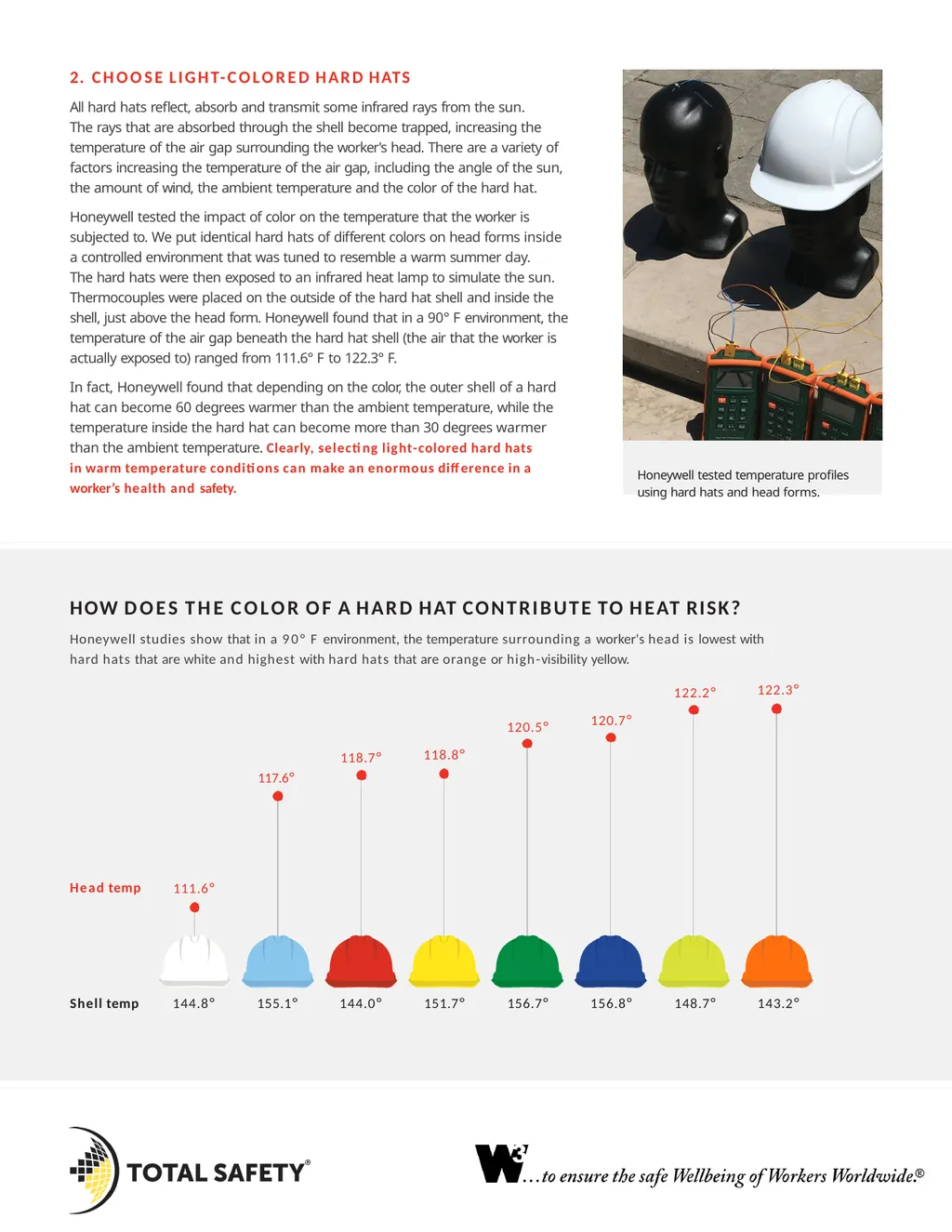
The hard hats were then exposed to an infrared heat lamp to simulate the sun. Thermocouples were placed on the outside of the hard hat shell and inside the shell, just above the head form. Honeywell found that in a 90° F environment, the temperature of the air gap beneath the hard hat shell (the air that the worker is actually exposed to) ranged from 111.6° F to 122.3° F.
In fact, Honeywell found that depending on the color, the outer shell of a hard hat can become 60 degrees warmer than the ambient temperature, while the temperature inside the hard hat can become more than 30 degrees warmer than the ambient temperature. Clearly, selecting light-colored hard hats
in warm temperature conditions can make an enormous difference in a worker’s health and safety. HOW DOES THE COLOR OF A HARD HAT CONTRIBUTE TO HEAT RISK?
Honeywell studies show that in a 90° F environment, the temperature surrounding a worker's head is lowest with hard hats that are white and highest with hard hats that are orange or high-visibility yellow. Head temp Shell temp 144.8° 155.1° 144.0° 151.7° 156.7° 156.8° 148.7° 143.2° 111.6° 117.6° 118.7° 118.8° 120.5° 120.7° 122.2° 122.3°<br>
04
Honeywell replicated these results by setting up several hard hats on head forms in warm, sunny environments across the globe. The sunlight-powered experiments provided data that was consistent with our controlled tests.
In summary, the head form under the light-colored hard hats was significantly cooler than under darker colored hard hats. Interestingly, the orange color performed the worst, allowing infrared rays to penetrate the shell and creating the highest temperature in the air gap surrounding the worker’s head.
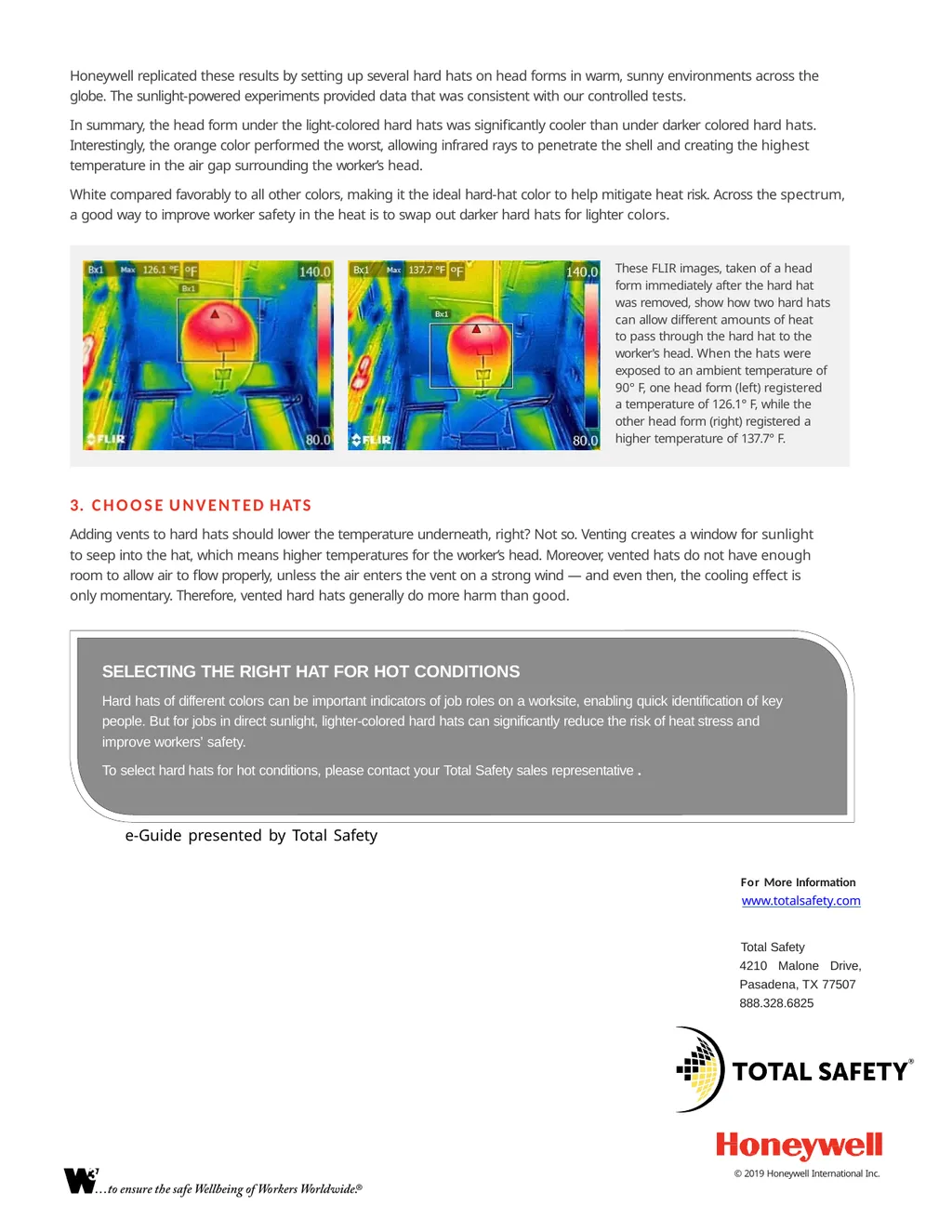
White compared favorably to all other colors, making it the ideal hard-hat color to help mitigate heat risk. Across the spectrum, a good way to improve worker safety in the heat is to swap out darker hard hats for lighter colors. These FLIR images, taken of a head form immediately after the hard hat was removed, show how two hard hats can allow different amounts of heat
to pass through the hard hat to the worker's head. When the hats were exposed to an ambient temperature of 90° F, one head form (left) registered a temperature of 126.1° F, while the other head form (right) registered a higher temperature of 137.7° F. For More Information
www.totalsafety.com