
Beginning Stroke and Turn USA-S Officials Training
SB
Published · 53 slides · 0 views

1 / 1


Description
Beginning Stroke and Turn USA-S Officials Training V 3.4 1032019 v. 3.4 1 Morning Session Beginning Stroke and Turn Course Objectives Understanding the charter of the USA-S Organization Understanding and application of technical stroke
Related Topics
Share
Embed code
Download this presentation From Below
"Beginning Stroke and Turn USA-S Officials Training" is the property of its rightful owner. Permission is granted to download and print the materials on this website for personal, non-commercial use only, and to display it on your personal computer provided you do not modify the materials and that you retain all copyright notices contained in the materials. By downloading content from our website, you accept the terms of this agreement.
Presentation Transcript
01
Beginning Stroke and Turn USA-S Officials Training
V 3.4 10/3/2019 v. 3.4 1 Morning Session<br>
V 3.4 10/3/2019 v. 3.4 1 Morning Session<br>
02
Beginning Stroke and Turn
Course Objectives Understanding the charter of the USA-S Organization
Understanding and application of technical stroke rules
Procedure of disqualification and filling out the DQ Slip
Overview of a swim meet from the official’s perspective
Certification Requirement and Process 10/3/2019 v. 3.4 2<br>
Understanding and application of technical stroke rules
Procedure of disqualification and filling out the DQ Slip
Overview of a swim meet from the official’s perspective
Certification Requirement and Process 10/3/2019 v. 3.4 2<br>
03
Training Agenda Introduction
Why officiate?
Technical rules, and DQ’s
Stroke and Turn in action – Deck Time
Anatomy of a swim meet
The Certification Process 10/3/2019 v. 3.4 3<br>
Why officiate?
Technical rules, and DQ’s
Stroke and Turn in action – Deck Time
Anatomy of a swim meet
The Certification Process 10/3/2019 v. 3.4 3<br>
04
Why Officiate? 10/3/2019 v. 3.4 4<br>
05
USA Swimming
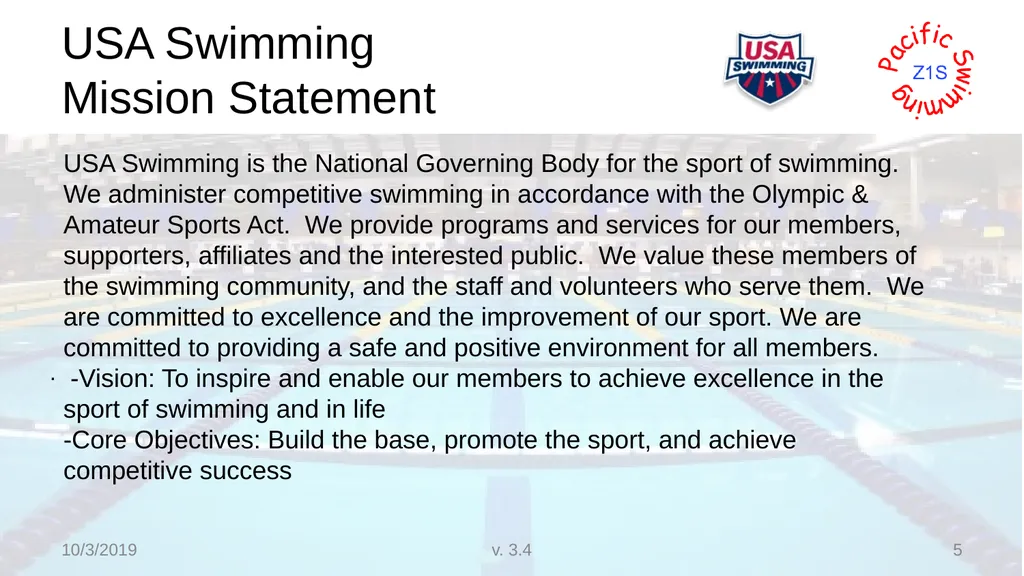
Mission Statement USA Swimming is the National Governing Body for the sport of swimming. We administer competitive swimming in accordance with the Olympic & Amateur Sports Act. We provide programs and services for our members, supporters, affiliates and the interested public. We value these members of the swimming community, and the staff and volunteers who serve them. We are committed to excellence and the improvement of our sport. We are committed to providing a safe and positive environment for all members.
-Vision: To inspire and enable our members to achieve excellence in the sport of swimming and in life
-Core Objectives: Build the base, promote the sport, and achieve competitive success . 10/3/2019 v. 3.4 5<br>
-Vision: To inspire and enable our members to achieve excellence in the sport of swimming and in life
-Core Objectives: Build the base, promote the sport, and achieve competitive success . 10/3/2019 v. 3.4 5<br>
06
Why do you want to be a USA-S official? Officials are ambassadors for the sport of swimming: They support the athletes and coaches, by ensuring swimming competition is conducted in a safe and fair manner for all … and also get to watch some great swimming while doing their jobs.
What is your interest in becoming an official?
Being part of the meet versus a spectator, interacting with athletes and coaches
Developing a passion for swimming by building knowledge and new skills
Building friendships with officials across the zone, LSC and nation: becoming part of the larger officials’ community
The Perks … Officials parking, hospitality, and a starbucks card!
Hanging out at a swim meet in the parent tent with nothing to do – not fun!
Letting our kids take responsibility for themselves by getting out of their way
Volunteer hours are not a problem!!
Giving back 10/3/2019 v. 3.4 6<br>
What is your interest in becoming an official?
Being part of the meet versus a spectator, interacting with athletes and coaches
Developing a passion for swimming by building knowledge and new skills
Building friendships with officials across the zone, LSC and nation: becoming part of the larger officials’ community
The Perks … Officials parking, hospitality, and a starbucks card!
Hanging out at a swim meet in the parent tent with nothing to do – not fun!
Letting our kids take responsibility for themselves by getting out of their way
Volunteer hours are not a problem!!
Giving back 10/3/2019 v. 3.4 6<br>
07
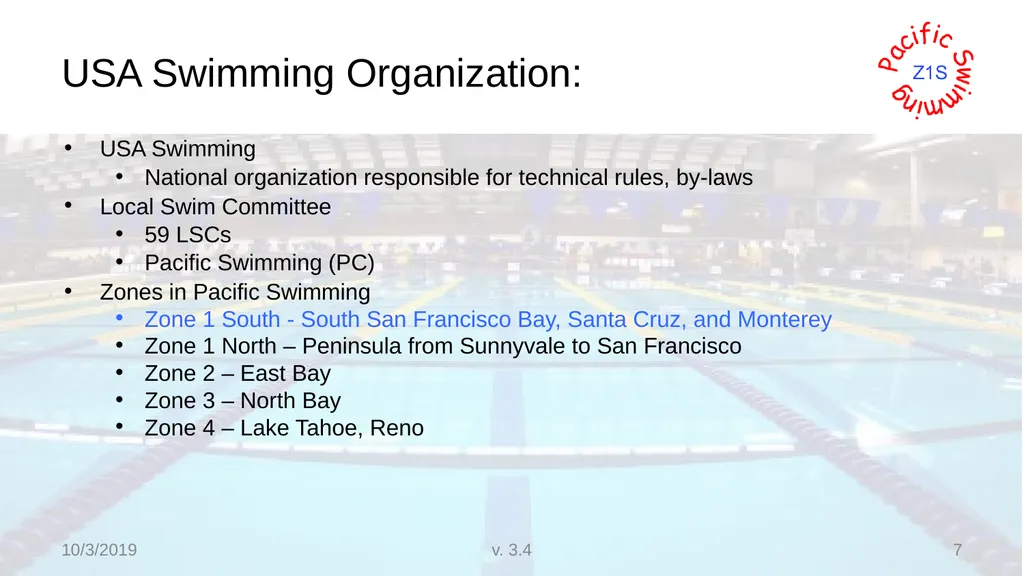
USA Swimming Organization: USA Swimming
National organization responsible for technical rules, by-laws
Local Swim Committee
59 LSCs
Pacific Swimming (PC)
Zones in Pacific Swimming
Zone 1 South - South San Francisco Bay, Santa Cruz, and Monterey
Zone 1 North – Peninsula from Sunnyvale to San Francisco
Zone 2 – East Bay
Zone 3 – North Bay
Zone 4 – Lake Tahoe, Reno 10/3/2019 v. 3.4 7<br>
National organization responsible for technical rules, by-laws
Local Swim Committee
59 LSCs
Pacific Swimming (PC)
Zones in Pacific Swimming
Zone 1 South - South San Francisco Bay, Santa Cruz, and Monterey
Zone 1 North – Peninsula from Sunnyvale to San Francisco
Zone 2 – East Bay
Zone 3 – North Bay
Zone 4 – Lake Tahoe, Reno 10/3/2019 v. 3.4 7<br>
08
Philosophy of Officiating Everything is grounded in the rules. The rules define what is legal and what is not.
Graceful ≠ Legal; Ugly ≠ Illegal
Observers, not inspectors or coaches
Observation should be consistent for all rules and all swimmers
Do NOT infer or extrapolate
Swimmer ALWAYS gets the benefit of the doubt!! v. 3.4 10/3/2019 8<br>
Graceful ≠ Legal; Ugly ≠ Illegal
Observers, not inspectors or coaches
Observation should be consistent for all rules and all swimmers
Do NOT infer or extrapolate
Swimmer ALWAYS gets the benefit of the doubt!! v. 3.4 10/3/2019 8<br>
09
Uniform and Self-Presentation Uniform Requirements:
(Khaki or Navy) pants or knee-length shorts or skirt (not jeans)
White polo shirt, tucked
Belt
Primarily white tennis shoes, or boots
White socks
Credentials, and nametag (lanyard or not?)
Look professional at all times!
USA Swimming has begun using black pants and black shoes at some meets v. 3.4 10/3/2019 9<br>
(Khaki or Navy) pants or knee-length shorts or skirt (not jeans)
White polo shirt, tucked
Belt
Primarily white tennis shoes, or boots
White socks
Credentials, and nametag (lanyard or not?)
Look professional at all times!
USA Swimming has begun using black pants and black shoes at some meets v. 3.4 10/3/2019 9<br>
10
The Technical Rules v. 3.4 10 10/3/2019<br>
11
The Four Competitive Strokes Butterfly
Backstroke
Breaststroke
Freestyle 10/3/2019 v. 3.4 11<br>
Backstroke
Breaststroke
Freestyle 10/3/2019 v. 3.4 11<br>
12
The Technical Rules Start
Stroke
Kick (except backstroke & freestyle – why?)
Turn
Finish 10/3/2019 v. 3.4 12 The Technical Rules for each competitive stroke are broken down in the USA-S Rule Book into the following components to describe a legal swim:<br>
Stroke
Kick (except backstroke & freestyle – why?)
Turn
Finish 10/3/2019 v. 3.4 12 The Technical Rules for each competitive stroke are broken down in the USA-S Rule Book into the following components to describe a legal swim:<br>
13
Definitions Arm--that part of the body that extends from the shoulder to the wrist
Body--the torso, including the shoulders and hips
Finish--the instant that a swimmer touches the wall at the end of the prescribed distance
May--permissive, not mandatory
Shall--mandatory v. 3.4 10/3/2019 13<br>
Body--the torso, including the shoulders and hips
Finish--the instant that a swimmer touches the wall at the end of the prescribed distance
May--permissive, not mandatory
Shall--mandatory v. 3.4 10/3/2019 13<br>
14
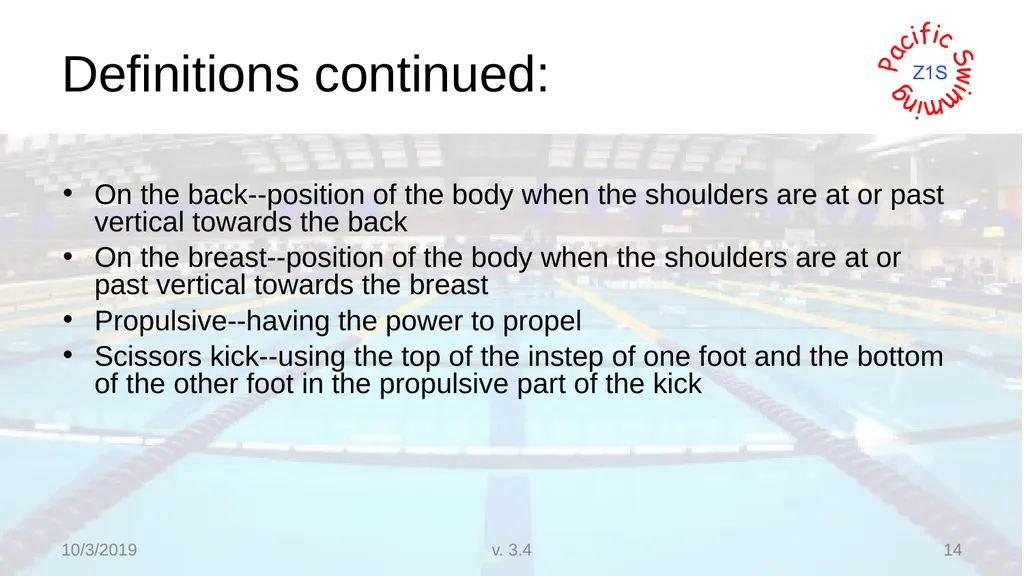
Definitions continued: On the back--position of the body when the shoulders are at or past vertical towards the back
On the breast--position of the body when the shoulders are at or past vertical towards the breast
Propulsive--having the power to propel
Scissors kick--using the top of the instep of one foot and the bottom of the other foot in the propulsive part of the kick v. 3.4 10/3/2019 14<br>
On the breast--position of the body when the shoulders are at or past vertical towards the breast
Propulsive--having the power to propel
Scissors kick--using the top of the instep of one foot and the bottom of the other foot in the propulsive part of the kick v. 3.4 10/3/2019 14<br>
15
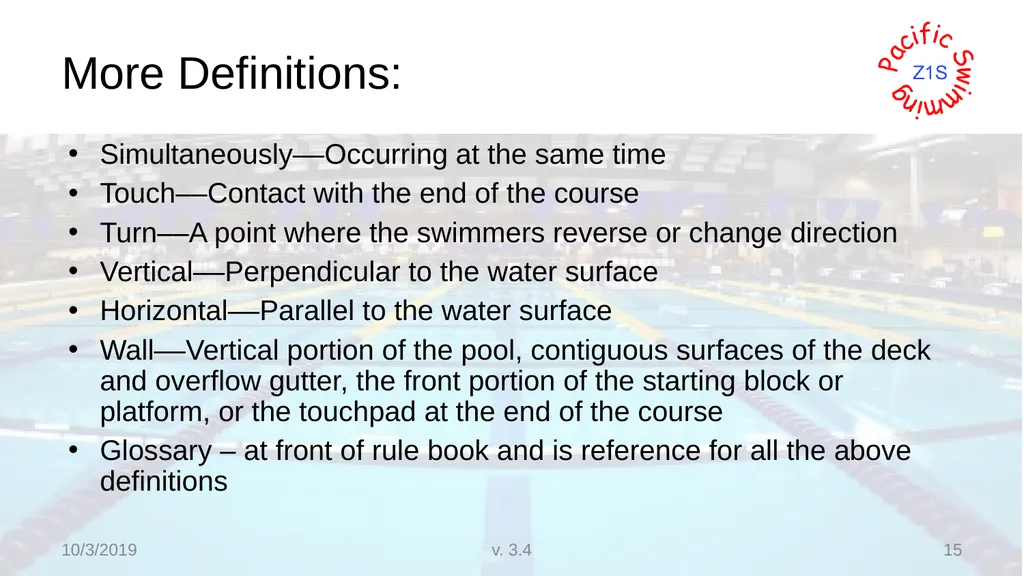
More Definitions: Simultaneously––Occurring at the same time
Touch––Contact with the end of the course
Turn––A point where the swimmers reverse or change direction
Vertical––Perpendicular to the water surface
Horizontal––Parallel to the water surface
Wall––Vertical portion of the pool, contiguous surfaces of the deck and overflow gutter, the front portion of the starting block or platform, or the touchpad at the end of the course
Glossary – at front of rule book and is reference for all the above definitions v. 3.4 10/3/2019 15<br>
Touch––Contact with the end of the course
Turn––A point where the swimmers reverse or change direction
Vertical––Perpendicular to the water surface
Horizontal––Parallel to the water surface
Wall––Vertical portion of the pool, contiguous surfaces of the deck and overflow gutter, the front portion of the starting block or platform, or the touchpad at the end of the course
Glossary – at front of rule book and is reference for all the above definitions v. 3.4 10/3/2019 15<br>
16
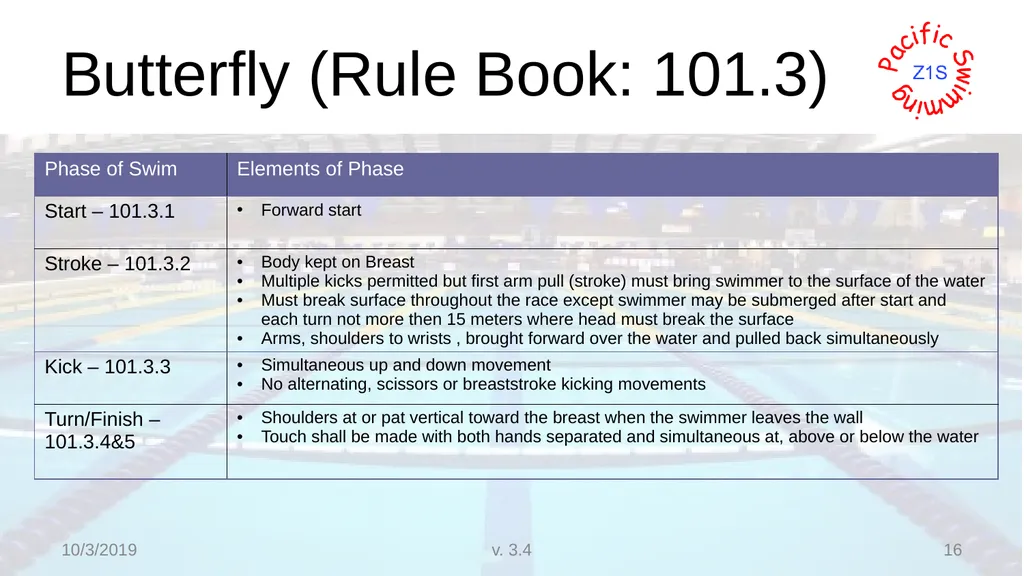
Butterfly (Rule Book: 101.3) 10/3/2019 v. 3.4 16<br>
17
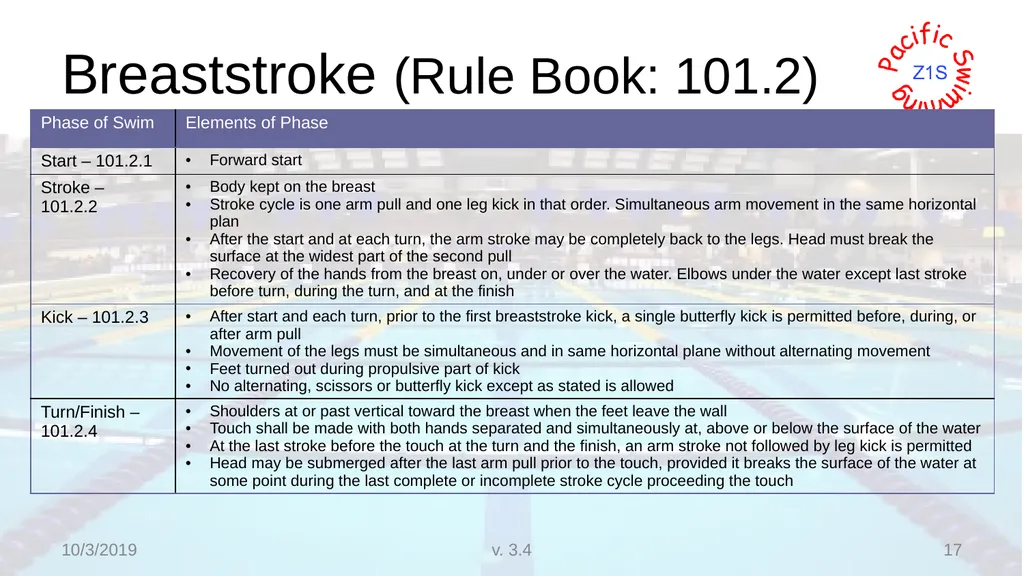
Breaststroke (Rule Book: 101.2) 10/3/2019 v. 3.4 17<br>
18
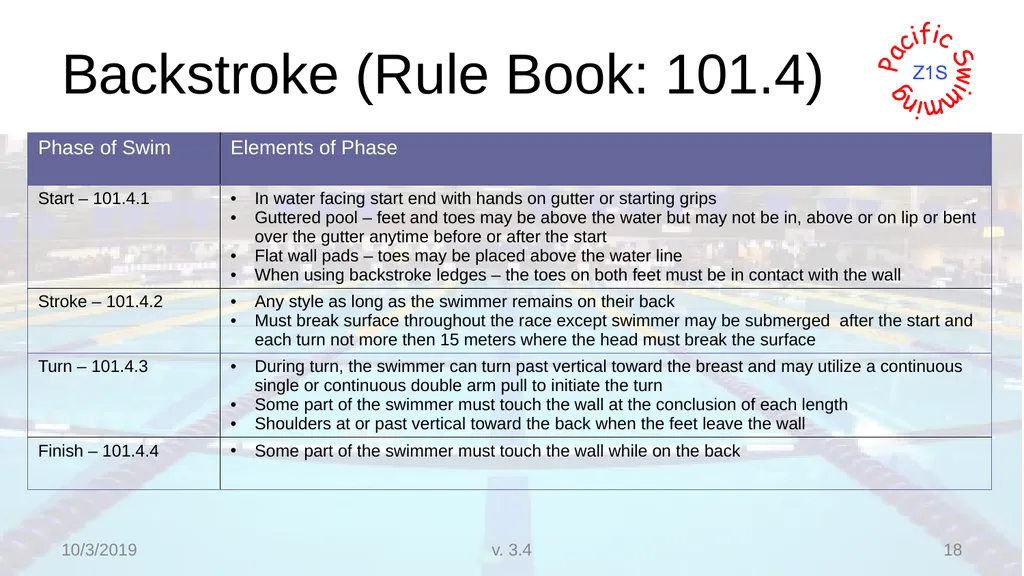
Backstroke (Rule Book: 101.4) 10/3/2019 v. 3.4 18<br>
19
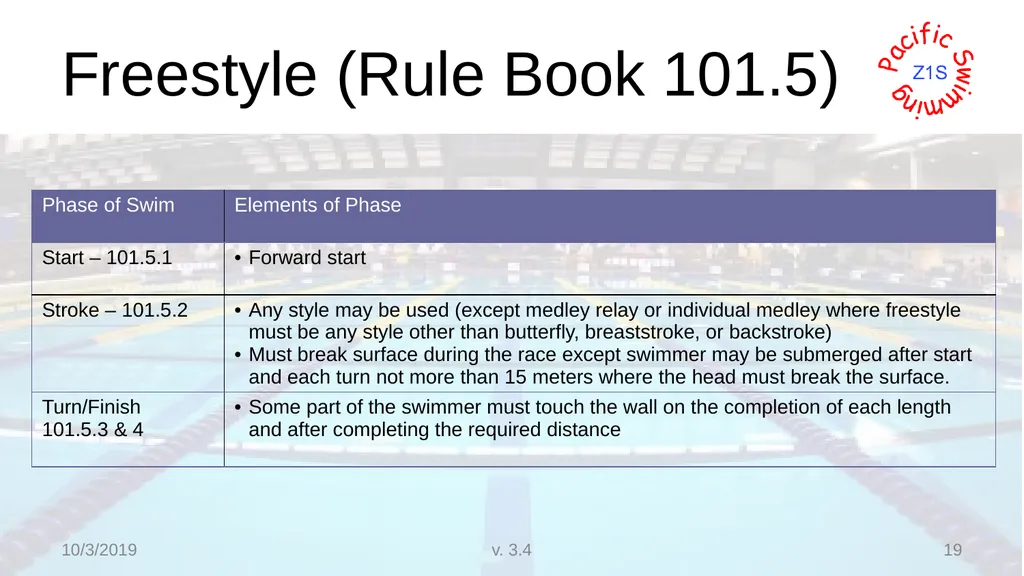
Freestyle (Rule Book 101.5) 10/3/2019 v. 3.4 19<br>
20
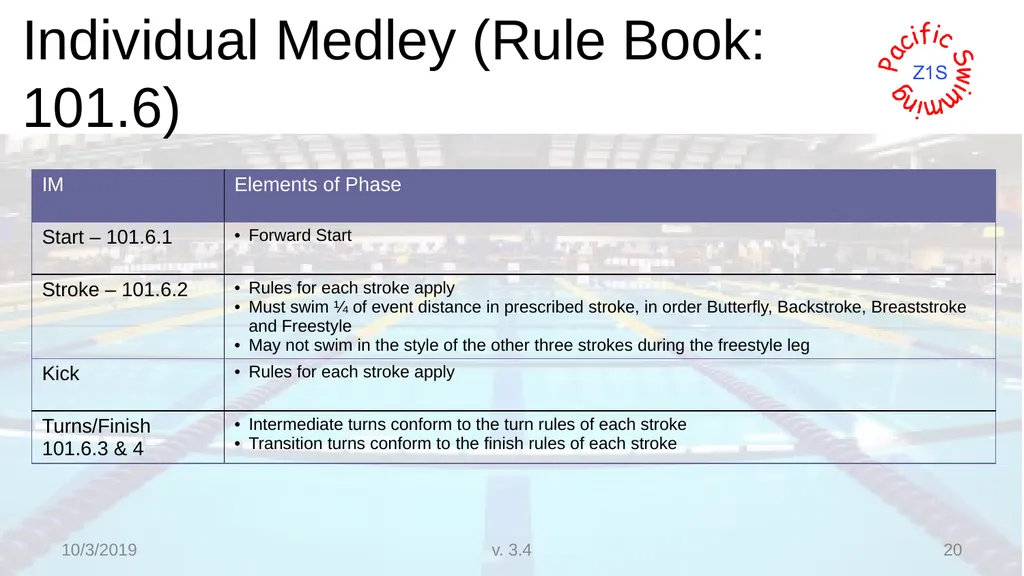
Individual Medley (Rule Book: 101.6) 10/3/2019 v. 3.4 20<br>
21
Disqualification Process 10/3/2019 v. 3.4 21<br>
22
Disqualification (DQ) process: If you see something, don’t be afraid to call it
Don’t expect the other judge to call it
Raise your hand – keep it up so referee/chief judge can see it
Note: lane, heat, event (correct swimmer!), infraction
Jot down notes (cheat sheet)
Once swimmers leave your jurisdiction: write the DQ
Step back, take your time!, focus, take a breath
Coverage while writing DQ 10/3/2019 v. 3.4 22<br>
Don’t expect the other judge to call it
Raise your hand – keep it up so referee/chief judge can see it
Note: lane, heat, event (correct swimmer!), infraction
Jot down notes (cheat sheet)
Once swimmers leave your jurisdiction: write the DQ
Step back, take your time!, focus, take a breath
Coverage while writing DQ 10/3/2019 v. 3.4 22<br>
23
DQ slip details: When writing the DQ make sure:
Take your time, fill it out completely and neatly
Circle the infraction(s)
Sign as judge
Medley: write number code(s) in space
Obtain swimmer’s name from timers
Notify swimmer if you can, yellow slip goes to the swimmer
Turn in white DQ to the deck referee
Be available to answer questions/clarifications if needed 10/3/2019 v. 3.4 23<br>
Take your time, fill it out completely and neatly
Circle the infraction(s)
Sign as judge
Medley: write number code(s) in space
Obtain swimmer’s name from timers
Notify swimmer if you can, yellow slip goes to the swimmer
Turn in white DQ to the deck referee
Be available to answer questions/clarifications if needed 10/3/2019 v. 3.4 23<br>
24
Athlete Notification When notifying an athlete, make sure you do the following:
Ask the athlete to step behind the timers
Remove sunglasses and get down to eye level with the athlete
Apply the "sandwich” technique – compliment, DQ, encourage
Explain to the athlete what you observed, and why that resulted in the DQ
Give athlete the yellow copy, and ask him to bring it to the coach
(per USA-S rules, officials are required to make an attempt to notify the athlete or coach that they have been disqualified)
Please do not …
Coach the athlete (that is not in your job description)
Use arm or leg movements to explain the disqualification 10/3/2019 v. 3.4 24<br>
Ask the athlete to step behind the timers
Remove sunglasses and get down to eye level with the athlete
Apply the "sandwich” technique – compliment, DQ, encourage
Explain to the athlete what you observed, and why that resulted in the DQ
Give athlete the yellow copy, and ask him to bring it to the coach
(per USA-S rules, officials are required to make an attempt to notify the athlete or coach that they have been disqualified)
Please do not …
Coach the athlete (that is not in your job description)
Use arm or leg movements to explain the disqualification 10/3/2019 v. 3.4 24<br>
25
Things you should do: Judge per the rules, not style – lack of mastery does not mean the stroke is not legal
Know your jurisdiction (discussed later)
Judge fairly and evenly: all swimmers equal
Learn effective positioning
Experienced, novice, younger, older: all the same! – be objective, you are a judge.
Benefit of doubt always goes to the swimmer
If you have questions ask team leader or chief judge, don’t be afraid to ask! 10/3/2019 v. 3.4 25<br>
Know your jurisdiction (discussed later)
Judge fairly and evenly: all swimmers equal
Learn effective positioning
Experienced, novice, younger, older: all the same! – be objective, you are a judge.
Benefit of doubt always goes to the swimmer
If you have questions ask team leader or chief judge, don’t be afraid to ask! 10/3/2019 v. 3.4 25<br>
26
Avoid at all Costs Coach an athlete who was disqualified
Discussion of DQs with parents, athlete or coaches-- refer parents to the coach and the coach to chief judge/deck referee
Don’t take it personally if your call is overturned
Don’t avoid DQ’ing athlete because you feel badly for him/her. This is part of the learning process for the swimmer
Don’t favor any swimmer, team, friend, etc.
We “Observe” versus “scrutinize” the athletes (no over-judging) 10/3/2019 v. 3.4 26<br>
Discussion of DQs with parents, athlete or coaches-- refer parents to the coach and the coach to chief judge/deck referee
Don’t take it personally if your call is overturned
Don’t avoid DQ’ing athlete because you feel badly for him/her. This is part of the learning process for the swimmer
Don’t favor any swimmer, team, friend, etc.
We “Observe” versus “scrutinize” the athletes (no over-judging) 10/3/2019 v. 3.4 26<br>
27
Protests The swimmer’s coach is responsible for protesting a DQ. Parents may NOT protest a DQ.
Protest is initiated through the Chief Judge or Referee. Stroke & Turn Officials should not discuss DQs with coaches or parents.
The Chief Judge or Referee is responsible for investigating the DQ.
The Referee will make the determination to uphold or overturn the DQ based on the investigation 10/3/2019 v. 3.4 27<br>
Protest is initiated through the Chief Judge or Referee. Stroke & Turn Officials should not discuss DQs with coaches or parents.
The Chief Judge or Referee is responsible for investigating the DQ.
The Referee will make the determination to uphold or overturn the DQ based on the investigation 10/3/2019 v. 3.4 27<br>
28
Protests The following are questions that you may be asked by the Chief Judge or Referee:
What is your jurisdiction? Was the infraction yours to call?
Where were you standing? Were you standing in a position such that you can observe the infraction you called?
What did you observe? In few words, describe what you saw the swimmer do. For example, at the finish of the race, the swimmer reached and touched the wall with their left hand and then the right hand.
What was the infraction? Does the infraction match what was observed? 10/3/2019 v. 3.4 28<br>
What is your jurisdiction? Was the infraction yours to call?
Where were you standing? Were you standing in a position such that you can observe the infraction you called?
What did you observe? In few words, describe what you saw the swimmer do. For example, at the finish of the race, the swimmer reached and touched the wall with their left hand and then the right hand.
What was the infraction? Does the infraction match what was observed? 10/3/2019 v. 3.4 28<br>
29
Beginning Stroke and Turn USA-S Officials Training 10/3/2019 v. 3.4 29 Afternoon Session<br>
30
DQ Slip Walkthrough “Gentlemen, this is a football”. In only five words, Vince Lombardi communicated his point: We’re going to start with the basics and make sure we’re executing all the fundamentals.
Ladies and gentlemen, this is a DQ slip 10/3/2019 30 v. 3.4<br>
Ladies and gentlemen, this is a DQ slip 10/3/2019 30 v. 3.4<br>
31
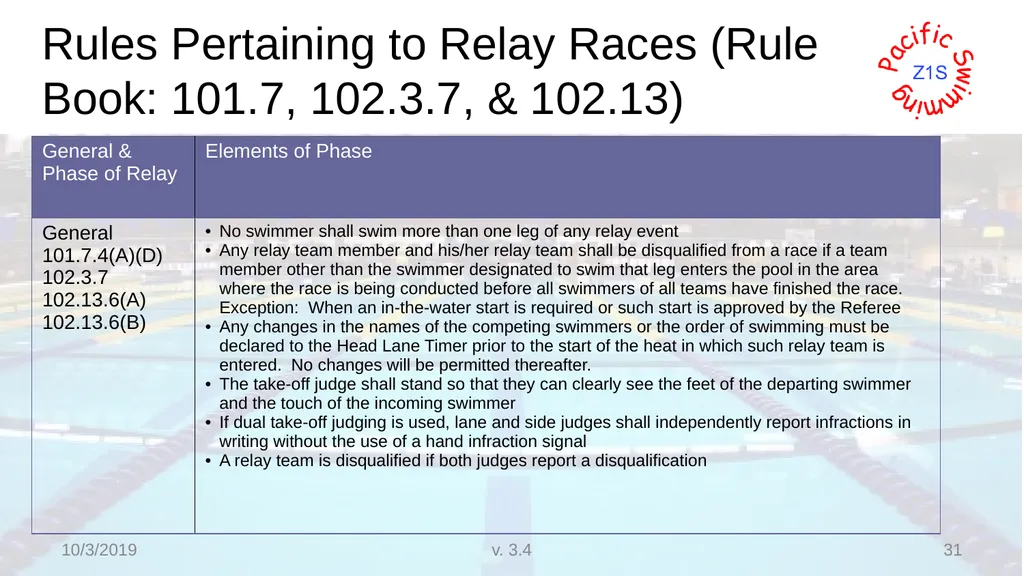
Rules Pertaining to Relay Races (Rule Book: 101.7, 102.3.7, & 102.13) 10/3/2019 v. 3.4 31<br>
32
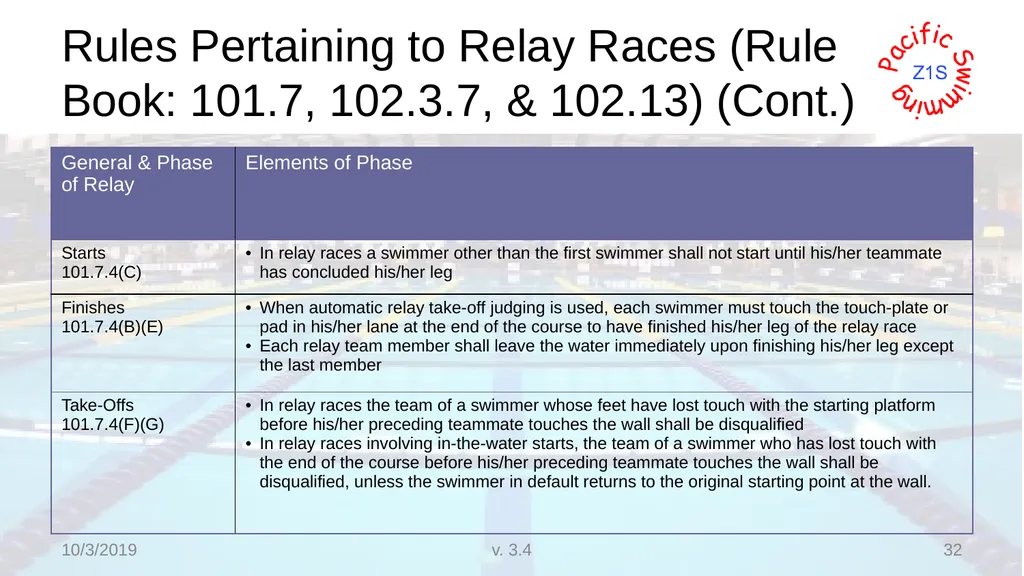
Rules Pertaining to Relay Races (Rule Book: 101.7, 102.3.7, & 102.13) (Cont.) 10/3/2019 v. 3.4 32<br>
33
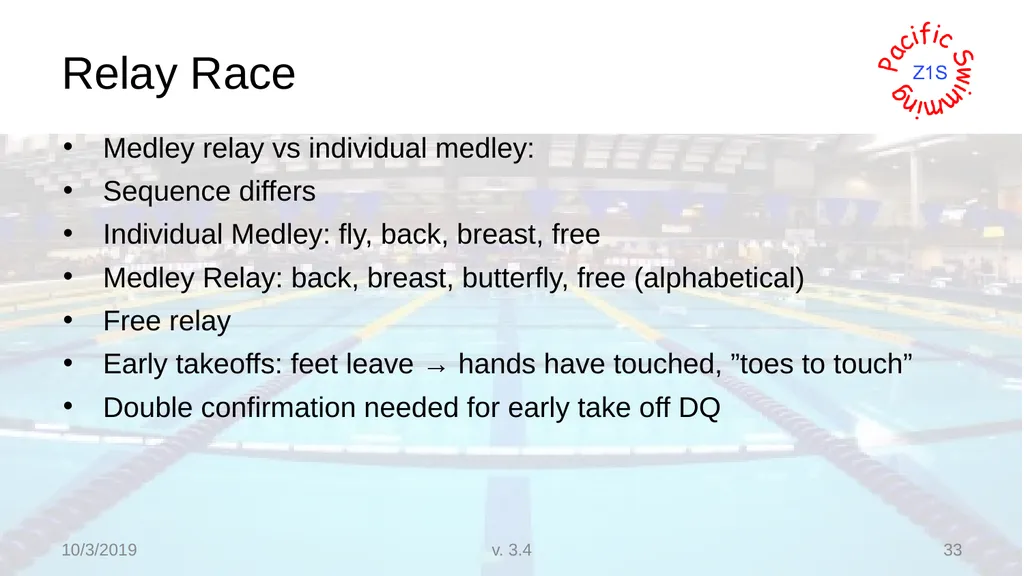
Relay Race Medley relay vs individual medley:
Sequence differs
Individual Medley: fly, back, breast, free
Medley Relay: back, breast, butterfly, free (alphabetical)
Free relay
Early takeoffs: feet leave → hands have touched, ”toes to touch”
Double confirmation needed for early take off DQ 10/3/2019 v. 3.4 33<br>
Sequence differs
Individual Medley: fly, back, breast, free
Medley Relay: back, breast, butterfly, free (alphabetical)
Free relay
Early takeoffs: feet leave → hands have touched, ”toes to touch”
Double confirmation needed for early take off DQ 10/3/2019 v. 3.4 33<br>
34
Jurisdiction The specific area of the pool that you will be responsible for judging including
Which lanes and what part of those lanes
Walkers versus Turn Judges (LC)
15 meter mark
This will vary from meet to meet
Short Course 25 yard pool
Long Course 50 meter pool
Championship Meet 10/3/2019 v. 3.4 34<br>
Which lanes and what part of those lanes
Walkers versus Turn Judges (LC)
15 meter mark
This will vary from meet to meet
Short Course 25 yard pool
Long Course 50 meter pool
Championship Meet 10/3/2019 v. 3.4 34<br>
35
Positioning All about trying to get the best view of the athletes in your jurisdiction.
More difficult the more lanes you have to watch
When there are no restrictions (like starting blocks), don’t be afraid to move around to get that best view
Typically easiest on turn end of pool
Presentation of some scenarios on easel<br>
More difficult the more lanes you have to watch
When there are no restrictions (like starting blocks), don’t be afraid to move around to get that best view
Typically easiest on turn end of pool
Presentation of some scenarios on easel<br>
36
The Anatomy of a Swim Meet 10/3/2019 v. 3.4 36<br>
37
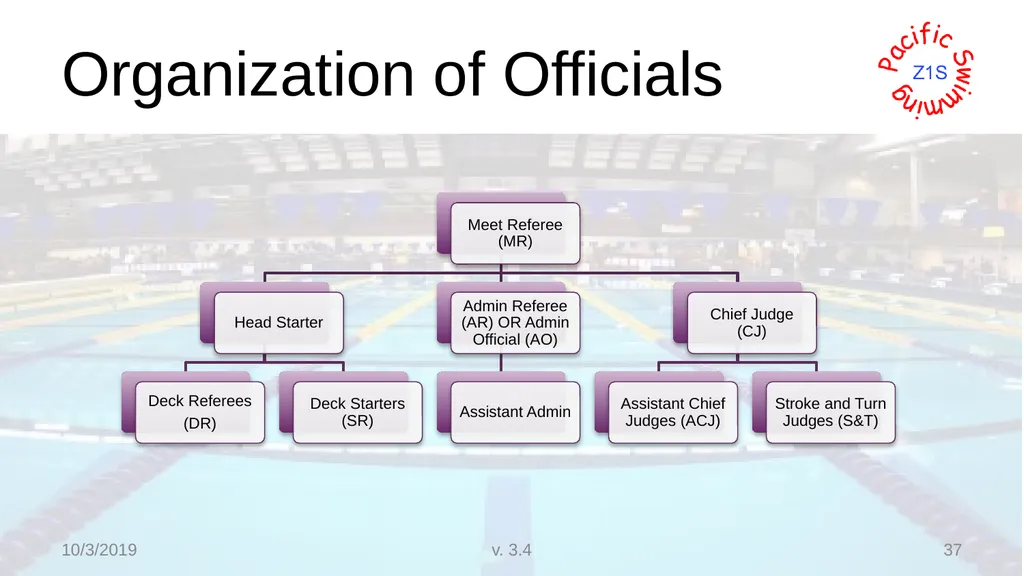
Organization of Officials 10/3/2019 v. 3.4 37<br>
38
The Professional S&T Official Timely arrival
Appropriate attire
Professionalism
Interaction with other volunteers
Just like swimmers, becoming a good official takes work/experience
Be aware of your behavior even when not officiating 10/3/2019 v. 3.4 38<br>
Appropriate attire
Professionalism
Interaction with other volunteers
Just like swimmers, becoming a good official takes work/experience
Be aware of your behavior even when not officiating 10/3/2019 v. 3.4 38<br>
39
When you arrive Check in with CJ or Meet Referee
Sign in, make sure you bring your credentials and they are up to date (Deck Pass OK)
Confirm the time and location of the Official’s Meeting
If applicable, take care of your family first so you can ….
Be on time for the official’s meeting! 10/3/2019 v. 3.4 39<br>
Sign in, make sure you bring your credentials and they are up to date (Deck Pass OK)
Confirm the time and location of the Official’s Meeting
If applicable, take care of your family first so you can ….
Be on time for the official’s meeting! 10/3/2019 v. 3.4 39<br>
40
The Officials’ meeting Meet the senior and other officials for the meet
Learn how this meet is going to run
Learn what team you will be assigned to
Review stroke and turn rules 10/3/2019 v. 3.4 40<br>
Learn how this meet is going to run
Learn what team you will be assigned to
Review stroke and turn rules 10/3/2019 v. 3.4 40<br>
41
Things you will learn at the meeting Pool deck orientation:
Where things are – First Aid, Hospitality, rest rooms, etc.
Expectations for the meet – Timeline, jurisdictions, pool setup, and overall staffing
Any special considerations or other information, issues will be conveyed here 10/3/2019 v. 3.4 41<br>
Where things are – First Aid, Hospitality, rest rooms, etc.
Expectations for the meet – Timeline, jurisdictions, pool setup, and overall staffing
Any special considerations or other information, issues will be conveyed here 10/3/2019 v. 3.4 41<br>
42
More things you will get at the meeting Jurisdiction for officiating
Officiating teams/team leaders
Rotations
Timing of rotations and breaks
Stroke briefing – review of technical rules for ALL strokes
Focus is not on one stroke/infraction
If you have a question regarding a specific rule, take to your CJ one on one, do not bring it up at the meeting
Notification of swimmers – for DQ’s
Other things for you to be aware of while on deck 10/3/2019 v. 3.4 42<br>
Officiating teams/team leaders
Rotations
Timing of rotations and breaks
Stroke briefing – review of technical rules for ALL strokes
Focus is not on one stroke/infraction
If you have a question regarding a specific rule, take to your CJ one on one, do not bring it up at the meeting
Notification of swimmers – for DQ’s
Other things for you to be aware of while on deck 10/3/2019 v. 3.4 42<br>
43
Safety: we are marshals as well Safety - in the water and on deck
No Glass Containers on deck
No pets on deck
No running, horseplay
Three point entry into warm up area (no diving)
No photography/videos from behind the blocks
Remember 25 yard events starting on the turn end
Photography/videos allowed toward the turn-side of the starting area 10/3/2019 v. 3.4 43<br>
No Glass Containers on deck
No pets on deck
No running, horseplay
Three point entry into warm up area (no diving)
No photography/videos from behind the blocks
Remember 25 yard events starting on the turn end
Photography/videos allowed toward the turn-side of the starting area 10/3/2019 v. 3.4 43<br>
44
The Certification Process 10/3/2019 v. 3.4 44<br>
45
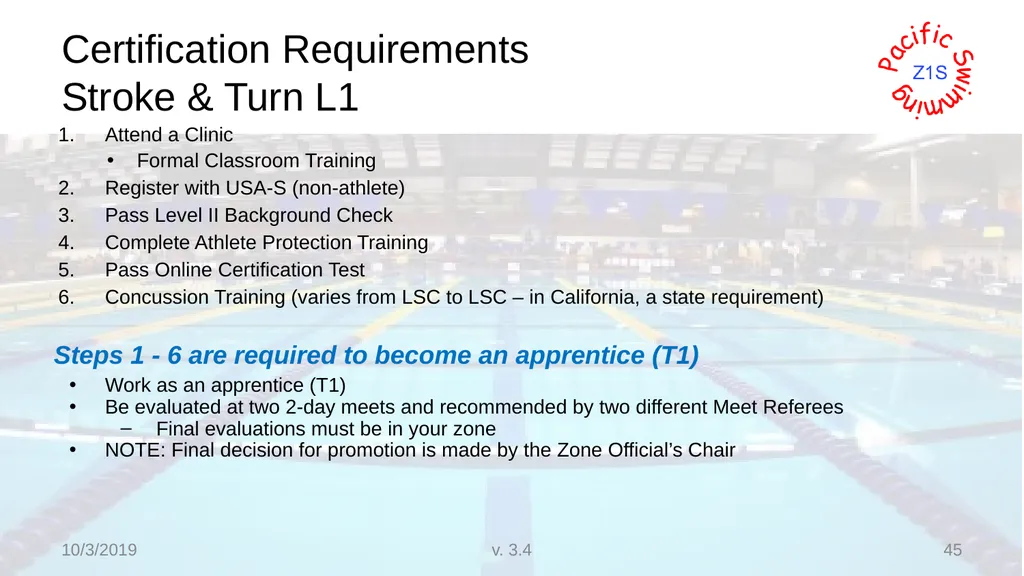
Certification Requirements
Stroke & Turn L1 Attend a Clinic
Formal Classroom Training
Register with USA-S (non-athlete)
Pass Level II Background Check
Complete Athlete Protection Training
Pass Online Certification Test
Concussion Training (varies from LSC to LSC – in California, a state requirement)
Steps 1 - 6 are required to become an apprentice (T1)
Work as an apprentice (T1)
Be evaluated at two 2-day meets and recommended by two different Meet Referees
Final evaluations must be in your zone
NOTE: Final decision for promotion is made by the Zone Official’s Chair 10/3/2019 v. 3.4 45<br>
Formal Classroom Training
Register with USA-S (non-athlete)
Pass Level II Background Check
Complete Athlete Protection Training
Pass Online Certification Test
Concussion Training (varies from LSC to LSC – in California, a state requirement)
Steps 1 - 6 are required to become an apprentice (T1)
Work as an apprentice (T1)
Be evaluated at two 2-day meets and recommended by two different Meet Referees
Final evaluations must be in your zone
NOTE: Final decision for promotion is made by the Zone Official’s Chair 10/3/2019 v. 3.4 45<br>
46
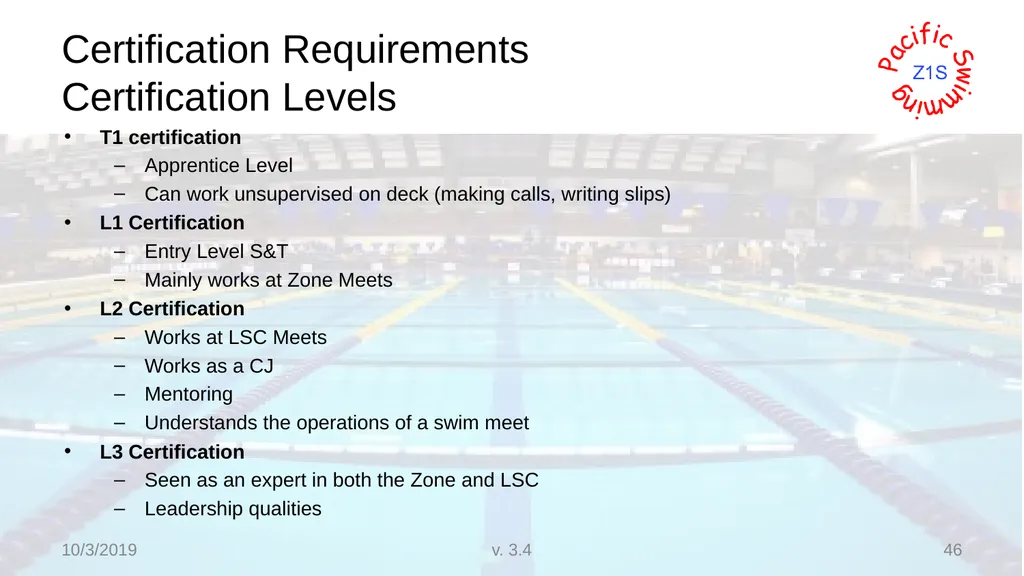
Certification Requirements
Certification Levels T1 certification
Apprentice Level
Can work unsupervised on deck (making calls, writing slips)
L1 Certification
Entry Level S&T
Mainly works at Zone Meets
L2 Certification
Works at LSC Meets
Works as a CJ
Mentoring
Understands the operations of a swim meet
L3 Certification
Seen as an expert in both the Zone and LSC
Leadership qualities 10/3/2019 v. 3.4 46<br>
Apprentice Level
Can work unsupervised on deck (making calls, writing slips)
L1 Certification
Entry Level S&T
Mainly works at Zone Meets
L2 Certification
Works at LSC Meets
Works as a CJ
Mentoring
Understands the operations of a swim meet
L3 Certification
Seen as an expert in both the Zone and LSC
Leadership qualities 10/3/2019 v. 3.4 46<br>
47
Certification Requirements: Shadowing Shadowing is training by observing a certified official perform their duties as a Stroke and Turn including:
Team, jurisdiction, and rotations
Calling an infraction by raising their hand
Filling out the disqualification slip
Interaction with other officials – e.g. chief judge, deck referee, starter
Critical component of the training process for an official
No pre-requisite required to shadow at a swim meet
S&T Trainees are encouraged to shadow after they complete their clinic until they receive their T1 (Z1S – varies a bit from zone to zone)
If you plan to shadow, attend the officials meeting at the beginning of the session and sign-in as a shadow. 10/3/2019 v. 3.4 47<br>
Team, jurisdiction, and rotations
Calling an infraction by raising their hand
Filling out the disqualification slip
Interaction with other officials – e.g. chief judge, deck referee, starter
Critical component of the training process for an official
No pre-requisite required to shadow at a swim meet
S&T Trainees are encouraged to shadow after they complete their clinic until they receive their T1 (Z1S – varies a bit from zone to zone)
If you plan to shadow, attend the officials meeting at the beginning of the session and sign-in as a shadow. 10/3/2019 v. 3.4 47<br>
48
Certification Requirements: Apprentice or Trainee An Apprentice (also referred to as a Trainee or T1) is a non-certified official who continues to learn and develop their skills by working as a S&T under the direct supervision of a certified official, CJ, or Meet Referee.
Requirements for becoming an apprentice include the following:
Attend a clinic (formal training)
Register with USA-S as an official
Pass Level II Background check
Complete the Athlete protection training (APT)/Concussion
Pass the S&T/Timer On-line certification test
Official Trainees should work several sessions as an apprentice to develop their skills prior to their first and second evaluations:
Take advantage of shadowing before working as an apprentice
Make sure you feel comfortable working as an apprentice before asking for your first evaluation (this isn’t a race) 10/3/2019 v. 3.4 48<br>
Requirements for becoming an apprentice include the following:
Attend a clinic (formal training)
Register with USA-S as an official
Pass Level II Background check
Complete the Athlete protection training (APT)/Concussion
Pass the S&T/Timer On-line certification test
Official Trainees should work several sessions as an apprentice to develop their skills prior to their first and second evaluations:
Take advantage of shadowing before working as an apprentice
Make sure you feel comfortable working as an apprentice before asking for your first evaluation (this isn’t a race) 10/3/2019 v. 3.4 48<br>
49
Certification Requirements: Evaluation Process Final Step of certification process (must be T1 to be evaled in Z1S)
2 evaluations and recommended by two Meet Refs
For each eval, must work two days or more at a 2+ day Meet
Highly encouraged to work 2-4 sessions between initial and final evaluation
Zone Official’s Chair makes final decision
Not pass or fail, but provides feedback regarding where a person is in their development process, and if they are ready to work independently 10/3/2019 v. 3.4 49<br>
2 evaluations and recommended by two Meet Refs
For each eval, must work two days or more at a 2+ day Meet
Highly encouraged to work 2-4 sessions between initial and final evaluation
Zone Official’s Chair makes final decision
Not pass or fail, but provides feedback regarding where a person is in their development process, and if they are ready to work independently 10/3/2019 v. 3.4 49<br>
50
Certification Requirements cont: Evaluation form (can be found at pacswim.org)
What are we looking for in an L1 Official:
Open to receiving and incorporating feedback
Team player
Understanding of technical rules and ability to apply them in typical situations
Understands Meet protocols (official’s meeting, jurisdictions, teams, rotations, DQ process)
Ample time on deck working as an apprentice 10/3/2019 v. 3.4 50<br>
What are we looking for in an L1 Official:
Open to receiving and incorporating feedback
Team player
Understanding of technical rules and ability to apply them in typical situations
Understands Meet protocols (official’s meeting, jurisdictions, teams, rotations, DQ process)
Ample time on deck working as an apprentice 10/3/2019 v. 3.4 50<br>
51
Officials Tracking System OTS (Online Tracking System), Deck Pass
Used to track worked sessions, activities (i.e. clinics) and tests for officials
Create account on USA Swimming Website
Links your USA-S membership ID to your account (requires register, background and APT)
Pac Swimming Annual Clinic
October 12th (for 2019)
Officials from all over Bay Area 10/3/2019 v. 3.4 51<br>
Used to track worked sessions, activities (i.e. clinics) and tests for officials
Create account on USA Swimming Website
Links your USA-S membership ID to your account (requires register, background and APT)
Pac Swimming Annual Clinic
October 12th (for 2019)
Officials from all over Bay Area 10/3/2019 v. 3.4 51<br>
52
The National Certification Process 10/3/2019 v. 3.4 52<br>
53
Questions? 10/3/2019 v. 3.4 53<br>