
Behavioral Sciences & Health Promotion Capstone



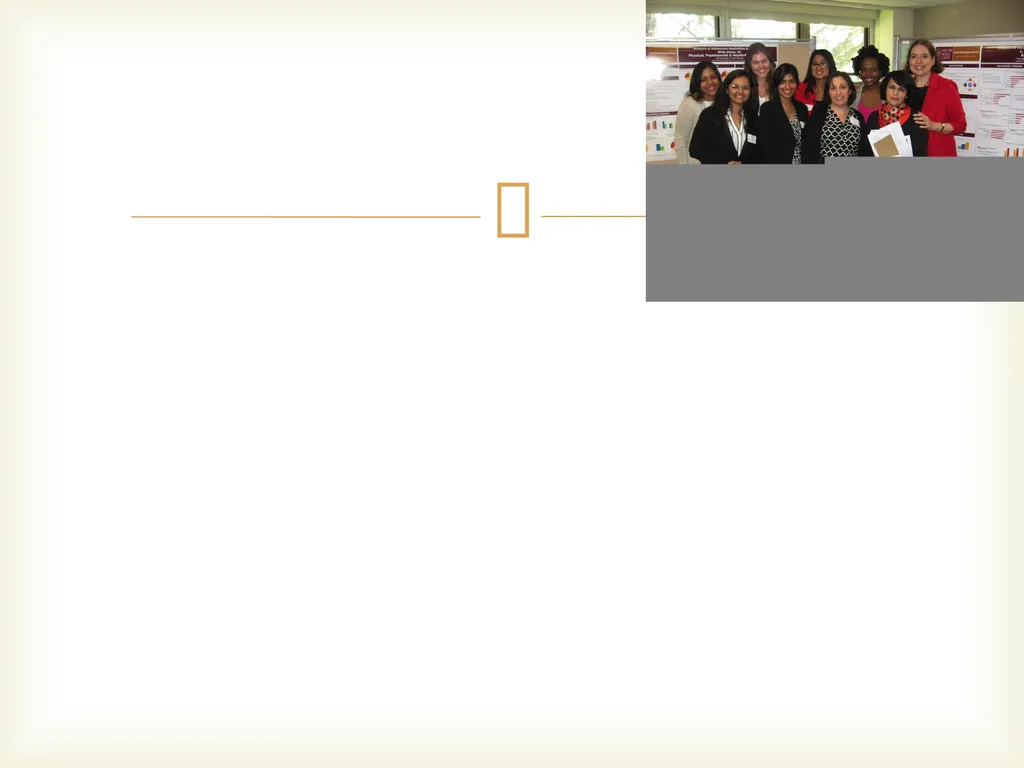

Description: Behavioral Sciences Health Promotion Capstone Penny Liberatos, PhD David A. Moskowitz, PhD Department of Epidemiology Community Health New York Medical College October 31, 2016 Delta Omega National Curriculum Award, Delta Alpha Chapter
Related Topics
Download Presentation
"Behavioral Sciences & Health Promotion Capstone" is the property of its rightful owner. Permission is granted to download and print the materials on this website for personal, non-commercial use only, and to display it on your personal computer provided you do not modify the materials and that you retain all copyright notices contained in the materials. By downloading content from our website, you accept the terms of this agreement.
Presentation Transcript
slide1. Behavioral Sciences & Health Promotion Capstone Penny Liberatos, PhD
David A. Moskowitz, PhD
Department of Epidemiology &
Community Health
New York Medical College
October 31, 2016 Delta Omega National Curriculum Award, Delta Alpha Chapter<br>
slide2. Course history & intent
Course design
Course structure
2016 implementation
Educational culmination
Thanks! Overview<br>
slide3. Origins
Needed to replace Thesis with a more applied culminating experience
Capstone course developed in 2009
Many improvements since
Last “course” prior to graduation
Course Intent
Intended to take classroom learning into the field
Intended to bridge school and work environments
Focuses on each student meeting core and program competencies Course History & Intent<br>
slide4. Designed for students to work on a current public health issue in collaboration with a community-based organization (stakeholder)
Community-based organization
Identified by Instructor through
Prior community contacts
Practicum sites
Has a need for a public health “project” to be done
Evaluation of a current public health program
Data to be analyzed
Public health intervention to be developed
Health assessment to be conducted Course Design Collaboration<br>
slide5. Collaboration with community-based organization (stakeholder)
Project goals developed collaboratively
Must be amenable to completion within academic semester
Must be public health focused
Must utilize student skillset
Must be amenable to allowing student group to make recommendations based on scientific evidence Course Design Collaboration<br>
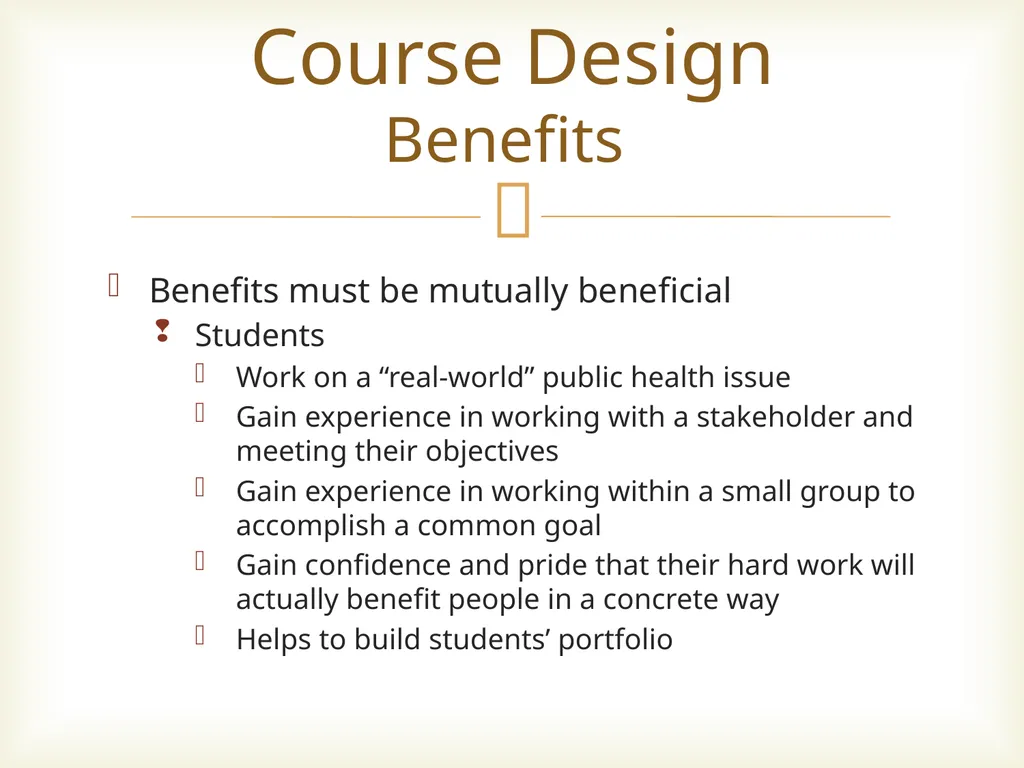
slide6. Benefits must be mutually beneficial
Students
Work on a “real-world” public health issue
Gain experience in working with a stakeholder and meeting their objectives
Gain experience in working within a small group to accomplish a common goal
Gain confidence and pride that their hard work will actually benefit people in a concrete way
Helps to build students’ portfolio Course Design Benefits<br>
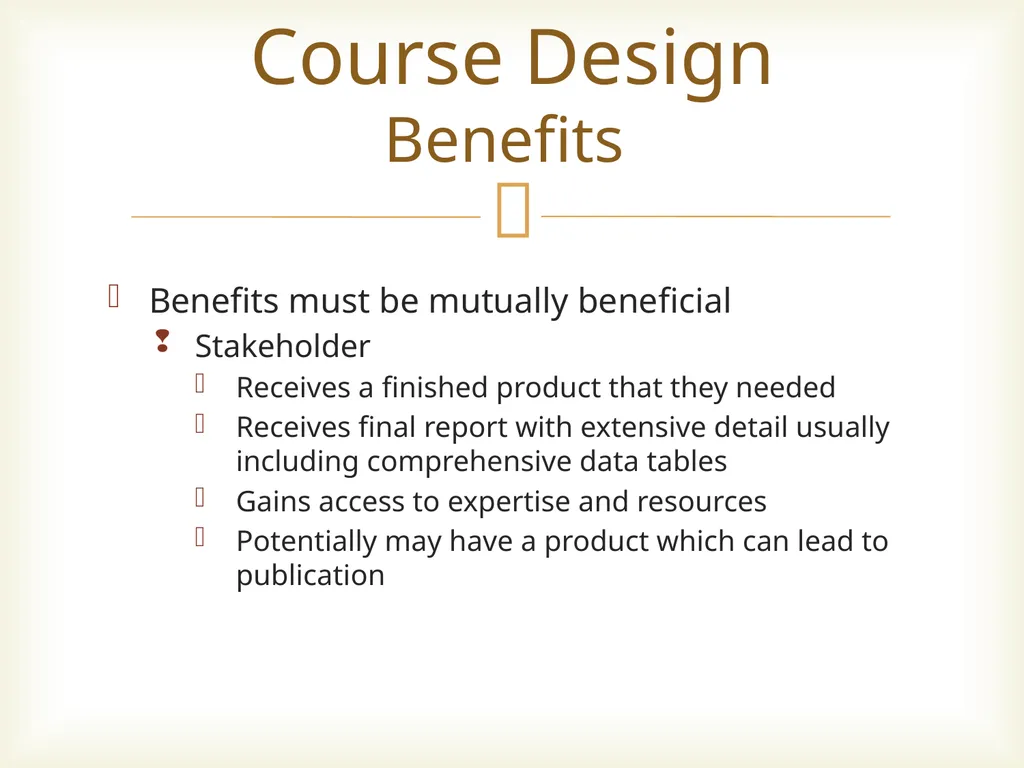
slide7. Benefits must be mutually beneficial
Stakeholder
Receives a finished product that they needed
Receives final report with extensive detail usually including comprehensive data tables
Gains access to expertise and resources
Potentially may have a product which can lead to publication Course Design Benefits<br>
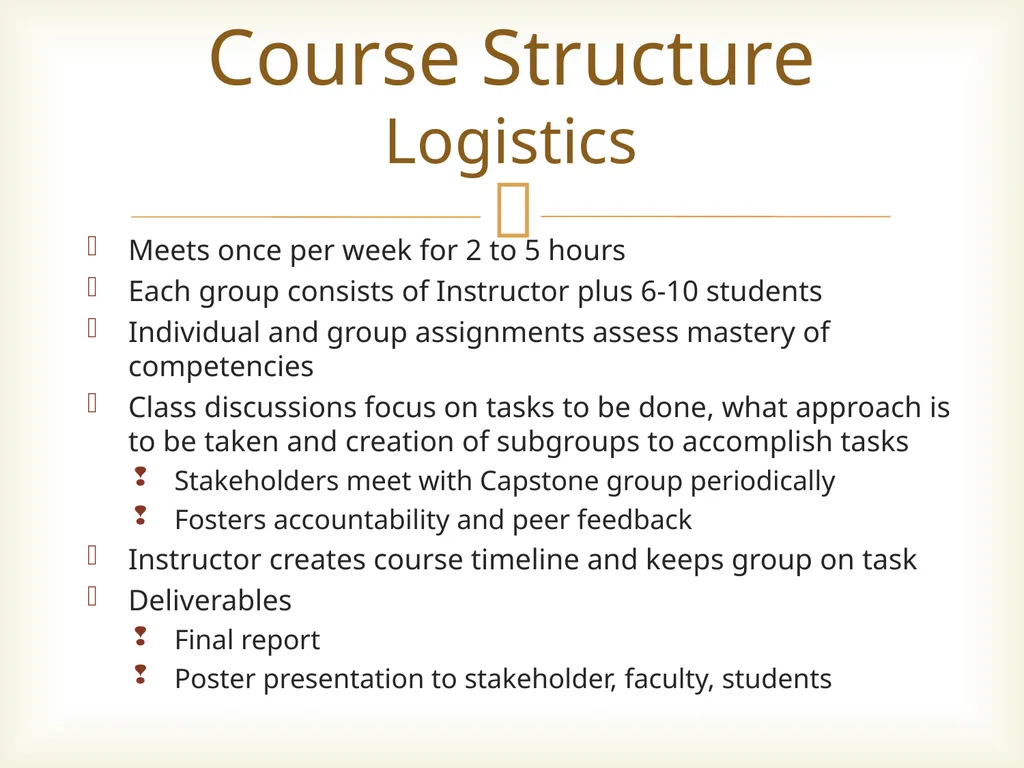
slide8. Meets once per week for 2 to 5 hours
Each group consists of Instructor plus 6-10 students
Individual and group assignments assess mastery of competencies
Class discussions focus on tasks to be done, what approach is to be taken and creation of subgroups to accomplish tasks
Stakeholders meet with Capstone group periodically
Fosters accountability and peer feedback
Instructor creates course timeline and keeps group on task
Deliverables
Final report
Poster presentation to stakeholder, faculty, students Course Structure Logistics<br>
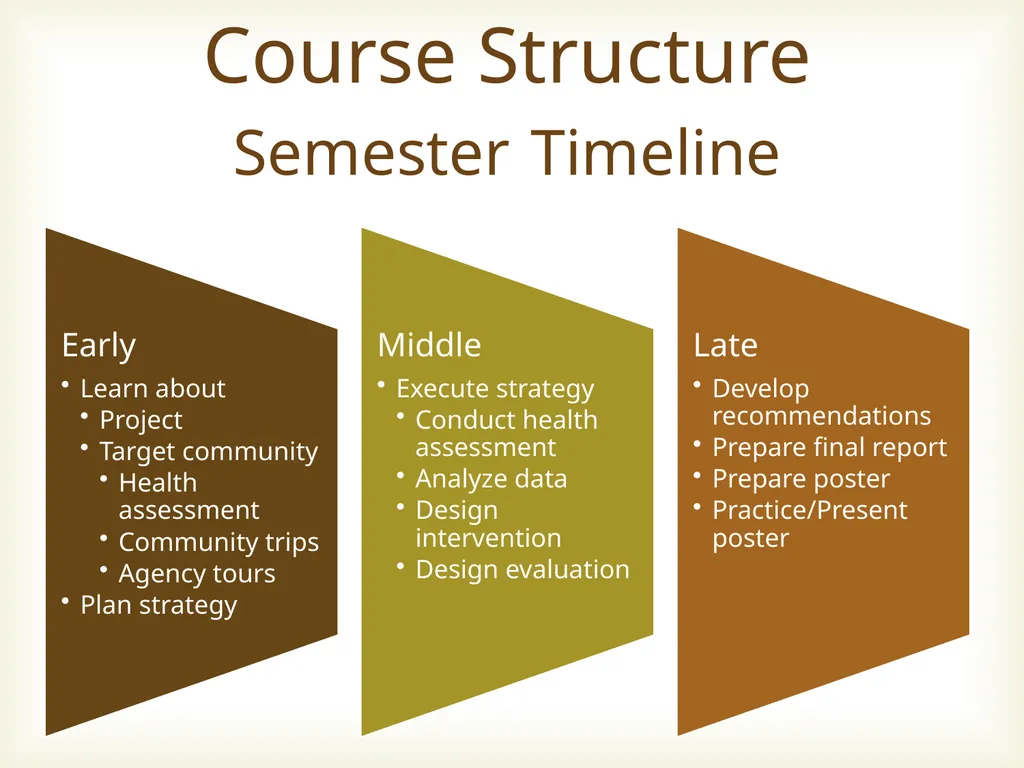
slide9. Course Structure Semester Timeline<br>
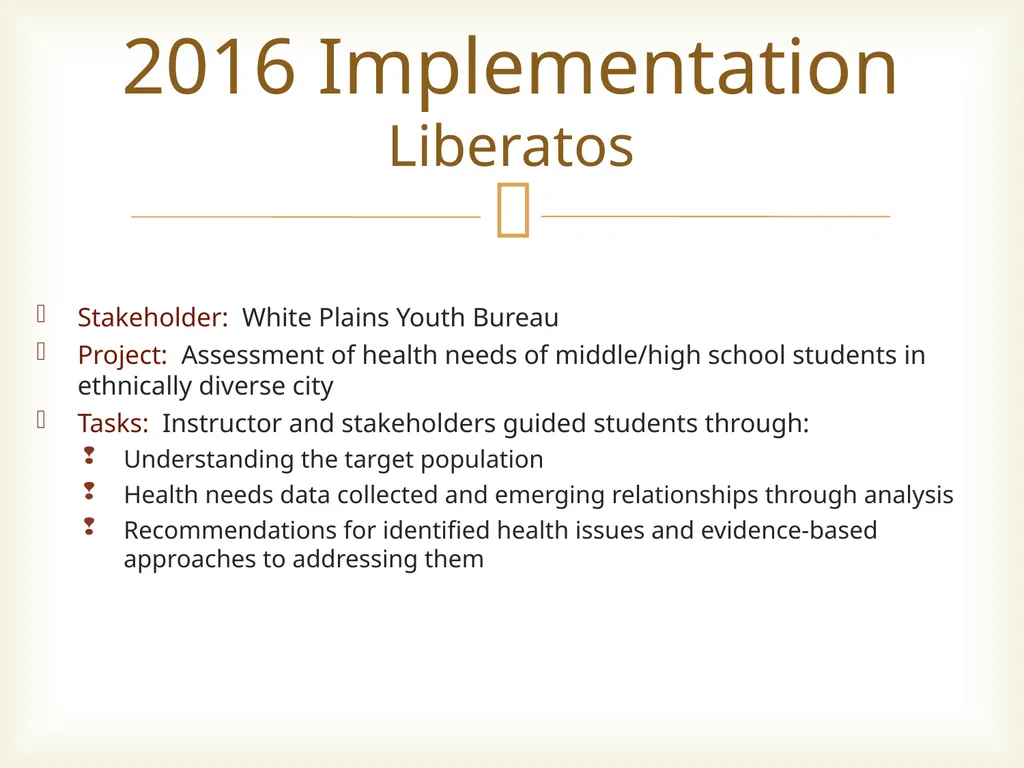
slide10. Stakeholder: White Plains Youth Bureau
Project: Assessment of health needs of middle/high school students in ethnically diverse city
Tasks: Instructor and stakeholders guided students through:
Understanding the target population
Health needs data collected and emerging relationships through analysis
Recommendations for identified health issues and evidence-based approaches to addressing them 2016 Implementation Liberatos<br>
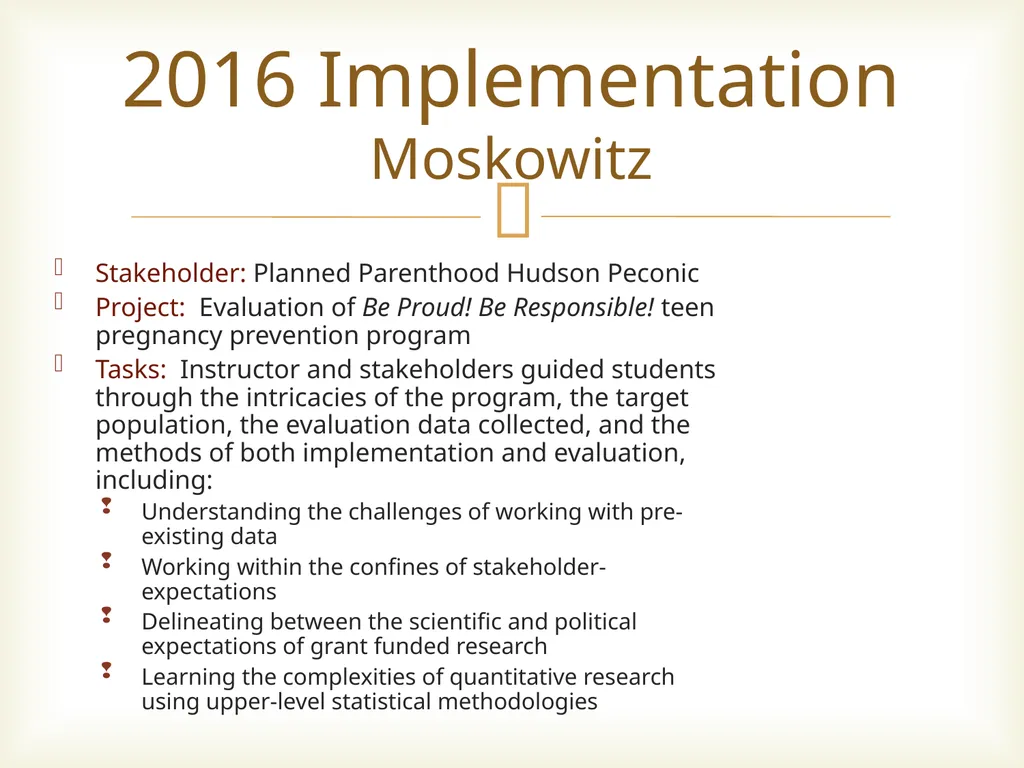
slide11. Stakeholder: Planned Parenthood Hudson Peconic
Project: Evaluation of Be Proud! Be Responsible! teen pregnancy prevention program
Tasks: Instructor and stakeholders guided students through the intricacies of the program, the target population, the evaluation data collected, and the methods of both implementation and evaluation, including:
Understanding the challenges of working with pre-existing data
Working within the confines of stakeholder-expectations
Delineating between the scientific and political expectations of grant funded research
Learning the complexities of quantitative research using upper-level statistical methodologies 2016 Implementation Moskowitz<br>
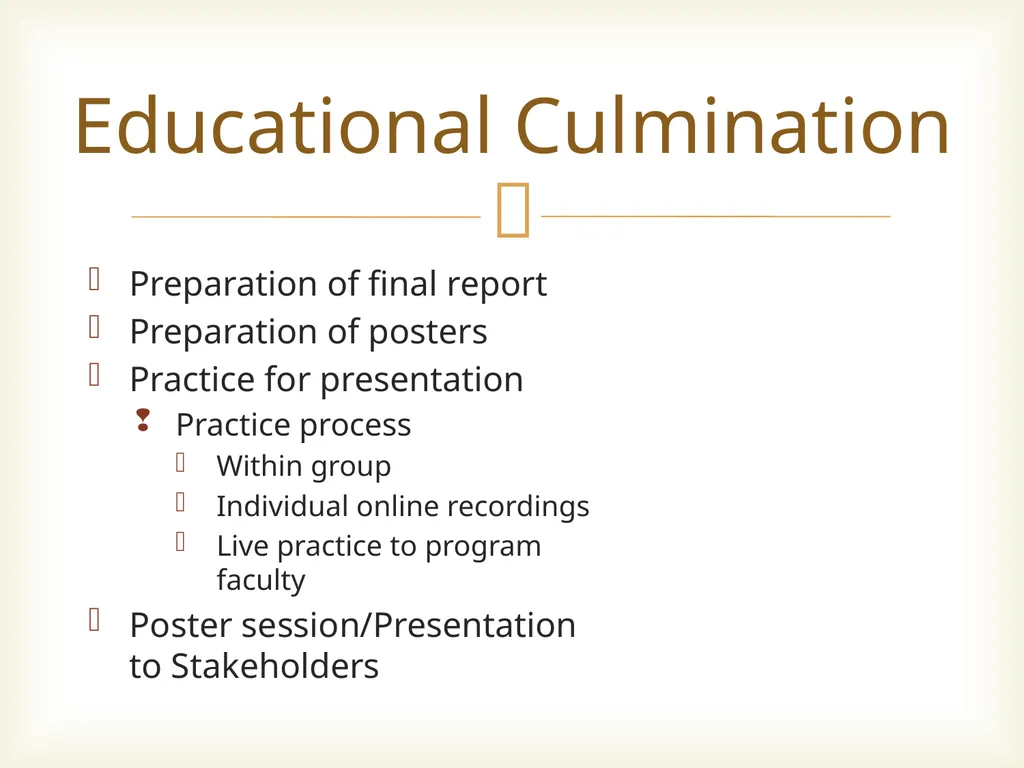
slide12. Preparation of final report
Preparation of posters
Practice for presentation
Practice process
Within group
Individual online recordings
Live practice to program faculty
Poster session/Presentation to Stakeholders Educational Culmination<br>
slide16. Penny Liberatos, PhD
Director, Behavioral Sciences & Health Promotion
Epidemiology & Community Health
School of Health Sciences & Practice
New York Medical College
penny_liberatos@nymc.edu
David A. Moskowitz, PhD
Associate Professor
Vice President, Delta Alpha Chapter
Epidemiology & Community Health
School of Health Sciences & Practice
New York Medical College
david_moskowitz@nymc.edu Special thanks to Delta Omega for this Award!<br>
David A. Moskowitz, PhD
Department of Epidemiology &
Community Health
New York Medical College
October 31, 2016 Delta Omega National Curriculum Award, Delta Alpha Chapter<br>
slide2. Course history & intent
Course design
Course structure
2016 implementation
Educational culmination
Thanks! Overview<br>
slide3. Origins
Needed to replace Thesis with a more applied culminating experience
Capstone course developed in 2009
Many improvements since
Last “course” prior to graduation
Course Intent
Intended to take classroom learning into the field
Intended to bridge school and work environments
Focuses on each student meeting core and program competencies Course History & Intent<br>
slide4. Designed for students to work on a current public health issue in collaboration with a community-based organization (stakeholder)
Community-based organization
Identified by Instructor through
Prior community contacts
Practicum sites
Has a need for a public health “project” to be done
Evaluation of a current public health program
Data to be analyzed
Public health intervention to be developed
Health assessment to be conducted Course Design Collaboration<br>
slide5. Collaboration with community-based organization (stakeholder)
Project goals developed collaboratively
Must be amenable to completion within academic semester
Must be public health focused
Must utilize student skillset
Must be amenable to allowing student group to make recommendations based on scientific evidence Course Design Collaboration<br>
slide6. Benefits must be mutually beneficial
Students
Work on a “real-world” public health issue
Gain experience in working with a stakeholder and meeting their objectives
Gain experience in working within a small group to accomplish a common goal
Gain confidence and pride that their hard work will actually benefit people in a concrete way
Helps to build students’ portfolio Course Design Benefits<br>
slide7. Benefits must be mutually beneficial
Stakeholder
Receives a finished product that they needed
Receives final report with extensive detail usually including comprehensive data tables
Gains access to expertise and resources
Potentially may have a product which can lead to publication Course Design Benefits<br>
slide8. Meets once per week for 2 to 5 hours
Each group consists of Instructor plus 6-10 students
Individual and group assignments assess mastery of competencies
Class discussions focus on tasks to be done, what approach is to be taken and creation of subgroups to accomplish tasks
Stakeholders meet with Capstone group periodically
Fosters accountability and peer feedback
Instructor creates course timeline and keeps group on task
Deliverables
Final report
Poster presentation to stakeholder, faculty, students Course Structure Logistics<br>
slide9. Course Structure Semester Timeline<br>
slide10. Stakeholder: White Plains Youth Bureau
Project: Assessment of health needs of middle/high school students in ethnically diverse city
Tasks: Instructor and stakeholders guided students through:
Understanding the target population
Health needs data collected and emerging relationships through analysis
Recommendations for identified health issues and evidence-based approaches to addressing them 2016 Implementation Liberatos<br>
slide11. Stakeholder: Planned Parenthood Hudson Peconic
Project: Evaluation of Be Proud! Be Responsible! teen pregnancy prevention program
Tasks: Instructor and stakeholders guided students through the intricacies of the program, the target population, the evaluation data collected, and the methods of both implementation and evaluation, including:
Understanding the challenges of working with pre-existing data
Working within the confines of stakeholder-expectations
Delineating between the scientific and political expectations of grant funded research
Learning the complexities of quantitative research using upper-level statistical methodologies 2016 Implementation Moskowitz<br>
slide12. Preparation of final report
Preparation of posters
Practice for presentation
Practice process
Within group
Individual online recordings
Live practice to program faculty
Poster session/Presentation to Stakeholders Educational Culmination<br>
slide16. Penny Liberatos, PhD
Director, Behavioral Sciences & Health Promotion
Epidemiology & Community Health
School of Health Sciences & Practice
New York Medical College
penny_liberatos@nymc.edu
David A. Moskowitz, PhD
Associate Professor
Vice President, Delta Alpha Chapter
Epidemiology & Community Health
School of Health Sciences & Practice
New York Medical College
david_moskowitz@nymc.edu Special thanks to Delta Omega for this Award!<br>