
Bell’s inequality. The quantum world is stranger
YM
Published · 18 slides · 0 views

1 / 1
Description
Bells inequality. The quantum world is stranger than we can imagine Next time: Measurements March 27 Quiz on Quantum Mechanics. Today March 29 Term paper outline partial draft Bells theorem is the most profound discovery of science.
Related Topics
Share
Embed code
Download this presentation From Below
"Bell’s inequality. The quantum world is stranger" is the property of its rightful owner. Permission is granted to download and print the materials on this website for personal, non-commercial use only, and to display it on your personal computer provided you do not modify the materials and that you retain all copyright notices contained in the materials. By downloading content from our website, you accept the terms of this agreement.
Presentation Transcript
01
Bell’s inequality.
The quantum world is stranger than we can imagine Next time: Measurements March 27 Quiz on Quantum Mechanics. Today
March 29 Term paper outline/ partial draft "Bell's theorem is the most profound discovery of science.” Henry Stapp<br>
March 29 Term paper outline/ partial draft "Bell's theorem is the most profound discovery of science.” Henry Stapp<br>
02
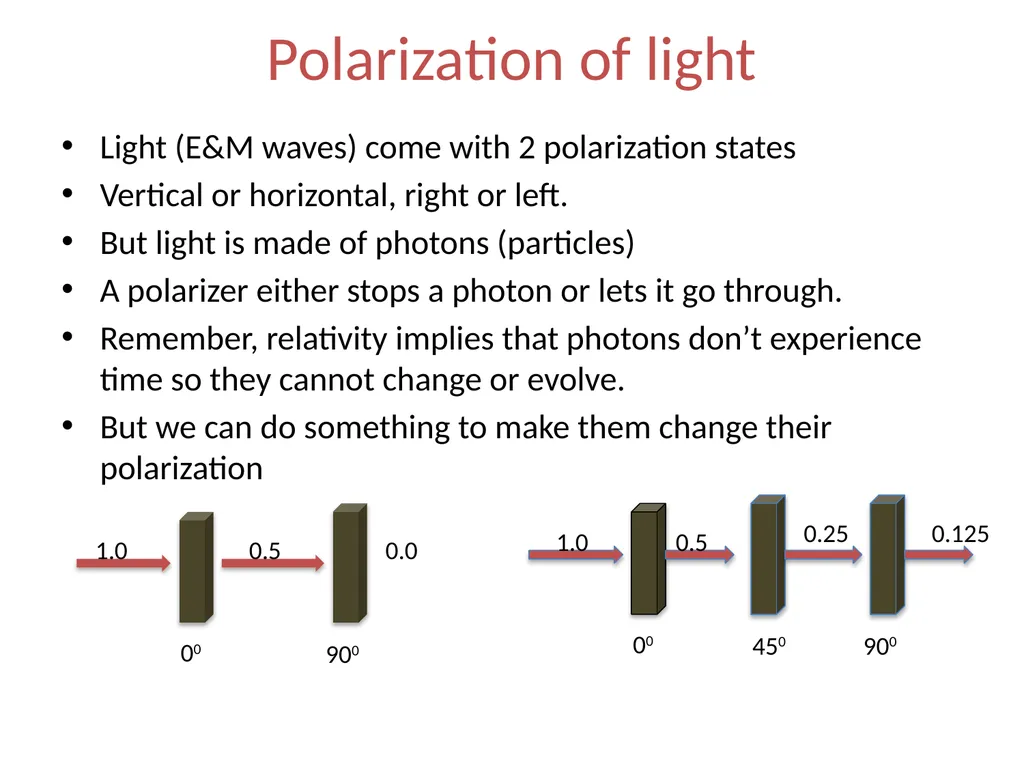
Polarization of light Light (E&M waves) come with 2 polarization states
Vertical or horizontal, right or left.
But light is made of photons (particles)
A polarizer either stops a photon or lets it go through.
Remember, relativity implies that photons don’t experience time so they cannot change or evolve.
But we can do something to make them change their polarization 0.0 0.5 450 00 1.0 900 0.25 0.125<br>
Vertical or horizontal, right or left.
But light is made of photons (particles)
A polarizer either stops a photon or lets it go through.
Remember, relativity implies that photons don’t experience time so they cannot change or evolve.
But we can do something to make them change their polarization 0.0 0.5 450 00 1.0 900 0.25 0.125<br>
03
Quantum theory of light If a photon is known to be vertically polarized and it is passed thru a filter of angle Φ:
Probability of making through is cos2(Φ)
Polarization state afterwards is Φ.
The polarization description of 0o and 45o are complementary (like x and p). You cannot know both.
If we measure the component in the vertical direction we destroy the component in the diagonal direction. (or any other direction)!
Consistent with Maxwell’s equation, except light is made of photons (quantized)<br>
Probability of making through is cos2(Φ)
Polarization state afterwards is Φ.
The polarization description of 0o and 45o are complementary (like x and p). You cannot know both.
If we measure the component in the vertical direction we destroy the component in the diagonal direction. (or any other direction)!
Consistent with Maxwell’s equation, except light is made of photons (quantized)<br>
04
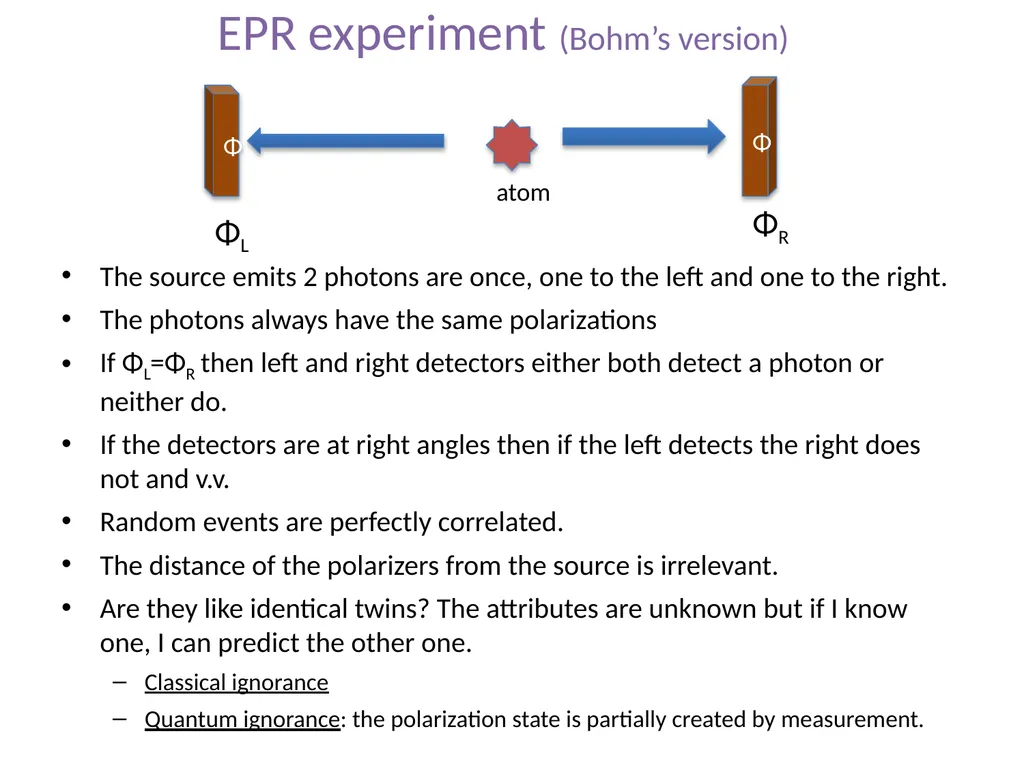
EPR experiment (Bohm’s version) The source emits 2 photons are once, one to the left and one to the right.
The photons always have the same polarizations
If ΦL=ΦR then left and right detectors either both detect a photon or neither do.
If the detectors are at right angles then if the left detects the right does not and v.v.
Random events are perfectly correlated.
The distance of the polarizers from the source is irrelevant.
Are they like identical twins? The attributes are unknown but if I know one, I can predict the other one.
Classical ignorance
Quantum ignorance: the polarization state is partially created by measurement. Φ Φ ΦL ΦR atom<br>
The photons always have the same polarizations
If ΦL=ΦR then left and right detectors either both detect a photon or neither do.
If the detectors are at right angles then if the left detects the right does not and v.v.
Random events are perfectly correlated.
The distance of the polarizers from the source is irrelevant.
Are they like identical twins? The attributes are unknown but if I know one, I can predict the other one.
Classical ignorance
Quantum ignorance: the polarization state is partially created by measurement. Φ Φ ΦL ΦR atom<br>
05
Einstein-Podolsky-Rosen (1935)
“Can a quantum mechanical description of physical reality be considered complete?” Einstein and collaborators (EPR) proposed that by using the conservation laws, one could show that QM was missing something.
Either polarization might occur, but not a mixture, which would violate conservation of momentum.
A conservation law says the particles have to have the same polarizations.
Possible resolutions:
The conservation laws only hold on the average. Bohr thought this at one time, but it's completely wrong experimentally.
The particles always have the same polarization, because there is some hidden variable which allows them to know what to do when they are detected. QM is incomplete!
Even though it is predetermined that the photons are coupled, what those polarizations are is not determined until one is (randomly) detected. The other somehow knows its polarization, faster than the speed of light!
Einstein believed that this argument showed the incompleteness of QM.
But experiment finds such "spooky correlations at a distance."<br>
Either polarization might occur, but not a mixture, which would violate conservation of momentum.
A conservation law says the particles have to have the same polarizations.
Possible resolutions:
The conservation laws only hold on the average. Bohr thought this at one time, but it's completely wrong experimentally.
The particles always have the same polarization, because there is some hidden variable which allows them to know what to do when they are detected. QM is incomplete!
Even though it is predetermined that the photons are coupled, what those polarizations are is not determined until one is (randomly) detected. The other somehow knows its polarization, faster than the speed of light!
Einstein believed that this argument showed the incompleteness of QM.
But experiment finds such "spooky correlations at a distance."<br>
06
Assume locality as demanded by the special theory of relativity.
Implies that the left polarizer should not affect the right polarizer.
If left polarizer were to be held at Φ, then the result for the right polarizer will be known if it is measured either at Φ or at right angles.
We cannot use to send a signal because only after 2 observers have recorded their findings and brought than back together can we see that correlations exist. “quantum cryptography”
Einstein: Each photon carries along “hidden variables” that say whether or not it will go through any possible filter.
Bohr: How do you know? You can only do one measurement. After that the state has changed.
“Counterfactual definiteness”: a certain outcome would have led to a definite outcome.
Bohr: “Unperformed experiments have no outcomes.”<br>
Implies that the left polarizer should not affect the right polarizer.
If left polarizer were to be held at Φ, then the result for the right polarizer will be known if it is measured either at Φ or at right angles.
We cannot use to send a signal because only after 2 observers have recorded their findings and brought than back together can we see that correlations exist. “quantum cryptography”
Einstein: Each photon carries along “hidden variables” that say whether or not it will go through any possible filter.
Bohr: How do you know? You can only do one measurement. After that the state has changed.
“Counterfactual definiteness”: a certain outcome would have led to a definite outcome.
Bohr: “Unperformed experiments have no outcomes.”<br>
07
Einstein’s thesis: Reality Criteria “if without in any way disturbing a system we can predict with certainty the value of a physical quantity, then that quantity is physically real.”
Completeness Criteria “ A theory is complete only if every element of physical reality has a counterpart in the theory.”
“We are forced to conclude that the quantum mechanical description of physical reality is not complete.”
Quantum mechanics has "spooky correlations at a distance."<br>
Completeness Criteria “ A theory is complete only if every element of physical reality has a counterpart in the theory.”
“We are forced to conclude that the quantum mechanical description of physical reality is not complete.”
Quantum mechanics has "spooky correlations at a distance."<br>
08
Bohr’s response: “The account must include all relevant features… Indeed the festure of wholeness ... Any attempt at a subdivision would demand a change in the experimental arrangement incompatible with the phenomena under investigation.”
"The apparent contradiction in fact discloses only an essential inadequacy of the customary viewpoint of natural philosophy for a rational account of physical phenomena….The interaction between object and measuring agencies entails- because of the impossibility of controlling the reaction of the object on the measuring instruments…the necessity of a final revision of the classical ideal of causality and a radical revision of our attitude towards the problem of physical reality. The criterion of reality proposed contains an essential ambiguity… regarding the expression 'without in any way disturbing the system’ The principal point is that such measurements demand mutually exclusive arrangements.”
“It is wrong to think that the task of physics is to find out how nature is. Physics concerns what we can say about nature.”<br>
"The apparent contradiction in fact discloses only an essential inadequacy of the customary viewpoint of natural philosophy for a rational account of physical phenomena….The interaction between object and measuring agencies entails- because of the impossibility of controlling the reaction of the object on the measuring instruments…the necessity of a final revision of the classical ideal of causality and a radical revision of our attitude towards the problem of physical reality. The criterion of reality proposed contains an essential ambiguity… regarding the expression 'without in any way disturbing the system’ The principal point is that such measurements demand mutually exclusive arrangements.”
“It is wrong to think that the task of physics is to find out how nature is. Physics concerns what we can say about nature.”<br>
09
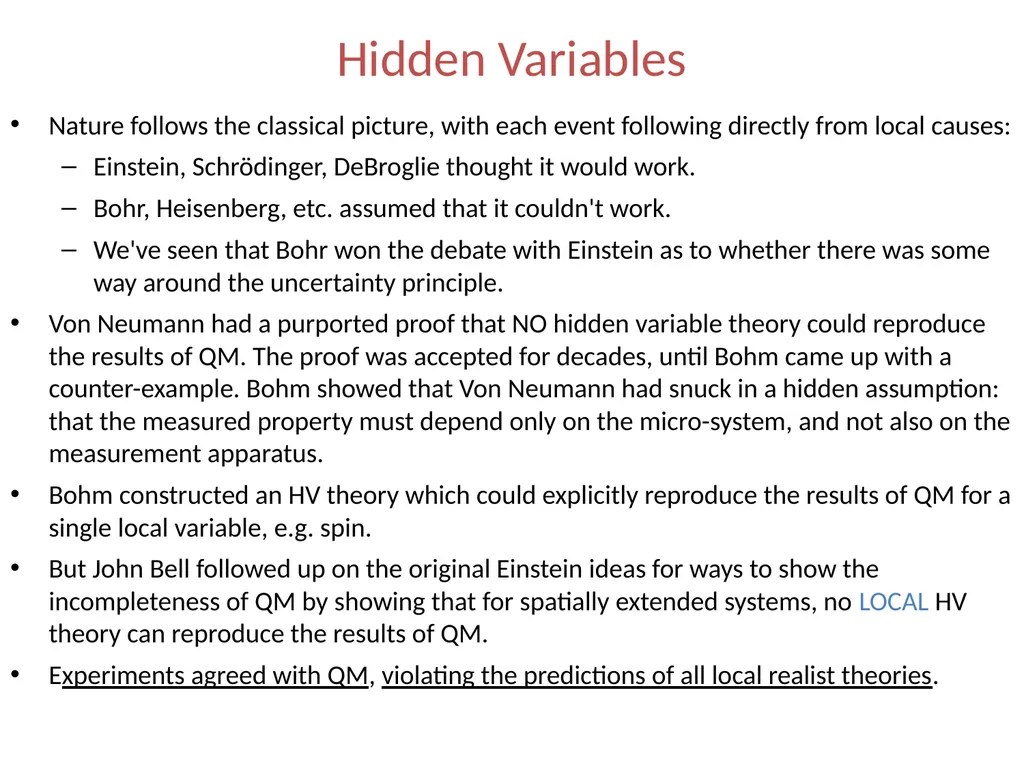
Hidden Variables Nature follows the classical picture, with each event following directly from local causes:
Einstein, Schrödinger, DeBroglie thought it would work.
Bohr, Heisenberg, etc. assumed that it couldn't work.
We've seen that Bohr won the debate with Einstein as to whether there was some way around the uncertainty principle.
Von Neumann had a purported proof that NO hidden variable theory could reproduce the results of QM. The proof was accepted for decades, until Bohm came up with a counter-example. Bohm showed that Von Neumann had snuck in a hidden assumption: that the measured property must depend only on the micro-system, and not also on the measurement apparatus.
Bohm constructed an HV theory which could explicitly reproduce the results of QM for a single local variable, e.g. spin.
But John Bell followed up on the original Einstein ideas for ways to show the incompleteness of QM by showing that for spatially extended systems, no LOCAL HV theory can reproduce the results of QM.
Experiments agreed with QM, violating the predictions of all local realist theories.<br>
Einstein, Schrödinger, DeBroglie thought it would work.
Bohr, Heisenberg, etc. assumed that it couldn't work.
We've seen that Bohr won the debate with Einstein as to whether there was some way around the uncertainty principle.
Von Neumann had a purported proof that NO hidden variable theory could reproduce the results of QM. The proof was accepted for decades, until Bohm came up with a counter-example. Bohm showed that Von Neumann had snuck in a hidden assumption: that the measured property must depend only on the micro-system, and not also on the measurement apparatus.
Bohm constructed an HV theory which could explicitly reproduce the results of QM for a single local variable, e.g. spin.
But John Bell followed up on the original Einstein ideas for ways to show the incompleteness of QM by showing that for spatially extended systems, no LOCAL HV theory can reproduce the results of QM.
Experiments agreed with QM, violating the predictions of all local realist theories.<br>
10
A story Say that you want to find out why people like pepperoni, mushrooms, and olives on pizza.
You ask many people, and they give Yes/No answers when asked about each. (Say 50% yes for each.) But you don't notice any distinguishing properties of the people who say Yes.
Does that mean you can conclude that the answer is random, some sort of momentary glitch that occurs in a person's response?
Of course not- you may just have missed the "hidden variables" needed to understand taste. There MAY be something in each person's mind ahead of time that determines their answer, or maybe not.<br>
You ask many people, and they give Yes/No answers when asked about each. (Say 50% yes for each.) But you don't notice any distinguishing properties of the people who say Yes.
Does that mean you can conclude that the answer is random, some sort of momentary glitch that occurs in a person's response?
Of course not- you may just have missed the "hidden variables" needed to understand taste. There MAY be something in each person's mind ahead of time that determines their answer, or maybe not.<br>
11
Ask couples Each couple gives the same answer to the one question you ask them, so you know there was already something in their heads that determined the answer. Otherwise how could they all get their stories straight? So there WAS some hidden variable determining the outcome.
A slight complication- all these folks seem to get confused after one question. If you ask each member of the couples a second question, the perfect correlation between them is lost. So you're only allowed to ask one of each person.
Now you try asking one person about pepperoni, and the other about mushrooms. You find that 85% of the time, they give the same answer (YY or NN). So you conclude that whatever makes people like mushrooms usually makes them like pepperoni.
You try the same thing asking about mushrooms and olives. Again 85% of the time, they agree. (YY or NN)
Now you ask about pepperoni and olives. What extent of agreement do you expect? The 15% who had different opinions on M-P and the 15% with different opinions on M-O might be the same people. Then there would be 0% disagreement on P-O. Or maybe they're all different people. Then there would be 15%+15% =30% disagreement on P-O. Or it could come out anywhere in between.<br>
A slight complication- all these folks seem to get confused after one question. If you ask each member of the couples a second question, the perfect correlation between them is lost. So you're only allowed to ask one of each person.
Now you try asking one person about pepperoni, and the other about mushrooms. You find that 85% of the time, they give the same answer (YY or NN). So you conclude that whatever makes people like mushrooms usually makes them like pepperoni.
You try the same thing asking about mushrooms and olives. Again 85% of the time, they agree. (YY or NN)
Now you ask about pepperoni and olives. What extent of agreement do you expect? The 15% who had different opinions on M-P and the 15% with different opinions on M-O might be the same people. Then there would be 0% disagreement on P-O. Or maybe they're all different people. Then there would be 15%+15% =30% disagreement on P-O. Or it could come out anywhere in between.<br>
12
Whoops You now ask the couples do you like pepperoni/olives?
they give the same answer 50% of the time.
What gives?
Maybe there was a statistical fluke. You try the same thing again with 100,000 couples- and get the same result.
Maybe the couples were secretly signaling each other, getting their stories coordinated (on some questions) AFTER the questions were asked.
Ask the questions in sealed boxes. Same result.
Ask the questions SIMULTANEOUSLY (in Earth frame). Same result.
Maybe the couples were getting their stories straight only on the questions which they knew they would be asked.
You draw the questions out of hats, in the sealed boxes, simultaneously. And get the same result.<br>
they give the same answer 50% of the time.
What gives?
Maybe there was a statistical fluke. You try the same thing again with 100,000 couples- and get the same result.
Maybe the couples were secretly signaling each other, getting their stories coordinated (on some questions) AFTER the questions were asked.
Ask the questions in sealed boxes. Same result.
Ask the questions SIMULTANEOUSLY (in Earth frame). Same result.
Maybe the couples were getting their stories straight only on the questions which they knew they would be asked.
You draw the questions out of hats, in the sealed boxes, simultaneously. And get the same result.<br>
13
Science Fiction? Conclusion: this story is obviously fiction. The identical results on any ONE question tell you that (whether or not you believe that people in general are spontaneous and random) on these particular issues there had to be some prior content in their heads determining the answers. But there is NO WAY of assigning answers to the 3 questions (M,O,P) which gives these results for the disagreements:<br>
14
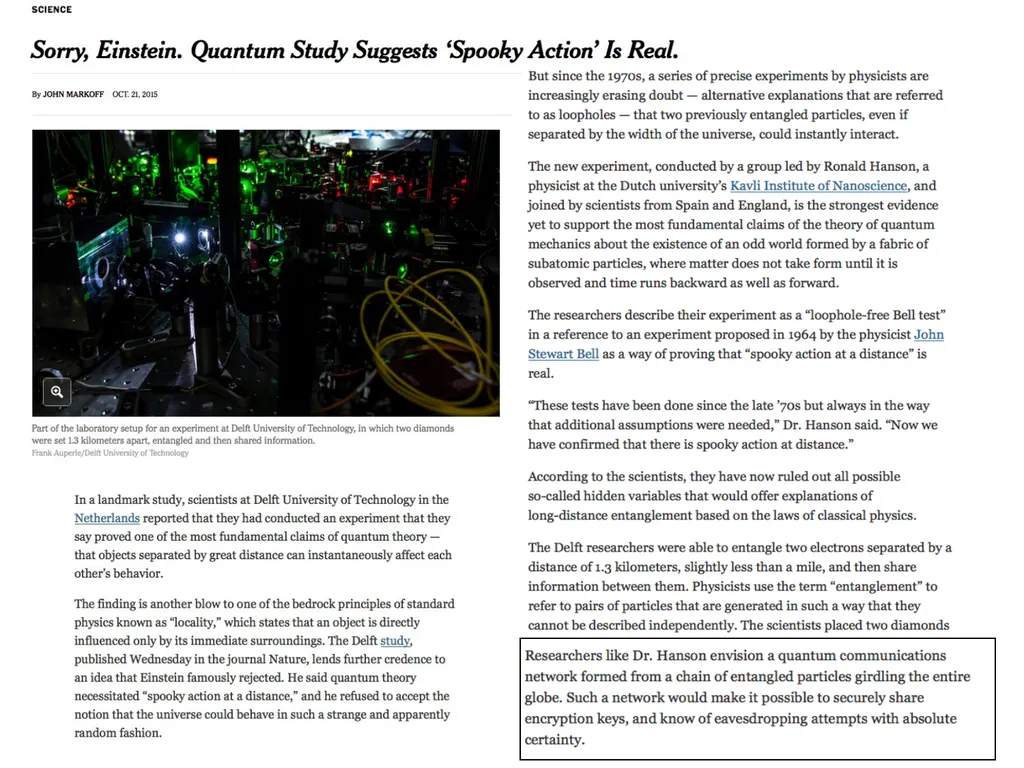
Tell the same story about particles "couples" are pairs emitted together in a decay process.
"Like pepperoni?" becomes polarized at 0
"Like olives?" becomes polarized at 90
"Like mushrooms?" becomes ”polarized at 45.
Experimentally the results are as we have described.
Obviously when we concluded that this story is science fiction we assumed something that's false.
What did we assume about reality?
we assumed nothing whatever about QM-
we didn't even mention it.
It happens that QM precisely predicts the results,<br>
"Like pepperoni?" becomes polarized at 0
"Like olives?" becomes polarized at 90
"Like mushrooms?" becomes ”polarized at 45.
Experimentally the results are as we have described.
Obviously when we concluded that this story is science fiction we assumed something that's false.
What did we assume about reality?
we assumed nothing whatever about QM-
we didn't even mention it.
It happens that QM precisely predicts the results,<br>
15
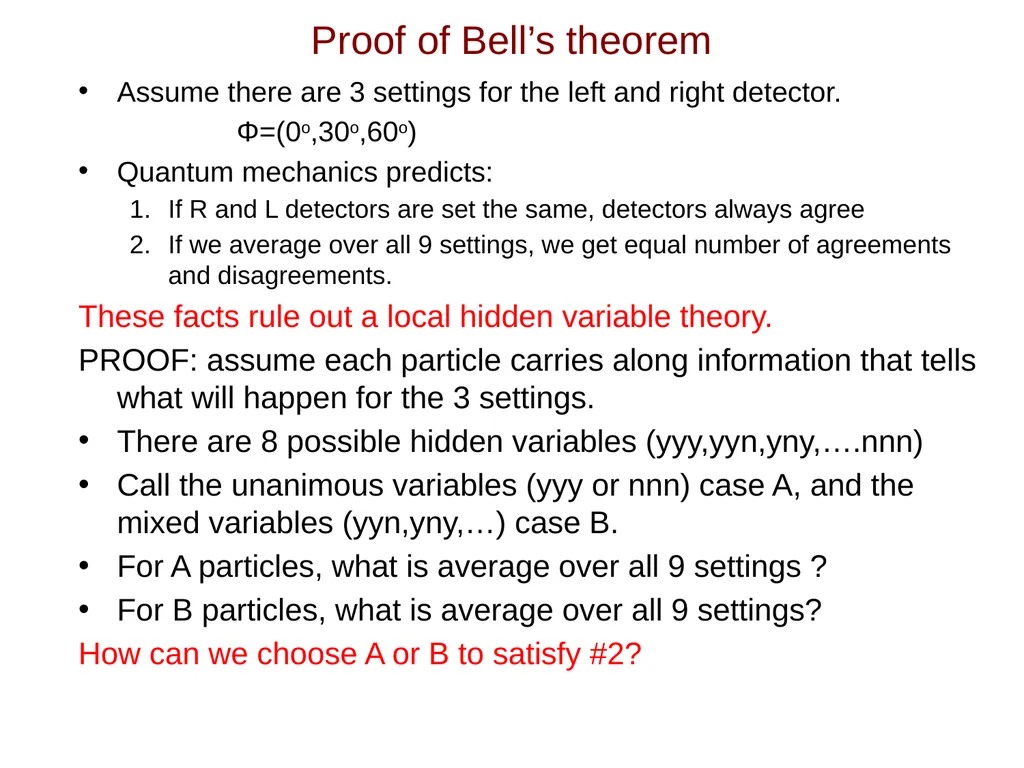
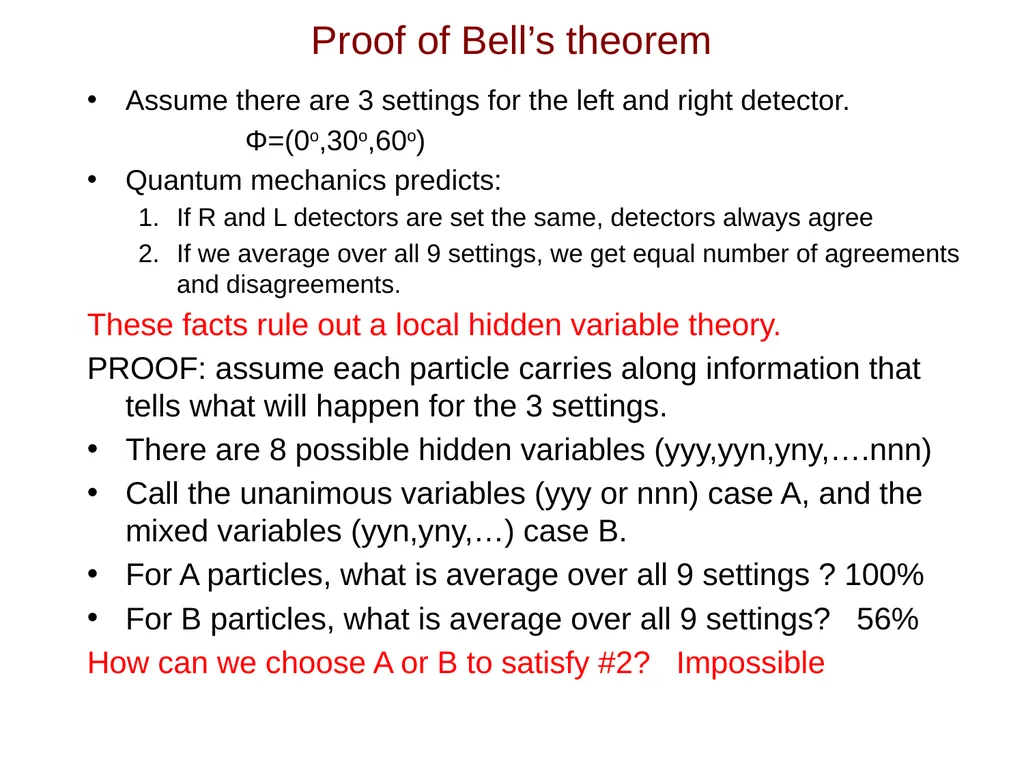
Proof of Bell’s theorem Assume there are 3 settings for the left and right detector.
Φ=(0o,30o,60o)
Quantum mechanics predicts:
If R and L detectors are set the same, detectors always agree
If we average over all 9 settings, we get equal number of agreements and disagreements.
These facts rule out a local hidden variable theory.
PROOF: assume each particle carries along information that tells what will happen for the 3 settings.
There are 8 possible hidden variables (yyy,yyn,yny,….nnn)
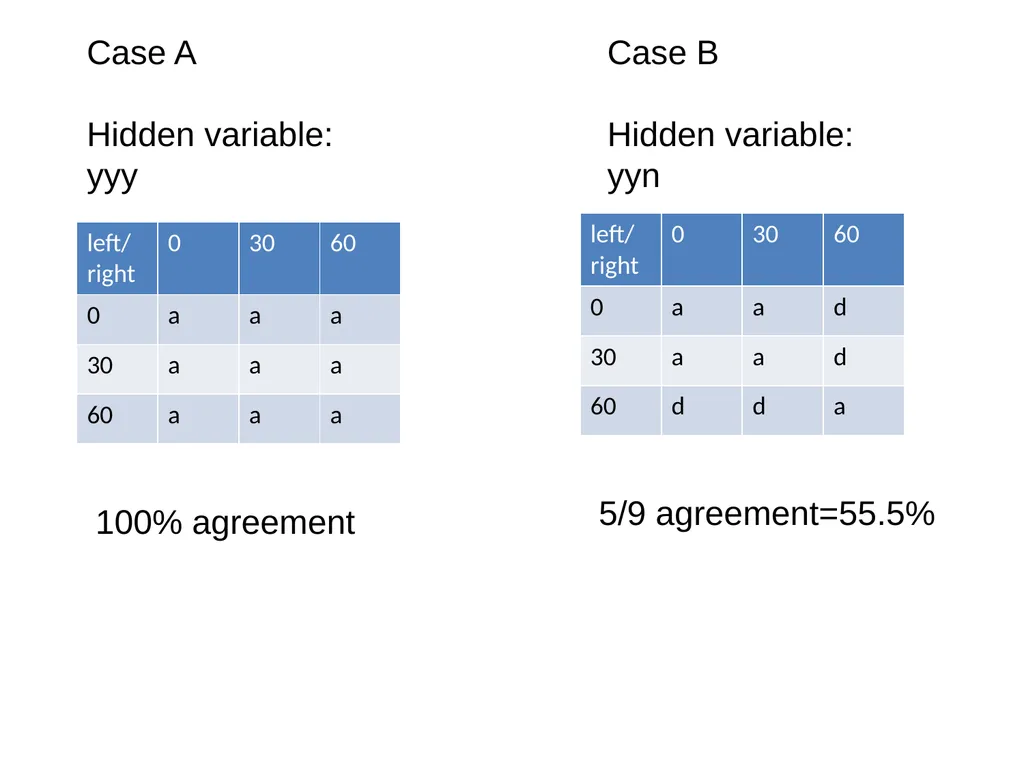
Call the unanimous variables (yyy or nnn) case A, and the mixed variables (yyn,yny,…) case B.
For A particles, what is average over all 9 settings ?
For B particles, what is average over all 9 settings?
How can we choose A or B to satisfy #2?<br>
Φ=(0o,30o,60o)
Quantum mechanics predicts:
If R and L detectors are set the same, detectors always agree
If we average over all 9 settings, we get equal number of agreements and disagreements.
These facts rule out a local hidden variable theory.
PROOF: assume each particle carries along information that tells what will happen for the 3 settings.
There are 8 possible hidden variables (yyy,yyn,yny,….nnn)
Call the unanimous variables (yyy or nnn) case A, and the mixed variables (yyn,yny,…) case B.
For A particles, what is average over all 9 settings ?
For B particles, what is average over all 9 settings?
How can we choose A or B to satisfy #2?<br>
16
Case A
Hidden variable: yyy Case B
Hidden variable: yyn 100% agreement 5/9 agreement=55.5%<br>
Hidden variable: yyy Case B
Hidden variable: yyn 100% agreement 5/9 agreement=55.5%<br>
17
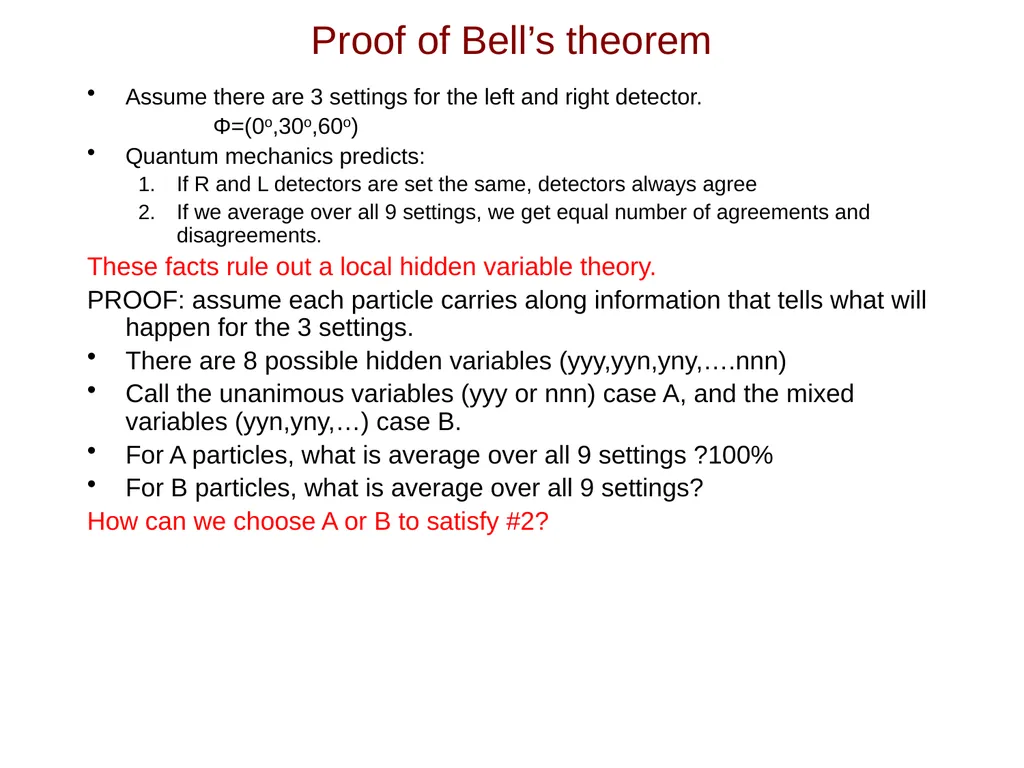
Proof of Bell’s theorem Assume there are 3 settings for the left and right detector.
Φ=(0o,30o,60o)
Quantum mechanics predicts:
If R and L detectors are set the same, detectors always agree
If we average over all 9 settings, we get equal number of agreements and disagreements.
These facts rule out a local hidden variable theory.
PROOF: assume each particle carries along information that tells what will happen for the 3 settings.
There are 8 possible hidden variables (yyy,yyn,yny,….nnn)
Call the unanimous variables (yyy or nnn) case A, and the mixed variables (yyn,yny,…) case B.
For A particles, what is average over all 9 settings ?100%
For B particles, what is average over all 9 settings?
How can we choose A or B to satisfy #2?<br>
Φ=(0o,30o,60o)
Quantum mechanics predicts:
If R and L detectors are set the same, detectors always agree
If we average over all 9 settings, we get equal number of agreements and disagreements.
These facts rule out a local hidden variable theory.
PROOF: assume each particle carries along information that tells what will happen for the 3 settings.
There are 8 possible hidden variables (yyy,yyn,yny,….nnn)
Call the unanimous variables (yyy or nnn) case A, and the mixed variables (yyn,yny,…) case B.
For A particles, what is average over all 9 settings ?100%
For B particles, what is average over all 9 settings?
How can we choose A or B to satisfy #2?<br>
18
Proof of Bell’s theorem Assume there are 3 settings for the left and right detector.
Φ=(0o,30o,60o)
Quantum mechanics predicts:
If R and L detectors are set the same, detectors always agree
If we average over all 9 settings, we get equal number of agreements and disagreements.
These facts rule out a local hidden variable theory.
PROOF: assume each particle carries along information that tells what will happen for the 3 settings.
There are 8 possible hidden variables (yyy,yyn,yny,….nnn)
Call the unanimous variables (yyy or nnn) case A, and the mixed variables (yyn,yny,…) case B.
For A particles, what is average over all 9 settings ? 100%
For B particles, what is average over all 9 settings? 56%
How can we choose A or B to satisfy #2? Impossible<br>
Φ=(0o,30o,60o)
Quantum mechanics predicts:
If R and L detectors are set the same, detectors always agree
If we average over all 9 settings, we get equal number of agreements and disagreements.
These facts rule out a local hidden variable theory.
PROOF: assume each particle carries along information that tells what will happen for the 3 settings.
There are 8 possible hidden variables (yyy,yyn,yny,….nnn)
Call the unanimous variables (yyy or nnn) case A, and the mixed variables (yyn,yny,…) case B.
For A particles, what is average over all 9 settings ? 100%
For B particles, what is average over all 9 settings? 56%
How can we choose A or B to satisfy #2? Impossible<br>
19
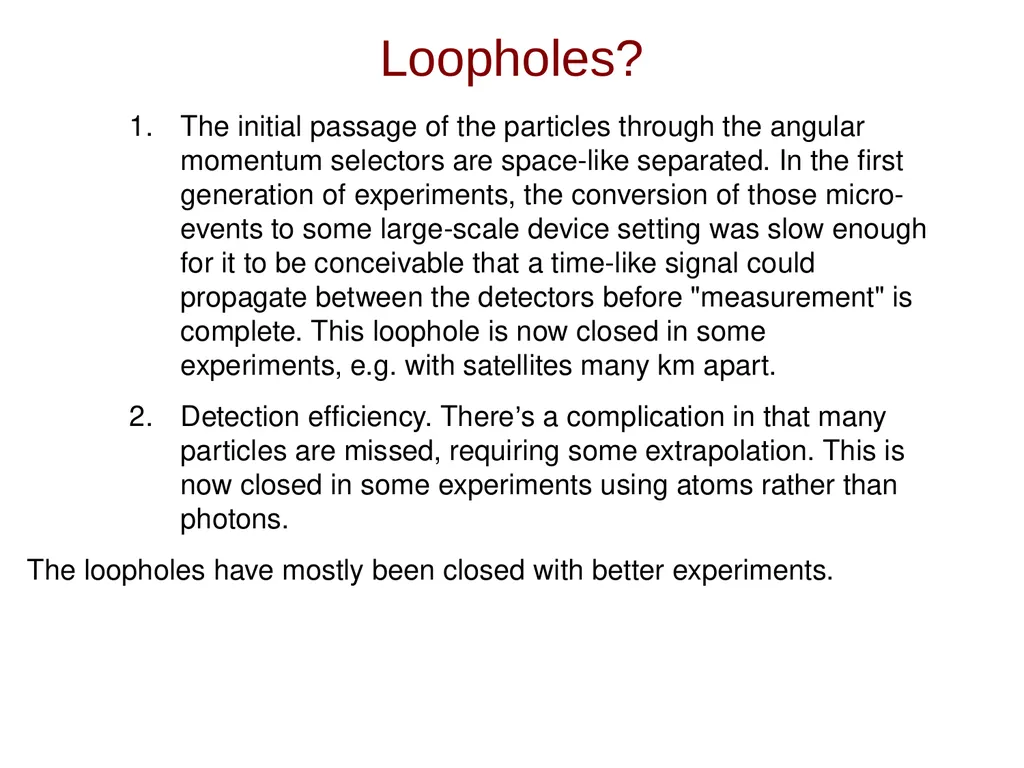
Loopholes? The initial passage of the particles through the angular momentum selectors are space-like separated. In the first generation of experiments, the conversion of those micro-events to some large-scale device setting was slow enough for it to be conceivable that a time-like signal could propagate between the detectors before "measurement" is complete. This loophole is now closed in some experiments, e.g. with satellites many km apart.
Detection efficiency. There’s a complication in that many particles are missed, requiring some extrapolation. This is now closed in some experiments using atoms rather than photons.
The loopholes have mostly been closed with better experiments.<br>
Detection efficiency. There’s a complication in that many particles are missed, requiring some extrapolation. This is now closed in some experiments using atoms rather than photons.
The loopholes have mostly been closed with better experiments.<br>
20
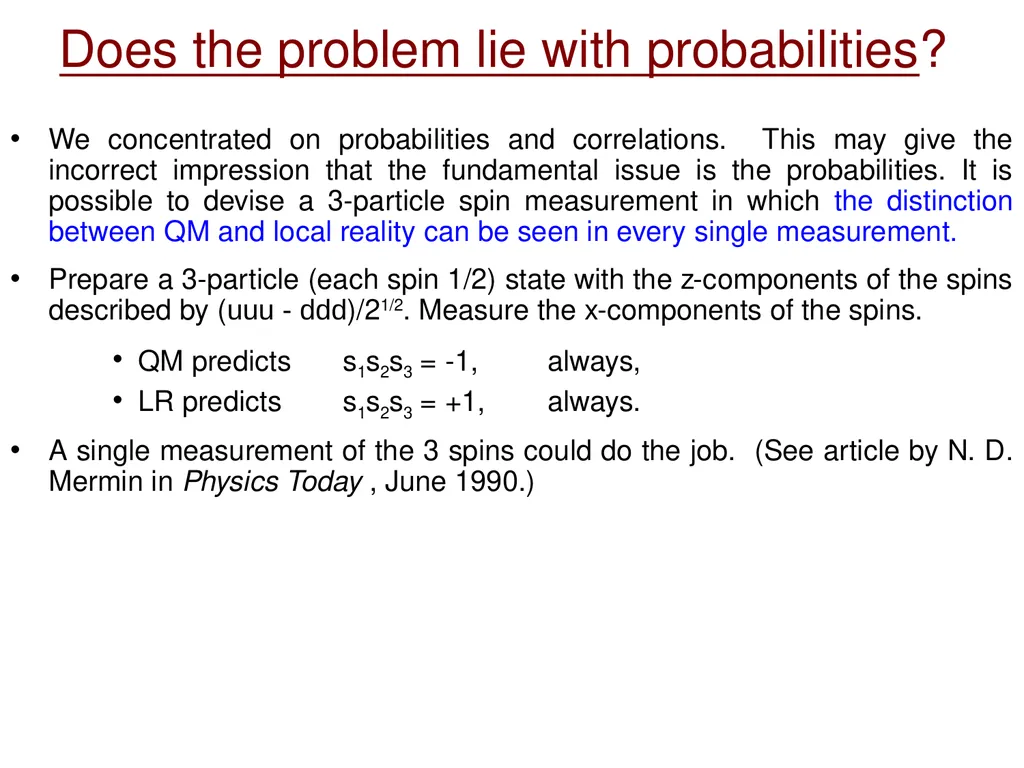
Does the problem lie with probabilities? We concentrated on probabilities and correlations. This may give the incorrect impression that the fundamental issue is the probabilities. It is possible to devise a 3-particle spin measurement in which the distinction between QM and local reality can be seen in every single measurement.
Prepare a 3-particle (each spin 1/2) state with the z-components of the spins described by (uuu - ddd)/21/2. Measure the x-components of the spins.
QM predicts s1s2s3 = -1, always,
LR predicts s1s2s3 = +1, always.
A single measurement of the 3 spins could do the job. (See article by N. D. Mermin in Physics Today , June 1990.)<br>
Prepare a 3-particle (each spin 1/2) state with the z-components of the spins described by (uuu - ddd)/21/2. Measure the x-components of the spins.
QM predicts s1s2s3 = -1, always,
LR predicts s1s2s3 = +1, always.
A single measurement of the 3 spins could do the job. (See article by N. D. Mermin in Physics Today , June 1990.)<br>
21
The new parable You can ask one question each of Anne,(1) Belinda (2), or Cary (3). The questions can be "olives?" (X) or "Onions?" (Y) . The answers can be "yes" (x=+1, y=+1) or "no" (x=-1, y=-1).
You always find that if you ask one "olives?" and two "onions?" the product of the answers is +1. So it sounds as if each answer is determined by an "element of reality" since it is predictable by asking two OTHER questions.
X1Y2Y3 = Y1X2Y3= Y1Y2X3=1
So if those are just numbers we're talking about:
X1Y2Y3Y1X2Y3Y1Y2X3 = X1X2X3 Y12 Y22 Y32 = X1X2X3 = 1 ALWAYS
BUT QM says something strange: X1X2X3 = -1 ALWAYS
Essentially this experiment (using photons rather than spin=1/2) has been done.<br>
You always find that if you ask one "olives?" and two "onions?" the product of the answers is +1. So it sounds as if each answer is determined by an "element of reality" since it is predictable by asking two OTHER questions.
X1Y2Y3 = Y1X2Y3= Y1Y2X3=1
So if those are just numbers we're talking about:
X1Y2Y3Y1X2Y3Y1Y2X3 = X1X2X3 Y12 Y22 Y32 = X1X2X3 = 1 ALWAYS
BUT QM says something strange: X1X2X3 = -1 ALWAYS
Essentially this experiment (using photons rather than spin=1/2) has been done.<br>
22
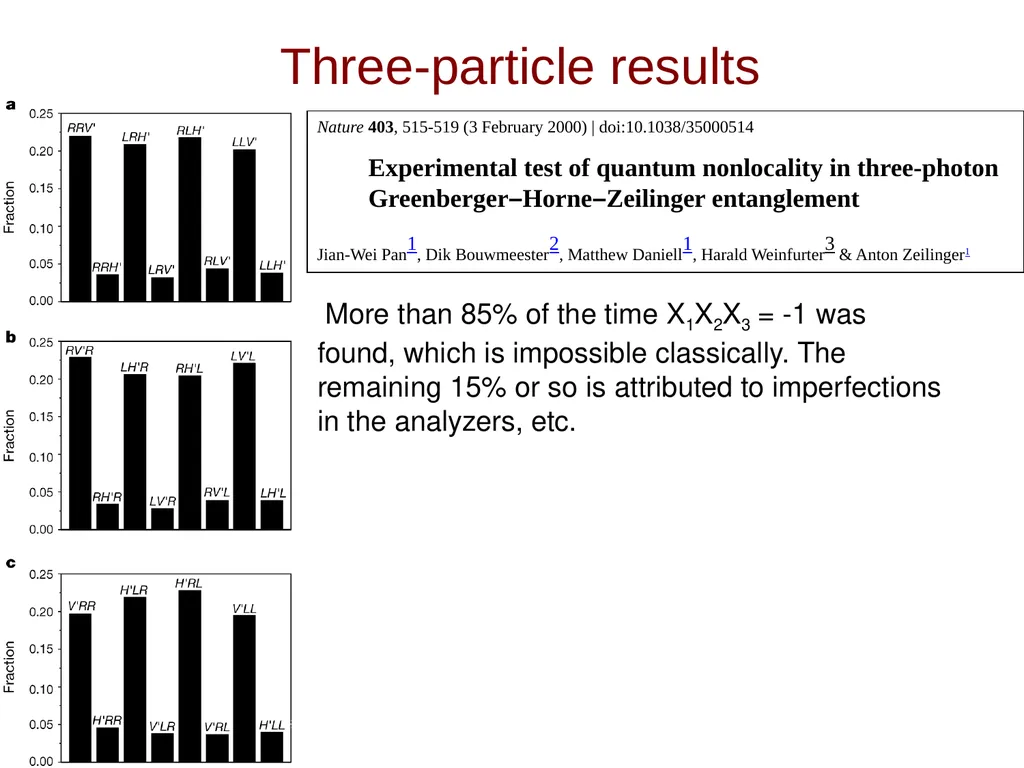
Three-particle results More than 85% of the time X1X2X3 = -1 was found, which is impossible classically. The remaining 15% or so is attributed to imperfections in the analyzers, etc. Nature 403, 515-519 (3 February 2000) | doi:10.1038/35000514
Experimental test of quantum nonlocality in three-photon Greenberger–Horne–Zeilinger entanglement
Jian-Wei Pan1, Dik Bouwmeester2, Matthew Daniell1, Harald Weinfurter3 & Anton Zeilinger1<br>
Experimental test of quantum nonlocality in three-photon Greenberger–Horne–Zeilinger entanglement
Jian-Wei Pan1, Dik Bouwmeester2, Matthew Daniell1, Harald Weinfurter3 & Anton Zeilinger1<br>
23
We assumed Realism. Not that the world must be deterministic, but only that those aspects of it which can be predicted perfectly are determined by some element of reality. You can predict the result on any particle by making the corresponding measurement on its partner.
"If, without in any way disturbing a system, we can predict with certainty (i.e., probability equal to unity) the value of a physical quantity, then there exists an element of physical reality corresponding to this physical quantity." (Einstein, Podolsky, Rosen, 1935)
Local causality. The value of a property possessed by an isolated system cannot be affected by any operations carried out at a sufficient (i.e., spacelike) separation from it.
Induction. (no conspiracies) The unmeasured values (chosen by random quantum processes) are not statistically different from the measured values. The properties of an ensemble are defined completely by the preparation conditions. In particular, the distribution of “possessed values” of a variable for the subensemble which we actually measure is identical to the distribution for the complete ensemble. (random sampling)
Which one are you willing to give up?<br>
"If, without in any way disturbing a system, we can predict with certainty (i.e., probability equal to unity) the value of a physical quantity, then there exists an element of physical reality corresponding to this physical quantity." (Einstein, Podolsky, Rosen, 1935)
Local causality. The value of a property possessed by an isolated system cannot be affected by any operations carried out at a sufficient (i.e., spacelike) separation from it.
Induction. (no conspiracies) The unmeasured values (chosen by random quantum processes) are not statistically different from the measured values. The properties of an ensemble are defined completely by the preparation conditions. In particular, the distribution of “possessed values” of a variable for the subensemble which we actually measure is identical to the distribution for the complete ensemble. (random sampling)
Which one are you willing to give up?<br>