
Beloved emerges LO: How does Toni Morrison evoke
CP
Published · 14 slides · 0 views

1 / 1



Description
Beloved emerges LO: How does Toni Morrison evoke the Middle Passage? The middle passage Beloved emerges Read p. 60-67 How would you interpret the water imagery here? How does it compare to other times when the motif of water was important?
Related Topics
Share
Embed code
Download this presentation From Below
"Beloved emerges LO: How does Toni Morrison evoke" is the property of its rightful owner. Permission is granted to download and print the materials on this website for personal, non-commercial use only, and to display it on your personal computer provided you do not modify the materials and that you retain all copyright notices contained in the materials. By downloading content from our website, you accept the terms of this agreement.
Presentation Transcript
01
Beloved emerges LO: How does Toni Morrison evoke the Middle Passage?<br>
02
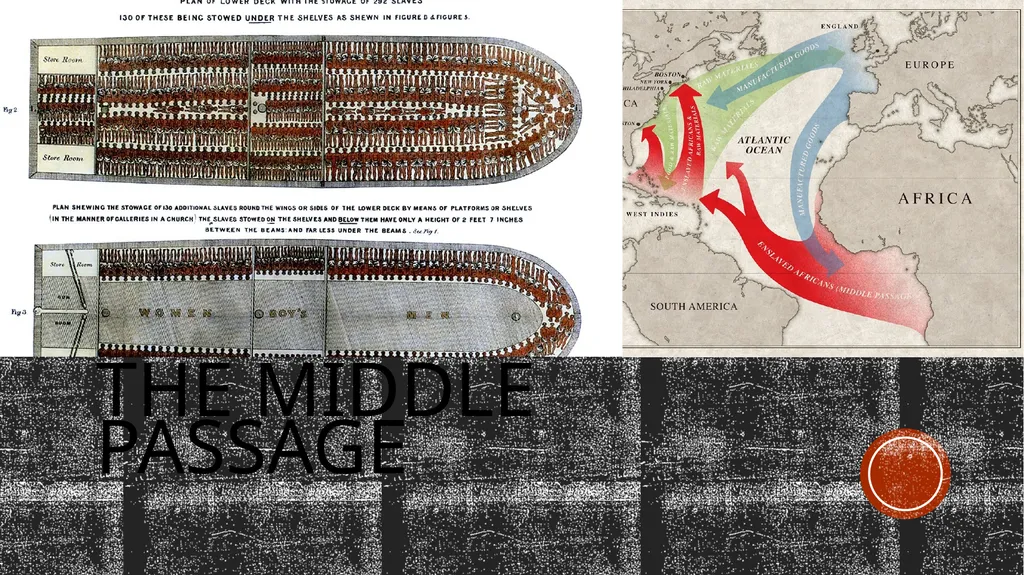
The middle passage<br>
03
Beloved emerges Read p. 60-67
How would you interpret the water imagery here? How does it compare to other times when the motif of water was important?
- Water to wash chamomile off – Sethe at the beginning of the novel
The water of the Ohio river<br>
How would you interpret the water imagery here? How does it compare to other times when the motif of water was important?
- Water to wash chamomile off – Sethe at the beginning of the novel
The water of the Ohio river<br>
04
How Can we contextualize Beloved (p. 63)? The early stages of the ‘Great Migration’
During Reconstruction freed slaves began to leave the South.
This culminated in the relocation of more than 6 million African Americans from the rural South to the cities of the North, Midwest and West from about 1916 to 1970.
To what extent is the supernatural made believable and authentic here? How does Morrison achieve this? Recap: The Emancipation Proclamation in 1863 freed African Americans in rebel states, and after the Civil War, the Thirteenth Amendment emancipated all U.S. slaves wherever they were.
Former slaves in the South now were a free people surrounded by many hostile whites. One freedman, Houston Hartsfield Holloway, wrote, “For we colored people did not know how to be free and the white people did not know how to have a free colored person about them.”
The Reconstruction implemented by Congress (1866 – 1877) aimed to reintegrate the Southern States into the Union and define how whites and blacks could live together in a nonslave society. The South, however, saw Reconstruction as a humiliating. States enacted a series of laws known as the Black Codes, which were designed to restrict freed Black peoples’ activity and ensure their availability as a labor force.
Education was considered a main tool of freedom - During the years after the war, black and white teachers from the North and South, missionary organizations, churches and schools worked tirelessly to give the emancipated population the opportunity to learn.
By 1877, when the last federal soldiers left the South and Reconstruction drew to a close, Black Americans had seen dishearteningly little improvement in their economic and social status, and what political gains they had made had been wiped away by the vigorous efforts of white supremacist forces throughout the region and violent groups such as the Ku Klux Klan<br>
During Reconstruction freed slaves began to leave the South.
This culminated in the relocation of more than 6 million African Americans from the rural South to the cities of the North, Midwest and West from about 1916 to 1970.
To what extent is the supernatural made believable and authentic here? How does Morrison achieve this? Recap: The Emancipation Proclamation in 1863 freed African Americans in rebel states, and after the Civil War, the Thirteenth Amendment emancipated all U.S. slaves wherever they were.
Former slaves in the South now were a free people surrounded by many hostile whites. One freedman, Houston Hartsfield Holloway, wrote, “For we colored people did not know how to be free and the white people did not know how to have a free colored person about them.”
The Reconstruction implemented by Congress (1866 – 1877) aimed to reintegrate the Southern States into the Union and define how whites and blacks could live together in a nonslave society. The South, however, saw Reconstruction as a humiliating. States enacted a series of laws known as the Black Codes, which were designed to restrict freed Black peoples’ activity and ensure their availability as a labor force.
Education was considered a main tool of freedom - During the years after the war, black and white teachers from the North and South, missionary organizations, churches and schools worked tirelessly to give the emancipated population the opportunity to learn.
By 1877, when the last federal soldiers left the South and Reconstruction drew to a close, Black Americans had seen dishearteningly little improvement in their economic and social status, and what political gains they had made had been wiped away by the vigorous efforts of white supremacist forces throughout the region and violent groups such as the Ku Klux Klan<br>
05
Spiritual Contexts:
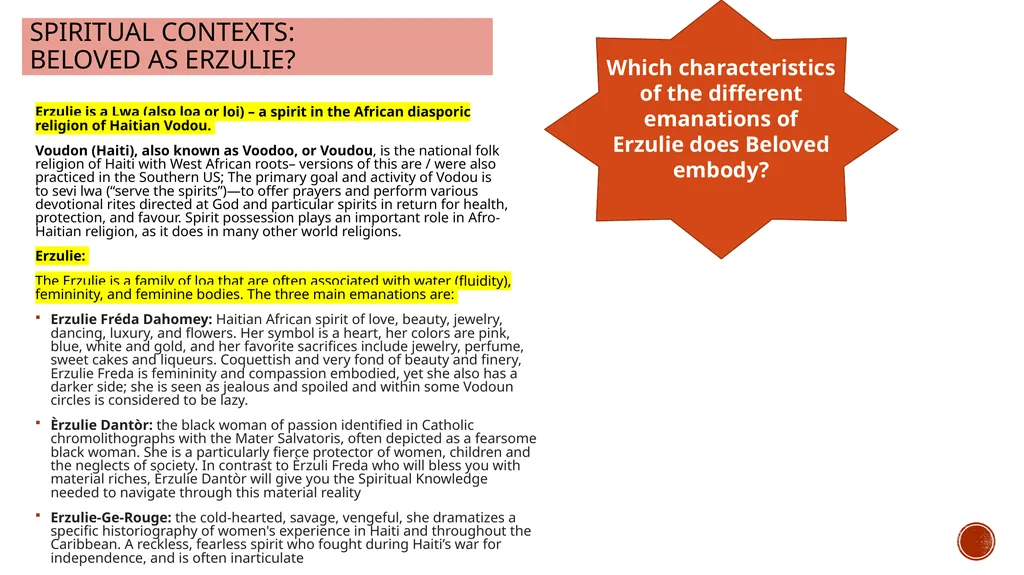
Beloved as Erzulie? Erzulie is a Lwa (also loa or loi) – a spirit in the African diasporic religion of Haitian Vodou.
Voudon (Haiti), also known as Voodoo, or Voudou, is the national folk religion of Haiti with West African roots– versions of this are / were also practiced in the Southern US; The primary goal and activity of Vodou is to sevi lwa (“serve the spirits”)—to offer prayers and perform various devotional rites directed at God and particular spirits in return for health, protection, and favour. Spirit possession plays an important role in Afro-Haitian religion, as it does in many other world religions.
Erzulie:
The Erzulie is a family of loa that are often associated with water (fluidity), femininity, and feminine bodies. The three main emanations are:
Erzulie Fréda Dahomey: Haitian African spirit of love, beauty, jewelry, dancing, luxury, and flowers. Her symbol is a heart, her colors are pink, blue, white and gold, and her favorite sacrifices include jewelry, perfume, sweet cakes and liqueurs. Coquettish and very fond of beauty and finery, Erzulie Freda is femininity and compassion embodied, yet she also has a darker side; she is seen as jealous and spoiled and within some Vodoun circles is considered to be lazy.
Èrzulie Dantòr: the black woman of passion identified in Catholic chromolithographs with the Mater Salvatoris, often depicted as a fearsome black woman. She is a particularly fierce protector of women, children and the neglects of society. In contrast to Èrzuli Freda who will bless you with material riches, Èrzulie Dantòr will give you the Spiritual Knowledge needed to navigate through this material reality
Erzulie-Ge-Rouge: the cold-hearted, savage, vengeful, she dramatizes a specific historiography of women's experience in Haiti and throughout the Caribbean. A reckless, fearless spirit who fought during Haiti’s war for independence, and is often inarticulate Which characteristics of the different emanations of Erzulie does Beloved embody?<br>
Voudon (Haiti), also known as Voodoo, or Voudou, is the national folk religion of Haiti with West African roots– versions of this are / were also practiced in the Southern US; The primary goal and activity of Vodou is to sevi lwa (“serve the spirits”)—to offer prayers and perform various devotional rites directed at God and particular spirits in return for health, protection, and favour. Spirit possession plays an important role in Afro-Haitian religion, as it does in many other world religions.
Erzulie:
The Erzulie is a family of loa that are often associated with water (fluidity), femininity, and feminine bodies. The three main emanations are:
Erzulie Fréda Dahomey: Haitian African spirit of love, beauty, jewelry, dancing, luxury, and flowers. Her symbol is a heart, her colors are pink, blue, white and gold, and her favorite sacrifices include jewelry, perfume, sweet cakes and liqueurs. Coquettish and very fond of beauty and finery, Erzulie Freda is femininity and compassion embodied, yet she also has a darker side; she is seen as jealous and spoiled and within some Vodoun circles is considered to be lazy.
Èrzulie Dantòr: the black woman of passion identified in Catholic chromolithographs with the Mater Salvatoris, often depicted as a fearsome black woman. She is a particularly fierce protector of women, children and the neglects of society. In contrast to Èrzuli Freda who will bless you with material riches, Èrzulie Dantòr will give you the Spiritual Knowledge needed to navigate through this material reality
Erzulie-Ge-Rouge: the cold-hearted, savage, vengeful, she dramatizes a specific historiography of women's experience in Haiti and throughout the Caribbean. A reckless, fearless spirit who fought during Haiti’s war for independence, and is often inarticulate Which characteristics of the different emanations of Erzulie does Beloved embody?<br>
06
Why are these spiritual contexts so important? Cultural identity: Alongside other folk traditions, these beliefs not only gave collective strength, but preserved the histories ignored, denigrated, or exoticized by the standard, "imperial" histories. It was the survival of these customs and gods that provided continuity for the dispossessed.
Thinking differently: Unlike Western religions that depend upon dualisms such as matter and spirit, body and soul, vodoun unsettles and subverts such apparent oppositions. This is evident when it comes to gender or colour: Erzulie "marries" women as well as men. Also, Maitresse Erzulie-Freda, the mulatresse blanche, is the lover of Ogoun, a black god of war. But she also wears the rings of Damballah, the white snake-god of the sweet waters, and Agou-Taroyo, the god of the sea who is figured as white. Key word: Syncretic
Describes the combination or fusion of different forms of belief or practice<br>
Thinking differently: Unlike Western religions that depend upon dualisms such as matter and spirit, body and soul, vodoun unsettles and subverts such apparent oppositions. This is evident when it comes to gender or colour: Erzulie "marries" women as well as men. Also, Maitresse Erzulie-Freda, the mulatresse blanche, is the lover of Ogoun, a black god of war. But she also wears the rings of Damballah, the white snake-god of the sweet waters, and Agou-Taroyo, the god of the sea who is figured as white. Key word: Syncretic
Describes the combination or fusion of different forms of belief or practice<br>
07
Other relevant Voudon or folkloric Beliefs in Beloved: Memories survive: "Some things go on. Pass on. Some things just stay. I used to think it was my rememory. You know. Some things you forget. Other things you never do. But it's not. Places, places are still there. If a house burns down, it's gone, but the place-the picture of it-stays, and not just in my rememory, but out there, in the world."
Re-possession is never abstract: the return is rigorously concrete and collective. This kind of memory is no individual, subjective journey into ideas of the past, but a continuing process of inhabiting memories anew and differently. of re-habitation, a re-positioning in terms of locale. There might be a prize to that – daring to remember is a theme.
Ancestral spirits: Beloved returns to her mother from "the other side," from under the waters, as do the ancestor spirits who soujourn in the bottom of river or lake. The narrative rituals that recall a history of possession and servitude are shot through with a love that will not quit.<br>
Re-possession is never abstract: the return is rigorously concrete and collective. This kind of memory is no individual, subjective journey into ideas of the past, but a continuing process of inhabiting memories anew and differently. of re-habitation, a re-positioning in terms of locale. There might be a prize to that – daring to remember is a theme.
Ancestral spirits: Beloved returns to her mother from "the other side," from under the waters, as do the ancestor spirits who soujourn in the bottom of river or lake. The narrative rituals that recall a history of possession and servitude are shot through with a love that will not quit.<br>
08
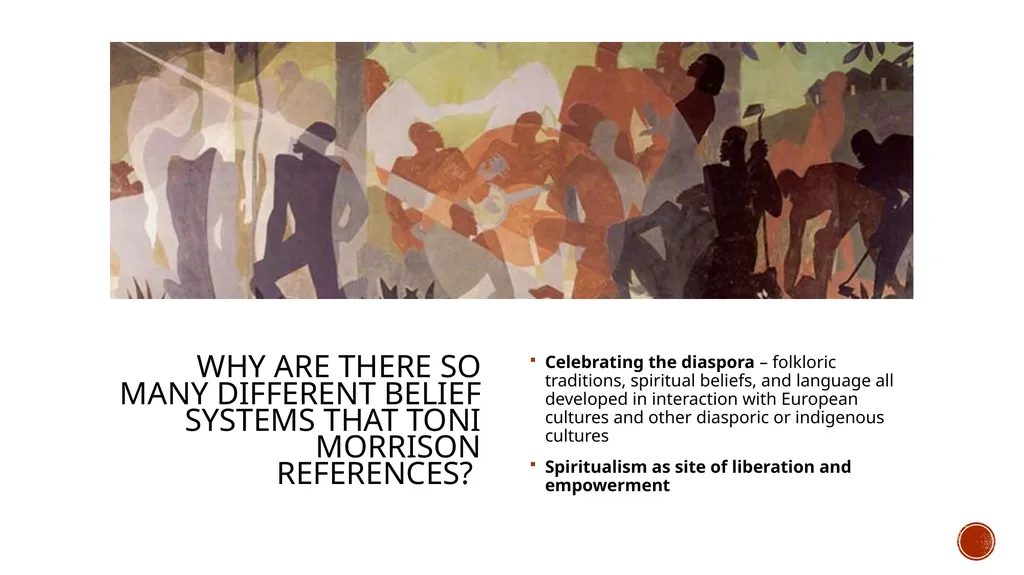
Why are there so many different belief systems that Toni Morrison references? Celebrating the diaspora – folkloric traditions, spiritual beliefs, and language all developed in interaction with European cultures and other diasporic or indigenous cultures
Spiritualism as site of liberation and empowerment<br>
Spiritualism as site of liberation and empowerment<br>
09
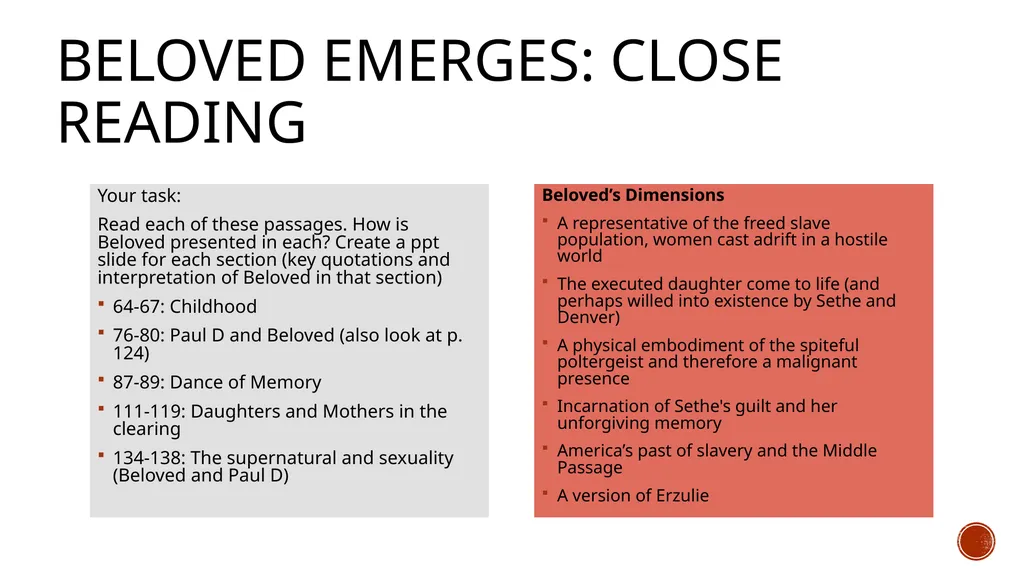
Beloved emerges: Close reading Your task:
Read each of these passages. How is Beloved presented in each? Create a ppt slide for each section (key quotations and interpretation of Beloved in that section)
64-67: Childhood
76-80: Paul D and Beloved (also look at p. 124)
87-89: Dance of Memory
111-119: Daughters and Mothers in the clearing
134-138: The supernatural and sexuality (Beloved and Paul D) Beloved’s Dimensions
A representative of the freed slave population, women cast adrift in a hostile world
The executed daughter come to life (and perhaps willed into existence by Sethe and Denver)
A physical embodiment of the spiteful poltergeist and therefore a malignant presence
Incarnation of Sethe's guilt and her unforgiving memory
America’s past of slavery and the Middle Passage
A version of Erzulie<br>
Read each of these passages. How is Beloved presented in each? Create a ppt slide for each section (key quotations and interpretation of Beloved in that section)
64-67: Childhood
76-80: Paul D and Beloved (also look at p. 124)
87-89: Dance of Memory
111-119: Daughters and Mothers in the clearing
134-138: The supernatural and sexuality (Beloved and Paul D) Beloved’s Dimensions
A representative of the freed slave population, women cast adrift in a hostile world
The executed daughter come to life (and perhaps willed into existence by Sethe and Denver)
A physical embodiment of the spiteful poltergeist and therefore a malignant presence
Incarnation of Sethe's guilt and her unforgiving memory
America’s past of slavery and the Middle Passage
A version of Erzulie<br>
10
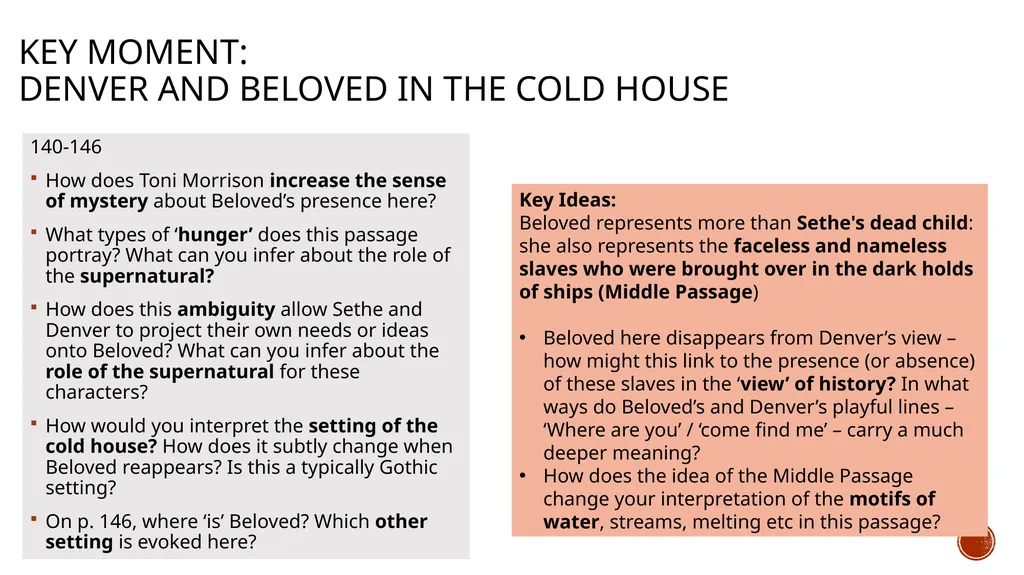
Key Moment:
Denver and Beloved in the cold house 140-146
How does Toni Morrison increase the sense of mystery about Beloved’s presence here?
What types of ‘hunger’ does this passage portray? What can you infer about the role of the supernatural?
How does this ambiguity allow Sethe and Denver to project their own needs or ideas onto Beloved? What can you infer about the role of the supernatural for these characters?
How would you interpret the setting of the cold house? How does it subtly change when Beloved reappears? Is this a typically Gothic setting?
On p. 146, where ‘is’ Beloved? Which other setting is evoked here? Key Ideas:
Beloved represents more than Sethe's dead child: she also represents the faceless and nameless slaves who were brought over in the dark holds of ships (Middle Passage)
Beloved here disappears from Denver’s view – how might this link to the presence (or absence) of these slaves in the ‘view’ of history? In what ways do Beloved’s and Denver’s playful lines – ‘Where are you’ / ‘come find me’ – carry a much deeper meaning?
How does the idea of the Middle Passage change your interpretation of the motifs of water, streams, melting etc in this passage?<br>
How does Toni Morrison increase the sense of mystery about Beloved’s presence here?
What types of ‘hunger’ does this passage portray? What can you infer about the role of the supernatural?
How does this ambiguity allow Sethe and Denver to project their own needs or ideas onto Beloved? What can you infer about the role of the supernatural for these characters?
How would you interpret the setting of the cold house? How does it subtly change when Beloved reappears? Is this a typically Gothic setting?
On p. 146, where ‘is’ Beloved? Which other setting is evoked here? Key Ideas:
Beloved represents more than Sethe's dead child: she also represents the faceless and nameless slaves who were brought over in the dark holds of ships (Middle Passage)
Beloved here disappears from Denver’s view – how might this link to the presence (or absence) of these slaves in the ‘view’ of history? In what ways do Beloved’s and Denver’s playful lines – ‘Where are you’ / ‘come find me’ – carry a much deeper meaning?
How does the idea of the Middle Passage change your interpretation of the motifs of water, streams, melting etc in this passage?<br>
11
Key Moment:
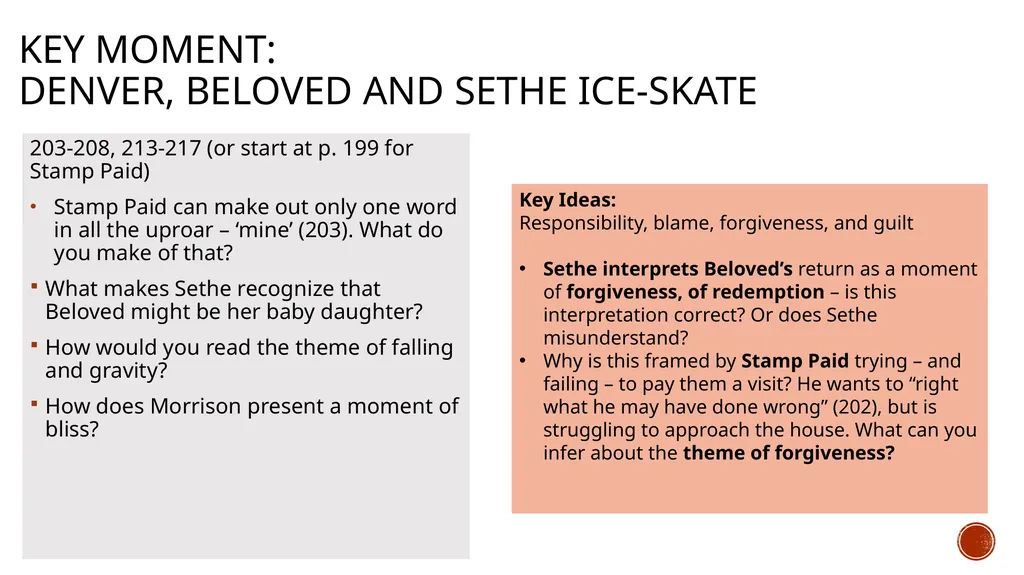
Denver, Beloved and Sethe Ice-Skate 203-208, 213-217 (or start at p. 199 for Stamp Paid)
Stamp Paid can make out only one word in all the uproar – ‘mine’ (203). What do you make of that?
What makes Sethe recognize that Beloved might be her baby daughter?
How would you read the theme of falling and gravity?
How does Morrison present a moment of bliss? Key Ideas:
Responsibility, blame, forgiveness, and guilt
Sethe interprets Beloved’s return as a moment of forgiveness, of redemption – is this interpretation correct? Or does Sethe misunderstand?
Why is this framed by Stamp Paid trying – and failing – to pay them a visit? He wants to “right what he may have done wrong” (202), but is struggling to approach the house. What can you infer about the theme of forgiveness?<br>
Stamp Paid can make out only one word in all the uproar – ‘mine’ (203). What do you make of that?
What makes Sethe recognize that Beloved might be her baby daughter?
How would you read the theme of falling and gravity?
How does Morrison present a moment of bliss? Key Ideas:
Responsibility, blame, forgiveness, and guilt
Sethe interprets Beloved’s return as a moment of forgiveness, of redemption – is this interpretation correct? Or does Sethe misunderstand?
Why is this framed by Stamp Paid trying – and failing – to pay them a visit? He wants to “right what he may have done wrong” (202), but is struggling to approach the house. What can you infer about the theme of forgiveness?<br>
12
Beloved’s voice in the chorus Read Beloved’s monologues on p. 248ff
How does the style differ from Sethe and Denver’s monologues? How would you describe Beloved’s voice?
How does her voice change and develop across the two sections?
Which interpretations of Beloved are emphasized here? Which motifs recur?
How would you interpret the motifs of laying claim to, hungering for, betrayal, and possession here?
Can you compare the voice of the supernatural to Dracula? How much space is given to Dracula's voice? Which motifs and tone is Dracula’s voice associated with? ‘Beloved’ and Jazz Aesthetics: Why is there a chorus?
Key ideas:
Polyphony of voices (voice upon voice upon voice, interwoven)
Call and response
Toni Morrison:
“If my work is faithfully to reflect the aesthetic tradition of Afro-American culture, it must make conscious use of the characteristics of its art forms and translate them into print: antiphony, the group nature of art, its functionality, its improvisational nature, its relationship to audience performance, the critical voice which upholds tradition and communal values and which also provides occasion for an individual to transcend and/or defy group restrictions.”<br>
How does the style differ from Sethe and Denver’s monologues? How would you describe Beloved’s voice?
How does her voice change and develop across the two sections?
Which interpretations of Beloved are emphasized here? Which motifs recur?
How would you interpret the motifs of laying claim to, hungering for, betrayal, and possession here?
Can you compare the voice of the supernatural to Dracula? How much space is given to Dracula's voice? Which motifs and tone is Dracula’s voice associated with? ‘Beloved’ and Jazz Aesthetics: Why is there a chorus?
Key ideas:
Polyphony of voices (voice upon voice upon voice, interwoven)
Call and response
Toni Morrison:
“If my work is faithfully to reflect the aesthetic tradition of Afro-American culture, it must make conscious use of the characteristics of its art forms and translate them into print: antiphony, the group nature of art, its functionality, its improvisational nature, its relationship to audience performance, the critical voice which upholds tradition and communal values and which also provides occasion for an individual to transcend and/or defy group restrictions.”<br>
13
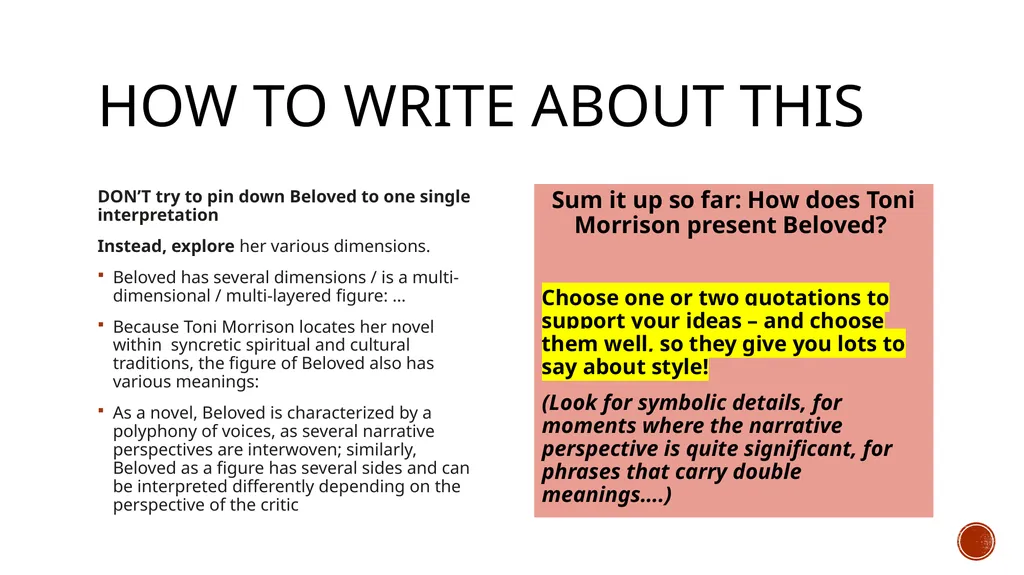
How to write about this DON’T try to pin down Beloved to one single interpretation
Instead, explore her various dimensions.
Beloved has several dimensions / is a multi-dimensional / multi-layered figure: …
Because Toni Morrison locates her novel within syncretic spiritual and cultural traditions, the figure of Beloved also has various meanings:
As a novel, Beloved is characterized by a polyphony of voices, as several narrative perspectives are interwoven; similarly, Beloved as a figure has several sides and can be interpreted differently depending on the perspective of the critic Sum it up so far: How does Toni Morrison present Beloved?
Choose one or two quotations to support your ideas – and choose them well, so they give you lots to say about style!
(Look for symbolic details, for moments where the narrative perspective is quite significant, for phrases that carry double meanings….)<br>
Instead, explore her various dimensions.
Beloved has several dimensions / is a multi-dimensional / multi-layered figure: …
Because Toni Morrison locates her novel within syncretic spiritual and cultural traditions, the figure of Beloved also has various meanings:
As a novel, Beloved is characterized by a polyphony of voices, as several narrative perspectives are interwoven; similarly, Beloved as a figure has several sides and can be interpreted differently depending on the perspective of the critic Sum it up so far: How does Toni Morrison present Beloved?
Choose one or two quotations to support your ideas – and choose them well, so they give you lots to say about style!
(Look for symbolic details, for moments where the narrative perspective is quite significant, for phrases that carry double meanings….)<br>
14
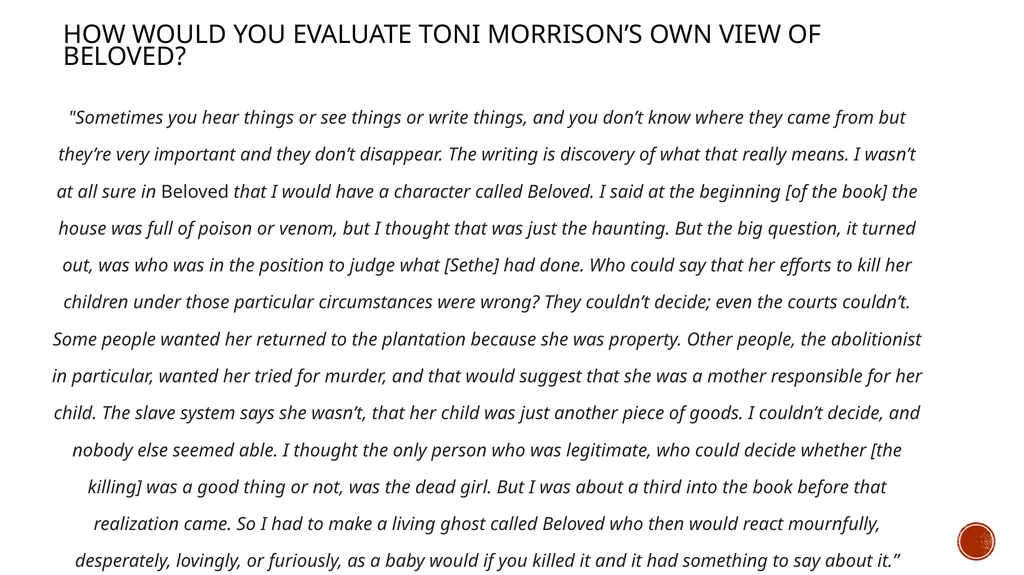
How would you evaluate Toni Morrison’s own view of beloved? "Sometimes you hear things or see things or write things, and you don’t know where they came from but they’re very important and they don’t disappear. The writing is discovery of what that really means. I wasn’t at all sure in Beloved that I would have a character called Beloved. I said at the beginning [of the book] the house was full of poison or venom, but I thought that was just the haunting. But the big question, it turned out, was who was in the position to judge what [Sethe] had done. Who could say that her efforts to kill her children under those particular circumstances were wrong? They couldn’t decide; even the courts couldn’t. Some people wanted her returned to the plantation because she was property. Other people, the abolitionist in particular, wanted her tried for murder, and that would suggest that she was a mother responsible for her child. The slave system says she wasn’t, that her child was just another piece of goods. I couldn’t decide, and nobody else seemed able. I thought the only person who was legitimate, who could decide whether [the killing] was a good thing or not, was the dead girl. But I was about a third into the book before that realization came. So I had to make a living ghost called Beloved who then would react mournfully, desperately, lovingly, or furiously, as a baby would if you killed it and it had something to say about it.”<br>