
Big Data Analytics with Parallel Jobs Ganesh
CS
Published · 46 slides · 0 views
1 / 1


Description
Big Data Analytics with Parallel Jobs Ganesh Ananthanarayanan University of California at Berkeley http:www.cs.berkeley.eduganesha Rising philosophy of data-ism Diagnostics and decisions backed by extensive data analytics In God we
Related Topics
Share
Embed code
Download this presentation From Below
"Big Data Analytics with Parallel Jobs Ganesh" is the property of its rightful owner. Permission is granted to download and print the materials on this website for personal, non-commercial use only, and to display it on your personal computer provided you do not modify the materials and that you retain all copyright notices contained in the materials. By downloading content from our website, you accept the terms of this agreement.
Presentation Transcript
01
Big Data Analytics with Parallel Jobs Ganesh Ananthanarayanan
University of California at Berkeley
http://www.cs.berkeley.edu/~ganesha/<br>
University of California at Berkeley
http://www.cs.berkeley.edu/~ganesha/<br>
02
Rising philosophy of data-ism Diagnostics and decisions backed by extensive data analytics
"In God we trust. Everybody else bring data to the table.“
Competitive and Social Benefits
Dichotomy: Ever-increasing data size and ever-decreasing latency target<br>
"In God we trust. Everybody else bring data to the table.“
Competitive and Social Benefits
Dichotomy: Ever-increasing data size and ever-decreasing latency target<br>
03
Parallelization Massive parallelization on large clusters
Data growing faster than Moore’s law
Computation Frameworks<br>
Data growing faster than Moore’s law
Computation Frameworks<br>
04
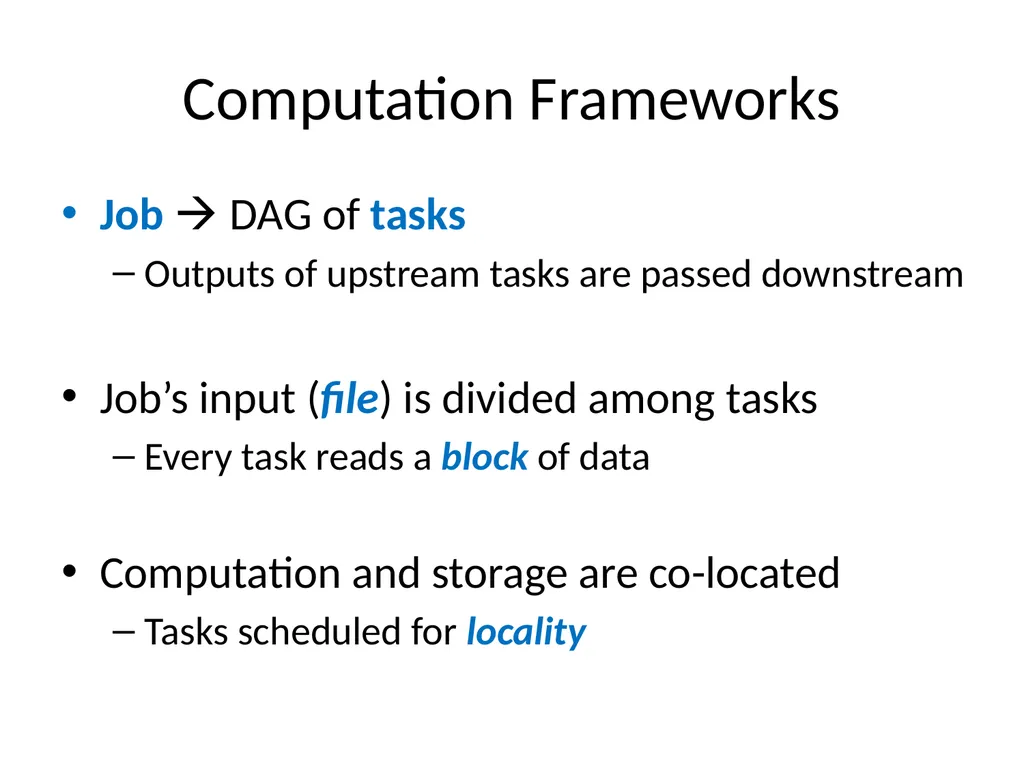
Computation Frameworks Job DAG of tasks
Outputs of upstream tasks are passed downstream
Job’s input (file) is divided among tasks
Every task reads a block of data
Computation and storage are co-located
Tasks scheduled for locality<br>
Outputs of upstream tasks are passed downstream
Job’s input (file) is divided among tasks
Every task reads a block of data
Computation and storage are co-located
Tasks scheduled for locality<br>
05
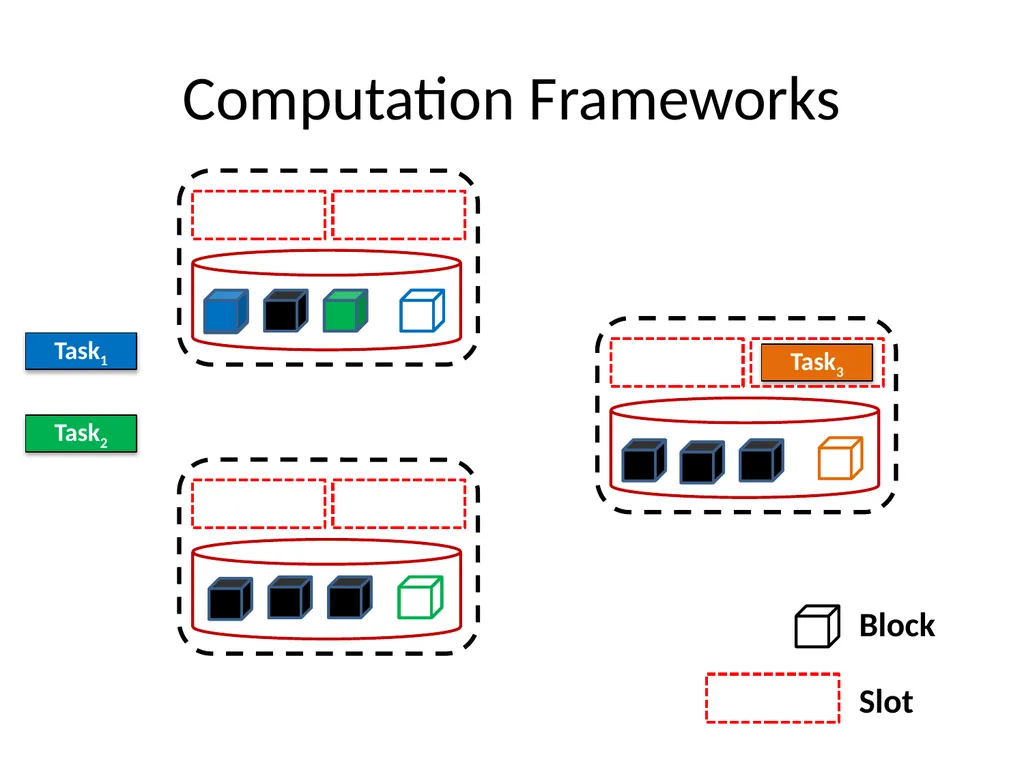
Task2 Task1 Task3 Computation Frameworks Block Slot<br>
06
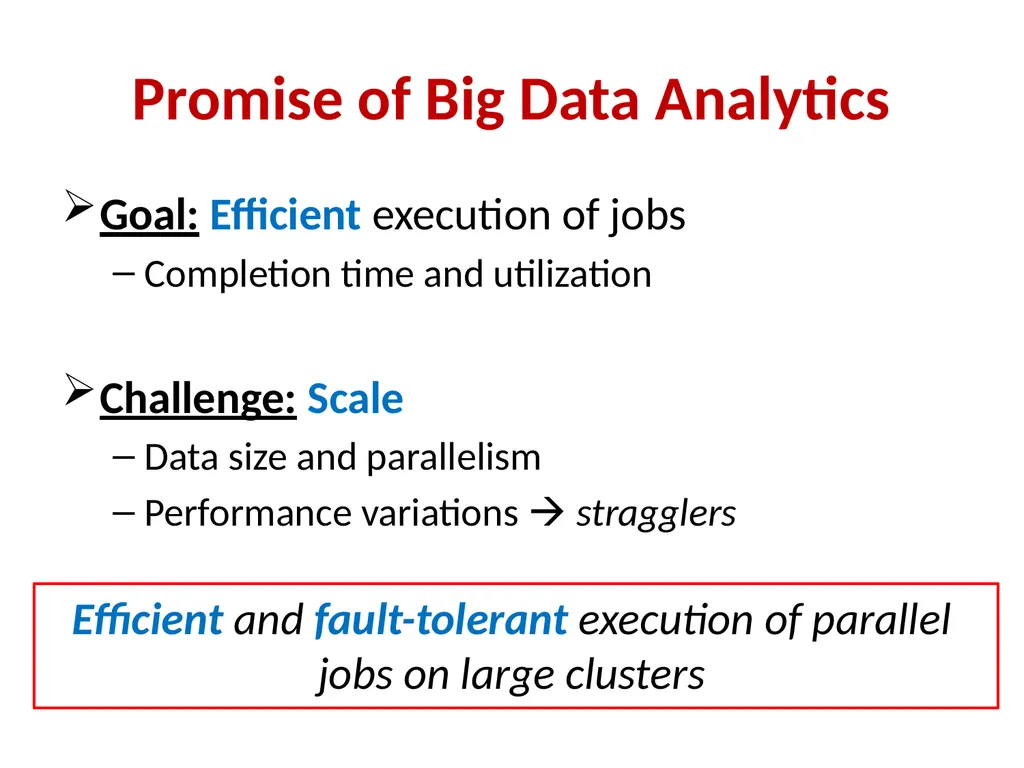
Promise of Big Data Analytics Goal: Efficient execution of jobs
Completion time and utilization
Challenge: Scale
Data size and parallelism
Performance variations stragglers Efficient and fault-tolerant execution of parallel jobs on large clusters<br>
Completion time and utilization
Challenge: Scale
Data size and parallelism
Performance variations stragglers Efficient and fault-tolerant execution of parallel jobs on large clusters<br>
07
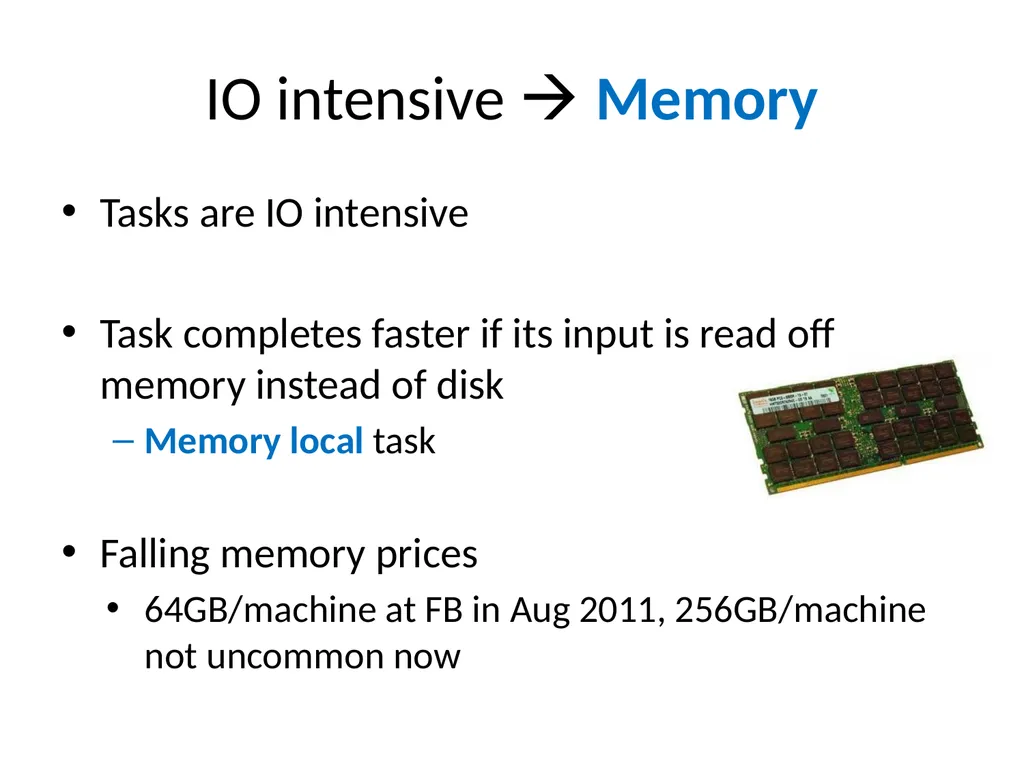
IO intensive Memory Tasks are IO intensive
Task completes faster if its input is read off memory instead of disk
Memory local task
Falling memory prices
64GB/machine at FB in Aug 2011, 256GB/machine not uncommon now<br>
Task completes faster if its input is read off memory instead of disk
Memory local task
Falling memory prices
64GB/machine at FB in Aug 2011, 256GB/machine not uncommon now<br>
08
Can we move all data to memory? Proposals for making “RAM as the new disk” (e.g., RAMCloud)
Huge discrepancy between storage and memory capacities
200x more data on disks than available memory Use memory as cache<br>
Huge discrepancy between storage and memory capacities
200x more data on disks than available memory Use memory as cache<br>
09
Production traces
Dryad and Hadoop clusters
Thousands of machines
Over 1 million jobs in all, span of 6 months (2011-12) Will the inputs fit in cache?<br>
Dryad and Hadoop clusters
Thousands of machines
Over 1 million jobs in all, span of 6 months (2011-12) Will the inputs fit in cache?<br>
10
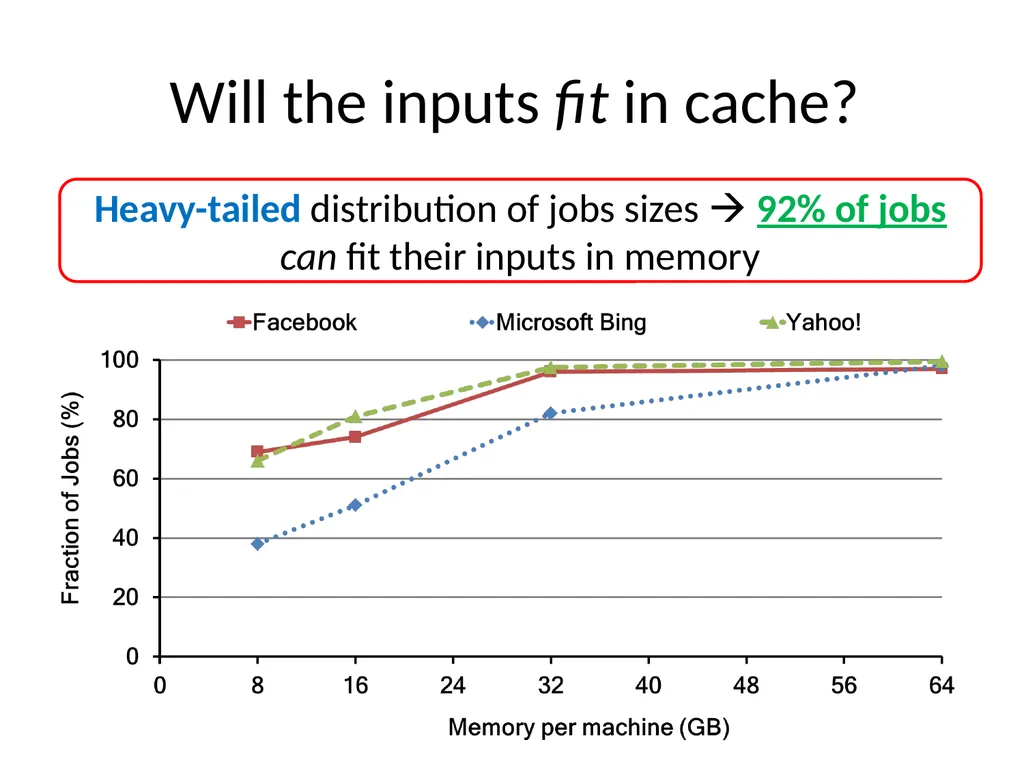
Will the inputs fit in cache? Heavy-tailed distribution of jobs sizes 92% of jobs can fit their inputs in memory<br>
11
We built a memory cache… Simple in-memory distributed cache
Cache input data of jobs
Schedule tasks for memory locality
Simple cache replacement policies
Least Recently Used (LRU) and Least Frequently Used (LFU)<br>
Cache input data of jobs
Schedule tasks for memory locality
Simple cache replacement policies
Least Recently Used (LRU) and Least Frequently Used (LFU)<br>
12
We built a memory cache… Replayed the Facebook trace of Hadoop jobs
Jobs sped up by 10% with LFU; hit-ratio of 67%
Belady’s MIN (optimal)
13% improvement with hit-ratio of 74% How do we make caching really speedup parallel jobs?<br>
Jobs sped up by 10% with LFU; hit-ratio of 67%
Belady’s MIN (optimal)
13% improvement with hit-ratio of 74% How do we make caching really speedup parallel jobs?<br>
13
Parallel jobs require a new class of cache replacement algorithms<br>
14
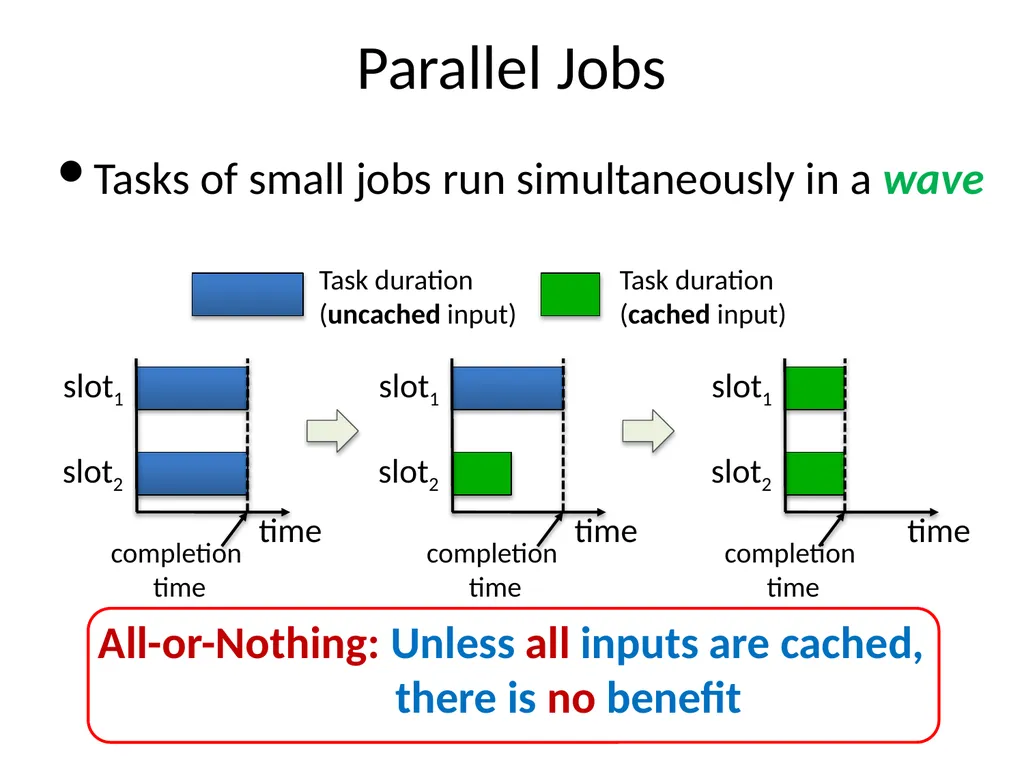
Parallel Jobs Tasks of small jobs run simultaneously in a wave Task duration
(uncached input) Task duration
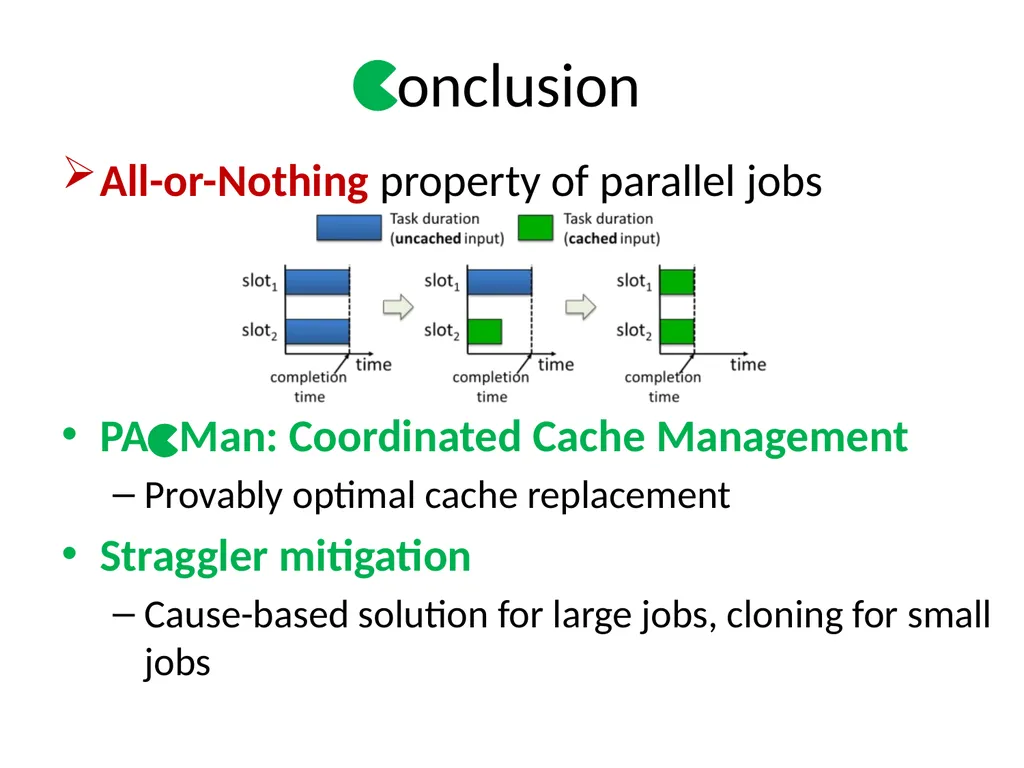
(cached input) All-or-Nothing: Unless all inputs are cached, there is no benefit<br>
(uncached input) Task duration
(cached input) All-or-Nothing: Unless all inputs are cached, there is no benefit<br>
15
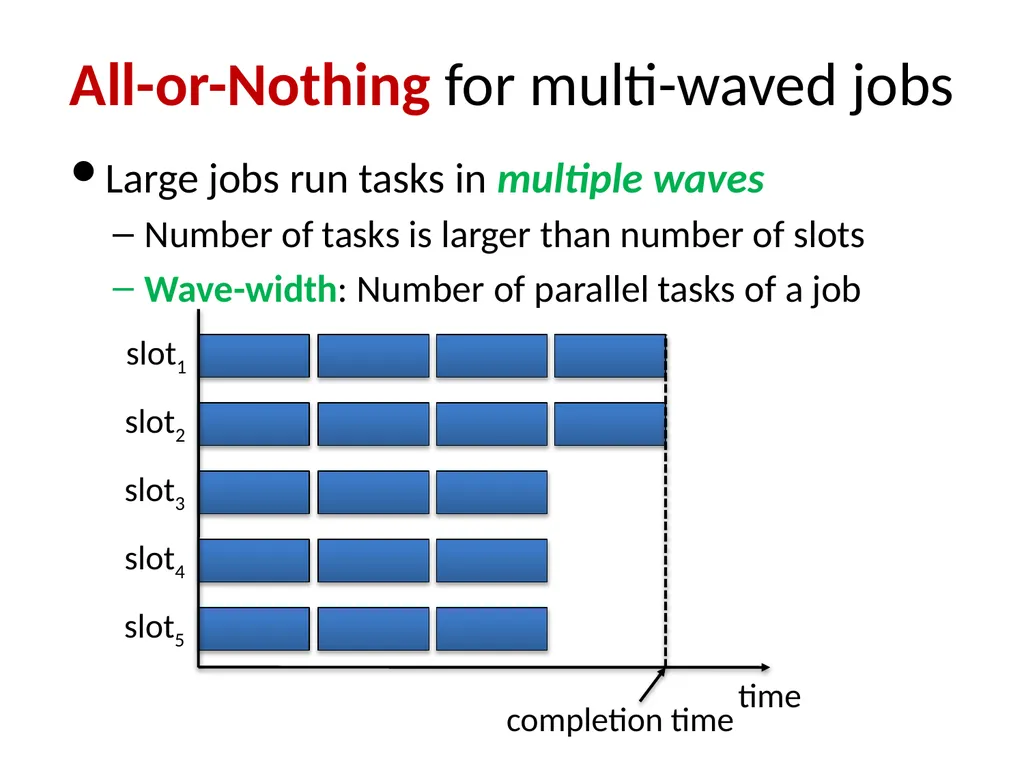
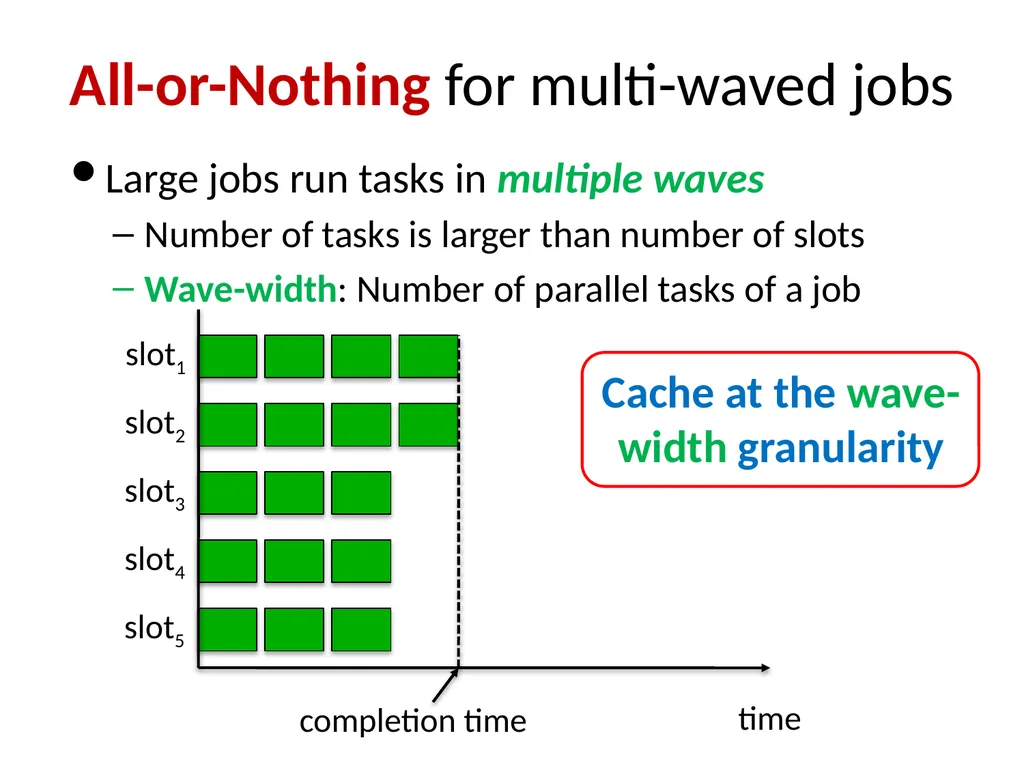
All-or-Nothing for multi-waved jobs Large jobs run tasks in multiple waves
Number of tasks is larger than number of slots
Wave-width: Number of parallel tasks of a job time slot5 slot4 slot3 slot2 slot1<br>
Number of tasks is larger than number of slots
Wave-width: Number of parallel tasks of a job time slot5 slot4 slot3 slot2 slot1<br>
16
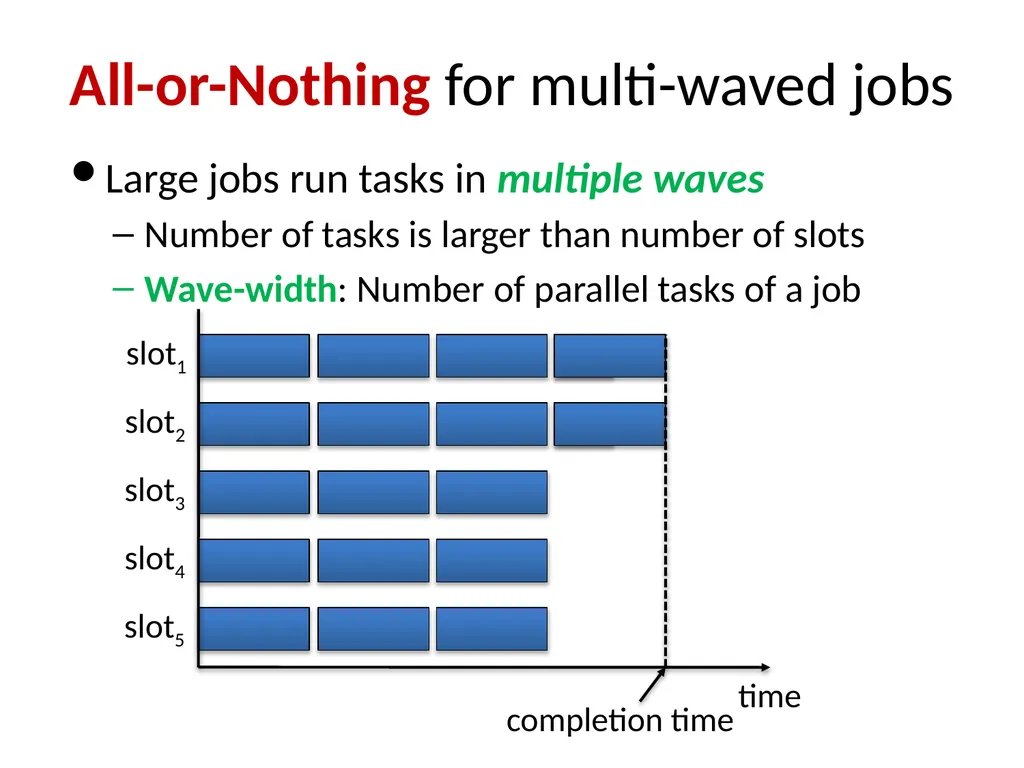
All-or-Nothing for multi-waved jobs Large jobs run tasks in multiple waves
Number of tasks is larger than number of slots
Wave-width: Number of parallel tasks of a job time slot5 slot4 slot3 slot2 slot1<br>
Number of tasks is larger than number of slots
Wave-width: Number of parallel tasks of a job time slot5 slot4 slot3 slot2 slot1<br>
17
All-or-Nothing for multi-waved jobs time slot5 slot4 slot3 slot2 slot1 Large jobs run tasks in multiple waves
Number of tasks is larger than number of slots
Wave-width: Number of parallel tasks of a job<br>
Number of tasks is larger than number of slots
Wave-width: Number of parallel tasks of a job<br>
18
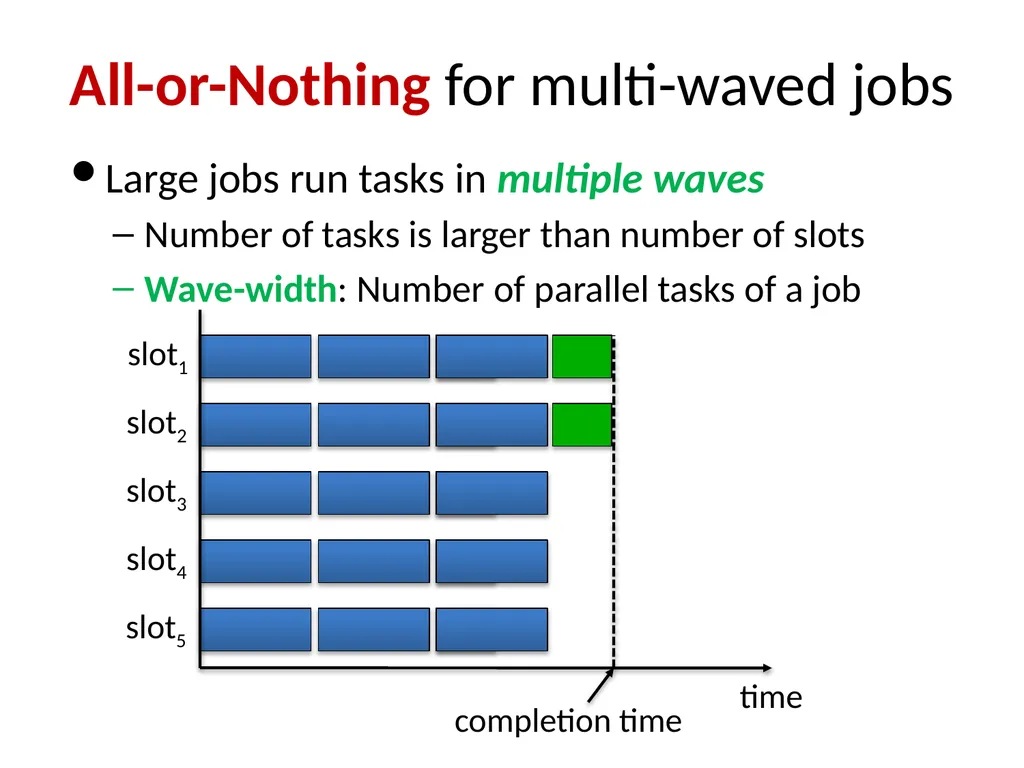
All-or-Nothing for multi-waved jobs time slot5 slot4 slot3 slot2 slot1 Large jobs run tasks in multiple waves
Number of tasks is larger than number of slots
Wave-width: Number of parallel tasks of a job Cache at the wave-width granularity<br>
Number of tasks is larger than number of slots
Wave-width: Number of parallel tasks of a job Cache at the wave-width granularity<br>
19
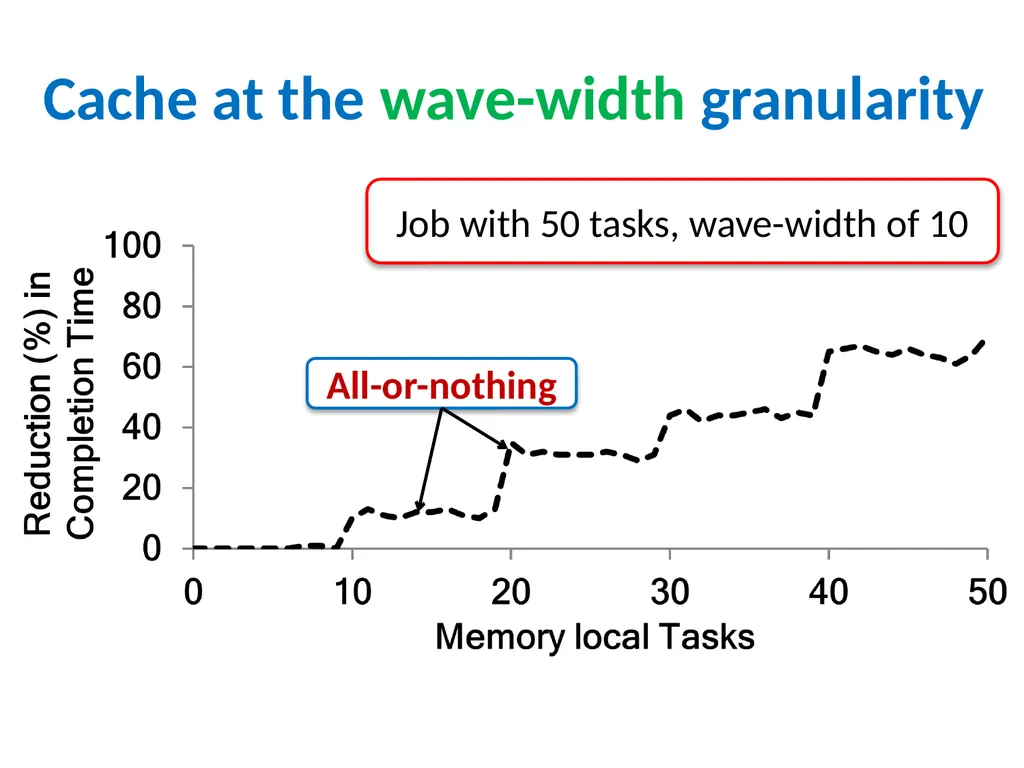
Cache at the wave-width granularity Job with 50 tasks, wave-width of 10 All-or-nothing<br>
20
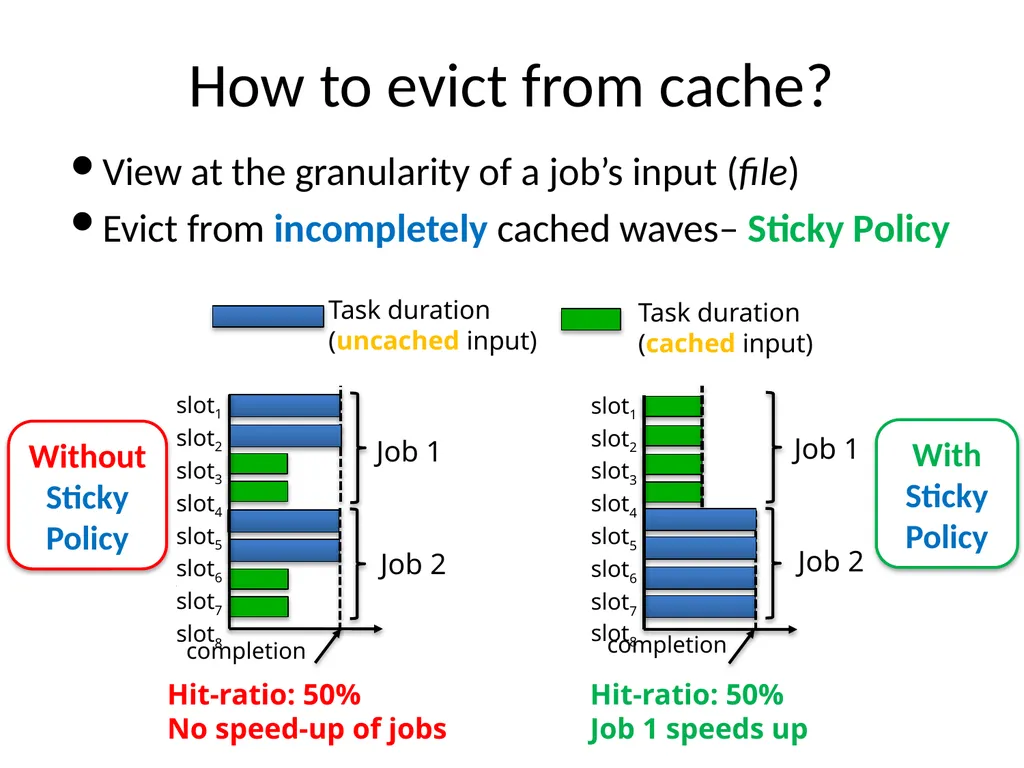
How to evict from cache? View at the granularity of a job’s input (file)
Evict from incompletely cached waves– Sticky Policy With Sticky Policy slot1
slot2
slot3
slot4
slot5
slot6
a
slot7
slot8 completion Hit-ratio: 50%
No speed-up of jobs Job 1 Job 2 Without Sticky Policy<br>
Evict from incompletely cached waves– Sticky Policy With Sticky Policy slot1
slot2
slot3
slot4
slot5
slot6
a
slot7
slot8 completion Hit-ratio: 50%
No speed-up of jobs Job 1 Job 2 Without Sticky Policy<br>
21
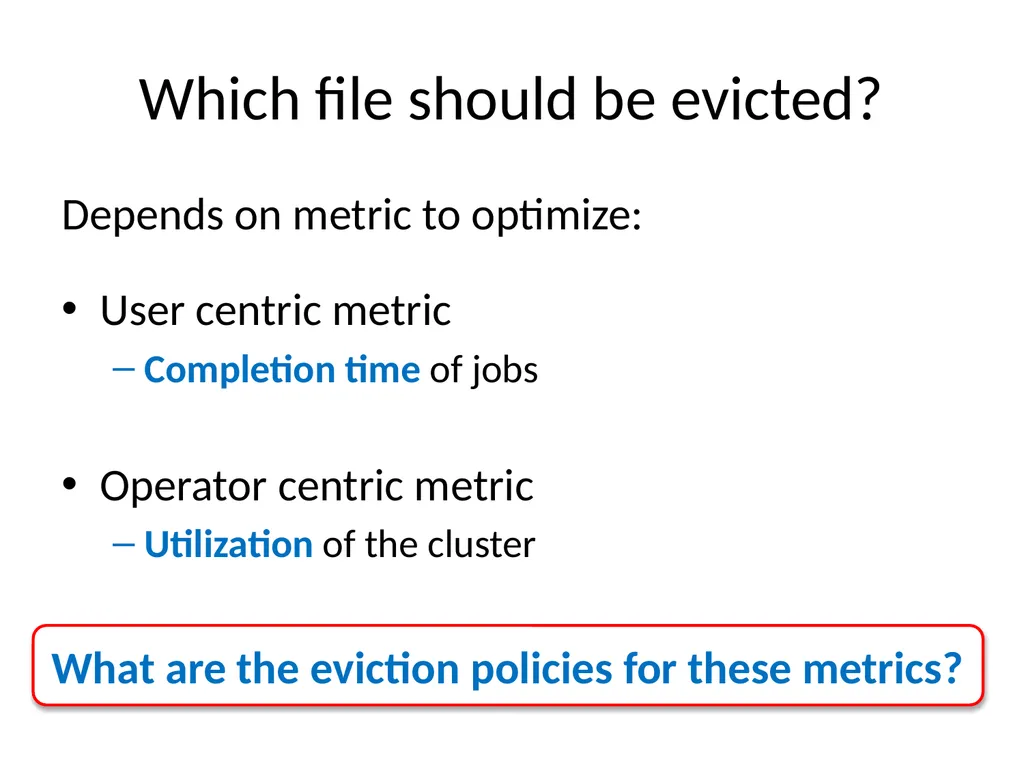
Which file should be evicted? Depends on metric to optimize:
User centric metric
Completion time of jobs
Operator centric metric
Utilization of the cluster What are the eviction policies for these metrics?<br>
User centric metric
Completion time of jobs
Operator centric metric
Utilization of the cluster What are the eviction policies for these metrics?<br>
22
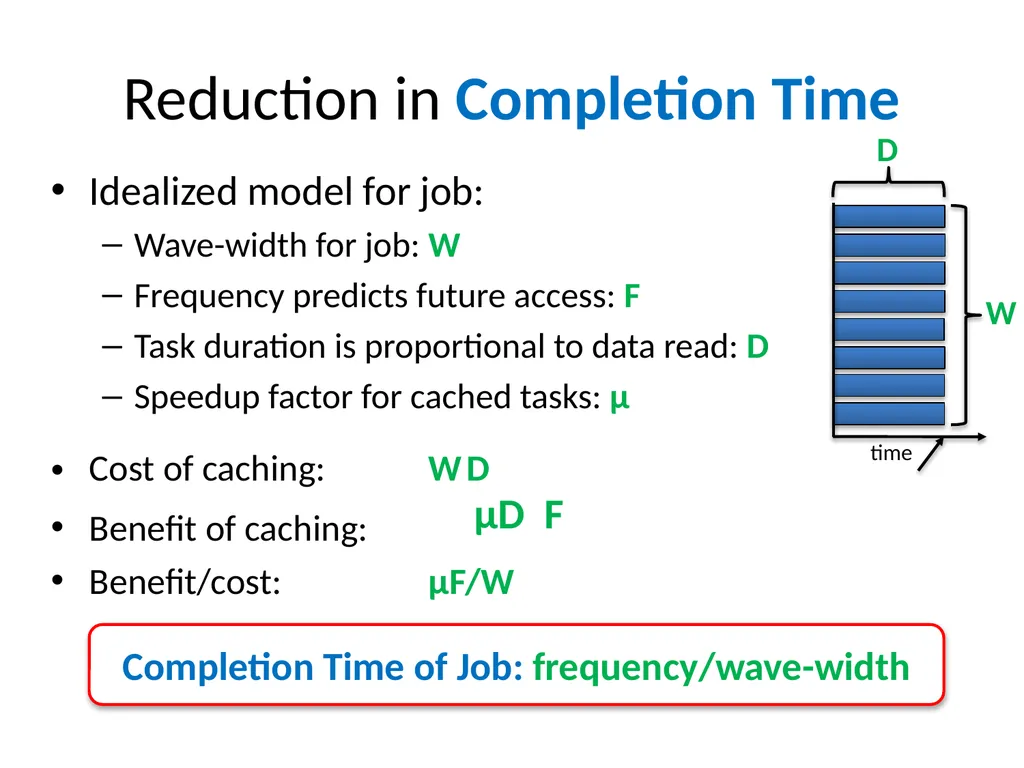
Reduction in Completion Time Idealized model for job:
Wave-width for job: W
Frequency predicts future access: F
Task duration is proportional to data read: D
Speedup factor for cached tasks: µ Cost of caching: W D
Benefit of caching:
Benefit/cost: µF/W Completion Time of Job: frequency/wave-width F µD<br>
Wave-width for job: W
Frequency predicts future access: F
Task duration is proportional to data read: D
Speedup factor for cached tasks: µ Cost of caching: W D
Benefit of caching:
Benefit/cost: µF/W Completion Time of Job: frequency/wave-width F µD<br>
23
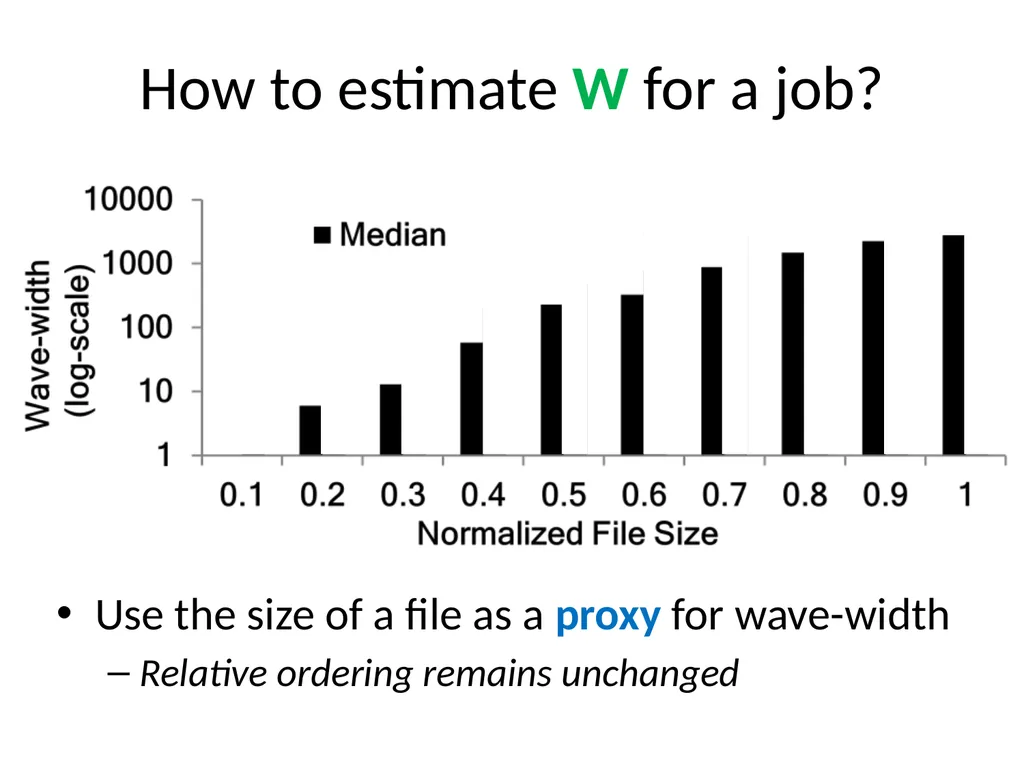
How to estimate W for a job? Job size Wave-width (slots) Use the size of a file as a proxy for wave-width
Relative ordering remains unchanged<br>
Relative ordering remains unchanged<br>
24
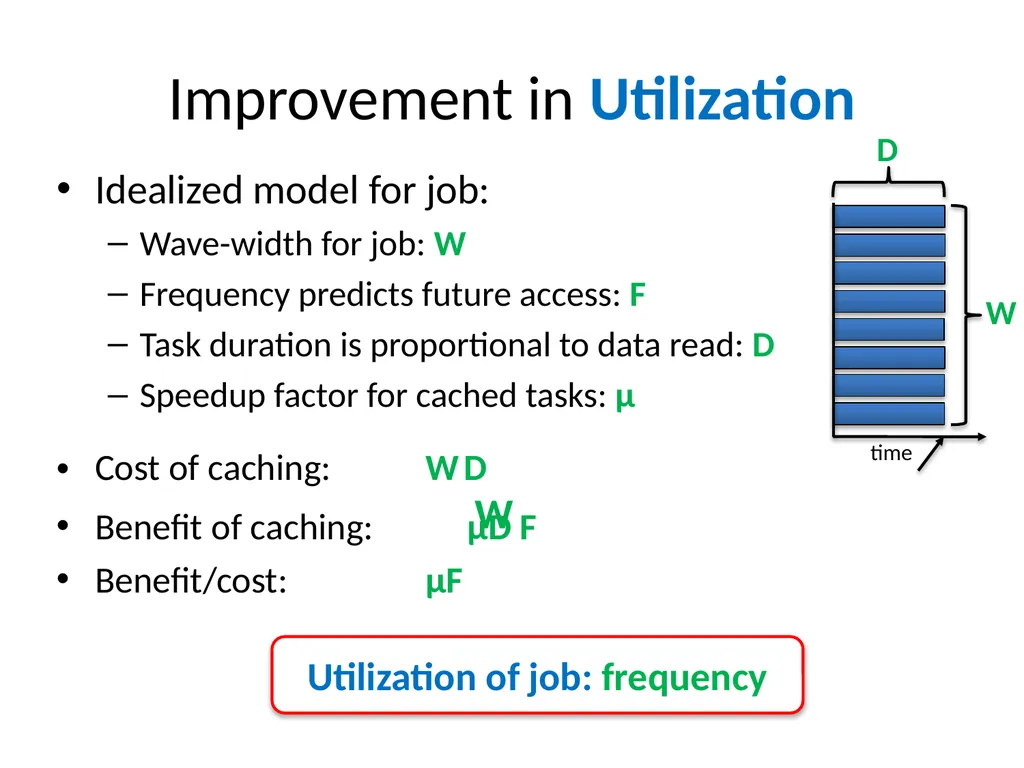
Improvement in Utilization Idealized model for job:
Wave-width for job: W
Frequency predicts future access: F
Task duration is proportional to data read: D
Speedup factor for cached tasks: µ Cost of caching: W D
Benefit of caching: µD F
Benefit/cost: µF Utilization of job: frequency W<br>
Wave-width for job: W
Frequency predicts future access: F
Task duration is proportional to data read: D
Speedup factor for cached tasks: µ Cost of caching: W D
Benefit of caching: µD F
Benefit/cost: µF Utilization of job: frequency W<br>
25
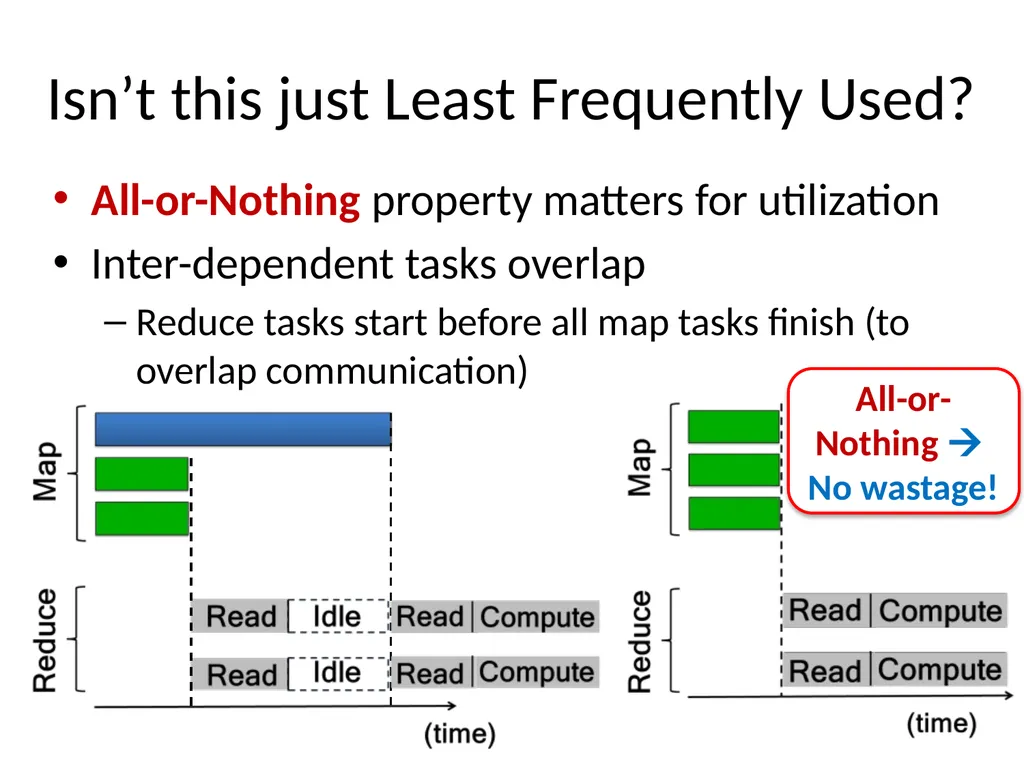
Isn’t this just Least Frequently Used? All-or-Nothing property matters for utilization
Inter-dependent tasks overlap
Reduce tasks start before all map tasks finish (to overlap communication) All-or-Nothing
No wastage!<br>
Inter-dependent tasks overlap
Reduce tasks start before all map tasks finish (to overlap communication) All-or-Nothing
No wastage!<br>
26
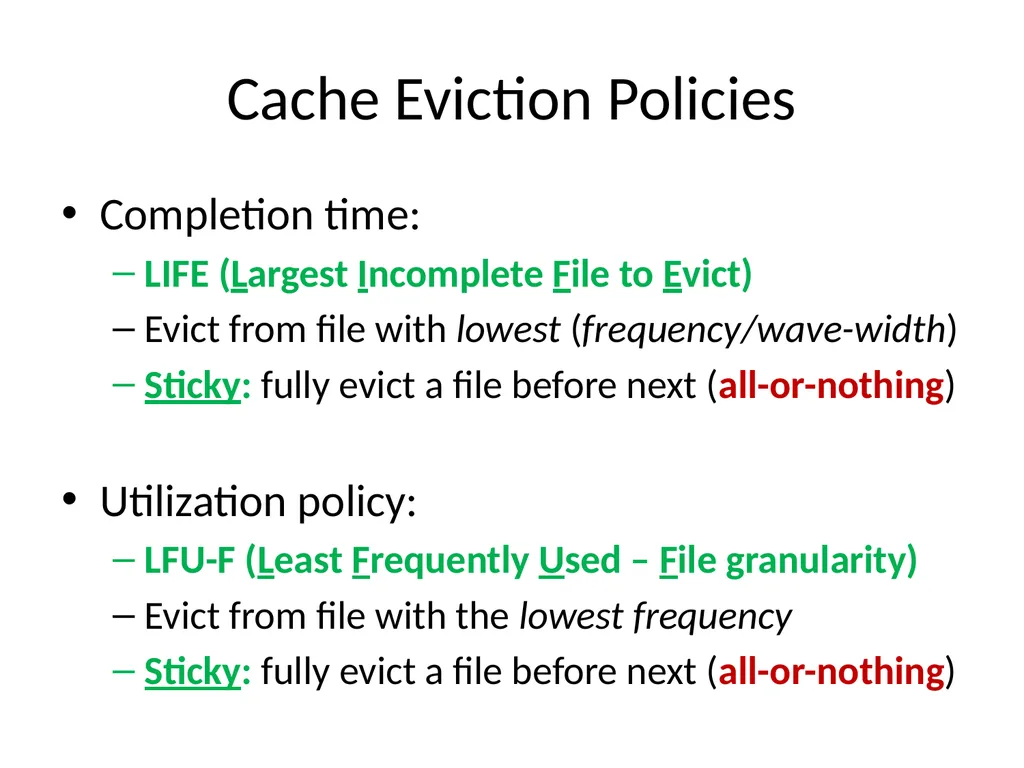
Cache Eviction Policies Completion time:
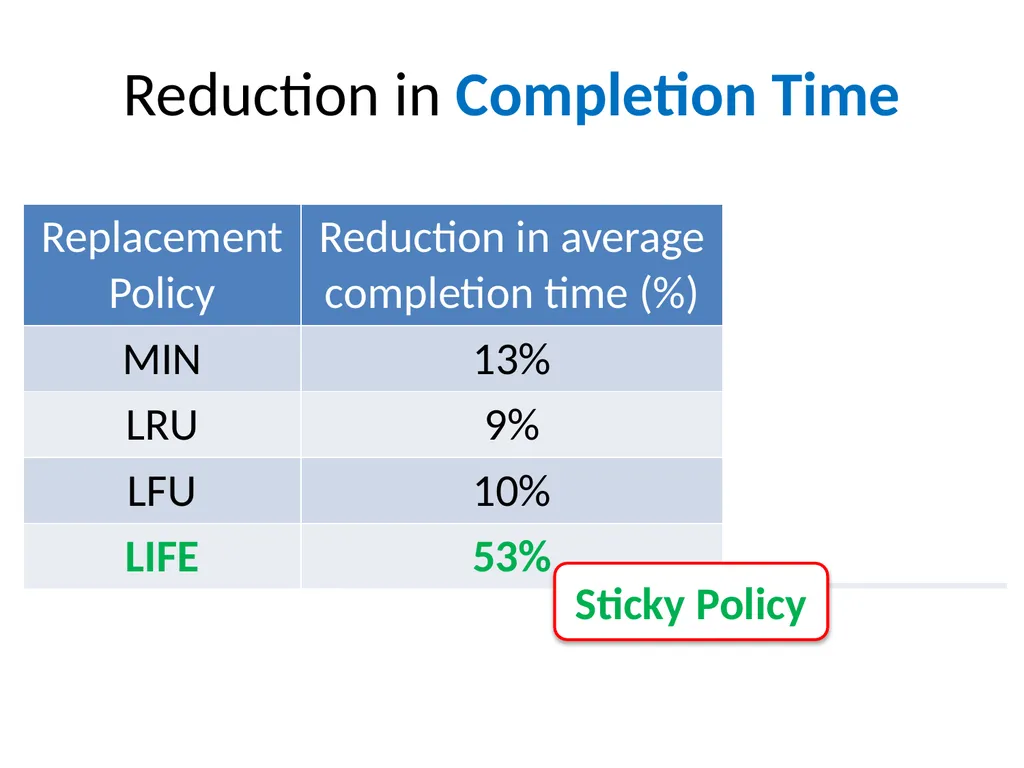
LIFE (Largest Incomplete File to Evict)
Evict from file with lowest (frequency/wave-width)
Sticky: fully evict a file before next (all-or-nothing)
Utilization policy:
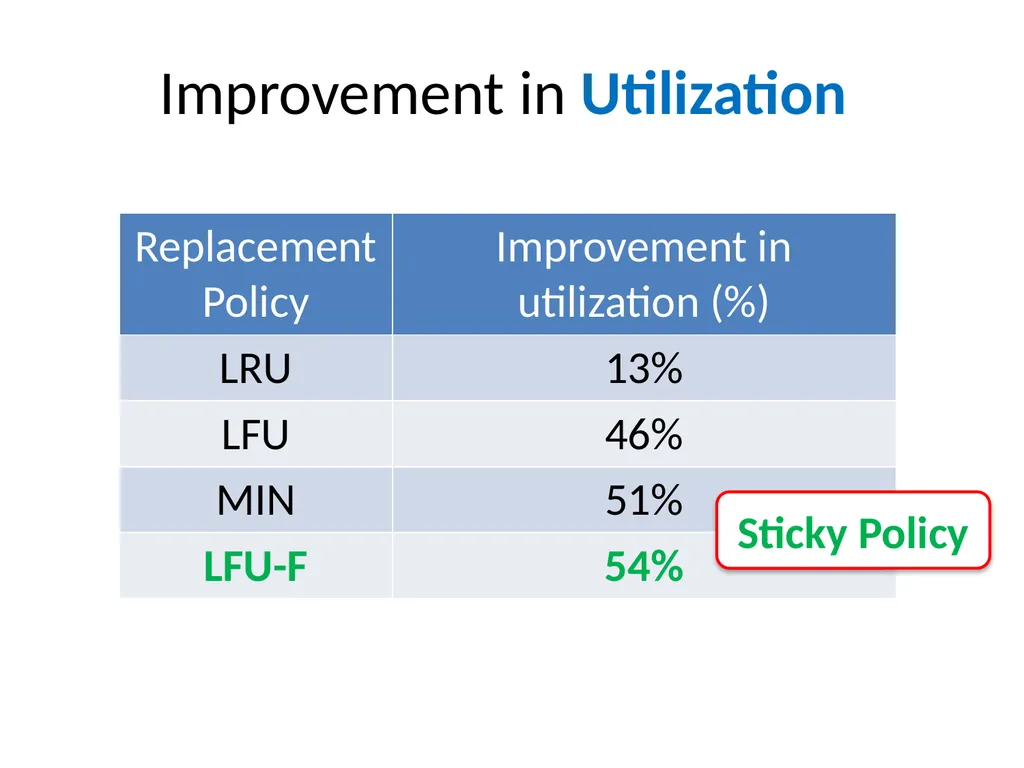
LFU-F (Least Frequently Used – File granularity)
Evict from file with the lowest frequency
Sticky: fully evict a file before next (all-or-nothing)<br>
LIFE (Largest Incomplete File to Evict)
Evict from file with lowest (frequency/wave-width)
Sticky: fully evict a file before next (all-or-nothing)
Utilization policy:
LFU-F (Least Frequently Used – File granularity)
Evict from file with the lowest frequency
Sticky: fully evict a file before next (all-or-nothing)<br>
27
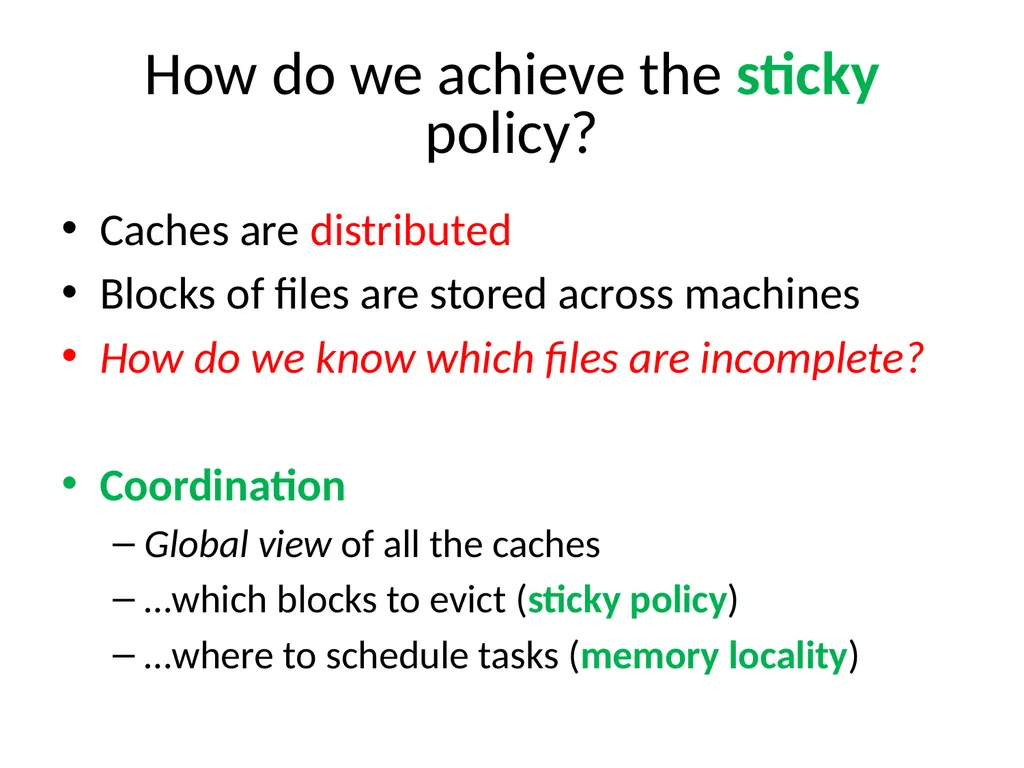
How do we achieve the sticky policy? Caches are distributed
Blocks of files are stored across machines
How do we know which files are incomplete?
Coordination
Global view of all the caches
…which blocks to evict (sticky policy)
…where to schedule tasks (memory locality)<br>
Blocks of files are stored across machines
How do we know which files are incomplete?
Coordination
Global view of all the caches
…which blocks to evict (sticky policy)
…where to schedule tasks (memory locality)<br>
28
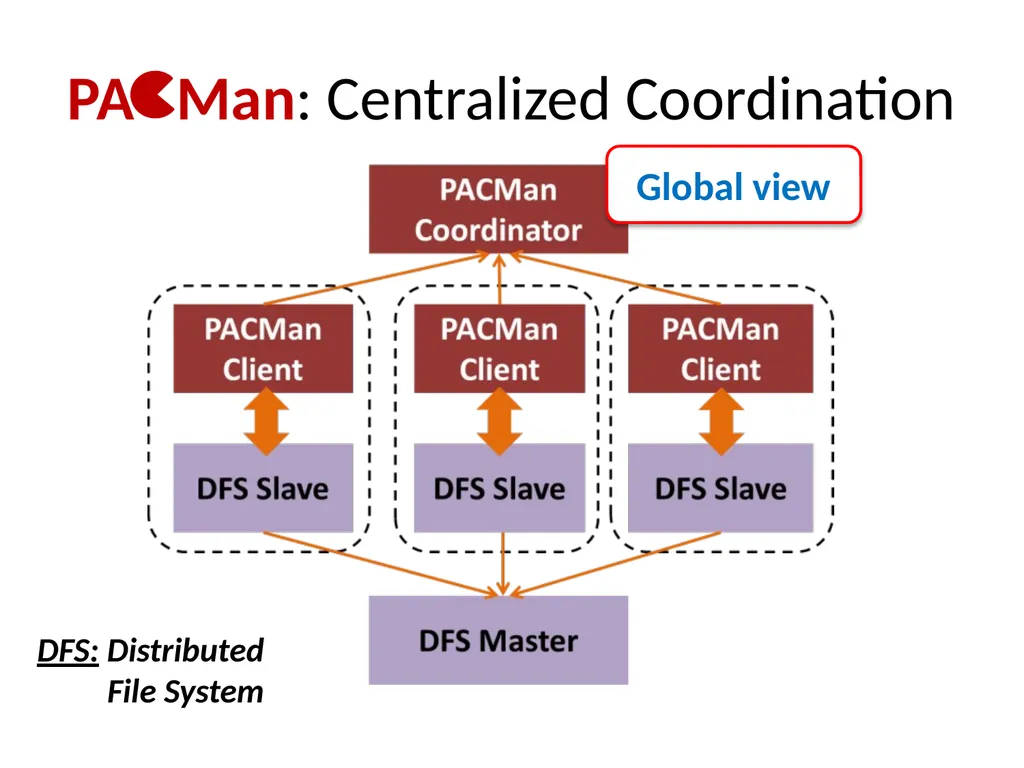
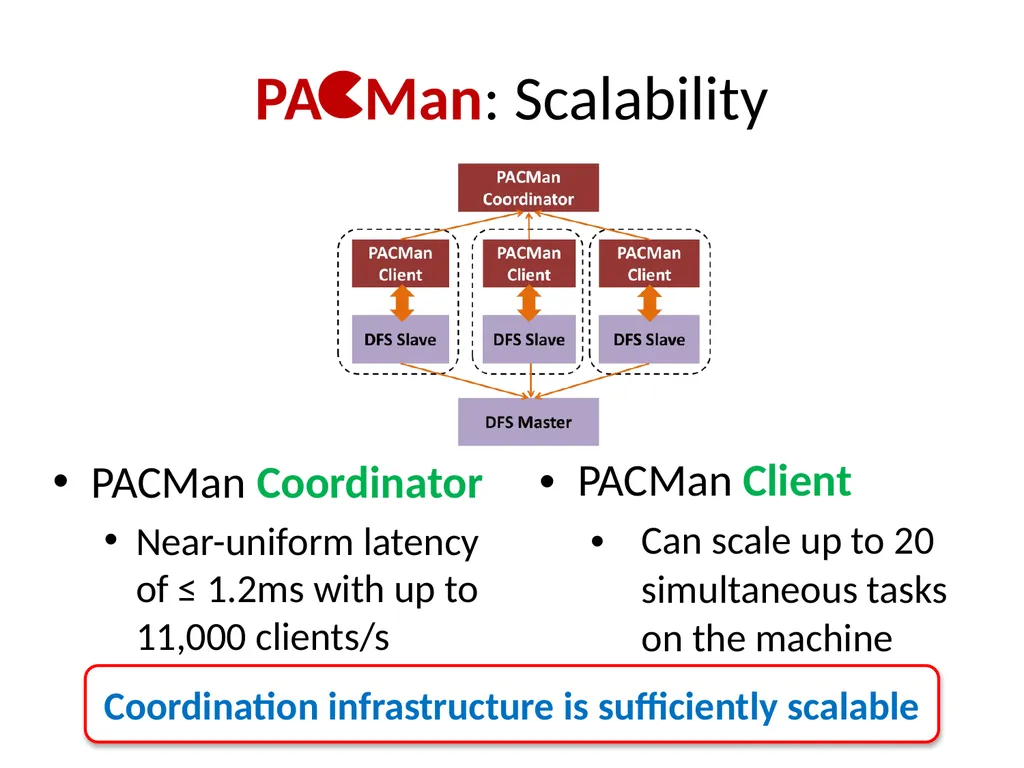
PA Man: Centralized Coordination Global view DFS: Distributed File System<br>
29
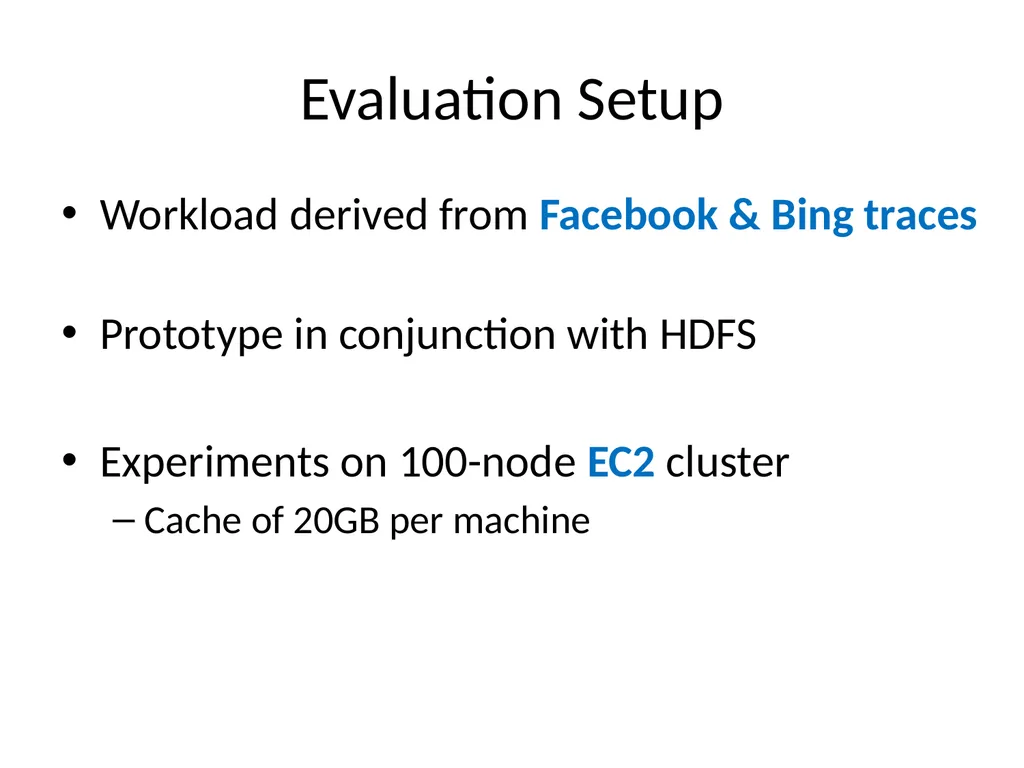
Evaluation Setup Workload derived from Facebook & Bing traces
Prototype in conjunction with HDFS
Experiments on 100-node EC2 cluster
Cache of 20GB per machine<br>
Prototype in conjunction with HDFS
Experiments on 100-node EC2 cluster
Cache of 20GB per machine<br>
30
Sticky Policy Reduction in Completion Time<br>
31
Improvement in Utilization Sticky Policy<br>
32
PA Man: Scalability PACMan Coordinator
Near-uniform latency of ≤ 1.2ms with up to 11,000 clients/s PACMan Client
Can scale up to 20 simultaneous tasks on the machine Coordination infrastructure is sufficiently scalable<br>
Near-uniform latency of ≤ 1.2ms with up to 11,000 clients/s PACMan Client
Can scale up to 20 simultaneous tasks on the machine Coordination infrastructure is sufficiently scalable<br>
33
How far is LIFE from the optimal for speeding up parallel jobs?<br>
34
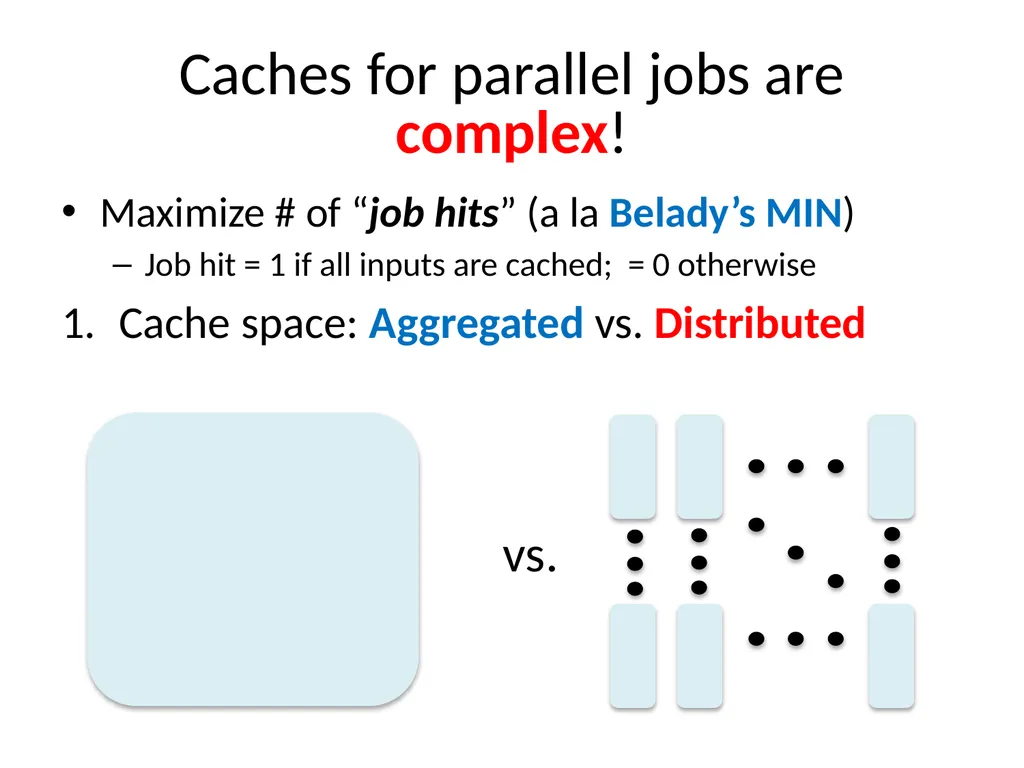
Caches for parallel jobs are complex! Maximize # of “job hits” (a la Belady’s MIN)
Job hit = 1 if all inputs are cached; = 0 otherwise
Cache space: Aggregated vs. Distributed vs.<br>
Job hit = 1 if all inputs are cached; = 0 otherwise
Cache space: Aggregated vs. Distributed vs.<br>
35
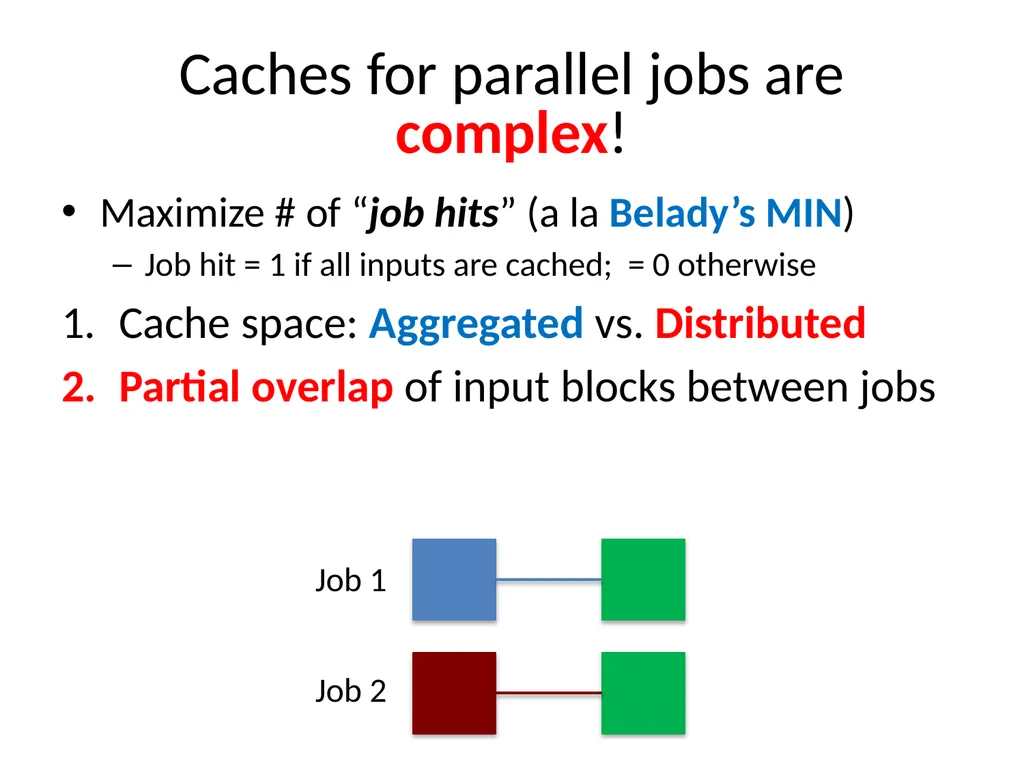
Caches for parallel jobs are complex! Maximize # of “job hits” (a la Belady’s MIN)
Job hit = 1 if all inputs are cached; = 0 otherwise
Cache space: Aggregated vs. Distributed
Partial overlap of input blocks between jobs Job 1 Job 2<br>
Job hit = 1 if all inputs are cached; = 0 otherwise
Cache space: Aggregated vs. Distributed
Partial overlap of input blocks between jobs Job 1 Job 2<br>
36
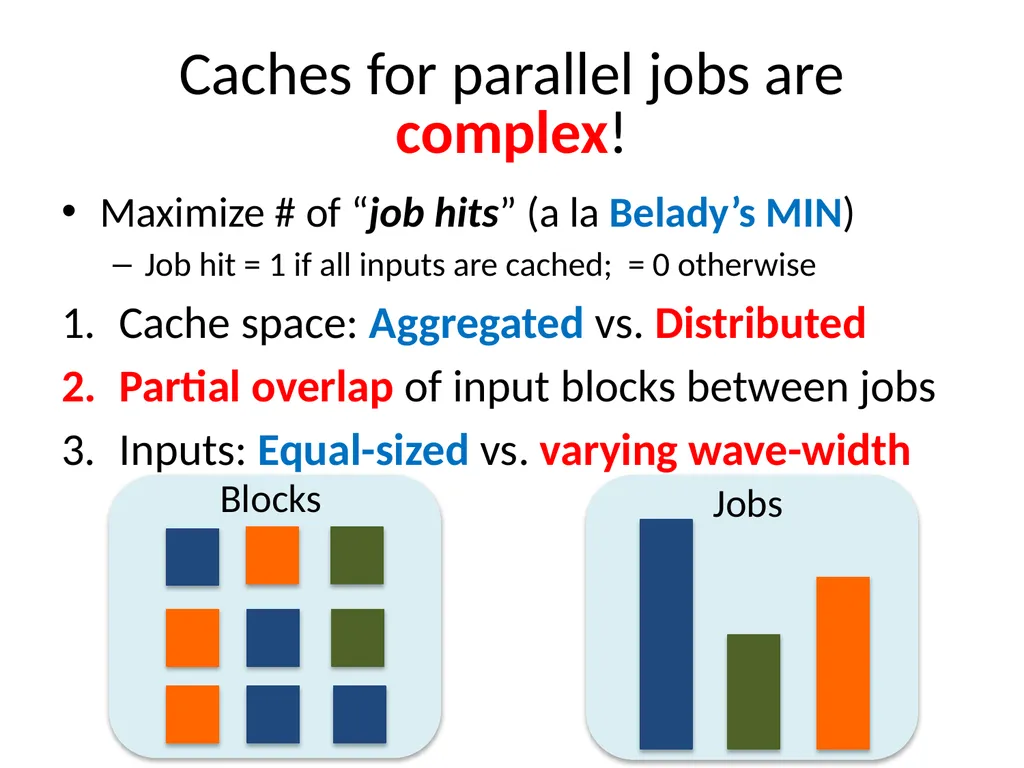
Caches for parallel jobs are complex! Maximize # of “job hits” (a la Belady’s MIN)
Job hit = 1 if all inputs are cached; = 0 otherwise
Cache space: Aggregated vs. Distributed
Partial overlap of input blocks between jobs
Inputs: Equal-sized vs. varying wave-width Blocks Jobs<br>
Job hit = 1 if all inputs are cached; = 0 otherwise
Cache space: Aggregated vs. Distributed
Partial overlap of input blocks between jobs
Inputs: Equal-sized vs. varying wave-width Blocks Jobs<br>
37
Simplifying Assumptions Cache space: Aggregated vs. Distributed
At ~100% locality, aggregated ~ distributed
Assume: Aggregated cache space
Partial overlap of input blocks between jobs
98% of jobs have no partial overlap
Assume: No partial overlap
Inputs: Equal-sized vs. varying wave-width<br>
At ~100% locality, aggregated ~ distributed
Assume: Aggregated cache space
Partial overlap of input blocks between jobs
98% of jobs have no partial overlap
Assume: No partial overlap
Inputs: Equal-sized vs. varying wave-width<br>
38
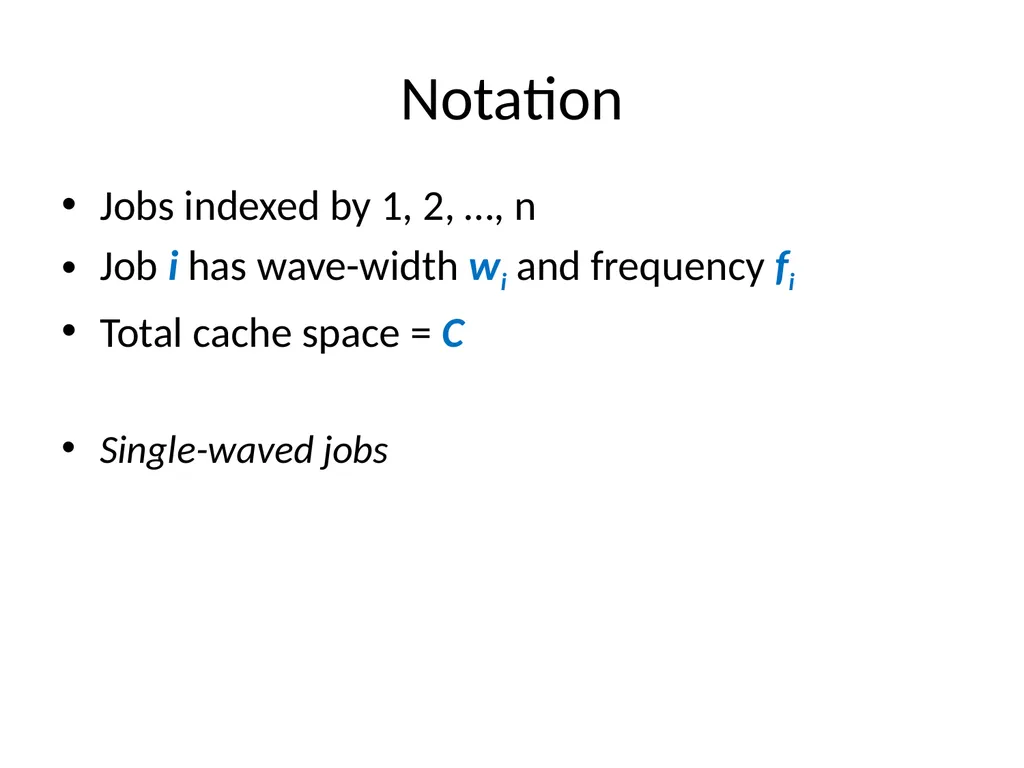
Notation Jobs indexed by 1, 2, …, n
Job i has wave-width wi and frequency fi
Total cache space = C
Single-waved jobs<br>
Job i has wave-width wi and frequency fi
Total cache space = C
Single-waved jobs<br>
39
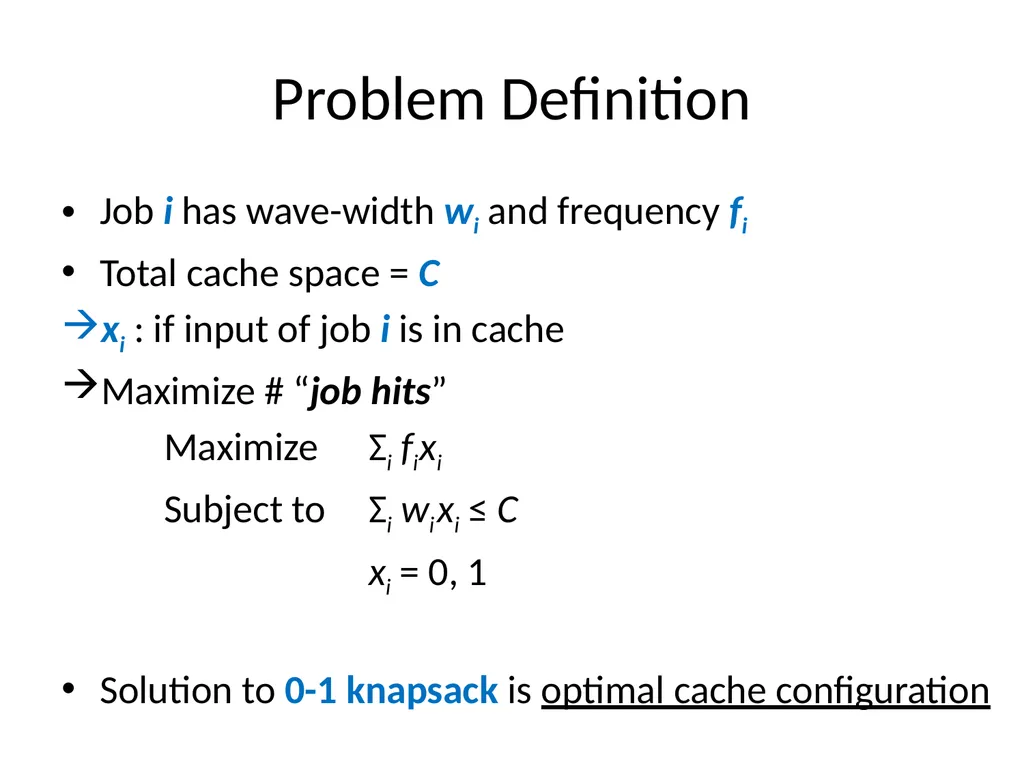
Problem Definition Job i has wave-width wi and frequency fi
Total cache space = C
xi : if input of job i is in cache
Maximize # “job hits”
Maximize Σi fi xi
Subject to Σi wi xi ≤ C
xi = 0, 1
Solution to 0-1 knapsack is optimal cache configuration<br>
Total cache space = C
xi : if input of job i is in cache
Maximize # “job hits”
Maximize Σi fi xi
Subject to Σi wi xi ≤ C
xi = 0, 1
Solution to 0-1 knapsack is optimal cache configuration<br>
40
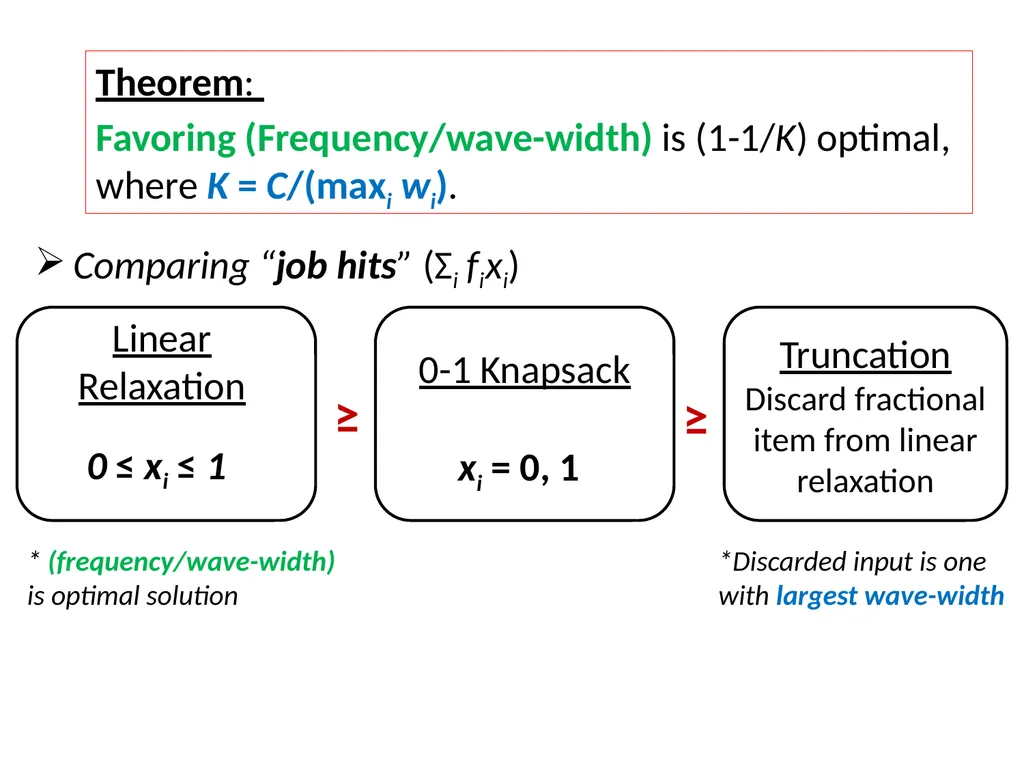
Linear Relaxation *Discarded input is one with largest wave-width 0 ≤ xi ≤ 1 xi = 0, 1 Truncation Discard fractional item from linear relaxation ≥ ≥ 0-1 Knapsack Theorem:
Favoring (Frequency/wave-width) is (1-1/K) optimal, where K = C/(maxi wi). * (frequency/wave-width) is optimal solution Comparing “job hits” (Σi fi xi)<br>
Favoring (Frequency/wave-width) is (1-1/K) optimal, where K = C/(maxi wi). * (frequency/wave-width) is optimal solution Comparing “job hits” (Σi fi xi)<br>
41
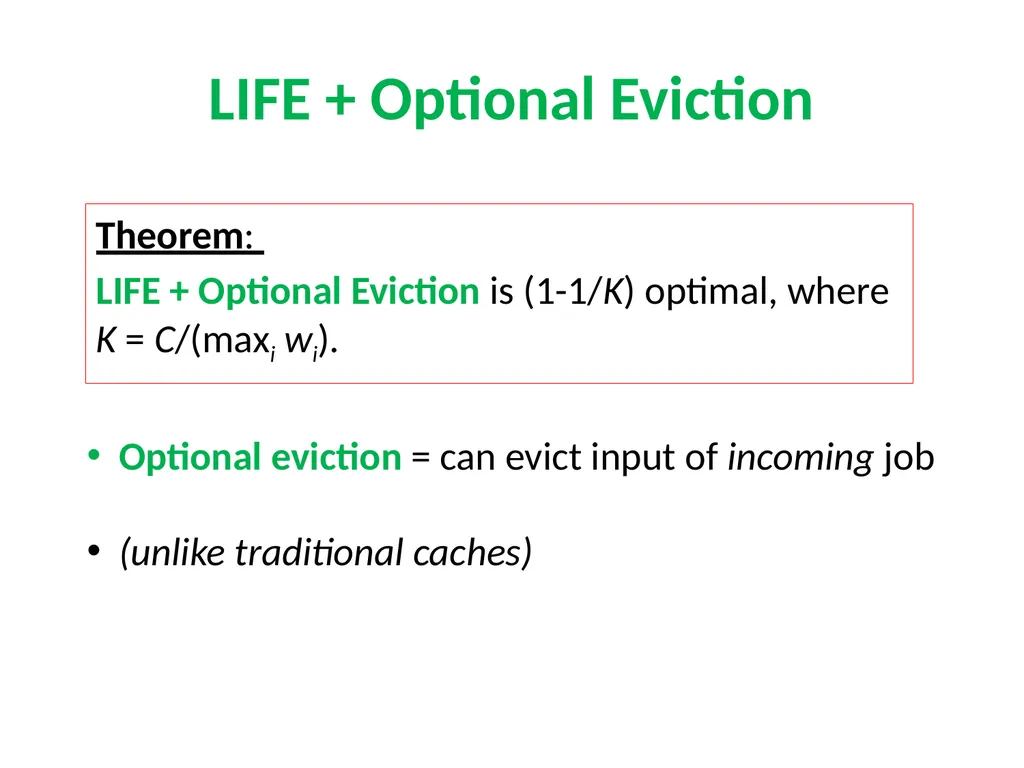
Theorem:
LIFE + Optional Eviction is (1-1/K) optimal, where K = C/(maxi wi). Optional eviction = can evict input of incoming job
(unlike traditional caches) LIFE + Optional Eviction<br>
LIFE + Optional Eviction is (1-1/K) optimal, where K = C/(maxi wi). Optional eviction = can evict input of incoming job
(unlike traditional caches) LIFE + Optional Eviction<br>
42
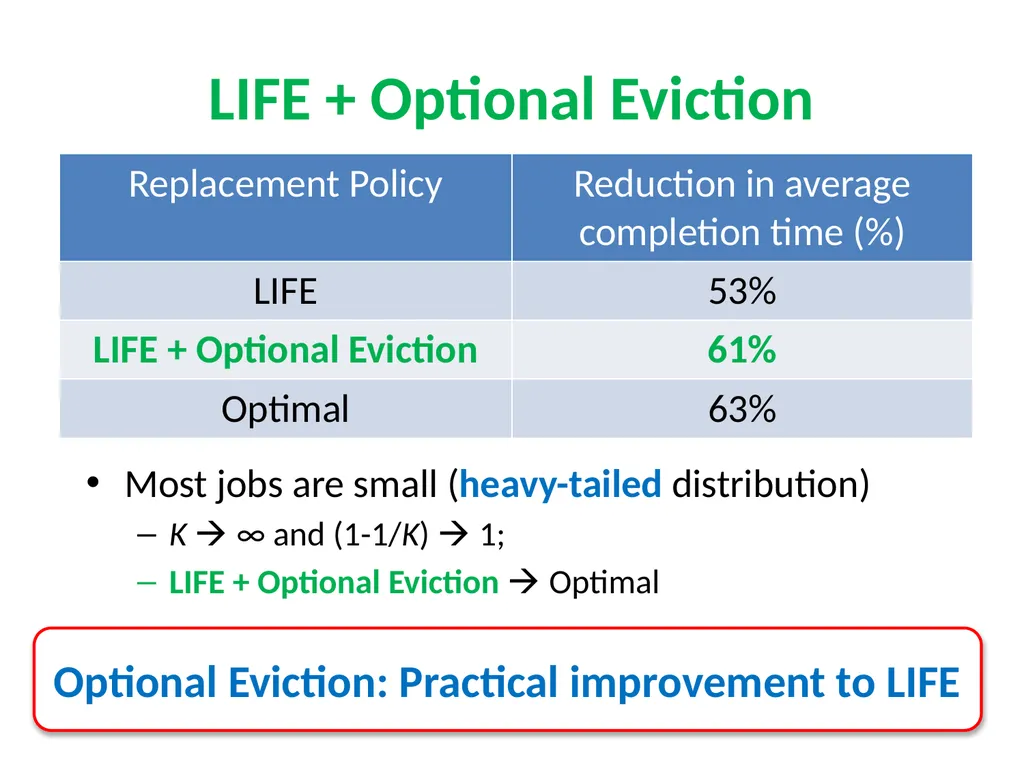
LIFE + Optional Eviction Most jobs are small (heavy-tailed distribution)
K ∞ and (1-1/K) 1;
LIFE + Optional Eviction Optimal Optional Eviction: Practical improvement to LIFE<br>
K ∞ and (1-1/K) 1;
LIFE + Optional Eviction Optimal Optional Eviction: Practical improvement to LIFE<br>
43
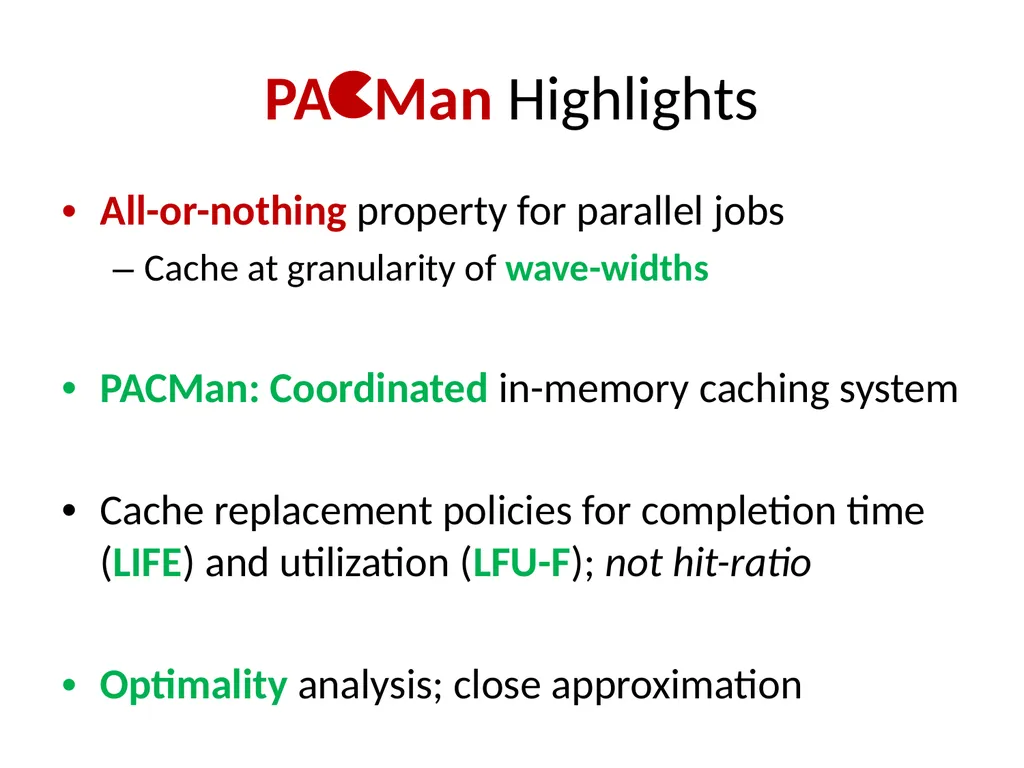
All-or-nothing property for parallel jobs
Cache at granularity of wave-widths
PACMan: Coordinated in-memory caching system
Cache replacement policies for completion time (LIFE) and utilization (LFU-F); not hit-ratio
Optimality analysis; close approximation PA Man Highlights<br>
Cache at granularity of wave-widths
PACMan: Coordinated in-memory caching system
Cache replacement policies for completion time (LIFE) and utilization (LFU-F); not hit-ratio
Optimality analysis; close approximation PA Man Highlights<br>
44
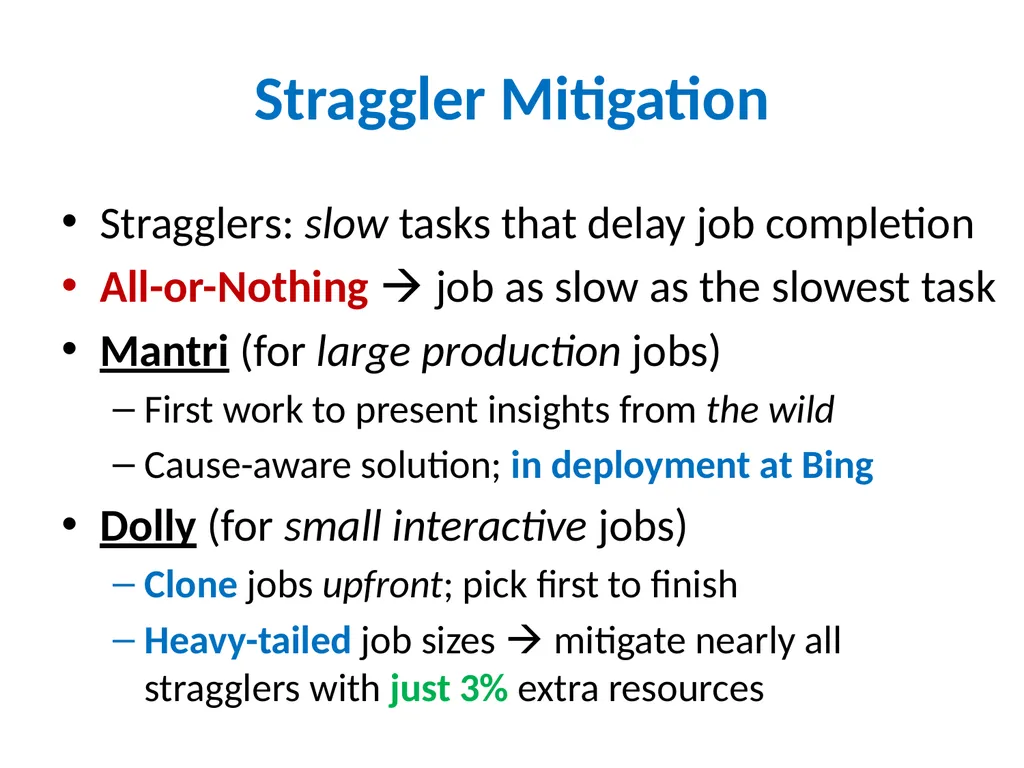
Straggler Mitigation Stragglers: slow tasks that delay job completion
All-or-Nothing job as slow as the slowest task
Mantri (for large production jobs)
First work to present insights from the wild
Cause-aware solution; in deployment at Bing
Dolly (for small interactive jobs)
Clone jobs upfront; pick first to finish
Heavy-tailed job sizes mitigate nearly all stragglers with just 3% extra resources<br>
All-or-Nothing job as slow as the slowest task
Mantri (for large production jobs)
First work to present insights from the wild
Cause-aware solution; in deployment at Bing
Dolly (for small interactive jobs)
Clone jobs upfront; pick first to finish
Heavy-tailed job sizes mitigate nearly all stragglers with just 3% extra resources<br>
45
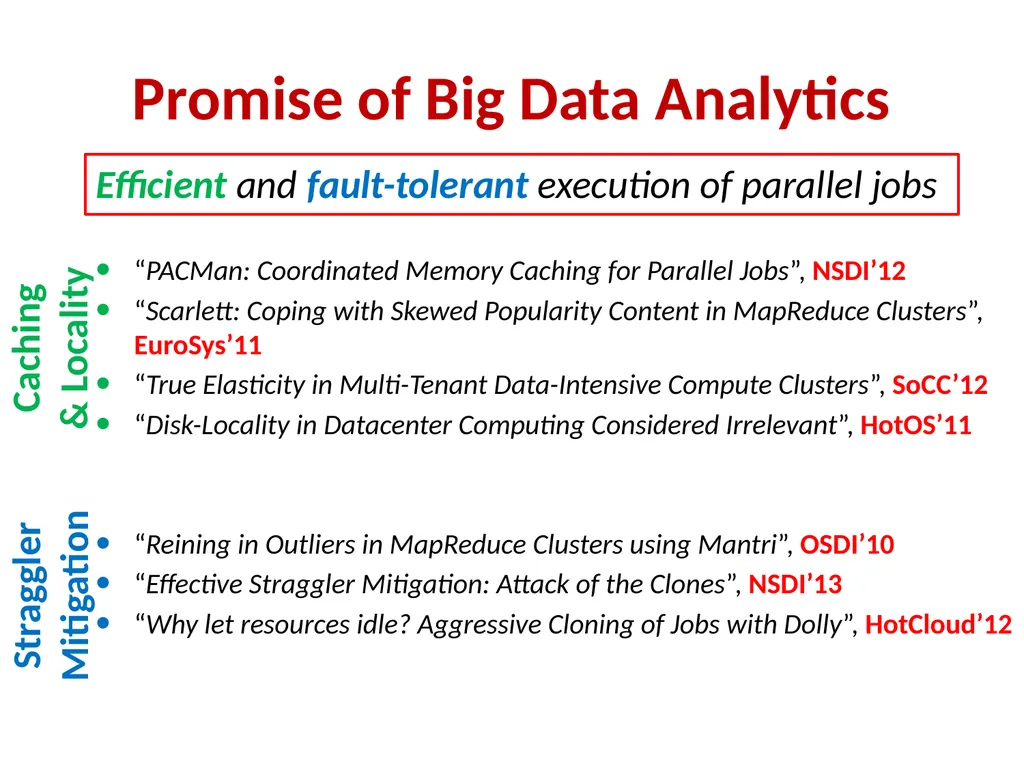
Promise of Big Data Analytics Efficient and fault-tolerant execution of parallel jobs
“PACMan: Coordinated Memory Caching for Parallel Jobs”, NSDI’12
“Scarlett: Coping with Skewed Popularity Content in MapReduce Clusters”, EuroSys’11
“True Elasticity in Multi-Tenant Data-Intensive Compute Clusters”, SoCC’12
“Disk-Locality in Datacenter Computing Considered Irrelevant”, HotOS’11
“Reining in Outliers in MapReduce Clusters using Mantri”, OSDI’10
“Effective Straggler Mitigation: Attack of the Clones”, NSDI’13
“Why let resources idle? Aggressive Cloning of Jobs with Dolly”, HotCloud’12 Caching & Locality Straggler Mitigation<br>
“PACMan: Coordinated Memory Caching for Parallel Jobs”, NSDI’12
“Scarlett: Coping with Skewed Popularity Content in MapReduce Clusters”, EuroSys’11
“True Elasticity in Multi-Tenant Data-Intensive Compute Clusters”, SoCC’12
“Disk-Locality in Datacenter Computing Considered Irrelevant”, HotOS’11
“Reining in Outliers in MapReduce Clusters using Mantri”, OSDI’10
“Effective Straggler Mitigation: Attack of the Clones”, NSDI’13
“Why let resources idle? Aggressive Cloning of Jobs with Dolly”, HotCloud’12 Caching & Locality Straggler Mitigation<br>
46
onclusion All-or-Nothing property of parallel jobs
PA Man: Coordinated Cache Management
Provably optimal cache replacement
Straggler mitigation
Cause-based solution for large jobs, cloning for small jobs<br>
PA Man: Coordinated Cache Management
Provably optimal cache replacement
Straggler mitigation
Cause-based solution for large jobs, cloning for small jobs<br>