
Big Energy Saving Network Training Presentation
SN
Published · 44 slides · 0 views
1 / 1


Description
Big Energy Saving Network Training Presentation insert your name and job title team here Introduction In the chat box please introduce yourself: What is your name? Which organisation you are from and what is your role? Have you
Related Topics
Share
Embed code
Download this presentation From Below
"Big Energy Saving Network Training Presentation" is the property of its rightful owner. Permission is granted to download and print the materials on this website for personal, non-commercial use only, and to display it on your personal computer provided you do not modify the materials and that you retain all copyright notices contained in the materials. By downloading content from our website, you accept the terms of this agreement.
Presentation Transcript
01
Big Energy Saving Network
Training Presentation [insert your name and job title / team here]<br>
Training Presentation [insert your name and job title / team here]<br>
02
Introduction In the chat box please introduce yourself:
What is your name?
Which organisation you are from and what is your role?
Have you delivered energy advice before?
What are you hoping to learn today?<br>
What is your name?
Which organisation you are from and what is your role?
Have you delivered energy advice before?
What are you hoping to learn today?<br>
03
Optional Contents Slide<br>
04
Optional Agenda slide<br>
05
Your organisation Please draft a short slide introducing yourself and your organisation. This is a good opportunity to establish your credibility, as well explaining how you could help clients in the future.<br>
06
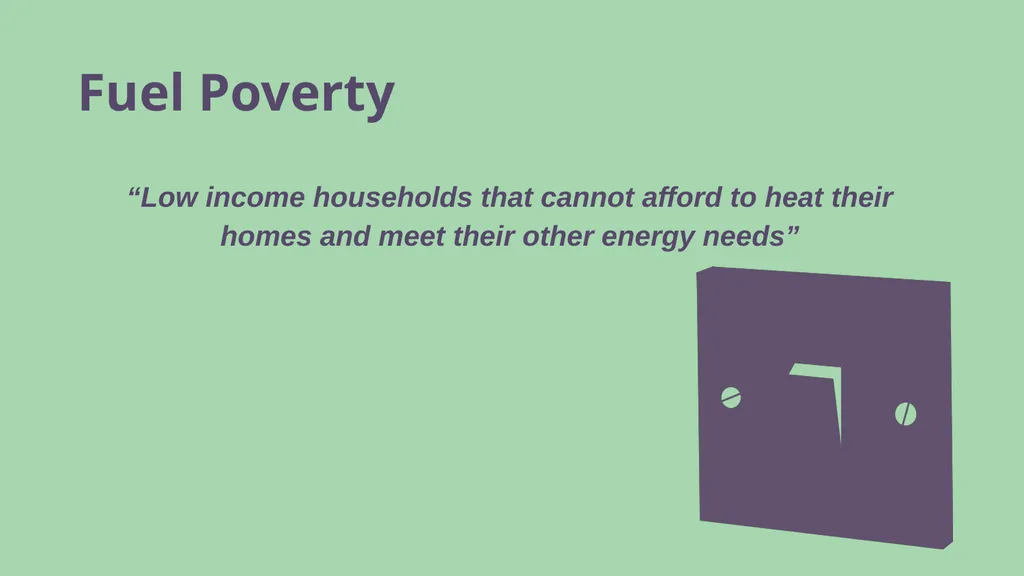
Fuel Poverty “Low income households that cannot afford to heat their homes and meet their other energy needs”<br>
07
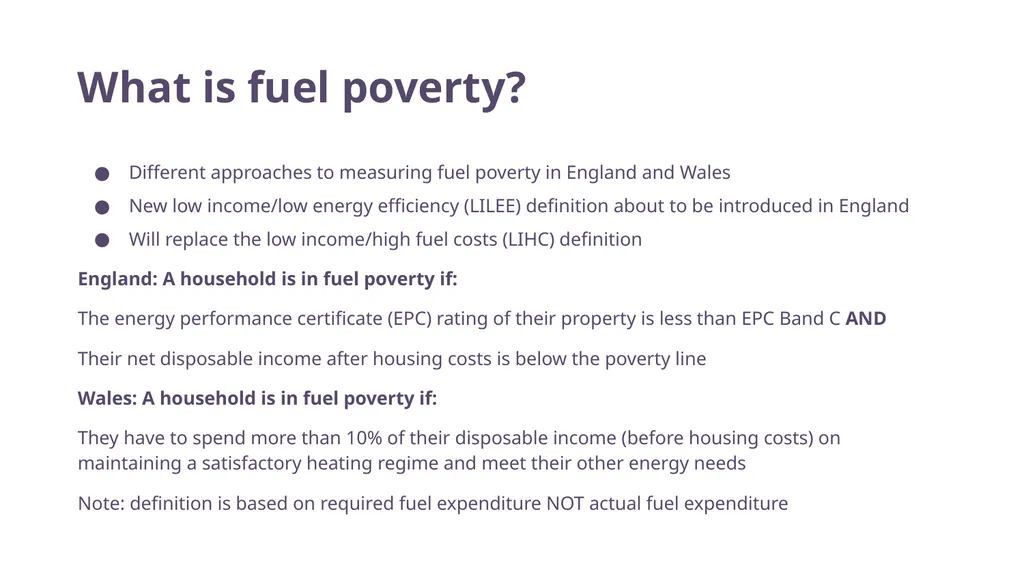
What is fuel poverty? Different approaches to measuring fuel poverty in England and Wales
New low income/low energy efficiency (LILEE) definition about to be introduced in England
Will replace the low income/high fuel costs (LIHC) definition
England: A household is in fuel poverty if:
The energy performance certificate (EPC) rating of their property is less than EPC Band C AND
Their net disposable income after housing costs is below the poverty line
Wales: A household is in fuel poverty if:
They have to spend more than 10% of their disposable income (before housing costs) on maintaining a satisfactory heating regime and meet their other energy needs
Note: definition is based on required fuel expenditure NOT actual fuel expenditure<br>
08
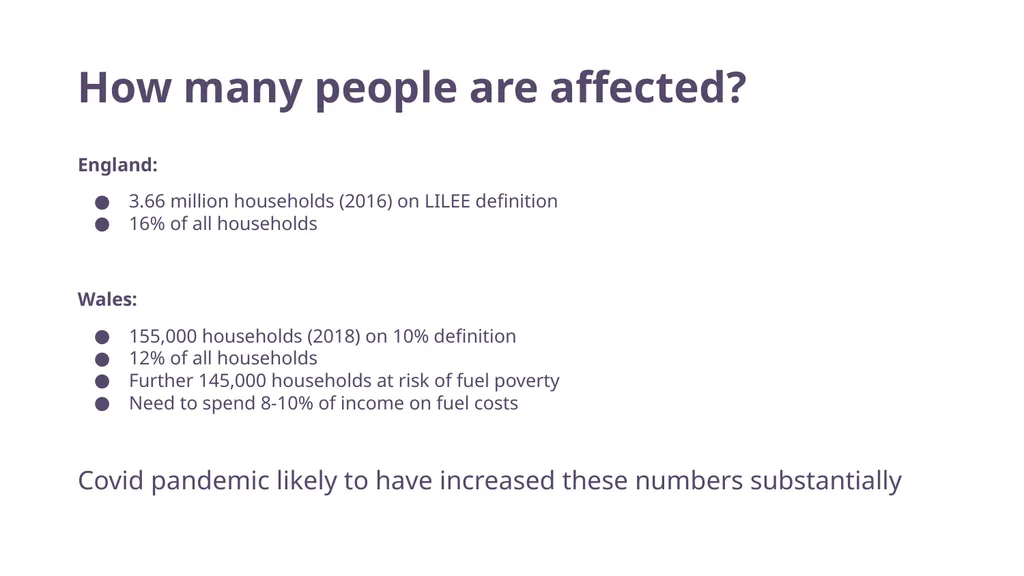
How many people are affected? England:
3.66 million households (2016) on LILEE definition
16% of all households
Wales:
155,000 households (2018) on 10% definition
12% of all households
Further 145,000 households at risk of fuel poverty
Need to spend 8-10% of income on fuel costs
Covid pandemic likely to have increased these numbers substantially<br>
09
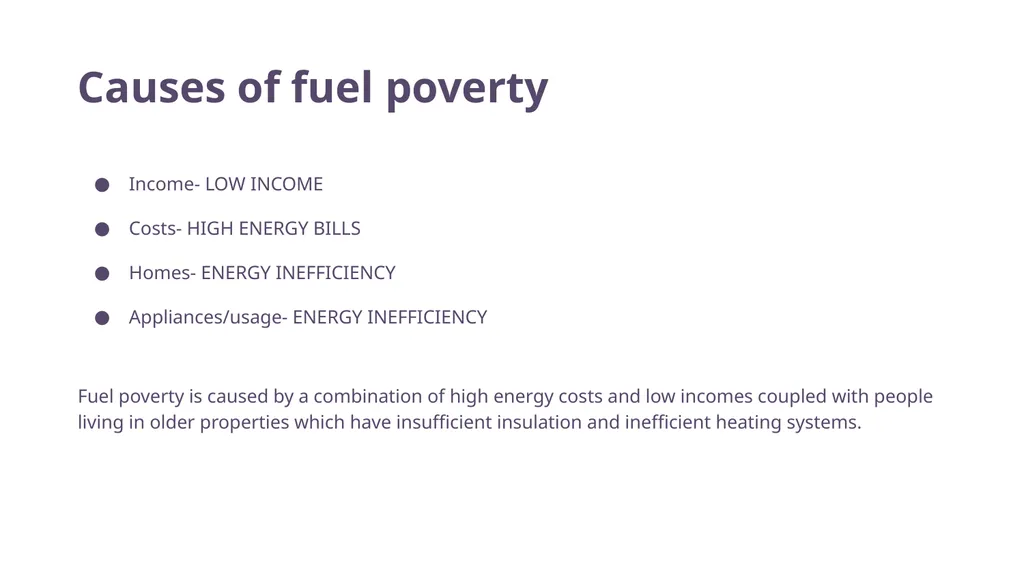
Causes of fuel poverty Income- LOW INCOME
Costs- HIGH ENERGY BILLS
Homes- ENERGY INEFFICIENCY
Appliances/usage- ENERGY INEFFICIENCY
Fuel poverty is caused by a combination of high energy costs and low incomes coupled with people living in older properties which have insufficient insulation and inefficient heating systems.<br>
Costs- HIGH ENERGY BILLS
Homes- ENERGY INEFFICIENCY
Appliances/usage- ENERGY INEFFICIENCY
Fuel poverty is caused by a combination of high energy costs and low incomes coupled with people living in older properties which have insufficient insulation and inefficient heating systems.<br>
10
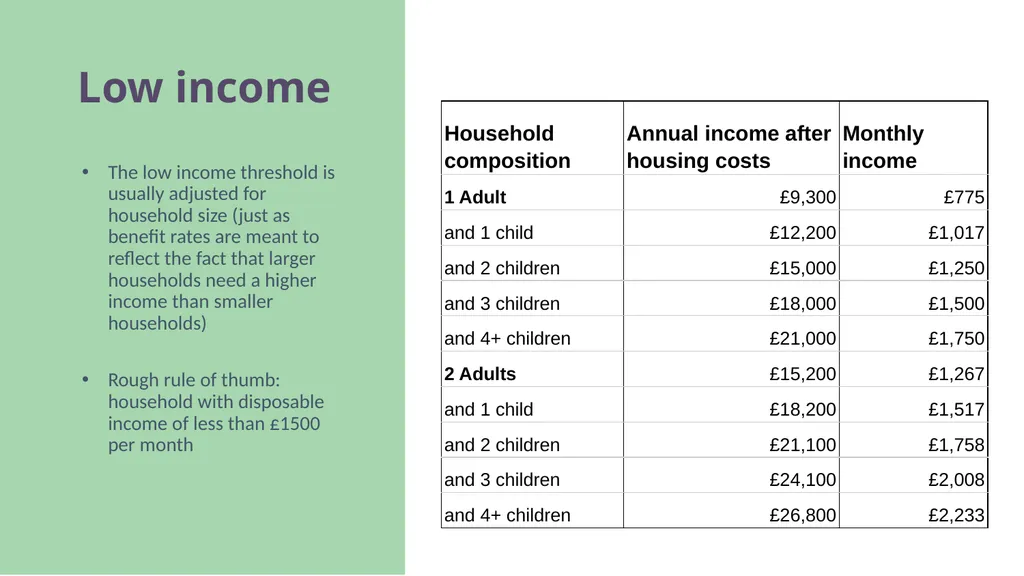
Low income The low income threshold is usually adjusted for household size (just as benefit rates are meant to reflect the fact that larger households need a higher income than smaller households)
Rough rule of thumb: household with disposable income of less than £1500 per month<br>
Rough rule of thumb: household with disposable income of less than £1500 per month<br>
11
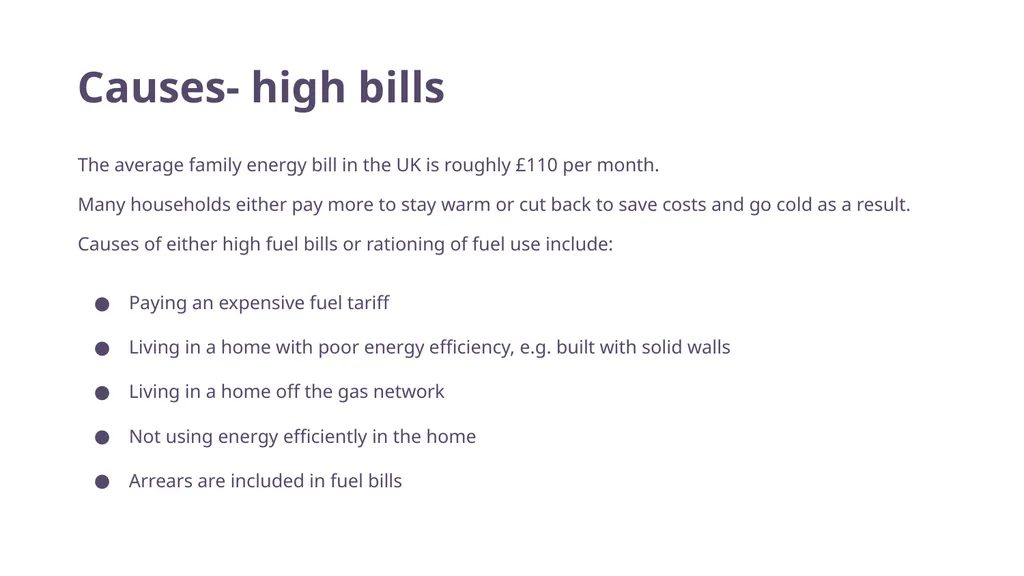
Causes- high bills The average family energy bill in the UK is roughly £110 per month.
Many households either pay more to stay warm or cut back to save costs and go cold as a result.
Causes of either high fuel bills or rationing of fuel use include:
Paying an expensive fuel tariff
Living in a home with poor energy efficiency, e.g. built with solid walls
Living in a home off the gas network
Not using energy efficiently in the home
Arrears are included in fuel bills<br>
12
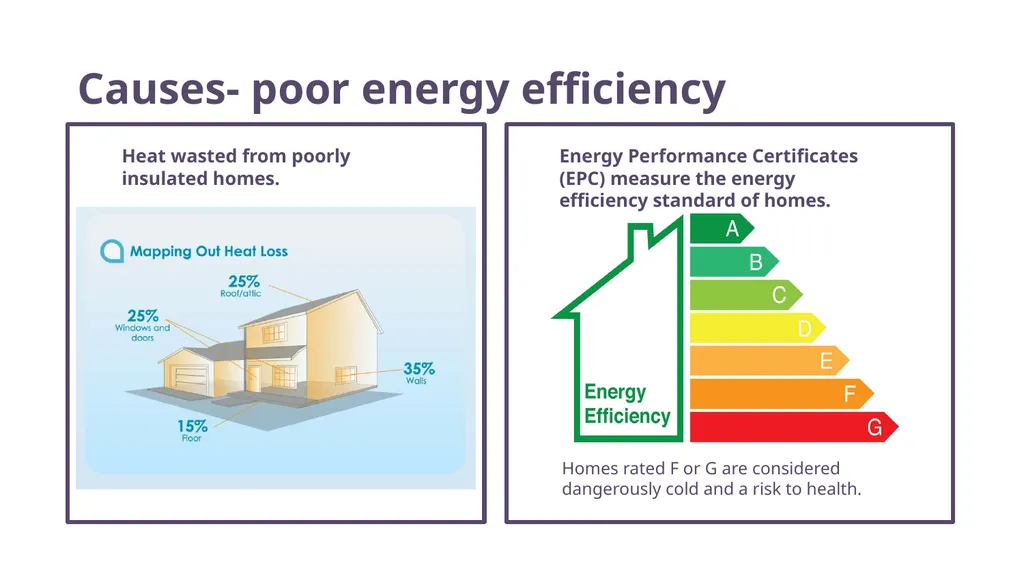
Causes- poor energy efficiency Heat wasted from poorly insulated homes. Energy Performance Certificates (EPC) measure the energy efficiency standard of homes. Homes rated F or G are considered dangerously cold and a risk to health.<br>
13
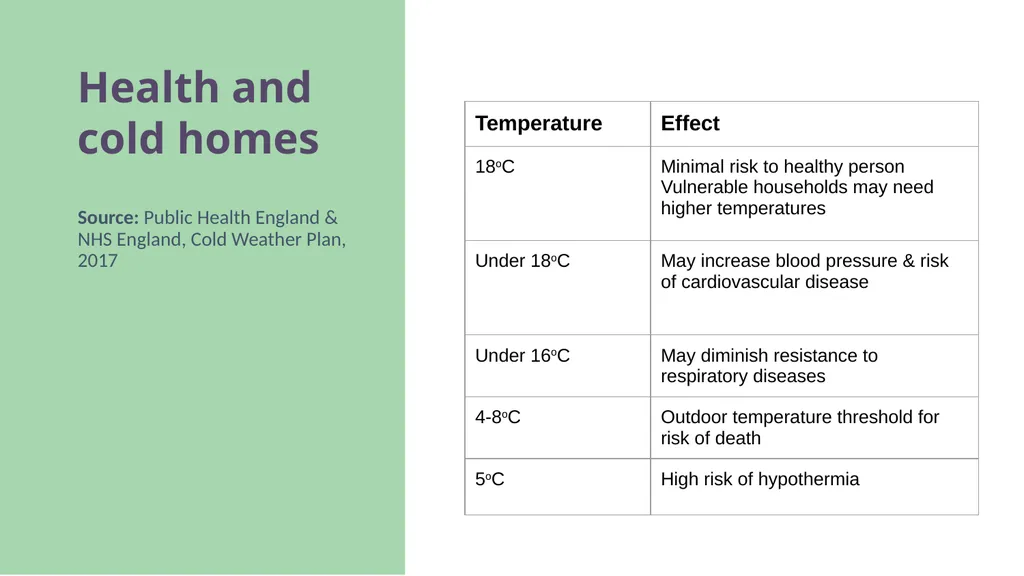
Health and cold homes Source: Public Health England & NHS England, Cold Weather Plan, 2017<br>
14
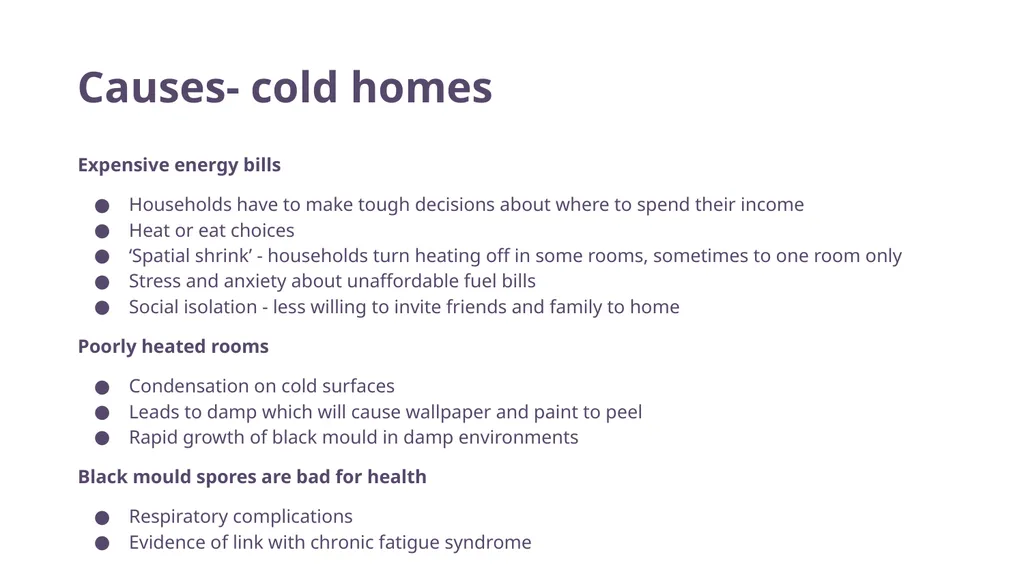
Causes- cold homes Expensive energy bills
Households have to make tough decisions about where to spend their income
Heat or eat choices
‘Spatial shrink’ - households turn heating off in some rooms, sometimes to one room only
Stress and anxiety about unaffordable fuel bills
Social isolation - less willing to invite friends and family to home
Poorly heated rooms
Condensation on cold surfaces
Leads to damp which will cause wallpaper and paint to peel
Rapid growth of black mould in damp environments
Black mould spores are bad for health
Respiratory complications
Evidence of link with chronic fatigue syndrome<br>
15
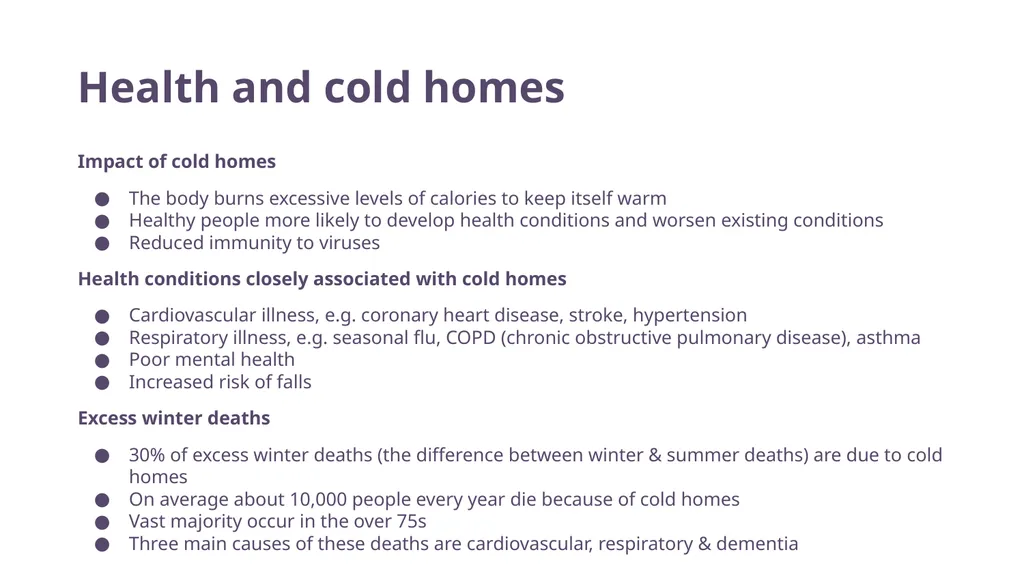
Health and cold homes Impact of cold homes
The body burns excessive levels of calories to keep itself warm
Healthy people more likely to develop health conditions and worsen existing conditions
Reduced immunity to viruses
Health conditions closely associated with cold homes
Cardiovascular illness, e.g. coronary heart disease, stroke, hypertension
Respiratory illness, e.g. seasonal flu, COPD (chronic obstructive pulmonary disease), asthma
Poor mental health
Increased risk of falls
Excess winter deaths
30% of excess winter deaths (the difference between winter & summer deaths) are due to cold homes
On average about 10,000 people every year die because of cold homes
Vast majority occur in the over 75s
Three main causes of these deaths are cardiovascular, respiratory & dementia<br>
16
COVID-19 and fuel poverty Increased unemployment and reduced income due to pandemic measures
Estimated 200,000 (at least) more households in fuel poverty
Home confinement means higher energy bills
First lockdown: moderate increase in bills
Current lockdown: increase likely to be much higher due to winter heating bills
Increased risk of fuel debt or rationing of fuel use among low income households
Health implications of cold homes & Covid-19
Evidence of increased susceptibility to Covid-19
Increased risk of severe symptoms
Slower recovery for those returning from hospital (as is the case for many illnesses)<br>
17
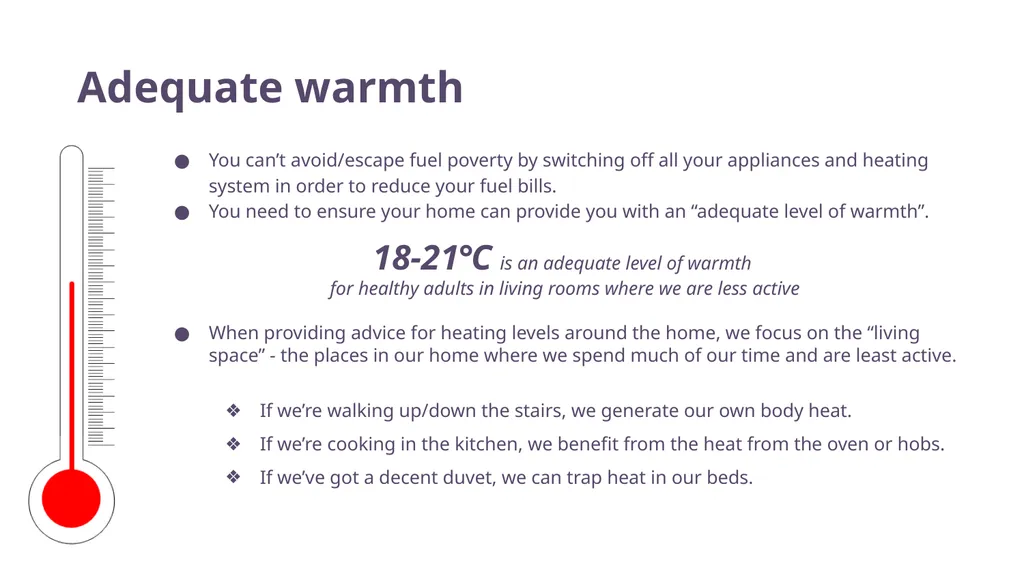
Adequate warmth You can’t avoid/escape fuel poverty by switching off all your appliances and heating system in order to reduce your fuel bills.
You need to ensure your home can provide you with an “adequate level of warmth”.
18-21℃ is an adequate level of warmth
for healthy adults in living rooms where we are less active
When providing advice for heating levels around the home, we focus on the “living space” - the places in our home where we spend much of our time and are least active.
If we’re walking up/down the stairs, we generate our own body heat.
If we’re cooking in the kitchen, we benefit from the heat from the oven or hobs.
If we’ve got a decent duvet, we can trap heat in our beds.<br>
18
Vulnerable groups Vulnerable people are those who aren’t capable of generating enough body heat, and require their living space to provide them with additional comfort.
People with poor mobility might struggle to generate body heat due to lack of movement, they require their living space to be warm enough to provide the additional warmth needed.
The elderly take longer to warm up, and are more likely to feel the cold. This means they need to turn the thermostat up higher than a healthy person to stay well. But...
At 24℃ dehydration can set in. It can cause forgetfulness and clumsiness. People have been misdiagnosed with dementia because their heating is too set too high.
Advice around energy use and energy efficiency is vital for health.
Cold homes are also linked to reduced cognitive ability:
Children may find they struggle to complete homework
Older people are more likely to suffer trips and falls
People recently discharged from hospital may suffer relapse<br>
19
Providing advice Identifying people’s issues and helping energy consumers to save money and keep their homes warmer<br>
20
Why do we give Energy Advice? Raise the awareness of problems caused by living in a cold home and the effect on health and wellbeing.
Increased consumer confidence to deal with energy issues.
Integrate energy advice into the welfare rights advice offer.<br>
Increased consumer confidence to deal with energy issues.
Integrate energy advice into the welfare rights advice offer.<br>
21
What's available? Income maximisation advice
Reducing costs by switching tariff or provider or changing payment method
Advice around energy efficiency
Bills and metering to reduce costs
Warm Home Discount
Priority Services Register
Fuel debt problems
Welfare Benefits checks and assistance<br>
Reducing costs by switching tariff or provider or changing payment method
Advice around energy efficiency
Bills and metering to reduce costs
Warm Home Discount
Priority Services Register
Fuel debt problems
Welfare Benefits checks and assistance<br>
22
Spotting the signs of fuel poverty Is the home feeling cold/draughty?
Are they using single point heaters/no central heating?
Is there mould on the walls/peeling wallpaper?
Is there dust on radiators or heating elements- indicating non use?
Do they have water?
Are blankets and/or outdoor coats used inside to keep warm?
Are fuel bills too high so usage is self restricted/rationed?
Is money owed to energy supplier?
Is there self disconnection?<br>
23
Finding the best deal NOT shopping around, can cost people hundreds of
pounds more than they need to pay
This can be done:
Through a price comparison website - make sure it is Ofgem accredited
Use the Citizens Advice website: customer service rating as well as price comparison
By getting in touch with the supplier directly
You’ll need to know:
Name of the current supplier and tariffs
How much energy was used in the past year
How energy is currently paid for (for example, prepayment meter or direct debit)<br>
24
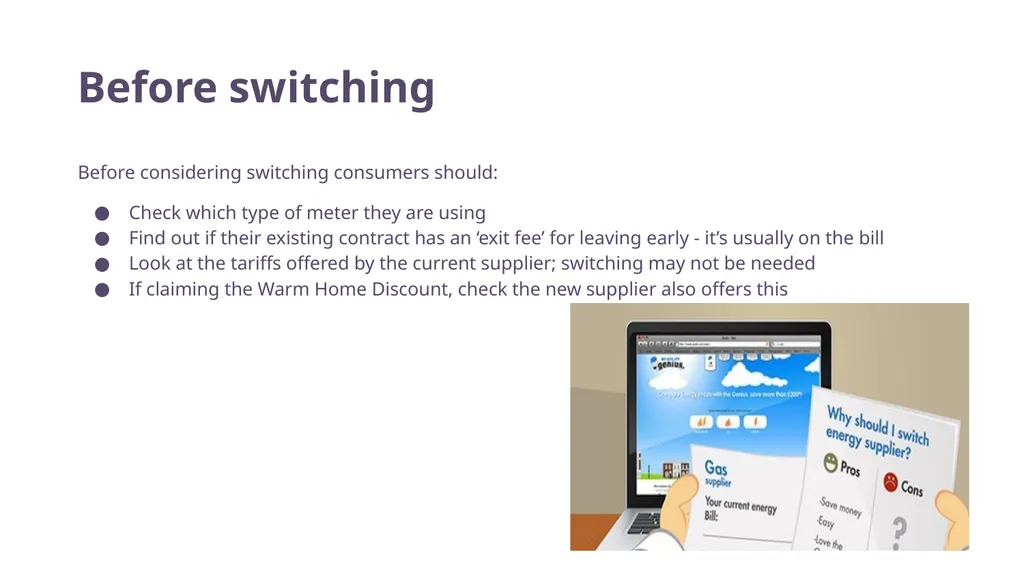
Before switching Before considering switching consumers should:
Check which type of meter they are using
Find out if their existing contract has an ‘exit fee’ for leaving early - it’s usually on the bill
Look at the tariffs offered by the current supplier; switching may not be needed
If claiming the Warm Home Discount, check the new supplier also offers this<br>
25
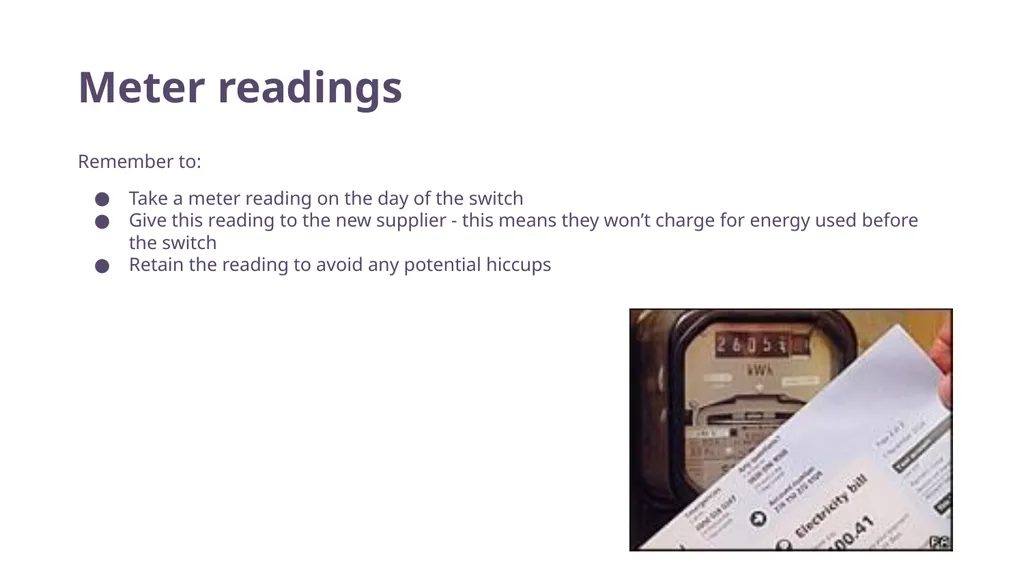
Meter readings Remember to:
Take a meter reading on the day of the switch
Give this reading to the new supplier - this means they won’t charge for energy used before the switch
Retain the reading to avoid any potential hiccups<br>
Take a meter reading on the day of the switch
Give this reading to the new supplier - this means they won’t charge for energy used before the switch
Retain the reading to avoid any potential hiccups<br>
26
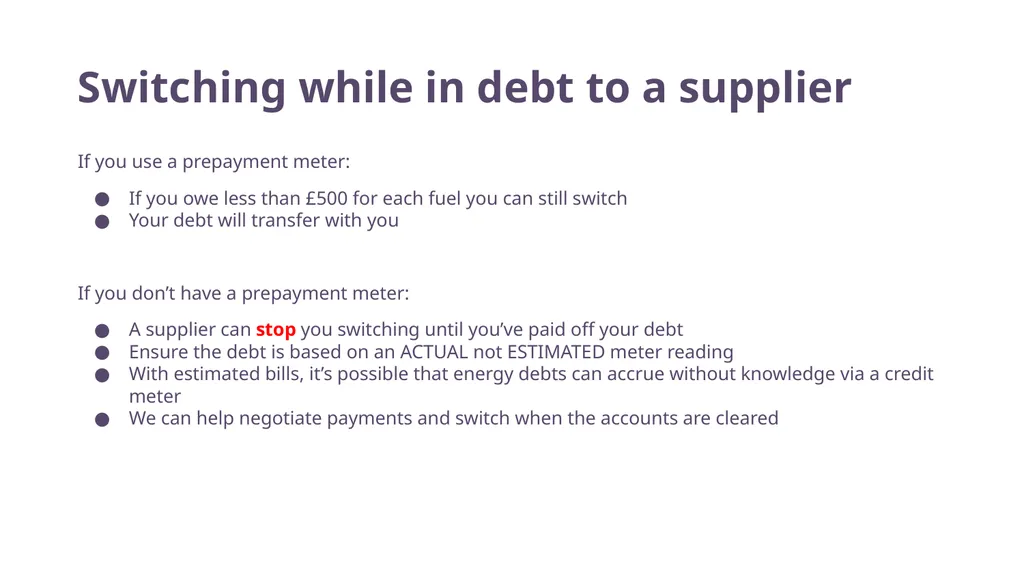
Switching while in debt to a supplier If you use a prepayment meter:
If you owe less than £500 for each fuel you can still switch
Your debt will transfer with you
If you don’t have a prepayment meter:
A supplier can stop you switching until you’ve paid off your debt
Ensure the debt is based on an ACTUAL not ESTIMATED meter reading
With estimated bills, it’s possible that energy debts can accrue without knowledge via a credit meter
We can help negotiate payments and switch when the accounts are cleared<br>
27
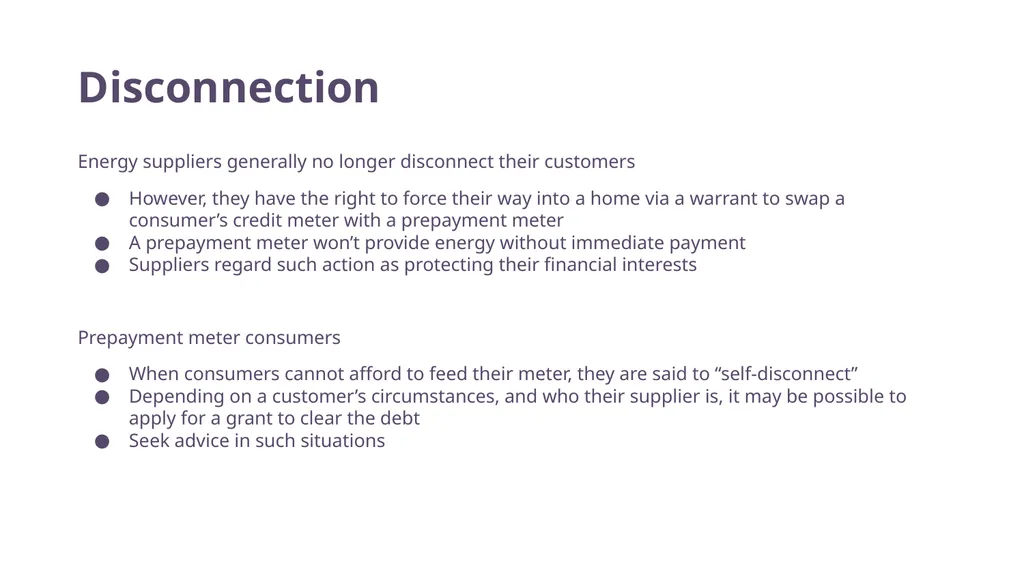
Disconnection Energy suppliers generally no longer disconnect their customers
However, they have the right to force their way into a home via a warrant to swap a consumer’s credit meter with a prepayment meter
A prepayment meter won’t provide energy without immediate payment
Suppliers regard such action as protecting their financial interests
Prepayment meter consumers
When consumers cannot afford to feed their meter, they are said to “self-disconnect”
Depending on a customer’s circumstances, and who their supplier is, it may be possible to apply for a grant to clear the debt
Seek advice in such situations<br>
28
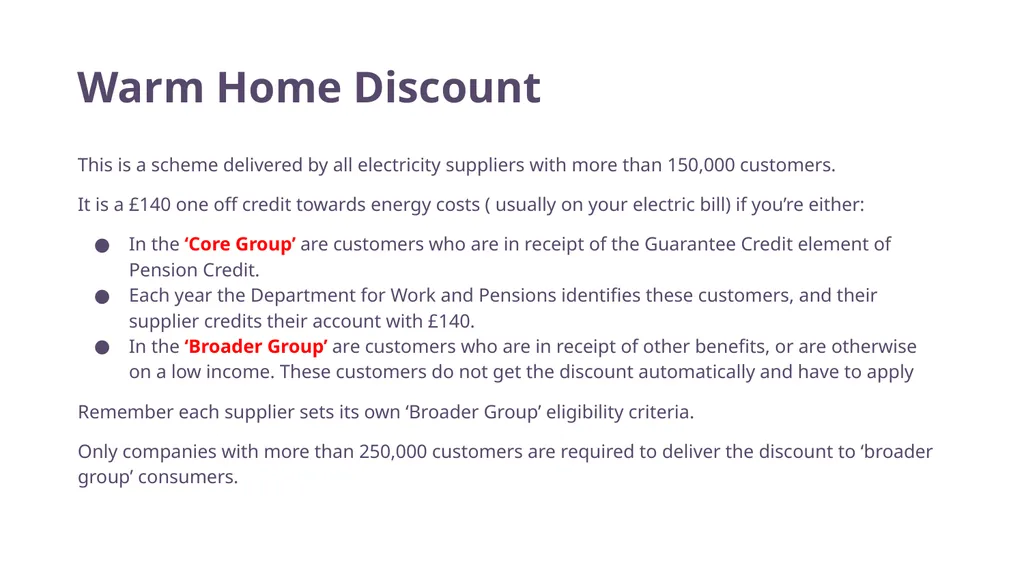
Warm Home Discount This is a scheme delivered by all electricity suppliers with more than 150,000 customers.
It is a £140 one off credit towards energy costs ( usually on your electric bill) if you’re either:
In the ‘Core Group’ are customers who are in receipt of the Guarantee Credit element of Pension Credit.
Each year the Department for Work and Pensions identifies these customers, and their supplier credits their account with £140.
In the ‘Broader Group’ are customers who are in receipt of other benefits, or are otherwise on a low income. These customers do not get the discount automatically and have to apply
Remember each supplier sets its own ‘Broader Group’ eligibility criteria.
Only companies with more than 250,000 customers are required to deliver the discount to ‘broader group’ consumers.<br>
29
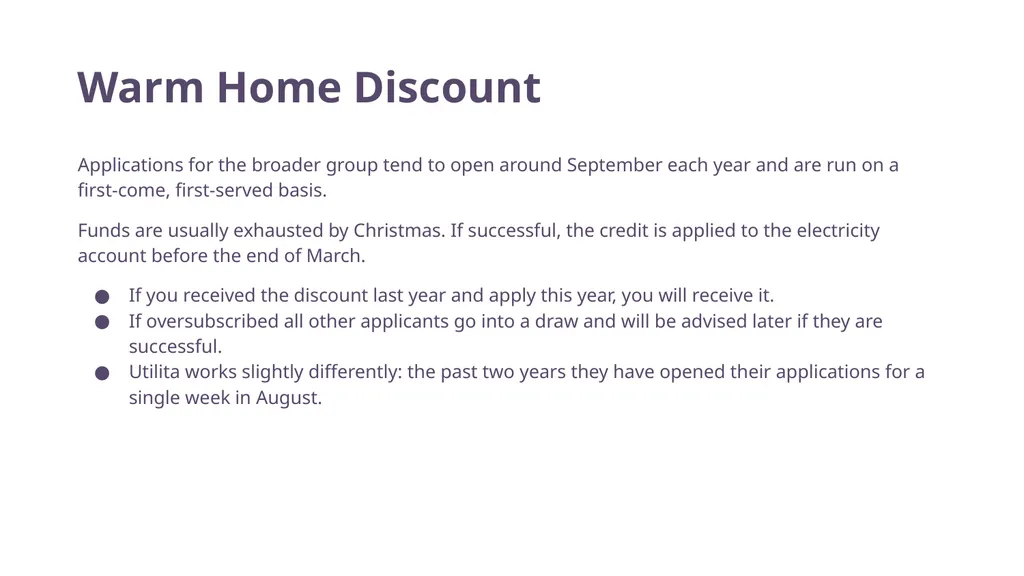
Warm Home Discount Applications for the broader group tend to open around September each year and are run on a first-come, first-served basis.
Funds are usually exhausted by Christmas. If successful, the credit is applied to the electricity account before the end of March.
If you received the discount last year and apply this year, you will receive it.
If oversubscribed all other applicants go into a draw and will be advised later if they are successful.
Utilita works slightly differently: the past two years they have opened their applications for a single week in August.<br>
30
Priority Services Register Offers extra services free of charge if someone:
Is of pensionable age
Is disabled or chronically sick
Has a long-term medical condition
Has a hearing or visual impairment or additional communication needs
Is in a vulnerable situation
To be added to their Priority Services Register you contact both the network/energy supplier.<br>
Is of pensionable age
Is disabled or chronically sick
Has a long-term medical condition
Has a hearing or visual impairment or additional communication needs
Is in a vulnerable situation
To be added to their Priority Services Register you contact both the network/energy supplier.<br>
31
Priority Services Register- benefits Advance notice of planned power cuts
If you rely medically on your energy supply you can arrange for the network operator to give you advance notice of planned power cuts, e.g due to engineering work.
Priority support in an emergency
The network operator can provide alternative heating and cooking facilities in the event of a supply interruption.
The British Red Cross may be able to provide hot food, blankets and emergency batteries to vulnerable customers without power
Identification scheme
Reassurance that callers, for example meter readers, are genuine
Suppliers have to provide additional support to help identify someone acting on their behalf
May include arranging a password or showing an agreed picture card upon visit
Password protection
Network operators must offer to agree a password with you (or your representative) that can be used by any representative of the company to enable you to identify them<br>
32
Priority Services Register- benefits Nominee scheme
Customers can ask their supplier to send communications (such as account statements or bills) to someone you have nominated, e.g. family member, carer or someone you trust.
Arrangements to ensure safe and practical use of your prepayment meter
For example moving a prepayment meter if you are unable to access it safely to top it up
Meter reading services at appropriate intervals.
If nobody living at your property is able to read the meter and there isn’t anyone else you can nominate to read the meter on your behalf, your supplier may be able to read it for you.
Accessible information
Account and bill information in an accessible format, e.g. larger print or braille
Free gas safety checks, e.g. for a gas boiler, for eligible homeowners every 12 months
Eligibility criteria:
means-tested benefit and live with a child under five
live alone and are of pensionable age, disabled or chronically sick and live alone
live with others who are of pensionable age, disabled, chronically sick or under 18 and you are also of pensionable age, disabled or chronically sick.<br>
33
DNOs
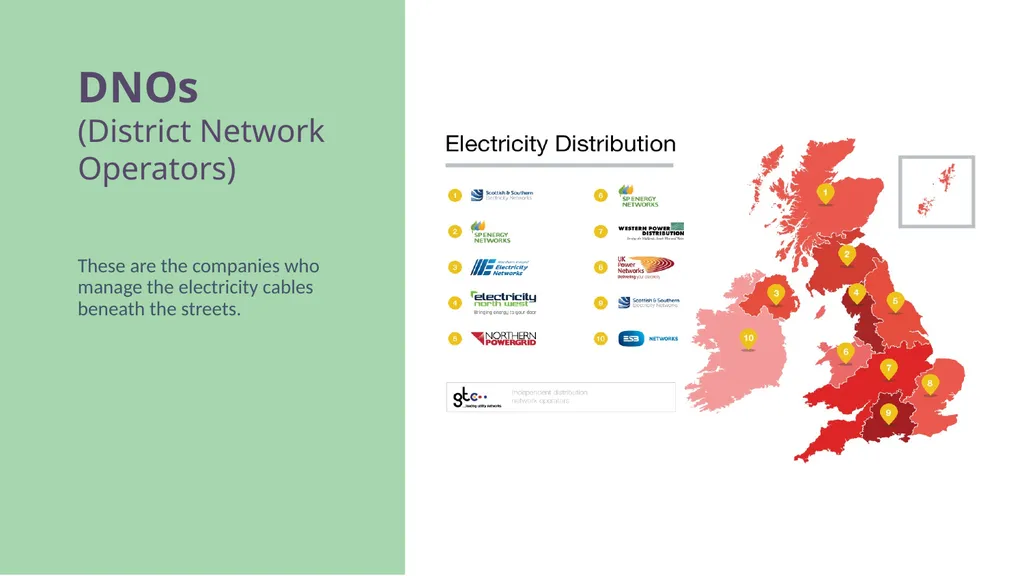
(District Network Operators) These are the companies who manage the electricity cables beneath the streets.<br>
(District Network Operators) These are the companies who manage the electricity cables beneath the streets.<br>
34
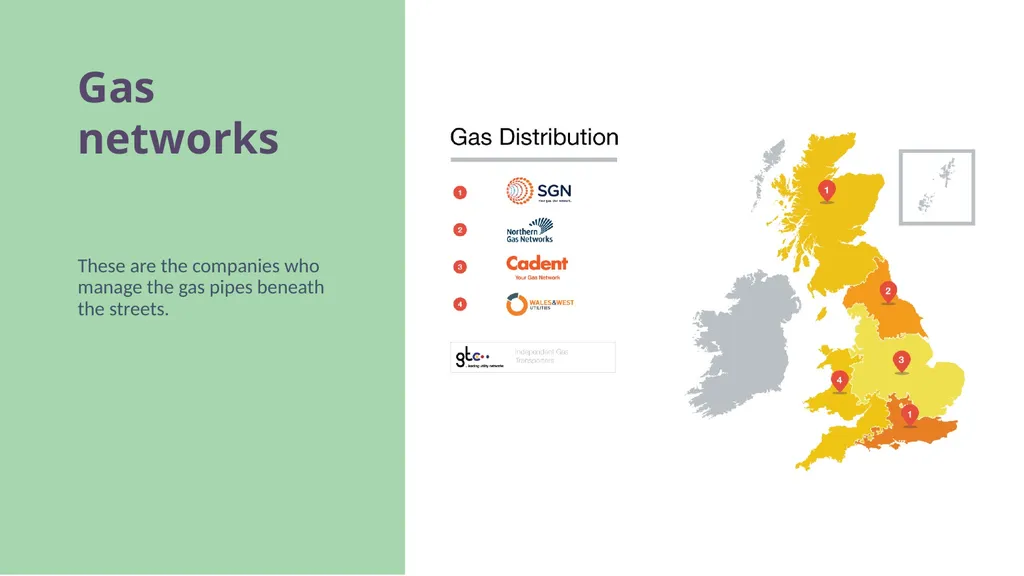
Gas networks These are the companies who manage the gas pipes beneath the streets.<br>
35
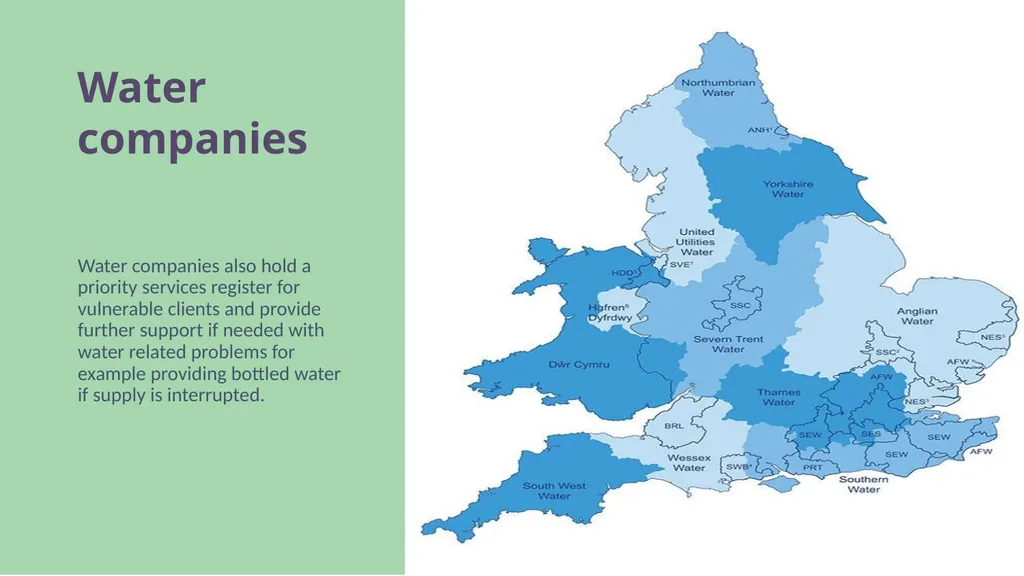
Water companies Water companies also hold a priority services register for vulnerable clients and provide further support if needed with water related problems for example providing bottled water if supply is interrupted.<br>
36
Other schemes There are further schemes available to help clients<br>
37
Green homes grants Grants (vouchers) for insulation and low carbon heating (only England)
General scheme:
All owner occupiers
Private rented sector landlords
Social housing landlords
Park home owners
Voucher will cover up to ⅔ of cost of measures - up to £5,000
Low income scheme:
Owner occupiers only
In receipt of certain means-tested benefits
Voucher will cover full cost of measures - up to £10,000<br>
38
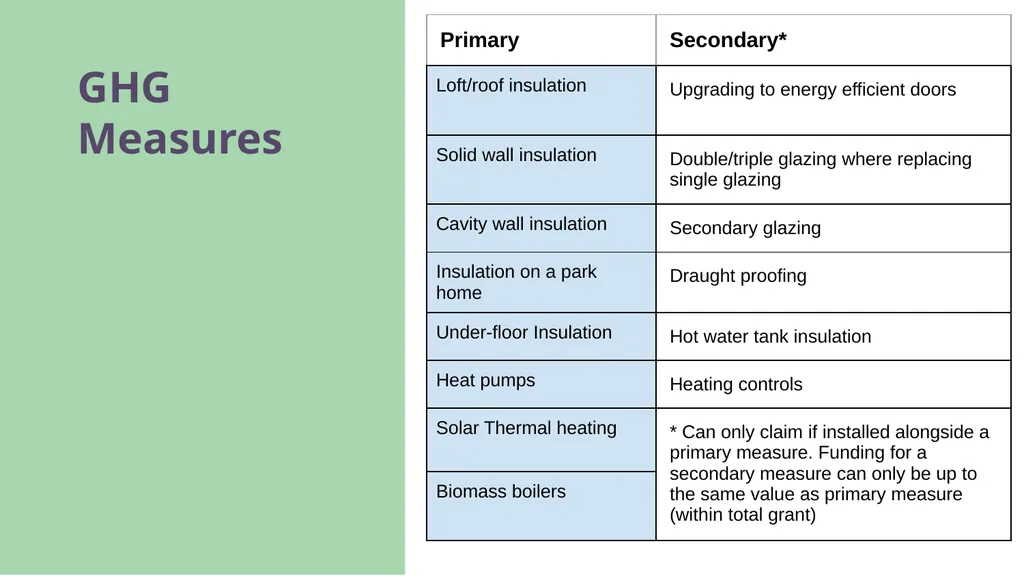
GHG
Measures<br>
Measures<br>
39
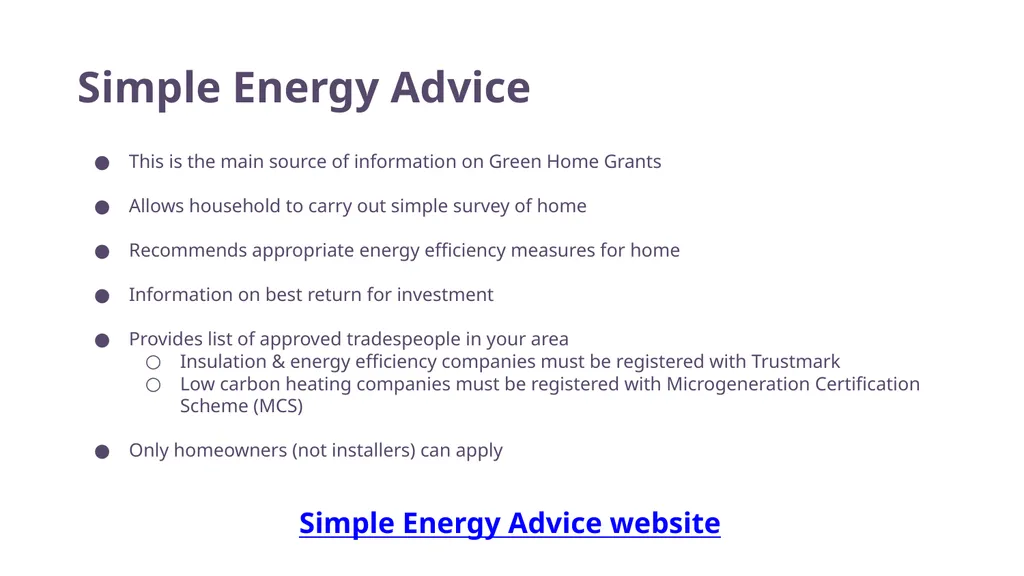
Simple Energy Advice This is the main source of information on Green Home Grants
Allows household to carry out simple survey of home
Recommends appropriate energy efficiency measures for home
Information on best return for investment
Provides list of approved tradespeople in your area
Insulation & energy efficiency companies must be registered with Trustmark
Low carbon heating companies must be registered with Microgeneration Certification Scheme (MCS)
Only homeowners (not installers) can apply
Simple Energy Advice website<br>
40
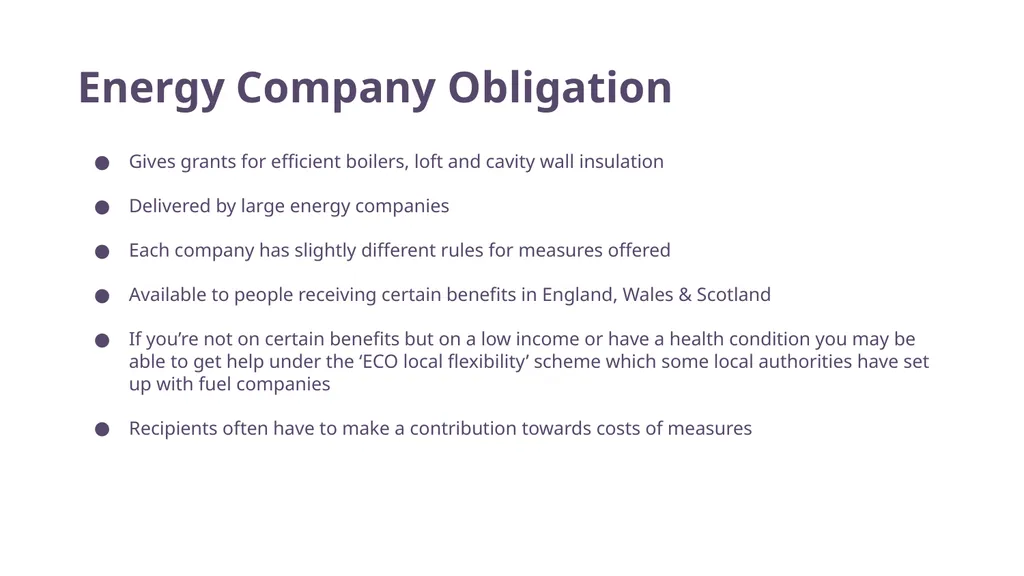
Energy Company Obligation Gives grants for efficient boilers, loft and cavity wall insulation
Delivered by large energy companies
Each company has slightly different rules for measures offered
Available to people receiving certain benefits in England, Wales & Scotland
If you’re not on certain benefits but on a low income or have a health condition you may be able to get help under the ‘ECO local flexibility’ scheme which some local authorities have set up with fuel companies
Recipients often have to make a contribution towards costs of measures<br>
41
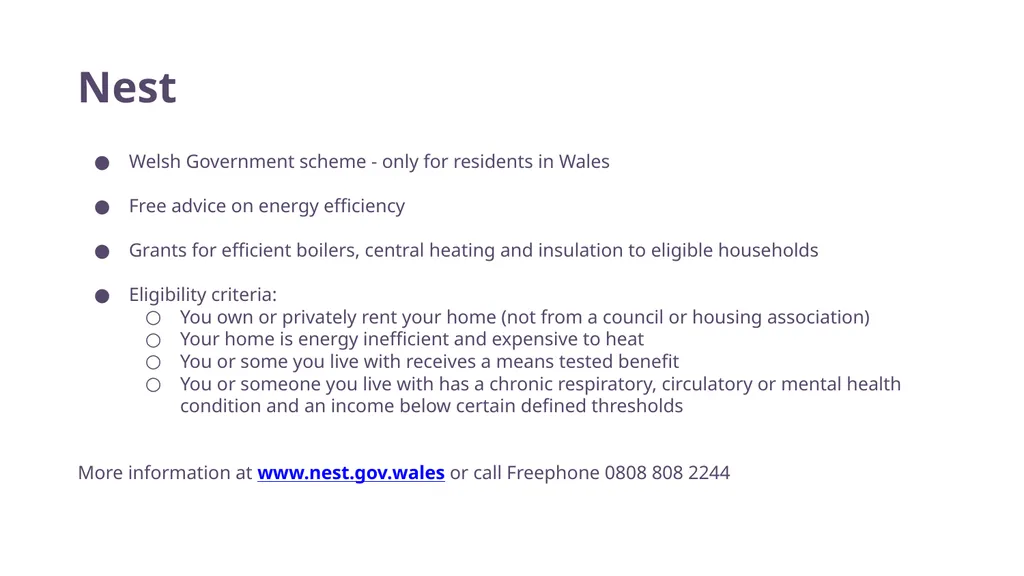
Nest Welsh Government scheme - only for residents in Wales
Free advice on energy efficiency
Grants for efficient boilers, central heating and insulation to eligible households
Eligibility criteria:
You own or privately rent your home (not from a council or housing association)
Your home is energy inefficient and expensive to heat
You or some you live with receives a means tested benefit
You or someone you live with has a chronic respiratory, circulatory or mental health condition and an income below certain defined thresholds
More information at www.nest.gov.wales or call Freephone 0808 808 2244<br>
42
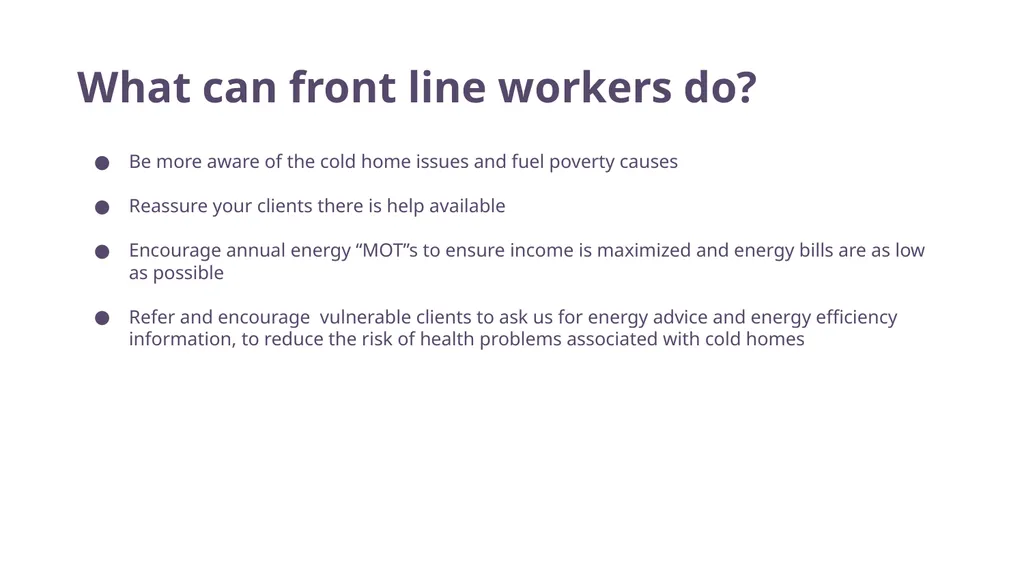
What can front line workers do? Be more aware of the cold home issues and fuel poverty causes
Reassure your clients there is help available
Encourage annual energy “MOT”s to ensure income is maximized and energy bills are as low as possible
Refer and encourage vulnerable clients to ask us for energy advice and energy efficiency information, to reduce the risk of health problems associated with cold homes<br>
43
Other schemes Please include a slide or two to remind people about your organisation, ask them to complete the follow up survey, and let them know how to get in touch with you.
Link to feedback form: https://forms.gle/p42zLu6frhvZMHhW8<br>
Link to feedback form: https://forms.gle/p42zLu6frhvZMHhW8<br>
44
Thank you [insert name of team presenter]
[insert contact details]
[insert organisation logo]<br>
[insert contact details]
[insert organisation logo]<br>