Big Ideas for RE KS4 Curriculum Islam Practices
Description: Big Ideas for RE KS4 Curriculum Islam Practices (AQA a) 10: lesser Jihad: is it ever right to fight? From the spec different understandings of jihad: meaning and significance of greater and lesser jihad; origins, influence and conditions
Related Topics
Download Presentation
"Big Ideas for RE KS4 Curriculum Islam Practices" is the property of its rightful owner. Permission is granted to download and print the materials on this website for personal, non-commercial use only, and to display it on your personal computer provided you do not modify the materials and that you retain all copyright notices contained in the materials. By downloading content from our website, you accept the terms of this agreement.
Presentation Transcript
slide1. Big Ideas for REKS4 Curriculum Islam
Practices (AQA a)<br>
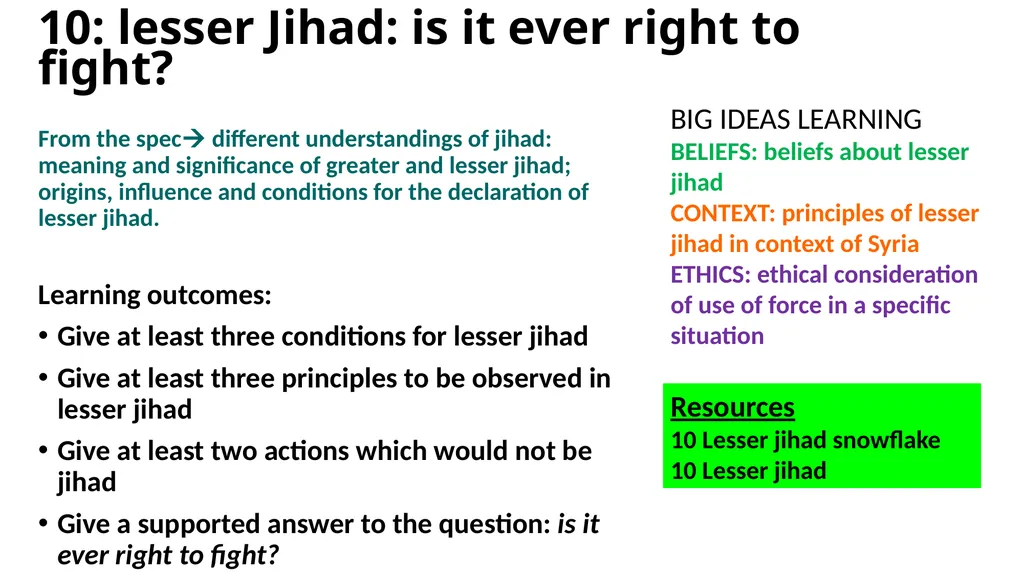
slide2. 10: lesser Jihad: is it ever right to fight? From the spec different understandings of jihad: meaning and significance of greater and lesser jihad; origins, influence and conditions for the declaration of lesser jihad.
Learning outcomes:
Give at least three conditions for lesser jihad
Give at least three principles to be observed in lesser jihad
Give at least two actions which would not be jihad
Give a supported answer to the question: is it ever right to fight? BIG IDEAS LEARNING
BELIEFS: beliefs about lesser jihad
CONTEXT: principles of lesser jihad in context of Syria
ETHICS: ethical consideration of use of force in a specific situation Resources
10 Lesser jihad snowflake
10 Lesser jihad<br>
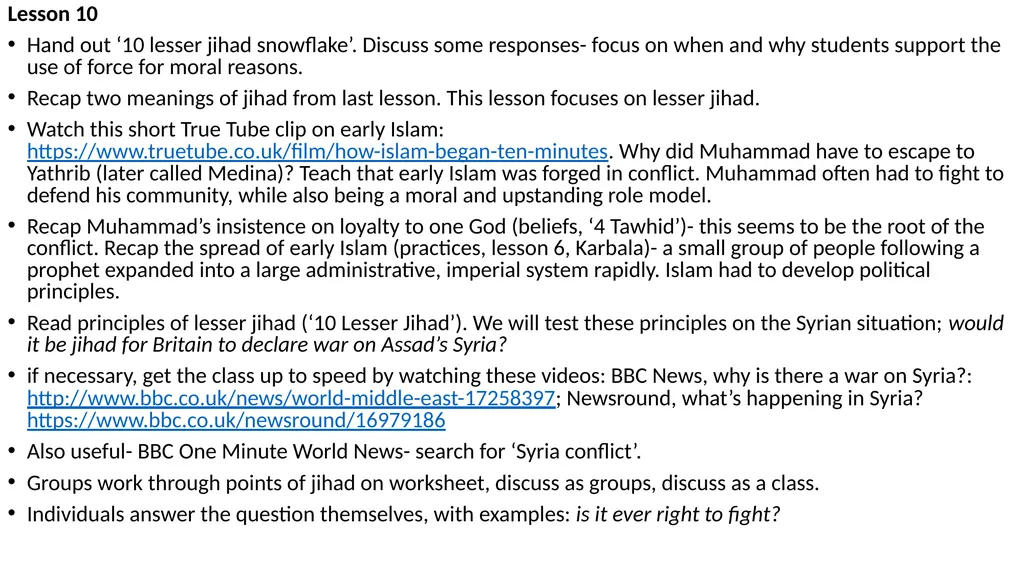
slide3. Lesson 10
Hand out ‘10 lesser jihad snowflake’. Discuss some responses- focus on when and why students support the use of force for moral reasons.
Recap two meanings of jihad from last lesson. This lesson focuses on lesser jihad.
Watch this short True Tube clip on early Islam: https://www.truetube.co.uk/film/how-islam-began-ten-minutes. Why did Muhammad have to escape to Yathrib (later called Medina)? Teach that early Islam was forged in conflict. Muhammad often had to fight to defend his community, while also being a moral and upstanding role model.
Recap Muhammad’s insistence on loyalty to one God (beliefs, ‘4 Tawhid’)- this seems to be the root of the conflict. Recap the spread of early Islam (practices, lesson 6, Karbala)- a small group of people following a prophet expanded into a large administrative, imperial system rapidly. Islam had to develop political principles.
Read principles of lesser jihad (‘10 Lesser Jihad’). We will test these principles on the Syrian situation; would it be jihad for Britain to declare war on Assad’s Syria?
if necessary, get the class up to speed by watching these videos: BBC News, why is there a war on Syria?: http://www.bbc.co.uk/news/world-middle-east-17258397; Newsround, what’s happening in Syria? https://www.bbc.co.uk/newsround/16979186
Also useful- BBC One Minute World News- search for ‘Syria conflict’.
Groups work through points of jihad on worksheet, discuss as groups, discuss as a class.
Individuals answer the question themselves, with examples: is it ever right to fight?<br>

Practices (AQA a)<br>
slide2. 10: lesser Jihad: is it ever right to fight? From the spec different understandings of jihad: meaning and significance of greater and lesser jihad; origins, influence and conditions for the declaration of lesser jihad.
Learning outcomes:
Give at least three conditions for lesser jihad
Give at least three principles to be observed in lesser jihad
Give at least two actions which would not be jihad
Give a supported answer to the question: is it ever right to fight? BIG IDEAS LEARNING
BELIEFS: beliefs about lesser jihad
CONTEXT: principles of lesser jihad in context of Syria
ETHICS: ethical consideration of use of force in a specific situation Resources
10 Lesser jihad snowflake
10 Lesser jihad<br>
slide3. Lesson 10
Hand out ‘10 lesser jihad snowflake’. Discuss some responses- focus on when and why students support the use of force for moral reasons.
Recap two meanings of jihad from last lesson. This lesson focuses on lesser jihad.
Watch this short True Tube clip on early Islam: https://www.truetube.co.uk/film/how-islam-began-ten-minutes. Why did Muhammad have to escape to Yathrib (later called Medina)? Teach that early Islam was forged in conflict. Muhammad often had to fight to defend his community, while also being a moral and upstanding role model.
Recap Muhammad’s insistence on loyalty to one God (beliefs, ‘4 Tawhid’)- this seems to be the root of the conflict. Recap the spread of early Islam (practices, lesson 6, Karbala)- a small group of people following a prophet expanded into a large administrative, imperial system rapidly. Islam had to develop political principles.
Read principles of lesser jihad (‘10 Lesser Jihad’). We will test these principles on the Syrian situation; would it be jihad for Britain to declare war on Assad’s Syria?
if necessary, get the class up to speed by watching these videos: BBC News, why is there a war on Syria?: http://www.bbc.co.uk/news/world-middle-east-17258397; Newsround, what’s happening in Syria? https://www.bbc.co.uk/newsround/16979186
Also useful- BBC One Minute World News- search for ‘Syria conflict’.
Groups work through points of jihad on worksheet, discuss as groups, discuss as a class.
Individuals answer the question themselves, with examples: is it ever right to fight?<br>