BIOCHEMISTY BINITA RANI ASSOCIATE PROFESSOR (DAIRY CHEMISTRY) FACULTY OF DAIRY TECHNOLOGY S.G.I.D.T., BVC CAMPUS, P.O.- BVC, DIST.-PATNA-800014 ELECTRON TRANSPORT CHAIN AND ATP SYNTHESIS Course No.-DTC-111, Credit Hours 2 (11) In
"BIOCHEMISTY BINITA RANI ASSOCIATE PROFESSOR (DAIRY" is the property of its rightful owner. Permission is granted to
download and print the materials on this website for personal, non-commercial use only, and to display it
on your personal computer provided you do not modify the materials and that you retain all copyright
notices contained in the materials. By downloading content from our website, you accept the terms of this
agreement.
Presentation Transcript
01
BIOCHEMISTY BINITA RANI
ASSOCIATE PROFESSOR (DAIRY CHEMISTRY)
FACULTY OF DAIRY TECHNOLOGY
S.G.I.D.T., BVC CAMPUS,
P.O.- BVC, DIST.-PATNA-800014 ELECTRON TRANSPORT CHAIN AND ATP SYNTHESIS Course No.-DTC-111, Credit Hours – 2 (1+1)<br>
02
•In eukaryotes => Electron transport and oxidative phosphorylation => inner mitochondrial membrane.
• These processes => re-oxidize NADH and FADH2 <= from the citric acid cycle (mitochondrial matrix ), glycolysis (cytoplasm ) and fatty acid oxidation ( mitochondrial matrix ) and => trap the energy released as ATP.
• Oxidative phosphorylation => major source of ATP in the cell.
In prokaryotes => electron transport and oxidative phosphorylation components => in the plasma membrane.<br>
03
Redox Potential
Oxidation => loss of electrons.
Reduction => gain of electrons.
In chemical reaction :
if one molecule is oxidized => another must be reduced
i.e. oxidation-reduction reaction => transfer of electrons. .<br>
04
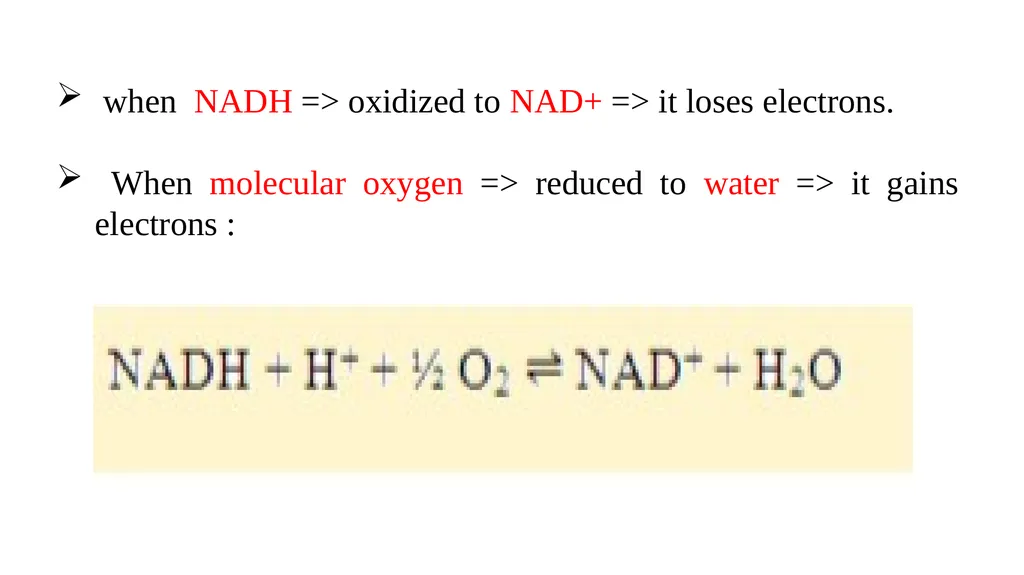
when NADH => oxidized to NAD+ => it loses electrons.
When molecular oxygen => reduced to water => it gains electrons :<br>
05
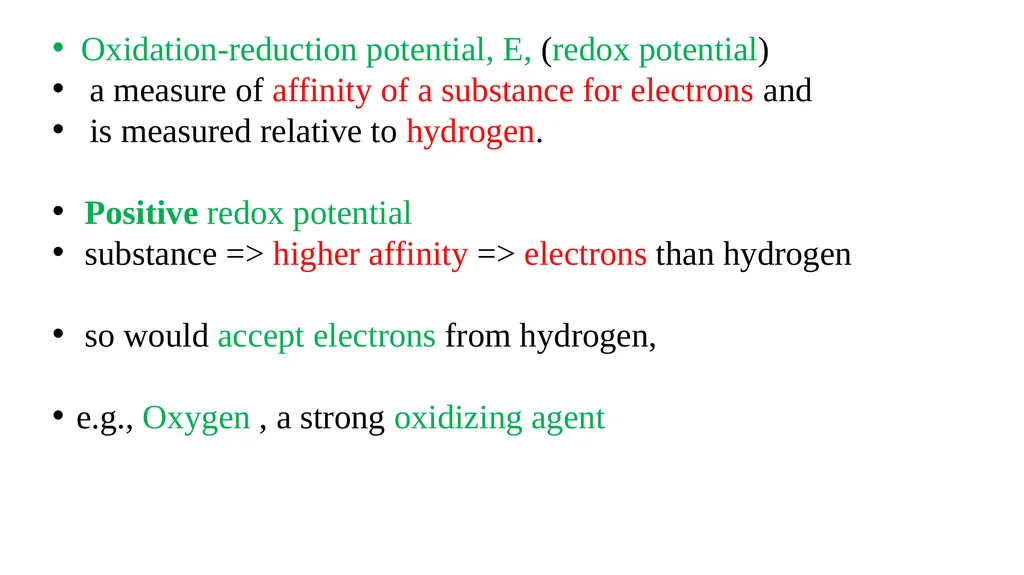
Oxidation-reduction potential, E, (redox potential)
a measure of affinity of a substance for electrons and
is measured relative to hydrogen.
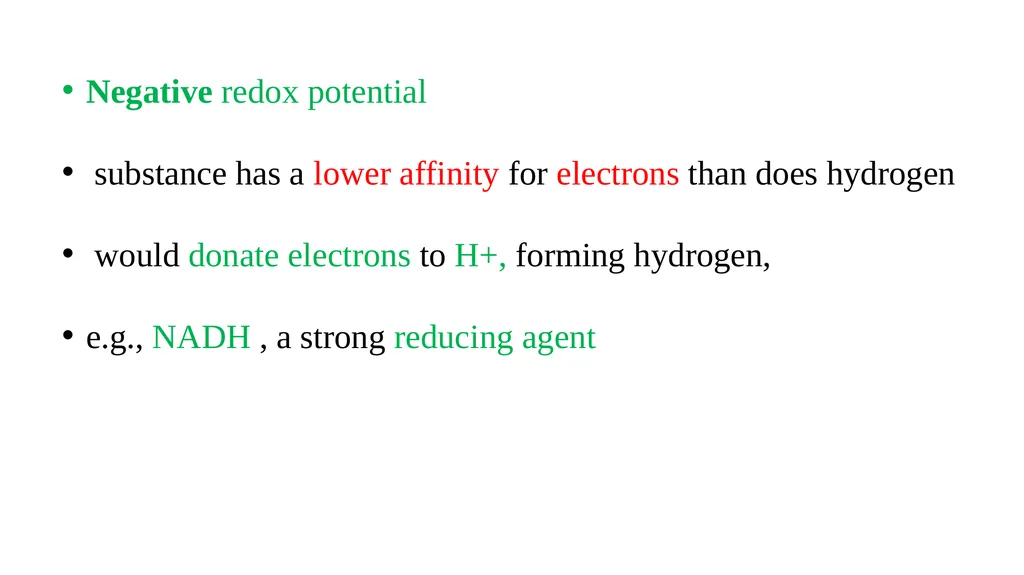
substance has a lower affinity for electrons than does hydrogen
would donate electrons to H+, forming hydrogen,
e.g., NADH , a strong reducing agent<br>
07
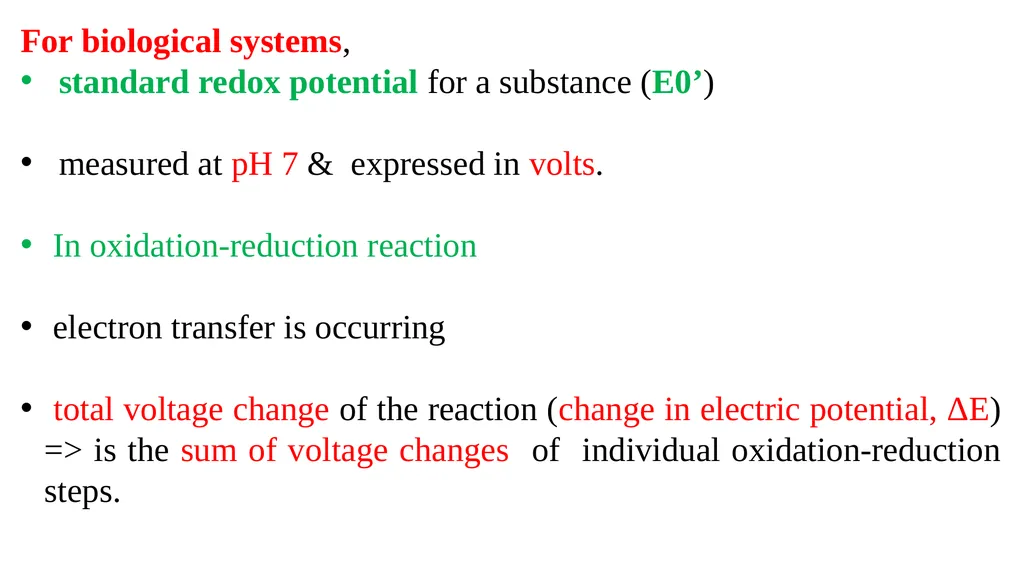
For biological systems,
standard redox potential for a substance (E0’)
measured at pH 7 & expressed in volts.
In oxidation-reduction reaction
electron transfer is occurring
total voltage change of the reaction (change in electric potential, ΔE) => is the sum of voltage changes of individual oxidation-reduction steps.<br>
08
Standard free energy change of a reaction at pH 7 => ΔG0’=> calculated from the change in redox potential ΔE0’ of substrates and products:
ΔG0’ = -n F ΔE0’
Where, n -- number of electrons transferred,
ΔE0’ -- in volts (V),
ΔG0’ -- in kilocalories per mole (kcal mol-1) and
F -- constant called Faraday (23.06 kcal V-1 mol-1).<br>
09
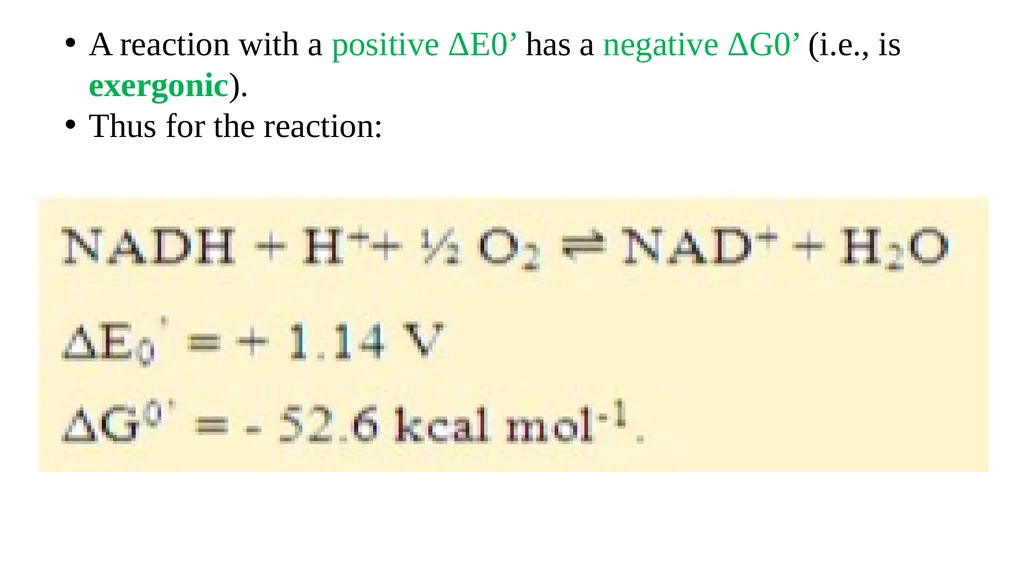
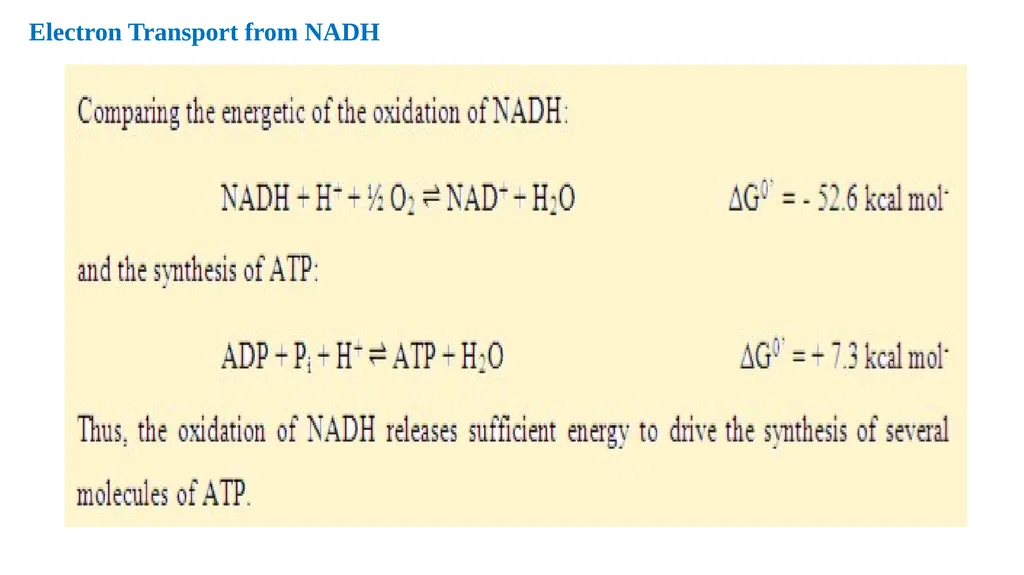
A reaction with a positive ΔE0’ has a negative ΔG0’ (i.e., is exergonic).
Thus for the reaction:<br>
10
Electron Transport from NADH<br>
11
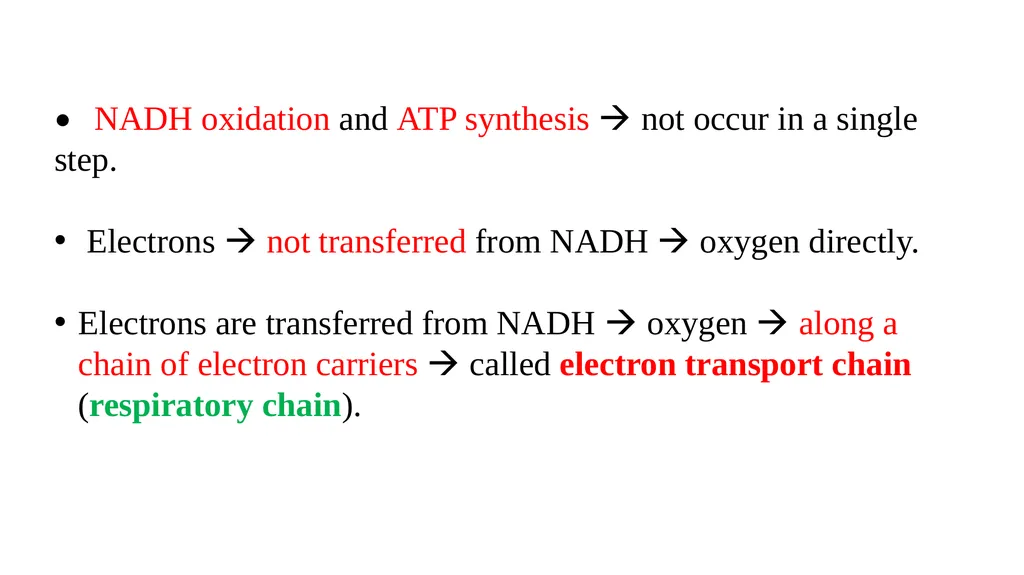
• NADH oxidation and ATP synthesis not occur in a single step.
Electrons not transferred from NADH oxygen directly.
Electrons are transferred from NADH oxygen along a chain of electron carriers called electron transport chain (respiratory chain).<br>
12
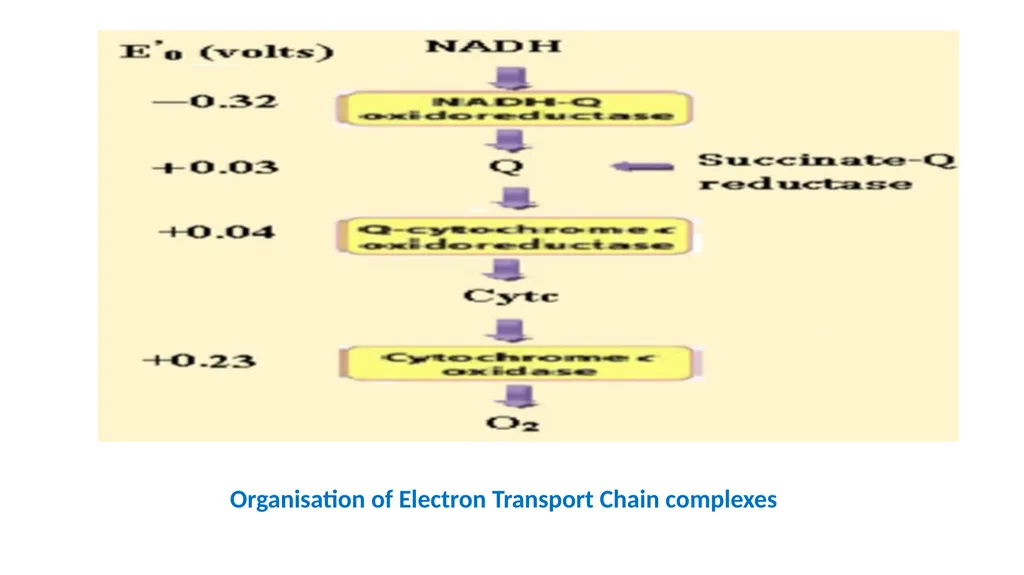
Organisation of Electron Transport Chain complexes<br>
13
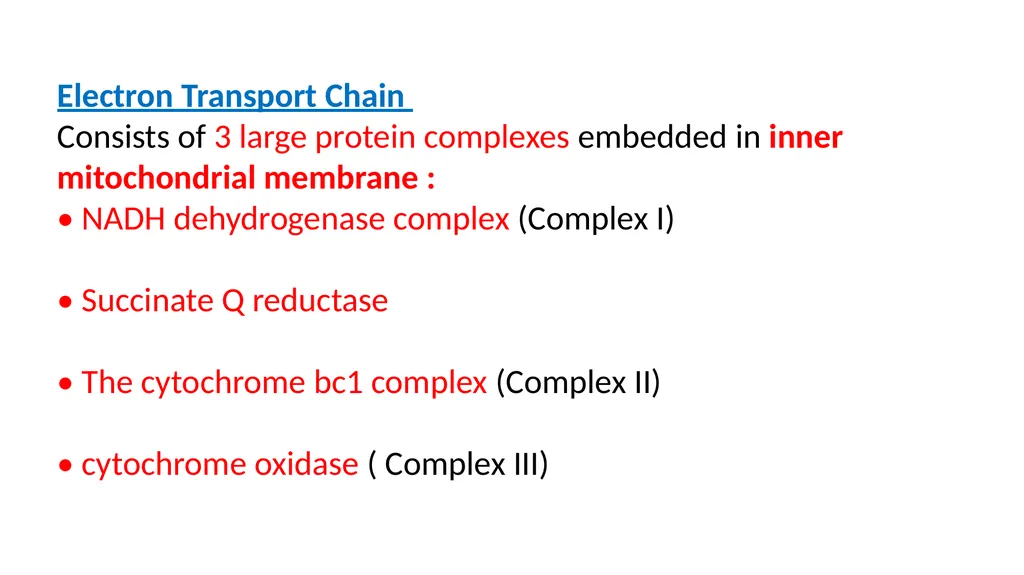
Electron Transport Chain
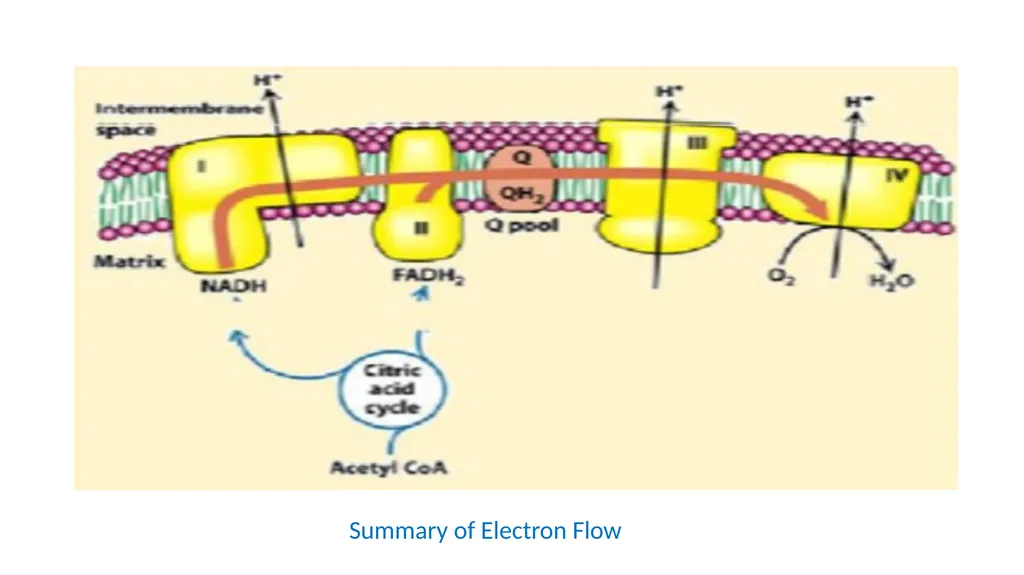
Consists of 3 large protein complexes embedded in inner mitochondrial membrane :
• NADH dehydrogenase complex (Complex I)
• Succinate Q reductase
• The cytochrome bc1 complex (Complex II)
• cytochrome oxidase ( Complex III)<br>
14
Electrons flow from NADH to oxygen through these three complexes
Each complex contains several electron carriers work sequentially carry electrons down the chain.
2 free electron carriers are also needed to link these large complexes:
• Ubiquinone {coenzyme Q (CoQ)}
• cytochrome c<br>
15
ATP Synthesis (Oxidative Phosphorylation)
• NADH and FADH2 are oxidized by electron transport through respiratory chain Synthesis of ATP.
• Energy liberated by electron transport => used to create a proton gradient across the mitochondrial inner membrane => that is used to drive ATP synthesis (chemiosmotic hypothesis) in presence of ATP synthase .<br>
16
Thus the proton gradient couples electron transport and ATP synthesis .
(not a chemical intermediate as in substrate level phosphorylation.)
(enzyme originally ATPase because without input of energy from electron transport the reaction can reverse and actually hydrolyzes ATP.)<br>
17
Summary
• Electron transport down the respiratory chain from NADH oxidation => causes H+ ions to be pumped out into the inter membrane space by three H+ pumps NADH dehydrogenase, cytochrome bc1 complex and cytochrome oxidase.
• Free energy change => in transporting an electrically charged ion => across a membrane => leads to formation of electrochemical proton gradient.<br>
18
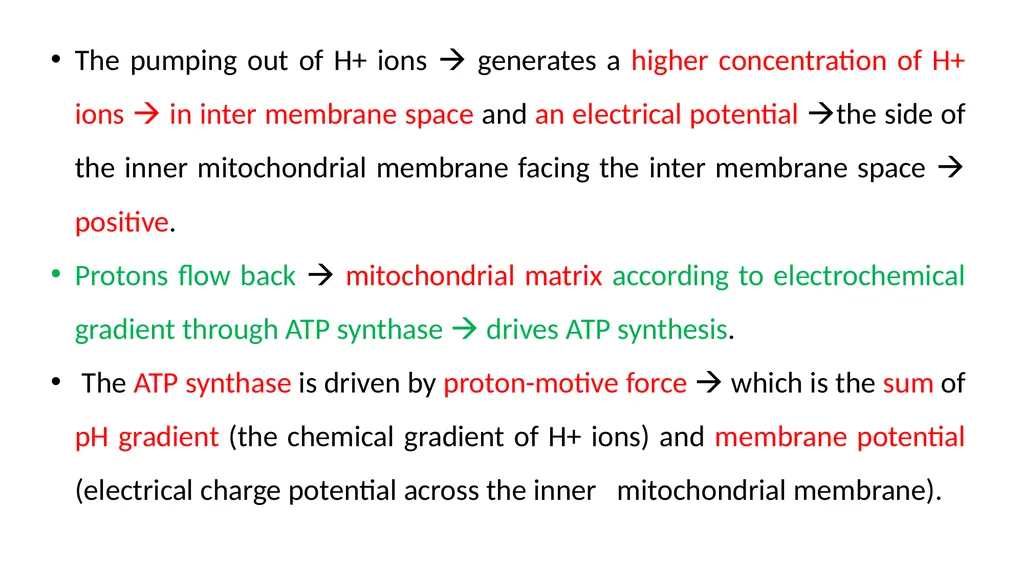
The pumping out of H+ ions generates a higher concentration of H+ ions in inter membrane space and an electrical potential the side of the inner mitochondrial membrane facing the inter membrane space positive.
Protons flow back mitochondrial matrix according to electrochemical gradient through ATP synthase drives ATP synthesis.
The ATP synthase is driven by proton-motive force which is the sum of pH gradient (the chemical gradient of H+ ions) and membrane potential (electrical charge potential across the inner mitochondrial membrane).<br>
19
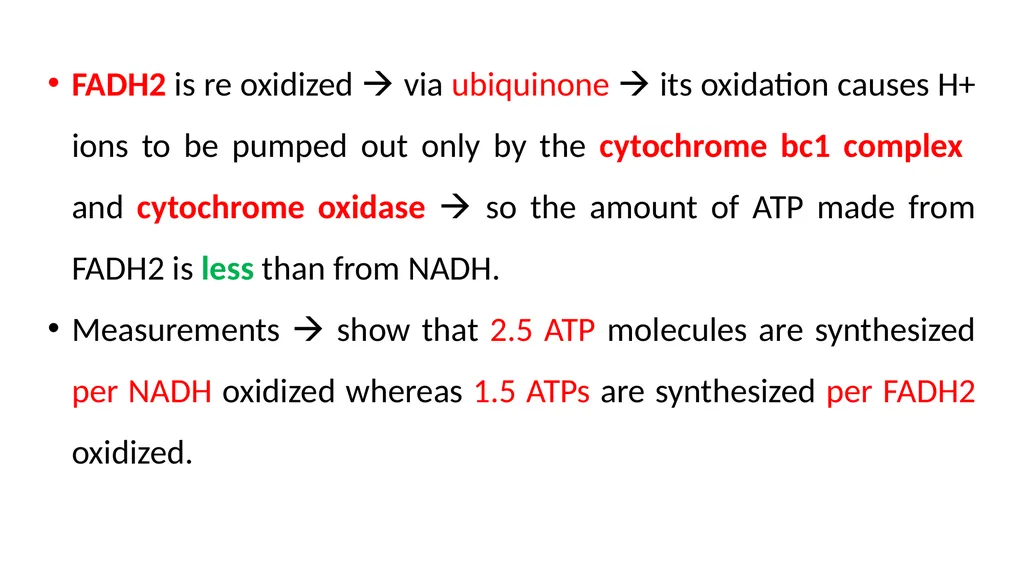
FADH2 is re oxidized via ubiquinone its oxidation causes H+ ions to be pumped out only by the cytochrome bc1 complex and cytochrome oxidase so the amount of ATP made from FADH2 is less than from NADH.
Measurements show that 2.5 ATP molecules are synthesized per NADH oxidized whereas 1.5 ATPs are synthesized per FADH2 oxidized.<br>