Bioethics in Anatomy Education Resources: Use of Eponyms in Health Care Education Description: These PowerPoint slides provide information on the use of eponyms in health care education. Feel free to use or modify the text. The topics
"Bioethics in Anatomy Education Resources: Use of" is the property of its rightful owner. Permission is granted to
download and print the materials on this website for personal, non-commercial use only, and to display it
on your personal computer provided you do not modify the materials and that you retain all copyright
notices contained in the materials. By downloading content from our website, you accept the terms of this
agreement.
Presentation Transcript
01
Bioethics in Anatomy Education Resources:
Use of Eponyms in Health Care Education
Description:
These PowerPoint slides provide information on the use of eponyms in health care education. Feel free to use or modify the text.
The topics covered by this resource include:
Eponyms
Anatomy
Histology
Neuroanatomy
Further reading:
Winkelmann, A. Should We Teach Abernethy and Zuckerkandl? Clin Anat. 2012;25:241-245.
Four articles in Clinical Anatomy, 2014, 27:1137-1148.<br>
02
Use of Eponyms in Health Care Education What is an eponym?
A structure or procedure given an individual’s name as its description.
What is a medical eponym?
Usually a structure, disease or procedure named after the person who first described it.
Who are these persons?
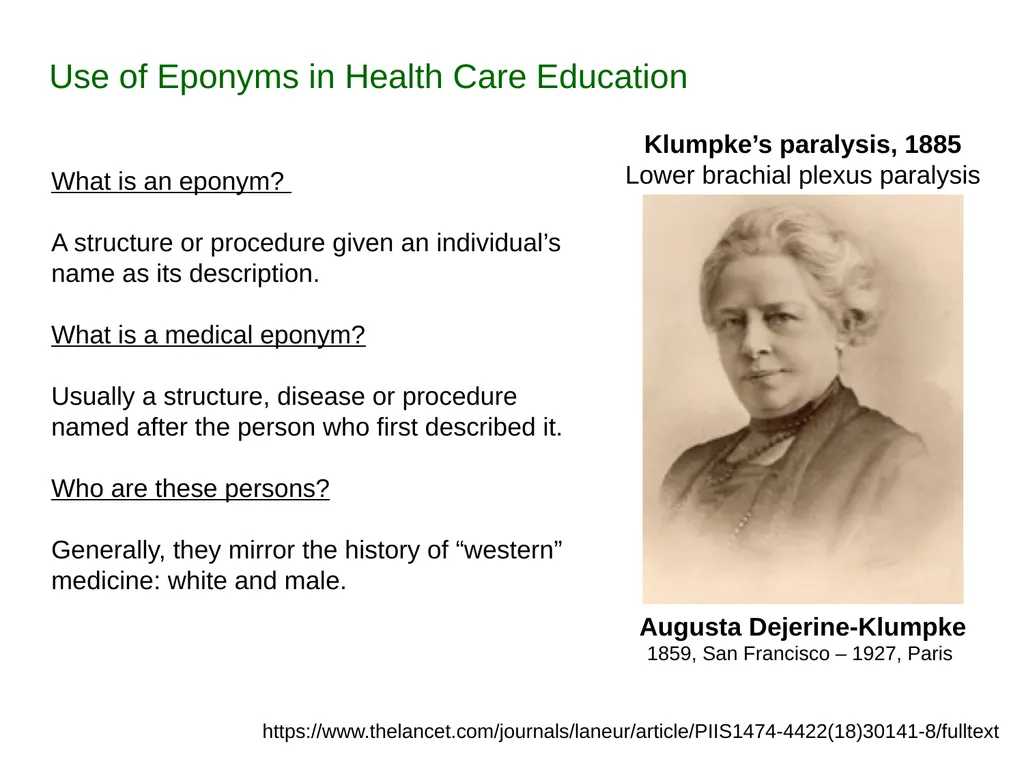
Generally, they mirror the history of “western” medicine: white and male. Augusta Dejerine-Klumpke
1859, San Francisco – 1927, Paris Klumpke’s paralysis, 1885
Lower brachial plexus paralysis https://www.thelancet.com/journals/laneur/article/PIIS1474-4422(18)30141-8/fulltext<br>
03
Use of Eponyms in Health Care Education Why are eponyms still a part of health care education?
Pragmatism: They are frequently used in clinical settings, although educators can help shift that use by putting less reliance on eponyms.
Epistemology: They can be used as a teaching moment in education:
How was this knowledge gained?
Who were the actors?
Why these actors?
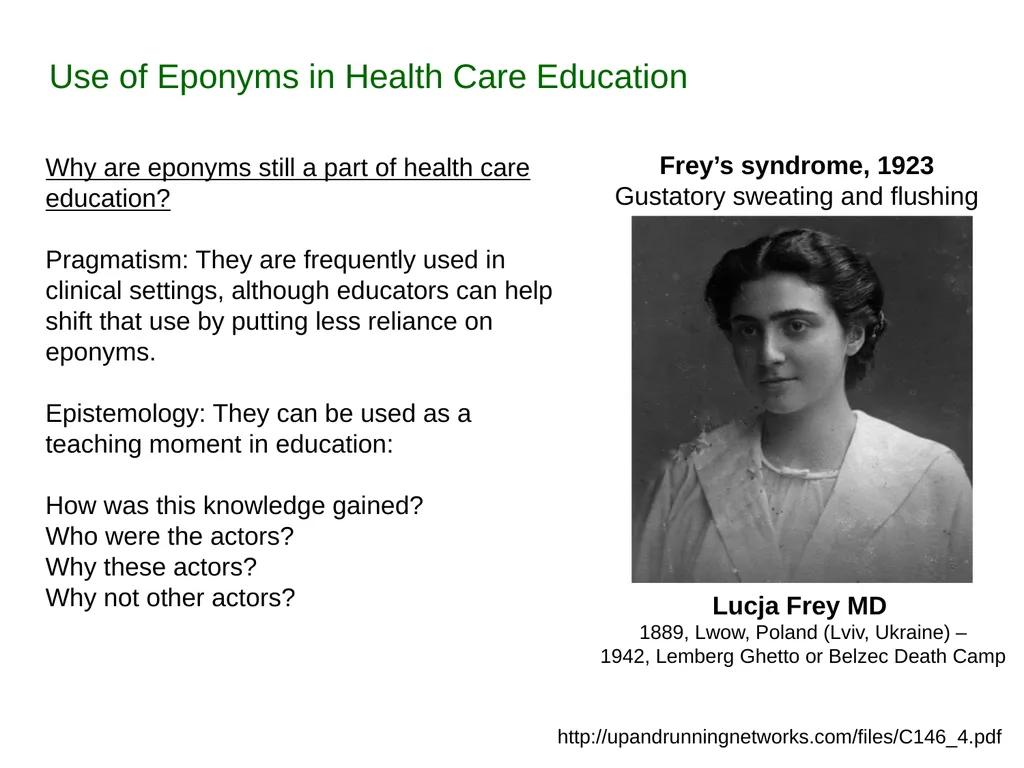
Why not other actors? Frey’s syndrome, 1923
Gustatory sweating and flushing Lucja Frey MD
1889, Lwow, Poland (Lviv, Ukraine) –
1942, Lemberg Ghetto or Belzec Death Camp http://upandrunningnetworks.com/files/C146_4.pdf<br>
04
Use of Eponyms in Health Care Education Questions to consider:
Should eponym use be discouraged?
Is education / pedagogy better off without eponyms?
Will historical appreciation of medicine be lost with the loss of eponyms?
Should eponyms be removed from those who obtained the eponym unethically (eg, Clara Cells)?
Is there justification for the continued use of eponyms?
For a long list of medical eponyms, visit: whonamedit.com Pinterest.com<br>
05
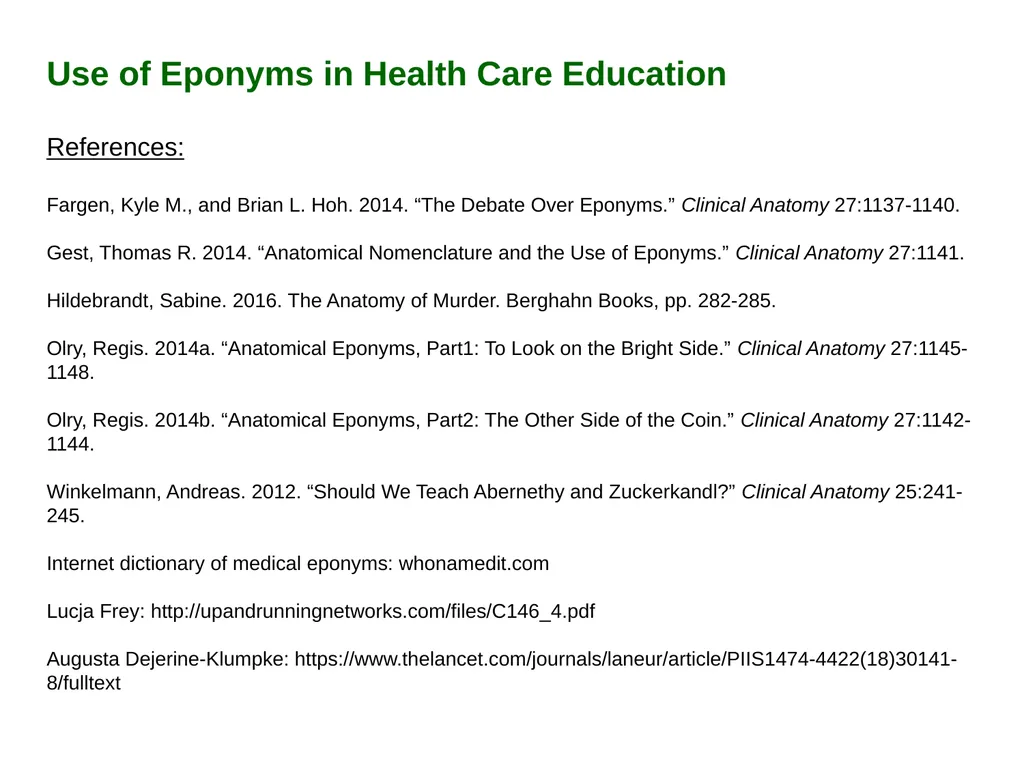
References:
Fargen, Kyle M., and Brian L. Hoh. 2014. “The Debate Over Eponyms.” Clinical Anatomy 27:1137-1140.
Gest, Thomas R. 2014. “Anatomical Nomenclature and the Use of Eponyms.” Clinical Anatomy 27:1141.
Hildebrandt, Sabine. 2016. The Anatomy of Murder. Berghahn Books, pp. 282-285.
Olry, Regis. 2014a. “Anatomical Eponyms, Part1: To Look on the Bright Side.” Clinical Anatomy 27:1145-1148.
Olry, Regis. 2014b. “Anatomical Eponyms, Part2: The Other Side of the Coin.” Clinical Anatomy 27:1142-1144.
Winkelmann, Andreas. 2012. “Should We Teach Abernethy and Zuckerkandl?” Clinical Anatomy 25:241-245.
Internet dictionary of medical eponyms: whonamedit.com
Augusta Dejerine-Klumpke: https://www.thelancet.com/journals/laneur/article/PIIS1474-4422(18)30141-8/fulltext Use of Eponyms in Health Care Education<br>