
Biological Controls Biological control –
NS
Published · 21 slides · 0 views
1 / 1



Description
Biological Controls Biological control populations of beneficial organisms are intentionally used and manipulated, under the role of natural enemy, to manage and limit insect pest populations. Natural enemy - a predator, parasite, or
Related Topics
Download this presentation From Below
"Biological Controls Biological control –" is the property of its rightful owner. Permission is granted to download and print the materials on this website for personal, non-commercial use only, and to display it on your personal computer provided you do not modify the materials and that you retain all copyright notices contained in the materials. By downloading content from our website, you accept the terms of this agreement.
Share
Embed code
Presentation Transcript
01
Biological Controls<br>
02
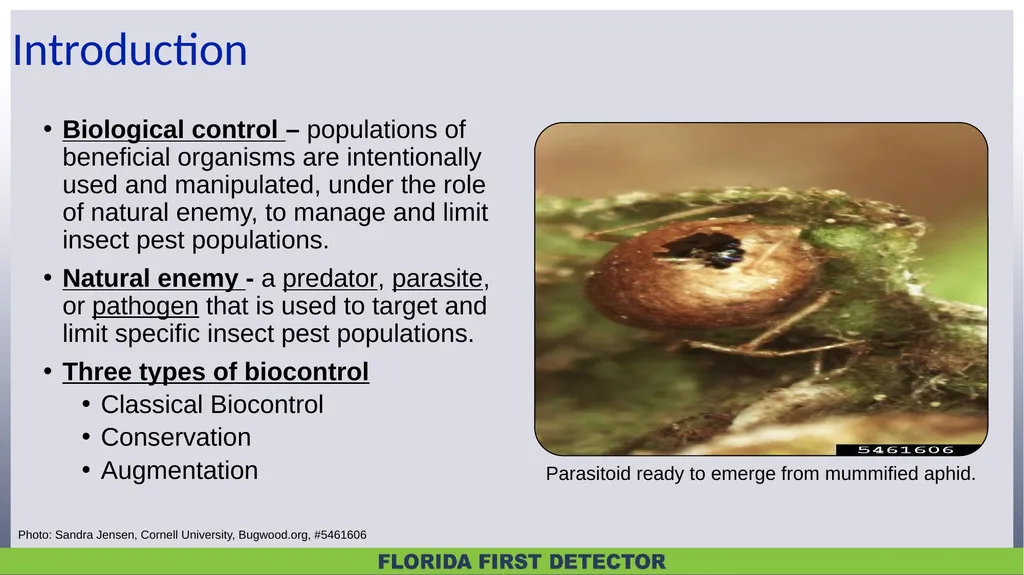
Biological control – populations of beneficial organisms are intentionally used and manipulated, under the role of natural enemy, to manage and limit insect pest populations.
Natural enemy - a predator, parasite, or pathogen that is used to target and limit specific insect pest populations.
Three types of biocontrol
Classical Biocontrol
Conservation
Augmentation Introduction Photo: Sandra Jensen, Cornell University, Bugwood.org, #5461606 Parasitoid ready to emerge from mummified aphid.<br>
Natural enemy - a predator, parasite, or pathogen that is used to target and limit specific insect pest populations.
Three types of biocontrol
Classical Biocontrol
Conservation
Augmentation Introduction Photo: Sandra Jensen, Cornell University, Bugwood.org, #5461606 Parasitoid ready to emerge from mummified aphid.<br>
03
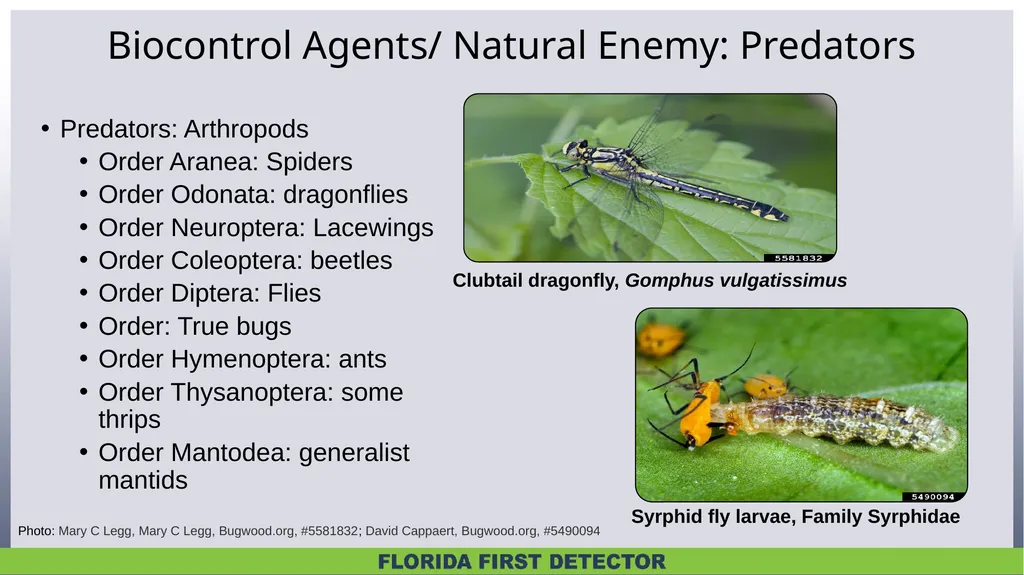
Predators: Arthropods
Order Aranea: Spiders
Order Odonata: dragonflies
Order Neuroptera: Lacewings
Order Coleoptera: beetles
Order Diptera: Flies
Order: True bugs
Order Hymenoptera: ants
Order Thysanoptera: some thrips
Order Mantodea: generalist mantids Biocontrol Agents/ Natural Enemy: Predators Photo: Mary C Legg, Mary C Legg, Bugwood.org, #5581832; David Cappaert, Bugwood.org, #5490094 Clubtail dragonfly, Gomphus vulgatissimus Syrphid fly larvae, Family Syrphidae<br>
Order Aranea: Spiders
Order Odonata: dragonflies
Order Neuroptera: Lacewings
Order Coleoptera: beetles
Order Diptera: Flies
Order: True bugs
Order Hymenoptera: ants
Order Thysanoptera: some thrips
Order Mantodea: generalist mantids Biocontrol Agents/ Natural Enemy: Predators Photo: Mary C Legg, Mary C Legg, Bugwood.org, #5581832; David Cappaert, Bugwood.org, #5490094 Clubtail dragonfly, Gomphus vulgatissimus Syrphid fly larvae, Family Syrphidae<br>
04
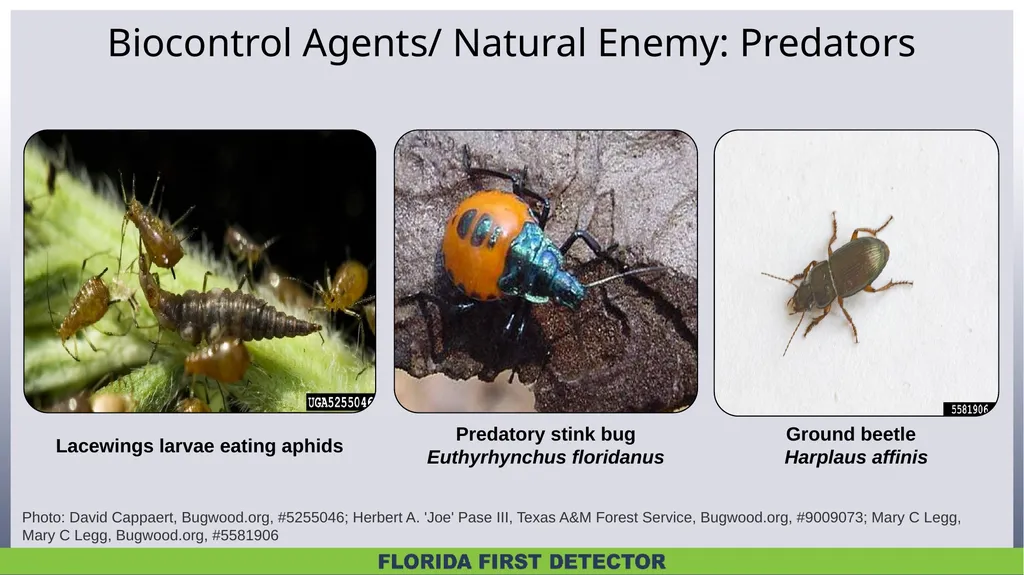
Biocontrol Agents/ Natural Enemy: Predators Lacewings larvae eating aphids Predatory stink bug Euthyrhynchus floridanus Ground beetle
Harplaus affinis Photo: David Cappaert, Bugwood.org, #5255046; Herbert A. 'Joe' Pase III, Texas A&M Forest Service, Bugwood.org, #9009073; Mary C Legg, Mary C Legg, Bugwood.org, #5581906<br>
Harplaus affinis Photo: David Cappaert, Bugwood.org, #5255046; Herbert A. 'Joe' Pase III, Texas A&M Forest Service, Bugwood.org, #9009073; Mary C Legg, Mary C Legg, Bugwood.org, #5581906<br>
05
Parasitoids:
Roundworms
Nematodes (phylum Nematoda): entomopathogenic nematodes
Arthropods:
Order Diptera: flies
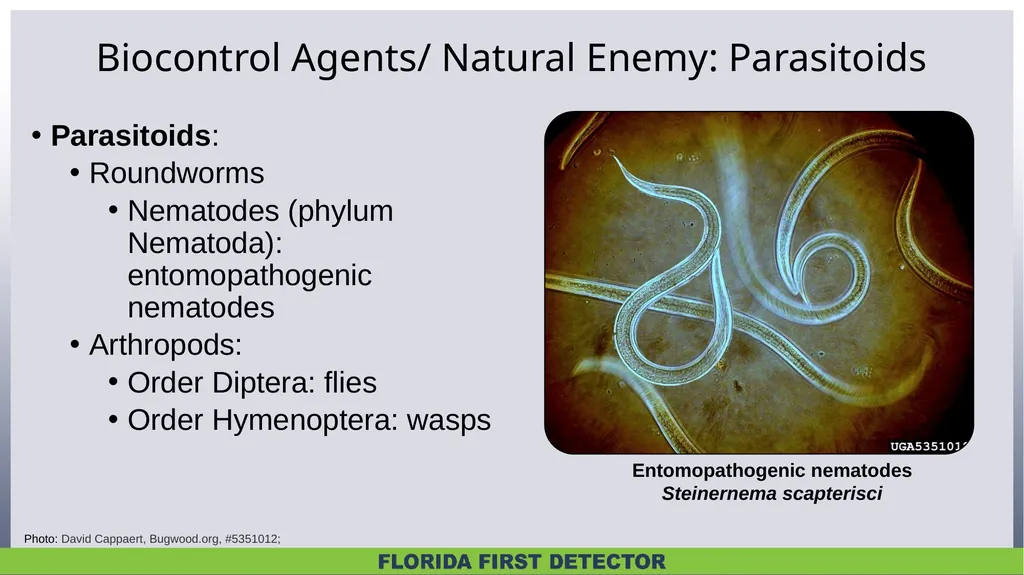
Order Hymenoptera: wasps Biocontrol Agents/ Natural Enemy: Parasitoids Photo: David Cappaert, Bugwood.org, #5351012; Entomopathogenic nematodes
Steinernema scapterisci<br>
Roundworms
Nematodes (phylum Nematoda): entomopathogenic nematodes
Arthropods:
Order Diptera: flies
Order Hymenoptera: wasps Biocontrol Agents/ Natural Enemy: Parasitoids Photo: David Cappaert, Bugwood.org, #5351012; Entomopathogenic nematodes
Steinernema scapterisci<br>
06
Tachinid flies
Phasia occidentis Biocontrol Agents/ Natural Enemy: Parasitoids Braconid wasp
Atanycolus cappaerti Photo: Whitney Cranshaw, Colorado State University, Bugwood.org, #1326220; David Cappaert, Bugwood.org, #5352009<br>
Phasia occidentis Biocontrol Agents/ Natural Enemy: Parasitoids Braconid wasp
Atanycolus cappaerti Photo: Whitney Cranshaw, Colorado State University, Bugwood.org, #1326220; David Cappaert, Bugwood.org, #5352009<br>
07
Pathogens:
Fungi – entomopathogenic fungus
Bacteria
Viruses – entomopathogenic viruses
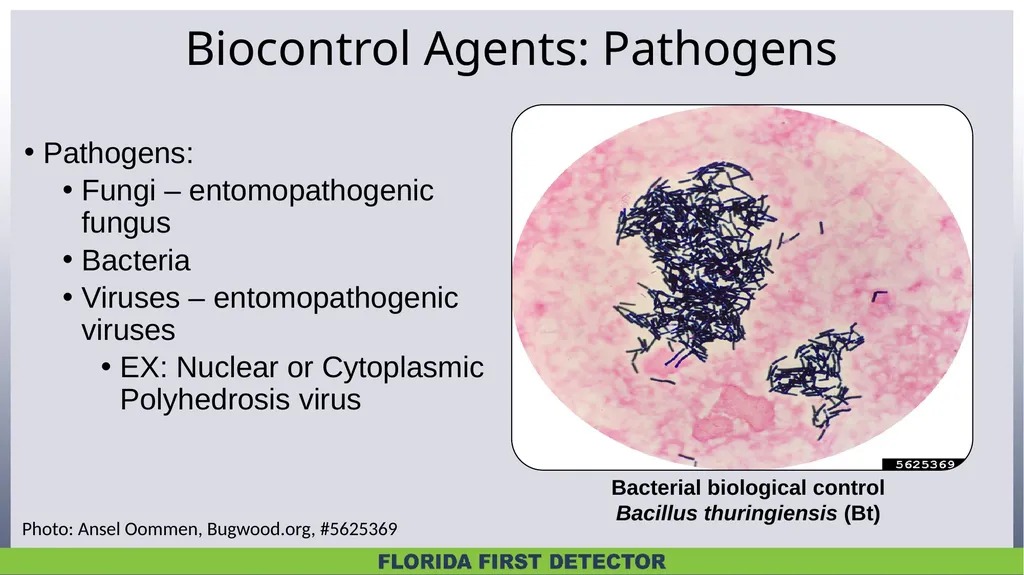
EX: Nuclear or Cytoplasmic Polyhedrosis virus Biocontrol Agents: Pathogens Bacterial biological control
Bacillus thuringiensis (Bt) Photo: Ansel Oommen, Bugwood.org, #5625369<br>
Fungi – entomopathogenic fungus
Bacteria
Viruses – entomopathogenic viruses
EX: Nuclear or Cytoplasmic Polyhedrosis virus Biocontrol Agents: Pathogens Bacterial biological control
Bacillus thuringiensis (Bt) Photo: Ansel Oommen, Bugwood.org, #5625369<br>
08
Generalist
Biocontrol agent that has a wide range of hosts that it will eat, parasitize, or infect (biocontrol pathogen). Specialist
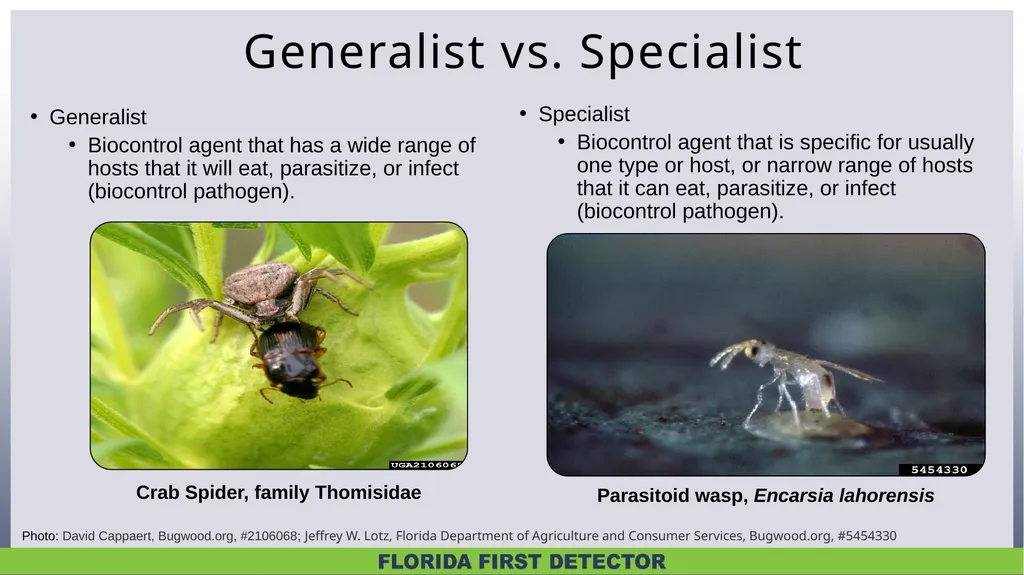
Biocontrol agent that is specific for usually one type or host, or narrow range of hosts that it can eat, parasitize, or infect (biocontrol pathogen). Generalist vs. Specialist Crab Spider, family Thomisidae Photo: David Cappaert, Bugwood.org, #2106068; Jeffrey W. Lotz, Florida Department of Agriculture and Consumer Services, Bugwood.org, #5454330 Parasitoid wasp, Encarsia lahorensis<br>
Biocontrol agent that has a wide range of hosts that it will eat, parasitize, or infect (biocontrol pathogen). Specialist
Biocontrol agent that is specific for usually one type or host, or narrow range of hosts that it can eat, parasitize, or infect (biocontrol pathogen). Generalist vs. Specialist Crab Spider, family Thomisidae Photo: David Cappaert, Bugwood.org, #2106068; Jeffrey W. Lotz, Florida Department of Agriculture and Consumer Services, Bugwood.org, #5454330 Parasitoid wasp, Encarsia lahorensis<br>
09
Import and release of non-native organism for the permanent establishment of this natural enemy to control target pest population.
Factors to consider:
Origin of pest and biocontrol agent
Biological life stage of biocontrol agent
Time to study their interactions
Permits to bring non-native biocontrol agent for research.
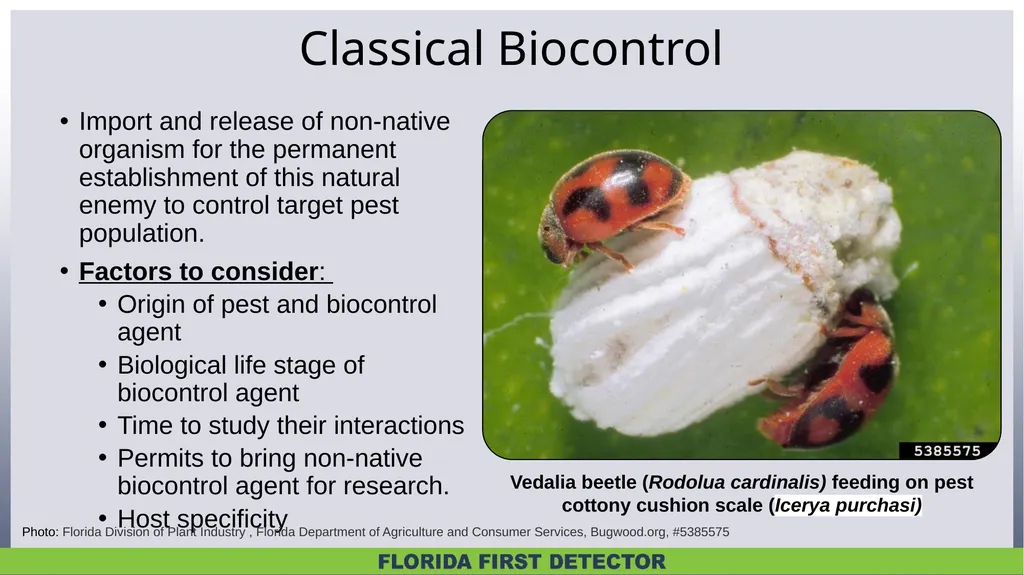
Host specificity Classical Biocontrol Photo: Florida Division of Plant Industry , Florida Department of Agriculture and Consumer Services, Bugwood.org, #5385575 Vedalia beetle (Rodolua cardinalis) feeding on pest cottony cushion scale (Icerya purchasi)<br>
Factors to consider:
Origin of pest and biocontrol agent
Biological life stage of biocontrol agent
Time to study their interactions
Permits to bring non-native biocontrol agent for research.
Host specificity Classical Biocontrol Photo: Florida Division of Plant Industry , Florida Department of Agriculture and Consumer Services, Bugwood.org, #5385575 Vedalia beetle (Rodolua cardinalis) feeding on pest cottony cushion scale (Icerya purchasi)<br>
10
Providing a habitat or environment that promotes and supports natural enemies that are present in the environment.
Benefits:
Providing flowering plants– nectar or pollen
Trees for natural enemies to overwinter or use for shelter
Trap plants for pests
Intercropping Conservation Biocontrol Trap crop: Sorghum attracts aphids Photo: Howard F. Schwartz, Colorado State University, Bugwood.org, #5361591 Mealybug destroyer, Cryptolaemus montrouzieri<br>
Benefits:
Providing flowering plants– nectar or pollen
Trees for natural enemies to overwinter or use for shelter
Trap plants for pests
Intercropping Conservation Biocontrol Trap crop: Sorghum attracts aphids Photo: Howard F. Schwartz, Colorado State University, Bugwood.org, #5361591 Mealybug destroyer, Cryptolaemus montrouzieri<br>
11
Release of natural enemies in multiple applications as an additional source, but the goal is not to have them to become established within the environment.
Pests are targeted with the release of higher numbers of natural enemies.
There are 2 approaches to augmentation biocontrol:
Inundative
Inoculative Augmentation Biocontrol Trichogramma wasp, Trichogramma ostriniae Photo: Peggy Greb, USDA Agricultural Research Service, Bugwood.org, #5526014<br>
Pests are targeted with the release of higher numbers of natural enemies.
There are 2 approaches to augmentation biocontrol:
Inundative
Inoculative Augmentation Biocontrol Trichogramma wasp, Trichogramma ostriniae Photo: Peggy Greb, USDA Agricultural Research Service, Bugwood.org, #5526014<br>
12
Used for a long-term (growing season) control to manage pest populations from reaching intolerable numbers.
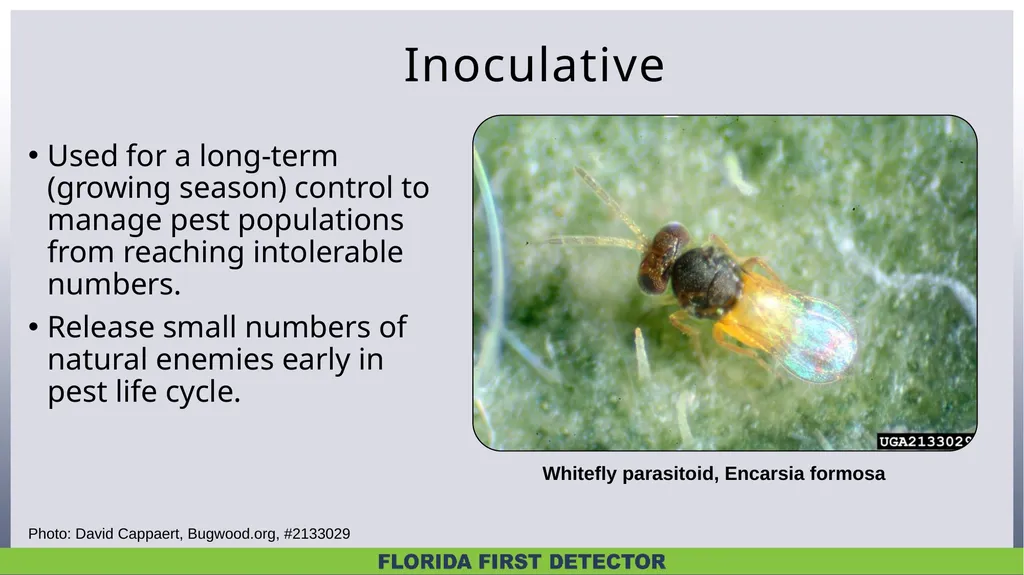
Release small numbers of natural enemies early in pest life cycle. Inoculative Whitefly parasitoid, Encarsia formosa Photo: David Cappaert, Bugwood.org, #2133029<br>
Release small numbers of natural enemies early in pest life cycle. Inoculative Whitefly parasitoid, Encarsia formosa Photo: David Cappaert, Bugwood.org, #2133029<br>
13
During pest outbreaks, natural enemies can be released in large numbers to overwhelm pest numbers.
This provides a quick reduction in pest population.
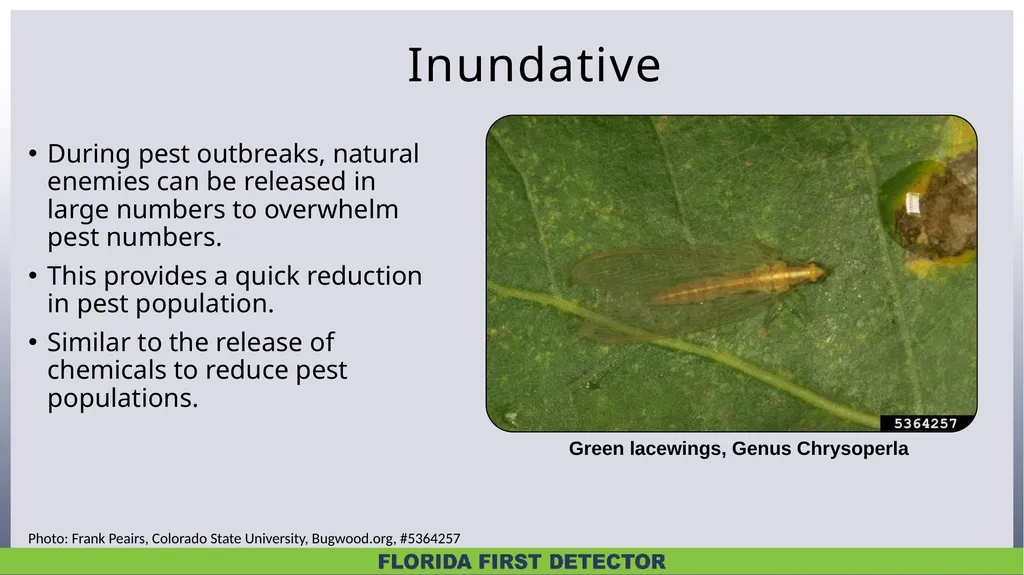
Similar to the release of chemicals to reduce pest populations. Inundative Green lacewings, Genus Chrysoperla Photo: Frank Peairs, Colorado State University, Bugwood.org, #5364257<br>
This provides a quick reduction in pest population.
Similar to the release of chemicals to reduce pest populations. Inundative Green lacewings, Genus Chrysoperla Photo: Frank Peairs, Colorado State University, Bugwood.org, #5364257<br>
14
Reporting to UF/IFAS Faculty in Florida Local county extension office
https://sfyl.ifas.ufl.edu/find-your-local-office/
Insect ID Lab - Dr. Lyle Buss
http://entnemdept.ufl.edu/insectid/
Nematode Diagnostic Lab - Dr. Billy Crow
http://nematology.ifas.ufl.edu/assaylab/index.html
Plant Diagnostic Center - Dr. Carrie Harmon
https://plantpath.ifas.ufl.edu/extension/plant-diagnostic-center/<br>
https://sfyl.ifas.ufl.edu/find-your-local-office/
Insect ID Lab - Dr. Lyle Buss
http://entnemdept.ufl.edu/insectid/
Nematode Diagnostic Lab - Dr. Billy Crow
http://nematology.ifas.ufl.edu/assaylab/index.html
Plant Diagnostic Center - Dr. Carrie Harmon
https://plantpath.ifas.ufl.edu/extension/plant-diagnostic-center/<br>
15
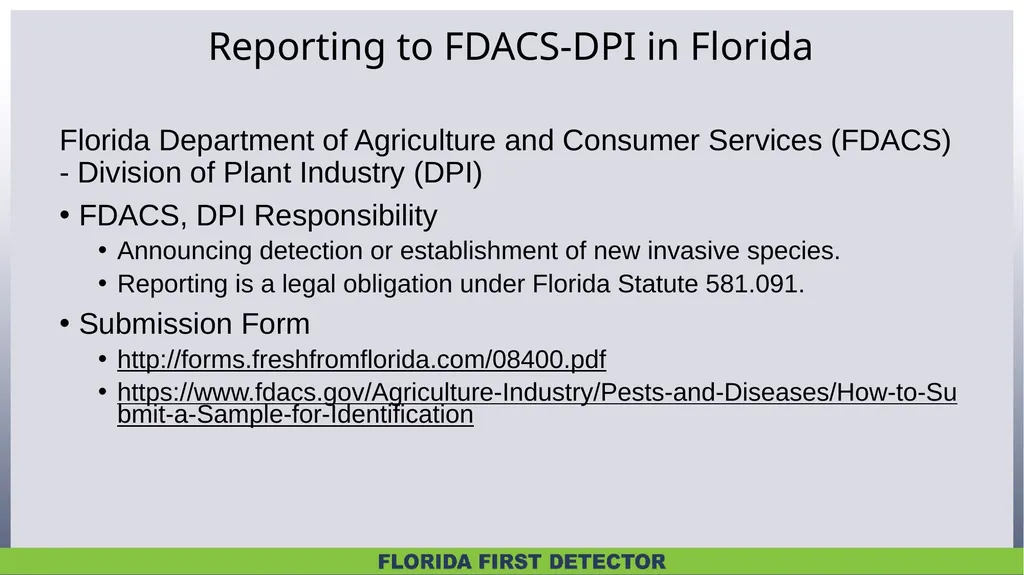
Reporting to FDACS-DPI in Florida Florida Department of Agriculture and Consumer Services (FDACS) - Division of Plant Industry (DPI)
FDACS, DPI Responsibility
Announcing detection or establishment of new invasive species.
Reporting is a legal obligation under Florida Statute 581.091.
Submission Form
http://forms.freshfromflorida.com/08400.pdf
https://www.fdacs.gov/Agriculture-Industry/Pests-and-Diseases/How-to-Submit-a-Sample-for-Identification<br>
FDACS, DPI Responsibility
Announcing detection or establishment of new invasive species.
Reporting is a legal obligation under Florida Statute 581.091.
Submission Form
http://forms.freshfromflorida.com/08400.pdf
https://www.fdacs.gov/Agriculture-Industry/Pests-and-Diseases/How-to-Submit-a-Sample-for-Identification<br>
16
FDACS, DPI Contact Dr. Leroy Whilby, Bureau Chief-Entomology, Nematology and Plant Pathology
352-395-4661
Leroy.whilby@freshfromflorida.com
Dr. Paul Skelley, Assistant Chief-Entomology, Nematology and Plant Pathology
352-395-4678
Paul.skelley@freshfromflorida.com
Division of Plant Industry Hotline
1-888-397-1517
DPIHelpline@FDACS.gov<br>
352-395-4661
Leroy.whilby@freshfromflorida.com
Dr. Paul Skelley, Assistant Chief-Entomology, Nematology and Plant Pathology
352-395-4678
Paul.skelley@freshfromflorida.com
Division of Plant Industry Hotline
1-888-397-1517
DPIHelpline@FDACS.gov<br>
17
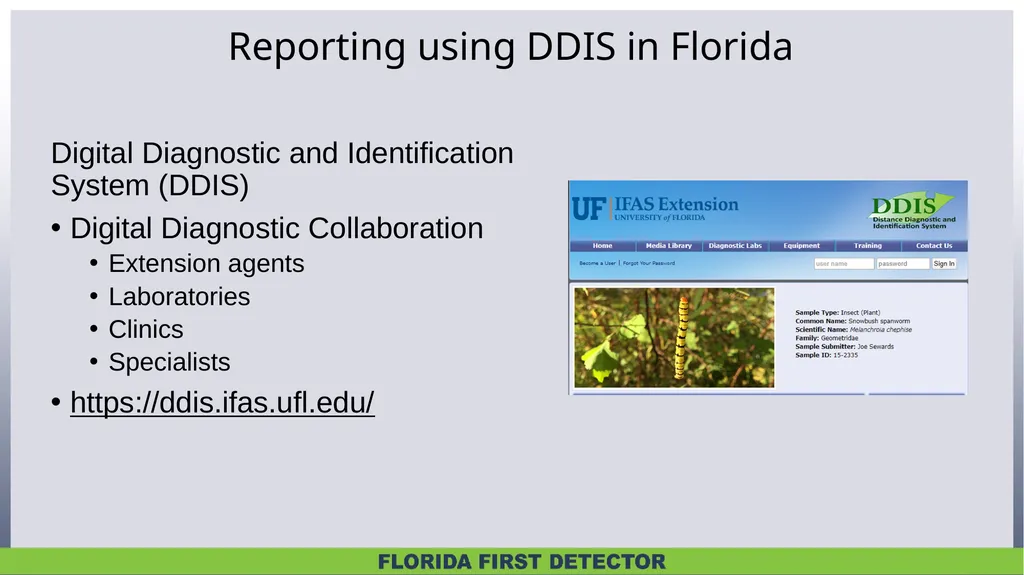
Reporting using DDIS in Florida Digital Diagnostic and Identification System (DDIS)
Digital Diagnostic Collaboration
Extension agents
Laboratories
Clinics
Specialists
https://ddis.ifas.ufl.edu/<br>
Digital Diagnostic Collaboration
Extension agents
Laboratories
Clinics
Specialists
https://ddis.ifas.ufl.edu/<br>
18
Find More Information At: https://entnemdept.ufl.edu/ffd/<br>
19
Lab Team Authors & Editors
Ariana Rollins, B.S. – Graduate Student, Doctor of Plant Medicine Program, Entomology and Nematology Department, University of Florida Daniela Perez Lugones, M.S. – Graduate Student, Doctor of Plant Medicine Program, Entomology and Nematology Department, University of Florida
Gideon Alake, PhD – Research Assistant Scientist, Entomology and Nematology Department, University of Florida
Jhonson Leonard, M.S. – Graduate Student, Doctor of Plant Medicine Program, Entomology and Nematology Department, University of Florida
Lyuyi Chen, M.S. – Graduate Student, Doctor of Plant Medicine Program, Entomology and Nematology Department, University of Florida
Sarah Tafel, B.S. – Graduate Student, Doctor of Plant Medicine Program, Entomology and Nematology Department, University of Florida
Lab and DPM Program Director
Amanda Hodges, Ph.D. - Extension Scientist and DPM Director, Entomology & Nematology Department, University of Florida<br>
Ariana Rollins, B.S. – Graduate Student, Doctor of Plant Medicine Program, Entomology and Nematology Department, University of Florida Daniela Perez Lugones, M.S. – Graduate Student, Doctor of Plant Medicine Program, Entomology and Nematology Department, University of Florida
Gideon Alake, PhD – Research Assistant Scientist, Entomology and Nematology Department, University of Florida
Jhonson Leonard, M.S. – Graduate Student, Doctor of Plant Medicine Program, Entomology and Nematology Department, University of Florida
Lyuyi Chen, M.S. – Graduate Student, Doctor of Plant Medicine Program, Entomology and Nematology Department, University of Florida
Sarah Tafel, B.S. – Graduate Student, Doctor of Plant Medicine Program, Entomology and Nematology Department, University of Florida
Lab and DPM Program Director
Amanda Hodges, Ph.D. - Extension Scientist and DPM Director, Entomology & Nematology Department, University of Florida<br>
20
Collaborating Agencies U.S. Department of Agriculture Animal and Plant Health Inspection Service (USDA-APHIS)
Cooperative Agricultural Pest Survey Program (CAPS)
Florida Department of Agriculture and Consumer Services (FDACS)
National Plant Diagnostic Network (NPDN)
Sentinel Plant Network (SPN)
University of Florida Institute of Food and Agricultural Sciences (UF-IFAS)
Protect U.S.<br>
Cooperative Agricultural Pest Survey Program (CAPS)
Florida Department of Agriculture and Consumer Services (FDACS)
National Plant Diagnostic Network (NPDN)
Sentinel Plant Network (SPN)
University of Florida Institute of Food and Agricultural Sciences (UF-IFAS)
Protect U.S.<br>
21
Educational Disclaimer and Citation This presentation can be used for educational purposes for NON-PROFIT workshops, trainings, etc.
Citation:
University of Florida, Entomology and Nematology Department, Biosecurity Research and Education Lab. May 2024. Biological Controls, Day Accessed<br>
Citation:
University of Florida, Entomology and Nematology Department, Biosecurity Research and Education Lab. May 2024. Biological Controls, Day Accessed<br>
22
UPDATE INFORMATION FOR AUTHORS
*Keep slide hidden* Presentation Topic: Biological Controls
Updated by: Ariana Rollins
Update began (dd/mm/yy): 5/1/2024
Update complete (dd/mm/yy): 5/9/2024
Uploaded to site (dd/mm/yy):<br>
Updated by: Ariana Rollins
Update began (dd/mm/yy): 5/1/2024
Update complete (dd/mm/yy): 5/9/2024
Uploaded to site (dd/mm/yy):<br>