
BIOLOGY 2E Chapter 7 CELLULAR RESPIRATION


Description: BIOLOGY 2E Chapter 7 CELLULAR RESPIRATION PowerPoint Image Slideshow This work is licensed under a Creative Commons Attribution-NonCommercial-ShareAlike 4.0 International License. Cells extract energy from food to generate ATP in a process
Related Topics
Download Presentation
"BIOLOGY 2E Chapter 7 CELLULAR RESPIRATION" is the property of its rightful owner. Permission is granted to download and print the materials on this website for personal, non-commercial use only, and to display it on your personal computer provided you do not modify the materials and that you retain all copyright notices contained in the materials. By downloading content from our website, you accept the terms of this agreement.
Presentation Transcript
slide1. BIOLOGY 2E
Chapter 7 CELLULAR RESPIRATION
PowerPoint Image Slideshow This work is licensed under a Creative Commons Attribution-NonCommercial-ShareAlike 4.0 International License.<br>
slide2. Cells extract energy from food to generate ATP in a process called glucose catabolism or cellular respiration.
As we work through the metabolic pathways involved, notice the close link between the transfer of energy and the movement of electrons (electrons have high energy levels).
This incremental transfer of electrons allows the cell to transfer food energy in small packages that can be captured in the phosphate bonds of ATP. OVERVIEW: CELLULAR RESPIRATION<br>
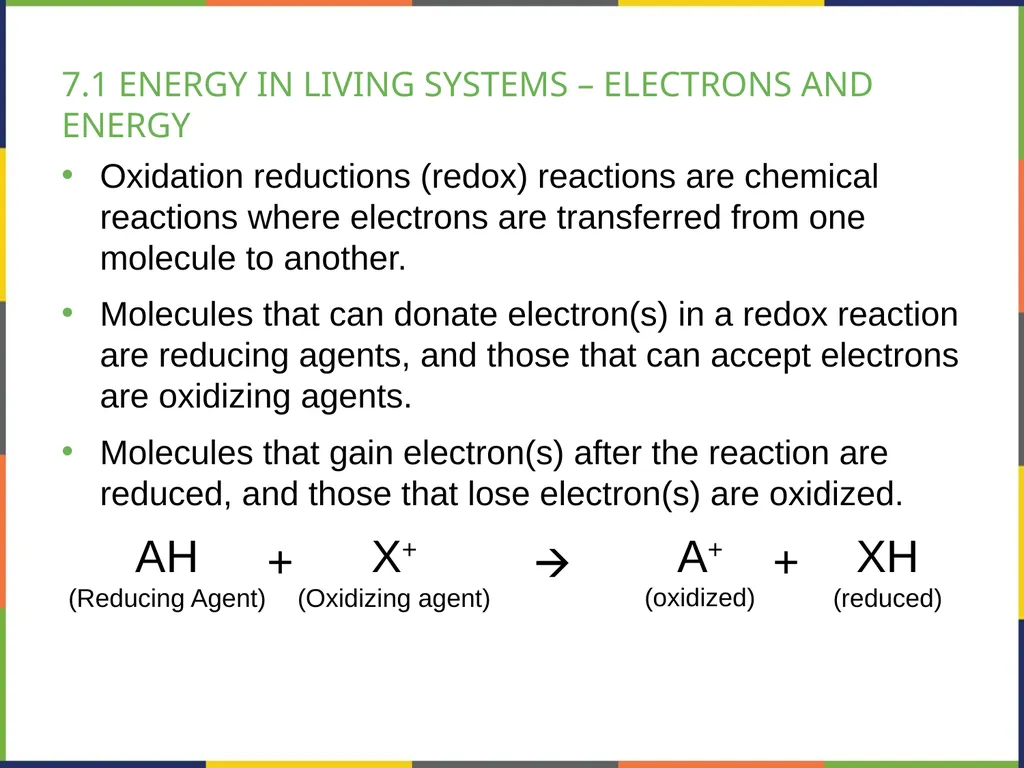
slide3. 7.1 ENERGY IN LIVING SYSTEMS – ELECTRONS AND ENERGY Oxidation reductions (redox) reactions are chemical reactions where electrons are transferred from one molecule to another.
Molecules that can donate electron(s) in a redox reaction are reducing agents, and those that can accept electrons are oxidizing agents.
Molecules that gain electron(s) after the reaction are reduced, and those that lose electron(s) are oxidized. AH
(Reducing Agent) X+
(Oxidizing agent) A+
(oxidized) XH
(reduced) + 🡪 +<br>
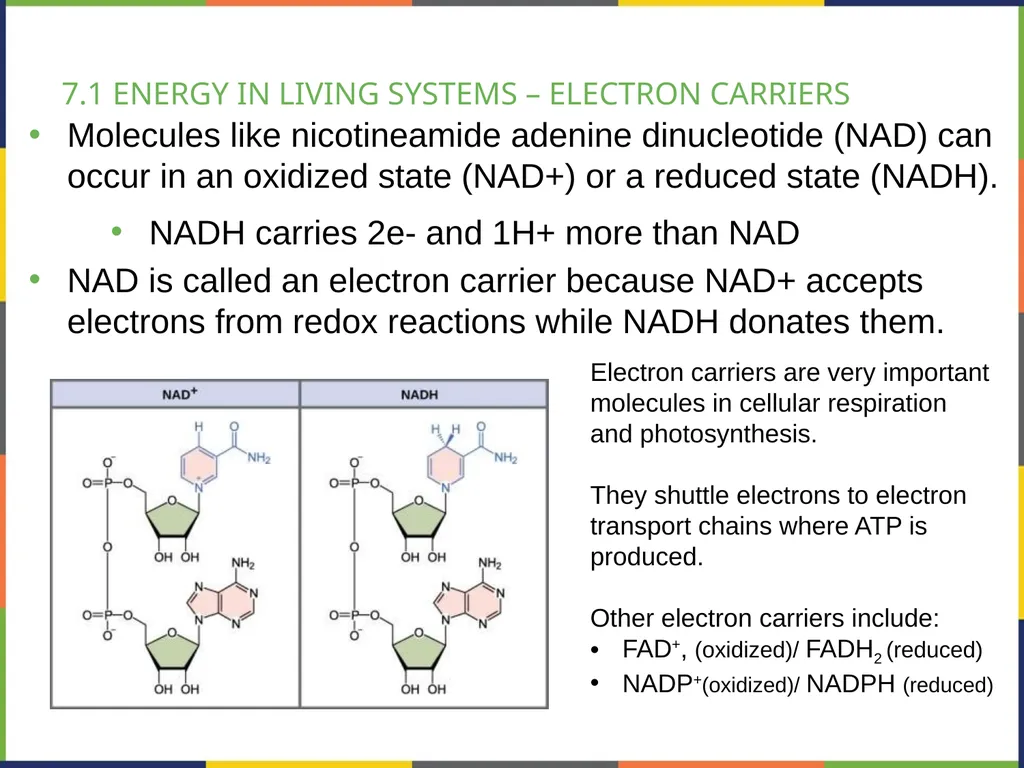
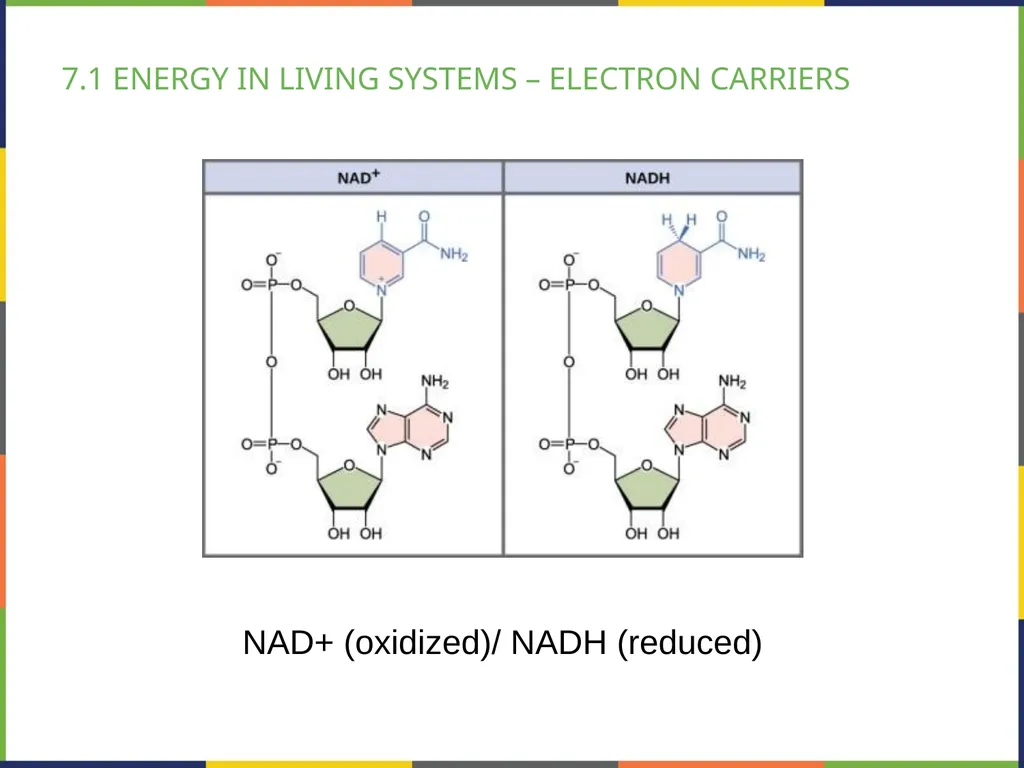
slide4. 7.1 ENERGY IN LIVING SYSTEMS – ELECTRON CARRIERS Molecules like nicotineamide adenine dinucleotide (NAD) can occur in an oxidized state (NAD+) or a reduced state (NADH).
NADH carries 2e- and 1H+ more than NAD
NAD is called an electron carrier because NAD+ accepts electrons from redox reactions while NADH donates them. Electron carriers are very important molecules in cellular respiration and photosynthesis.
They shuttle electrons to electron transport chains where ATP is produced.
Other electron carriers include:
FAD+, (oxidized)/ FADH2 (reduced)
NADP+(oxidized)/ NADPH (reduced)<br>
slide5. 7.1 ENERGY IN LIVING SYSTEMS – ELECTRON CARRIERS NAD+ (oxidized)/ NADH (reduced)<br>
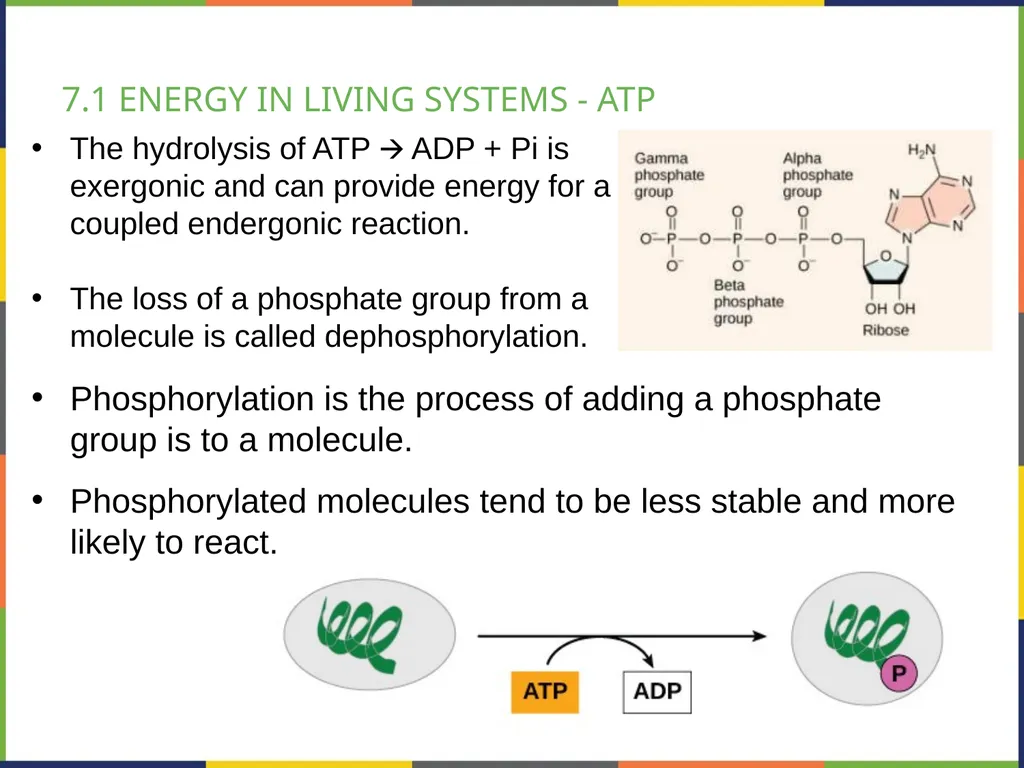
slide6. 7.1 ENERGY IN LIVING SYSTEMS - ATP The hydrolysis of ATP 🡪 ADP + Pi is exergonic and can provide energy for a coupled endergonic reaction.
The loss of a phosphate group from a molecule is called dephosphorylation. Phosphorylation is the process of adding a phosphate group is to a molecule.
Phosphorylated molecules tend to be less stable and more likely to react.<br>
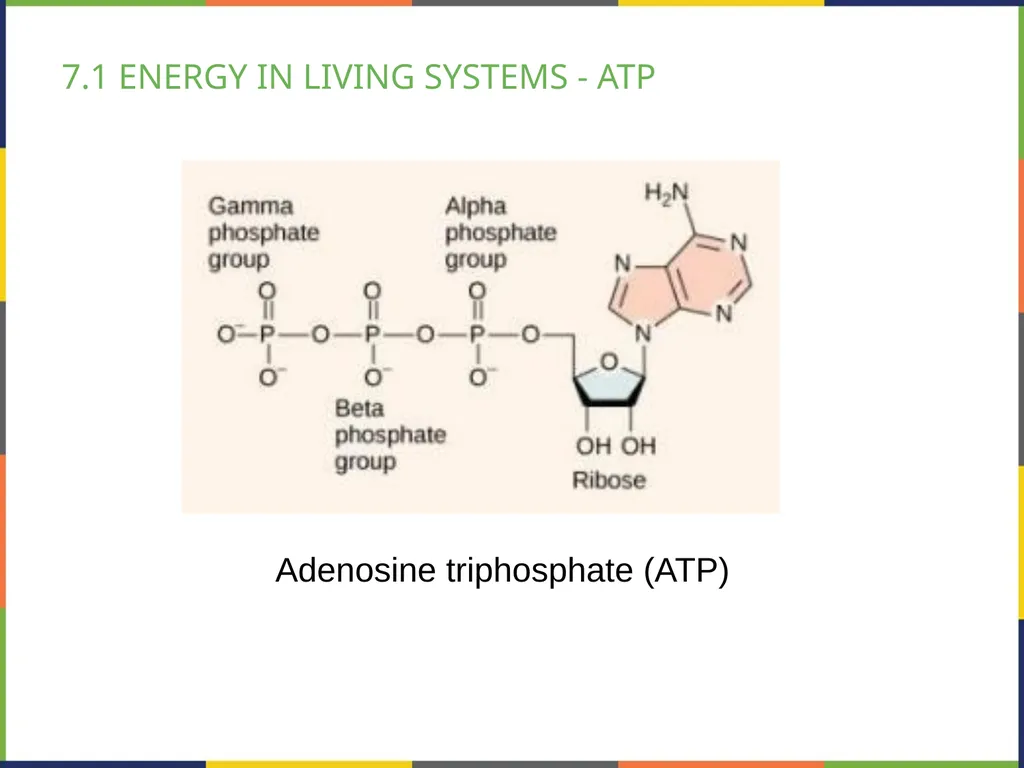
slide7. 7.1 ENERGY IN LIVING SYSTEMS - ATP Adenosine triphosphate (ATP)<br>
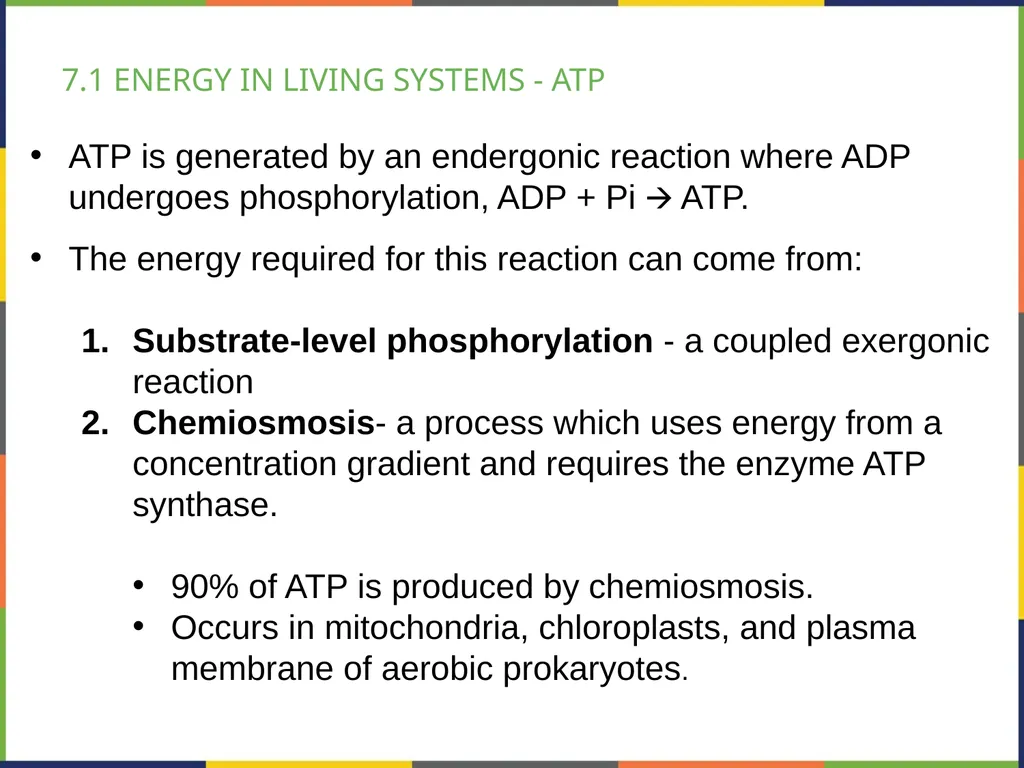
slide8. 7.1 ENERGY IN LIVING SYSTEMS - ATP ATP is generated by an endergonic reaction where ADP undergoes phosphorylation, ADP + Pi 🡪 ATP.
The energy required for this reaction can come from:
Substrate-level phosphorylation - a coupled exergonic reaction
Chemiosmosis- a process which uses energy from a concentration gradient and requires the enzyme ATP synthase.
90% of ATP is produced by chemiosmosis.
Occurs in mitochondria, chloroplasts, and plasma membrane of aerobic prokaryotes.<br>
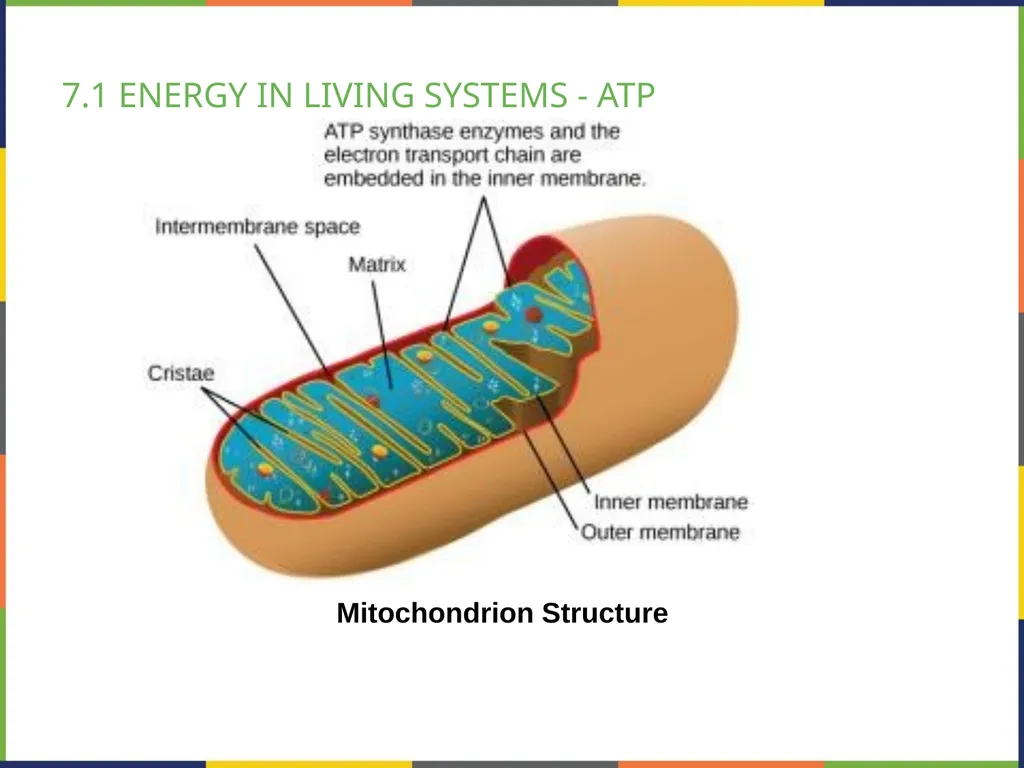
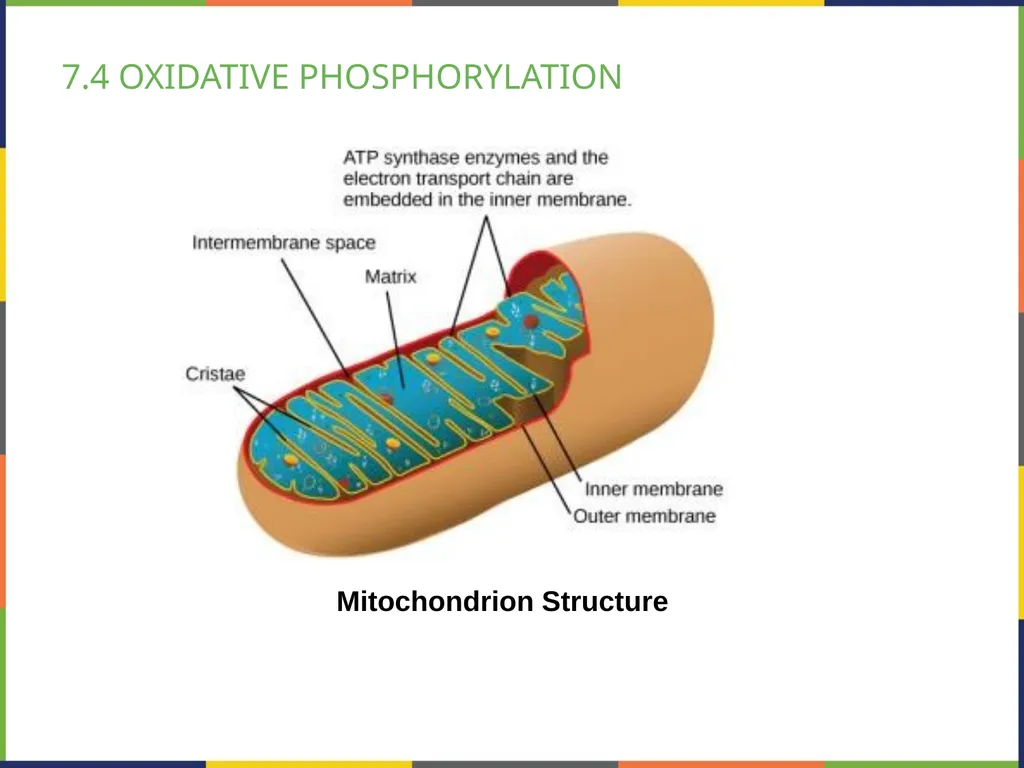
slide9. 7.1 ENERGY IN LIVING SYSTEMS - ATP Mitochondrion Structure<br>
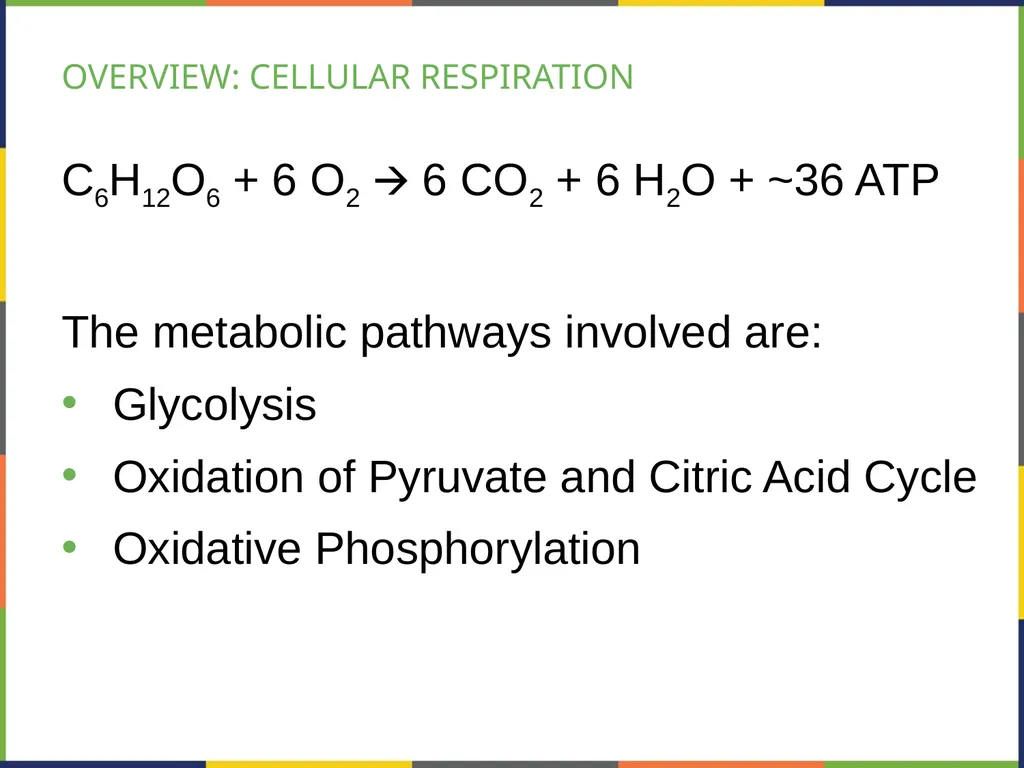
slide10. OVERVIEW: CELLULAR RESPIRATION C6H12O6 + 6 O2 🡪 6 CO2 + 6 H2O + ~36 ATP
The metabolic pathways involved are:
Glycolysis
Oxidation of Pyruvate and Citric Acid Cycle
Oxidative Phosphorylation<br>
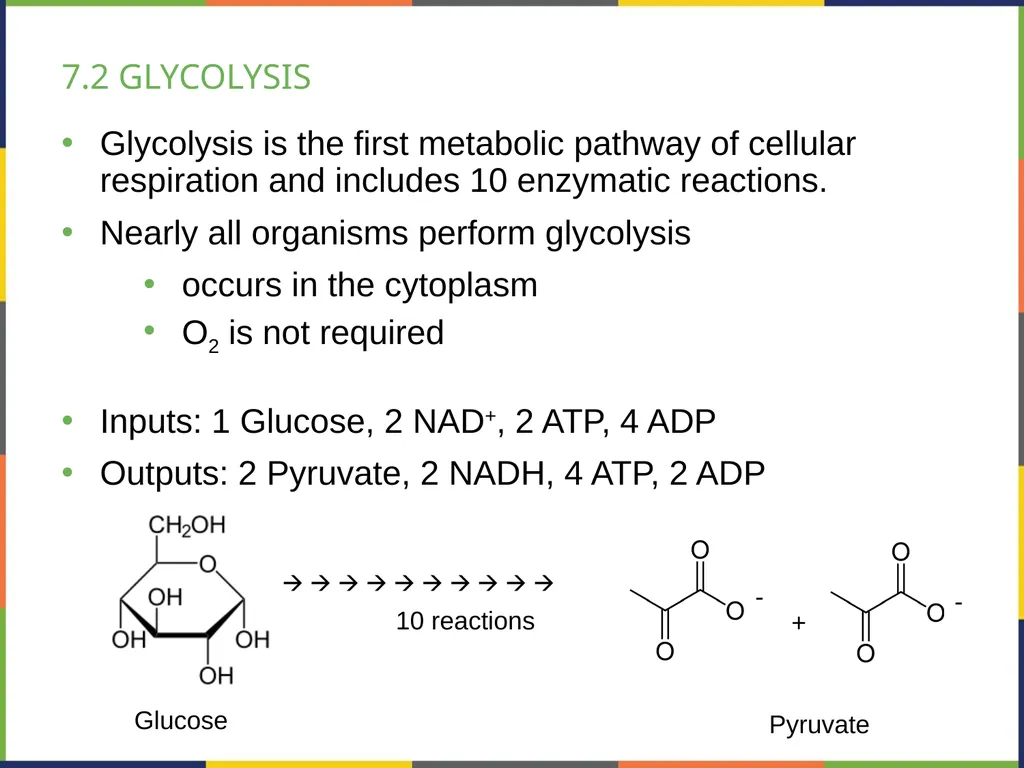
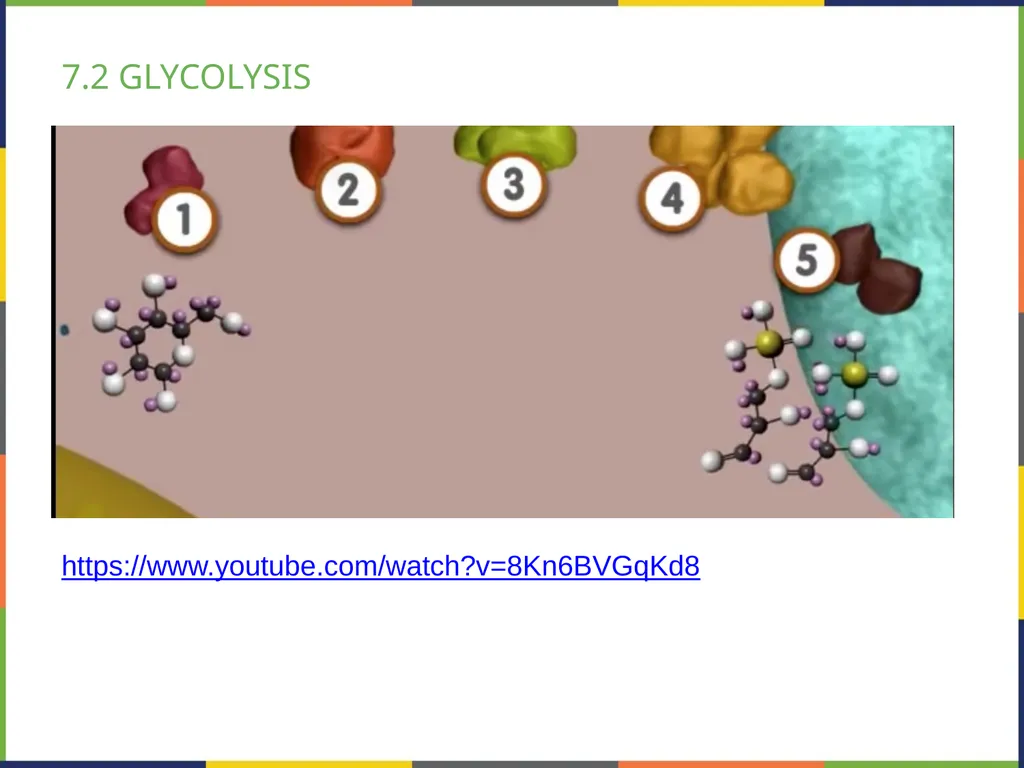
slide11. 7.2 GLYCOLYSIS Glycolysis is the first metabolic pathway of cellular respiration and includes 10 enzymatic reactions.
Nearly all organisms perform glycolysis
occurs in the cytoplasm
O2 is not required
Inputs: 1 Glucose, 2 NAD+, 2 ATP, 4 ADP
Outputs: 2 Pyruvate, 2 NADH, 4 ATP, 2 ADP - - + 🡪 🡪 🡪 🡪 🡪 🡪 🡪 🡪 🡪 🡪 Glucose 10 reactions Pyruvate<br>
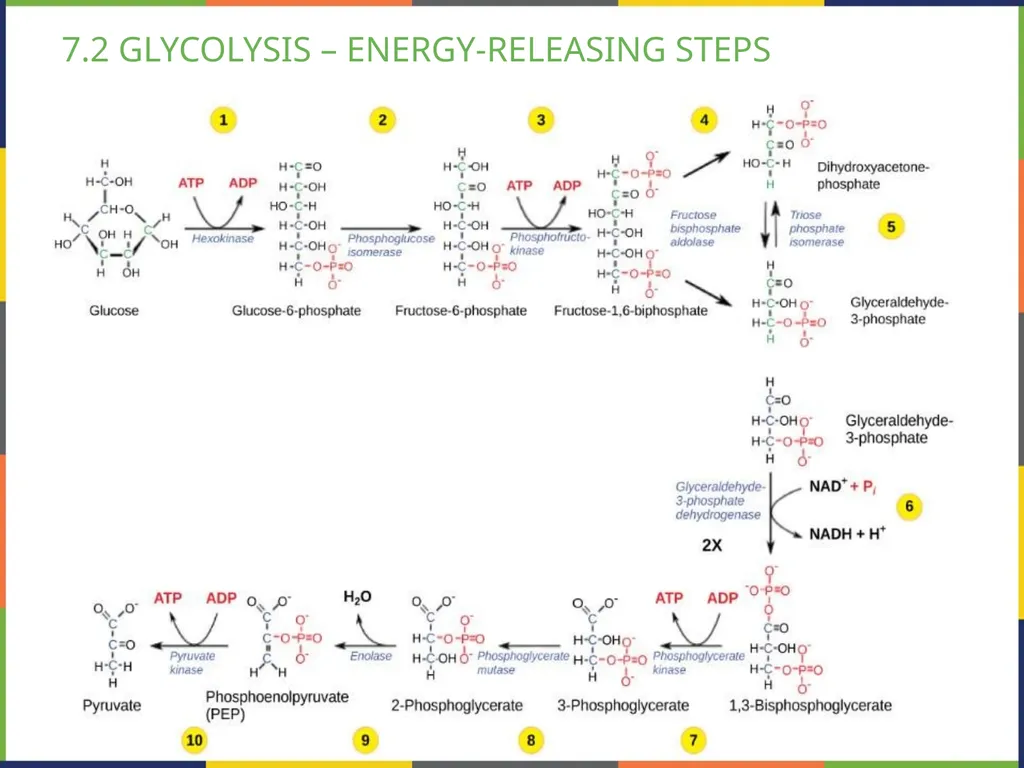
slide12. 7.2 GLYCOLYSIS – ENERGY-REQUIRING STEPS The first half of glycolysis involves 5 enzymes and uses two ATP molecules.
Glucose is phosphorylated twice and then split into two three-carbon molecules, called glyceraldehyde-3-phosphate (G3P).<br>
slide13. 7.2 GLYCOLYSIS – ENERGY-REQUIRING STEPS<br>
slide14. 7.2 GLYCOLYSIS – ENERGY-REQUIRING STEPS<br>
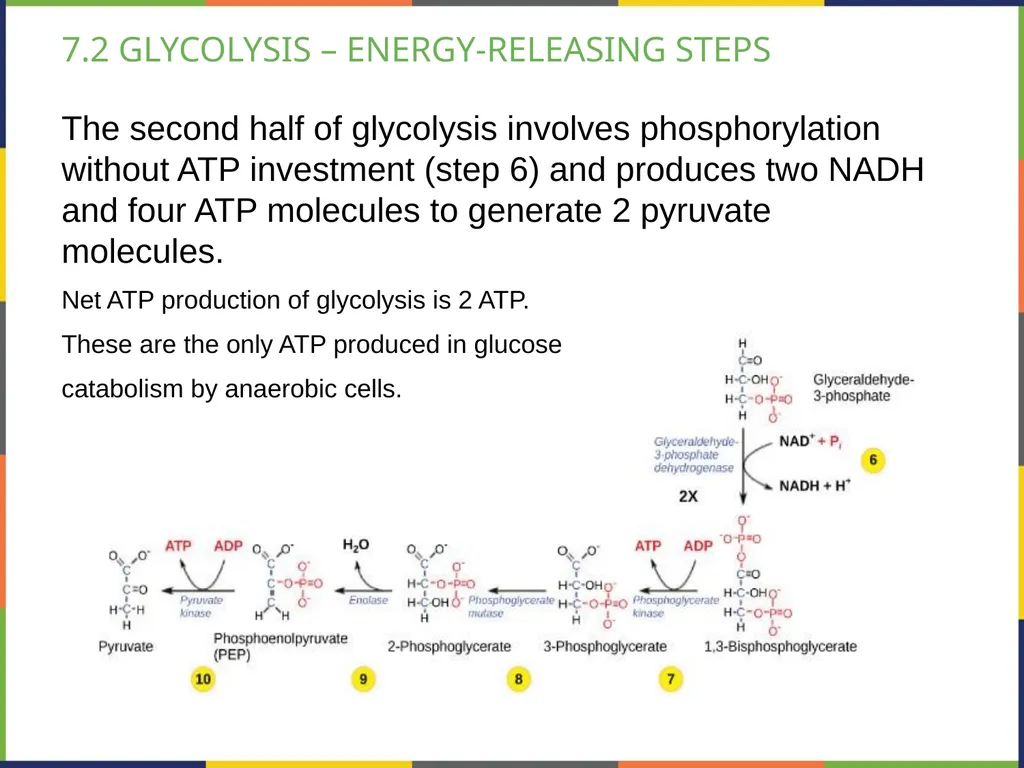
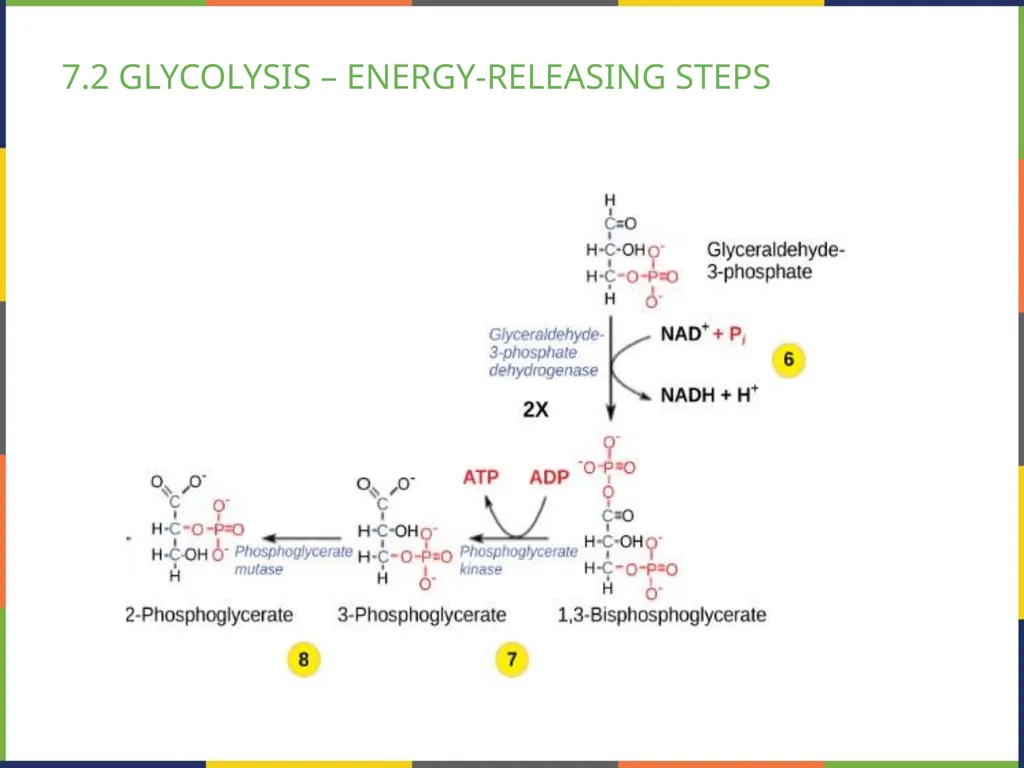
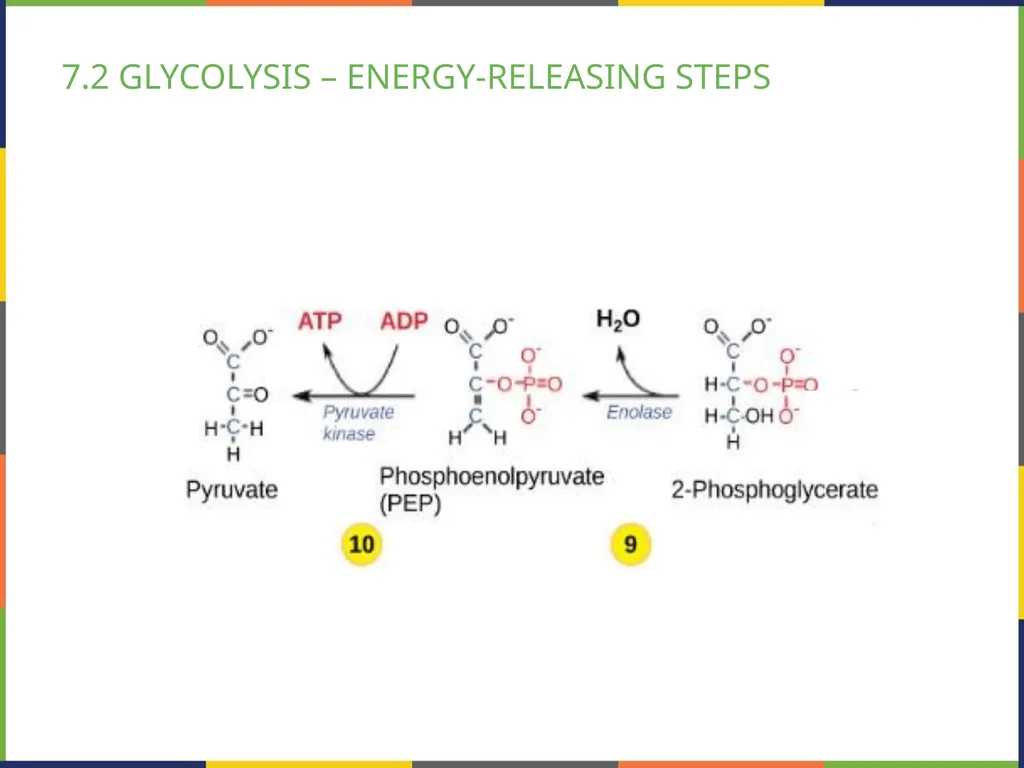
slide15. 7.2 GLYCOLYSIS – ENERGY-RELEASING STEPS The second half of glycolysis involves phosphorylation without ATP investment (step 6) and produces two NADH and four ATP molecules to generate 2 pyruvate molecules.
Net ATP production of glycolysis is 2 ATP.
These are the only ATP produced in glucose
catabolism by anaerobic cells.<br>
slide16. 7.2 GLYCOLYSIS – ENERGY-RELEASING STEPS<br>
slide17. 7.2 GLYCOLYSIS – ENERGY-RELEASING STEPS<br>
slide18. 7.2 GLYCOLYSIS – ENERGY-RELEASING STEPS<br>
slide19. 7.2 GLYCOLYSIS https://www.youtube.com/watch?v=8Kn6BVGqKd8<br>
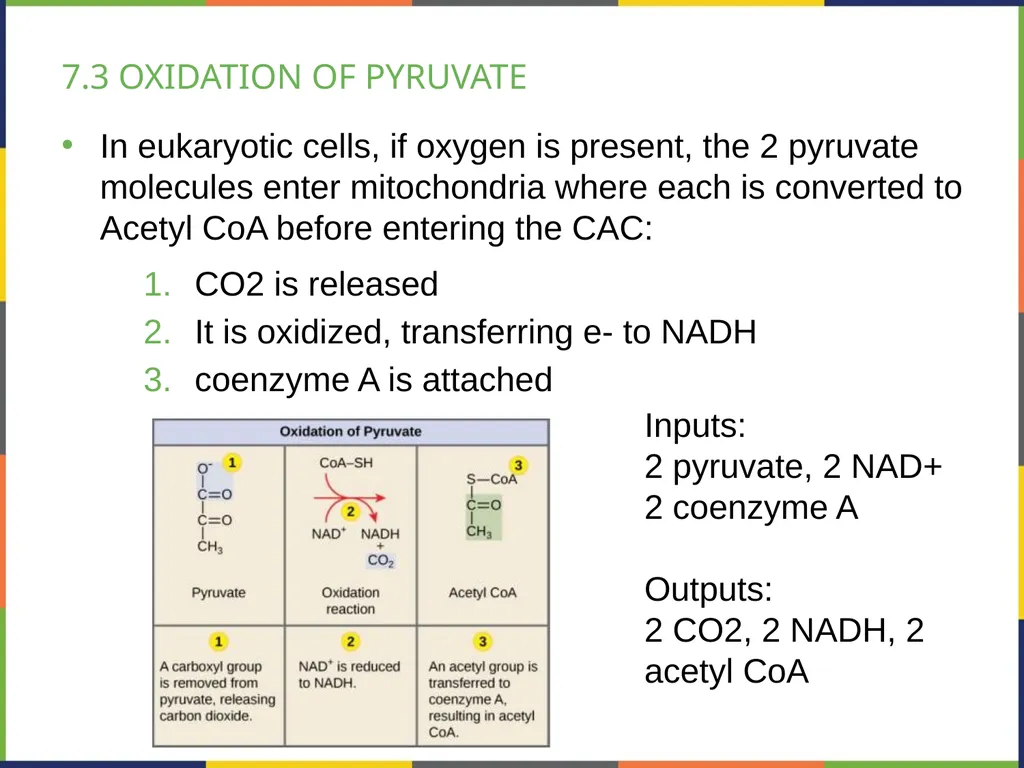
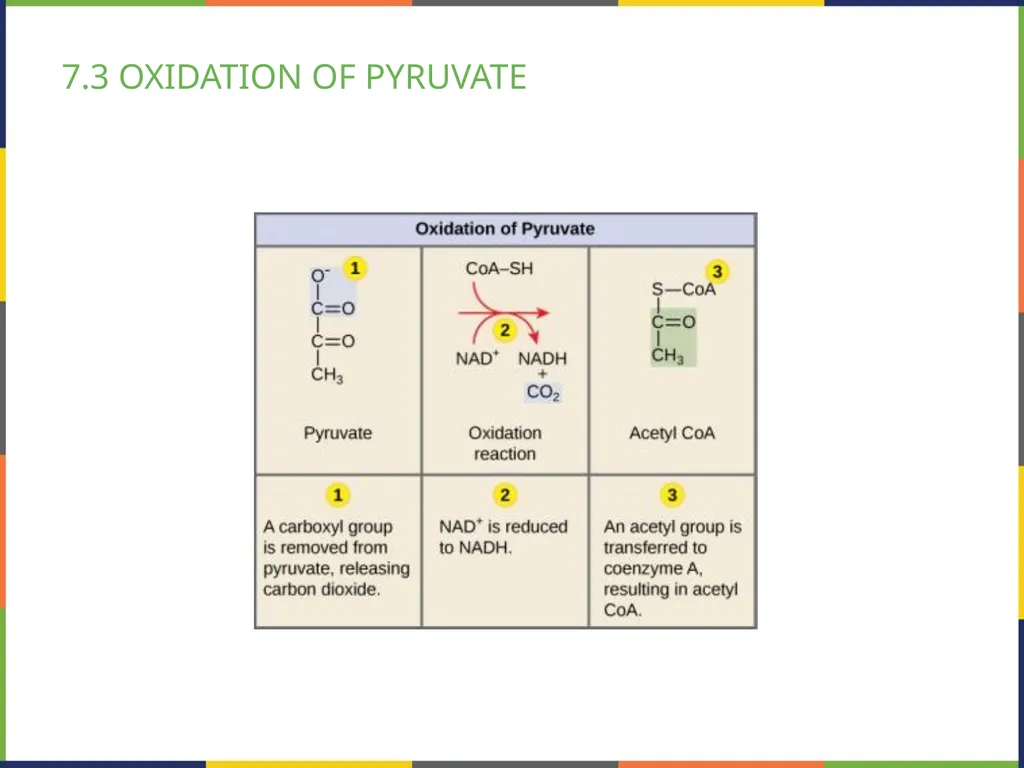
slide20. 7.3 OXIDATION OF PYRUVATE In eukaryotic cells, if oxygen is present, the 2 pyruvate molecules enter mitochondria where each is converted to Acetyl CoA before entering the CAC:
CO2 is released
It is oxidized, transferring e- to NADH
coenzyme A is attached Inputs:
2 pyruvate, 2 NAD+
2 coenzyme A
Outputs:
2 CO2, 2 NADH, 2 acetyl CoA<br>
slide21. 7.3 OXIDATION OF PYRUVATE<br>
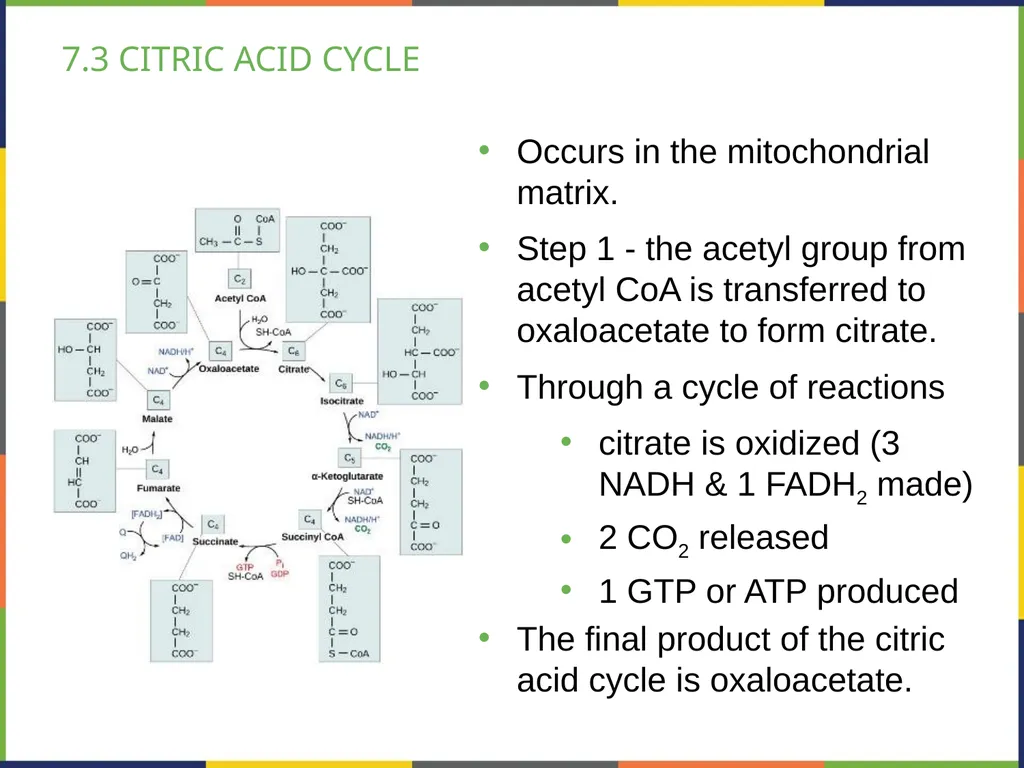
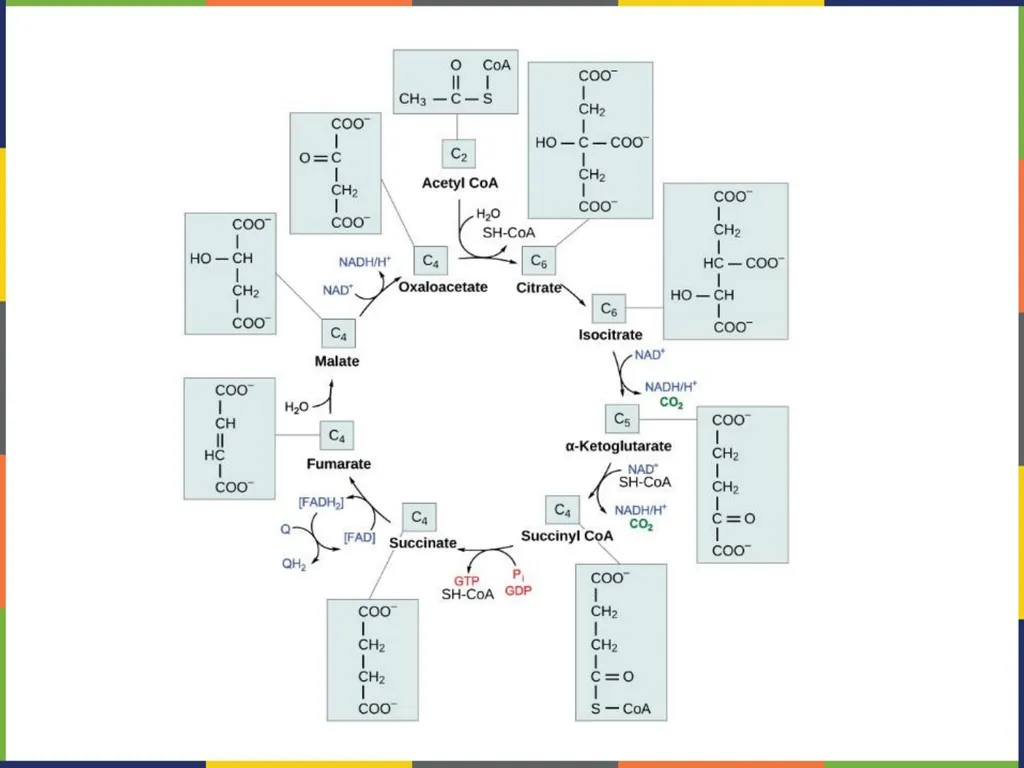
slide22. 7.3 CITRIC ACID CYCLE Occurs in the mitochondrial matrix.
Step 1 - the acetyl group from acetyl CoA is transferred to oxaloacetate to form citrate.
Through a cycle of reactions
citrate is oxidized (3 NADH & 1 FADH2 made)
2 CO2 released
1 GTP or ATP produced
The final product of the citric acid cycle is oxaloacetate.<br>
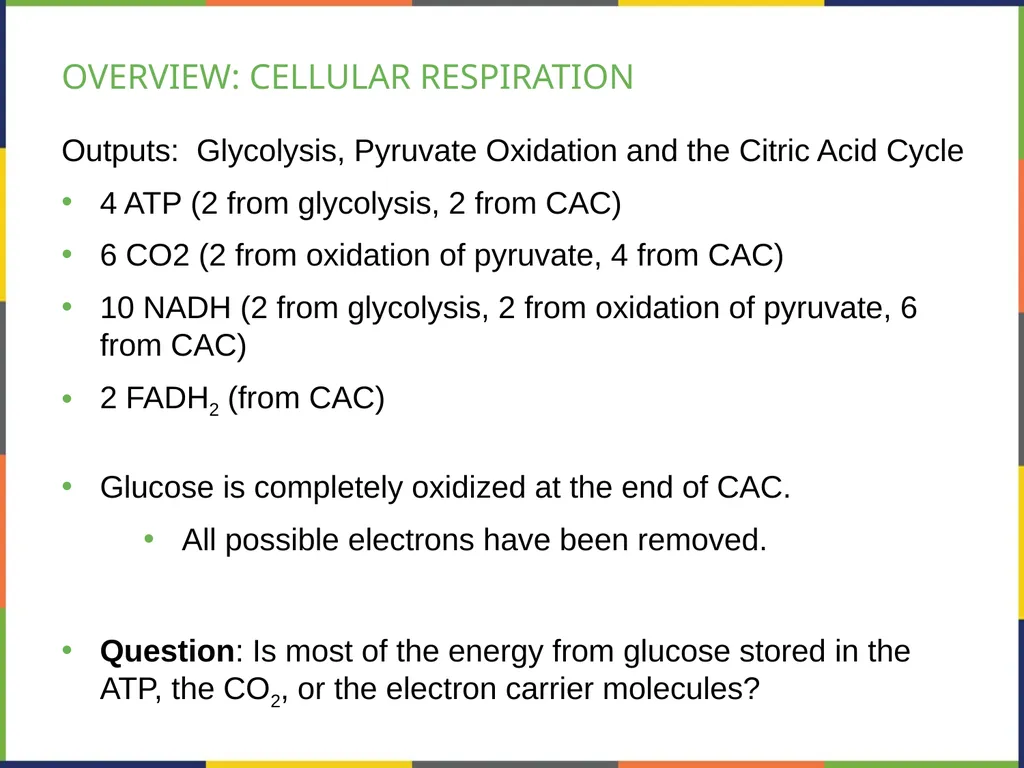
slide24. OVERVIEW: CELLULAR RESPIRATION Outputs: Glycolysis, Pyruvate Oxidation and the Citric Acid Cycle
4 ATP (2 from glycolysis, 2 from CAC)
6 CO2 (2 from oxidation of pyruvate, 4 from CAC)
10 NADH (2 from glycolysis, 2 from oxidation of pyruvate, 6 from CAC)
2 FADH2 (from CAC)
Glucose is completely oxidized at the end of CAC.
All possible electrons have been removed.
Question: Is most of the energy from glucose stored in the ATP, the CO2, or the electron carrier molecules?<br>
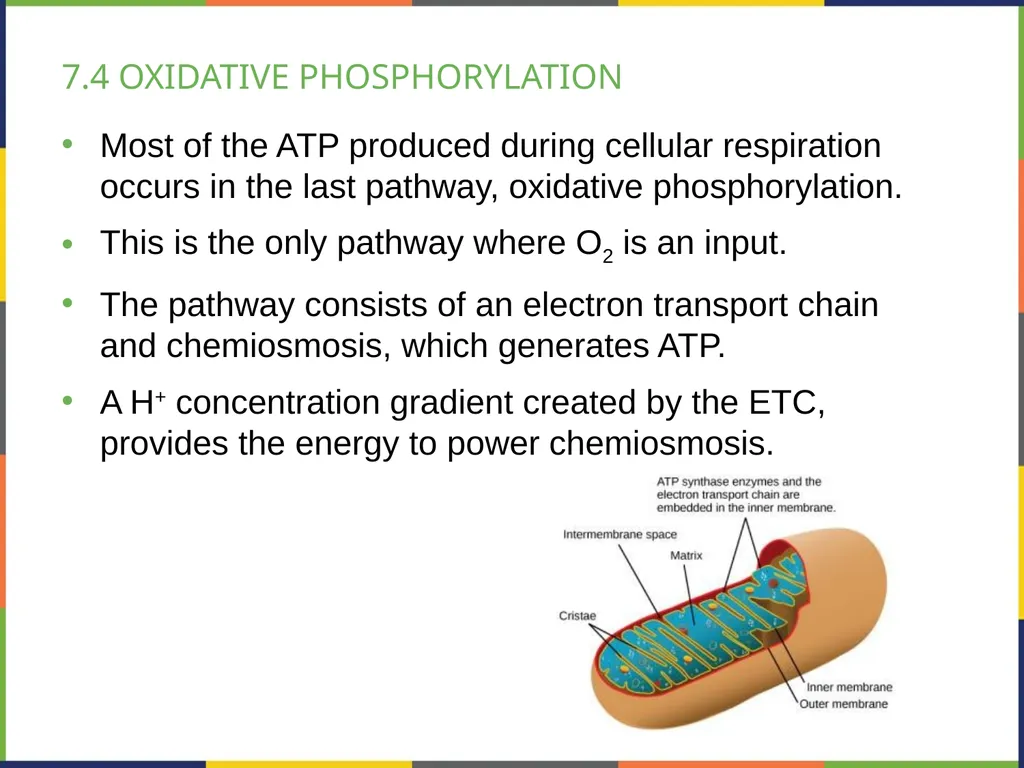
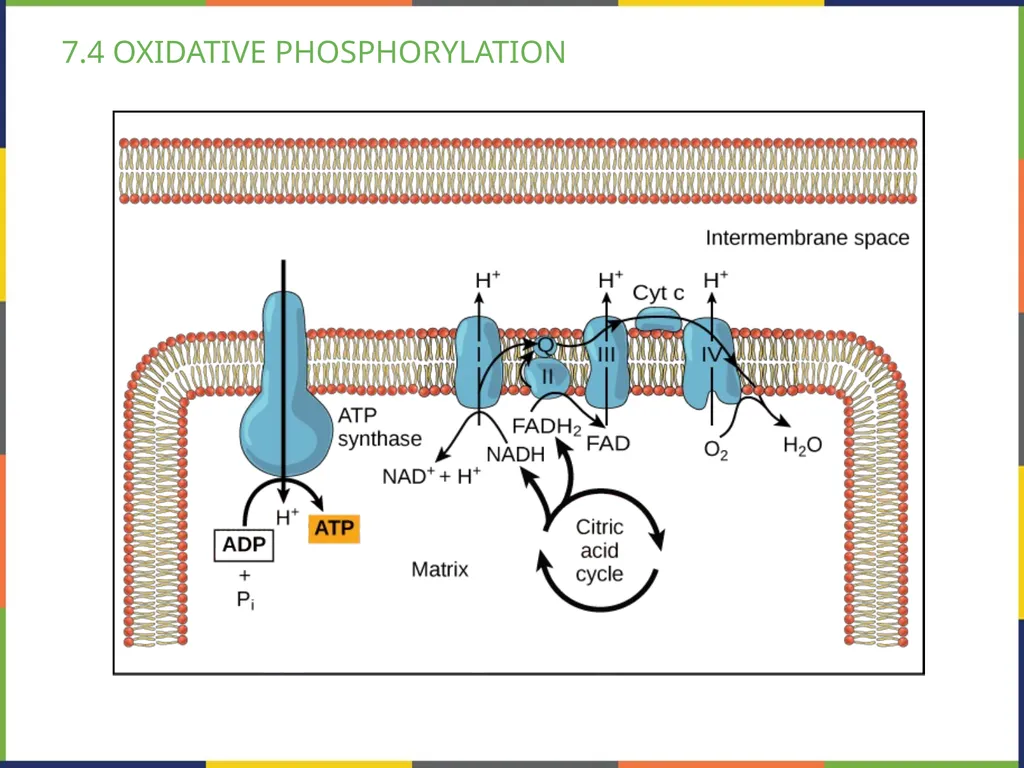
slide25. 7.4 OXIDATIVE PHOSPHORYLATION Most of the ATP produced during cellular respiration occurs in the last pathway, oxidative phosphorylation.
This is the only pathway where O2 is an input.
The pathway consists of an electron transport chain and chemiosmosis, which generates ATP.
A H+ concentration gradient created by the ETC, provides the energy to power chemiosmosis.<br>
slide26. 7.4 OXIDATIVE PHOSPHORYLATION Mitochondrion Structure<br>
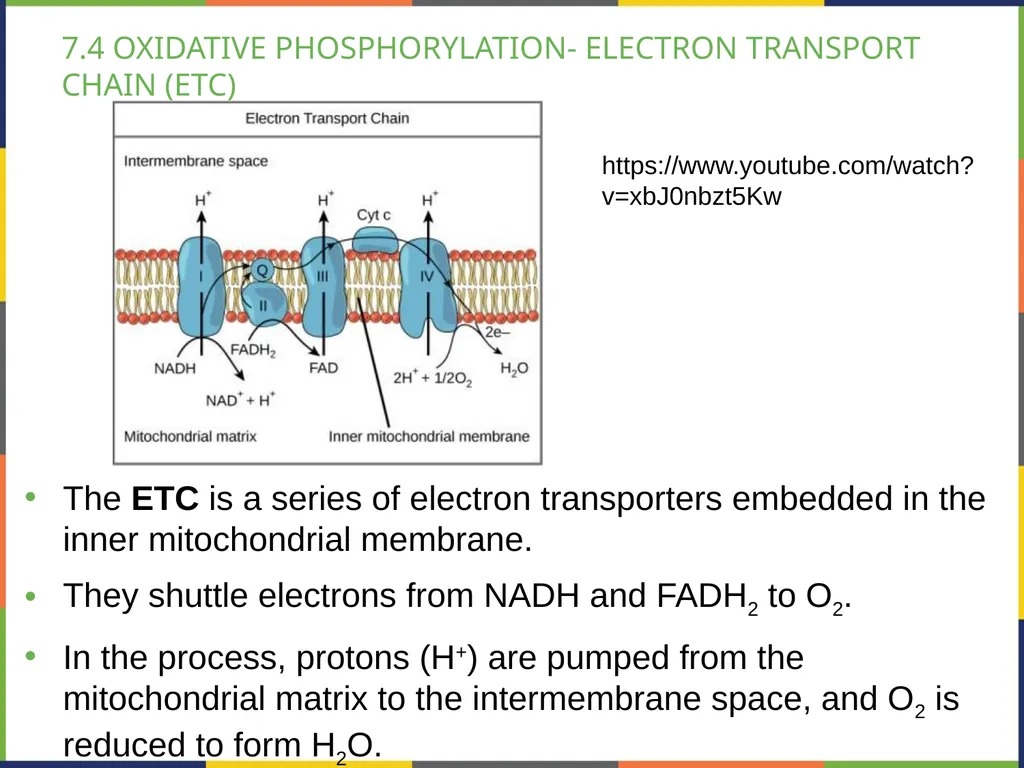
slide27. 7.4 OXIDATIVE PHOSPHORYLATION- ELECTRON TRANSPORT CHAIN (ETC) The ETC is a series of electron transporters embedded in the inner mitochondrial membrane.
They shuttle electrons from NADH and FADH2 to O2.
In the process, protons (H+) are pumped from the mitochondrial matrix to the intermembrane space, and O2 is reduced to form H2O. https://www.youtube.com/watch?v=xbJ0nbzt5Kw<br>
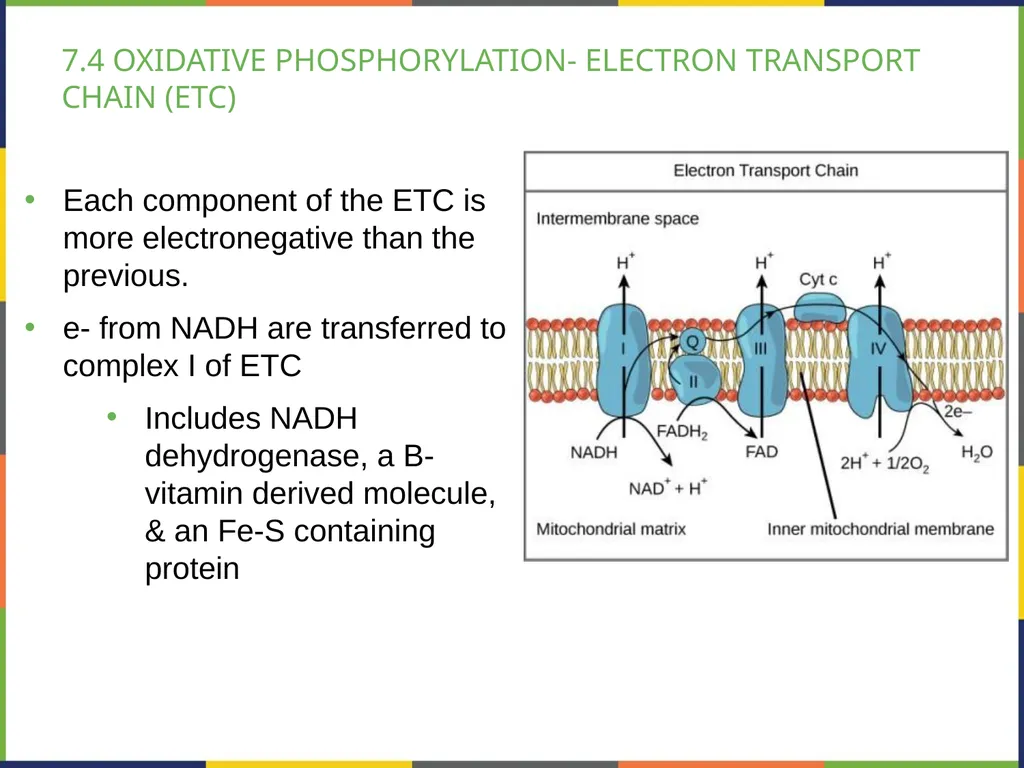
slide28. Each component of the ETC is more electronegative than the previous.
e- from NADH are transferred to complex I of ETC
Includes NADH dehydrogenase, a B-vitamin derived molecule, & an Fe-S containing protein 7.4 OXIDATIVE PHOSPHORYLATION- ELECTRON TRANSPORT CHAIN (ETC)<br>
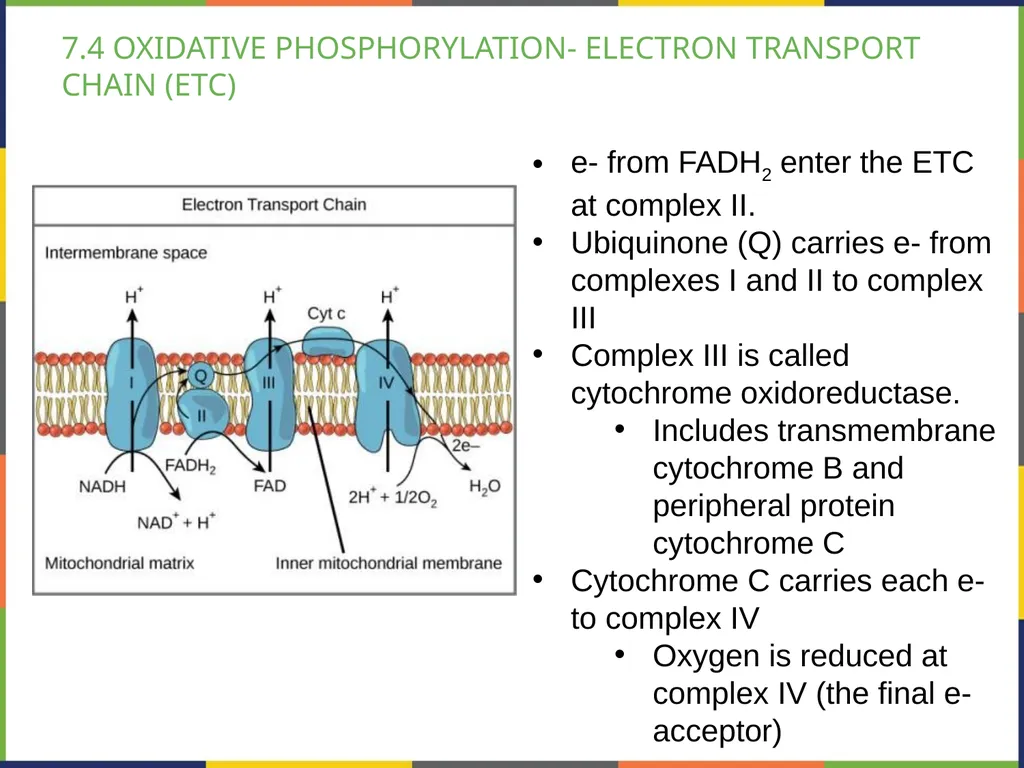
slide29. e- from FADH2 enter the ETC at complex II.
Ubiquinone (Q) carries e- from complexes I and II to complex III
Complex III is called cytochrome oxidoreductase.
Includes transmembrane cytochrome B and peripheral protein cytochrome C
Cytochrome C carries each e- to complex IV
Oxygen is reduced at complex IV (the final e- acceptor) 7.4 OXIDATIVE PHOSPHORYLATION- ELECTRON TRANSPORT CHAIN (ETC)<br>
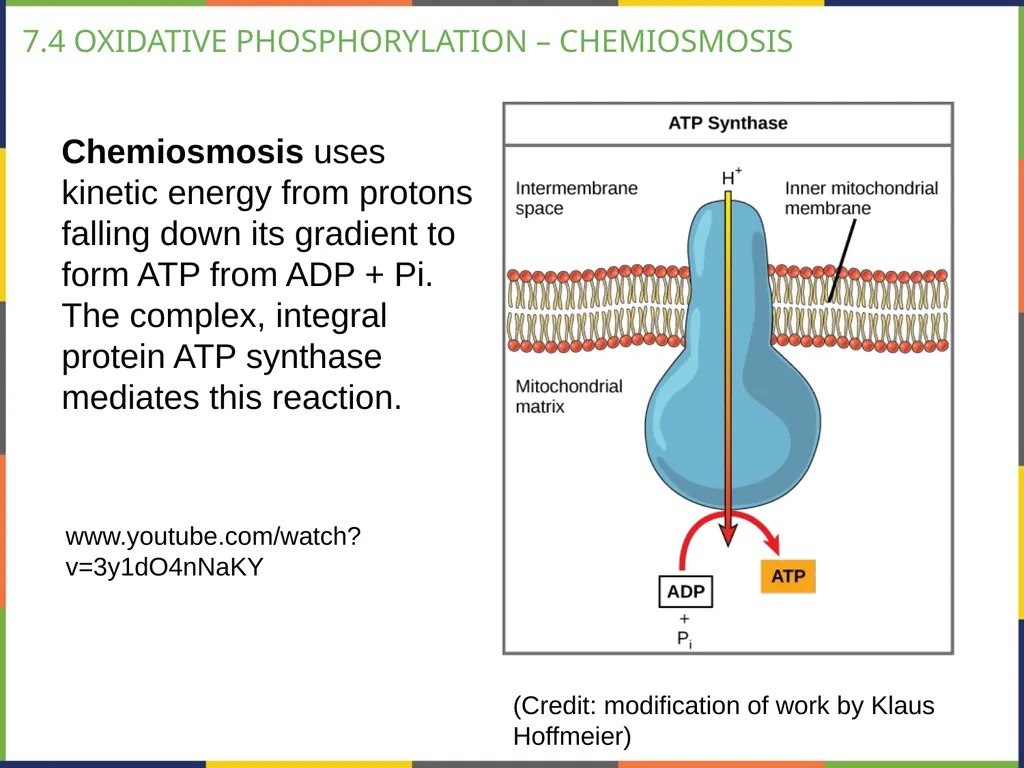
slide30. 7.4 OXIDATIVE PHOSPHORYLATION – CHEMIOSMOSIS Chemiosmosis uses kinetic energy from protons falling down its gradient to form ATP from ADP + Pi. The complex, integral protein ATP synthase mediates this reaction. www.youtube.com/watch?v=3y1dO4nNaKY (Credit: modification of work by Klaus Hoffmeier)<br>
slide31. 7.4 OXIDATIVE PHOSPHORYLATION<br>
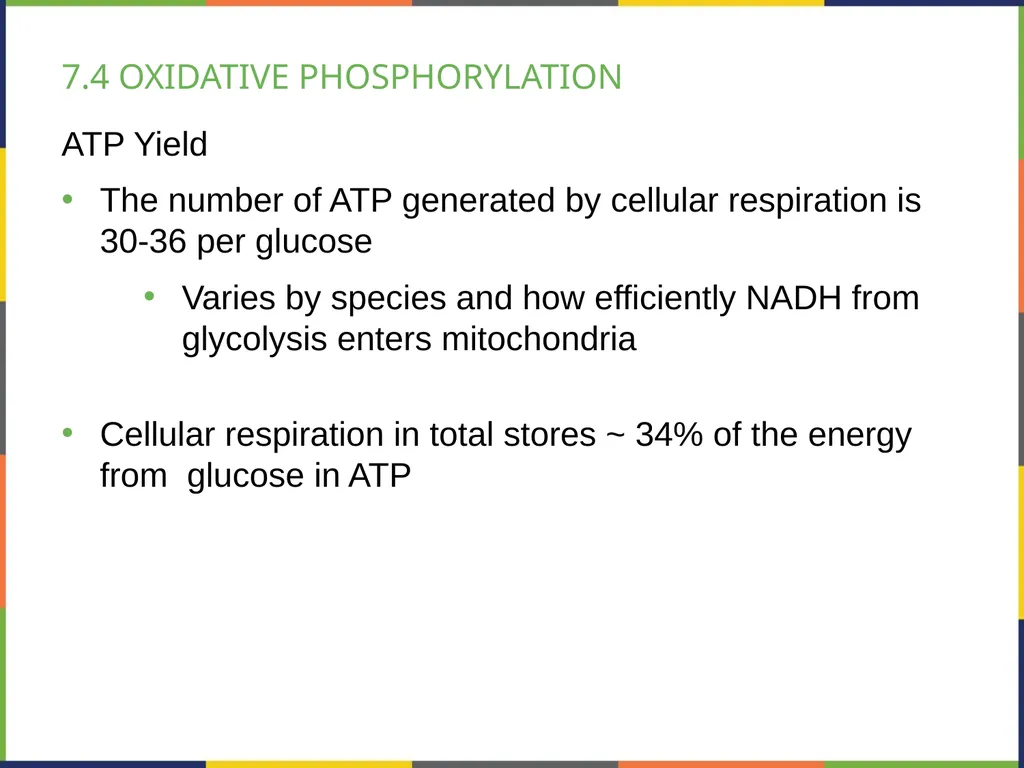
slide32. 7.4 OXIDATIVE PHOSPHORYLATION ATP Yield
The number of ATP generated by cellular respiration is 30-36 per glucose
Varies by species and how efficiently NADH from glycolysis enters mitochondria
Cellular respiration in total stores ~ 34% of the energy from glucose in ATP<br>
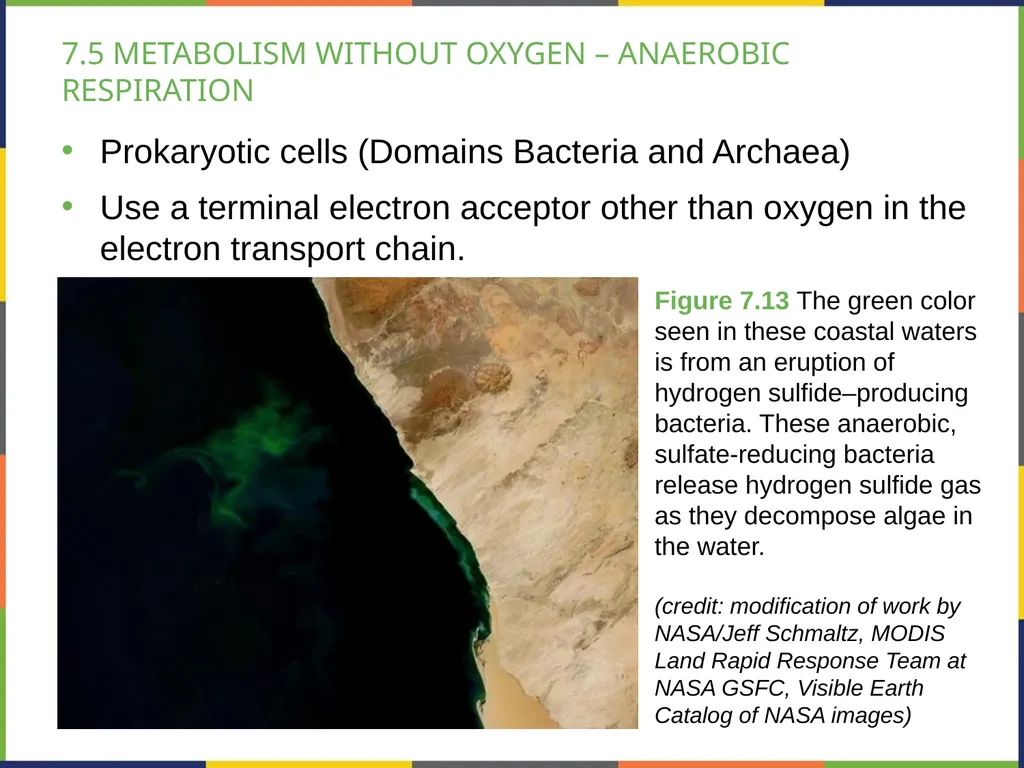
slide33. 7.5 METABOLISM WITHOUT OXYGEN – ANAEROBIC RESPIRATION Prokaryotic cells (Domains Bacteria and Archaea)
Use a terminal electron acceptor other than oxygen in the electron transport chain. Figure 7.13 The green color seen in these coastal waters is from an eruption of hydrogen sulfide–producing bacteria. These anaerobic, sulfate-reducing bacteria release hydrogen sulfide gas as they decompose algae in the water.
(credit: modification of work by NASA/Jeff Schmaltz, MODIS Land Rapid Response Team at NASA GSFC, Visible Earth Catalog of NASA images)<br>
slide34. 7.5 METABOLISM WITHOUT OXYGEN - FERMENTATION Glycolysis occurs in aerobic and anaerobic environments.
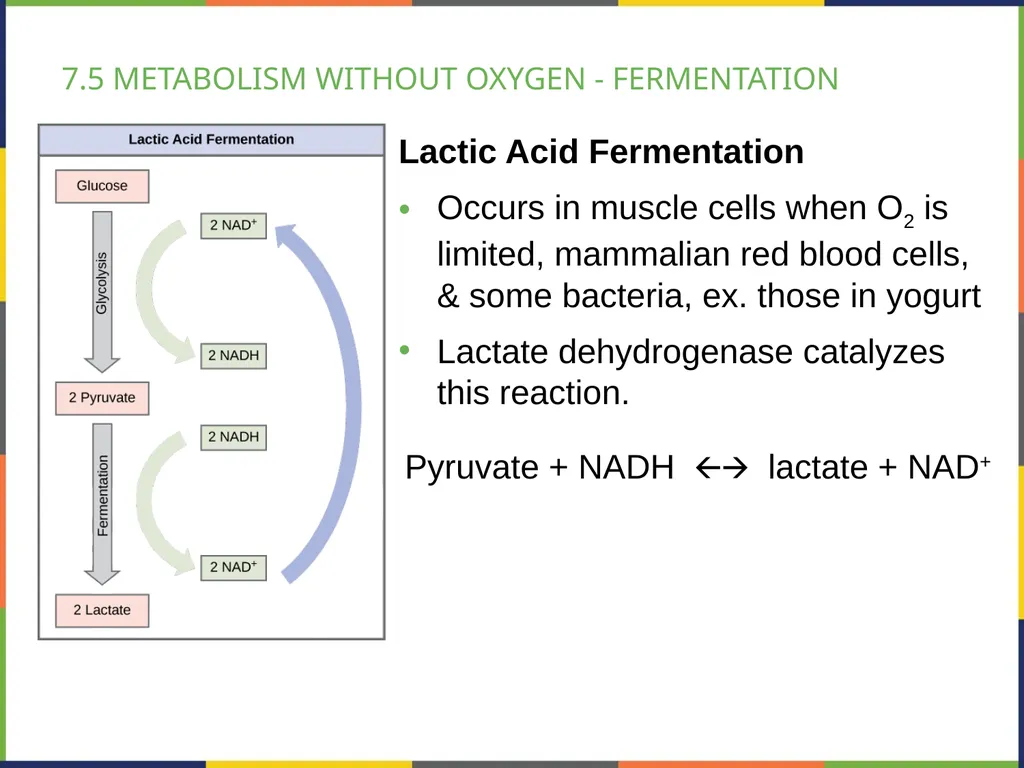
NAD+ is an input of glycolysis; regenerated during oxidative phosphorylation when O2 is present.
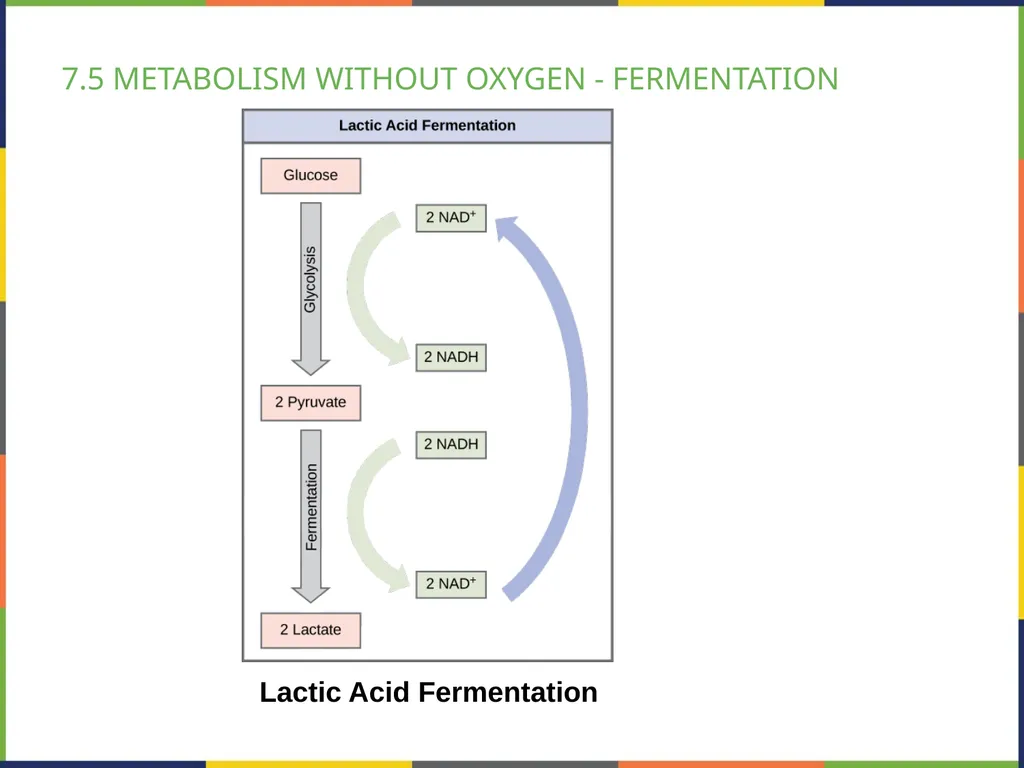
When O2 is lacking, fermentation regenerates NAD+; otherwise, glycolysis would halt.
There are two common types of fermentation
Lactic acid fermentation
Alcohol fermentation<br>
slide35. 7.5 METABOLISM WITHOUT OXYGEN - FERMENTATION Lactic Acid Fermentation
Occurs in muscle cells when O2 is limited, mammalian red blood cells, & some bacteria, ex. those in yogurt
Lactate dehydrogenase catalyzes this reaction. Pyruvate + NADH 🡨🡪 lactate + NAD+<br>
slide36. 7.5 METABOLISM WITHOUT OXYGEN - FERMENTATION Lactic Acid Fermentation<br>
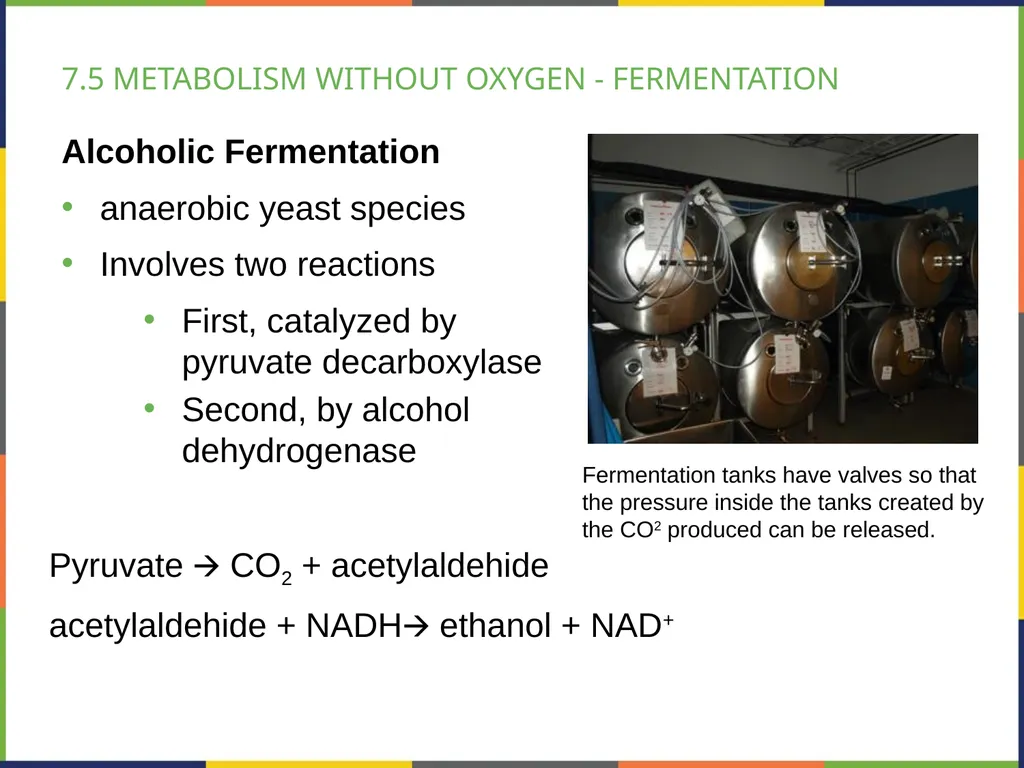
slide37. Alcoholic Fermentation
anaerobic yeast species
Involves two reactions
First, catalyzed by pyruvate decarboxylase
Second, by alcohol dehydrogenase 7.5 METABOLISM WITHOUT OXYGEN - FERMENTATION Fermentation tanks have valves so that the pressure inside the tanks created by the CO2 produced can be released. Pyruvate 🡪 CO2 + acetylaldehide acetylaldehide + NADH🡪 ethanol + NAD+<br>
slide38. 7.5 METABOLISM WITHOUT OXYGEN - FERMENTATION https://www.youtube.com/watch?v=Cngt2HmJuSo Measuring Respiration in Yeast<br>
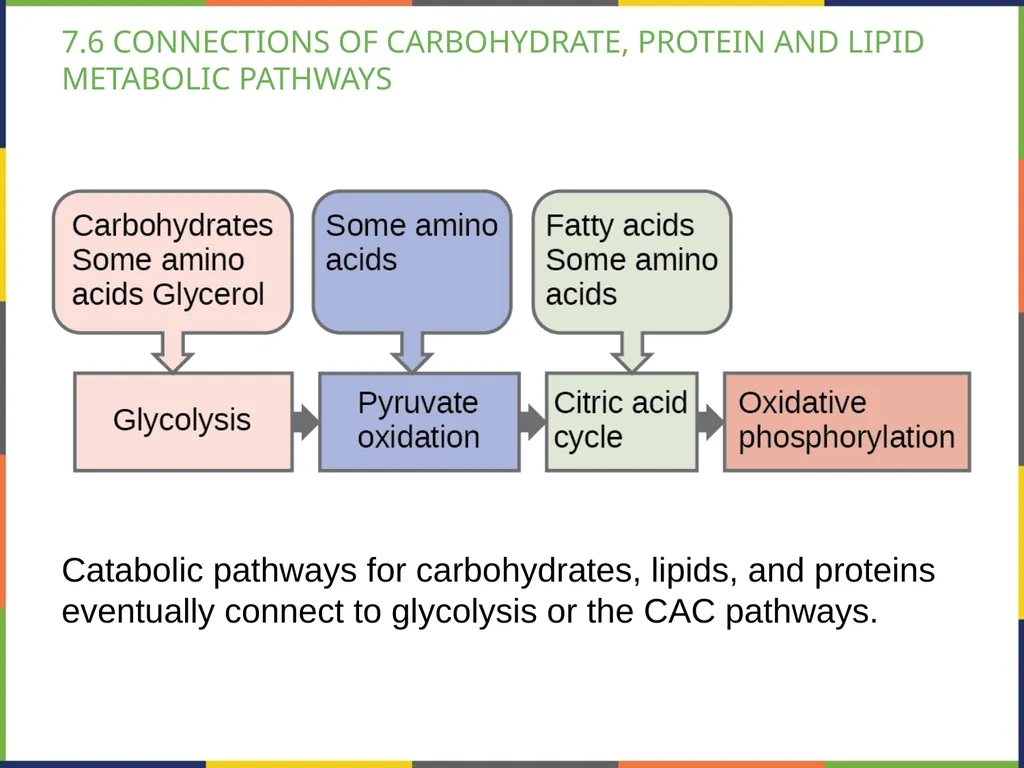
slide39. 7.6 CONNECTIONS OF CARBOHYDRATE, PROTEIN AND LIPID METABOLIC PATHWAYS Catabolic pathways for carbohydrates, lipids, and proteins eventually connect to glycolysis or the CAC pathways.<br>
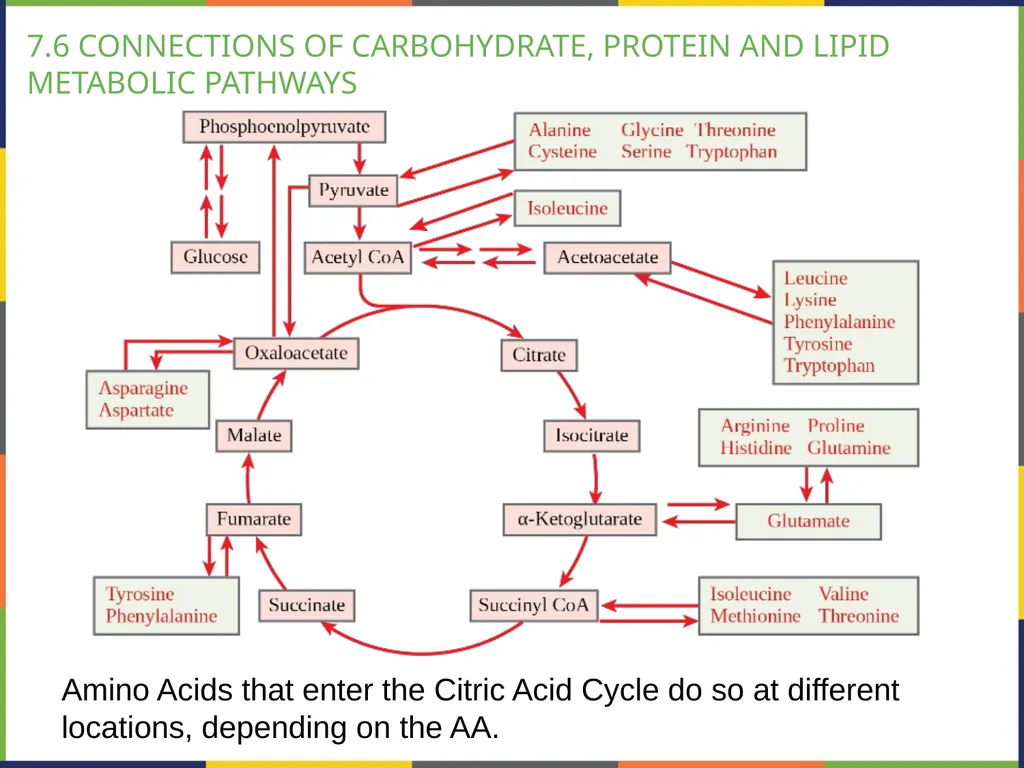
slide40. 7.6 CONNECTIONS OF CARBOHYDRATE, PROTEIN AND LIPID METABOLIC PATHWAYS Amino Acids that enter the Citric Acid Cycle do so at different locations, depending on the AA.<br>
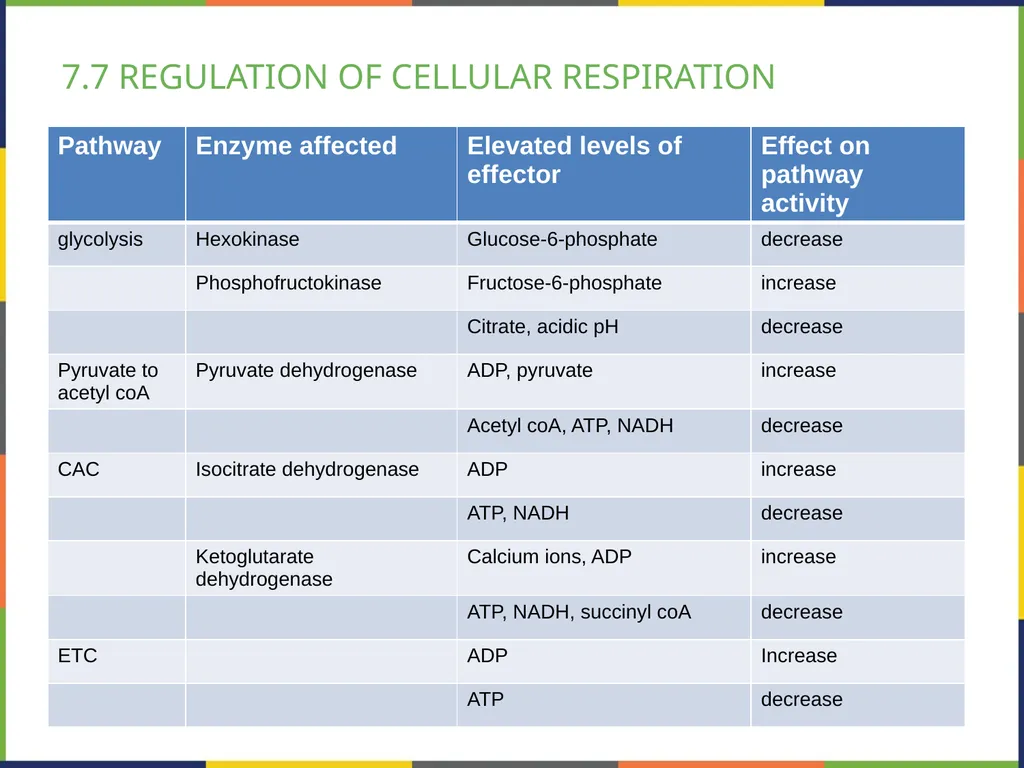
slide41. 7.7 REGULATION OF CELLULAR RESPIRATION Cellular respiration is regulated by many mechanisms, including:
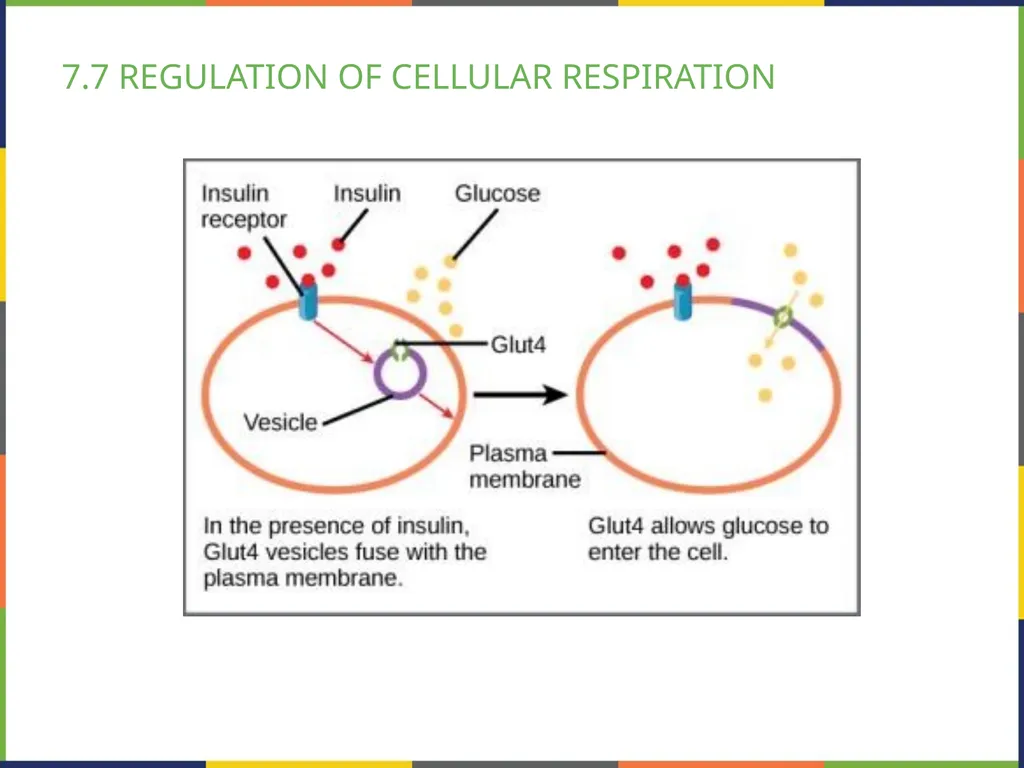
Hormonal control of glucose entry into the cell
Enzyme reversibility (functioning to substrate product equilibrium) or irreversibility (able to exceed equilibrium)
Enzyme sensitivity to pH changes due to lactic acid build-up
Feedback controls<br>
slide42. 7.7 REGULATION OF CELLULAR RESPIRATION<br>
slide43. 7.7 REGULATION OF CELLULAR RESPIRATION<br>
Chapter 7 CELLULAR RESPIRATION
PowerPoint Image Slideshow This work is licensed under a Creative Commons Attribution-NonCommercial-ShareAlike 4.0 International License.<br>
slide2. Cells extract energy from food to generate ATP in a process called glucose catabolism or cellular respiration.
As we work through the metabolic pathways involved, notice the close link between the transfer of energy and the movement of electrons (electrons have high energy levels).
This incremental transfer of electrons allows the cell to transfer food energy in small packages that can be captured in the phosphate bonds of ATP. OVERVIEW: CELLULAR RESPIRATION<br>
slide3. 7.1 ENERGY IN LIVING SYSTEMS – ELECTRONS AND ENERGY Oxidation reductions (redox) reactions are chemical reactions where electrons are transferred from one molecule to another.
Molecules that can donate electron(s) in a redox reaction are reducing agents, and those that can accept electrons are oxidizing agents.
Molecules that gain electron(s) after the reaction are reduced, and those that lose electron(s) are oxidized. AH
(Reducing Agent) X+
(Oxidizing agent) A+
(oxidized) XH
(reduced) + 🡪 +<br>
slide4. 7.1 ENERGY IN LIVING SYSTEMS – ELECTRON CARRIERS Molecules like nicotineamide adenine dinucleotide (NAD) can occur in an oxidized state (NAD+) or a reduced state (NADH).
NADH carries 2e- and 1H+ more than NAD
NAD is called an electron carrier because NAD+ accepts electrons from redox reactions while NADH donates them. Electron carriers are very important molecules in cellular respiration and photosynthesis.
They shuttle electrons to electron transport chains where ATP is produced.
Other electron carriers include:
FAD+, (oxidized)/ FADH2 (reduced)
NADP+(oxidized)/ NADPH (reduced)<br>
slide5. 7.1 ENERGY IN LIVING SYSTEMS – ELECTRON CARRIERS NAD+ (oxidized)/ NADH (reduced)<br>
slide6. 7.1 ENERGY IN LIVING SYSTEMS - ATP The hydrolysis of ATP 🡪 ADP + Pi is exergonic and can provide energy for a coupled endergonic reaction.
The loss of a phosphate group from a molecule is called dephosphorylation. Phosphorylation is the process of adding a phosphate group is to a molecule.
Phosphorylated molecules tend to be less stable and more likely to react.<br>
slide7. 7.1 ENERGY IN LIVING SYSTEMS - ATP Adenosine triphosphate (ATP)<br>
slide8. 7.1 ENERGY IN LIVING SYSTEMS - ATP ATP is generated by an endergonic reaction where ADP undergoes phosphorylation, ADP + Pi 🡪 ATP.
The energy required for this reaction can come from:
Substrate-level phosphorylation - a coupled exergonic reaction
Chemiosmosis- a process which uses energy from a concentration gradient and requires the enzyme ATP synthase.
90% of ATP is produced by chemiosmosis.
Occurs in mitochondria, chloroplasts, and plasma membrane of aerobic prokaryotes.<br>
slide9. 7.1 ENERGY IN LIVING SYSTEMS - ATP Mitochondrion Structure<br>
slide10. OVERVIEW: CELLULAR RESPIRATION C6H12O6 + 6 O2 🡪 6 CO2 + 6 H2O + ~36 ATP
The metabolic pathways involved are:
Glycolysis
Oxidation of Pyruvate and Citric Acid Cycle
Oxidative Phosphorylation<br>
slide11. 7.2 GLYCOLYSIS Glycolysis is the first metabolic pathway of cellular respiration and includes 10 enzymatic reactions.
Nearly all organisms perform glycolysis
occurs in the cytoplasm
O2 is not required
Inputs: 1 Glucose, 2 NAD+, 2 ATP, 4 ADP
Outputs: 2 Pyruvate, 2 NADH, 4 ATP, 2 ADP - - + 🡪 🡪 🡪 🡪 🡪 🡪 🡪 🡪 🡪 🡪 Glucose 10 reactions Pyruvate<br>
slide12. 7.2 GLYCOLYSIS – ENERGY-REQUIRING STEPS The first half of glycolysis involves 5 enzymes and uses two ATP molecules.
Glucose is phosphorylated twice and then split into two three-carbon molecules, called glyceraldehyde-3-phosphate (G3P).<br>
slide13. 7.2 GLYCOLYSIS – ENERGY-REQUIRING STEPS<br>
slide14. 7.2 GLYCOLYSIS – ENERGY-REQUIRING STEPS<br>
slide15. 7.2 GLYCOLYSIS – ENERGY-RELEASING STEPS The second half of glycolysis involves phosphorylation without ATP investment (step 6) and produces two NADH and four ATP molecules to generate 2 pyruvate molecules.
Net ATP production of glycolysis is 2 ATP.
These are the only ATP produced in glucose
catabolism by anaerobic cells.<br>
slide16. 7.2 GLYCOLYSIS – ENERGY-RELEASING STEPS<br>
slide17. 7.2 GLYCOLYSIS – ENERGY-RELEASING STEPS<br>
slide18. 7.2 GLYCOLYSIS – ENERGY-RELEASING STEPS<br>
slide19. 7.2 GLYCOLYSIS https://www.youtube.com/watch?v=8Kn6BVGqKd8<br>
slide20. 7.3 OXIDATION OF PYRUVATE In eukaryotic cells, if oxygen is present, the 2 pyruvate molecules enter mitochondria where each is converted to Acetyl CoA before entering the CAC:
CO2 is released
It is oxidized, transferring e- to NADH
coenzyme A is attached Inputs:
2 pyruvate, 2 NAD+
2 coenzyme A
Outputs:
2 CO2, 2 NADH, 2 acetyl CoA<br>
slide21. 7.3 OXIDATION OF PYRUVATE<br>
slide22. 7.3 CITRIC ACID CYCLE Occurs in the mitochondrial matrix.
Step 1 - the acetyl group from acetyl CoA is transferred to oxaloacetate to form citrate.
Through a cycle of reactions
citrate is oxidized (3 NADH & 1 FADH2 made)
2 CO2 released
1 GTP or ATP produced
The final product of the citric acid cycle is oxaloacetate.<br>
slide24. OVERVIEW: CELLULAR RESPIRATION Outputs: Glycolysis, Pyruvate Oxidation and the Citric Acid Cycle
4 ATP (2 from glycolysis, 2 from CAC)
6 CO2 (2 from oxidation of pyruvate, 4 from CAC)
10 NADH (2 from glycolysis, 2 from oxidation of pyruvate, 6 from CAC)
2 FADH2 (from CAC)
Glucose is completely oxidized at the end of CAC.
All possible electrons have been removed.
Question: Is most of the energy from glucose stored in the ATP, the CO2, or the electron carrier molecules?<br>
slide25. 7.4 OXIDATIVE PHOSPHORYLATION Most of the ATP produced during cellular respiration occurs in the last pathway, oxidative phosphorylation.
This is the only pathway where O2 is an input.
The pathway consists of an electron transport chain and chemiosmosis, which generates ATP.
A H+ concentration gradient created by the ETC, provides the energy to power chemiosmosis.<br>
slide26. 7.4 OXIDATIVE PHOSPHORYLATION Mitochondrion Structure<br>
slide27. 7.4 OXIDATIVE PHOSPHORYLATION- ELECTRON TRANSPORT CHAIN (ETC) The ETC is a series of electron transporters embedded in the inner mitochondrial membrane.
They shuttle electrons from NADH and FADH2 to O2.
In the process, protons (H+) are pumped from the mitochondrial matrix to the intermembrane space, and O2 is reduced to form H2O. https://www.youtube.com/watch?v=xbJ0nbzt5Kw<br>
slide28. Each component of the ETC is more electronegative than the previous.
e- from NADH are transferred to complex I of ETC
Includes NADH dehydrogenase, a B-vitamin derived molecule, & an Fe-S containing protein 7.4 OXIDATIVE PHOSPHORYLATION- ELECTRON TRANSPORT CHAIN (ETC)<br>
slide29. e- from FADH2 enter the ETC at complex II.
Ubiquinone (Q) carries e- from complexes I and II to complex III
Complex III is called cytochrome oxidoreductase.
Includes transmembrane cytochrome B and peripheral protein cytochrome C
Cytochrome C carries each e- to complex IV
Oxygen is reduced at complex IV (the final e- acceptor) 7.4 OXIDATIVE PHOSPHORYLATION- ELECTRON TRANSPORT CHAIN (ETC)<br>
slide30. 7.4 OXIDATIVE PHOSPHORYLATION – CHEMIOSMOSIS Chemiosmosis uses kinetic energy from protons falling down its gradient to form ATP from ADP + Pi. The complex, integral protein ATP synthase mediates this reaction. www.youtube.com/watch?v=3y1dO4nNaKY (Credit: modification of work by Klaus Hoffmeier)<br>
slide31. 7.4 OXIDATIVE PHOSPHORYLATION<br>
slide32. 7.4 OXIDATIVE PHOSPHORYLATION ATP Yield
The number of ATP generated by cellular respiration is 30-36 per glucose
Varies by species and how efficiently NADH from glycolysis enters mitochondria
Cellular respiration in total stores ~ 34% of the energy from glucose in ATP<br>
slide33. 7.5 METABOLISM WITHOUT OXYGEN – ANAEROBIC RESPIRATION Prokaryotic cells (Domains Bacteria and Archaea)
Use a terminal electron acceptor other than oxygen in the electron transport chain. Figure 7.13 The green color seen in these coastal waters is from an eruption of hydrogen sulfide–producing bacteria. These anaerobic, sulfate-reducing bacteria release hydrogen sulfide gas as they decompose algae in the water.
(credit: modification of work by NASA/Jeff Schmaltz, MODIS Land Rapid Response Team at NASA GSFC, Visible Earth Catalog of NASA images)<br>
slide34. 7.5 METABOLISM WITHOUT OXYGEN - FERMENTATION Glycolysis occurs in aerobic and anaerobic environments.
NAD+ is an input of glycolysis; regenerated during oxidative phosphorylation when O2 is present.
When O2 is lacking, fermentation regenerates NAD+; otherwise, glycolysis would halt.
There are two common types of fermentation
Lactic acid fermentation
Alcohol fermentation<br>
slide35. 7.5 METABOLISM WITHOUT OXYGEN - FERMENTATION Lactic Acid Fermentation
Occurs in muscle cells when O2 is limited, mammalian red blood cells, & some bacteria, ex. those in yogurt
Lactate dehydrogenase catalyzes this reaction. Pyruvate + NADH 🡨🡪 lactate + NAD+<br>
slide36. 7.5 METABOLISM WITHOUT OXYGEN - FERMENTATION Lactic Acid Fermentation<br>
slide37. Alcoholic Fermentation
anaerobic yeast species
Involves two reactions
First, catalyzed by pyruvate decarboxylase
Second, by alcohol dehydrogenase 7.5 METABOLISM WITHOUT OXYGEN - FERMENTATION Fermentation tanks have valves so that the pressure inside the tanks created by the CO2 produced can be released. Pyruvate 🡪 CO2 + acetylaldehide acetylaldehide + NADH🡪 ethanol + NAD+<br>
slide38. 7.5 METABOLISM WITHOUT OXYGEN - FERMENTATION https://www.youtube.com/watch?v=Cngt2HmJuSo Measuring Respiration in Yeast<br>
slide39. 7.6 CONNECTIONS OF CARBOHYDRATE, PROTEIN AND LIPID METABOLIC PATHWAYS Catabolic pathways for carbohydrates, lipids, and proteins eventually connect to glycolysis or the CAC pathways.<br>
slide40. 7.6 CONNECTIONS OF CARBOHYDRATE, PROTEIN AND LIPID METABOLIC PATHWAYS Amino Acids that enter the Citric Acid Cycle do so at different locations, depending on the AA.<br>
slide41. 7.7 REGULATION OF CELLULAR RESPIRATION Cellular respiration is regulated by many mechanisms, including:
Hormonal control of glucose entry into the cell
Enzyme reversibility (functioning to substrate product equilibrium) or irreversibility (able to exceed equilibrium)
Enzyme sensitivity to pH changes due to lactic acid build-up
Feedback controls<br>
slide42. 7.7 REGULATION OF CELLULAR RESPIRATION<br>
slide43. 7.7 REGULATION OF CELLULAR RESPIRATION<br>