
bioMEDical Instrumentation system By: Engr. Hinesh
KL
Published · 51 slides · 0 views

1 / 1

Description
bioMEDical Instrumentation system By: Engr. Hinesh Kumar Outline Generalized Medical Instrumentation Systems Components of Medical Instrumentation Systems PC Based Medical Instruments Systems Operational Modes Medical Measurement
Related Topics
Share
Embed code
Download this presentation From Below
"bioMEDical Instrumentation system By: Engr. Hinesh" is the property of its rightful owner. Permission is granted to download and print the materials on this website for personal, non-commercial use only, and to display it on your personal computer provided you do not modify the materials and that you retain all copyright notices contained in the materials. By downloading content from our website, you accept the terms of this agreement.
Presentation Transcript
01
bioMEDical Instrumentation system By: Engr. Hinesh Kumar<br>
02
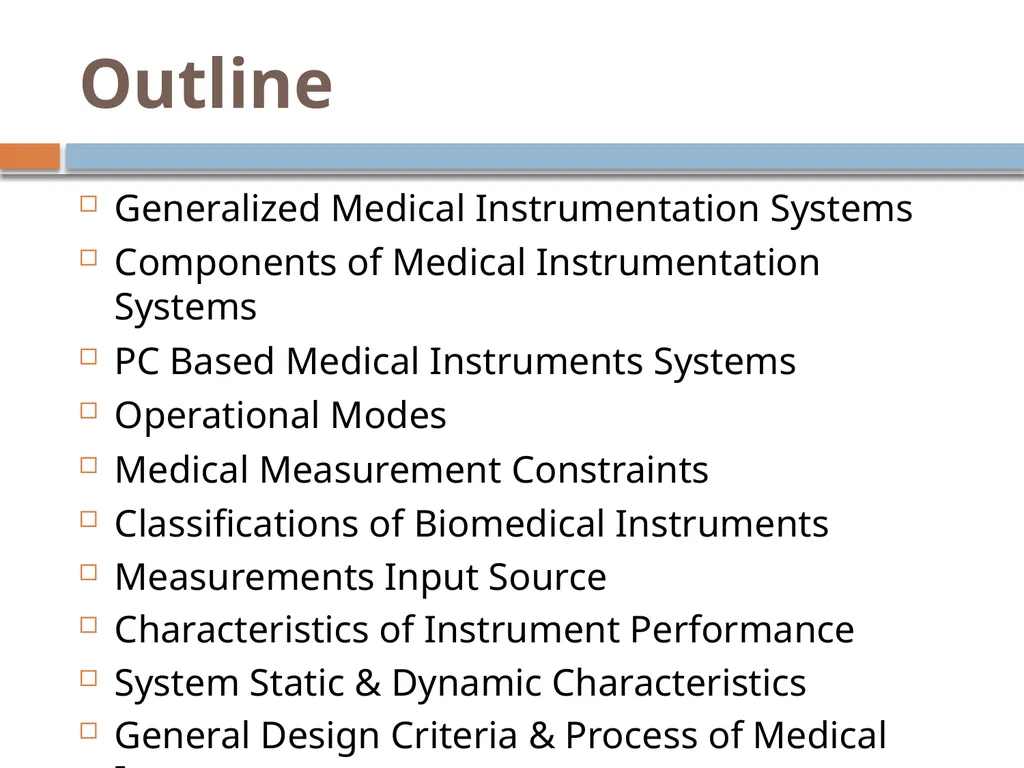
Outline Generalized Medical Instrumentation Systems
Components of Medical Instrumentation Systems
PC Based Medical Instruments Systems
Operational Modes
Medical Measurement Constraints
Classifications of Biomedical Instruments
Measurements Input Source
Characteristics of Instrument Performance
System Static & Dynamic Characteristics
General Design Criteria & Process of Medical Instruments
Commercial Medical Instrumentation Development Process<br>
Components of Medical Instrumentation Systems
PC Based Medical Instruments Systems
Operational Modes
Medical Measurement Constraints
Classifications of Biomedical Instruments
Measurements Input Source
Characteristics of Instrument Performance
System Static & Dynamic Characteristics
General Design Criteria & Process of Medical Instruments
Commercial Medical Instrumentation Development Process<br>
03
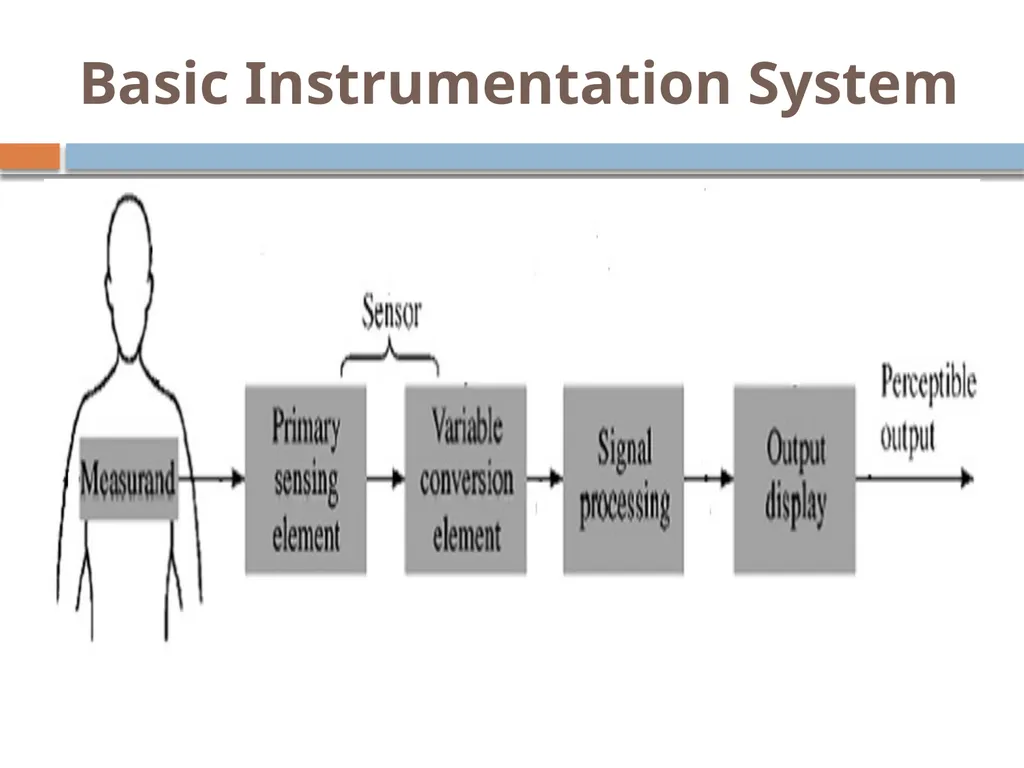
Basic Instrumentation System<br>
04
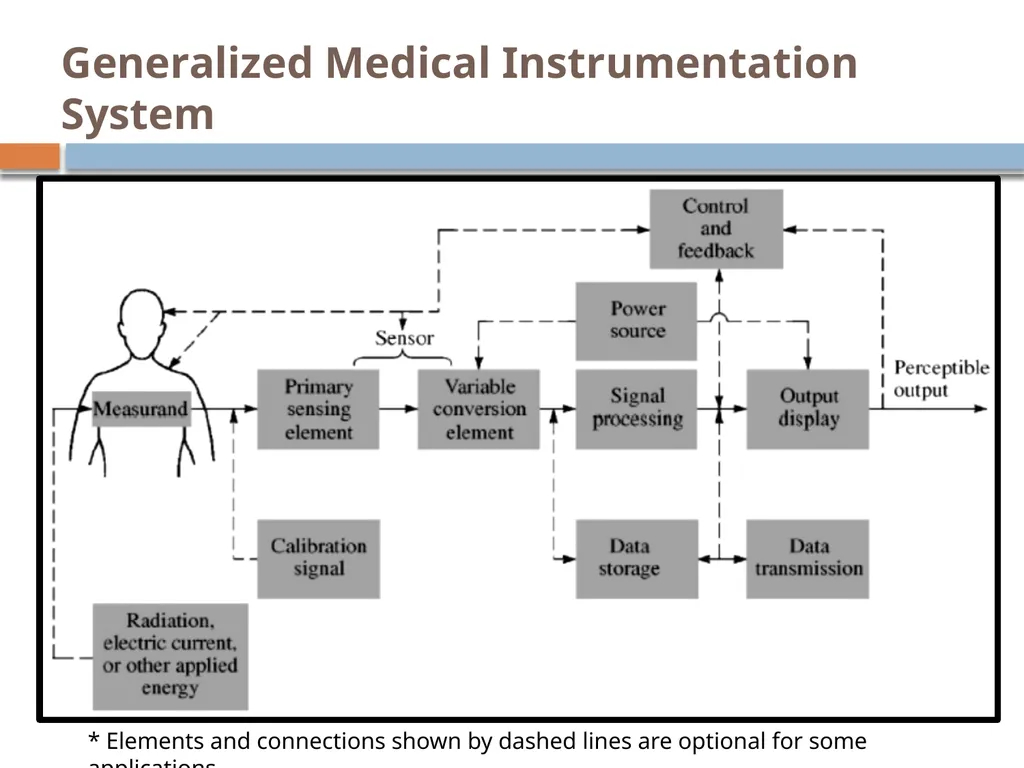
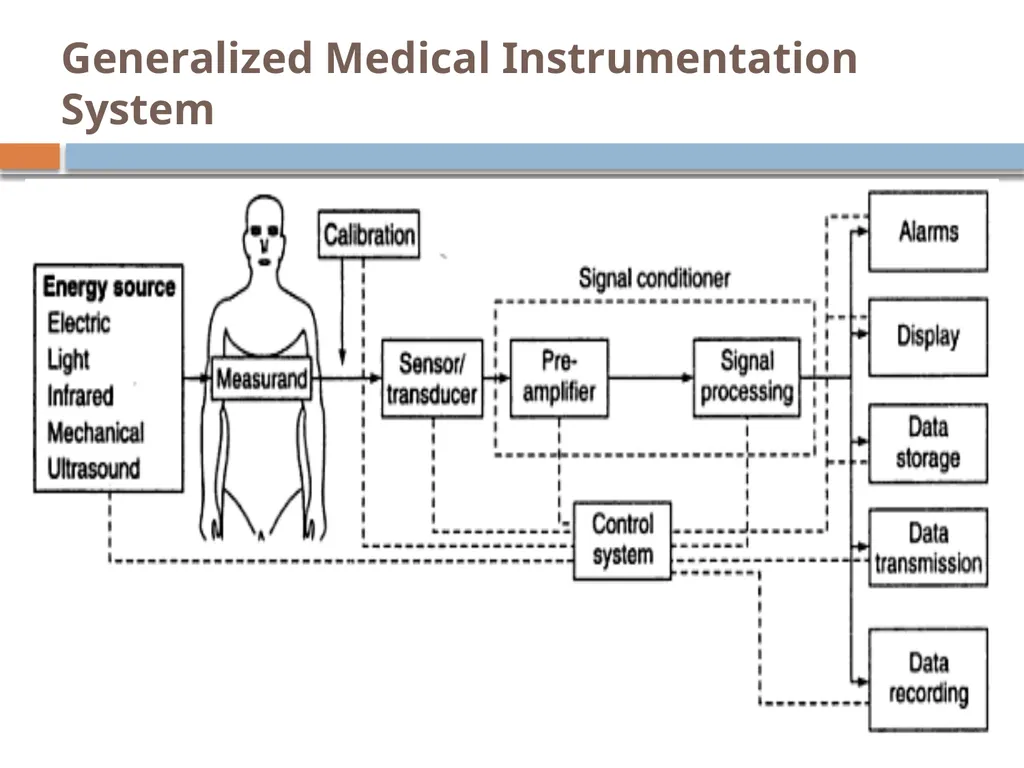
Generalized Medical Instrumentation System * Elements and connections shown by dashed lines are optional for some applications.<br>
05
Generalized Medical Instrumentation System<br>
06
Components of Medical Instrumentation System Measurand
Sensor / Transducer
Signal Conditioning
Output Display
Auxiliary Components<br>
Sensor / Transducer
Signal Conditioning
Output Display
Auxiliary Components<br>
07
Measurand The physical quantity, property, or condition that the system measures is called measurand.
The accessibility of the measurand is important because it may be:
Internal (Blood Pressure)
On the Body Surface (Electrocardiogram)
Emanate from the body (Infrared Radiation)
Derived from Tissue Sample (such as Blood or a Biopsy)<br>
The accessibility of the measurand is important because it may be:
Internal (Blood Pressure)
On the Body Surface (Electrocardiogram)
Emanate from the body (Infrared Radiation)
Derived from Tissue Sample (such as Blood or a Biopsy)<br>
08
Cont… Most medically important measurands can be grouped in the following groups:
Biopotential,
Pressure,
Flow,
Dimensions (Imaging),
Displacement (Velocity, Acceleration, And Force),
Impedance,
Temperature, And
Chemical Concentrations
The measurand may be localized to a specific organ or anatomical structure.<br>
Biopotential,
Pressure,
Flow,
Dimensions (Imaging),
Displacement (Velocity, Acceleration, And Force),
Impedance,
Temperature, And
Chemical Concentrations
The measurand may be localized to a specific organ or anatomical structure.<br>
09
Sensor The transducer is defined as a device that converts one form of energy to another.
A sensor converts a physical measurand to an electric output.
The sensor should respond only to the form of energy present in the measurand, to the exclusion of all others.
The sensor should non invasive and minimally invasive.<br>
A sensor converts a physical measurand to an electric output.
The sensor should respond only to the form of energy present in the measurand, to the exclusion of all others.
The sensor should non invasive and minimally invasive.<br>
10
Signal Conditioning Simple signal conditioners may only amplify and filter the signal or merely match the impedance of the sensor to the display.
Often sensor outputs are converted to digital form and then processed by specialized digital circuits or a microcomputer.
For example, signal filtering may reduce undesirable sensor signals.
It may also average repetitive signals to reduce noise, or it may convert information from the time domain to the frequency domain.<br>
Often sensor outputs are converted to digital form and then processed by specialized digital circuits or a microcomputer.
For example, signal filtering may reduce undesirable sensor signals.
It may also average repetitive signals to reduce noise, or it may convert information from the time domain to the frequency domain.<br>
11
Output Display The results of the measurement process must be displayed in a form that the human operator can perceive.
The best form for the display may be:
Numerical
Graphical,
Discrete or Continuous,
Permanent or Temporary
Visual / Hearing<br>
The best form for the display may be:
Numerical
Graphical,
Discrete or Continuous,
Permanent or Temporary
Visual / Hearing<br>
12
Auxiliary Components A calibration signal with the properties of the measurand should be applied to the sensor input or as early in the signal-processing chain as possible.
Many forms of control and feedback may be required to elicit the measurand, to adjust the sensor and signal conditioner, and to direct the flow of output for display, storage or transmission.
The control and feedback may be automatic or manual.<br>
Many forms of control and feedback may be required to elicit the measurand, to adjust the sensor and signal conditioner, and to direct the flow of output for display, storage or transmission.
The control and feedback may be automatic or manual.<br>
13
Cont… Data may be stored briefly to meet requirements of signal conditioning or to enable operator to examine the data that precede alarm conditions. Or data may be stored before signal conditioning, so that different processing schemes can be utilized.
Conventional principles of communication can often be used to transmit data to remote displays at nurses’ stations, medical centers, or medical data-processing facilities.<br>
Conventional principles of communication can often be used to transmit data to remote displays at nurses’ stations, medical centers, or medical data-processing facilities.<br>
14
PC Based Medical Instruments Personal computer are popular in medical field and also software is largely commercially available and the users can purchase and use it.
Computer are widely accepted in the medical field for data collection, manipulation, processing and a complete workstations for a variety of applications.
A personal computer becomes a workstation with the simple installation of one or more “instruments-on-a-board” in its accessory slots.<br>
Computer are widely accepted in the medical field for data collection, manipulation, processing and a complete workstations for a variety of applications.
A personal computer becomes a workstation with the simple installation of one or more “instruments-on-a-board” in its accessory slots.<br>
15
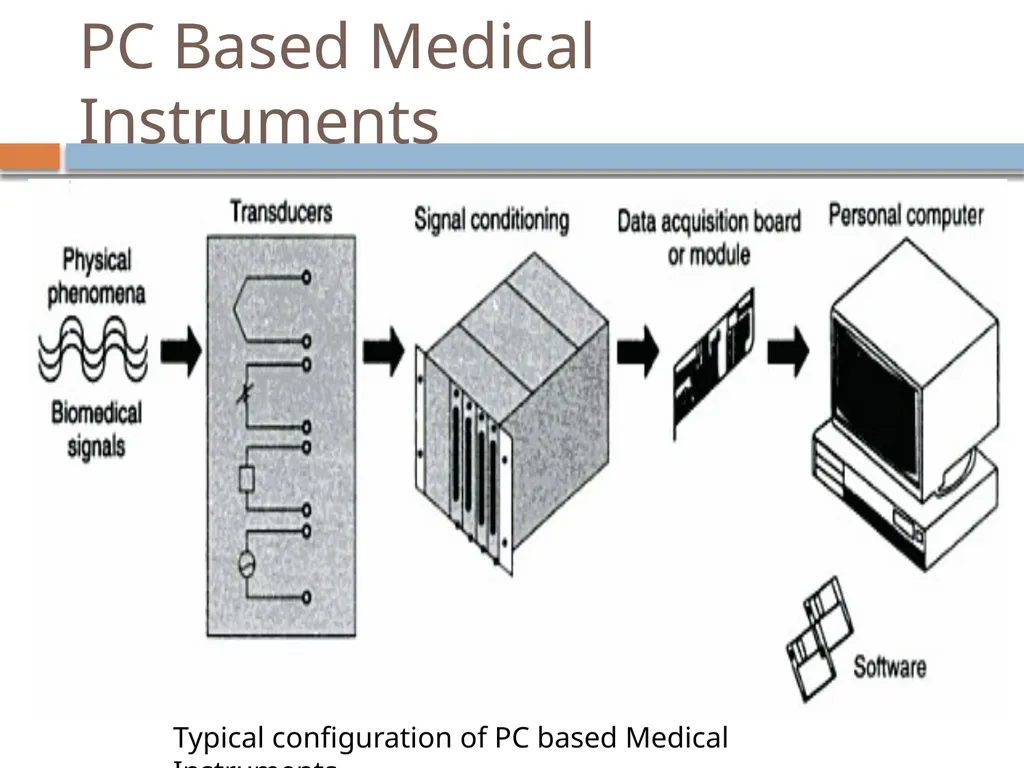
PC Based Medical Instruments Typical configuration of PC based Medical Instruments<br>
16
Cont… Fig illustrates the typical configuration of a PC based workstation. System is highly flexible and can accommodate a variety of inputs, which can be connected to PC for analysis, graphics and control.
Basic elements in the system include sensors or transducers that convert physical phenomena into a measurable signal, a data acquisition system, an acquisition/analysis software package or programme and computing platform.
The systems works totally under the control of software.<br>
Basic elements in the system include sensors or transducers that convert physical phenomena into a measurable signal, a data acquisition system, an acquisition/analysis software package or programme and computing platform.
The systems works totally under the control of software.<br>
17
Cont… PC medical instruments are gaining in popularity for several reasons including price, programmability and performance specifications.
Software development, rather than hardware development, increasingly dominates new product design cycles.
This includes operating systems, devices drivers, libraries, languages and debugging tools.<br>
Software development, rather than hardware development, increasingly dominates new product design cycles.
This includes operating systems, devices drivers, libraries, languages and debugging tools.<br>
18
Instruments Operational Modes Direct / Indirect Mode
Sampling and Continuous Modes
Generating and Modulating Modes
Analog and Digital Modes
Real time and Delayed Time Modes<br>
Sampling and Continuous Modes
Generating and Modulating Modes
Analog and Digital Modes
Real time and Delayed Time Modes<br>
19
Direct / Indirect Modes Direct Mode
Desired measurand can be interfaced directly to a sensor because the measurand is readily accessible
If the sensor is invasive, direct contact with the measurand is possible but expensive, risky and least acceptable.
Temperature
Heartbeat
Indirect Mode
Desired measurand can not be interfaced directly and not accessible
Morphology of internal organ: X-ray shadows
Volume of blood pumped per minute by the heart: respiration and blood gas concentration
Pulmonary volumes: variation in thoracic impedance plethysmography<br>
Desired measurand can be interfaced directly to a sensor because the measurand is readily accessible
If the sensor is invasive, direct contact with the measurand is possible but expensive, risky and least acceptable.
Temperature
Heartbeat
Indirect Mode
Desired measurand can not be interfaced directly and not accessible
Morphology of internal organ: X-ray shadows
Volume of blood pumped per minute by the heart: respiration and blood gas concentration
Pulmonary volumes: variation in thoracic impedance plethysmography<br>
20
Sampling Mode and Continuous Mode Sampling Mode
Sampling can change so slowly that they may be sampled infrequently.
Body Temperature
Ion Concentration
Continuous Mode
Frequent or constant monitoring of measurand
Electrocardiogram
Respiratory Gas Flow<br>
Sampling can change so slowly that they may be sampled infrequently.
Body Temperature
Ion Concentration
Continuous Mode
Frequent or constant monitoring of measurand
Electrocardiogram
Respiratory Gas Flow<br>
21
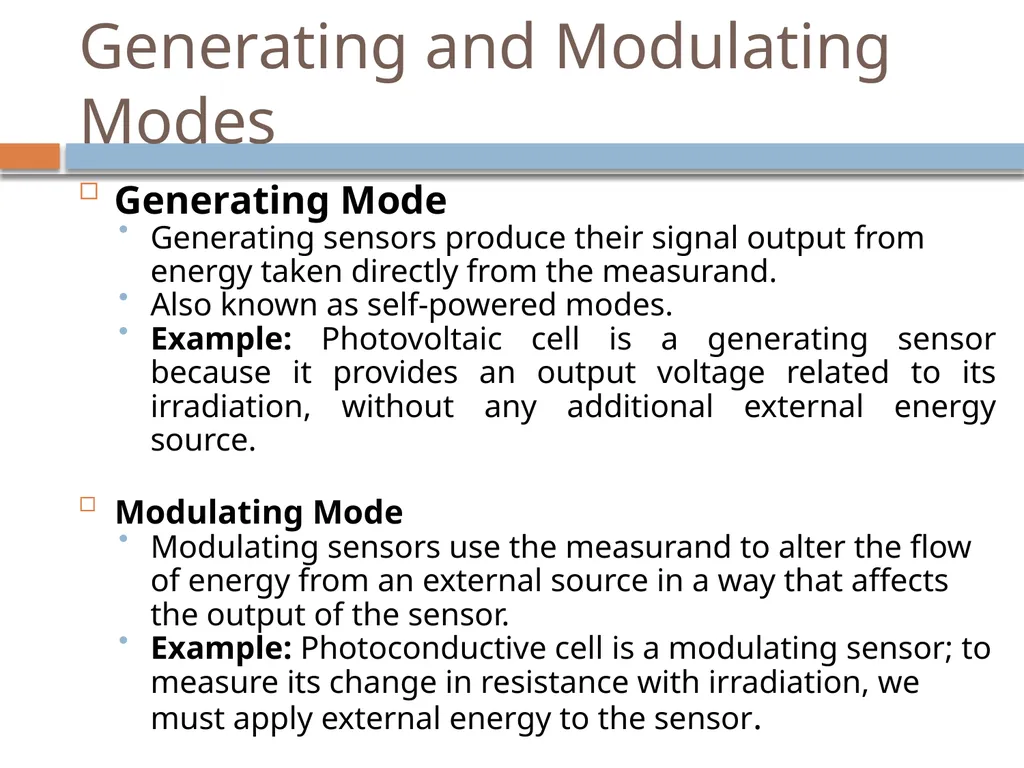
Generating and Modulating Modes Generating Mode
Generating sensors produce their signal output from energy taken directly from the measurand.
Also known as self-powered modes.
Example: Photovoltaic cell is a generating sensor because it provides an output voltage related to its irradiation, without any additional external energy source.
Modulating Mode
Modulating sensors use the measurand to alter the flow of energy from an external source in a way that affects the output of the sensor.
Example: Photoconductive cell is a modulating sensor; to measure its change in resistance with irradiation, we must apply external energy to the sensor.<br>
Generating sensors produce their signal output from energy taken directly from the measurand.
Also known as self-powered modes.
Example: Photovoltaic cell is a generating sensor because it provides an output voltage related to its irradiation, without any additional external energy source.
Modulating Mode
Modulating sensors use the measurand to alter the flow of energy from an external source in a way that affects the output of the sensor.
Example: Photoconductive cell is a modulating sensor; to measure its change in resistance with irradiation, we must apply external energy to the sensor.<br>
22
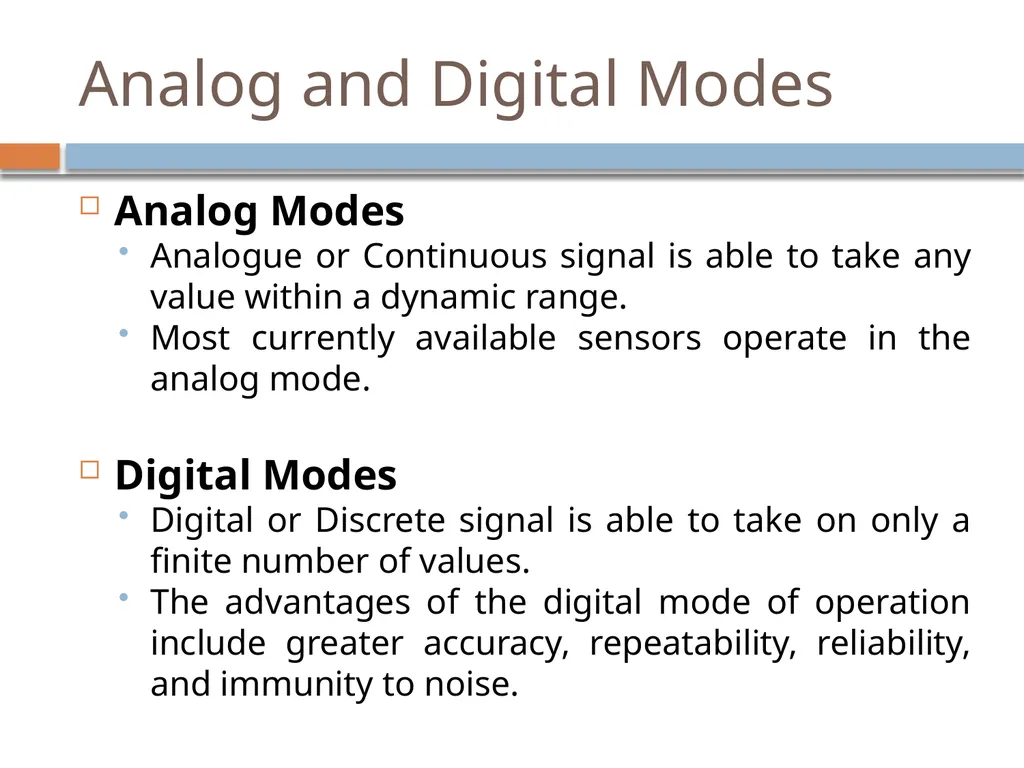
Analog and Digital Modes Analog Modes
Analogue or Continuous signal is able to take any value within a dynamic range.
Most currently available sensors operate in the analog mode.
Digital Modes
Digital or Discrete signal is able to take on only a finite number of values.
The advantages of the digital mode of operation include greater accuracy, repeatability, reliability, and immunity to noise.<br>
Analogue or Continuous signal is able to take any value within a dynamic range.
Most currently available sensors operate in the analog mode.
Digital Modes
Digital or Discrete signal is able to take on only a finite number of values.
The advantages of the digital mode of operation include greater accuracy, repeatability, reliability, and immunity to noise.<br>
23
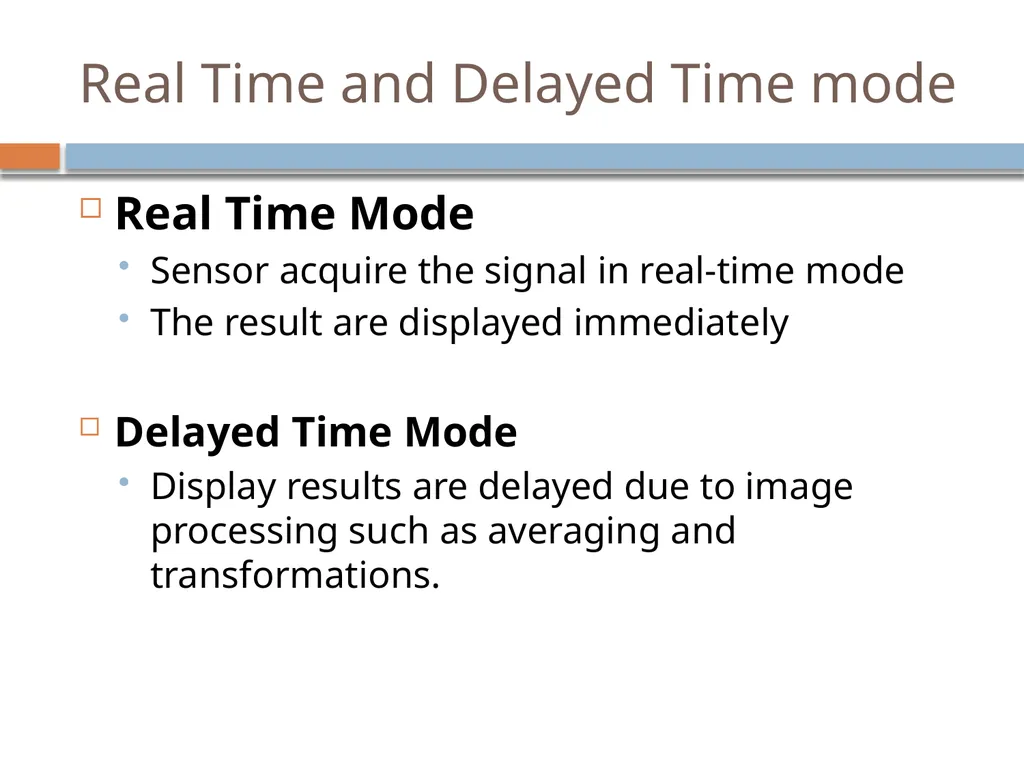
Real Time and Delayed Time mode Real Time Mode
Sensor acquire the signal in real-time mode
The result are displayed immediately
Delayed Time Mode
Display results are delayed due to image processing such as averaging and transformations.<br>
Sensor acquire the signal in real-time mode
The result are displayed immediately
Delayed Time Mode
Display results are delayed due to image processing such as averaging and transformations.<br>
24
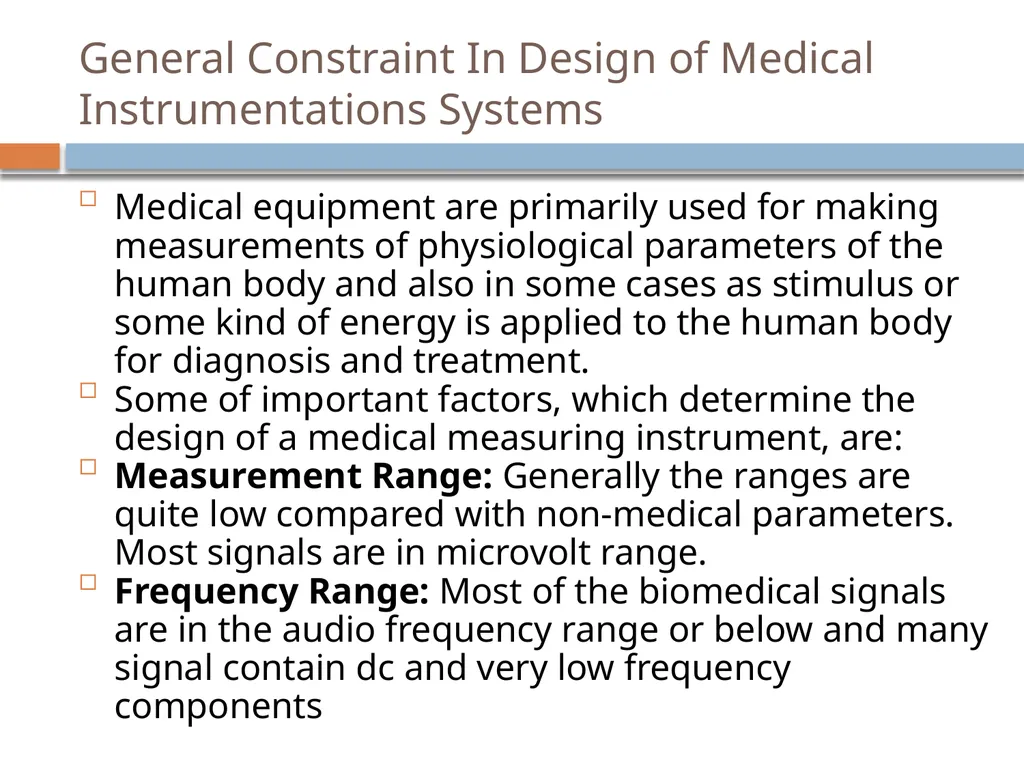
General Constraint In Design of Medical Instrumentations Systems Medical equipment are primarily used for making measurements of physiological parameters of the human body and also in some cases as stimulus or some kind of energy is applied to the human body for diagnosis and treatment.
Some of important factors, which determine the design of a medical measuring instrument, are:
Measurement Range: Generally the ranges are quite low compared with non-medical parameters. Most signals are in microvolt range.
Frequency Range: Most of the biomedical signals are in the audio frequency range or below and many signal contain dc and very low frequency components<br>
Some of important factors, which determine the design of a medical measuring instrument, are:
Measurement Range: Generally the ranges are quite low compared with non-medical parameters. Most signals are in microvolt range.
Frequency Range: Most of the biomedical signals are in the audio frequency range or below and many signal contain dc and very low frequency components<br>
25
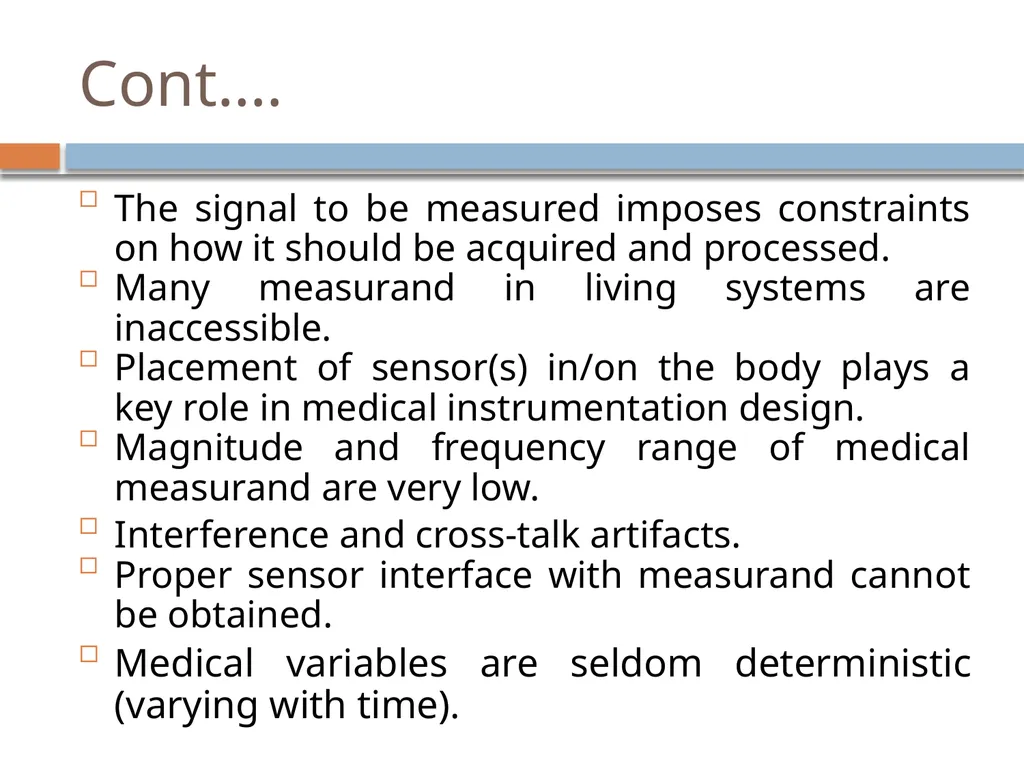
Cont…. The signal to be measured imposes constraints on how it should be acquired and processed.
Many measurand in living systems are inaccessible.
Placement of sensor(s) in/on the body plays a key role in medical instrumentation design.
Magnitude and frequency range of medical measurand are very low.
Interference and cross-talk artifacts.
Proper sensor interface with measurand cannot be obtained.
Medical variables are seldom deterministic (varying with time).<br>
Many measurand in living systems are inaccessible.
Placement of sensor(s) in/on the body plays a key role in medical instrumentation design.
Magnitude and frequency range of medical measurand are very low.
Interference and cross-talk artifacts.
Proper sensor interface with measurand cannot be obtained.
Medical variables are seldom deterministic (varying with time).<br>
26
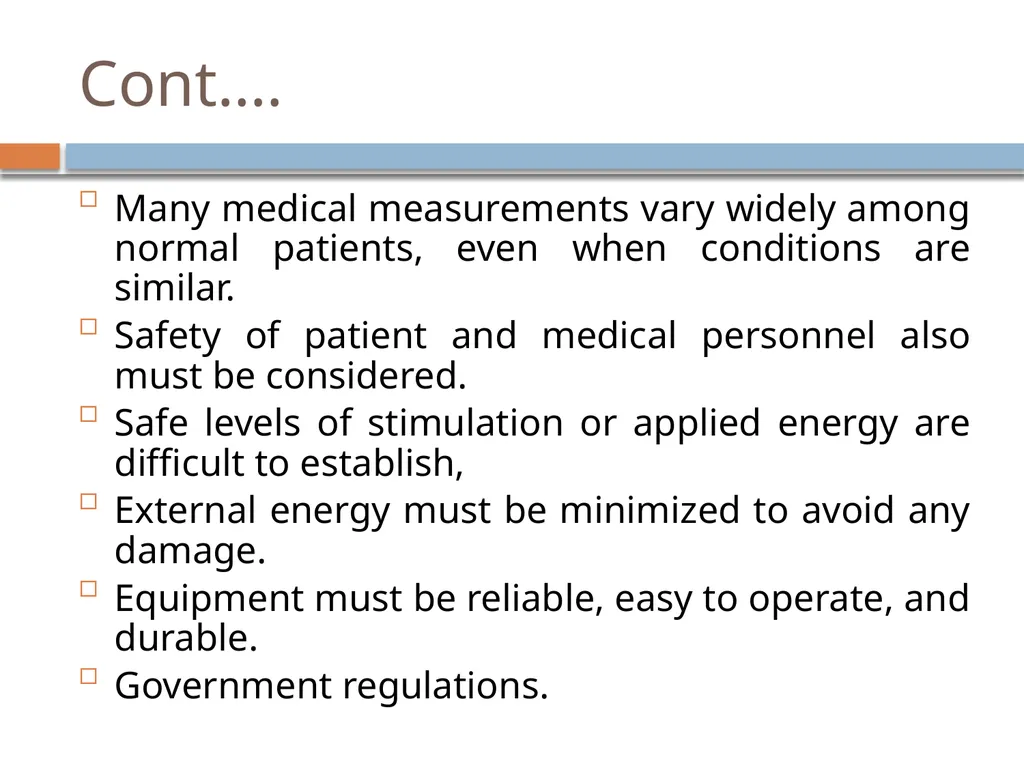
Cont…. Many medical measurements vary widely among normal patients, even when conditions are similar.
Safety of patient and medical personnel also must be considered.
Safe levels of stimulation or applied energy are difficult to establish,
External energy must be minimized to avoid any damage.
Equipment must be reliable, easy to operate, and durable.
Government regulations.<br>
Safety of patient and medical personnel also must be considered.
Safe levels of stimulation or applied energy are difficult to establish,
External energy must be minimized to avoid any damage.
Equipment must be reliable, easy to operate, and durable.
Government regulations.<br>
27
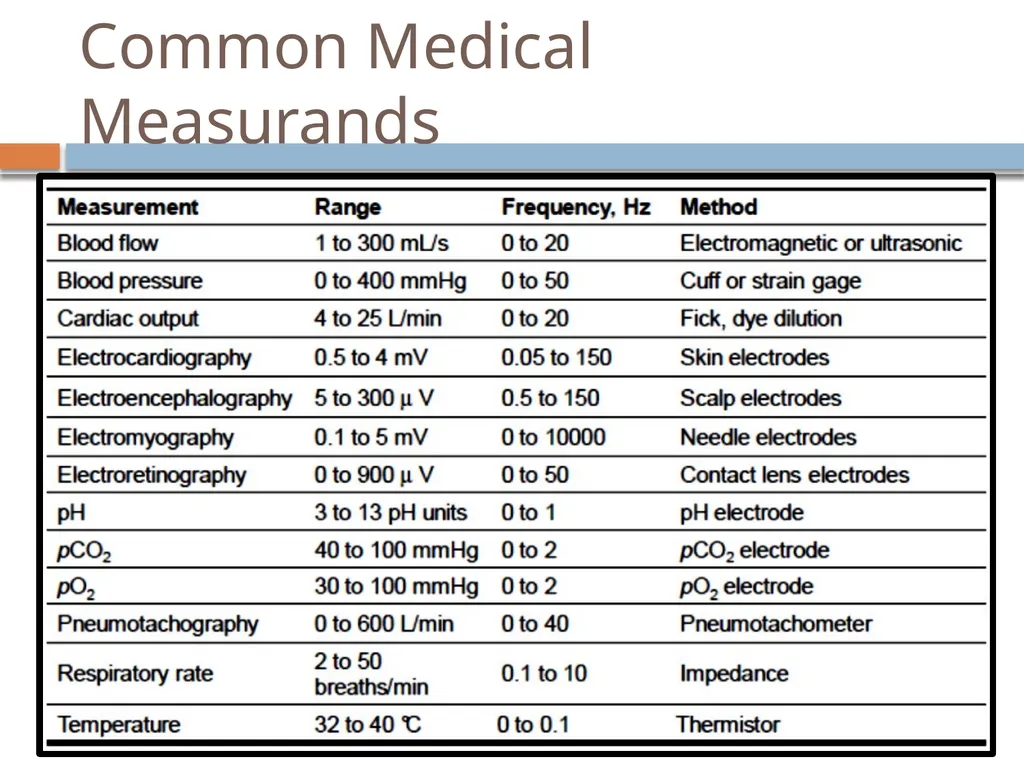
Common Medical Measurands<br>
28
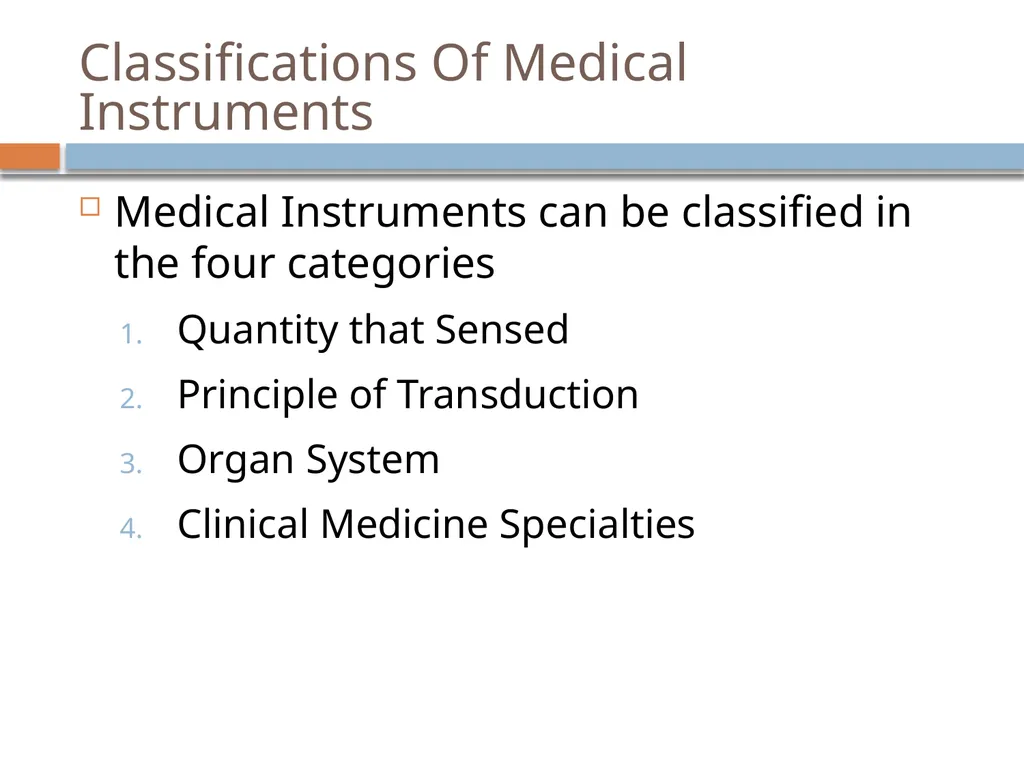
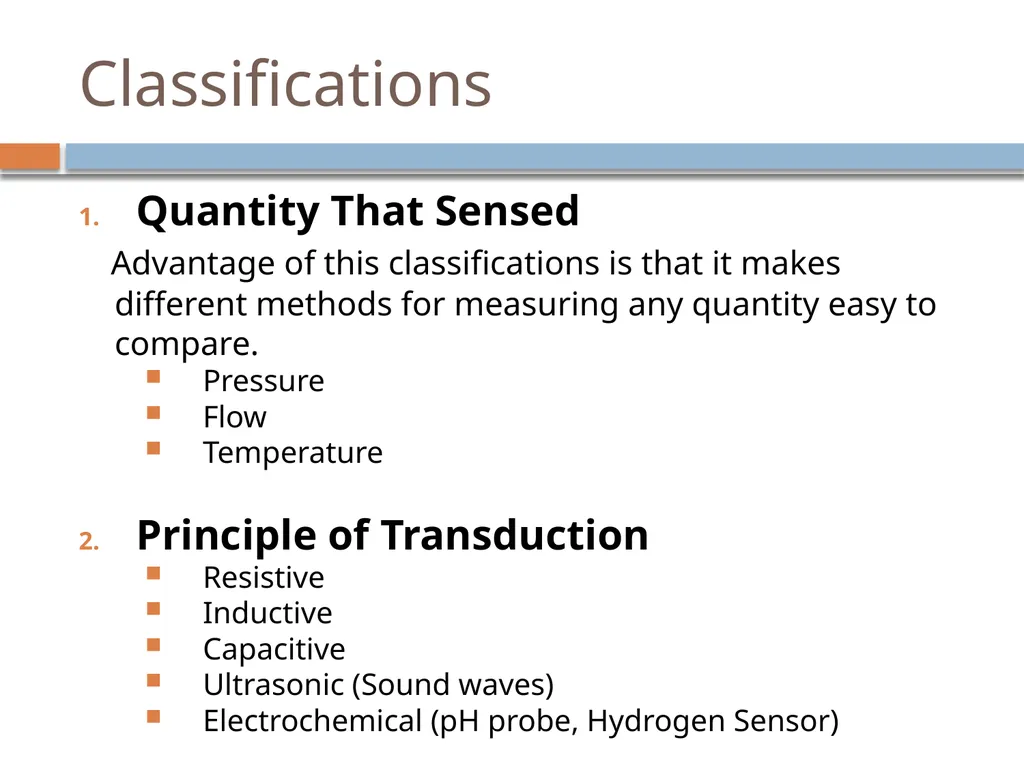
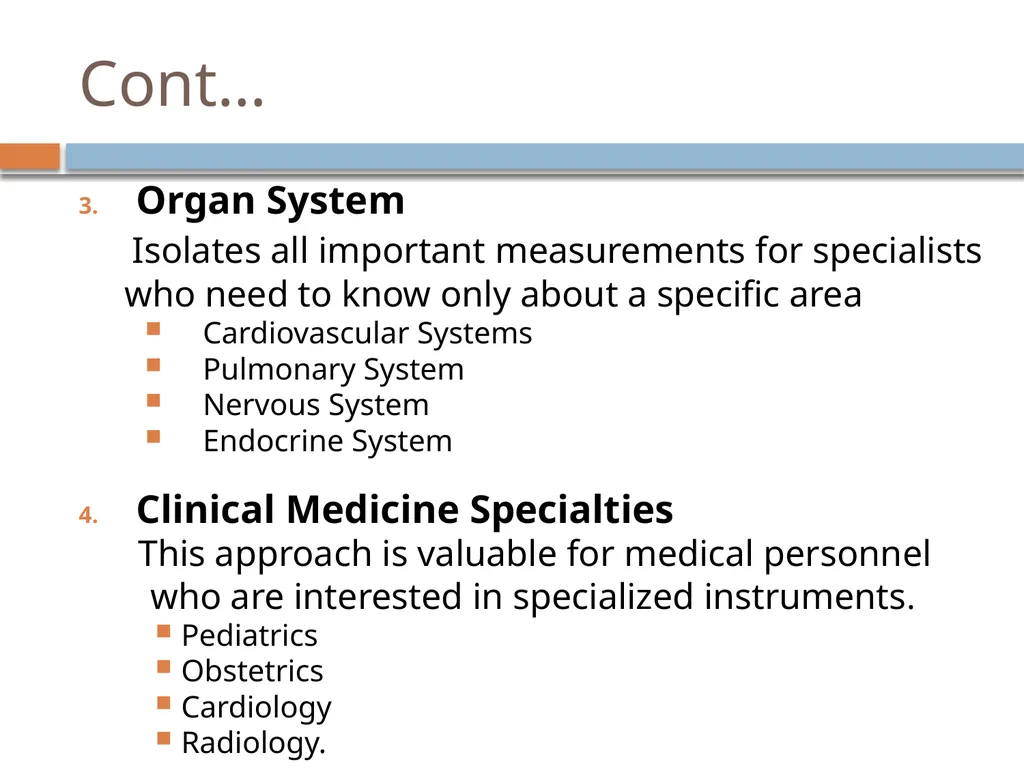
Classifications Of Medical Instruments Medical Instruments can be classified in the four categories
Quantity that Sensed
Principle of Transduction
Organ System
Clinical Medicine Specialties<br>
Quantity that Sensed
Principle of Transduction
Organ System
Clinical Medicine Specialties<br>
29
Classifications Quantity That Sensed
Advantage of this classifications is that it makes different methods for measuring any quantity easy to compare.
Pressure
Flow
Temperature
Principle of Transduction
Resistive
Inductive
Capacitive
Ultrasonic (Sound waves)
Electrochemical (pH probe, Hydrogen Sensor)<br>
Advantage of this classifications is that it makes different methods for measuring any quantity easy to compare.
Pressure
Flow
Temperature
Principle of Transduction
Resistive
Inductive
Capacitive
Ultrasonic (Sound waves)
Electrochemical (pH probe, Hydrogen Sensor)<br>
30
Cont… Organ System
Isolates all important measurements for specialists
who need to know only about a specific area
Cardiovascular Systems
Pulmonary System
Nervous System
Endocrine System
Clinical Medicine Specialties
This approach is valuable for medical personnel who are interested in specialized instruments.
Pediatrics
Obstetrics
Cardiology
Radiology.<br>
Isolates all important measurements for specialists
who need to know only about a specific area
Cardiovascular Systems
Pulmonary System
Nervous System
Endocrine System
Clinical Medicine Specialties
This approach is valuable for medical personnel who are interested in specialized instruments.
Pediatrics
Obstetrics
Cardiology
Radiology.<br>
31
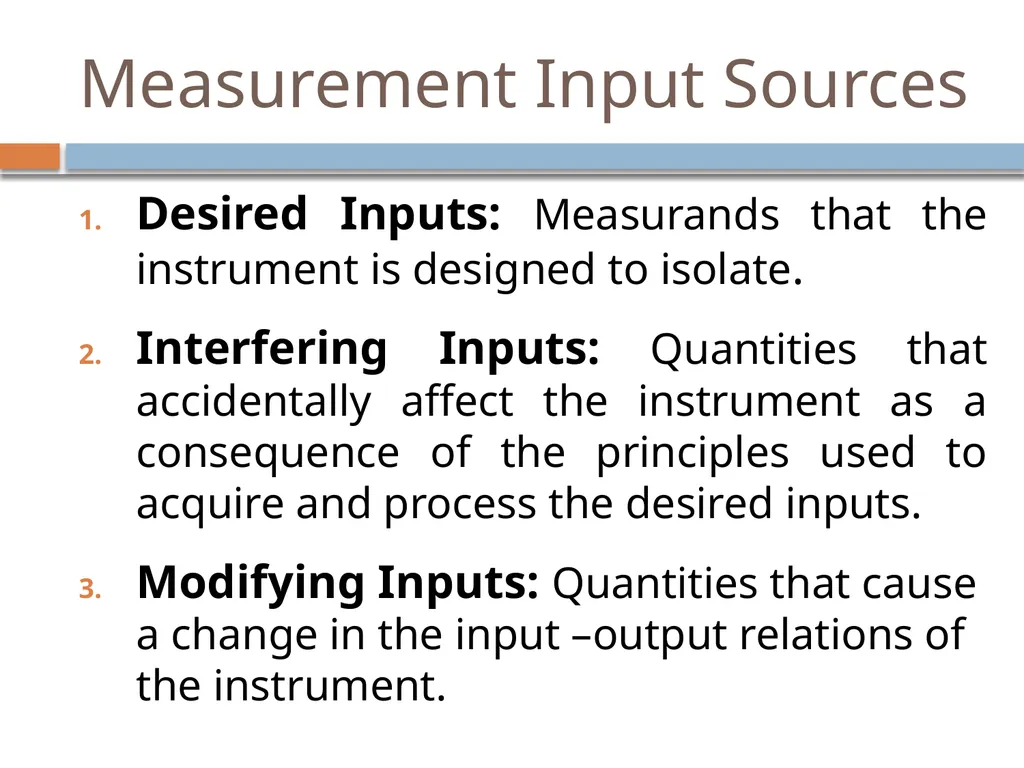
Measurement Input Sources Desired Inputs: Measurands that the instrument is designed to isolate.
Interfering Inputs: Quantities that accidentally affect the instrument as a consequence of the principles used to acquire and process the desired inputs.
Modifying Inputs: Quantities that cause a change in the input –output relations of the instrument.<br>
Interfering Inputs: Quantities that accidentally affect the instrument as a consequence of the principles used to acquire and process the desired inputs.
Modifying Inputs: Quantities that cause a change in the input –output relations of the instrument.<br>
32
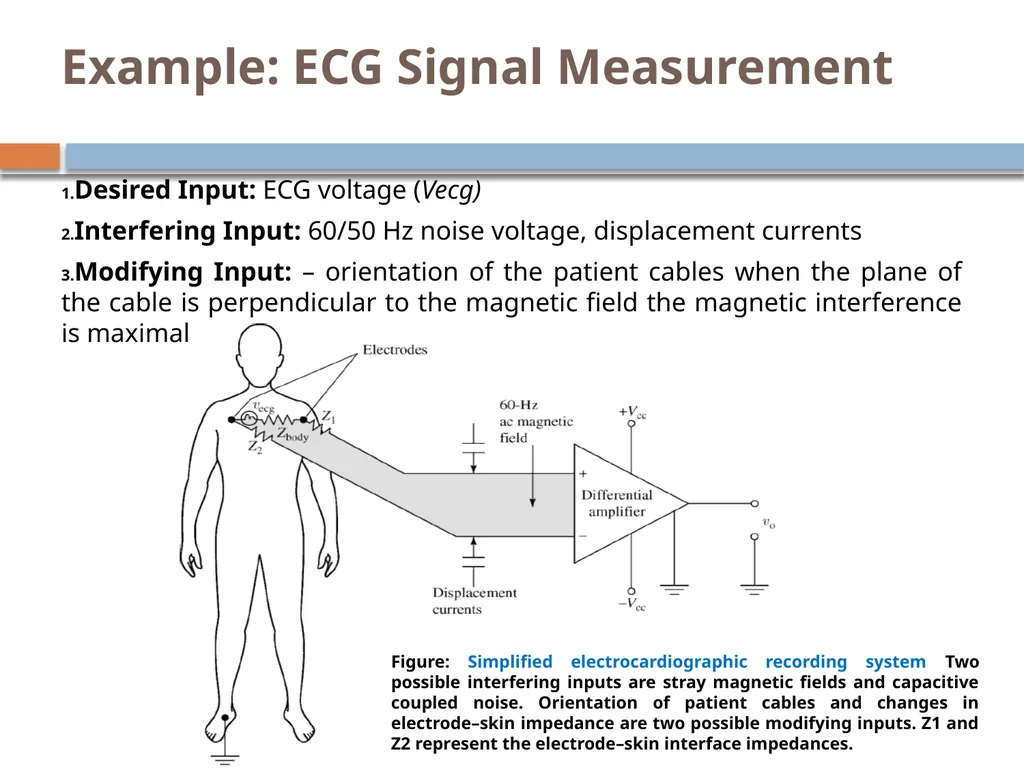
Desired Input: ECG voltage (Vecg)
Interfering Input: 60/50 Hz noise voltage, displacement currents
Modifying Input: – orientation of the patient cables when the plane of the cable is perpendicular to the magnetic field the magnetic interference is maximal Example: ECG Signal Measurement Figure: Simplified electrocardiographic recording system Two possible interfering inputs are stray magnetic fields and capacitive coupled noise. Orientation of patient cables and changes in electrode–skin impedance are two possible modifying inputs. Z1 and Z2 represent the electrode–skin interface impedances.<br>
Interfering Input: 60/50 Hz noise voltage, displacement currents
Modifying Input: – orientation of the patient cables when the plane of the cable is perpendicular to the magnetic field the magnetic interference is maximal Example: ECG Signal Measurement Figure: Simplified electrocardiographic recording system Two possible interfering inputs are stray magnetic fields and capacitive coupled noise. Orientation of patient cables and changes in electrode–skin impedance are two possible modifying inputs. Z1 and Z2 represent the electrode–skin interface impedances.<br>
33
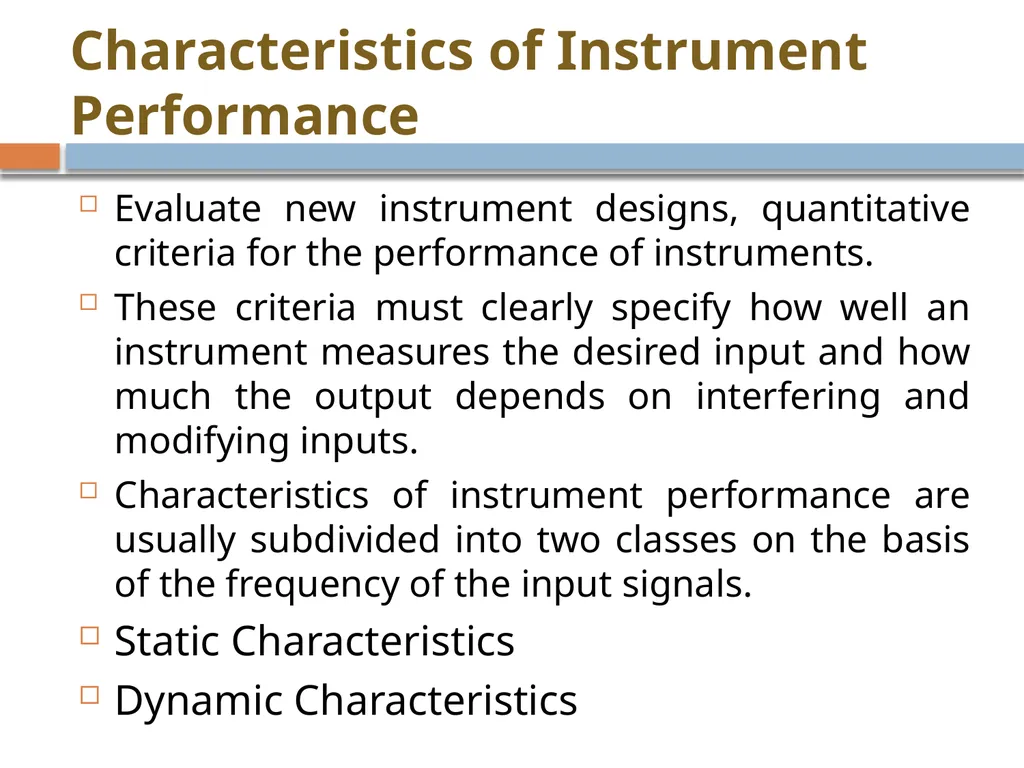
Characteristics of Instrument Performance Evaluate new instrument designs, quantitative criteria for the performance of instruments.
These criteria must clearly specify how well an instrument measures the desired input and how much the output depends on interfering and modifying inputs.
Characteristics of instrument performance are usually subdivided into two classes on the basis of the frequency of the input signals.
Static Characteristics
Dynamic Characteristics<br>
These criteria must clearly specify how well an instrument measures the desired input and how much the output depends on interfering and modifying inputs.
Characteristics of instrument performance are usually subdivided into two classes on the basis of the frequency of the input signals.
Static Characteristics
Dynamic Characteristics<br>
34
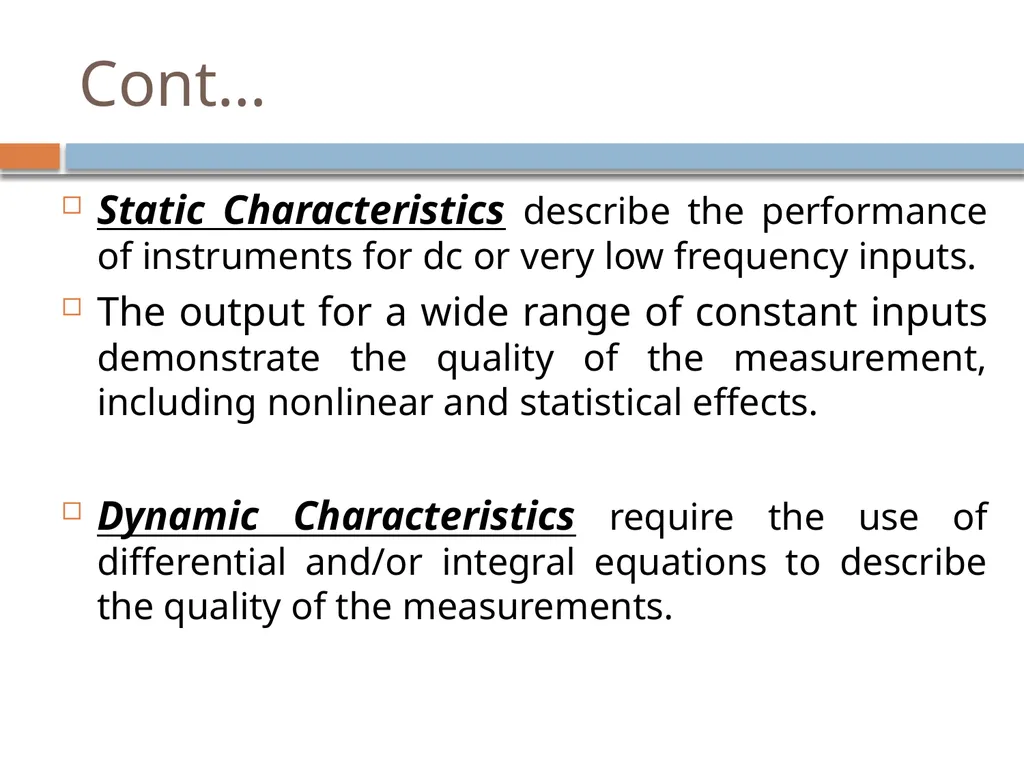
Cont… Static Characteristics describe the performance of instruments for dc or very low frequency inputs.
The output for a wide range of constant inputs demonstrate the quality of the measurement, including nonlinear and statistical effects.
Dynamic Characteristics require the use of differential and/or integral equations to describe the quality of the measurements.<br>
The output for a wide range of constant inputs demonstrate the quality of the measurement, including nonlinear and statistical effects.
Dynamic Characteristics require the use of differential and/or integral equations to describe the quality of the measurements.<br>
35
Generalized Static Characteristics Following are the parameters used to evaluate medical instrument:
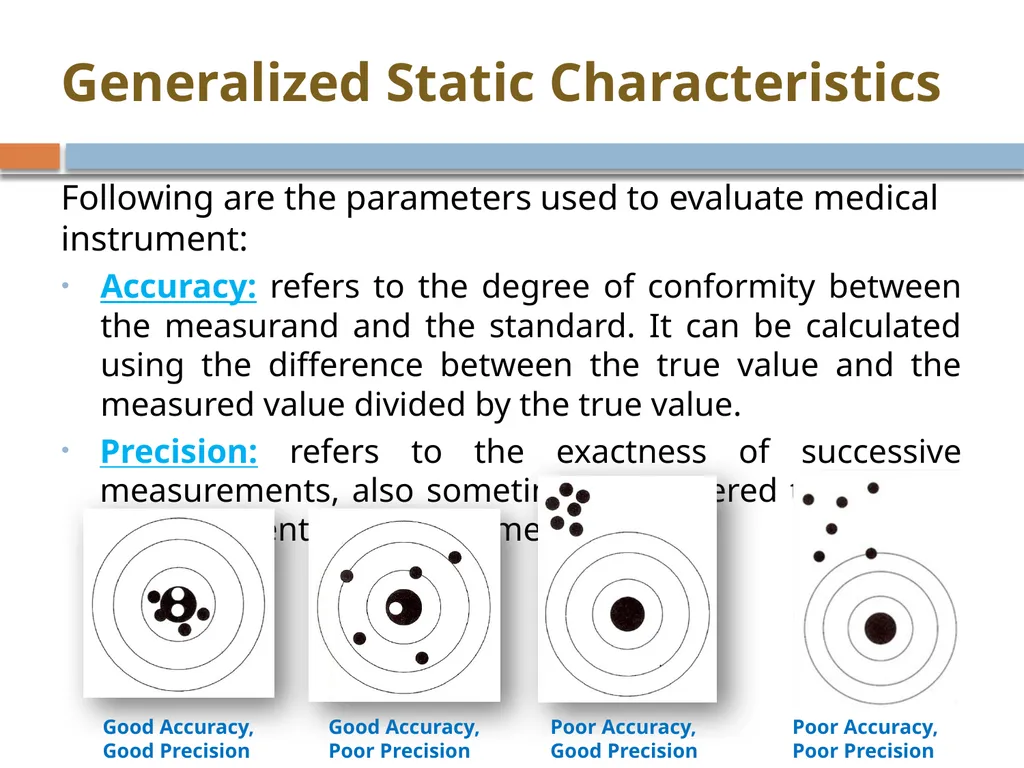
Accuracy: refers to the degree of conformity between the measurand and the standard. It can be calculated using the difference between the true value and the measured value divided by the true value.
Precision: refers to the exactness of successive measurements, also sometimes considered the degree of refinement of measurement. Good Accuracy, Good Precision Good Accuracy, Poor Precision Poor Accuracy, Good Precision Poor Accuracy, Poor Precision<br>
Accuracy: refers to the degree of conformity between the measurand and the standard. It can be calculated using the difference between the true value and the measured value divided by the true value.
Precision: refers to the exactness of successive measurements, also sometimes considered the degree of refinement of measurement. Good Accuracy, Good Precision Good Accuracy, Poor Precision Poor Accuracy, Good Precision Poor Accuracy, Poor Precision<br>
36
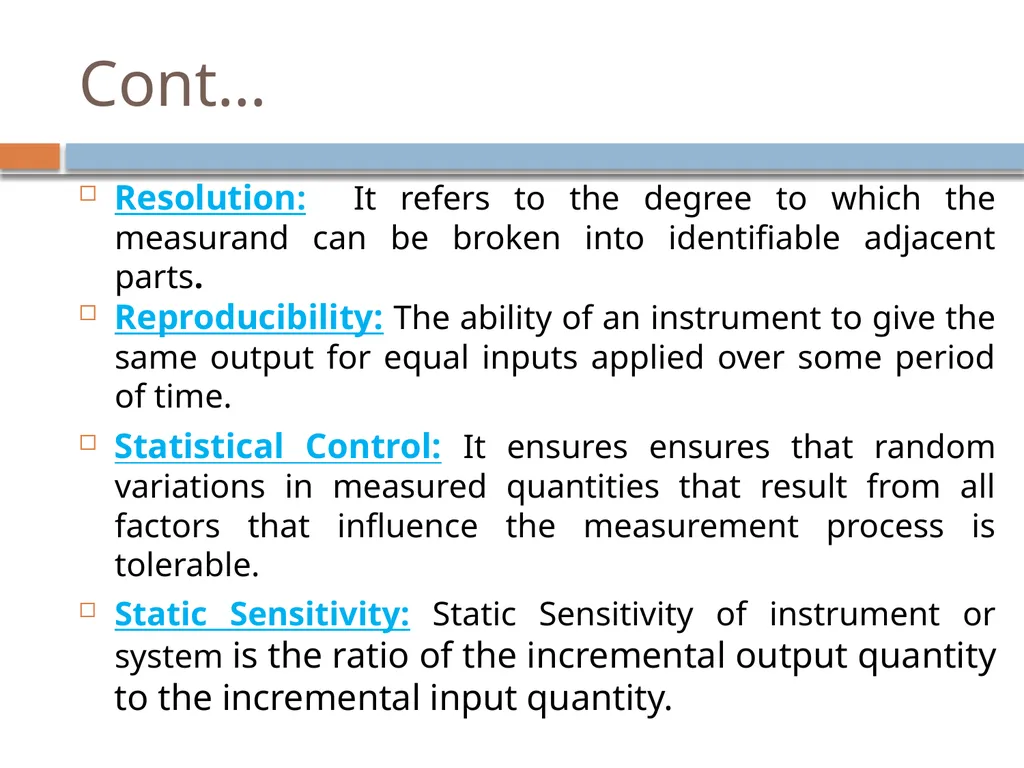
Cont… Resolution: It refers to the degree to which the measurand can be broken into identifiable adjacent parts.
Reproducibility: The ability of an instrument to give the same output for equal inputs applied over some period of time.
Statistical Control: It ensures ensures that random variations in measured quantities that result from all factors that influence the measurement process is tolerable.
Static Sensitivity: Static Sensitivity of instrument or system is the ratio of the incremental output quantity to the incremental input quantity.<br>
Reproducibility: The ability of an instrument to give the same output for equal inputs applied over some period of time.
Statistical Control: It ensures ensures that random variations in measured quantities that result from all factors that influence the measurement process is tolerable.
Static Sensitivity: Static Sensitivity of instrument or system is the ratio of the incremental output quantity to the incremental input quantity.<br>
37
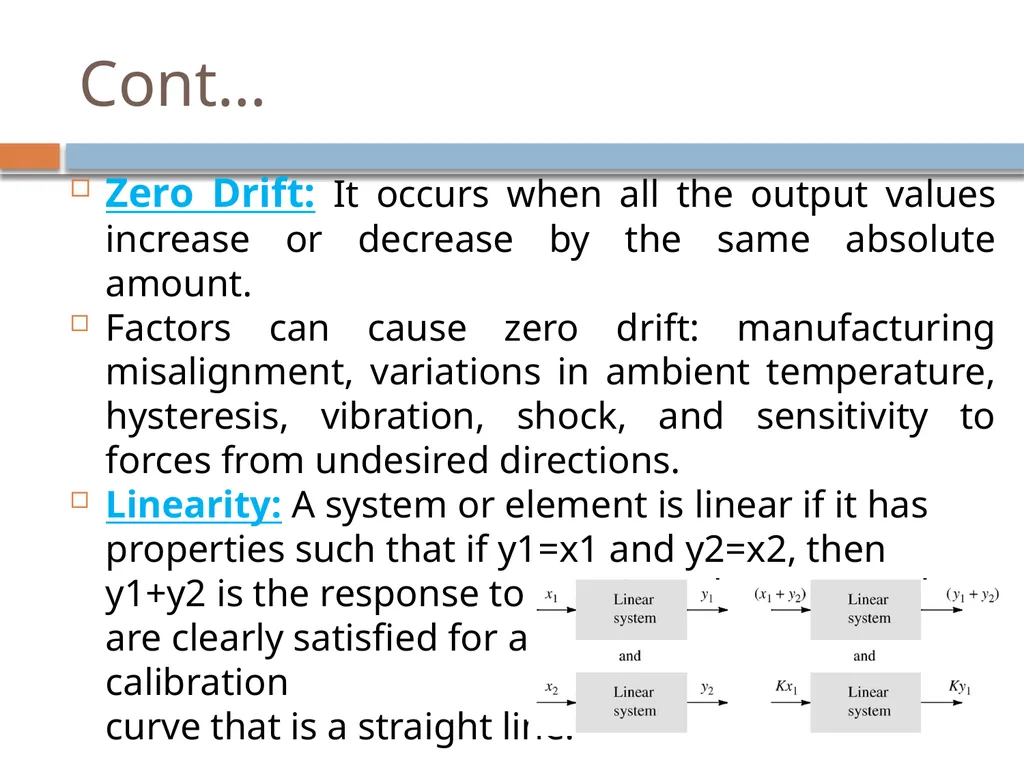
Cont… Zero Drift: It occurs when all the output values increase or decrease by the same absolute amount.
Factors can cause zero drift: manufacturing misalignment, variations in ambient temperature, hysteresis, vibration, shock, and sensitivity to forces from undesired directions.
Linearity: A system or element is linear if it has properties such that if y1=x1 and y2=x2, then y1+y2 is the response to x1+x2, and Ky1=Kx1. They are clearly satisfied for an instrument with a calibration
curve that is a straight line.<br>
Factors can cause zero drift: manufacturing misalignment, variations in ambient temperature, hysteresis, vibration, shock, and sensitivity to forces from undesired directions.
Linearity: A system or element is linear if it has properties such that if y1=x1 and y2=x2, then y1+y2 is the response to x1+x2, and Ky1=Kx1. They are clearly satisfied for an instrument with a calibration
curve that is a straight line.<br>
38
Input Ranges: The normal linear operating range specifies the maximal or near maximal inputs that give linear outputs.
Input Impedance: It is the ratio of the phasor equivalent of a steady-state sinusoidal effort input variable (voltage, force, pressure) to the phasor equivalent of a steady-state sinusoidal flow input
variable (current, velocity, flow).<br>
Input Impedance: It is the ratio of the phasor equivalent of a steady-state sinusoidal effort input variable (voltage, force, pressure) to the phasor equivalent of a steady-state sinusoidal flow input
variable (current, velocity, flow).<br>
39
Generalized Dynamic Characteristics Most of the biological signals time-varying in nature and therefore we should make sure that the instrument is a time-invariant system for an accurate measurement.
The dynamic characteristics of an instrument include its transfer function, its frequency response, and its phase or time delay.
Dynamic characteristics require the use of differential or integral equations to describe the quality of the measurements.
Transfer functions are used to predict the stability of a system.<br>
The dynamic characteristics of an instrument include its transfer function, its frequency response, and its phase or time delay.
Dynamic characteristics require the use of differential or integral equations to describe the quality of the measurements.
Transfer functions are used to predict the stability of a system.<br>
40
Cont… Zero Order Instruments:
It has ideal dynamic performance, because the output is proportional to the input for all frequencies and there is no amplitude or phase distortion.
Example: Linear Potentiometer
First Order Instruments:
It contains a single energy storage element.
Example: Low-pass RC filter.<br>
It has ideal dynamic performance, because the output is proportional to the input for all frequencies and there is no amplitude or phase distortion.
Example: Linear Potentiometer
First Order Instruments:
It contains a single energy storage element.
Example: Low-pass RC filter.<br>
41
Cont… Second Order Instruments:
Instruments that requires second-order differential equation is required to describe its dynamic response.
Many medical instruments are second order or higher, and low pass.
Example: Force-measuring Spring Scale
Time Delay:
Instrument elements that give an output that is exactly the same as the input, except that it is delayed in time.
Example: Equipment that require significant signal processing schemes.<br>
Instruments that requires second-order differential equation is required to describe its dynamic response.
Many medical instruments are second order or higher, and low pass.
Example: Force-measuring Spring Scale
Time Delay:
Instrument elements that give an output that is exactly the same as the input, except that it is delayed in time.
Example: Equipment that require significant signal processing schemes.<br>
42
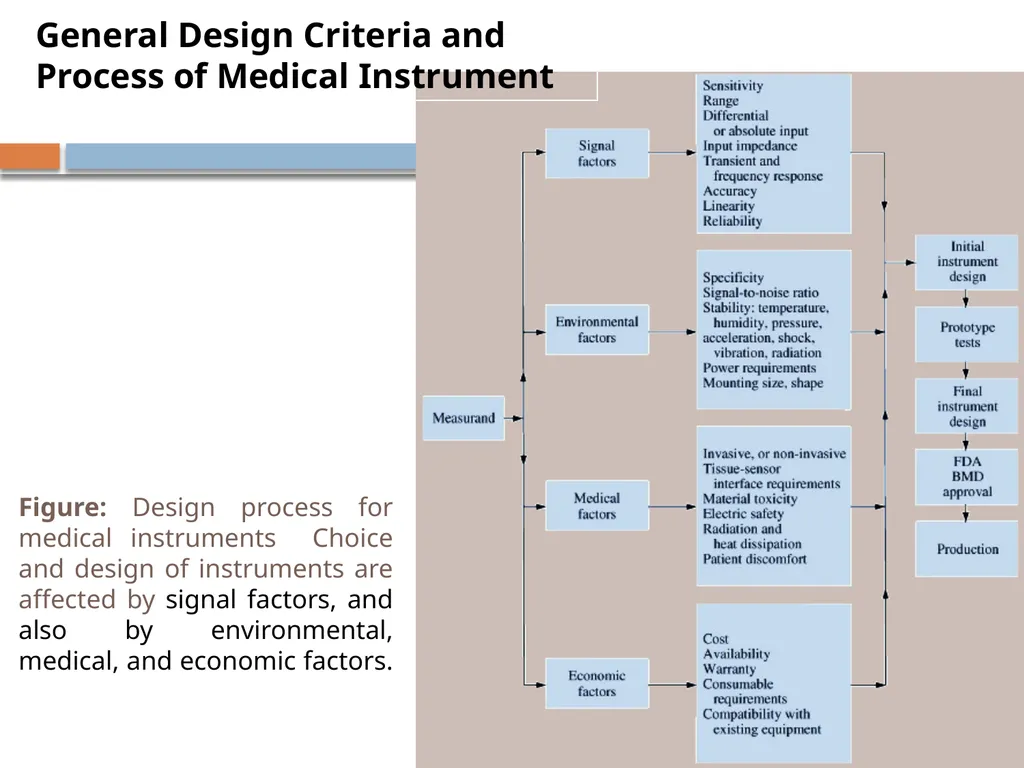
Figure: Design process for medical instruments Choice and design of instruments are affected by signal factors, and also by environmental, medical, and economic factors. General Design Criteria and Process of Medical Instrument<br>
43
Regulations of Medical Devices The medical instrumentation industry in general and hospitals in particular are required to be most regulated industries.
This is because when instruments are made on human beings and by the human beings, the equipment should not only be safe to operate but must give intended performance so that the patients could be properly diagnosed and treated.
To minimize the problems various countries have introduced a large numbers of codes, standards and regulations for different types of equipment and facilities.
It is therefore, essential that engineers understand their significance and be aware of the issues that are brought about by technological and economical relaities.<br>
This is because when instruments are made on human beings and by the human beings, the equipment should not only be safe to operate but must give intended performance so that the patients could be properly diagnosed and treated.
To minimize the problems various countries have introduced a large numbers of codes, standards and regulations for different types of equipment and facilities.
It is therefore, essential that engineers understand their significance and be aware of the issues that are brought about by technological and economical relaities.<br>
44
Cont…. Regulations: A regulation is an organization’s way of specifying that some particular standard must be adhered to. These are rules normally promulgate by the government.
Codes: A systems of principles or regulations or a systematized body of law or an accumulation of a system of regulations and standards. In general, a code is compilation of standards relating to providing health care to the state population.
Specification: Documents used to control the procurement of equipment by laying down the performance and other associated criteria. These documents usually cover design criteria, system performance, materials and technical data.<br>
Codes: A systems of principles or regulations or a systematized body of law or an accumulation of a system of regulations and standards. In general, a code is compilation of standards relating to providing health care to the state population.
Specification: Documents used to control the procurement of equipment by laying down the performance and other associated criteria. These documents usually cover design criteria, system performance, materials and technical data.<br>
45
Cont… Standards: A standard is a multi-party agreement for establishment of an arbitrary criterion for reference. Alternatively standard is prescribed set of rules, conditions or requirements concerned with the definition of terms, classification of components, delineation of procedures, specifications of materials, performance, design or operations, measurements of quality and quality in describing materials, products, systems, services or practice. Standards exist that address systems (protection of the electrical power distribution systems from faults), individuals (measure to reduce potential electric shock hazards) and protection of the environment (disposal of medical waste).<br>
46
Types of Standards There are in general three type of standards for medical devices:
Voluntary Standards: Developed through a consensus process where manufactures, users, consumers and government agencies participate.
Mandatory Standards: Required to be followed under law. They are incumbent on those to whom the standard is addressed and enforceable by the authority having jurisdiction
Proprietary Standards: Developed either by a manufacturer for its own internal use or by a trade association for use by its members.<br>
Voluntary Standards: Developed through a consensus process where manufactures, users, consumers and government agencies participate.
Mandatory Standards: Required to be followed under law. They are incumbent on those to whom the standard is addressed and enforceable by the authority having jurisdiction
Proprietary Standards: Developed either by a manufacturer for its own internal use or by a trade association for use by its members.<br>
47
Regulatory Requirements In 1976 the United States Congress passed what are known as the Medical Device Amendments (Public Law 94-295) to the Federal Food, Drug, and Cosmetics Act that dates back to the 1930s.
The primary purpose was to ensure the safety and efficacy of new medical devices prior to marketing of the device.
Medical devices were classified in two ways.
First, the division of such devices into Class I, II, and
III was based on the principle that devices that pose greater potential hazards should be subject to more regulatory requirements.<br>
The primary purpose was to ensure the safety and efficacy of new medical devices prior to marketing of the device.
Medical devices were classified in two ways.
First, the division of such devices into Class I, II, and
III was based on the principle that devices that pose greater potential hazards should be subject to more regulatory requirements.<br>
48
Cont… Second, seven categories were established: preamendment, postamendment, substantially equivalent, implant, custom, investigational, and transitional.
The seven categories into which medical devices are divided are described in Table, which also includes classification rules and examples.
Software used in medical devices has become an area of increasing concern.<br>
The seven categories into which medical devices are divided are described in Table, which also includes classification rules and examples.
Software used in medical devices has become an area of increasing concern.<br>
49
Cont… Class I General Controls: Manufacturers are required to perform registration, premarketing notification, record keeping, labeling, reporting of adverse experiences, and good manufacturing practices. These controls apply to all three classes.
Class II Performance Standards: Apply to devices for reasonable assurance of safety and efficacy, and for which existing information is sufficient to establish a performance standard. However, until performance standards are developed by regulation, only general control apply.<br>
Class II Performance Standards: Apply to devices for reasonable assurance of safety and efficacy, and for which existing information is sufficient to establish a performance standard. However, until performance standards are developed by regulation, only general control apply.<br>
50
Cont… Class III Premarketing Approval: Such approval is required for devices used in supporting or sustaining human life and preventing impairment of human health.
The FDA has extensively regulated these devices by requiring manufacturers to prove their safety and effectiveness prior to market release.<br>
The FDA has extensively regulated these devices by requiring manufacturers to prove their safety and effectiveness prior to market release.<br>
51
Questions???<br>