Biosecurity Operational Biosecurity Measures
Description: Biosecurity Operational Biosecurity Measures Adapted from the FAD PRePNAHEMS Guidelines: Biosecurity (2016) Describes operational biosecurity Presents considerations to develop an effective biosecurity plan Provides examples of operational
Related Topics
Download Presentation
"Biosecurity Operational Biosecurity Measures" is the property of its rightful owner. Permission is granted to download and print the materials on this website for personal, non-commercial use only, and to display it on your personal computer provided you do not modify the materials and that you retain all copyright notices contained in the materials. By downloading content from our website, you accept the terms of this agreement.
Presentation Transcript
slide1. Biosecurity Operational Biosecurity Measures Adapted from the FAD PReP/NAHEMS Guidelines: Biosecurity (2016)<br>
slide2. Describes operational biosecurity
Presents considerations to develop an effective biosecurity plan
Provides examples of operational measures
Applicable regardless of livestock species
Choices based on risk assessment
Site and situation specific USDA APHIS and CFSPH FAD PReP/NAHEMS Guidelines: Biosecurity - OpMeasures This Presentation<br>
slide3. Operational biosecurity
One of three levels of biosecurity
Review of three levels of biosecurity
Conceptual biosecurity
Structural biosecurity
Operational biosecurity USDA APHIS and CFSPH FAD PReP/NAHEMS Guidelines: Biosecurity - OpMeasures Levels of Biosecurity<br>
slide4. Processes, protocols, management practices, and standard operating procedures
Keeps disease agents out
Contains, prevents disease spread
Measures conducted on-premises
Addresses personnel, vectors, animals, equipment, and other materials USDA APHIS and CFSPH FAD PReP/NAHEMS Guidelines: Biosecurity - OpMeasures Operational Biosecurity<br>
slide5. Operational Procedures USDA APHIS and CFSPH FAD PReP/NAHEMS Guidelines: Biosecurity - OpMeasures<br>
slide6. Movements of personnel
Vectors
Equipment and vehicles
Carcass disposal
Manure/litter management
Animals
Feed, replacement bedding/litter, and water supply
Maintenance and security of the facility USDA APHIS and CFSPH FAD PReP/NAHEMS Guidelines: Biosecurity - OpMeasures Scope of Procedures<br>
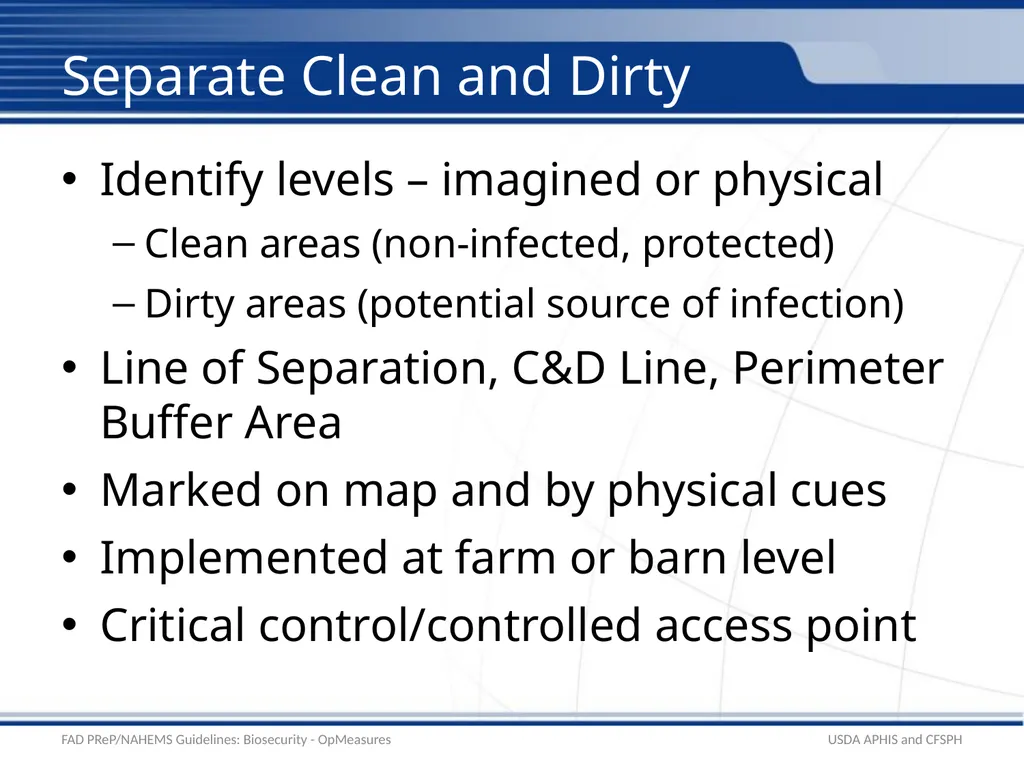
slide7. Identify levels – imagined or physical
Clean areas (non-infected, protected)
Dirty areas (potential source of infection)
Line of Separation, C&D Line, Perimeter Buffer Area
Marked on map and by physical cues
Implemented at farm or barn level
Critical control/controlled access point USDA APHIS and CFSPH FAD PReP/NAHEMS Guidelines: Biosecurity - OpMeasures Separate Clean and Dirty<br>
slide8. Evaluation to determine procedures
Critical control points
Apply control (to prevent harm)
At entrances and/or exits to premises, facility, or barn unit
Apply strategic measures
C&D, movement controls, and employment restrictions USDA APHIS and CFSPH FAD PReP/NAHEMS Guidelines: Biosecurity - OpMeasures Critical Control Points<br>
slide9. Assigned responsible individual
Develop written site-specific plan
Implement and train others
Prevent transfer of disease on clothes and personal articles
Biosecurity attire, shower in/shower out USDA APHIS and CFSPH FAD PReP/NAHEMS Guidelines: Biosecurity - OpMeasures People<br>
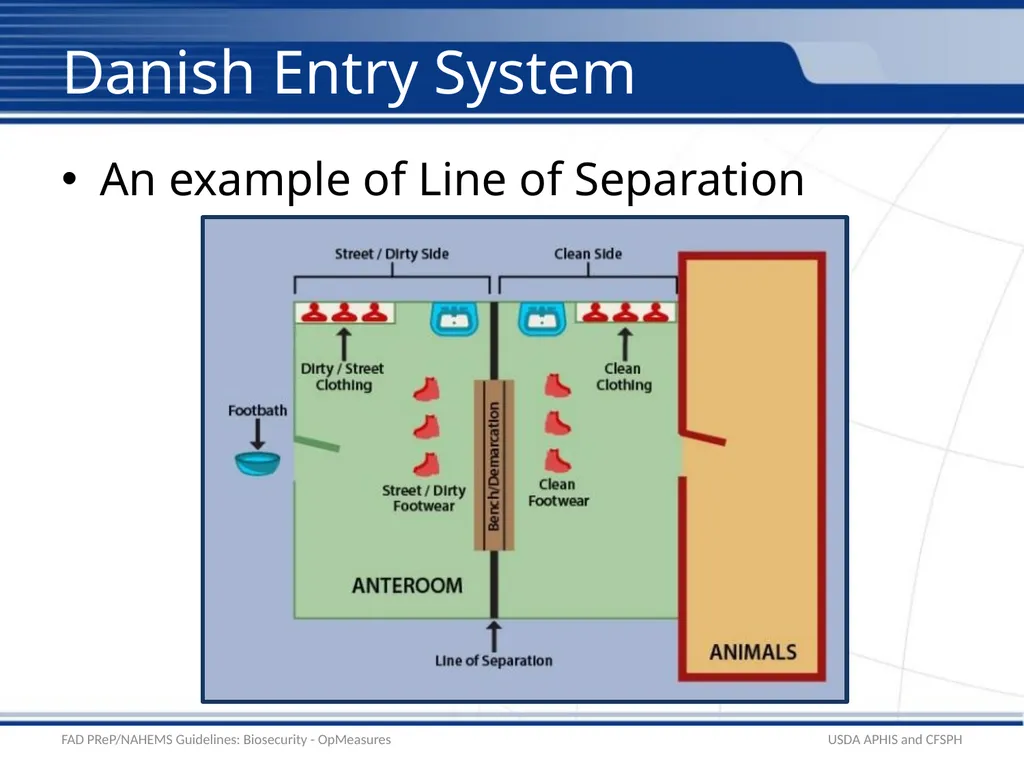
slide10. An example of Line of Separation USDA APHIS and CFSPH FAD PReP/NAHEMS Guidelines: Biosecurity - OpMeasures Danish Entry System<br>
slide11. On-site shuttle for movements
Employment conditions that minimize outside animal contact
Signage as biosecurity reminders USDA APHIS and CFSPH FAD PReP/NAHEMS Guidelines: Biosecurity - OpMeasures People<br>
slide12. Wildlife, insects, and household pets
Clean spilled feed immediately
Structural controls to prevent entry
Follow up with control programs
Reduce wildlife habitat by mowing USDA APHIS and CFSPH FAD PReP/NAHEMS Guidelines: Biosecurity - OpMeasures Vectors<br>
slide13. Dedicated equipment - avoid sharing
Cleaning protocols
Between groups on the premises
Prior to crossing Line of Separation
Supply and delivery entrance protocols to eliminate contamination USDA APHIS and CFSPH FAD PReP/NAHEMS Guidelines: Biosecurity - OpMeasures Equipment<br>
slide14. Internal vehicles service the facility
External vehicles excluded
Thorough C&D for those that must enter protected area
Wheels and wheel wells
Animal cargo areas and between loads
Deliveries at a distant location
Avoid crossing work paths USDA APHIS and CFSPH FAD PReP/NAHEMS Guidelines: Biosecurity - OpMeasures Vehicles<br>
slide15. Processes that prevent cross-contamination
Off-site carcasses, feed delivery
Other work paths
Prevents attraction of wildlife/vectors
Storage, composting, pick up at a distance from live animals
Rendering trucks do not enter protected space or Perimeter Buffer Area USDA APHIS and CFSPH FAD PReP/NAHEMS Guidelines: Biosecurity - OpMeasures Carcass Disposal<br>
slide16. Removal process prevents exposure to live animals
Management and handling avoids cross-contamination of feed delivery and work pathways USDA APHIS and CFSPH FAD PReP/NAHEMS Guidelines: Biosecurity - OpMeasures Manure/Litter Management<br>
slide17. Quarantined animals/herds usually do not move off the premises
Maintain as a closed herd
Replacements from infection-free sources
Transported in cleaned carriers
Isolation of new additions USDA APHIS and CFSPH FAD PReP/NAHEMS Guidelines: Biosecurity - OpMeasures Animals<br>
slide18. All-in/all-out management of groups
No re-entry without biosecurity measures, especially at load-out
No re-entry of animals once they leave
Specific order of daily care
Segregation of sick animals USDA APHIS and CFSPH FAD PReP/NAHEMS Guidelines: Biosecurity - OpMeasures Animals cont’d<br>
slide19. Closed containers to prevent contamination
During delivery, storage, and handling
Deliveries at a distant location
Shuttled by on-site equipment
Spilled feed cleaned immediately
Water from deep wells or treated sources USDA APHIS and CFSPH FAD PReP/NAHEMS Guidelines: Biosecurity - OpMeasures Feed, Bedding, Litter, Water Supply<br>
slide20. Reduce environmental contamination
Routine regular cleaning
Thorough cleaning and downtime between groups
Regular maintenance of the outside environment to discourage vectors USDA APHIS and CFSPH FAD PReP/NAHEMS Guidelines: Biosecurity - OpMeasures Maintenance<br>
slide21. Secure animal areas
Prevents breaches in biosecurity
Prevents unauthorized access
Prevents lack of vigilance after-hours
Lock buildings when no one present
No circumventing biosecurity rules USDA APHIS and CFSPH FAD PReP/NAHEMS Guidelines: Biosecurity - OpMeasures Security<br>
slide22. Examples not totally inclusive
Measures go beyond just cleaning and disinfection
Measures chosen based on
Specific site
Specific operations
Structural and conceptual biosecurity USDA APHIS and CFSPH FAD PReP/NAHEMS Guidelines: Biosecurity - OpMeasures Conclusion<br>
slide23. USDA APHIS and CFSPH FAD PReP/NAHEMS Guidelines: Biosecurity - OpMeasures For More Information FAD PReP/NAHEMS Guidelines & SOP: Biosecurity (2016)
http://www.aphis.usda.gov/fadprep
Biosecurity web-based training module:
http://naherc.sws.iastate.edu/<br>
slide24. Authors (CFSPH)
Janice P. Mogan, DVM
Heather Allen, PhD, MPA
Kristen Bretz, MS
Reviewers (USDA)
Jonathan T. Zack, DVM
James A. Roth, DVM, PhD, DACVM USDA APHIS and CFSPH FAD PReP/NAHEMS Guidelines: Biosecurity - OpMeasures Guidelines Content<br>
slide25. Acknowledgments Development of this presentation was by the Center for Food Security and Public Health at Iowa State University through funding from the USDA APHIS Veterinary Services PPT Authors: Janice P. Mogan, DVM; Logan Kilburn Reviewer: Kristen Bretz, MS<br>
slide2. Describes operational biosecurity
Presents considerations to develop an effective biosecurity plan
Provides examples of operational measures
Applicable regardless of livestock species
Choices based on risk assessment
Site and situation specific USDA APHIS and CFSPH FAD PReP/NAHEMS Guidelines: Biosecurity - OpMeasures This Presentation<br>
slide3. Operational biosecurity
One of three levels of biosecurity
Review of three levels of biosecurity
Conceptual biosecurity
Structural biosecurity
Operational biosecurity USDA APHIS and CFSPH FAD PReP/NAHEMS Guidelines: Biosecurity - OpMeasures Levels of Biosecurity<br>
slide4. Processes, protocols, management practices, and standard operating procedures
Keeps disease agents out
Contains, prevents disease spread
Measures conducted on-premises
Addresses personnel, vectors, animals, equipment, and other materials USDA APHIS and CFSPH FAD PReP/NAHEMS Guidelines: Biosecurity - OpMeasures Operational Biosecurity<br>
slide5. Operational Procedures USDA APHIS and CFSPH FAD PReP/NAHEMS Guidelines: Biosecurity - OpMeasures<br>
slide6. Movements of personnel
Vectors
Equipment and vehicles
Carcass disposal
Manure/litter management
Animals
Feed, replacement bedding/litter, and water supply
Maintenance and security of the facility USDA APHIS and CFSPH FAD PReP/NAHEMS Guidelines: Biosecurity - OpMeasures Scope of Procedures<br>
slide7. Identify levels – imagined or physical
Clean areas (non-infected, protected)
Dirty areas (potential source of infection)
Line of Separation, C&D Line, Perimeter Buffer Area
Marked on map and by physical cues
Implemented at farm or barn level
Critical control/controlled access point USDA APHIS and CFSPH FAD PReP/NAHEMS Guidelines: Biosecurity - OpMeasures Separate Clean and Dirty<br>
slide8. Evaluation to determine procedures
Critical control points
Apply control (to prevent harm)
At entrances and/or exits to premises, facility, or barn unit
Apply strategic measures
C&D, movement controls, and employment restrictions USDA APHIS and CFSPH FAD PReP/NAHEMS Guidelines: Biosecurity - OpMeasures Critical Control Points<br>
slide9. Assigned responsible individual
Develop written site-specific plan
Implement and train others
Prevent transfer of disease on clothes and personal articles
Biosecurity attire, shower in/shower out USDA APHIS and CFSPH FAD PReP/NAHEMS Guidelines: Biosecurity - OpMeasures People<br>
slide10. An example of Line of Separation USDA APHIS and CFSPH FAD PReP/NAHEMS Guidelines: Biosecurity - OpMeasures Danish Entry System<br>
slide11. On-site shuttle for movements
Employment conditions that minimize outside animal contact
Signage as biosecurity reminders USDA APHIS and CFSPH FAD PReP/NAHEMS Guidelines: Biosecurity - OpMeasures People<br>
slide12. Wildlife, insects, and household pets
Clean spilled feed immediately
Structural controls to prevent entry
Follow up with control programs
Reduce wildlife habitat by mowing USDA APHIS and CFSPH FAD PReP/NAHEMS Guidelines: Biosecurity - OpMeasures Vectors<br>
slide13. Dedicated equipment - avoid sharing
Cleaning protocols
Between groups on the premises
Prior to crossing Line of Separation
Supply and delivery entrance protocols to eliminate contamination USDA APHIS and CFSPH FAD PReP/NAHEMS Guidelines: Biosecurity - OpMeasures Equipment<br>
slide14. Internal vehicles service the facility
External vehicles excluded
Thorough C&D for those that must enter protected area
Wheels and wheel wells
Animal cargo areas and between loads
Deliveries at a distant location
Avoid crossing work paths USDA APHIS and CFSPH FAD PReP/NAHEMS Guidelines: Biosecurity - OpMeasures Vehicles<br>
slide15. Processes that prevent cross-contamination
Off-site carcasses, feed delivery
Other work paths
Prevents attraction of wildlife/vectors
Storage, composting, pick up at a distance from live animals
Rendering trucks do not enter protected space or Perimeter Buffer Area USDA APHIS and CFSPH FAD PReP/NAHEMS Guidelines: Biosecurity - OpMeasures Carcass Disposal<br>
slide16. Removal process prevents exposure to live animals
Management and handling avoids cross-contamination of feed delivery and work pathways USDA APHIS and CFSPH FAD PReP/NAHEMS Guidelines: Biosecurity - OpMeasures Manure/Litter Management<br>
slide17. Quarantined animals/herds usually do not move off the premises
Maintain as a closed herd
Replacements from infection-free sources
Transported in cleaned carriers
Isolation of new additions USDA APHIS and CFSPH FAD PReP/NAHEMS Guidelines: Biosecurity - OpMeasures Animals<br>
slide18. All-in/all-out management of groups
No re-entry without biosecurity measures, especially at load-out
No re-entry of animals once they leave
Specific order of daily care
Segregation of sick animals USDA APHIS and CFSPH FAD PReP/NAHEMS Guidelines: Biosecurity - OpMeasures Animals cont’d<br>
slide19. Closed containers to prevent contamination
During delivery, storage, and handling
Deliveries at a distant location
Shuttled by on-site equipment
Spilled feed cleaned immediately
Water from deep wells or treated sources USDA APHIS and CFSPH FAD PReP/NAHEMS Guidelines: Biosecurity - OpMeasures Feed, Bedding, Litter, Water Supply<br>
slide20. Reduce environmental contamination
Routine regular cleaning
Thorough cleaning and downtime between groups
Regular maintenance of the outside environment to discourage vectors USDA APHIS and CFSPH FAD PReP/NAHEMS Guidelines: Biosecurity - OpMeasures Maintenance<br>
slide21. Secure animal areas
Prevents breaches in biosecurity
Prevents unauthorized access
Prevents lack of vigilance after-hours
Lock buildings when no one present
No circumventing biosecurity rules USDA APHIS and CFSPH FAD PReP/NAHEMS Guidelines: Biosecurity - OpMeasures Security<br>
slide22. Examples not totally inclusive
Measures go beyond just cleaning and disinfection
Measures chosen based on
Specific site
Specific operations
Structural and conceptual biosecurity USDA APHIS and CFSPH FAD PReP/NAHEMS Guidelines: Biosecurity - OpMeasures Conclusion<br>
slide23. USDA APHIS and CFSPH FAD PReP/NAHEMS Guidelines: Biosecurity - OpMeasures For More Information FAD PReP/NAHEMS Guidelines & SOP: Biosecurity (2016)
http://www.aphis.usda.gov/fadprep
Biosecurity web-based training module:
http://naherc.sws.iastate.edu/<br>
slide24. Authors (CFSPH)
Janice P. Mogan, DVM
Heather Allen, PhD, MPA
Kristen Bretz, MS
Reviewers (USDA)
Jonathan T. Zack, DVM
James A. Roth, DVM, PhD, DACVM USDA APHIS and CFSPH FAD PReP/NAHEMS Guidelines: Biosecurity - OpMeasures Guidelines Content<br>
slide25. Acknowledgments Development of this presentation was by the Center for Food Security and Public Health at Iowa State University through funding from the USDA APHIS Veterinary Services PPT Authors: Janice P. Mogan, DVM; Logan Kilburn Reviewer: Kristen Bretz, MS<br>