
Biosimilars Knowledge Connect Slide Resource This
EM
Published · 22 slides · 0 views

1 / 1


Description
Biosimilars Knowledge Connect Slide Resource This slide deck has been designed to be used as a central resource from which pertinent slides can be extracted as needed and is not intended for use in its entirety
Related Topics
Share
Embed code
Download this presentation From Below
"Biosimilars Knowledge Connect Slide Resource This" is the property of its rightful owner. Permission is granted to download and print the materials on this website for personal, non-commercial use only, and to display it on your personal computer provided you do not modify the materials and that you retain all copyright notices contained in the materials. By downloading content from our website, you accept the terms of this agreement.
Presentation Transcript
01
Biosimilars Knowledge Connect Slide Resource
This slide deck has been designed to be used as a central resource from which pertinent slides can be extracted as needed and is not intended for use in its entirety www.BiosimilarsKnowledgeConnect.com<br>
02
Introduction to biological medicines
and biosimilars A biosimilar is an approved version of a biological medicine with an identical primary amino acid sequence to the originator and developed with the intention to be as close to the originator as possible
Like biological medicines, biosimilars are complex protein molecules that are produced by living organisms
During the past 15 years, biological medicines have had a profound impact on healthcare
primarily in the areas of rheumatology and oncology
as well as endocrinology, cardiology, dermatology, gastroenterology, and neurology
Many of the world’s top-selling medicines are now biological medicines
However, biological medicines are expensive (sometimes by several orders of magnitude more than small-molecule chemical drugs), limiting patient access
As many biological medicines come off patent globally, there is great interest in the development of biosimilars, which are likely to be more affordable<br>
Like biological medicines, biosimilars are complex protein molecules that are produced by living organisms
During the past 15 years, biological medicines have had a profound impact on healthcare
primarily in the areas of rheumatology and oncology
as well as endocrinology, cardiology, dermatology, gastroenterology, and neurology
Many of the world’s top-selling medicines are now biological medicines
However, biological medicines are expensive (sometimes by several orders of magnitude more than small-molecule chemical drugs), limiting patient access
As many biological medicines come off patent globally, there is great interest in the development of biosimilars, which are likely to be more affordable<br>
03
The increasing rate of development
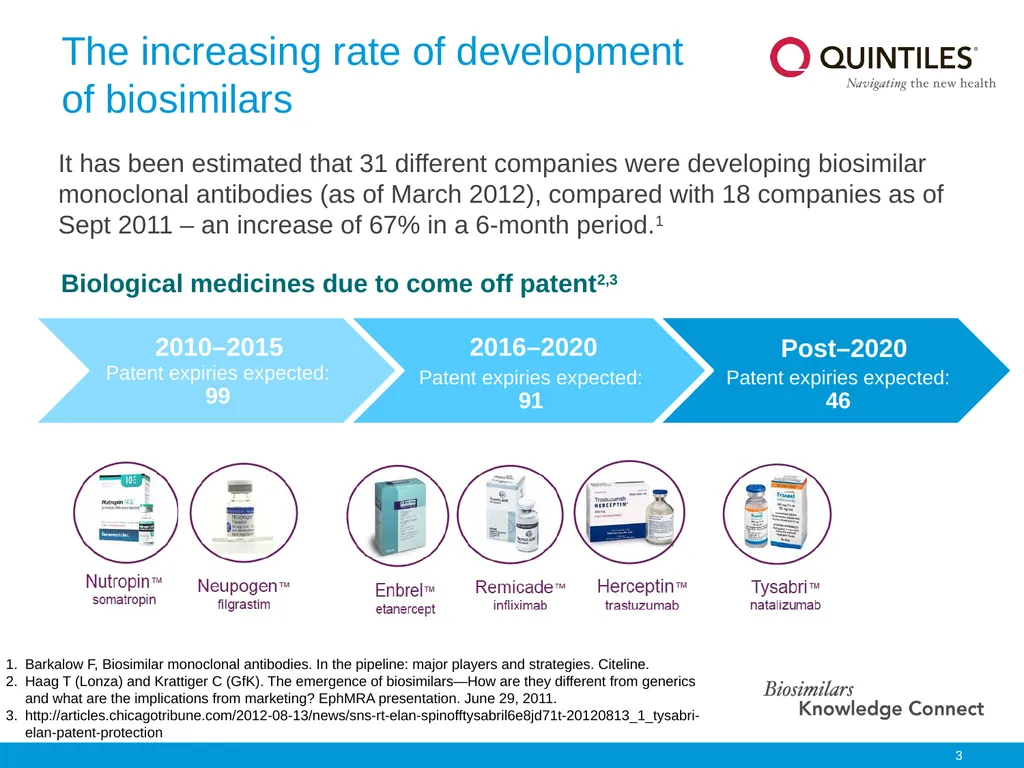
of biosimilars Biological medicines due to come off patent2,3 It has been estimated that 31 different companies were developing biosimilar monoclonal antibodies (as of March 2012), compared with 18 companies as of
Sept 2011 – an increase of 67% in a 6-month period.1 Barkalow F, Biosimilar monoclonal antibodies. In the pipeline: major players and strategies. Citeline.
Haag T (Lonza) and Krattiger C (GfK). The emergence of biosimilars—How are they different from generics and what are the implications from marketing? EphMRA presentation. June 29, 2011.
http://articles.chicagotribune.com/2012-08-13/news/sns-rt-elan-spinofftysabril6e8jd71t-20120813_1_tysabri-elan-patent-protection 2010–2015 2016–2020 Post–2020<br>
Haag T (Lonza) and Krattiger C (GfK). The emergence of biosimilars—How are they different from generics and what are the implications from marketing? EphMRA presentation. June 29, 2011.
http://articles.chicagotribune.com/2012-08-13/news/sns-rt-elan-spinofftysabril6e8jd71t-20120813_1_tysabri-elan-patent-protection 2010–2015 2016–2020 Post–2020<br>
04
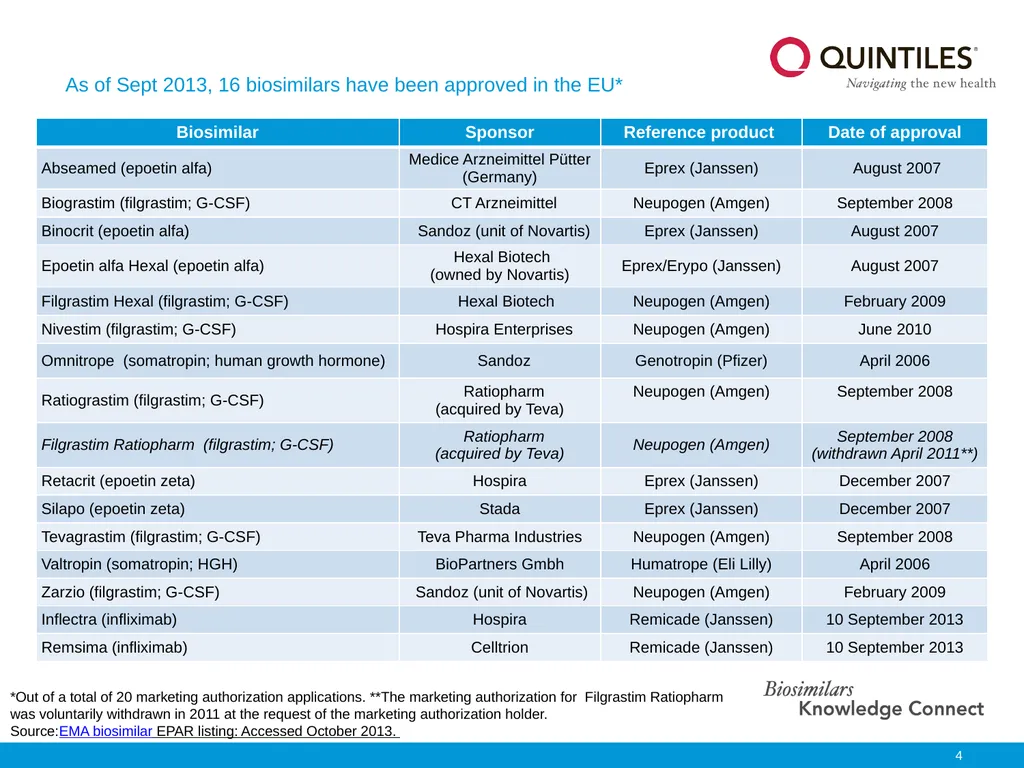
As of Sept 2013, 16 biosimilars have been approved in the EU* *Out of a total of 20 marketing authorization applications. **The marketing authorization for Filgrastim Ratiopharm
was voluntarily withdrawn in 2011 at the request of the marketing authorization holder.
Source:EMA biosimilar EPAR listing: Accessed October 2013.<br>
Source:EMA biosimilar EPAR listing: Accessed October 2013.<br>
05
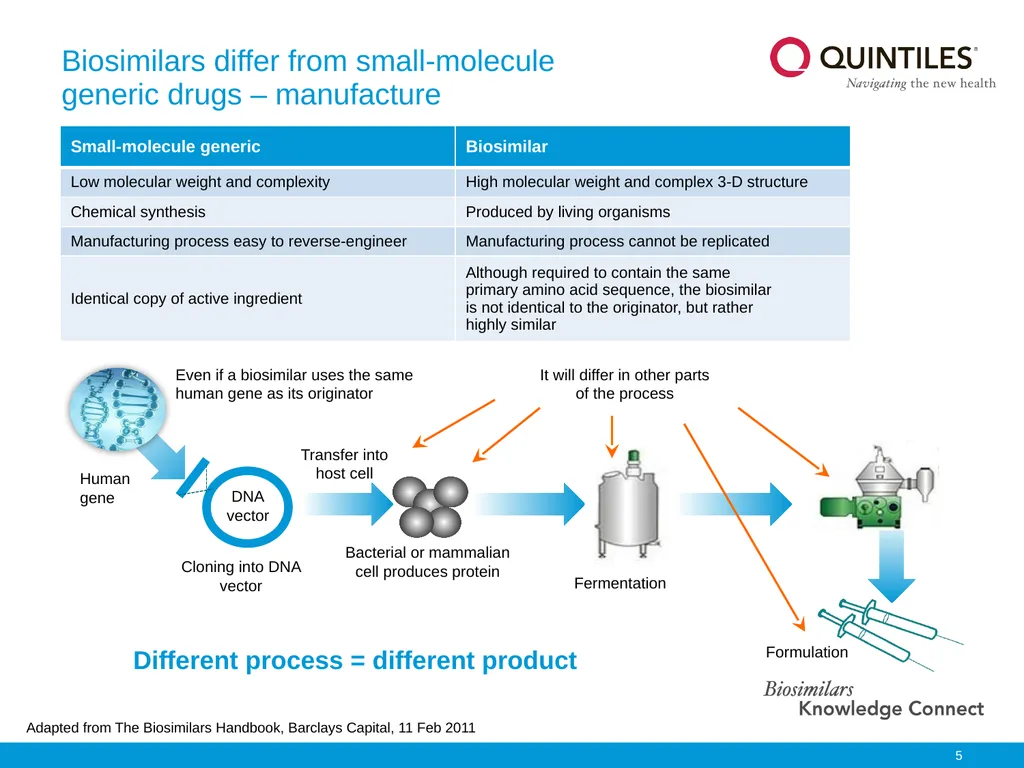
Biosimilars differ from small-molecule
generic drugs – manufacture Adapted from The Biosimilars Handbook, Barclays Capital, 11 Feb 2011<br>
06
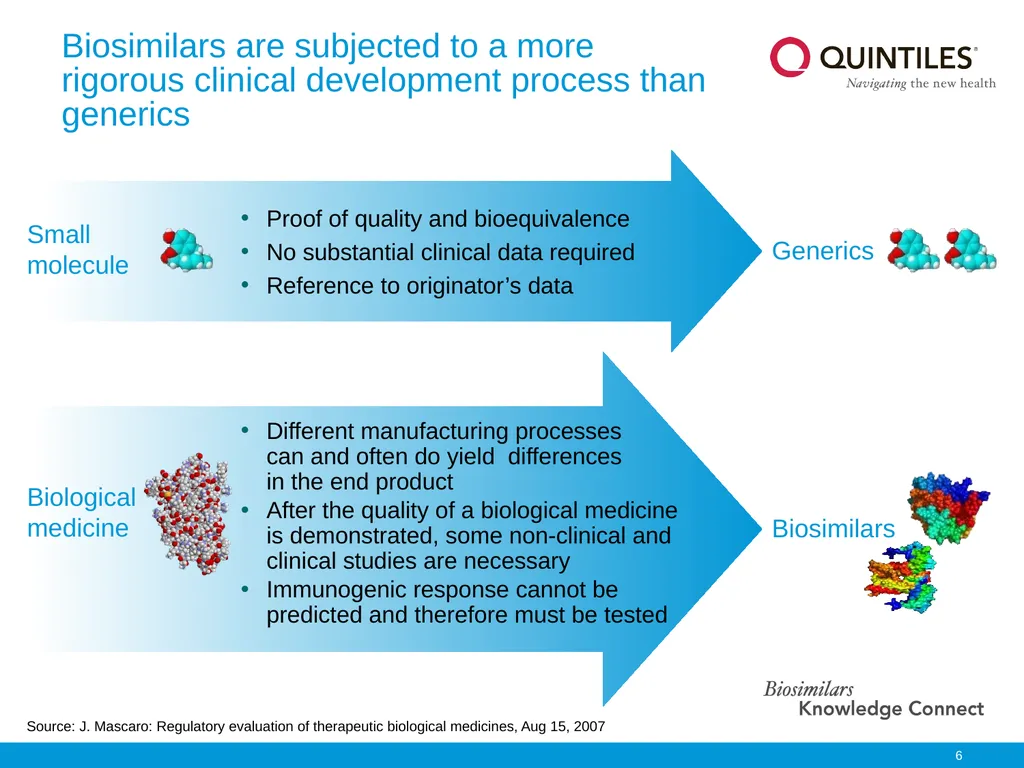
Biosimilars are subjected to a more rigorous clinical development process than generics Biosimilars Generics Proof of quality and bioequivalence
No substantial clinical data required
Reference to originator’s data Different manufacturing processes can and often do yield differences in the end product
After the quality of a biological medicine is demonstrated, some non-clinical and clinical studies are necessary
Immunogenic response cannot be predicted and therefore must be tested Source: J. Mascaro: Regulatory evaluation of therapeutic biological medicines, Aug 15, 2007<br>
No substantial clinical data required
Reference to originator’s data Different manufacturing processes can and often do yield differences in the end product
After the quality of a biological medicine is demonstrated, some non-clinical and clinical studies are necessary
Immunogenic response cannot be predicted and therefore must be tested Source: J. Mascaro: Regulatory evaluation of therapeutic biological medicines, Aug 15, 2007<br>
07
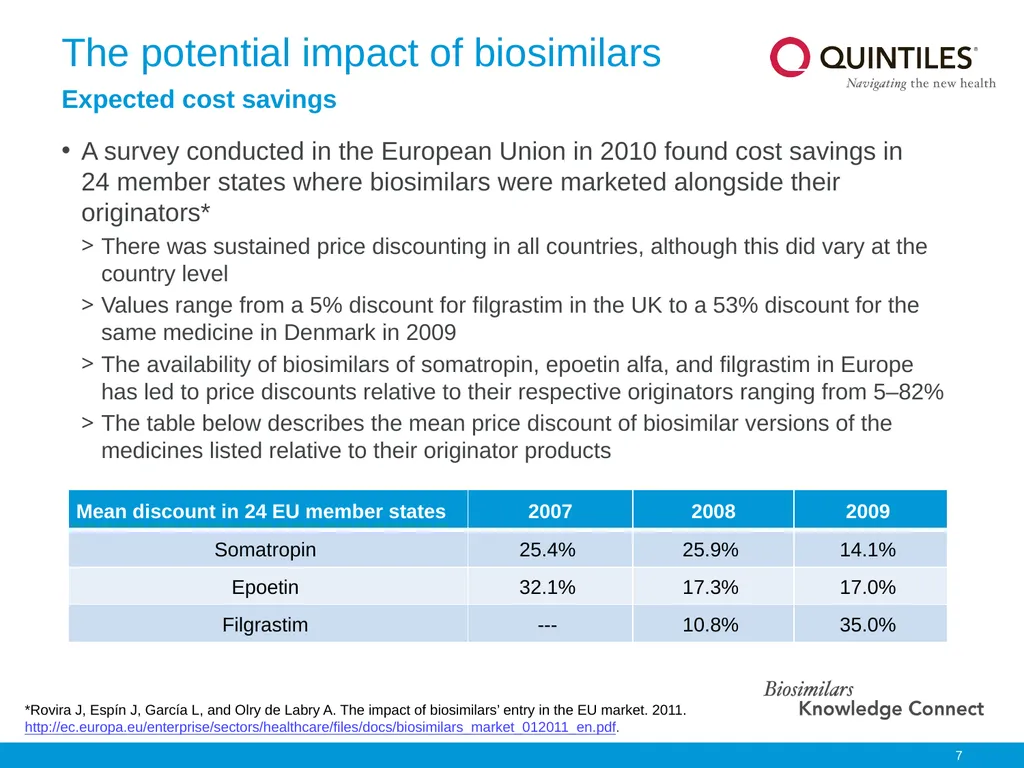
The potential impact of biosimilars A survey conducted in the European Union in 2010 found cost savings in
24 member states where biosimilars were marketed alongside their originators*
There was sustained price discounting in all countries, although this did vary at the country level
Values range from a 5% discount for filgrastim in the UK to a 53% discount for the same medicine in Denmark in 2009
The availability of biosimilars of somatropin, epoetin alfa, and filgrastim in Europe has led to price discounts relative to their respective originators ranging from 5–82%
The table below describes the mean price discount of biosimilar versions of the medicines listed relative to their originator products Expected cost savings *Rovira J, Espín J, García L, and Olry de Labry A. The impact of biosimilars’ entry in the EU market. 2011. http://ec.europa.eu/enterprise/sectors/healthcare/files/docs/biosimilars_market_012011_en.pdf.<br>
There was sustained price discounting in all countries, although this did vary at the country level
Values range from a 5% discount for filgrastim in the UK to a 53% discount for the same medicine in Denmark in 2009
The availability of biosimilars of somatropin, epoetin alfa, and filgrastim in Europe has led to price discounts relative to their respective originators ranging from 5–82%
The table below describes the mean price discount of biosimilar versions of the medicines listed relative to their originator products Expected cost savings *Rovira J, Espín J, García L, and Olry de Labry A. The impact of biosimilars’ entry in the EU market. 2011. http://ec.europa.eu/enterprise/sectors/healthcare/files/docs/biosimilars_market_012011_en.pdf.<br>
08
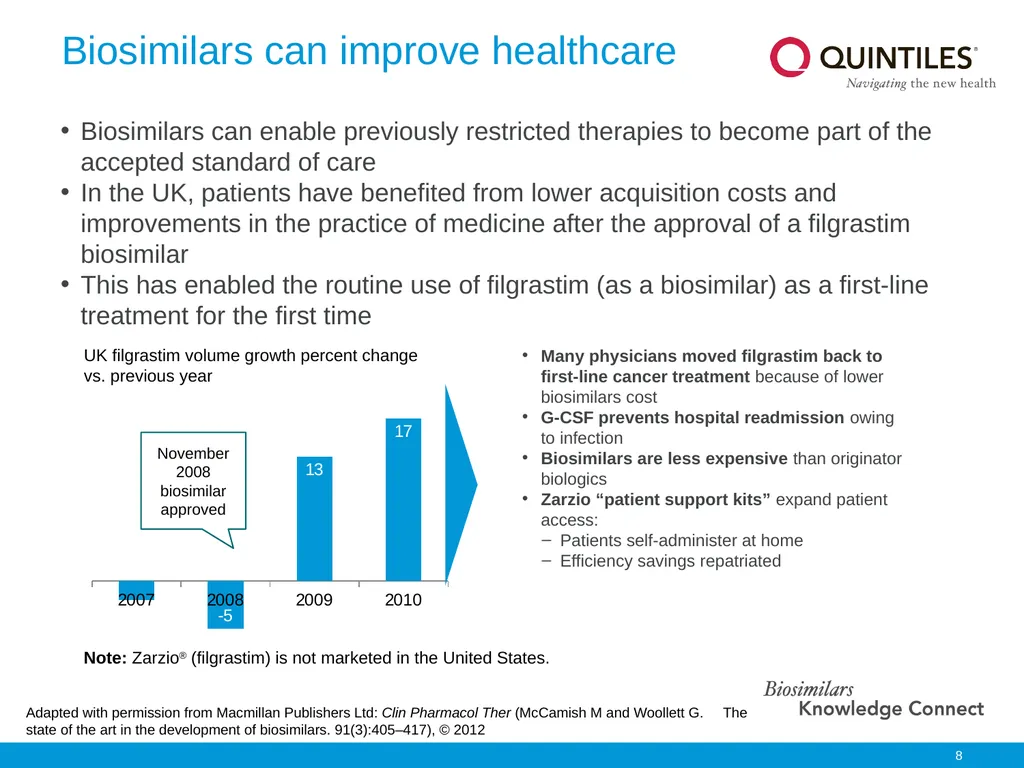
Adapted with permission from Macmillan Publishers Ltd: Clin Pharmacol Ther (McCamish M and Woollett G. The state of the art in the development of biosimilars. 91(3):405–417), © 2012 Biosimilars can improve healthcare Biosimilars can enable previously restricted therapies to become part of the accepted standard of care
In the UK, patients have benefited from lower acquisition costs and improvements in the practice of medicine after the approval of a filgrastim biosimilar
This has enabled the routine use of filgrastim (as a biosimilar) as a first-line treatment for the first time November 2008 biosimilar approved Note: Zarzio® (filgrastim) is not marketed in the United States. UK filgrastim volume growth percent change vs. previous year Many physicians moved filgrastim back to first-line cancer treatment because of lower biosimilars cost
G-CSF prevents hospital readmission owing to infection
Biosimilars are less expensive than originator biologics
Zarzio “patient support kits” expand patient access:
Patients self-administer at home
Efficiency savings repatriated<br>
In the UK, patients have benefited from lower acquisition costs and improvements in the practice of medicine after the approval of a filgrastim biosimilar
This has enabled the routine use of filgrastim (as a biosimilar) as a first-line treatment for the first time November 2008 biosimilar approved Note: Zarzio® (filgrastim) is not marketed in the United States. UK filgrastim volume growth percent change vs. previous year Many physicians moved filgrastim back to first-line cancer treatment because of lower biosimilars cost
G-CSF prevents hospital readmission owing to infection
Biosimilars are less expensive than originator biologics
Zarzio “patient support kits” expand patient access:
Patients self-administer at home
Efficiency savings repatriated<br>
09
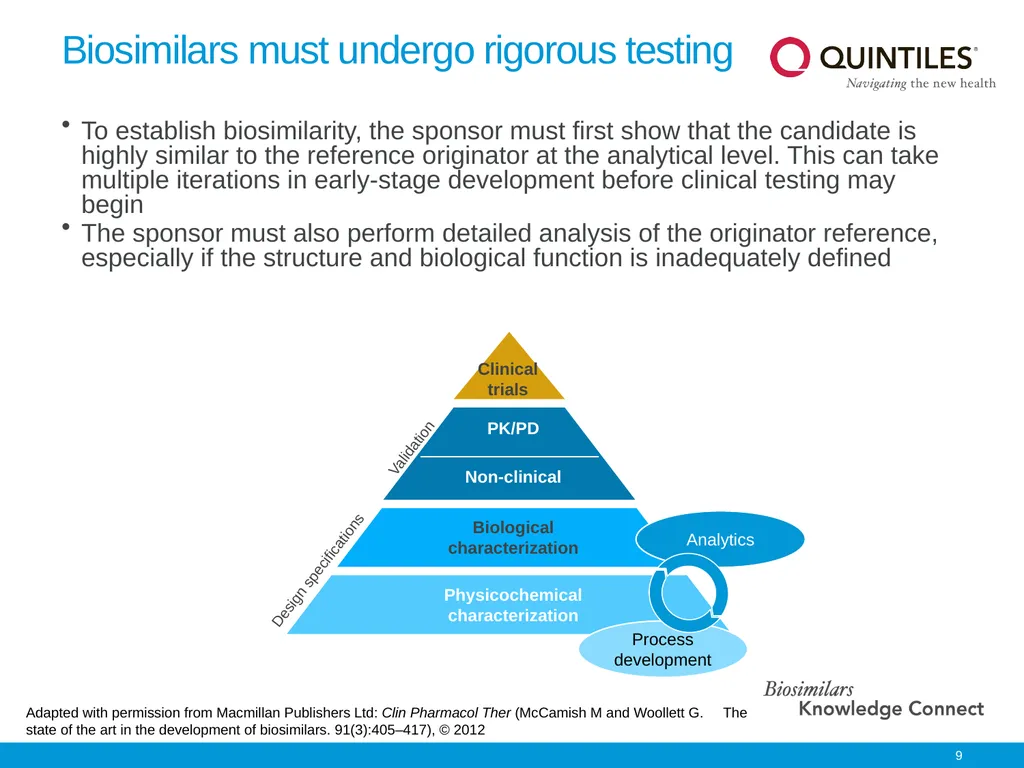
Biosimilars must undergo rigorous testing To establish biosimilarity, the sponsor must first show that the candidate is highly similar to the reference originator at the analytical level. This can take multiple iterations in early-stage development before clinical testing may begin
The sponsor must also perform detailed analysis of the originator reference, especially if the structure and biological function is inadequately defined Physicochemical characterization Biological characterization Non-clinical PK/PD Clinical trials Analytics Design specifications Validation Process development Adapted with permission from Macmillan Publishers Ltd: Clin Pharmacol Ther (McCamish M and Woollett G. The state of the art in the development of biosimilars. 91(3):405–417), © 2012<br>
The sponsor must also perform detailed analysis of the originator reference, especially if the structure and biological function is inadequately defined Physicochemical characterization Biological characterization Non-clinical PK/PD Clinical trials Analytics Design specifications Validation Process development Adapted with permission from Macmillan Publishers Ltd: Clin Pharmacol Ther (McCamish M and Woollett G. The state of the art in the development of biosimilars. 91(3):405–417), © 2012<br>
10
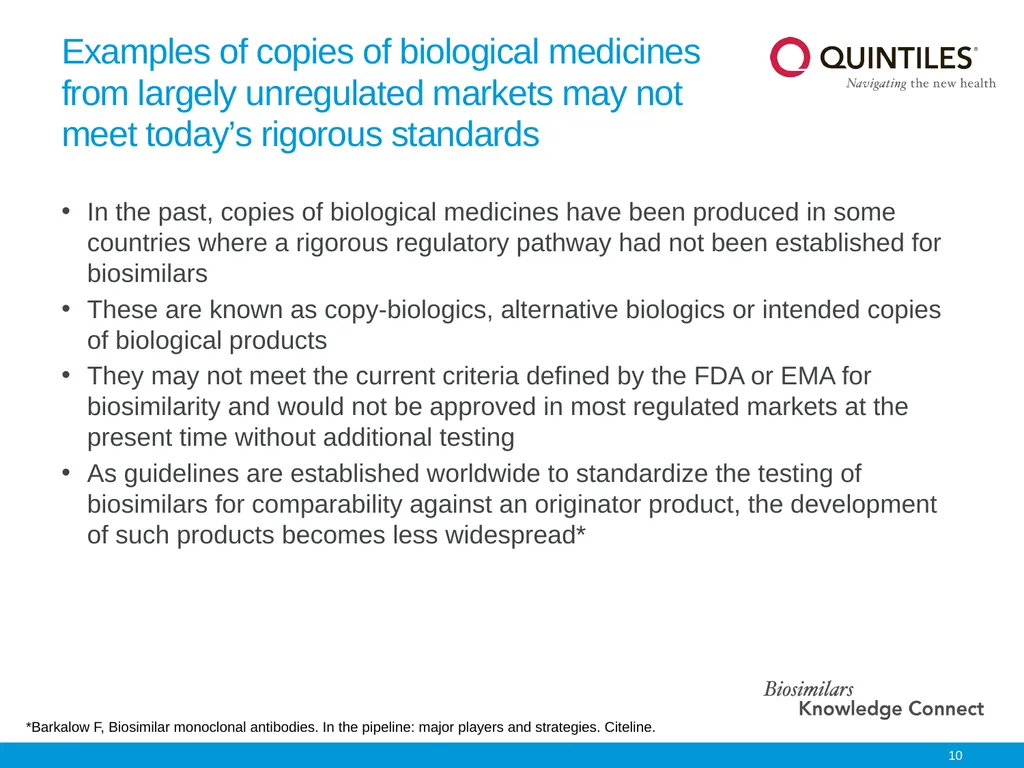
Examples of copies of biological medicines from largely unregulated markets may not meet today’s rigorous standards In the past, copies of biological medicines have been produced in some countries where a rigorous regulatory pathway had not been established for biosimilars
These are known as copy-biologics, alternative biologics or intended copies of biological products
They may not meet the current criteria defined by the FDA or EMA for biosimilarity and would not be approved in most regulated markets at the present time without additional testing
As guidelines are established worldwide to standardize the testing of biosimilars for comparability against an originator product, the development of such products becomes less widespread* *Barkalow F, Biosimilar monoclonal antibodies. In the pipeline: major players and strategies. Citeline.<br>
These are known as copy-biologics, alternative biologics or intended copies of biological products
They may not meet the current criteria defined by the FDA or EMA for biosimilarity and would not be approved in most regulated markets at the present time without additional testing
As guidelines are established worldwide to standardize the testing of biosimilars for comparability against an originator product, the development of such products becomes less widespread* *Barkalow F, Biosimilar monoclonal antibodies. In the pipeline: major players and strategies. Citeline.<br>
11
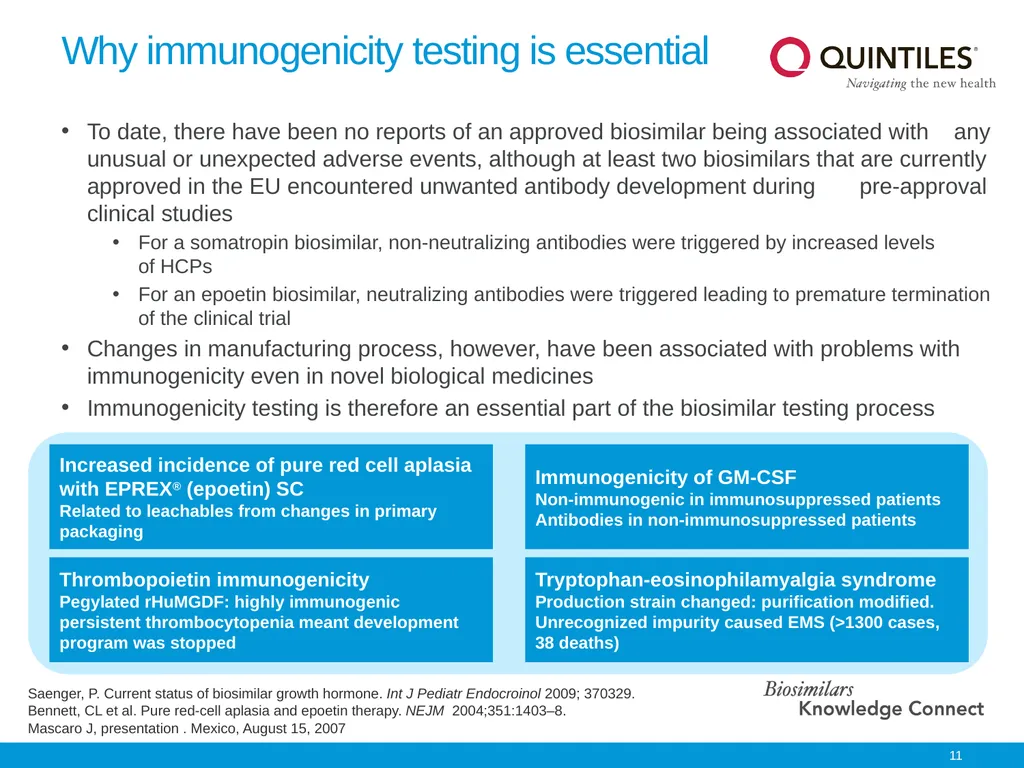
Why immunogenicity testing is essential To date, there have been no reports of an approved biosimilar being associated with any unusual or unexpected adverse events, although at least two biosimilars that are currently approved in the EU encountered unwanted antibody development during pre-approval clinical studies
For a somatropin biosimilar, non-neutralizing antibodies were triggered by increased levels of HCPs
For an epoetin biosimilar, neutralizing antibodies were triggered leading to premature termination of the clinical trial
Changes in manufacturing process, however, have been associated with problems with immunogenicity even in novel biological medicines
Immunogenicity testing is therefore an essential part of the biosimilar testing process Saenger, P. Current status of biosimilar growth hormone. Int J Pediatr Endocroinol 2009; 370329.
Bennett, CL et al. Pure red-cell aplasia and epoetin therapy. NEJM 2004;351:1403–8.
Mascaro J, presentation . Mexico, August 15, 2007 Increased incidence of pure red cell aplasia with EPREX® (epoetin) SC
Related to leachables from changes in primary packaging Immunogenicity of GM-CSF
Non-immunogenic in immunosuppressed patients
Antibodies in non-immunosuppressed patients Thrombopoietin immunogenicity
Pegylated rHuMGDF: highly immunogenic persistent thrombocytopenia meant development program was stopped Tryptophan-eosinophilamyalgia syndrome
Production strain changed: purification modified. Unrecognized impurity caused EMS (>1300 cases, 38 deaths)<br>
For a somatropin biosimilar, non-neutralizing antibodies were triggered by increased levels of HCPs
For an epoetin biosimilar, neutralizing antibodies were triggered leading to premature termination of the clinical trial
Changes in manufacturing process, however, have been associated with problems with immunogenicity even in novel biological medicines
Immunogenicity testing is therefore an essential part of the biosimilar testing process Saenger, P. Current status of biosimilar growth hormone. Int J Pediatr Endocroinol 2009; 370329.
Bennett, CL et al. Pure red-cell aplasia and epoetin therapy. NEJM 2004;351:1403–8.
Mascaro J, presentation . Mexico, August 15, 2007 Increased incidence of pure red cell aplasia with EPREX® (epoetin) SC
Related to leachables from changes in primary packaging Immunogenicity of GM-CSF
Non-immunogenic in immunosuppressed patients
Antibodies in non-immunosuppressed patients Thrombopoietin immunogenicity
Pegylated rHuMGDF: highly immunogenic persistent thrombocytopenia meant development program was stopped Tryptophan-eosinophilamyalgia syndrome
Production strain changed: purification modified. Unrecognized impurity caused EMS (>1300 cases, 38 deaths)<br>
12
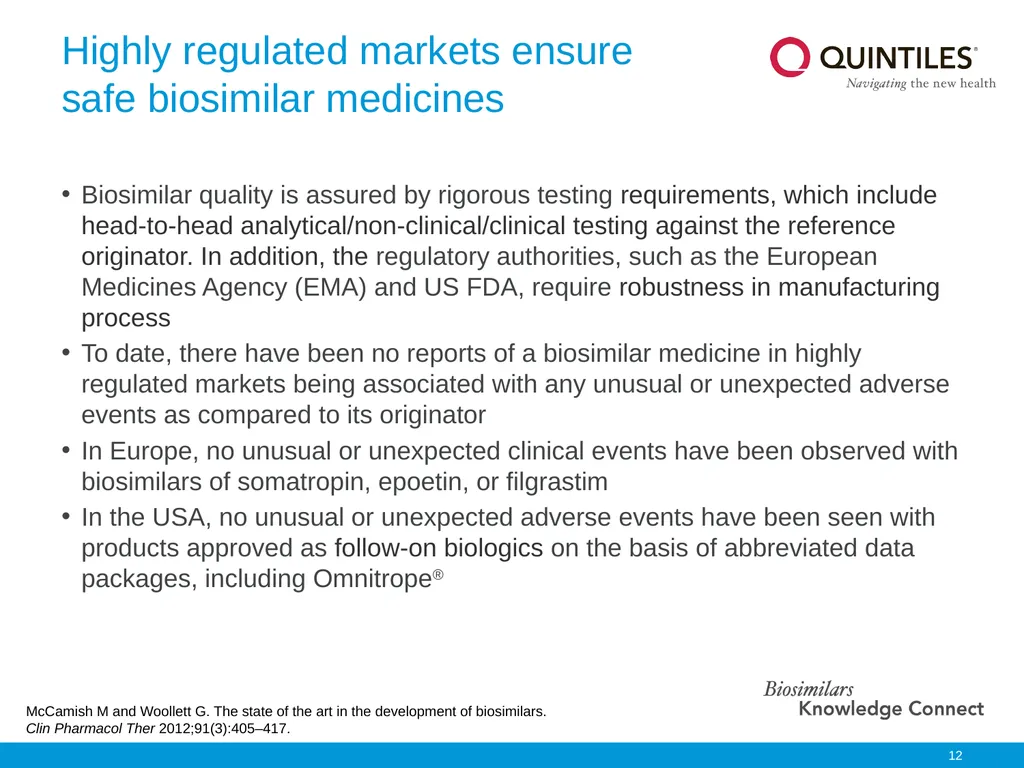
Highly regulated markets ensure safe biosimilar medicines Biosimilar quality is assured by rigorous testing requirements, which include head-to-head analytical/non-clinical/clinical testing against the reference originator. In addition, the regulatory authorities, such as the European Medicines Agency (EMA) and US FDA, require robustness in manufacturing process
To date, there have been no reports of a biosimilar medicine in highly regulated markets being associated with any unusual or unexpected adverse events as compared to its originator
In Europe, no unusual or unexpected clinical events have been observed with biosimilars of somatropin, epoetin, or filgrastim
In the USA, no unusual or unexpected adverse events have been seen with products approved as follow-on biologics on the basis of abbreviated data packages, including Omnitrope® McCamish M and Woollett G. The state of the art in the development of biosimilars. Clin Pharmacol Ther 2012;91(3):405–417.<br>
To date, there have been no reports of a biosimilar medicine in highly regulated markets being associated with any unusual or unexpected adverse events as compared to its originator
In Europe, no unusual or unexpected clinical events have been observed with biosimilars of somatropin, epoetin, or filgrastim
In the USA, no unusual or unexpected adverse events have been seen with products approved as follow-on biologics on the basis of abbreviated data packages, including Omnitrope® McCamish M and Woollett G. The state of the art in the development of biosimilars. Clin Pharmacol Ther 2012;91(3):405–417.<br>
13
http://www.ema.europa.eu/ema/index.jsp?curl=pages/regulation/general/general_content_000408.jsp&mid=WC0b01ac058002958c
The BPCI Act appears in Title VII, subtitle A of the Patient Protection and Affordable Care Act, March 2010.
US Food and Drug Administration. Guidance for industry. Scientific considerations in demonstrating biosimilarity to a reference
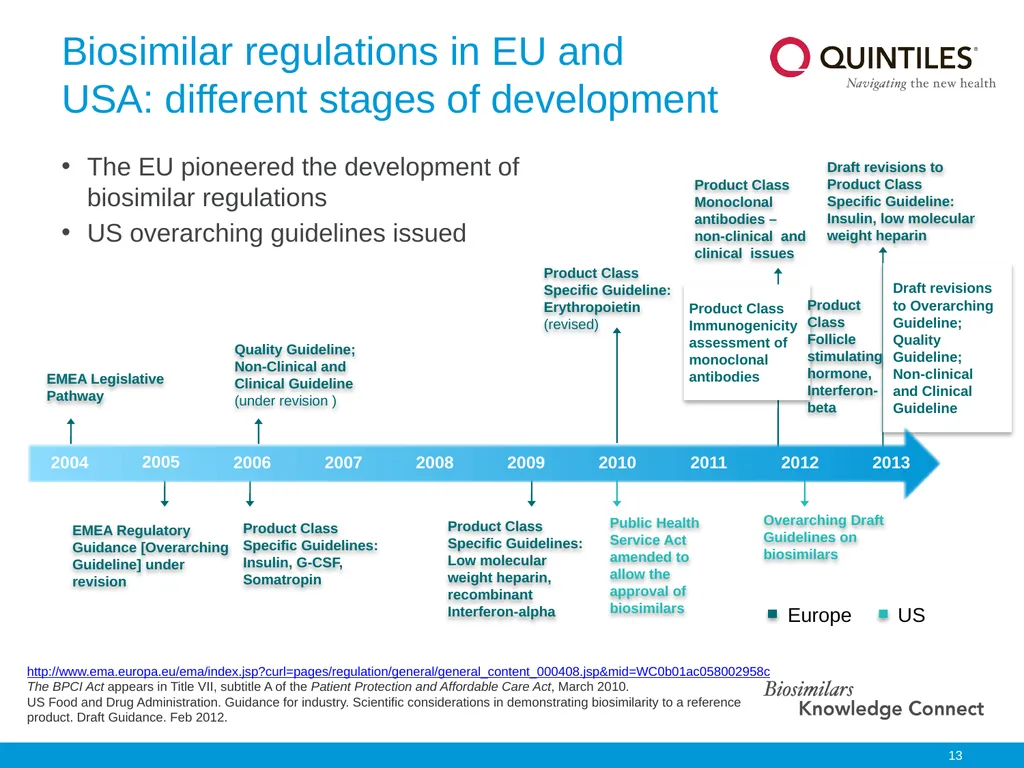
product. Draft Guidance. Feb 2012. Biosimilar regulations in EU and USA: different stages of development The EU pioneered the development of biosimilar regulations
US overarching guidelines issued Draft revisions to Product Class Specific Guideline: Insulin, low molecular weight heparin Product Class
Follicle stimulating hormone, Interferon-beta<br>
The BPCI Act appears in Title VII, subtitle A of the Patient Protection and Affordable Care Act, March 2010.
US Food and Drug Administration. Guidance for industry. Scientific considerations in demonstrating biosimilarity to a reference
product. Draft Guidance. Feb 2012. Biosimilar regulations in EU and USA: different stages of development The EU pioneered the development of biosimilar regulations
US overarching guidelines issued Draft revisions to Product Class Specific Guideline: Insulin, low molecular weight heparin Product Class
Follicle stimulating hormone, Interferon-beta<br>
14
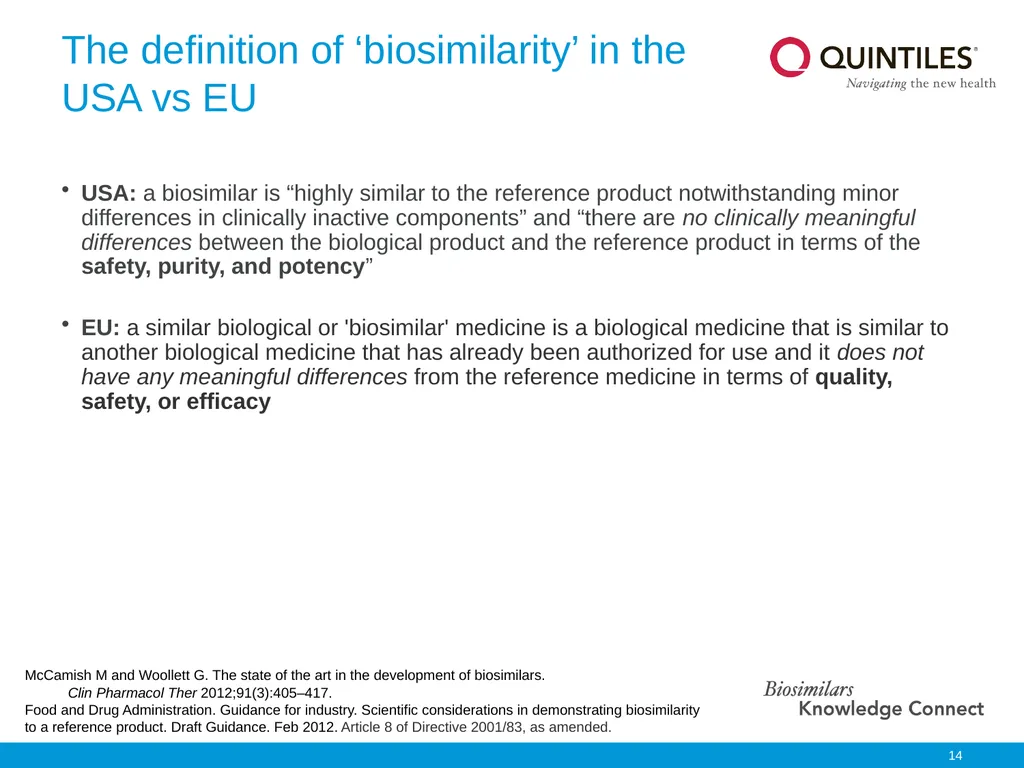
USA: a biosimilar is “highly similar to the reference product notwithstanding minor differences in clinically inactive components” and “there are no clinically meaningful differences between the biological product and the reference product in terms of the safety, purity, and potency”
EU: a similar biological or 'biosimilar' medicine is a biological medicine that is similar to another biological medicine that has already been authorized for use and it does not have any meaningful differences from the reference medicine in terms of quality, safety, or efficacy The definition of ‘biosimilarity’ in the USA vs EU McCamish M and Woollett G. The state of the art in the development of biosimilars. Clin Pharmacol Ther 2012;91(3):405–417.
Food and Drug Administration. Guidance for industry. Scientific considerations in demonstrating biosimilarity to a reference product. Draft Guidance. Feb 2012. Article 8 of Directive 2001/83, as amended.<br>
EU: a similar biological or 'biosimilar' medicine is a biological medicine that is similar to another biological medicine that has already been authorized for use and it does not have any meaningful differences from the reference medicine in terms of quality, safety, or efficacy The definition of ‘biosimilarity’ in the USA vs EU McCamish M and Woollett G. The state of the art in the development of biosimilars. Clin Pharmacol Ther 2012;91(3):405–417.
Food and Drug Administration. Guidance for industry. Scientific considerations in demonstrating biosimilarity to a reference product. Draft Guidance. Feb 2012. Article 8 of Directive 2001/83, as amended.<br>
15
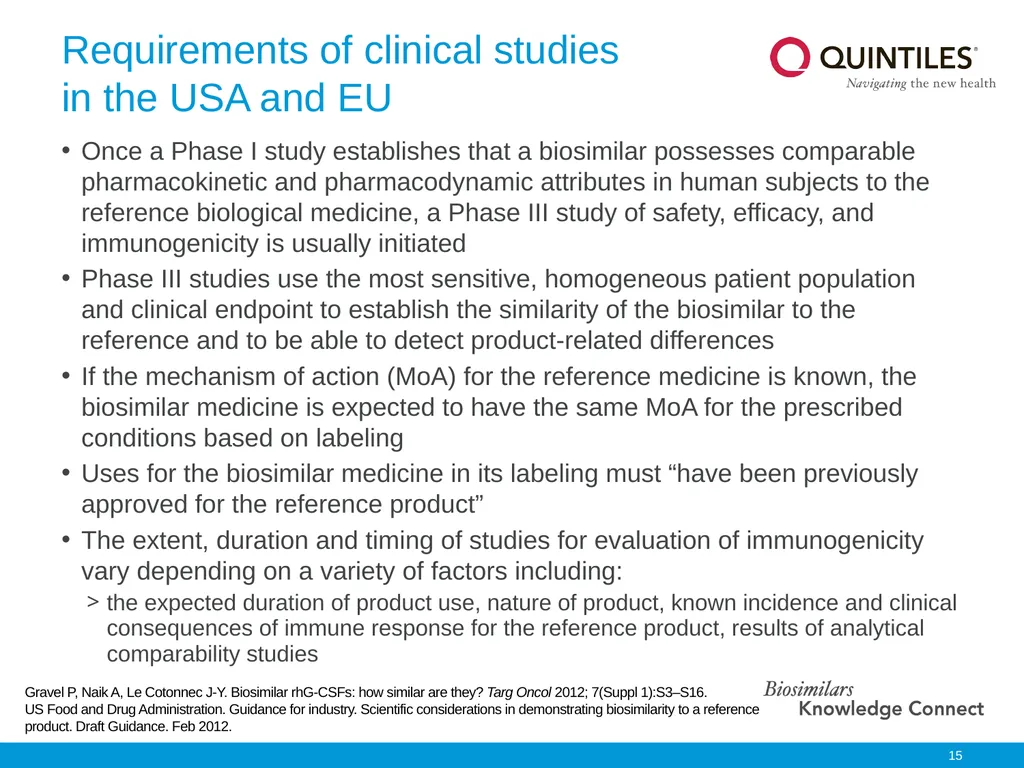
Requirements of clinical studies in the USA and EU Once a Phase I study establishes that a biosimilar possesses comparable pharmacokinetic and pharmacodynamic attributes in human subjects to the reference biological medicine, a Phase III study of safety, efficacy, and immunogenicity is usually initiated
Phase III studies use the most sensitive, homogeneous patient population and clinical endpoint to establish the similarity of the biosimilar to the reference and to be able to detect product-related differences
If the mechanism of action (MoA) for the reference medicine is known, the biosimilar medicine is expected to have the same MoA for the prescribed conditions based on labeling
Uses for the biosimilar medicine in its labeling must “have been previously approved for the reference product”
The extent, duration and timing of studies for evaluation of immunogenicity vary depending on a variety of factors including:
the expected duration of product use, nature of product, known incidence and clinical consequences of immune response for the reference product, results of analytical comparability studies Gravel P, Naik A, Le Cotonnec J-Y. Biosimilar rhG-CSFs: how similar are they? Targ Oncol 2012; 7(Suppl 1):S3–S16.
US Food and Drug Administration. Guidance for industry. Scientific considerations in demonstrating biosimilarity to a reference product. Draft Guidance. Feb 2012.<br>
Phase III studies use the most sensitive, homogeneous patient population and clinical endpoint to establish the similarity of the biosimilar to the reference and to be able to detect product-related differences
If the mechanism of action (MoA) for the reference medicine is known, the biosimilar medicine is expected to have the same MoA for the prescribed conditions based on labeling
Uses for the biosimilar medicine in its labeling must “have been previously approved for the reference product”
The extent, duration and timing of studies for evaluation of immunogenicity vary depending on a variety of factors including:
the expected duration of product use, nature of product, known incidence and clinical consequences of immune response for the reference product, results of analytical comparability studies Gravel P, Naik A, Le Cotonnec J-Y. Biosimilar rhG-CSFs: how similar are they? Targ Oncol 2012; 7(Suppl 1):S3–S16.
US Food and Drug Administration. Guidance for industry. Scientific considerations in demonstrating biosimilarity to a reference product. Draft Guidance. Feb 2012.<br>
16
Requirements of clinical studies
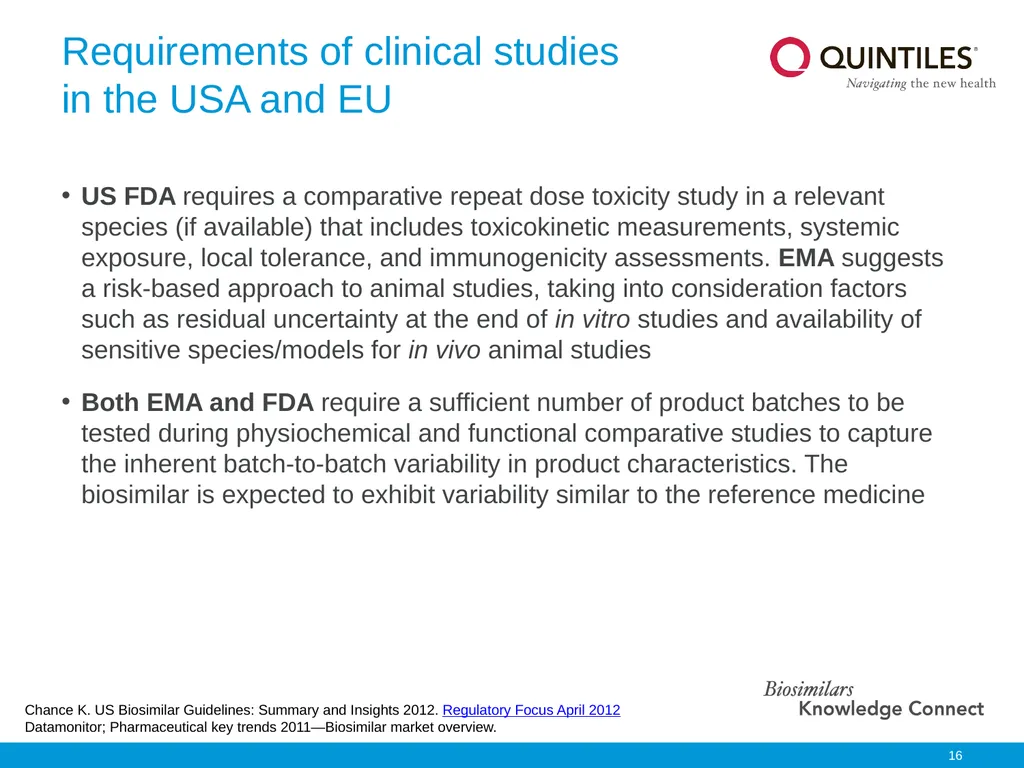
in the USA and EU US FDA requires a comparative repeat dose toxicity study in a relevant species (if available) that includes toxicokinetic measurements, systemic exposure, local tolerance, and immunogenicity assessments. EMA suggests a risk-based approach to animal studies, taking into consideration factors such as residual uncertainty at the end of in vitro studies and availability of sensitive species/models for in vivo animal studies
Both EMA and FDA require a sufficient number of product batches to be tested during physiochemical and functional comparative studies to capture the inherent batch-to-batch variability in product characteristics. The biosimilar is expected to exhibit variability similar to the reference medicine Chance K. US Biosimilar Guidelines: Summary and Insights 2012. Regulatory Focus April 2012
Datamonitor; Pharmaceutical key trends 2011—Biosimilar market overview.<br>
Both EMA and FDA require a sufficient number of product batches to be tested during physiochemical and functional comparative studies to capture the inherent batch-to-batch variability in product characteristics. The biosimilar is expected to exhibit variability similar to the reference medicine Chance K. US Biosimilar Guidelines: Summary and Insights 2012. Regulatory Focus April 2012
Datamonitor; Pharmaceutical key trends 2011—Biosimilar market overview.<br>
17
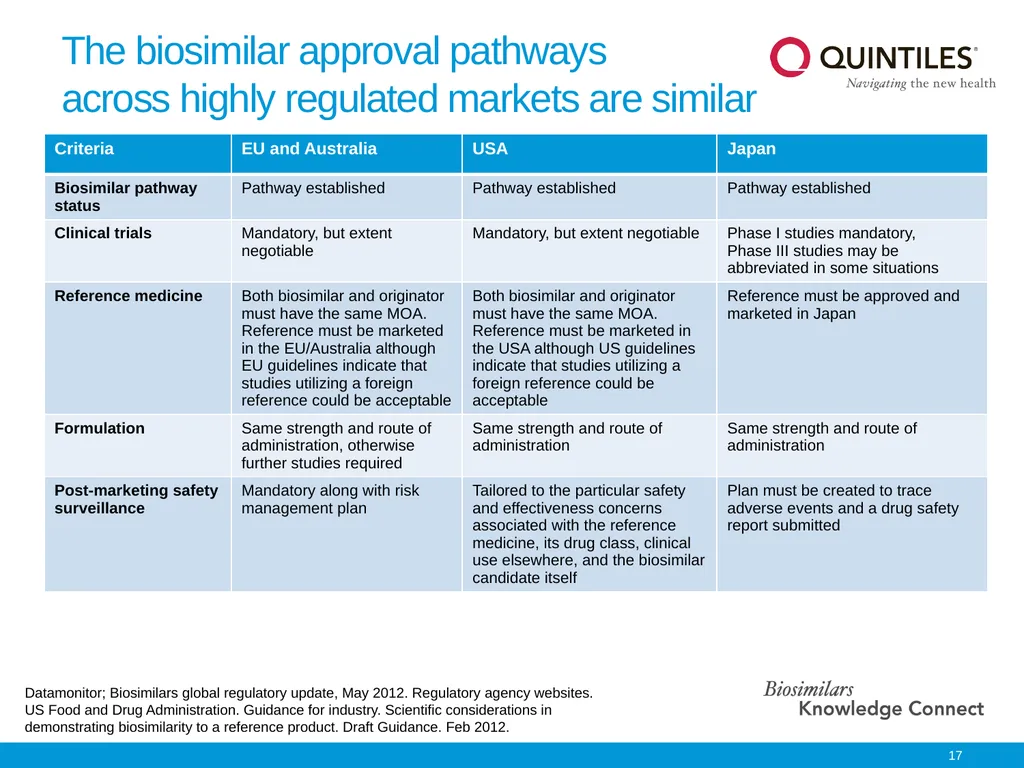
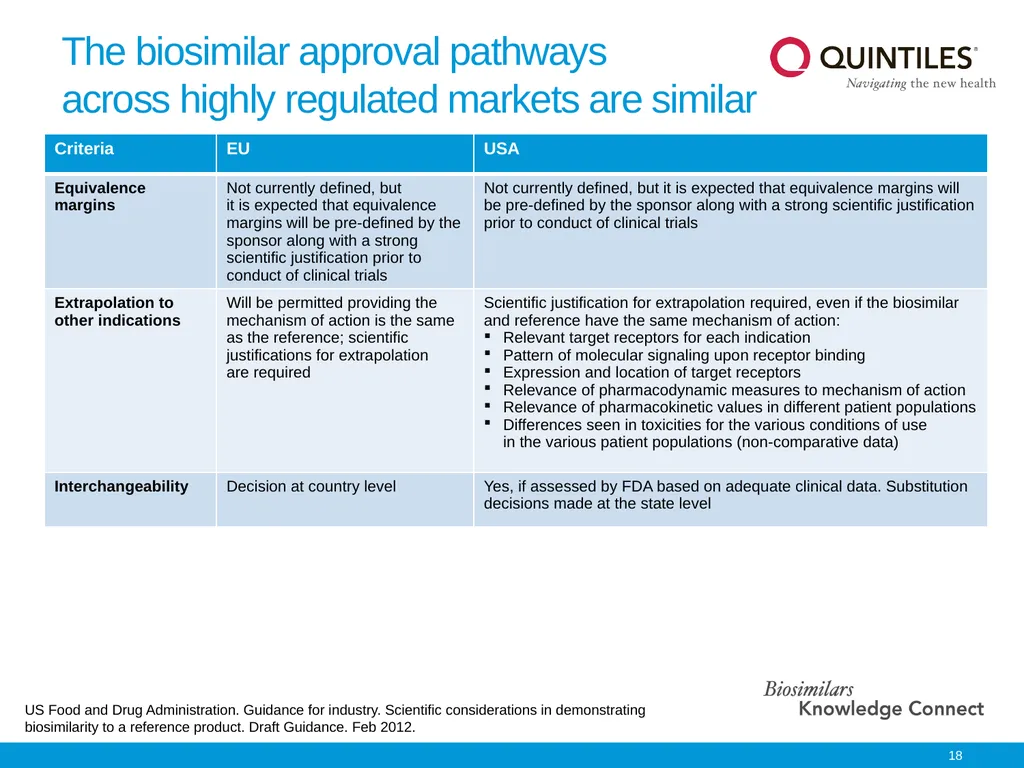
The biosimilar approval pathways
across highly regulated markets are similar Datamonitor; Biosimilars global regulatory update, May 2012. Regulatory agency websites.
US Food and Drug Administration. Guidance for industry. Scientific considerations in demonstrating biosimilarity to a reference product. Draft Guidance. Feb 2012.<br>
US Food and Drug Administration. Guidance for industry. Scientific considerations in demonstrating biosimilarity to a reference product. Draft Guidance. Feb 2012.<br>
18
The biosimilar approval pathways
across highly regulated markets are similar US Food and Drug Administration. Guidance for industry. Scientific considerations in demonstrating biosimilarity to a reference product. Draft Guidance. Feb 2012.<br>
19
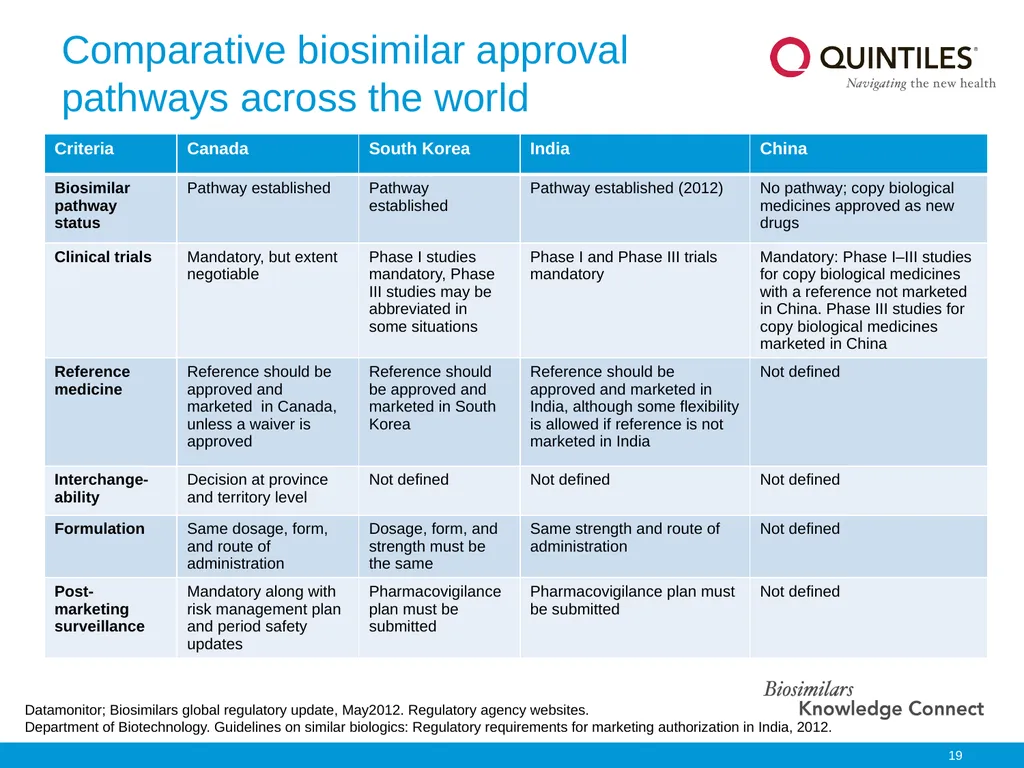
Comparative biosimilar approval
pathways across the world Datamonitor; Biosimilars global regulatory update, May2012. Regulatory agency websites.
Department of Biotechnology. Guidelines on similar biologics: Regulatory requirements for marketing authorization in India, 2012.<br>
Department of Biotechnology. Guidelines on similar biologics: Regulatory requirements for marketing authorization in India, 2012.<br>
20
EMA and FDA have rigorous
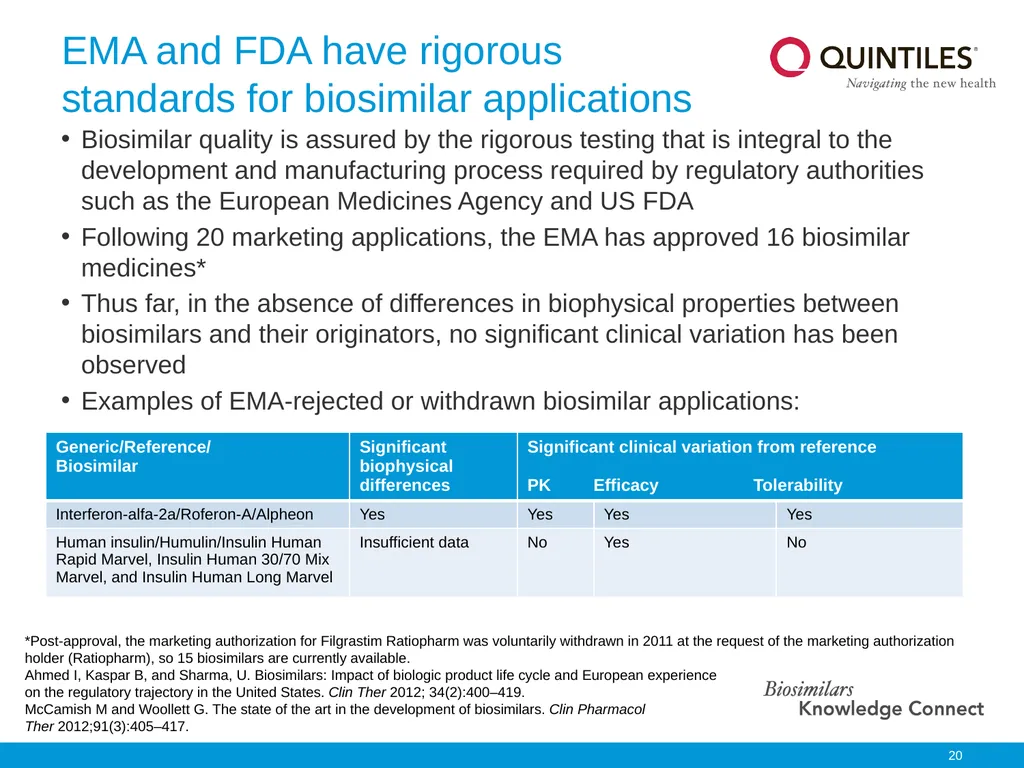
standards for biosimilar applications *Post-approval, the marketing authorization for Filgrastim Ratiopharm was voluntarily withdrawn in 2011 at the request of the marketing authorization holder (Ratiopharm), so 15 biosimilars are currently available.
Ahmed I, Kaspar B, and Sharma, U. Biosimilars: Impact of biologic product life cycle and European experience
on the regulatory trajectory in the United States. Clin Ther 2012; 34(2):400–419.
McCamish M and Woollett G. The state of the art in the development of biosimilars. Clin Pharmacol
Ther 2012;91(3):405–417. Biosimilar quality is assured by the rigorous testing that is integral to the development and manufacturing process required by regulatory authorities such as the European Medicines Agency and US FDA
Following 20 marketing applications, the EMA has approved 16 biosimilar medicines*
Thus far, in the absence of differences in biophysical properties between biosimilars and their originators, no significant clinical variation has been observed
Examples of EMA-rejected or withdrawn biosimilar applications:<br>
Ahmed I, Kaspar B, and Sharma, U. Biosimilars: Impact of biologic product life cycle and European experience
on the regulatory trajectory in the United States. Clin Ther 2012; 34(2):400–419.
McCamish M and Woollett G. The state of the art in the development of biosimilars. Clin Pharmacol
Ther 2012;91(3):405–417. Biosimilar quality is assured by the rigorous testing that is integral to the development and manufacturing process required by regulatory authorities such as the European Medicines Agency and US FDA
Following 20 marketing applications, the EMA has approved 16 biosimilar medicines*
Thus far, in the absence of differences in biophysical properties between biosimilars and their originators, no significant clinical variation has been observed
Examples of EMA-rejected or withdrawn biosimilar applications:<br>
21
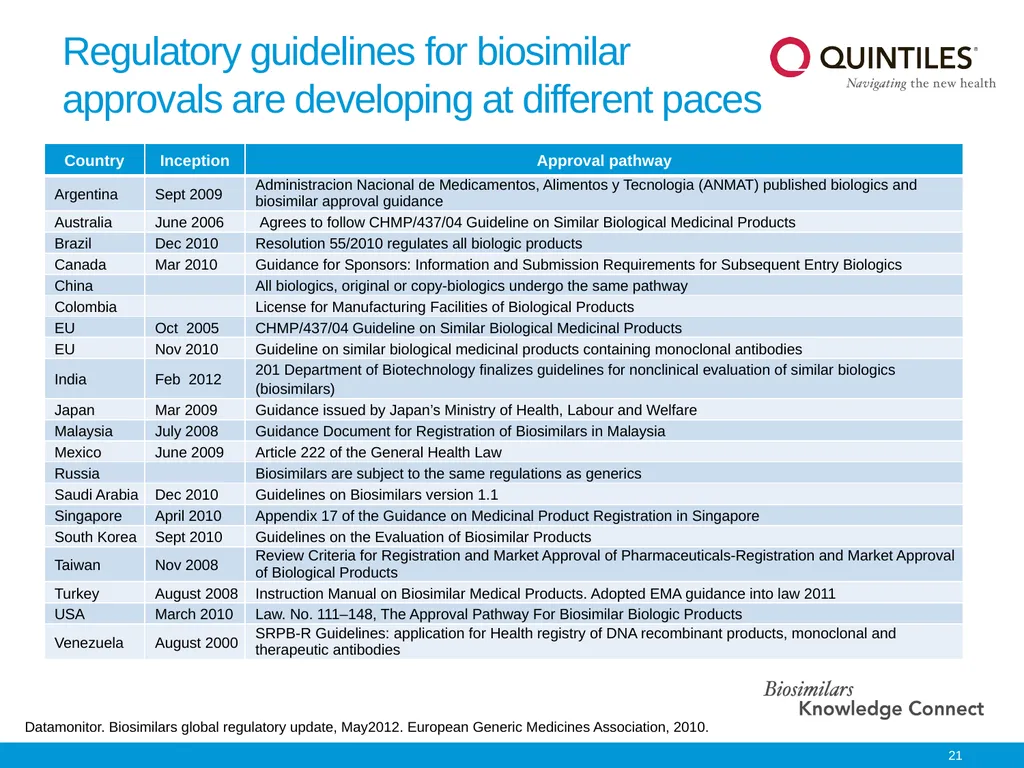
Regulatory guidelines for biosimilar
approvals are developing at different paces Datamonitor. Biosimilars global regulatory update, May2012. European Generic Medicines Association, 2010.<br>
approvals are developing at different paces Datamonitor. Biosimilars global regulatory update, May2012. European Generic Medicines Association, 2010.<br>
22
For any queries please visit www.BiosimilarsKnowledgeConnect.com<br>