01
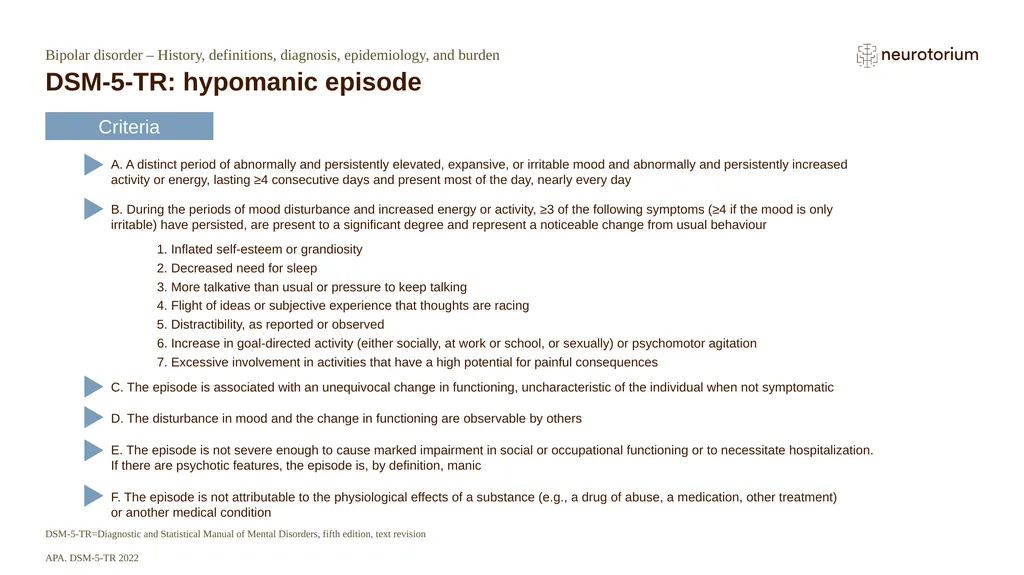
Bipolar disorder – History, definitions, diagnosis, epidemiology, and burden DSM-5-TR: hypomanic episode DSM-5-TR=Diagnostic and Statistical Manual of Mental Disorders, fifth edition, text revision��APA. DSM-5-TR 2022 Criteria A. A distinct period of abnormally and persistently elevated, expansive, or irritable mood and abnormally and persistently increased activity or energy, lasting ≥4 consecutive days and present most of the day, nearly every day B. During the periods of mood disturbance and increased energy or activity, ≥3 of the following symptoms (≥4 if the mood is only irritable) have persisted, are present to a significant degree and represent a noticeable change from usual behaviour 1. Inflated self-esteem or grandiosity C. The episode is associated with an unequivocal change in functioning, uncharacteristic of the individual when not symptomatic D. The disturbance in mood and the change in functioning are observable by others E. The episode is not severe enough to cause marked impairment in social or occupational functioning or to necessitate hospitalization. �If there are psychotic features, the episode is, by definition, manic F. The episode is not attributable to the physiological effects of a substance (e.g., a drug of abuse, a medication, other treatment) �or another medical condition 2. Decreased need for sleep 3. More talkative than usual or pressure to keep talking 4. Flight of ideas or subjective experience that thoughts are racing 5. Distractibility, as reported or observed 6. Increase in goal-directed activity (either socially, at work or school, or sexually) or psychomotor agitation 7. Excessive involvement in activities that have a high potential for painful consequences<br>