
Bitcoin and Blockchain Technology: What Attorneys
Description: Bitcoin and Blockchain Technology: What Attorneys Need to Know Matthew S. McKeever Copple, Rockey, McKeever Schlecht, P.C., L.L.O. Omaha Bar Association Innovations in the Law CLE December 7, 2018 Disclaimer The content on this
Related Topics
Download Presentation
"Bitcoin and Blockchain Technology: What Attorneys" is the property of its rightful owner. Permission is granted to download and print the materials on this website for personal, non-commercial use only, and to display it on your personal computer provided you do not modify the materials and that you retain all copyright notices contained in the materials. By downloading content from our website, you accept the terms of this agreement.
Presentation Transcript
slide1. Bitcoin and Blockchain Technology:
What Attorneys Need to Know Matthew S. McKeever
Copple, Rockey, McKeever & Schlecht, P.C., L.L.O.
Omaha Bar Association – Innovations in the Law CLE
December 7, 2018<br>
slide2. Disclaimer The content on this presentation is offered only as a public service for information purposes only does not constitute solicitation or provision of legal advice or financial advice. This presentation should not be used as a substitute for obtaining legal advice from an attorney, tax advice from an accountant or investment advise from a licensed financial advisor. You should always consult a suitably qualified professional regarding any specific legal, accounting, tax or investment matters. The comments and opinions expressed are of the individual presenter and may not reflect the opinions of the firm or any individual attorney.<br>
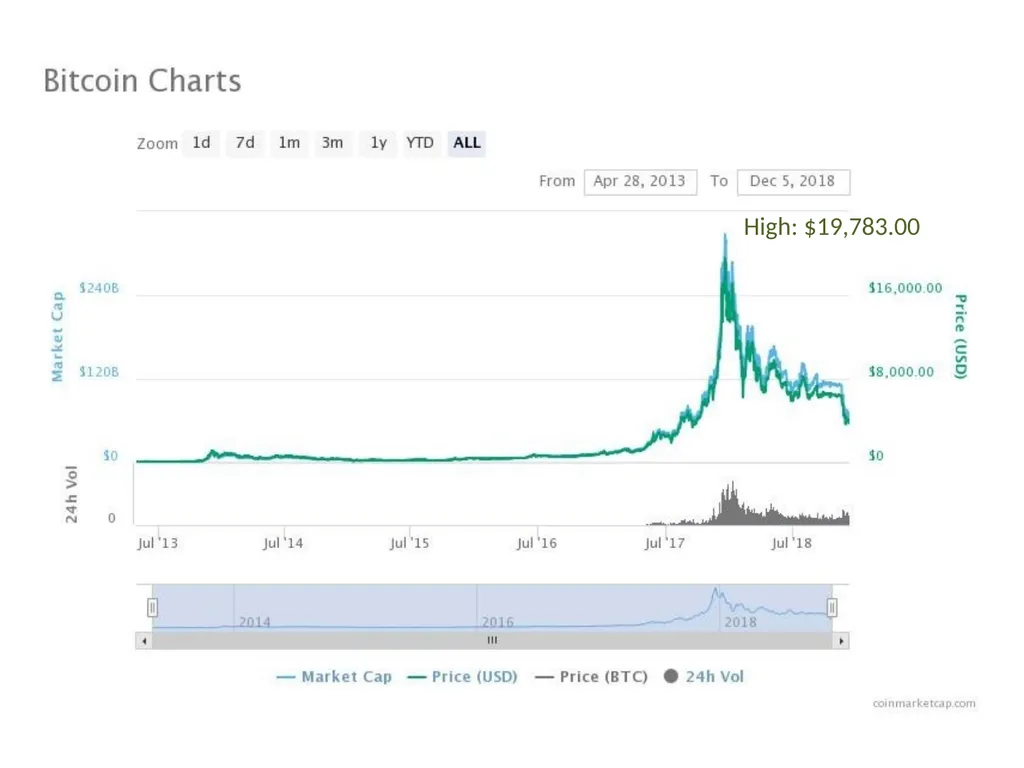
slide3. Courtesy Forbes Magazine High: $19,783.00<br>
slide4. What is Bitcoin? “Digital ledger book.” – Former CEO of Paypal
Software that records and secures transactions.
There are no physical coins.
Bitcoin: units on a public, digital ledger.
Bitcoins stored in files called “wallets”.
Entries are submitted by “keys”.
Transactions secured as pieces of a math puzzle.
Bitcoin program runs on 400,000 computers.
Internet’s version of cash. “Digital cash.”
Value comes from utility, acceptance & speculation.<br>
slide5. Bitcoin is Decentralized No central authority runs Bitcoin, no “Fed”.
Bitcoin program run by thousands of
computers linked over the internet – “miners”.
Peer-to-peer transactions - no “middle-man”.
“Trustless”
Not a “fiat currency”
No central exchange or a “CEO of Bitcoin”.<br>
slide6. Bitcoin as Cryptography Transactions held together by math puzzle.
Bitcoin is a puzzle that is solved one piece at a
time, called a “block”.
Each puzzle piece holds records of a series of
transactions on the ledger.
The series of blocks is called the “blockchain”.
Cryptography and shared nature prevents
duplication and fraud.<br>
slide7. Wallets and Transactions Wallets – Place to keep track of your bitcoins.
1. Private key
2. Public key
Transactions from one wallet to another.
Wallets secure: 64 bit encryption.
Record of transactions secured by:
1. Shared ledger.
2. Cryptography.<br>
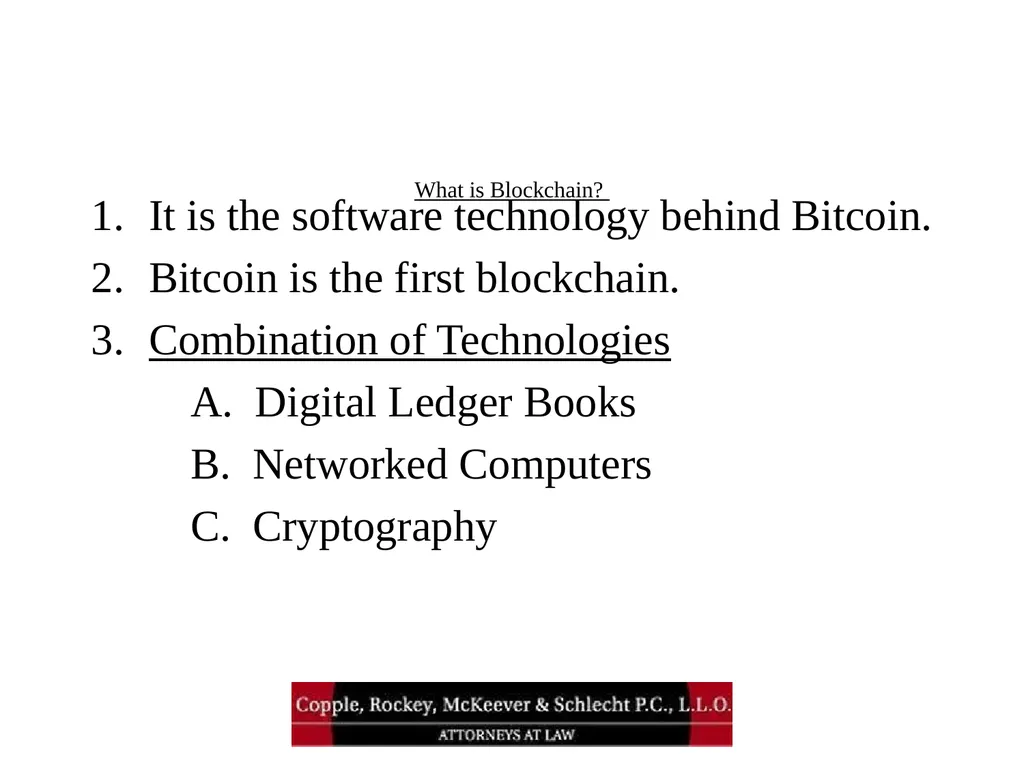
slide8. What is Blockchain? It is the software technology behind Bitcoin.
Bitcoin is the first blockchain.
Combination of Technologies
A. Digital Ledger Books
B. Networked Computers
C. Cryptography<br>
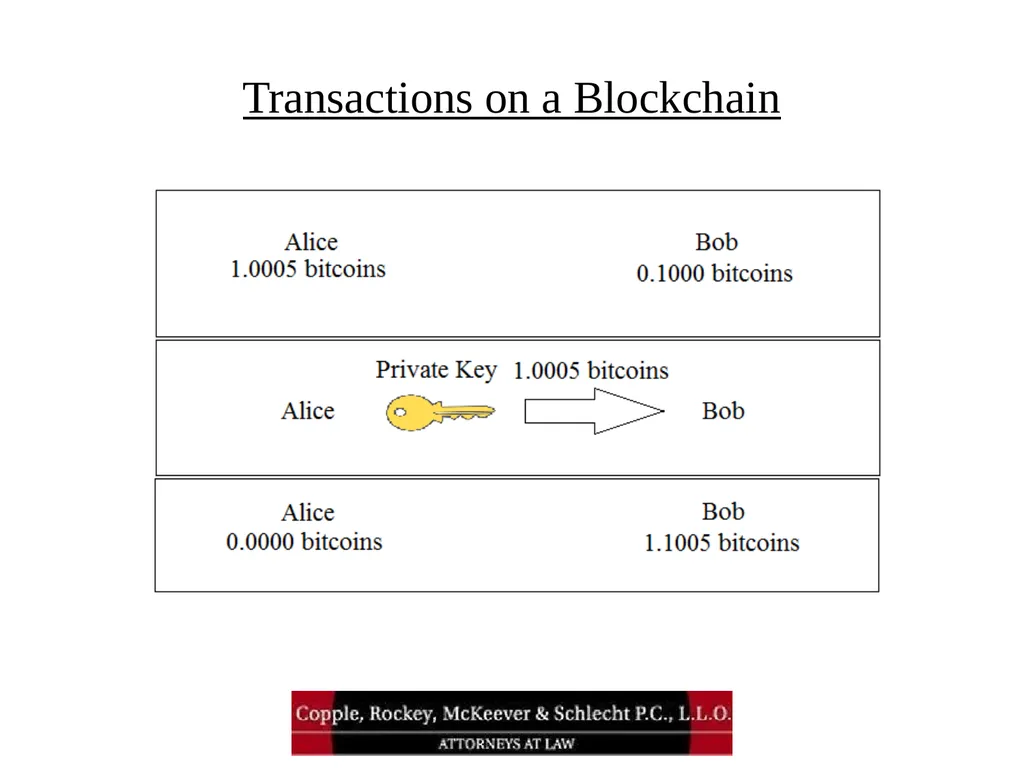
slide9. Transactions on a Blockchain<br>
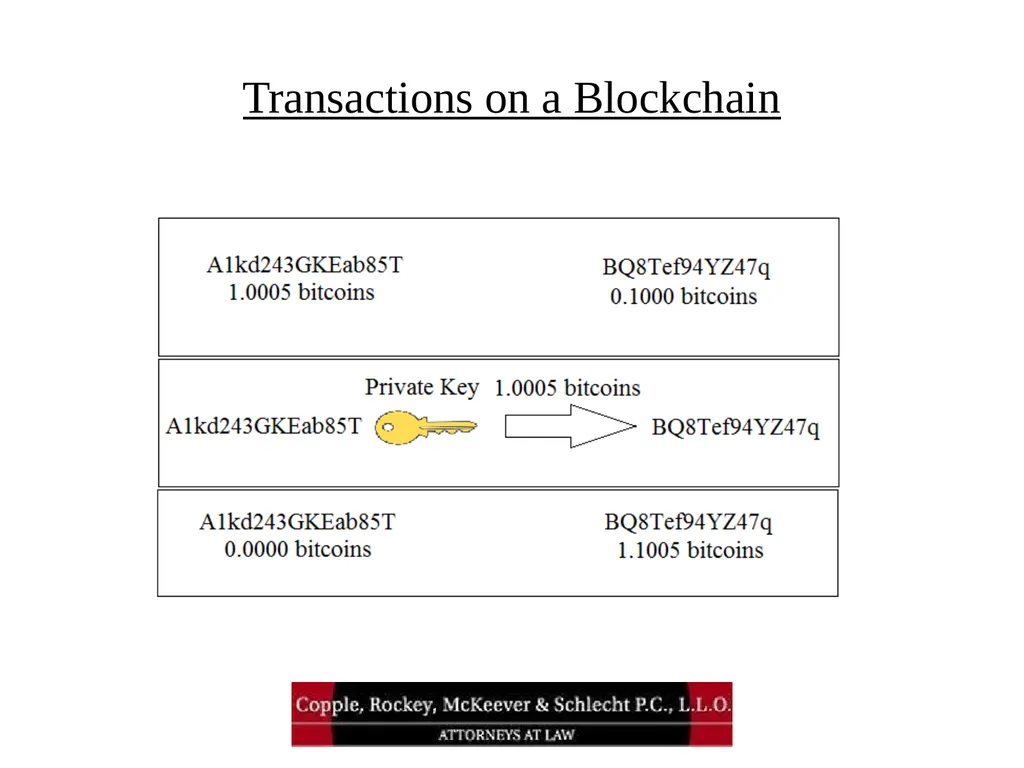
slide10. Transactions on a Blockchain<br>
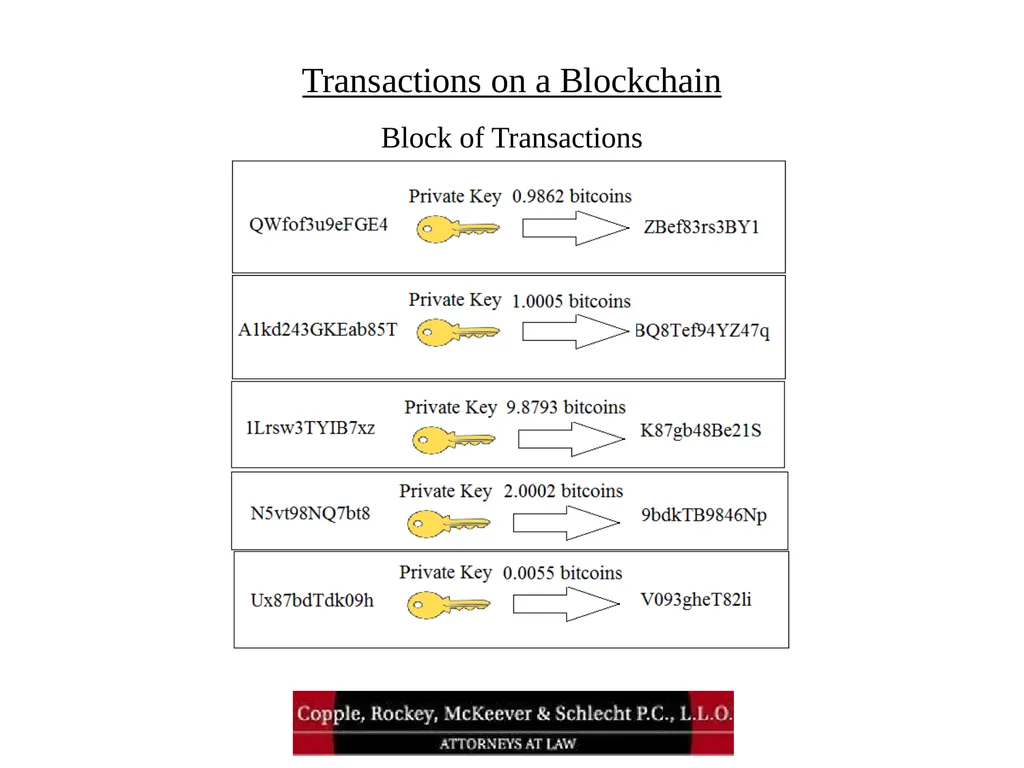
slide11. Transactions on a Blockchain Block of Transactions<br>
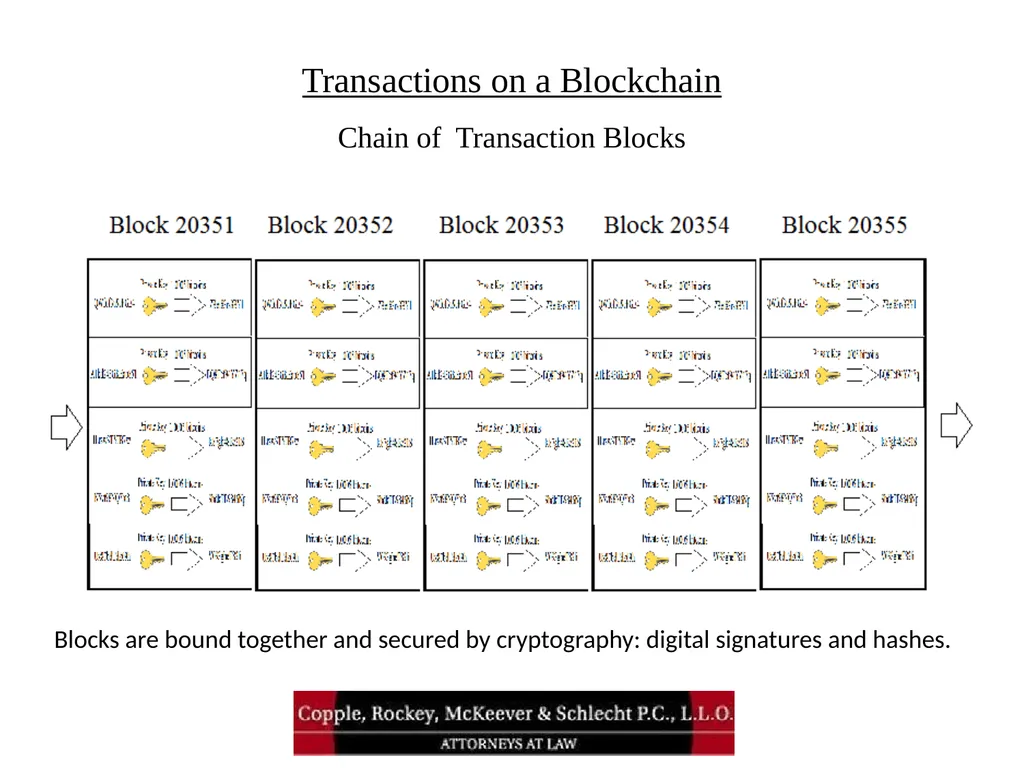
slide12. Transactions on a Blockchain Chain of Transaction Blocks Blocks are bound together and secured by cryptography: digital signatures and hashes.<br>
slide13. Thousands of Blockchains Litecoin – faster version of Bitcoin
Ethereum – Network for “smart contracts”
Ripple – Private, centralized.
Bitcoin Cash – Fork of Bitcoin to solve scalabilty
Auroracoin - Iceland
Mazacoin – Lakota Sioux Nation
Peercoin – Partially “Proof of Work”
Blackcoin – Completely “Proof of Stake”
PowerCoin – Tokens to represent grid units
and…<br>
slide14. Dogecoin<br>
slide15. Blockchain Applications – Not Just Payments Logistics and Quality Control (IBM)
Tokens for produce, diamonds, or head of livestock
Records and Documents
Secure encrypted medical records on blockchain
Register of Deeds, Notary
Accounting
All transactions automatically tracked.
Copyrights
Music industry (Embermine)
Art & Photos (Kodak)
Printing (Ink)
5. Banking (FNBO, R3)<br>
slide16. Issue 1: Is Your Client an Unlicensed Money Transmitter? Bitcoin is legal to buy and sell!
But did you buy just so you can sell to third parties?
FinCEN requires KYC and AML.
48 State Money Transmitter Laws.
Nebraska Money Transmitters Act:
Neb. Rev. Stat. §8-2701<br>
slide17. State Laws Kansas Office of the State Bank Commissioner
1. Cryptocurrencies were neither “money” nor “monetary value”.
2. Limited the applicability of the Kansas money transmission statutes to certain third-party exchange operations.
Kansas Office of the State Bank Commissioner Guidance Document MT 2014-01, June 6, 2014<br>
slide18. Nebraska Unicameral 2018 LB987 –Uniform Regulation of Virtual Currencies Act - Sen. Paul Schumacher (Columbus)
LB691 - Anti-Money Laundering and Regulation as Money Transmitters – Sen. Carol Blood (Bellevue)
LB694 - Cities and Counties cannot regulate or tax
LB695 – Smart contracts and electronic Notary<br>
slide19. Issue 2: Is Your Client Illegally Avoiding Taxes? IRS Guidance of March 25, 2014
Asset, not currency
Taxed as capital asset (short-term or long-term capital gains rules are used)
Wages paid in virtual currency must be subject to withholding and taxes paid in fiat.
Mining (creating coins) is taxed as income.
Conversion to fiat or use in transaction is a taxable event – income taxes or capital gains.<br>
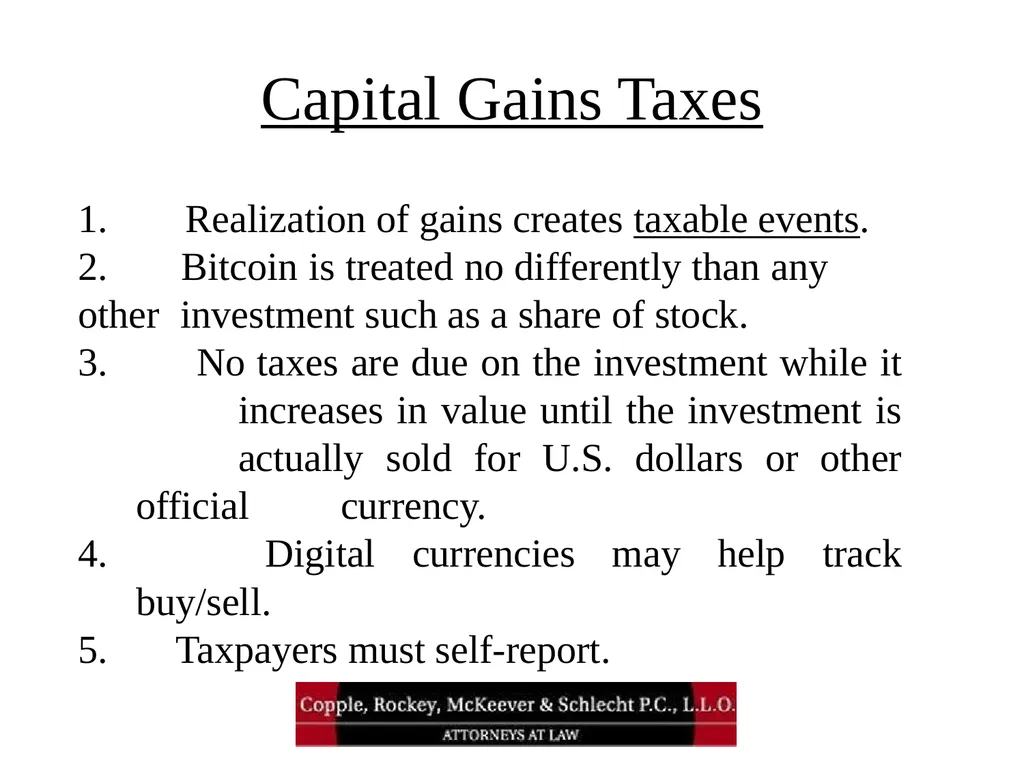
slide20. Capital Gains Taxes Realization of gains creates taxable events.
2. Bitcoin is treated no differently than any other investment such as a share of stock.
No taxes are due on the investment while it increases in value until the investment is actually sold for U.S. dollars or other official currency.
Digital currencies may help track buy/sell.
Taxpayers must self-report.<br>
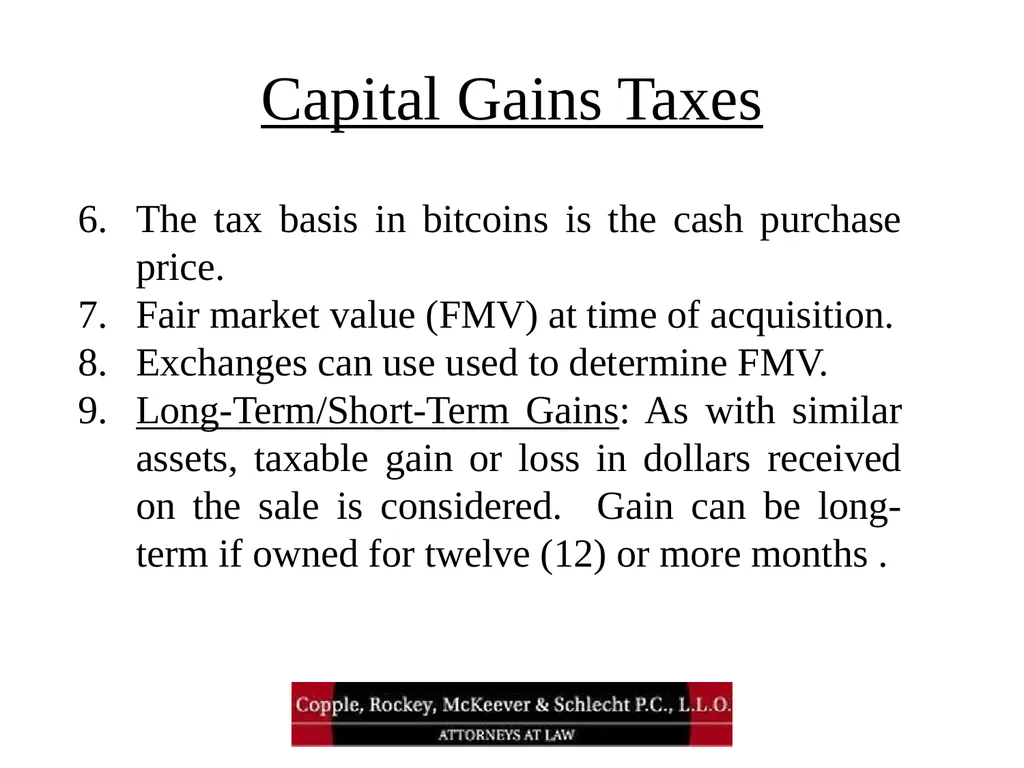
slide21. Capital Gains Taxes The tax basis in bitcoins is the cash purchase price.
Fair market value (FMV) at time of acquisition.
Exchanges can use used to determine FMV.
Long-Term/Short-Term Gains: As with similar assets, taxable gain or loss in dollars received on the sale is considered. Gain can be long-term if owned for twelve (12) or more months .<br>
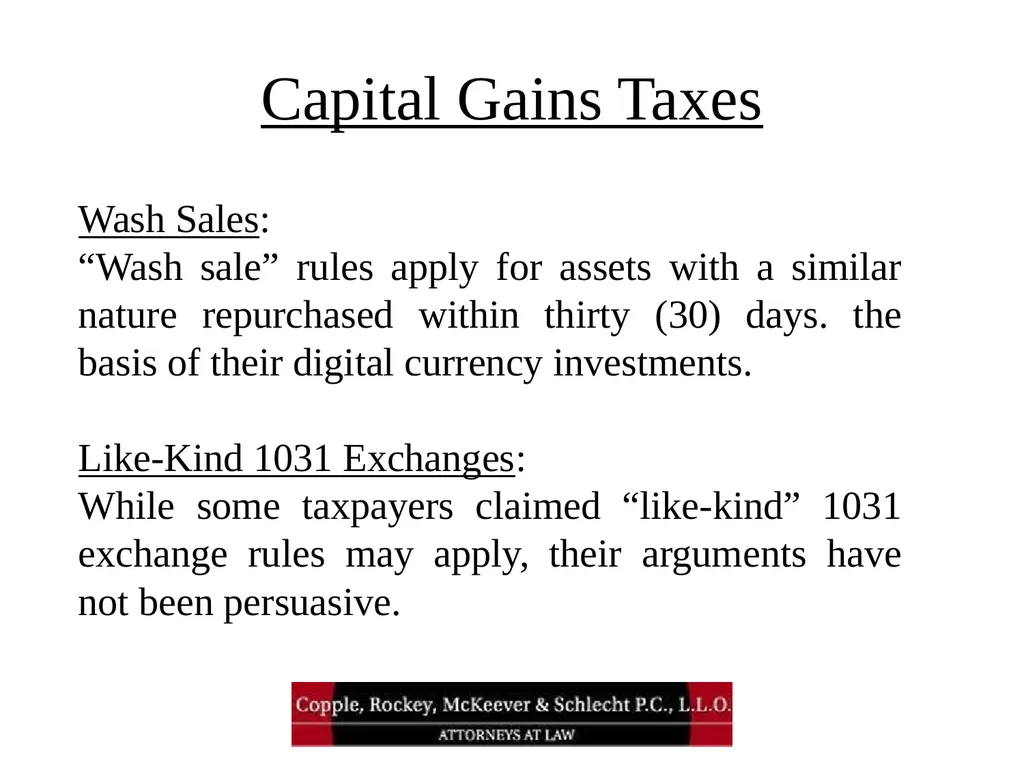
slide22. Capital Gains Taxes Wash Sales:
“Wash sale” rules apply for assets with a similar nature repurchased within thirty (30) days. the basis of their digital currency investments.
Like-Kind 1031 Exchanges:
While some taxpayers claimed “like-kind” 1031 exchange rules may apply, their arguments have not been persuasive.<br>
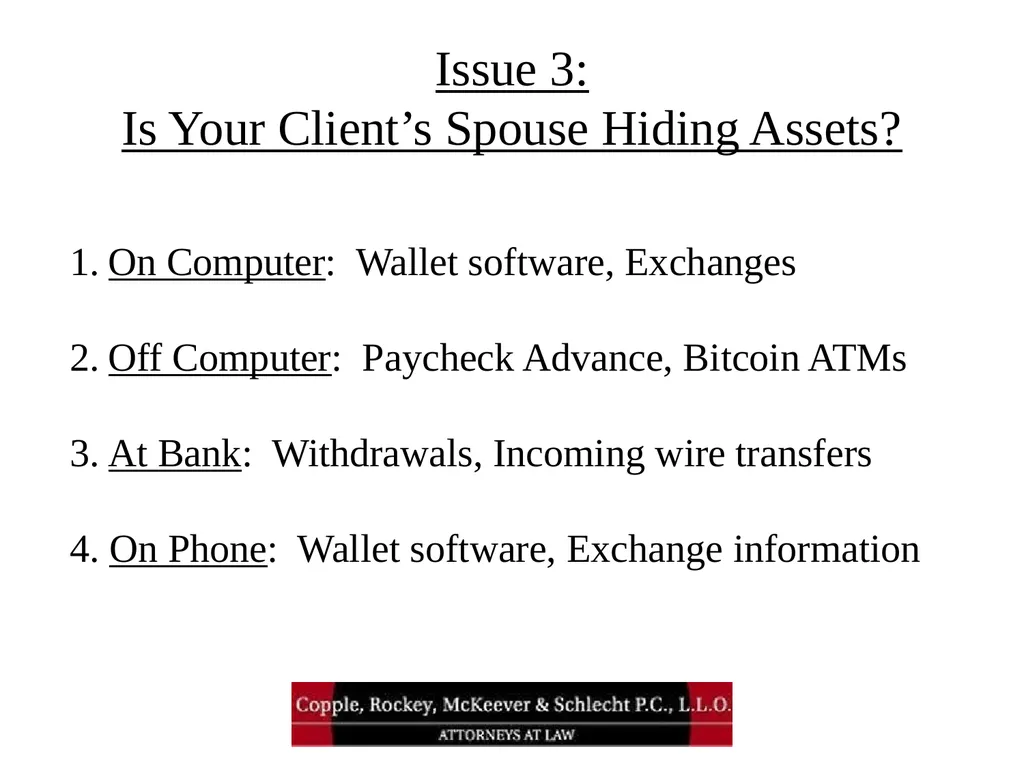
slide23. Issue 3: Is Your Client’s Spouse Hiding Assets? On Computer: Wallet software, Exchanges
Off Computer: Paycheck Advance, Bitcoin ATMs
At Bank: Withdrawals, Incoming wire transfers
4. On Phone: Wallet software, Exchange information<br>
slide24. Discovery/Debtor Exam Questions Held any digital currencies (or other digital assets/accounts such as Paypal, venmo, cashapp or frequent flyer miles)?
What digital assets were held?
How are they stored?
Where are they stored? (Computer, phone, cloud?)
How can they be accessed?
To whom did you send any digital assets?
From whom did you receive any digital assets?<br>
slide25. Discovery/Debtor Production Electronically stored information (wallet software, phone app, cloud-based)
Transaction information (accounts, wallets, exchanges)
Tax reporting documents (capital gains, foreign accounts)<br>
slide26. Issue 4: Can Your Client Pay You With Digital Currencies? Short Answer: Yes.
1. Need to immediately convert them to dollars.
Can accept third-party payments on behalf of clients.
3. Can hold digital currencies in trust for clients.<br>
slide27. Payments From Clients With Digital Currencies Neb. Ethics Advisory Opinion for Lawyers No. 17-03
1. Attorneys may accepts property in payment of services.
Neb. Ct. R. Prof. Cond. §3-501, Comment 4.
Must be sure that the fee remains reasonable.
Neb. Ct. R. Prof. Cond. §3-501.5(a).
3. Volatility creates possible unconscionable overpayment.
4. Must convert using objective market rates at time of payment. Payment processor should be used.<br>
slide28. Conversion Using Third-Party Payment Processors Coinbase
Bitpay
Circle
Trend: No fees for the first $1 million.
Example: Coinbase charges 1% after first $1 million in revenue.<br>
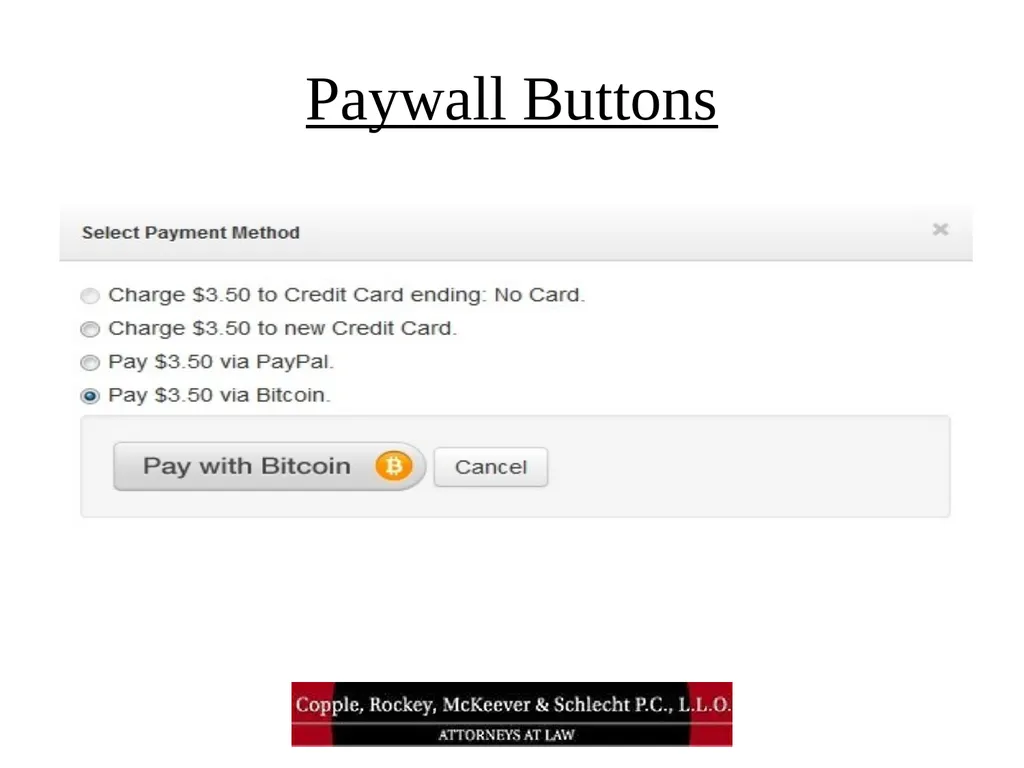
slide29. Paywall Buttons<br>
slide30. Questions? FAQ #1: Are you giving out free bitcoins?
Answer: No, of course not.
FAQ #2: Where can I go for more information?
Answer: Coindesk.com and CoinTelegraph.com
Matthew S. McKeever
Copple, Rockey, McKeever & Schlecht, P.C., L.L.O.
(402) 493-5675
msmckeever@greatadvocates.com<br>
slide31. Why the Hype? Advantages of Digital Currencies Volatility.
Privacy.
No government control.
Person-to-person like cash.
Alternative to credit cards and wire transfers.
No chargebacks!
Instant transactions with no or low cost.<br>
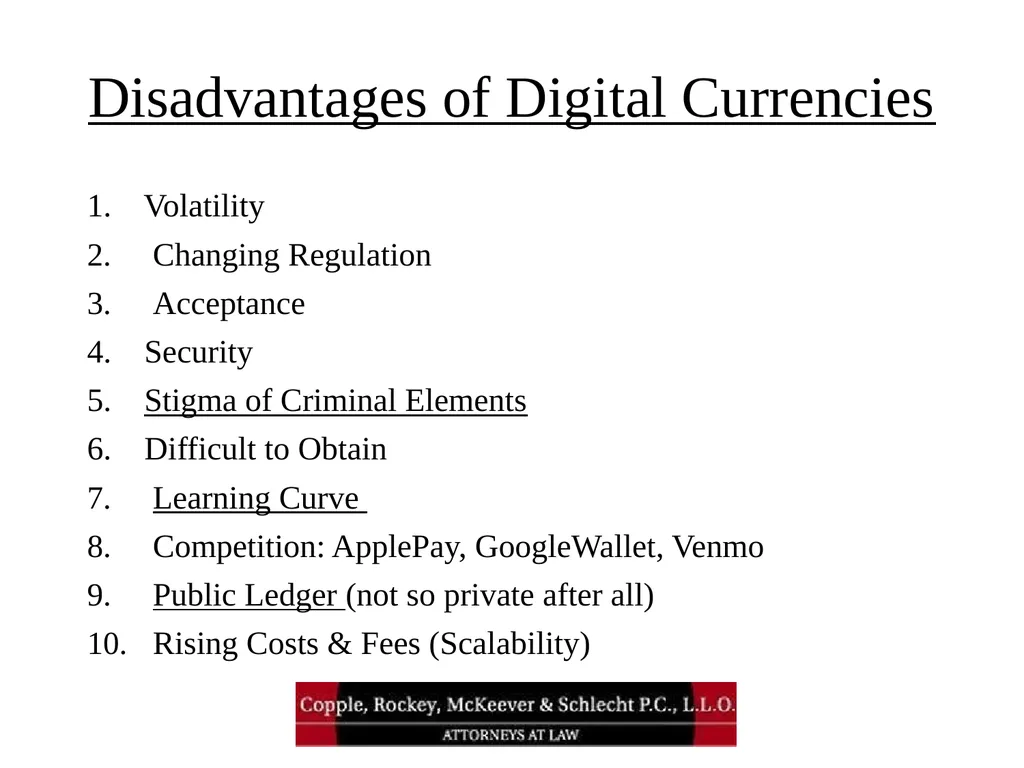
slide32. Disadvantages of Digital Currencies 1. Volatility
Changing Regulation
Acceptance
4. Security
5. Stigma of Criminal Elements
6. Difficult to Obtain
Learning Curve
Competition: ApplePay, GoogleWallet, Venmo
Public Ledger (not so private after all)
Rising Costs & Fees (Scalability)<br>
Copple, Rockey, McKeever & Schlecht, P.C., L.L.O.
Omaha Bar Association – Innovations in the Law CLE
December 7, 2018<br>
slide2. Disclaimer The content on this presentation is offered only as a public service for information purposes only does not constitute solicitation or provision of legal advice or financial advice. This presentation should not be used as a substitute for obtaining legal advice from an attorney, tax advice from an accountant or investment advise from a licensed financial advisor. You should always consult a suitably qualified professional regarding any specific legal, accounting, tax or investment matters. The comments and opinions expressed are of the individual presenter and may not reflect the opinions of the firm or any individual attorney.<br>
slide3. Courtesy Forbes Magazine High: $19,783.00<br>
slide4. What is Bitcoin? “Digital ledger book.” – Former CEO of Paypal
Software that records and secures transactions.
There are no physical coins.
Bitcoin: units on a public, digital ledger.
Bitcoins stored in files called “wallets”.
Entries are submitted by “keys”.
Transactions secured as pieces of a math puzzle.
Bitcoin program runs on 400,000 computers.
Internet’s version of cash. “Digital cash.”
Value comes from utility, acceptance & speculation.<br>
slide5. Bitcoin is Decentralized No central authority runs Bitcoin, no “Fed”.
Bitcoin program run by thousands of
computers linked over the internet – “miners”.
Peer-to-peer transactions - no “middle-man”.
“Trustless”
Not a “fiat currency”
No central exchange or a “CEO of Bitcoin”.<br>
slide6. Bitcoin as Cryptography Transactions held together by math puzzle.
Bitcoin is a puzzle that is solved one piece at a
time, called a “block”.
Each puzzle piece holds records of a series of
transactions on the ledger.
The series of blocks is called the “blockchain”.
Cryptography and shared nature prevents
duplication and fraud.<br>
slide7. Wallets and Transactions Wallets – Place to keep track of your bitcoins.
1. Private key
2. Public key
Transactions from one wallet to another.
Wallets secure: 64 bit encryption.
Record of transactions secured by:
1. Shared ledger.
2. Cryptography.<br>
slide8. What is Blockchain? It is the software technology behind Bitcoin.
Bitcoin is the first blockchain.
Combination of Technologies
A. Digital Ledger Books
B. Networked Computers
C. Cryptography<br>
slide9. Transactions on a Blockchain<br>
slide10. Transactions on a Blockchain<br>
slide11. Transactions on a Blockchain Block of Transactions<br>
slide12. Transactions on a Blockchain Chain of Transaction Blocks Blocks are bound together and secured by cryptography: digital signatures and hashes.<br>
slide13. Thousands of Blockchains Litecoin – faster version of Bitcoin
Ethereum – Network for “smart contracts”
Ripple – Private, centralized.
Bitcoin Cash – Fork of Bitcoin to solve scalabilty
Auroracoin - Iceland
Mazacoin – Lakota Sioux Nation
Peercoin – Partially “Proof of Work”
Blackcoin – Completely “Proof of Stake”
PowerCoin – Tokens to represent grid units
and…<br>
slide14. Dogecoin<br>
slide15. Blockchain Applications – Not Just Payments Logistics and Quality Control (IBM)
Tokens for produce, diamonds, or head of livestock
Records and Documents
Secure encrypted medical records on blockchain
Register of Deeds, Notary
Accounting
All transactions automatically tracked.
Copyrights
Music industry (Embermine)
Art & Photos (Kodak)
Printing (Ink)
5. Banking (FNBO, R3)<br>
slide16. Issue 1: Is Your Client an Unlicensed Money Transmitter? Bitcoin is legal to buy and sell!
But did you buy just so you can sell to third parties?
FinCEN requires KYC and AML.
48 State Money Transmitter Laws.
Nebraska Money Transmitters Act:
Neb. Rev. Stat. §8-2701<br>
slide17. State Laws Kansas Office of the State Bank Commissioner
1. Cryptocurrencies were neither “money” nor “monetary value”.
2. Limited the applicability of the Kansas money transmission statutes to certain third-party exchange operations.
Kansas Office of the State Bank Commissioner Guidance Document MT 2014-01, June 6, 2014<br>
slide18. Nebraska Unicameral 2018 LB987 –Uniform Regulation of Virtual Currencies Act - Sen. Paul Schumacher (Columbus)
LB691 - Anti-Money Laundering and Regulation as Money Transmitters – Sen. Carol Blood (Bellevue)
LB694 - Cities and Counties cannot regulate or tax
LB695 – Smart contracts and electronic Notary<br>
slide19. Issue 2: Is Your Client Illegally Avoiding Taxes? IRS Guidance of March 25, 2014
Asset, not currency
Taxed as capital asset (short-term or long-term capital gains rules are used)
Wages paid in virtual currency must be subject to withholding and taxes paid in fiat.
Mining (creating coins) is taxed as income.
Conversion to fiat or use in transaction is a taxable event – income taxes or capital gains.<br>
slide20. Capital Gains Taxes Realization of gains creates taxable events.
2. Bitcoin is treated no differently than any other investment such as a share of stock.
No taxes are due on the investment while it increases in value until the investment is actually sold for U.S. dollars or other official currency.
Digital currencies may help track buy/sell.
Taxpayers must self-report.<br>
slide21. Capital Gains Taxes The tax basis in bitcoins is the cash purchase price.
Fair market value (FMV) at time of acquisition.
Exchanges can use used to determine FMV.
Long-Term/Short-Term Gains: As with similar assets, taxable gain or loss in dollars received on the sale is considered. Gain can be long-term if owned for twelve (12) or more months .<br>
slide22. Capital Gains Taxes Wash Sales:
“Wash sale” rules apply for assets with a similar nature repurchased within thirty (30) days. the basis of their digital currency investments.
Like-Kind 1031 Exchanges:
While some taxpayers claimed “like-kind” 1031 exchange rules may apply, their arguments have not been persuasive.<br>
slide23. Issue 3: Is Your Client’s Spouse Hiding Assets? On Computer: Wallet software, Exchanges
Off Computer: Paycheck Advance, Bitcoin ATMs
At Bank: Withdrawals, Incoming wire transfers
4. On Phone: Wallet software, Exchange information<br>
slide24. Discovery/Debtor Exam Questions Held any digital currencies (or other digital assets/accounts such as Paypal, venmo, cashapp or frequent flyer miles)?
What digital assets were held?
How are they stored?
Where are they stored? (Computer, phone, cloud?)
How can they be accessed?
To whom did you send any digital assets?
From whom did you receive any digital assets?<br>
slide25. Discovery/Debtor Production Electronically stored information (wallet software, phone app, cloud-based)
Transaction information (accounts, wallets, exchanges)
Tax reporting documents (capital gains, foreign accounts)<br>
slide26. Issue 4: Can Your Client Pay You With Digital Currencies? Short Answer: Yes.
1. Need to immediately convert them to dollars.
Can accept third-party payments on behalf of clients.
3. Can hold digital currencies in trust for clients.<br>
slide27. Payments From Clients With Digital Currencies Neb. Ethics Advisory Opinion for Lawyers No. 17-03
1. Attorneys may accepts property in payment of services.
Neb. Ct. R. Prof. Cond. §3-501, Comment 4.
Must be sure that the fee remains reasonable.
Neb. Ct. R. Prof. Cond. §3-501.5(a).
3. Volatility creates possible unconscionable overpayment.
4. Must convert using objective market rates at time of payment. Payment processor should be used.<br>
slide28. Conversion Using Third-Party Payment Processors Coinbase
Bitpay
Circle
Trend: No fees for the first $1 million.
Example: Coinbase charges 1% after first $1 million in revenue.<br>
slide29. Paywall Buttons<br>
slide30. Questions? FAQ #1: Are you giving out free bitcoins?
Answer: No, of course not.
FAQ #2: Where can I go for more information?
Answer: Coindesk.com and CoinTelegraph.com
Matthew S. McKeever
Copple, Rockey, McKeever & Schlecht, P.C., L.L.O.
(402) 493-5675
msmckeever@greatadvocates.com<br>
slide31. Why the Hype? Advantages of Digital Currencies Volatility.
Privacy.
No government control.
Person-to-person like cash.
Alternative to credit cards and wire transfers.
No chargebacks!
Instant transactions with no or low cost.<br>
slide32. Disadvantages of Digital Currencies 1. Volatility
Changing Regulation
Acceptance
4. Security
5. Stigma of Criminal Elements
6. Difficult to Obtain
Learning Curve
Competition: ApplePay, GoogleWallet, Venmo
Public Ledger (not so private after all)
Rising Costs & Fees (Scalability)<br>