
Bleeding Control (B-Con) Basic Copyright © 2017 by
SN
Published · 61 slides · 0 views
1 / 1

Description
Bleeding Control (B-Con) Basic Copyright 2017 by the American College of Surgeons What everyone should know to control bleeding Bleeding Control Basic v. 1.0 This educational program is the product of a cooperative effort by: The Hartford
Related Topics
Share
Embed code
Download this presentation From Below
"Bleeding Control (B-Con) Basic Copyright © 2017 by" is the property of its rightful owner. Permission is granted to download and print the materials on this website for personal, non-commercial use only, and to display it on your personal computer provided you do not modify the materials and that you retain all copyright notices contained in the materials. By downloading content from our website, you accept the terms of this agreement.
Presentation Transcript
01
Bleeding Control (B-Con) Basic Copyright © 2017 by the American College of Surgeons<br>
02
What everyone should know to
control bleeding Bleeding Control Basic v. 1.0<br>
control bleeding Bleeding Control Basic v. 1.0<br>
03
This educational program is the product of a cooperative effort by: The Hartford Consensus The American College of
Surgeons Committee on Trauma The Committee on Tactical Combat Casualty Care The National
Association of Emergency Medical Technicians<br>
Surgeons Committee on Trauma The Committee on Tactical Combat Casualty Care The National
Association of Emergency Medical Technicians<br>
04
Introduction | Principles | A-Alert | B-Bleeding | C-Compression | The focus of this program is on:
The immediate response to bleeding
Recognize life-threatening bleeding
Appropriate ways to stop the bleeding
The help given by an immediate responder can often make the difference between life and death, even before professional rescuers arrive.
With the right training, YOU can help save lives!<br>
The immediate response to bleeding
Recognize life-threatening bleeding
Appropriate ways to stop the bleeding
The help given by an immediate responder can often make the difference between life and death, even before professional rescuers arrive.
With the right training, YOU can help save lives!<br>
05
WARNING! Some of the images shown during this presentation are graphic
and may be disturbing to some people. Bleeding Control Basic v. 1.0 Introduction | Principles | A-Alert | B-Bleeding | C-Compression |<br>
and may be disturbing to some people. Bleeding Control Basic v. 1.0 Introduction | Principles | A-Alert | B-Bleeding | C-Compression |<br>
06
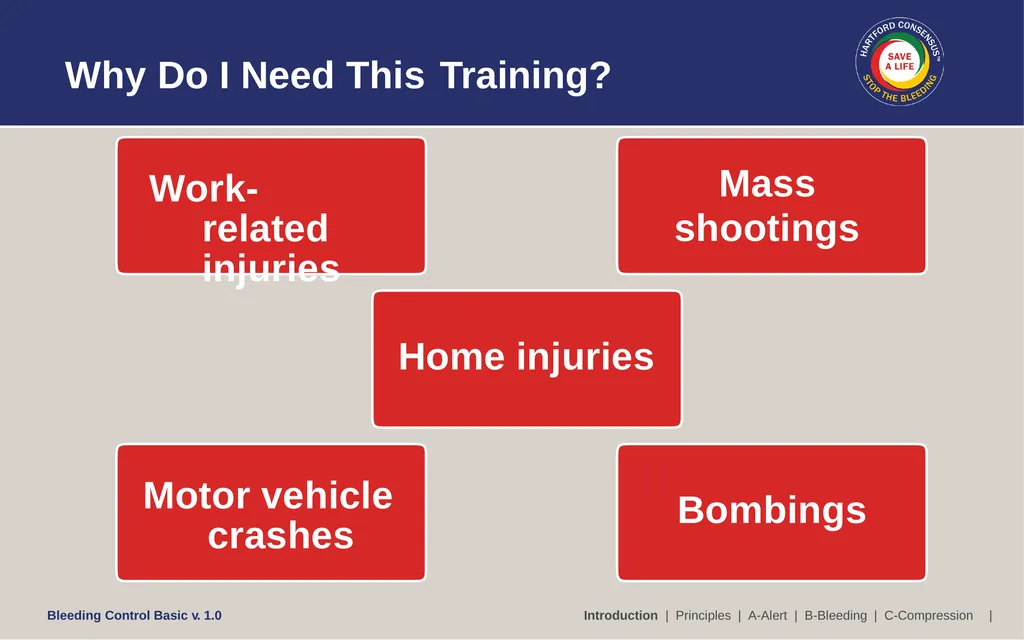
Why Do I Need This Training? Work-related injuries Motor vehicle crashes Mass
shootings Bombings Home injuries Bleeding Control Basic v. 1.0 Introduction | Principles | A-Alert | B-Bleeding | C-Compression |<br>
shootings Bombings Home injuries Bleeding Control Basic v. 1.0 Introduction | Principles | A-Alert | B-Bleeding | C-Compression |<br>
07
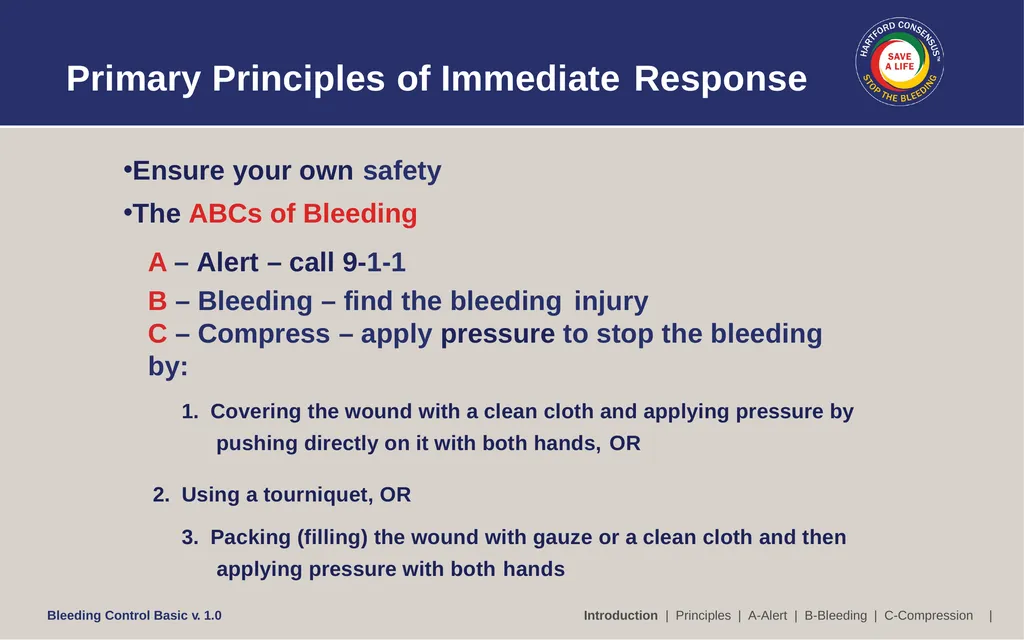
Primary Principles of Immediate Response Bleeding Control Basic v. 1.0 Introduction | Principles | A-Alert | B-Bleeding | C-Compression | Ensure your own safety
The ABCs of Bleeding
A – Alert – call 9-1-1
B – Bleeding – find the bleeding injury
C – Compress – apply pressure to stop the bleeding by:
Covering the wound with a clean cloth and applying pressure by pushing directly on it with both hands, OR
Using a tourniquet, OR
Packing (filling) the wound with gauze or a clean cloth and then applying pressure with both hands<br>
The ABCs of Bleeding
A – Alert – call 9-1-1
B – Bleeding – find the bleeding injury
C – Compress – apply pressure to stop the bleeding by:
Covering the wound with a clean cloth and applying pressure by pushing directly on it with both hands, OR
Using a tourniquet, OR
Packing (filling) the wound with gauze or a clean cloth and then applying pressure with both hands<br>
08
Primary Principles: Bleeding Control Basic v. 1.0 Introduction | Principles | A-Alert | B-Bleeding | C-Compression | Safety Before you offer any help, you must remain safe
If you become injured, you will not be able to help the victim
Initiate care if the scene is safe for you to do so
If, at any time, your safety is threatened, attempt to remove yourself from danger and find a safe location
Protect yourself from blood-borne infections by wearing gloves, if available<br>
If you become injured, you will not be able to help the victim
Initiate care if the scene is safe for you to do so
If, at any time, your safety is threatened, attempt to remove yourself from danger and find a safe location
Protect yourself from blood-borne infections by wearing gloves, if available<br>
09
Primary Principles: Bleeding Control Basic v. 1.0 Introduction | Principles | A-Alert | B-Bleeding | C-Compression | ABCs of Bleeding A • Alert Get help
Call 9-1-1 yourself, OR
Tell someone to call 9-1-1
Alerting 9-1-1 will notify and get emergency medical responders and, depending on the situation, police officers to respond to the scene<br>
Call 9-1-1 yourself, OR
Tell someone to call 9-1-1
Alerting 9-1-1 will notify and get emergency medical responders and, depending on the situation, police officers to respond to the scene<br>
10
Primary Principles: Bleeding Control Basic v. 1.0 Introduction | Principles | A-Alert | B-Bleeding | C-Compression | ABCs of Bleeding Find where the victim is bleeding from
Open or remove the clothing so you can see the wound
Look for and identify “life-threatening” bleeding
Blood that is spurting out of the wound
Blood that won’t stop coming out of the wound
Blood that is pooling on the ground
Clothing that is soaked with blood
Bandages that are soaked with blood
Loss of all or part of an arm or leg
Bleeding in a victim who is now confused or unconscious B • Bleeding<br>
Open or remove the clothing so you can see the wound
Look for and identify “life-threatening” bleeding
Blood that is spurting out of the wound
Blood that won’t stop coming out of the wound
Blood that is pooling on the ground
Clothing that is soaked with blood
Bandages that are soaked with blood
Loss of all or part of an arm or leg
Bleeding in a victim who is now confused or unconscious B • Bleeding<br>
11
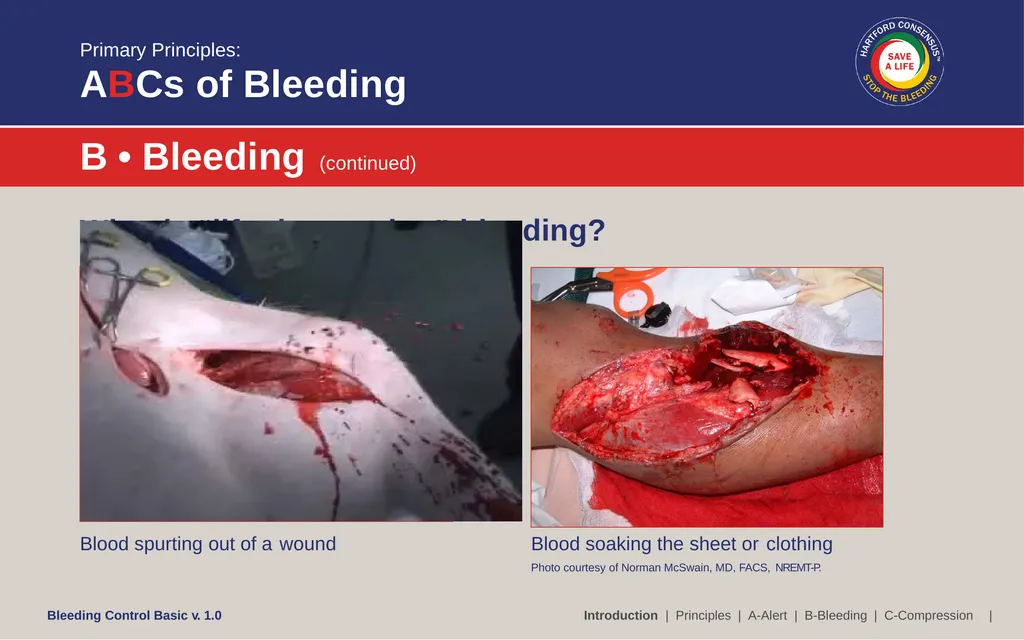
Primary Principles: ABCs of Bleeding B • Bleeding (continued) What is “life-threatening” blee ding? Blood soaking the sheet or clothing
Photo courtesy of Norman McSwain, MD, FACS, NREMT-P. Blood spurting out of a wound Bleeding Control Basic v. 1.0 Introduction | Principles | A-Alert | B-Bleeding | C-Compression |<br>
Photo courtesy of Norman McSwain, MD, FACS, NREMT-P. Blood spurting out of a wound Bleeding Control Basic v. 1.0 Introduction | Principles | A-Alert | B-Bleeding | C-Compression |<br>
12
Primary Principles: ABCs of Bleeding B • Bleeding (continued) Wounds That Can Lead to Death from Bleeding (1 of 3)
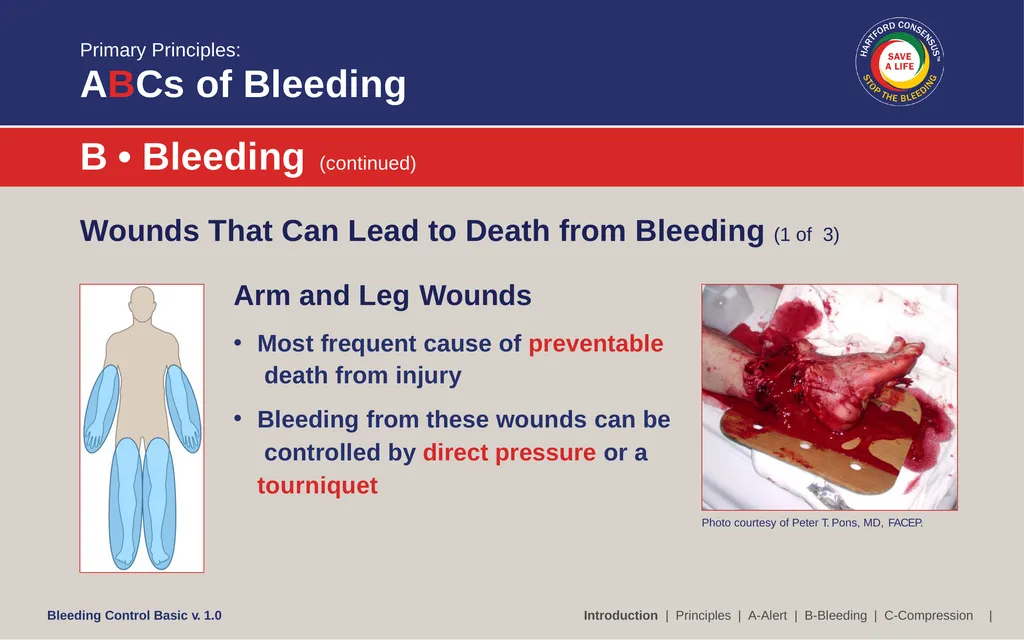
Arm and Leg Wounds
Most frequent cause of preventable death from injury
Bleeding from these wounds can be controlled by direct pressure or a tourniquet Photo courtesy of Peter T. Pons, MD, FACEP. Bleeding Control Basic v. 1.0 Introduction | Principles | A-Alert | B-Bleeding | C-Compression |<br>
Arm and Leg Wounds
Most frequent cause of preventable death from injury
Bleeding from these wounds can be controlled by direct pressure or a tourniquet Photo courtesy of Peter T. Pons, MD, FACEP. Bleeding Control Basic v. 1.0 Introduction | Principles | A-Alert | B-Bleeding | C-Compression |<br>
13
Primary Principles: ABCs of Bleeding B • Bleeding (continued) Wounds That Can Lead to Death from Bleeding (2 of 3)
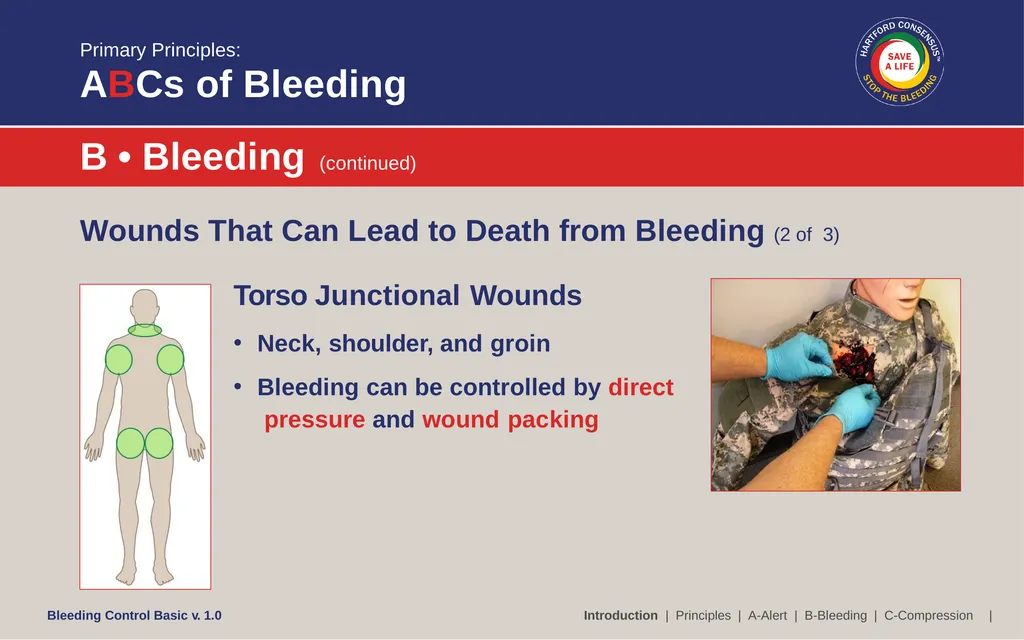
Torso Junctional Wounds
Neck, shoulder, and groin
Bleeding can be controlled by direct pressure and wound packing Bleeding Control Basic v. 1.0 Introduction | Principles | A-Alert | B-Bleeding | C-Compression |<br>
Torso Junctional Wounds
Neck, shoulder, and groin
Bleeding can be controlled by direct pressure and wound packing Bleeding Control Basic v. 1.0 Introduction | Principles | A-Alert | B-Bleeding | C-Compression |<br>
14
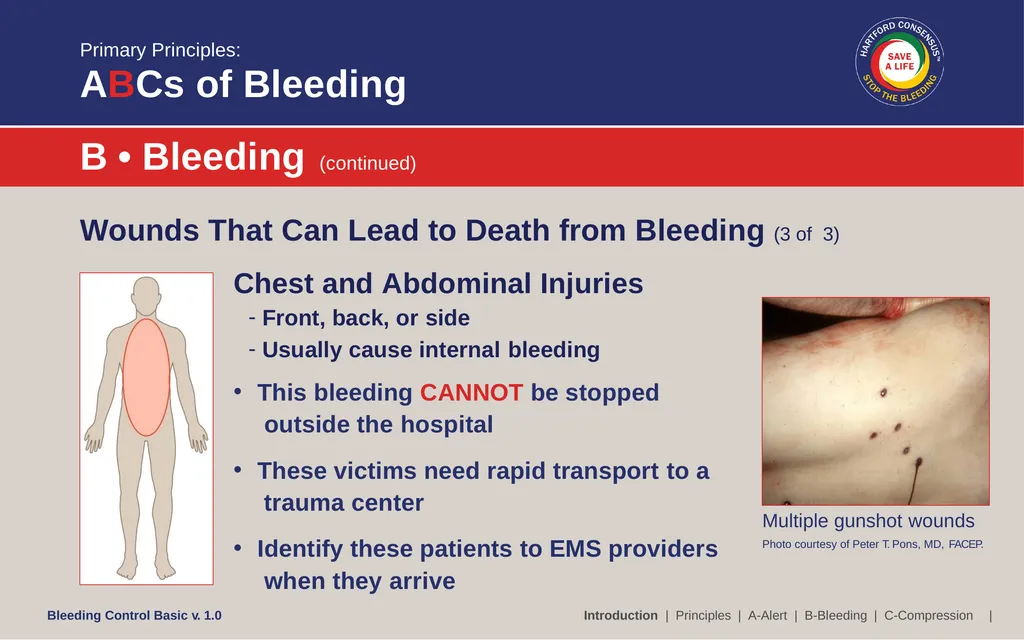
Primary Principles: ABCs of Bleeding B • Bleeding (continued) Wounds That Can Lead to Death from Bleeding (3 of 3) Chest and Abdominal Injuries
Front, back, or side
Usually cause internal bleeding
This bleeding CANNOT be stopped outside the hospital
These victims need rapid transport to a trauma center
Identify these patients to EMS providers when they arrive Multiple gunshot wounds
Photo courtesy of Peter T. Pons, MD, FACEP. Bleeding Control Basic v. 1.0 Introduction | Principles | A-Alert | B-Bleeding | C-Compression |<br>
Front, back, or side
Usually cause internal bleeding
This bleeding CANNOT be stopped outside the hospital
These victims need rapid transport to a trauma center
Identify these patients to EMS providers when they arrive Multiple gunshot wounds
Photo courtesy of Peter T. Pons, MD, FACEP. Bleeding Control Basic v. 1.0 Introduction | Principles | A-Alert | B-Bleeding | C-Compression |<br>
15
Primary Principles:
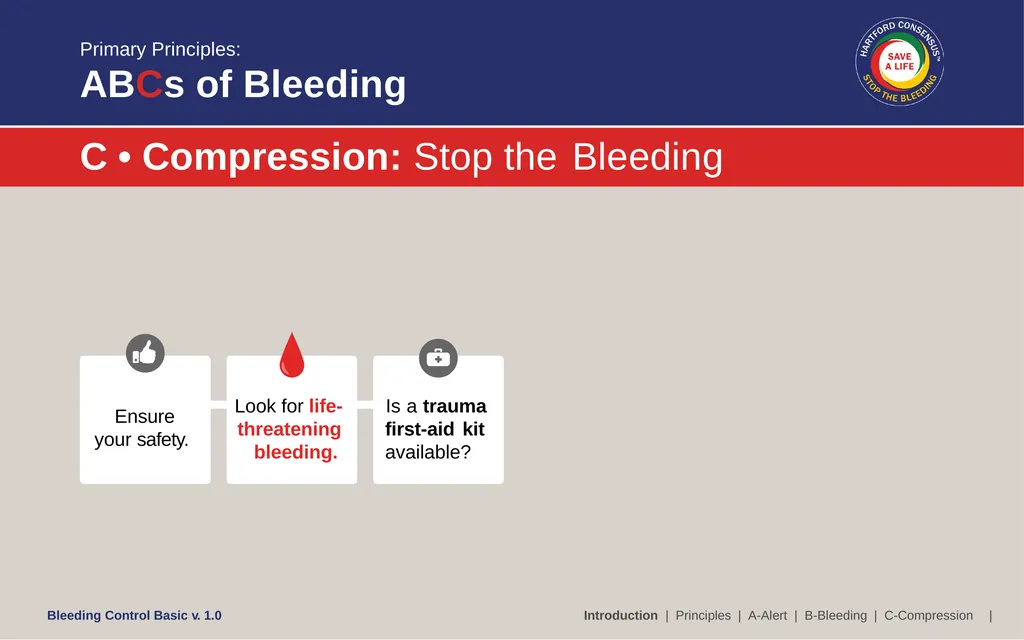
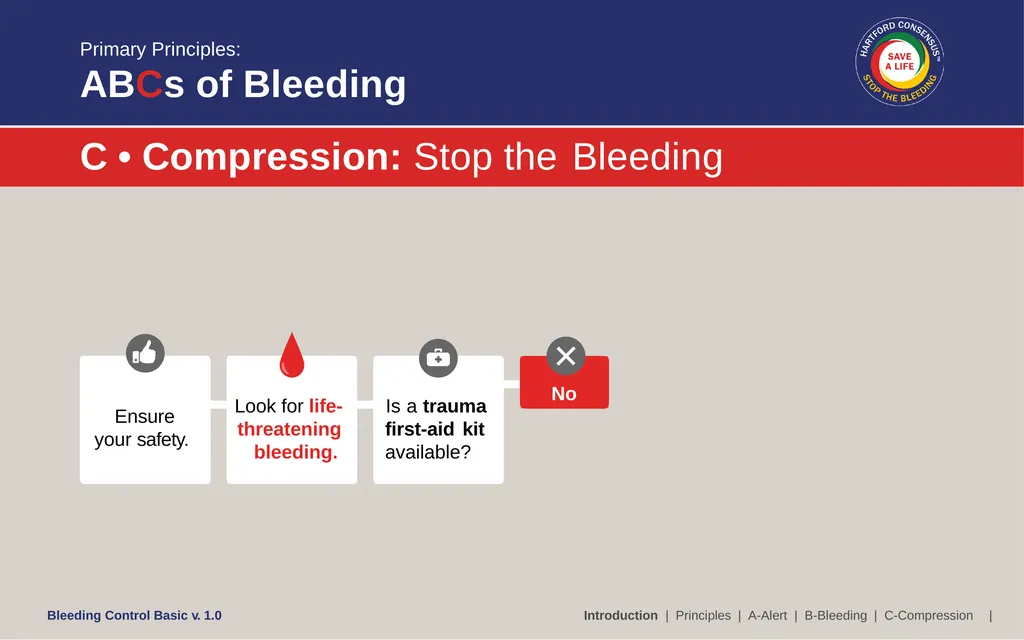
ABCs of Bleeding C • Compression: Stop the Bleeding Ensure your safety. Look for life- threatening bleeding. Is a trauma first-aid kit available? Bleeding Control Basic v. 1.0 Introduction | Principles | A-Alert | B-Bleeding | C-Compression |<br>
ABCs of Bleeding C • Compression: Stop the Bleeding Ensure your safety. Look for life- threatening bleeding. Is a trauma first-aid kit available? Bleeding Control Basic v. 1.0 Introduction | Principles | A-Alert | B-Bleeding | C-Compression |<br>
16
Primary Principles:
ABCs of Bleeding C • Compression: Stop the Bleeding No Ensure your safety. Look for life- threatening bleeding. Is a trauma first-aid kit available? Bleeding Control Basic v. 1.0 Introduction | Principles | A-Alert | B-Bleeding | C-Compression |<br>
ABCs of Bleeding C • Compression: Stop the Bleeding No Ensure your safety. Look for life- threatening bleeding. Is a trauma first-aid kit available? Bleeding Control Basic v. 1.0 Introduction | Principles | A-Alert | B-Bleeding | C-Compression |<br>
17
Primary Principles:
ABCs of Bleeding C • Compression: Stop the Bleeding
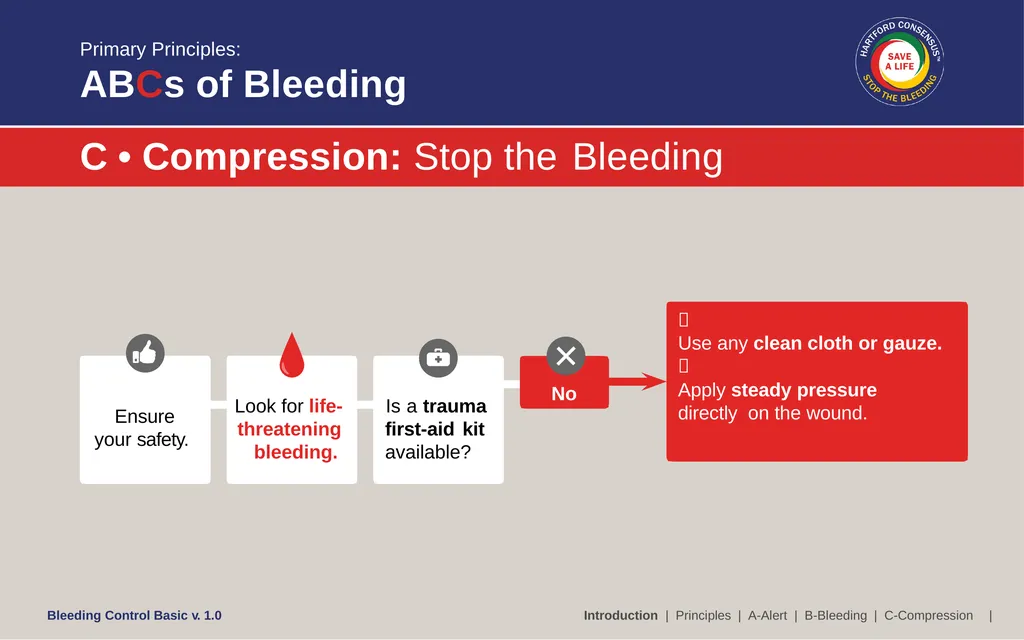
Use any clean cloth or gauze.
Apply steady pressure directly on the wound. No Ensure your safety. Look for life- threatening bleeding. Is a trauma first-aid kit available? Bleeding Control Basic v. 1.0 Introduction | Principles | A-Alert | B-Bleeding | C-Compression |<br>
ABCs of Bleeding C • Compression: Stop the Bleeding
Use any clean cloth or gauze.
Apply steady pressure directly on the wound. No Ensure your safety. Look for life- threatening bleeding. Is a trauma first-aid kit available? Bleeding Control Basic v. 1.0 Introduction | Principles | A-Alert | B-Bleeding | C-Compression |<br>
18
Primary Principles: Bleeding Control Basic v. 1.0 Introduction | Principles | A-Alert | B-Bleeding | C-Compression | ABCs of Bleeding C • Compression: Stop the Bleeding (continued) Direct Pressure (1 of 3)
Use your hand or fingers
Use two hands, if at all possible
Effective most of the time for external bleeding
Direct pressure can stop even major arterial bleeding
Bleeding control requires very firm, continuous pressure until relieved by medical responders
To be effective, apply pressure with the victim on a firm surface to provide support
Don’t release pressure to check the wound<br>
Use your hand or fingers
Use two hands, if at all possible
Effective most of the time for external bleeding
Direct pressure can stop even major arterial bleeding
Bleeding control requires very firm, continuous pressure until relieved by medical responders
To be effective, apply pressure with the victim on a firm surface to provide support
Don’t release pressure to check the wound<br>
19
Primary Principles: ABCs of Bleeding C • Compression: Stop the Bleeding (continued) Direct Pressure (2 of 3)
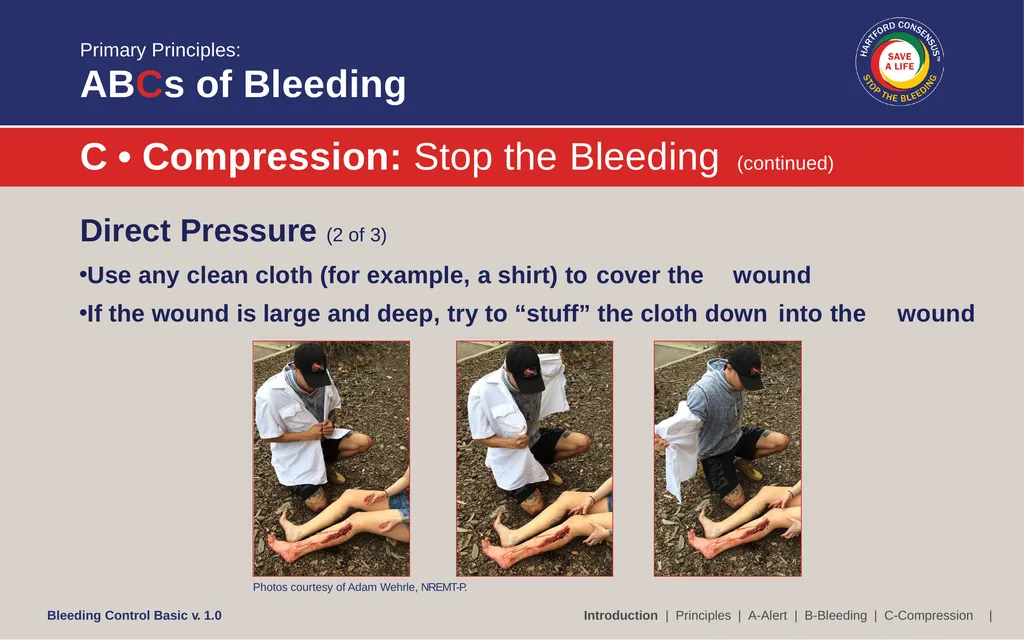
Use any clean cloth (for example, a shirt) to cover the wound
If the wound is large and deep, try to “stuff” the cloth down into the wound Photos courtesy of Adam Wehrle, NREMT-P. Bleeding Control Basic v. 1.0 Introduction | Principles | A-Alert | B-Bleeding | C-Compression |<br>
Use any clean cloth (for example, a shirt) to cover the wound
If the wound is large and deep, try to “stuff” the cloth down into the wound Photos courtesy of Adam Wehrle, NREMT-P. Bleeding Control Basic v. 1.0 Introduction | Principles | A-Alert | B-Bleeding | C-Compression |<br>
20
Primary Principles: ABCs of Bleeding C • Compression: Stop the Bleeding (continued) Direct Pressure (3 of 3)
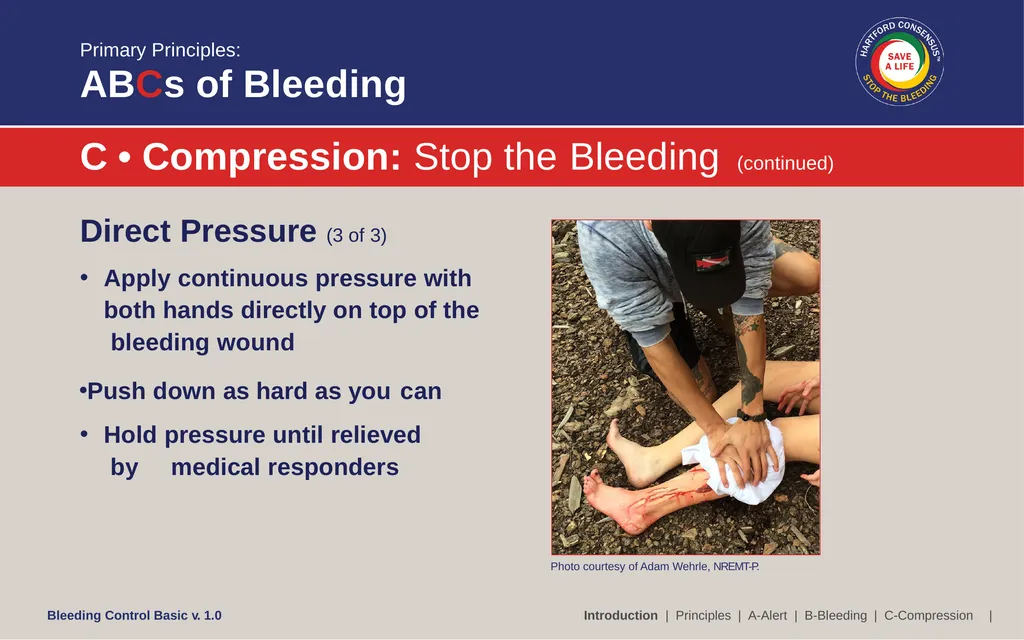
Apply continuous pressure with both hands directly on top of the bleeding wound
Push down as hard as you can
Hold pressure until relieved by medical responders Photo courtesy of Adam Wehrle, NREMT-P. Bleeding Control Basic v. 1.0 Introduction | Principles | A-Alert | B-Bleeding | C-Compression |<br>
Apply continuous pressure with both hands directly on top of the bleeding wound
Push down as hard as you can
Hold pressure until relieved by medical responders Photo courtesy of Adam Wehrle, NREMT-P. Bleeding Control Basic v. 1.0 Introduction | Principles | A-Alert | B-Bleeding | C-Compression |<br>
21
Primary Principles:
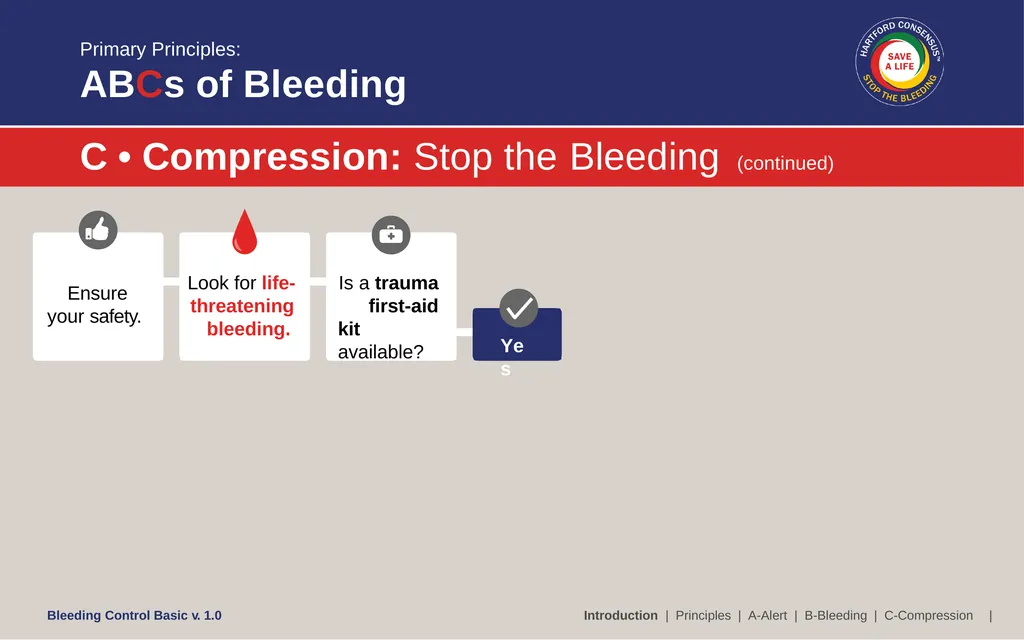
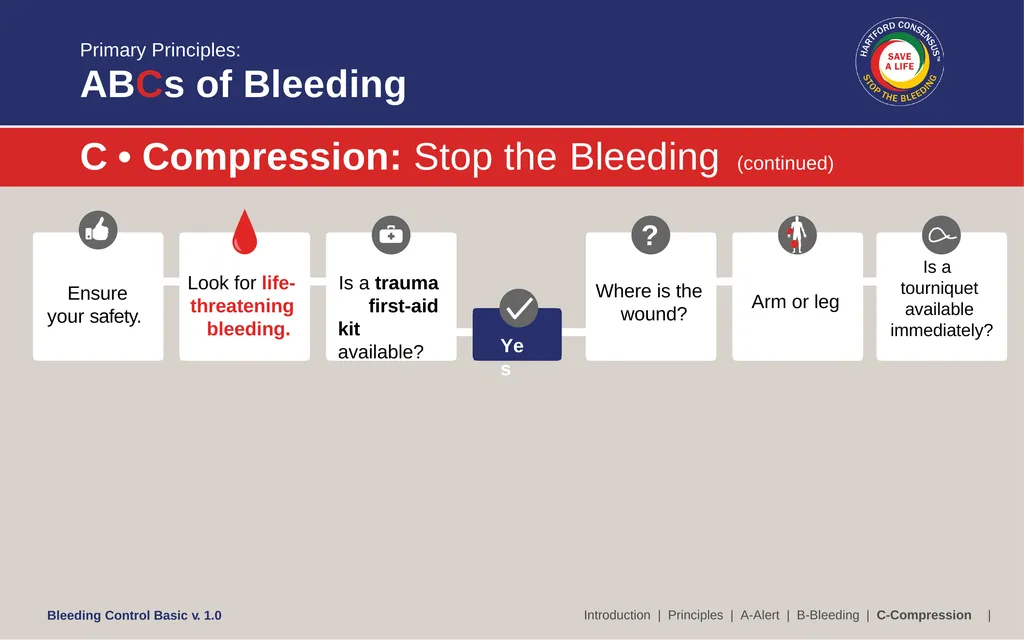
ABCs of Bleeding C • Compression: Stop the Bleeding (continued) Ensure your safety. Look for life- threatening bleeding. Is a trauma first-aid kit available? Yes Bleeding Control Basic v. 1.0 Introduction | Principles | A-Alert | B-Bleeding | C-Compression |<br>
ABCs of Bleeding C • Compression: Stop the Bleeding (continued) Ensure your safety. Look for life- threatening bleeding. Is a trauma first-aid kit available? Yes Bleeding Control Basic v. 1.0 Introduction | Principles | A-Alert | B-Bleeding | C-Compression |<br>
22
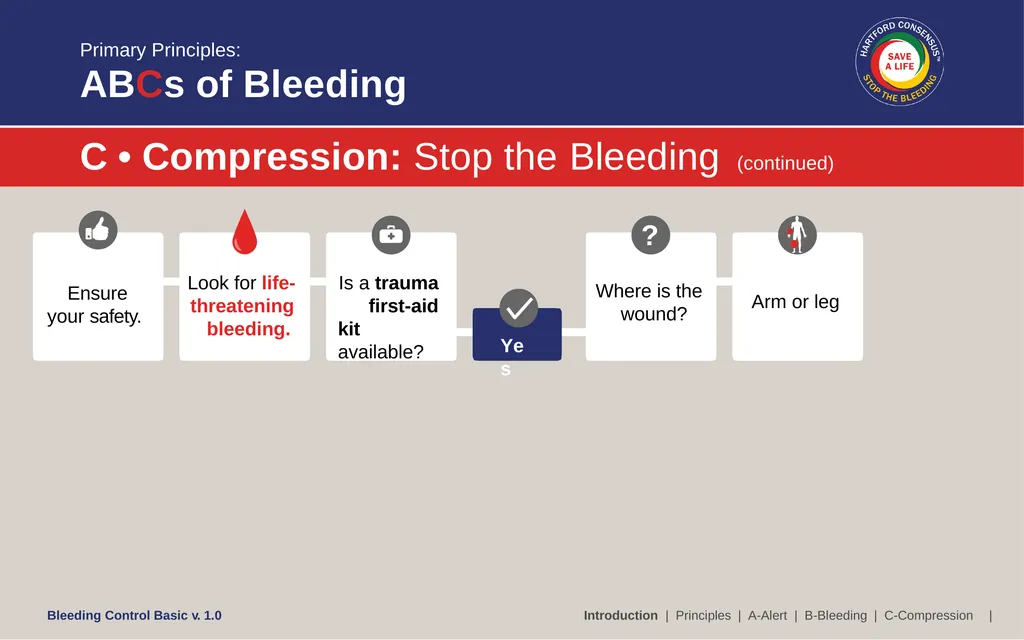
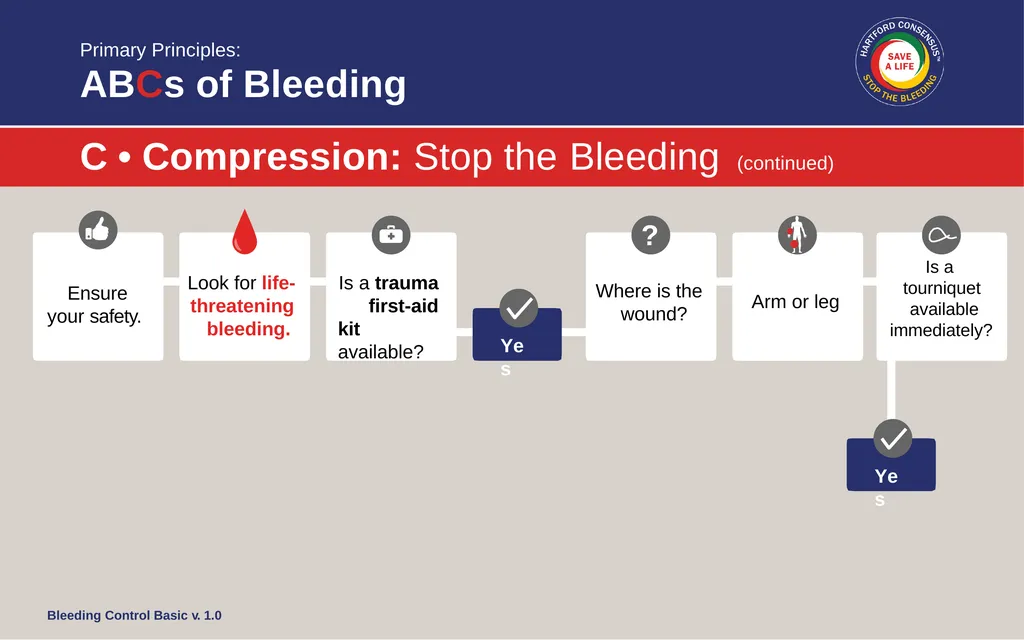
Primary Principles: ABCs of Bleeding Ensure your safety. Look for life- threatening bleeding. Is a trauma first-aid kit available? Where is the wound? Arm or leg Yes C • Compression: Stop the Bleeding (continued) ? Bleeding Control Basic v. 1.0 Introduction | Principles | A-Alert | B-Bleeding | C-Compression |<br>
23
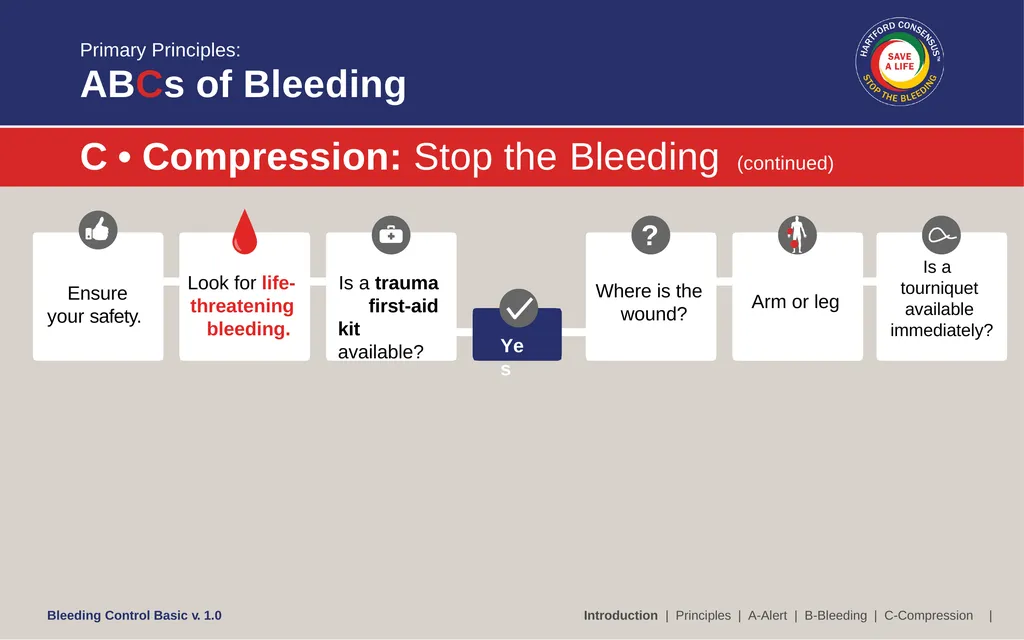
Primary Principles: ABCs of Bleeding Ensure your safety. Look for life- threatening bleeding. Is a trauma first-aid kit available? Where is the wound? Arm or leg Is a tourniquet available immediately? Yes C • Compression: Stop the Bleeding (continued) ? Bleeding Control Basic v. 1.0 Introduction | Principles | A-Alert | B-Bleeding | C-Compression |<br>
24
Primary Principles: ABCs of Bleeding Ensure your safety. Look for life- threatening bleeding. Is a trauma first-aid kit available? Where is the wound? Arm or leg Is a tourniquet available immediately? Yes Yes C • Compression: Stop the Bleeding (continued) ? Bleeding Control Basic v. 1.0<br>
25
Primary Principles: ABCs of Bleeding
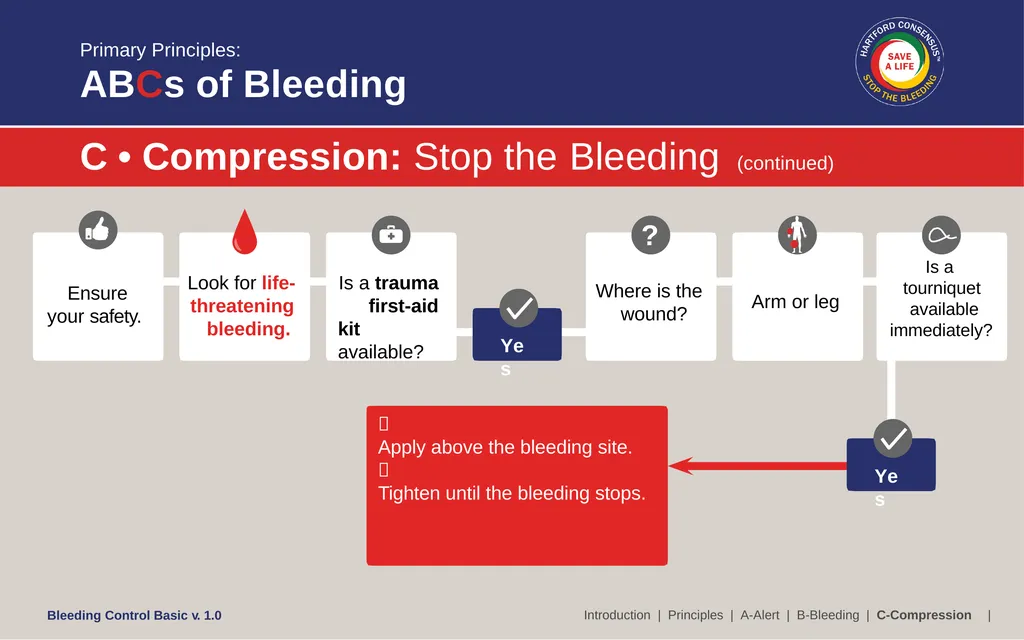
Apply above the bleeding site.
Tighten until the bleeding stops. Ensure your safety. Look for life- threatening bleeding. Is a trauma first-aid kit available? Where is the wound? Arm or leg Is a tourniquet available immediately? Yes Yes C • Compression: Stop the Bleeding (continued) ? Introduction | Principles | A-Alert | B-Bleeding | C-Compression | Bleeding Control Basic v. 1.0<br>
Apply above the bleeding site.
Tighten until the bleeding stops. Ensure your safety. Look for life- threatening bleeding. Is a trauma first-aid kit available? Where is the wound? Arm or leg Is a tourniquet available immediately? Yes Yes C • Compression: Stop the Bleeding (continued) ? Introduction | Principles | A-Alert | B-Bleeding | C-Compression | Bleeding Control Basic v. 1.0<br>
26
Primary Principles: ABCs of Bleeding C • Compression: Stop the Bleeding (continued) The Tourniquet
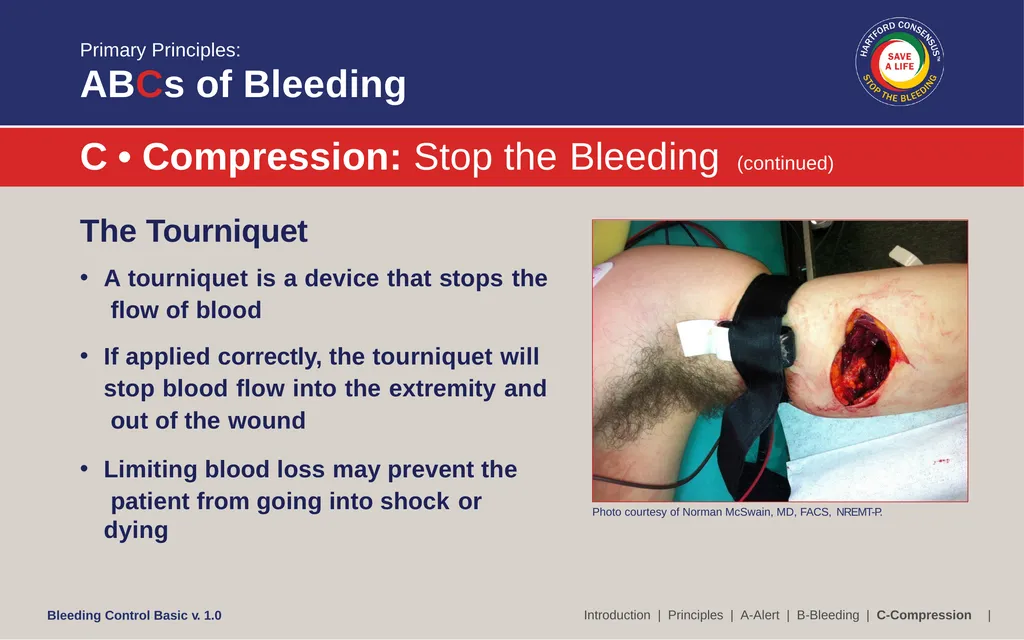
A tourniquet is a device that stops the flow of blood
If applied correctly, the tourniquet will stop blood flow into the extremity and out of the wound
Limiting blood loss may prevent the patient from going into shock or
dying Photo courtesy of Norman McSwain, MD, FACS, NREMT-P. Introduction | Principles | A-Alert | B-Bleeding | C-Compression | Bleeding Control Basic v. 1.0<br>
A tourniquet is a device that stops the flow of blood
If applied correctly, the tourniquet will stop blood flow into the extremity and out of the wound
Limiting blood loss may prevent the patient from going into shock or
dying Photo courtesy of Norman McSwain, MD, FACS, NREMT-P. Introduction | Principles | A-Alert | B-Bleeding | C-Compression | Bleeding Control Basic v. 1.0<br>
27
Primary Principles: Introduction | Principles | A-Alert | B-Bleeding | C-Compression | Bleeding Control Basic v. 1.0 ABCs of Bleeding C • Compression: Stop the Bleeding (continued) Tourniquet Application
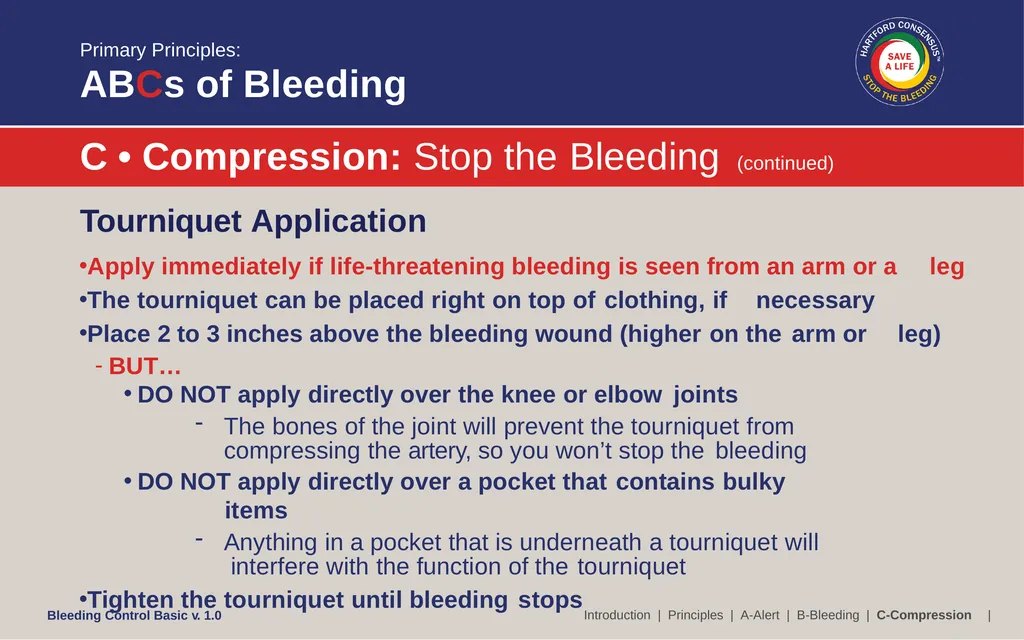
Apply immediately if life-threatening bleeding is seen from an arm or a leg
The tourniquet can be placed right on top of clothing, if necessary
Place 2 to 3 inches above the bleeding wound (higher on the arm or leg)
BUT…
DO NOT apply directly over the knee or elbow joints
The bones of the joint will prevent the tourniquet from compressing the artery, so you won’t stop the bleeding
DO NOT apply directly over a pocket that contains bulky items
Anything in a pocket that is underneath a tourniquet will interfere with the function of the tourniquet
Tighten the tourniquet until bleeding stops<br>
Apply immediately if life-threatening bleeding is seen from an arm or a leg
The tourniquet can be placed right on top of clothing, if necessary
Place 2 to 3 inches above the bleeding wound (higher on the arm or leg)
BUT…
DO NOT apply directly over the knee or elbow joints
The bones of the joint will prevent the tourniquet from compressing the artery, so you won’t stop the bleeding
DO NOT apply directly over a pocket that contains bulky items
Anything in a pocket that is underneath a tourniquet will interfere with the function of the tourniquet
Tighten the tourniquet until bleeding stops<br>
28
Primary Principles: ABCs of Bleeding C • Compression: Stop the Bleeding (continued) Tourniquet Types
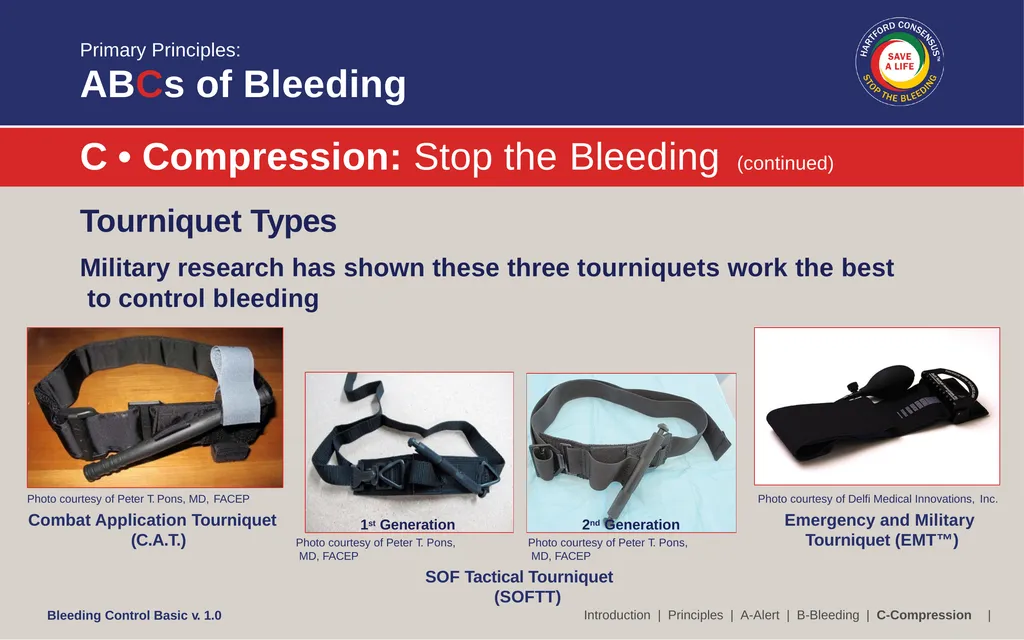
Military research has shown these three tourniquets work the best to control bleeding Photo courtesy of Peter T. Pons, MD, FACEP Photo courtesy of Peter T. Pons, MD, FACEP Photo courtesy of Peter T. Pons, MD, FACEP
Combat Application Tourniquet (C.A.T.) SOF Tactical Tourniquet (SOFTT) Photo courtesy of Delfi Medical Innovations, Inc.
Emergency and Military Tourniquet (EMT™) Introduction | Principles | A-Alert | B-Bleeding | C-Compression | Bleeding Control Basic v. 1.0 1st Generation 2nd Generation<br>
Military research has shown these three tourniquets work the best to control bleeding Photo courtesy of Peter T. Pons, MD, FACEP Photo courtesy of Peter T. Pons, MD, FACEP Photo courtesy of Peter T. Pons, MD, FACEP
Combat Application Tourniquet (C.A.T.) SOF Tactical Tourniquet (SOFTT) Photo courtesy of Delfi Medical Innovations, Inc.
Emergency and Military Tourniquet (EMT™) Introduction | Principles | A-Alert | B-Bleeding | C-Compression | Bleeding Control Basic v. 1.0 1st Generation 2nd Generation<br>
29
Primary Principles: ABCs of Bleeding C • Compression: Stop the Bleeding (continued) C.A.T. Tourniquet
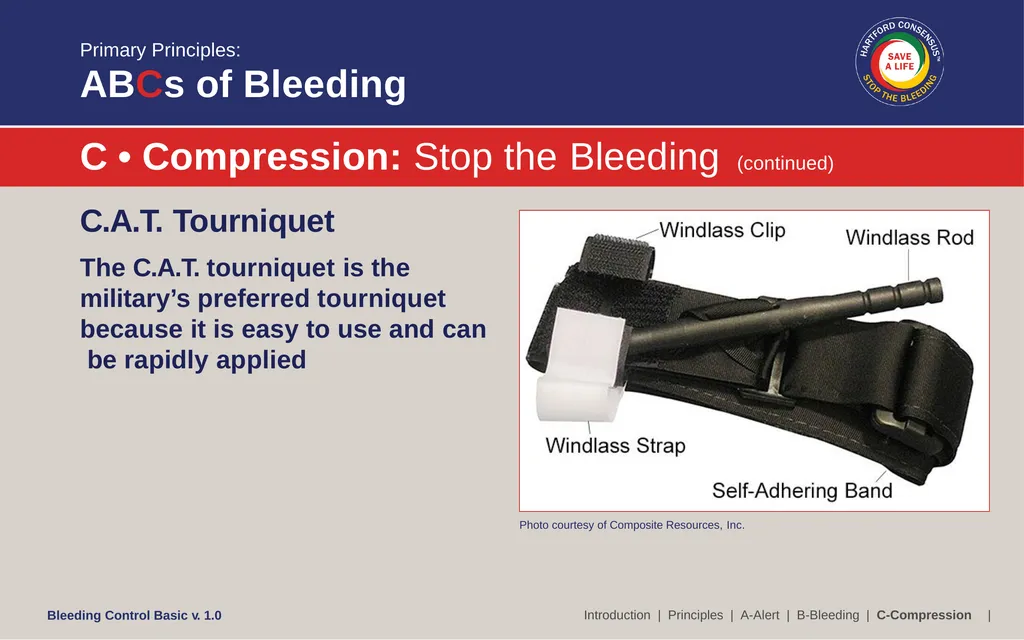
The C.A.T. tourniquet is the military’s preferred tourniquet because it is easy to use and can be rapidly applied Photo courtesy of Composite Resources, Inc. Introduction | Principles | A-Alert | B-Bleeding | C-Compression | Bleeding Control Basic v. 1.0<br>
The C.A.T. tourniquet is the military’s preferred tourniquet because it is easy to use and can be rapidly applied Photo courtesy of Composite Resources, Inc. Introduction | Principles | A-Alert | B-Bleeding | C-Compression | Bleeding Control Basic v. 1.0<br>
30
Primary Principles: ABCs of Bleeding C • Compression: Stop the Bleeding (continued) Application of a C.A.T. Tourniquet (1 of 8)
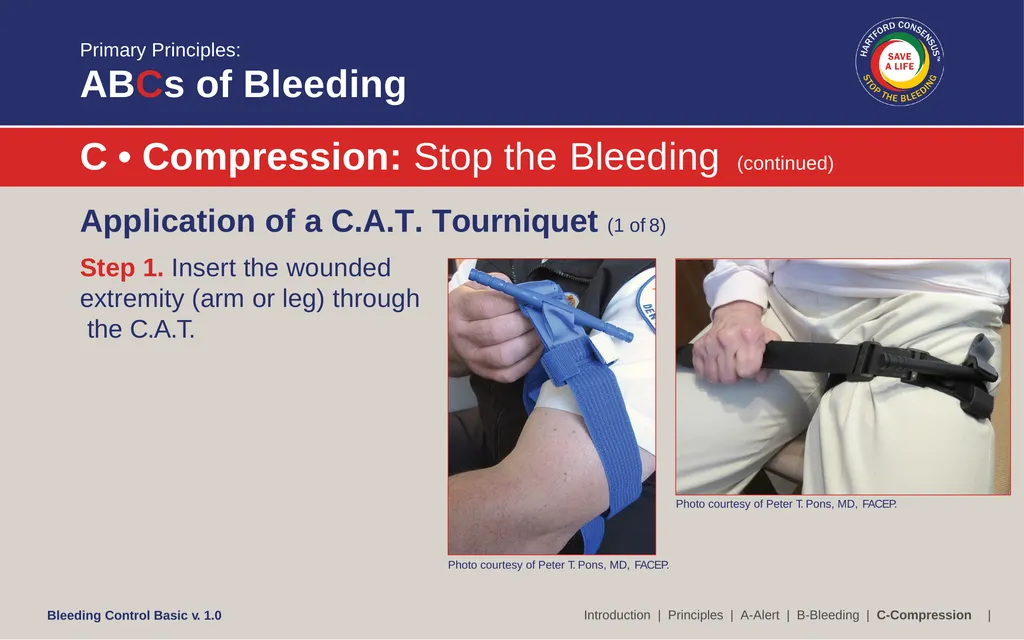
Step 1. Insert the wounded extremity (arm or leg) through the C.A.T. Photo courtesy of Peter T. Pons, MD, FACEP. Introduction | Principles | A-Alert | B-Bleeding | C-Compression | Bleeding Control Basic v. 1.0 Photo courtesy of Peter T. Pons, MD, FACEP.<br>
Step 1. Insert the wounded extremity (arm or leg) through the C.A.T. Photo courtesy of Peter T. Pons, MD, FACEP. Introduction | Principles | A-Alert | B-Bleeding | C-Compression | Bleeding Control Basic v. 1.0 Photo courtesy of Peter T. Pons, MD, FACEP.<br>
31
Primary Principles: ABCs of Bleeding C • Compression: Stop the Bleeding (continued) Application of a C.A.T. Tourniquet (2 of 8)
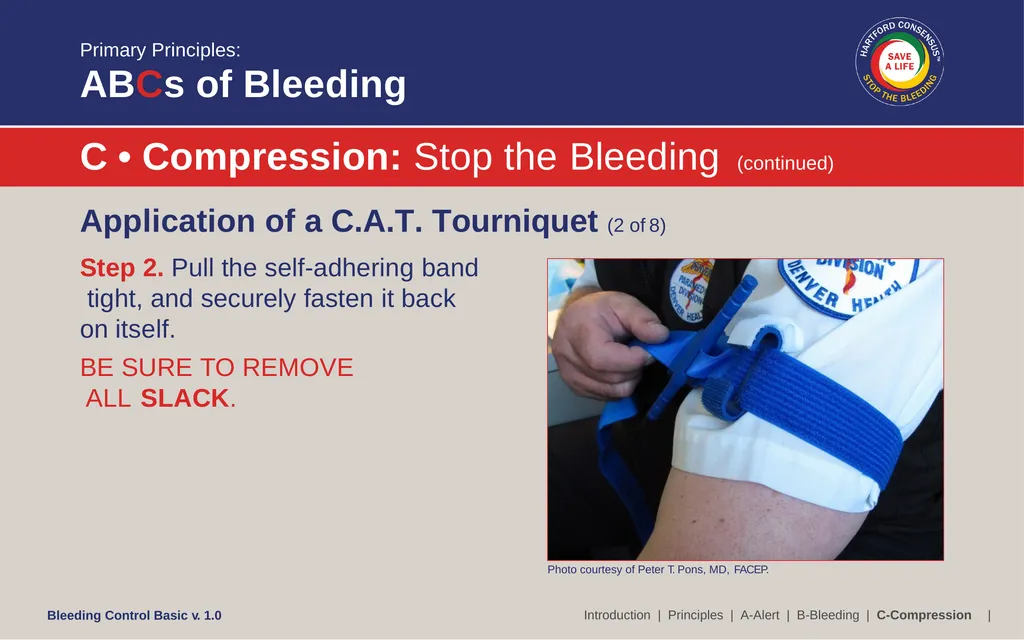
Step 2. Pull the self-adhering band tight, and securely fasten it back on itself.
BE SURE TO REMOVE ALL SLACK. Photo courtesy of Peter T. Pons, MD, FACEP. Introduction | Principles | A-Alert | B-Bleeding | C-Compression | Bleeding Control Basic v. 1.0<br>
Step 2. Pull the self-adhering band tight, and securely fasten it back on itself.
BE SURE TO REMOVE ALL SLACK. Photo courtesy of Peter T. Pons, MD, FACEP. Introduction | Principles | A-Alert | B-Bleeding | C-Compression | Bleeding Control Basic v. 1.0<br>
32
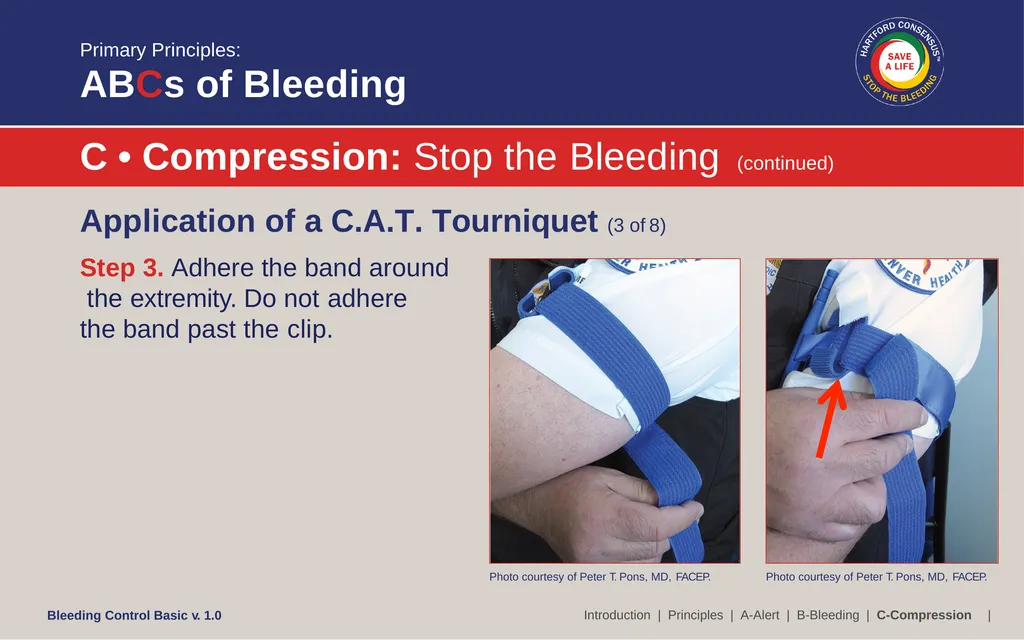
Primary Principles: ABCs of Bleeding C • Compression: Stop the Bleeding (continued) Application of a C.A.T. Tourniquet (3 of 8)
Step 3. Adhere the band around the extremity. Do not adhere
the band past the clip. Photo courtesy of Peter T. Pons, MD, FACEP. Introduction | Principles | A-Alert | B-Bleeding | C-Compression | Bleeding Control Basic v. 1.0 Photo courtesy of Peter T. Pons, MD, FACEP.<br>
Step 3. Adhere the band around the extremity. Do not adhere
the band past the clip. Photo courtesy of Peter T. Pons, MD, FACEP. Introduction | Principles | A-Alert | B-Bleeding | C-Compression | Bleeding Control Basic v. 1.0 Photo courtesy of Peter T. Pons, MD, FACEP.<br>
33
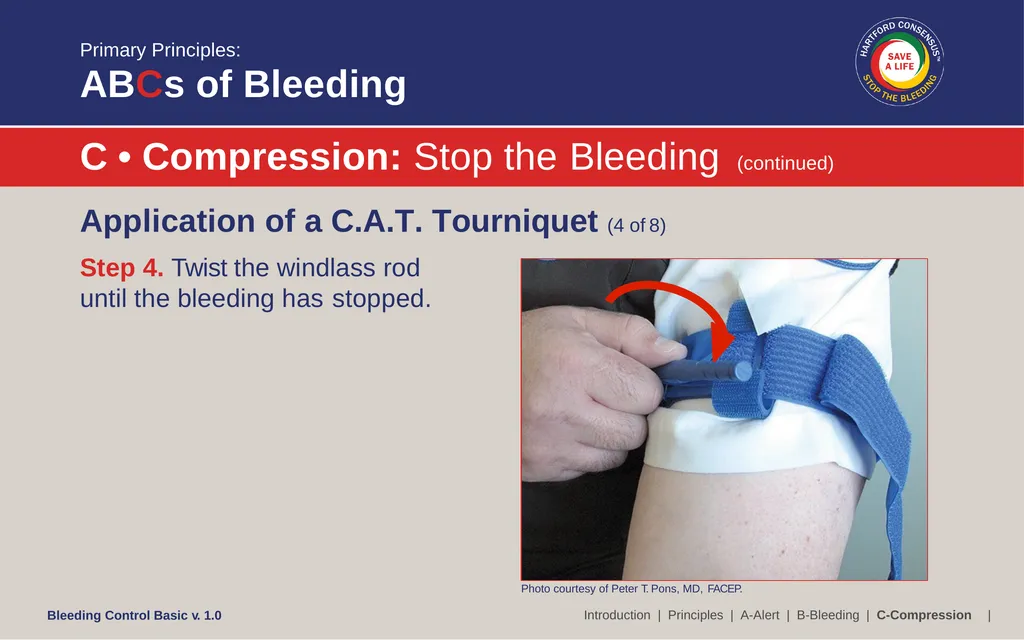
Primary Principles: ABCs of Bleeding C • Compression: Stop the Bleeding (continued) Application of a C.A.T. Tourniquet (4 of 8)
Step 4. Twist the windlass rod until the bleeding has stopped. Photo courtesy of Peter T. Pons, MD, FACEP. Introduction | Principles | A-Alert | B-Bleeding | C-Compression | Bleeding Control Basic v. 1.0<br>
Step 4. Twist the windlass rod until the bleeding has stopped. Photo courtesy of Peter T. Pons, MD, FACEP. Introduction | Principles | A-Alert | B-Bleeding | C-Compression | Bleeding Control Basic v. 1.0<br>
34
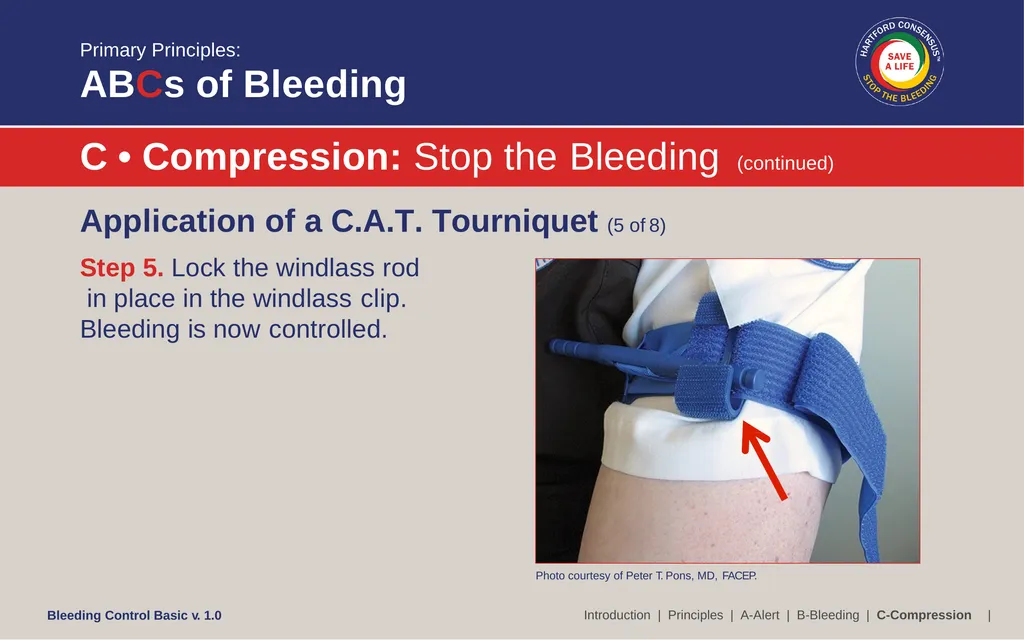
Primary Principles: ABCs of Bleeding C • Compression: Stop the Bleeding (continued) Application of a C.A.T. Tourniquet (5 of 8)
Step 5. Lock the windlass rod in place in the windlass clip.
Bleeding is now controlled. Photo courtesy of Peter T. Pons, MD, FACEP. Introduction | Principles | A-Alert | B-Bleeding | C-Compression | Bleeding Control Basic v. 1.0<br>
Step 5. Lock the windlass rod in place in the windlass clip.
Bleeding is now controlled. Photo courtesy of Peter T. Pons, MD, FACEP. Introduction | Principles | A-Alert | B-Bleeding | C-Compression | Bleeding Control Basic v. 1.0<br>
35
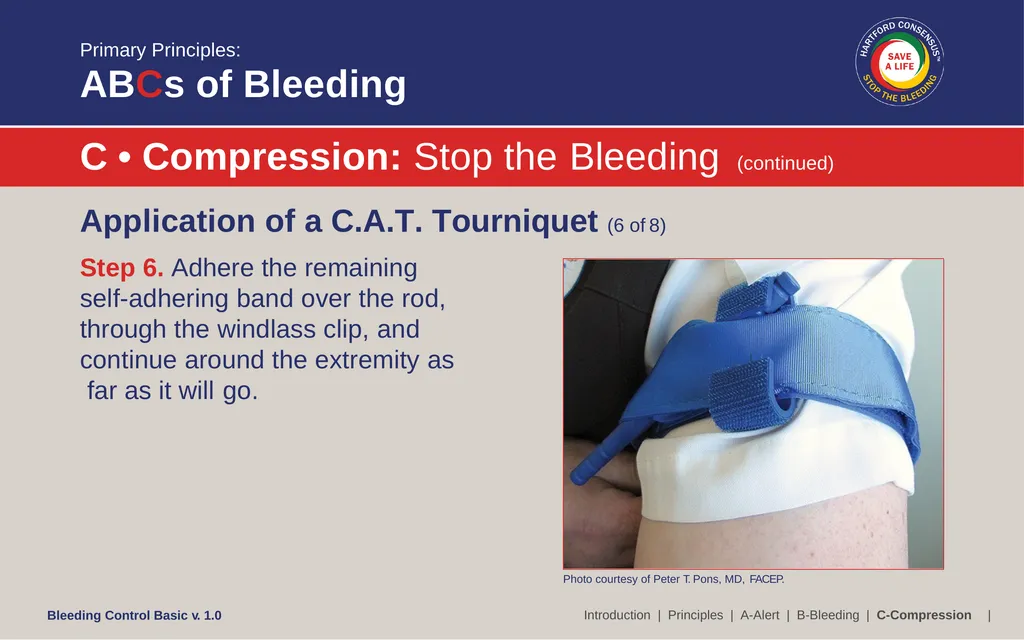
Primary Principles: ABCs of Bleeding C • Compression: Stop the Bleeding (continued) Application of a C.A.T. Tourniquet (6 of 8)
Step 6. Adhere the remaining self-adhering band over the rod, through the windlass clip, and continue around the extremity as far as it will go. Photo courtesy of Peter T. Pons, MD, FACEP. Introduction | Principles | A-Alert | B-Bleeding | C-Compression | Bleeding Control Basic v. 1.0<br>
Step 6. Adhere the remaining self-adhering band over the rod, through the windlass clip, and continue around the extremity as far as it will go. Photo courtesy of Peter T. Pons, MD, FACEP. Introduction | Principles | A-Alert | B-Bleeding | C-Compression | Bleeding Control Basic v. 1.0<br>
36
Primary Principles: ABCs of Bleeding C • Compression: Stop the Bleeding (continued) Application of a C.A.T. Tourniquet (7 of 8)
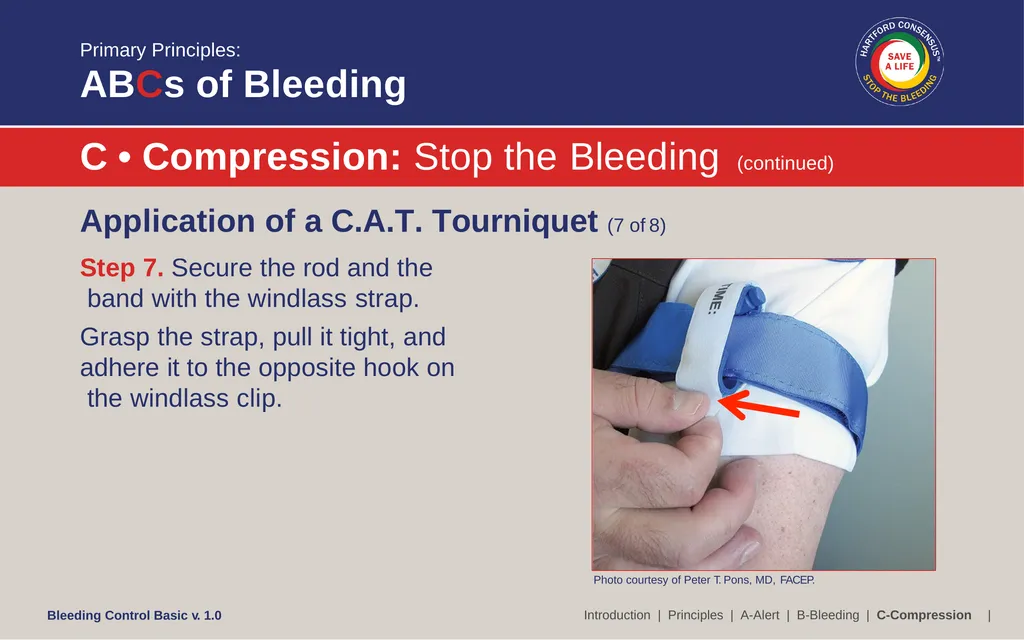
Step 7. Secure the rod and the band with the windlass strap.
Grasp the strap, pull it tight, and adhere it to the opposite hook on the windlass clip. Photo courtesy of Peter T. Pons, MD, FACEP. Introduction | Principles | A-Alert | B-Bleeding | C-Compression | Bleeding Control Basic v. 1.0<br>
Step 7. Secure the rod and the band with the windlass strap.
Grasp the strap, pull it tight, and adhere it to the opposite hook on the windlass clip. Photo courtesy of Peter T. Pons, MD, FACEP. Introduction | Principles | A-Alert | B-Bleeding | C-Compression | Bleeding Control Basic v. 1.0<br>
37
Primary Principles: ABCs of Bleeding C • Compression: Stop the Bleeding (continued) Application of a C.A.T. Tourniquet (8 of 8)
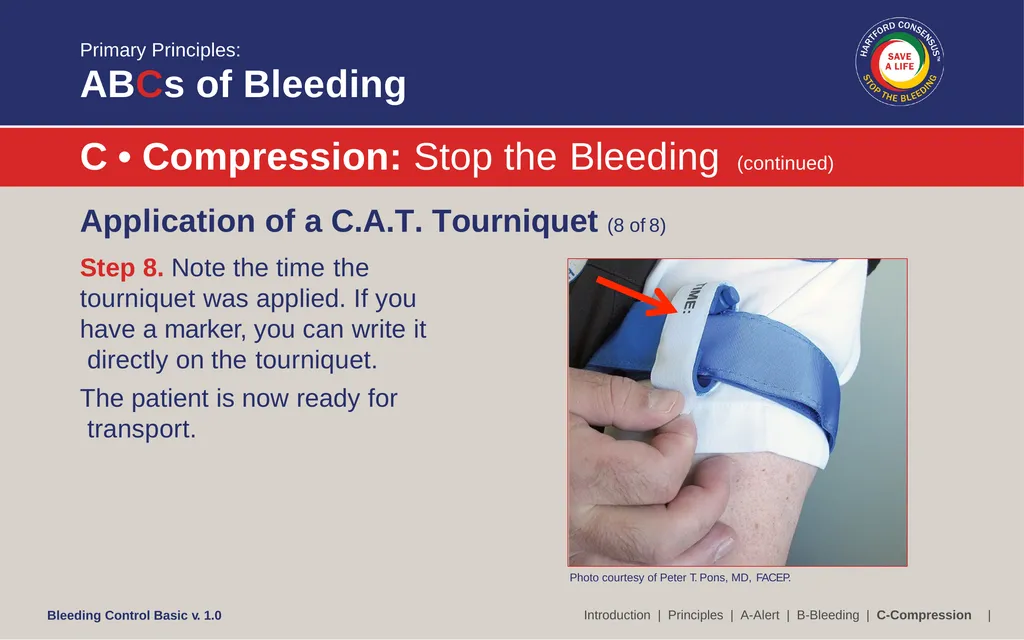
Step 8. Note the time the
tourniquet was applied. If you have a marker, you can write it directly on the tourniquet.
The patient is now ready for transport. Photo courtesy of Peter T. Pons, MD, FACEP. Introduction | Principles | A-Alert | B-Bleeding | C-Compression | Bleeding Control Basic v. 1.0<br>
Step 8. Note the time the
tourniquet was applied. If you have a marker, you can write it directly on the tourniquet.
The patient is now ready for transport. Photo courtesy of Peter T. Pons, MD, FACEP. Introduction | Principles | A-Alert | B-Bleeding | C-Compression | Bleeding Control Basic v. 1.0<br>
38
Primary Principles: ABCs of Bleeding C • Compression: Stop the Bleeding (continued) Key Points (1 of 2)
Using one of the recommended tourniquets is a safe procedure
- Improvised (homemade) tourniquets are much less effective than commercially available tourniquets such as the C.A.T. and are difficult to make and apply without extensive practice
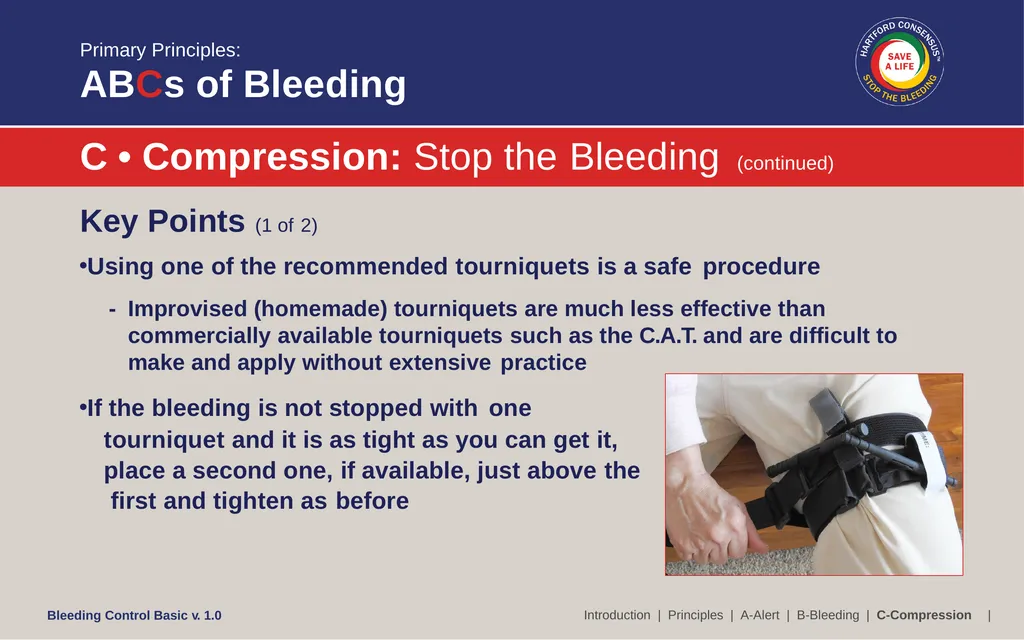
If the bleeding is not stopped with one
tourniquet and it is as tight as you can get it, place a second one, if available, just above the first and tighten as before Introduction | Principles | A-Alert | B-Bleeding | C-Compression | Bleeding Control Basic v. 1.0<br>
Using one of the recommended tourniquets is a safe procedure
- Improvised (homemade) tourniquets are much less effective than commercially available tourniquets such as the C.A.T. and are difficult to make and apply without extensive practice
If the bleeding is not stopped with one
tourniquet and it is as tight as you can get it, place a second one, if available, just above the first and tighten as before Introduction | Principles | A-Alert | B-Bleeding | C-Compression | Bleeding Control Basic v. 1.0<br>
39
Primary Principles: Introduction | Principles | A-Alert | B-Bleeding | C-Compression | Bleeding Control Basic v. 1.0 ABCs of Bleeding C • Compression: Stop the Bleeding (continued) Key Points (2 of 2)
No amputations have been caused by a tourniquet when left in place for fewer than two hours
BUT… it is best to get the patient to a trauma center as soon as possible so the bleeding can be completely controlled and the tourniquet removed
Better to risk damage to the arm or leg than to have a victim bleed to death
Training (practice) tourniquets should NOT be used during a real patient incident
Repetitive use during training exercises may cause the tourniquet to fail<br>
No amputations have been caused by a tourniquet when left in place for fewer than two hours
BUT… it is best to get the patient to a trauma center as soon as possible so the bleeding can be completely controlled and the tourniquet removed
Better to risk damage to the arm or leg than to have a victim bleed to death
Training (practice) tourniquets should NOT be used during a real patient incident
Repetitive use during training exercises may cause the tourniquet to fail<br>
40
Primary Principles: Introduction | Principles | A-Alert | B-Bleeding | C-Compression | Bleeding Control Basic v. 1.0 ABCs of Bleeding C • Compression: Stop the Bleeding (continued) Tourniquet Pain
Tourniquets HURT when applied effectively (they HURT A LOT)
- Explain this fact to the victim
Pain DOES NOT mean you put on the tourniquet incorrectly
Pain DOES NOT mean you should take the tourniquet off
Once paramedics arrive, they will treat the pain with medication<br>
Tourniquets HURT when applied effectively (they HURT A LOT)
- Explain this fact to the victim
Pain DOES NOT mean you put on the tourniquet incorrectly
Pain DOES NOT mean you should take the tourniquet off
Once paramedics arrive, they will treat the pain with medication<br>
41
Primary Principles: Introduction | Principles | A-Alert | B-Bleeding | C-Compression | Bleeding Control Basic v. 1.0 ABCs of Bleeding C • Compression: Stop the Bleeding (continued) Common Mistakes
Not using a tourniquet or waiting too long to apply it when there is life-threatening bleeding
Not making the tourniquet tight enough to stop the bleeding
Not using a second tourniquet, if needed
Periodically loosening the tourniquet to allow blood flow to the injured extremity
Causes unacceptable additional blood loss—DO NOT LOOSEN
Removing a tourniquet
Only a paramedic or physician should loosen or remove it<br>
Not using a tourniquet or waiting too long to apply it when there is life-threatening bleeding
Not making the tourniquet tight enough to stop the bleeding
Not using a second tourniquet, if needed
Periodically loosening the tourniquet to allow blood flow to the injured extremity
Causes unacceptable additional blood loss—DO NOT LOOSEN
Removing a tourniquet
Only a paramedic or physician should loosen or remove it<br>
42
Primary Principles: Introduction | Principles | A-Alert | B-Bleeding | C-Compression | Bleeding Control Basic v. 1.0 ABCs of Bleeding C • Compression: Stop the Bleeding (continued) Questions about
tourniquets?<br>
tourniquets?<br>
43
Primary Principles: Introduction | Principles | A-Alert | B-Bleeding | C-Compression | Bleeding Control Basic v. 1.0 ABCs of Bleeding C • Compression: Stop the Bleeding (continued) Tourniquet Practice<br>
44
Primary Principles: ABCs of Bleeding Ensure your safety. Look for life- threatening bleeding. Is a trauma first-aid kit available? Where is the wound? Arm or leg Is a tourniquet available immediately? Yes C • Compression: Stop the Bleeding (continued) ? Introduction | Principles | A-Alert | B-Bleeding | C-Compression | Bleeding Control Basic v. 1.0<br>
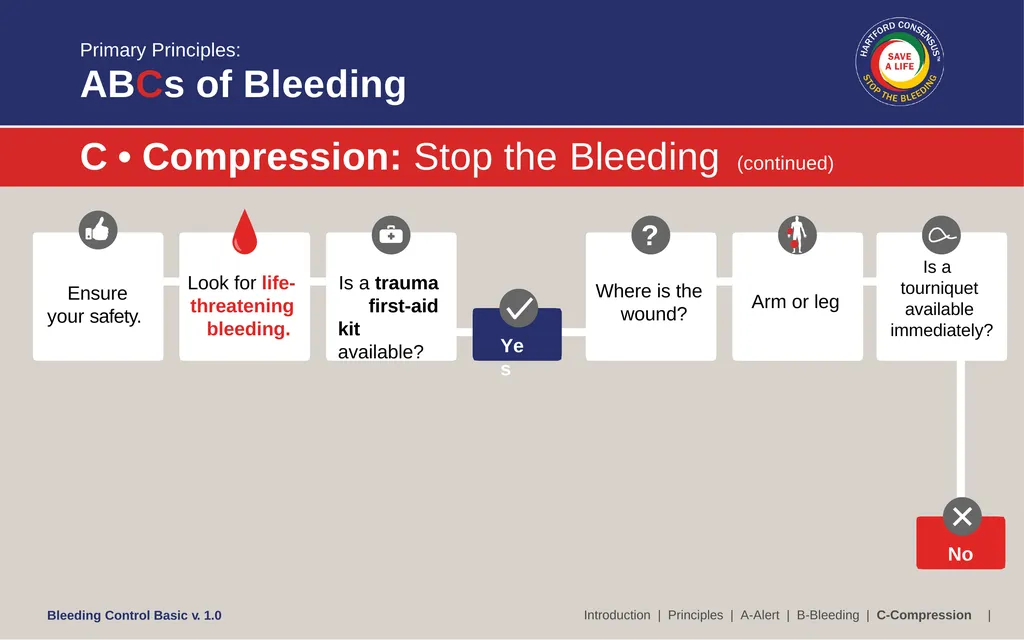
45
Primary Principles: ABCs of Bleeding No Ensure your safety. Look for life- threatening bleeding. Is a trauma first-aid kit available? Where is the wound? Arm or leg Is a tourniquet available immediately? Yes C • Compression: Stop the Bleeding (continued) ? Introduction | Principles | A-Alert | B-Bleeding | C-Compression | Bleeding Control Basic v. 1.0<br>
46
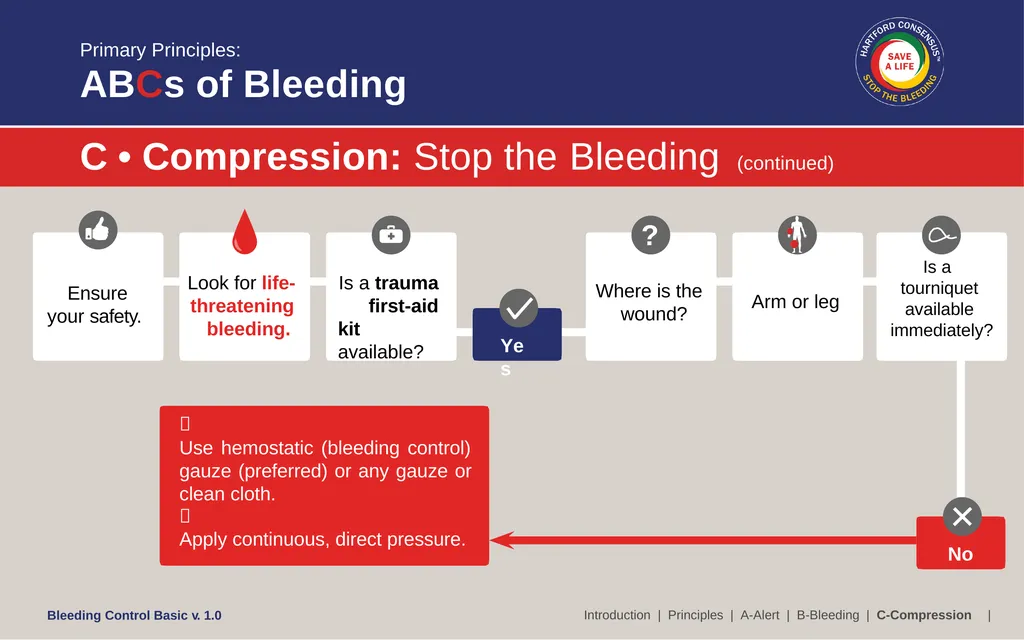
Primary Principles: ABCs of Bleeding
Use hemostatic (bleeding control) gauze (preferred) or any gauze or clean cloth.
Apply continuous, direct pressure. No Ensure your safety. Look for life- threatening bleeding. Is a trauma first-aid kit available? Where is the wound? Arm or leg Is a tourniquet available immediately? Yes C • Compression: Stop the Bleeding (continued) ? Introduction | Principles | A-Alert | B-Bleeding | C-Compression | Bleeding Control Basic v. 1.0<br>
Use hemostatic (bleeding control) gauze (preferred) or any gauze or clean cloth.
Apply continuous, direct pressure. No Ensure your safety. Look for life- threatening bleeding. Is a trauma first-aid kit available? Where is the wound? Arm or leg Is a tourniquet available immediately? Yes C • Compression: Stop the Bleeding (continued) ? Introduction | Principles | A-Alert | B-Bleeding | C-Compression | Bleeding Control Basic v. 1.0<br>
47
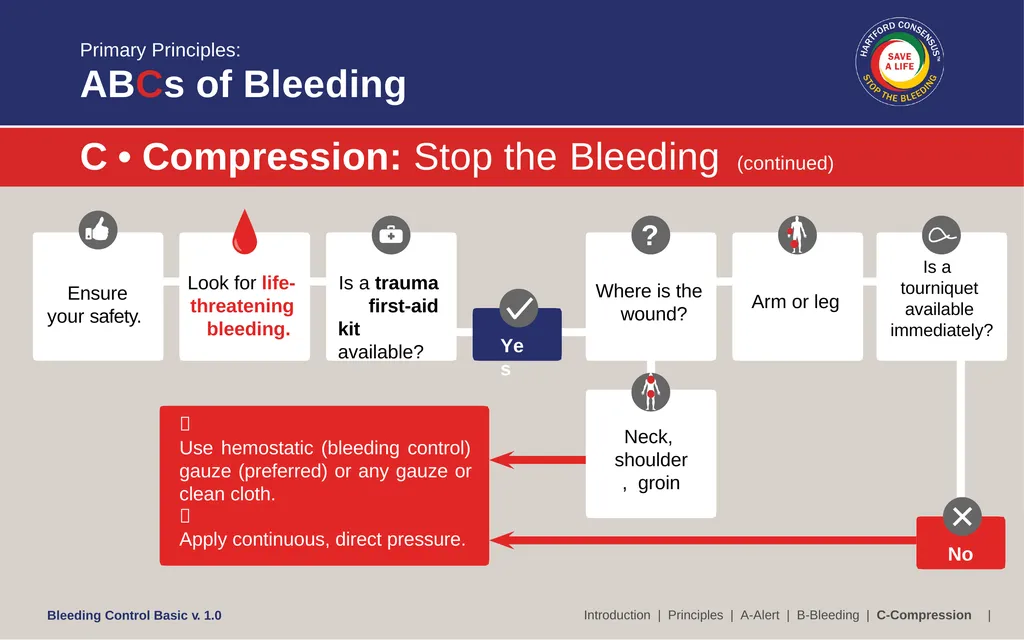
Primary Principles: ABCs of Bleeding
Use hemostatic (bleeding control) gauze (preferred) or any gauze or clean cloth.
Apply continuous, direct pressure. No Ensure your safety. Look for life- threatening bleeding. Is a trauma first-aid kit available? Where is the wound? Neck, shoulder, groin Arm or leg Is a tourniquet available immediately? Yes C • Compression: Stop the Bleeding (continued) ? Introduction | Principles | A-Alert | B-Bleeding | C-Compression | Bleeding Control Basic v. 1.0<br>
Use hemostatic (bleeding control) gauze (preferred) or any gauze or clean cloth.
Apply continuous, direct pressure. No Ensure your safety. Look for life- threatening bleeding. Is a trauma first-aid kit available? Where is the wound? Neck, shoulder, groin Arm or leg Is a tourniquet available immediately? Yes C • Compression: Stop the Bleeding (continued) ? Introduction | Principles | A-Alert | B-Bleeding | C-Compression | Bleeding Control Basic v. 1.0<br>
48
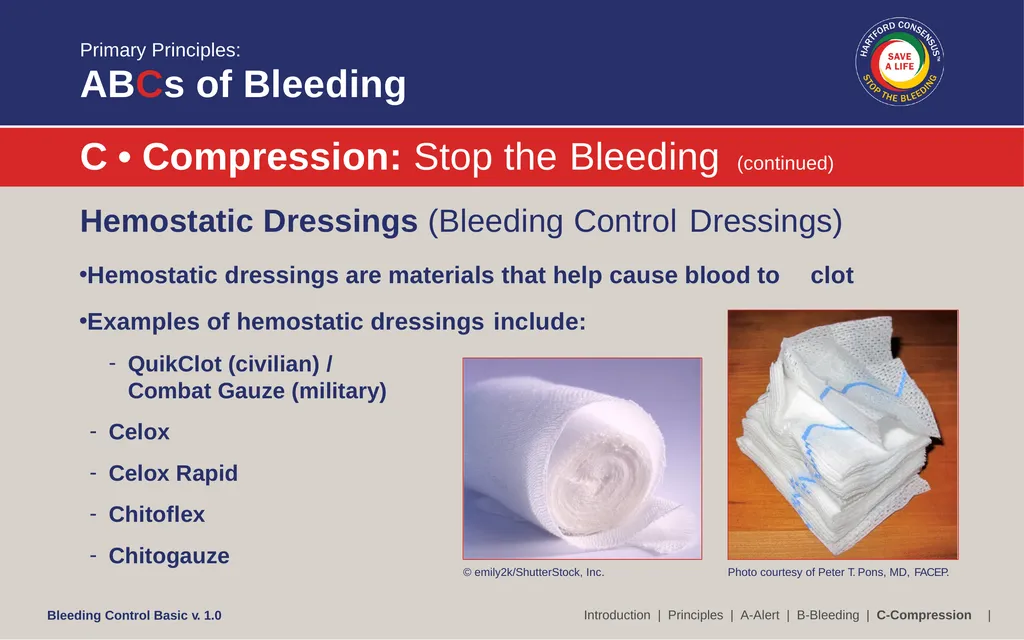
Primary Principles: ABCs of Bleeding C • Compression: Stop the Bleeding (continued) Hemostatic Dressings (Bleeding Control Dressings)
Hemostatic dressings are materials that help cause blood to clot
Examples of hemostatic dressings include:
QuikClot (civilian) / Combat Gauze (military)
Celox
Celox Rapid
Chitoflex
Chitogauze © emily2k/ShutterStock, Inc. Introduction | Principles | A-Alert | B-Bleeding | C-Compression | Bleeding Control Basic v. 1.0 Photo courtesy of Peter T. Pons, MD, FACEP.<br>
Hemostatic dressings are materials that help cause blood to clot
Examples of hemostatic dressings include:
QuikClot (civilian) / Combat Gauze (military)
Celox
Celox Rapid
Chitoflex
Chitogauze © emily2k/ShutterStock, Inc. Introduction | Principles | A-Alert | B-Bleeding | C-Compression | Bleeding Control Basic v. 1.0 Photo courtesy of Peter T. Pons, MD, FACEP.<br>
49
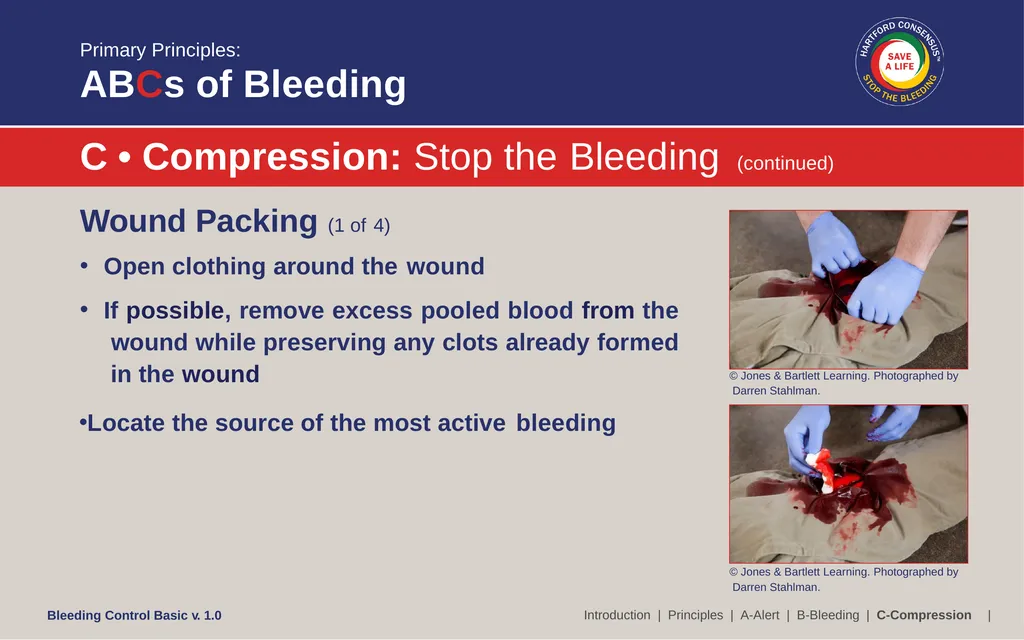
Primary Principles: ABCs of Bleeding C • Compression: Stop the Bleeding (continued) Wound Packing (1 of 4)
Open clothing around the wound
If possible, remove excess pooled blood from the wound while preserving any clots already formed in the wound
Locate the source of the most active bleeding © Jones & Bartlett Learning. Photographed by Darren Stahlman. Introduction | Principles | A-Alert | B-Bleeding | C-Compression | Bleeding Control Basic v. 1.0 © Jones & Bartlett Learning. Photographed by Darren Stahlman.<br>
Open clothing around the wound
If possible, remove excess pooled blood from the wound while preserving any clots already formed in the wound
Locate the source of the most active bleeding © Jones & Bartlett Learning. Photographed by Darren Stahlman. Introduction | Principles | A-Alert | B-Bleeding | C-Compression | Bleeding Control Basic v. 1.0 © Jones & Bartlett Learning. Photographed by Darren Stahlman.<br>
50
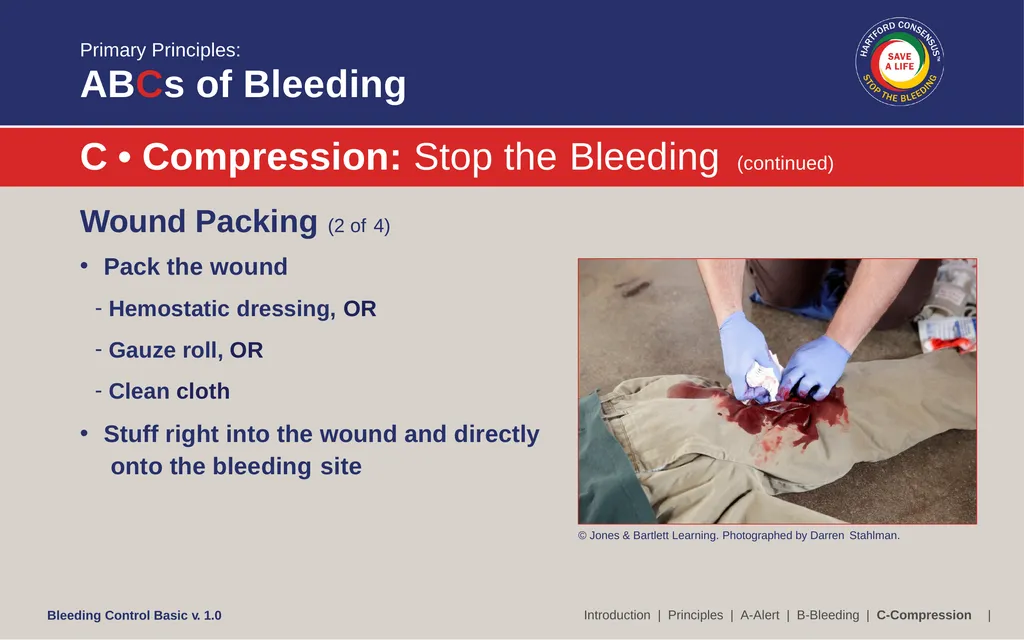
Primary Principles: ABCs of Bleeding C • Compression: Stop the Bleeding (continued) Wound Packing (2 of 4)
Pack the wound
Hemostatic dressing, OR
Gauze roll, OR
Clean cloth
Stuff right into the wound and directly onto the bleeding site © Jones & Bartlett Learning. Photographed by Darren Stahlman. Introduction | Principles | A-Alert | B-Bleeding | C-Compression | Bleeding Control Basic v. 1.0<br>
Pack the wound
Hemostatic dressing, OR
Gauze roll, OR
Clean cloth
Stuff right into the wound and directly onto the bleeding site © Jones & Bartlett Learning. Photographed by Darren Stahlman. Introduction | Principles | A-Alert | B-Bleeding | C-Compression | Bleeding Control Basic v. 1.0<br>
51
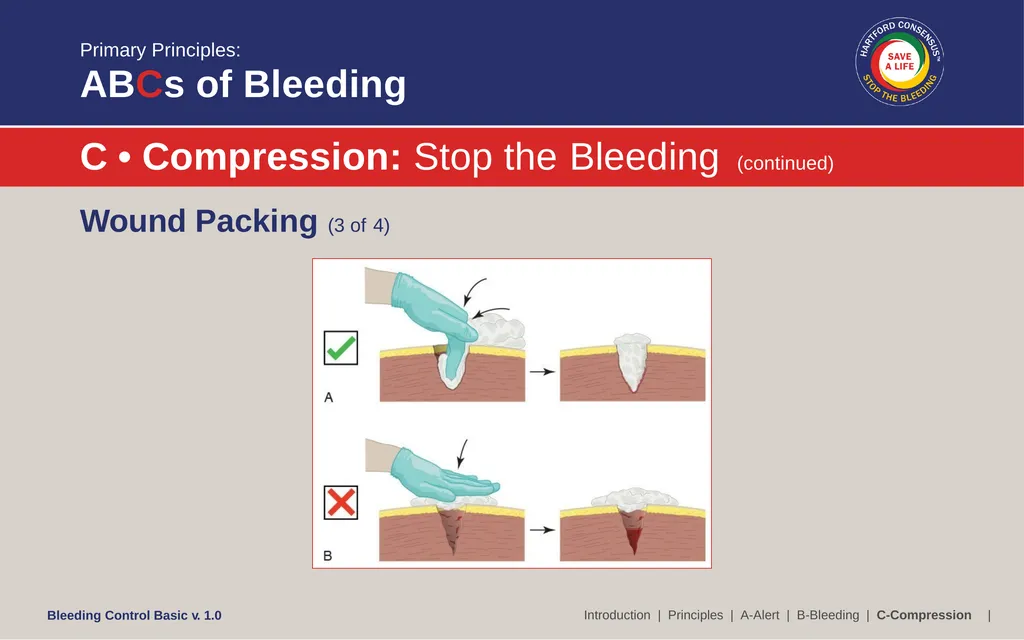
Primary Principles: ABCs of Bleeding C • Compression: Stop the Bleeding (continued) Wound Packing (3 of 4) Introduction | Principles | A-Alert | B-Bleeding | C-Compression | Bleeding Control Basic v. 1.0<br>
52
Primary Principles: ABCs of Bleeding C • Compression: Stop the Bleeding (continued) Wound Packing (4 of 4)
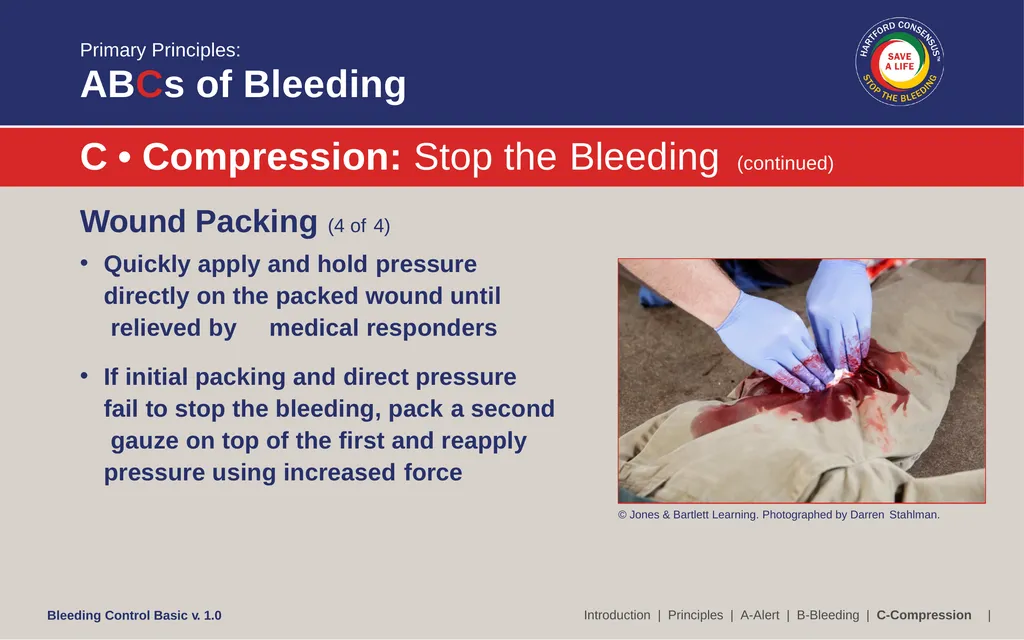
Quickly apply and hold pressure directly on the packed wound until relieved by medical responders
If initial packing and direct pressure fail to stop the bleeding, pack a second gauze on top of the first and reapply pressure using increased force © Jones & Bartlett Learning. Photographed by Darren Stahlman. Introduction | Principles | A-Alert | B-Bleeding | C-Compression | Bleeding Control Basic v. 1.0<br>
Quickly apply and hold pressure directly on the packed wound until relieved by medical responders
If initial packing and direct pressure fail to stop the bleeding, pack a second gauze on top of the first and reapply pressure using increased force © Jones & Bartlett Learning. Photographed by Darren Stahlman. Introduction | Principles | A-Alert | B-Bleeding | C-Compression | Bleeding Control Basic v. 1.0<br>
53
Primary Principles: Introduction | Principles | A-Alert | B-Bleeding | C-Compression | Bleeding Control Basic v. 1.0 ABCs of Bleeding C • Compression: Stop the Bleeding (continued) Questions about wound packing
and direct pressure?<br>
and direct pressure?<br>
54
Wound Packing Practice Introduction | Principles | A-Alert | B-Bleeding | C-Compression | Bleeding Control Basic v. 1.0 Primary Principles: ABCs of Bleeding C • Compression: Stop the Bleeding (continued)<br>
55
Bleeding control in children Bleeding Control Basic v. 1.0 In all but the extremely young child, the same
tourniquet used for adults can be used in children.
For the infant or very small child (tourniquet too big), direct pressure on the wound as described previously will work in virtually all cases.
For large, deep wounds, wound packing can be performed in children just as in adults using the same technique as described previously.<br>
tourniquet used for adults can be used in children.
For the infant or very small child (tourniquet too big), direct pressure on the wound as described previously will work in virtually all cases.
For large, deep wounds, wound packing can be performed in children just as in adults using the same technique as described previously.<br>
56
Blood Exposure Bleeding Control Basic v. 1.0 After arrival of medical responders, if you have any blood on you:
Wash thoroughly with soap and water to remove all blood, AND
Notify medical responders of possible exposure<br>
Wash thoroughly with soap and water to remove all blood, AND
Notify medical responders of possible exposure<br>
57
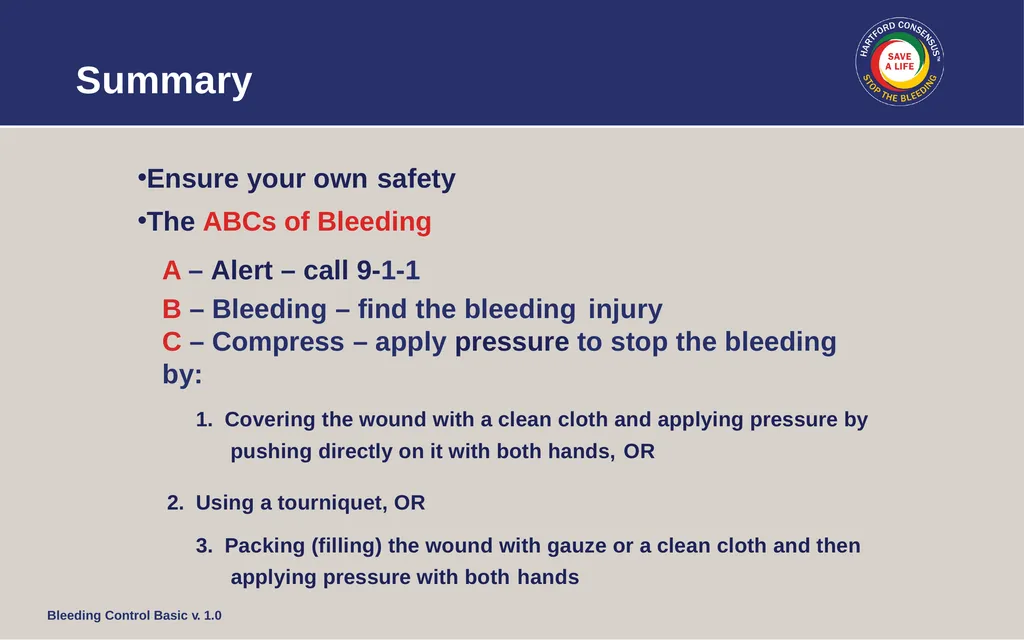
Summary Bleeding Control Basic v. 1.0 Ensure your own safety
The ABCs of Bleeding
A – Alert – call 9-1-1
B – Bleeding – find the bleeding injury
C – Compress – apply pressure to stop the bleeding by:
Covering the wound with a clean cloth and applying pressure by pushing directly on it with both hands, OR
Using a tourniquet, OR
Packing (filling) the wound with gauze or a clean cloth and then applying pressure with both hands<br>
The ABCs of Bleeding
A – Alert – call 9-1-1
B – Bleeding – find the bleeding injury
C – Compress – apply pressure to stop the bleeding by:
Covering the wound with a clean cloth and applying pressure by pushing directly on it with both hands, OR
Using a tourniquet, OR
Packing (filling) the wound with gauze or a clean cloth and then applying pressure with both hands<br>
58
Conclusion Bleeding Control Basic v. 1.0 The only thing more tragic than a death… is a death that could have been prevented. Thank you for your participation.
Questions?<br>
Questions?<br>
59
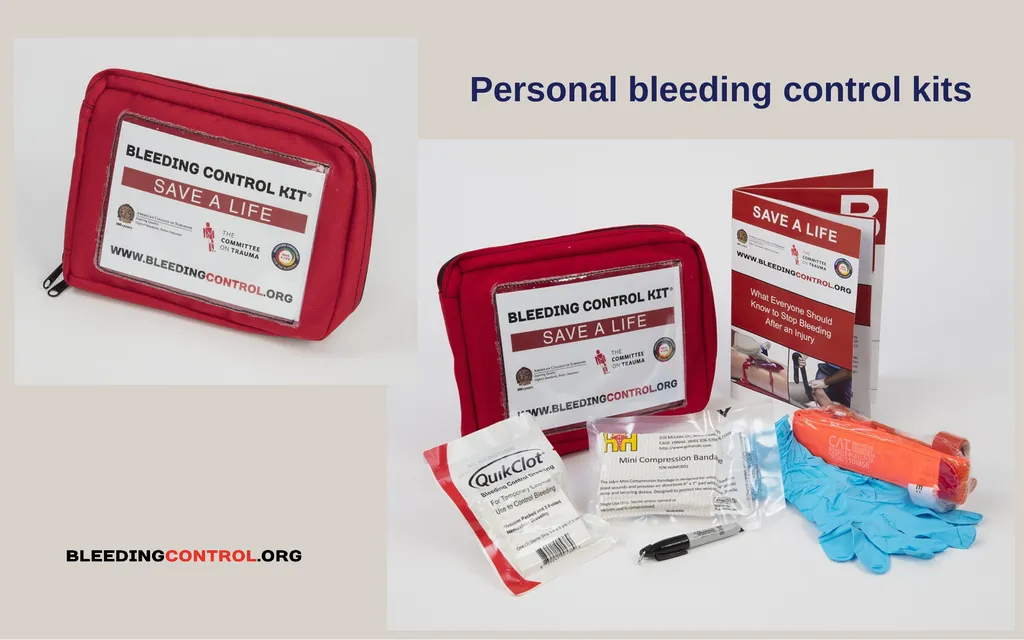
Personal bleeding control kits<br>
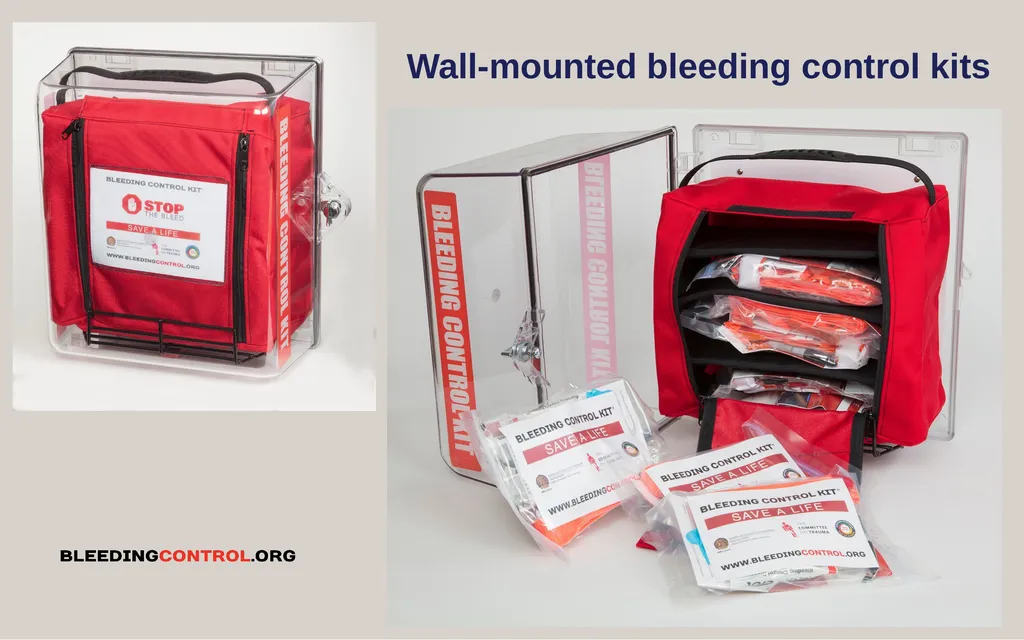
60
Wall-mounted bleeding control kits<br>
61
BLEEDINGCONTROL.ORG For further information and additional resources, please visit<br>