
Blessing by Imtiaz Dharker How does Dharker incite




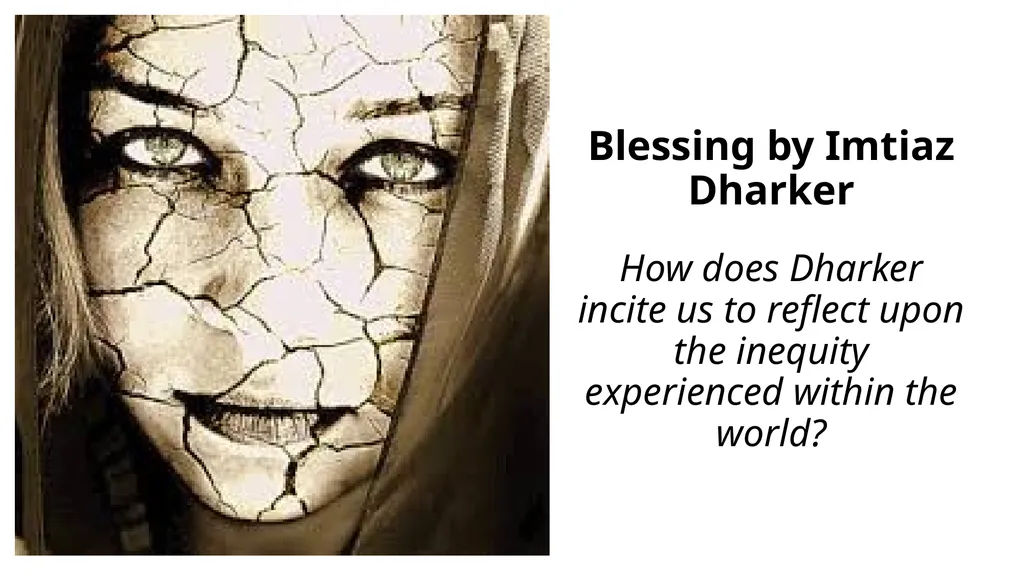
Description: Blessing by Imtiaz Dharker How does Dharker incite us to reflect upon the inequity experienced within the world? Imtiaz Dharker. Imtiaz Dharker was born in Lahore, Pakistan, to Pakistani parents. When she was less than a year old, her
Related Topics
Download Presentation
"Blessing by Imtiaz Dharker How does Dharker incite" is the property of its rightful owner. Permission is granted to download and print the materials on this website for personal, non-commercial use only, and to display it on your personal computer provided you do not modify the materials and that you retain all copyright notices contained in the materials. By downloading content from our website, you accept the terms of this agreement.
Presentation Transcript
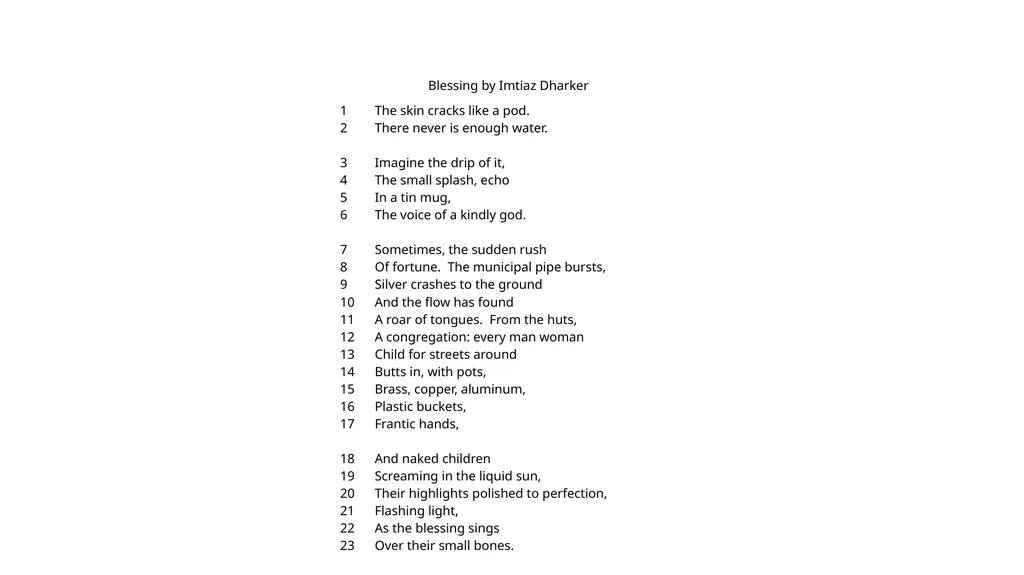
slide1. Blessing by Imtiaz Dharker
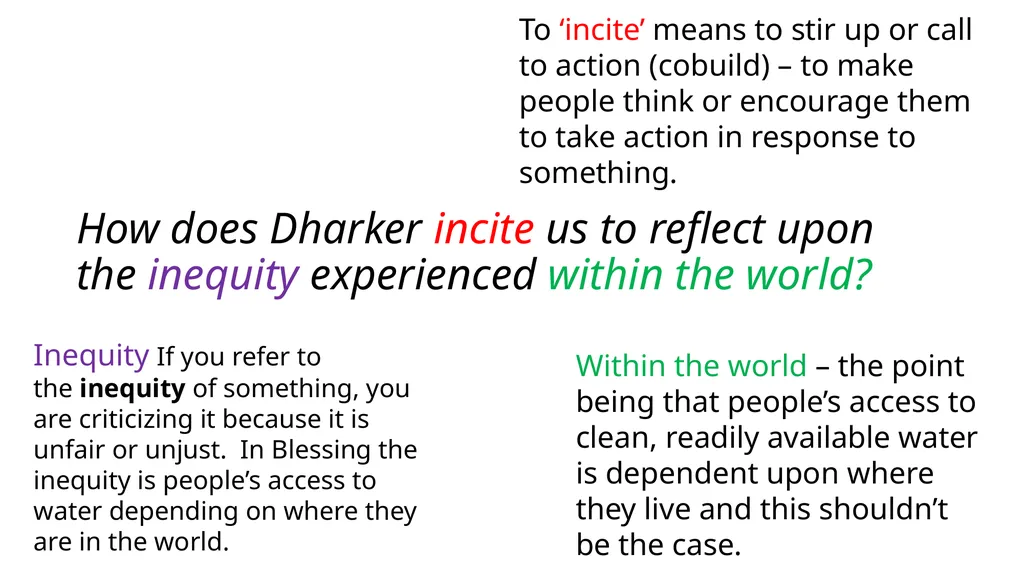
How does Dharker incite us to reflect upon the inequity experienced within the world?<br>
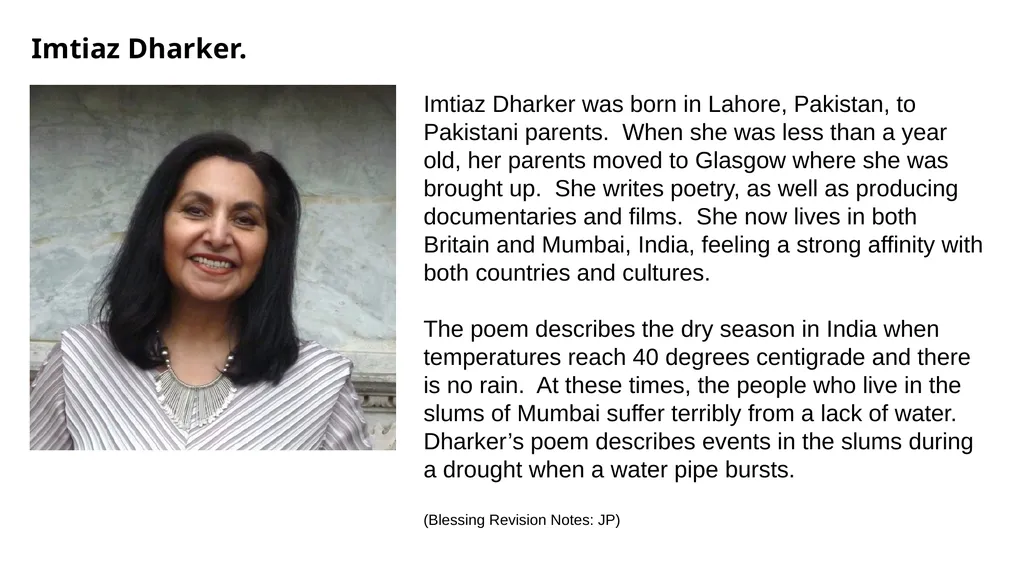
slide2. Imtiaz Dharker. Imtiaz Dharker was born in Lahore, Pakistan, to Pakistani parents. When she was less than a year old, her parents moved to Glasgow where she was brought up. She writes poetry, as well as producing documentaries and films. She now lives in both Britain and Mumbai, India, feeling a strong affinity with both countries and cultures.
The poem describes the dry season in India when temperatures reach 40 degrees centigrade and there is no rain. At these times, the people who live in the slums of Mumbai suffer terribly from a lack of water. Dharker’s poem describes events in the slums during a drought when a water pipe bursts.
(Blessing Revision Notes: JP)<br>
slide4. How does Dharker incite us to reflect upon the inequity experienced within the world? To ‘incite’ means to stir up or call to action (cobuild) – to make people think or encourage them to take action in response to something. Within the world – the point being that people’s access to clean, readily available water is dependent upon where they live and this shouldn’t be the case. Inequity If you refer to the inequity of something, you are criticizing it because it is unfair or unjust. In Blessing the inequity is people’s access to water depending on where they are in the world.<br>
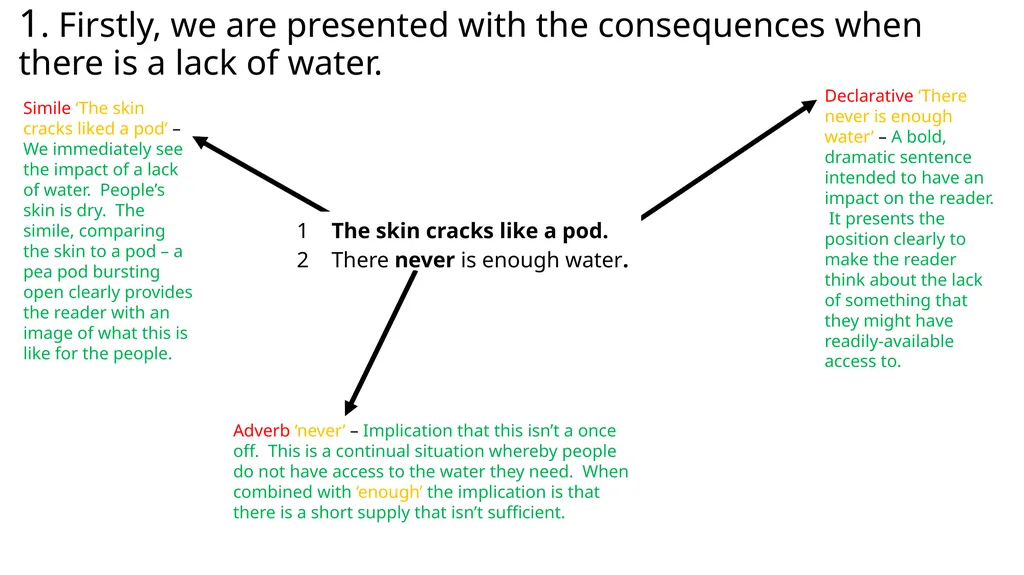
slide5. 1. Firstly, we are presented with the consequences when there is a lack of water. Simile ‘The skin cracks liked a pod’ – We immediately see the impact of a lack of water. People’s skin is dry. The simile, comparing the skin to a pod – a pea pod bursting open clearly provides the reader with an image of what this is like for the people. Adverb ‘never’ – Implication that this isn’t a once off. This is a continual situation whereby people do not have access to the water they need. When combined with ‘enough’ the implication is that there is a short supply that isn’t sufficient. Declarative ‘There never is enough water’ – A bold, dramatic sentence intended to have an impact on the reader. It presents the position clearly to make the reader think about the lack of something that they might have readily-available access to.<br>
slide6. 2. Dharker appeals to the readers directly. Imperative ‘Imagine…’ – Dharker is positioning the reader and wants them to develop their understanding / empathy to consider what it might be like to live without water. Enjambment ‘echo/in a tin mug’ – The enjambment is beautiful – echo is left hanging until the next line to reinforce the distance between a noise being made and the echo being heard. Again, this reinforces the scarcity of water but also the desperate longing, even for a drip of it. Noun phrase ‘The small splash’ – When combined with the noun ‘drip’ the scarcity of water is really being emphasized. The sibilance of ‘small splash’ also draws out the pace of the words to slow it down which evokes a sense of longing. Noun phrase ‘tin mug’ – Potentially reinforces the poverty of the people Metaphor ‘the voice of a kindly god’ – The water dripping being compared to the sounds being made by a god. The adjective ‘kindly’ suggesting that the god is looking down favorably to provide the people with some water. Intimation towards the start of a blessing with religious undertones.<br>
slide7. 3. Dharker reinforces the importance of water to the community. Noun phrase ‘sudden rush’– opportune moments where the water becomes free-flowing. Metaphor ‘a roar of tongues– The community’s noisy reaction to the event – their excitement by water, their desperation to get water, their calling out to each other to get water Clause ‘The municipal pipe bursts’ – accidental not normal – so it is a blessing rather than a provision Listing, lack of punctuation ‘every man woman / child’ – Lack of punctuation implies the desperate rush of everyone to get some of the water. Verb phrase: ‘butts in’ suggests everyone is pushing against each other to get their share. Listing ‘pots, brass, copper, aluminum, plastic buckets, frantic hands’ – people are grabbing anything they can get their hands on to collect water. Quality of what they grab declines as list continues suggesting anything will do and they become more desperate just to capture any water they can by any means how. Metaphor ‘fortune’ ‘silver’– water being described as fortune and silver because it is as precious to them Onomatopoeia ‘crashes’– sounds of water free-flowing – dramatic verbs to emphasise the dramatic nature of the situation Religious imagery ‘a congregation’– the community Colon ‘:’– the community has been described as a congregation prior to colon. Post-colon, listing who the congregation comprises of<br>
slide8. 3. Dharker reinforces the importance of water to the community but also offers a stark warning that they cannot rely on ‘blessings’ Verb ‘screaming’– joy that the water brings Metaphor ‘liquid sun’ – to describe the water – the sun provides nutrition and nourishment which is exactly what the water is doing for the people within this community. Noun phrase ‘small bones’ – the joy associated with the singing is then contrasted immediately with the imagery of the children’s small bones – a result of the lack of nourishment they have been receiving. This image being placed as the final words of the poem ensures the poem ends in a dramatic way to reach out to the reader and to make them consider how the community can’t rely on blessings, they need regular access to water to ensure they maintain their health. Religious imagery ‘blessing’– this is a blessing rather than a normative experience Verb phrase ‘polished to perfection’– that the nutrition from the water is restoring the children to their former healthy state. When you polish something you restore its appearance and this is what is happening here as the children get the water on them. Personification ‘sings’– it is a joyous moment – a moment to celebrate<br>
slide9. Blessing by Imtiaz Dharker
How does Dharker incite us to reflect upon the inequity experienced within the world?<br>
How does Dharker incite us to reflect upon the inequity experienced within the world?<br>
slide2. Imtiaz Dharker. Imtiaz Dharker was born in Lahore, Pakistan, to Pakistani parents. When she was less than a year old, her parents moved to Glasgow where she was brought up. She writes poetry, as well as producing documentaries and films. She now lives in both Britain and Mumbai, India, feeling a strong affinity with both countries and cultures.
The poem describes the dry season in India when temperatures reach 40 degrees centigrade and there is no rain. At these times, the people who live in the slums of Mumbai suffer terribly from a lack of water. Dharker’s poem describes events in the slums during a drought when a water pipe bursts.
(Blessing Revision Notes: JP)<br>
slide4. How does Dharker incite us to reflect upon the inequity experienced within the world? To ‘incite’ means to stir up or call to action (cobuild) – to make people think or encourage them to take action in response to something. Within the world – the point being that people’s access to clean, readily available water is dependent upon where they live and this shouldn’t be the case. Inequity If you refer to the inequity of something, you are criticizing it because it is unfair or unjust. In Blessing the inequity is people’s access to water depending on where they are in the world.<br>
slide5. 1. Firstly, we are presented with the consequences when there is a lack of water. Simile ‘The skin cracks liked a pod’ – We immediately see the impact of a lack of water. People’s skin is dry. The simile, comparing the skin to a pod – a pea pod bursting open clearly provides the reader with an image of what this is like for the people. Adverb ‘never’ – Implication that this isn’t a once off. This is a continual situation whereby people do not have access to the water they need. When combined with ‘enough’ the implication is that there is a short supply that isn’t sufficient. Declarative ‘There never is enough water’ – A bold, dramatic sentence intended to have an impact on the reader. It presents the position clearly to make the reader think about the lack of something that they might have readily-available access to.<br>
slide6. 2. Dharker appeals to the readers directly. Imperative ‘Imagine…’ – Dharker is positioning the reader and wants them to develop their understanding / empathy to consider what it might be like to live without water. Enjambment ‘echo/in a tin mug’ – The enjambment is beautiful – echo is left hanging until the next line to reinforce the distance between a noise being made and the echo being heard. Again, this reinforces the scarcity of water but also the desperate longing, even for a drip of it. Noun phrase ‘The small splash’ – When combined with the noun ‘drip’ the scarcity of water is really being emphasized. The sibilance of ‘small splash’ also draws out the pace of the words to slow it down which evokes a sense of longing. Noun phrase ‘tin mug’ – Potentially reinforces the poverty of the people Metaphor ‘the voice of a kindly god’ – The water dripping being compared to the sounds being made by a god. The adjective ‘kindly’ suggesting that the god is looking down favorably to provide the people with some water. Intimation towards the start of a blessing with religious undertones.<br>
slide7. 3. Dharker reinforces the importance of water to the community. Noun phrase ‘sudden rush’– opportune moments where the water becomes free-flowing. Metaphor ‘a roar of tongues– The community’s noisy reaction to the event – their excitement by water, their desperation to get water, their calling out to each other to get water Clause ‘The municipal pipe bursts’ – accidental not normal – so it is a blessing rather than a provision Listing, lack of punctuation ‘every man woman / child’ – Lack of punctuation implies the desperate rush of everyone to get some of the water. Verb phrase: ‘butts in’ suggests everyone is pushing against each other to get their share. Listing ‘pots, brass, copper, aluminum, plastic buckets, frantic hands’ – people are grabbing anything they can get their hands on to collect water. Quality of what they grab declines as list continues suggesting anything will do and they become more desperate just to capture any water they can by any means how. Metaphor ‘fortune’ ‘silver’– water being described as fortune and silver because it is as precious to them Onomatopoeia ‘crashes’– sounds of water free-flowing – dramatic verbs to emphasise the dramatic nature of the situation Religious imagery ‘a congregation’– the community Colon ‘:’– the community has been described as a congregation prior to colon. Post-colon, listing who the congregation comprises of<br>
slide8. 3. Dharker reinforces the importance of water to the community but also offers a stark warning that they cannot rely on ‘blessings’ Verb ‘screaming’– joy that the water brings Metaphor ‘liquid sun’ – to describe the water – the sun provides nutrition and nourishment which is exactly what the water is doing for the people within this community. Noun phrase ‘small bones’ – the joy associated with the singing is then contrasted immediately with the imagery of the children’s small bones – a result of the lack of nourishment they have been receiving. This image being placed as the final words of the poem ensures the poem ends in a dramatic way to reach out to the reader and to make them consider how the community can’t rely on blessings, they need regular access to water to ensure they maintain their health. Religious imagery ‘blessing’– this is a blessing rather than a normative experience Verb phrase ‘polished to perfection’– that the nutrition from the water is restoring the children to their former healthy state. When you polish something you restore its appearance and this is what is happening here as the children get the water on them. Personification ‘sings’– it is a joyous moment – a moment to celebrate<br>
slide9. Blessing by Imtiaz Dharker
How does Dharker incite us to reflect upon the inequity experienced within the world?<br>