
BLISS Project Output O3 Open Education Resource


Description: BLISS Project Output O3 Open Education Resource Task O3-T1 Training and assessment material 50 Introduces how the characteristics of blockchain technology can disrupt andor innovate existing business models and business processes. Examines
Related Topics
Download Presentation
"BLISS Project Output O3 Open Education Resource" is the property of its rightful owner. Permission is granted to download and print the materials on this website for personal, non-commercial use only, and to display it on your personal computer provided you do not modify the materials and that you retain all copyright notices contained in the materials. By downloading content from our website, you accept the terms of this agreement.
Presentation Transcript
slide2. BLISS Project
Output O3 Open Education Resource
Task O3-T1 Training and assessment material 50 Introduces how the characteristics of blockchain technology can disrupt and/or innovate existing business models and business processes. Examines existing blockchain-based use cases in industries such as finance, public services, provenance, supply chains etc. U3 Communicating the business merits, challenges and implications of blockchain technology Learning unit : Abstract : Hours :<br>
slide3. Learning outcomes Policy and regulation
Blockchain and Public Policy, Central Banks & governmental regulations
Implications of blockchains for governments, policy makers, law professionals, regulators and society Recognise potential regulatory and legal frameworks for blockchain operation, including consumer protection, and taxation Knowledge Skills Learning unit U3 Communicating the business merits, challenges and implications of blockchain technology Interpret the legal, regulatory and consumer challenges to wider blockchain adoption and conformance K5<br>
slide4. Learning outcomes Blockchain as innovator of businesses and processes
Blockchain business models
Blockchain emerging trends susceptible to create value for the business
Innovative blockchain solutions and entrepreneurship
Blockchain transforming business and professionalism Provide detailed examples of the blockchain transforming power in specific contexts Knowledge Skills Learning unit U3 Communicating the business merits, challenges and implications of blockchain technology Monitor the intervention of blockchain technology in business models K6<br>
slide5. Learning outcomes Blockchain maturity and strategies
Blockchain adoption metrics, challenges and opportunities
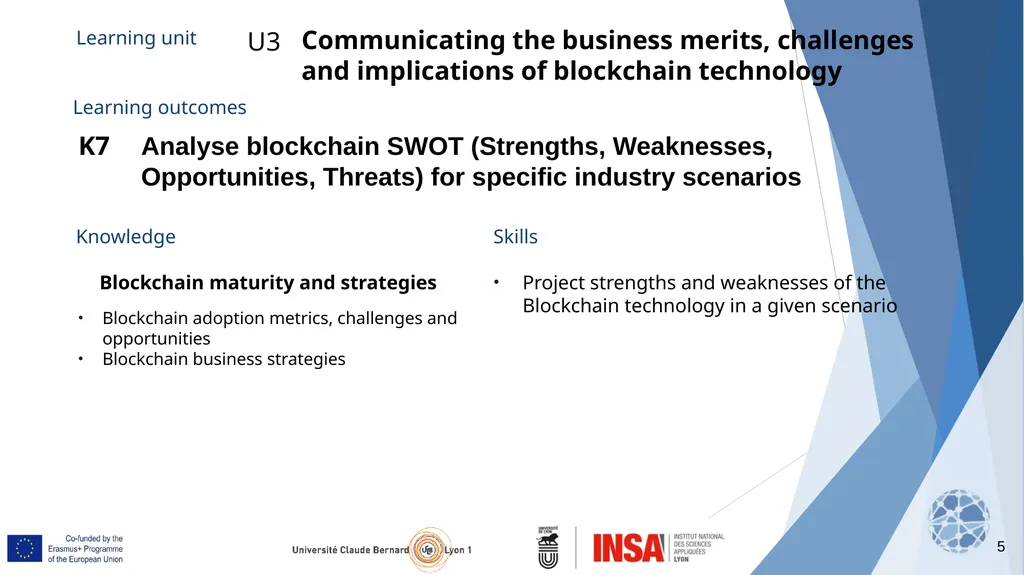
Blockchain business strategies Project strengths and weaknesses of the Blockchain technology in a given scenario Knowledge Skills Learning unit U3 Communicating the business merits, challenges and implications of blockchain technology Analyse blockchain SWOT (Strengths, Weaknesses, Opportunities, Threats) for specific industry scenarios K7<br>
slide6. Learning outcomes Blockchain as business model disruption
Implications of blockchains for corporates, such as disruption by open markets, winner-takes-all, multi-sided market platforms, the role of trust in blockchain markets
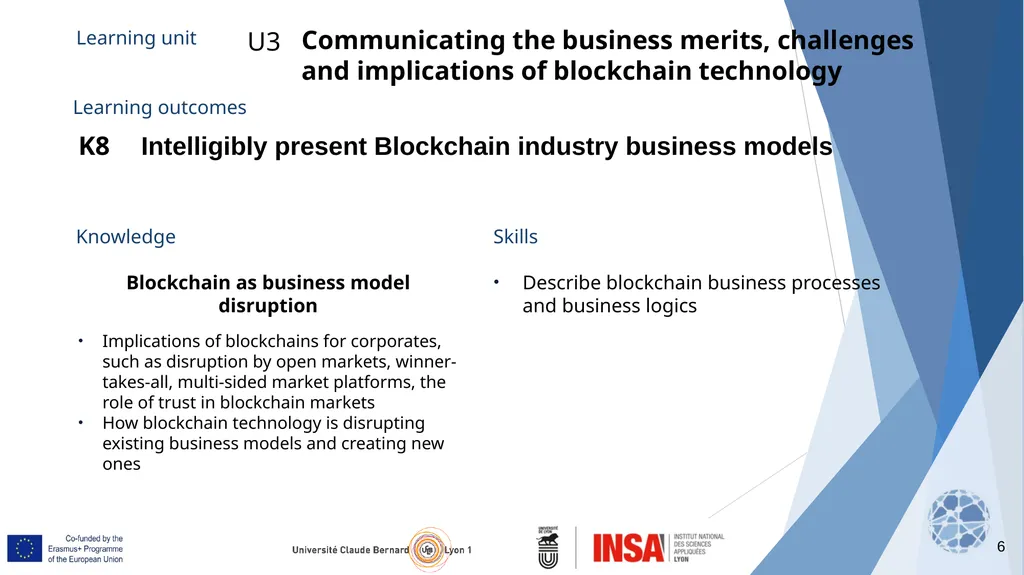
How blockchain technology is disrupting existing business models and creating new ones Describe blockchain business processes and business logics Knowledge Skills Learning unit U3 Communicating the business merits, challenges and implications of blockchain technology Intelligibly present Blockchain industry business models K8<br>
slide7. Learning outcomes Existing applications
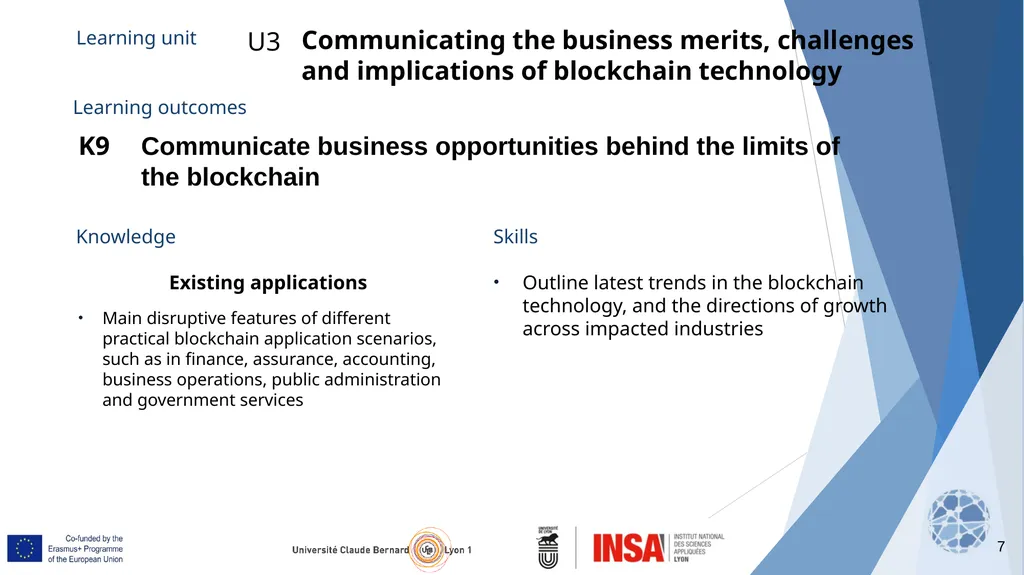
Main disruptive features of different practical blockchain application scenarios, such as in finance, assurance, accounting, business operations, public administration and government services Outline latest trends in the blockchain technology, and the directions of growth across impacted industries Knowledge Skills Learning unit U3 Communicating the business merits, challenges and implications of blockchain technology Communicate business opportunities behind the limits of the blockchain K9<br>
slide8. U3 : Communicating the business merits, challenges and implications of blockchain technology Frédérique Biennier INSA of Lyon, France<br>
slide9. Table of Contents Part 1: Promoting Blockchain usage
From traditional economy to digital economy
Blockchain context
New business models or new technologies for existing business models?
Exercises
Part 2: Value models
Traditional value models
Characterizing a blockchain value system
Building the Blockchain value model
Integration of blockchain value models in digital economy collaborative business
Exercises<br>
slide10. Table of Contents: PART 1 From traditional economy to digital economy
Blockchain context
New business models or new technologies for existing business models?
Exercises<br>
slide11. According to you, how can you qualify the digital economy? Are there any models qualifying the business environment?
What are the main collaborative ecosystems models?
Which requirements can be fulfilled using a blockchain?<br>
slide12. According to you, how can you qualify the digital economy? In this part you will
Learn basic elements on digital economy and collaborative ecosystems
Learn how IT and blockchain technologies have evolved to fit the economic context
Get information on collaborative ecosystem requirements and how blockchain technology can be an answer<br>
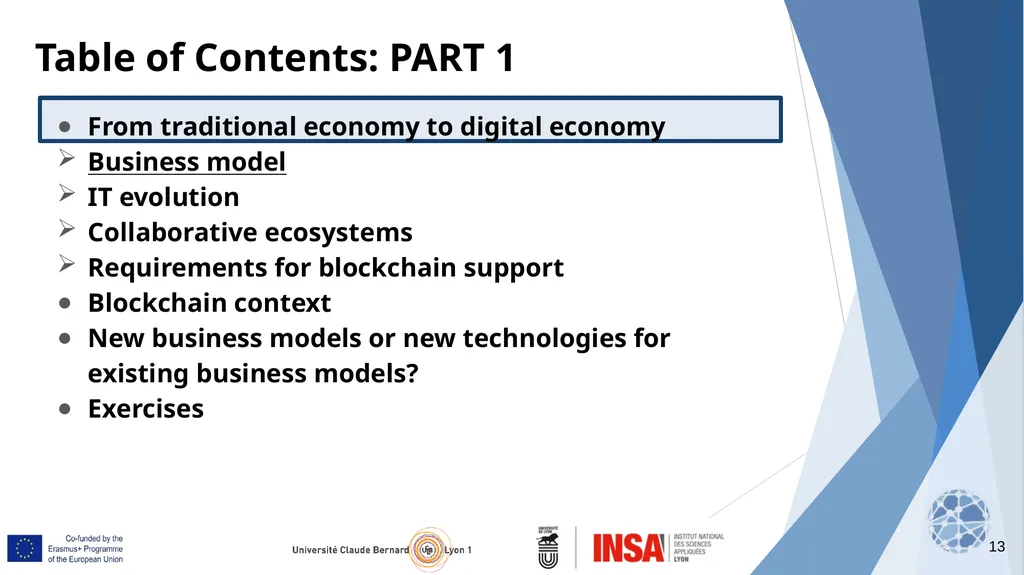
slide13. Table of Contents: PART 1 From traditional economy to digital economy
Business model
IT evolution
Collaborative ecosystems
Requirements for blockchain support
Blockchain context
New business models or new technologies for existing business models?
Exercises<br>
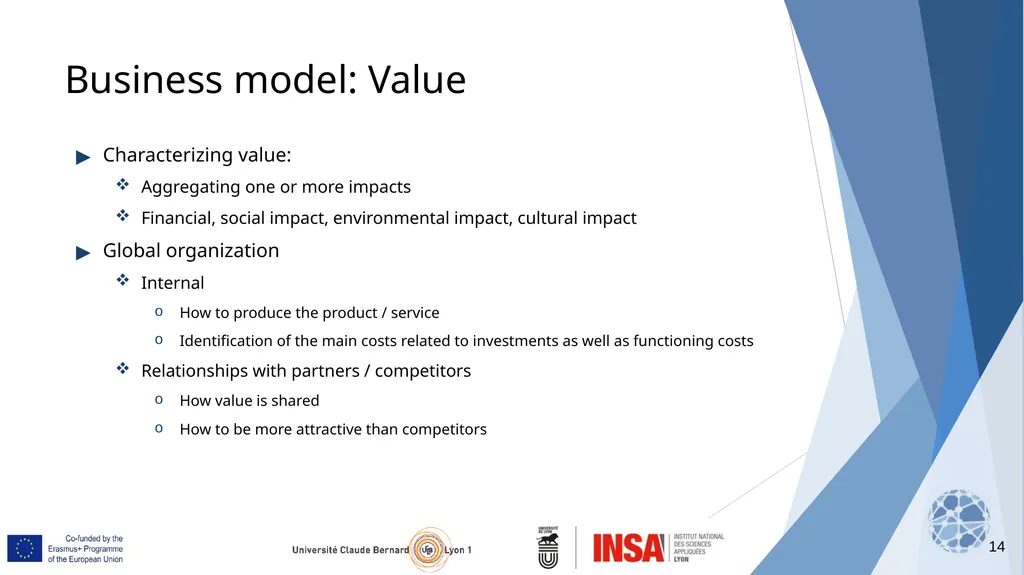
slide14. Business model: Value Characterizing value:
Aggregating one or more impacts
Financial, social impact, environmental impact, cultural impact
Global organization
Internal
How to produce the product / service
Identification of the main costs related to investments as well as functioning costs
Relationships with partners / competitors
How value is shared
How to be more attractive than competitors<br>
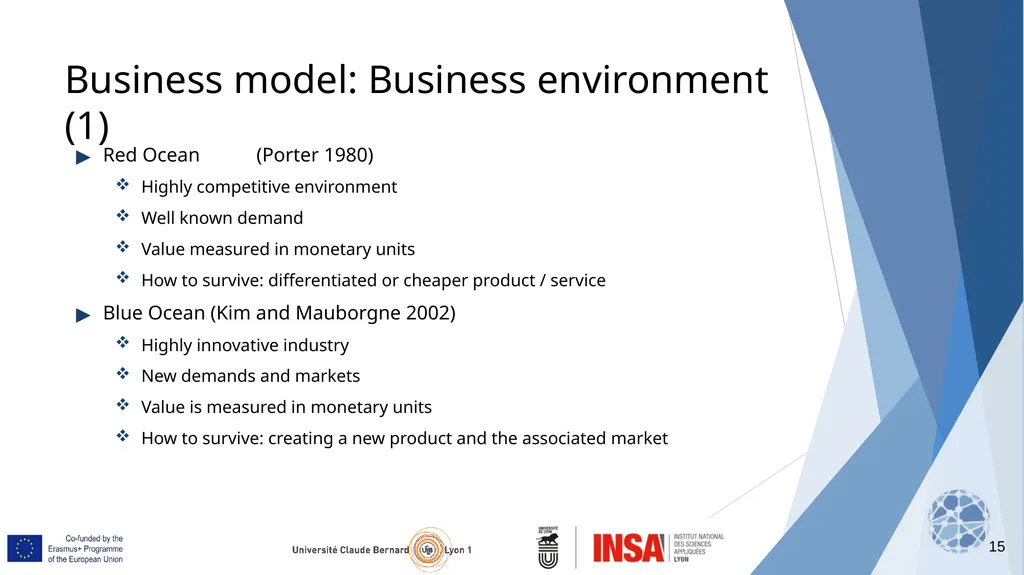
slide15. Business model: Business environment (1) Red Ocean (Porter 1980)
Highly competitive environment
Well known demand
Value measured in monetary units
How to survive: differentiated or cheaper product / service
Blue Ocean (Kim and Mauborgne 2002)
Highly innovative industry
New demands and markets
Value is measured in monetary units
How to survive: creating a new product and the associated market 15<br>
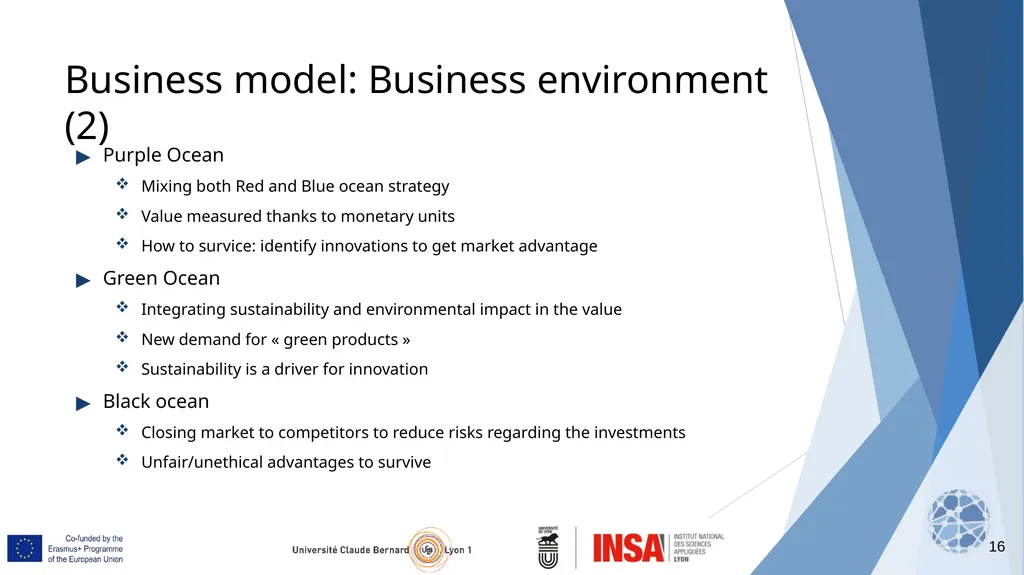
slide16. Business model: Business environment (2) Purple Ocean
Mixing both Red and Blue ocean strategy
Value measured thanks to monetary units
How to survice: identify innovations to get market advantage
Green Ocean
Integrating sustainability and environmental impact in the value
New demand for « green products »
Sustainability is a driver for innovation
Black ocean
Closing market to competitors to reduce risks regarding the investments
Unfair/unethical advantages to survive 16<br>
slide17. Business model: Blockchain market Disruptive technology
New demand for distributed trust management
Distributed and opened applications
Core mining function
Highly competitive market
Red Ocean strategy
Blockchain based development
Mixing both innovation and strong competition
Blockchain appears as a differentiation mean
Private / semi-private blockchain may be used to « close the market » 17<br>
slide18. Table of Contents: PART 1 From traditional economy to digital economy
Business model
IT evolution
Collaborative ecosystems
Requirements for blockchain support
Blockchain context
New business models or new technologies for existing business models?
Exercises<br>
slide19. IT Evolution: Architecture evolution (1) Centralized
Years 60-70
Main cost related to hardware
Repetitive tasks
File system / centralized DB
Years 90-2000
Main costs related to the software configuration
ERP => Standard software
Centralized organization to support distributed decision 19 Distributed
Years 80-90
Microprocessor => PC
Main cost related to the software
Relational DB with interoperable query language
Years 2000-2010
SOA
Web technologies
More adaptive systems
Cloud => outsourcing and industrialized organisation<br>
slide20. IT Evolution: Architecture evolution (2) SMAC – IT revolution?
Front end / back end organization
Different accesses
Social media
Mobile vs traditional systems
Extend the collaboration requirements
Generalized XaaS model
Pay per use
On demand
Data are seen as value due to analytical processes
Extend the service and distributed application challenges 20<br>
slide21. IT evolution: requirements (1) Years 60 - 70:
Programing is an art!
High ownership costs
Development of languages, databases, files systems
Industrial organization of IT production.
First attempts towards multi-media…
Years 80 - 95
Relational databases -> openness provided by SQL
Object Oriented Programing
Software packages and “on the shelf” offers
First step to industrialize of software production 21<br>
slide22. IT evolution: requirements (2) Years 95 / 2000
Large scale software packages
Minor purchasing costs
Major parametrization costs
“Proprietary” environments
“Framework” development
Start industrialize software production environment
Now
Communication costs decrease
Middleware logics
Pay per use
Open source software development
Mutation towards a service-oriented environment
Increase the call for Distributed Transaction management 22<br>
slide23. IT evolution: Network environment Internet architecture
Built incrementally in the 70
P2P organization
Few application oriented services
Telcos vision
Rather prospective => OSI model
Integration of several service features such as interoperability, synchronization management, application service organization
Web-based technology
Extend the Internet stack use
P2P organization
Extended connectors to deploy collaborative business 23<br>
slide24. Table of Contents: PART 1 From traditional economy to digital economy
Business model
IT evolution
Collaborative ecosystems
Requirements for blockchain support
Blockchain context
New business models or new technologies for existing business models?
Exercises<br>
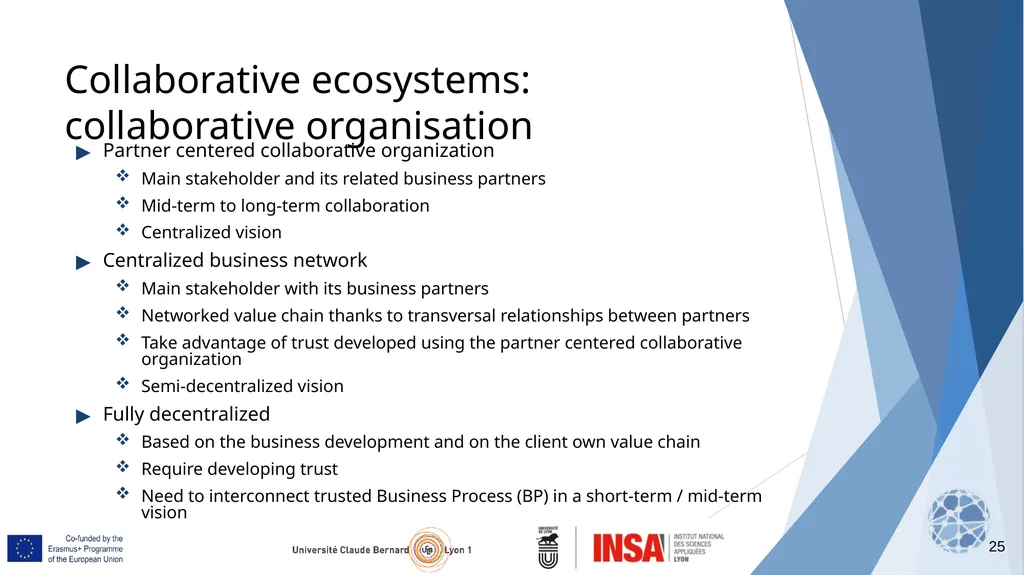
slide25. Collaborative ecosystems: collaborative organisation Partner centered collaborative organization
Main stakeholder and its related business partners
Mid-term to long-term collaboration
Centralized vision
Centralized business network
Main stakeholder with its business partners
Networked value chain thanks to transversal relationships between partners
Take advantage of trust developed using the partner centered collaborative organization
Semi-decentralized vision
Fully decentralized
Based on the business development and on the client own value chain
Require developing trust
Need to interconnect trusted Business Process (BP) in a short-term / mid-term vision 25<br>
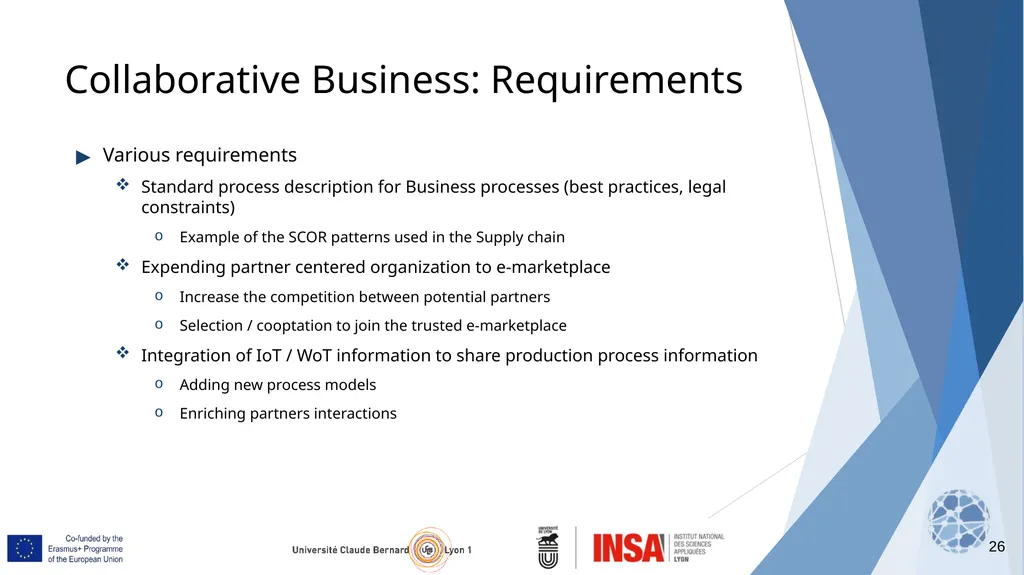
slide26. Collaborative Business: Requirements Various requirements
Standard process description for Business processes (best practices, legal constraints)
Example of the SCOR patterns used in the Supply chain
Expending partner centered organization to e-marketplace
Increase the competition between potential partners
Selection / cooptation to join the trusted e-marketplace
Integration of IoT / WoT information to share production process information
Adding new process models
Enriching partners interactions 26<br>
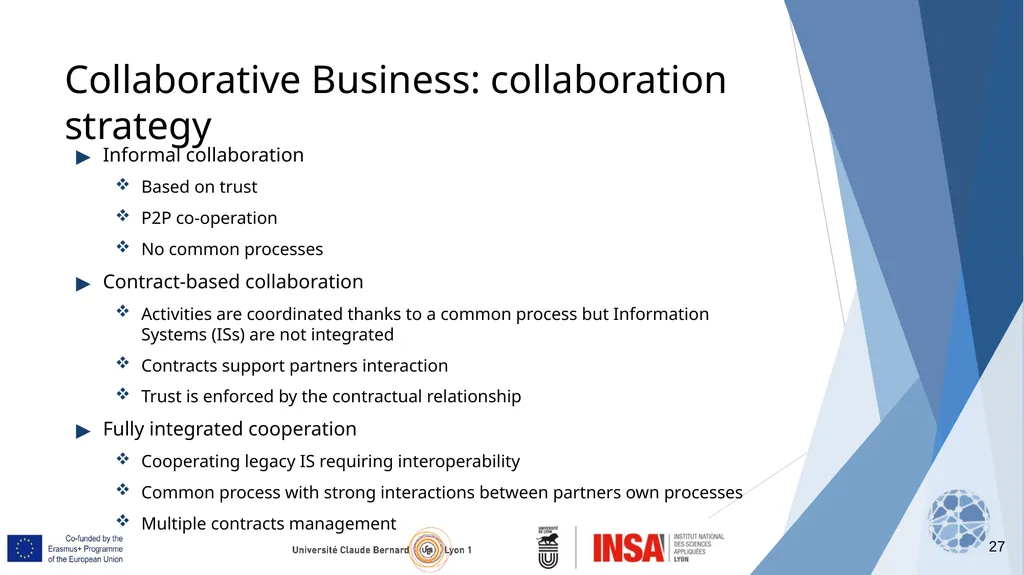
slide27. Collaborative Business: collaboration strategy Informal collaboration
Based on trust
P2P co-operation
No common processes
Contract-based collaboration
Activities are coordinated thanks to a common process but Information Systems (ISs) are not integrated
Contracts support partners interaction
Trust is enforced by the contractual relationship
Fully integrated cooperation
Cooperating legacy IS requiring interoperability
Common process with strong interactions between partners own processes
Multiple contracts management 27<br>
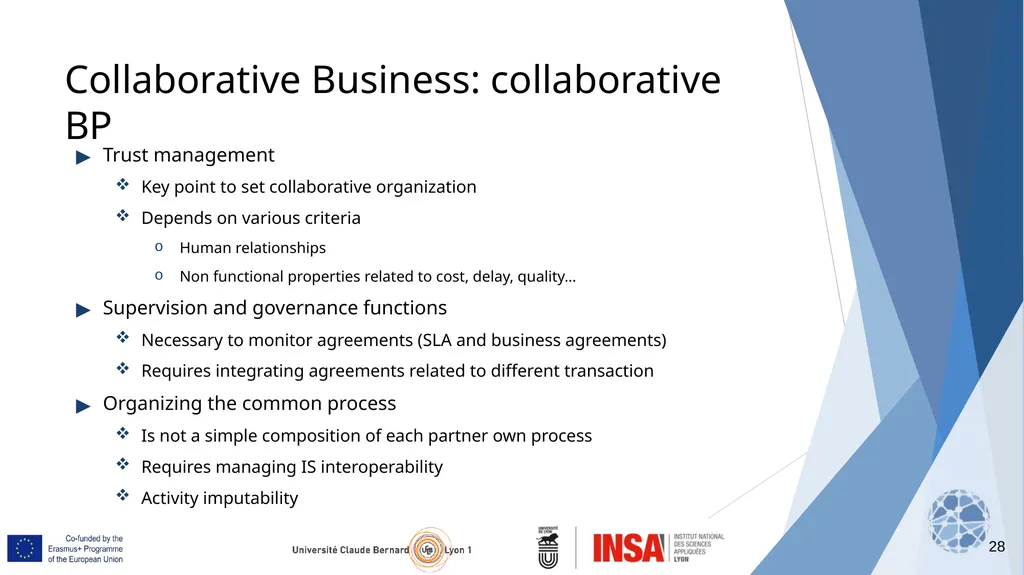
slide28. Collaborative Business: collaborative BP Trust management
Key point to set collaborative organization
Depends on various criteria
Human relationships
Non functional properties related to cost, delay, quality…
Supervision and governance functions
Necessary to monitor agreements (SLA and business agreements)
Requires integrating agreements related to different transaction
Organizing the common process
Is not a simple composition of each partner own process
Requires managing IS interoperability
Activity imputability 28<br>
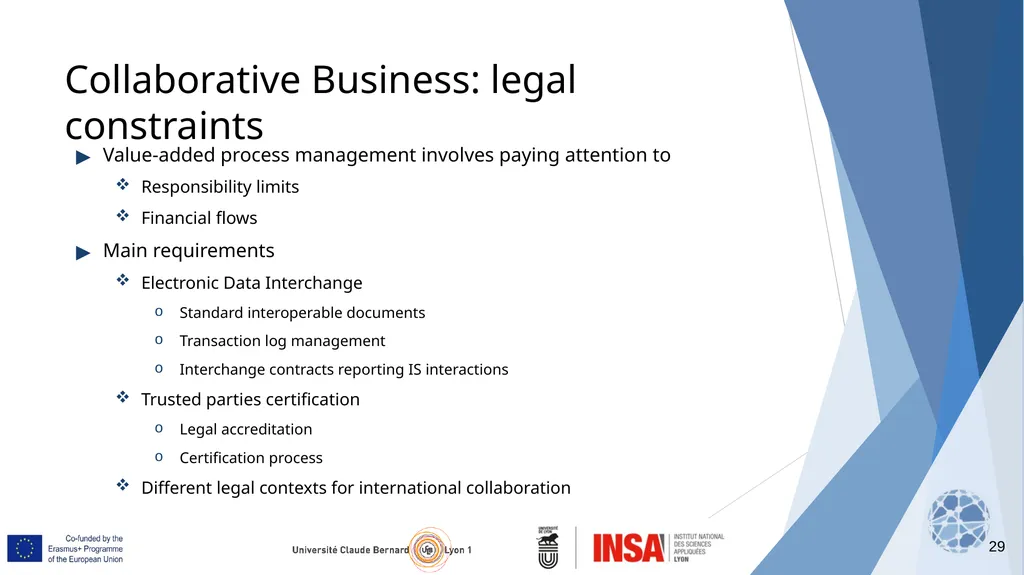
slide29. Collaborative Business: legal constraints Value-added process management involves paying attention to
Responsibility limits
Financial flows
Main requirements
Electronic Data Interchange
Standard interoperable documents
Transaction log management
Interchange contracts reporting IS interactions
Trusted parties certification
Legal accreditation
Certification process
Different legal contexts for international collaboration 29<br>
slide30. Table of Contents From traditional economy to digital economy
Business model
IT evolution
Collaborative ecosystems
Requirements for blockchain support
Blockchain context
New business models or new technologies for existing business models?
Exercises<br>
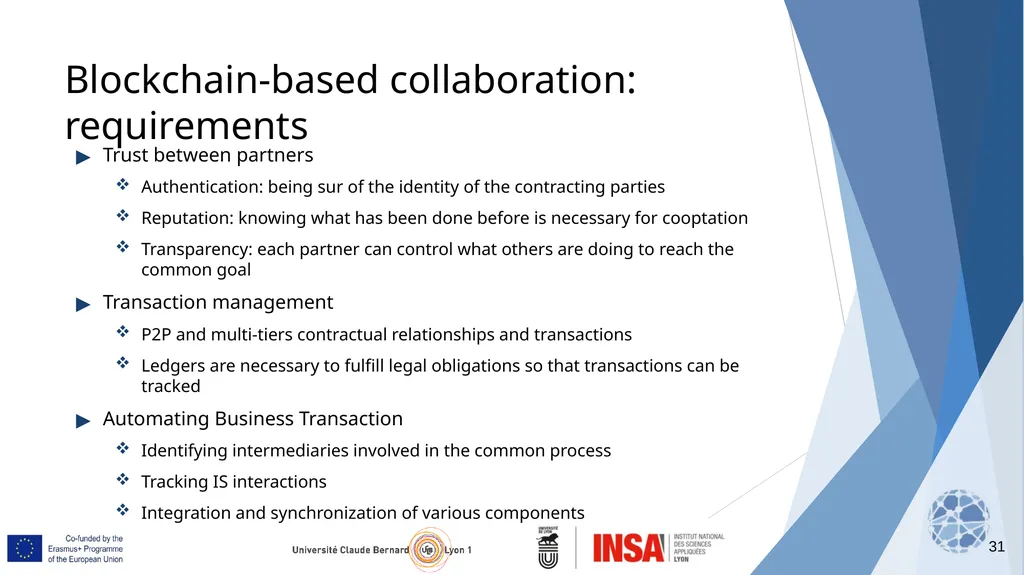
slide31. Blockchain-based collaboration: requirements Trust between partners
Authentication: being sur of the identity of the contracting parties
Reputation: knowing what has been done before is necessary for cooptation
Transparency: each partner can control what others are doing to reach the common goal
Transaction management
P2P and multi-tiers contractual relationships and transactions
Ledgers are necessary to fulfill legal obligations so that transactions can be tracked
Automating Business Transaction
Identifying intermediaries involved in the common process
Tracking IS interactions
Integration and synchronization of various components 31<br>
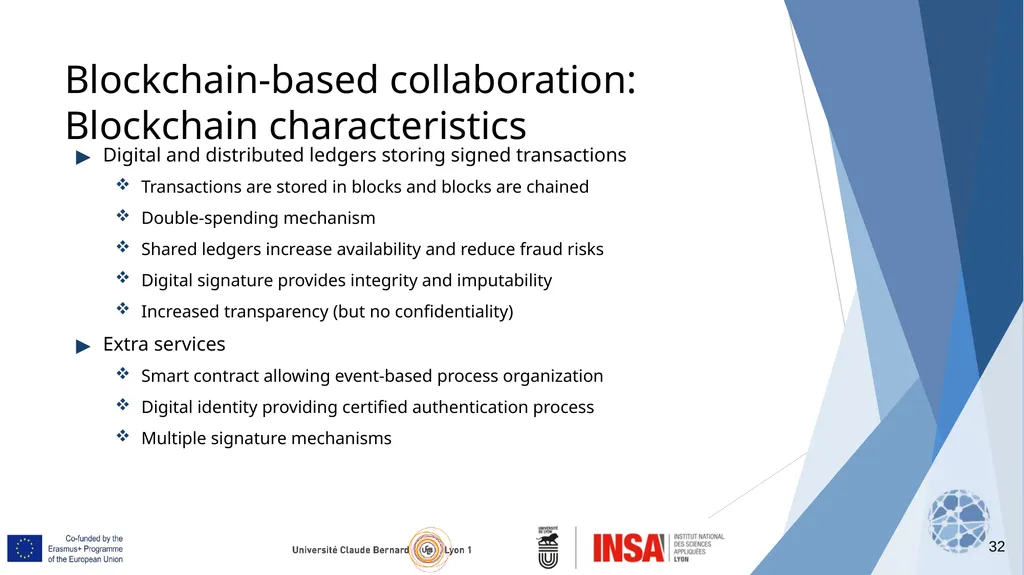
slide32. Blockchain-based collaboration: Blockchain characteristics Digital and distributed ledgers storing signed transactions
Transactions are stored in blocks and blocks are chained
Double-spending mechanism
Shared ledgers increase availability and reduce fraud risks
Digital signature provides integrity and imputability
Increased transparency (but no confidentiality)
Extra services
Smart contract allowing event-based process organization
Digital identity providing certified authentication process
Multiple signature mechanisms 32<br>
slide33. Blockchain-based collaboration: benefits Transparency
Recorded transactions
Need to define precisely the transaction information
Collaborative network management
Identity certification
Cooptation process registering
Distributed BP
Record processes interactions
Identify “launching conditions” for each sub-process 33<br>
slide34. Table of Contents: PART 1 From traditional economy to digital economy
Blockchain context
Blockchain key principles
Blockchain characteristics
Hype cycle
New business models or new technologies for existing business models?
Exercises<br>
slide35. According to you, how can you qualify a blockchain project? Is there only one kind of Blockchain project or several kinds of blockchain?
How to set a blockchain typology?
What are the main components?
Is Blockchain only a buz word or can its hype cycle be characterized?<br>
slide36. According to you, how can you qualify the digital economy? In this part you will
Learn basic elements on blockchain characteristics to set a typology
Identify key elements to select a convenient blockchain support
Get information on blockchain hype cycle<br>
slide37. Table of Contents: PART 1 From traditional economy to digital economy
Blockchain context
Blockchain key principles
Blockchain characteristics
Hype cycle
New business models or new technologies for existing business models?
Exercises<br>
slide38. Blockchain key principles: Previous works Time-stamped information
Digital signature including a time-stamp (1991)
Use hashing techniques
Merkle tree (1979)
Store hashed information
Binary tree organization
Merging blocks involves computing new hash associated to the “father node”
Strong cryptographic foundation but
How can the Merkle tree be stored
How to protect it from attacks 38<br>
slide39. Blockchain key principles: characteristics From transaction to blockchain
A block stores
transactions data
The previous block hash
A Merkle tree stores the blocks
Each block is signed with a hash
Decentralized storage of the Merkle tree
Distributed ledgers
Safer storage
Common governance rule
How to trust the block validation process 39<br>
slide40. Blockchain key principles: governance rules Proof of Work (PoW)
Block’s hash is computed according to a mathematical challenge
Finding the “nonce” in a bruteforce way
Requires important computing resources and energy
Trust depend on the hardware investment and on the “consumed” computing resources
Proof of Stake
Validator is randomly chosen according to the invested currency
Avoid heavy computation
Involves less speculation
Proof of Authority
List of potential certified validators
Reputation mark 40<br>
slide41. Table of Contents: PART 1 From traditional economy to digital economy
Blockchain context
Blockchain key principles
Blockchain characteristics
Hype cycle
New business models or new technologies for existing business models?
Exercises<br>
slide42. Blockchain characteristics: access control Permissionless blockchain
Opened and shared ledgers
Free access for validators
Users are identified by their avatar
Public blockchain
Permissioned blockchain
Authorized validators
Restricted access to the ledgers
Users are associated to well known identities
Used for private blockchain / consortium blockchain 42<br>
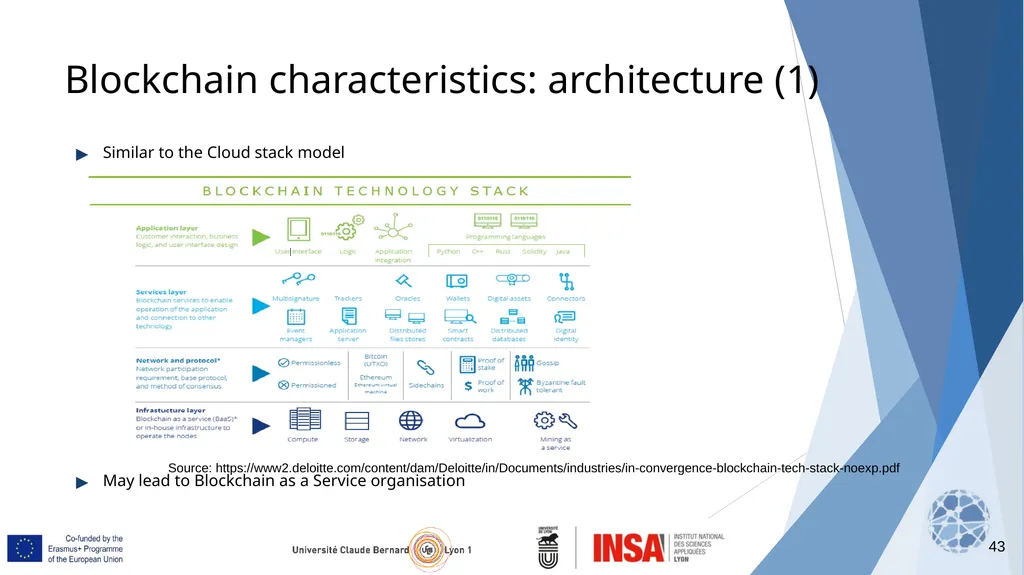
slide43. Blockchain characteristics: architecture (1) Similar to the Cloud stack model
May lead to Blockchain as a Service organisation 43 Source: https://www2.deloitte.com/content/dam/Deloitte/in/Documents/industries/in-convergence-blockchain-tech-stack-noexp.pdf<br>
slide44. Blockchain characteristics: architecture (2) Infrastructure
Computing, communication and storage features
Mining process
Adapted hardware
Optimized cryptographic computation
Organisation and protocols
Blockchain platform
Validation strategy
Consensus method
Services
End user wallet system
Trusted services: identity management, distributed files/DB, event manager, digital asset management… 44<br>
slide45. Table of Contents: PART 1 From traditional economy to digital economy
Blockchain context
Blockchain key principles
Blockchain characteristics
Hype cycle
New business models or new technologies for existing business models?
Exercises<br>
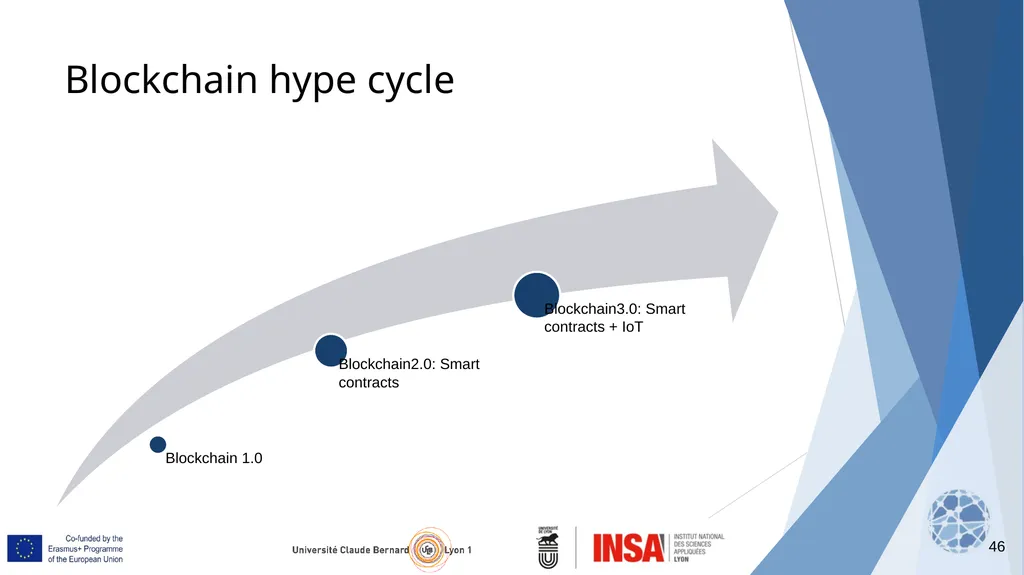
slide46. Blockchain hype cycle 46<br>
slide47. Blockchain hype cycle: Blockchain 1.0 key elements First introduced as Bitcoin
Fiat currency
P2P currency transfer without intermediaries
But it requires miners!
No valuable good exchange to support the crypto-currency
Transaction validation
Solve the double spending problem
Fees
Use the blockchain token
Miners choose “the best transactions” to integrate into blocks
Paid only if the block is validated 47<br>
slide48. Blockchain hype cycle: Blockchain 1.0 limits Long delay (10 minutes for a bitcoin block validation)
Scalability problem
Identity management
Identity related to a key
No proven links between the real identity and the avatar
Security risks
Internal byzantine fault
Lossing private key
Crypto-currency
No legal status for the tokens
Crypto-currency isolation: no exchange mechanisms between different currencies
Highly volatile value due to speculation of the main actors 48<br>
slide49. Blockchain hype cycle: Blockchain 2.0 key elements First implementation in Ethereum
Smart contracts
Distributed application
Contract based organization
Event driven
Integrates the transaction payment
Distributed application
Open-source
Manage its own tokens
Automated transaction execution
Data and operations are stored in the blockchain 49<br>
slide50. Blockchain hype cycle: Blockchain 2.0 limits Smart contract legal status
Computarized transaction and not a contract
How parties identity can be proven?
How to be sure of the capacity of the contracting parties?
Different regulations depending on the hosting countries
Event driven organization
Allows reactivity
Different organization than the traditional control driven logic
“Code is law”
Code cannot be adapted even in case of failure
Increased security risks
Blockchain delay and scalability? 50<br>
slide51. Blockchain hype cycle: Blockchain 3.0 Key points Designed to overcome Blockchain 1.0 and 2.0 main limits
Lack of scalability
Lack of interoperability
Lack of sustainability
Off-line governance strategy lack of transparency
Main characteristics
Blockchain middleware approach
New on line governance strategy
Scalable validation processes
Integration of private blockchain requirements and characteristics
Sustainable block management
IoT integration 51<br>
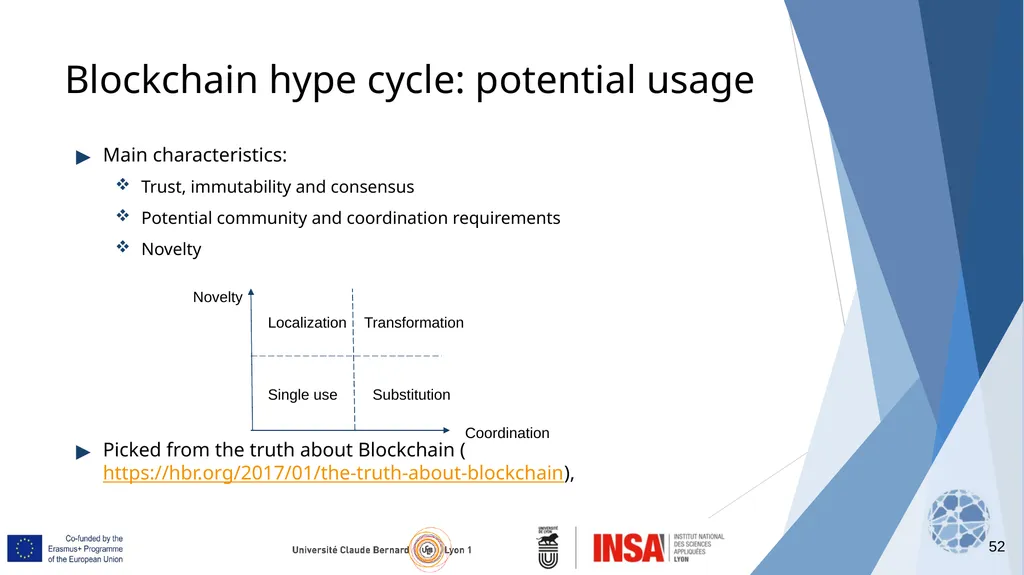
slide52. Blockchain hype cycle: potential usage Main characteristics:
Trust, immutability and consensus
Potential community and coordination requirements
Novelty
Picked from the truth about Blockchain (https://hbr.org/2017/01/the-truth-about-blockchain), 52 Localization Single use Transformation Substitution Novelty Coordination<br>
slide53. Blockchain hype cycle: Reduced community Single use
Blockchain provides a less expensive solution
Focused solution
Used to certify and store transactions in a distributed ledger
Example: micro-payment
Localisation
Reduced business community
High novelty
Mostly FinTech applications
Example: NASDAQ management 53<br>
slide54. Blockchain hype cycle: large community Substitution
Blockchain technology replaces traditional ones
Use basic blockchain characteristics
Immutability
Availability
Most applications are related to
Certification (diploma, shipment documents…)
Exchange (gift cards…)
Transformation
Rethink applications to fit the digital transformation
Heavy use of smart contracts
Example: collaborative and shared economy (energy P2P exchange…) 54<br>
slide55. Table of Contents: PART 1 From traditional economy to digital economy
Blockchain context
New business models or new technologies for existing business models?
Exercises<br>
slide56. According to you, how can you set a blockchain project perimeter? Is Blockchain a new “universal” technology?
Is blockchain a new technology for new business models?<br>
slide57. According to you, how can you qualify the digital economy? In this part you will
Integrate the knowledge picked from digital economy and blockchain technological contexts to identify how blockchain can be integrated in a collaborative business systems
Get some elements to promote blockchain usage<br>
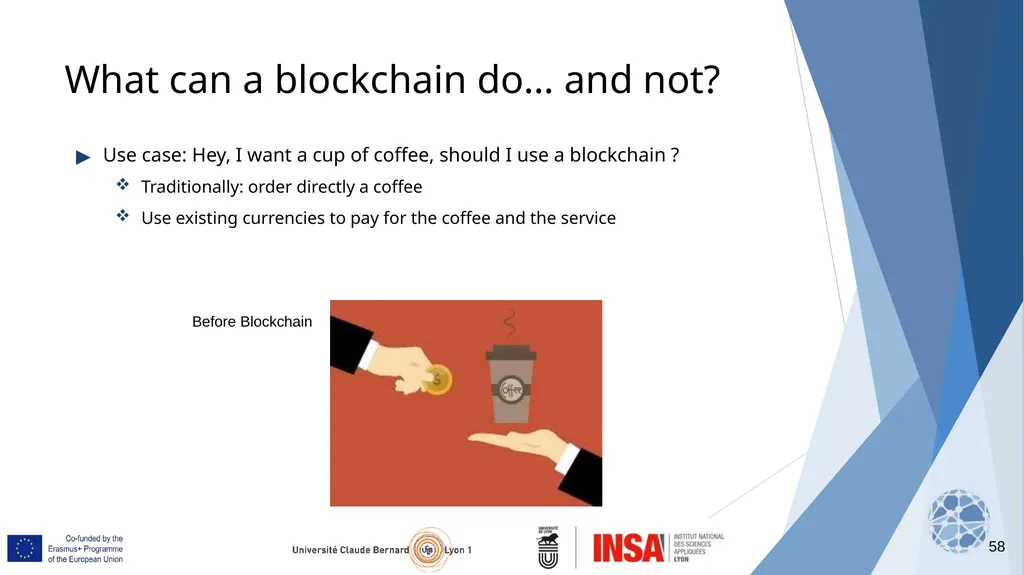
slide58. What can a blockchain do… and not? Use case: Hey, I want a cup of coffee, should I use a blockchain ?
Traditionally: order directly a coffee
Use existing currencies to pay for the coffee and the service 58 Before Blockchain<br>
slide59. Hey, I want a cup of coffee, should I use a blockchain ? Blockchain 1.0 Easy to pay without taking care of the currency type of the country
trusted exchange
« no charge »
Heavy Carbon cost !
Various real price depending on the cryptocurrency rate
Require adding the cryptocurrency as a payment mean in the reseller information system<br>
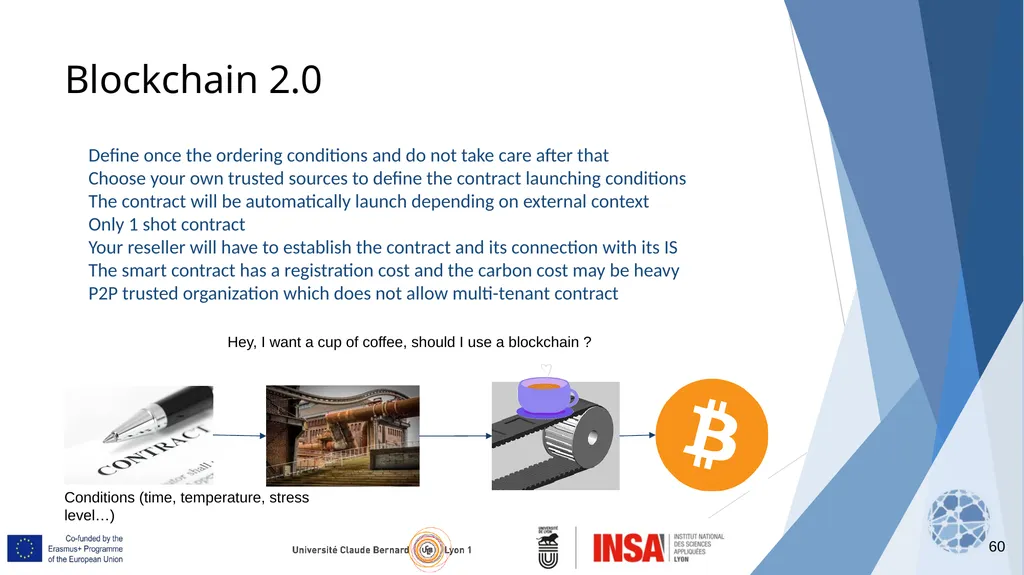
slide60. Blockchain 2.0 Define once the ordering conditions and do not take care after that
Choose your own trusted sources to define the contract launching conditions
The contract will be automatically launch depending on external context
Only 1 shot contract
Your reseller will have to establish the contract and its connection with its IS
The smart contract has a registration cost and the carbon cost may be heavy
P2P trusted organization which does not allow multi-tenant contract Hey, I want a cup of coffee, should I use a blockchain ? Conditions (time, temperature, stress level…)<br>
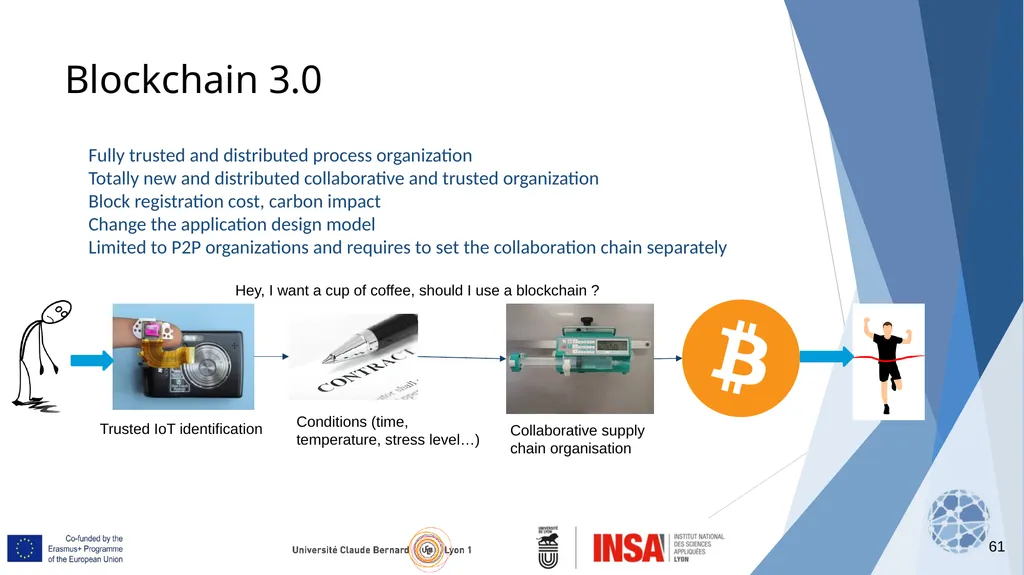
slide61. Blockchain 3.0 Fully trusted and distributed process organization
Totally new and distributed collaborative and trusted organization
Block registration cost, carbon impact
Change the application design model
Limited to P2P organizations and requires to set the collaboration chain separately Hey, I want a cup of coffee, should I use a blockchain ? Conditions (time, temperature, stress level…) Trusted IoT identification Collaborative supply chain organisation<br>
slide3. Learning outcomes Policy and regulation
Blockchain and Public Policy, Central Banks & governmental regulations
Implications of blockchains for governments, policy makers, law professionals, regulators and society Recognise potential regulatory and legal frameworks for blockchain operation, including consumer protection, and taxation Knowledge Skills Learning unit U3 Communicating the business merits, challenges and implications of blockchain technology Interpret the legal, regulatory and consumer challenges to wider blockchain adoption and conformance K5<br>
slide4. Learning outcomes Blockchain as innovator of businesses and processes
Blockchain business models
Blockchain emerging trends susceptible to create value for the business
Innovative blockchain solutions and entrepreneurship
Blockchain transforming business and professionalism Provide detailed examples of the blockchain transforming power in specific contexts Knowledge Skills Learning unit U3 Communicating the business merits, challenges and implications of blockchain technology Monitor the intervention of blockchain technology in business models K6<br>
slide5. Learning outcomes Blockchain maturity and strategies
Blockchain adoption metrics, challenges and opportunities
Blockchain business strategies Project strengths and weaknesses of the Blockchain technology in a given scenario Knowledge Skills Learning unit U3 Communicating the business merits, challenges and implications of blockchain technology Analyse blockchain SWOT (Strengths, Weaknesses, Opportunities, Threats) for specific industry scenarios K7<br>
slide6. Learning outcomes Blockchain as business model disruption
Implications of blockchains for corporates, such as disruption by open markets, winner-takes-all, multi-sided market platforms, the role of trust in blockchain markets
How blockchain technology is disrupting existing business models and creating new ones Describe blockchain business processes and business logics Knowledge Skills Learning unit U3 Communicating the business merits, challenges and implications of blockchain technology Intelligibly present Blockchain industry business models K8<br>
slide7. Learning outcomes Existing applications
Main disruptive features of different practical blockchain application scenarios, such as in finance, assurance, accounting, business operations, public administration and government services Outline latest trends in the blockchain technology, and the directions of growth across impacted industries Knowledge Skills Learning unit U3 Communicating the business merits, challenges and implications of blockchain technology Communicate business opportunities behind the limits of the blockchain K9<br>
slide8. U3 : Communicating the business merits, challenges and implications of blockchain technology Frédérique Biennier INSA of Lyon, France<br>
slide9. Table of Contents Part 1: Promoting Blockchain usage
From traditional economy to digital economy
Blockchain context
New business models or new technologies for existing business models?
Exercises
Part 2: Value models
Traditional value models
Characterizing a blockchain value system
Building the Blockchain value model
Integration of blockchain value models in digital economy collaborative business
Exercises<br>
slide10. Table of Contents: PART 1 From traditional economy to digital economy
Blockchain context
New business models or new technologies for existing business models?
Exercises<br>
slide11. According to you, how can you qualify the digital economy? Are there any models qualifying the business environment?
What are the main collaborative ecosystems models?
Which requirements can be fulfilled using a blockchain?<br>
slide12. According to you, how can you qualify the digital economy? In this part you will
Learn basic elements on digital economy and collaborative ecosystems
Learn how IT and blockchain technologies have evolved to fit the economic context
Get information on collaborative ecosystem requirements and how blockchain technology can be an answer<br>
slide13. Table of Contents: PART 1 From traditional economy to digital economy
Business model
IT evolution
Collaborative ecosystems
Requirements for blockchain support
Blockchain context
New business models or new technologies for existing business models?
Exercises<br>
slide14. Business model: Value Characterizing value:
Aggregating one or more impacts
Financial, social impact, environmental impact, cultural impact
Global organization
Internal
How to produce the product / service
Identification of the main costs related to investments as well as functioning costs
Relationships with partners / competitors
How value is shared
How to be more attractive than competitors<br>
slide15. Business model: Business environment (1) Red Ocean (Porter 1980)
Highly competitive environment
Well known demand
Value measured in monetary units
How to survive: differentiated or cheaper product / service
Blue Ocean (Kim and Mauborgne 2002)
Highly innovative industry
New demands and markets
Value is measured in monetary units
How to survive: creating a new product and the associated market 15<br>
slide16. Business model: Business environment (2) Purple Ocean
Mixing both Red and Blue ocean strategy
Value measured thanks to monetary units
How to survice: identify innovations to get market advantage
Green Ocean
Integrating sustainability and environmental impact in the value
New demand for « green products »
Sustainability is a driver for innovation
Black ocean
Closing market to competitors to reduce risks regarding the investments
Unfair/unethical advantages to survive 16<br>
slide17. Business model: Blockchain market Disruptive technology
New demand for distributed trust management
Distributed and opened applications
Core mining function
Highly competitive market
Red Ocean strategy
Blockchain based development
Mixing both innovation and strong competition
Blockchain appears as a differentiation mean
Private / semi-private blockchain may be used to « close the market » 17<br>
slide18. Table of Contents: PART 1 From traditional economy to digital economy
Business model
IT evolution
Collaborative ecosystems
Requirements for blockchain support
Blockchain context
New business models or new technologies for existing business models?
Exercises<br>
slide19. IT Evolution: Architecture evolution (1) Centralized
Years 60-70
Main cost related to hardware
Repetitive tasks
File system / centralized DB
Years 90-2000
Main costs related to the software configuration
ERP => Standard software
Centralized organization to support distributed decision 19 Distributed
Years 80-90
Microprocessor => PC
Main cost related to the software
Relational DB with interoperable query language
Years 2000-2010
SOA
Web technologies
More adaptive systems
Cloud => outsourcing and industrialized organisation<br>
slide20. IT Evolution: Architecture evolution (2) SMAC – IT revolution?
Front end / back end organization
Different accesses
Social media
Mobile vs traditional systems
Extend the collaboration requirements
Generalized XaaS model
Pay per use
On demand
Data are seen as value due to analytical processes
Extend the service and distributed application challenges 20<br>
slide21. IT evolution: requirements (1) Years 60 - 70:
Programing is an art!
High ownership costs
Development of languages, databases, files systems
Industrial organization of IT production.
First attempts towards multi-media…
Years 80 - 95
Relational databases -> openness provided by SQL
Object Oriented Programing
Software packages and “on the shelf” offers
First step to industrialize of software production 21<br>
slide22. IT evolution: requirements (2) Years 95 / 2000
Large scale software packages
Minor purchasing costs
Major parametrization costs
“Proprietary” environments
“Framework” development
Start industrialize software production environment
Now
Communication costs decrease
Middleware logics
Pay per use
Open source software development
Mutation towards a service-oriented environment
Increase the call for Distributed Transaction management 22<br>
slide23. IT evolution: Network environment Internet architecture
Built incrementally in the 70
P2P organization
Few application oriented services
Telcos vision
Rather prospective => OSI model
Integration of several service features such as interoperability, synchronization management, application service organization
Web-based technology
Extend the Internet stack use
P2P organization
Extended connectors to deploy collaborative business 23<br>
slide24. Table of Contents: PART 1 From traditional economy to digital economy
Business model
IT evolution
Collaborative ecosystems
Requirements for blockchain support
Blockchain context
New business models or new technologies for existing business models?
Exercises<br>
slide25. Collaborative ecosystems: collaborative organisation Partner centered collaborative organization
Main stakeholder and its related business partners
Mid-term to long-term collaboration
Centralized vision
Centralized business network
Main stakeholder with its business partners
Networked value chain thanks to transversal relationships between partners
Take advantage of trust developed using the partner centered collaborative organization
Semi-decentralized vision
Fully decentralized
Based on the business development and on the client own value chain
Require developing trust
Need to interconnect trusted Business Process (BP) in a short-term / mid-term vision 25<br>
slide26. Collaborative Business: Requirements Various requirements
Standard process description for Business processes (best practices, legal constraints)
Example of the SCOR patterns used in the Supply chain
Expending partner centered organization to e-marketplace
Increase the competition between potential partners
Selection / cooptation to join the trusted e-marketplace
Integration of IoT / WoT information to share production process information
Adding new process models
Enriching partners interactions 26<br>
slide27. Collaborative Business: collaboration strategy Informal collaboration
Based on trust
P2P co-operation
No common processes
Contract-based collaboration
Activities are coordinated thanks to a common process but Information Systems (ISs) are not integrated
Contracts support partners interaction
Trust is enforced by the contractual relationship
Fully integrated cooperation
Cooperating legacy IS requiring interoperability
Common process with strong interactions between partners own processes
Multiple contracts management 27<br>
slide28. Collaborative Business: collaborative BP Trust management
Key point to set collaborative organization
Depends on various criteria
Human relationships
Non functional properties related to cost, delay, quality…
Supervision and governance functions
Necessary to monitor agreements (SLA and business agreements)
Requires integrating agreements related to different transaction
Organizing the common process
Is not a simple composition of each partner own process
Requires managing IS interoperability
Activity imputability 28<br>
slide29. Collaborative Business: legal constraints Value-added process management involves paying attention to
Responsibility limits
Financial flows
Main requirements
Electronic Data Interchange
Standard interoperable documents
Transaction log management
Interchange contracts reporting IS interactions
Trusted parties certification
Legal accreditation
Certification process
Different legal contexts for international collaboration 29<br>
slide30. Table of Contents From traditional economy to digital economy
Business model
IT evolution
Collaborative ecosystems
Requirements for blockchain support
Blockchain context
New business models or new technologies for existing business models?
Exercises<br>
slide31. Blockchain-based collaboration: requirements Trust between partners
Authentication: being sur of the identity of the contracting parties
Reputation: knowing what has been done before is necessary for cooptation
Transparency: each partner can control what others are doing to reach the common goal
Transaction management
P2P and multi-tiers contractual relationships and transactions
Ledgers are necessary to fulfill legal obligations so that transactions can be tracked
Automating Business Transaction
Identifying intermediaries involved in the common process
Tracking IS interactions
Integration and synchronization of various components 31<br>
slide32. Blockchain-based collaboration: Blockchain characteristics Digital and distributed ledgers storing signed transactions
Transactions are stored in blocks and blocks are chained
Double-spending mechanism
Shared ledgers increase availability and reduce fraud risks
Digital signature provides integrity and imputability
Increased transparency (but no confidentiality)
Extra services
Smart contract allowing event-based process organization
Digital identity providing certified authentication process
Multiple signature mechanisms 32<br>
slide33. Blockchain-based collaboration: benefits Transparency
Recorded transactions
Need to define precisely the transaction information
Collaborative network management
Identity certification
Cooptation process registering
Distributed BP
Record processes interactions
Identify “launching conditions” for each sub-process 33<br>
slide34. Table of Contents: PART 1 From traditional economy to digital economy
Blockchain context
Blockchain key principles
Blockchain characteristics
Hype cycle
New business models or new technologies for existing business models?
Exercises<br>
slide35. According to you, how can you qualify a blockchain project? Is there only one kind of Blockchain project or several kinds of blockchain?
How to set a blockchain typology?
What are the main components?
Is Blockchain only a buz word or can its hype cycle be characterized?<br>
slide36. According to you, how can you qualify the digital economy? In this part you will
Learn basic elements on blockchain characteristics to set a typology
Identify key elements to select a convenient blockchain support
Get information on blockchain hype cycle<br>
slide37. Table of Contents: PART 1 From traditional economy to digital economy
Blockchain context
Blockchain key principles
Blockchain characteristics
Hype cycle
New business models or new technologies for existing business models?
Exercises<br>
slide38. Blockchain key principles: Previous works Time-stamped information
Digital signature including a time-stamp (1991)
Use hashing techniques
Merkle tree (1979)
Store hashed information
Binary tree organization
Merging blocks involves computing new hash associated to the “father node”
Strong cryptographic foundation but
How can the Merkle tree be stored
How to protect it from attacks 38<br>
slide39. Blockchain key principles: characteristics From transaction to blockchain
A block stores
transactions data
The previous block hash
A Merkle tree stores the blocks
Each block is signed with a hash
Decentralized storage of the Merkle tree
Distributed ledgers
Safer storage
Common governance rule
How to trust the block validation process 39<br>
slide40. Blockchain key principles: governance rules Proof of Work (PoW)
Block’s hash is computed according to a mathematical challenge
Finding the “nonce” in a bruteforce way
Requires important computing resources and energy
Trust depend on the hardware investment and on the “consumed” computing resources
Proof of Stake
Validator is randomly chosen according to the invested currency
Avoid heavy computation
Involves less speculation
Proof of Authority
List of potential certified validators
Reputation mark 40<br>
slide41. Table of Contents: PART 1 From traditional economy to digital economy
Blockchain context
Blockchain key principles
Blockchain characteristics
Hype cycle
New business models or new technologies for existing business models?
Exercises<br>
slide42. Blockchain characteristics: access control Permissionless blockchain
Opened and shared ledgers
Free access for validators
Users are identified by their avatar
Public blockchain
Permissioned blockchain
Authorized validators
Restricted access to the ledgers
Users are associated to well known identities
Used for private blockchain / consortium blockchain 42<br>
slide43. Blockchain characteristics: architecture (1) Similar to the Cloud stack model
May lead to Blockchain as a Service organisation 43 Source: https://www2.deloitte.com/content/dam/Deloitte/in/Documents/industries/in-convergence-blockchain-tech-stack-noexp.pdf<br>
slide44. Blockchain characteristics: architecture (2) Infrastructure
Computing, communication and storage features
Mining process
Adapted hardware
Optimized cryptographic computation
Organisation and protocols
Blockchain platform
Validation strategy
Consensus method
Services
End user wallet system
Trusted services: identity management, distributed files/DB, event manager, digital asset management… 44<br>
slide45. Table of Contents: PART 1 From traditional economy to digital economy
Blockchain context
Blockchain key principles
Blockchain characteristics
Hype cycle
New business models or new technologies for existing business models?
Exercises<br>
slide46. Blockchain hype cycle 46<br>
slide47. Blockchain hype cycle: Blockchain 1.0 key elements First introduced as Bitcoin
Fiat currency
P2P currency transfer without intermediaries
But it requires miners!
No valuable good exchange to support the crypto-currency
Transaction validation
Solve the double spending problem
Fees
Use the blockchain token
Miners choose “the best transactions” to integrate into blocks
Paid only if the block is validated 47<br>
slide48. Blockchain hype cycle: Blockchain 1.0 limits Long delay (10 minutes for a bitcoin block validation)
Scalability problem
Identity management
Identity related to a key
No proven links between the real identity and the avatar
Security risks
Internal byzantine fault
Lossing private key
Crypto-currency
No legal status for the tokens
Crypto-currency isolation: no exchange mechanisms between different currencies
Highly volatile value due to speculation of the main actors 48<br>
slide49. Blockchain hype cycle: Blockchain 2.0 key elements First implementation in Ethereum
Smart contracts
Distributed application
Contract based organization
Event driven
Integrates the transaction payment
Distributed application
Open-source
Manage its own tokens
Automated transaction execution
Data and operations are stored in the blockchain 49<br>
slide50. Blockchain hype cycle: Blockchain 2.0 limits Smart contract legal status
Computarized transaction and not a contract
How parties identity can be proven?
How to be sure of the capacity of the contracting parties?
Different regulations depending on the hosting countries
Event driven organization
Allows reactivity
Different organization than the traditional control driven logic
“Code is law”
Code cannot be adapted even in case of failure
Increased security risks
Blockchain delay and scalability? 50<br>
slide51. Blockchain hype cycle: Blockchain 3.0 Key points Designed to overcome Blockchain 1.0 and 2.0 main limits
Lack of scalability
Lack of interoperability
Lack of sustainability
Off-line governance strategy lack of transparency
Main characteristics
Blockchain middleware approach
New on line governance strategy
Scalable validation processes
Integration of private blockchain requirements and characteristics
Sustainable block management
IoT integration 51<br>
slide52. Blockchain hype cycle: potential usage Main characteristics:
Trust, immutability and consensus
Potential community and coordination requirements
Novelty
Picked from the truth about Blockchain (https://hbr.org/2017/01/the-truth-about-blockchain), 52 Localization Single use Transformation Substitution Novelty Coordination<br>
slide53. Blockchain hype cycle: Reduced community Single use
Blockchain provides a less expensive solution
Focused solution
Used to certify and store transactions in a distributed ledger
Example: micro-payment
Localisation
Reduced business community
High novelty
Mostly FinTech applications
Example: NASDAQ management 53<br>
slide54. Blockchain hype cycle: large community Substitution
Blockchain technology replaces traditional ones
Use basic blockchain characteristics
Immutability
Availability
Most applications are related to
Certification (diploma, shipment documents…)
Exchange (gift cards…)
Transformation
Rethink applications to fit the digital transformation
Heavy use of smart contracts
Example: collaborative and shared economy (energy P2P exchange…) 54<br>
slide55. Table of Contents: PART 1 From traditional economy to digital economy
Blockchain context
New business models or new technologies for existing business models?
Exercises<br>
slide56. According to you, how can you set a blockchain project perimeter? Is Blockchain a new “universal” technology?
Is blockchain a new technology for new business models?<br>
slide57. According to you, how can you qualify the digital economy? In this part you will
Integrate the knowledge picked from digital economy and blockchain technological contexts to identify how blockchain can be integrated in a collaborative business systems
Get some elements to promote blockchain usage<br>
slide58. What can a blockchain do… and not? Use case: Hey, I want a cup of coffee, should I use a blockchain ?
Traditionally: order directly a coffee
Use existing currencies to pay for the coffee and the service 58 Before Blockchain<br>
slide59. Hey, I want a cup of coffee, should I use a blockchain ? Blockchain 1.0 Easy to pay without taking care of the currency type of the country
trusted exchange
« no charge »
Heavy Carbon cost !
Various real price depending on the cryptocurrency rate
Require adding the cryptocurrency as a payment mean in the reseller information system<br>
slide60. Blockchain 2.0 Define once the ordering conditions and do not take care after that
Choose your own trusted sources to define the contract launching conditions
The contract will be automatically launch depending on external context
Only 1 shot contract
Your reseller will have to establish the contract and its connection with its IS
The smart contract has a registration cost and the carbon cost may be heavy
P2P trusted organization which does not allow multi-tenant contract Hey, I want a cup of coffee, should I use a blockchain ? Conditions (time, temperature, stress level…)<br>
slide61. Blockchain 3.0 Fully trusted and distributed process organization
Totally new and distributed collaborative and trusted organization
Block registration cost, carbon impact
Change the application design model
Limited to P2P organizations and requires to set the collaboration chain separately Hey, I want a cup of coffee, should I use a blockchain ? Conditions (time, temperature, stress level…) Trusted IoT identification Collaborative supply chain organisation<br>