
Block 2: Energy efficiency in buildings 2.4 Energy
PC
Published · 30 slides · 0 views

1 / 1


Description
Block 2: Energy efficiency in buildings 2.4 Energy management in buildings e-learning course FEEDSCHOOLS, by ENVIROS This module is part of a training package developed to provide local authorities with free tuition that may inspire and
Related Topics
Share
Embed code
Download this presentation From Below
"Block 2: Energy efficiency in buildings 2.4 Energy" is the property of its rightful owner. Permission is granted to download and print the materials on this website for personal, non-commercial use only, and to display it on your personal computer provided you do not modify the materials and that you retain all copyright notices contained in the materials. By downloading content from our website, you accept the terms of this agreement.
Presentation Transcript
01
Block 2: Energy efficiency in buildings
2.4 Energy management in buildings e-learning course FEEDSCHOOLS, by ENVIROS<br>
2.4 Energy management in buildings e-learning course FEEDSCHOOLS, by ENVIROS<br>
02
This module is part of a training package developed to provide local authorities with free tuition that may inspire and help them in adopting new technical and financial solutions to implement ‘nearly Zero Energy Building’ (NZEB) renovation activities in schools.
The objective of this block is to help all interested parties (local authorities, school managers, teachers and students) better understand the concept of energy management in schools and to show them how to adopt the basic rules of energy management implementation.
Level: beginner – no special knowledge is needed<br>
03
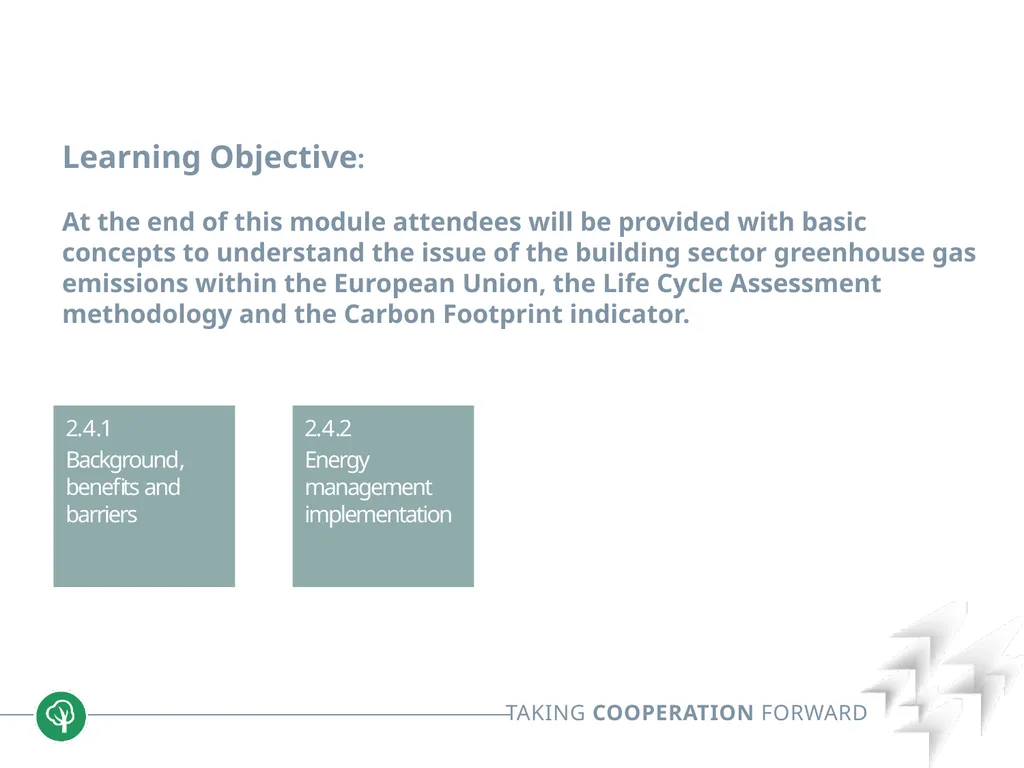
2.4.1
Background, benefits and barriers 2.4.2
Energy management implementation Learning Objective:
At the end of this module attendees will be provided with basic concepts to understand the issue of the building sector greenhouse gas emissions within the European Union, the Life Cycle Assessment methodology and the Carbon Footprint indicator.<br>
04
2.4.1 Background, benefits and barriers 2.4.1 objective
The objective of this part is to explain to all interested groups (local authorities, school managers, teachers and students) what is energy management, why it is important and how can school benefit from the implementation of energy management.<br>
The objective of this part is to explain to all interested groups (local authorities, school managers, teachers and students) what is energy management, why it is important and how can school benefit from the implementation of energy management.<br>
05
Energy management is the system of rules, activities, technologies and measures working in synergy and resulting in more efficient use of energy and thus reduction of operating cost of a building.
Energy management is an investment-friendly process that helps the buildings‘ owners conceptually and systematically reduce their expenses on energy. It means systematic use of management and technology to improve an organization's energy performance.
Successful energy management must combine an effective strategy with the right practical interventions. Many organizations (also schools) would like to save energy, but they need to make energy management an integral part of running the organization to ensure success. https://ec.europa.eu/energy/en/topics/energy-efficiency/buildings<br>
06
There are different ways to implement energy management in an organization. An industrial facility will have different requirements and resources for energy management implementation than a school with limited operating budget and limited staff.
A school is a difficult environment for the implementation of energy management, despite the fact that implementation of simple energy management in schools that have never looked at the energy management can bring significant savings (5-10% ) and benefits for users of the building.
This is mainly because school managers manage a limited budget, the amount of which is not directly impacted by the amount of achieved energy savings. School users are therefore not interested in reducing energy costs and usually are not involved in energy saving actions.<br>
07
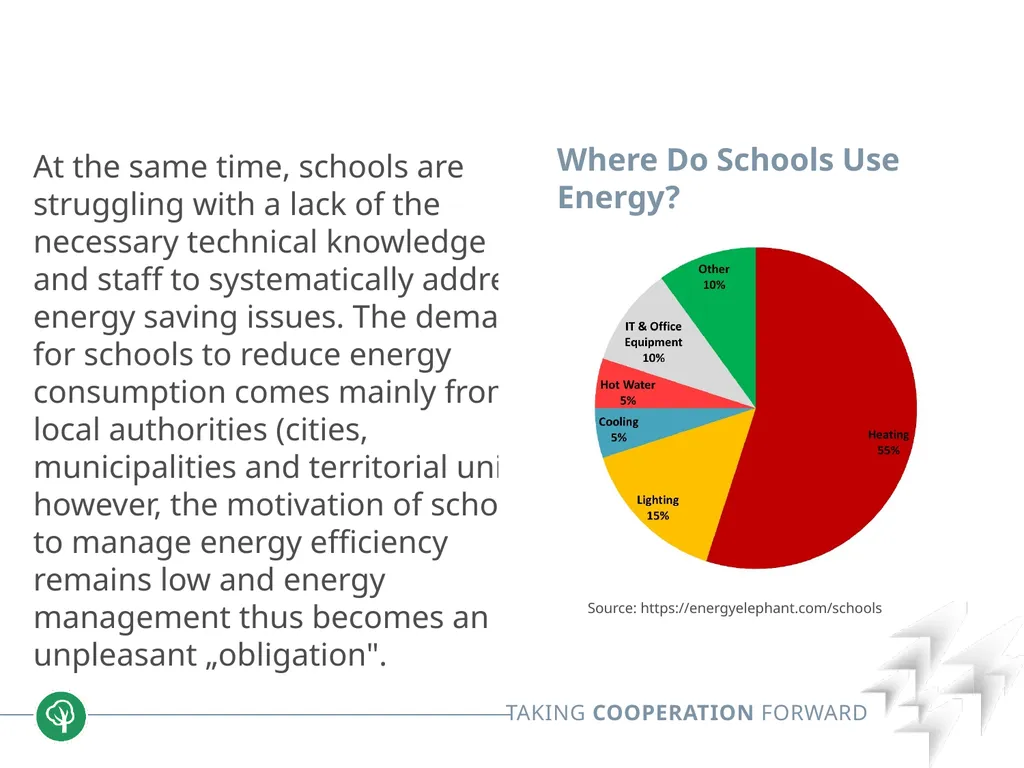
At the same time, schools are struggling with a lack of the necessary technical knowledge and staff to systematically address energy saving issues. The demand for schools to reduce energy consumption comes mainly from local authorities (cities, municipalities and territorial units), however, the motivation of schools to manage energy efficiency remains low and energy management thus becomes an unpleasant „obligation". Where Do Schools Use Energy? Source: https://energyelephant.com/schools<br>
08
In relation to schools, the approach to energy management can be as follows:
Centrally managed certification system of energy management for instance according to the ISO 50001 standard,
Local energy management of an individual school provided by school staff and students<br>
Centrally managed certification system of energy management for instance according to the ISO 50001 standard,
Local energy management of an individual school provided by school staff and students<br>
09
Energy management according to the ISO 50001
Implementer: usually a local authority employee with external technical assistance,
Certification: professional certification body
Energy management borders: all contributory organizations of a city/municipality/region including schools (can be hundreds of organization)
This complex system consists of organizational processes, competences, mandatory documentation, internal audits and system solving the nonconformities, which is certified and audited each year by independent certification body. This robust system is suitable for extensive energy management including number of buildings or operations.<br>
10
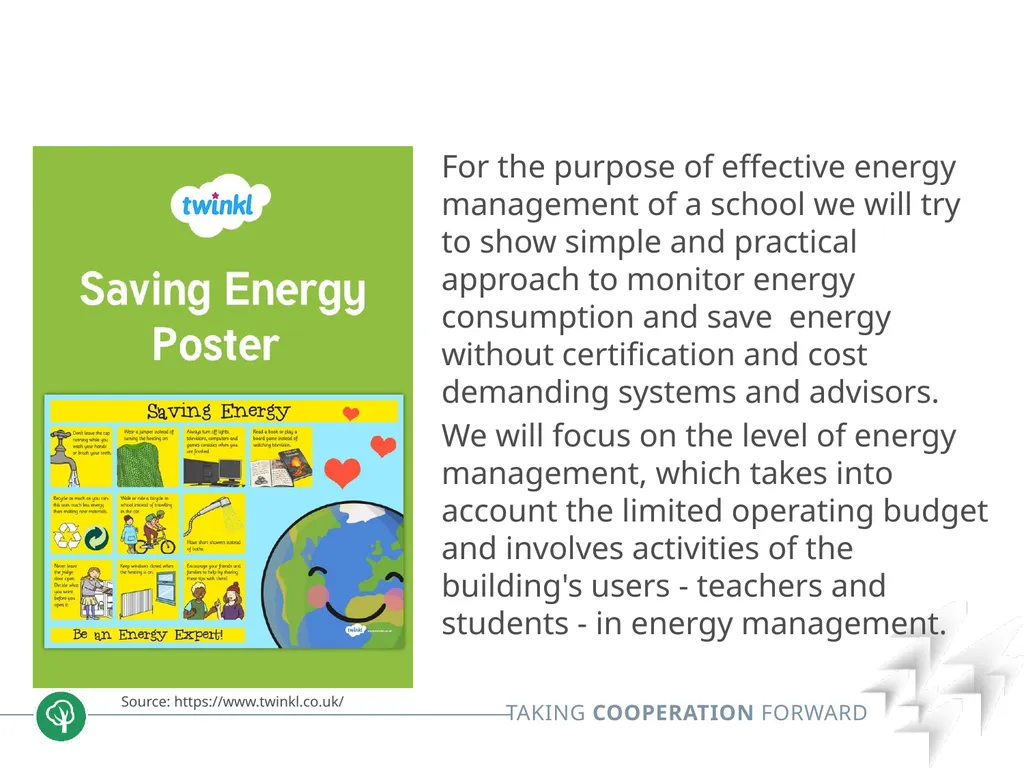
For the purpose of effective energy management of a school we will try to show simple and practical approach to monitor energy consumption and save energy without certification and cost demanding systems and advisors.
We will focus on the level of energy management, which takes into account the limited operating budget and involves activities of the building's users - teachers and students - in energy management. Source: https://www.twinkl.co.uk/<br>
We will focus on the level of energy management, which takes into account the limited operating budget and involves activities of the building's users - teachers and students - in energy management. Source: https://www.twinkl.co.uk/<br>
11
A school with implemented energy management can benefit from:
more efficient use of energy and thus control and reduction of operating cost of a school building
minimization of carbon emissions
optimal comfortable indoor environment – to gain best indoor condition for classrooms with minimum possible energy use
saved resources for other school activities
education of students in energy efficiency and energy savings – experience for students to control energy and to see the results<br>
12
We have summarized bellow the common barriers which a school manager can meet in his way to energy management implementation.
School buildings are usually owned by regional or municipal administration, school managers are not the decision makers,the communication between schools and respective authorities concerning the energy performance of school buildings is poor
Lack of general and technical knowledge on the part of school staff
Lack of human resources (lack of time) in schools
Low motivation of the staff and students – usually no financial motivation for the school staff
Low motivation – schools are mostly budgetary organizations (means what they save they will not get next year)
Difficult condition to efficiently manage children or youngsters<br>
13
2.4.2 Energy management implementation 2.4.2 objective
The objective of this unit is to show to stakeholders the basic rules for implementation of energy in a school building. The readers will get familiar with management basic steps necessary for successful energy management implementation and its subsequent operation.<br>
The objective of this unit is to show to stakeholders the basic rules for implementation of energy in a school building. The readers will get familiar with management basic steps necessary for successful energy management implementation and its subsequent operation.<br>
14
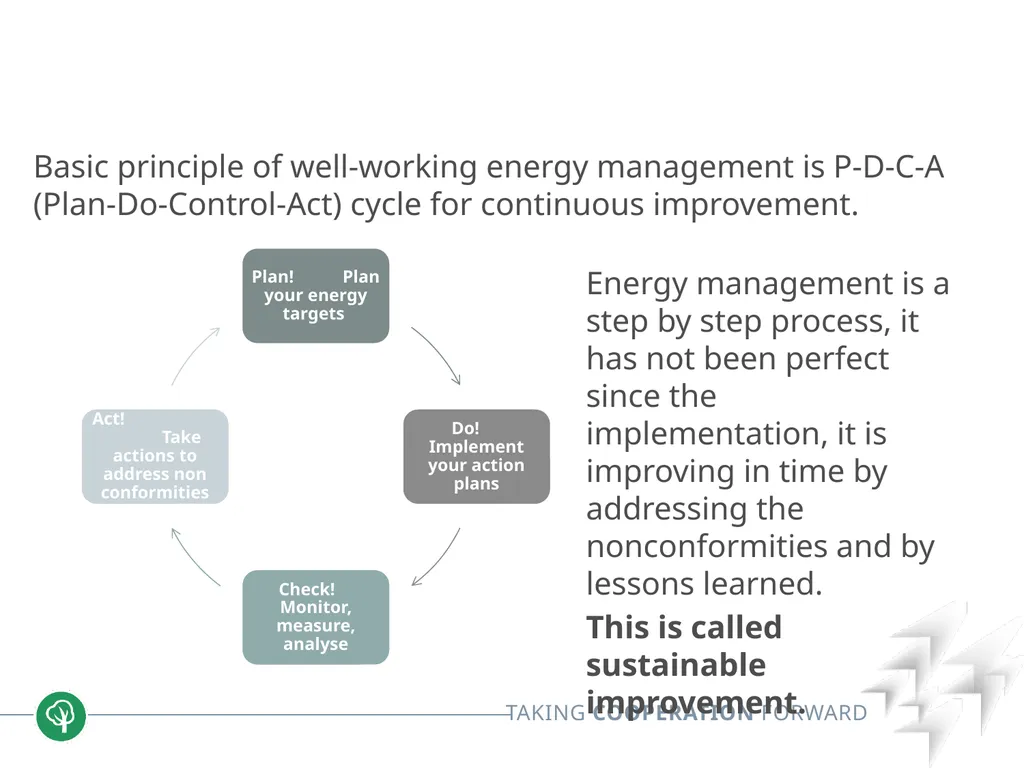
Basic principle of well-working energy management is P-D-C-A (Plan-Do-Control-Act) cycle for continuous improvement. Energy management is a step by step process, it has not been perfect since the implementation, it is improving in time by addressing the nonconformities and by lessons learned.
This is called sustainable improvement.<br>
This is called sustainable improvement.<br>
15
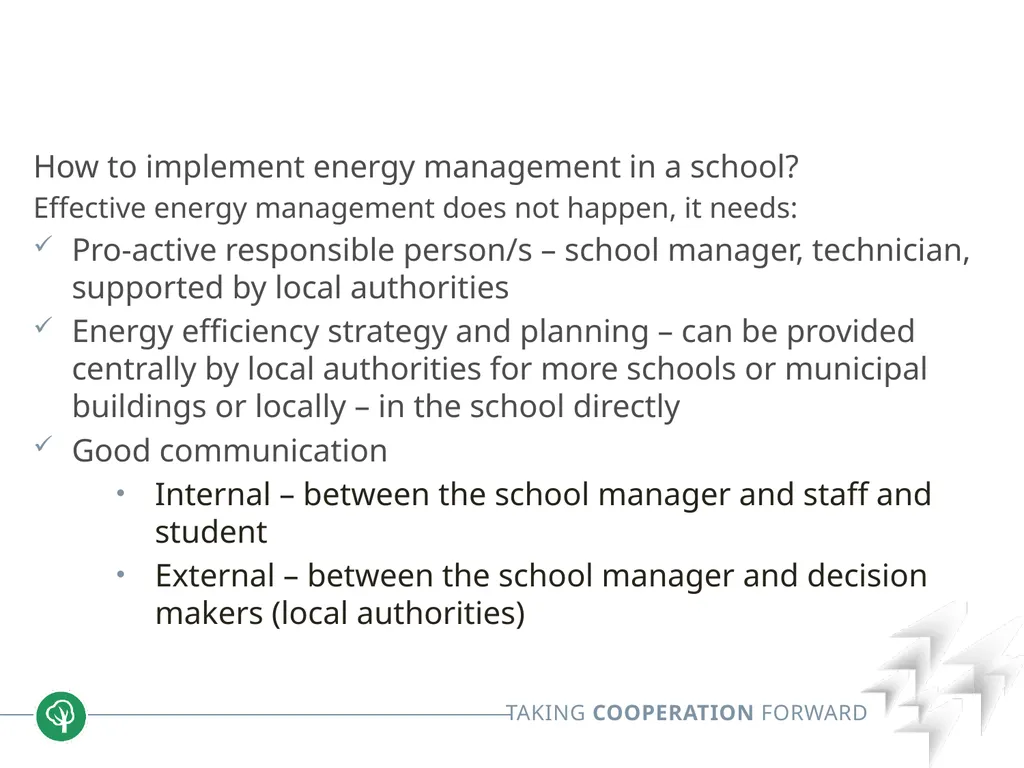
How to implement energy management in a school?
Effective energy management does not happen, it needs:
Pro-active responsible person/s – school manager, technician, supported by local authorities
Energy efficiency strategy and planning – can be provided centrally by local authorities for more schools or municipal buildings or locally – in the school directly
Good communication
Internal – between the school manager and staff and student
External – between the school manager and decision makers (local authorities)<br>
16
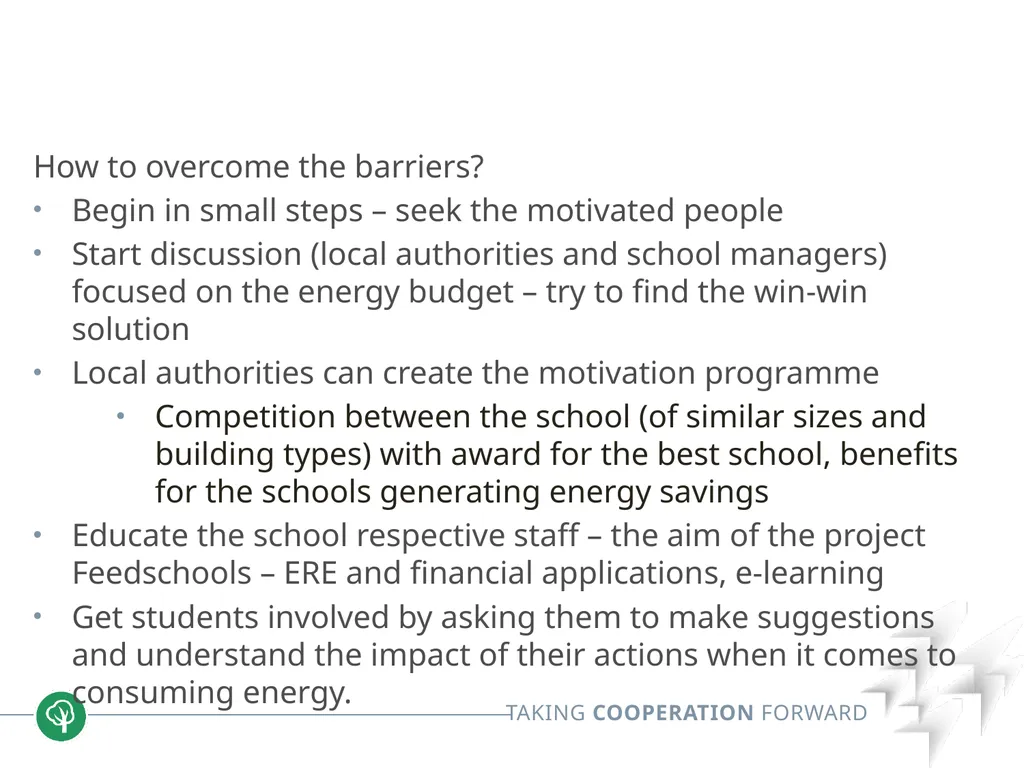
How to overcome the barriers?
Begin in small steps – seek the motivated people
Start discussion (local authorities and school managers) focused on the energy budget – try to find the win-win solution
Local authorities can create the motivation programme
Competition between the school (of similar sizes and building types) with award for the best school, benefits for the schools generating energy savings
Educate the school respective staff – the aim of the project Feedschools – ERE and financial applications, e-learning
Get students involved by asking them to make suggestions and understand the impact of their actions when it comes to consuming energy.<br>
17
Plan!
Competency
Find a motivated person or a team who will take care – the students can be involved, find a motivation, define the competences, organize a kick off meeting focused on the strategy to involve staff and students into the energy saving activities.<br>
Competency
Find a motivated person or a team who will take care – the students can be involved, find a motivation, define the competences, organize a kick off meeting focused on the strategy to involve staff and students into the energy saving activities.<br>
18
Plan!
Energy review
You need to understand the initial state of energy efficiency in your school – how is energy managed currently
start making a note of your current consumption
identify the current types of energy, specify the significant usage of energy, specify factors influencing energy performance (facility size, hours of operation, number of persons..)<br>
19
Plan!
Setting realistic targets
Collect the information from energy review and proposals and ideas from school staff and students and set a realistic target for your energy consumption or energy saving,
define the date when you analyze the consumption again to see the results (e.g. 1 year interval)<br>
Setting realistic targets
Collect the information from energy review and proposals and ideas from school staff and students and set a realistic target for your energy consumption or energy saving,
define the date when you analyze the consumption again to see the results (e.g. 1 year interval)<br>
20
Plan!
Development of the Action Plans
Specify the steps you will take to achieve the targets.
Identify the zero cost and low cost opportunities and set the action plan.
For high cost opportunities identification get in touch with your owner (e.g. local authorities) and communicate the possibilities and budget and set together the suitable investment proposal.<br>
21
Plan!
Development of the Action plans
Action plan contents clearly defined activities how to achieve the defined energy targets.
Basic action plan can be in a table format. It might involve minimally following information:
Description of planned activity
What resources will be used – financial, personal, time
Who will be responsible for the activity
When it will be completed
How the results will be evaluated/checked<br>
22
Do!
Action plan implementation
Implement your action plan, check the mile stones and deadlines.
Legislation compliance
Make activities required by legislation – e.g. energy audits, energy performance certificates, HVAC inspections, boiler inspections, etc.<br>
Action plan implementation
Implement your action plan, check the mile stones and deadlines.
Legislation compliance
Make activities required by legislation – e.g. energy audits, energy performance certificates, HVAC inspections, boiler inspections, etc.<br>
23
Do!
Procurement of services and equipment
When procuring energy using products or equipment, integrate energy performance as a criteria for your purchase
Discuss with school building owner (local authorities) the energy budget – try to negotiate some benefits for school in case that energy consumption is reduced
Dissemination
Inform the students and staff about the zero cost opportunities how to save energy, state clear rules for behavioural changes.<br>
24
Check!
Energy monitoring
Monitor your energy consumption for each energy carriers minimally once a month and write it down
Analyze the consumption – find the nonconformities and try to justify them
The best way is using an IT systems, but you can use also excel files at the beginning<br>
Energy monitoring
Monitor your energy consumption for each energy carriers minimally once a month and write it down
Analyze the consumption – find the nonconformities and try to justify them
The best way is using an IT systems, but you can use also excel files at the beginning<br>
25
Check!
Energy targets evaluation
Analyze the target regularly – e.g. once a year, compare the actual versus expected energy consumption. If you did not achieve the target, try to find out why and what you can improve
Legal compliance
Evaluate the compliance with legal requirement regularly. Check all revision reports, energy performance certificates, eventually energy audits and all other compliance with local energy regulation<br>
26
Act!
Corrective action
If you noticed any variation during the year, make a note and think what could cause them. Most of them usually have good reason – e.g. different use of the building, different weather conditions, change of equipment
If you find a variation which you cannot logically explain, search for its reason – it is probably some defect/non-comformity, take respective corrective actions.<br>
27
Act!
Improvement
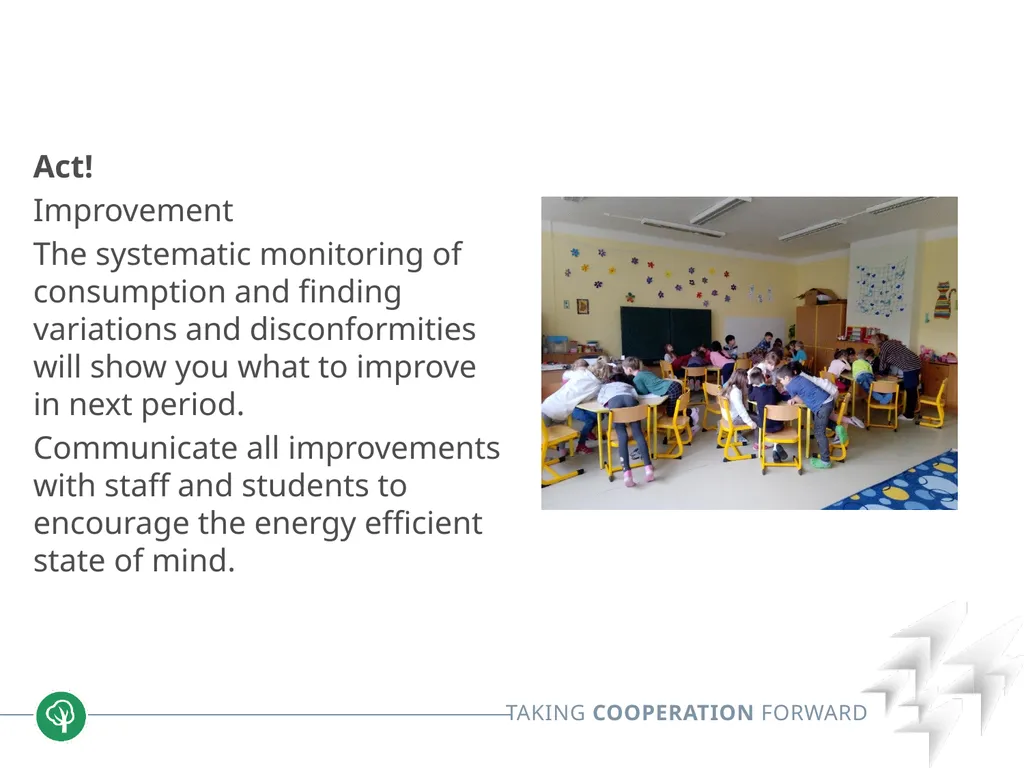
The systematic monitoring of consumption and finding variations and disconformities will show you what to improve in next period.
Communicate all improvements with staff and students to encourage the energy efficient state of mind.<br>
Improvement
The systematic monitoring of consumption and finding variations and disconformities will show you what to improve in next period.
Communicate all improvements with staff and students to encourage the energy efficient state of mind.<br>
28
https://ec.europa.eu/energy/topics/energy-efficiency/energy-efficient-buildings
This website provides the official and most comprehensive access to EU information concerning the building sector.
ISO 50001:2018 Energy management systems — Requirements with guidance for use (charged)
https://www.iso.org/standard/69426.html
TOGETHER - Step-by-step procedure handbook for EnMs in public buildings
https://www.interreg-central.eu/Content.Node/TOGETHER/CE51-TOGETHER--D.T2.1.5-Energy-Management-in-public-building.pdf
ENERinToWN - Monitoring and Control of Energy Consumption in Municipal Public Buildings over the Internet
https://ec.europa.eu/energy/intelligent/projects/sites/iee-projects/files/projects/documents/enerintown_publishable_report_en.pdf
JRC - Survey of energy audits and energy management systems in the Member States
https://publications.jrc.ec.europa.eu/repository/bitstream/JRC95432/survey%20of%20energy%20audits%20and%20energy%20management%20systems%20in%20the%20member%20states_pub.pdf<br>
29
ENVIROS, s.r.o.
Zuzana Lhotáková, consultant
Feedschools +420 284 007 498 Zuzana.lhotakova@enviros.cz www.enviros.cz facebook.com/enviros www.linkedin.com/company/enviros-s.r.o./<br>
Zuzana Lhotáková, consultant
Feedschools +420 284 007 498 Zuzana.lhotakova@enviros.cz www.enviros.cz facebook.com/enviros www.linkedin.com/company/enviros-s.r.o./<br>
30
Self assessment test Energy management means:
Energy management is the system of rules, activities, technologies and measures working in synergy and resulting to more efficient use of energy and thus reduction of operation cost of a building.
Specific software focused on energy consumption planning, monitoring and other energy management processes
Implementation of energy efficiency measures to reduce energy consumption of an organization.
The most often basic principle of well-working energy management is called:
P-D-C-A (plan-act-do-check)
Linear improvement of energy consumption
Monitoring and targeting
Energy targets are:
Activities which have to be done to achieve the planned reduction of energy consumption
Planned values (or planned reduction) of energy consumption to achieve in the next planning period
Energy labels located at the electric appliances
The energy review which is a part of energy management means:
Setting the targets for energy consumption reduction
Finding out the initial state of energy efficiency (current types of energy, significant usage of energy, specify factors influencing energy performance, energy consumption….)
Finding out the competencies of energy management implementation team<br>