
Block 2: Energy efficiency in buildings 2.1. nZEB
CP
Published · 23 slides · 0 views

1 / 1


Description
Block 2: Energy efficiency in buildings 2.1. nZEB legislation in EU E-learning course FEEDSCHOOLS, by RIC PRO-AKADEMIA This module is part of a training package developed to provide local authorities with free tuition that may inspire and
Related Topics
Share
Embed code
Download this presentation From Below
"Block 2: Energy efficiency in buildings 2.1. nZEB" is the property of its rightful owner. Permission is granted to download and print the materials on this website for personal, non-commercial use only, and to display it on your personal computer provided you do not modify the materials and that you retain all copyright notices contained in the materials. By downloading content from our website, you accept the terms of this agreement.
Presentation Transcript
01
Block 2: Energy efficiency in buildings
2.1. nZEB legislation in EU E-learning course FEEDSCHOOLS, by RIC PRO-AKADEMIA<br>
2.1. nZEB legislation in EU E-learning course FEEDSCHOOLS, by RIC PRO-AKADEMIA<br>
02
This module is part of a training package developed to provide local authorities with free tuition that may inspire and help them in adopting new technical and financial solutions to implement ‘nearly Zero Energy Building’ (NZEB) renovation activities in schools.
This block is meant to introduce you to EU legislation related to energy efficiency of buildings and NZEB. Beside regulations introduced at the European level, examples of their implementation in selected countries will be presented.
Beginner: No special knowledge is needed.
Intermediate: No special knowledge is needed.
Advanced: No special knowledge is needed.<br>
This block is meant to introduce you to EU legislation related to energy efficiency of buildings and NZEB. Beside regulations introduced at the European level, examples of their implementation in selected countries will be presented.
Beginner: No special knowledge is needed.
Intermediate: No special knowledge is needed.
Advanced: No special knowledge is needed.<br>
03
2.1.1 Motivation – energy consumption in buidlings in the EU 2.1.2 Key provisions for Member States regarding energy efficiency 2.1.3 nZEB concept and its implementation in selected EU countires Learning Objective:
At the end of this module attendees will be provided with general knowledge about legal basis of energy efficiency in buildigns in the EU.<br>
At the end of this module attendees will be provided with general knowledge about legal basis of energy efficiency in buildigns in the EU.<br>
04
2.1.1 Motivation – energy consumption in buidlings in the EU Objective
In this unit you will learn why increasing energy energy efficiency in buildings is important in the EU.<br>
In this unit you will learn why increasing energy energy efficiency in buildings is important in the EU.<br>
05
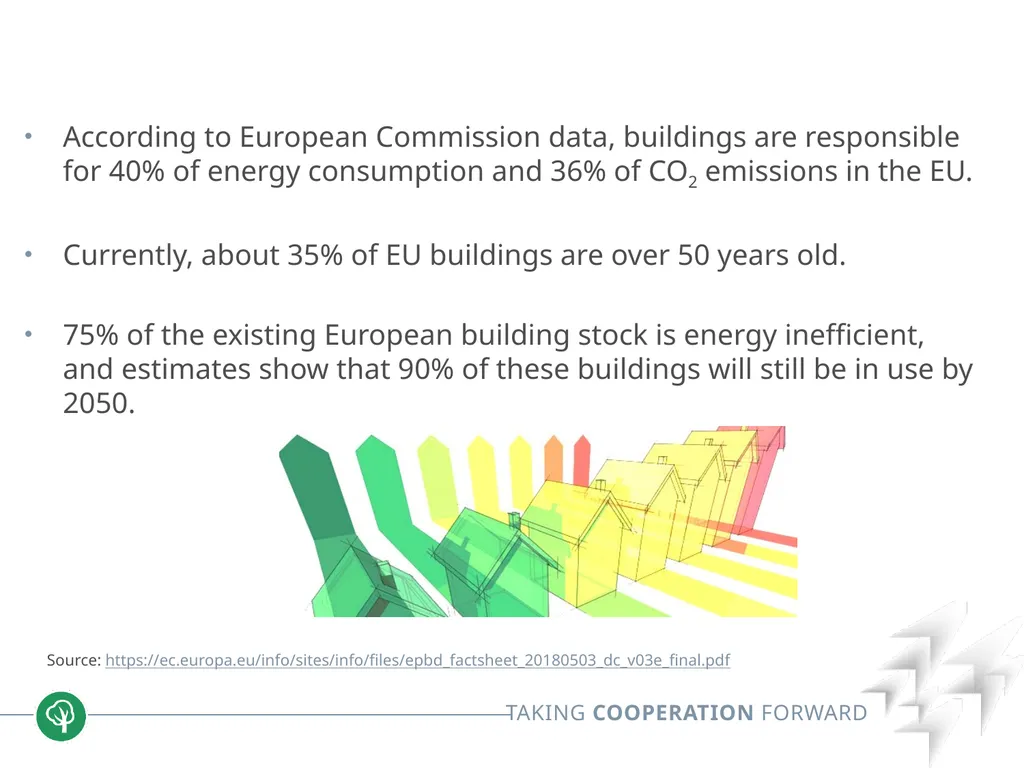
According to European Commission data, buildings are responsible for 40% of energy consumption and 36% of CO2 emissions in the EU.
Currently, about 35% of EU buildings are over 50 years old.
75% of the existing European building stock is energy inefficient, and estimates show that 90% of these buildings will still be in use by 2050. Source: https://ec.europa.eu/info/sites/info/files/epbd_factsheet_20180503_dc_v03e_final.pdf<br>
Currently, about 35% of EU buildings are over 50 years old.
75% of the existing European building stock is energy inefficient, and estimates show that 90% of these buildings will still be in use by 2050. Source: https://ec.europa.eu/info/sites/info/files/epbd_factsheet_20180503_dc_v03e_final.pdf<br>
06
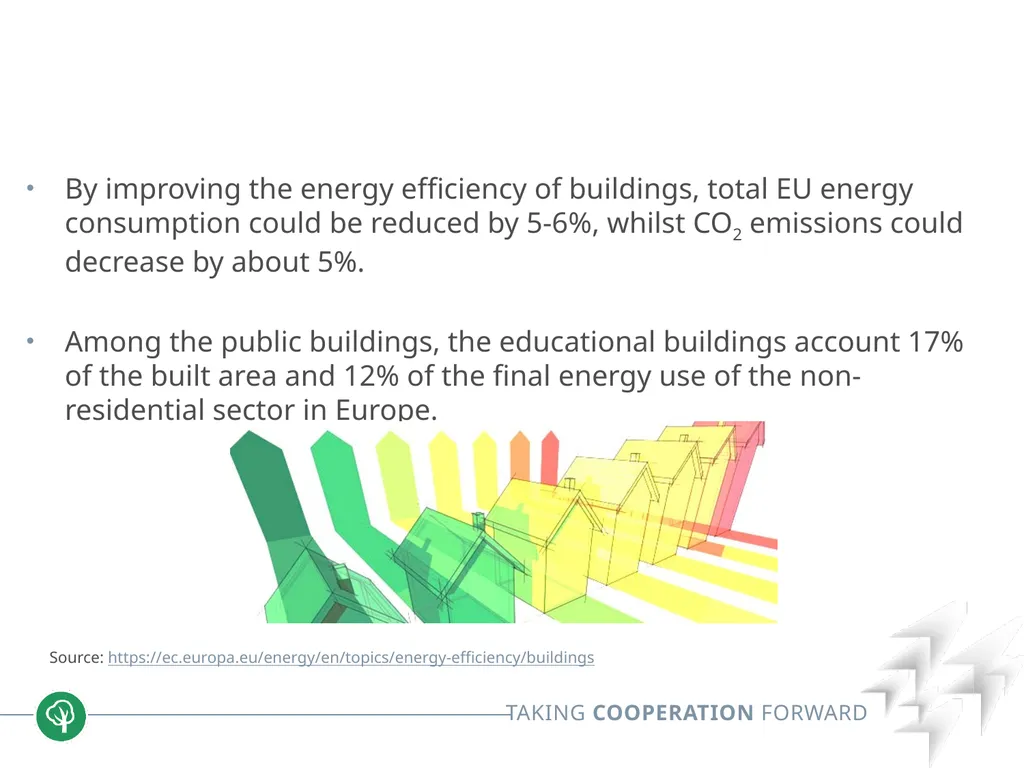
By improving the energy efficiency of buildings, total EU energy consumption could be reduced by 5‑6%, whilst CO2 emissions could decrease by about 5%.
Among the public buildings, the educational buildings account 17% of the built area and 12% of the final energy use of the non-residential sector in Europe. Source: https://ec.europa.eu/energy/en/topics/energy-efficiency/buildings<br>
Among the public buildings, the educational buildings account 17% of the built area and 12% of the final energy use of the non-residential sector in Europe. Source: https://ec.europa.eu/energy/en/topics/energy-efficiency/buildings<br>
07
2.1.2 Key provisions for Member States regarding energy efficiency Objective
In this unit you will learn which EU directives are essential in terms of energy efficiency of buildings, and what requirements they put on EU Member States<br>
In this unit you will learn which EU directives are essential in terms of energy efficiency of buildings, and what requirements they put on EU Member States<br>
08
Directive 2010/31/EU on the energy performance of buildings (EPBD)
Sets minimum energy performance requirements for new buildings, for the major renovation of buildings and for the replacement or retrofit of building elements
Requires that all new buildings must be nearly zero-energy buildings (‘nZEB’) since 2021.
Requires that buildings occupied and owned by public authorities must be nZEB since 2019.
Member States are required to develop National Plans for increasing the number of NZEBs<br>
Sets minimum energy performance requirements for new buildings, for the major renovation of buildings and for the replacement or retrofit of building elements
Requires that all new buildings must be nearly zero-energy buildings (‘nZEB’) since 2021.
Requires that buildings occupied and owned by public authorities must be nZEB since 2019.
Member States are required to develop National Plans for increasing the number of NZEBs<br>
09
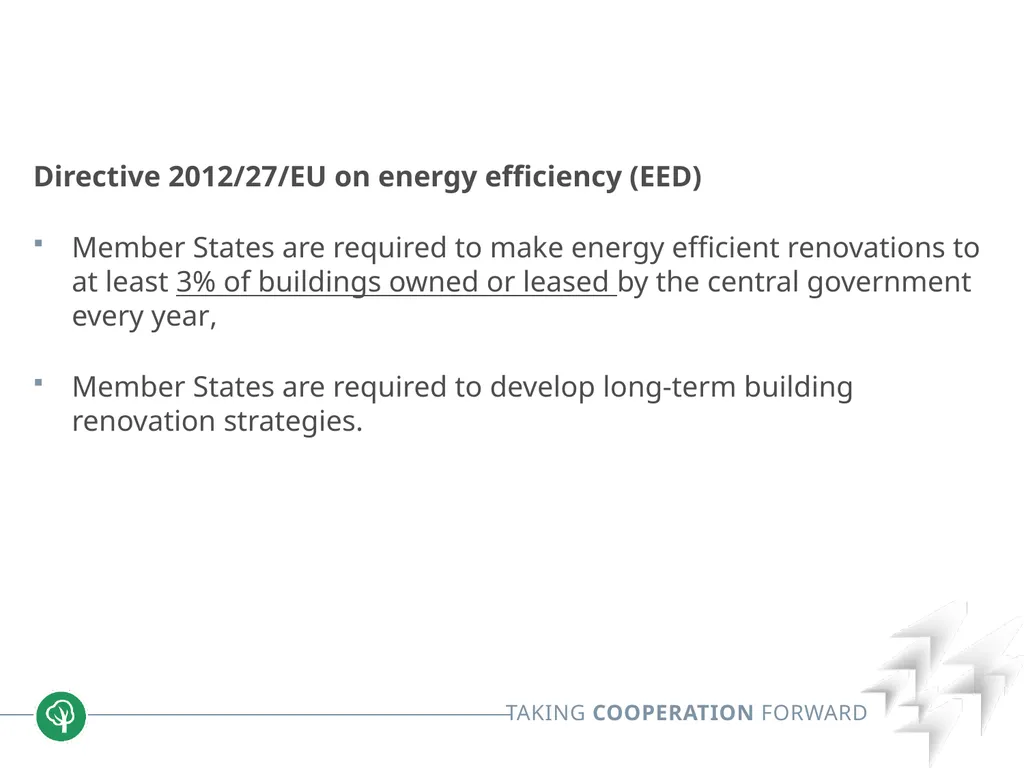
Directive 2012/27/EU on energy efficiency (EED)
Member States are required to make energy efficient renovations to at least 3% of buildings owned or leased by the central government every year,
Member States are required to develop long-term building renovation strategies.<br>
Member States are required to make energy efficient renovations to at least 3% of buildings owned or leased by the central government every year,
Member States are required to develop long-term building renovation strategies.<br>
10
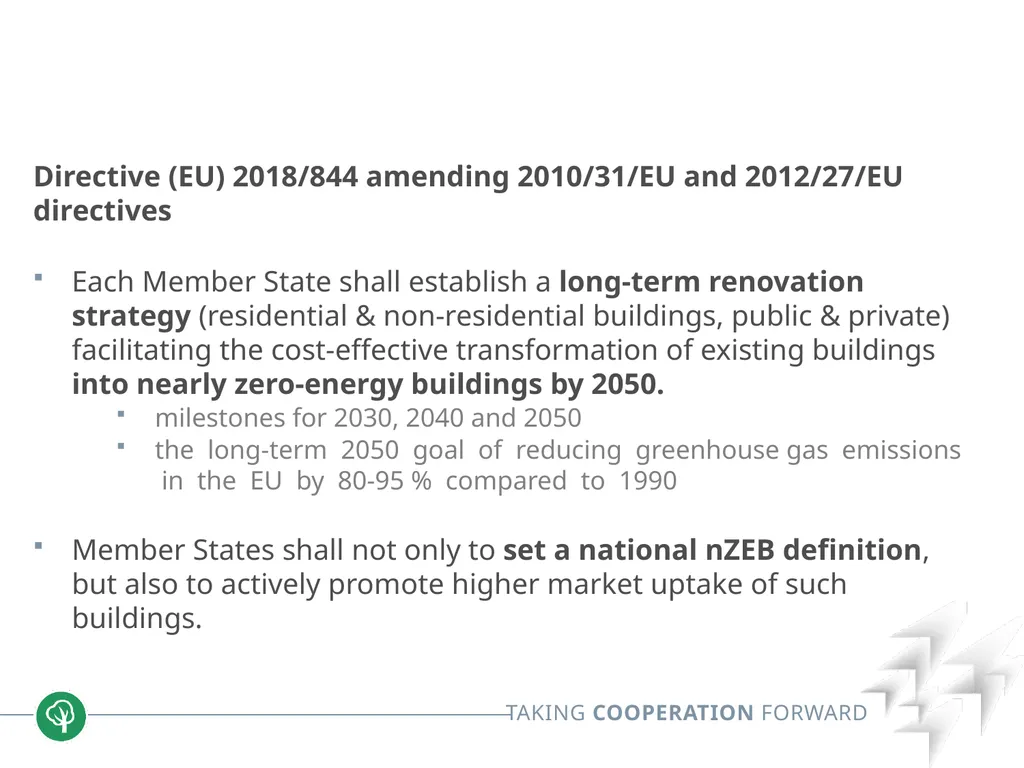
Directive (EU) 2018/844 amending 2010/31/EU and 2012/27/EU directives
Each Member State shall establish a long-term renovation strategy (residential & non-residential buildings, public & private) facilitating the cost-effective transformation of existing buildings into nearly zero-energy buildings by 2050.
milestones for 2030, 2040 and 2050
the long-term 2050 goal of reducing greenhouse gas emissions in the EU by 80-95 % compared to 1990
Member States shall not only to set a national nZEB definition, but also to actively promote higher market uptake of such buildings.<br>
Each Member State shall establish a long-term renovation strategy (residential & non-residential buildings, public & private) facilitating the cost-effective transformation of existing buildings into nearly zero-energy buildings by 2050.
milestones for 2030, 2040 and 2050
the long-term 2050 goal of reducing greenhouse gas emissions in the EU by 80-95 % compared to 1990
Member States shall not only to set a national nZEB definition, but also to actively promote higher market uptake of such buildings.<br>
11
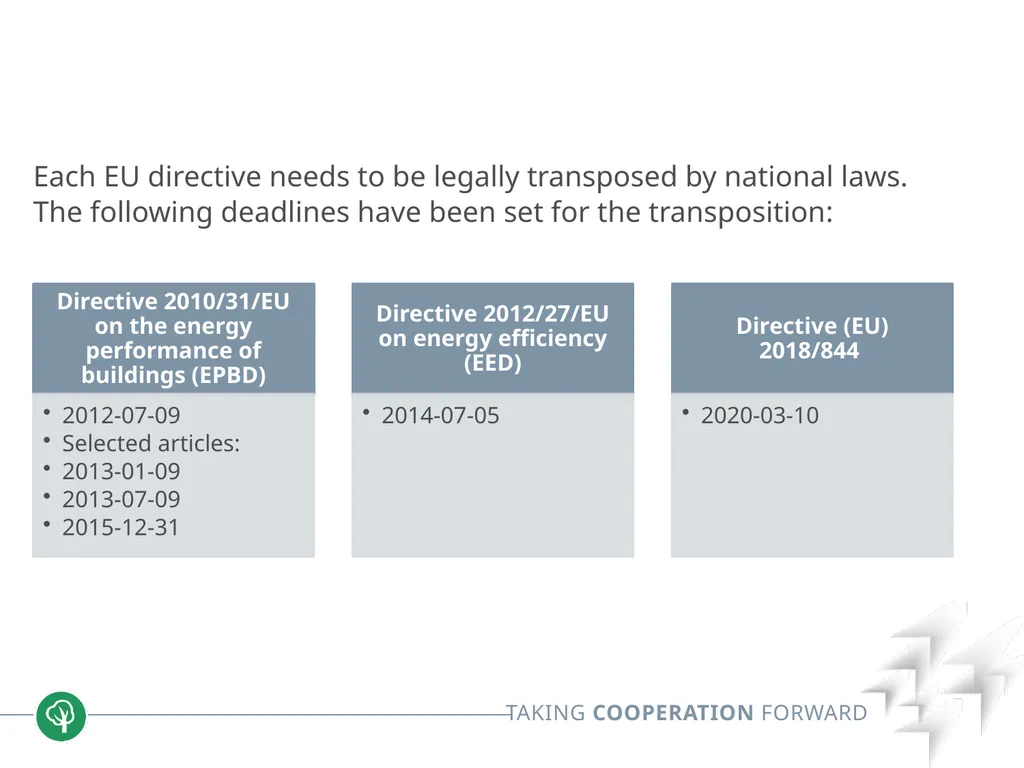
Each EU directive needs to be legally transposed by national laws.
The following deadlines have been set for the transposition:<br>
The following deadlines have been set for the transposition:<br>
12
2.1.3 nZEB concept and its implementation in selected EU Countires Objective
In this unit you will learn what does “nearly-zero energy building” mean and how selected Central European countries implemented this concept into their national regulations<br>
In this unit you will learn what does “nearly-zero energy building” mean and how selected Central European countries implemented this concept into their national regulations<br>
13
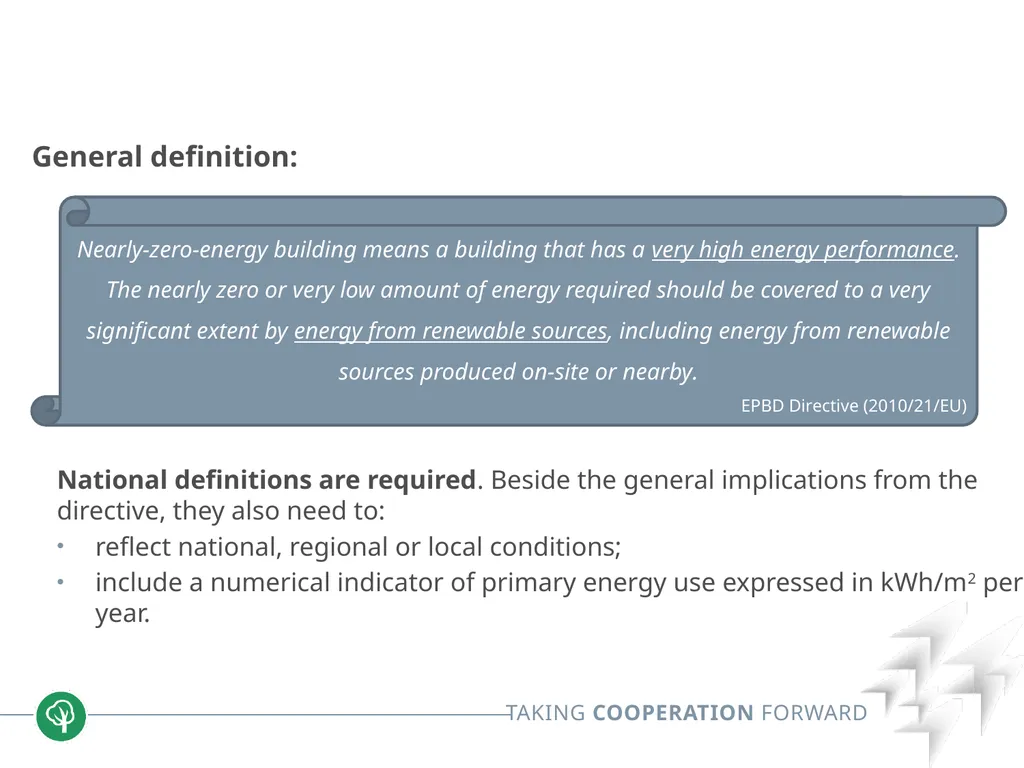
General definition: Nearly-zero-energy building means a building that has a very high energy performance. The nearly zero or very low amount of energy required should be covered to a very significant extent by energy from renewable sources, including energy from renewable sources produced on-site or nearby.
EPBD Directive (2010/21/EU) National definitions are required. Beside the general implications from the directive, they also need to:
reflect national, regional or local conditions;
include a numerical indicator of primary energy use expressed in kWh/m2 per year.<br>
EPBD Directive (2010/21/EU) National definitions are required. Beside the general implications from the directive, they also need to:
reflect national, regional or local conditions;
include a numerical indicator of primary energy use expressed in kWh/m2 per year.<br>
14
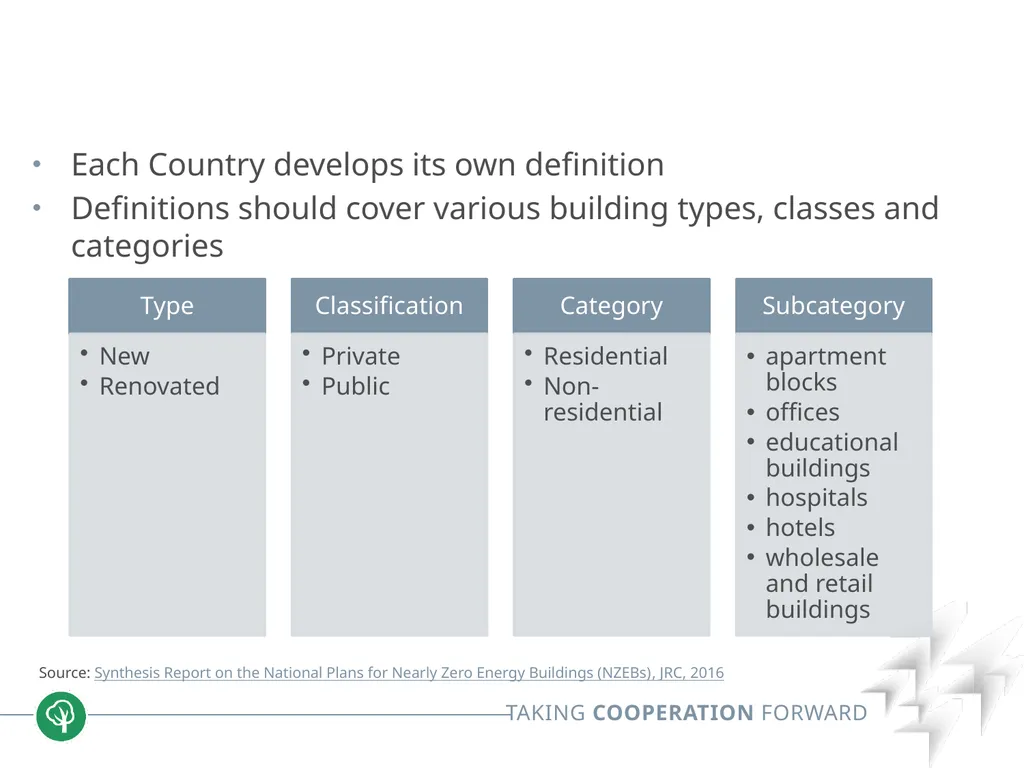
Source: Synthesis Report on the National Plans for Nearly Zero Energy Buildings (NZEBs), JRC, 2016 Each Country develops its own definition
Definitions should cover various building types, classes and categories<br>
Definitions should cover various building types, classes and categories<br>
15
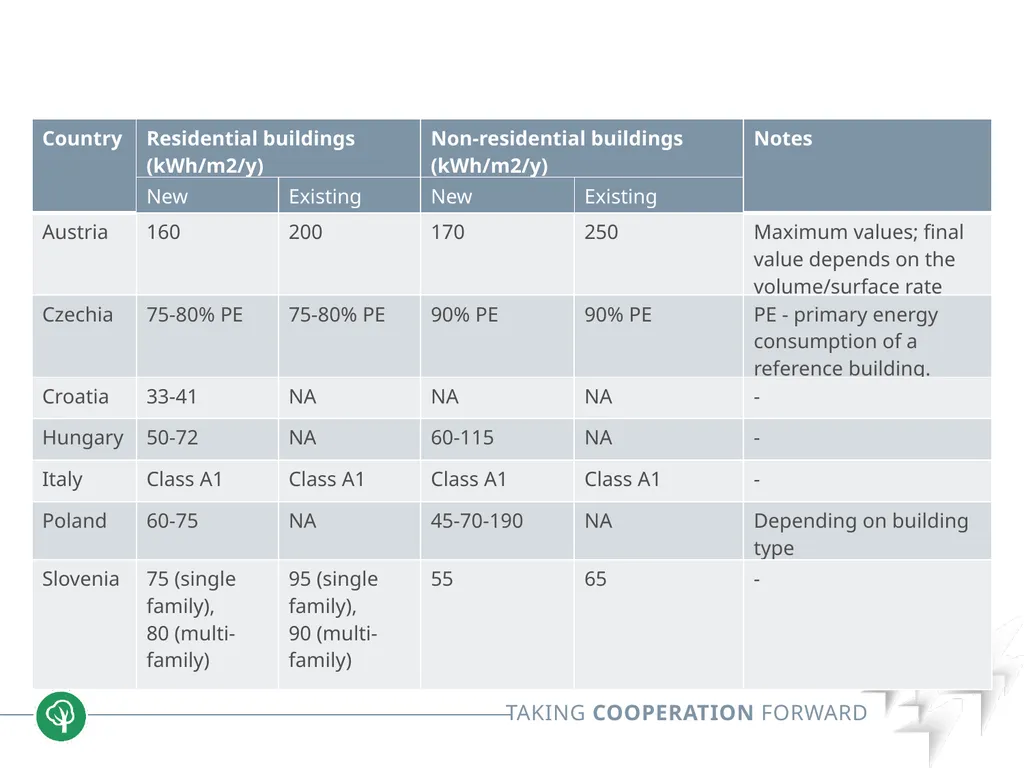
Source: Synthesis Report on the National Plans for Nearly Zero Energy Buildings (NZEBs), JRC, 2016<br>
16
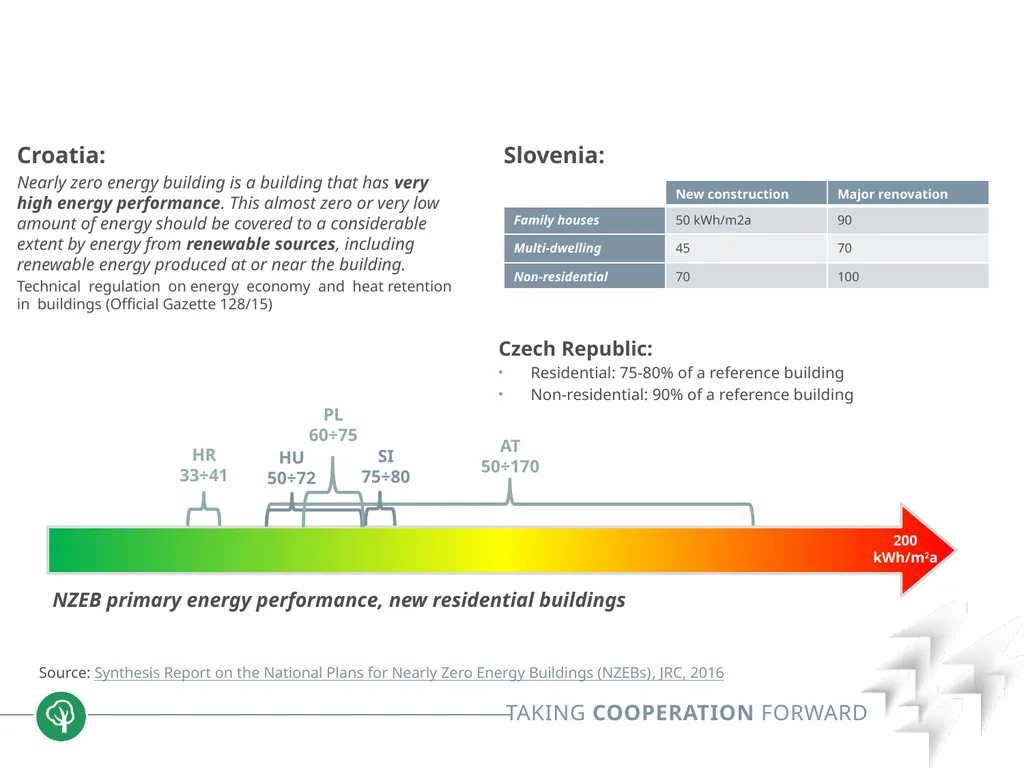
Croatia:
Nearly zero energy building is a building that has very high energy performance. This almost zero or very low amount of energy should be covered to a considerable extent by energy from renewable sources, including renewable energy produced at or near the building.
Technical regulation on energy economy and heat retention in buildings (Official Gazette 128/15) Slovenia: Source: Synthesis Report on the National Plans for Nearly Zero Energy Buildings (NZEBs), JRC, 2016 NZEB primary energy performance, new residential buildings Czech Republic:
Residential: 75-80% of a reference building
Non-residential: 90% of a reference building<br>
Nearly zero energy building is a building that has very high energy performance. This almost zero or very low amount of energy should be covered to a considerable extent by energy from renewable sources, including renewable energy produced at or near the building.
Technical regulation on energy economy and heat retention in buildings (Official Gazette 128/15) Slovenia: Source: Synthesis Report on the National Plans for Nearly Zero Energy Buildings (NZEBs), JRC, 2016 NZEB primary energy performance, new residential buildings Czech Republic:
Residential: 75-80% of a reference building
Non-residential: 90% of a reference building<br>
17
Katarzyna Korczak
Research and Innovation Centre Pro-Akademia katarzyna.korczak@proakademia.eu www.proakademia.eu/en/ facebook.com/ProAkademia/ twitter.com/CBI_ProAkademia/ linkedin.com/company/5154403/<br>
Research and Innovation Centre Pro-Akademia katarzyna.korczak@proakademia.eu www.proakademia.eu/en/ facebook.com/ProAkademia/ twitter.com/CBI_ProAkademia/ linkedin.com/company/5154403/<br>
18
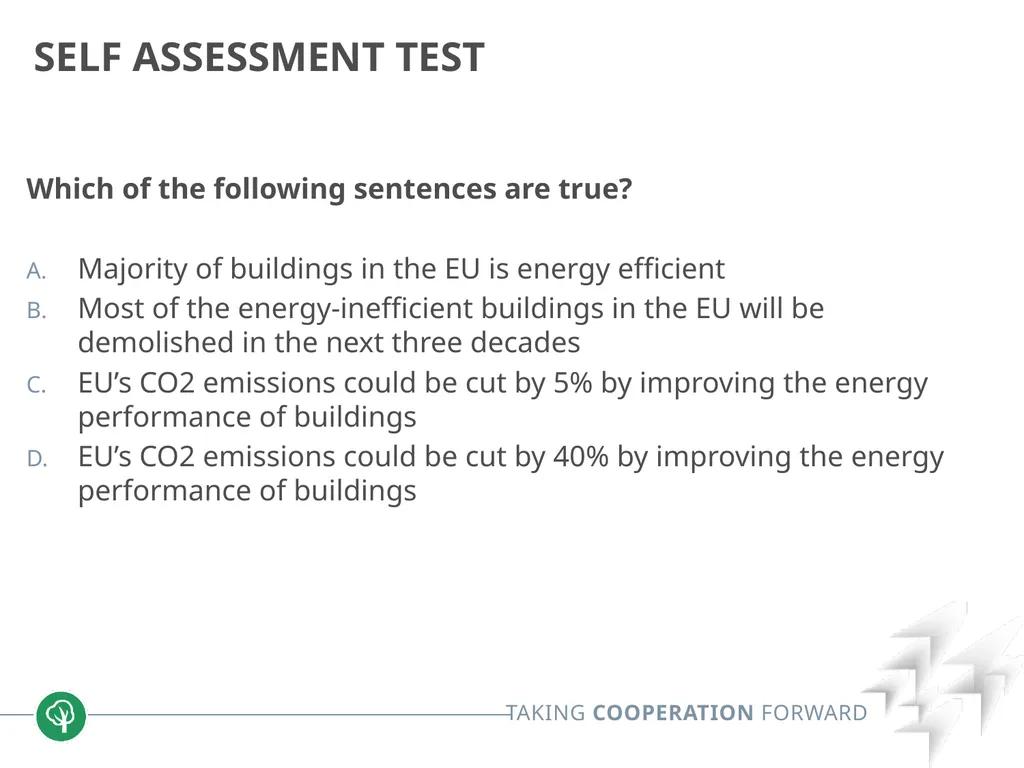
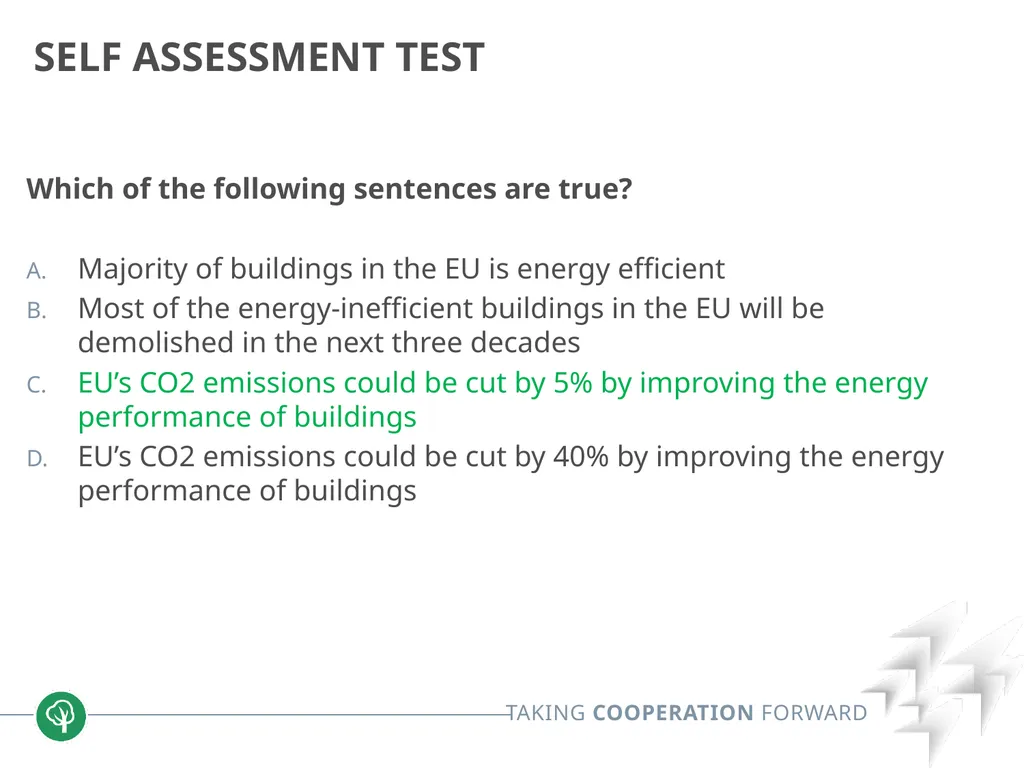
Self assessment test Which of the following sentences are true?
Majority of buildings in the EU is energy efficient
Most of the energy-inefficient buildings in the EU will be demolished in the next three decades
EU’s CO2 emissions could be cut by 5% by improving the energy performance of buildings
EU’s CO2 emissions could be cut by 40% by improving the energy performance of buildings<br>
Majority of buildings in the EU is energy efficient
Most of the energy-inefficient buildings in the EU will be demolished in the next three decades
EU’s CO2 emissions could be cut by 5% by improving the energy performance of buildings
EU’s CO2 emissions could be cut by 40% by improving the energy performance of buildings<br>
19
Self assessment test Which of the following sentences are true?
Majority of buildings in the EU is energy efficient
Most of the energy-inefficient buildings in the EU will be demolished in the next three decades
EU’s CO2 emissions could be cut by 5% by improving the energy performance of buildings
EU’s CO2 emissions could be cut by 40% by improving the energy performance of buildings<br>
Majority of buildings in the EU is energy efficient
Most of the energy-inefficient buildings in the EU will be demolished in the next three decades
EU’s CO2 emissions could be cut by 5% by improving the energy performance of buildings
EU’s CO2 emissions could be cut by 40% by improving the energy performance of buildings<br>
20
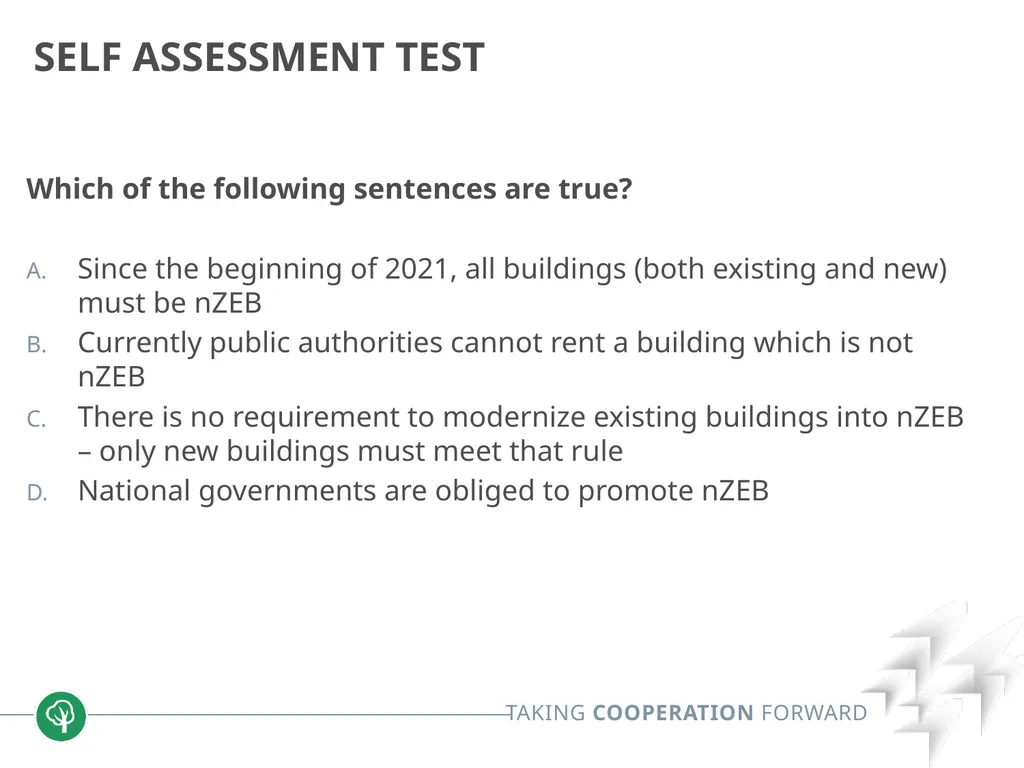
Self assessment test Which of the following sentences are true?
Since the beginning of 2021, all buildings (both existing and new) must be nZEB
Currently public authorities cannot rent a building which is not nZEB
There is no requirement to modernize existing buildings into nZEB – only new buildings must meet that rule
National governments are obliged to promote nZEB<br>
Since the beginning of 2021, all buildings (both existing and new) must be nZEB
Currently public authorities cannot rent a building which is not nZEB
There is no requirement to modernize existing buildings into nZEB – only new buildings must meet that rule
National governments are obliged to promote nZEB<br>
21
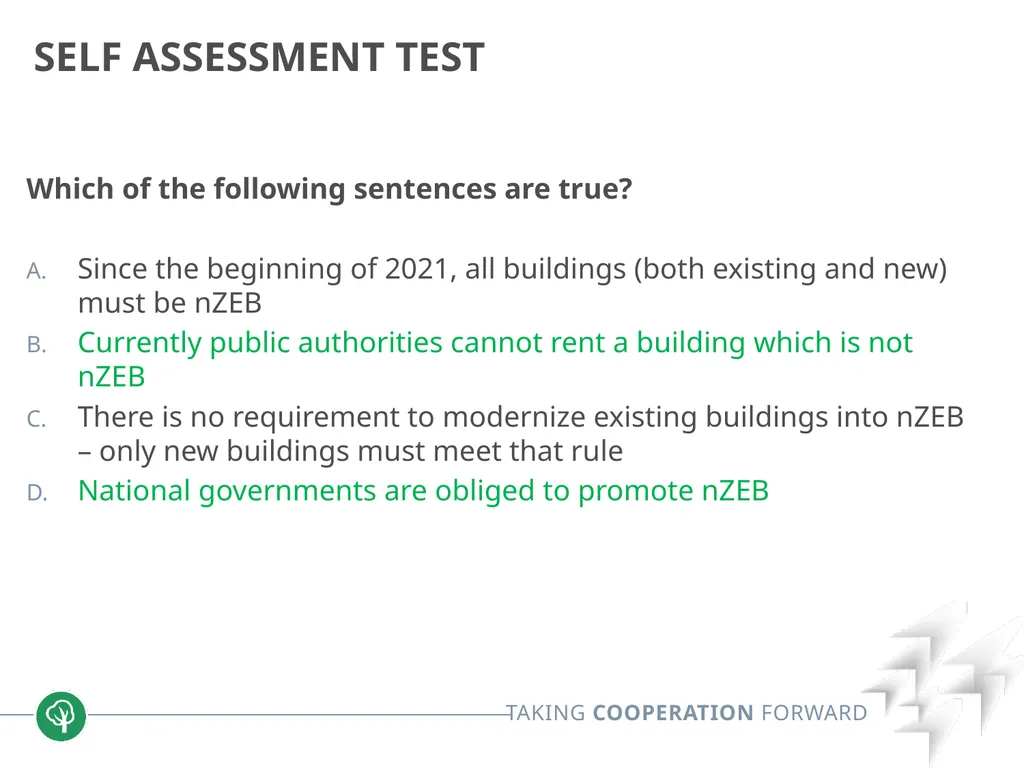
Self assessment test Which of the following sentences are true?
Since the beginning of 2021, all buildings (both existing and new) must be nZEB
Currently public authorities cannot rent a building which is not nZEB
There is no requirement to modernize existing buildings into nZEB – only new buildings must meet that rule
National governments are obliged to promote nZEB<br>
Since the beginning of 2021, all buildings (both existing and new) must be nZEB
Currently public authorities cannot rent a building which is not nZEB
There is no requirement to modernize existing buildings into nZEB – only new buildings must meet that rule
National governments are obliged to promote nZEB<br>
22
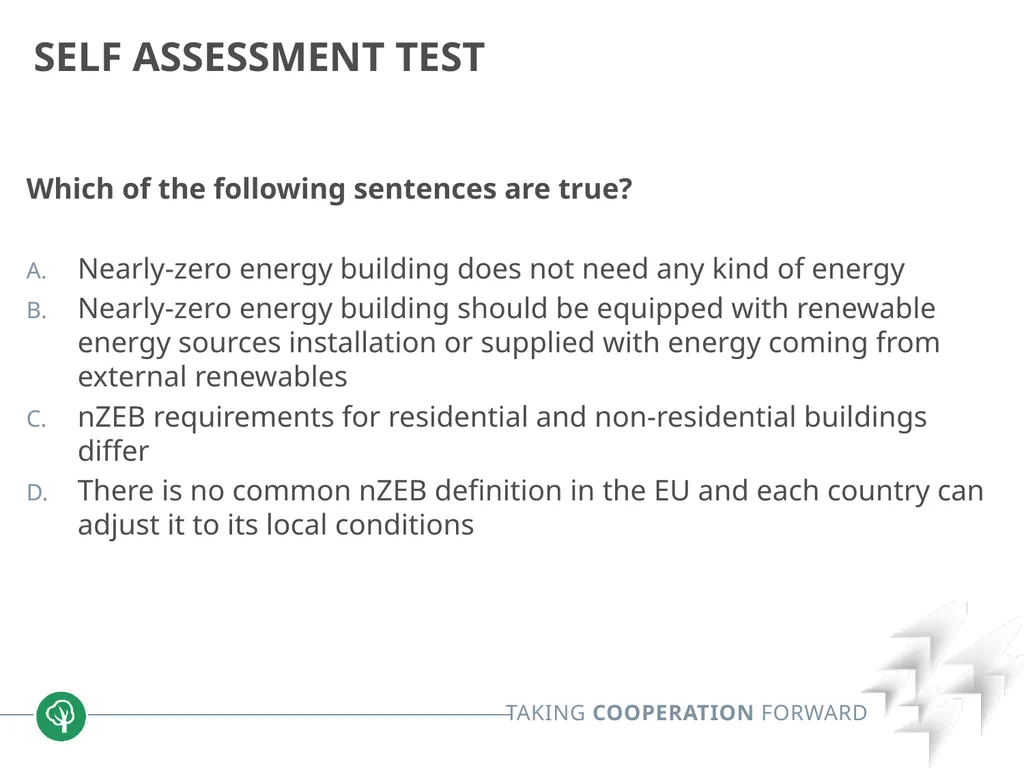
Self assessment test Which of the following sentences are true?
Nearly-zero energy building does not need any kind of energy
Nearly-zero energy building should be equipped with renewable energy sources installation or supplied with energy coming from external renewables
nZEB requirements for residential and non-residential buildings differ
There is no common nZEB definition in the EU and each country can adjust it to its local conditions<br>
Nearly-zero energy building does not need any kind of energy
Nearly-zero energy building should be equipped with renewable energy sources installation or supplied with energy coming from external renewables
nZEB requirements for residential and non-residential buildings differ
There is no common nZEB definition in the EU and each country can adjust it to its local conditions<br>
23
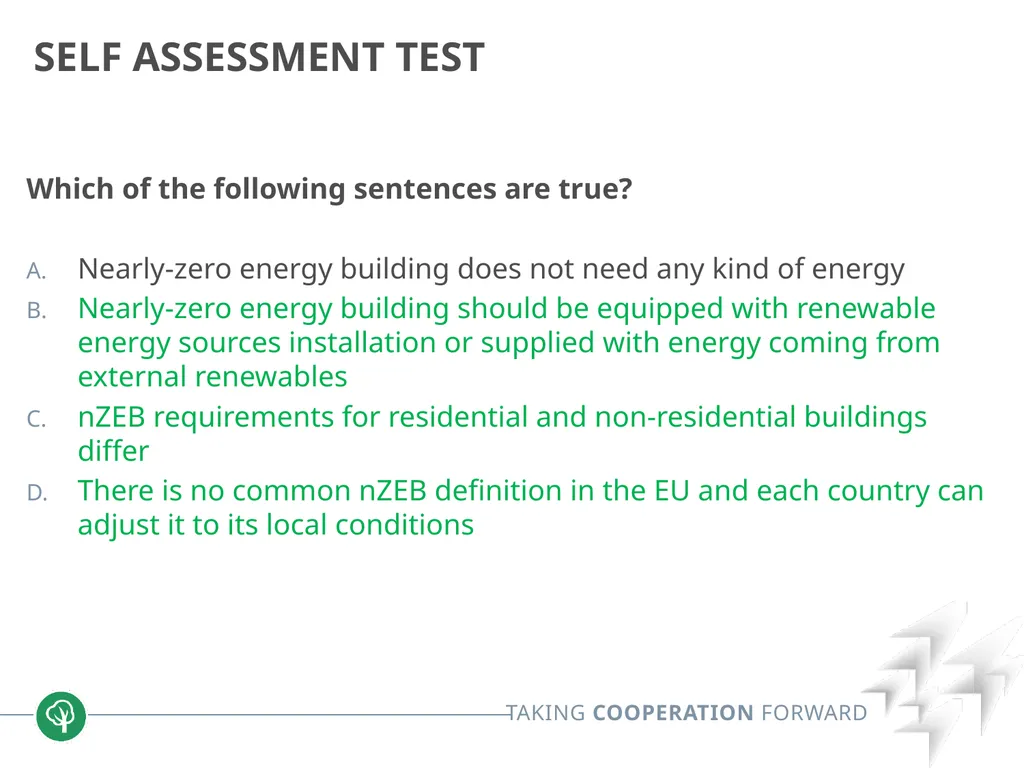
Self assessment test Which of the following sentences are true?
Nearly-zero energy building does not need any kind of energy
Nearly-zero energy building should be equipped with renewable energy sources installation or supplied with energy coming from external renewables
nZEB requirements for residential and non-residential buildings differ
There is no common nZEB definition in the EU and each country can adjust it to its local conditions<br>
Nearly-zero energy building does not need any kind of energy
Nearly-zero energy building should be equipped with renewable energy sources installation or supplied with energy coming from external renewables
nZEB requirements for residential and non-residential buildings differ
There is no common nZEB definition in the EU and each country can adjust it to its local conditions<br>