
Blockchain What is blockchain Open ledger, a
BR
Published · 35 slides · 0 views
1 / 1
Description
Blockchain What is blockchain Open ledger, a technology for securely transferring assets (without a trusted 3rd party). Third parties often charge a sizeable fee, and slow down transactions (think of banks, credit card companies) and are a
Related Topics
Share
Embed code
Download this presentation From Below
"Blockchain What is blockchain Open ledger, a" is the property of its rightful owner. Permission is granted to download and print the materials on this website for personal, non-commercial use only, and to display it on your personal computer provided you do not modify the materials and that you retain all copyright notices contained in the materials. By downloading content from our website, you accept the terms of this agreement.
Presentation Transcript
01
Blockchain<br>
02
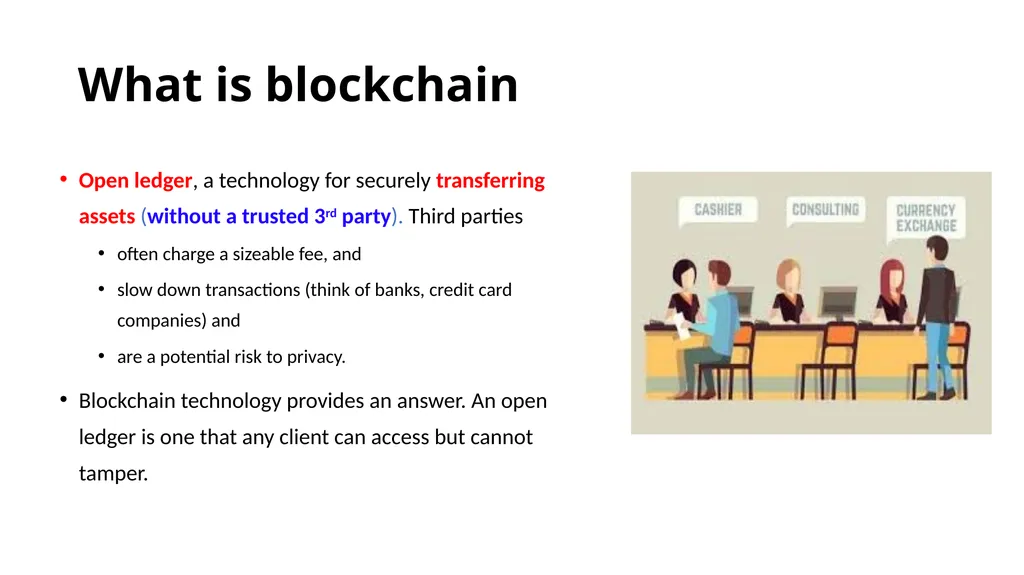
What is blockchain Open ledger, a technology for securely transferring assets (without a trusted 3rd party). Third parties
often charge a sizeable fee, and
slow down transactions (think of banks, credit card companies) and
are a potential risk to privacy.
Blockchain technology provides an answer. An open ledger is one that any client can access but cannot tamper.<br>
often charge a sizeable fee, and
slow down transactions (think of banks, credit card companies) and
are a potential risk to privacy.
Blockchain technology provides an answer. An open ledger is one that any client can access but cannot tamper.<br>
03
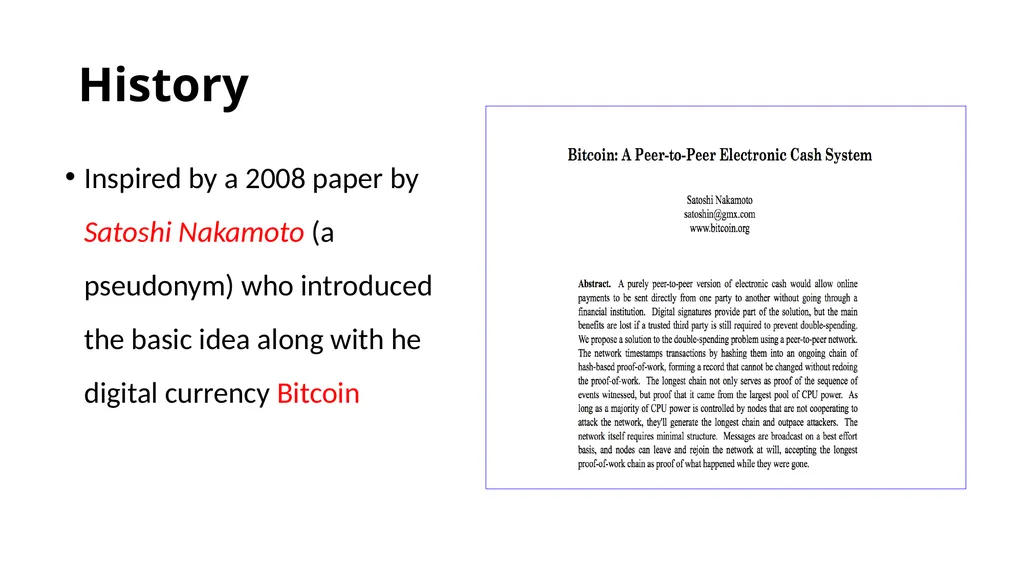
History Inspired by a 2008 paper by Satoshi Nakamoto (a pseudonym) who introduced the basic idea along with he digital currency Bitcoin<br>
04
The Network Each node is a computer in a P2P network.
Each client has two keys:
the public key (known to all) used as the address of the client’s account
The private key is known to the client only<br>
Each client has two keys:
the public key (known to all) used as the address of the client’s account
The private key is known to the client only<br>
05
Open ledger A ledger is an account book used to record transactions.
Blockchain is an open distributed ledger that records all transactions between clients in a verifiable way, and all changes are irreversible, so the records are permanent. No one can tamper it.<br>
Blockchain is an open distributed ledger that records all transactions between clients in a verifiable way, and all changes are irreversible, so the records are permanent. No one can tamper it.<br>
06
Permissionless vs permissioned blockchain Permissionless (public or open) blockchain
Anyone can join, access and verify the records.
Bitcoin and Ethereum use permissionless blockchain
Permissioned (private or closed) blockchain
Need permission to join. Privately controlled. In a way, flips the
whole idea of a blockchain on its head. But works within an enterprise.<br>
Anyone can join, access and verify the records.
Bitcoin and Ethereum use permissionless blockchain
Permissioned (private or closed) blockchain
Need permission to join. Privately controlled. In a way, flips the
whole idea of a blockchain on its head. But works within an enterprise.<br>
07
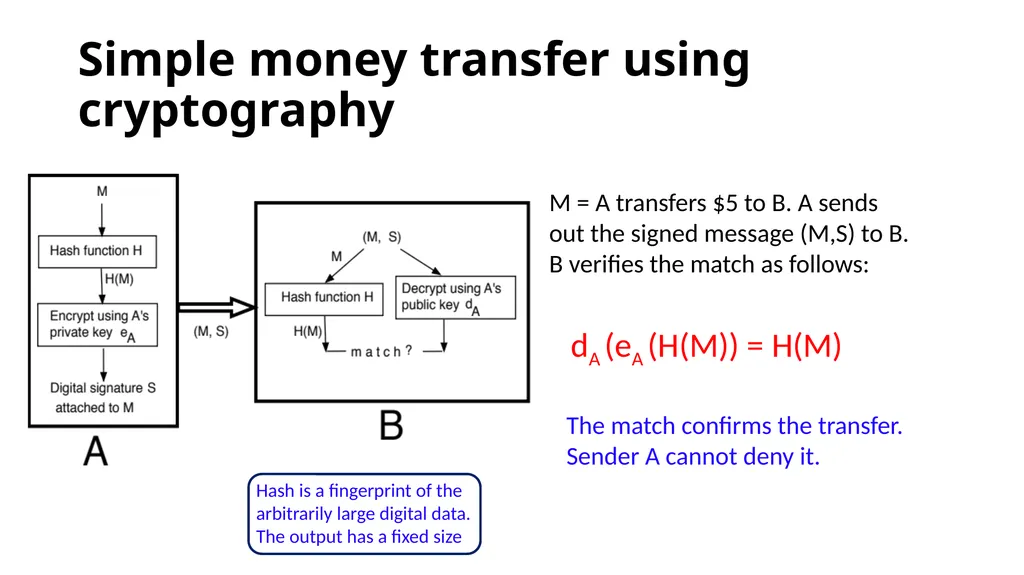
Simple money transfer using cryptography The match confirms the transfer.
Sender A cannot deny it. M = A transfers $5 to B. A sends
out the signed message (M,S) to B.
B verifies the match as follows: Hash is a fingerprint of the
arbitrarily large digital data.
The output has a fixed size dA (eA (H(M)) = H(M)<br>
Sender A cannot deny it. M = A transfers $5 to B. A sends
out the signed message (M,S) to B.
B verifies the match as follows: Hash is a fingerprint of the
arbitrarily large digital data.
The output has a fixed size dA (eA (H(M)) = H(M)<br>
08
Double spending attack Beware of double spending.
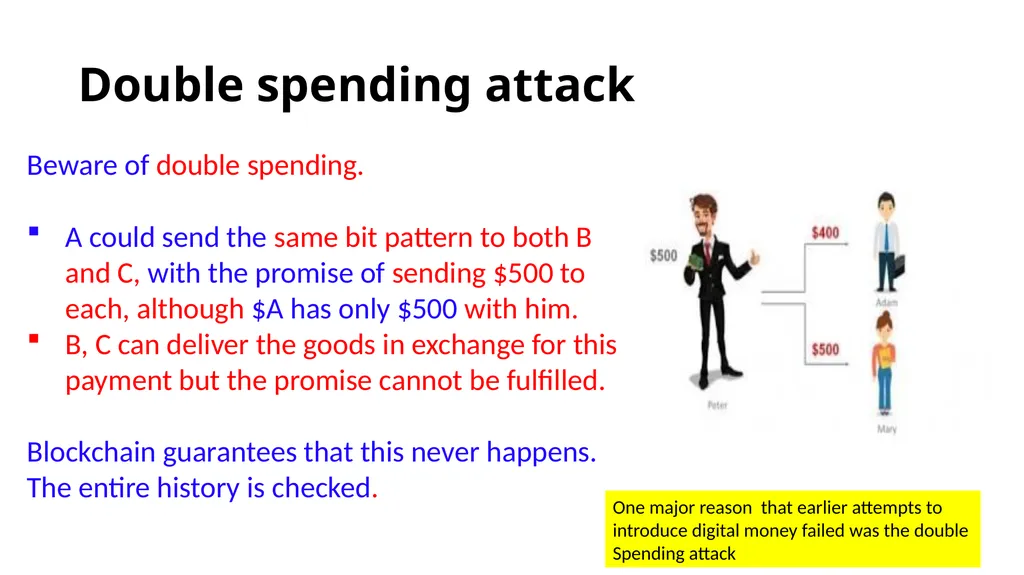
A could send the same bit pattern to both B and C, with the promise of sending $500 to each, although $A has only $500 with him.
B, C can deliver the goods in exchange for this payment but the promise cannot be fulfilled.
Blockchain guarantees that this never happens. The entire history is checked. One major reason that earlier attempts to
introduce digital money failed was the double
Spending attack<br>
A could send the same bit pattern to both B and C, with the promise of sending $500 to each, although $A has only $500 with him.
B, C can deliver the goods in exchange for this payment but the promise cannot be fulfilled.
Blockchain guarantees that this never happens. The entire history is checked. One major reason that earlier attempts to
introduce digital money failed was the double
Spending attack<br>
09
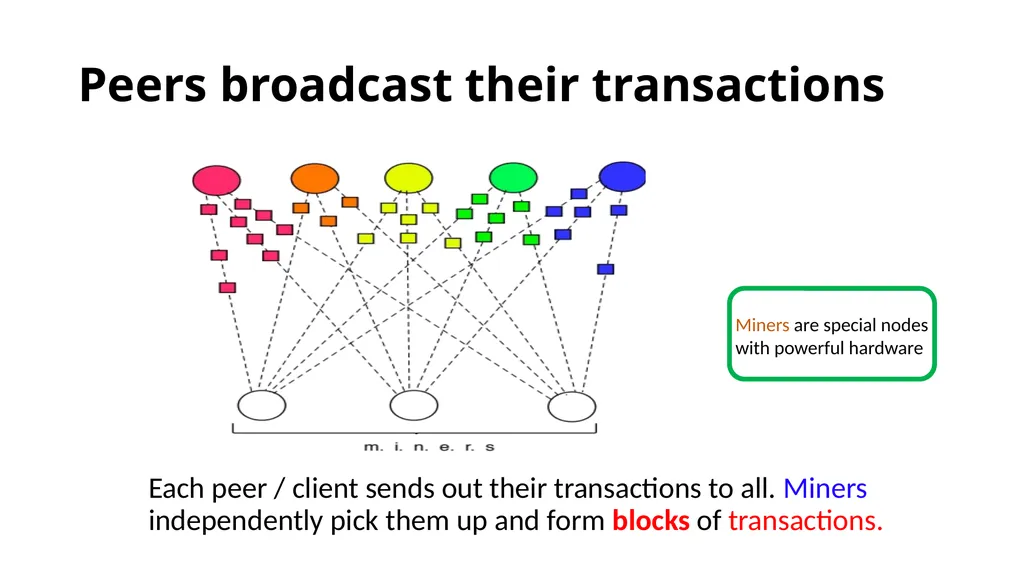
Peers broadcast their transactions Each peer / client sends out their transactions to all. Miners independently pick them up and form blocks of transactions. Miners are special nodes
with powerful hardware<br>
with powerful hardware<br>
10
Blocks and miners Header
+
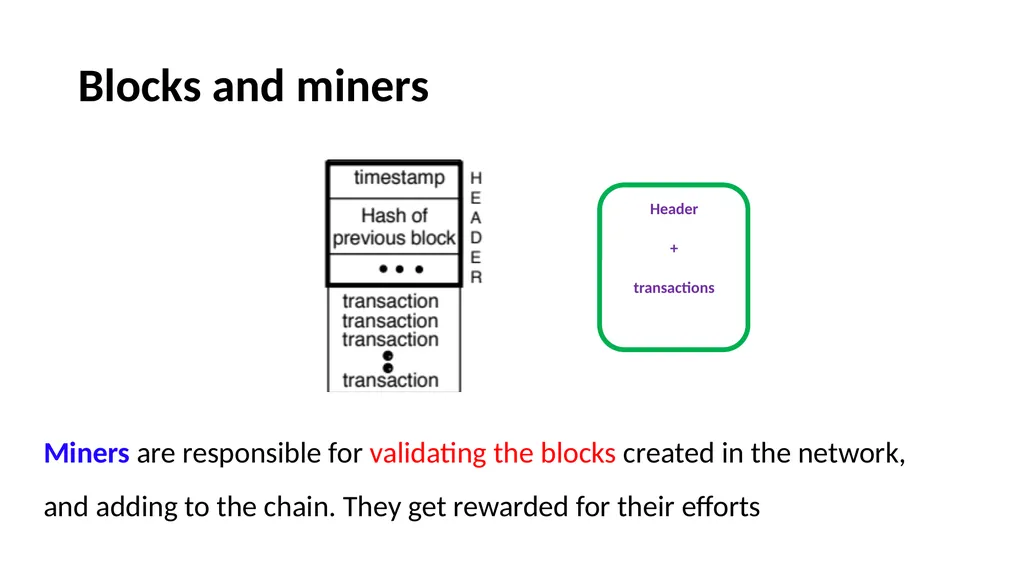
transactions Miners are responsible for validating the blocks created in the network,
and adding to the chain. They get rewarded for their efforts<br>
+
transactions Miners are responsible for validating the blocks created in the network,
and adding to the chain. They get rewarded for their efforts<br>
11
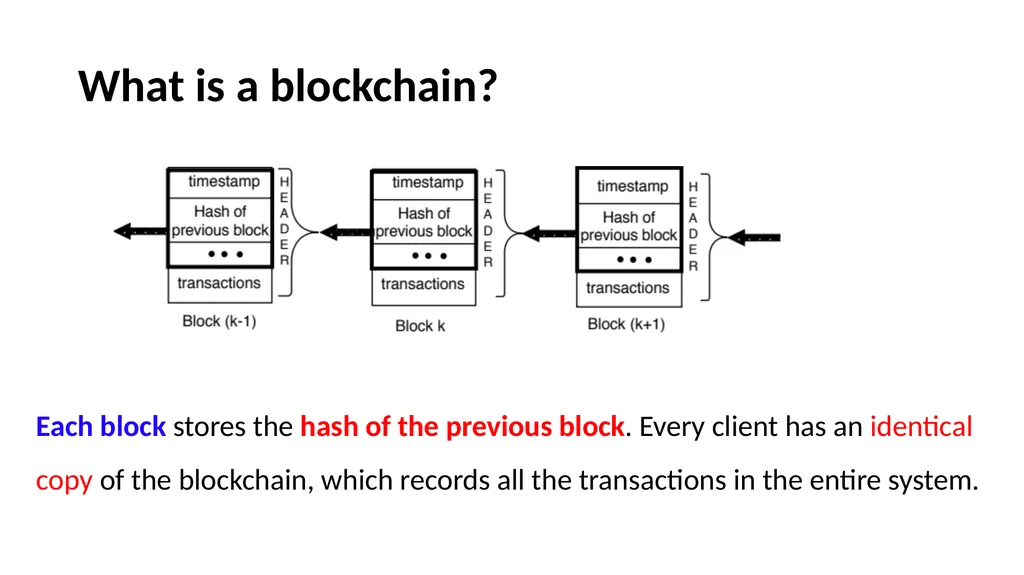
What is a blockchain? Each block stores the hash of the previous block. Every client has an identical
copy of the blockchain, which records all the transactions in the entire system.<br>
copy of the blockchain, which records all the transactions in the entire system.<br>
12
More on blockchain Block 0 is called the genesis block. It was created by Nakamoto, the
unknown developer of Bitcoin. Now. there are >500,000 blocks in the
Bitcoin blockchain.
Blockchain technology lets one verify any transaction by visiting
the entire chain following the links.<br>
unknown developer of Bitcoin. Now. there are >500,000 blocks in the
Bitcoin blockchain.
Blockchain technology lets one verify any transaction by visiting
the entire chain following the links.<br>
13
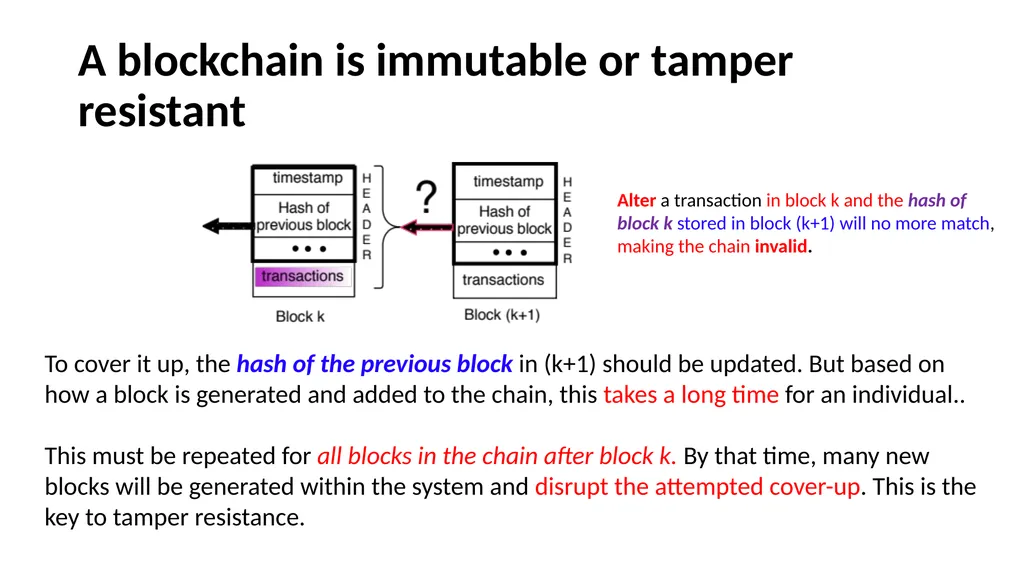
A blockchain is immutable or tamper resistant To cover it up, the hash of the previous block in (k+1) should be updated. But based on how a block is generated and added to the chain, this takes a long time for an individual..
This must be repeated for all blocks in the chain after block k. By that time, many new blocks will be generated within the system and disrupt the attempted cover-up. This is the key to tamper resistance. Alter a transaction in block k and the hash of
block k stored in block (k+1) will no more match,
making the chain invalid.<br>
This must be repeated for all blocks in the chain after block k. By that time, many new blocks will be generated within the system and disrupt the attempted cover-up. This is the key to tamper resistance. Alter a transaction in block k and the hash of
block k stored in block (k+1) will no more match,
making the chain invalid.<br>
14
Miners validate blocks Miners pick transaction from an unconfirmed pool, and form blocks.
For inclusion in a block, miners check the feasibility of the transaction
by walking sown the chain and examining relevant past transactions.
Then they take the responsibility of confirming or validating a block by
solving a cryptographic puzzle.<br>
For inclusion in a block, miners check the feasibility of the transaction
by walking sown the chain and examining relevant past transactions.
Then they take the responsibility of confirming or validating a block by
solving a cryptographic puzzle.<br>
15
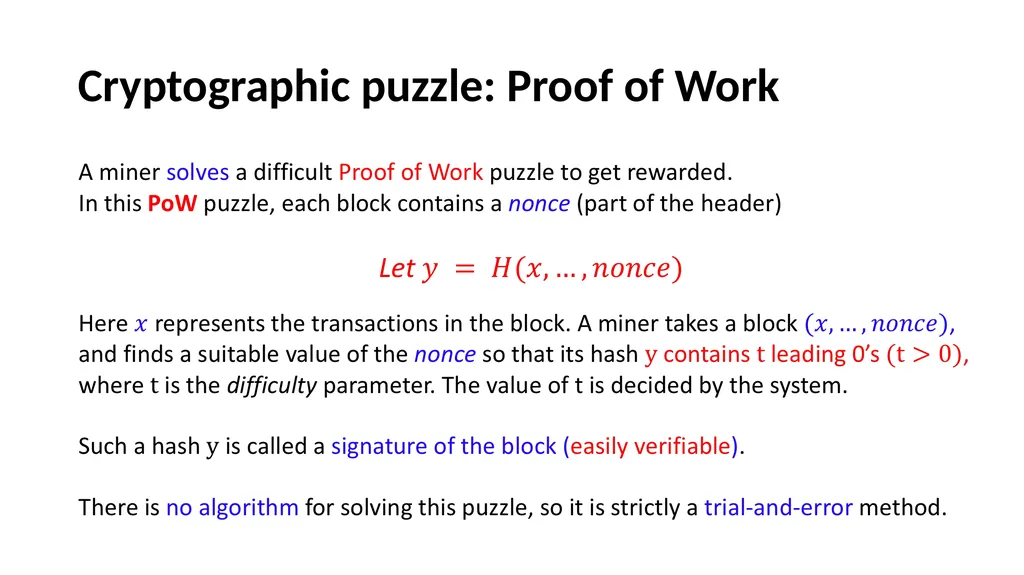
Cryptographic puzzle: Proof of Work<br>
16
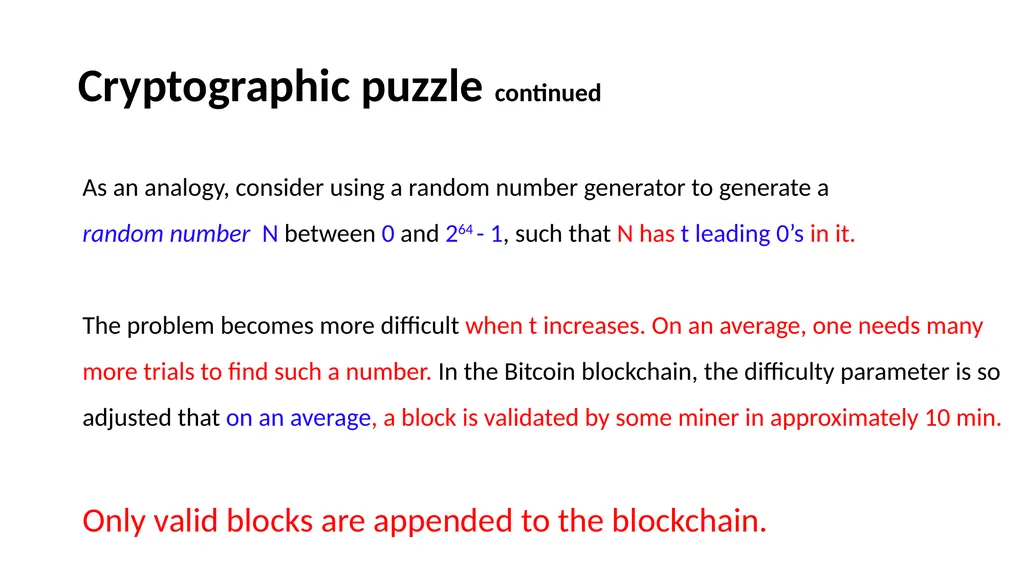
Cryptographic puzzle continued As an analogy, consider using a random number generator to generate a
random number N between 0 and 264 - 1, such that N has t leading 0’s in it.
The problem becomes more difficult when t increases. On an average, one needs many
more trials to find such a number. In the Bitcoin blockchain, the difficulty parameter is so
adjusted that on an average, a block is validated by some miner in approximately 10 min.
Only valid blocks are appended to the blockchain.
.<br>
random number N between 0 and 264 - 1, such that N has t leading 0’s in it.
The problem becomes more difficult when t increases. On an average, one needs many
more trials to find such a number. In the Bitcoin blockchain, the difficulty parameter is so
adjusted that on an average, a block is validated by some miner in approximately 10 min.
Only valid blocks are appended to the blockchain.
.<br>
17
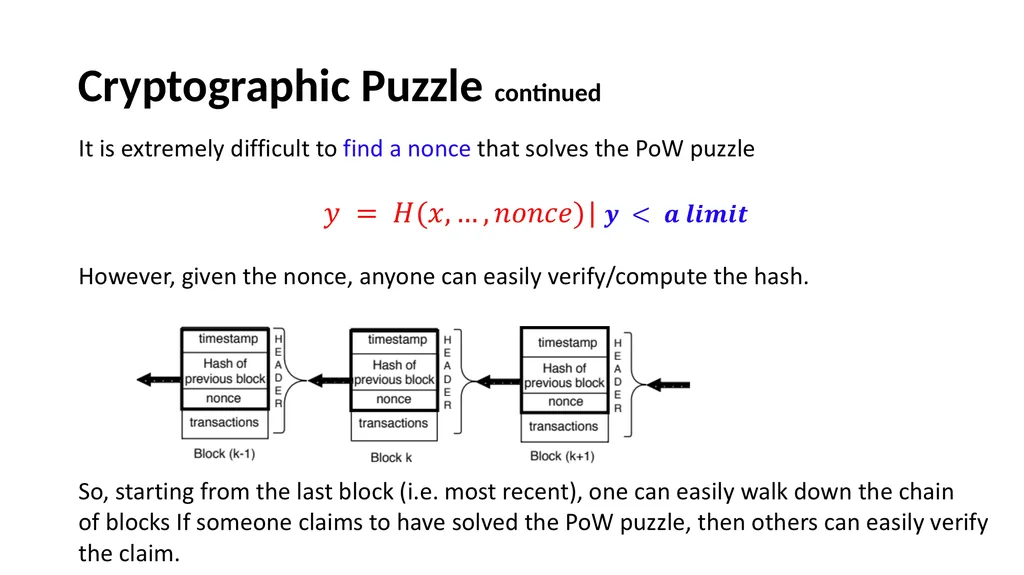
Cryptographic Puzzle continued<br>
18
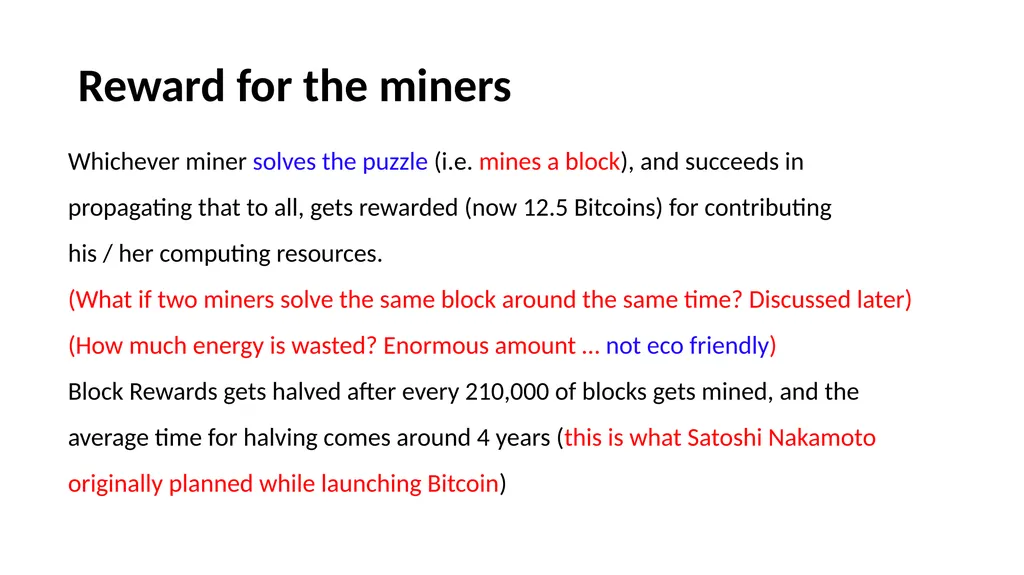
Reward for the miners Whichever miner solves the puzzle (i.e. mines a block), and succeeds in propagating that to all, gets rewarded (now 12.5 Bitcoins) for contributing
his / her computing resources.
(What if two miners solve the same block around the same time? Discussed later)
(How much energy is wasted? Enormous amount … not eco friendly)
Block Rewards gets halved after every 210,000 of blocks gets mined, and the average time for halving comes around 4 years (this is what Satoshi Nakamoto originally planned while launching Bitcoin)<br>
his / her computing resources.
(What if two miners solve the same block around the same time? Discussed later)
(How much energy is wasted? Enormous amount … not eco friendly)
Block Rewards gets halved after every 210,000 of blocks gets mined, and the average time for halving comes around 4 years (this is what Satoshi Nakamoto originally planned while launching Bitcoin)<br>
19
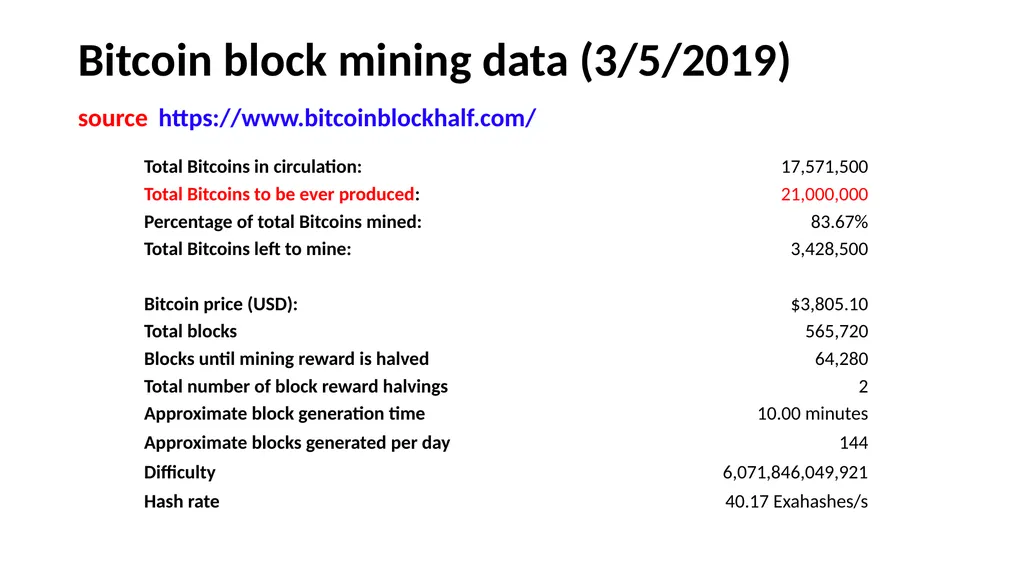
Bitcoin block mining data (3/5/2019)
source https://www.bitcoinblockhalf.com/<br>
20
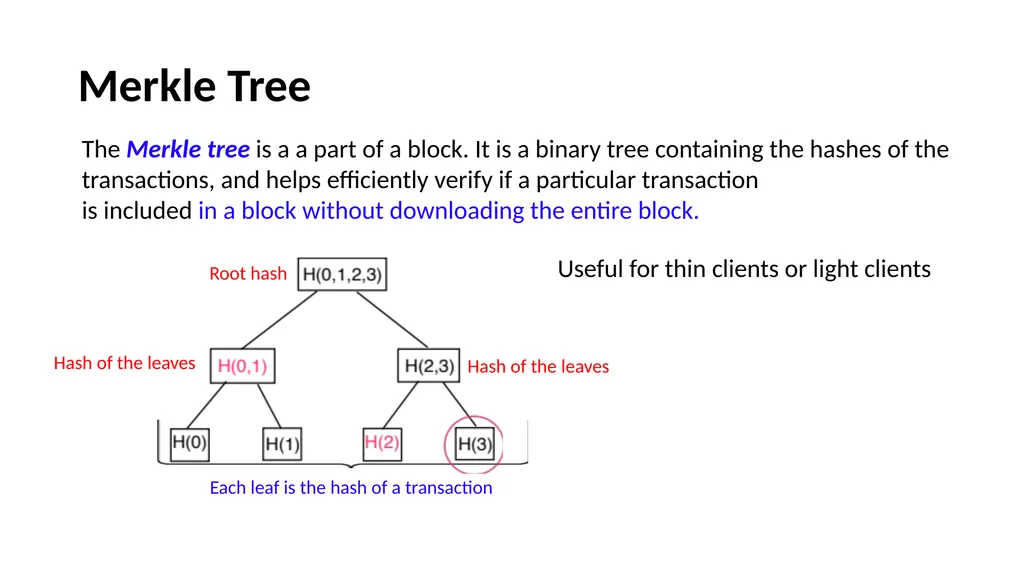
Merkle Tree The Merkle tree is a a part of a block. It is a binary tree containing the hashes of the
transactions, and helps efficiently verify if a particular transaction
is included in a block without downloading the entire block. Root hash Each leaf is the hash of a transaction Hash of the leaves Hash of the leaves Useful for thin clients or light clients<br>
transactions, and helps efficiently verify if a particular transaction
is included in a block without downloading the entire block. Root hash Each leaf is the hash of a transaction Hash of the leaves Hash of the leaves Useful for thin clients or light clients<br>
21
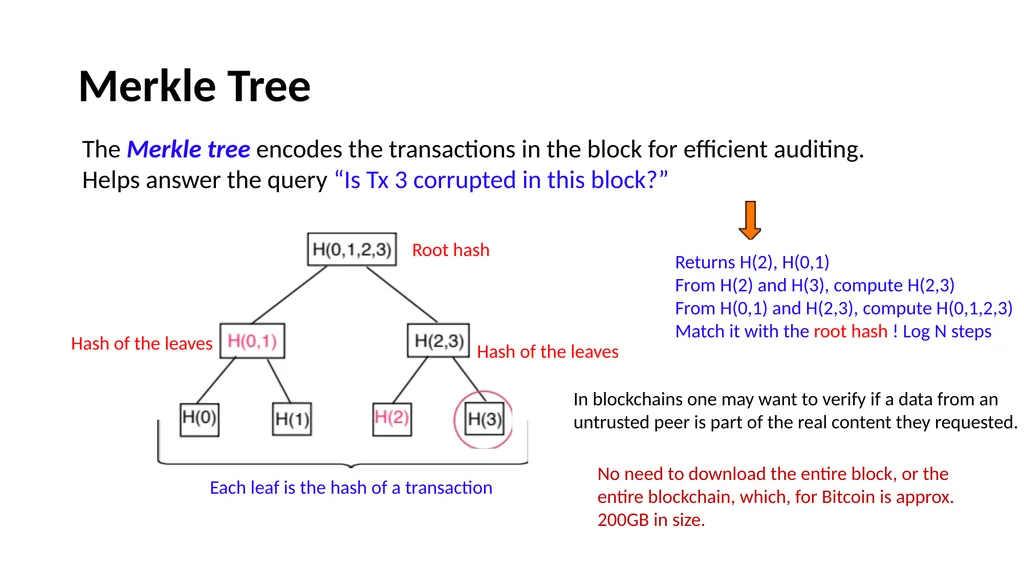
Merkle Tree The Merkle tree encodes the transactions in the block for efficient auditing.
Helps answer the query “Is Tx 3 corrupted in this block?” Root hash Each leaf is the hash of a transaction Hash of the leaves Hash of the leaves Returns H(2), H(0,1)
From H(2) and H(3), compute H(2,3)
From H(0,1) and H(2,3), compute H(0,1,2,3)
Match it with the root hash ! Log N steps No need to download the entire block, or the entire blockchain, which, for Bitcoin is approx. 200GB in size. In blockchains one may want to verify if a data from an
untrusted peer is part of the real content they requested.<br>
Helps answer the query “Is Tx 3 corrupted in this block?” Root hash Each leaf is the hash of a transaction Hash of the leaves Hash of the leaves Returns H(2), H(0,1)
From H(2) and H(3), compute H(2,3)
From H(0,1) and H(2,3), compute H(0,1,2,3)
Match it with the root hash ! Log N steps No need to download the entire block, or the entire blockchain, which, for Bitcoin is approx. 200GB in size. In blockchains one may want to verify if a data from an
untrusted peer is part of the real content they requested.<br>
22
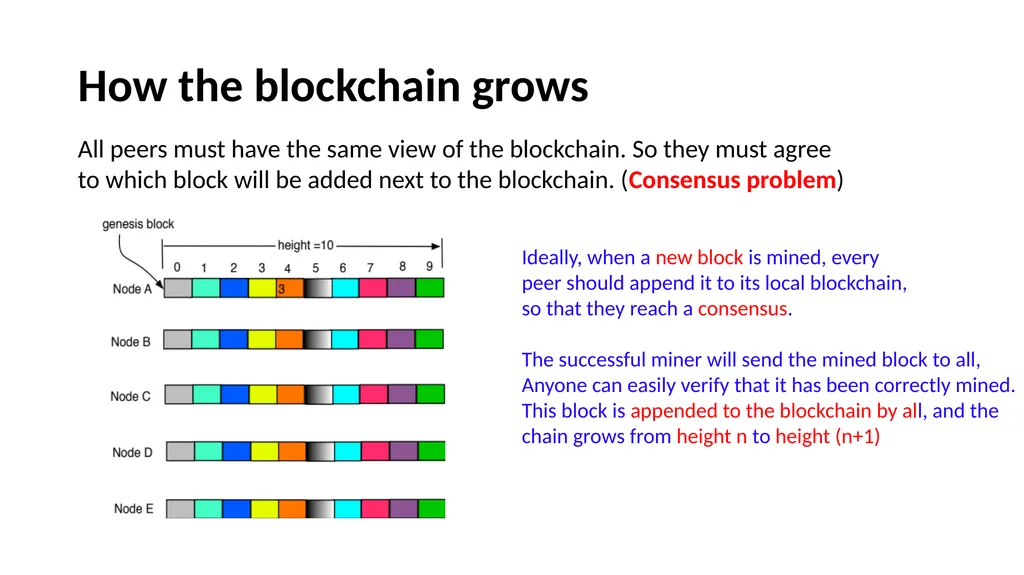
How the blockchain grows All peers must have the same view of the blockchain. So they must agree to which block will be added next to the blockchain. (Consensus problem) Ideally, when a new block is mined, every
peer should append it to its local blockchain,
so that they reach a consensus.
The successful miner will send the mined block to all,
Anyone can easily verify that it has been correctly mined.
This block is appended to the blockchain by all, and the
chain grows from height n to height (n+1)<br>
peer should append it to its local blockchain,
so that they reach a consensus.
The successful miner will send the mined block to all,
Anyone can easily verify that it has been correctly mined.
This block is appended to the blockchain by all, and the
chain grows from height n to height (n+1)<br>
23
How the blockchain grows When a newly solved block reaches other nodes in the network, each receiving node validates it via a set of tests before forwarding it to a neighboring node. This ensures that only honest miners’ efforts get rewarded.
A dishonest miner can include phony transactions into its block, and may claim to have solved the proof-of-work-puzzle without actually doing so. Such dishonest miners not only receive no rewards, but also waste their computation effort that acts as a deterrent.<br>
A dishonest miner can include phony transactions into its block, and may claim to have solved the proof-of-work-puzzle without actually doing so. Such dishonest miners not only receive no rewards, but also waste their computation effort that acts as a deterrent.<br>
24
How does a miner forms a block Miners independently pick transactions to form blocks.
Peers often pay a small fee for mining each transaction, and a miner picks the transactions with the largest fee. The first miner that successfully solves a block containing that transaction, collects that fee.
It is possible for two or more miners to pick the same transactions Tx in a block.
The first miner who solves the block with Tx, gets rewarded. The second miner while broadcasting its validated block will find that Tx is already claimed in another block, so this block will be invalid.
Contention can lead to a fork. Fork resolution will be discussed later.<br>
Peers often pay a small fee for mining each transaction, and a miner picks the transactions with the largest fee. The first miner that successfully solves a block containing that transaction, collects that fee.
It is possible for two or more miners to pick the same transactions Tx in a block.
The first miner who solves the block with Tx, gets rewarded. The second miner while broadcasting its validated block will find that Tx is already claimed in another block, so this block will be invalid.
Contention can lead to a fork. Fork resolution will be discussed later.<br>
25
Types of nodes in Bitcoin Blockchain Bitcoin uses three types of nodes : mining nodes, full nodes, and light nodes.
Mining nodes have acquired substantial computing power to solve the cryptographic puzzle in a reasonable time.
Full nodes hold and distribute the copies of the entire ledger (fast reaching 200 GB ) to other full nodes. Form the trust base of Bitcoin.
Light nodes are thin clients with limited memory hold only a small fraction of the blockchain. A light node typically connects to a full node that has a copy of the entire blockchain.<br>
Mining nodes have acquired substantial computing power to solve the cryptographic puzzle in a reasonable time.
Full nodes hold and distribute the copies of the entire ledger (fast reaching 200 GB ) to other full nodes. Form the trust base of Bitcoin.
Light nodes are thin clients with limited memory hold only a small fraction of the blockchain. A light node typically connects to a full node that has a copy of the entire blockchain.<br>
26
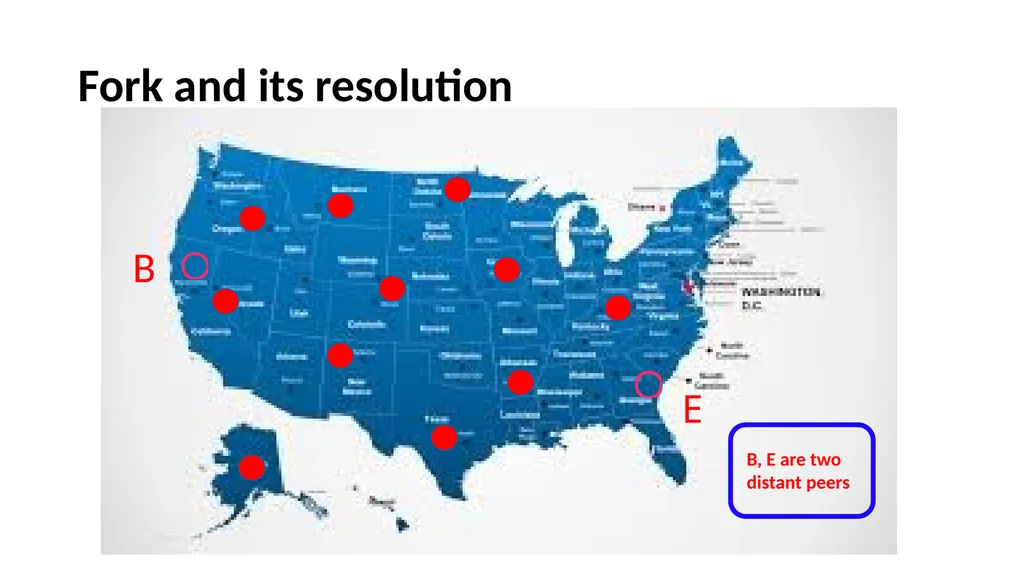
Fork and its resolution 3999 × 2250 B B, E are two
distant peers E<br>
distant peers E<br>
27
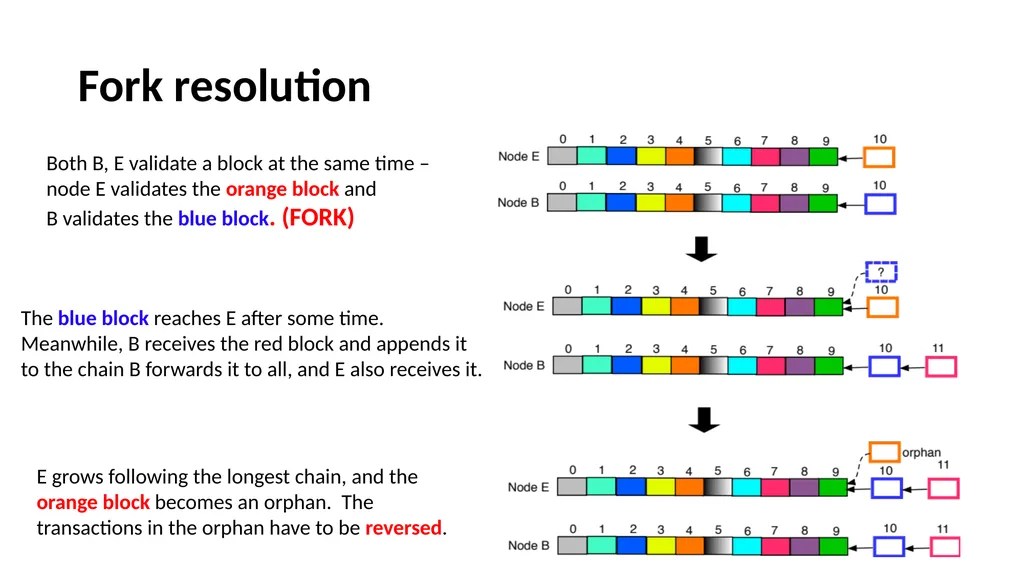
Fork resolution Both B, E validate a block at the same time –
node E validates the orange block and
B validates the blue block. (FORK) The blue block reaches E after some time.
Meanwhile, B receives the red block and appends it
to the chain B forwards it to all, and E also receives it. E grows following the longest chain, and the
orange block becomes an orphan. The
transactions in the orphan have to be reversed.<br>
node E validates the orange block and
B validates the blue block. (FORK) The blue block reaches E after some time.
Meanwhile, B receives the red block and appends it
to the chain B forwards it to all, and E also receives it. E grows following the longest chain, and the
orange block becomes an orphan. The
transactions in the orphan have to be reversed.<br>
28
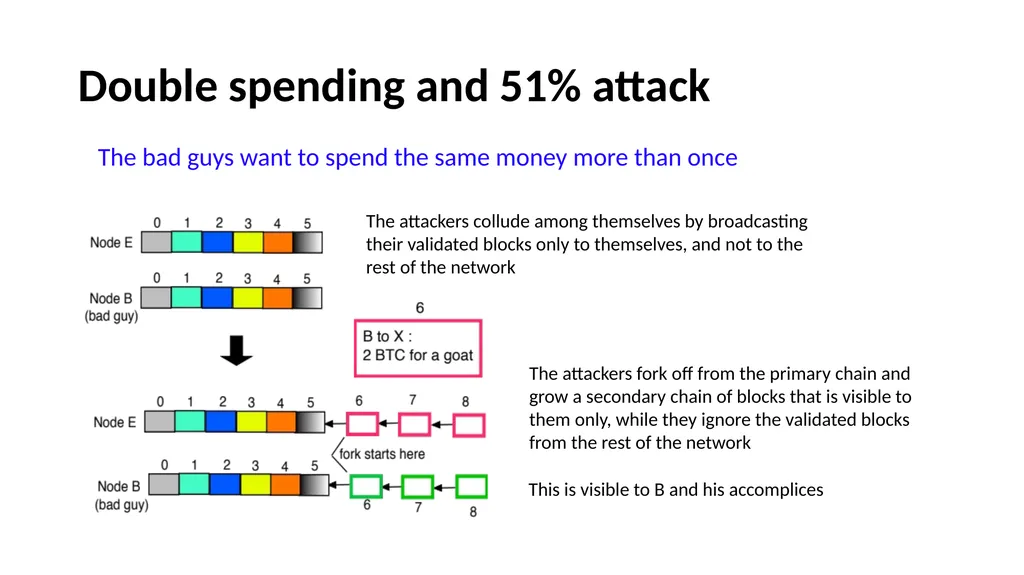
Double spending and 51% attack The bad guys want to spend the same money more than once The attackers fork off from the primary chain and
grow a secondary chain of blocks that is visible to
them only, while they ignore the validated blocks
from the rest of the network This is visible to B and his accomplices The attackers collude among themselves by broadcasting
their validated blocks only to themselves, and not to the
rest of the network<br>
grow a secondary chain of blocks that is visible to
them only, while they ignore the validated blocks
from the rest of the network This is visible to B and his accomplices The attackers collude among themselves by broadcasting
their validated blocks only to themselves, and not to the
rest of the network<br>
29
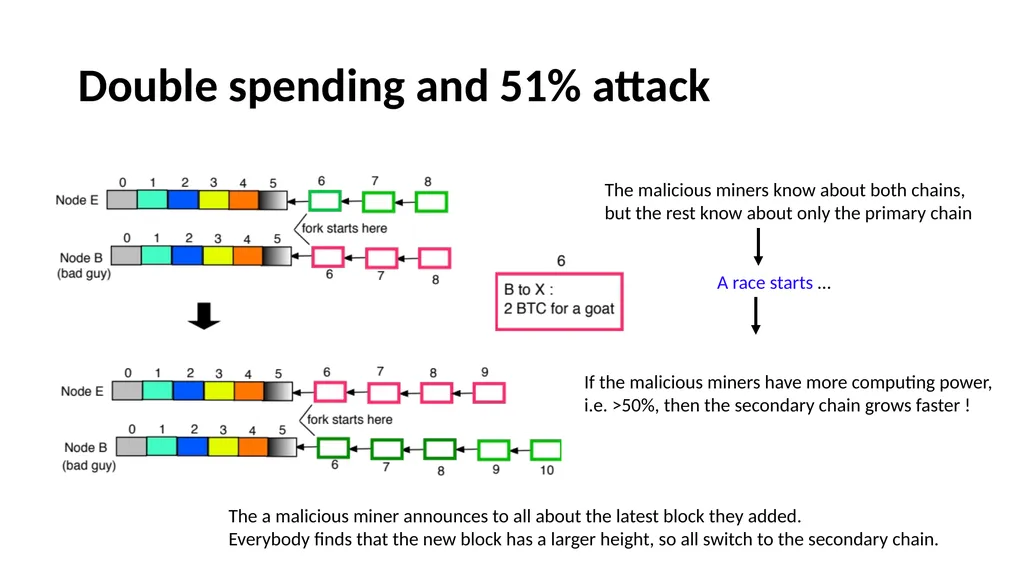
Double spending and 51% attack The malicious miners know about both chains,
but the rest know about only the primary chain A race starts … If the malicious miners have more computing power,
i.e. >50%, then the secondary chain grows faster ! The a malicious miner announces to all about the latest block they added.
Everybody finds that the new block has a larger height, so all switch to the secondary chain.<br>
but the rest know about only the primary chain A race starts … If the malicious miners have more computing power,
i.e. >50%, then the secondary chain grows faster ! The a malicious miner announces to all about the latest block they added.
Everybody finds that the new block has a larger height, so all switch to the secondary chain.<br>
30
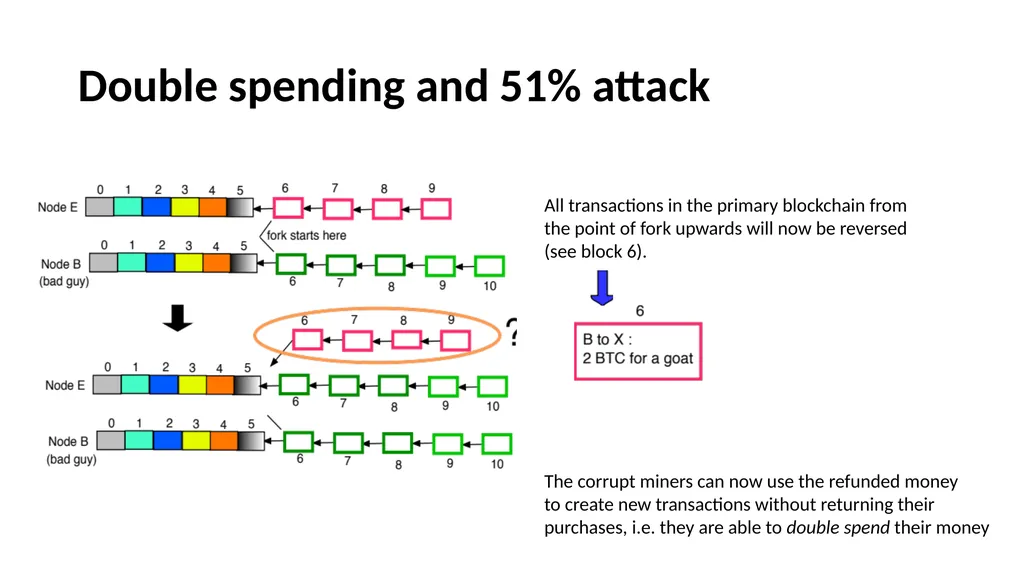
Double spending and 51% attack All transactions in the primary blockchain from
the point of fork upwards will now be reversed
(see block 6).
The corrupt miners can now use the refunded money
to create new transactions without returning their
purchases, i.e. they are able to double spend their money<br>
the point of fork upwards will now be reversed
(see block 6).
The corrupt miners can now use the refunded money
to create new transactions without returning their
purchases, i.e. they are able to double spend their money<br>
31
Byzantine Fault Tolerance First, think of how you, as a bad guy, will launch a Byzantine attack on Blockchain.
Broadcast different blocks (say two different blocks p and q, both valid and with
the same block #) to different peers, so that no consensus is reached ?
Then the attacker has to generate two such blocks in quick succession, and get both
accepted before newer valid blocks are mined. How feasible is this? Does the Proof of
Work scheme provides a natural tolerance to BFT?<br>
Broadcast different blocks (say two different blocks p and q, both valid and with
the same block #) to different peers, so that no consensus is reached ?
Then the attacker has to generate two such blocks in quick succession, and get both
accepted before newer valid blocks are mined. How feasible is this? Does the Proof of
Work scheme provides a natural tolerance to BFT?<br>
32
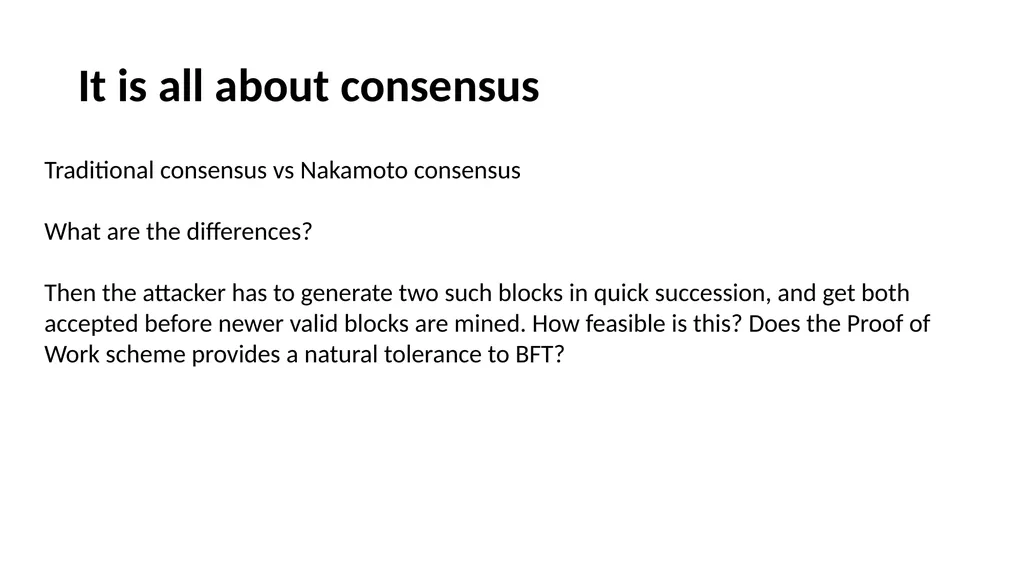
It is all about consensus Traditional consensus vs Nakamoto consensus
What are the differences?
Then the attacker has to generate two such blocks in quick succession, and get both
accepted before newer valid blocks are mined. How feasible is this? Does the Proof of
Work scheme provides a natural tolerance to BFT?<br>
What are the differences?
Then the attacker has to generate two such blocks in quick succession, and get both
accepted before newer valid blocks are mined. How feasible is this? Does the Proof of
Work scheme provides a natural tolerance to BFT?<br>
33
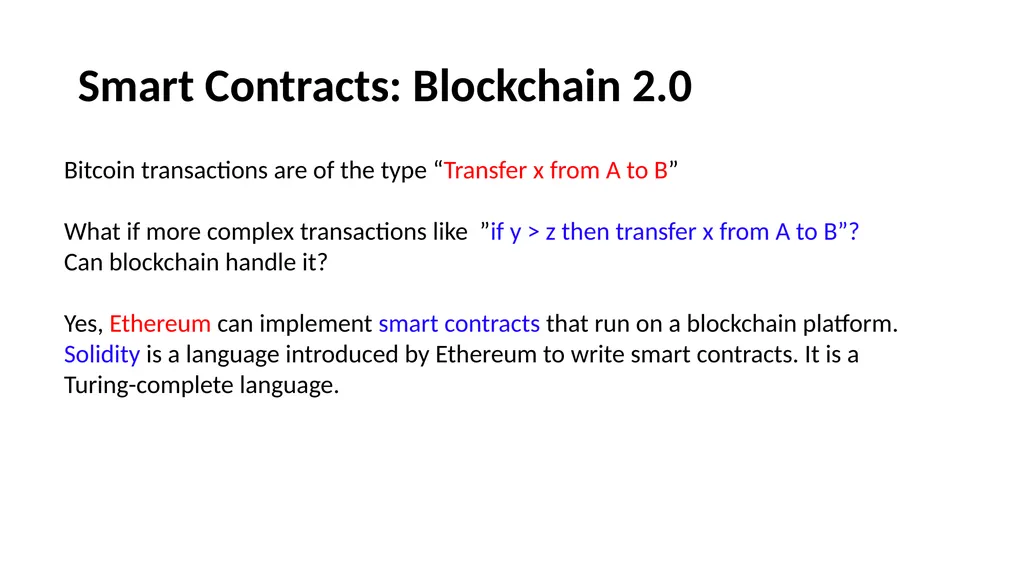
Smart Contracts: Blockchain 2.0 Bitcoin transactions are of the type “Transfer x from A to B”
What if more complex transactions like ”if y > z then transfer x from A to B”?
Can blockchain handle it?
Yes, Ethereum can implement smart contracts that run on a blockchain platform.
Solidity is a language introduced by Ethereum to write smart contracts. It is a
Turing-complete language.<br>
What if more complex transactions like ”if y > z then transfer x from A to B”?
Can blockchain handle it?
Yes, Ethereum can implement smart contracts that run on a blockchain platform.
Solidity is a language introduced by Ethereum to write smart contracts. It is a
Turing-complete language.<br>
34
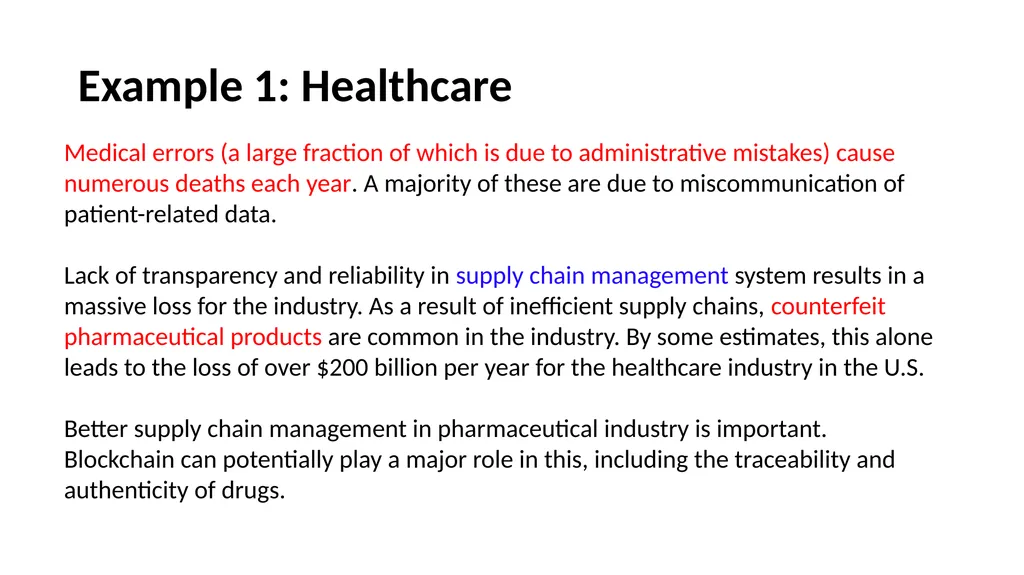
Example 1: Healthcare Medical errors (a large fraction of which is due to administrative mistakes) cause numerous deaths each year. A majority of these are due to miscommunication of patient-related data.
Lack of transparency and reliability in supply chain management system results in a massive loss for the industry. As a result of inefficient supply chains, counterfeit pharmaceutical products are common in the industry. By some estimates, this alone leads to the loss of over $200 billion per year for the healthcare industry in the U.S.
Better supply chain management in pharmaceutical industry is important.
Blockchain can potentially play a major role in this, including the traceability and authenticity of drugs.<br>
Lack of transparency and reliability in supply chain management system results in a massive loss for the industry. As a result of inefficient supply chains, counterfeit pharmaceutical products are common in the industry. By some estimates, this alone leads to the loss of over $200 billion per year for the healthcare industry in the U.S.
Better supply chain management in pharmaceutical industry is important.
Blockchain can potentially play a major role in this, including the traceability and authenticity of drugs.<br>
35
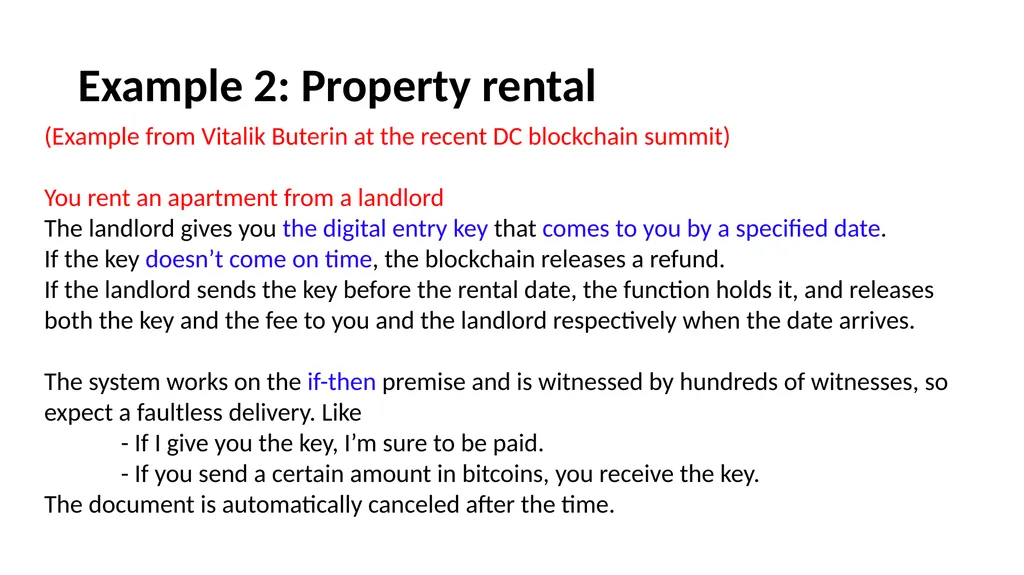
Example 2: Property rental (Example from Vitalik Buterin at the recent DC blockchain summit)
You rent an apartment from a landlord
The landlord gives you the digital entry key that comes to you by a specified date.
If the key doesn’t come on time, the blockchain releases a refund.
If the landlord sends the key before the rental date, the function holds it, and releases both the key and the fee to you and the landlord respectively when the date arrives.
The system works on the if-then premise and is witnessed by hundreds of witnesses, so expect a faultless delivery. Like
- If I give you the key, I’m sure to be paid.
- If you send a certain amount in bitcoins, you receive the key.
The document is automatically canceled after the time.<br>
You rent an apartment from a landlord
The landlord gives you the digital entry key that comes to you by a specified date.
If the key doesn’t come on time, the blockchain releases a refund.
If the landlord sends the key before the rental date, the function holds it, and releases both the key and the fee to you and the landlord respectively when the date arrives.
The system works on the if-then premise and is witnessed by hundreds of witnesses, so expect a faultless delivery. Like
- If I give you the key, I’m sure to be paid.
- If you send a certain amount in bitcoins, you receive the key.
The document is automatically canceled after the time.<br>