Blood transfusion ABO -Blood type Rhesus Factor Course Lab. 1 3rd Grade Fall Semester 2022-2023 Muzhda H. Saber Muzhda.haydartiu.edu.iq Date3112022 Blood transfusions: Is the transfer of blood or blood components into a persons
"Blood transfusion ABO -Blood type Rhesus Factor" is the property of its rightful owner. Permission is granted to
download and print the materials on this website for personal, non-commercial use only, and to display it
on your personal computer provided you do not modify the materials and that you retain all copyright
notices contained in the materials. By downloading content from our website, you accept the terms of this
agreement.
Presentation Transcript
01
Blood transfusion
ABO -Blood type
Rhesus Factor Course_
Lab. 1 3rd Grade – Fall Semester 2022-2023 Muzhda H. Saber Muzhda.haydar@tiu.edu.iq Date_31/1/2022<br>
02
Blood transfusions:
Is the transfer of blood or blood components into a person's blood stream, have been carried out for hundreds of years.
An adult human has about 4–6 liters of blood circulating in the body. Among other things, blood transports oxygen to various parts of the body.
Blood consists of several types of cells floating around in a fluid called plasma.<br>
03
What are the different blood groups?
A blood group also called a Blood Type
There are more than 20 genetically determined blood group systems known today, but the AB0 and Rh systems are the most important ones used for blood transfusions.
Classification of blood is based on the presence or absence of inherited antigenic substances on the surface of red blood cells.<br>
04
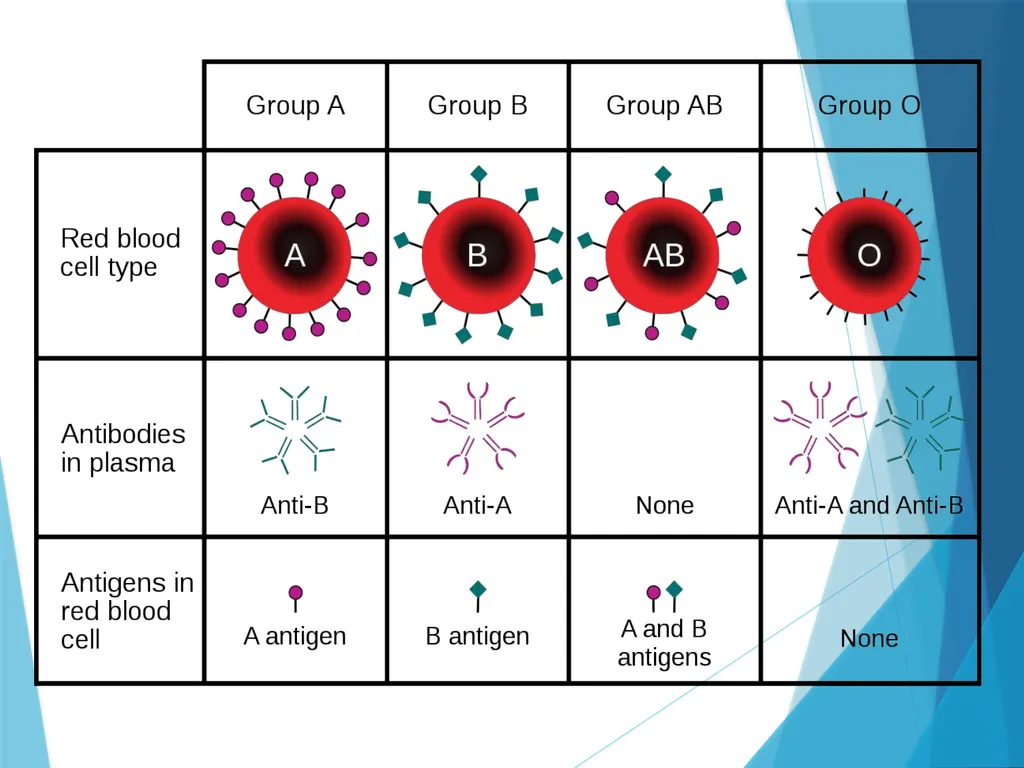
These antigens may be proteins, carbohydrates, glycoproteins, or glycolipids, depending on the blood group system. Determination of ABO blood groups depends upon the immunological reaction between antigen and antibody.
Based on the presence or absence of antigen A and antigen B, blood is divided into four
groups: A, B, AB and ‘O’ group.<br>
05
Rh factor blood grouping system Many people also have a so called Rh factor on the red blood cell's surface.
This is also an antigen and those who have it are called Rh+.
Those who haven't are called Rh-.
A person with Rh- blood does not have Rh antibodies naturally in the blood plasma (as one can have A or B antibodies, for instance).
But a person with Rh- blood can develop Rh antibodies in the blood plasma if he or she receives blood from a person with Rh+ blood, whose Rh antigens can trigger the production of Rh antibodies.
A person with Rh+ blood can receive blood from a person with Rh- blood without any problems.<br>
06
Principle of Blood Grouping
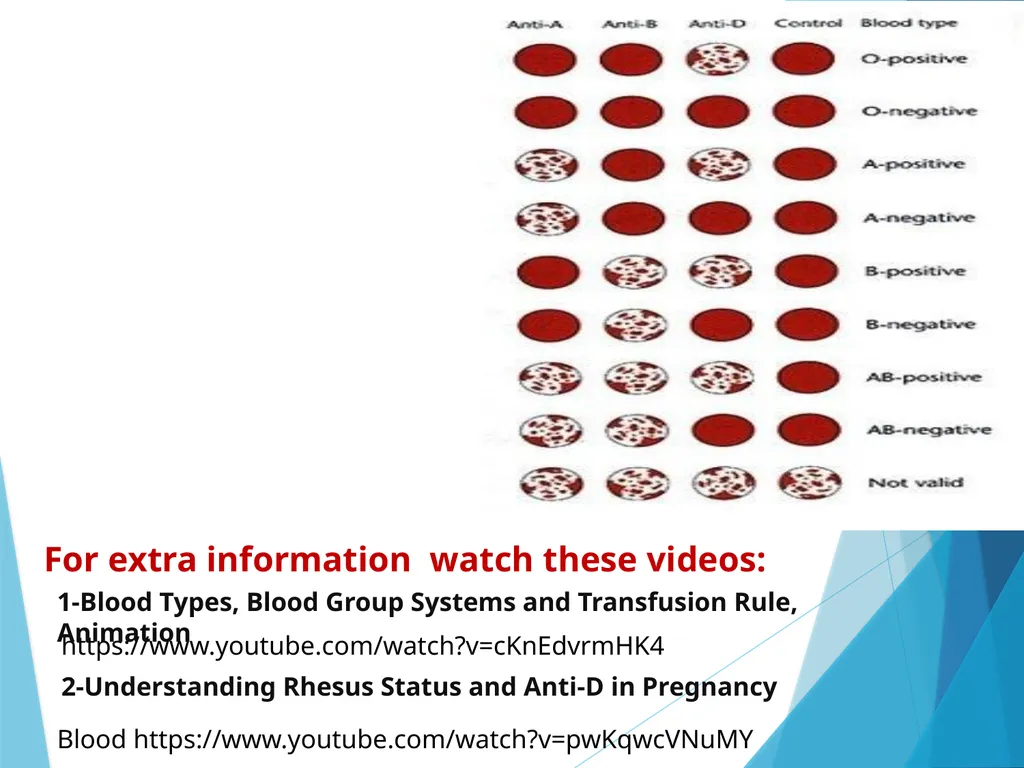
Blood grouping is done on the basis of agglutination.
Agglutination means the collection of separate particles like RBCs into clumps or masses.
Agglutination occurs if an antigen is mixed with its corresponding antibody, i.e. occurs when A antigen is mixed with anti-A or when B antigen is mixed with anti-B.<br>
07
IMPORTANCE OF ABO GROUPS
IN BLOOD TRANSFUSION
During blood transfusion, only compatible blood must be used.
The one who gives blood is called the ‘donor’ and the one who receives the blood is called ‘recipient’.
While transfusing the blood, antigen of the donor and the antibody of the recipient are considered.<br>
08
RBC of ‘O’ group has no antigen and so agglutination does not occur with any other group of blood. So, ‘O’ group blood can be given to any blood group persons and the people with this blood group are called
‘universal donors’.
AB blood group has no antibody. This does not cause agglutination of RBC from any other group of blood.
People with AB group can receive blood from any blood group persons. So, people with this blood group are called ‘universal recipients’.<br>
09
In mismatched transfusion, the transfusion reactions occur between donor’s RBC and recipient’s plasma.
So, if the donor’s plasma contains agglutinins against recipient’s RBC, agglutination does not occur because these antibodies are diluted in the recipient’s blood.<br>
10
Rh blood group System Rh antigen is another sets of cell surface marker on human RBC appearing early during development red blood cells, and have not been found on other body tissues.
It is the most important blood group system after ABO.
Anyone who has this D antigen is said to be Rh positive, whereas a person who does not have D antigen is said to be Rh negative.<br>
11
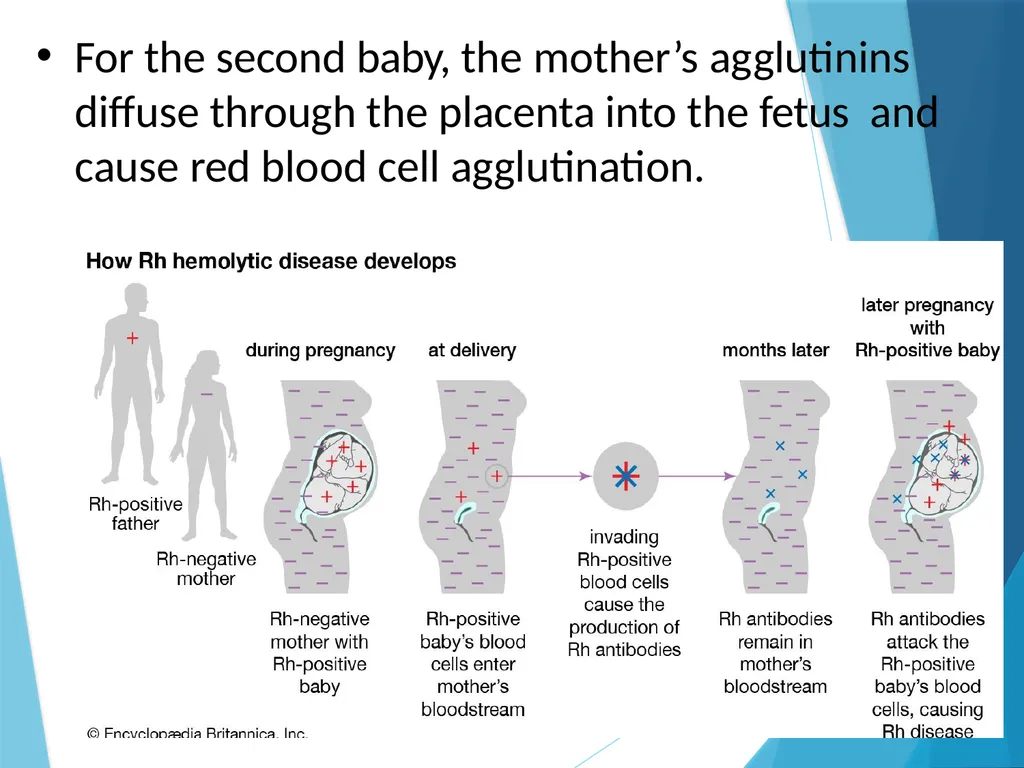
Erythroblastosis Fetalis (“Hemolytic Disease of the Newborn”)
Erythroblastosis fetalis is a disease of the fetus and newborn child characterized by agglutination and phagocytosis of the fetus’s red blood cells.
In most instances of erythroblastosis fetalis, the mother is Rh negative and the father Rh positive. The baby has inherited the Rh-positive antigen from the father, and the mother develops
anti-Rh agglutinins from exposure to the fetus’s Rh antigen at birth.<br>
12
For the second baby, the mother’s agglutinins diffuse through the placenta into the fetus and cause red blood cell agglutination.<br>
13
Blood group testing Aim
The main purpose of conducting this experiment is to understand the basic concept of the ABO blood group system and to know our blood group and type.
Materials Required
Toothpicks or stickers
Blood sample
Alcohol Swabs
Lancet
Clean glass slide or (white chart)
Sterile cotton
Monoclonal Antibodies (Anti-A, B, and D) kit<br>
14
Procedure
Take a clean glass slide or white chart
Wipe the middle finger with the alcohol swabs and rub gently near the fingertip, where the blood sample will be collected.
Prick the fingertip with the lancet and wipe off the first drop of the blood.
Allow it to fall on the glass slide by gently pressing the fingertip.<br>
15
Add three drops of the blood to the slide or white chart.
Keep the slide aside safely without disturbing.
Unpack the Monoclonal Antibodies (MAB) kit. add Anti-A, Anti-B and Anti-D respectively to the blood drops with the help of a dropper.
Mix the blood sample gently with the help of a toothpick or sticker and wait for a minute to observe the result.<br>
16
Blood https://www.youtube.com/watch?v=pwKqwcVNuMY 2-Understanding Rhesus Status and Anti-D in Pregnancy https://www.youtube.com/watch?v=cKnEdvrmHK4 1-Blood Types, Blood Group Systems and Transfusion Rule, Animation For extra information watch these videos:<br>
17
References Dean, Laura. Blood Groups and Red Cell Antigens [Internet].. Bethesda (MD): National Center for Biotechnology Information (US); 2005, Chapter. 7.
^ "Rh System". Canadian Blood Services at learnserology.ca. Retrieved 2021-01-19.
^ Weiner AS (1 February 1949). "Genetics and Nomenclature of the Rh–Hr Blood Types". Antonie van Leeuwenhoek. 15 (1): 17–28. doi:10.1007/BF02062626. ISSN 0003-6072. S2CID 35680084.
^ "dbRBC – Blood Group Antigen Gene Mutation Database". www.ncbi.nlm.nih.gov. Archived from the original on 2011-02-13. Retrieved 2010-06-15.
^ "RHD Rh blood group, D antigen [Homo sapiens] – Gene Result". nlm.nih.gov. Retrieved 2010-06-15.<br>