Board Briefing: AI Regulatory Updates Overview of this presentation Presentation Goals: This presentation is intended to help legal and compliance leaders educate their board members on recent regulatory updates surrounding the development
"Board Briefing: AI Regulatory Updates Overview of" is the property of its rightful owner. Permission is granted to
download and print the materials on this website for personal, non-commercial use only, and to display it
on your personal computer provided you do not modify the materials and that you retain all copyright
notices contained in the materials. By downloading content from our website, you accept the terms of this
agreement.
Presentation Transcript
01
Board Briefing: AI Regulatory Updates<br>
02
Overview of this presentation Presentation Goals:
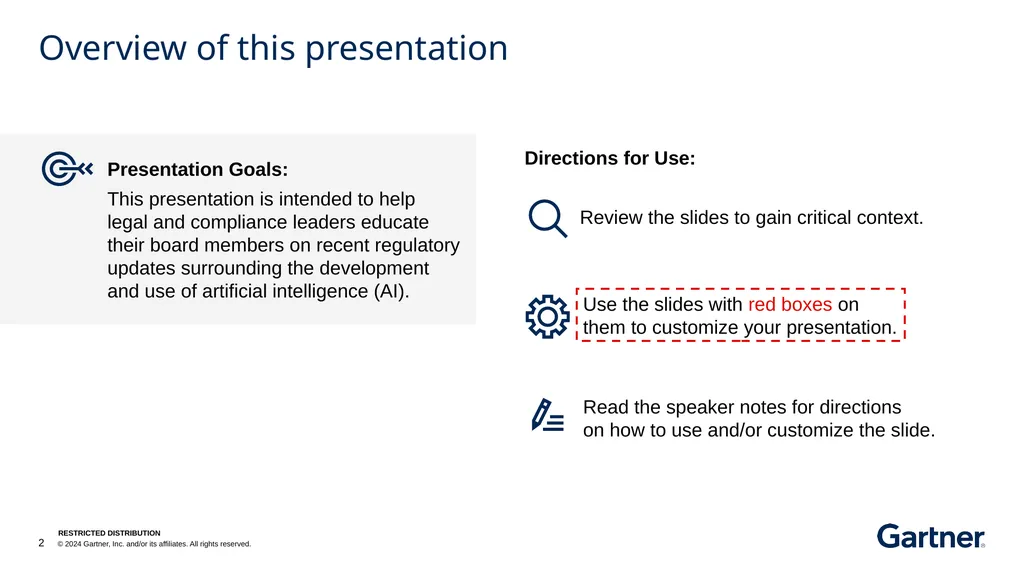
This presentation is intended to help legal and compliance leaders educate their board members on recent regulatory updates surrounding the development and use of artificial intelligence (AI). Review the slides to gain critical context. Use the slides with red boxes on them to customize your presentation. Read the speaker notes for directions on how to use and/or customize the slide. Directions for Use:<br>
03
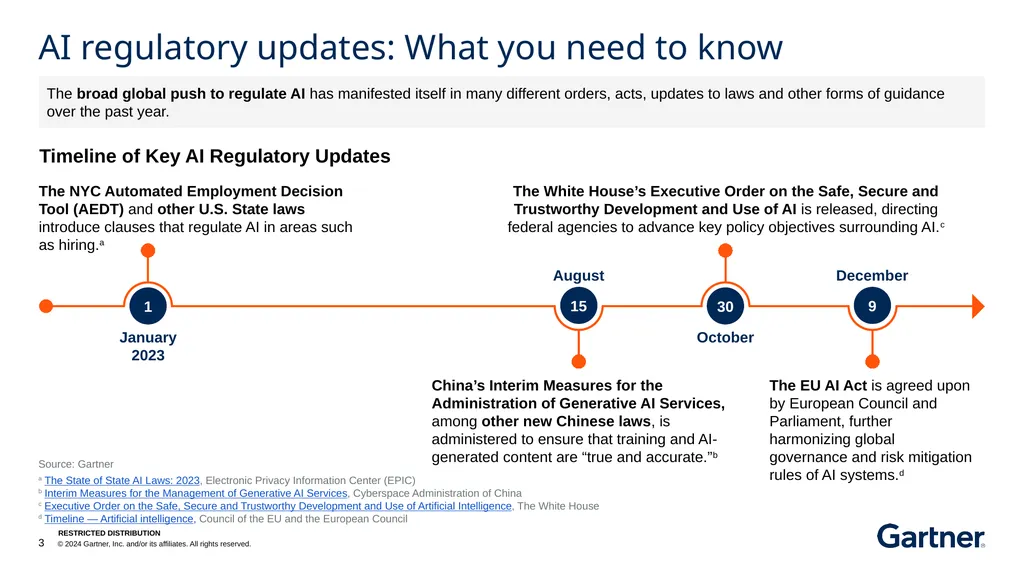
AI regulatory updates: What you need to know Timeline of Key AI Regulatory Updates Source: Gartner
a The State of State AI Laws: 2023, Electronic Privacy Information Center (EPIC)
b Interim Measures for the Management of Generative AI Services, Cyberspace Administration of China
c Executive Order on the Safe, Secure and Trustworthy Development and Use of Artificial Intelligence, The White House
d Timeline — Artificial intelligence, Council of the EU and the European Council China’s Interim Measures for the Administration of Generative AI Services, among other new Chinese laws, is administered to ensure that training and AI-generated content are “true and accurate.”b The EU AI Act is agreed upon by European Council and Parliament, further harmonizing global governance and risk mitigation rules of AI systems.d January 2023 August October December 15 30 9 1 The NYC Automated Employment Decision Tool (AEDT) and other U.S. State laws introduce clauses that regulate AI in areas such as hiring.a The White House’s Executive Order on the Safe, Secure and Trustworthy Development and Use of AI is released, directing federal agencies to advance key policy objectives surrounding AI.c The broad global push to regulate AI has manifested itself in many different orders, acts, updates to laws and other forms of guidance over the past year.<br>
04
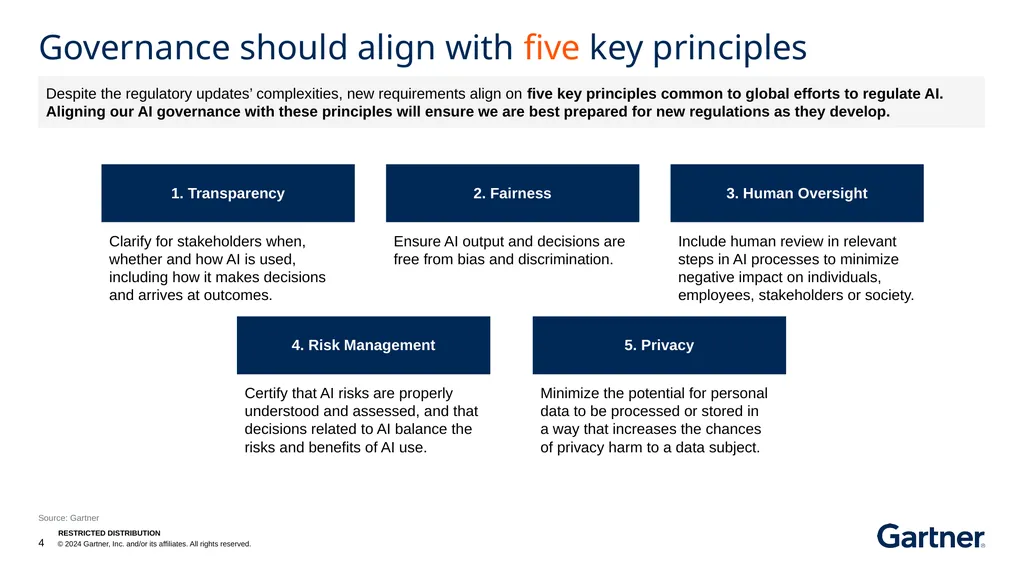
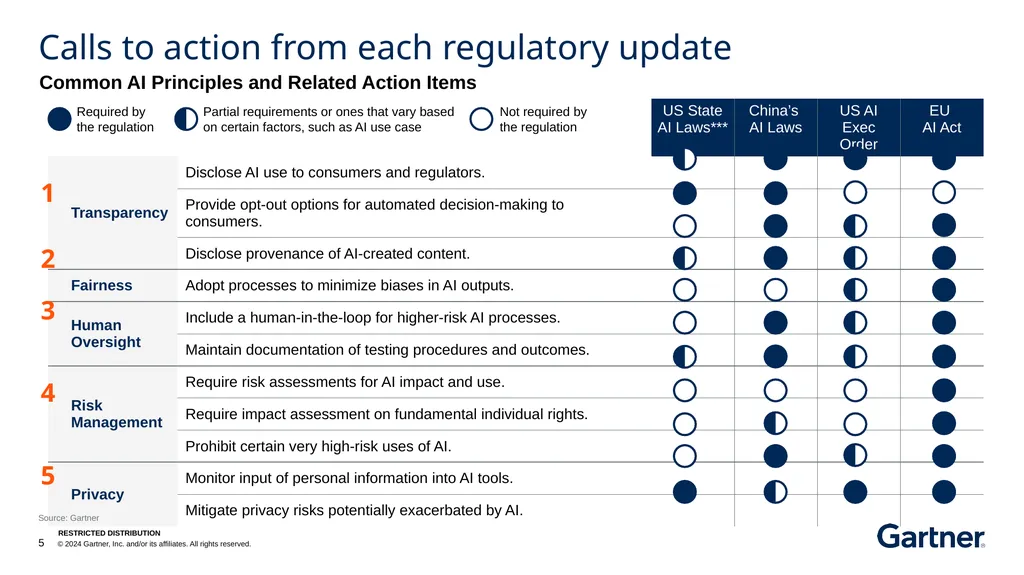
1. Transparency Governance should align with five key principles Despite the regulatory updates’ complexities, new requirements align on five key principles common to global efforts to regulate AI. Aligning our AI governance with these principles will ensure we are best prepared for new regulations as they develop. Clarify for stakeholders when, whether and how AI is used, including how it makes decisions and arrives at outcomes. 2. Fairness Ensure AI output and decisions are free from bias and discrimination. 3. Human Oversight Include human review in relevant steps in AI processes to minimize negative impact on individuals, employees, stakeholders or society. 4. Risk Management Certify that AI risks are properly understood and assessed, and that decisions related to AI balance the risks and benefits of AI use. 5. Privacy Minimize the potential for personal data to be processed or stored in a way that increases the chances of privacy harm to a data subject. Source: Gartner<br>
05
Calls to action from each regulatory update Common AI Principles and Related Action Items 1 2 3 4 5 Required by the regulation Source: Gartner<br>
06
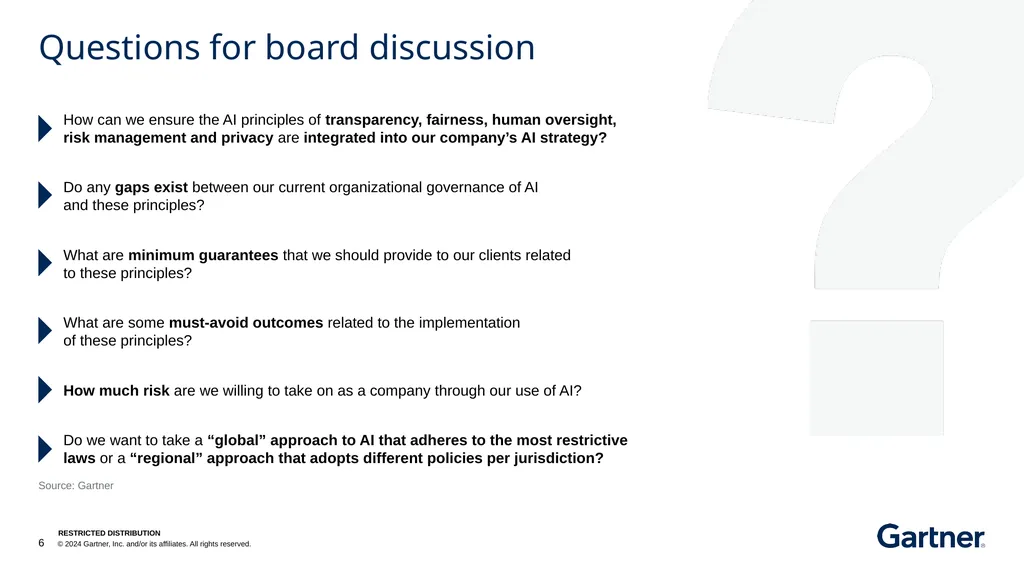
Questions for board discussion How can we ensure the AI principles of transparency, fairness, human oversight, risk management and privacy are integrated into our company’s AI strategy?
Do any gaps exist between our current organizational governance of AI and these principles?
What are minimum guarantees that we should provide to our clients related to these principles?
What are some must-avoid outcomes related to the implementation of these principles?
How much risk are we willing to take on as a company through our use of AI?
Do we want to take a “global” approach to AI that adheres to the most restrictive laws or a “regional” approach that adopts different policies per jurisdiction? Source: Gartner<br>
07
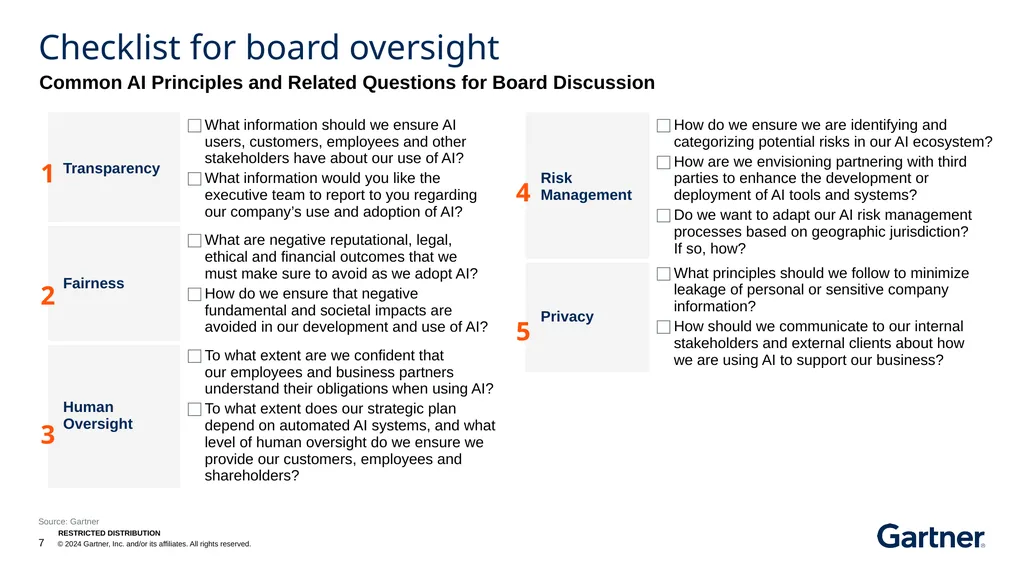
Checklist for board oversight Common AI Principles and Related Questions for Board Discussion 1 2 3 4 5 Source: Gartner<br>
08
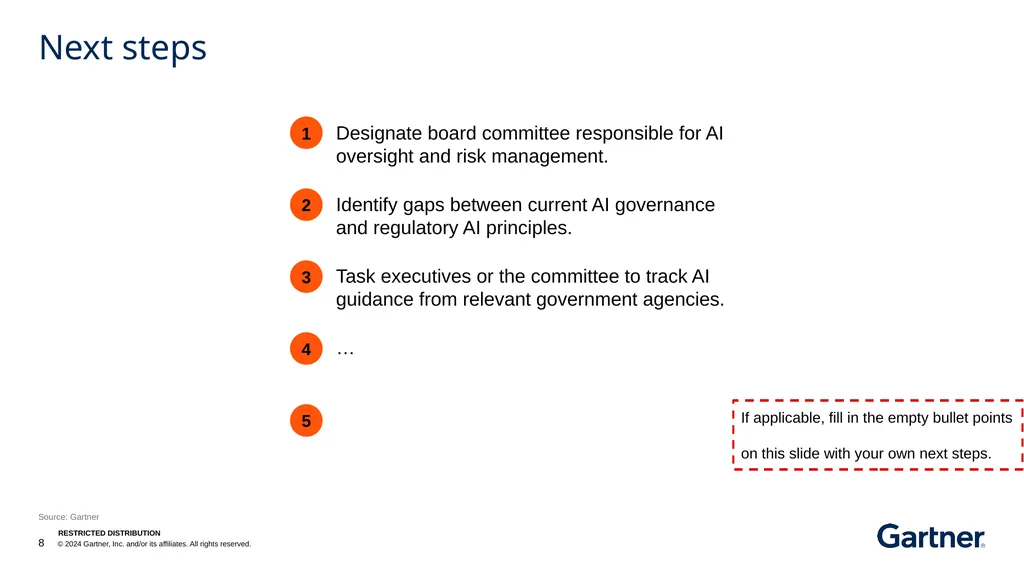
Next steps Designate board committee responsible for AI oversight and risk management.
Identify gaps between current AI governance and regulatory AI principles.
Task executives or the committee to track AI guidance from relevant government agencies.
… 1 2 3 4 5 Source: Gartner If applicable, fill in the empty bullet points on this slide with your own next steps.<br>
09
Appendix Choose 1-2 of the following slides that are most relevant to your company and its jurisdictions and input them between slides 3 and 4. Delete the irrelevant ones and this slide.<br>
10
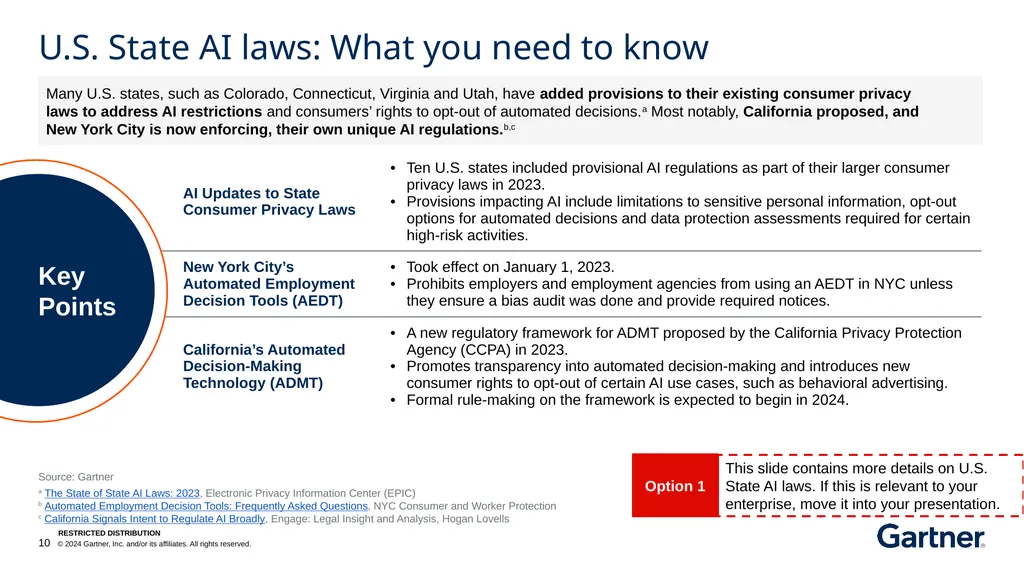
U.S. State AI laws: What you need to know Source: Gartner
a The State of State AI Laws: 2023, Electronic Privacy Information Center (EPIC)
b Automated Employment Decision Tools: Frequently Asked Questions, NYC Consumer and Worker Protection
c California Signals Intent to Regulate AI Broadly, Engage: Legal Insight and Analysis, Hogan Lovells Key Points Many U.S. states, such as Colorado, Connecticut, Virginia and Utah, have added provisions to their existing consumer privacy laws to address AI restrictions and consumers’ rights to opt-out of automated decisions.a Most notably, California proposed, and New York City is now enforcing, their own unique AI regulations.b,c<br>
11
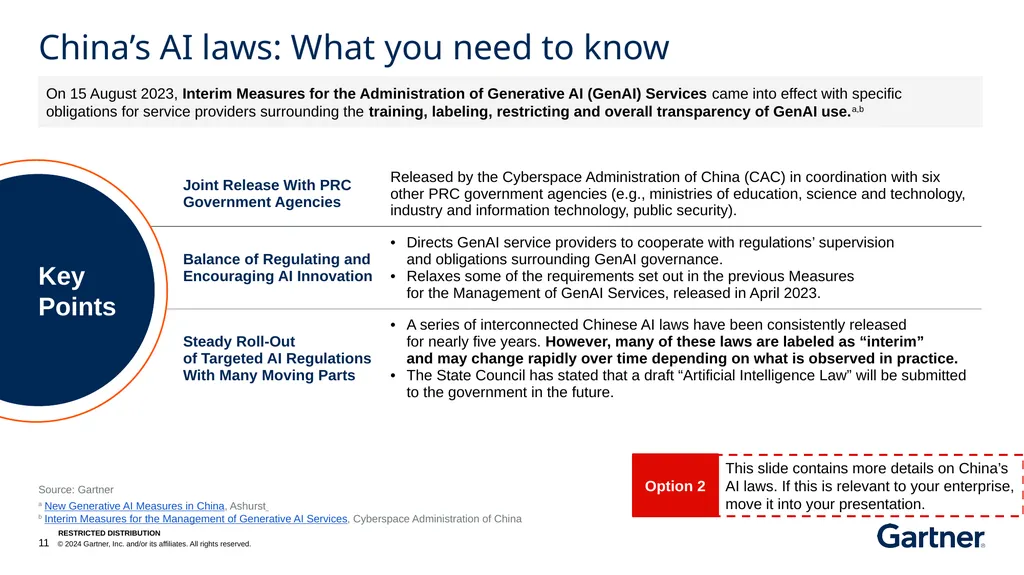
China’s AI laws: What you need to know Source: Gartner
a New Generative AI Measures in China, Ashurst
b Interim Measures for the Management of Generative AI Services, Cyberspace Administration of China Key Points On 15 August 2023, Interim Measures for the Administration of Generative AI (GenAI) Services came into effect with specific obligations for service providers surrounding the training, labeling, restricting and overall transparency of GenAI use.a,b<br>
12
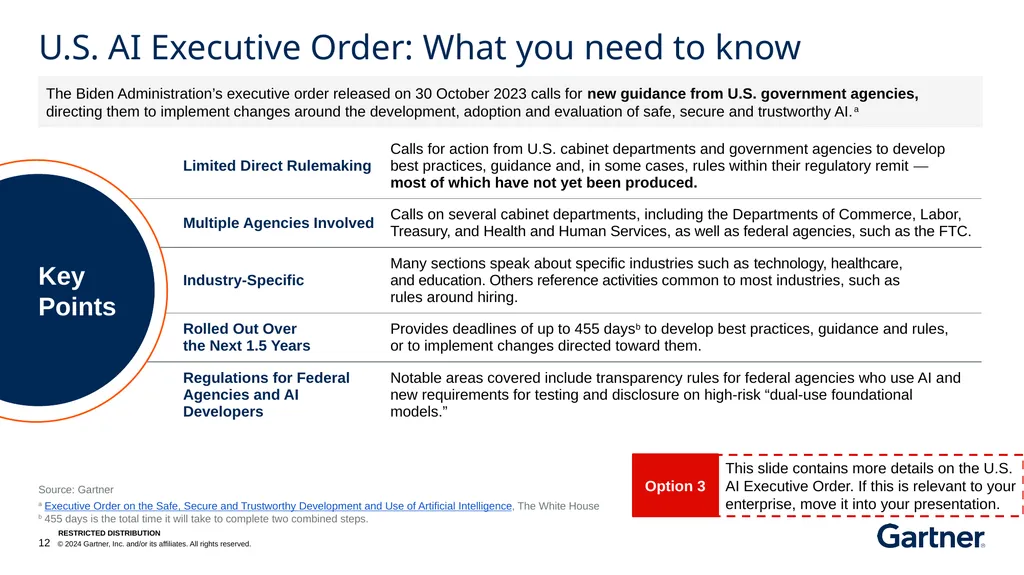
U.S. AI Executive Order: What you need to know Source: Gartner
a Executive Order on the Safe, Secure and Trustworthy Development and Use of Artificial Intelligence, The White House
b 455 days is the total time it will take to complete two combined steps. The Biden Administration’s executive order released on 30 October 2023 calls for new guidance from U.S. government agencies, directing them to implement changes around the development, adoption and evaluation of safe, secure and trustworthy AI.a Key Points<br>
13
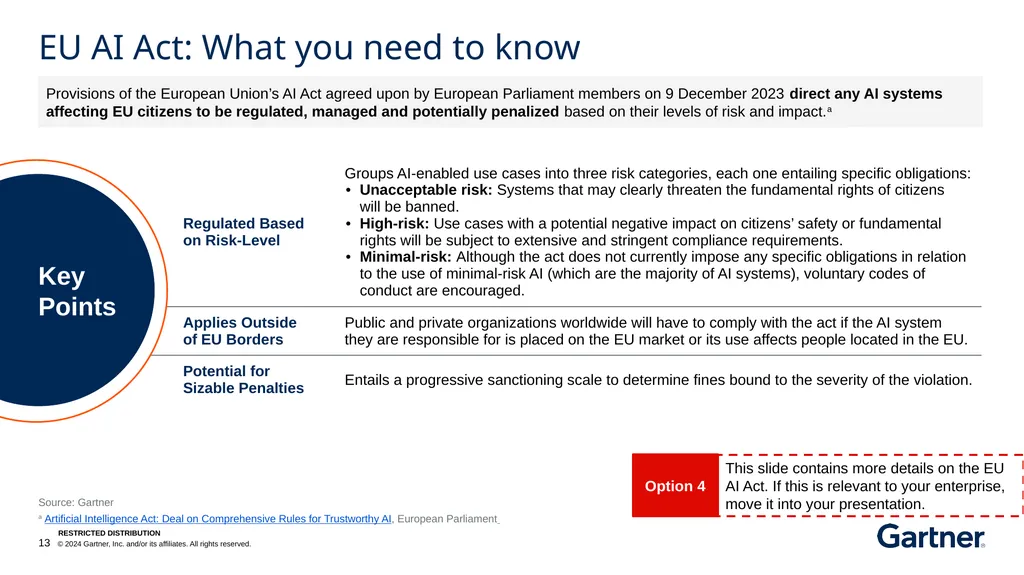
EU AI Act: What you need to know Provisions of the European Union’s AI Act agreed upon by European Parliament members on 9 December 2023 direct any AI systems affecting EU citizens to be regulated, managed and potentially penalized based on their levels of risk and impact.a Source: Gartner
a Artificial Intelligence Act: Deal on Comprehensive Rules for Trustworthy AI, European Parliament Key Points<br>
14
Actionable, objective insight Position your legal and compliance function for success. Explore these additional complimentary resources and tools: Already a client?
Get access to even more resources in your client portal. Log In Webinar
Join a Virtual Event
Hear the latest insights from Gartner experts at an upcoming or recorded event. Watch Now Download Report Report
Top Priorities for Legal and Compliance Leaders
Explore the top 5 legal and compliance trends to maximize the trends. Download Now Report
Legal and Compliance Risks Reports
Future-proof your organization against 12 emerging legal and compliance risks. Download Now How We Help
Gartner for Legal, Risk & Compliance Leaders
Discover how we can help you tackle your mission-critical priorities. Learn More<br>