
Bob Tabor | http://www.LearnVisualStudio.NET

Published  . 0 views
↓ Download
Bob Tabor | http://www.LearnVisualStudio.NET
1 / 1
Bob Tabor | http://www.LearnVisualStudio.NET - slide 1 of 7 Bob Tabor | http://www.LearnVisualStudio.NET - slide 2 of 7 Bob Tabor | http://www.LearnVisualStudio.NET - slide 3 of 7 Bob Tabor | http://www.LearnVisualStudio.NET - slide 4 of 7 Bob Tabor | http://www.LearnVisualStudio.NET - slide 5 of 7 Bob Tabor | http://www.LearnVisualStudio.NET - slide 6 of 7 Bob Tabor | http://www.LearnVisualStudio.NET - slide 7 of 7

Description: Bob Tabor http:www.LearnVisualStudio.NET bobtabor Microsoft Azure Fundamentals: Data Understanding Microsoft Azure Storage Queues What we already know about Azure Storage Queues Messages are inserted into Queues and kept in order until

Related Topics

Download Presentation

"Bob Tabor | http://www.LearnVisualStudio.NET" is the property of its rightful owner. Permission is granted to download and print the materials on this website for personal, non-commercial use only, and to display it on your personal computer provided you do not modify the materials and that you retain all copyright notices contained in the materials. By downloading content from our website, you accept the terms of this agreement.

Presentation Transcript

slide1. Bob Tabor | http://www.LearnVisualStudio.NET
@bobtabor Microsoft Azure Fundamentals: Data Understanding Microsoft Azure Storage Queues<br>
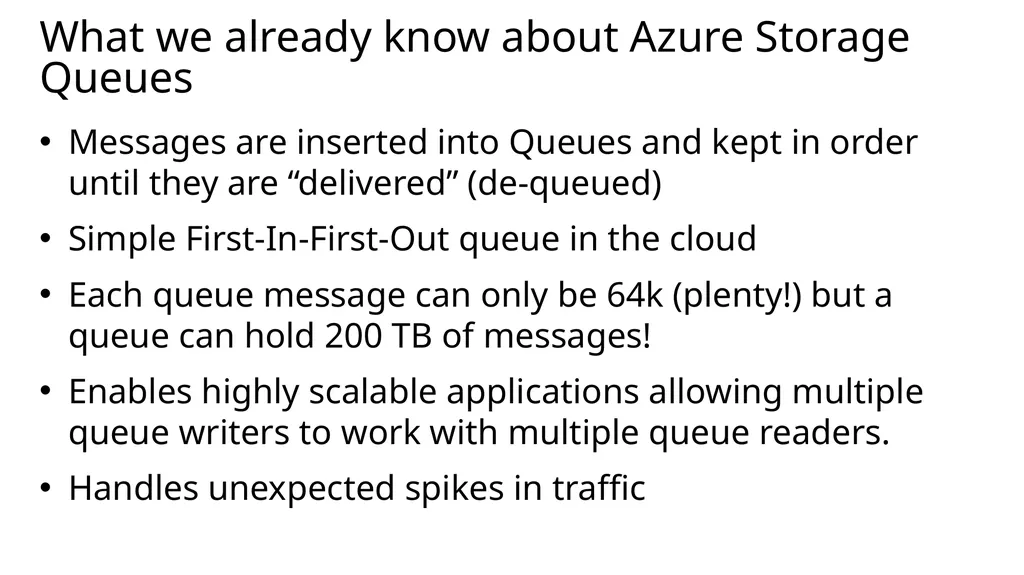
slide2. What we already know about Azure Storage Queues Messages are inserted into Queues and kept in order until they are “delivered” (de-queued)
Simple First-In-First-Out queue in the cloud
Each queue message can only be 64k (plenty!) but a queue can hold 200 TB of messages!
Enables highly scalable applications allowing multiple queue writers to work with multiple queue readers.
Handles unexpected spikes in traffic<br>
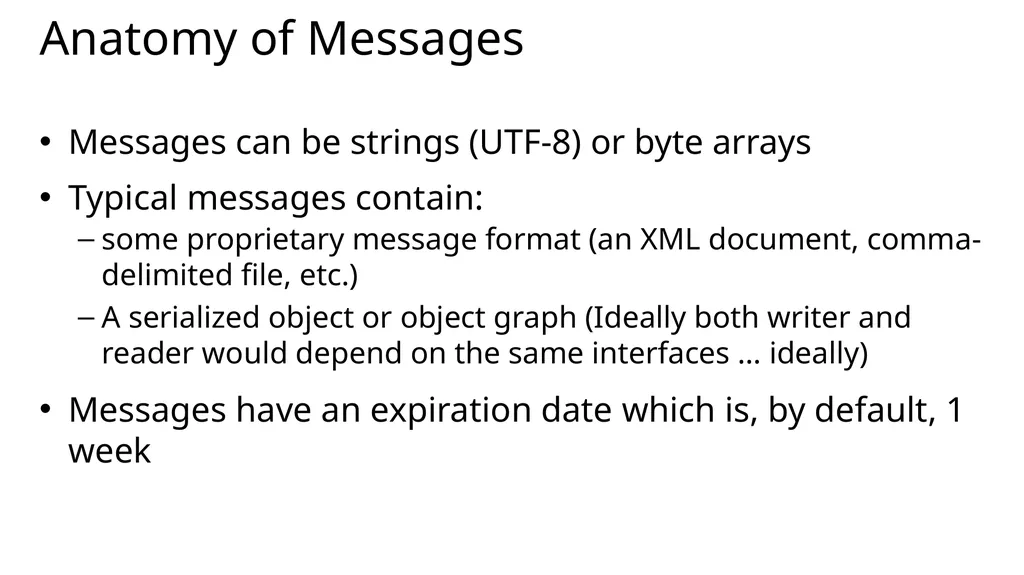
slide3. Anatomy of Messages Messages can be strings (UTF-8) or byte arrays
Typical messages contain:
some proprietary message format (an XML document, comma-delimited file, etc.)
A serialized object or object graph (Ideally both writer and reader would depend on the same interfaces … ideally)
Messages have an expiration date which is, by default, 1 week<br>
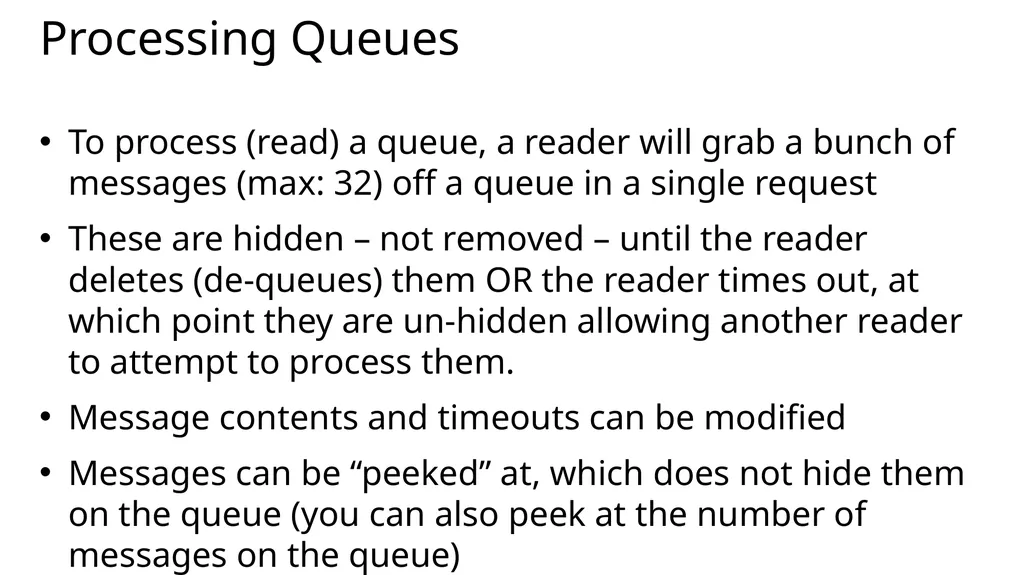
slide4. Processing Queues To process (read) a queue, a reader will grab a bunch of messages (max: 32) off a queue in a single request
These are hidden – not removed – until the reader deletes (de-queues) them OR the reader times out, at which point they are un-hidden allowing another reader to attempt to process them.
Message contents and timeouts can be modified
Messages can be “peeked” at, which does not hide them on the queue (you can also peek at the number of messages on the queue)<br>
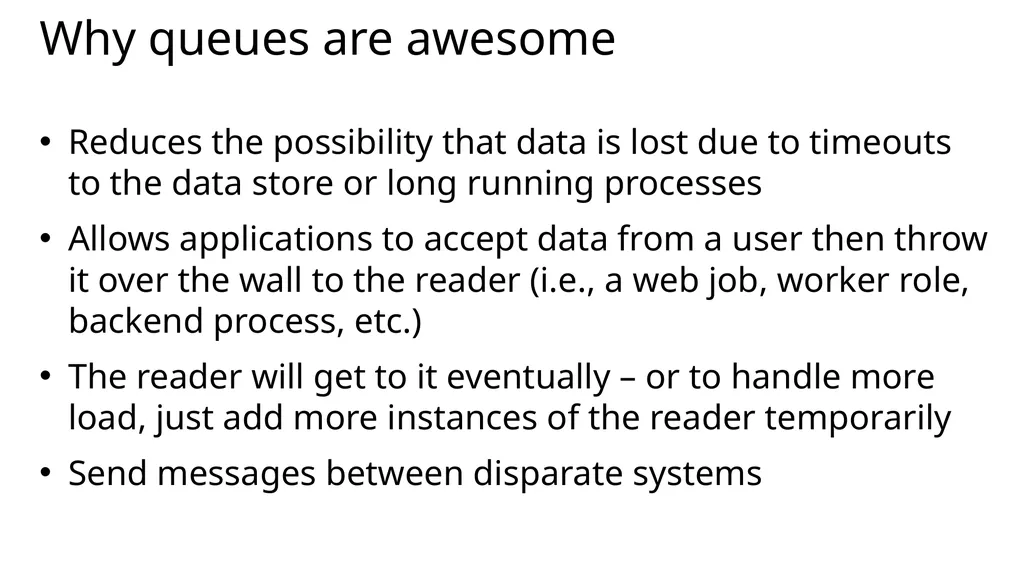
slide5. Why queues are awesome Reduces the possibility that data is lost due to timeouts to the data store or long running processes
Allows applications to accept data from a user then throw it over the wall to the reader (i.e., a web job, worker role, backend process, etc.)
The reader will get to it eventually – or to handle more load, just add more instances of the reader temporarily
Send messages between disparate systems<br>
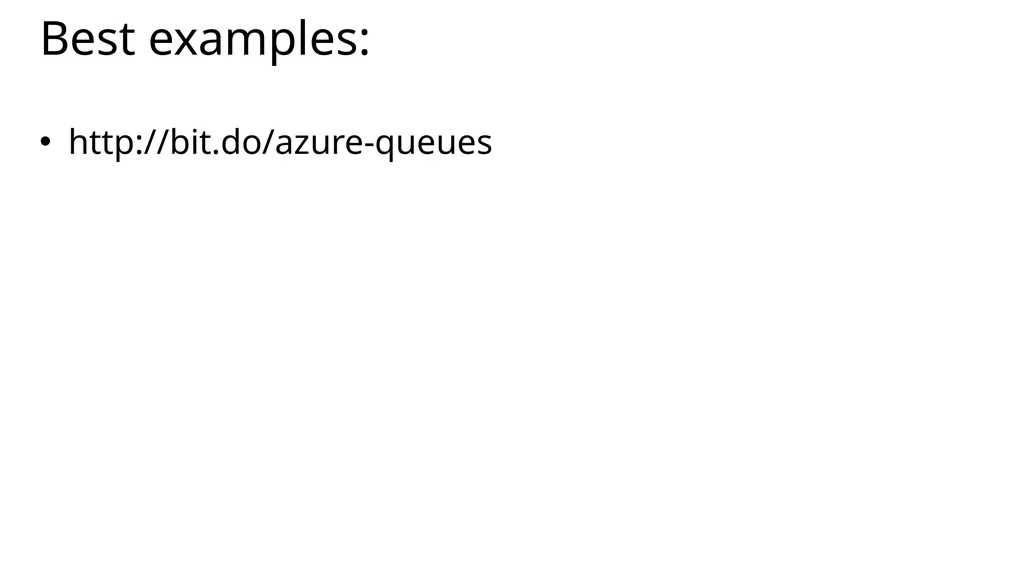
slide6. Best examples: http://bit.do/azure-queues<br>