BODY DEFENSES Introduction: Every human being has
Description: BODY DEFENSES Introduction: Every human being has its immune system to defend it against the pathogens. Resistance is the ability to prevent the disease through our defences. Meaning: Body defenses means to defenses against infection. The
Related Topics
Download Presentation
"BODY DEFENSES Introduction: Every human being has" is the property of its rightful owner. Permission is granted to download and print the materials on this website for personal, non-commercial use only, and to display it on your personal computer provided you do not modify the materials and that you retain all copyright notices contained in the materials. By downloading content from our website, you accept the terms of this agreement.
Presentation Transcript
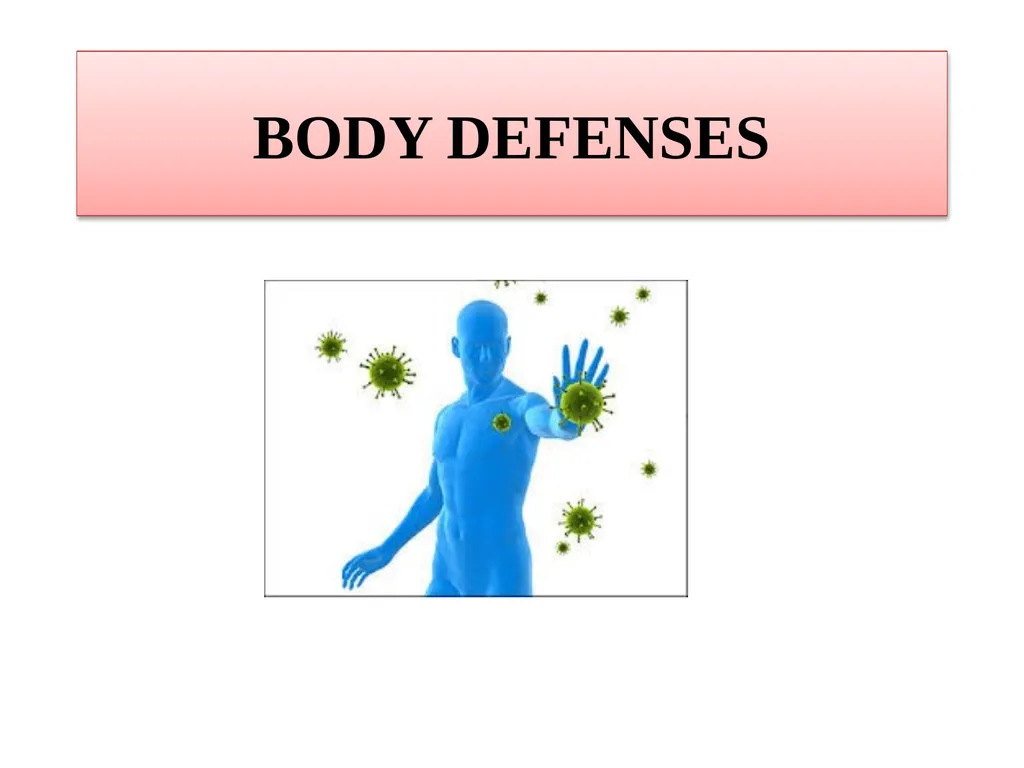
slide1. BODY DEFENSES<br>
slide2. Introduction: Every human being has its immune system to defend it against the pathogens.
Resistance is the ability to prevent the disease through our defences.<br>
slide3. Meaning: “Body defenses means to defenses against infection.”
The body has natural defenses that protect against infection.
Normal floras, body system defenses, and inflammation are all nonspecific defenses that protect against microorganisms regardless of prior exposure.
If any body defenses fail, an infection usually occurs and leads to a serious health problem.<br>
slide5. Categories / Types of Body defence: Defences can be categorized as nonspecific and specific.
Nonspecific defenses: protect the person against all microorganisms, regardless of prior exposure.
Specific (immune) defenses: are directed against identifiable bacteria,viruses, fungi, or other infectious agents. SHRI VINOBA BHAVE COLLEGE OF NURSING, SILVASSA 5<br>
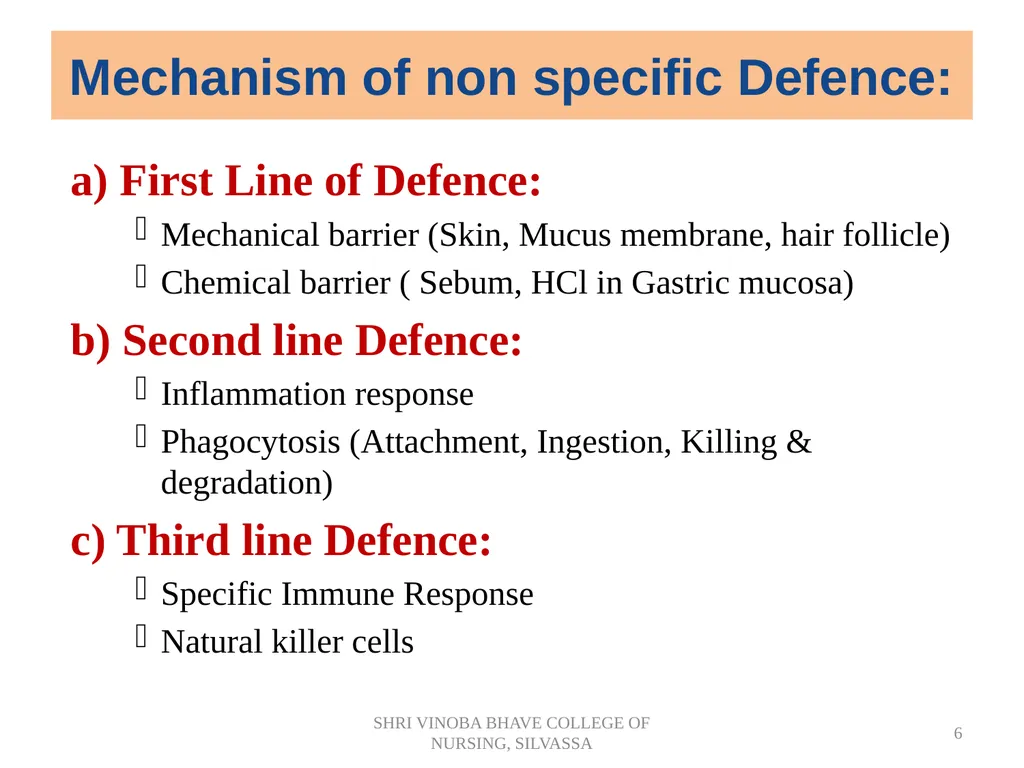
slide6. Mechanism of non specific Defence: a) First Line of Defence:
Mechanical barrier (Skin, Mucus membrane, hair follicle)
Chemical barrier ( Sebum, HCl in Gastric mucosa)
b) Second line Defence:
Inflammation response
Phagocytosis (Attachment, Ingestion, Killing & degradation)
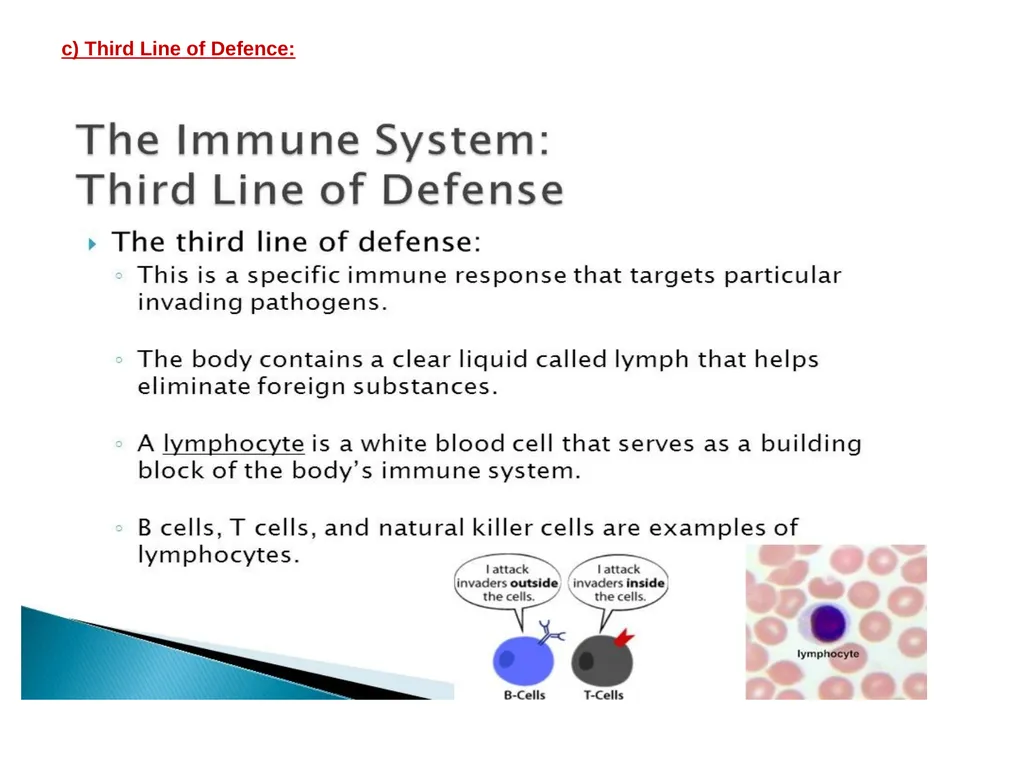
c) Third line Defence:
Specific Immune Response
Natural killer cells SHRI VINOBA BHAVE COLLEGE OF NURSING, SILVASSA 6<br>
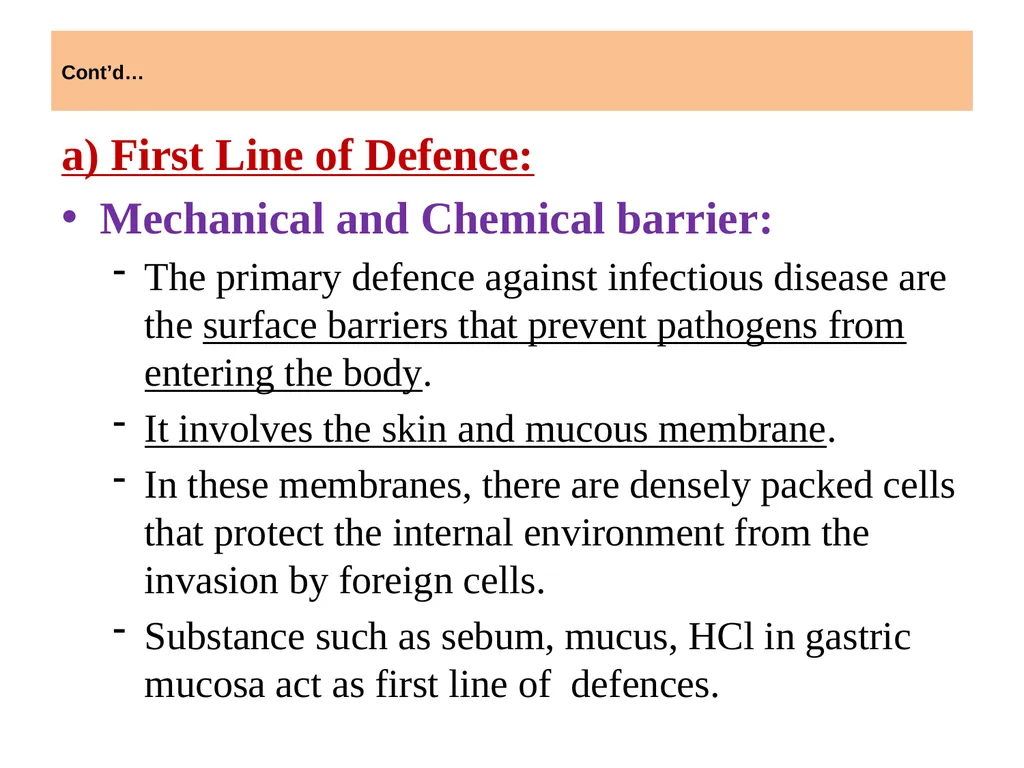
slide7. Cont’d… a) First Line of Defence:
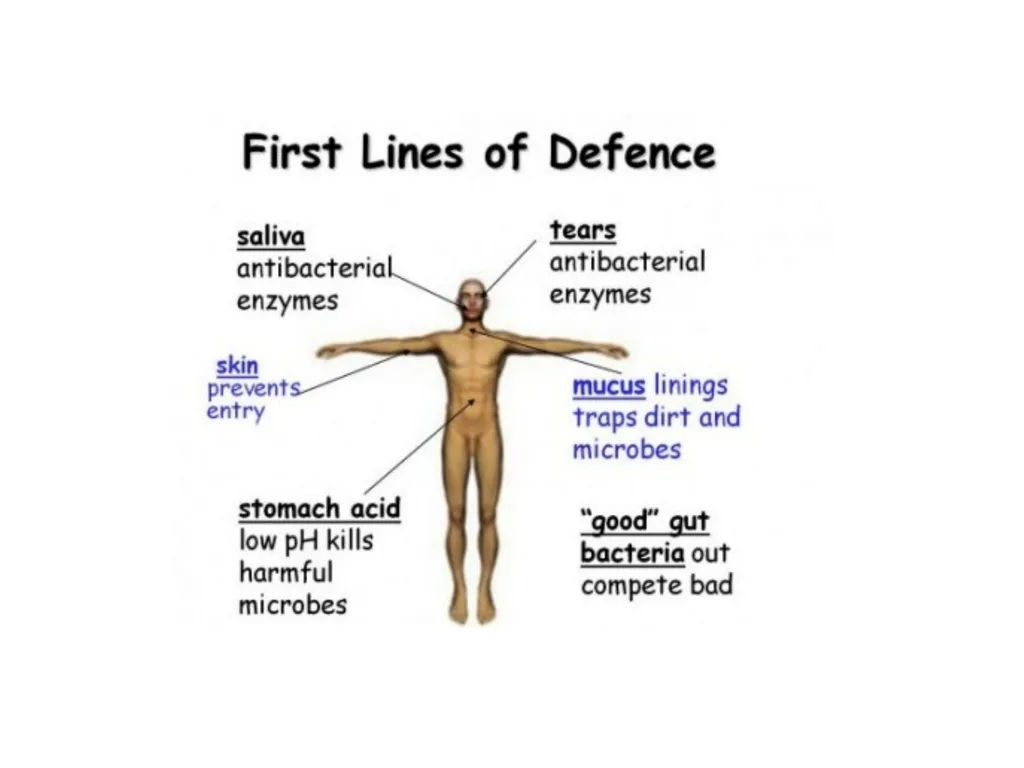
Mechanical and Chemical barrier:
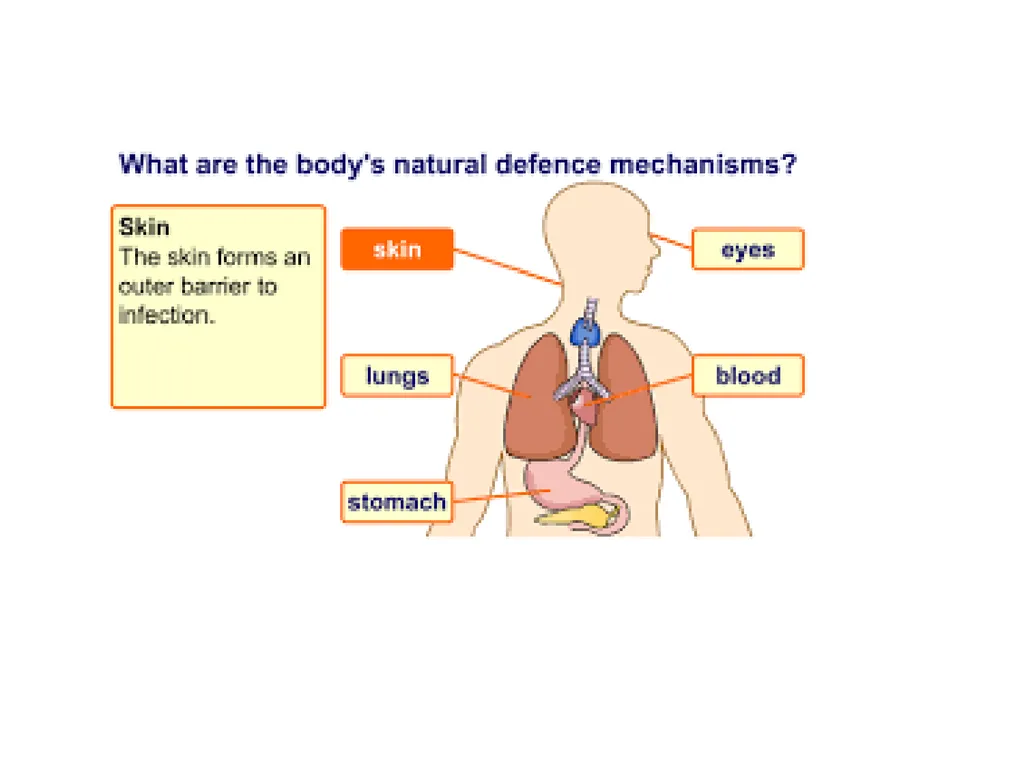
The primary defence against infectious disease are the surface barriers that prevent pathogens from entering the body.
It involves the skin and mucous membrane.
In these membranes, there are densely packed cells that protect the internal environment from the invasion by foreign cells.
Substance such as sebum, mucus, HCl in gastric mucosa act as first line of defences.<br>
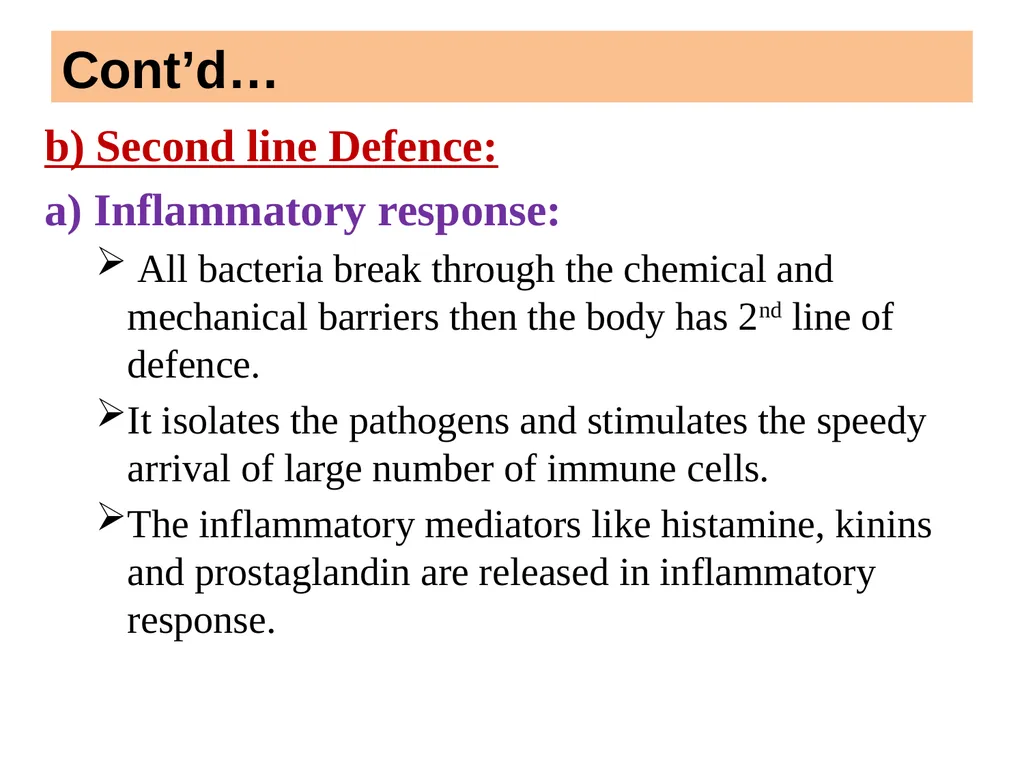
slide9. Cont’d… b) Second line Defence:
a) Inflammatory response:
All bacteria break through the chemical and mechanical barriers then the body has 2nd line of defence.
It isolates the pathogens and stimulates the speedy arrival of large number of immune cells.
The inflammatory mediators like histamine, kinins and prostaglandin are released in inflammatory response.<br>
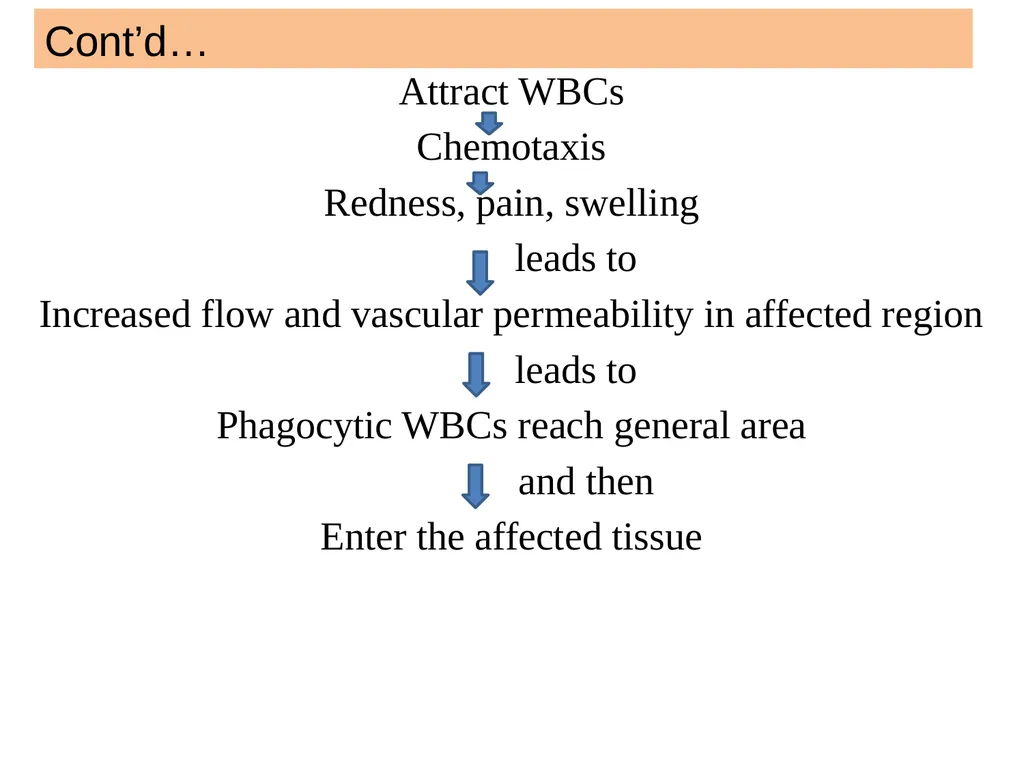
slide10. Cont’d… Attract WBCs
Chemotaxis
Redness, pain, swelling
leads to
Increased flow and vascular permeability in affected region
leads to
Phagocytic WBCs reach general area
and then
Enter the affected tissue<br>
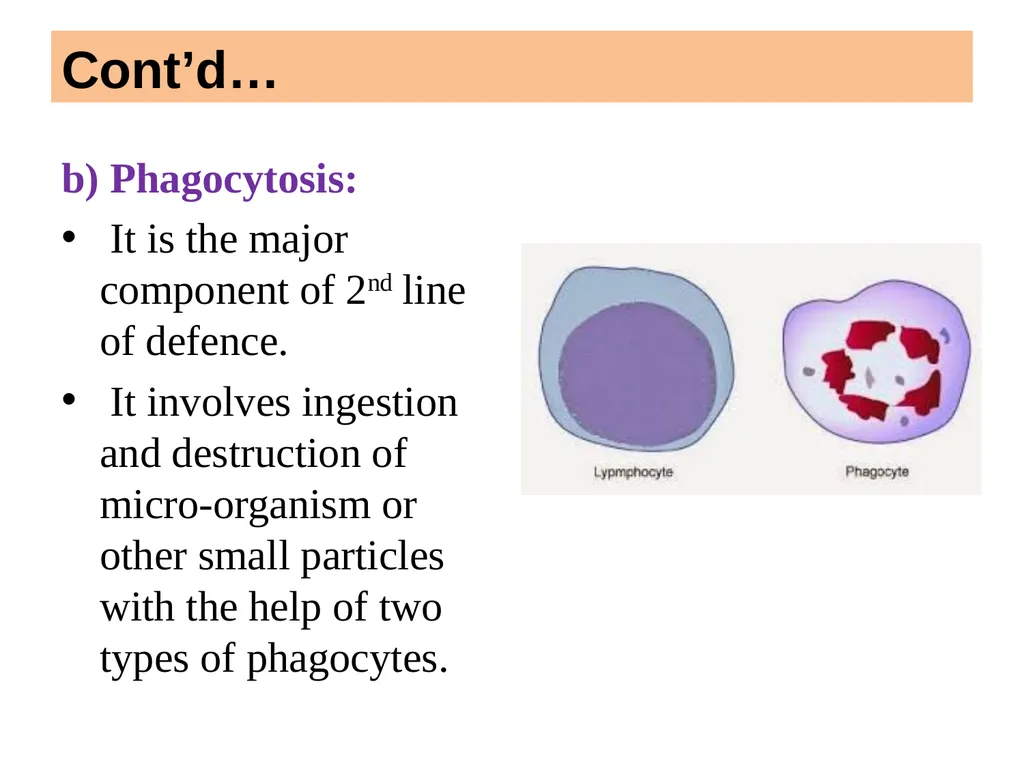
slide11. Cont’d… b) Phagocytosis:
It is the major component of 2nd line of defence.
It involves ingestion and destruction of micro-organism or other small particles with the help of two types of phagocytes.<br>
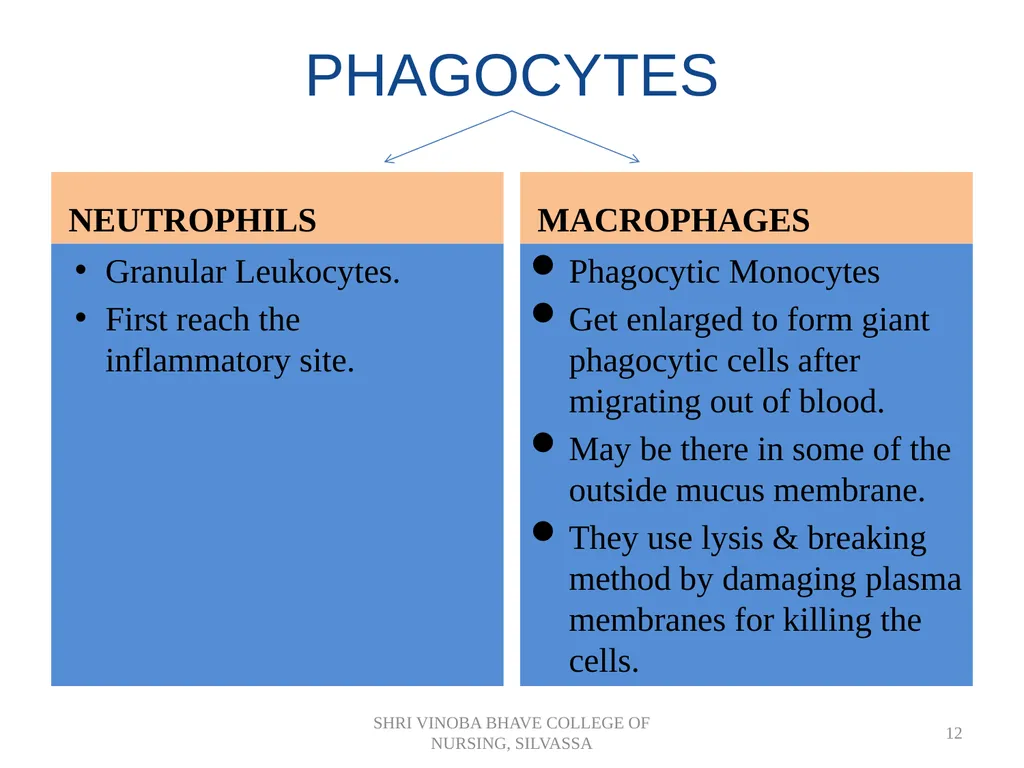
slide12. PHAGOCYTES NEUTROPHILS Granular Leukocytes.
First reach the inflammatory site. MACROPHAGES Phagocytic Monocytes
Get enlarged to form giant phagocytic cells after migrating out of blood.
May be there in some of the outside mucus membrane.
They use lysis & breaking method by damaging plasma membranes for killing the cells. SHRI VINOBA BHAVE COLLEGE OF NURSING, SILVASSA 12<br>
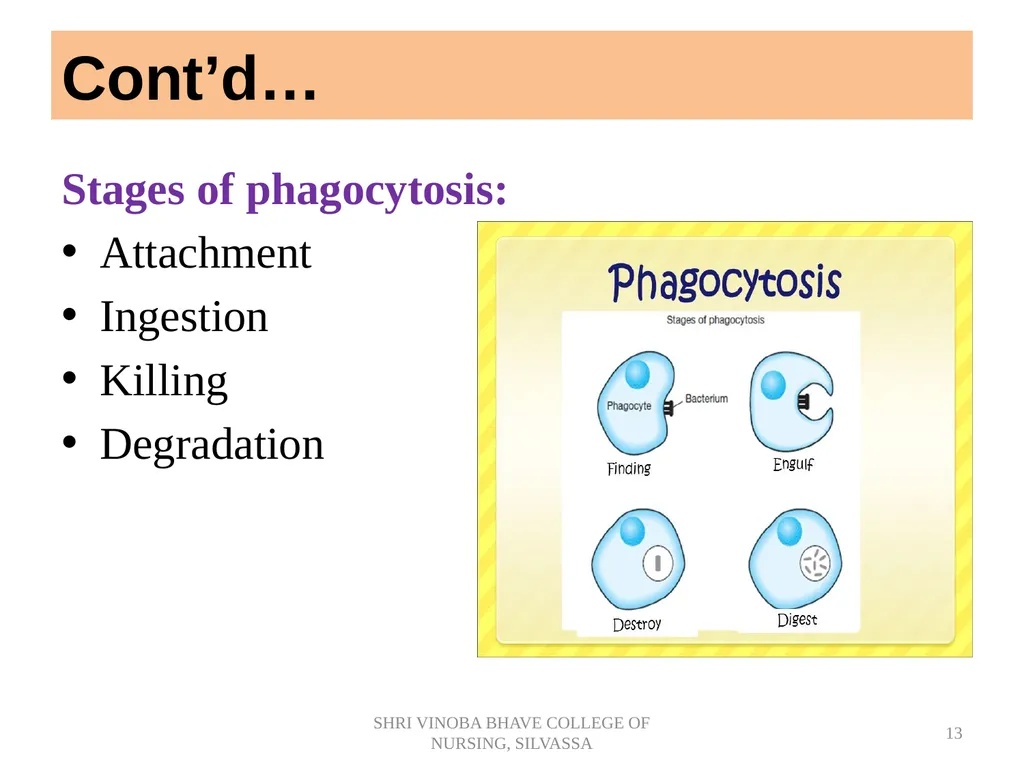
slide13. Cont’d… Stages of phagocytosis:
Attachment
Ingestion
Killing
Degradation SHRI VINOBA BHAVE COLLEGE OF NURSING, SILVASSA 13<br>
slide14. c) Third Line of Defence:<br>
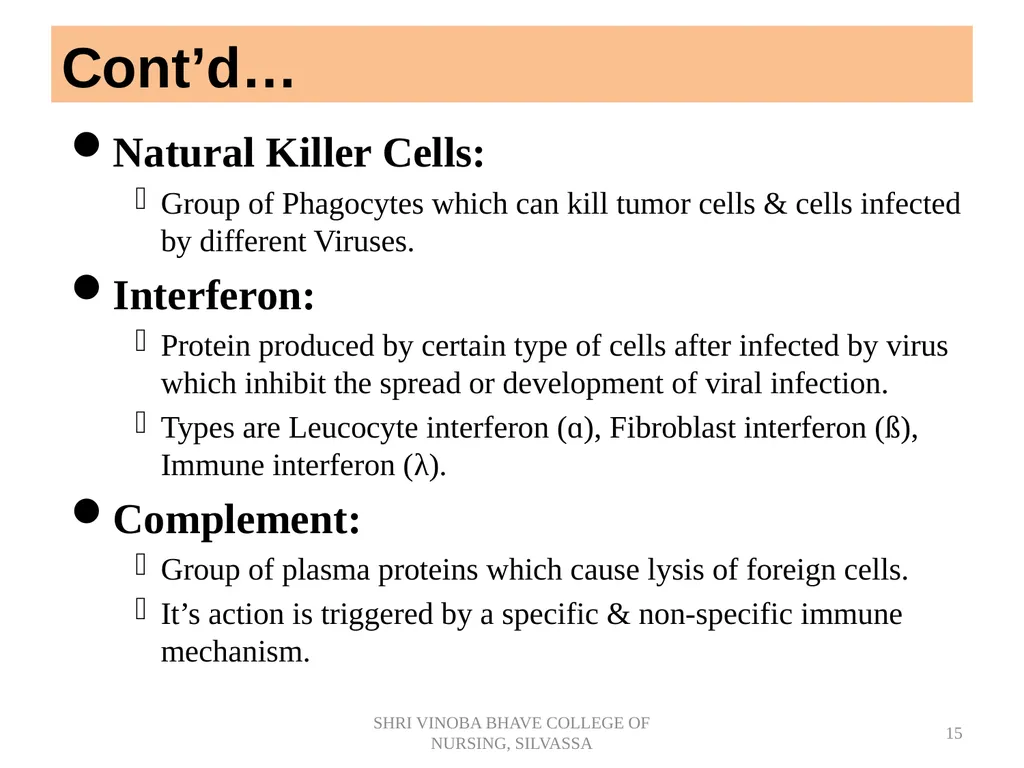
slide15. Cont’d… Natural Killer Cells:
Group of Phagocytes which can kill tumor cells & cells infected by different Viruses.
Interferon:
Protein produced by certain type of cells after infected by virus which inhibit the spread or development of viral infection.
Types are Leucocyte interferon (ɑ), Fibroblast interferon (ß), Immune interferon (λ).
Complement:
Group of plasma proteins which cause lysis of foreign cells.
It’s action is triggered by a specific & non-specific immune mechanism. SHRI VINOBA BHAVE COLLEGE OF NURSING, SILVASSA 15<br>
slide16. SPECIFIC RESISTANCE OR IMMUNITY<br>
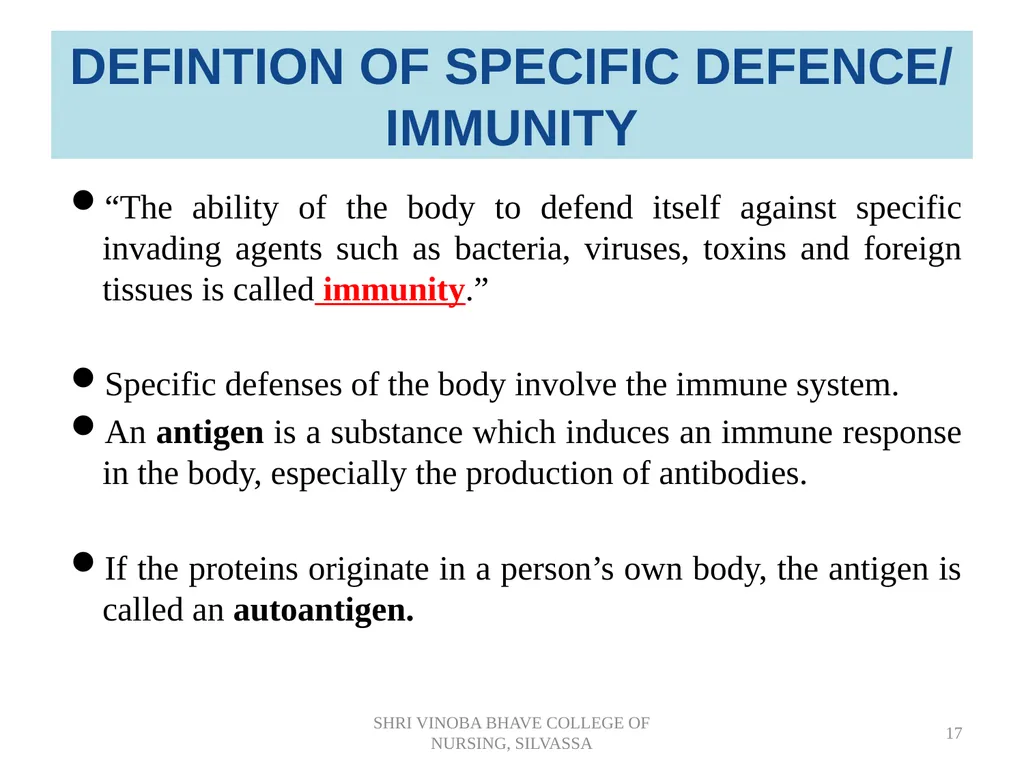
slide17. DEFINTION OF SPECIFIC DEFENCE/ IMMUNITY “The ability of the body to defend itself against specific invading agents such as bacteria, viruses, toxins and foreign tissues is called immunity.”
Specific defenses of the body involve the immune system.
An antigen is a substance which induces an immune response in the body, especially the production of antibodies.
If the proteins originate in a person’s own body, the antigen is called an autoantigen. SHRI VINOBA BHAVE COLLEGE OF NURSING, SILVASSA 17<br>
slide18. Types of Immune Responses: The immune response has two components:
Cell mediated immunity
Antibody mediated (Humoral) Immune Response<br>
slide19. Cont’d… 1. Cell mediated immunity:
The cell-mediated defenses, or cellular immunity, occur through the T-cell system.
CD 8 & T Cells proliferate into Killer cells & directly attack the invader antigen.
It is effective against intracellular pathogens, cancer cells and foreign tissue transplant.<br>
slide20. Cont’d… 2. Antibody mediated (Humoral) Immune Response:
Another name for the antibody-mediated defenses is humoral (or circulating) immunity.
In this B cells transform into plasma cells, which synthesize and secrete proteins called antibodies or immunoglobulin.
It works against antigens dissolved in body fluids and intracellular pathogens.<br>
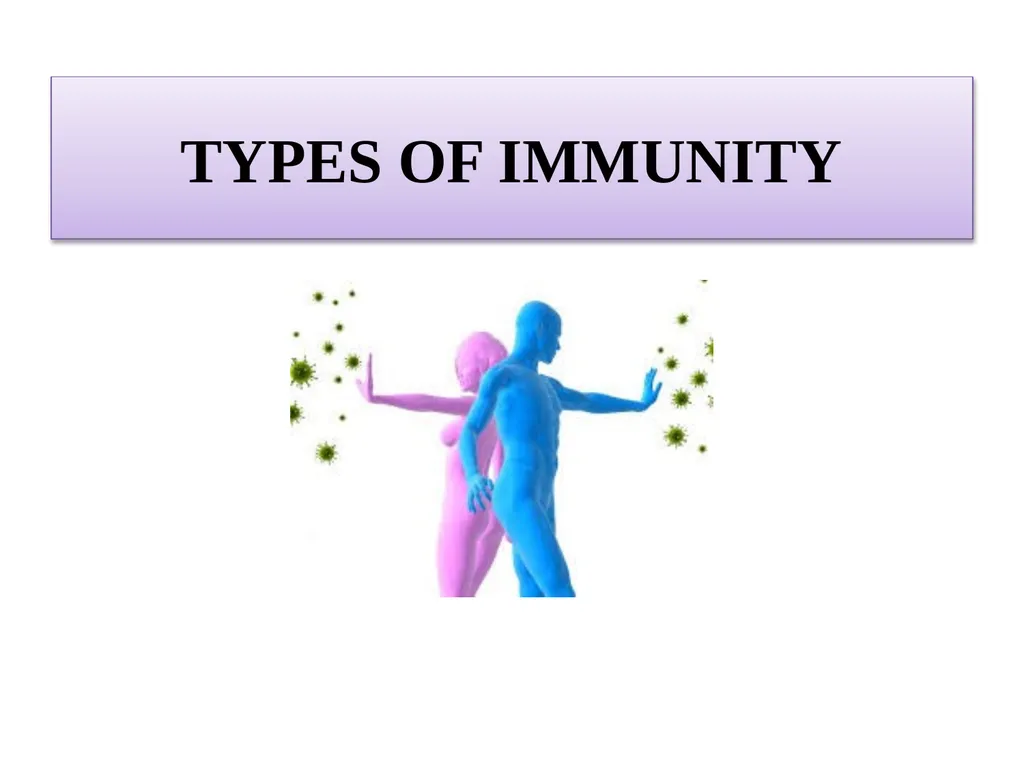
slide21. TYPES OF IMMUNITY<br>
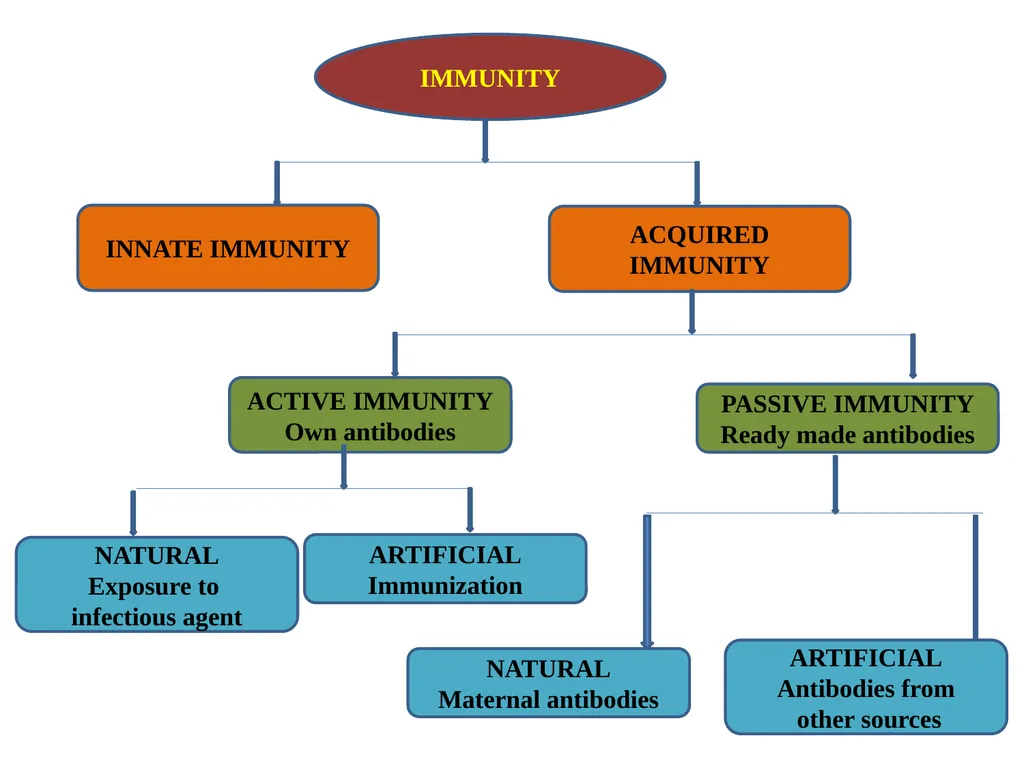
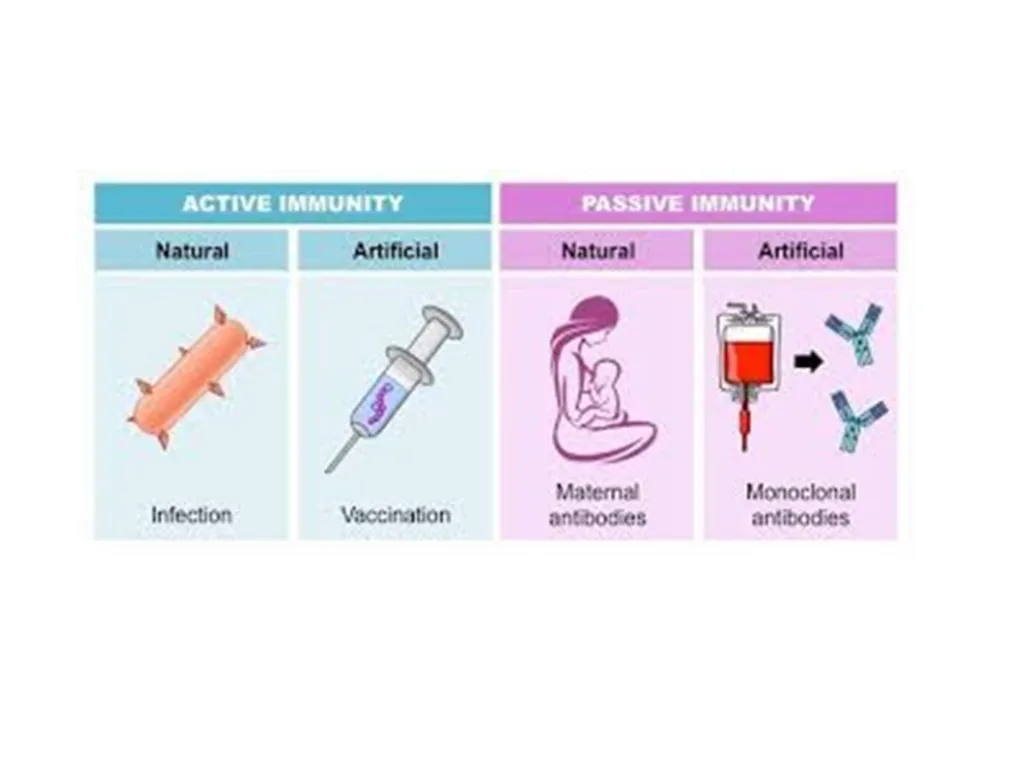
slide22. IMMUNITY INNATE IMMUNITY ACQUIRED IMMUNITY ACTIVE IMMUNITY
Own antibodies PASSIVE IMMUNITY
Ready made antibodies ARTIFICIAL
Immunization NATURAL
Exposure to
infectious agent NATURAL
Maternal antibodies ARTIFICIAL
Antibodies from
other sources<br>
slide24. IMMUNIZATION<br>
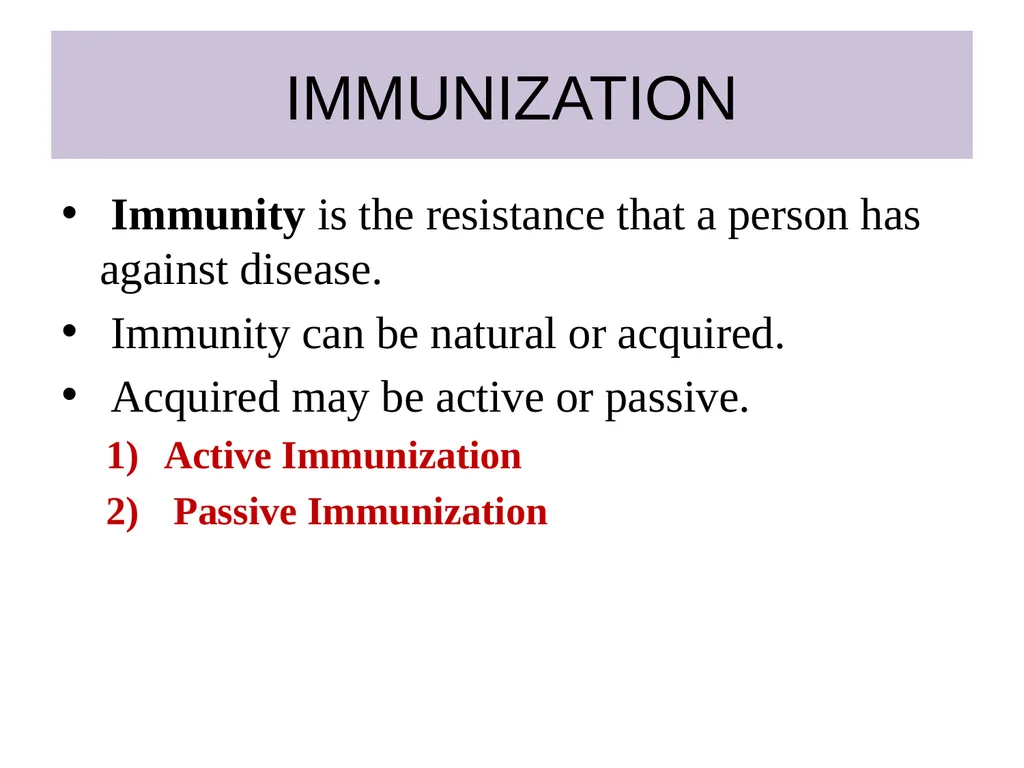
slide25. IMMUNIZATION Immunity is the resistance that a person has against disease.
Immunity can be natural or acquired.
Acquired may be active or passive.
Active Immunization
Passive Immunization<br>
slide26. Cont’d… Active Immunization:
It is produced by natural or acquired stimulation, So that the body produces its own antibodies.
It may be produced by administering live or killed micro-organisms or their antigens or inactivated vaccines and toxoids.
Passive Immunization:
Passive immunization can occur naturally, when maternal antibodies are transferred to the fetus through the placenta, and it can also be induced artificially.
It is given for temporary protection against disease when active immunizing agents are not available or when there is insufficient time to acquire active immunization following exposure to disease.<br>
slide27. SHRI VINOBA BHAVE COLLEGE OF NURSING, SILVASSA 27 THANK YOU<br>

slide2. Introduction: Every human being has its immune system to defend it against the pathogens.
Resistance is the ability to prevent the disease through our defences.<br>
slide3. Meaning: “Body defenses means to defenses against infection.”
The body has natural defenses that protect against infection.
Normal floras, body system defenses, and inflammation are all nonspecific defenses that protect against microorganisms regardless of prior exposure.
If any body defenses fail, an infection usually occurs and leads to a serious health problem.<br>
slide5. Categories / Types of Body defence: Defences can be categorized as nonspecific and specific.
Nonspecific defenses: protect the person against all microorganisms, regardless of prior exposure.
Specific (immune) defenses: are directed against identifiable bacteria,viruses, fungi, or other infectious agents. SHRI VINOBA BHAVE COLLEGE OF NURSING, SILVASSA 5<br>
slide6. Mechanism of non specific Defence: a) First Line of Defence:
Mechanical barrier (Skin, Mucus membrane, hair follicle)
Chemical barrier ( Sebum, HCl in Gastric mucosa)
b) Second line Defence:
Inflammation response
Phagocytosis (Attachment, Ingestion, Killing & degradation)
c) Third line Defence:
Specific Immune Response
Natural killer cells SHRI VINOBA BHAVE COLLEGE OF NURSING, SILVASSA 6<br>
slide7. Cont’d… a) First Line of Defence:
Mechanical and Chemical barrier:
The primary defence against infectious disease are the surface barriers that prevent pathogens from entering the body.
It involves the skin and mucous membrane.
In these membranes, there are densely packed cells that protect the internal environment from the invasion by foreign cells.
Substance such as sebum, mucus, HCl in gastric mucosa act as first line of defences.<br>
slide9. Cont’d… b) Second line Defence:
a) Inflammatory response:
All bacteria break through the chemical and mechanical barriers then the body has 2nd line of defence.
It isolates the pathogens and stimulates the speedy arrival of large number of immune cells.
The inflammatory mediators like histamine, kinins and prostaglandin are released in inflammatory response.<br>
slide10. Cont’d… Attract WBCs
Chemotaxis
Redness, pain, swelling
leads to
Increased flow and vascular permeability in affected region
leads to
Phagocytic WBCs reach general area
and then
Enter the affected tissue<br>
slide11. Cont’d… b) Phagocytosis:
It is the major component of 2nd line of defence.
It involves ingestion and destruction of micro-organism or other small particles with the help of two types of phagocytes.<br>
slide12. PHAGOCYTES NEUTROPHILS Granular Leukocytes.
First reach the inflammatory site. MACROPHAGES Phagocytic Monocytes
Get enlarged to form giant phagocytic cells after migrating out of blood.
May be there in some of the outside mucus membrane.
They use lysis & breaking method by damaging plasma membranes for killing the cells. SHRI VINOBA BHAVE COLLEGE OF NURSING, SILVASSA 12<br>
slide13. Cont’d… Stages of phagocytosis:
Attachment
Ingestion
Killing
Degradation SHRI VINOBA BHAVE COLLEGE OF NURSING, SILVASSA 13<br>
slide14. c) Third Line of Defence:<br>
slide15. Cont’d… Natural Killer Cells:
Group of Phagocytes which can kill tumor cells & cells infected by different Viruses.
Interferon:
Protein produced by certain type of cells after infected by virus which inhibit the spread or development of viral infection.
Types are Leucocyte interferon (ɑ), Fibroblast interferon (ß), Immune interferon (λ).
Complement:
Group of plasma proteins which cause lysis of foreign cells.
It’s action is triggered by a specific & non-specific immune mechanism. SHRI VINOBA BHAVE COLLEGE OF NURSING, SILVASSA 15<br>
slide16. SPECIFIC RESISTANCE OR IMMUNITY<br>
slide17. DEFINTION OF SPECIFIC DEFENCE/ IMMUNITY “The ability of the body to defend itself against specific invading agents such as bacteria, viruses, toxins and foreign tissues is called immunity.”
Specific defenses of the body involve the immune system.
An antigen is a substance which induces an immune response in the body, especially the production of antibodies.
If the proteins originate in a person’s own body, the antigen is called an autoantigen. SHRI VINOBA BHAVE COLLEGE OF NURSING, SILVASSA 17<br>
slide18. Types of Immune Responses: The immune response has two components:
Cell mediated immunity
Antibody mediated (Humoral) Immune Response<br>
slide19. Cont’d… 1. Cell mediated immunity:
The cell-mediated defenses, or cellular immunity, occur through the T-cell system.
CD 8 & T Cells proliferate into Killer cells & directly attack the invader antigen.
It is effective against intracellular pathogens, cancer cells and foreign tissue transplant.<br>
slide20. Cont’d… 2. Antibody mediated (Humoral) Immune Response:
Another name for the antibody-mediated defenses is humoral (or circulating) immunity.
In this B cells transform into plasma cells, which synthesize and secrete proteins called antibodies or immunoglobulin.
It works against antigens dissolved in body fluids and intracellular pathogens.<br>
slide21. TYPES OF IMMUNITY<br>
slide22. IMMUNITY INNATE IMMUNITY ACQUIRED IMMUNITY ACTIVE IMMUNITY
Own antibodies PASSIVE IMMUNITY
Ready made antibodies ARTIFICIAL
Immunization NATURAL
Exposure to
infectious agent NATURAL
Maternal antibodies ARTIFICIAL
Antibodies from
other sources<br>
slide24. IMMUNIZATION<br>
slide25. IMMUNIZATION Immunity is the resistance that a person has against disease.
Immunity can be natural or acquired.
Acquired may be active or passive.
Active Immunization
Passive Immunization<br>
slide26. Cont’d… Active Immunization:
It is produced by natural or acquired stimulation, So that the body produces its own antibodies.
It may be produced by administering live or killed micro-organisms or their antigens or inactivated vaccines and toxoids.
Passive Immunization:
Passive immunization can occur naturally, when maternal antibodies are transferred to the fetus through the placenta, and it can also be induced artificially.
It is given for temporary protection against disease when active immunizing agents are not available or when there is insufficient time to acquire active immunization following exposure to disease.<br>
slide27. SHRI VINOBA BHAVE COLLEGE OF NURSING, SILVASSA 27 THANK YOU<br>