Borrowing and the Public Debt Objective: To learn what historic events caused the US to go into debt Borrowing The Constitution gives Congress the power to borrow Money to meet the costs of crisis situations, like wars, and to pay for large
"Borrowing and the Public Debt Objective: To learn" is the property of its rightful owner. Permission is granted to
download and print the materials on this website for personal, non-commercial use only, and to display it
on your personal computer provided you do not modify the materials and that you retain all copyright
notices contained in the materials. By downloading content from our website, you accept the terms of this
agreement.
Share
Embed code
Presentation Transcript
01
Borrowing and the Public Debt Objective: To learn what historic events caused the US to go into debt<br>
02
Borrowing The Constitution gives Congress the power to borrow Money to meet the costs of crisis situations, like wars, and to pay for large scale projects that could not be financed out of current income.
Beginning in the 1930s, the Federal Government has borrowed to finance budget deficits, which is the shortfall between income and outgo.
We did not show a surplus (more income than outgo) from 1970 to 1998.<br>
03
The Depression and Deficit Spending The Federal Government had to take a more active role because few states could handle the crisis of the Great Depression.
Under Hoover, the government were committed to the traditional view that the government had very limited power to deal with a private economic crisis.
They believed that the success or failure of businesses was a matter best left to the workings of the free market.<br>
04
Keynesian Economics When President Roosevelt came into office, he launched the New Deal, which was a series of government spending influenced by British economist John Maynard Keynes.
Keynesians argue that even if a government must borrow to support that increased spending, the higher employment that results will soon produce higher tax revenues. This is known as demand-side economics.
Later presidents such as Reagan and Bush have insisted that lower taxes, not greater spending, is the best way to ensure a stronger economy. This is known as supply-side economics.<br>
05
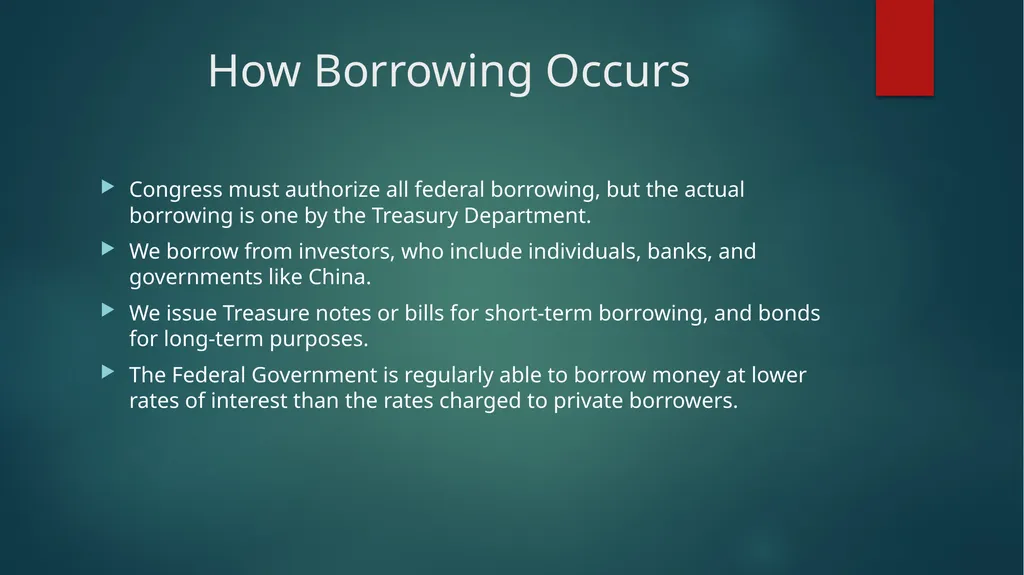
How Borrowing Occurs Congress must authorize all federal borrowing, but the actual borrowing is one by the Treasury Department.
We borrow from investors, who include individuals, banks, and governments like China.
We issue Treasure notes or bills for short-term borrowing, and bonds for long-term purposes.
The Federal Government is regularly able to borrow money at lower rates of interest than the rates charged to private borrowers.<br>
06
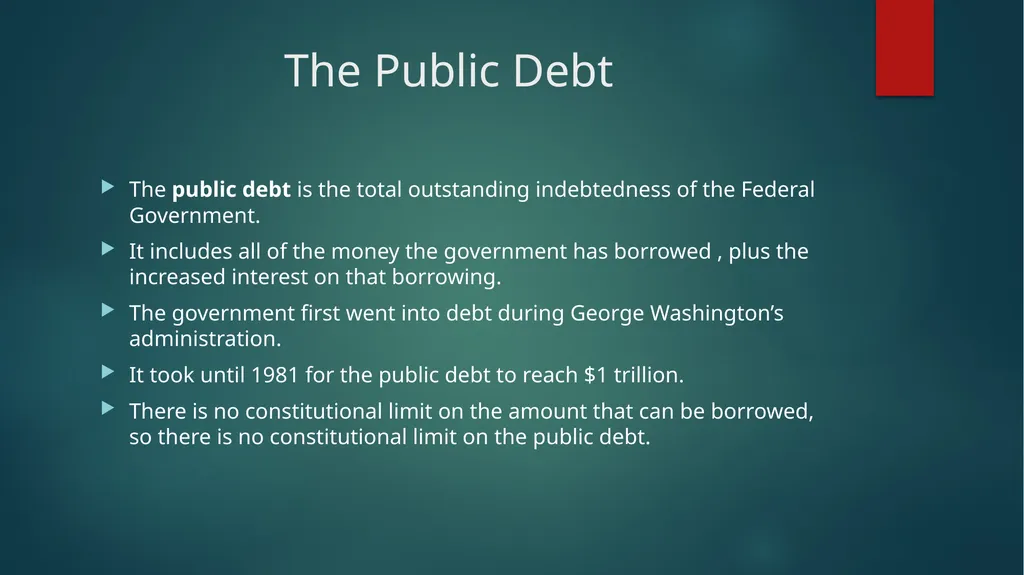
The Public Debt The public debt is the total outstanding indebtedness of the Federal Government.
It includes all of the money the government has borrowed , plus the increased interest on that borrowing.
The government first went into debt during George Washington’s administration.
It took until 1981 for the public debt to reach $1 trillion.
There is no constitutional limit on the amount that can be borrowed, so there is no constitutional limit on the public debt.<br>