Branding Some analysts see Brands as the major enduring asset of a company, outlasting specific products and facilities Brands are powerful assets that must be carefully managed and developed They are more than just names or symbols. They
Related Topics
Share
Embed code
Download this presentation From Below
"Branding Some analysts see Brands as the major" is the property of its rightful owner. Permission is granted to
download and print the materials on this website for personal, non-commercial use only, and to display it
on your personal computer provided you do not modify the materials and that you retain all copyright
notices contained in the materials. By downloading content from our website, you accept the terms of this
agreement.
Presentation Transcript
01
Branding<br>
02
Some analysts see Brands as the major enduring asset of a company, outlasting specific products and facilities
Brands are powerful assets that must be carefully managed and developed
They are more than just names or symbols. They are a key element in the company’s relationship with the consumer
The real value of a strong Brand is its power to capture consumer preference and loyalty.
- Kotler<br>
03
There are a number of interpretations of the term brand (De Chernatony 2003). They are summarized as follows: A brand is simply a logo e.g. McDonald's Golden Arches.
A brand is a legal instrument, existing in a similar way to a patent or copyright.
A brand is a company e.g. Coca-Cola.
A brand is shorthand - not as straightforward. Here a brand that is perceived as having benefits in the mind of the consumer is recognised and acts as a shortcut to circumvent large chunks of information. So when searching for a product or service in less familiar surroundings you will conduct an information search. A recognised brand will help you reach a decision more conveniently.
A brand is a risk reducer. The brand reassures you when in unfamiliar territory.
A brand is positioning. It is situated in relation to other brands in the mind of the consumer as better, worse, quicker, slower, etc.
A brand is a personality, beyond function e.g. Apple's iPod versus just any MP3 player.
A brand is a cluster of values e.g. Google is reliable, ethical, invaluable, innovative and so on.
A brand is a vision. Here managers aspire to see a brand with a cluster of values. In this context vision is similar to goal or mission.
A brand is added value, where the consumer sees value in a brand over and above its competition e.g. Audi over Volkswagen, and Volkswagen over Skoda - despite similarities.<br>
04
Brand Equity A powerful Brand has high Brand equity
This is the positive differential effect that knowing the brand name has on customer response to the product or service
One way of measuring equity is the extent to which customers are willing to pay more for the Brand
There is significant competitive advantage with high brand equity; enjoy a high level of consumer awareness, loyalty, more leverage in bargaining with resellers, easier to launch line extensions, strong and profitable customer relationships<br>
05
Brand valuation The process of estimating the total financial value of the Brand
Measuring this value is not straight forward and can be difficult
E.g: coke is valued at $67 billion, Microsoft $57 Billion, IBM $56 Billion.<br>
06
Building Strong Brands<br>
07
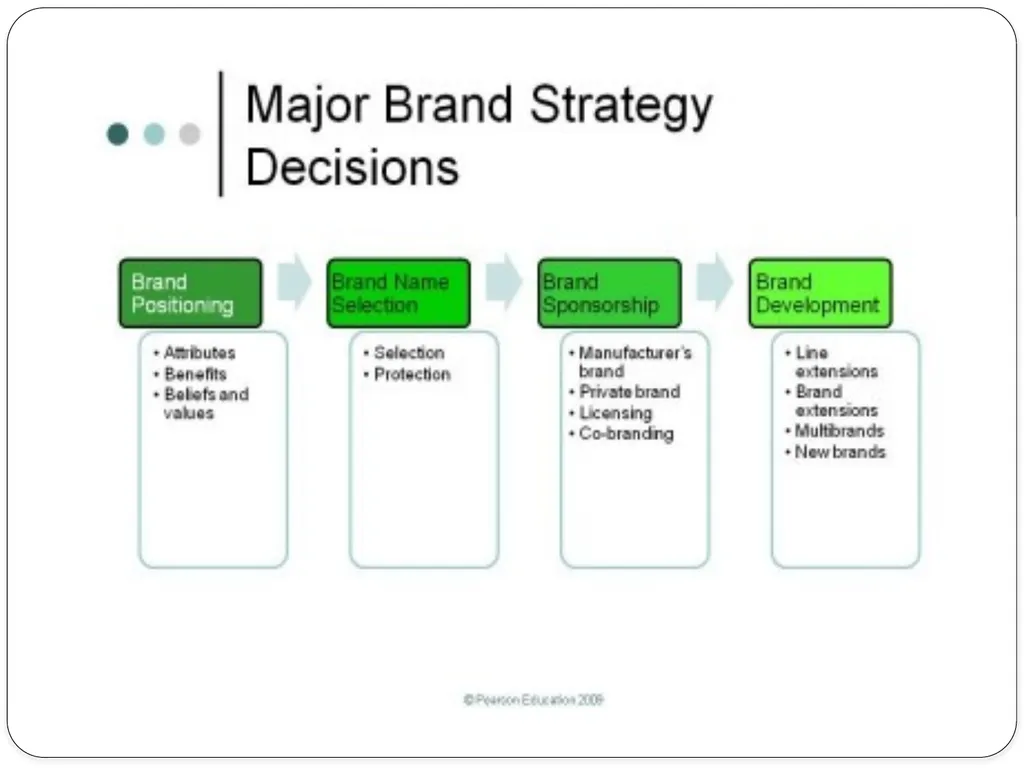
Brand Positioning Positioning can be done at 3 levels-
Product attributes- least desirable for Brand positioning. Competitors can easily copy attributes
Benefit-go beyond the Product attribute and position based on the benefit to the customer (Nike-performance, Volvo-safety, FedEx- on time delivery)
Beliefs & values- engaging the customers on a deep emotional level. Creating passion and excitement around a Brand.
The marketer needs to establish a vision and mission for the Brand. A Brand is the company’s promise to deliver a specific set of features, benefits, services and experience.<br>
08
Brand Name selection This is part science, part art and a measure of instinct
It should suggest something about the Product benefits, easy to pronounce and remember, distinctive, extendable to other categories, be able to be translated to other languages, capable of registration and legal protection
Once chosen the Brand name should be protected with the registered trademark symbol
There are instance of protected brands becoming generic names; aspirin, nylon, escalator, thermos<br>
09
Brand Sponsorship<br>
10
Manufacturer Brands Vs Private Brands Almost every retailer now carry their own brand
Private Brand is a brand created and owned by a reseller of a product or service
The retailer controls the stock, where they go on the shelf, price to be charged.
They give the reseller exclusive brands that are not available with the competition
Retailers tend to price their products lower than the competition to appeal to the budget conscious shopper.<br>
11
Licensing Some companies license names or symbols previously created by other manufacturers, names of celebrity names or popular movies
E.g: Calvin Klein, Armani, Gucci, Sesame Street, Spider man
Licensing can be a highly profitable business. Annual sales in Licensing business is more than $ 175 billion today
Licensing can provide an instant and proven Brand name<br>
12
Co-Branding The practice of using established Brand names of 2 diferent companies on the same product
Because each brand dominates in a different category, the combined brands create broader consumer appeal and brand equity
Allows a company to enter into a new category that might be difficult to enter otherwise (Walmart & SunTrust Bank)
Co-branding involves complex legal contracts and licenses. Each partner must coordinate its advertising, promotion and other marketing efforts<br>
13
Brand Development<br>
14
Line Extension When a company extends existing Brand names to new forms, colors, sizes or flavours of an existing product
(e.g Newdale yoghurts)
This may be a low cost, low risk approach to introduce new products or to use up excess capacity
However an over extended brand name might lose its specific meaning; e.g: Coke and its variants of Diet coke<br>
15
Brand Extension Extending an existing brand name to new product categories
This gives a product instant recognition and faster acceptance.
Saves on high advertising costs required to build a new brand name
Sometimes a brand extension may not be appropriate to certain products<br>
16
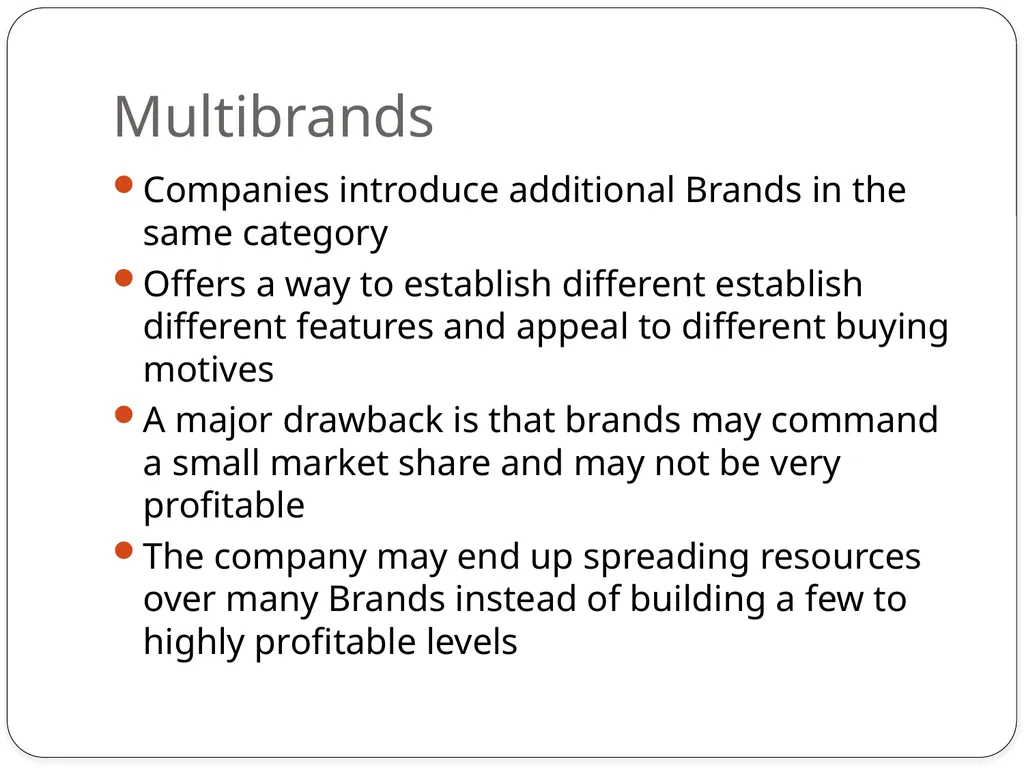
Multibrands Companies introduce additional Brands in the same category
Offers a way to establish different establish different features and appeal to different buying motives
A major drawback is that brands may command a small market share and may not be very profitable
The company may end up spreading resources over many Brands instead of building a few to highly profitable levels<br>
17
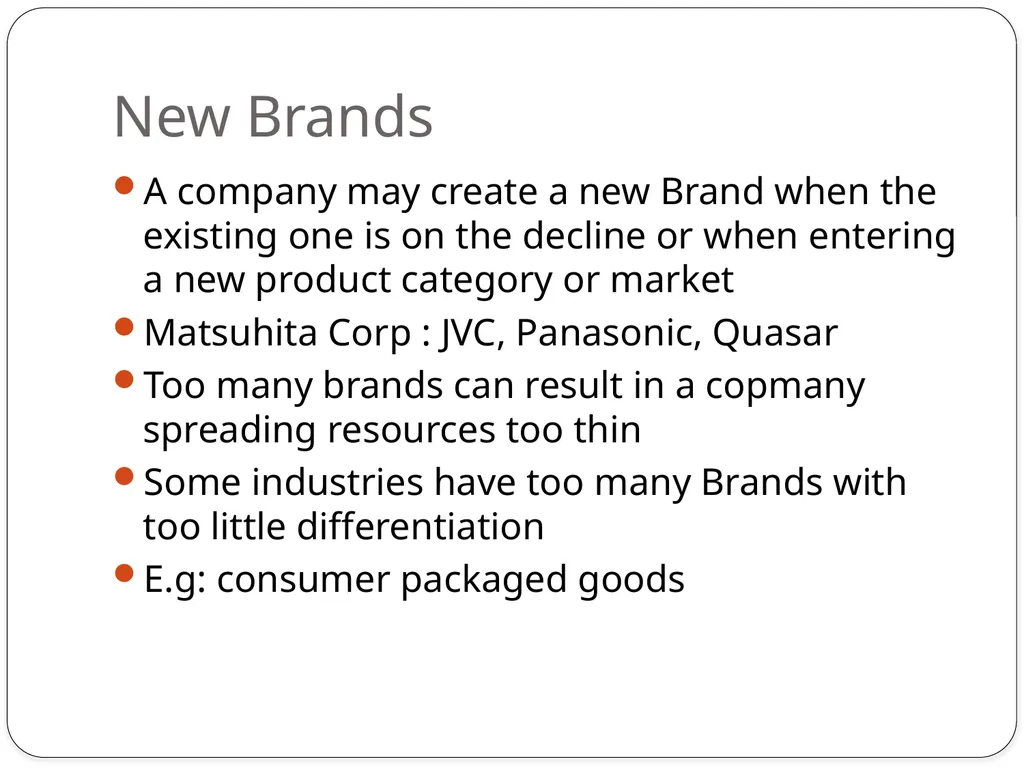
New Brands A company may create a new Brand when the existing one is on the decline or when entering a new product category or market
Matsuhita Corp : JVC, Panasonic, Quasar
Too many brands can result in a copmany spreading resources too thin
Some industries have too many Brands with too little differentiation
E.g: consumer packaged goods<br>
18
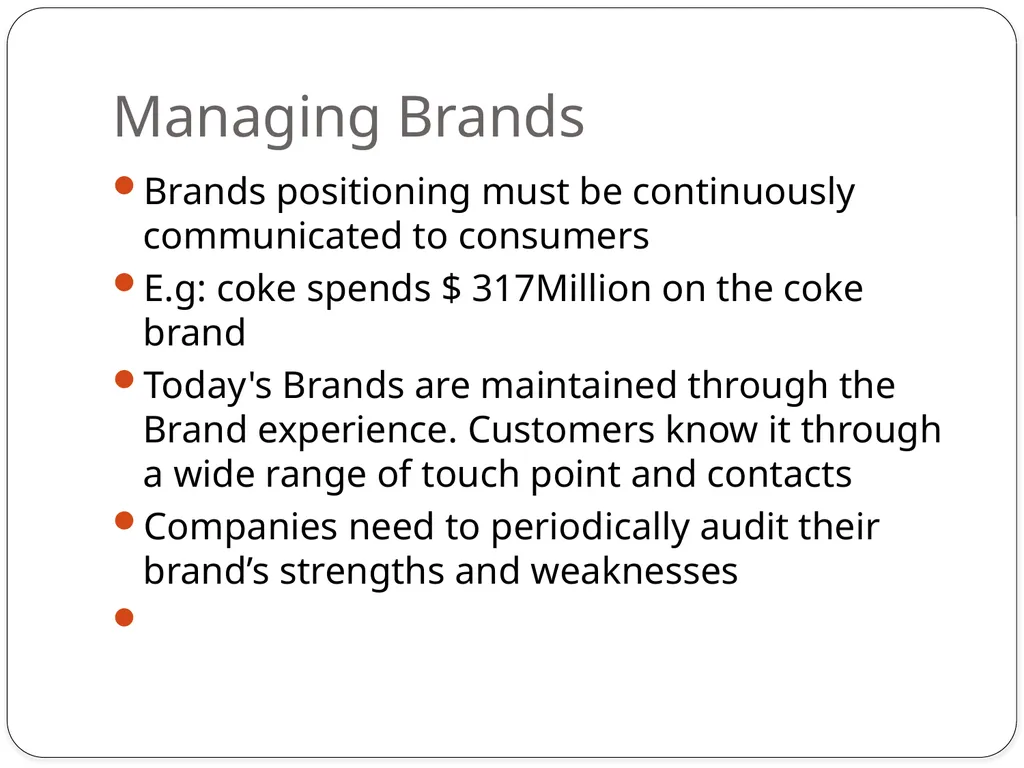
Managing Brands Brands positioning must be continuously communicated to consumers
E.g: coke spends $ 317Million on the coke brand
Today's Brands are maintained through the Brand experience. Customers know it through a wide range of touch point and contacts
Companies need to periodically audit their brand’s strengths and weaknesses<br>
19
Branding gives the seller several advantages: Brand name makes it easier for the seller to
process orders and track down problems
Seller’s brand name and trademark provide legal
protection of unique product features
Branding gives the seller the opportunity to
attract a loyal and profitable set of customers.
Branding helps the seller segment markets.
Strong brands help build corporate image,
making it easier to launch new brands and gain
acceptance by distributors and consumers.<br>
20
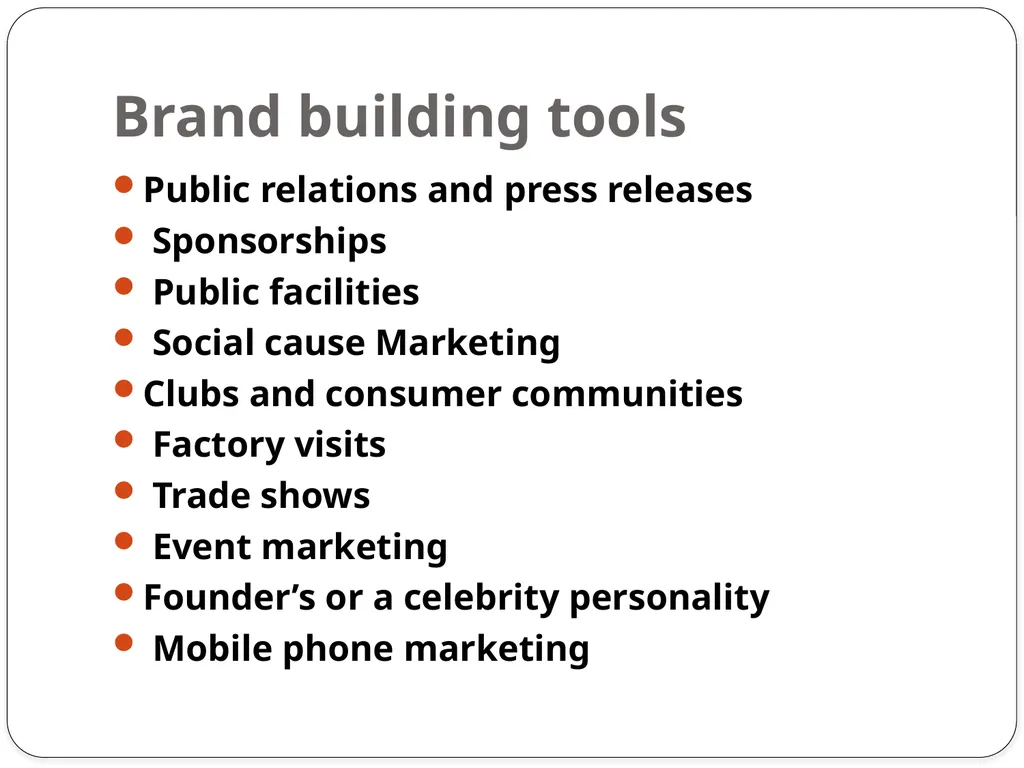
Brand building tools Public relations and press releases
Sponsorships
Public facilities
Social cause Marketing
Clubs and consumer communities
Factory visits
Trade shows
Event marketing
Founder’s or a celebrity personality
Mobile phone marketing<br>