
Breastfeeding: Ensuring a good start










Description: Breastfeeding: Ensuring a good start Breastfeeding: Ensuring a good start Goal and learning outcomes The situation Principles of lactation Benefits of breast milk and breastfeeding Early initiation Practical support Summary Clinical
Related Topics
Download Presentation
"Breastfeeding: Ensuring a good start" is the property of its rightful owner. Permission is granted to download and print the materials on this website for personal, non-commercial use only, and to display it on your personal computer provided you do not modify the materials and that you retain all copyright notices contained in the materials. By downloading content from our website, you accept the terms of this agreement.
Presentation Transcript
slide1. Breastfeeding:
Ensuring a good start Breastfeeding:
Ensuring a good start<br>
slide2. Goal and learning outcomes
The situation
Principles of lactation
Benefits of breast milk and breastfeeding
Early initiation
Practical support
Summary
Clinical practice
Quality improvement
References and additional resources Content<br>
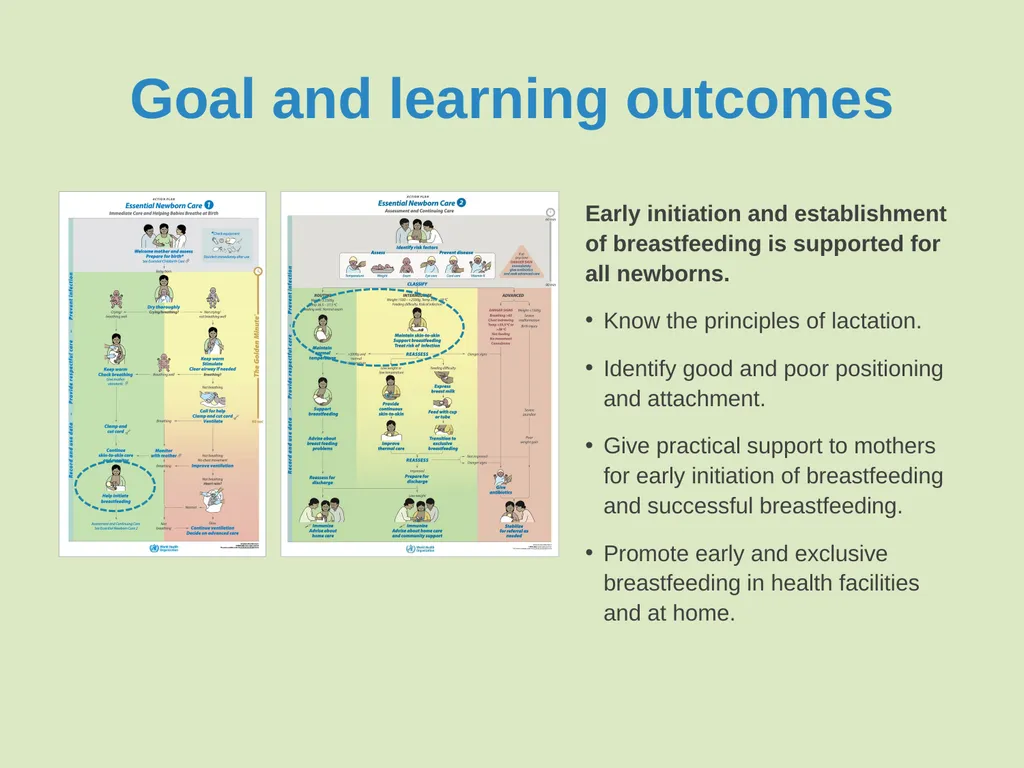
slide3. Early initiation and establishment of breastfeeding is supported for all newborns.
Know the principles of lactation.
Identify good and poor positioning and attachment.
Give practical support to mothers for early initiation of breastfeeding and successful breastfeeding.
Promote early and exclusive breastfeeding in health facilities and at home. Goal and learning outcomes<br>
slide4. Ella was born 30 minutes ago by spontaneous vaginal delivery.
She is showing feeding cues.
How would you have managed Ella differently to ensure a good start for breastfeeding? The situation © WHO/VN Dr Helenlouise Taylor<br>
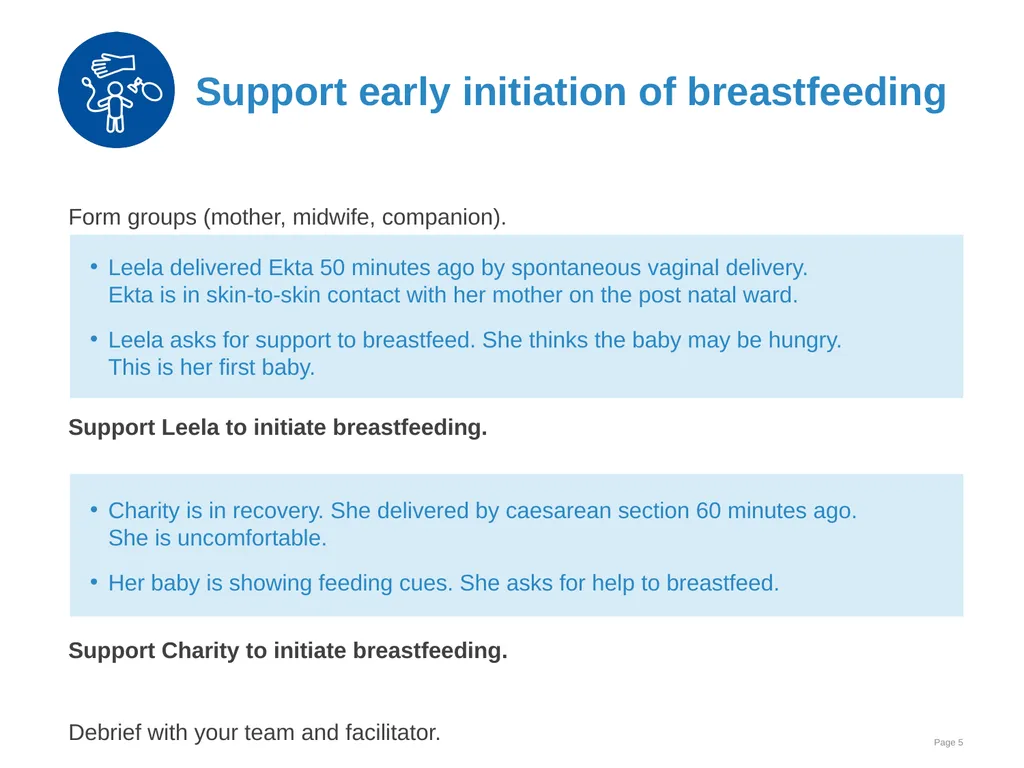
slide5. Support early initiation of breastfeeding Form groups (mother, midwife, companion).
Support Leela to initiate breastfeeding.
Support Charity to initiate breastfeeding.
Debrief with your team and facilitator. Leela delivered Ekta 50 minutes ago by spontaneous vaginal delivery. Ekta is in skin-to-skin contact with her mother on the post natal ward.
Leela asks for support to breastfeed. She thinks the baby may be hungry. This is her first baby. Charity is in recovery. She delivered by caesarean section 60 minutes ago. She is uncomfortable.
Her baby is showing feeding cues. She asks for help to breastfeed.<br>
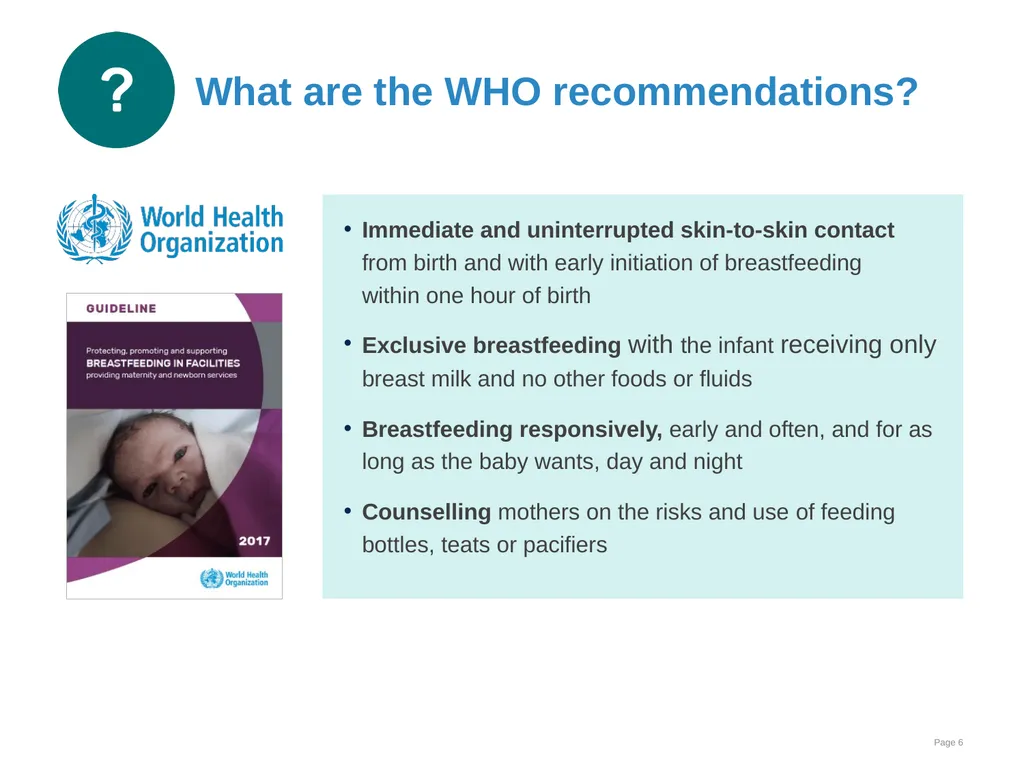
slide6. What are the WHO recommendations? Immediate and uninterrupted skin-to-skin contact from birth and with early initiation of breastfeeding within one hour of birth
Exclusive breastfeeding with the infant receiving only breast milk and no other foods or fluids
Breastfeeding responsively, early and often, and for as long as the baby wants, day and night
Counselling mothers on the risks and use of feeding bottles, teats or pacifiers<br>
slide7. Principles of lactation<br>
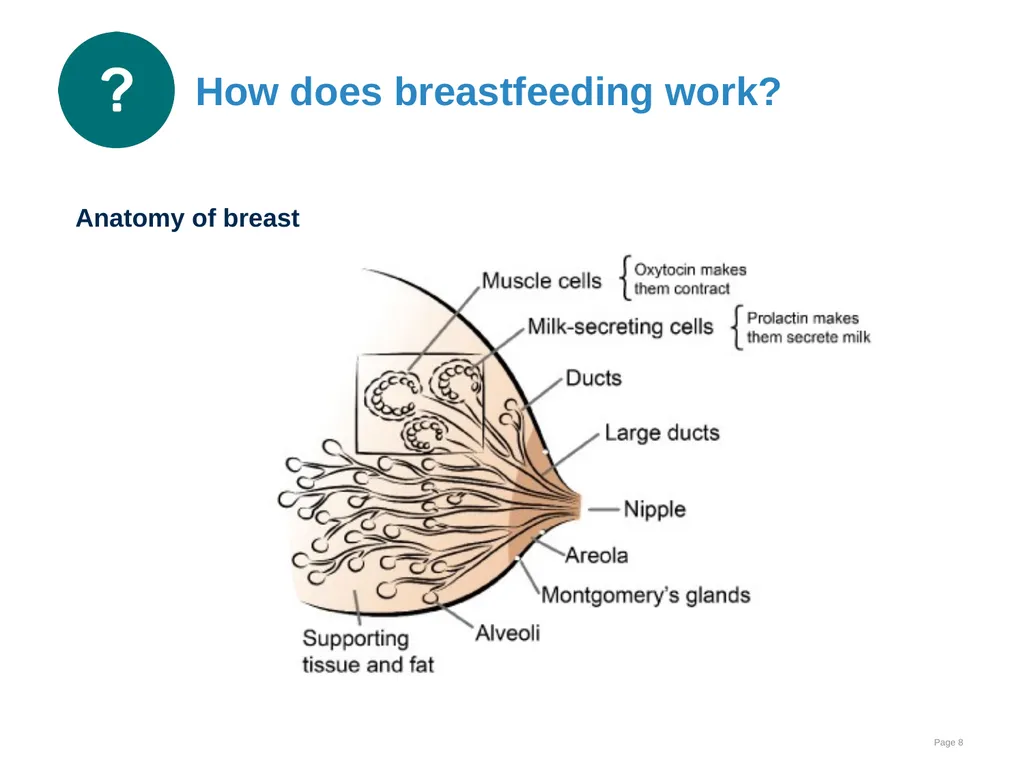
slide8. How does breastfeeding work? Anatomy of breast<br>
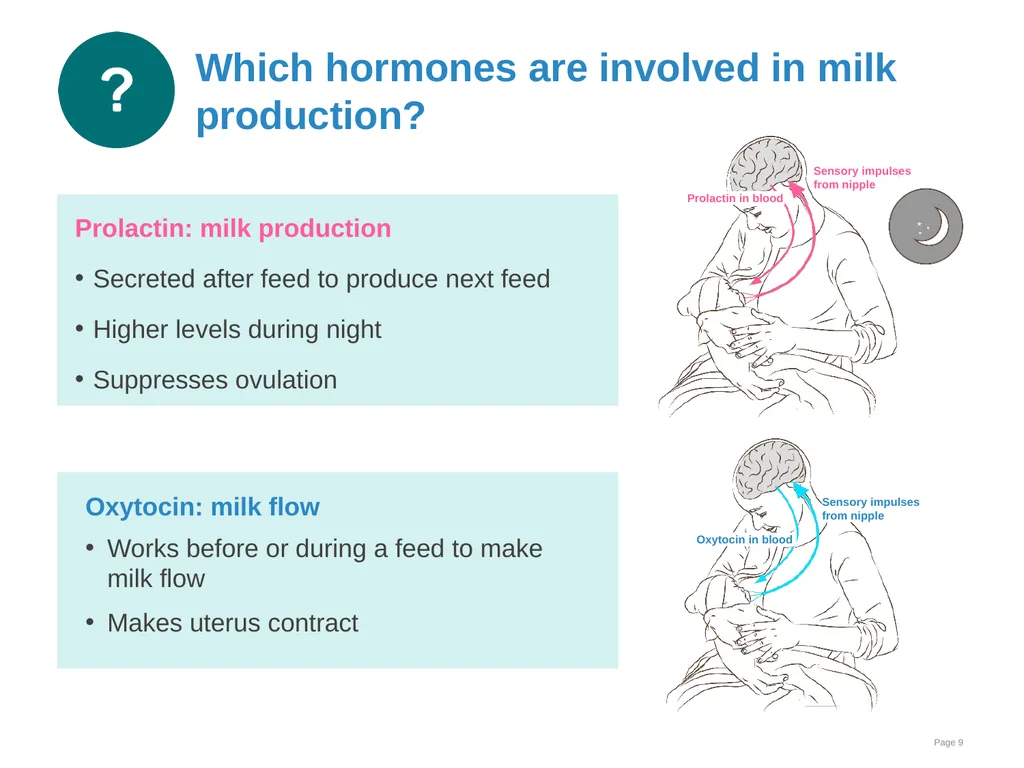
slide9. Which hormones are involved in milk production? Prolactin: milk production
Secreted after feed to produce next feed
Higher levels during night
Suppresses ovulation Oxytocin: milk flow
Works before or during a feed to make milk flow
Makes uterus contract Prolactin in blood Sensory impulses from nipple Sensory impulses from nipple Oxytocin in blood<br>
slide10. What helps or hinders the oxytocin reflex for milk flow? What helps the reflex?
Thinking lovingly of the baby
Hearing the baby
Seeing the baby
Smelling the baby
Touching the baby
Having confidence in ability to breastfeed
What hinders the reflex?
Worry
Stress
Pain
Doubt
Separation of the baby from the mother © WHO/Yoshi Shimizu<br>
slide11. What are the signs and sensations of oxytocin reflex? A squeezing or tingling sensation in the breasts just before or during a feed.
Milk flowing from the breasts when thinking of the baby or hearing the baby cry.
Milk dripping from the other breast when the baby is suckling.
Milk flowing from the breast in fine streams, if the baby comes off the breast during a feed.
Pain from uterine contractions, sometimes with a rush of blood, during feeds in the first week.
Slow deep sucks and swallowing by the baby, which show that breast milk is flowing into the mouth.<br>
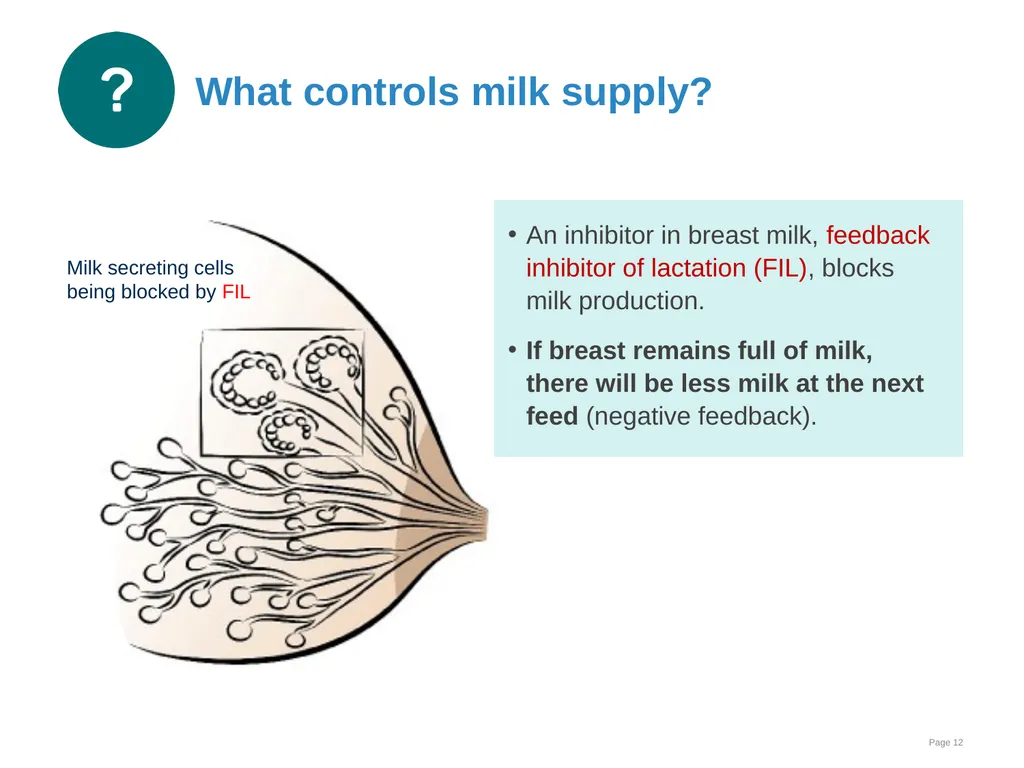
slide12. What controls milk supply? An inhibitor in breast milk, feedback inhibitor of lactation (FIL), blocks milk production.
If breast remains full of milk, there will be less milk at the next feed (negative feedback). Milk secreting cells being blocked by FIL<br>
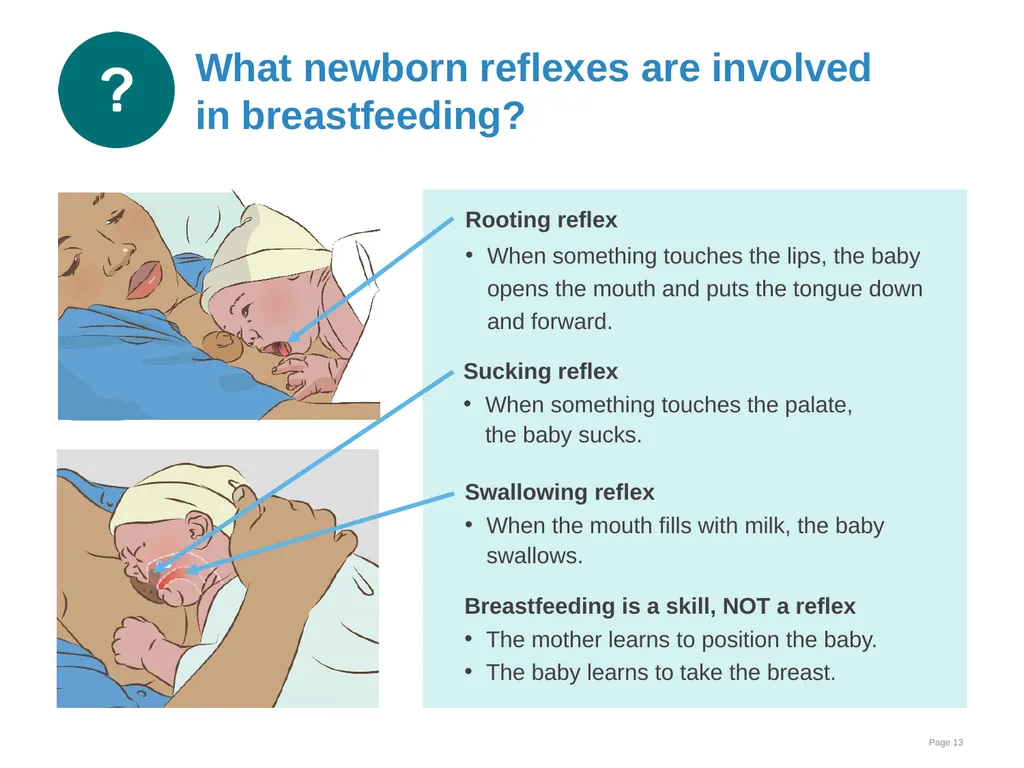
slide13. What newborn reflexes are involved in breastfeeding? Rooting reflex
When something touches the lips, the baby opens the mouth and puts the tongue down and forward. Sucking reflex
When something touches the palate, the baby sucks. Swallowing reflex
When the mouth fills with milk, the baby swallows. Breastfeeding is a skill, NOT a reflex
The mother learns to position the baby.
The baby learns to take the breast.<br>
slide14. Benefits of breast milk and breastfeeding<br>
slide15. What are benefits of breast milk and breastfeeding? Benefits of breast milk
Provides complete nutrients
Digests easily
Protects against infection
Protects against long-term noncommunicable diseases
Costs less than artificial feeding
Benefits of breastfeeding
Helps bonding and development
Helps delay a new pregnancy
Protects mother’s health<br>
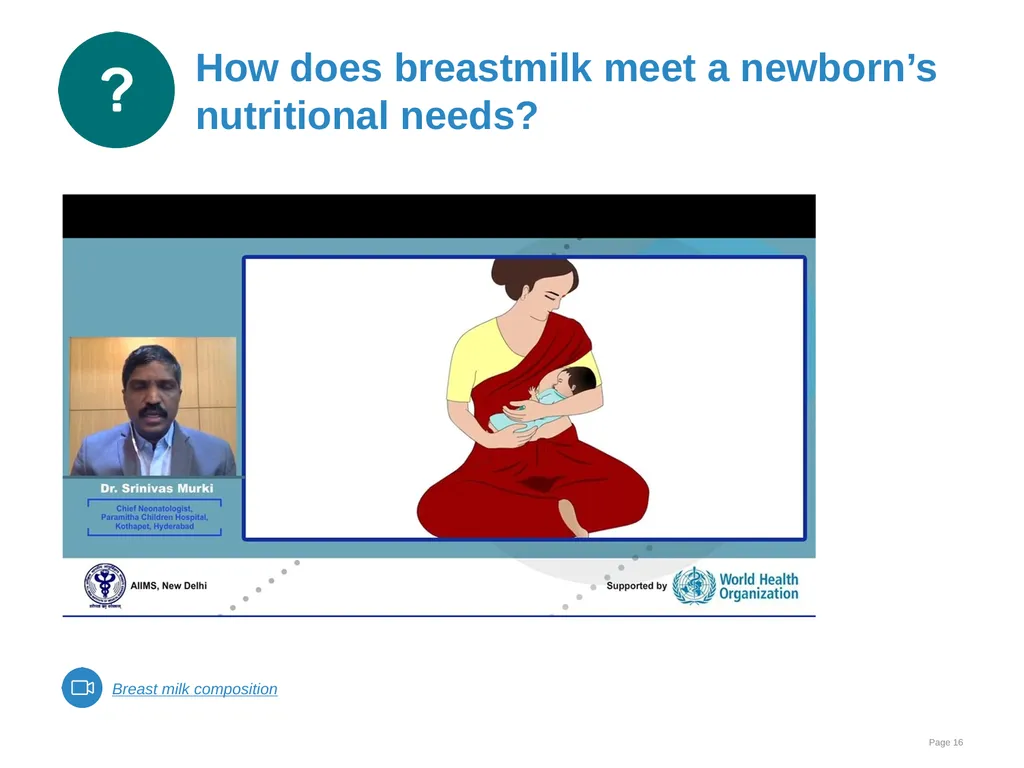
slide16. How does breastmilk meet a newborn’s nutritional needs?<br>
slide17. Early initiation<br>
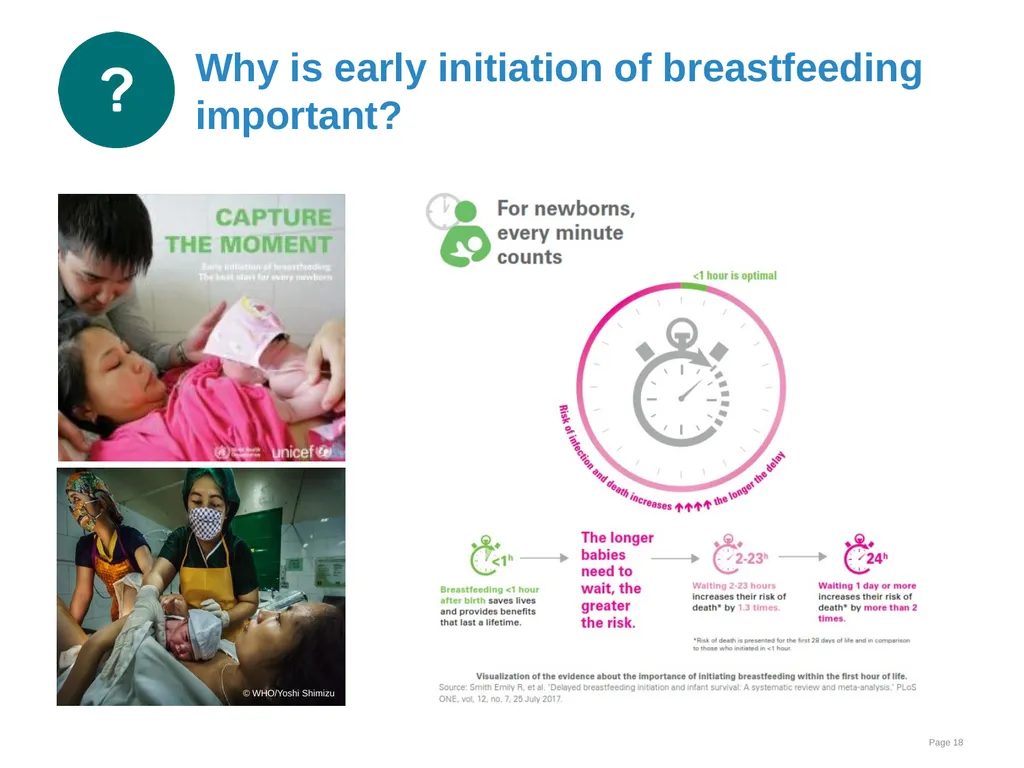
slide18. Why is early initiation of breastfeeding important? © WHO/Yoshi Shimizu<br>
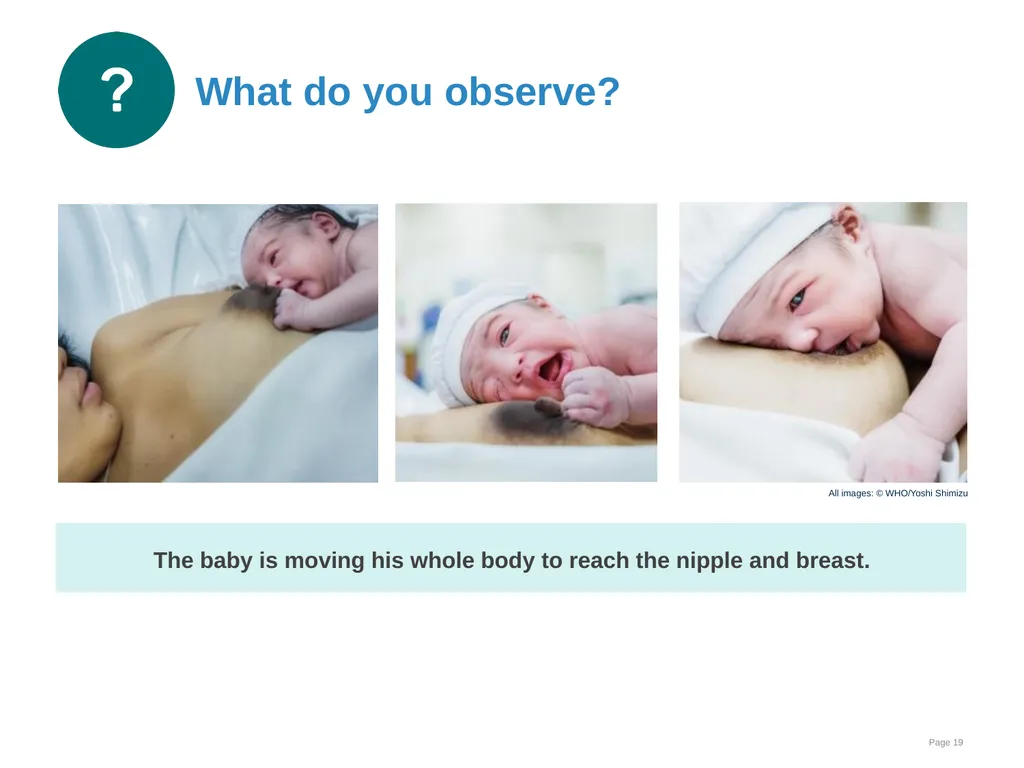
slide19. What do you observe? The baby is moving his whole body to reach the nipple and breast.<br>
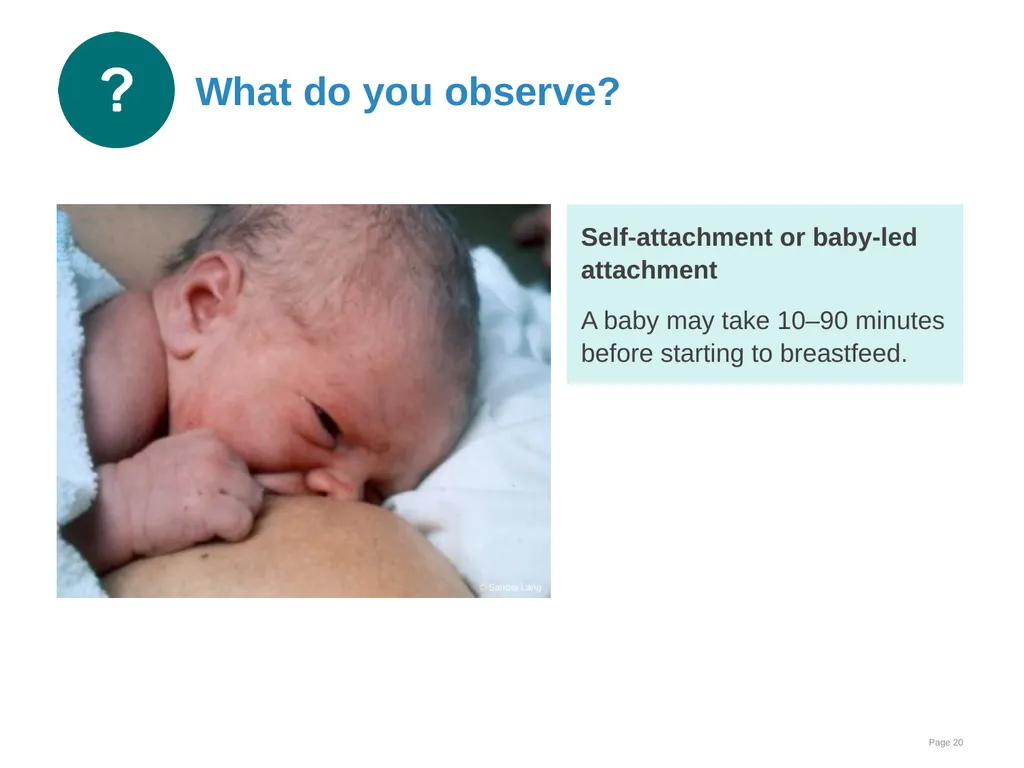
slide20. What do you observe? Self-attachment or baby-led attachment
A baby may take 10–90 minutes before starting to breastfeed. © Sandra Lang<br>
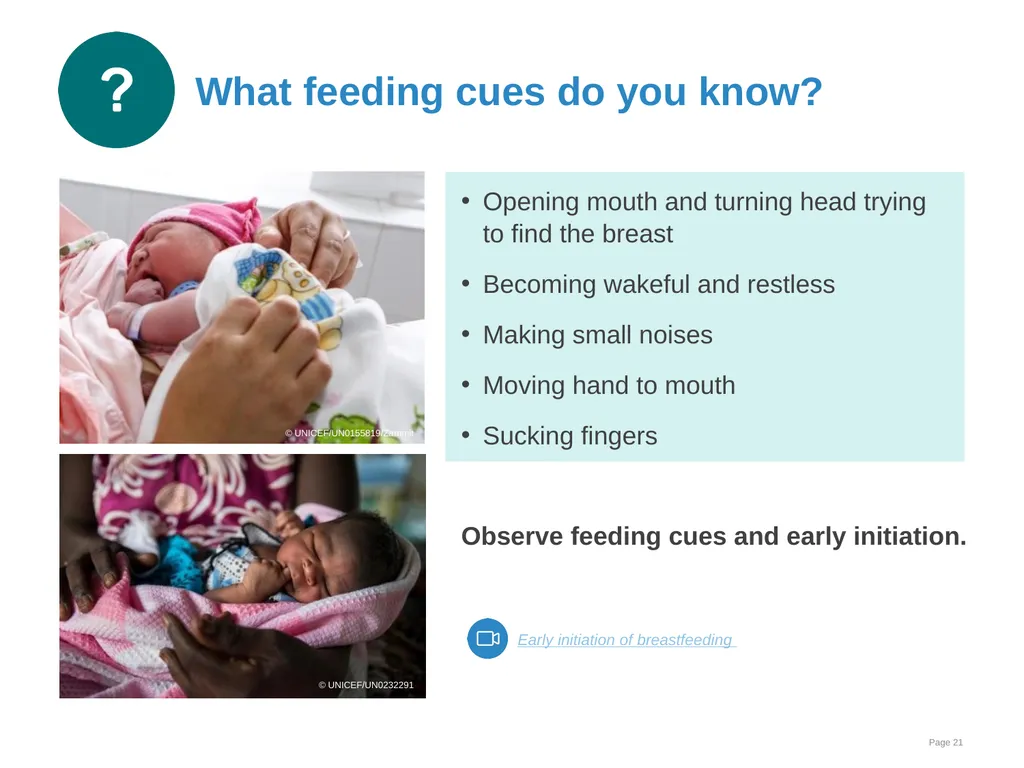
slide21. What feeding cues do you know? Opening mouth and turning head trying to find the breast
Becoming wakeful and restless
Making small noises
Moving hand to mouth
Sucking fingers
Observe feeding cues and early initiation. © UNICEF/UN0232291 © UNICEF/UN0155819/Zammit<br>
slide22. 4 key signs of good positioning The mother must be relaxed and comfortable. Whatever position the mother uses, the same four key points apply:
The baby's head and body should be in a straight line.
The mother should hold the baby’s body close to hers.
If the baby is newborn, support the whole body, not just the head and shoulders.
The baby’s face should face the breast with the baby’s nose opposite the nipple.<br>
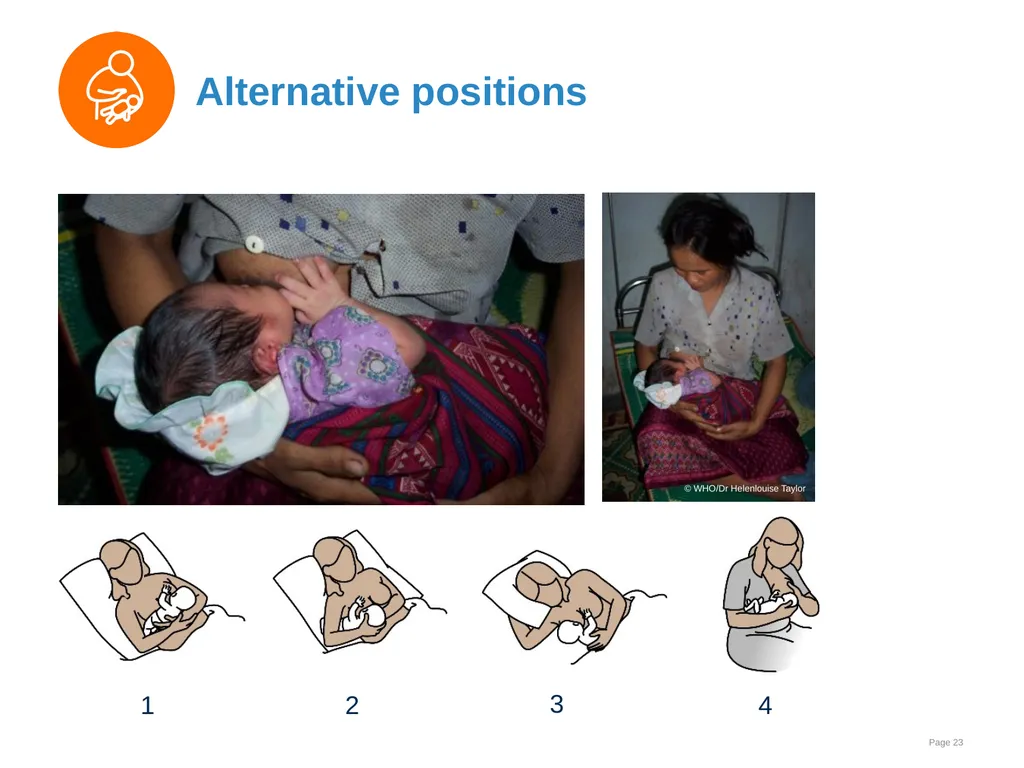
slide23. Alternative positions<br>
slide24. What are the 4 key signs of good attachment? More areola is visible above the baby’s mouth than below.
The baby’s mouth is wide open.
The lower lip is turned out.
The chin is touching the breast (or nearly so). © Felicity Savage<br>
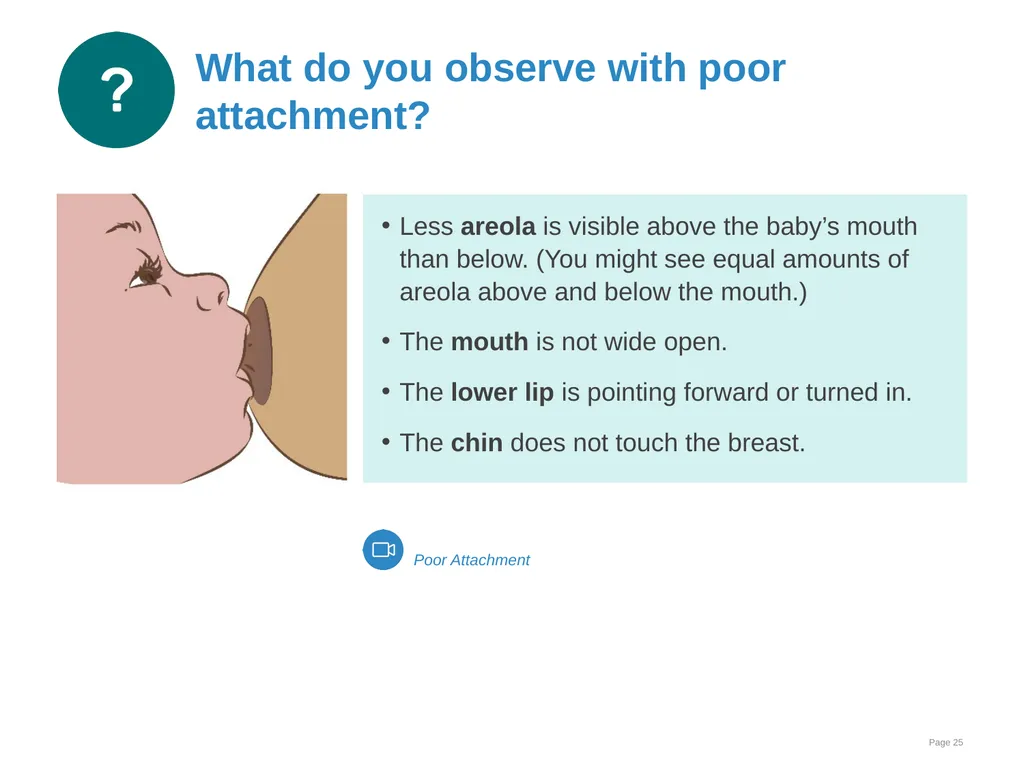
slide25. What do you observe with poor attachment? Less areola is visible above the baby’s mouth than below. (You might see equal amounts of areola above and below the mouth.)
The mouth is not wide open.
The lower lip is pointing forward or turned in.
The chin does not touch the breast.<br>
slide26. What are the results of poor attachment? Painful nipples
Damaged nipples (cracked)
Engorgement
Decreased milk production
Failure to gain weight
Frequent feeds
Frequent crying from unsatisfied hunger<br>
slide27. Practical support<br>
slide28. What is the role of health workers in supporting breastfeeding? Explaining the importance of breastfeeding and providing practical support.
Protecting newborns from harmful practices such as separation, pre-lacteal feeds or supplementation with infant formula.
Knowing and meeting obligations under the International Code of Marketing of Breast-milk Substitutes.<br>
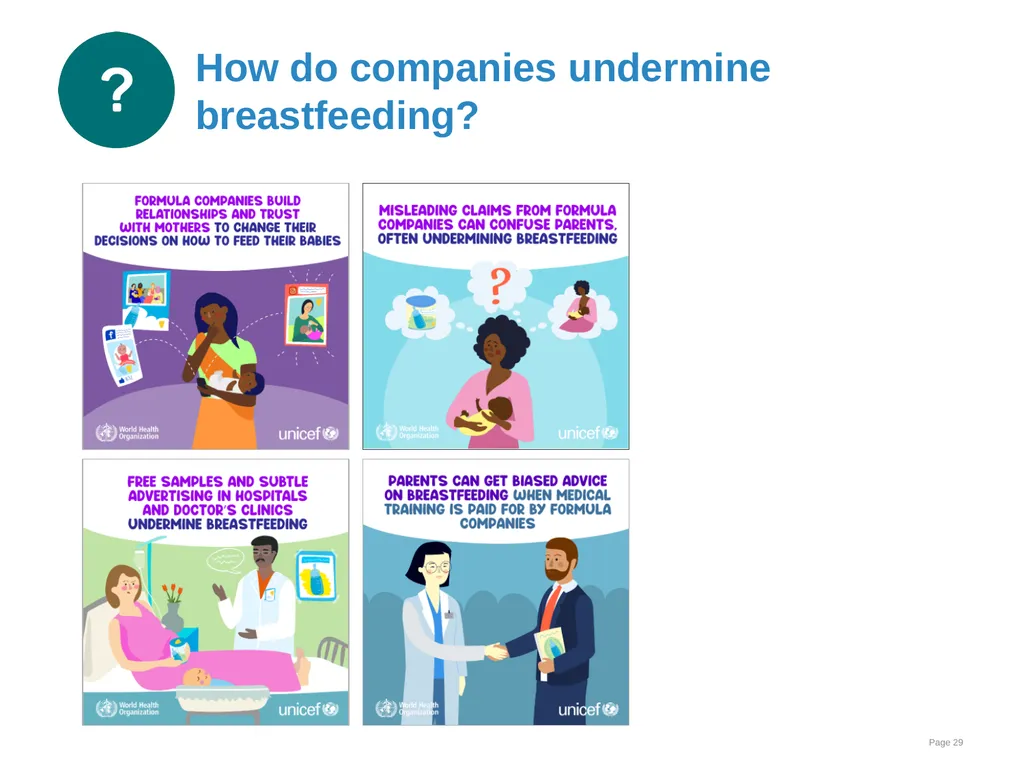
slide29. How do companies undermine breastfeeding?<br>
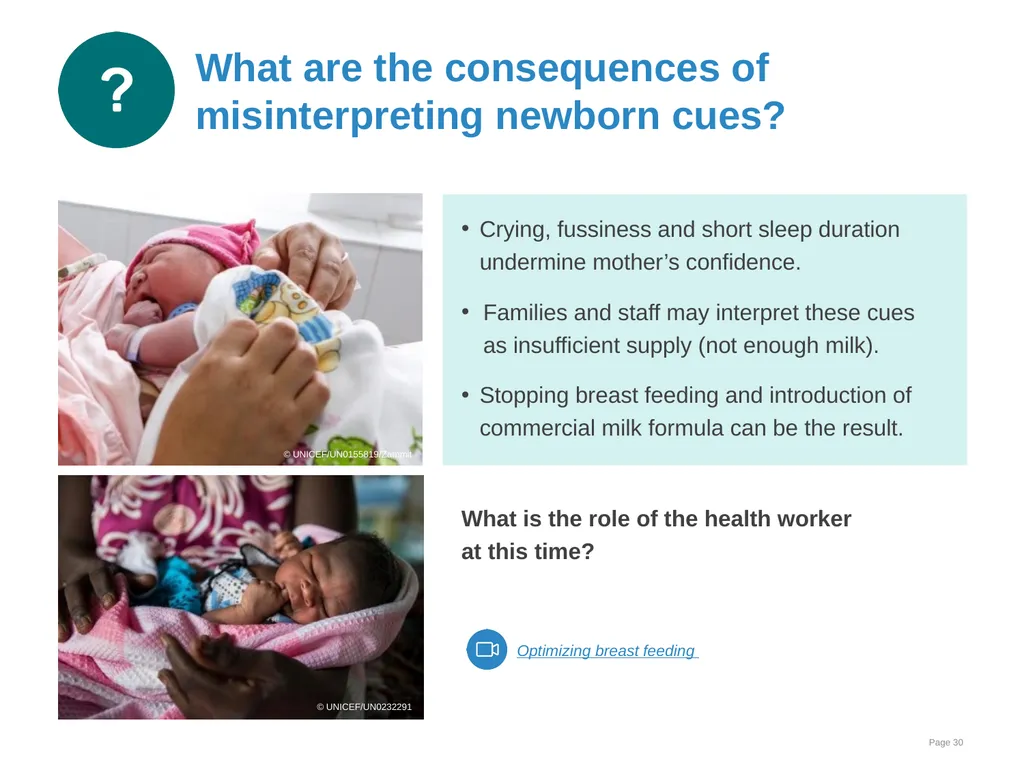
slide30. What are the consequences of misinterpreting newborn cues? Crying, fussiness and short sleep duration undermine mother’s confidence.
Families and staff may interpret these cues as insufficient supply (not enough milk).
Stopping breast feeding and introduction of commercial milk formula can be the result.
What is the role of the health worker at this time? © UNICEF/UN0232291 © UNICEF/UN0155819/Zammit<br>
slide31. What are the benefits of rooming-in? Mothers and babies are together day and night.
Mother can respond to baby and feeding cues.
Mother is more confident about breastfeeding.
Babies gain weight more quickly.
Breastfeeding continues longer.
Minimizing separation helps bonding. © WHO / Almaz Zhumaliev<br>
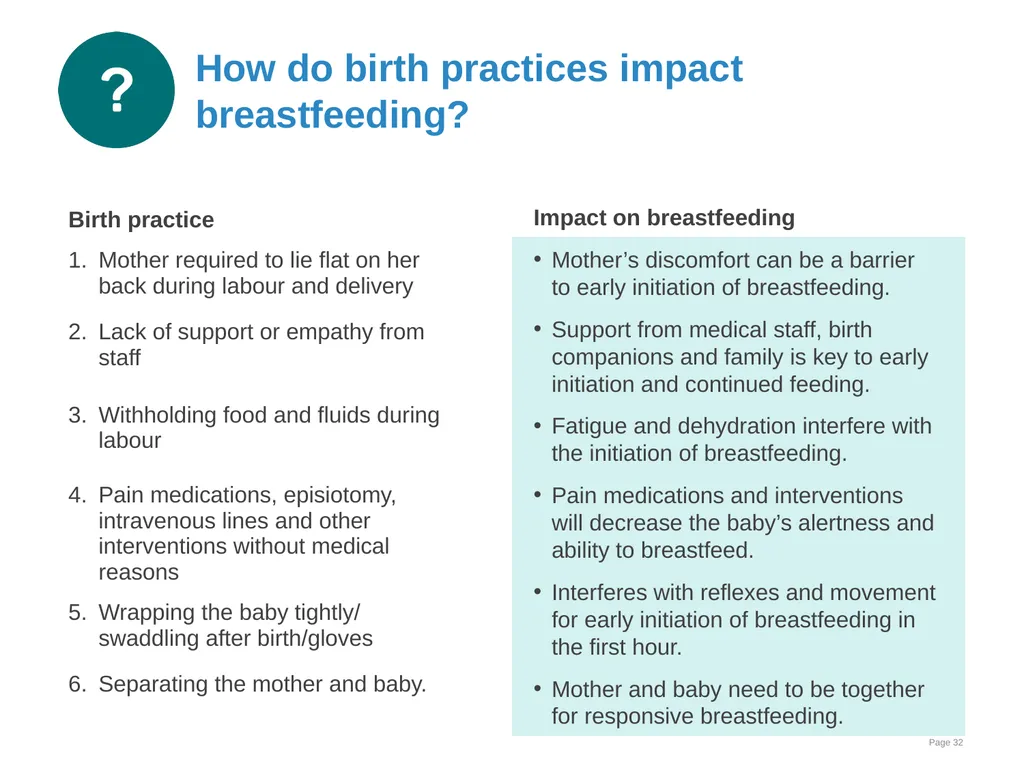
slide32. How do birth practices impact breastfeeding? Birth practice
Mother required to lie flat on her back during labour and delivery
Lack of support or empathy from staff
Withholding food and fluids during labour
Pain medications, episiotomy, intravenous lines and other interventions without medical reasons
Wrapping the baby tightly/ swaddling after birth/gloves
Separating the mother and baby. Impact on breastfeeding
Mother’s discomfort can be a barrier to early initiation of breastfeeding.
Support from medical staff, birth companions and family is key to early initiation and continued feeding.
Fatigue and dehydration interfere with the initiation of breastfeeding.
Pain medications and interventions will decrease the baby’s alertness and ability to breastfeed.
Interferes with reflexes and movement for early initiation of breastfeeding in the first hour.
Mother and baby need to be together for responsive breastfeeding.<br>
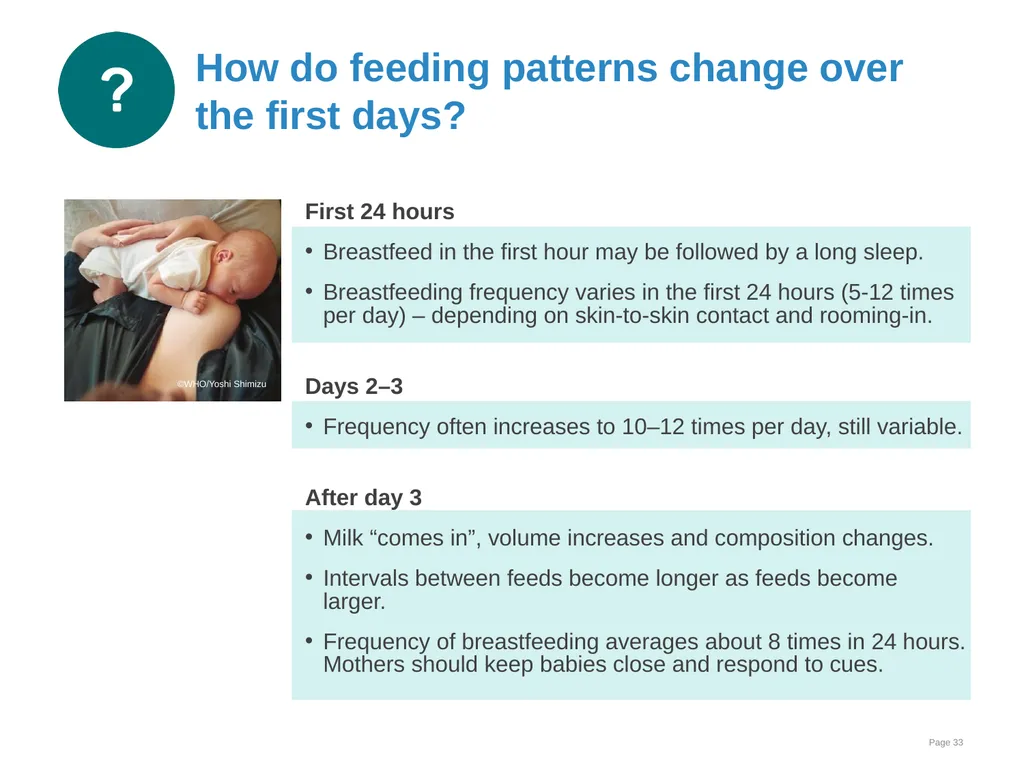
slide33. How do feeding patterns change over the first days? First 24 hours
Breastfeed in the first hour may be followed by a long sleep.
Breastfeeding frequency varies in the first 24 hours (5-12 times per day) – depending on skin-to-skin contact and rooming-in.
Days 2–3
Frequency often increases to 10–12 times per day, still variable.
After day 3
Milk “comes in”, volume increases and composition changes.
Intervals between feeds become longer as feeds become larger.
Frequency of breastfeeding averages about 8 times in 24 hours. Mothers should keep babies close and respond to cues. ©WHO/Yoshi Shimizu<br>
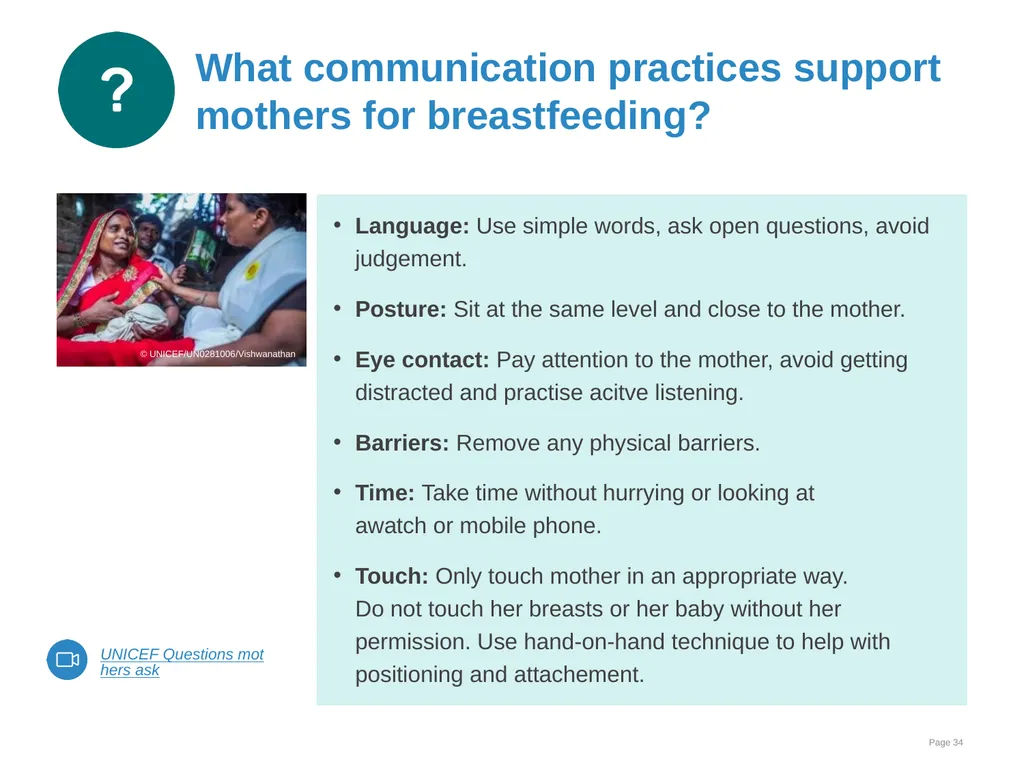
slide34. What communication practices support mothers for breastfeeding? Language: Use simple words, ask open questions, avoid judgement.
Posture: Sit at the same level and close to the mother.
Eye contact: Pay attention to the mother, avoid getting distracted and practise acitve listening.
Barriers: Remove any physical barriers.
Time: Take time without hurrying or looking at awatch or mobile phone.
Touch: Only touch mother in an appropriate way. Do not touch her breasts or her baby without her permission. Use hand-on-hand technique to help with positioning and attachement. © UNICEF/UN0281006/Vishwanathan<br>
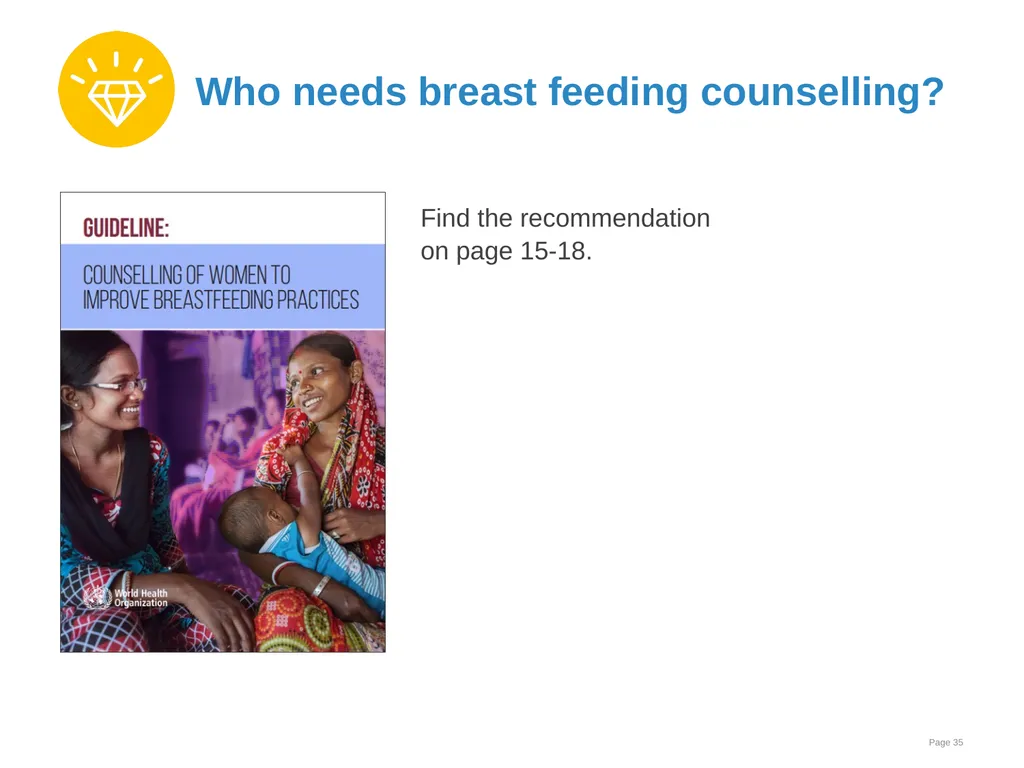
slide35. Who needs breast feeding counselling? Find the recommendation on page 15-18.<br>
slide36. Recommendation and reasons Breastfeeding counselling should be provided to all pregnant women and mothers with young children.
Benefits of breastfeeding counselling for pregnant women and mothers
Promotes the initiation of breastfeeding within the first hour after birth
Promotes breastfeeding and exclusive breastfeeding
Reduces giving pre lacteal feeds, additional food or fluids other than breast milk
Reduces the use of artificial teats and bottles<br>
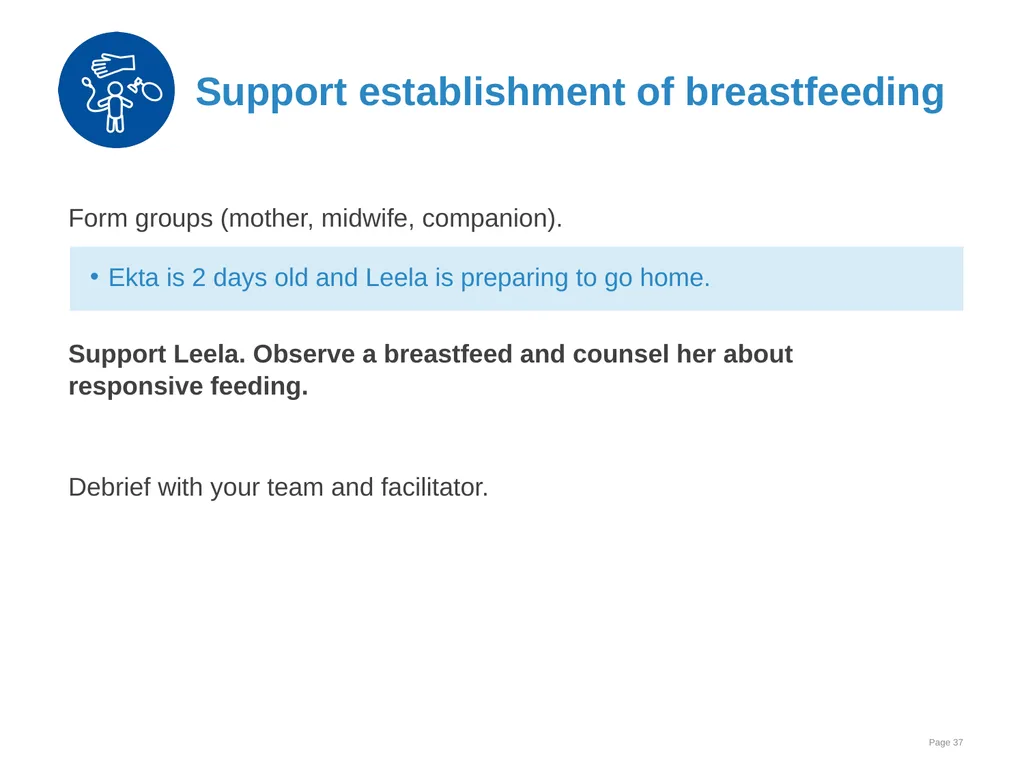
slide37. Support establishment of breastfeeding Form groups (mother, midwife, companion).
Support Leela. Observe a breastfeed and counsel her about responsive feeding.
Debrief with your team and facilitator. Ekta is 2 days old and Leela is preparing to go home.<br>
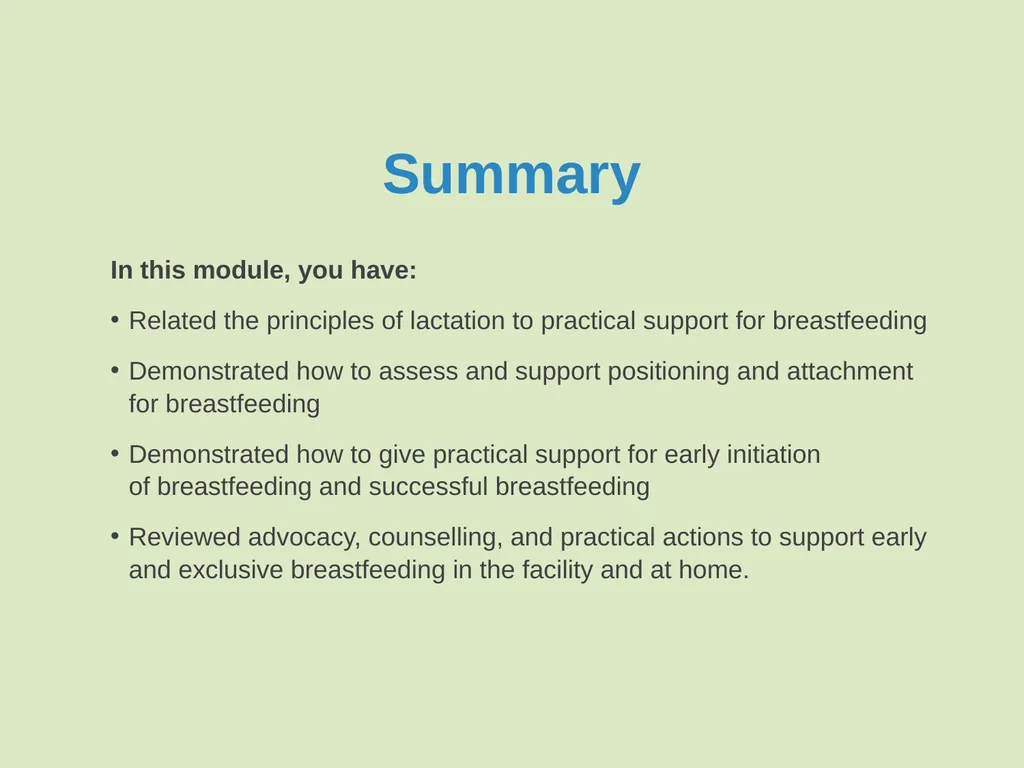
slide38. Summary In this module, you have:
Related the principles of lactation to practical support for breastfeeding
Demonstrated how to assess and support positioning and attachment for breastfeeding
Demonstrated how to give practical support for early initiation of breastfeeding and successful breastfeeding
Reviewed advocacy, counselling, and practical actions to support early and exclusive breastfeeding in the facility and at home.<br>
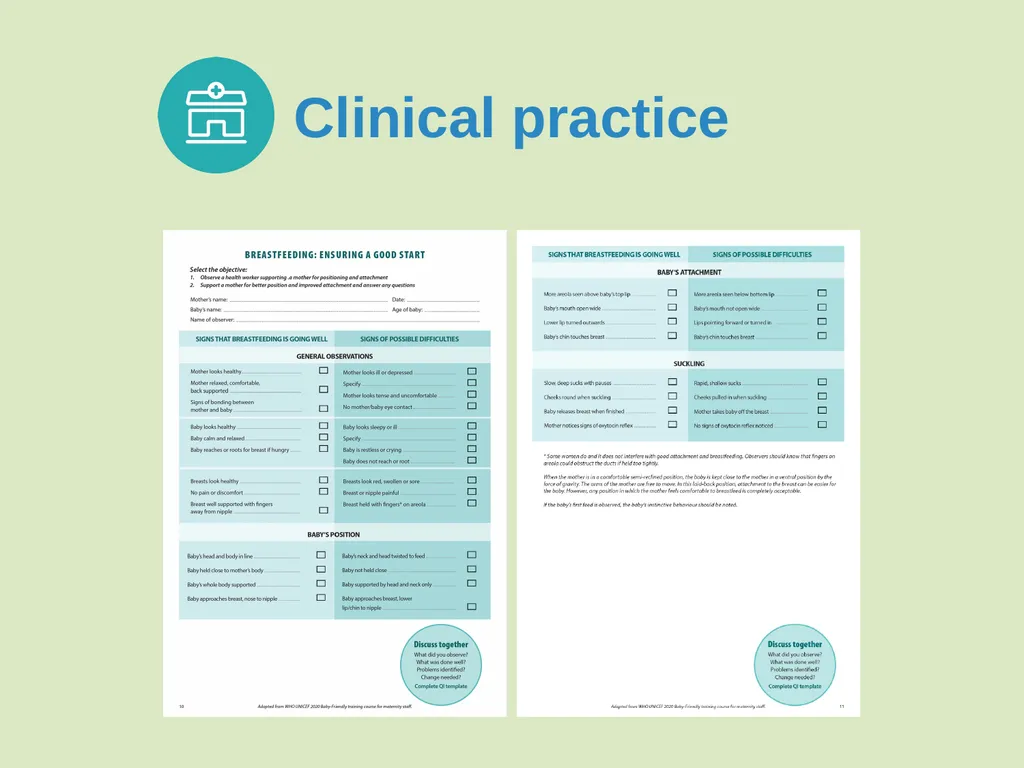
slide39. Clinical practice<br>
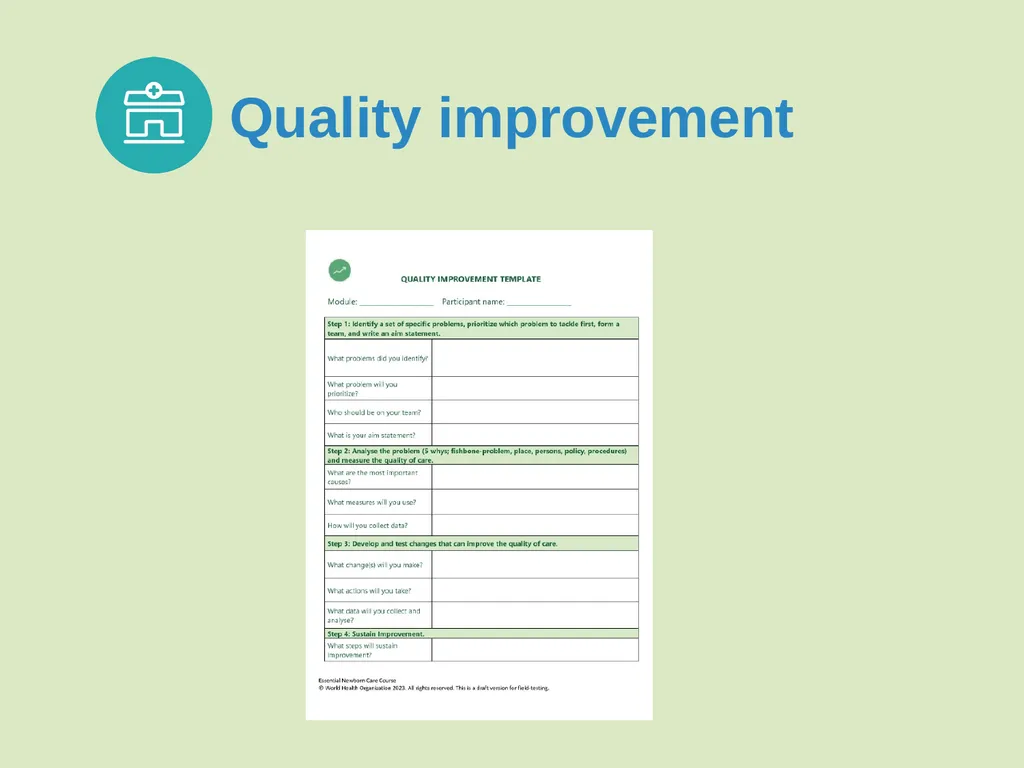
slide40. Quality improvement<br>
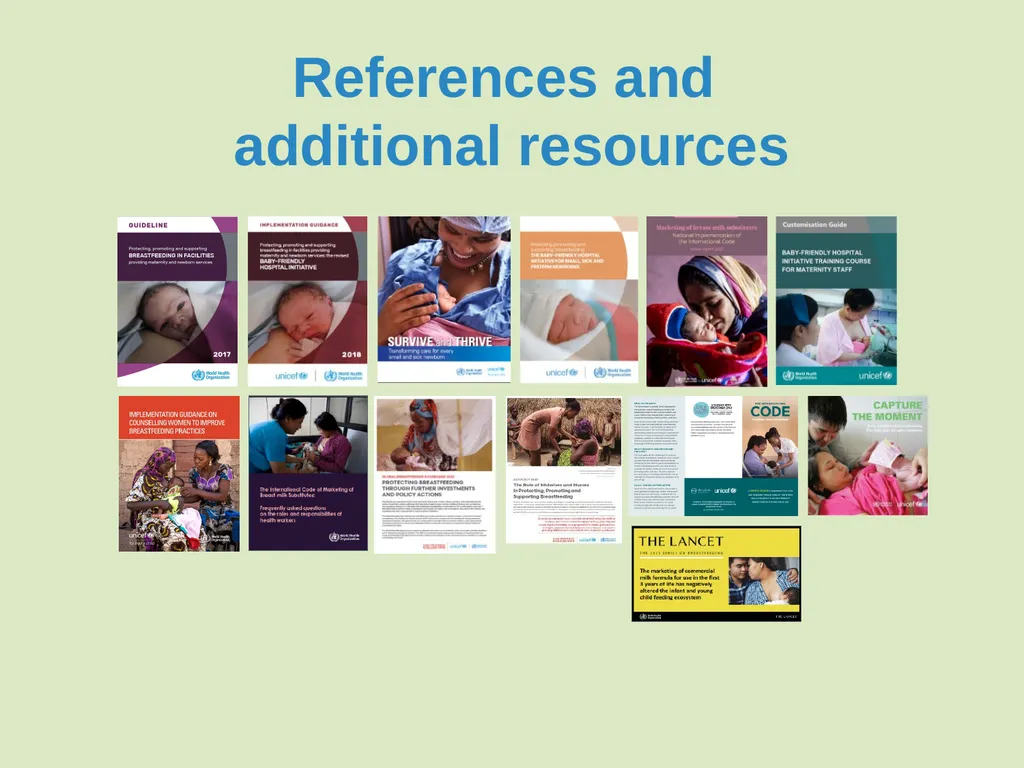
slide41. References and additional resources<br>
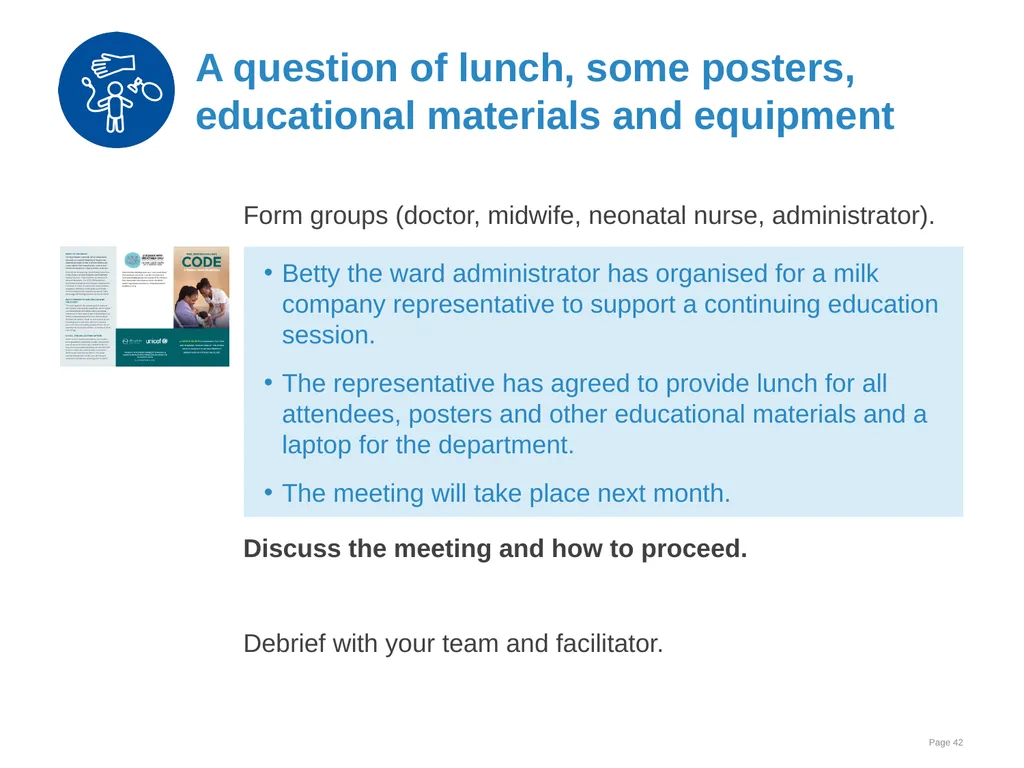
slide42. A question of lunch, some posters, educational materials and equipment Form groups (doctor, midwife, neonatal nurse, administrator).
Discuss the meeting and how to proceed.
Debrief with your team and facilitator. Betty the ward administrator has organised for a milk company representative to support a continuing education session.
The representative has agreed to provide lunch for all attendees, posters and other educational materials and a laptop for the department.
The meeting will take place next month.<br>
slide43. Counsel mother for establishment of breastfeeding Form groups (mother, midwife, companion).
Counsel Susie and support her for positioning and attachment.
Debrief with your team and facilitator. Mollie is 4 hours old. She was born at term by spontaneous vaginal delivery.
She was placed skin-to-skin immediately after birth. She crawled and attached herself to the breast, to the surprise of her mother and father.
Her mother, Susie, has never been counselled on breastfeeding bottle feeding her previous 2 children. She has decided to breastfeed.
Mollie is showing feeding cues.<br>
slide44. Support Charity to establish breastfeeding Form groups (mother, companion, neonatal nurse).
Support Charity to find comfortable positioning and good attachment.
Debrief with your team and facilitator. Charity delivered by caesarean section 2 days ago. She is uncomfortable and in pain from her caesarian incision. She is in tears.<br>
slide2. Goal and learning outcomes
The situation
Principles of lactation
Benefits of breast milk and breastfeeding
Early initiation
Practical support
Summary
Clinical practice
Quality improvement
References and additional resources Content<br>
slide3. Early initiation and establishment of breastfeeding is supported for all newborns.
Know the principles of lactation.
Identify good and poor positioning and attachment.
Give practical support to mothers for early initiation of breastfeeding and successful breastfeeding.
Promote early and exclusive breastfeeding in health facilities and at home. Goal and learning outcomes<br>
slide4. Ella was born 30 minutes ago by spontaneous vaginal delivery.
She is showing feeding cues.
How would you have managed Ella differently to ensure a good start for breastfeeding? The situation © WHO/VN Dr Helenlouise Taylor<br>
slide5. Support early initiation of breastfeeding Form groups (mother, midwife, companion).
Support Leela to initiate breastfeeding.
Support Charity to initiate breastfeeding.
Debrief with your team and facilitator. Leela delivered Ekta 50 minutes ago by spontaneous vaginal delivery. Ekta is in skin-to-skin contact with her mother on the post natal ward.
Leela asks for support to breastfeed. She thinks the baby may be hungry. This is her first baby. Charity is in recovery. She delivered by caesarean section 60 minutes ago. She is uncomfortable.
Her baby is showing feeding cues. She asks for help to breastfeed.<br>
slide6. What are the WHO recommendations? Immediate and uninterrupted skin-to-skin contact from birth and with early initiation of breastfeeding within one hour of birth
Exclusive breastfeeding with the infant receiving only breast milk and no other foods or fluids
Breastfeeding responsively, early and often, and for as long as the baby wants, day and night
Counselling mothers on the risks and use of feeding bottles, teats or pacifiers<br>
slide7. Principles of lactation<br>
slide8. How does breastfeeding work? Anatomy of breast<br>
slide9. Which hormones are involved in milk production? Prolactin: milk production
Secreted after feed to produce next feed
Higher levels during night
Suppresses ovulation Oxytocin: milk flow
Works before or during a feed to make milk flow
Makes uterus contract Prolactin in blood Sensory impulses from nipple Sensory impulses from nipple Oxytocin in blood<br>
slide10. What helps or hinders the oxytocin reflex for milk flow? What helps the reflex?
Thinking lovingly of the baby
Hearing the baby
Seeing the baby
Smelling the baby
Touching the baby
Having confidence in ability to breastfeed
What hinders the reflex?
Worry
Stress
Pain
Doubt
Separation of the baby from the mother © WHO/Yoshi Shimizu<br>
slide11. What are the signs and sensations of oxytocin reflex? A squeezing or tingling sensation in the breasts just before or during a feed.
Milk flowing from the breasts when thinking of the baby or hearing the baby cry.
Milk dripping from the other breast when the baby is suckling.
Milk flowing from the breast in fine streams, if the baby comes off the breast during a feed.
Pain from uterine contractions, sometimes with a rush of blood, during feeds in the first week.
Slow deep sucks and swallowing by the baby, which show that breast milk is flowing into the mouth.<br>
slide12. What controls milk supply? An inhibitor in breast milk, feedback inhibitor of lactation (FIL), blocks milk production.
If breast remains full of milk, there will be less milk at the next feed (negative feedback). Milk secreting cells being blocked by FIL<br>
slide13. What newborn reflexes are involved in breastfeeding? Rooting reflex
When something touches the lips, the baby opens the mouth and puts the tongue down and forward. Sucking reflex
When something touches the palate, the baby sucks. Swallowing reflex
When the mouth fills with milk, the baby swallows. Breastfeeding is a skill, NOT a reflex
The mother learns to position the baby.
The baby learns to take the breast.<br>
slide14. Benefits of breast milk and breastfeeding<br>
slide15. What are benefits of breast milk and breastfeeding? Benefits of breast milk
Provides complete nutrients
Digests easily
Protects against infection
Protects against long-term noncommunicable diseases
Costs less than artificial feeding
Benefits of breastfeeding
Helps bonding and development
Helps delay a new pregnancy
Protects mother’s health<br>
slide16. How does breastmilk meet a newborn’s nutritional needs?<br>
slide17. Early initiation<br>
slide18. Why is early initiation of breastfeeding important? © WHO/Yoshi Shimizu<br>
slide19. What do you observe? The baby is moving his whole body to reach the nipple and breast.<br>
slide20. What do you observe? Self-attachment or baby-led attachment
A baby may take 10–90 minutes before starting to breastfeed. © Sandra Lang<br>
slide21. What feeding cues do you know? Opening mouth and turning head trying to find the breast
Becoming wakeful and restless
Making small noises
Moving hand to mouth
Sucking fingers
Observe feeding cues and early initiation. © UNICEF/UN0232291 © UNICEF/UN0155819/Zammit<br>
slide22. 4 key signs of good positioning The mother must be relaxed and comfortable. Whatever position the mother uses, the same four key points apply:
The baby's head and body should be in a straight line.
The mother should hold the baby’s body close to hers.
If the baby is newborn, support the whole body, not just the head and shoulders.
The baby’s face should face the breast with the baby’s nose opposite the nipple.<br>
slide23. Alternative positions<br>
slide24. What are the 4 key signs of good attachment? More areola is visible above the baby’s mouth than below.
The baby’s mouth is wide open.
The lower lip is turned out.
The chin is touching the breast (or nearly so). © Felicity Savage<br>
slide25. What do you observe with poor attachment? Less areola is visible above the baby’s mouth than below. (You might see equal amounts of areola above and below the mouth.)
The mouth is not wide open.
The lower lip is pointing forward or turned in.
The chin does not touch the breast.<br>
slide26. What are the results of poor attachment? Painful nipples
Damaged nipples (cracked)
Engorgement
Decreased milk production
Failure to gain weight
Frequent feeds
Frequent crying from unsatisfied hunger<br>
slide27. Practical support<br>
slide28. What is the role of health workers in supporting breastfeeding? Explaining the importance of breastfeeding and providing practical support.
Protecting newborns from harmful practices such as separation, pre-lacteal feeds or supplementation with infant formula.
Knowing and meeting obligations under the International Code of Marketing of Breast-milk Substitutes.<br>
slide29. How do companies undermine breastfeeding?<br>
slide30. What are the consequences of misinterpreting newborn cues? Crying, fussiness and short sleep duration undermine mother’s confidence.
Families and staff may interpret these cues as insufficient supply (not enough milk).
Stopping breast feeding and introduction of commercial milk formula can be the result.
What is the role of the health worker at this time? © UNICEF/UN0232291 © UNICEF/UN0155819/Zammit<br>
slide31. What are the benefits of rooming-in? Mothers and babies are together day and night.
Mother can respond to baby and feeding cues.
Mother is more confident about breastfeeding.
Babies gain weight more quickly.
Breastfeeding continues longer.
Minimizing separation helps bonding. © WHO / Almaz Zhumaliev<br>
slide32. How do birth practices impact breastfeeding? Birth practice
Mother required to lie flat on her back during labour and delivery
Lack of support or empathy from staff
Withholding food and fluids during labour
Pain medications, episiotomy, intravenous lines and other interventions without medical reasons
Wrapping the baby tightly/ swaddling after birth/gloves
Separating the mother and baby. Impact on breastfeeding
Mother’s discomfort can be a barrier to early initiation of breastfeeding.
Support from medical staff, birth companions and family is key to early initiation and continued feeding.
Fatigue and dehydration interfere with the initiation of breastfeeding.
Pain medications and interventions will decrease the baby’s alertness and ability to breastfeed.
Interferes with reflexes and movement for early initiation of breastfeeding in the first hour.
Mother and baby need to be together for responsive breastfeeding.<br>
slide33. How do feeding patterns change over the first days? First 24 hours
Breastfeed in the first hour may be followed by a long sleep.
Breastfeeding frequency varies in the first 24 hours (5-12 times per day) – depending on skin-to-skin contact and rooming-in.
Days 2–3
Frequency often increases to 10–12 times per day, still variable.
After day 3
Milk “comes in”, volume increases and composition changes.
Intervals between feeds become longer as feeds become larger.
Frequency of breastfeeding averages about 8 times in 24 hours. Mothers should keep babies close and respond to cues. ©WHO/Yoshi Shimizu<br>
slide34. What communication practices support mothers for breastfeeding? Language: Use simple words, ask open questions, avoid judgement.
Posture: Sit at the same level and close to the mother.
Eye contact: Pay attention to the mother, avoid getting distracted and practise acitve listening.
Barriers: Remove any physical barriers.
Time: Take time without hurrying or looking at awatch or mobile phone.
Touch: Only touch mother in an appropriate way. Do not touch her breasts or her baby without her permission. Use hand-on-hand technique to help with positioning and attachement. © UNICEF/UN0281006/Vishwanathan<br>
slide35. Who needs breast feeding counselling? Find the recommendation on page 15-18.<br>
slide36. Recommendation and reasons Breastfeeding counselling should be provided to all pregnant women and mothers with young children.
Benefits of breastfeeding counselling for pregnant women and mothers
Promotes the initiation of breastfeeding within the first hour after birth
Promotes breastfeeding and exclusive breastfeeding
Reduces giving pre lacteal feeds, additional food or fluids other than breast milk
Reduces the use of artificial teats and bottles<br>
slide37. Support establishment of breastfeeding Form groups (mother, midwife, companion).
Support Leela. Observe a breastfeed and counsel her about responsive feeding.
Debrief with your team and facilitator. Ekta is 2 days old and Leela is preparing to go home.<br>
slide38. Summary In this module, you have:
Related the principles of lactation to practical support for breastfeeding
Demonstrated how to assess and support positioning and attachment for breastfeeding
Demonstrated how to give practical support for early initiation of breastfeeding and successful breastfeeding
Reviewed advocacy, counselling, and practical actions to support early and exclusive breastfeeding in the facility and at home.<br>
slide39. Clinical practice<br>
slide40. Quality improvement<br>
slide41. References and additional resources<br>
slide42. A question of lunch, some posters, educational materials and equipment Form groups (doctor, midwife, neonatal nurse, administrator).
Discuss the meeting and how to proceed.
Debrief with your team and facilitator. Betty the ward administrator has organised for a milk company representative to support a continuing education session.
The representative has agreed to provide lunch for all attendees, posters and other educational materials and a laptop for the department.
The meeting will take place next month.<br>
slide43. Counsel mother for establishment of breastfeeding Form groups (mother, midwife, companion).
Counsel Susie and support her for positioning and attachment.
Debrief with your team and facilitator. Mollie is 4 hours old. She was born at term by spontaneous vaginal delivery.
She was placed skin-to-skin immediately after birth. She crawled and attached herself to the breast, to the surprise of her mother and father.
Her mother, Susie, has never been counselled on breastfeeding bottle feeding her previous 2 children. She has decided to breastfeed.
Mollie is showing feeding cues.<br>
slide44. Support Charity to establish breastfeeding Form groups (mother, companion, neonatal nurse).
Support Charity to find comfortable positioning and good attachment.
Debrief with your team and facilitator. Charity delivered by caesarean section 2 days ago. She is uncomfortable and in pain from her caesarian incision. She is in tears.<br>