
Bregenz, Austria 7 June 2015 Shaping our future:

Description: Bregenz, Austria 7 June 2015 Shaping our future: higher education helping create the society we want Gayane Harutyunyan Main documents Yerevan Communiqué Statement of the Fourth Bologna Policy Forum Belarus - new EHEA member, accompanied
Related Topics
Download Presentation
"Bregenz, Austria 7 June 2015 Shaping our future:" is the property of its rightful owner. Permission is granted to download and print the materials on this website for personal, non-commercial use only, and to display it on your personal computer provided you do not modify the materials and that you retain all copyright notices contained in the materials. By downloading content from our website, you accept the terms of this agreement.
Presentation Transcript
slide1. Bregenz, Austria
7 June 2015 Shaping our future: higher education helping create the society we want Gayane Harutyunyan<br>
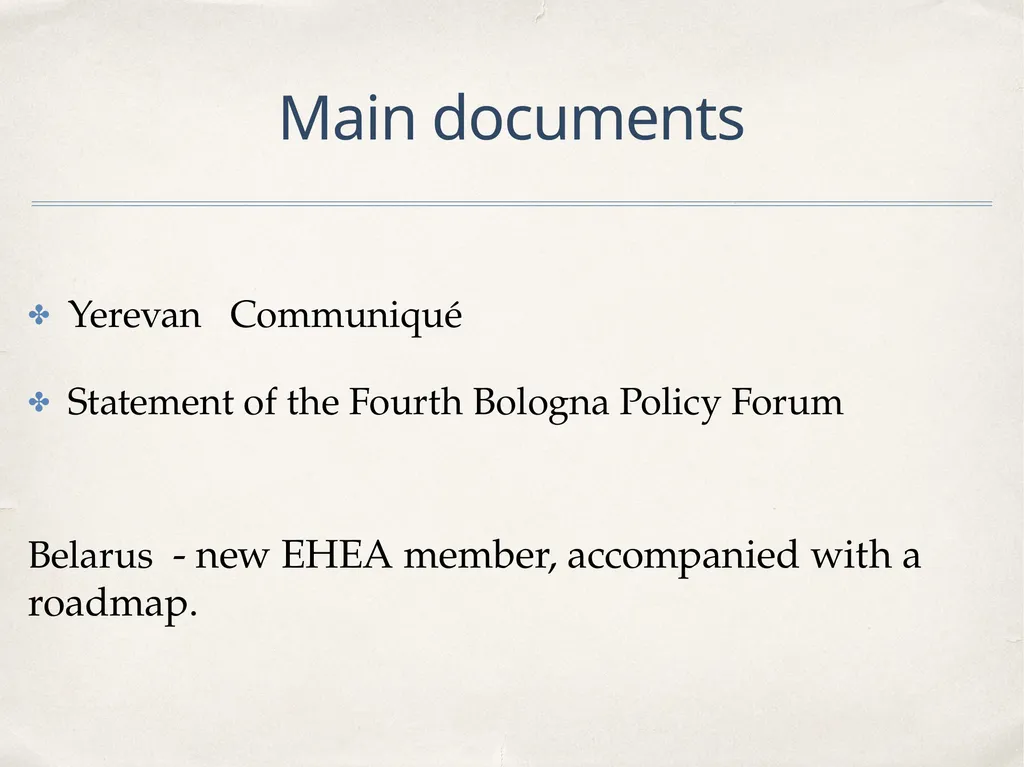
slide2. Main documents Yerevan Communiqué
Statement of the Fourth Bologna Policy Forum
Belarus - new EHEA member, accompanied with a roadmap.<br>
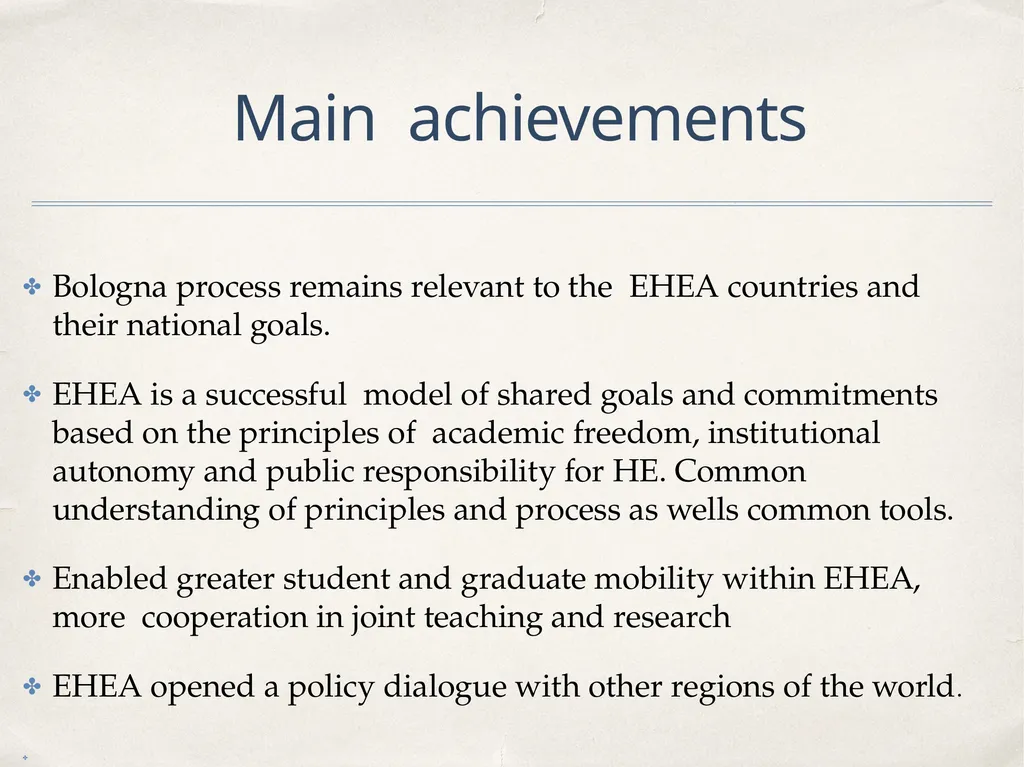
slide3. Main achievements Bologna process remains relevant to the EHEA countries and their national goals.
EHEA is a successful model of shared goals and commitments based on the principles of academic freedom, institutional autonomy and public responsibility for HE. Common understanding of principles and process as wells common tools.
Enabled greater student and graduate mobility within EHEA, more cooperation in joint teaching and research
EHEA opened a policy dialogue with other regions of the world.<br>
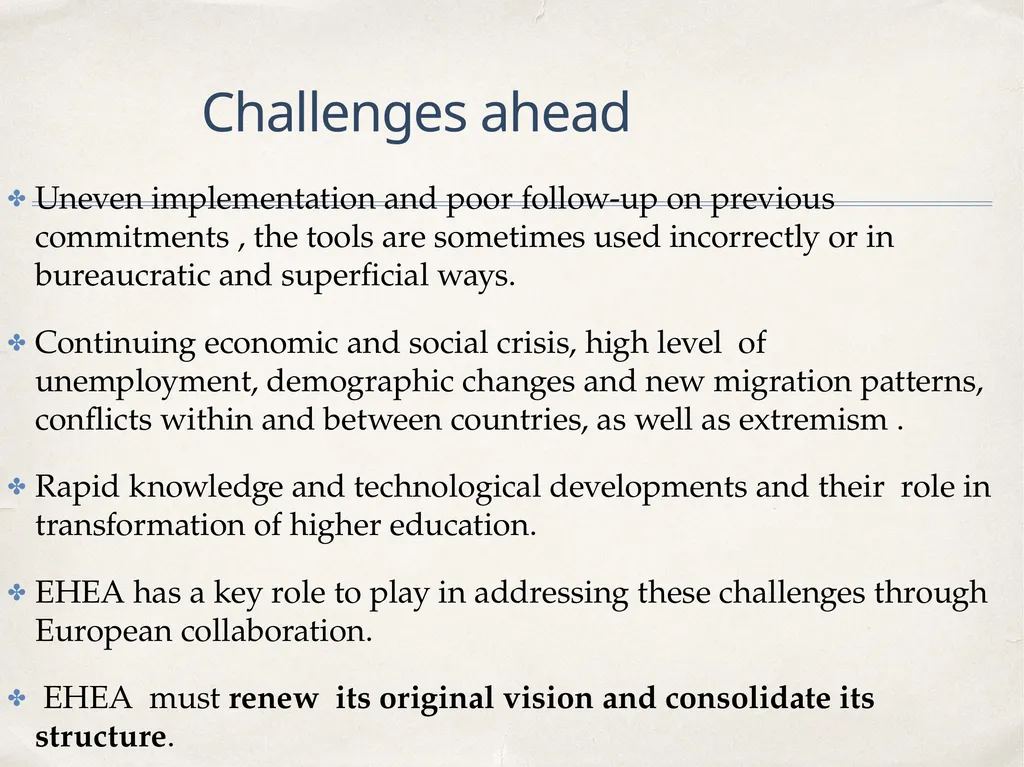
slide4. Challenges ahead Uneven implementation and poor follow-up on previous commitments , the tools are sometimes used incorrectly or in bureaucratic and superficial ways.
Continuing economic and social crisis, high level of unemployment, demographic changes and new migration patterns, conflicts within and between countries, as well as extremism .
Rapid knowledge and technological developments and their role in transformation of higher education.
EHEA has a key role to play in addressing these challenges through European collaboration.
EHEA must renew its original vision and consolidate its structure.<br>
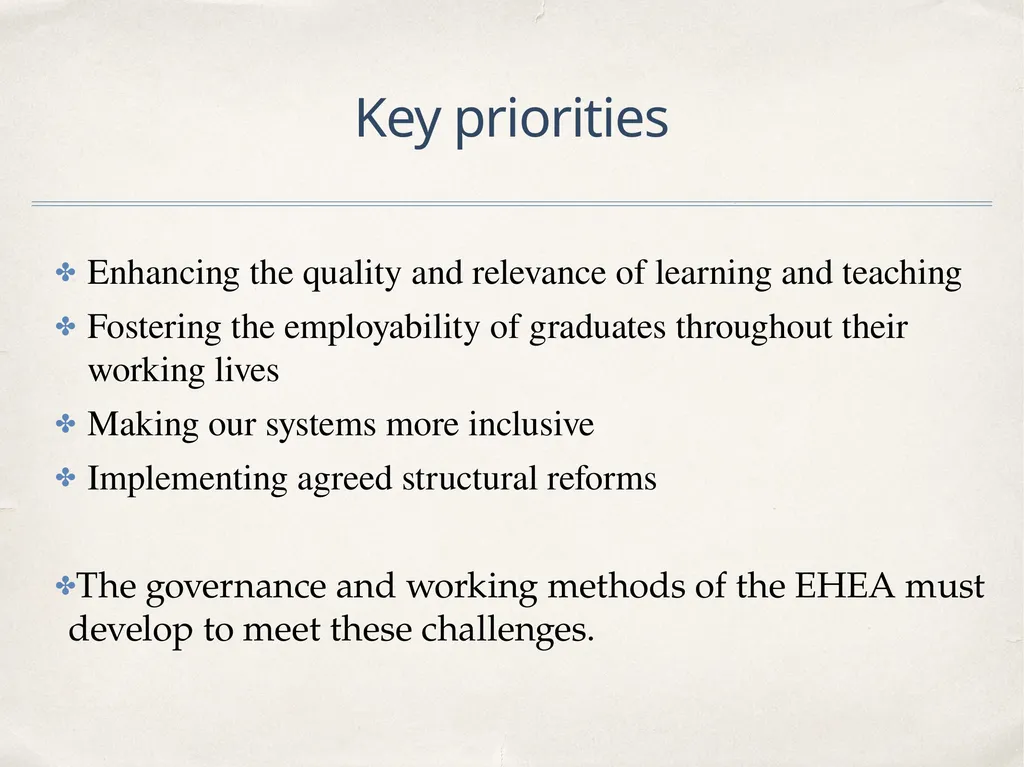
slide5. Key priorities Enhancing the quality and relevance of learning and teaching
Fostering the employability of graduates throughout their working lives
Making our systems more inclusive
Implementing agreed structural reforms
The governance and working methods of the EHEA must develop to meet these challenges.<br>
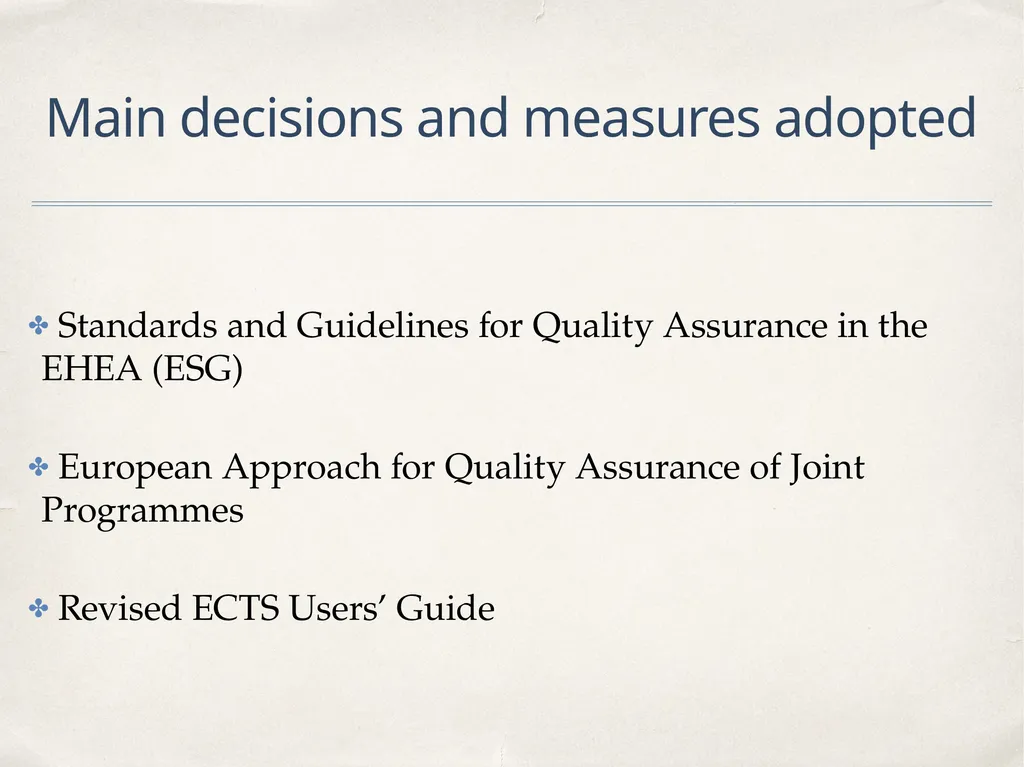
slide6. Main decisions and measures adopted Standards and Guidelines for Quality Assurance in the EHEA (ESG)
European Approach for Quality Assurance of Joint Programmes
Revised ECTS Users’ Guide<br>
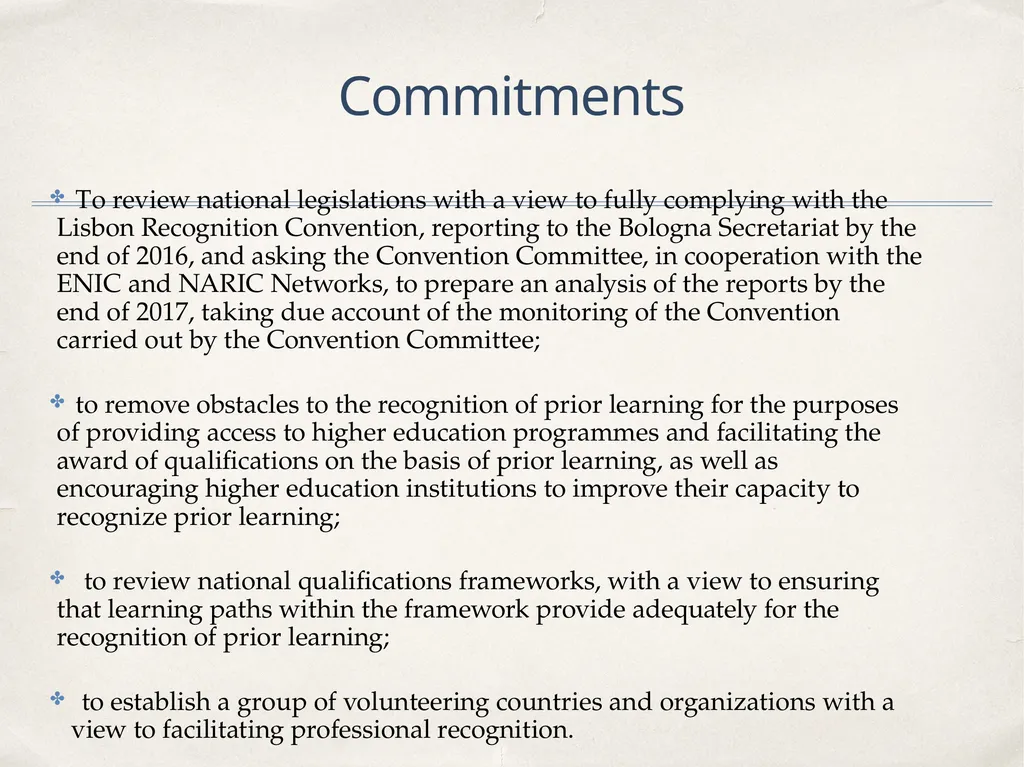
slide7. Commitments To review national legislations with a view to fully complying with the Lisbon Recognition Convention, reporting to the Bologna Secretariat by the end of 2016, and asking the Convention Committee, in cooperation with the ENIC and NARIC Networks, to prepare an analysis of the reports by the end of 2017, taking due account of the monitoring of the Convention carried out by the Convention Committee;
to remove obstacles to the recognition of prior learning for the purposes of providing access to higher education programmes and facilitating the award of qualifications on the basis of prior learning, as well as encouraging higher education institutions to improve their capacity to recognize prior learning;
to review national qualifications frameworks, with a view to ensuring that learning paths within the framework provide adequately for the recognition of prior learning;
to establish a group of volunteering countries and organizations with a view to facilitating professional recognition.<br>
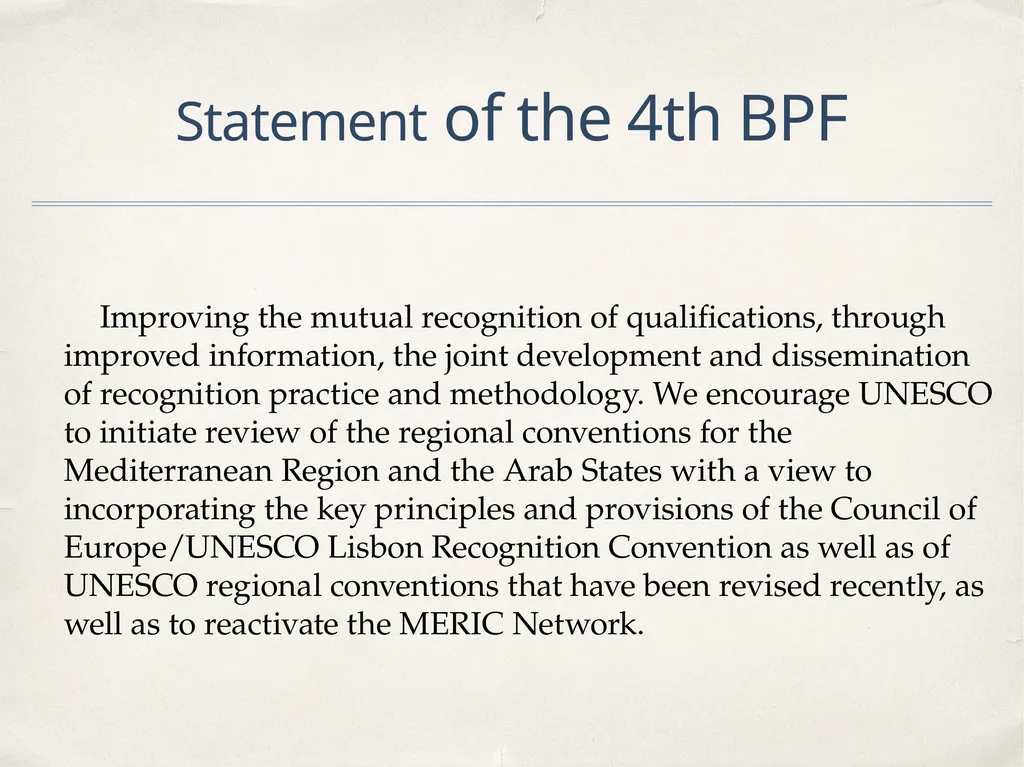
slide8. Statement of the 4th BPF Improving the mutual recognition of qualifications, through improved information, the joint development and dissemination of recognition practice and methodology. We encourage UNESCO to initiate review of the regional conventions for the Mediterranean Region and the Arab States with a view to incorporating the key principles and provisions of the Council of Europe/UNESCO Lisbon Recognition Convention as well as of UNESCO regional conventions that have been revised recently, as well as to reactivate the MERIC Network.<br>
slide9. Thank you.<br>
7 June 2015 Shaping our future: higher education helping create the society we want Gayane Harutyunyan<br>
slide2. Main documents Yerevan Communiqué
Statement of the Fourth Bologna Policy Forum
Belarus - new EHEA member, accompanied with a roadmap.<br>
slide3. Main achievements Bologna process remains relevant to the EHEA countries and their national goals.
EHEA is a successful model of shared goals and commitments based on the principles of academic freedom, institutional autonomy and public responsibility for HE. Common understanding of principles and process as wells common tools.
Enabled greater student and graduate mobility within EHEA, more cooperation in joint teaching and research
EHEA opened a policy dialogue with other regions of the world.<br>
slide4. Challenges ahead Uneven implementation and poor follow-up on previous commitments , the tools are sometimes used incorrectly or in bureaucratic and superficial ways.
Continuing economic and social crisis, high level of unemployment, demographic changes and new migration patterns, conflicts within and between countries, as well as extremism .
Rapid knowledge and technological developments and their role in transformation of higher education.
EHEA has a key role to play in addressing these challenges through European collaboration.
EHEA must renew its original vision and consolidate its structure.<br>
slide5. Key priorities Enhancing the quality and relevance of learning and teaching
Fostering the employability of graduates throughout their working lives
Making our systems more inclusive
Implementing agreed structural reforms
The governance and working methods of the EHEA must develop to meet these challenges.<br>
slide6. Main decisions and measures adopted Standards and Guidelines for Quality Assurance in the EHEA (ESG)
European Approach for Quality Assurance of Joint Programmes
Revised ECTS Users’ Guide<br>
slide7. Commitments To review national legislations with a view to fully complying with the Lisbon Recognition Convention, reporting to the Bologna Secretariat by the end of 2016, and asking the Convention Committee, in cooperation with the ENIC and NARIC Networks, to prepare an analysis of the reports by the end of 2017, taking due account of the monitoring of the Convention carried out by the Convention Committee;
to remove obstacles to the recognition of prior learning for the purposes of providing access to higher education programmes and facilitating the award of qualifications on the basis of prior learning, as well as encouraging higher education institutions to improve their capacity to recognize prior learning;
to review national qualifications frameworks, with a view to ensuring that learning paths within the framework provide adequately for the recognition of prior learning;
to establish a group of volunteering countries and organizations with a view to facilitating professional recognition.<br>
slide8. Statement of the 4th BPF Improving the mutual recognition of qualifications, through improved information, the joint development and dissemination of recognition practice and methodology. We encourage UNESCO to initiate review of the regional conventions for the Mediterranean Region and the Arab States with a view to incorporating the key principles and provisions of the Council of Europe/UNESCO Lisbon Recognition Convention as well as of UNESCO regional conventions that have been revised recently, as well as to reactivate the MERIC Network.<br>
slide9. Thank you.<br>